
Detecting nanoparticles in the Cosmos PAH

Description: Detecting nanoparticles in the Cosmos PAH evolution along the stellar lifecycle. Check marks indicate the importance of PAH formation andor destruction during each stage and if NIR emission from PAHs with deuterium and nitrogen containing
Related Topics
Download Presentation
"Detecting nanoparticles in the Cosmos PAH" is the property of its rightful owner. Permission is granted to download and print the materials on this website for personal, non-commercial use only, and to display it on your personal computer provided you do not modify the materials and that you retain all copyright notices contained in the materials. By downloading content from our website, you accept the terms of this agreement.
Presentation Transcript
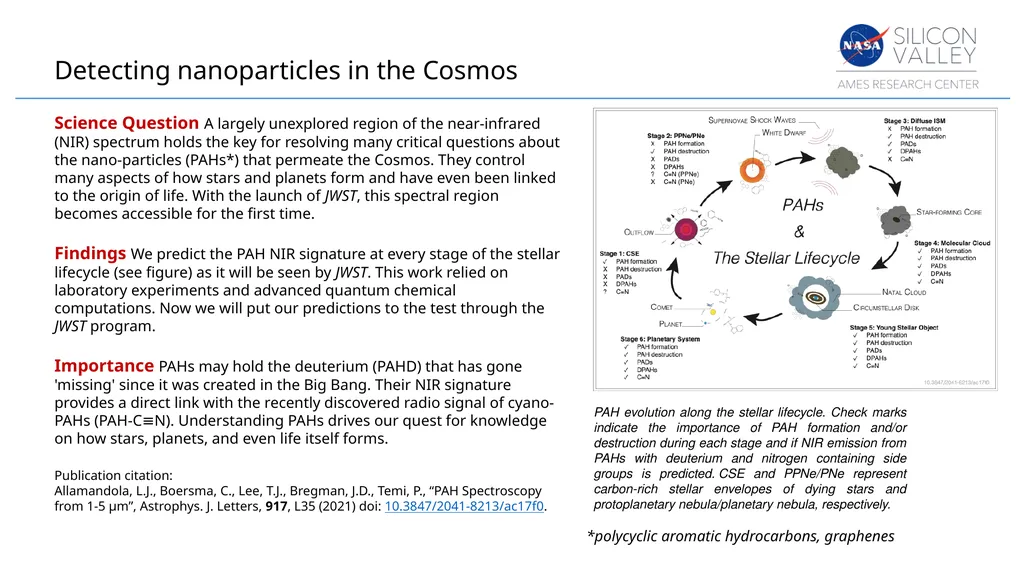
slide1. Detecting nanoparticles in the Cosmos PAH evolution along the stellar lifecycle. Check marks indicate the importance of PAH formation and/or destruction during each stage and if NIR emission from PAHs with deuterium and nitrogen containing side groups is predicted. CSE and PPNe/PNe represent carbon-rich stellar envelopes of dying stars and protoplanetary nebula/planetary nebula, respectively. Science Question A largely unexplored region of the near-infrared (NIR) spectrum holds the key for resolving many critical questions about the nano-particles (PAHs*) that permeate the Cosmos. They control many aspects of how stars and planets form and have even been linked to the origin of life. With the launch of JWST, this spectral region becomes accessible for the first time.
Findings We predict the PAH NIR signature at every stage of the stellar lifecycle (see figure) as it will be seen by JWST. This work relied on laboratory experiments and advanced quantum chemical computations. Now we will put our predictions to the test through the JWST program.
Importance PAHs may hold the deuterium (PAHD) that has gone 'missing' since it was created in the Big Bang. Their NIR signature provides a direct link with the recently discovered radio signal of cyano-PAHs (PAH-C≡N). Understanding PAHs drives our quest for knowledge on how stars, planets, and even life itself forms.
Publication citation:
Allamandola, L.J., Boersma, C., Lee, T.J., Bregman, J.D., Temi, P., “PAH Spectroscopy from 1-5 µm”, Astrophys. J. Letters, 917, L35 (2021) doi: 10.3847/2041-8213/ac17f0. *polycyclic aromatic hydrocarbons, graphenes<br>
slide2. The James Webb Space Telescope:
PAHs, Deuterated PAHs and Cyano-PAHs* Background A largely unexplored region of the near-infrared (NIR) spectrum holds the key for resolving many critical questions about the nano-particles (PAHs*) that permeate the Cosmos. They control many aspects of how stars and planets form, and have even been linked to the origin of life. With the launch of JWST, this spectral region becomes accessible for the first time.
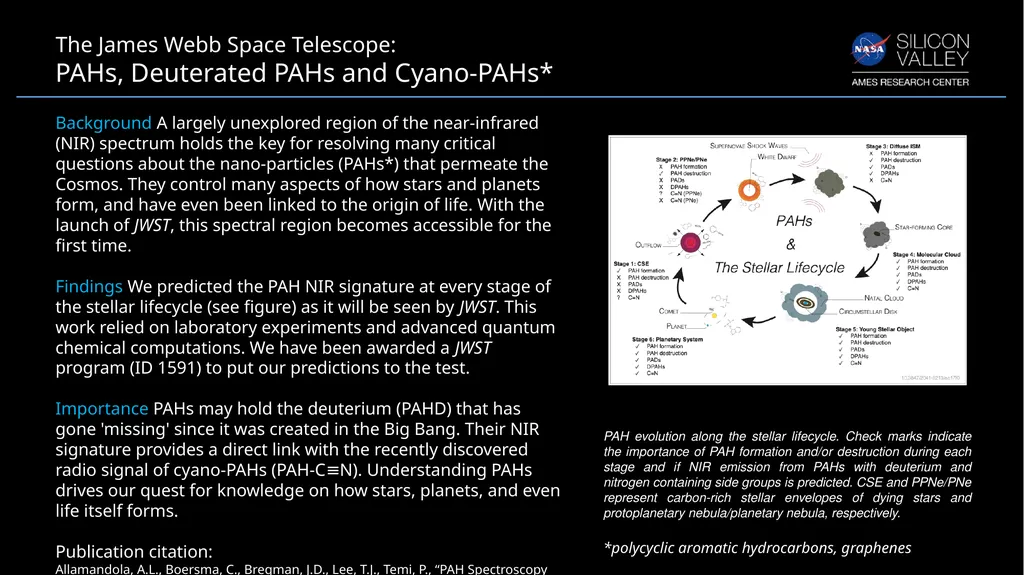
Findings We predicted the PAH NIR signature at every stage of the stellar lifecycle (see figure) as it will be seen by JWST. This work relied on laboratory experiments and advanced quantum chemical computations. We have been awarded a JWST program (ID 1591) to put our predictions to the test.
Importance PAHs may hold the deuterium (PAHD) that has gone 'missing' since it was created in the Big Bang. Their NIR signature provides a direct link with the recently discovered radio signal of cyano-PAHs (PAH-C≡N). Understanding PAHs drives our quest for knowledge on how stars, planets, and even life itself forms.
Publication citation:
Allamandola, A.L., Boersma, C., Bregman, J.D., Lee, T.J., Temi, P., “PAH Spectroscopy from 1-5 µm”, Astrophys. J. Letters, 917, L35 (2021) doi: 10.3847/2041-8213/ac17f0. *polycyclic aromatic hydrocarbons, graphenes PAH evolution along the stellar lifecycle. Check marks indicate the importance of PAH formation and/or destruction during each stage and if NIR emission from PAHs with deuterium and nitrogen containing side groups is predicted. CSE and PPNe/PNe represent carbon-rich stellar envelopes of dying stars and protoplanetary nebula/planetary nebula, respectively.<br>
Findings We predict the PAH NIR signature at every stage of the stellar lifecycle (see figure) as it will be seen by JWST. This work relied on laboratory experiments and advanced quantum chemical computations. Now we will put our predictions to the test through the JWST program.
Importance PAHs may hold the deuterium (PAHD) that has gone 'missing' since it was created in the Big Bang. Their NIR signature provides a direct link with the recently discovered radio signal of cyano-PAHs (PAH-C≡N). Understanding PAHs drives our quest for knowledge on how stars, planets, and even life itself forms.
Publication citation:
Allamandola, L.J., Boersma, C., Lee, T.J., Bregman, J.D., Temi, P., “PAH Spectroscopy from 1-5 µm”, Astrophys. J. Letters, 917, L35 (2021) doi: 10.3847/2041-8213/ac17f0. *polycyclic aromatic hydrocarbons, graphenes<br>
slide2. The James Webb Space Telescope:
PAHs, Deuterated PAHs and Cyano-PAHs* Background A largely unexplored region of the near-infrared (NIR) spectrum holds the key for resolving many critical questions about the nano-particles (PAHs*) that permeate the Cosmos. They control many aspects of how stars and planets form, and have even been linked to the origin of life. With the launch of JWST, this spectral region becomes accessible for the first time.
Findings We predicted the PAH NIR signature at every stage of the stellar lifecycle (see figure) as it will be seen by JWST. This work relied on laboratory experiments and advanced quantum chemical computations. We have been awarded a JWST program (ID 1591) to put our predictions to the test.
Importance PAHs may hold the deuterium (PAHD) that has gone 'missing' since it was created in the Big Bang. Their NIR signature provides a direct link with the recently discovered radio signal of cyano-PAHs (PAH-C≡N). Understanding PAHs drives our quest for knowledge on how stars, planets, and even life itself forms.
Publication citation:
Allamandola, A.L., Boersma, C., Bregman, J.D., Lee, T.J., Temi, P., “PAH Spectroscopy from 1-5 µm”, Astrophys. J. Letters, 917, L35 (2021) doi: 10.3847/2041-8213/ac17f0. *polycyclic aromatic hydrocarbons, graphenes PAH evolution along the stellar lifecycle. Check marks indicate the importance of PAH formation and/or destruction during each stage and if NIR emission from PAHs with deuterium and nitrogen containing side groups is predicted. CSE and PPNe/PNe represent carbon-rich stellar envelopes of dying stars and protoplanetary nebula/planetary nebula, respectively.<br>