
Determining the Expanded Uncertainty of


Description: Determining the Expanded Uncertainty of Three-Component Solar Radiation Measurements Presenter: Aron Habte Stephen Wilcox,1 Tom Stoffel,1 Aron Habte,2 and Manajit Sengupta2 1 Solar Resource Solutions, LLC, Louisville, CO 80401 USA 2
Related Topics
Download Presentation
"Determining the Expanded Uncertainty of" is the property of its rightful owner. Permission is granted to download and print the materials on this website for personal, non-commercial use only, and to display it on your personal computer provided you do not modify the materials and that you retain all copyright notices contained in the materials. By downloading content from our website, you accept the terms of this agreement.
Presentation Transcript
slide1. Determining the Expanded Uncertainty of Three-Component Solar Radiation Measurements Presenter: Aron Habte
Stephen Wilcox,1 Tom Stoffel,1 Aron Habte,2 and Manajit Sengupta2 1 Solar Resource Solutions, LLC, Louisville, CO 80401 USA 2 National Renewable Energy Laboratory, Golden CO 80204 USA 18th WRCP/BSRN Scientific Review and Workshop July 1-5, 2024, Tokyo, Japan<br>
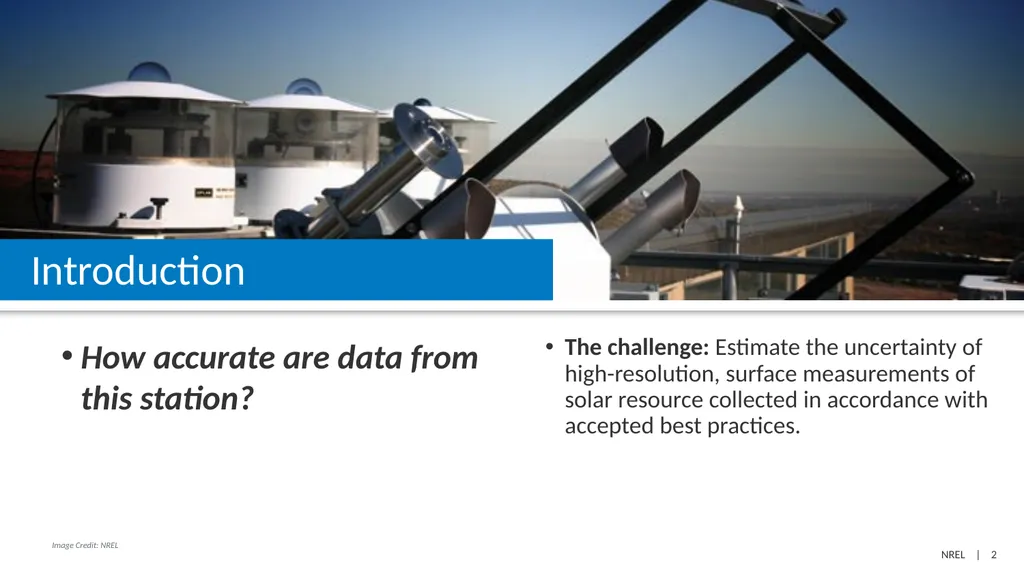
slide2. Introduction How accurate are data from this station? The challenge: Estimate the uncertainty of high-resolution, surface measurements of solar resource collected in accordance with accepted best practices. Image Credit: NREL<br>
slide3. Estimating Uncertainty of Solar Resources Historically, the uncertainty of a data set has frequently been represented by either the manufacturer’s stated instrument uncertainty or the uncertainty assigned by the calibration process.
This approach, fails to acknowledge additional sources of error during field operations that cannot accounted for prior to the measurement. The issues:<br>
slide4. Project Goal Develop an Integrated Solar Resource Uncertainty Software Package that provides a method to assign expanded uncertainty estimates to three-component measured solar radiation data.
The system merges static uncertainty information about radiometer performance with the dynamic operational uncertainty information extracted from data quality assessment.<br>
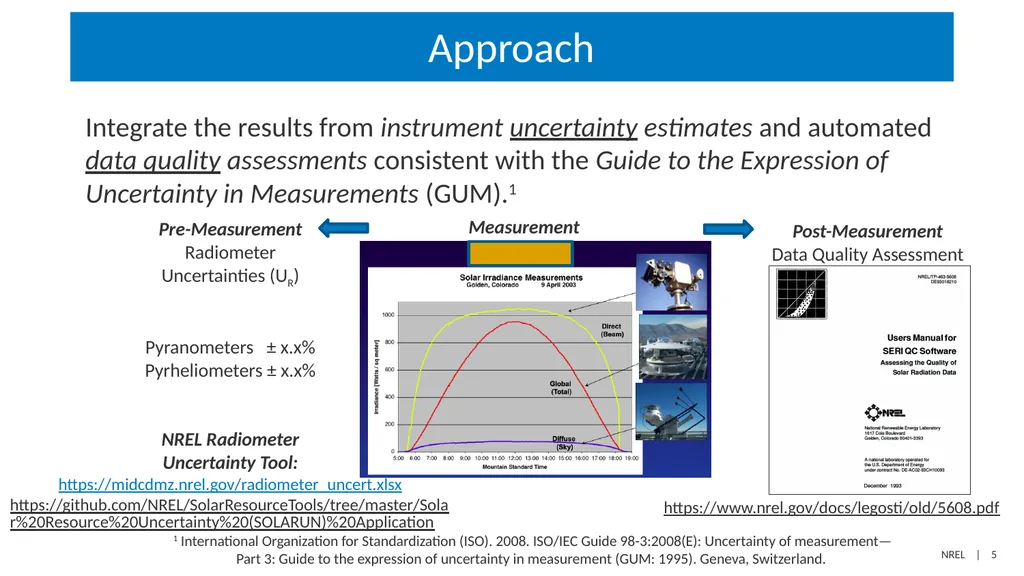
slide5. Approach Integrate the results from instrument uncertainty estimates and automated data quality assessments consistent with the Guide to the Expression of Uncertainty in Measurements (GUM).1 Pre-Measurement
Radiometer
Uncertainties (UR)
Pyranometers ± x.x%
Pyrheliometers ± x.x%
NREL Radiometer
Uncertainty Tool:
https://midcdmz.nrel.gov/radiometer_uncert.xlsx
https://github.com/NREL/SolarResourceTools/tree/master/Solar%20Resource%20Uncertainty%20(SOLARUN)%20Application Post-Measurement
Data Quality Assessment https://www.nrel.gov/docs/legosti/old/5608.pdf 1 International Organization for Standardization (ISO). 2008. ISO/IEC Guide 98-3:2008(E): Uncertainty of measurement—
Part 3: Guide to the expression of uncertainty in measurement (GUM: 1995). Geneva, Switzerland. Measurement<br>
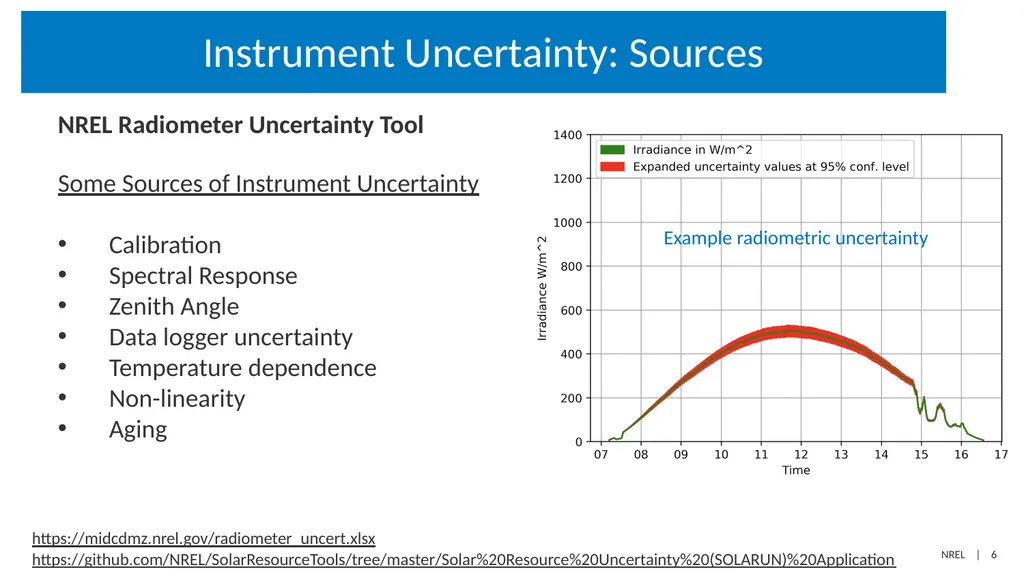
slide6. Instrument Uncertainty: Sources https://midcdmz.nrel.gov/radiometer_uncert.xlsx
https://github.com/NREL/SolarResourceTools/tree/master/Solar%20Resource%20Uncertainty%20(SOLARUN)%20Application Some Sources of Instrument Uncertainty
Calibration
Spectral Response
Zenith Angle
Data logger uncertainty
Temperature dependence
Non-linearity
Aging NREL Radiometer Uncertainty Tool Example radiometric uncertainty<br>
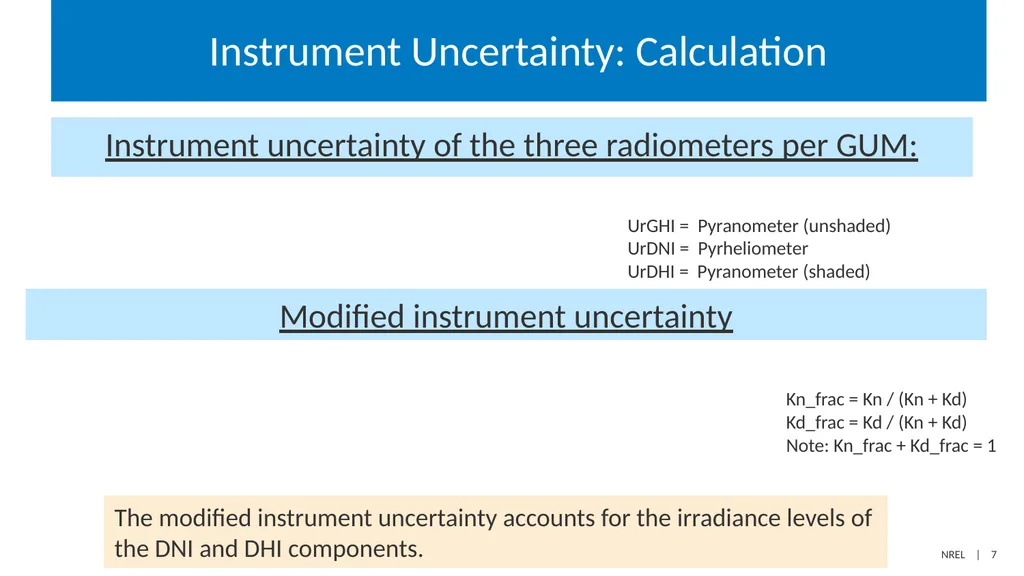
slide7. Instrument Uncertainty: Calculation Instrument uncertainty of the three radiometers per GUM: UrGHI = Pyranometer (unshaded)
UrDNI = Pyrheliometer
UrDHI = Pyranometer (shaded) Modified instrument uncertainty Kn_frac = Kn / (Kn + Kd)
Kd_frac = Kd / (Kn + Kd)
Note: Kn_frac + Kd_frac = 1 The modified instrument uncertainty accounts for the irradiance levels of the DNI and DHI components.<br>
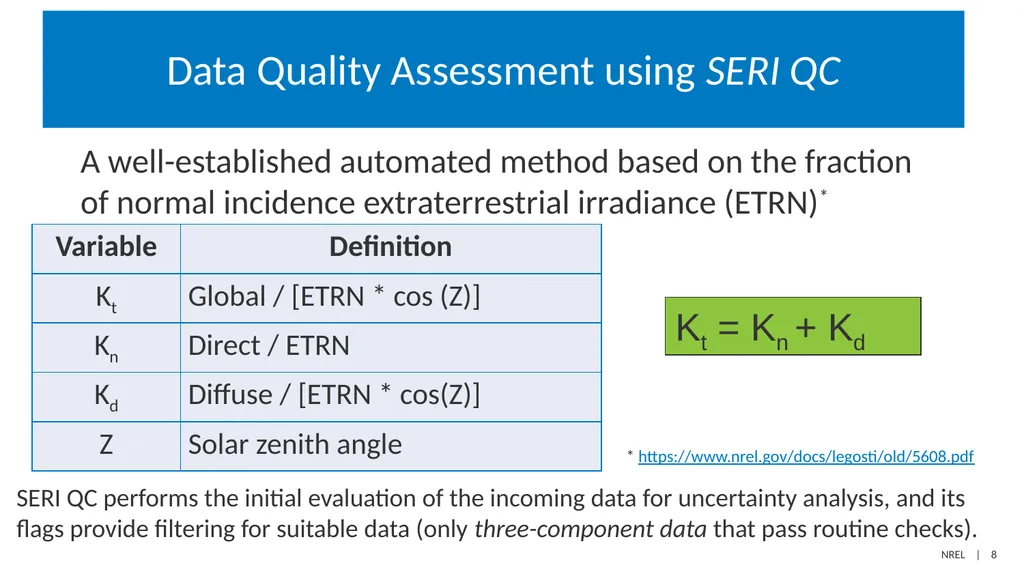
slide8. Data Quality Assessment using SERI QC A well-established automated method based on the fraction of normal incidence extraterrestrial irradiance (ETRN)* Kt = Kn + Kd * https://www.nrel.gov/docs/legosti/old/5608.pdf SERI QC performs the initial evaluation of the incoming data for uncertainty analysis, and its flags provide filtering for suitable data (only three-component data that pass routine checks).<br>
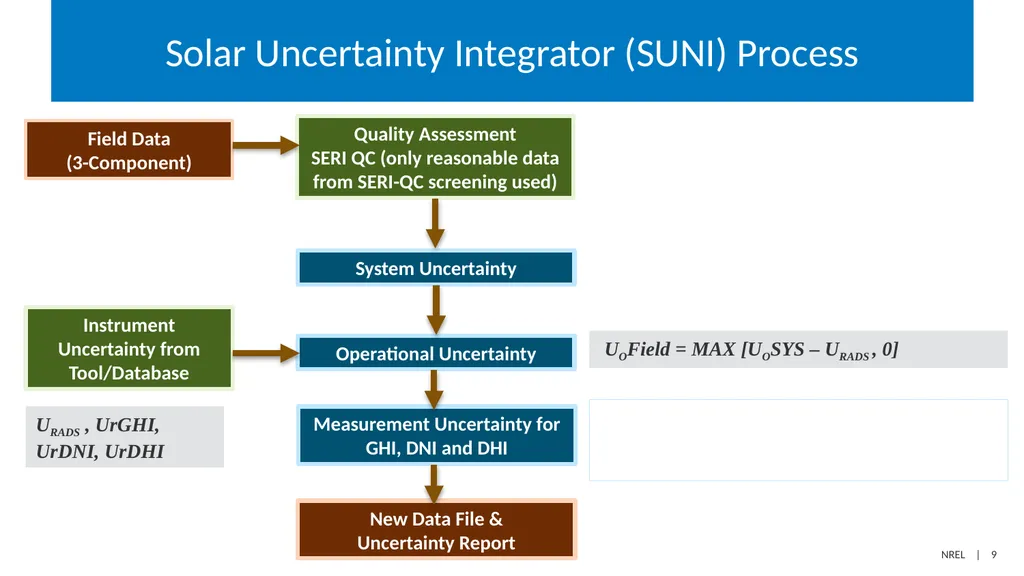
slide9. Solar Uncertainty Integrator (SUNI) Process Field Data
(3-Component) Instrument Uncertainty from Tool/Database Quality Assessment
SERI QC (only reasonable data from SERI-QC screening used) Operational Uncertainty System Uncertainty New Data File &
Uncertainty Report Measurement Uncertainty for GHI, DNI and DHI UOField = MAX [UOSYS – URADS , 0] URADS , UrGHI, UrDNI, UrDHI<br>
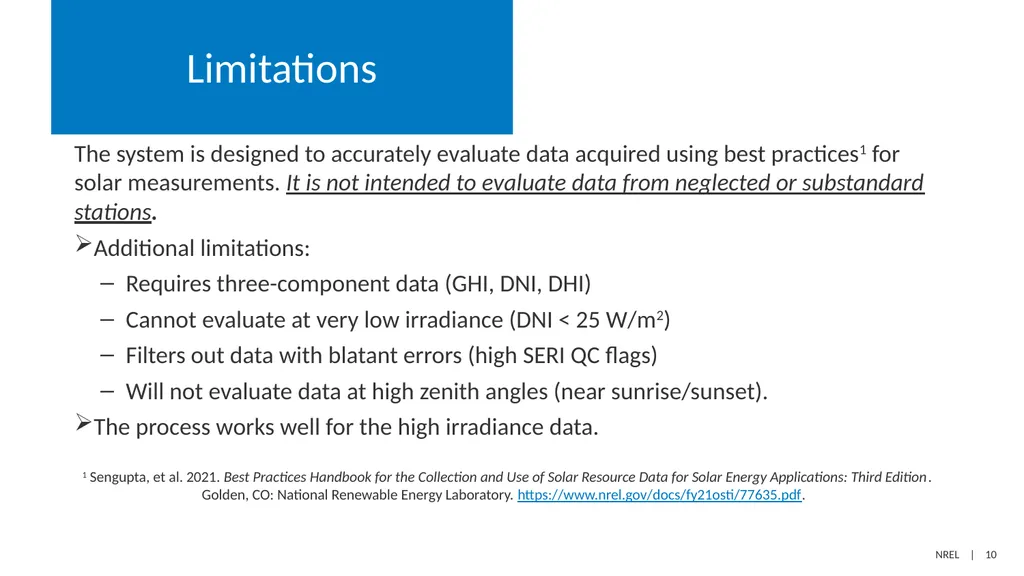
slide10. Limitations The system is designed to accurately evaluate data acquired using best practices1 for solar measurements. It is not intended to evaluate data from neglected or substandard stations.
Additional limitations:
Requires three-component data (GHI, DNI, DHI)
Cannot evaluate at very low irradiance (DNI < 25 W/m2)
Filters out data with blatant errors (high SERI QC flags)
Will not evaluate data at high zenith angles (near sunrise/sunset).
The process works well for the high irradiance data. 1 Sengupta, et al. 2021. Best Practices Handbook for the Collection and Use of Solar Resource Data for Solar Energy Applications: Third Edition.
Golden, CO: National Renewable Energy Laboratory. https://www.nrel.gov/docs/fy21osti/77635.pdf.<br>
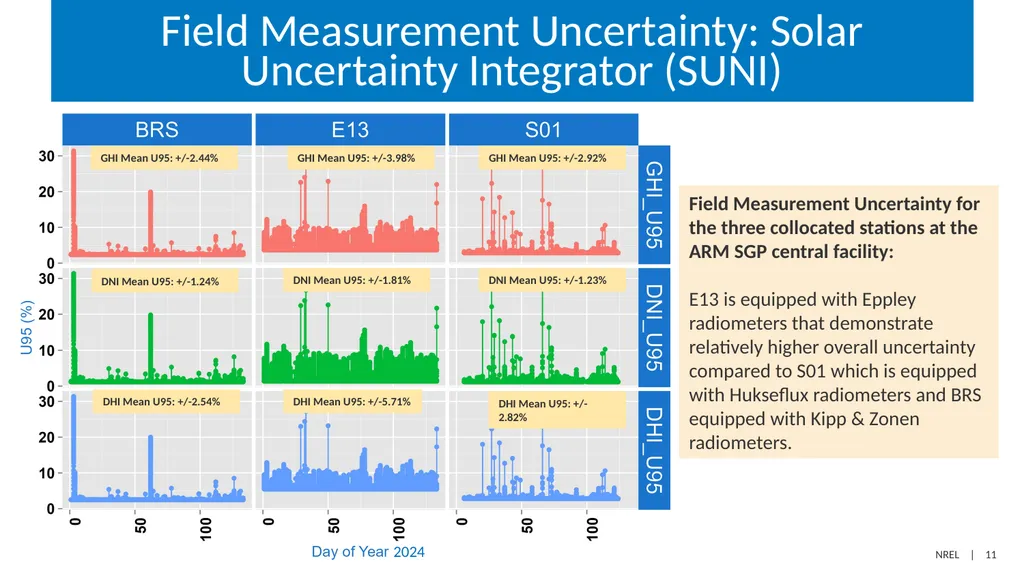
slide11. Field Measurement Uncertainty: Solar Uncertainty Integrator (SUNI) Field Measurement Uncertainty for the three collocated stations at the ARM SGP central facility:
E13 is equipped with Eppley radiometers that demonstrate relatively higher overall uncertainty compared to S01 which is equipped with Hukseflux radiometers and BRS equipped with Kipp & Zonen radiometers. GHI Mean U95: +/-3.98% DNI Mean U95: +/-1.81% DHI Mean U95: +/-5.71% GHI Mean U95: +/-2.44% DNI Mean U95: +/-1.24% DHI Mean U95: +/-2.54% GHI Mean U95: +/-2.92% DNI Mean U95: +/-1.23% DHI Mean U95: +/-2.82% 2024<br>
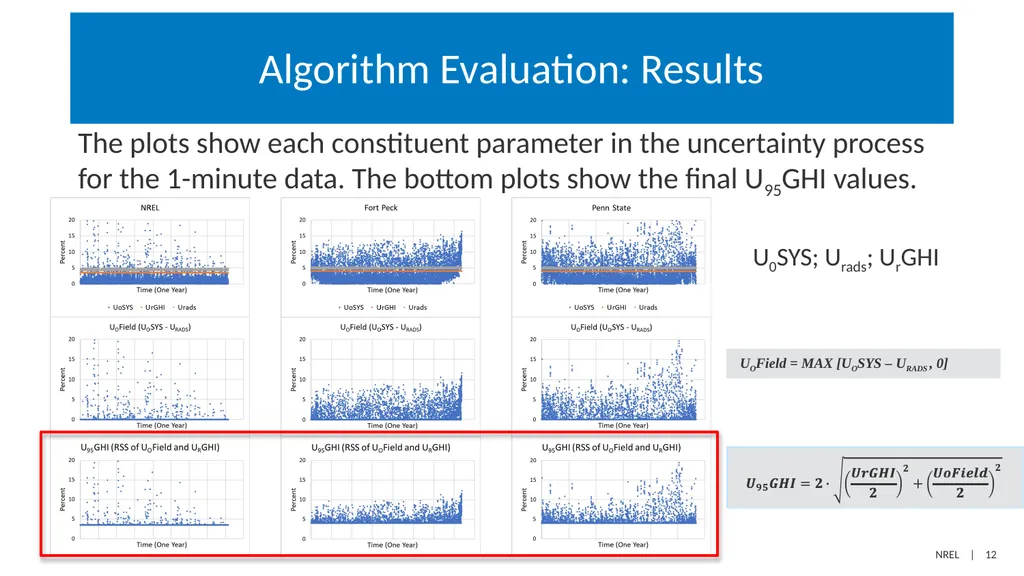
slide12. Algorithm Evaluation: Results The plots show each constituent parameter in the uncertainty process for the 1-minute data. The bottom plots show the final U95GHI values. U0SYS; Urads; UrGHI UOField = MAX [UOSYS – URADS , 0]<br>
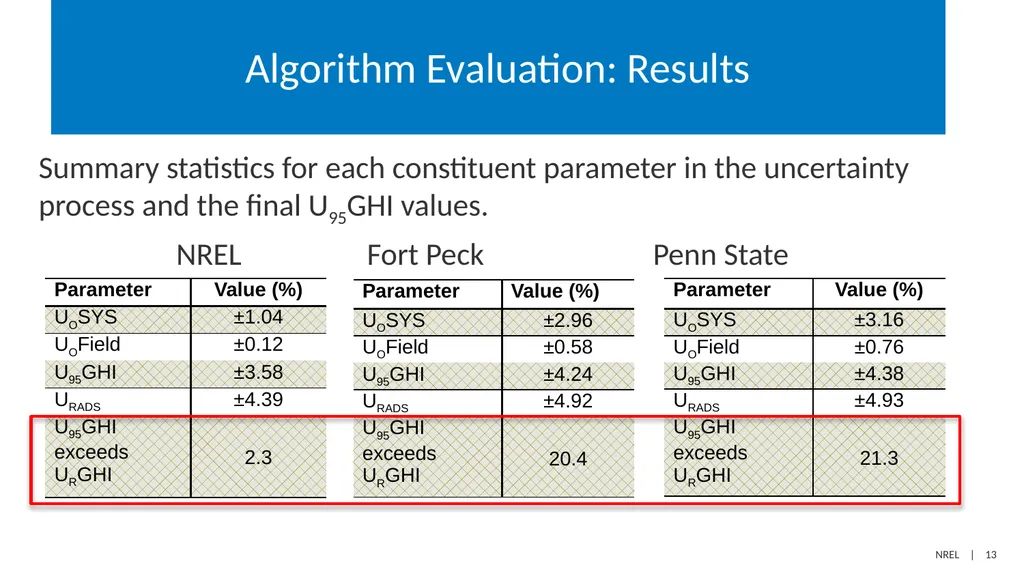
slide13. Algorithm Evaluation: Results Summary statistics for each constituent parameter in the uncertainty process and the final U95GHI values.
NREL Fort Peck Penn State<br>
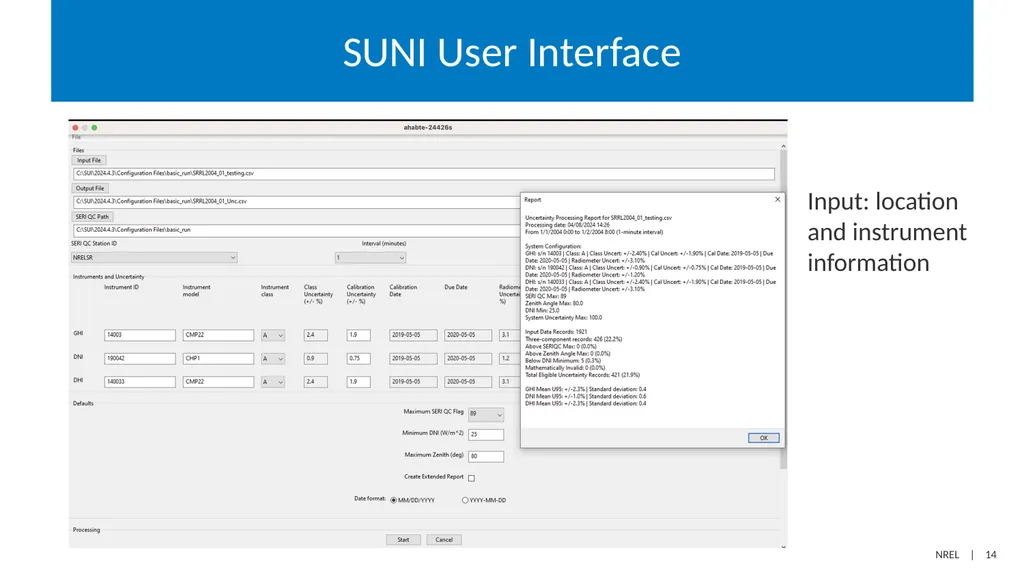
slide14. SUNI User Interface Input: location and instrument information<br>
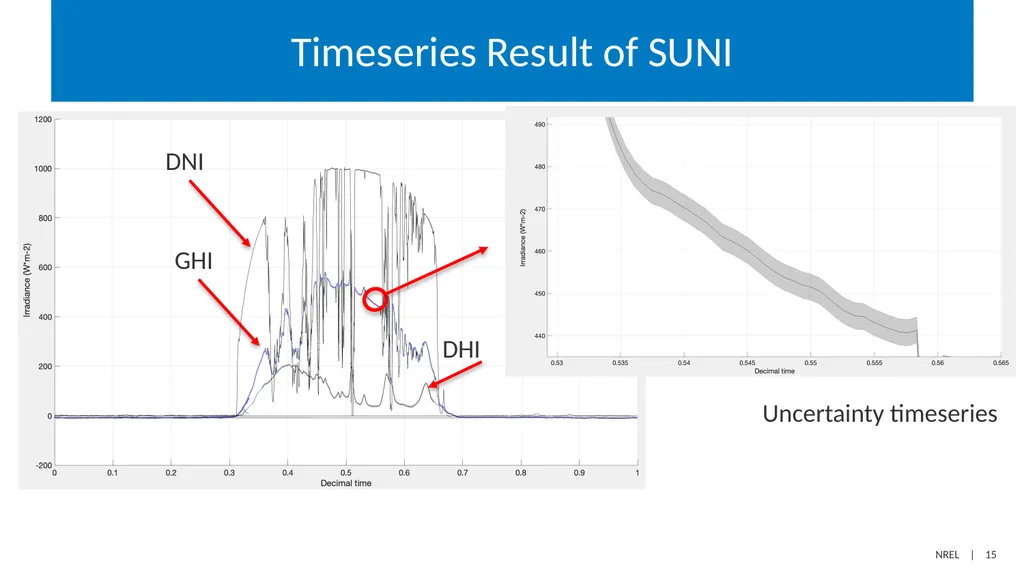
slide15. Timeseries Result of SUNI Uncertainty timeseries<br>
slide16. Conclusions A new algorithm has been developed to assess the uncertainty of three-component solar irradiance measurements consistent with GUM.
The method estimates operational Uncertainties based on SERI QC, an existing data quality assessment tool.
It uses static radiometer (instrument) uncertainties and an operational uncertainty derived from field data to determine the overall uncertainty of data used for PV.
The method has been evaluated using 1-minute solar irradiance measurements according to accepted best practices.
After further testing, the resulting software package will be based on the new algorithm and made publicly available.<br>
slide17. We are looking for Beta Testers. Thank You! This work was authored by the National Renewable Energy Laboratory, operated by Alliance for Sustainable Energy, LLC, for the U.S. Department of Energy (DOE) under Contract No. DE-AC36-08GO28308. Funding provided by U.S. Department of Energy Office of Energy Efficiency and Renewable Energy Solar Energy Technologies Office. The views expressed in the article do not necessarily represent the views of the DOE or the U.S. Government. The U.S. Government retains and the publisher, by accepting the article for publication, acknowledges that the U.S. Government retains a nonexclusive, paid-up, irrevocable, worldwide license to publish or reproduce the published form of this work, or allow others to do so, for U.S. Government purposes.<br>
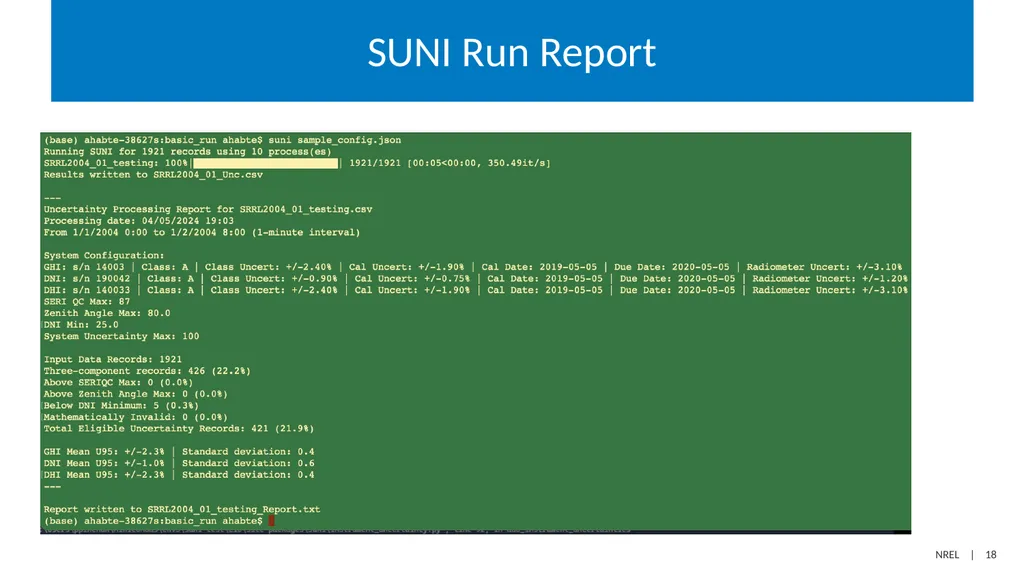
slide18. SUNI Run Report<br>
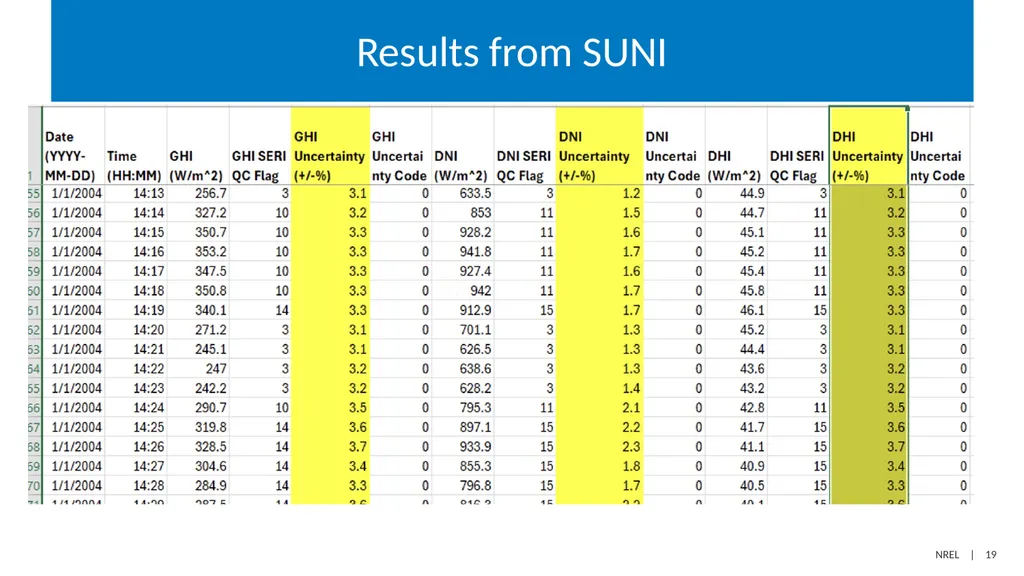
slide19. Results from SUNI<br>
Stephen Wilcox,1 Tom Stoffel,1 Aron Habte,2 and Manajit Sengupta2 1 Solar Resource Solutions, LLC, Louisville, CO 80401 USA 2 National Renewable Energy Laboratory, Golden CO 80204 USA 18th WRCP/BSRN Scientific Review and Workshop July 1-5, 2024, Tokyo, Japan<br>
slide2. Introduction How accurate are data from this station? The challenge: Estimate the uncertainty of high-resolution, surface measurements of solar resource collected in accordance with accepted best practices. Image Credit: NREL<br>
slide3. Estimating Uncertainty of Solar Resources Historically, the uncertainty of a data set has frequently been represented by either the manufacturer’s stated instrument uncertainty or the uncertainty assigned by the calibration process.
This approach, fails to acknowledge additional sources of error during field operations that cannot accounted for prior to the measurement. The issues:<br>
slide4. Project Goal Develop an Integrated Solar Resource Uncertainty Software Package that provides a method to assign expanded uncertainty estimates to three-component measured solar radiation data.
The system merges static uncertainty information about radiometer performance with the dynamic operational uncertainty information extracted from data quality assessment.<br>
slide5. Approach Integrate the results from instrument uncertainty estimates and automated data quality assessments consistent with the Guide to the Expression of Uncertainty in Measurements (GUM).1 Pre-Measurement
Radiometer
Uncertainties (UR)
Pyranometers ± x.x%
Pyrheliometers ± x.x%
NREL Radiometer
Uncertainty Tool:
https://midcdmz.nrel.gov/radiometer_uncert.xlsx
https://github.com/NREL/SolarResourceTools/tree/master/Solar%20Resource%20Uncertainty%20(SOLARUN)%20Application Post-Measurement
Data Quality Assessment https://www.nrel.gov/docs/legosti/old/5608.pdf 1 International Organization for Standardization (ISO). 2008. ISO/IEC Guide 98-3:2008(E): Uncertainty of measurement—
Part 3: Guide to the expression of uncertainty in measurement (GUM: 1995). Geneva, Switzerland. Measurement<br>
slide6. Instrument Uncertainty: Sources https://midcdmz.nrel.gov/radiometer_uncert.xlsx
https://github.com/NREL/SolarResourceTools/tree/master/Solar%20Resource%20Uncertainty%20(SOLARUN)%20Application Some Sources of Instrument Uncertainty
Calibration
Spectral Response
Zenith Angle
Data logger uncertainty
Temperature dependence
Non-linearity
Aging NREL Radiometer Uncertainty Tool Example radiometric uncertainty<br>
slide7. Instrument Uncertainty: Calculation Instrument uncertainty of the three radiometers per GUM: UrGHI = Pyranometer (unshaded)
UrDNI = Pyrheliometer
UrDHI = Pyranometer (shaded) Modified instrument uncertainty Kn_frac = Kn / (Kn + Kd)
Kd_frac = Kd / (Kn + Kd)
Note: Kn_frac + Kd_frac = 1 The modified instrument uncertainty accounts for the irradiance levels of the DNI and DHI components.<br>
slide8. Data Quality Assessment using SERI QC A well-established automated method based on the fraction of normal incidence extraterrestrial irradiance (ETRN)* Kt = Kn + Kd * https://www.nrel.gov/docs/legosti/old/5608.pdf SERI QC performs the initial evaluation of the incoming data for uncertainty analysis, and its flags provide filtering for suitable data (only three-component data that pass routine checks).<br>
slide9. Solar Uncertainty Integrator (SUNI) Process Field Data
(3-Component) Instrument Uncertainty from Tool/Database Quality Assessment
SERI QC (only reasonable data from SERI-QC screening used) Operational Uncertainty System Uncertainty New Data File &
Uncertainty Report Measurement Uncertainty for GHI, DNI and DHI UOField = MAX [UOSYS – URADS , 0] URADS , UrGHI, UrDNI, UrDHI<br>
slide10. Limitations The system is designed to accurately evaluate data acquired using best practices1 for solar measurements. It is not intended to evaluate data from neglected or substandard stations.
Additional limitations:
Requires three-component data (GHI, DNI, DHI)
Cannot evaluate at very low irradiance (DNI < 25 W/m2)
Filters out data with blatant errors (high SERI QC flags)
Will not evaluate data at high zenith angles (near sunrise/sunset).
The process works well for the high irradiance data. 1 Sengupta, et al. 2021. Best Practices Handbook for the Collection and Use of Solar Resource Data for Solar Energy Applications: Third Edition.
Golden, CO: National Renewable Energy Laboratory. https://www.nrel.gov/docs/fy21osti/77635.pdf.<br>
slide11. Field Measurement Uncertainty: Solar Uncertainty Integrator (SUNI) Field Measurement Uncertainty for the three collocated stations at the ARM SGP central facility:
E13 is equipped with Eppley radiometers that demonstrate relatively higher overall uncertainty compared to S01 which is equipped with Hukseflux radiometers and BRS equipped with Kipp & Zonen radiometers. GHI Mean U95: +/-3.98% DNI Mean U95: +/-1.81% DHI Mean U95: +/-5.71% GHI Mean U95: +/-2.44% DNI Mean U95: +/-1.24% DHI Mean U95: +/-2.54% GHI Mean U95: +/-2.92% DNI Mean U95: +/-1.23% DHI Mean U95: +/-2.82% 2024<br>
slide12. Algorithm Evaluation: Results The plots show each constituent parameter in the uncertainty process for the 1-minute data. The bottom plots show the final U95GHI values. U0SYS; Urads; UrGHI UOField = MAX [UOSYS – URADS , 0]<br>
slide13. Algorithm Evaluation: Results Summary statistics for each constituent parameter in the uncertainty process and the final U95GHI values.
NREL Fort Peck Penn State<br>
slide14. SUNI User Interface Input: location and instrument information<br>
slide15. Timeseries Result of SUNI Uncertainty timeseries<br>
slide16. Conclusions A new algorithm has been developed to assess the uncertainty of three-component solar irradiance measurements consistent with GUM.
The method estimates operational Uncertainties based on SERI QC, an existing data quality assessment tool.
It uses static radiometer (instrument) uncertainties and an operational uncertainty derived from field data to determine the overall uncertainty of data used for PV.
The method has been evaluated using 1-minute solar irradiance measurements according to accepted best practices.
After further testing, the resulting software package will be based on the new algorithm and made publicly available.<br>
slide17. We are looking for Beta Testers. Thank You! This work was authored by the National Renewable Energy Laboratory, operated by Alliance for Sustainable Energy, LLC, for the U.S. Department of Energy (DOE) under Contract No. DE-AC36-08GO28308. Funding provided by U.S. Department of Energy Office of Energy Efficiency and Renewable Energy Solar Energy Technologies Office. The views expressed in the article do not necessarily represent the views of the DOE or the U.S. Government. The U.S. Government retains and the publisher, by accepting the article for publication, acknowledges that the U.S. Government retains a nonexclusive, paid-up, irrevocable, worldwide license to publish or reproduce the published form of this work, or allow others to do so, for U.S. Government purposes.<br>
slide18. SUNI Run Report<br>
slide19. Results from SUNI<br>