
Developed by Prof. Alexei Lapkin, University of
CP
Published · 21 slides · 0 views

1 / 1
Description
Developed by Prof. Alexei Lapkin, University of Cambridge, Dr. Martyn Jones, The University of Manchester, Dr. Dana Kralisch, University of Jena. January 2016. Stage-and-Gate in Research Projects Content and learning objectives: This module
Related Topics
Share
Embed code
Download this presentation From Below
"Developed by Prof. Alexei Lapkin, University of" is the property of its rightful owner. Permission is granted to download and print the materials on this website for personal, non-commercial use only, and to display it on your personal computer provided you do not modify the materials and that you retain all copyright notices contained in the materials. By downloading content from our website, you accept the terms of this agreement.
Presentation Transcript
01
Developed by Prof. Alexei Lapkin, University of Cambridge, Dr. Martyn Jones, The University of Manchester, Dr. Dana Kralisch, University of Jena. January 2016. Stage-and-Gate in Research Projects<br>
02
Content and learning objectives:
This module introduces stage-and-gate as a decision support framework for academic and academic-industrial collaborative research projects. The concept is largely based on industrial framework of stage-and-gate processes, but has been adapted by the authors and trialed in a number of collaborative R&D projects. About this module<br>
This module introduces stage-and-gate as a decision support framework for academic and academic-industrial collaborative research projects. The concept is largely based on industrial framework of stage-and-gate processes, but has been adapted by the authors and trialed in a number of collaborative R&D projects. About this module<br>
03
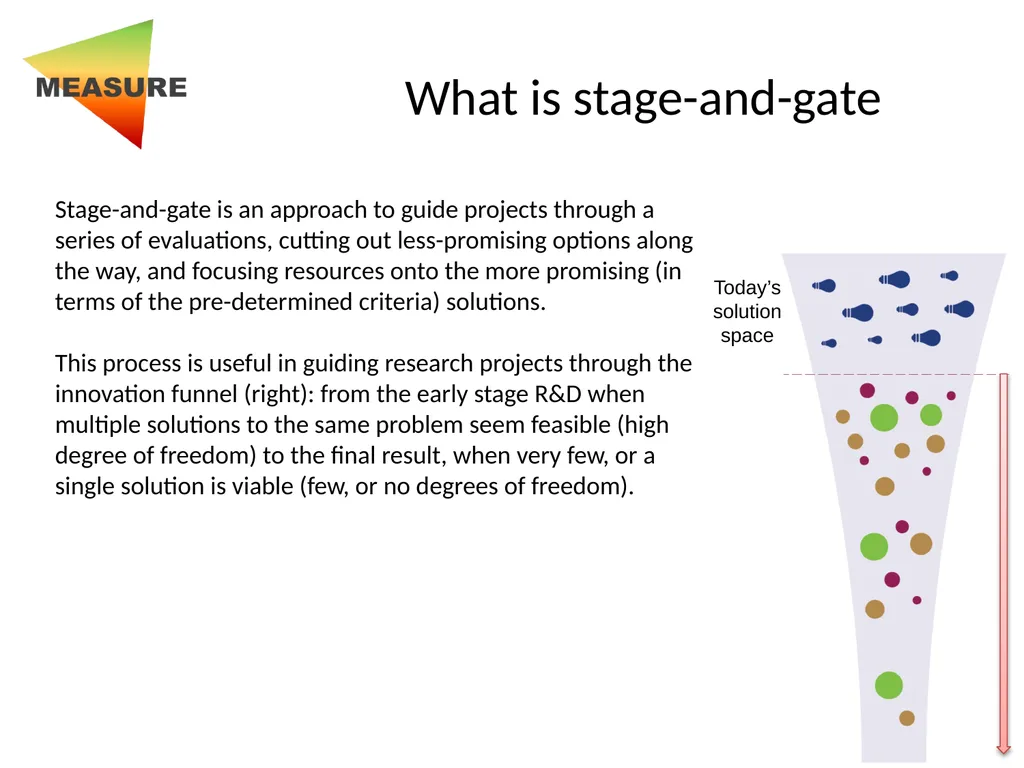
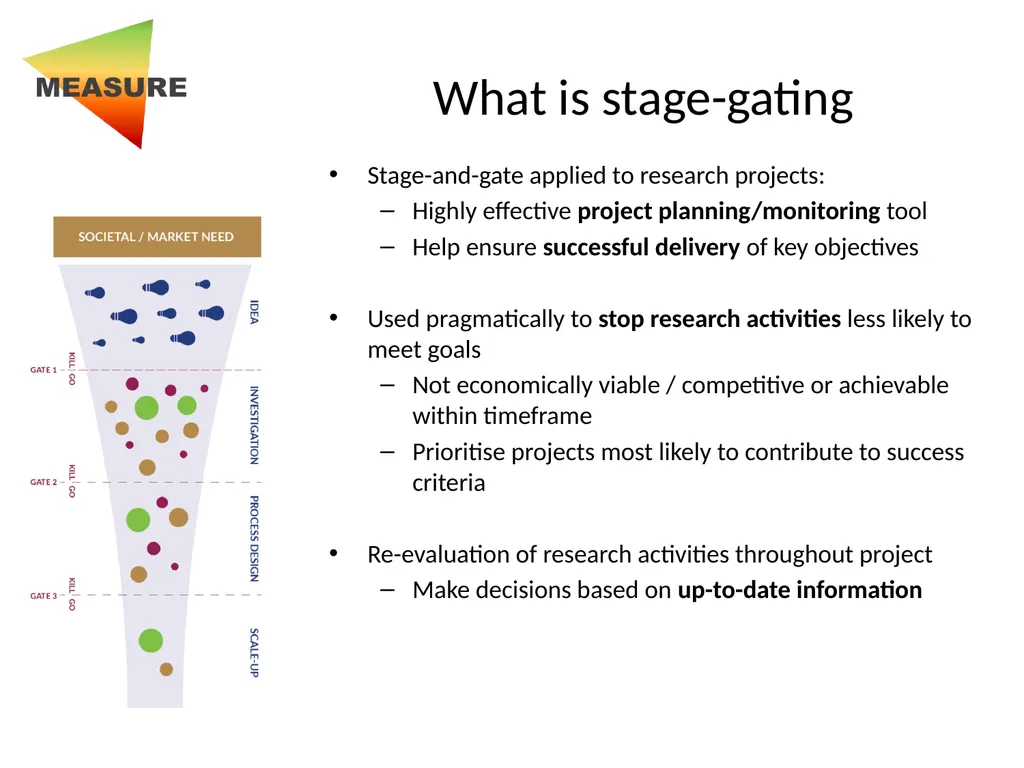
What is stage-and-gate Stage-and-gate is an approach to guide projects through a series of evaluations, cutting out less-promising options along the way, and focusing resources onto the more promising (in terms of the pre-determined criteria) solutions.
This process is useful in guiding research projects through the innovation funnel (right): from the early stage R&D when multiple solutions to the same problem seem feasible (high degree of freedom) to the final result, when very few, or a single solution is viable (few, or no degrees of freedom). Today’s solution space<br>
This process is useful in guiding research projects through the innovation funnel (right): from the early stage R&D when multiple solutions to the same problem seem feasible (high degree of freedom) to the final result, when very few, or a single solution is viable (few, or no degrees of freedom). Today’s solution space<br>
04
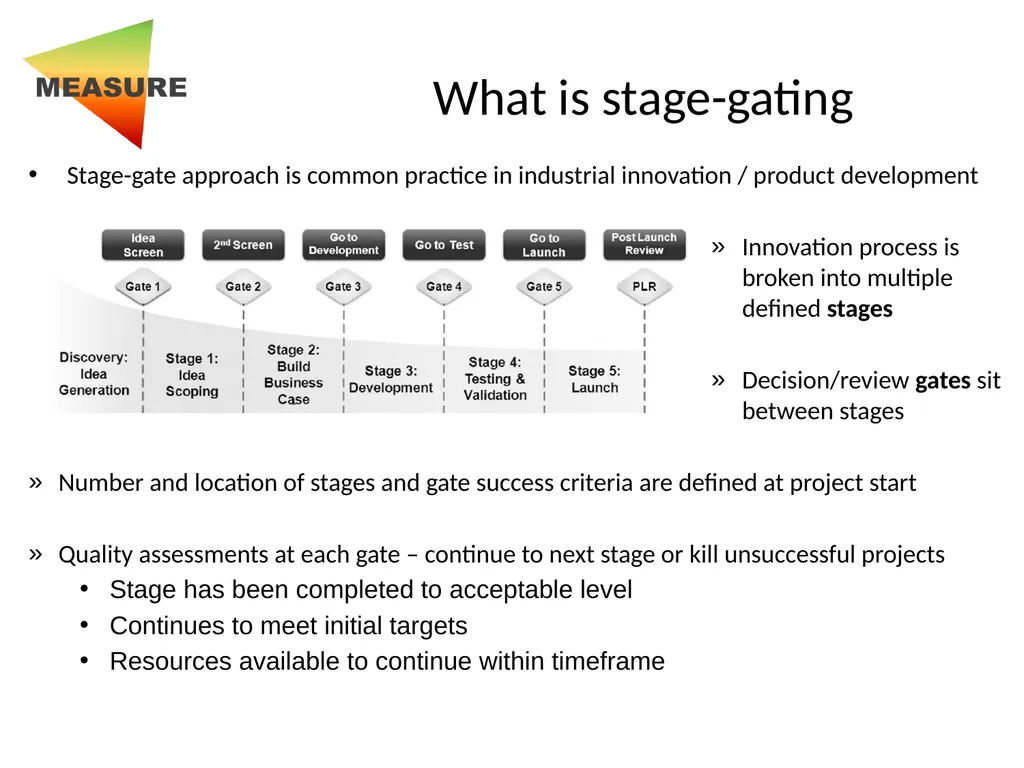
What is stage-gating Stage-gate approach is common practice in industrial innovation / product development
Innovation process is broken into multiple defined stages
Decision/review gates sit between stages
Number and location of stages and gate success criteria are defined at project start
Quality assessments at each gate – continue to next stage or kill unsuccessful projects
Stage has been completed to acceptable level
Continues to meet initial targets
Resources available to continue within timeframe<br>
05
What is stage-gating Stage-and-gate applied to research projects:
Highly effective project planning/monitoring tool
Help ensure successful delivery of key objectives
Used pragmatically to stop research activities less likely to meet goals
Not economically viable / competitive or achievable within timeframe
Prioritise projects most likely to contribute to success criteria
Re-evaluation of research activities throughout project
Make decisions based on up-to-date information<br>
06
Defining the gates For the stage-and-gate process to work effectively the gates and the corresponding success criteria should be pre-determined at the start of the project and then adjusted as the project progresses. The gates should help to realize which of the initial research directions have no chance of delivering the main project objectives.
The gates are not linked to any specific functional barriers, such as disciplines or expertise.
It is best if the entire project team, including different expertise (e.g., synthetic chemists, process chemists, process engineers, operators, business manager, etc..) are involved in specifying the gates and pass criteria.
The key elements of the process are the gates: review of criteria met by the project and decisions to kill or continue specific activities.<br>
07
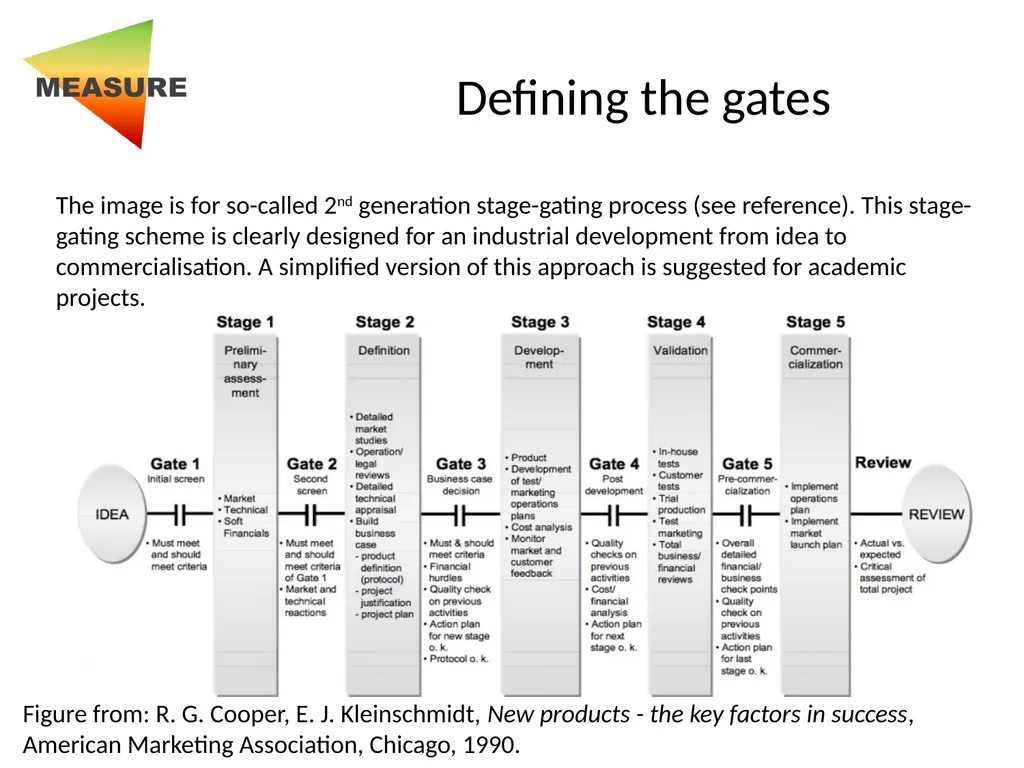
Defining the gates Figure from: R. G. Cooper, E. J. Kleinschmidt, New products - the key factors in success, American Marketing Association, Chicago, 1990. The image is for so-called 2nd generation stage-gating process (see reference). This stage-gating scheme is clearly designed for an industrial development from idea to commercialisation. A simplified version of this approach is suggested for academic projects.<br>
08
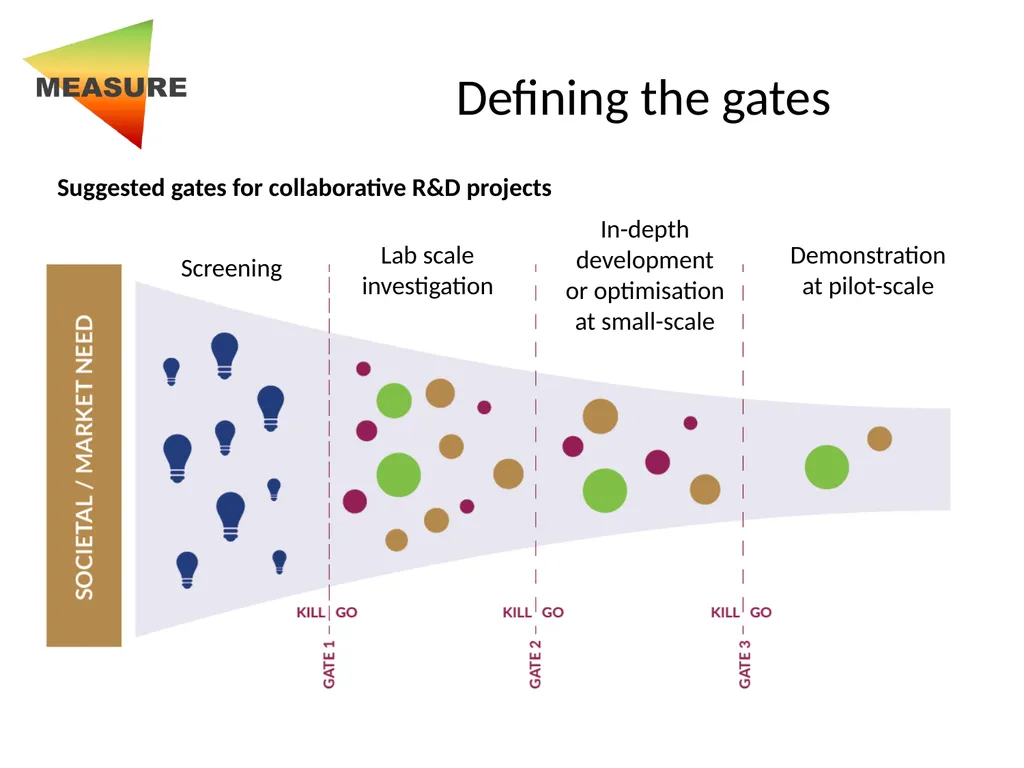
Defining the gates In-depth development or optimisation at small-scale Demonstration at pilot-scale Lab scale
investigation Screening Suggested gates for collaborative R&D projects<br>
investigation Screening Suggested gates for collaborative R&D projects<br>
09
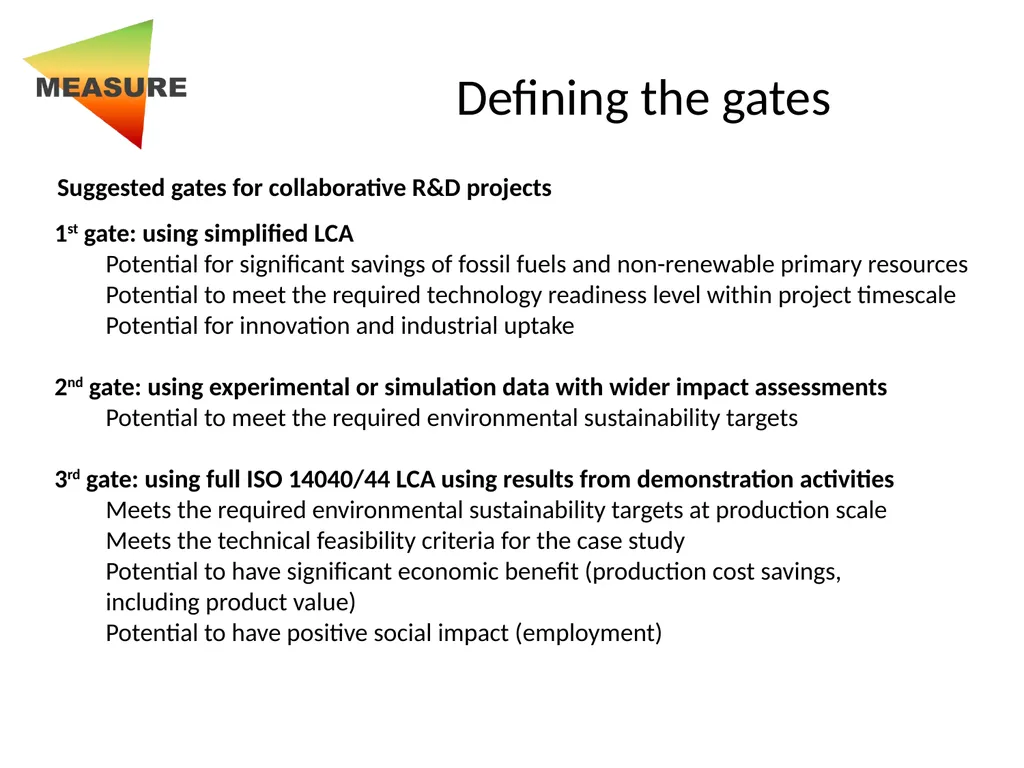
1st gate: using simplified LCA
Potential for significant savings of fossil fuels and non-renewable primary resources
Potential to meet the required technology readiness level within project timescale
Potential for innovation and industrial uptake
2nd gate: using experimental or simulation data with wider impact assessments
Potential to meet the required environmental sustainability targets
3rd gate: using full ISO 14040/44 LCA using results from demonstration activities
Meets the required environmental sustainability targets at production scale
Meets the technical feasibility criteria for the case study
Potential to have significant economic benefit (production cost savings, including product value)
Potential to have positive social impact (employment) Defining the gates Suggested gates for collaborative R&D projects<br>
10
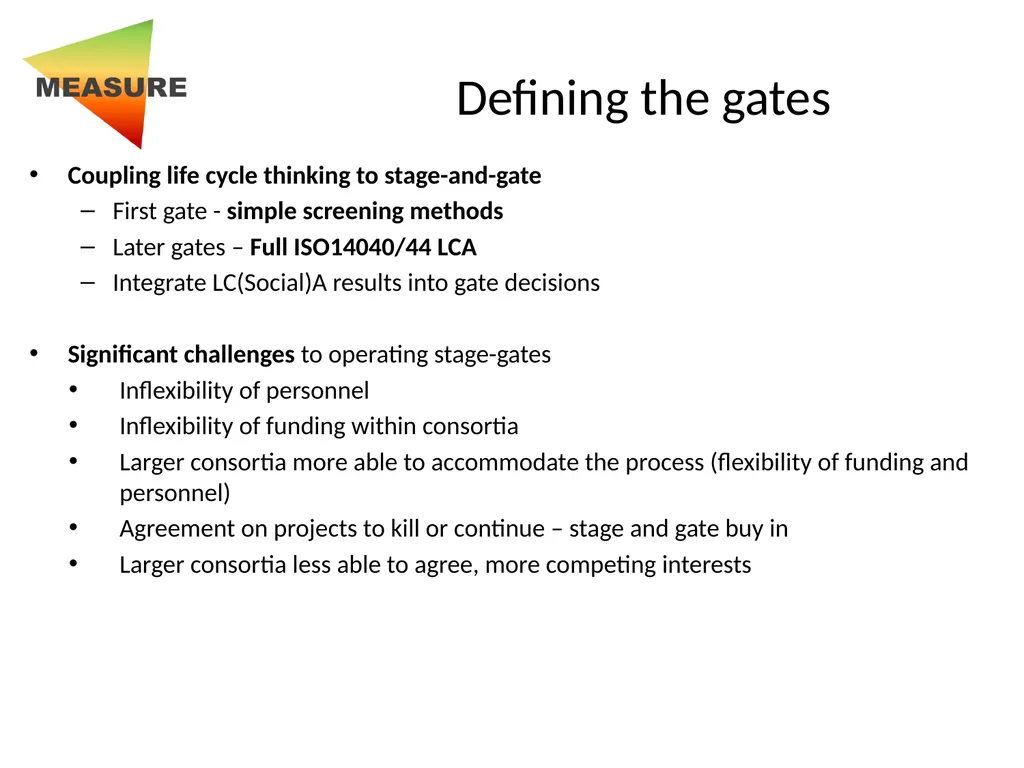
Coupling life cycle thinking to stage-and-gate
First gate - simple screening methods
Later gates – Full ISO14040/44 LCA
Integrate LC(Social)A results into gate decisions
Significant challenges to operating stage-gates
Inflexibility of personnel
Inflexibility of funding within consortia
Larger consortia more able to accommodate the process (flexibility of funding and personnel)
Agreement on projects to kill or continue – stage and gate buy in
Larger consortia less able to agree, more competing interests Defining the gates<br>
11
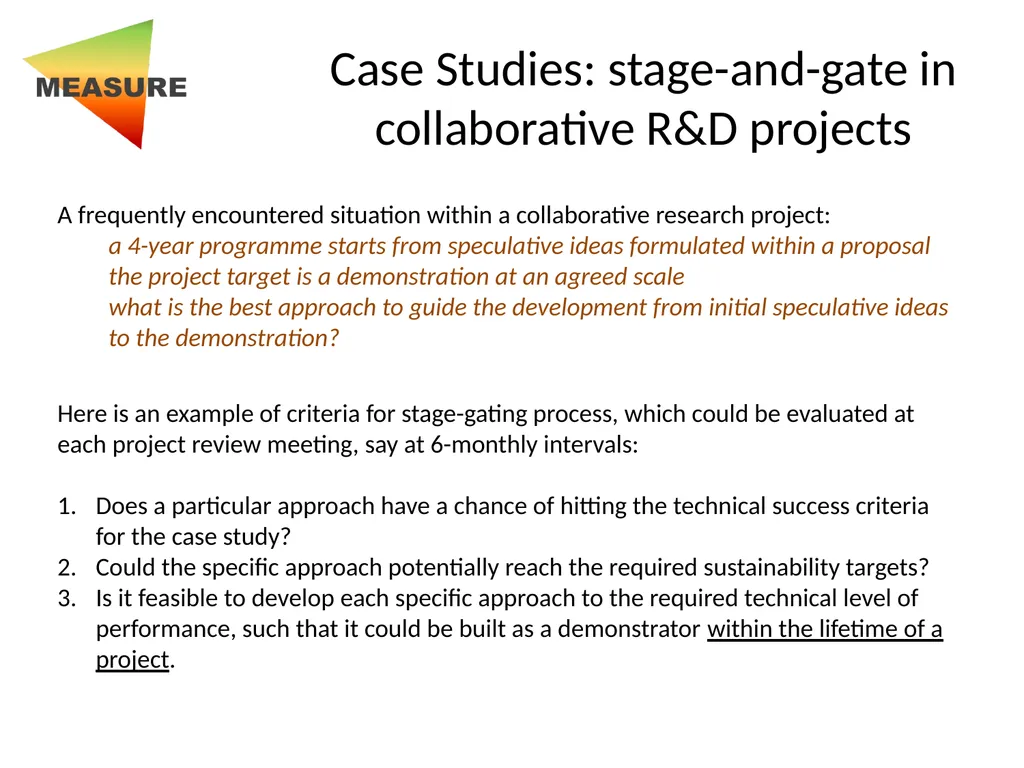
Case Studies: stage-and-gate in collaborative R&D projects A frequently encountered situation within a collaborative research project:
a 4-year programme starts from speculative ideas formulated within a proposal the project target is a demonstration at an agreed scale what is the best approach to guide the development from initial speculative ideas to the demonstration? Here is an example of criteria for stage-gating process, which could be evaluated at each project review meeting, say at 6-monthly intervals:
Does a particular approach have a chance of hitting the technical success criteria for the case study?
Could the specific approach potentially reach the required sustainability targets?
Is it feasible to develop each specific approach to the required technical level of performance, such that it could be built as a demonstrator within the lifetime of a project.<br>
12
Assessment of technical level of an approach against set criteria:
this requires clear definition of performance criteria and understanding of fundamental limitations of specific approaches; this is not always feasible to evaluate. An example when this is possible, is when a thermodynamic limit of performance could be established. Case Studies: stage-and-gate in collaborative R&D projects<br>
this requires clear definition of performance criteria and understanding of fundamental limitations of specific approaches; this is not always feasible to evaluate. An example when this is possible, is when a thermodynamic limit of performance could be established. Case Studies: stage-and-gate in collaborative R&D projects<br>
13
Could the specific approach potentially reach the required sustainability targets?
at the early stages of a project there is little data available; as project evolves, there is more data and more indicators of sustainability could be evaluated. However, it is highly desirable to have an indication about the likely sustainability metrics even at the very early stages. So, some data-lean methods are highly desirable. Case Studies: stage-and-gate in collaborative R&D projects<br>
at the early stages of a project there is little data available; as project evolves, there is more data and more indicators of sustainability could be evaluated. However, it is highly desirable to have an indication about the likely sustainability metrics even at the very early stages. So, some data-lean methods are highly desirable. Case Studies: stage-and-gate in collaborative R&D projects<br>
14
Could the specific approach potentially reach the required sustainability targets?
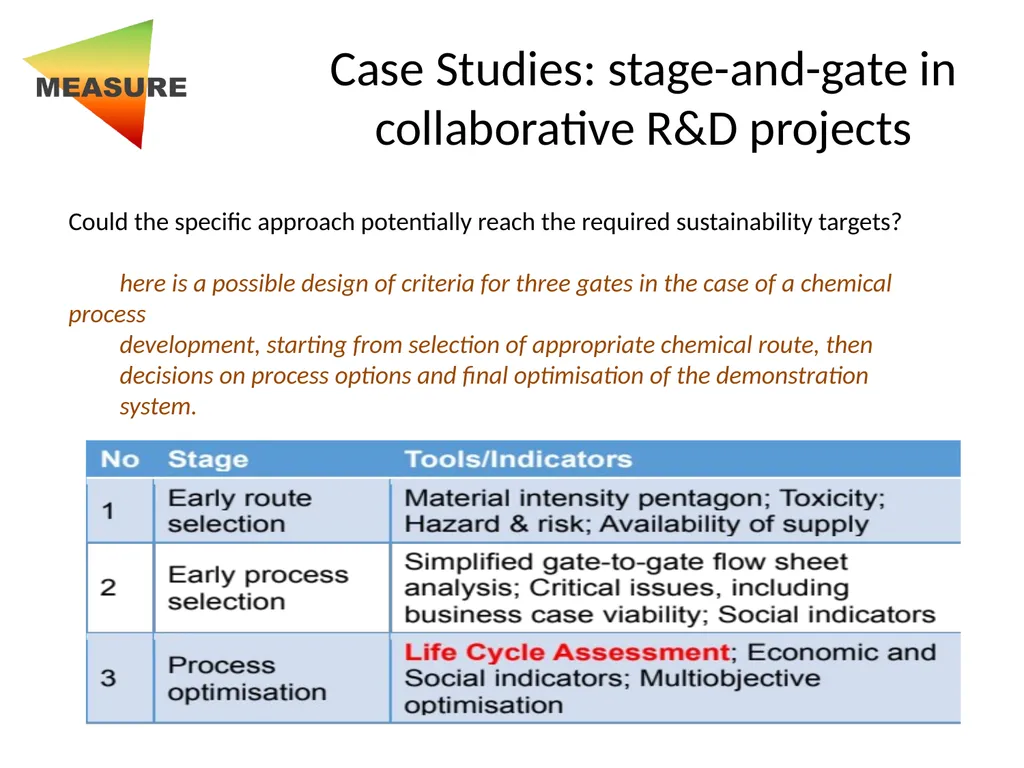
here is a possible design of criteria for three gates in the case of a chemical process development, starting from selection of appropriate chemical route, then decisions on process options and final optimisation of the demonstration system. Case Studies: stage-and-gate in collaborative R&D projects<br>
here is a possible design of criteria for three gates in the case of a chemical process development, starting from selection of appropriate chemical route, then decisions on process options and final optimisation of the demonstration system. Case Studies: stage-and-gate in collaborative R&D projects<br>
15
Is it feasible to develop each specific approach to the required technical level of performance, such that it could be built as a demonstrator within the lifetime of a project.
this is largely a ‘business’ decision based on experience of the investigators: some really interesting ideas and leads may be identified at the start of the project, but if they are too far from demonstration, is there enough time to get these ideas developed sufficiently? For this analysis it is important to work backwards from the end of the project: how long is the demonstration campaign and what should be done with the generated data? by when demonstration plant should be ready? when all parts for the demo plant must be ordered by designed by? so when is the decision about demonstrator case study must be made? the remainder from the project start is what’s available for R&D – this is almost always less than one thinks! Case Studies: stage-and-gate in collaborative R&D projects<br>
this is largely a ‘business’ decision based on experience of the investigators: some really interesting ideas and leads may be identified at the start of the project, but if they are too far from demonstration, is there enough time to get these ideas developed sufficiently? For this analysis it is important to work backwards from the end of the project: how long is the demonstration campaign and what should be done with the generated data? by when demonstration plant should be ready? when all parts for the demo plant must be ordered by designed by? so when is the decision about demonstrator case study must be made? the remainder from the project start is what’s available for R&D – this is almost always less than one thinks! Case Studies: stage-and-gate in collaborative R&D projects<br>
16
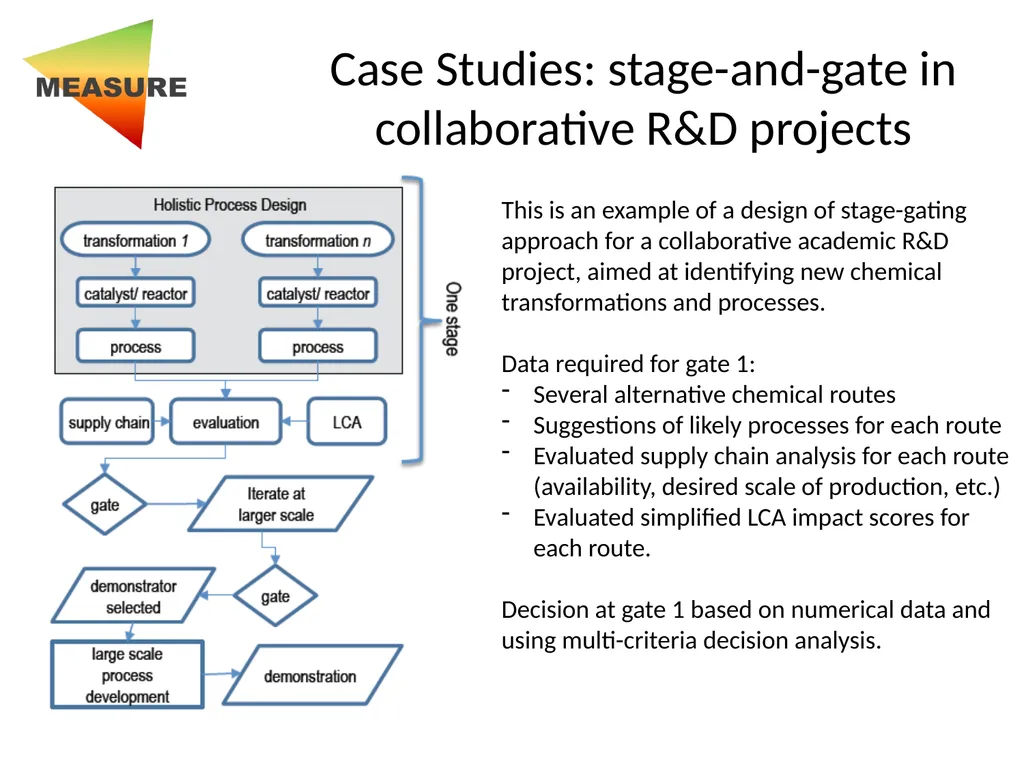
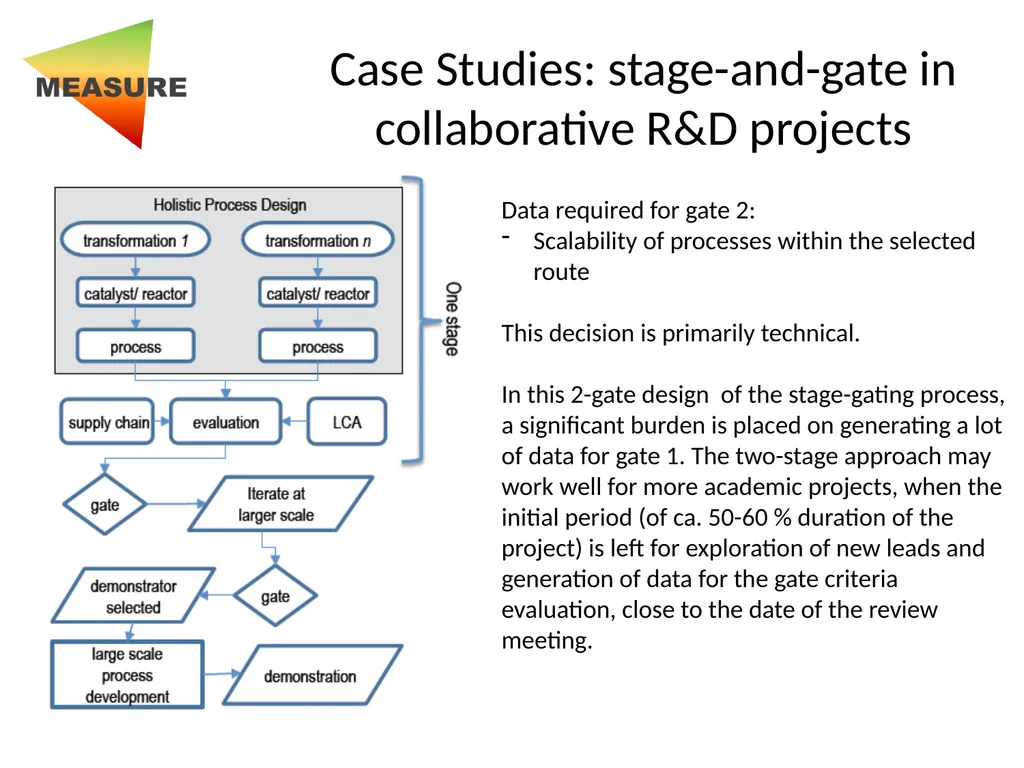
This is an example of a design of stage-gating approach for a collaborative academic R&D project, aimed at identifying new chemical transformations and processes.
Data required for gate 1:
Several alternative chemical routes
Suggestions of likely processes for each route
Evaluated supply chain analysis for each route (availability, desired scale of production, etc.)
Evaluated simplified LCA impact scores for each route.
Decision at gate 1 based on numerical data and using multi-criteria decision analysis. Case Studies: stage-and-gate in collaborative R&D projects<br>
17
Data required for gate 2:
Scalability of processes within the selected route
This decision is primarily technical.
In this 2-gate design of the stage-gating process, a significant burden is placed on generating a lot of data for gate 1. The two-stage approach may work well for more academic projects, when the initial period (of ca. 50-60 % duration of the project) is left for exploration of new leads and generation of data for the gate criteria evaluation, close to the date of the review meeting. Case Studies: stage-and-gate in collaborative R&D projects<br>
18
LCA and stage-and-gate
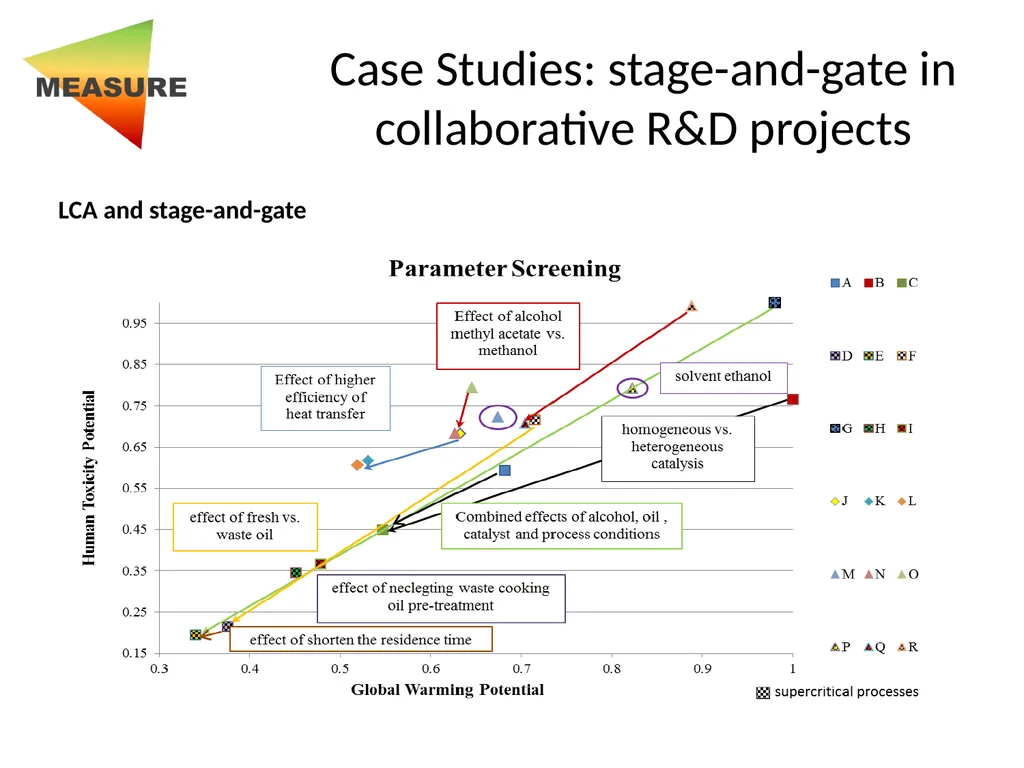
Generation of LCA (and costing data) at the very early stage of R&D project using literature data or best guesses is potentially most useful in identifying the critical parameters of the processes that must be addressed in the R&D programme. Shown is the approach of simplified LCA – to obtain the insight from using a life-cycle thinking approach, but without performing a full rigorous LCA. Case Studies: stage-and-gate in collaborative R&D projects<br>
Generation of LCA (and costing data) at the very early stage of R&D project using literature data or best guesses is potentially most useful in identifying the critical parameters of the processes that must be addressed in the R&D programme. Shown is the approach of simplified LCA – to obtain the insight from using a life-cycle thinking approach, but without performing a full rigorous LCA. Case Studies: stage-and-gate in collaborative R&D projects<br>
19
LCA and stage-and-gate Case Studies: stage-and-gate in collaborative R&D projects<br>
20
Stage-and-gate is a very useful methodology to streamline projects towards a set of specific objectives. In the case of the innovation-driven projects, this approach should result in a large % of successful (in terms of reaching the demonstration stage) projects.
For this it is recommended that:
Milestones in work-programmes are replaced with stage-gates. Milestones are already envisaged to be decision points. However, in practice milestones are seldom used for the purpose of narrowing down options and tracking the progress towards objectives. Stage-and-gate assessments are evaluations against targets that are progressively closer to the objectives, and remain to be decision points.
Work-programmes should develop an initial set of criteria for stage-gates at the proposal stage and should put in place a mechanism for updating those during the projects.
Flexible fund within the projects would allow for change of direction, bringing in new expertise and moving personnel between beneficiaries, which may require additional resources for relocation, salary differences, etc. Conclusions<br>
21
J. C. Mankins, Advanced Concepts Office, Office of Space and Technology, NASA, 1995.
D. Mann, Hands-on systematic innovation: for technical systems, CREAX Press, Ieper, Belgium, 2002.
a) R. G. Cooper, E. J. Kleinschmidt, New products - the key factors in success, American Marketing Association, Chicago, 1990; b) R. G. Cooper, E. J. Kleinschmidt, Ind. Marketing Management 1991, 20, 137-147.
D. Kralisch, D. Ott, S. Kressirer, C. Staffel, I. Sell, U. Krtschil, P. Loeb, gps 2013, 2, 465-478.
V. Hessel, Chem. Eng. Technol. 2009, 32, 1655-1681.
D. Kralisch, C. Staffel, D. Ott, S. Bensaid, G. Saracco, P. Bellantoni, P. Loeb, Green Chem. 2013, 15, 463-477.
a) D. Kralisch, D. Ott, S. Kressirer, C. Staffel, I. Sell, U. Krtschil, P. Loeb, Green Processing and Synthesis 2013, 2, 465–478; b) I. Sell, D. Ott, D. Kralisch, ChemBioEng Reviews 2014, 1, 50-56.
a) D. Ott, D. Kralisch, I. Denčic, V. Hessel, Y. Laribi, P. D. Perrichon, C. Berguerand, L. Kiwi-Minsker, P. Loeb, ChemSusChem 2014, 7, 3521–3533; b) I. Dencic, D. Ott, D. Kralisch, T. Noel, J. Meuldijk, M. De Croon, V. Hessel, Y. Laribi, P. Perrichon, Organic Process Research & Development 2014, 18, 1326–1338. Literature and further reading<br>