
Developing and Writing Effective Documents
PT
Published · 193 slides · 0 views

1 / 1
Description
Developing and Writing Effective Documents Prepared for the Bureau of Land Management Prepared by ICF International Instructors Ellen Unsworth, M.S., E.L.S., is a project manager and technical specialist at ICF in Sacramento, where she
Related Topics
Share
Embed code
Download this presentation From Below
"Developing and Writing Effective Documents" is the property of its rightful owner. Permission is granted to download and print the materials on this website for personal, non-commercial use only, and to display it on your personal computer provided you do not modify the materials and that you retain all copyright notices contained in the materials. By downloading content from our website, you accept the terms of this agreement.
Presentation Transcript
01
Developing and Writing
Effective Documents Prepared for the
Bureau of Land Management
Prepared by ICF International<br>
Prepared by ICF International<br>
02
Instructors Ellen Unsworth, M.S., E.L.S., is a project manager and technical specialist at ICF in Sacramento, where she works on a wide variety of document types, including California Environmental Quality Act (CEQA) documents, scientific studies, monitoring reports, manuals, construction specifications, and interpretative exhibits. As a writer, she works primarily on geology and paleontology sections for National Environmental Policy Act (NEPA) and CEQA documents and on Caltrans-specific documents required for transportation projects affecting paleontological resources. In her 17 years as a technical writer and editor, Ellen has worked for the software industry, academia, and the state of Idaho. Ellen is also certified by the Board of Editors in the Life Sciences and holds a certificate of language proficiency in Danish.
Laura Cooper, B.A., is a managing editor at ICF in Portland, where she leads the PNW Environmental Management Team and edits National Environmental Policy Act (NEPA), California Environmental Quality Act (CEQA), and Washington State Environmental Policy Act (SEPA) documents, as well as wetland, natural resource, restoration, planning, and other documents. In her 25-year editing and writing career, Laura has researched and written about a broad range of environmental topics, provided copywriting and collateral for various nonprofit organizations, and developed training materials for businesses and schools. 2<br>
Laura Cooper, B.A., is a managing editor at ICF in Portland, where she leads the PNW Environmental Management Team and edits National Environmental Policy Act (NEPA), California Environmental Quality Act (CEQA), and Washington State Environmental Policy Act (SEPA) documents, as well as wetland, natural resource, restoration, planning, and other documents. In her 25-year editing and writing career, Laura has researched and written about a broad range of environmental topics, provided copywriting and collateral for various nonprofit organizations, and developed training materials for businesses and schools. 2<br>
03
Table of Contents Introduction
Goals for the Class
3-Day Class Outline
Instructors
Class Introductions
Document Layers 3<br>
Goals for the Class
3-Day Class Outline
Instructors
Class Introductions
Document Layers 3<br>
04
Table of Contents Chapter 1 Prewriting
Determining Document Needs
Identifying Your Audience
Getting Started
Establishing Parallelism
Outlining Your Document
Using Questions as a Writing Tool
Citing Sources 4<br>
Determining Document Needs
Identifying Your Audience
Getting Started
Establishing Parallelism
Outlining Your Document
Using Questions as a Writing Tool
Citing Sources 4<br>
05
Table of Contents Chapter 2 Writing
Why Good Writing Matters
Paragraph and Topic Sentences
Passive versus Active
Wordiness and Foggy Writing
Grammar
Punctuation
Style
Commonly Misused Words and Phrases
Numbers 5<br>
Why Good Writing Matters
Paragraph and Topic Sentences
Passive versus Active
Wordiness and Foggy Writing
Grammar
Punctuation
Style
Commonly Misused Words and Phrases
Numbers 5<br>
06
Table of Contents Chapter 3 Managing Documents
Setting Up Authors for Success
Creating a Writing Template
Writing Impact Statements and Mitigation Measures
Managing the Writing Process
Responding to Comments
Tables 6<br>
Setting Up Authors for Success
Creating a Writing Template
Writing Impact Statements and Mitigation Measures
Managing the Writing Process
Responding to Comments
Tables 6<br>
07
Introduction 7<br>
08
Introduction Goals for the Class
3-Day Class Outline
Instructors
Class Introductions
Document Layers 8<br>
3-Day Class Outline
Instructors
Class Introductions
Document Layers 8<br>
09
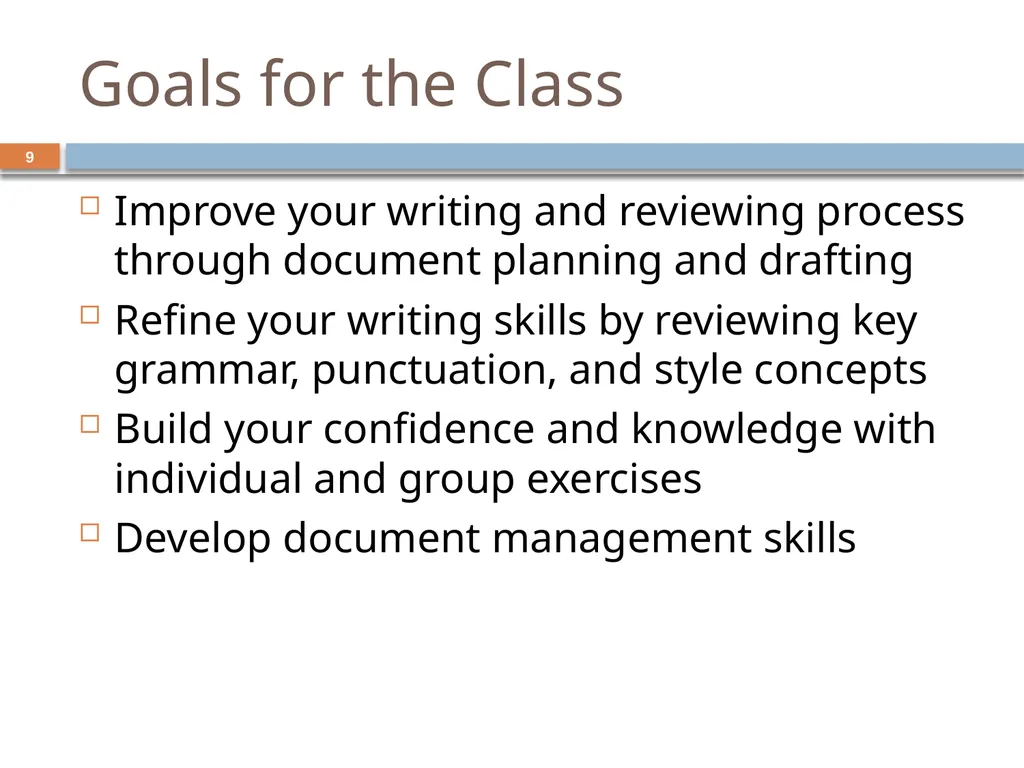
Goals for the Class Improve your writing and reviewing process through document planning and drafting
Refine your writing skills by reviewing key grammar, punctuation, and style concepts
Build your confidence and knowledge with individual and group exercises
Develop document management skills 9<br>
Refine your writing skills by reviewing key grammar, punctuation, and style concepts
Build your confidence and knowledge with individual and group exercises
Develop document management skills 9<br>
10
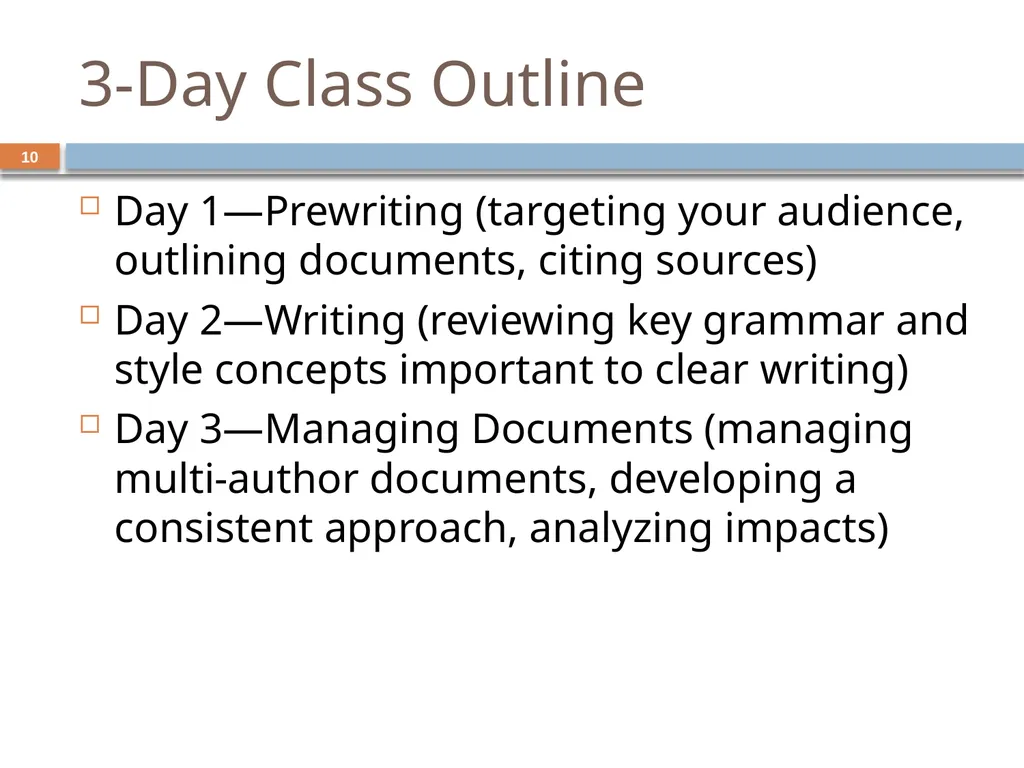
3-Day Class Outline Day 1―Prewriting (targeting your audience, outlining documents, citing sources)
Day 2―Writing (reviewing key grammar and style concepts important to clear writing)
Day 3―Managing Documents (managing multi-author documents, developing a consistent approach, analyzing impacts) 10<br>
Day 2―Writing (reviewing key grammar and style concepts important to clear writing)
Day 3―Managing Documents (managing multi-author documents, developing a consistent approach, analyzing impacts) 10<br>
11
Instructors Ellen Unsworth (M.S., E.L.S.; ICF, Sacramento)
Laura Cooper (B.A.; ICF, Portland) 11<br>
Laura Cooper (B.A.; ICF, Portland) 11<br>
12
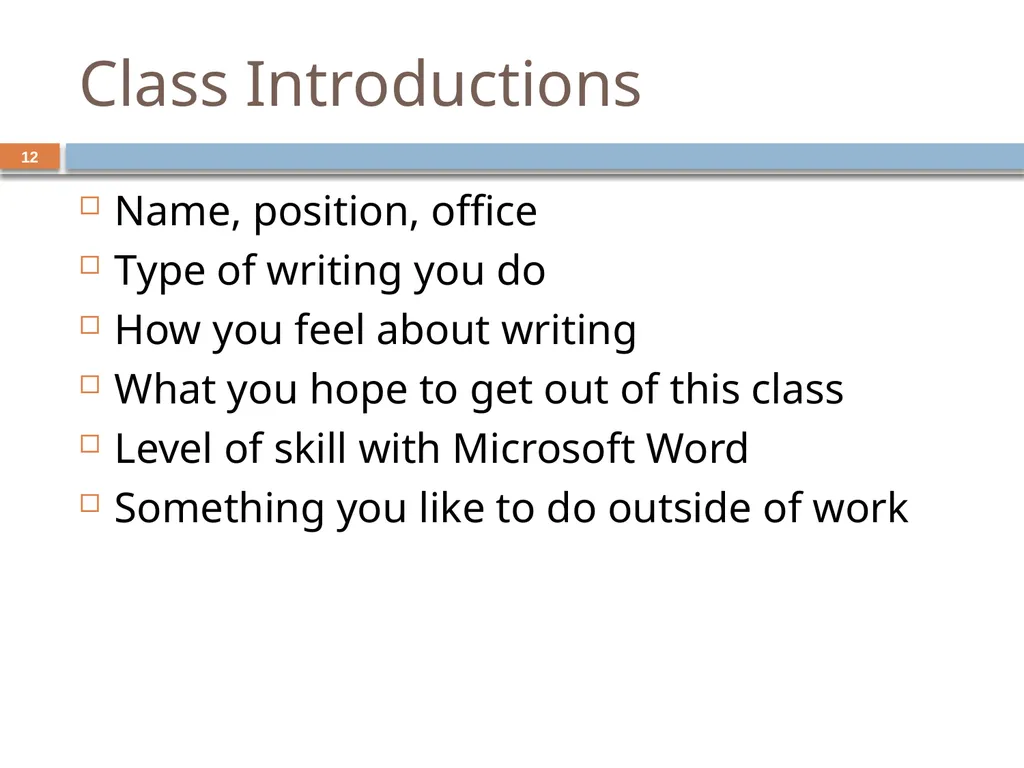
Class Introductions Name, position, office
Type of writing you do
How you feel about writing
What you hope to get out of this class
Level of skill with Microsoft Word
Something you like to do outside of work 12<br>
Type of writing you do
How you feel about writing
What you hope to get out of this class
Level of skill with Microsoft Word
Something you like to do outside of work 12<br>
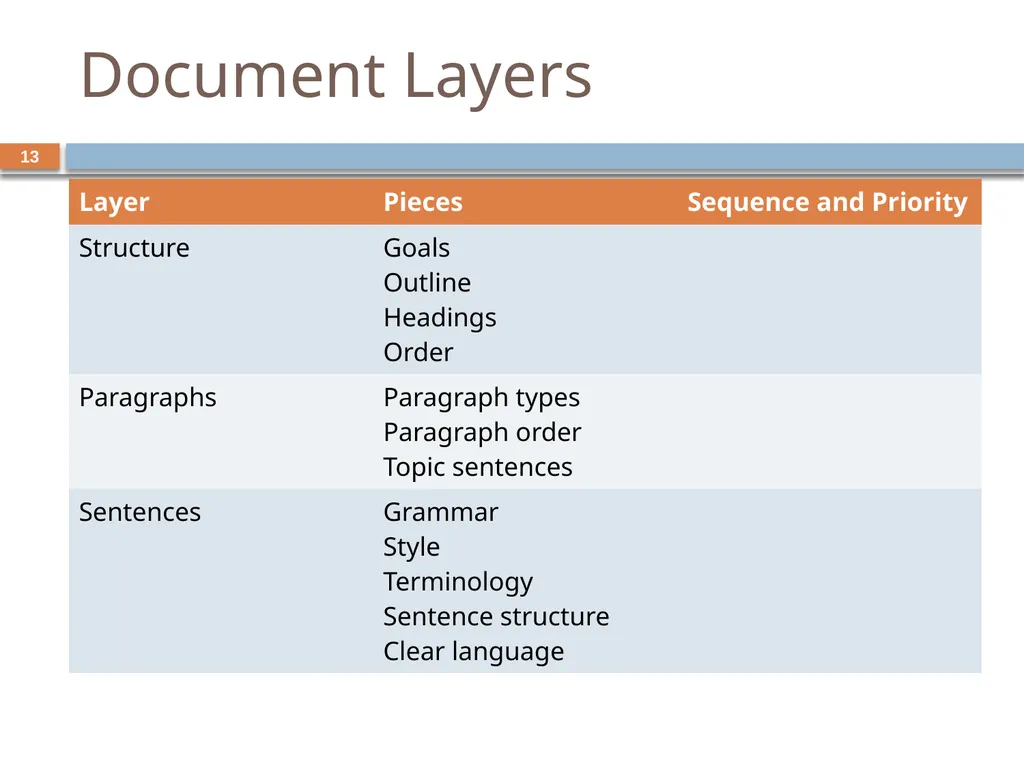
13
Document Layers 13<br>
14
14<br>
15
Chapter 1–Prewriting 15<br>
16
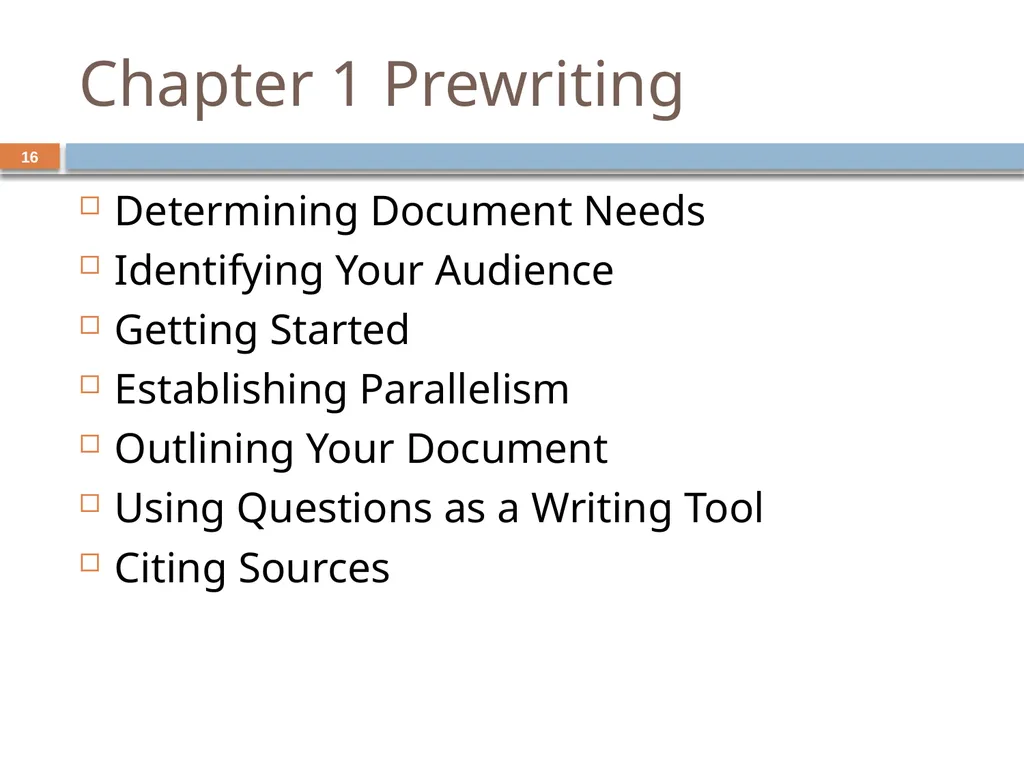
Chapter 1 Prewriting Determining Document Needs
Identifying Your Audience
Getting Started
Establishing Parallelism
Outlining Your Document
Using Questions as a Writing Tool
Citing Sources 16<br>
Identifying Your Audience
Getting Started
Establishing Parallelism
Outlining Your Document
Using Questions as a Writing Tool
Citing Sources 16<br>
17
Determining Document Needs What is the purpose of the document?
Technical information? Summary? Public information?
How does the audience affect the tone and content?
Is the document descriptive, persuasive, analytical? A combination? 17<br>
Technical information? Summary? Public information?
How does the audience affect the tone and content?
Is the document descriptive, persuasive, analytical? A combination? 17<br>
18
Determining Document Needs What do you need to know about document needs in order to get started?
What level of detail is appropriate?
What are common unknowns?
What is the budget and schedule?
What is the likelihood the project will be subject to litigation? Is it a controversial project? 18<br>
What level of detail is appropriate?
What are common unknowns?
What is the budget and schedule?
What is the likelihood the project will be subject to litigation? Is it a controversial project? 18<br>
19
19<br>
20
Identifying Your Audience Write for your audience
Consider your first audience and your final audience
Reviewers
Intended audience 20<br>
Consider your first audience and your final audience
Reviewers
Intended audience 20<br>
21
Identifying Your Audience Know Your Reviewers
Why are they reviewing the document?
What do they look for in a document?
What is important to them?
What are their pet peeves? 21<br>
Why are they reviewing the document?
What do they look for in a document?
What is important to them?
What are their pet peeves? 21<br>
22
Identifying Your Audience Understand Your Intended Audience
How much do they know about the subject?
Are they technical or nontechnical?
Why are they reading your document?
How much background do they need?
What are they concerned about? 22<br>
How much do they know about the subject?
Are they technical or nontechnical?
Why are they reading your document?
How much background do they need?
What are they concerned about? 22<br>
23
Identifying Your Audience Are there potential controversies?
What can you do to make your document more useful to them?
Do they have document-related preferences? 23<br>
What can you do to make your document more useful to them?
Do they have document-related preferences? 23<br>
24
24<br>
25
Getting Started Writing as a Recursive Process (not linear)
Preparing to write
Writing
Revising 25<br>
Preparing to write
Writing
Revising 25<br>
26
Getting Started Generating ideas and avoiding the “blank page syndrome”
Reading
Brainstorming
Outlining
Mapping
Freewriting/focused freewriting
Writing in pieces 26<br>
Reading
Brainstorming
Outlining
Mapping
Freewriting/focused freewriting
Writing in pieces 26<br>
27
27<br>
28
Establishing Parallelism Parallelism refers to expressing similar ideas in similar ways and showing that these ideas have the same level of importance
Parallel structure—which consists of repeating a pattern in a series of items in a list, consecutive sentences, headings, or ideas—helps your reader see the connections between ideas
Parallel structure should be maintained at all levels of writing: outline, paragraph, sentence, and word 28<br>
Parallel structure—which consists of repeating a pattern in a series of items in a list, consecutive sentences, headings, or ideas—helps your reader see the connections between ideas
Parallel structure should be maintained at all levels of writing: outline, paragraph, sentence, and word 28<br>
29
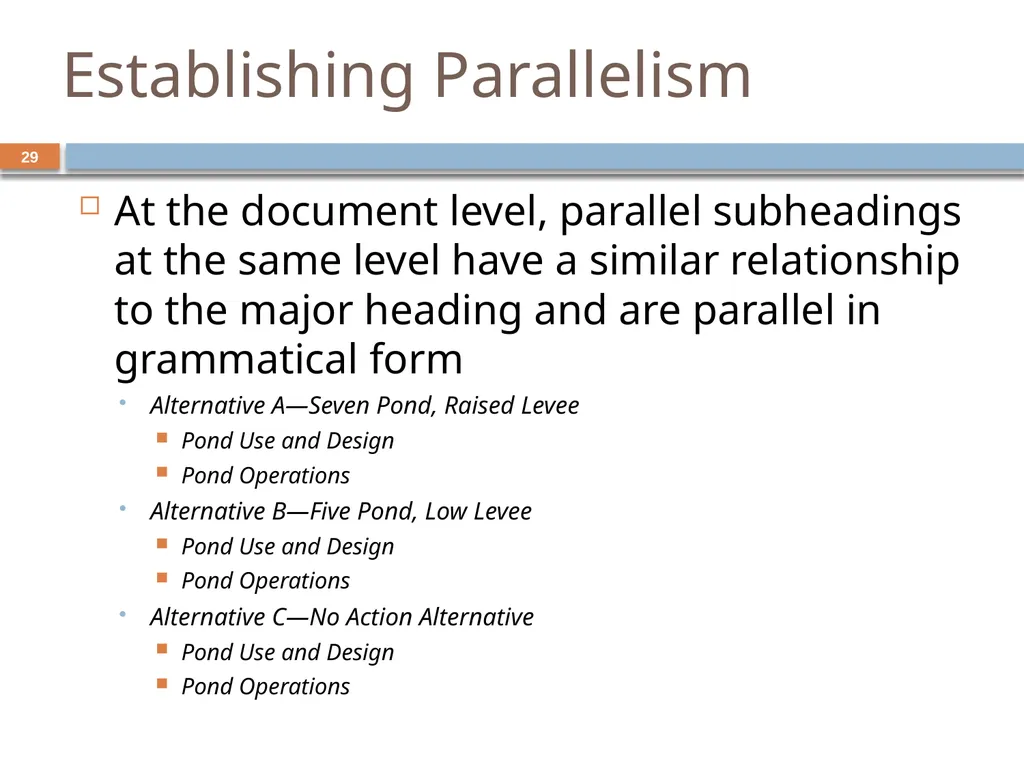
Establishing Parallelism At the document level, parallel subheadings at the same level have a similar relationship to the major heading and are parallel in grammatical form
Alternative A—Seven Pond, Raised Levee
Pond Use and Design
Pond Operations
Alternative B—Five Pond, Low Levee
Pond Use and Design
Pond Operations
Alternative C—No Action Alternative
Pond Use and Design
Pond Operations 29<br>
Alternative A—Seven Pond, Raised Levee
Pond Use and Design
Pond Operations
Alternative B—Five Pond, Low Levee
Pond Use and Design
Pond Operations
Alternative C—No Action Alternative
Pond Use and Design
Pond Operations 29<br>
30
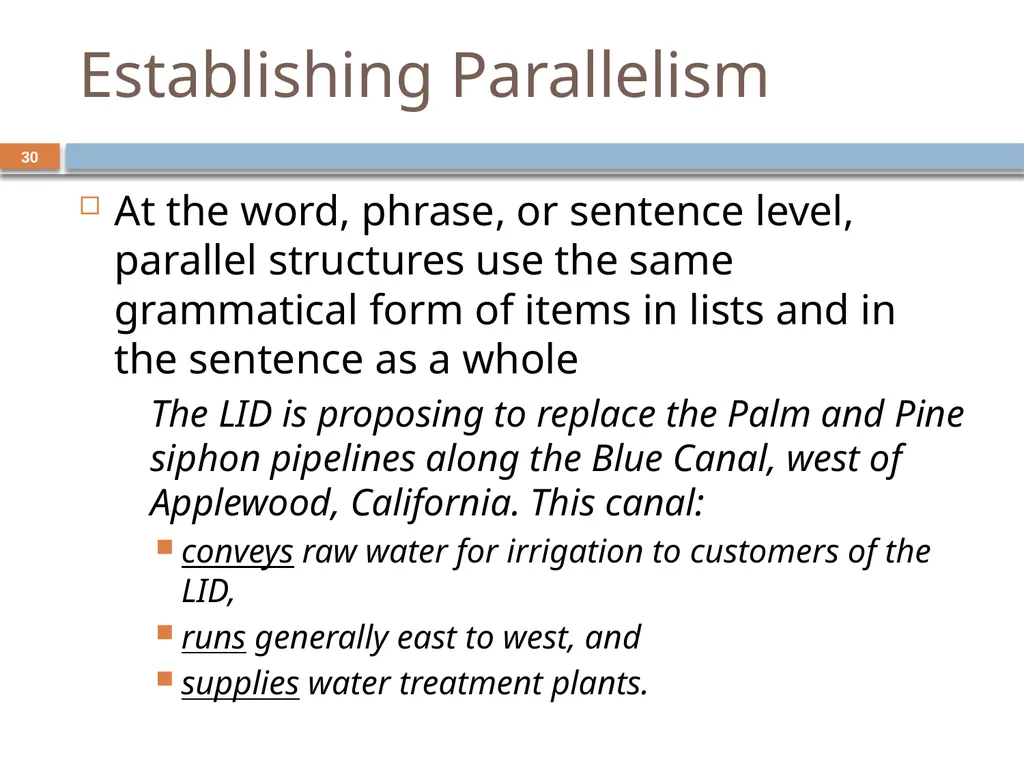
Establishing Parallelism At the word, phrase, or sentence level, parallel structures use the same grammatical form of items in lists and in the sentence as a whole
The LID is proposing to replace the Palm and Pine siphon pipelines along the Blue Canal, west of Applewood, California. This canal:
conveys raw water for irrigation to customers of the LID,
runs generally east to west, and
supplies water treatment plants. 30<br>
The LID is proposing to replace the Palm and Pine siphon pipelines along the Blue Canal, west of Applewood, California. This canal:
conveys raw water for irrigation to customers of the LID,
runs generally east to west, and
supplies water treatment plants. 30<br>
31
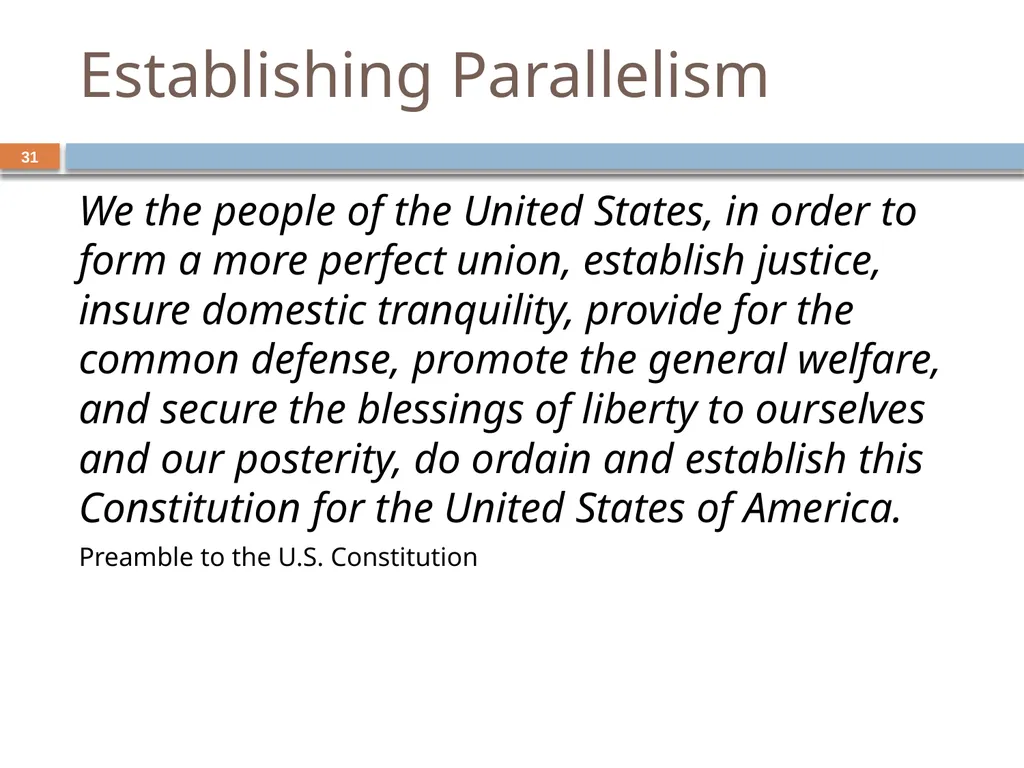
Establishing Parallelism We the people of the United States, in order to form a more perfect union, establish justice, insure domestic tranquility, provide for the common defense, promote the general welfare, and secure the blessings of liberty to ourselves and our posterity, do ordain and establish this Constitution for the United States of America.
Preamble to the U.S. Constitution 31<br>
Preamble to the U.S. Constitution 31<br>
32
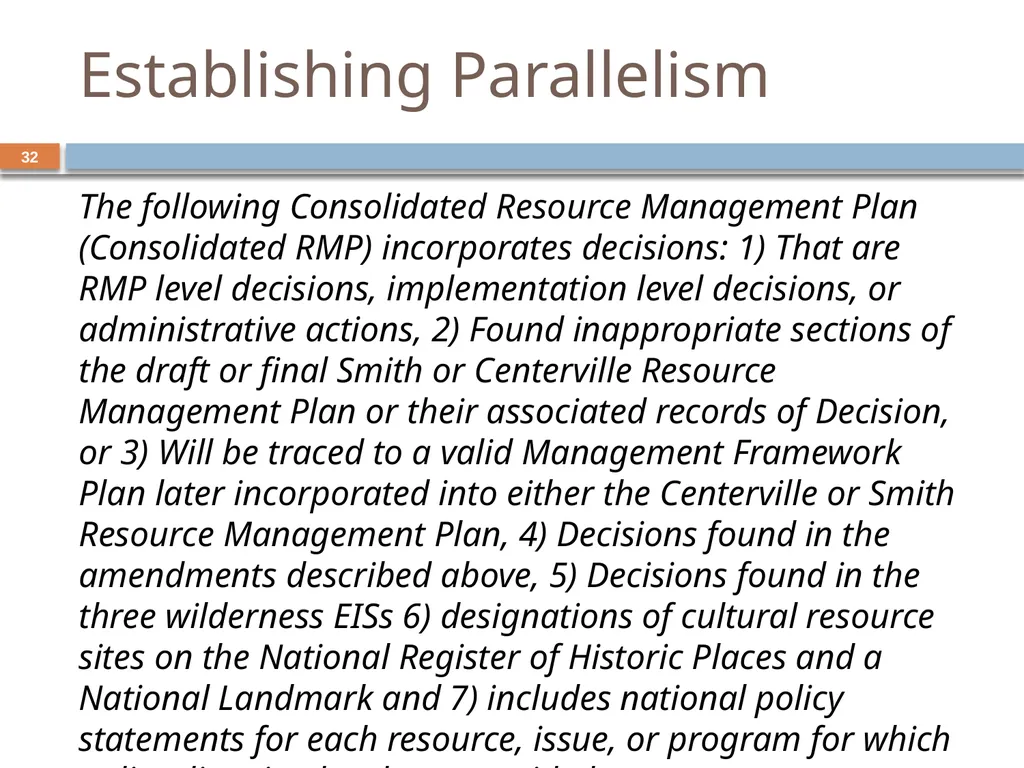
Establishing Parallelism The following Consolidated Resource Management Plan (Consolidated RMP) incorporates decisions: 1) That are RMP level decisions, implementation level decisions, or administrative actions, 2) Found inappropriate sections of the draft or final Smith or Centerville Resource Management Plan or their associated records of Decision, or 3) Will be traced to a valid Management Framework Plan later incorporated into either the Centerville or Smith Resource Management Plan, 4) Decisions found in the amendments described above, 5) Decisions found in the three wilderness EISs 6) designations of cultural resource sites on the National Register of Historic Places and a National Landmark and 7) includes national policy statements for each resource, issue, or program for which policy direction has been provided. 32<br>
33
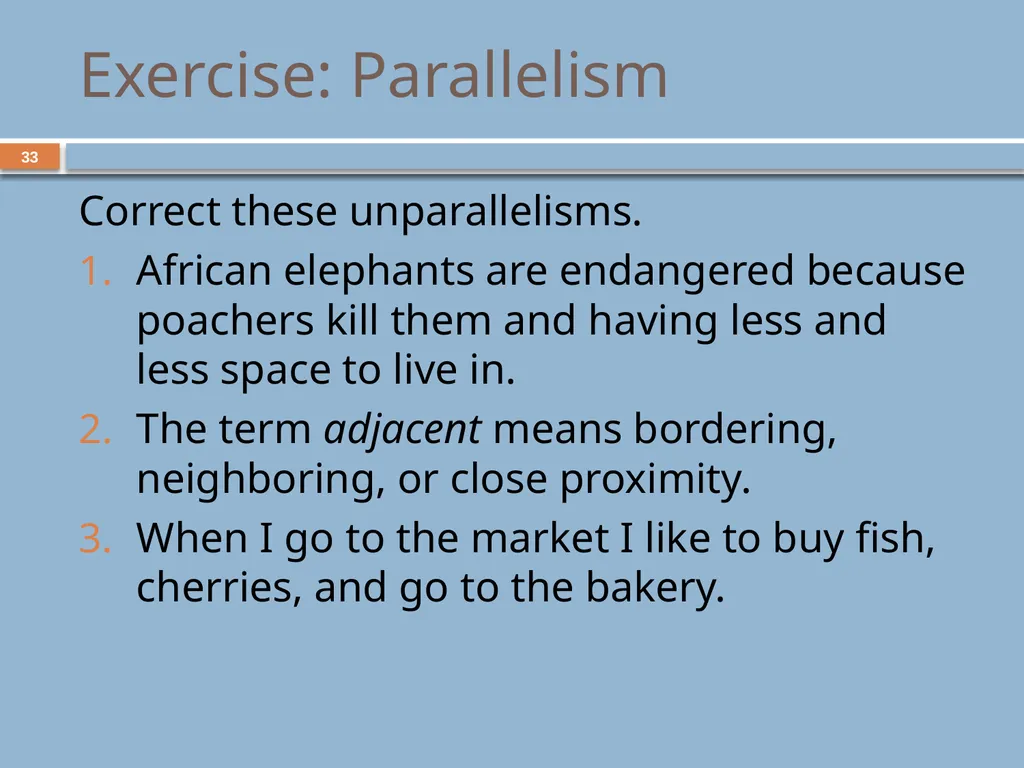
Exercise: Parallelism Correct these unparallelisms.
African elephants are endangered because poachers kill them and having less and less space to live in.
The term adjacent means bordering, neighboring, or close proximity.
When I go to the market I like to buy fish, cherries, and go to the bakery. 33<br>
African elephants are endangered because poachers kill them and having less and less space to live in.
The term adjacent means bordering, neighboring, or close proximity.
When I go to the market I like to buy fish, cherries, and go to the bakery. 33<br>
34
Exercise: Parallelism Complete Exercise 1, Parallelism. 34<br>
35
35<br>
36
Outlining Your Document Benefits of Outlining
Eases you into the writing process
Saves you time
Allows you to separate the thinking and writing processes
Saves your reviewers time
Helps you and your reviewers detect duplicated, superfluous, or missing information
Helps you present information in a parallel manner 36<br>
Eases you into the writing process
Saves you time
Allows you to separate the thinking and writing processes
Saves your reviewers time
Helps you and your reviewers detect duplicated, superfluous, or missing information
Helps you present information in a parallel manner 36<br>
37
Outlining Your Document Develop the main headings
Add second-level headings
Add third-level headings
See examples from an EA on following slides 37<br>
Add second-level headings
Add third-level headings
See examples from an EA on following slides 37<br>
38
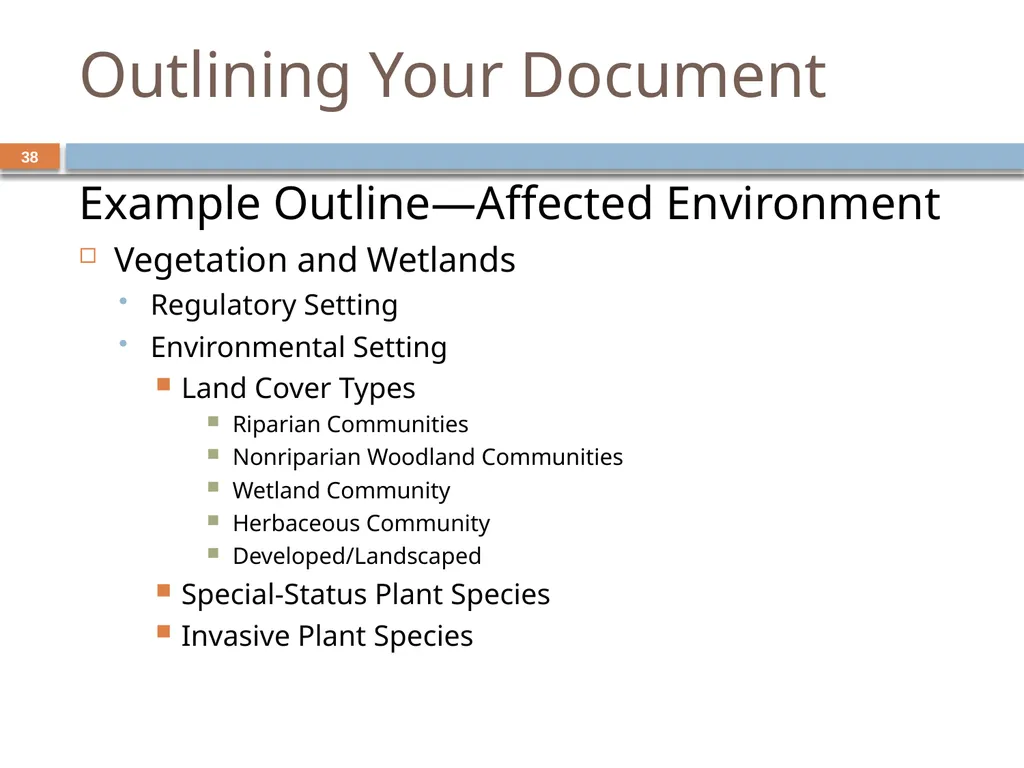
Outlining Your Document Example Outline—Affected Environment
Vegetation and Wetlands
Regulatory Setting
Environmental Setting
Land Cover Types
Riparian Communities
Nonriparian Woodland Communities
Wetland Community
Herbaceous Community
Developed/Landscaped
Special-Status Plant Species
Invasive Plant Species 38<br>
Vegetation and Wetlands
Regulatory Setting
Environmental Setting
Land Cover Types
Riparian Communities
Nonriparian Woodland Communities
Wetland Community
Herbaceous Community
Developed/Landscaped
Special-Status Plant Species
Invasive Plant Species 38<br>
39
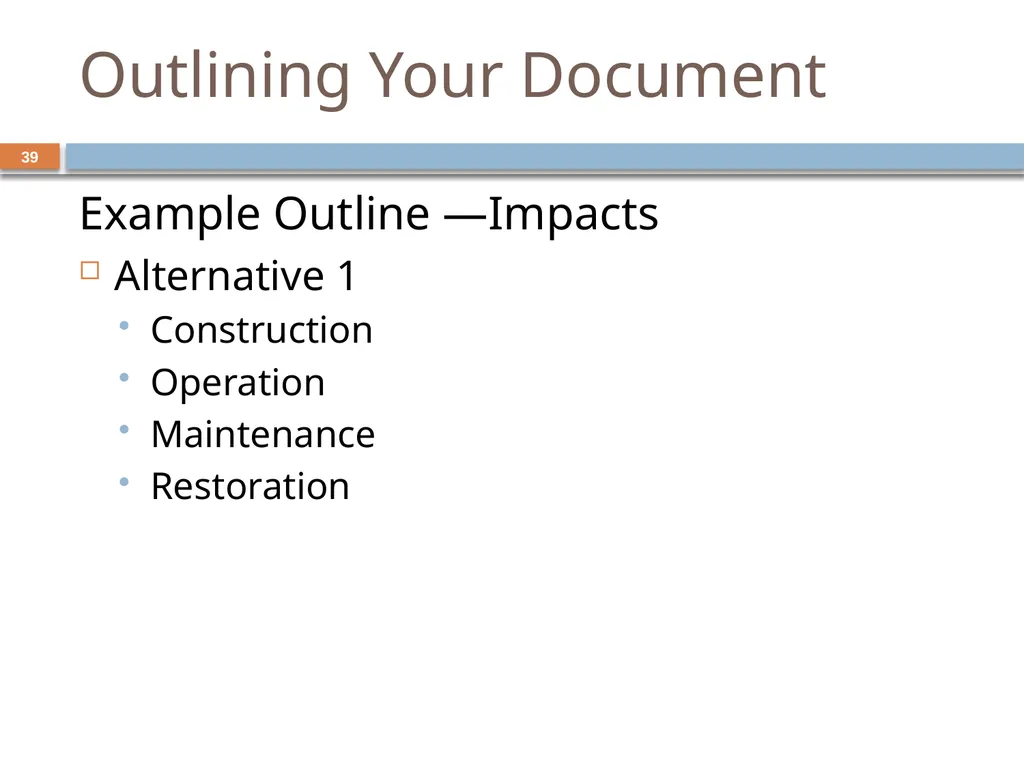
Outlining Your Document Example Outline —Impacts
Alternative 1
Construction
Operation
Maintenance
Restoration 39<br>
Alternative 1
Construction
Operation
Maintenance
Restoration 39<br>
40
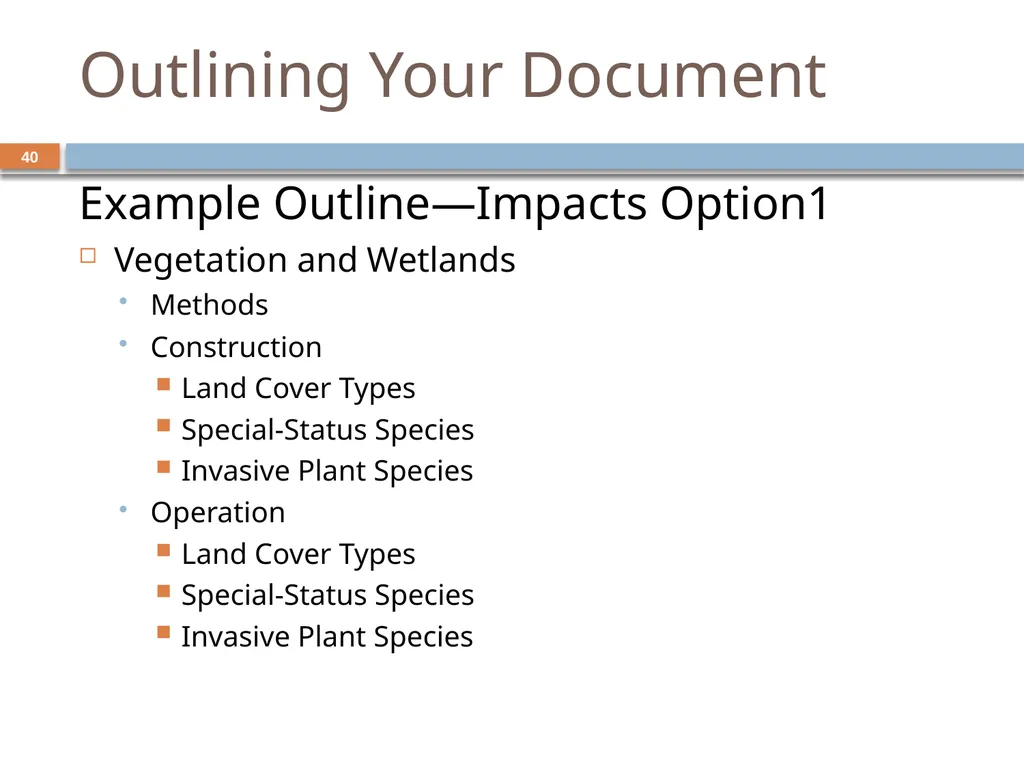
Outlining Your Document Example Outline—Impacts Option1
Vegetation and Wetlands
Methods
Construction
Land Cover Types
Special-Status Species
Invasive Plant Species
Operation
Land Cover Types
Special-Status Species
Invasive Plant Species 40<br>
Vegetation and Wetlands
Methods
Construction
Land Cover Types
Special-Status Species
Invasive Plant Species
Operation
Land Cover Types
Special-Status Species
Invasive Plant Species 40<br>
41
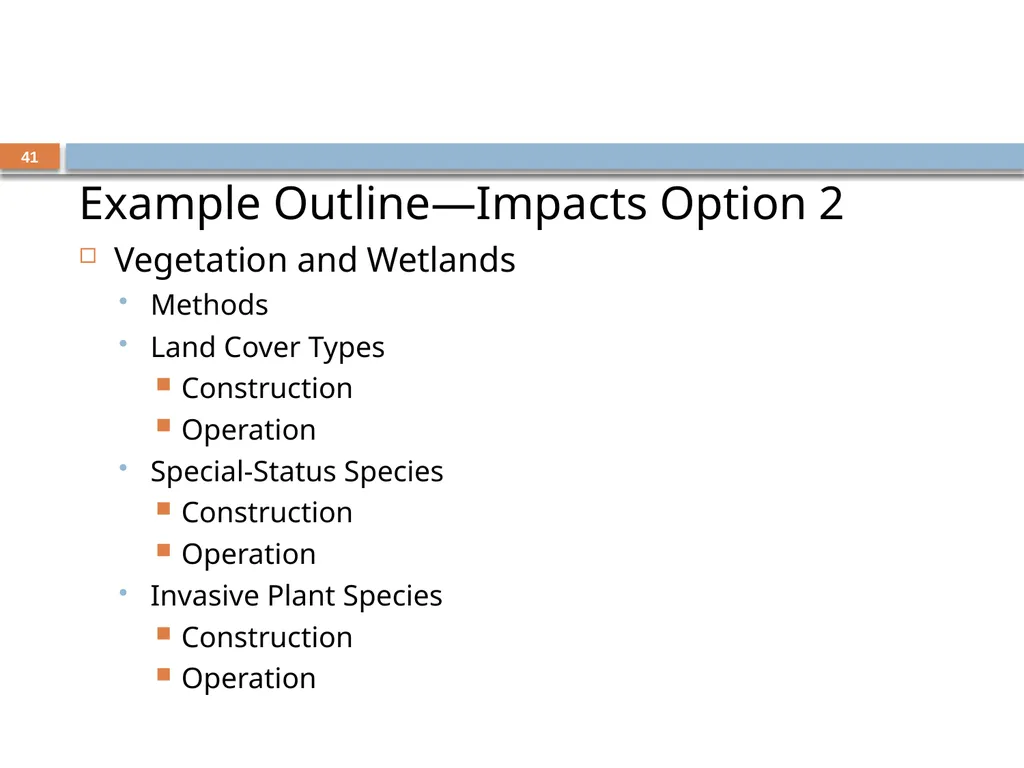
Example Outline—Impacts Option 2
Vegetation and Wetlands
Methods
Land Cover Types
Construction
Operation
Special-Status Species
Construction
Operation
Invasive Plant Species
Construction
Operation 41<br>
Vegetation and Wetlands
Methods
Land Cover Types
Construction
Operation
Special-Status Species
Construction
Operation
Invasive Plant Species
Construction
Operation 41<br>
42
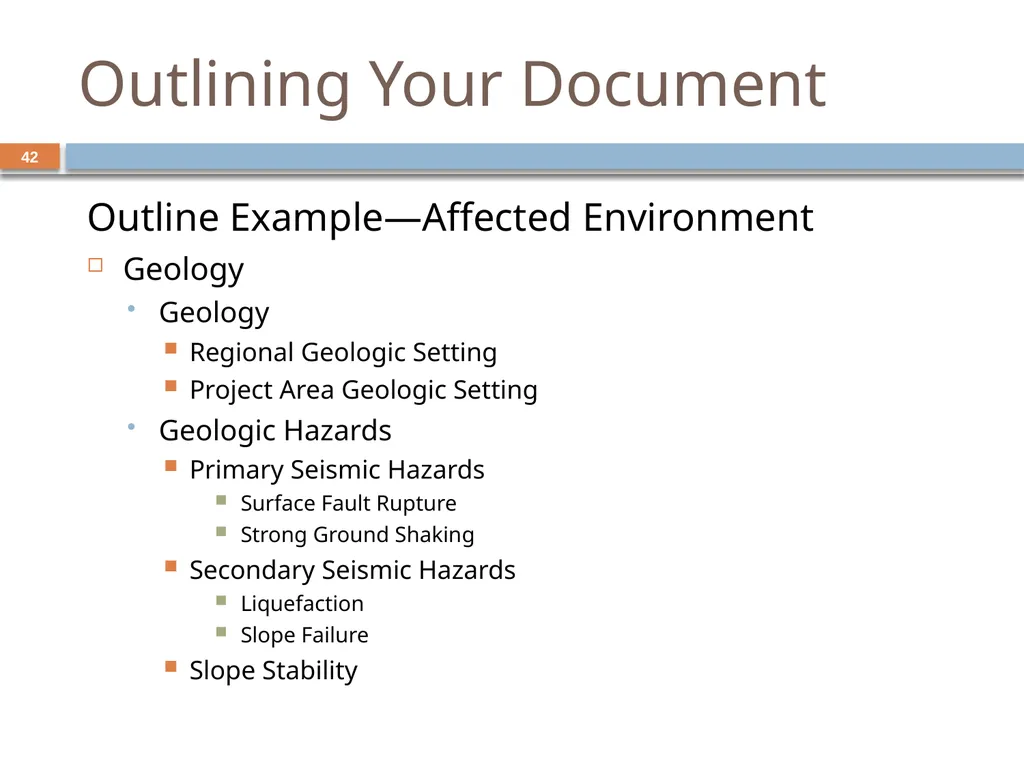
Outlining Your Document Outline Example—Affected Environment
Geology
Geology
Regional Geologic Setting
Project Area Geologic Setting
Geologic Hazards
Primary Seismic Hazards
Surface Fault Rupture
Strong Ground Shaking
Secondary Seismic Hazards
Liquefaction
Slope Failure
Slope Stability 42<br>
Geology
Geology
Regional Geologic Setting
Project Area Geologic Setting
Geologic Hazards
Primary Seismic Hazards
Surface Fault Rupture
Strong Ground Shaking
Secondary Seismic Hazards
Liquefaction
Slope Failure
Slope Stability 42<br>
43
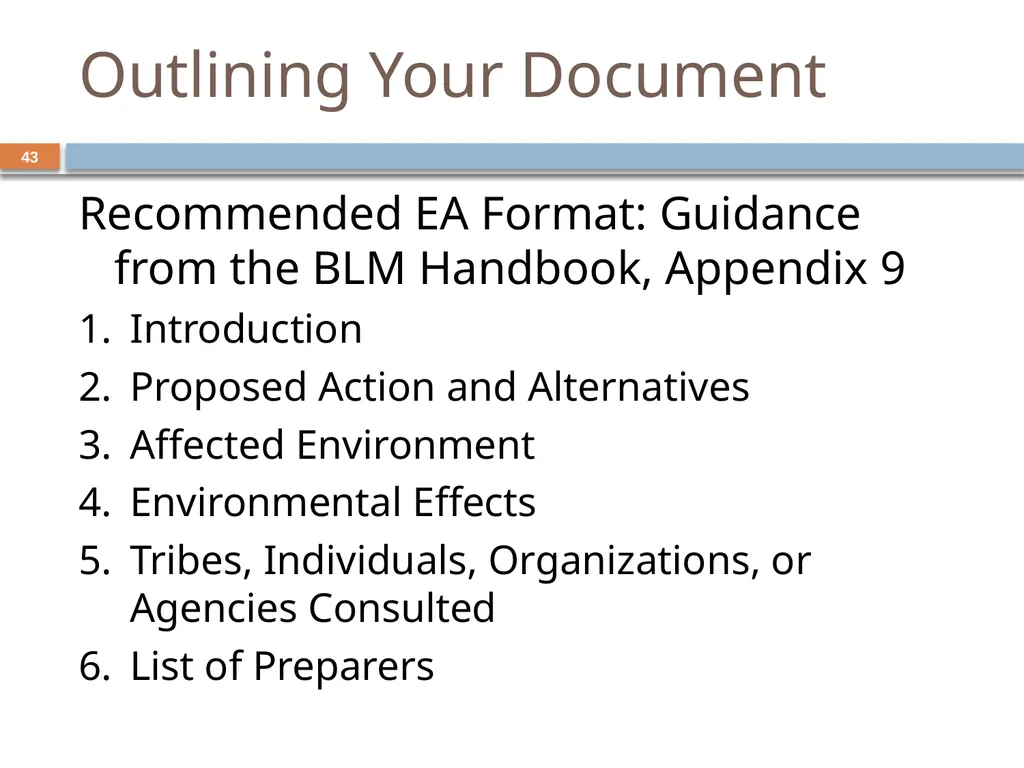
Outlining Your Document Recommended EA Format: Guidance from the BLM Handbook, Appendix 9
1. Introduction
2. Proposed Action and Alternatives
3. Affected Environment
4. Environmental Effects
5. Tribes, Individuals, Organizations, or Agencies Consulted
6. List of Preparers 43<br>
1. Introduction
2. Proposed Action and Alternatives
3. Affected Environment
4. Environmental Effects
5. Tribes, Individuals, Organizations, or Agencies Consulted
6. List of Preparers 43<br>
44
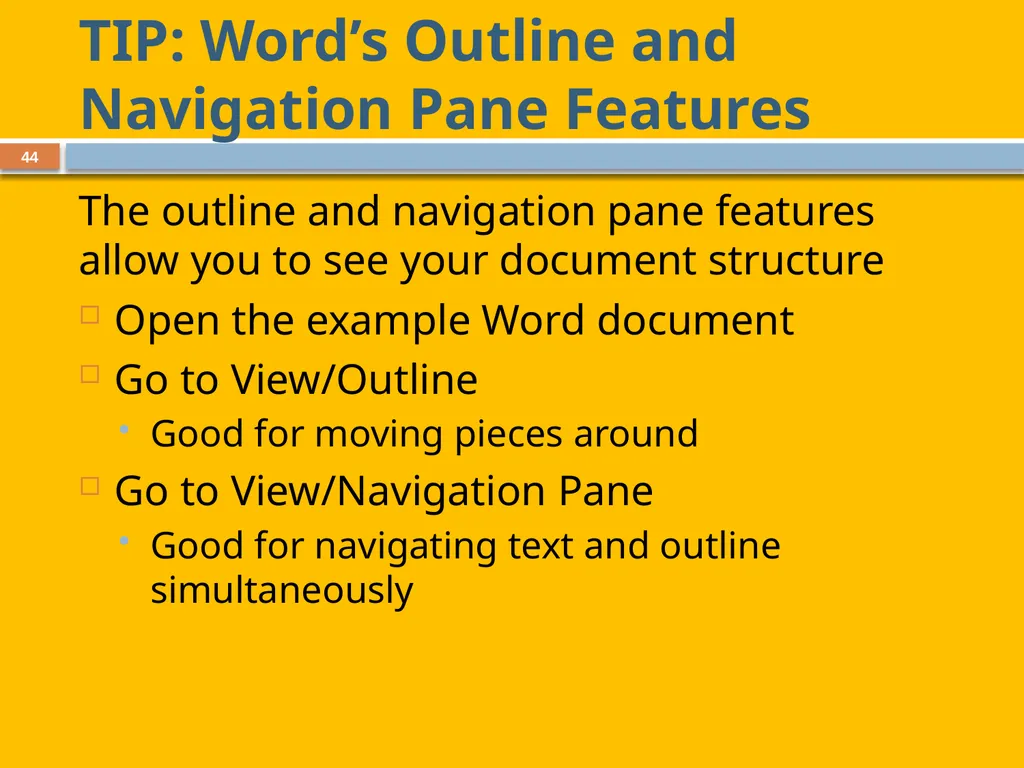
TIP: Word’s Outline and
Navigation Pane Features The outline and navigation pane features allow you to see your document structure
Open the example Word document
Go to View/Outline
Good for moving pieces around
Go to View/Navigation Pane
Good for navigating text and outline simultaneously 44<br>
Open the example Word document
Go to View/Outline
Good for moving pieces around
Go to View/Navigation Pane
Good for navigating text and outline simultaneously 44<br>
45
Exercise: Outlining Review and revise the outline of your document or the example document.
Go to the third-level headings
Make improvements
Take about 20 minutes 45<br>
Go to the third-level headings
Make improvements
Take about 20 minutes 45<br>
46
46<br>
47
Using Questions as a Writing Tool Develop questions under each heading
What information do you need to cover in this section?
Benefits of developing these questions
You can discuss content with your reviewers
Questions lead to topic sentences 47<br>
What information do you need to cover in this section?
Benefits of developing these questions
You can discuss content with your reviewers
Questions lead to topic sentences 47<br>
48
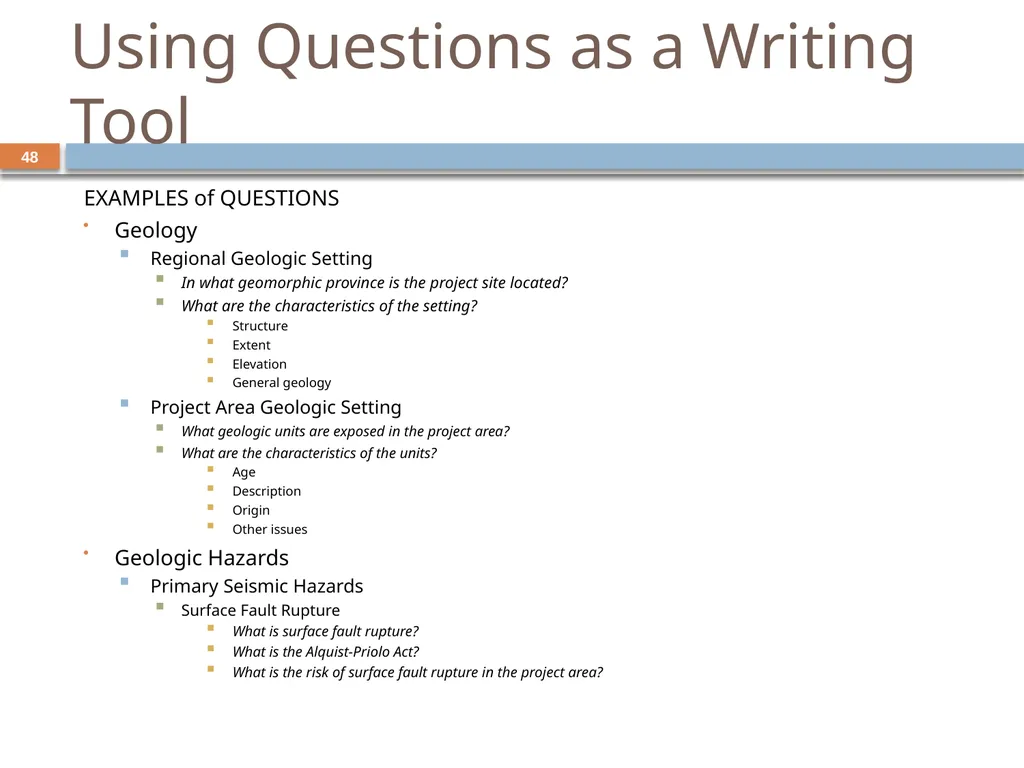
Using Questions as a Writing Tool EXAMPLES of QUESTIONS
Geology
Regional Geologic Setting
In what geomorphic province is the project site located?
What are the characteristics of the setting?
Structure
Extent
Elevation
General geology
Project Area Geologic Setting
What geologic units are exposed in the project area?
What are the characteristics of the units?
Age
Description
Origin
Other issues
Geologic Hazards
Primary Seismic Hazards
Surface Fault Rupture
What is surface fault rupture?
What is the Alquist-Priolo Act?
What is the risk of surface fault rupture in the project area? 48<br>
Geology
Regional Geologic Setting
In what geomorphic province is the project site located?
What are the characteristics of the setting?
Structure
Extent
Elevation
General geology
Project Area Geologic Setting
What geologic units are exposed in the project area?
What are the characteristics of the units?
Age
Description
Origin
Other issues
Geologic Hazards
Primary Seismic Hazards
Surface Fault Rupture
What is surface fault rupture?
What is the Alquist-Priolo Act?
What is the risk of surface fault rupture in the project area? 48<br>
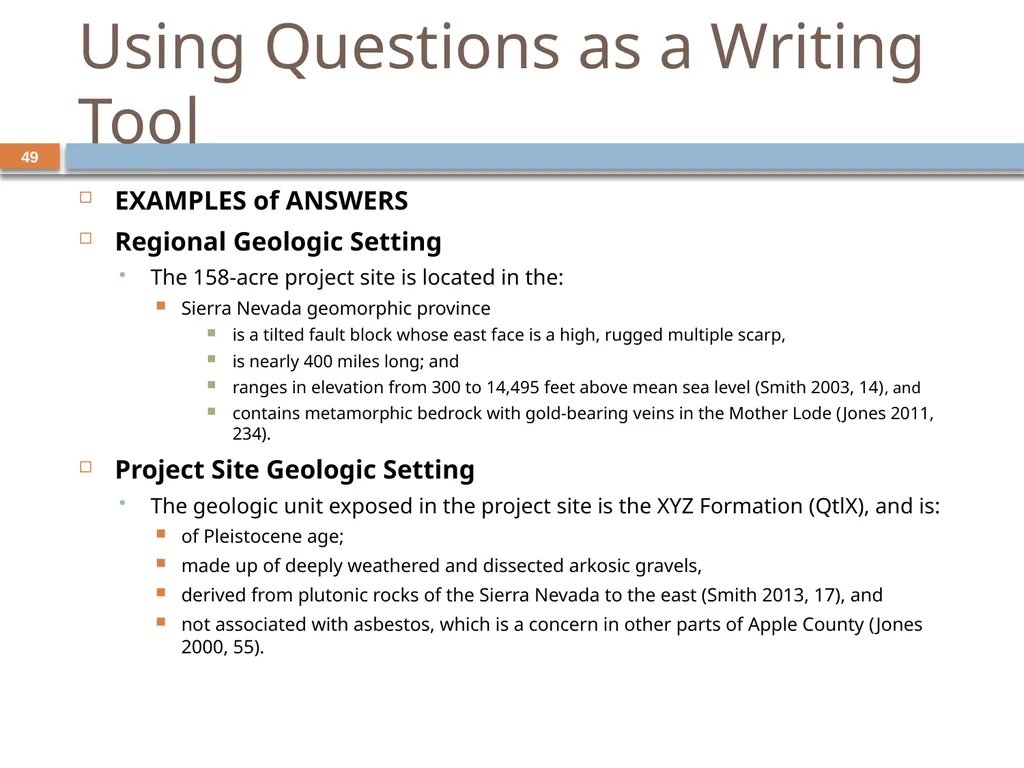
49
Using Questions as a Writing Tool EXAMPLES of ANSWERS
Regional Geologic Setting
The 158-acre project site is located in the:
Sierra Nevada geomorphic province
is a tilted fault block whose east face is a high, rugged multiple scarp,
is nearly 400 miles long; and
ranges in elevation from 300 to 14,495 feet above mean sea level (Smith 2003, 14), and
contains metamorphic bedrock with gold-bearing veins in the Mother Lode (Jones 2011, 234).
Project Site Geologic Setting
The geologic unit exposed in the project site is the XYZ Formation (QtlX), and is:
of Pleistocene age;
made up of deeply weathered and dissected arkosic gravels,
derived from plutonic rocks of the Sierra Nevada to the east (Smith 2013, 17), and
not associated with asbestos, which is a concern in other parts of Apple County (Jones 2000, 55). 49<br>
Regional Geologic Setting
The 158-acre project site is located in the:
Sierra Nevada geomorphic province
is a tilted fault block whose east face is a high, rugged multiple scarp,
is nearly 400 miles long; and
ranges in elevation from 300 to 14,495 feet above mean sea level (Smith 2003, 14), and
contains metamorphic bedrock with gold-bearing veins in the Mother Lode (Jones 2011, 234).
Project Site Geologic Setting
The geologic unit exposed in the project site is the XYZ Formation (QtlX), and is:
of Pleistocene age;
made up of deeply weathered and dissected arkosic gravels,
derived from plutonic rocks of the Sierra Nevada to the east (Smith 2013, 17), and
not associated with asbestos, which is a concern in other parts of Apple County (Jones 2000, 55). 49<br>
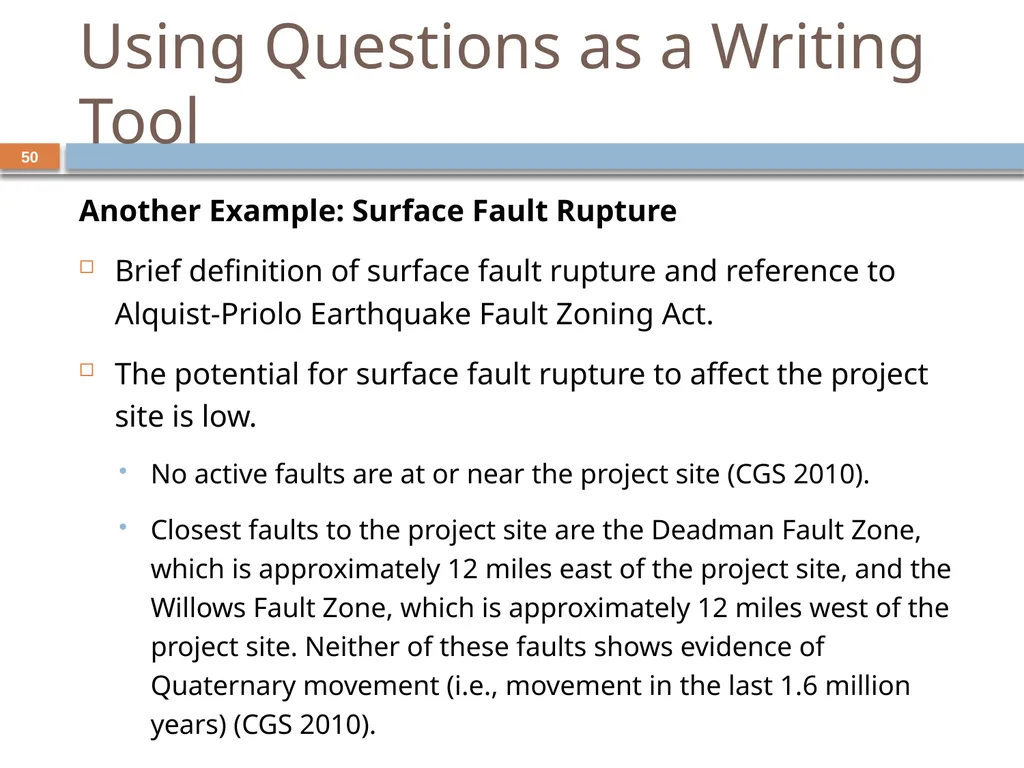
50
Using Questions as a Writing Tool Another Example: Surface Fault Rupture
Brief definition of surface fault rupture and reference to Alquist-Priolo Earthquake Fault Zoning Act.
The potential for surface fault rupture to affect the project site is low.
No active faults are at or near the project site (CGS 2010).
Closest faults to the project site are the Deadman Fault Zone, which is approximately 12 miles east of the project site, and the Willows Fault Zone, which is approximately 12 miles west of the project site. Neither of these faults shows evidence of Quaternary movement (i.e., movement in the last 1.6 million years) (CGS 2010). 50<br>
Brief definition of surface fault rupture and reference to Alquist-Priolo Earthquake Fault Zoning Act.
The potential for surface fault rupture to affect the project site is low.
No active faults are at or near the project site (CGS 2010).
Closest faults to the project site are the Deadman Fault Zone, which is approximately 12 miles east of the project site, and the Willows Fault Zone, which is approximately 12 miles west of the project site. Neither of these faults shows evidence of Quaternary movement (i.e., movement in the last 1.6 million years) (CGS 2010). 50<br>
51
Exercise: Using Questions as a Tool In your own document:
Develop questions under each heading. 51<br>
Develop questions under each heading. 51<br>
52
52<br>
53
Citing Sources Documenting source materials is important for three reasons:
To complete the administrative record and to produce a legally defensible document
To provide reviewers information about source materials that substantiate your analysis
To avoid the risk of plagiarism 53<br>
To complete the administrative record and to produce a legally defensible document
To provide reviewers information about source materials that substantiate your analysis
To avoid the risk of plagiarism 53<br>
54
Citing Sources Correct citation consists of two components
In-text citation
Corresponding reference 54<br>
In-text citation
Corresponding reference 54<br>
55
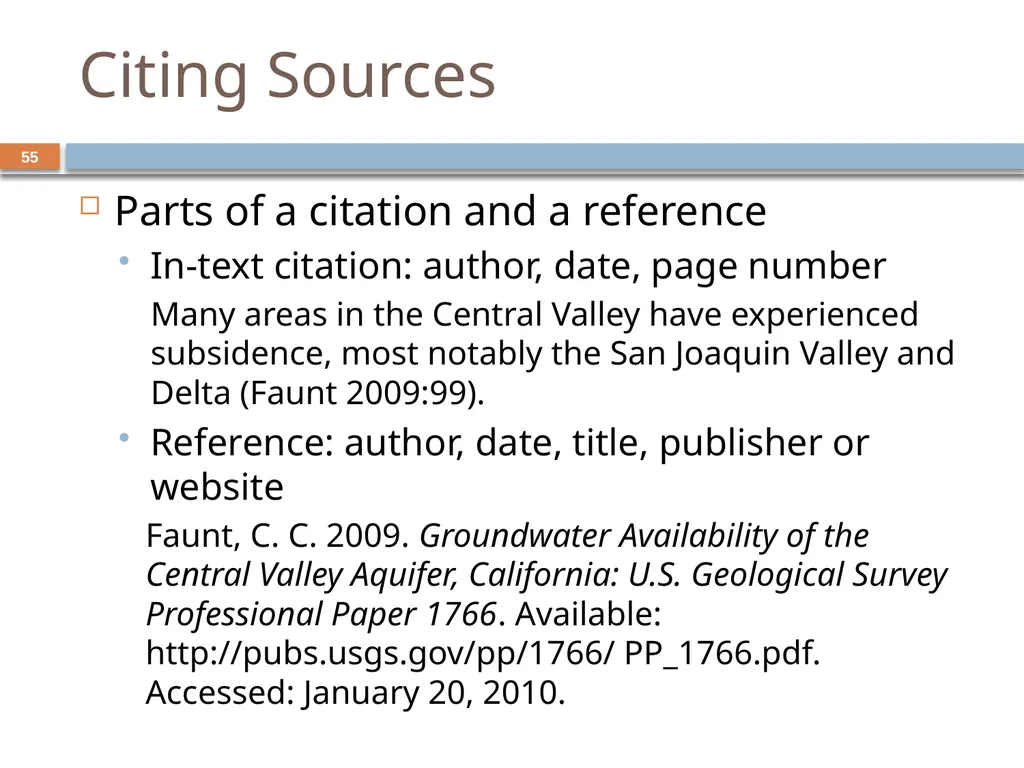
Citing Sources Parts of a citation and a reference
In-text citation: author, date, page number
Many areas in the Central Valley have experienced subsidence, most notably the San Joaquin Valley and Delta (Faunt 2009:99).
Reference: author, date, title, publisher or website
Faunt, C. C. 2009. Groundwater Availability of the Central Valley Aquifer, California: U.S. Geological Survey Professional Paper 1766. Available: http://pubs.usgs.gov/pp/1766/ PP_1766.pdf. Accessed: January 20, 2010. 55<br>
In-text citation: author, date, page number
Many areas in the Central Valley have experienced subsidence, most notably the San Joaquin Valley and Delta (Faunt 2009:99).
Reference: author, date, title, publisher or website
Faunt, C. C. 2009. Groundwater Availability of the Central Valley Aquifer, California: U.S. Geological Survey Professional Paper 1766. Available: http://pubs.usgs.gov/pp/1766/ PP_1766.pdf. Accessed: January 20, 2010. 55<br>
56
Citing Sources What do you NOT need to cite?
Common knowledge
Facts, proverbs, familiar expressions, and information generally accepted as “common knowledge” in a specific discipline require no citation unless they are taken verbatim from another source
On April 14, 1865, a few days after Lee’s surrender, Lincoln was assassinated.
Common knowledge depends on context 56<br>
Common knowledge
Facts, proverbs, familiar expressions, and information generally accepted as “common knowledge” in a specific discipline require no citation unless they are taken verbatim from another source
On April 14, 1865, a few days after Lee’s surrender, Lincoln was assassinated.
Common knowledge depends on context 56<br>
57
Citing Sources What do you NOT need to cite?
Material you authored
If the source material was authored by your agency, no in-text citation is needed (other than for sources embedded in the borrowed text)
Direct verbatim quotation from someone in your agency is permissible without quotation marks 57<br>
Material you authored
If the source material was authored by your agency, no in-text citation is needed (other than for sources embedded in the borrowed text)
Direct verbatim quotation from someone in your agency is permissible without quotation marks 57<br>
58
Citing Sources What do you NEED to cite?
Direct quotations
The secondary source that reports on, summarizes, or interprets your primary resource
The ideas, concepts, or underlying arguments that support your analysis, whether you summarize, paraphrase, or quote them 58<br>
Direct quotations
The secondary source that reports on, summarizes, or interprets your primary resource
The ideas, concepts, or underlying arguments that support your analysis, whether you summarize, paraphrase, or quote them 58<br>
59
Citing Sources What constitutes plagiarism?
Copying the text, verbatim, of another source without proper citation
Copying the idea, data, or results of another source without proper citation (theft of intellectual property)
Plagiarism is an act of fraud 59<br>
Copying the text, verbatim, of another source without proper citation
Copying the idea, data, or results of another source without proper citation (theft of intellectual property)
Plagiarism is an act of fraud 59<br>
60
Citing Sources Where are we at greatest risk for plagiarism?
Copying text from websites
Copying text from old reports 60<br>
Copying text from websites
Copying text from old reports 60<br>
61
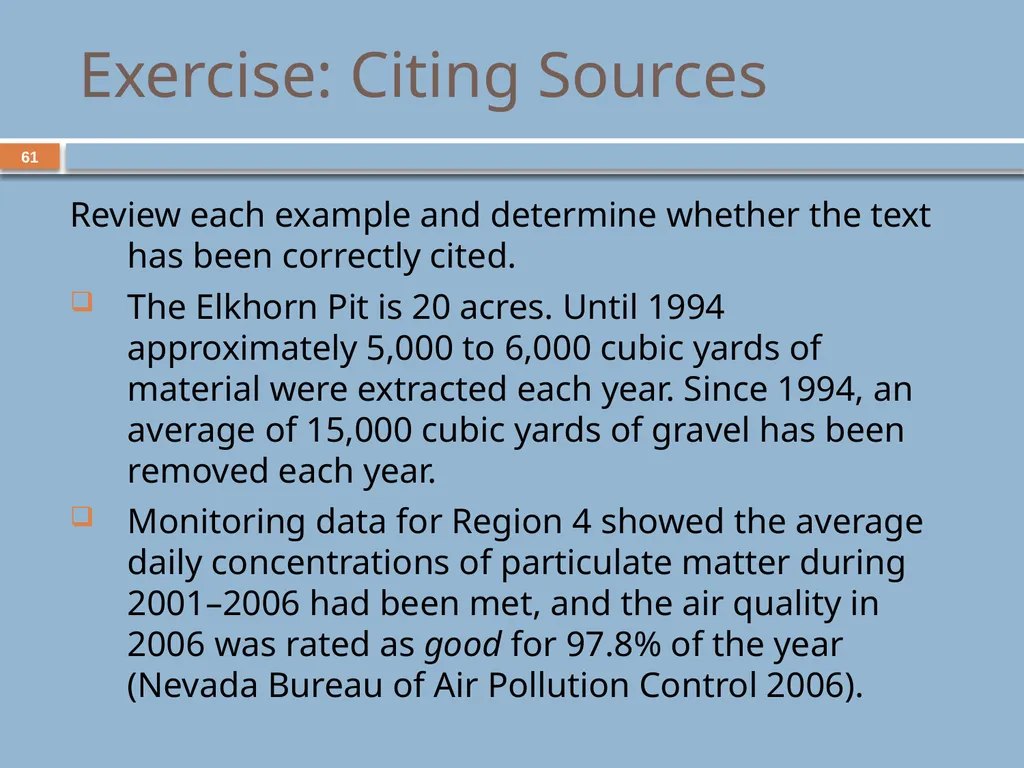
Exercise: Citing Sources Review each example and determine whether the text has been correctly cited.
The Elkhorn Pit is 20 acres. Until 1994 approximately 5,000 to 6,000 cubic yards of material were extracted each year. Since 1994, an average of 15,000 cubic yards of gravel has been removed each year.
Monitoring data for Region 4 showed the average daily concentrations of particulate matter during 2001–2006 had been met, and the air quality in 2006 was rated as good for 97.8% of the year (Nevada Bureau of Air Pollution Control 2006). 61<br>
The Elkhorn Pit is 20 acres. Until 1994 approximately 5,000 to 6,000 cubic yards of material were extracted each year. Since 1994, an average of 15,000 cubic yards of gravel has been removed each year.
Monitoring data for Region 4 showed the average daily concentrations of particulate matter during 2001–2006 had been met, and the air quality in 2006 was rated as good for 97.8% of the year (Nevada Bureau of Air Pollution Control 2006). 61<br>
62
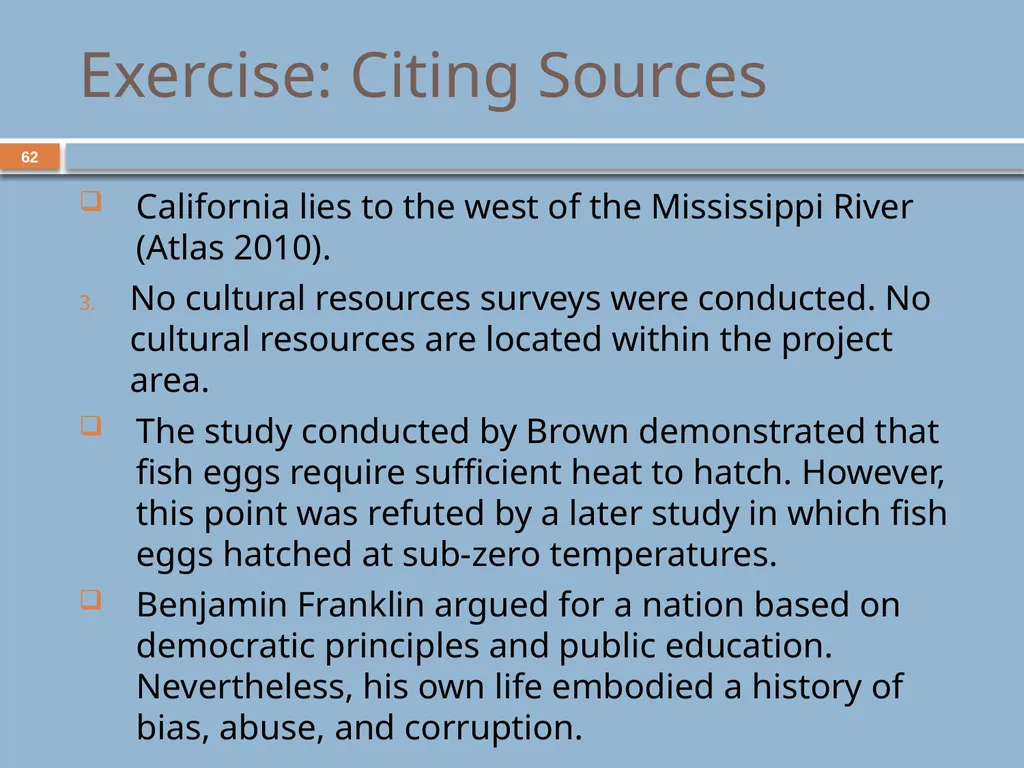
Exercise: Citing Sources California lies to the west of the Mississippi River (Atlas 2010).
No cultural resources surveys were conducted. No cultural resources are located within the project area.
The study conducted by Brown demonstrated that fish eggs require sufficient heat to hatch. However, this point was refuted by a later study in which fish eggs hatched at sub-zero temperatures.
Benjamin Franklin argued for a nation based on democratic principles and public education. Nevertheless, his own life embodied a history of bias, abuse, and corruption. 62<br>
No cultural resources surveys were conducted. No cultural resources are located within the project area.
The study conducted by Brown demonstrated that fish eggs require sufficient heat to hatch. However, this point was refuted by a later study in which fish eggs hatched at sub-zero temperatures.
Benjamin Franklin argued for a nation based on democratic principles and public education. Nevertheless, his own life embodied a history of bias, abuse, and corruption. 62<br>
63
Citing Sources As You Write Your Document
Track sources from the start of your research
Developing a source list can help you get a good overview of your approach
Watching the list grow can reinforce your sense of accomplishment and competency
Tracking the references from the beginning saves you from the onerous job of assembling the information after you’ve finished writing 63<br>
Track sources from the start of your research
Developing a source list can help you get a good overview of your approach
Watching the list grow can reinforce your sense of accomplishment and competency
Tracking the references from the beginning saves you from the onerous job of assembling the information after you’ve finished writing 63<br>
64
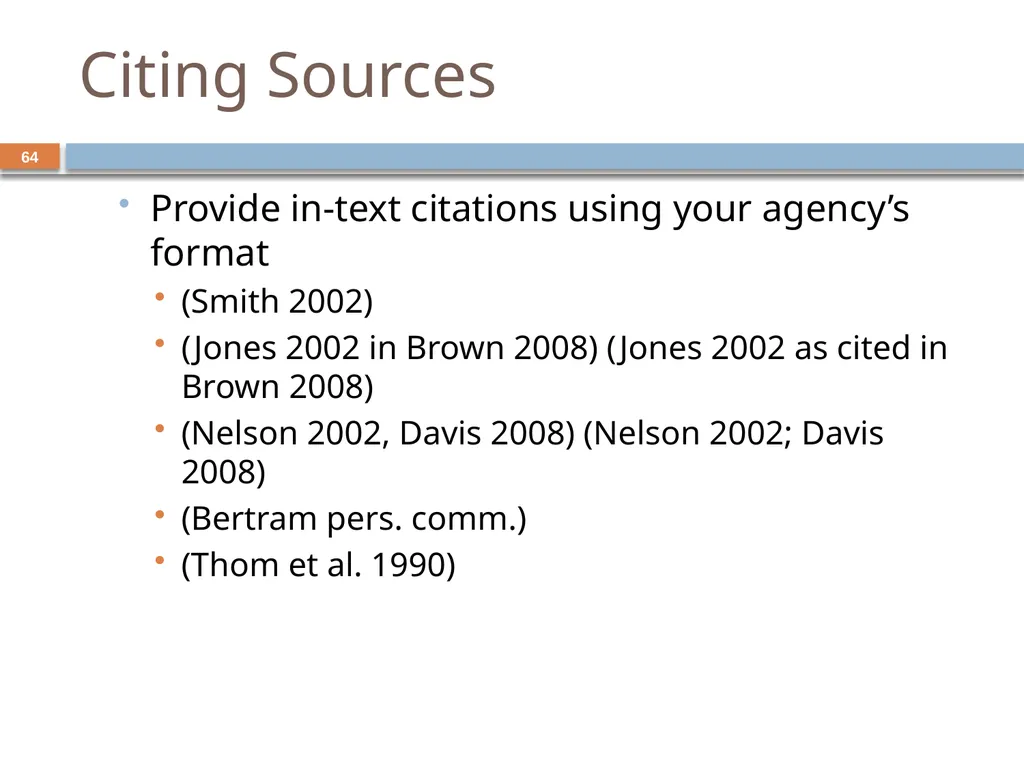
Citing Sources Provide in-text citations using your agency’s format
(Smith 2002)
(Jones 2002 in Brown 2008) (Jones 2002 as cited in Brown 2008)
(Nelson 2002, Davis 2008) (Nelson 2002; Davis 2008)
(Bertram pers. comm.)
(Thom et al. 1990) 64<br>
(Smith 2002)
(Jones 2002 in Brown 2008) (Jones 2002 as cited in Brown 2008)
(Nelson 2002, Davis 2008) (Nelson 2002; Davis 2008)
(Bertram pers. comm.)
(Thom et al. 1990) 64<br>
65
Citing Sources Develop a template for each item in your bibliography
book
monograph or other bound publication in a series
report (including government reports)
journal article
published dissertation
web page 65<br>
book
monograph or other bound publication in a series
report (including government reports)
journal article
published dissertation
web page 65<br>
66
Citing Sources Style Manuals
MLA (Modern Language Association; see http://www.mla.org/style and http://owl.english.purdue.edu/owl/resource/557/01/)
APA (American Psychological Association; see http://apastyle.apa.org/ and http://owl.english.purdue.edu/owl/resource/560/01/)
Chicago Manual of Style (see http://www.chicagomanualofstyle.org/tools_citationguide.html)
The OWL at Purdue
http://owl.english.purdue.edu/owl/resource/696/01/ 66<br>
MLA (Modern Language Association; see http://www.mla.org/style and http://owl.english.purdue.edu/owl/resource/557/01/)
APA (American Psychological Association; see http://apastyle.apa.org/ and http://owl.english.purdue.edu/owl/resource/560/01/)
Chicago Manual of Style (see http://www.chicagomanualofstyle.org/tools_citationguide.html)
The OWL at Purdue
http://owl.english.purdue.edu/owl/resource/696/01/ 66<br>
67
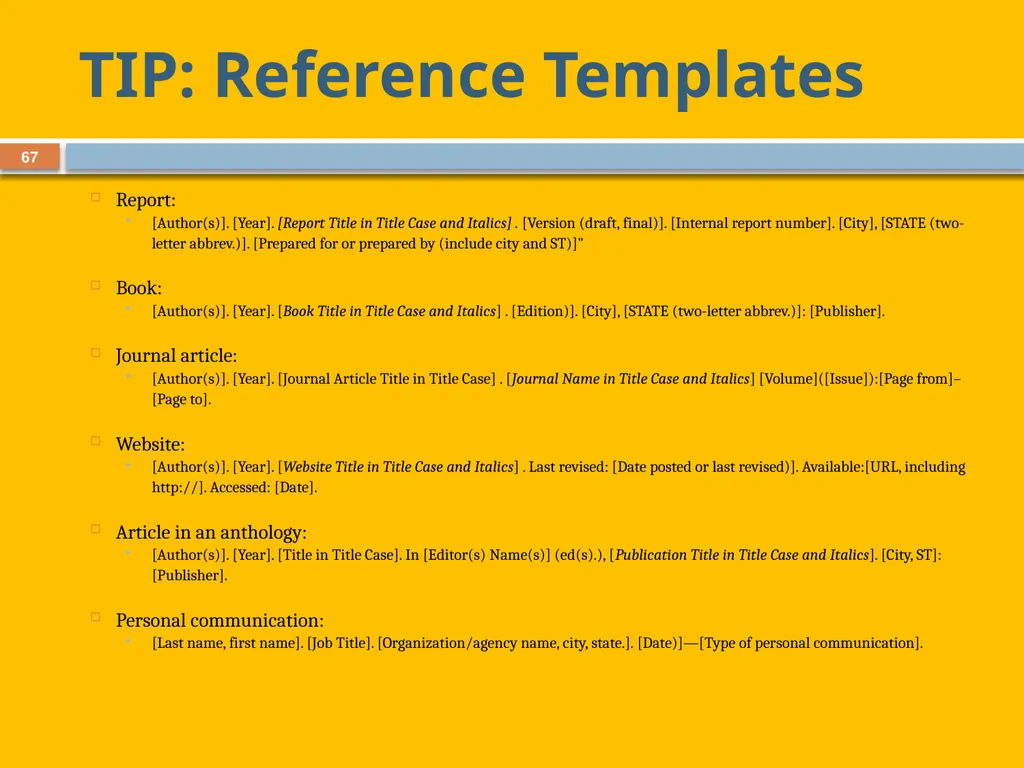
TIP: Reference Templates Report:
[Author(s)]. [Year]. [Report Title in Title Case and Italics] . [Version (draft, final)]. [Internal report number]. [City], [STATE (two-letter abbrev.)]. [Prepared for or prepared by (include city and ST)]"
Book:
[Author(s)]. [Year]. [Book Title in Title Case and Italics] . [Edition)]. [City], [STATE (two-letter abbrev.)]: [Publisher].
Journal article:
[Author(s)]. [Year]. [Journal Article Title in Title Case] . [Journal Name in Title Case and Italics] [Volume]([Issue]):[Page from]–[Page to].
Website:
[Author(s)]. [Year]. [Website Title in Title Case and Italics] . Last revised: [Date posted or last revised)]. Available:[URL, including http://]. Accessed: [Date].
Article in an anthology:
[Author(s)]. [Year]. [Title in Title Case]. In [Editor(s) Name(s)] (ed(s).), [Publication Title in Title Case and Italics]. [City, ST]: [Publisher].
Personal communication:
[Last name, first name]. [Job Title]. [Organization/agency name, city, state.]. [Date)]—[Type of personal communication]. 67<br>
[Author(s)]. [Year]. [Report Title in Title Case and Italics] . [Version (draft, final)]. [Internal report number]. [City], [STATE (two-letter abbrev.)]. [Prepared for or prepared by (include city and ST)]"
Book:
[Author(s)]. [Year]. [Book Title in Title Case and Italics] . [Edition)]. [City], [STATE (two-letter abbrev.)]: [Publisher].
Journal article:
[Author(s)]. [Year]. [Journal Article Title in Title Case] . [Journal Name in Title Case and Italics] [Volume]([Issue]):[Page from]–[Page to].
Website:
[Author(s)]. [Year]. [Website Title in Title Case and Italics] . Last revised: [Date posted or last revised)]. Available:[URL, including http://]. Accessed: [Date].
Article in an anthology:
[Author(s)]. [Year]. [Title in Title Case]. In [Editor(s) Name(s)] (ed(s).), [Publication Title in Title Case and Italics]. [City, ST]: [Publisher].
Personal communication:
[Last name, first name]. [Job Title]. [Organization/agency name, city, state.]. [Date)]—[Type of personal communication]. 67<br>
68
TIP: Word’s Reference Ribbon, Quick Parts, and Clipboard References ribbon lets you insert citations
Clipboard lets you copy multiple items and paste them as you need them
Quick parts lets you build in automation 68<br>
Clipboard lets you copy multiple items and paste them as you need them
Quick parts lets you build in automation 68<br>
69
Exercise: References Select three documents and write a citation and reference for each one.
Choose different types of references—books, unpublished reports, web sites, personal communications. 69<br>
Choose different types of references—books, unpublished reports, web sites, personal communications. 69<br>
70
70<br>
71
Chapter 1 Prewriting: Review Determining Document Needs
Identifying Your Audience
Getting Started
Establishing Parallelism
Outlining Your Document
Using Questions as a Writing Tool
Citing Sources
Questions? 71<br>
Identifying Your Audience
Getting Started
Establishing Parallelism
Outlining Your Document
Using Questions as a Writing Tool
Citing Sources
Questions? 71<br>
72
Goodnight! 72<br>
73
Chapter 2–Writing 73<br>
74
Chapter 2 Writing Why Good Writing Matters
Paragraph and Topic Sentences
Passive versus Active Voice
Wordiness and Foggy Writing
Grammar
Punctuation
Style
Commonly Misused Words and Phrases
Numbers 74<br>
Paragraph and Topic Sentences
Passive versus Active Voice
Wordiness and Foggy Writing
Grammar
Punctuation
Style
Commonly Misused Words and Phrases
Numbers 74<br>
75
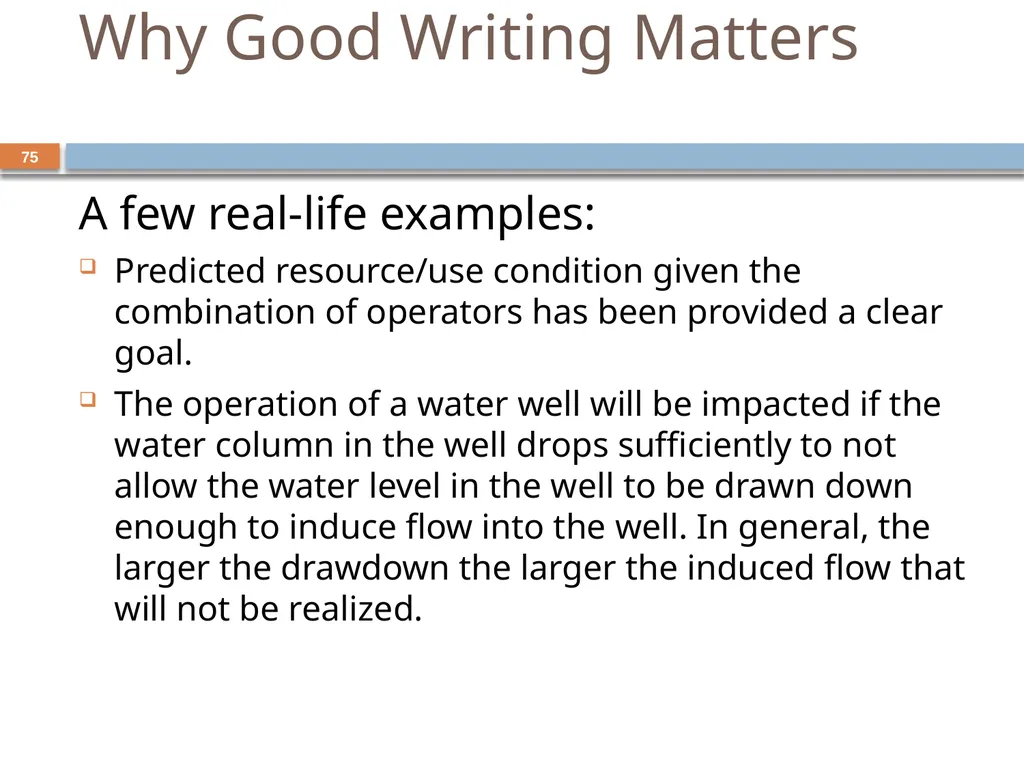
Why Good Writing Matters A few real-life examples:
Predicted resource/use condition given the combination of operators has been provided a clear goal.
The operation of a water well will be impacted if the water column in the well drops sufficiently to not allow the water level in the well to be drawn down enough to induce flow into the well. In general, the larger the drawdown the larger the induced flow that will not be realized. 75<br>
Predicted resource/use condition given the combination of operators has been provided a clear goal.
The operation of a water well will be impacted if the water column in the well drops sufficiently to not allow the water level in the well to be drawn down enough to induce flow into the well. In general, the larger the drawdown the larger the induced flow that will not be realized. 75<br>
76
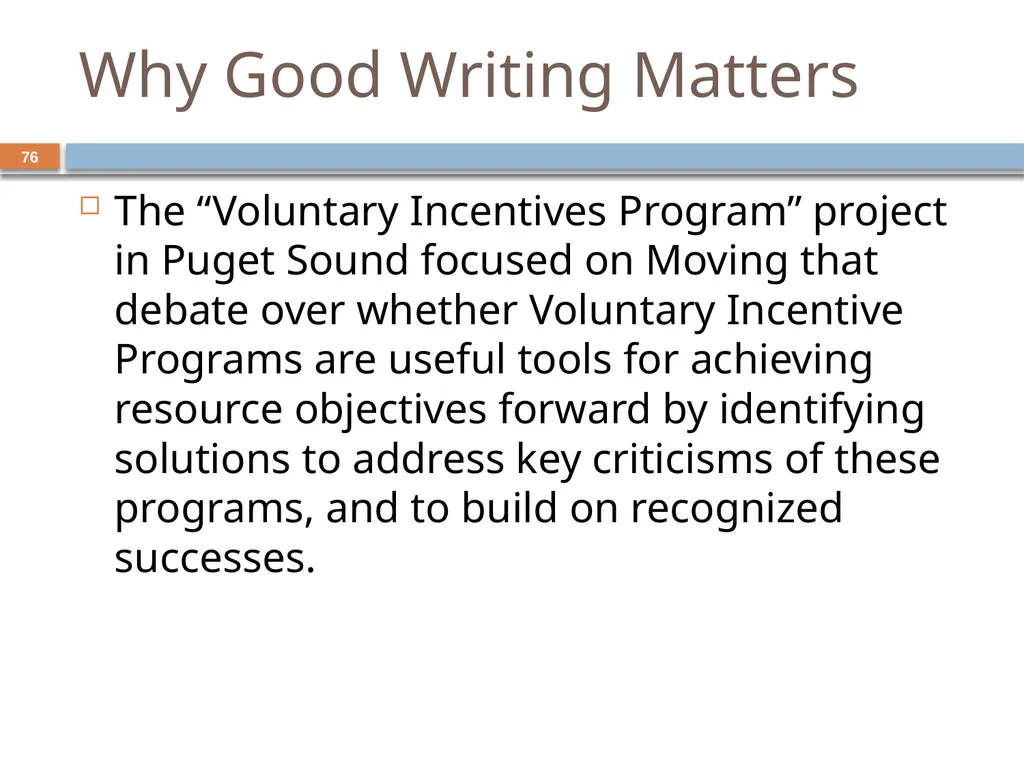
Why Good Writing Matters The “Voluntary Incentives Program” project in Puget Sound focused on Moving that debate over whether Voluntary Incentive Programs are useful tools for achieving resource objectives forward by identifying solutions to address key criticisms of these programs, and to build on recognized successes. 76<br>
77
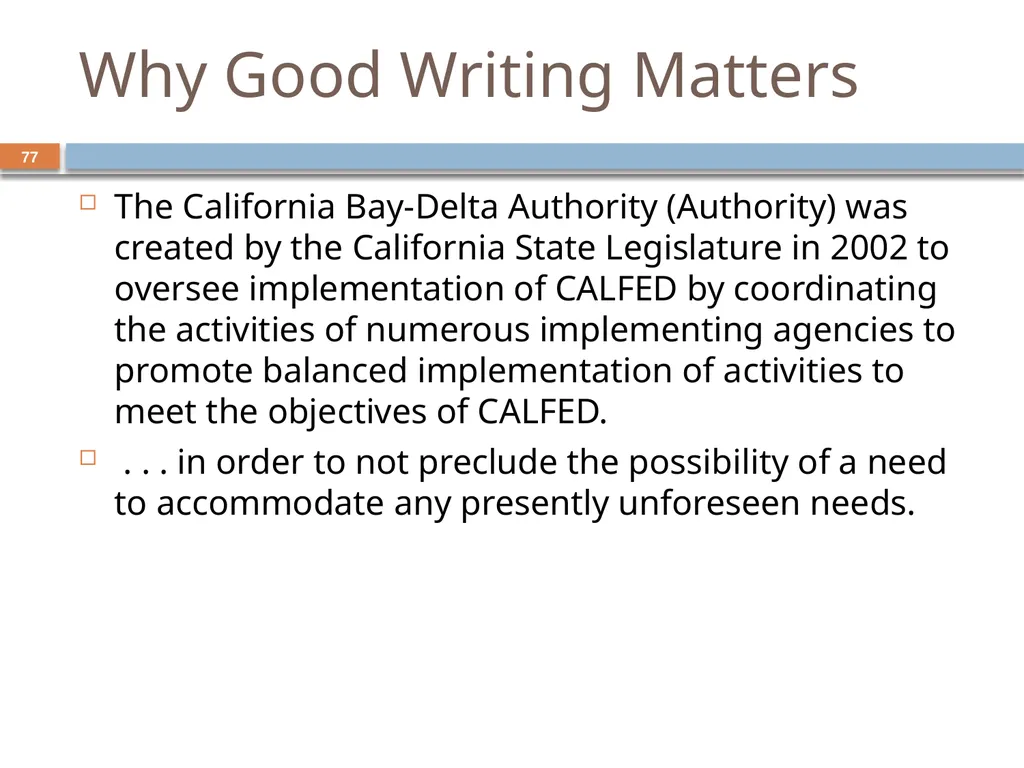
Why Good Writing Matters The California Bay-Delta Authority (Authority) was created by the California State Legislature in 2002 to oversee implementation of CALFED by coordinating the activities of numerous implementing agencies to promote balanced implementation of activities to meet the objectives of CALFED.
. . . in order to not preclude the possibility of a need to accommodate any presently unforeseen needs. 77<br>
. . . in order to not preclude the possibility of a need to accommodate any presently unforeseen needs. 77<br>
78
78<br>
79
Paragraph and Topic Sentences Focus on a main point
A paragraph should be unified around a main point. The main point should be clear to the reader, and all sentences in the paragraph must relate to it. 79<br>
A paragraph should be unified around a main point. The main point should be clear to the reader, and all sentences in the paragraph must relate to it. 79<br>
80
Paragraph and Topic Sentences Summarize the main point in a topic sentence
Generally, the topic sentence appears first
It tells the reader where you are going
It helps the reader remember or refer back to your point
It enables the skimmer to find information quickly 80<br>
Generally, the topic sentence appears first
It tells the reader where you are going
It helps the reader remember or refer back to your point
It enables the skimmer to find information quickly 80<br>
81
Paragraph and Topic Sentences Topic sentences can also appear later
Transitional sentences at the beginning of paragraphs
Topic sentence withheld until the end of the paragraph
Paragraph is descriptive and does not need a topic sentence
Topic sentence is not needed if a paragraph continues to develop an idea clearly introduced in a previous paragraph
Most paragraphs need a topic sentence! 81<br>
Transitional sentences at the beginning of paragraphs
Topic sentence withheld until the end of the paragraph
Paragraph is descriptive and does not need a topic sentence
Topic sentence is not needed if a paragraph continues to develop an idea clearly introduced in a previous paragraph
Most paragraphs need a topic sentence! 81<br>
82
Paragraph and Topic Sentences Laura’s favorite topic sentences:
Call me Ishmael. (Herman Melville, Moby Dick, 1851)
It was the best of times, it was the worst of times, it was the age of wisdom, it was the age of foolishness, it was the epoch of belief, it was the epoch of incredulity, it was the season of Light, it was the season of Darkness, it was the spring of hope, it was the winter of despair. (Charles Dickens, A Tale of Two Cities, 1859)
Ellen’s favorite topic sentence:
Some of the strongest evidence for transgenerational inheritance (…) in humans comes from the survivors of the Dutch Hunger Winter. (Natural History 6/12) 82<br>
Call me Ishmael. (Herman Melville, Moby Dick, 1851)
It was the best of times, it was the worst of times, it was the age of wisdom, it was the age of foolishness, it was the epoch of belief, it was the epoch of incredulity, it was the season of Light, it was the season of Darkness, it was the spring of hope, it was the winter of despair. (Charles Dickens, A Tale of Two Cities, 1859)
Ellen’s favorite topic sentence:
Some of the strongest evidence for transgenerational inheritance (…) in humans comes from the survivors of the Dutch Hunger Winter. (Natural History 6/12) 82<br>
83
Paragraph and Topic Sentences Organizing your paragraph
Examples and illustrations (most common)
Narration
Description
Process (usually describing how to do something)
Comparison and contrast
Analogy
Cause and effect
Classification and division
Definition 83<br>
Examples and illustrations (most common)
Narration
Description
Process (usually describing how to do something)
Comparison and contrast
Analogy
Cause and effect
Classification and division
Definition 83<br>
84
Paragraph and Topic Sentences Here is an example of a classification paragraph:
Scientists sort electric fishes into two categories. The first comprises the strongly electric species such as the marine electric rays or the South American electric eel; these deliver a punch strong enough to stun a human. In recent years, biologists have focused on a second category: weakly electric fish in the South American and African rivers that use tiny voltages for communication and navigation. —Anne Rudloe and Jack Rudloe, “Electric Warfare: The Fish That Kill with Thunderbolts” 84<br>
Scientists sort electric fishes into two categories. The first comprises the strongly electric species such as the marine electric rays or the South American electric eel; these deliver a punch strong enough to stun a human. In recent years, biologists have focused on a second category: weakly electric fish in the South American and African rivers that use tiny voltages for communication and navigation. —Anne Rudloe and Jack Rudloe, “Electric Warfare: The Fish That Kill with Thunderbolts” 84<br>
85
Paragraph and Topic Sentences Arranging the information
Chronological order
Spatial order
Dramatic order (building toward a conclusion)
Order of complexity (from simple to complex)
Order of familiarity (from most familiar to least familiar)
Order of audience appeal (from safe ideas to ideas that may challenge the audience’s views) 85<br>
Chronological order
Spatial order
Dramatic order (building toward a conclusion)
Order of complexity (from simple to complex)
Order of familiarity (from most familiar to least familiar)
Order of audience appeal (from safe ideas to ideas that may challenge the audience’s views) 85<br>
86
Paragraph and Topic Sentences Reasons for beginning a new paragraph
To shift to a new idea after the preceding one has been fully developed
To signal the introduction or conclusion
To highlight a contrast
To provide readers with a needed pause
To break up text that looks too dense 86<br>
To shift to a new idea after the preceding one has been fully developed
To signal the introduction or conclusion
To highlight a contrast
To provide readers with a needed pause
To break up text that looks too dense 86<br>
87
Paragraph and Topic Sentences Reasons for combining paragraphs
To sustain the reader’s momentum
To clarify the essay’s organization
To connect closely related ideas
To bind together text that looks too choppy 87<br>
To sustain the reader’s momentum
To clarify the essay’s organization
To connect closely related ideas
To bind together text that looks too choppy 87<br>
88
Paragraph and Topic Sentences BLM Paragraph Example
Reclamation will be completed on areas that are depleted of gravel and are no longer needed for processing or stockpiling. The area will be appropriately contoured, adequate drainage provided, and topsoil put back and seeded to plant species identified by the authorized officer. If needed, seeding shall be repeated until appropriate ground cover is established as determined by the authorized officer. Unwanted material would be buried on site. 88<br>
Reclamation will be completed on areas that are depleted of gravel and are no longer needed for processing or stockpiling. The area will be appropriately contoured, adequate drainage provided, and topsoil put back and seeded to plant species identified by the authorized officer. If needed, seeding shall be repeated until appropriate ground cover is established as determined by the authorized officer. Unwanted material would be buried on site. 88<br>
89
Exercise: Paragraphs and Topic Sentences Select one of the paragraphs from Exercise 2, Paragraph/Topic Sentence.
Read the paragraph closely to determine the topic sentence. Not all the paragraphs will have a topic sentence; if yours doesn’t, devise one.
Reorganize, rearrange, revise as needed.
Make sure the paragraph focuses on a main point.
Take about 20 minutes. 89<br>
Read the paragraph closely to determine the topic sentence. Not all the paragraphs will have a topic sentence; if yours doesn’t, devise one.
Reorganize, rearrange, revise as needed.
Make sure the paragraph focuses on a main point.
Take about 20 minutes. 89<br>
90
90<br>
91
Passive versus Active Voice The active voice emphasizes the actor while the passive voice emphasizes the action and the thing being acted upon
The active voice makes writing clear and direct
The passive voice is acceptable if the action is more important than the actor (as in scientific and technical documents)
The main problem with passive is that it obscures who is doing the acting (mistakes were made, it was decided), which obscures responsibility for the action 91<br>
The active voice makes writing clear and direct
The passive voice is acceptable if the action is more important than the actor (as in scientific and technical documents)
The main problem with passive is that it obscures who is doing the acting (mistakes were made, it was decided), which obscures responsibility for the action 91<br>
92
Passive versus Active Voice Passive or Active Voice in a NEPA Document?
Purpose and Need
Proposed Project and Alternatives
Resource Analysis
Study Area
Methods
Affected Environment
Impacts
Mitigation 92<br>
Purpose and Need
Proposed Project and Alternatives
Resource Analysis
Study Area
Methods
Affected Environment
Impacts
Mitigation 92<br>
93
Exercise: Passive versus Active Voice Determine whether active or passive voice is acceptable for each sentence and rephrase as necessary.
Another unnamed drainage, which originates from irrigation runoff, is crossed by the siphon near the outlet.
The levee is dominated by nonnative annual grasses.
No special-status plants were observed in the study area.
A new process for eliminating nitrogen oxides from diesel engines is presented in this article. 93<br>
Another unnamed drainage, which originates from irrigation runoff, is crossed by the siphon near the outlet.
The levee is dominated by nonnative annual grasses.
No special-status plants were observed in the study area.
A new process for eliminating nitrogen oxides from diesel engines is presented in this article. 93<br>
94
94<br>
95
Wordiness and Foggy Writing Example
Therefore, given that the daily management of water exports to limit entrainment under the existing conditions also would occur under the proposed project, it is concluded that there is no effect of the proposed project in changing this stressor for larval and juvenile fish. 95<br>
Therefore, given that the daily management of water exports to limit entrainment under the existing conditions also would occur under the proposed project, it is concluded that there is no effect of the proposed project in changing this stressor for larval and juvenile fish. 95<br>
96
Wordiness and Foggy Writing Eliminate weak verbs or verbs converted to noun phrases
Example
The BLM cannot make the revisions of the document in time.
Revision
The BLM cannot revise the document in time.
Example
The BLM completed the authorization of the plan last week.
Revision
The BLM authorized the plan last week. 96<br>
Example
The BLM cannot make the revisions of the document in time.
Revision
The BLM cannot revise the document in time.
Example
The BLM completed the authorization of the plan last week.
Revision
The BLM authorized the plan last week. 96<br>
97
Wordiness and Foggy Writing Avoid noun strings
Example
The draft water quality standard pollutant inputs are complete.
Revision
The pollutant inputs for the draft version of the water quality standards are complete. 97<br>
Example
The draft water quality standard pollutant inputs are complete.
Revision
The pollutant inputs for the draft version of the water quality standards are complete. 97<br>
98
Wordiness and Foggy Writing Eliminate unnecessary words
A sufficient number of vs. enough
On a monthly basis vs. monthly
In order to vs. to
It is important to note that….
Eliminate unnecessary modifiers
Totally redundant vs. redundant
Really tired vs. tired
Particularly important vs. important
Completely done vs. done 98<br>
A sufficient number of vs. enough
On a monthly basis vs. monthly
In order to vs. to
It is important to note that….
Eliminate unnecessary modifiers
Totally redundant vs. redundant
Really tired vs. tired
Particularly important vs. important
Completely done vs. done 98<br>
99
Wordiness and Foggy Writing Use terms consistently
Example
The greater sandhill crane is a large bird that depends on shallow-water habitat. During the day, the crane forages near shallow water for grain. At night, the GSHC roosts in shallow water to avoid predators such as coyotes.
Revisions
The greater sandhill crane is a large bird that depends on shallow-water habitat. During the day, the crane forages near shallow water for grain. At night, the crane roosts in shallow water to avoid predators such as coyotes.
The greater sandhill crane (GSHC) is a large bird that depends on shallow-water habitat. During the day, the GSHC forages near shallow water for grain. At night, the GSHC roosts in shallow water to avoid predators such as coyotes. 99<br>
Example
The greater sandhill crane is a large bird that depends on shallow-water habitat. During the day, the crane forages near shallow water for grain. At night, the GSHC roosts in shallow water to avoid predators such as coyotes.
Revisions
The greater sandhill crane is a large bird that depends on shallow-water habitat. During the day, the crane forages near shallow water for grain. At night, the crane roosts in shallow water to avoid predators such as coyotes.
The greater sandhill crane (GSHC) is a large bird that depends on shallow-water habitat. During the day, the GSHC forages near shallow water for grain. At night, the GSHC roosts in shallow water to avoid predators such as coyotes. 99<br>
100
Use terms consistently (continued)
Example
The well site would be leveled and surfaced with mineral material. All areas not needed for production would be reclaimed by removing the caliche, recontouring the area, spreading the stockpiled topsoil over the area, and seeding the area.
Revision
The well site would be leveled and surfaced with mineral material. All areas not needed for production would be reclaimed by removing the mineral material, recontouring the area, spreading the stockpiled topsoil over the area, and seeding the area. 100<br>
Example
The well site would be leveled and surfaced with mineral material. All areas not needed for production would be reclaimed by removing the caliche, recontouring the area, spreading the stockpiled topsoil over the area, and seeding the area.
Revision
The well site would be leveled and surfaced with mineral material. All areas not needed for production would be reclaimed by removing the mineral material, recontouring the area, spreading the stockpiled topsoil over the area, and seeding the area. 100<br>
101
Exercise: Wordiness and Foggy Writing Revise the sentence below for clarity and brevity.
Therefore, given that the daily management of water exports to limit entrainment under the existing conditions also would occur under the proposed project, it is concluded that there is no effect of the proposed project in changing this stressor for larval and juvenile fish. 101<br>
Therefore, given that the daily management of water exports to limit entrainment under the existing conditions also would occur under the proposed project, it is concluded that there is no effect of the proposed project in changing this stressor for larval and juvenile fish. 101<br>
102
Exercise: Wordiness and Foggy Writing Revision
Because the proposed project would also manage water exports to limit entrainment, the proposed project would not affect this stressor. 102<br>
Because the proposed project would also manage water exports to limit entrainment, the proposed project would not affect this stressor. 102<br>
103
103<br>
104
Grammar Grammar rules address the correct use of parts of speech and their organization into meaningful sentences
Grammar rules can evolve over time
Grammar rules are less flexible than style rules 104<br>
Grammar rules can evolve over time
Grammar rules are less flexible than style rules 104<br>
105
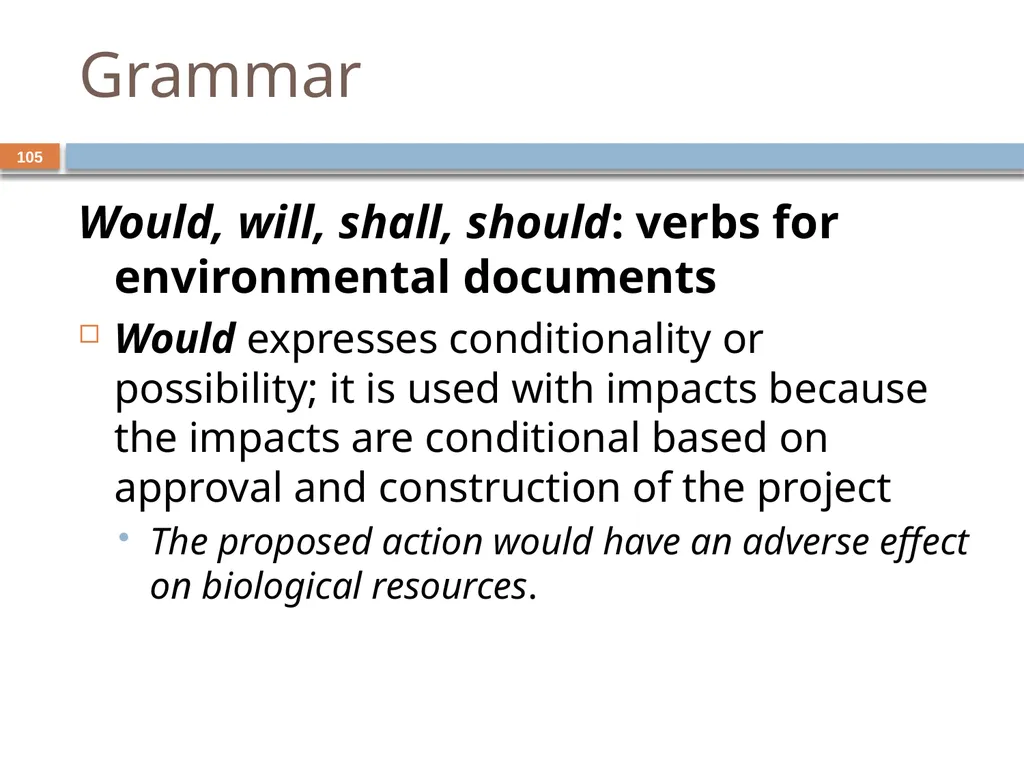
Grammar Would, will, shall, should: verbs for environmental documents
Would expresses conditionality or possibility; it is used with impacts because the impacts are conditional based on approval and construction of the project
The proposed action would have an adverse effect on biological resources. 105<br>
Would expresses conditionality or possibility; it is used with impacts because the impacts are conditional based on approval and construction of the project
The proposed action would have an adverse effect on biological resources. 105<br>
106
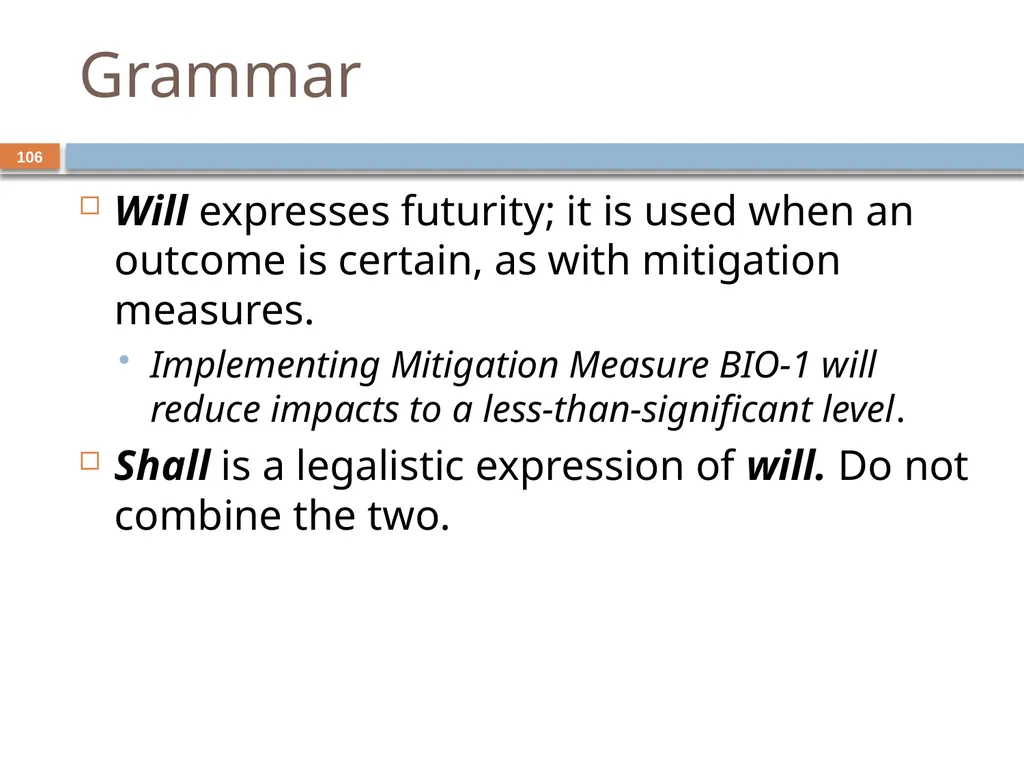
Grammar Will expresses futurity; it is used when an outcome is certain, as with mitigation measures.
Implementing Mitigation Measure BIO-1 will reduce impacts to a less-than-significant level.
Shall is a legalistic expression of will. Do not combine the two. 106<br>
Implementing Mitigation Measure BIO-1 will reduce impacts to a less-than-significant level.
Shall is a legalistic expression of will. Do not combine the two. 106<br>
107
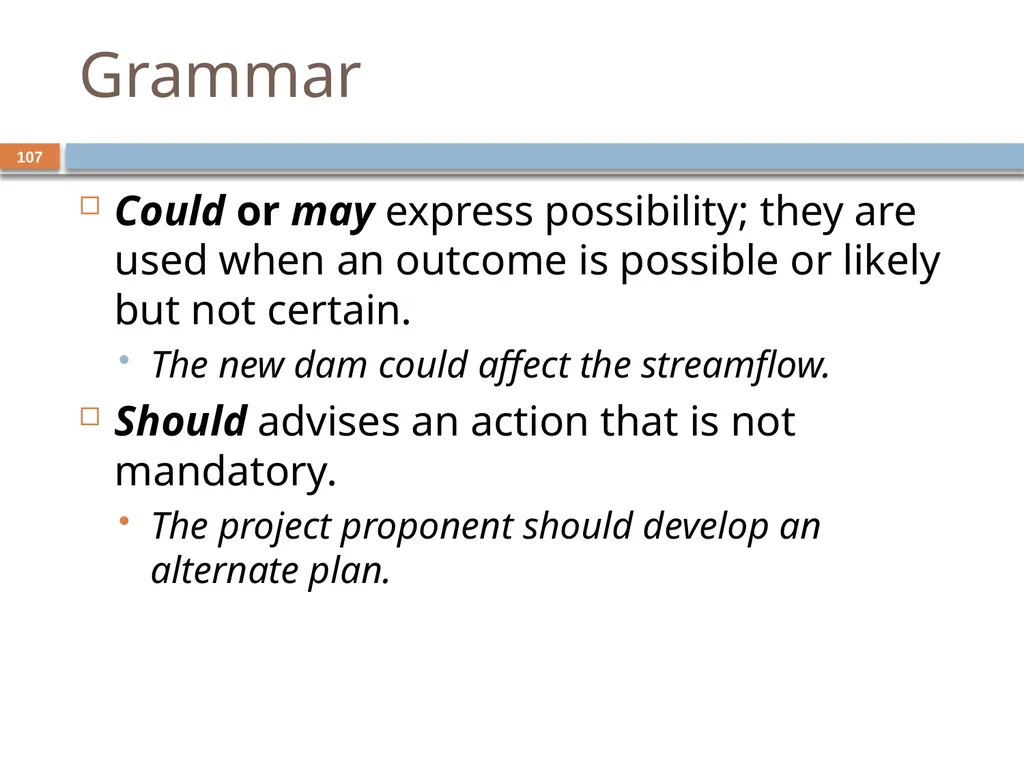
Grammar Could or may express possibility; they are used when an outcome is possible or likely but not certain.
The new dam could affect the streamflow.
Should advises an action that is not mandatory.
The project proponent should develop an alternate plan. 107<br>
The new dam could affect the streamflow.
Should advises an action that is not mandatory.
The project proponent should develop an alternate plan. 107<br>
108
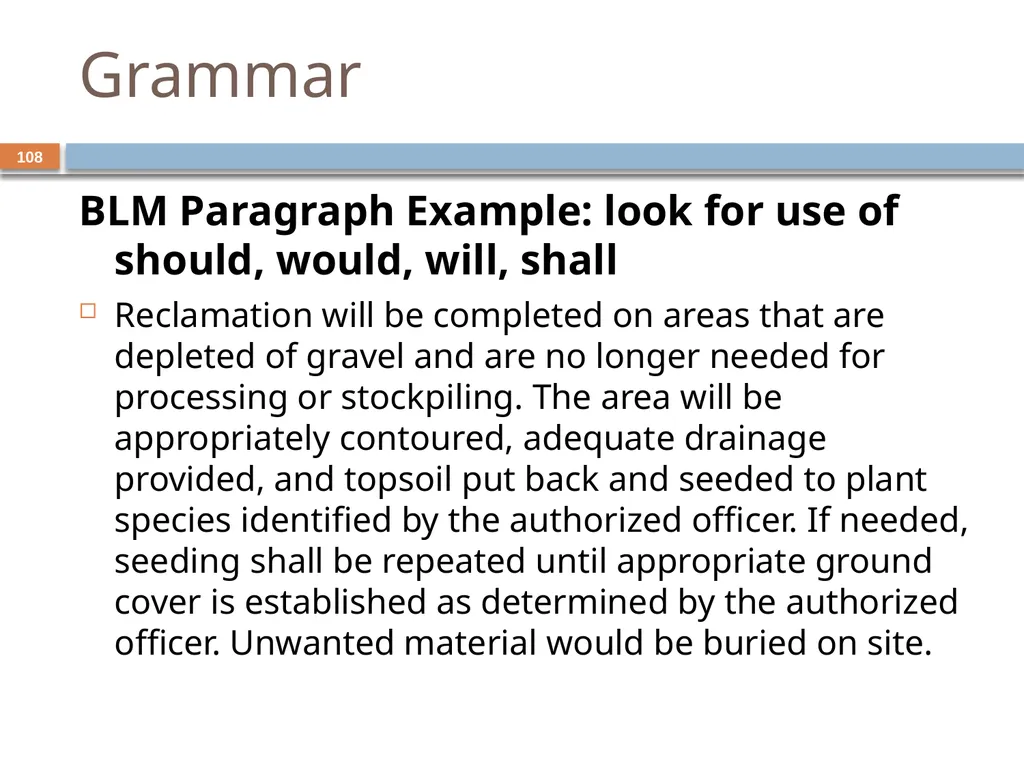
Grammar BLM Paragraph Example: look for use of should, would, will, shall
Reclamation will be completed on areas that are depleted of gravel and are no longer needed for processing or stockpiling. The area will be appropriately contoured, adequate drainage provided, and topsoil put back and seeded to plant species identified by the authorized officer. If needed, seeding shall be repeated until appropriate ground cover is established as determined by the authorized officer. Unwanted material would be buried on site. 108<br>
Reclamation will be completed on areas that are depleted of gravel and are no longer needed for processing or stockpiling. The area will be appropriately contoured, adequate drainage provided, and topsoil put back and seeded to plant species identified by the authorized officer. If needed, seeding shall be repeated until appropriate ground cover is established as determined by the authorized officer. Unwanted material would be buried on site. 108<br>
109
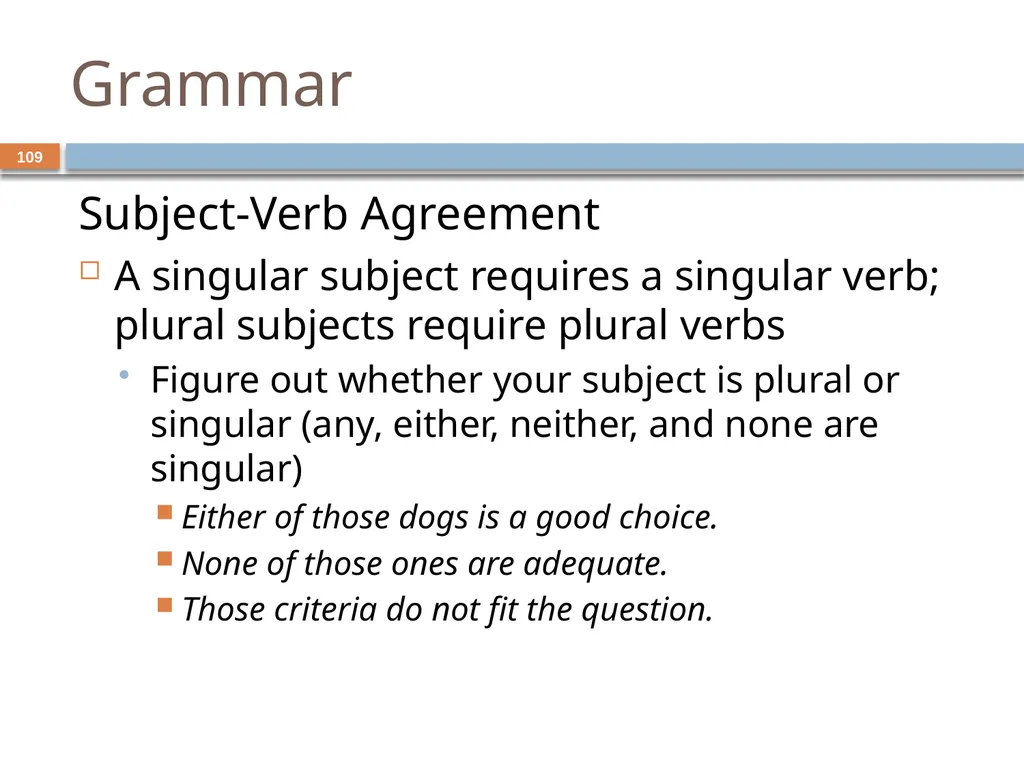
Grammar Subject-Verb Agreement
A singular subject requires a singular verb; plural subjects require plural verbs
Figure out whether your subject is plural or singular (any, either, neither, and none are singular)
Either of those dogs is a good choice.
None of those ones are adequate.
Those criteria do not fit the question. 109<br>
A singular subject requires a singular verb; plural subjects require plural verbs
Figure out whether your subject is plural or singular (any, either, neither, and none are singular)
Either of those dogs is a good choice.
None of those ones are adequate.
Those criteria do not fit the question. 109<br>
110
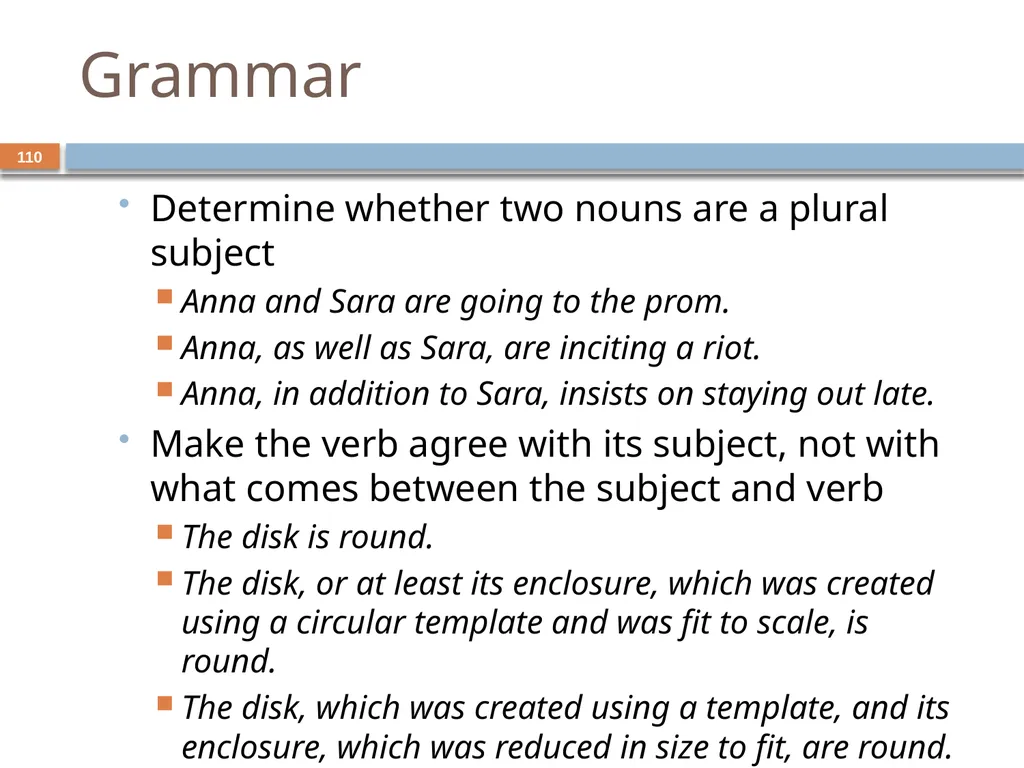
Grammar Determine whether two nouns are a plural subject
Anna and Sara are going to the prom.
Anna, as well as Sara, are inciting a riot.
Anna, in addition to Sara, insists on staying out late.
Make the verb agree with its subject, not with what comes between the subject and verb
The disk is round.
The disk, or at least its enclosure, which was created using a circular template and was fit to scale, is round.
The disk, which was created using a template, and its enclosure, which was reduced in size to fit, are round. 110<br>
Anna and Sara are going to the prom.
Anna, as well as Sara, are inciting a riot.
Anna, in addition to Sara, insists on staying out late.
Make the verb agree with its subject, not with what comes between the subject and verb
The disk is round.
The disk, or at least its enclosure, which was created using a circular template and was fit to scale, is round.
The disk, which was created using a template, and its enclosure, which was reduced in size to fit, are round. 110<br>
111
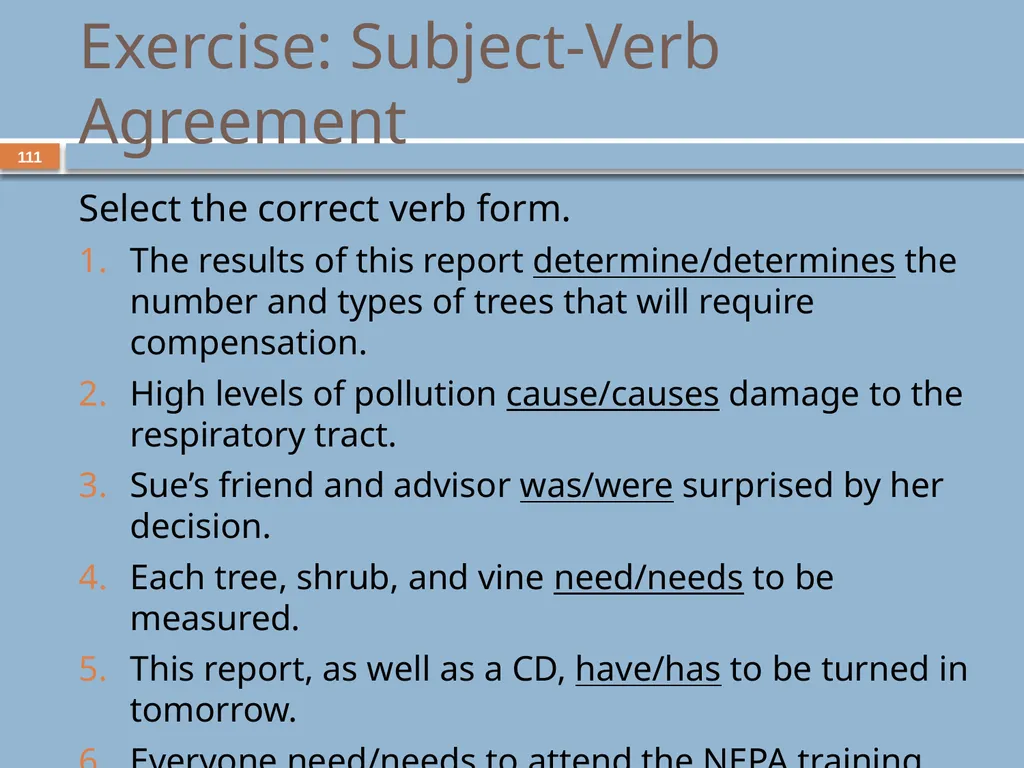
Exercise: Subject-Verb Agreement Select the correct verb form.
The results of this report determine/determines the number and types of trees that will require compensation.
High levels of pollution cause/causes damage to the respiratory tract.
Sue’s friend and advisor was/were surprised by her decision.
Each tree, shrub, and vine need/needs to be measured.
This report, as well as a CD, have/has to be turned in tomorrow.
Everyone need/needs to attend the NEPA training. 111<br>
The results of this report determine/determines the number and types of trees that will require compensation.
High levels of pollution cause/causes damage to the respiratory tract.
Sue’s friend and advisor was/were surprised by her decision.
Each tree, shrub, and vine need/needs to be measured.
This report, as well as a CD, have/has to be turned in tomorrow.
Everyone need/needs to attend the NEPA training. 111<br>
112
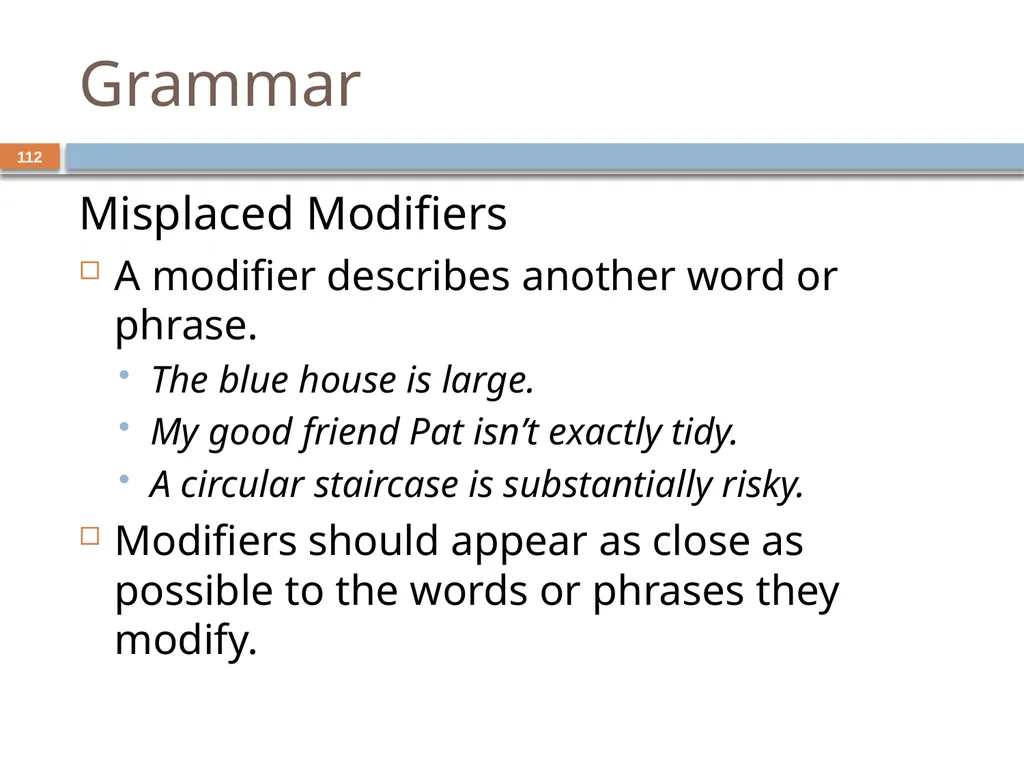
Grammar Misplaced Modifiers
A modifier describes another word or phrase.
The blue house is large.
My good friend Pat isn’t exactly tidy.
A circular staircase is substantially risky.
Modifiers should appear as close as possible to the words or phrases they modify. 112<br>
A modifier describes another word or phrase.
The blue house is large.
My good friend Pat isn’t exactly tidy.
A circular staircase is substantially risky.
Modifiers should appear as close as possible to the words or phrases they modify. 112<br>
113
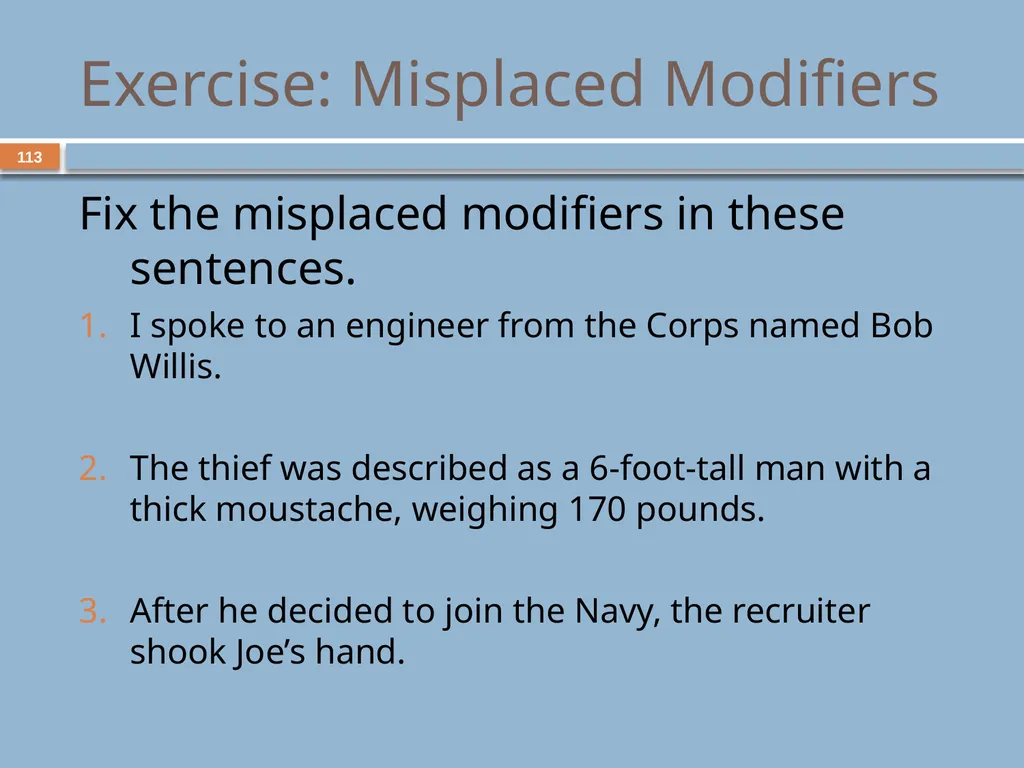
Exercise: Misplaced Modifiers Fix the misplaced modifiers in these sentences.
I spoke to an engineer from the Corps named Bob Willis.
The thief was described as a 6-foot-tall man with a thick moustache, weighing 170 pounds.
After he decided to join the Navy, the recruiter shook Joe’s hand. 113<br>
I spoke to an engineer from the Corps named Bob Willis.
The thief was described as a 6-foot-tall man with a thick moustache, weighing 170 pounds.
After he decided to join the Navy, the recruiter shook Joe’s hand. 113<br>
114
Grammar Split infinitives
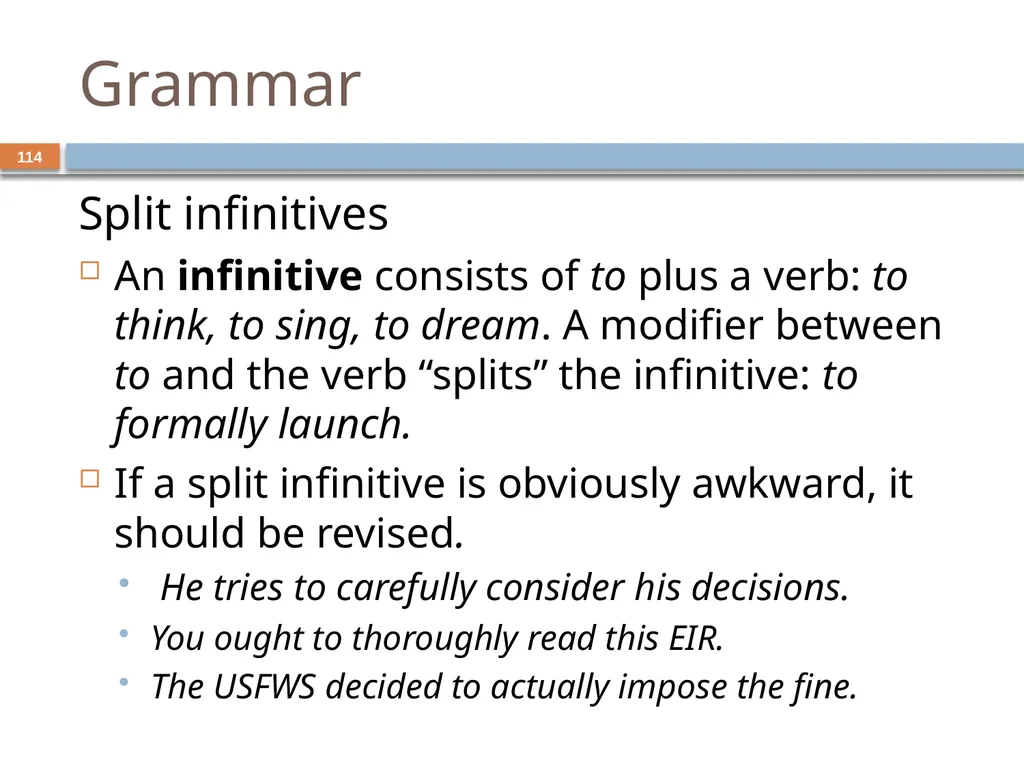
An infinitive consists of to plus a verb: to think, to sing, to dream. A modifier between to and the verb “splits” the infinitive: to formally launch.
If a split infinitive is obviously awkward, it should be revised.
He tries to carefully consider his decisions.
You ought to thoroughly read this EIR.
The USFWS decided to actually impose the fine. 114<br>
An infinitive consists of to plus a verb: to think, to sing, to dream. A modifier between to and the verb “splits” the infinitive: to formally launch.
If a split infinitive is obviously awkward, it should be revised.
He tries to carefully consider his decisions.
You ought to thoroughly read this EIR.
The USFWS decided to actually impose the fine. 114<br>
115
Grammar That versus which: restrictive and nonrestrictive clauses
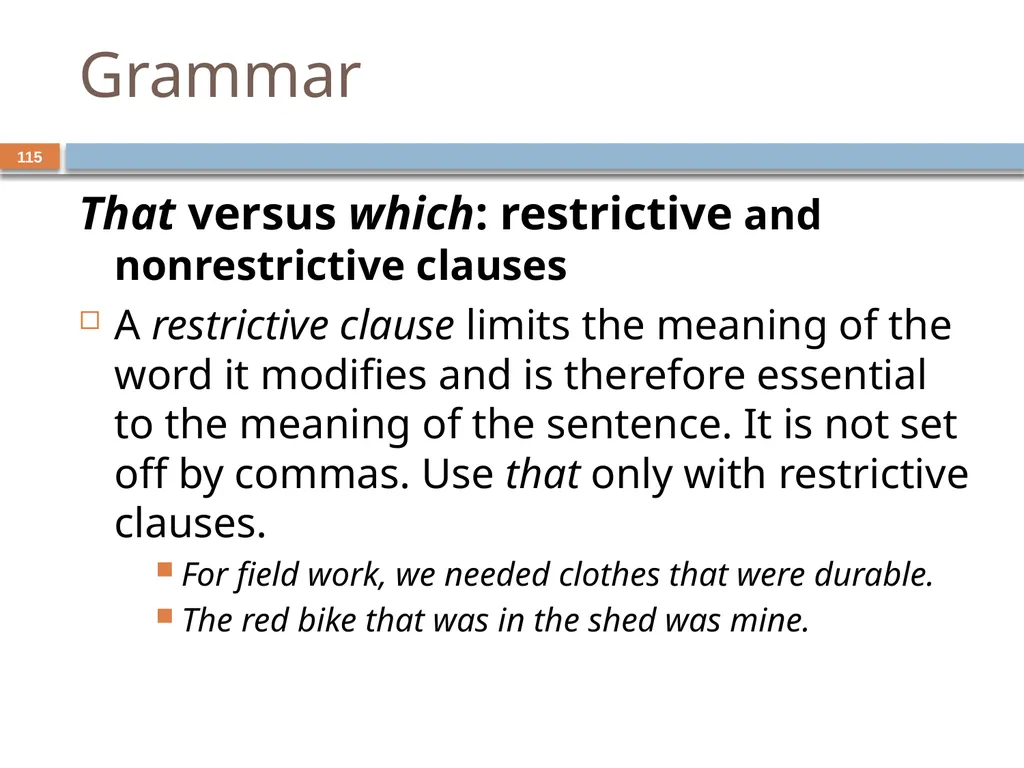
A restrictive clause limits the meaning of the word it modifies and is therefore essential to the meaning of the sentence. It is not set off by commas. Use that only with restrictive clauses.
For field work, we needed clothes that were durable.
The red bike that was in the shed was mine. 115<br>
A restrictive clause limits the meaning of the word it modifies and is therefore essential to the meaning of the sentence. It is not set off by commas. Use that only with restrictive clauses.
For field work, we needed clothes that were durable.
The red bike that was in the shed was mine. 115<br>
116
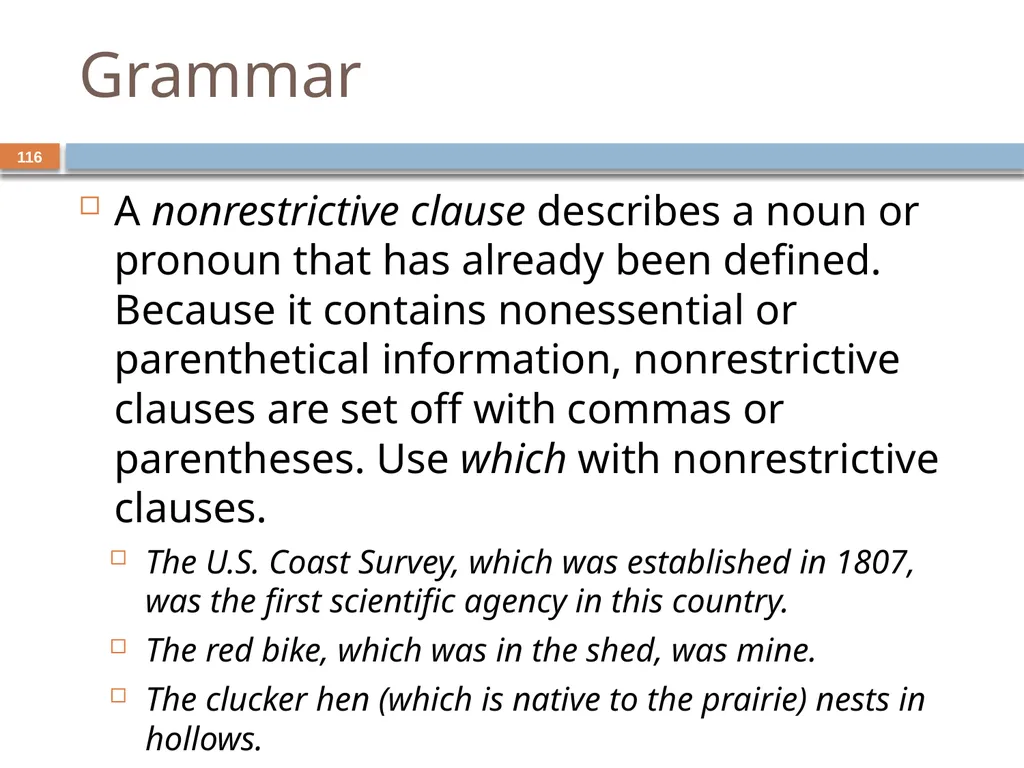
Grammar A nonrestrictive clause describes a noun or pronoun that has already been defined. Because it contains nonessential or parenthetical information, nonrestrictive clauses are set off with commas or parentheses. Use which with nonrestrictive clauses.
The U.S. Coast Survey, which was established in 1807, was the first scientific agency in this country.
The red bike, which was in the shed, was mine.
The clucker hen (which is native to the prairie) nests in hollows. 116<br>
The U.S. Coast Survey, which was established in 1807, was the first scientific agency in this country.
The red bike, which was in the shed, was mine.
The clucker hen (which is native to the prairie) nests in hollows. 116<br>
117
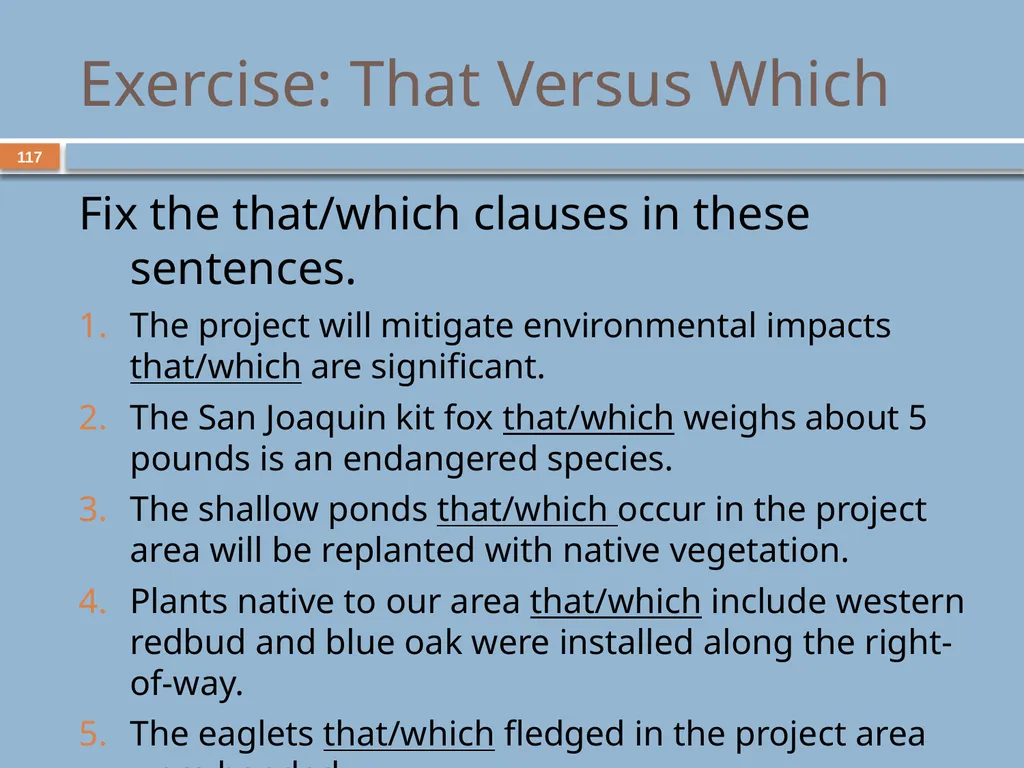
Exercise: That Versus Which Fix the that/which clauses in these sentences.
The project will mitigate environmental impacts that/which are significant.
The San Joaquin kit fox that/which weighs about 5 pounds is an endangered species.
The shallow ponds that/which occur in the project area will be replanted with native vegetation.
Plants native to our area that/which include western redbud and blue oak were installed along the right-of-way.
The eaglets that/which fledged in the project area were banded. 117<br>
The project will mitigate environmental impacts that/which are significant.
The San Joaquin kit fox that/which weighs about 5 pounds is an endangered species.
The shallow ponds that/which occur in the project area will be replanted with native vegetation.
Plants native to our area that/which include western redbud and blue oak were installed along the right-of-way.
The eaglets that/which fledged in the project area were banded. 117<br>
118
Grammar Transitions are bridges between what has been read and what is about to be read; they help readers move from one sentence to another. They also show the connections between ideas at the sentence level or the paragraph level or even between longer blocks of text and thus provide coherence.
See Handout 1, Transitional Expressions. 118<br>
See Handout 1, Transitional Expressions. 118<br>
119
119<br>
120
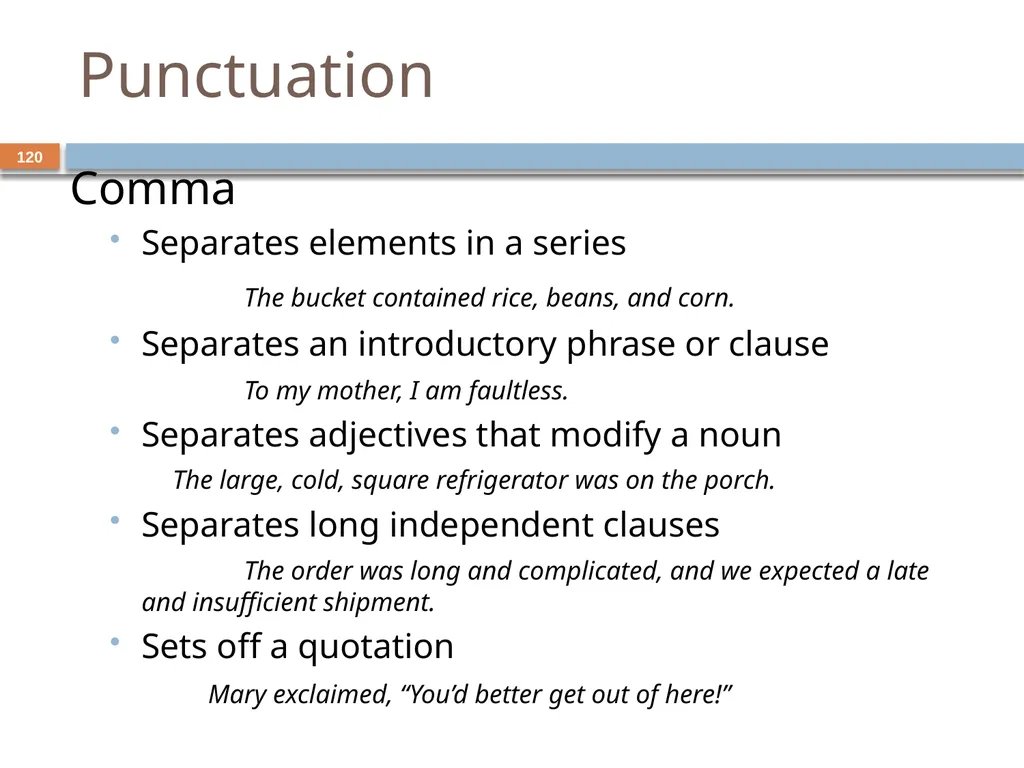
Punctuation Comma
Separates elements in a series
The bucket contained rice, beans, and corn.
Separates an introductory phrase or clause
To my mother, I am faultless.
Separates adjectives that modify a noun
The large, cold, square refrigerator was on the porch.
Separates long independent clauses
The order was long and complicated, and we expected a late and insufficient shipment.
Sets off a quotation
Mary exclaimed, “You’d better get out of here!” 120<br>
Separates elements in a series
The bucket contained rice, beans, and corn.
Separates an introductory phrase or clause
To my mother, I am faultless.
Separates adjectives that modify a noun
The large, cold, square refrigerator was on the porch.
Separates long independent clauses
The order was long and complicated, and we expected a late and insufficient shipment.
Sets off a quotation
Mary exclaimed, “You’d better get out of here!” 120<br>
121
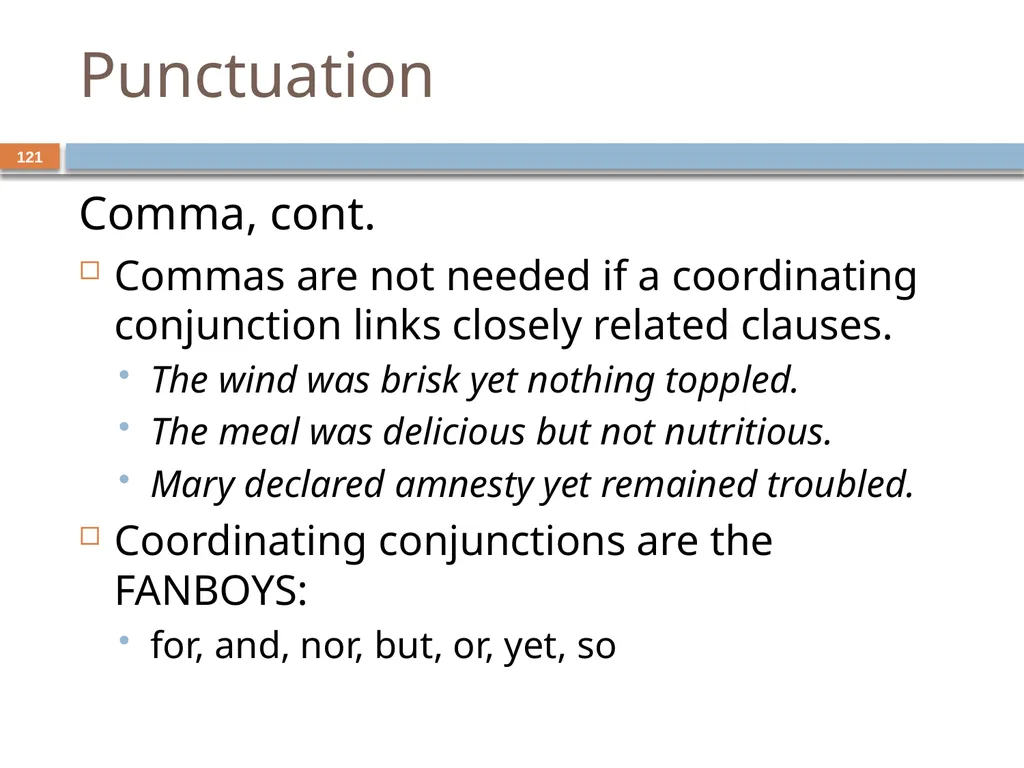
Punctuation Comma, cont.
Commas are not needed if a coordinating conjunction links closely related clauses.
The wind was brisk yet nothing toppled.
The meal was delicious but not nutritious.
Mary declared amnesty yet remained troubled.
Coordinating conjunctions are the FANBOYS:
for, and, nor, but, or, yet, so 121<br>
Commas are not needed if a coordinating conjunction links closely related clauses.
The wind was brisk yet nothing toppled.
The meal was delicious but not nutritious.
Mary declared amnesty yet remained troubled.
Coordinating conjunctions are the FANBOYS:
for, and, nor, but, or, yet, so 121<br>
122
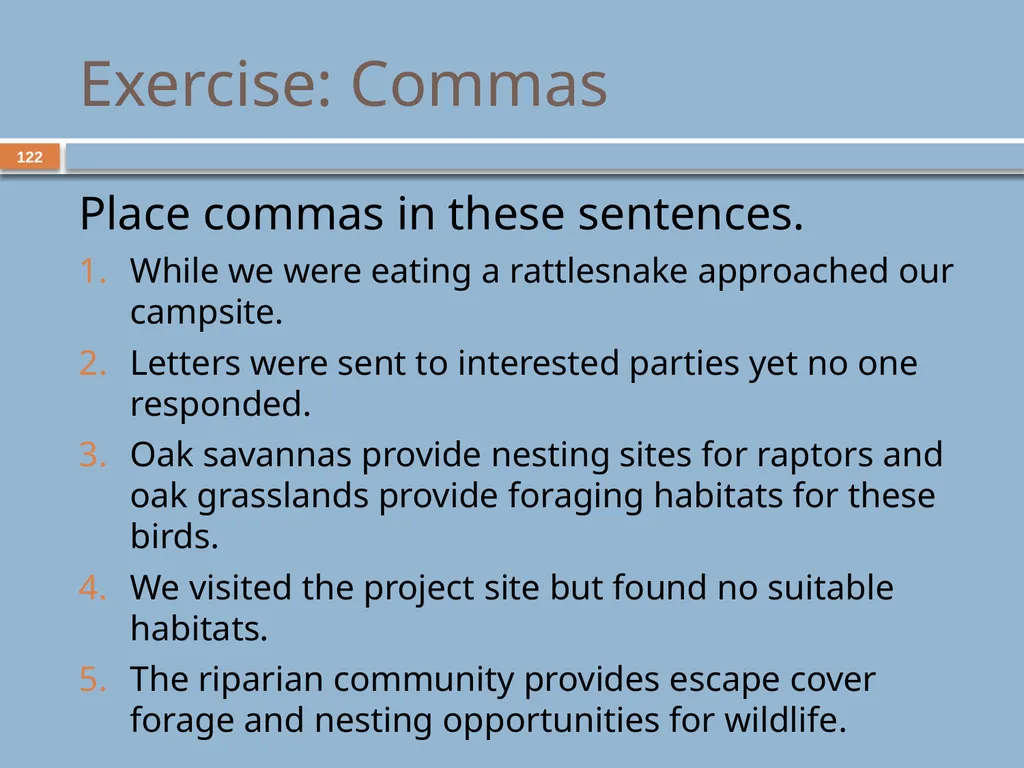
Exercise: Commas Place commas in these sentences.
While we were eating a rattlesnake approached our campsite.
Letters were sent to interested parties yet no one responded.
Oak savannas provide nesting sites for raptors and oak grasslands provide foraging habitats for these birds.
We visited the project site but found no suitable habitats.
The riparian community provides escape cover forage and nesting opportunities for wildlife. 122<br>
While we were eating a rattlesnake approached our campsite.
Letters were sent to interested parties yet no one responded.
Oak savannas provide nesting sites for raptors and oak grasslands provide foraging habitats for these birds.
We visited the project site but found no suitable habitats.
The riparian community provides escape cover forage and nesting opportunities for wildlife. 122<br>
123
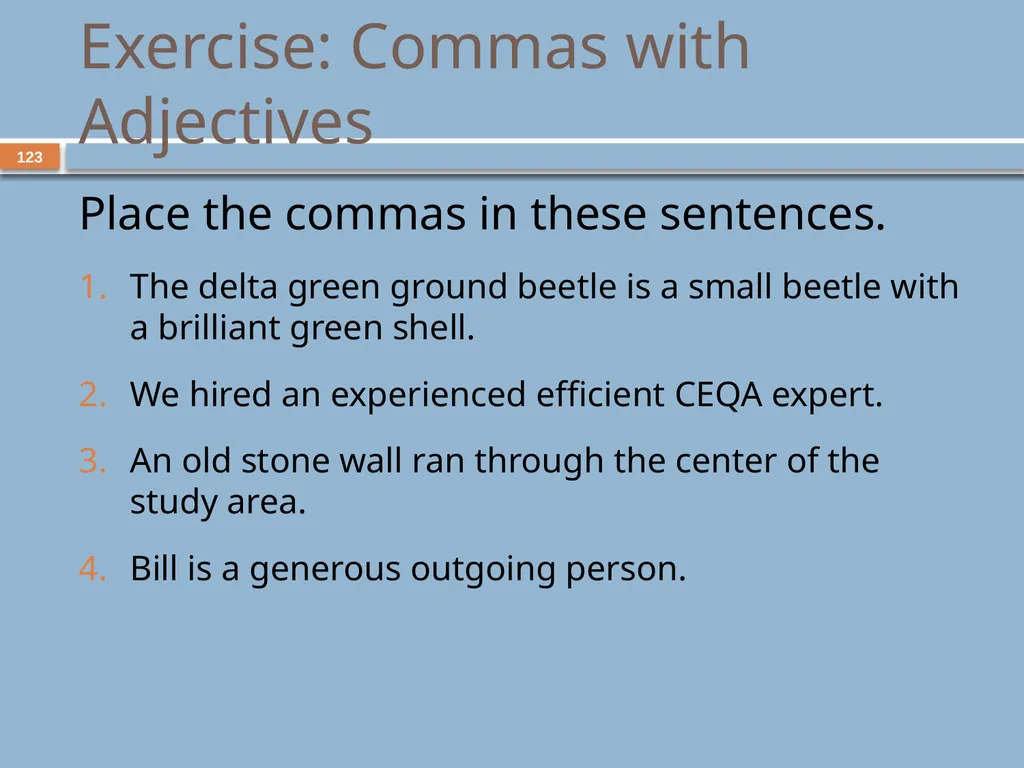
Exercise: Commas with Adjectives Place the commas in these sentences.
The delta green ground beetle is a small beetle with a brilliant green shell.
We hired an experienced efficient CEQA expert.
An old stone wall ran through the center of the study area.
Bill is a generous outgoing person. 123<br>
The delta green ground beetle is a small beetle with a brilliant green shell.
We hired an experienced efficient CEQA expert.
An old stone wall ran through the center of the study area.
Bill is a generous outgoing person. 123<br>
124
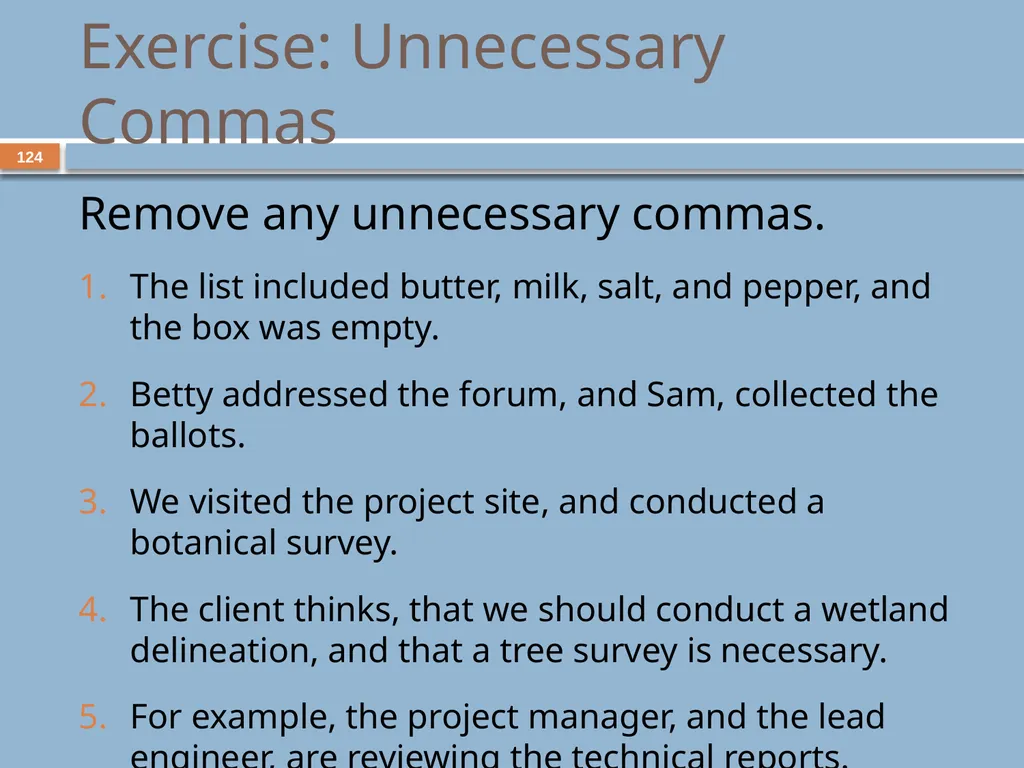
Exercise: Unnecessary Commas Remove any unnecessary commas.
The list included butter, milk, salt, and pepper, and the box was empty.
Betty addressed the forum, and Sam, collected the ballots.
We visited the project site, and conducted a botanical survey.
The client thinks, that we should conduct a wetland delineation, and that a tree survey is necessary.
For example, the project manager, and the lead engineer, are reviewing the technical reports. 124<br>
The list included butter, milk, salt, and pepper, and the box was empty.
Betty addressed the forum, and Sam, collected the ballots.
We visited the project site, and conducted a botanical survey.
The client thinks, that we should conduct a wetland delineation, and that a tree survey is necessary.
For example, the project manager, and the lead engineer, are reviewing the technical reports. 124<br>
125
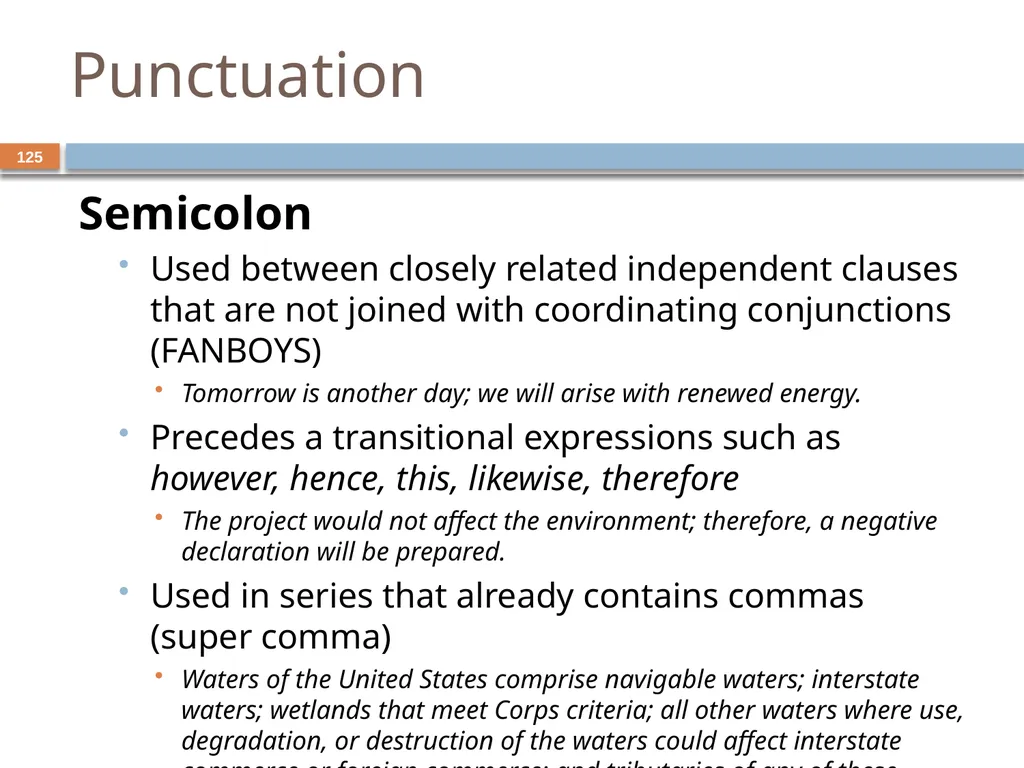
Punctuation Semicolon
Used between closely related independent clauses that are not joined with coordinating conjunctions (FANBOYS)
Tomorrow is another day; we will arise with renewed energy.
Precedes a transitional expressions such as however, hence, this, likewise, therefore
The project would not affect the environment; therefore, a negative declaration will be prepared.
Used in series that already contains commas (super comma)
Waters of the United States comprise navigable waters; interstate waters; wetlands that meet Corps criteria; all other waters where use, degradation, or destruction of the waters could affect interstate commerce or foreign commerce; and tributaries of any of these waters 125<br>
Used between closely related independent clauses that are not joined with coordinating conjunctions (FANBOYS)
Tomorrow is another day; we will arise with renewed energy.
Precedes a transitional expressions such as however, hence, this, likewise, therefore
The project would not affect the environment; therefore, a negative declaration will be prepared.
Used in series that already contains commas (super comma)
Waters of the United States comprise navigable waters; interstate waters; wetlands that meet Corps criteria; all other waters where use, degradation, or destruction of the waters could affect interstate commerce or foreign commerce; and tributaries of any of these waters 125<br>
126
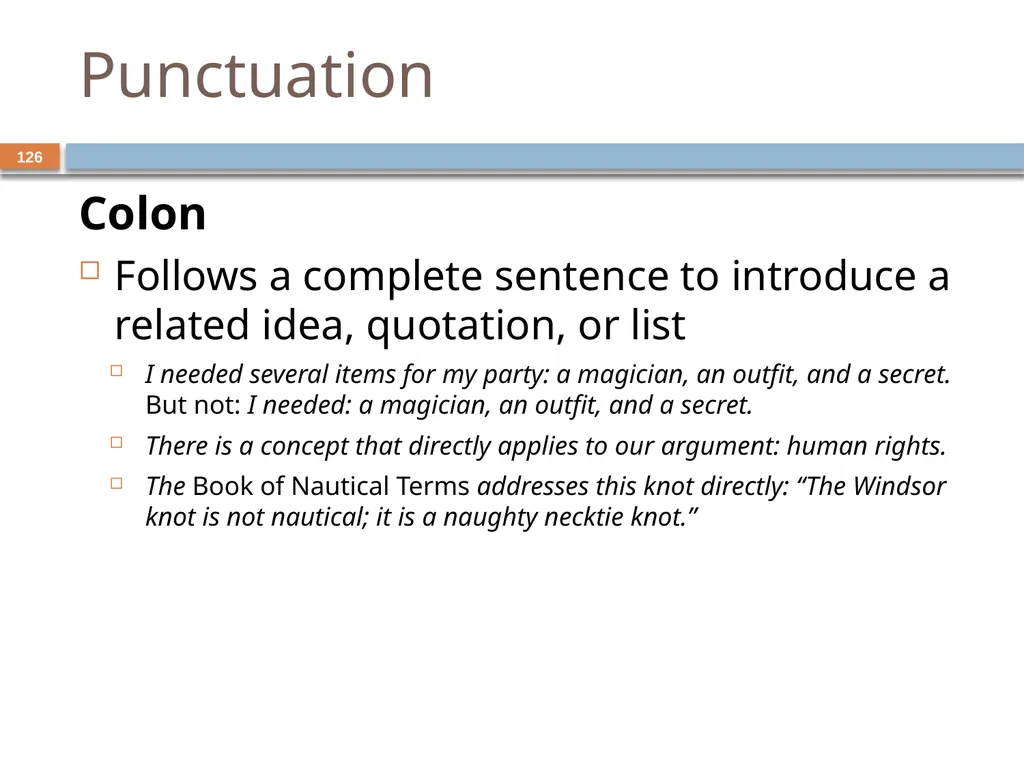
Punctuation Colon
Follows a complete sentence to introduce a related idea, quotation, or list
I needed several items for my party: a magician, an outfit, and a secret. But not: I needed: a magician, an outfit, and a secret.
There is a concept that directly applies to our argument: human rights.
The Book of Nautical Terms addresses this knot directly: “The Windsor knot is not nautical; it is a naughty necktie knot.” 126<br>
Follows a complete sentence to introduce a related idea, quotation, or list
I needed several items for my party: a magician, an outfit, and a secret. But not: I needed: a magician, an outfit, and a secret.
There is a concept that directly applies to our argument: human rights.
The Book of Nautical Terms addresses this knot directly: “The Windsor knot is not nautical; it is a naughty necktie knot.” 126<br>
127
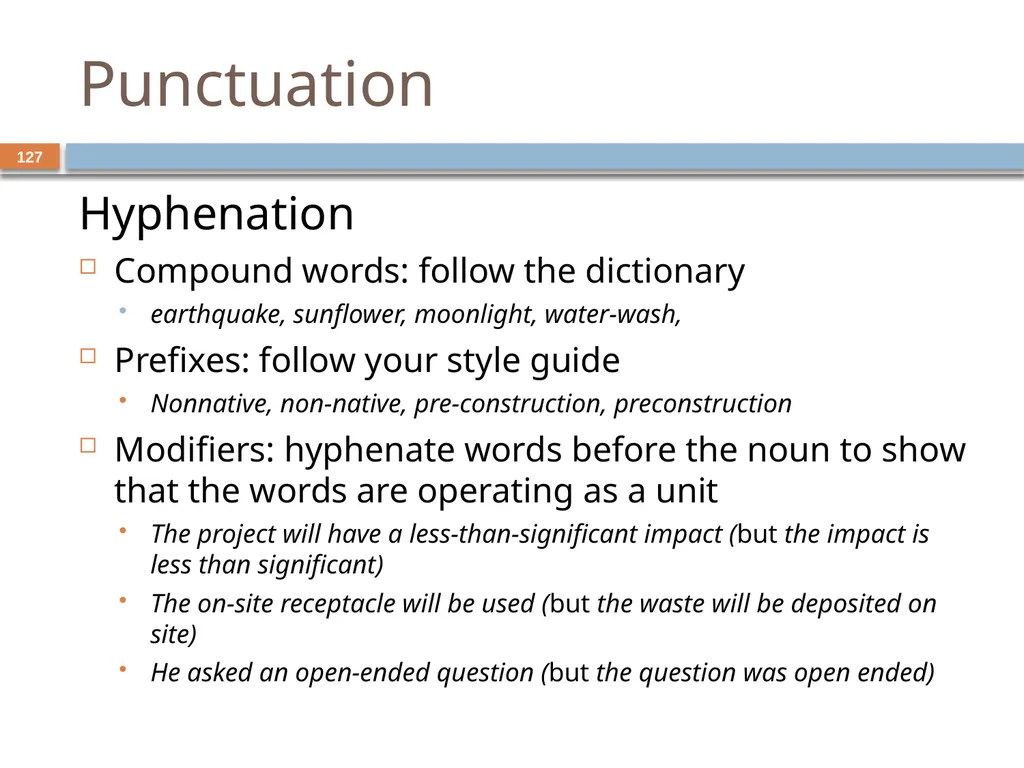
Punctuation Hyphenation
Compound words: follow the dictionary
earthquake, sunflower, moonlight, water-wash,
Prefixes: follow your style guide
Nonnative, non-native, pre-construction, preconstruction
Modifiers: hyphenate words before the noun to show that the words are operating as a unit
The project will have a less-than-significant impact (but the impact is less than significant)
The on-site receptacle will be used (but the waste will be deposited on site)
He asked an open-ended question (but the question was open ended) 127<br>
Compound words: follow the dictionary
earthquake, sunflower, moonlight, water-wash,
Prefixes: follow your style guide
Nonnative, non-native, pre-construction, preconstruction
Modifiers: hyphenate words before the noun to show that the words are operating as a unit
The project will have a less-than-significant impact (but the impact is less than significant)
The on-site receptacle will be used (but the waste will be deposited on site)
He asked an open-ended question (but the question was open ended) 127<br>
128
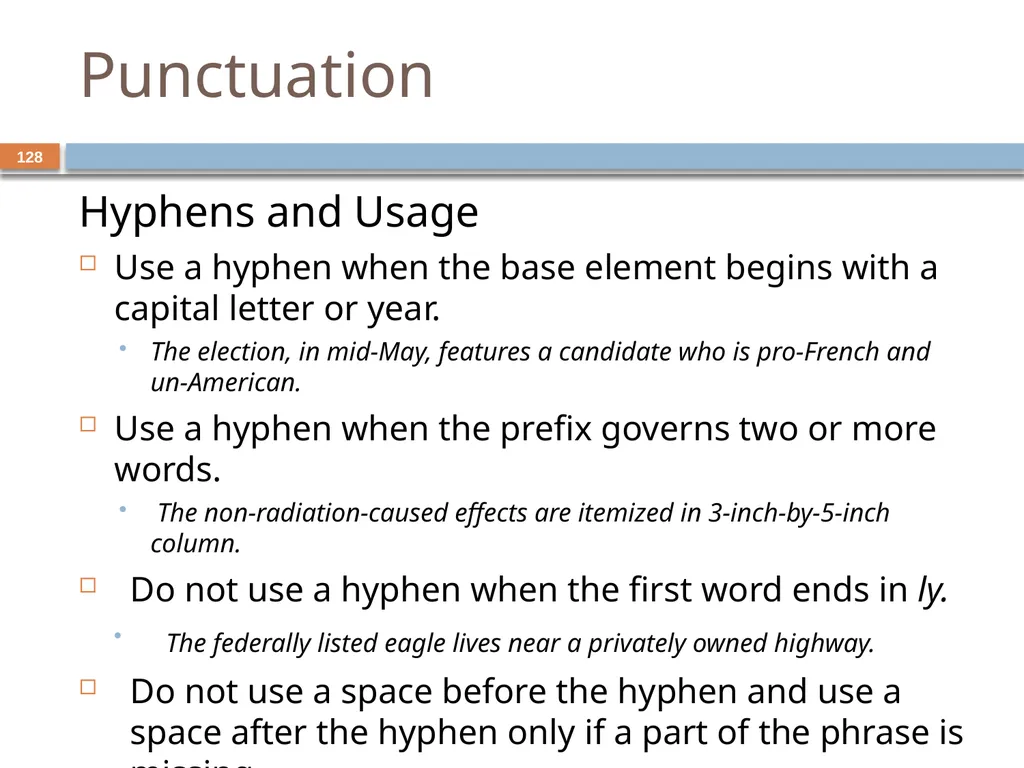
Punctuation Hyphens and Usage
Use a hyphen when the base element begins with a capital letter or year.
The election, in mid-May, features a candidate who is pro-French and un-American.
Use a hyphen when the prefix governs two or more words.
The non-radiation-caused effects are itemized in 3-inch-by-5-inch column.
Do not use a hyphen when the first word ends in ly.
The federally listed eagle lives near a privately owned highway.
Do not use a space before the hyphen and use a space after the hyphen only if a part of the phrase is missing.
Streamflow was measured at 5- and 10-minute intervals. 128<br>
Use a hyphen when the base element begins with a capital letter or year.
The election, in mid-May, features a candidate who is pro-French and un-American.
Use a hyphen when the prefix governs two or more words.
The non-radiation-caused effects are itemized in 3-inch-by-5-inch column.
Do not use a hyphen when the first word ends in ly.
The federally listed eagle lives near a privately owned highway.
Do not use a space before the hyphen and use a space after the hyphen only if a part of the phrase is missing.
Streamflow was measured at 5- and 10-minute intervals. 128<br>
129
Punctuation Em dash
The em dash breaks or separates thoughts with emphasis
After 1 year, CO2 concentrations were 367 parts per million—a much higher increase than predicted.
Three raptors—Cooper’s hawk, sharp-shinned hawk, and Swainson’s hawk—were observed in the project area. 129<br>
The em dash breaks or separates thoughts with emphasis
After 1 year, CO2 concentrations were 367 parts per million—a much higher increase than predicted.
Three raptors—Cooper’s hawk, sharp-shinned hawk, and Swainson’s hawk—were observed in the project area. 129<br>
130
Punctuation En dash
The en dash signifies a range and is read as X to X. It includes the values at both ends of the range.
See Chapters 16–19 for documentation.
The World War II years, 1939–1945, are his area of expertise.
See pages 119–147 for the revised text. 130<br>
The en dash signifies a range and is read as X to X. It includes the values at both ends of the range.
See Chapters 16–19 for documentation.
The World War II years, 1939–1945, are his area of expertise.
See pages 119–147 for the revised text. 130<br>
131
131<br>
132
Style Style conventions are defined by discipline, by publisher, or by publication
Style conventions can evolve over time
Style conventions may be negotiable 132<br>
Style conventions can evolve over time
Style conventions may be negotiable 132<br>
133
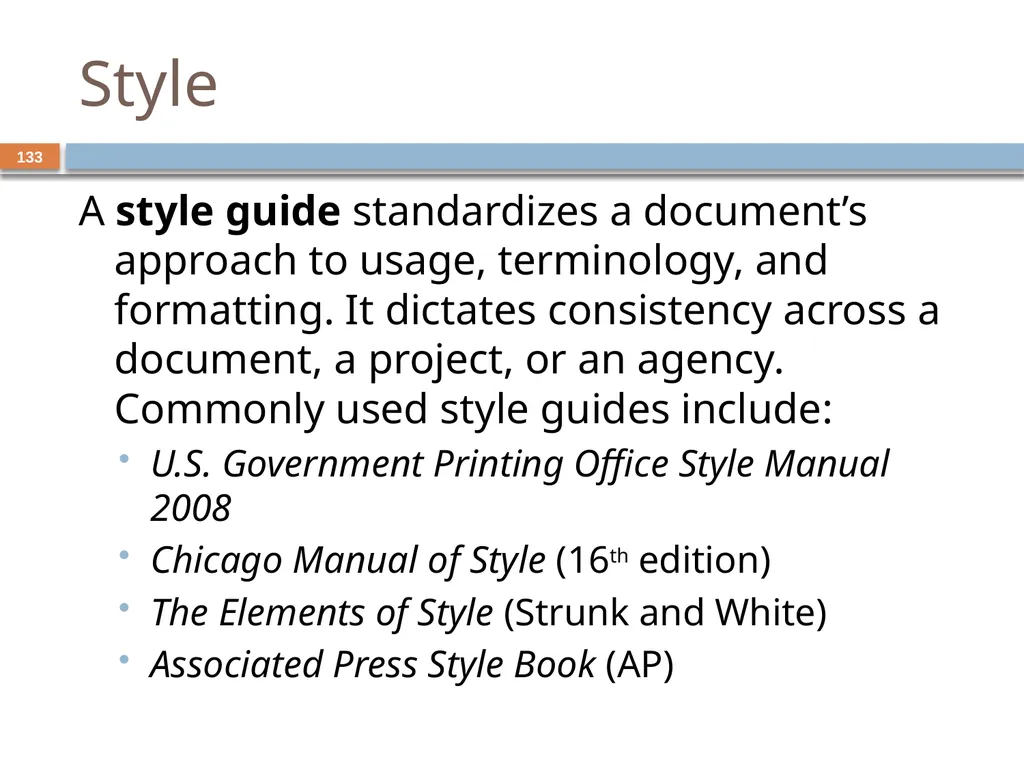
Style A style guide standardizes a document’s approach to usage, terminology, and formatting. It dictates consistency across a document, a project, or an agency. Commonly used style guides include:
U.S. Government Printing Office Style Manual 2008
Chicago Manual of Style (16th edition)
The Elements of Style (Strunk and White)
Associated Press Style Book (AP) 133<br>
U.S. Government Printing Office Style Manual 2008
Chicago Manual of Style (16th edition)
The Elements of Style (Strunk and White)
Associated Press Style Book (AP) 133<br>
134
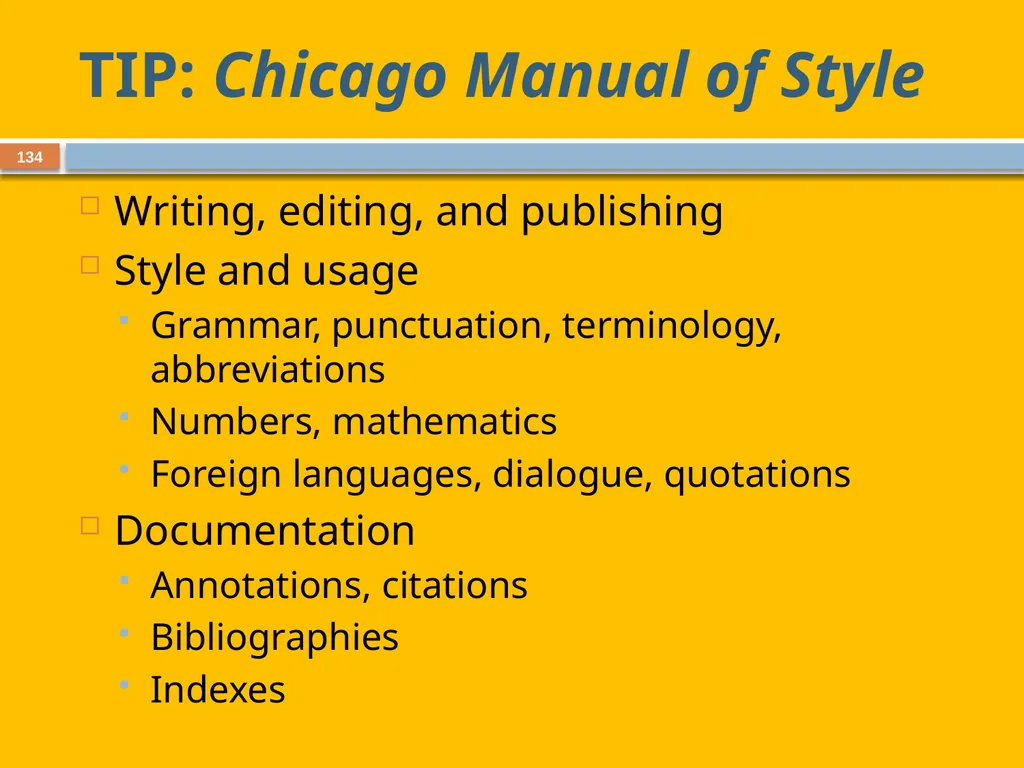
TIP: Chicago Manual of Style Writing, editing, and publishing
Style and usage
Grammar, punctuation, terminology, abbreviations
Numbers, mathematics
Foreign languages, dialogue, quotations
Documentation
Annotations, citations
Bibliographies
Indexes 134<br>
Style and usage
Grammar, punctuation, terminology, abbreviations
Numbers, mathematics
Foreign languages, dialogue, quotations
Documentation
Annotations, citations
Bibliographies
Indexes 134<br>
135
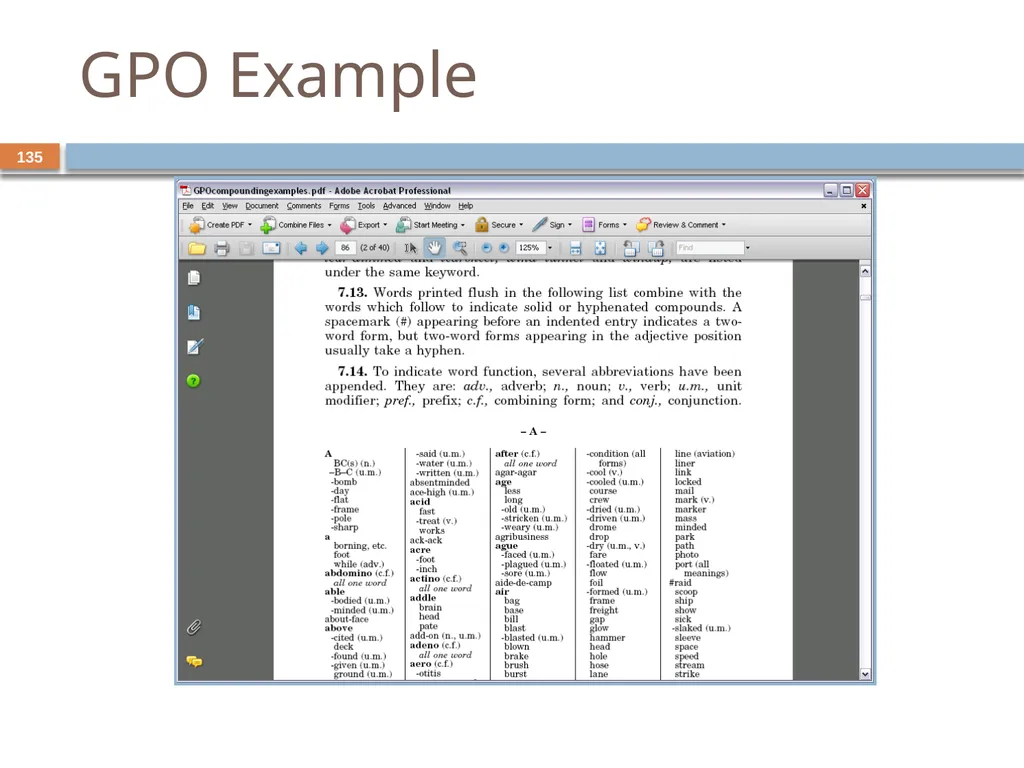
GPO Example 135<br>
136
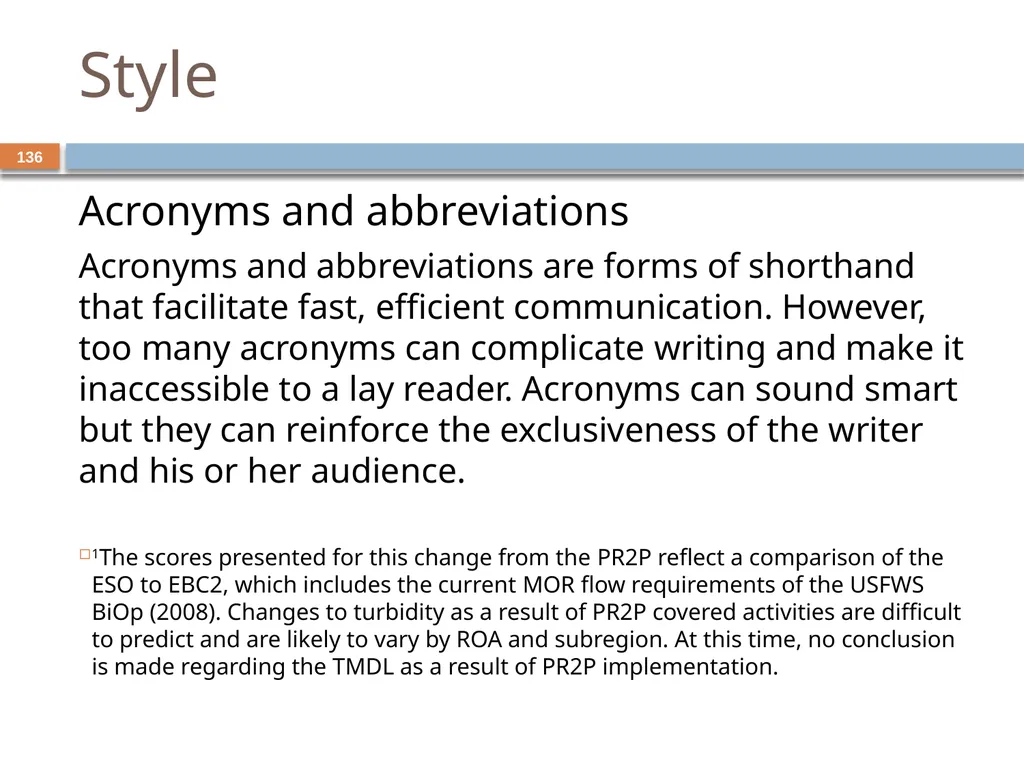
Style Acronyms and abbreviations
Acronyms and abbreviations are forms of shorthand that facilitate fast, efficient communication. However, too many acronyms can complicate writing and make it inaccessible to a lay reader. Acronyms can sound smart but they can reinforce the exclusiveness of the writer and his or her audience.
1The scores presented for this change from the PR2P reflect a comparison of the ESO to EBC2, which includes the current MOR flow requirements of the USFWS BiOp (2008). Changes to turbidity as a result of PR2P covered activities are difficult to predict and are likely to vary by ROA and subregion. At this time, no conclusion is made regarding the TMDL as a result of PR2P implementation. 136<br>
Acronyms and abbreviations are forms of shorthand that facilitate fast, efficient communication. However, too many acronyms can complicate writing and make it inaccessible to a lay reader. Acronyms can sound smart but they can reinforce the exclusiveness of the writer and his or her audience.
1The scores presented for this change from the PR2P reflect a comparison of the ESO to EBC2, which includes the current MOR flow requirements of the USFWS BiOp (2008). Changes to turbidity as a result of PR2P covered activities are difficult to predict and are likely to vary by ROA and subregion. At this time, no conclusion is made regarding the TMDL as a result of PR2P implementation. 136<br>
137
Style Acronym guidelines
Always define the acronym
In text in a shorter document, by chapter in longer documents, or in an acronym list
Use an acronym only if the term is used at least three times
Avoid using acronyms when a shorter generic term will do
The Smith-Dodson Employment Act (SDEA) vs. the act
Define and use an acronym if it has replaced the original term in common usage
the BLM, NEPA 137<br>
Always define the acronym
In text in a shorter document, by chapter in longer documents, or in an acronym list
Use an acronym only if the term is used at least three times
Avoid using acronyms when a shorter generic term will do
The Smith-Dodson Employment Act (SDEA) vs. the act
Define and use an acronym if it has replaced the original term in common usage
the BLM, NEPA 137<br>
138
Style Capitalization
Capitalization styles change over time
Capitalize proper nouns only
Job titles: the USFWS Program Manager; the program manager
Institutions: Arizona University; the university
Geographic features: the Willamette and Columbia Rivers; the rivers
Reports: the Boise General Plan; the plan or general plan
Species names: the Swainson’s hawk; the hawk 138<br>
Capitalization styles change over time
Capitalize proper nouns only
Job titles: the USFWS Program Manager; the program manager
Institutions: Arizona University; the university
Geographic features: the Willamette and Columbia Rivers; the rivers
Reports: the Boise General Plan; the plan or general plan
Species names: the Swainson’s hawk; the hawk 138<br>
139
Style Bullet List Punctuation
The most important rule in bullet punctuation is to maintain consistency throughout the document. You can incorporate different styles for different applications, or use one style for all applications. This is a style choice.
Guidelines:
Use bullets for three items or more; never for one item
Use an appropriate lead-in sentence (do not start a bullet list directly under a heading) 139<br>
The most important rule in bullet punctuation is to maintain consistency throughout the document. You can incorporate different styles for different applications, or use one style for all applications. This is a style choice.
Guidelines:
Use bullets for three items or more; never for one item
Use an appropriate lead-in sentence (do not start a bullet list directly under a heading) 139<br>
140
Style Bullet List Guidelines:
Use a numbered list to indicate hierarchy or sequence
Use bullets for three items or more
Do not start a bullet list directly under a heading
Punctuate the lead-in sentence with a period or colon
Construct the bullets in parallel fashion
Punctuate the bullets if they are complete sentences or complete the introductory sentence
Capitalize list items (one or two words, no punctuation)
Consolidate the articles (a, the, one) at the beginning 140<br>
Use a numbered list to indicate hierarchy or sequence
Use bullets for three items or more
Do not start a bullet list directly under a heading
Punctuate the lead-in sentence with a period or colon
Construct the bullets in parallel fashion
Punctuate the bullets if they are complete sentences or complete the introductory sentence
Capitalize list items (one or two words, no punctuation)
Consolidate the articles (a, the, one) at the beginning 140<br>
141
Style Bullet List Examples
The basket from Granny contained the following items:
A woolen sweater.
A bottle of elderflower wine.
Pressed flowers.
There were many items in the basket, including:
a woolen sweater,
a bottle of elderflower wine, and
pressed flowers. 141<br>
The basket from Granny contained the following items:
A woolen sweater.
A bottle of elderflower wine.
Pressed flowers.
There were many items in the basket, including:
a woolen sweater,
a bottle of elderflower wine, and
pressed flowers. 141<br>
142
Style Bullet List Punctuation Examples
There were many items in the basket:
A woolen sweater
A bottle of elderflower wine
Pressed flowers
Granny was kind enough to send me a basket filled with gifts that express her caring.
A woolen sweater keeps me warm when the snows fall.
A bottle of elderflower wine offers consolation for a dark Sunday evening.
Pressed flowers hearken back to our summer in the meadows. 142<br>
There were many items in the basket:
A woolen sweater
A bottle of elderflower wine
Pressed flowers
Granny was kind enough to send me a basket filled with gifts that express her caring.
A woolen sweater keeps me warm when the snows fall.
A bottle of elderflower wine offers consolation for a dark Sunday evening.
Pressed flowers hearken back to our summer in the meadows. 142<br>
143
143<br>
144
Commonly Misused Words and Phrases Handout 2, Commonly Misused Words and Phrases 144<br>
145
Exercise: Editing Complete Exercise 4, Editing. 145<br>
146
Numbers Use numerals with units of measure or time
0.25 acre
1 month
3 years
4 megawatts
7 years old
5 hours
3.6 grams 146<br>
0.25 acre
1 month
3 years
4 megawatts
7 years old
5 hours
3.6 grams 146<br>
147
Numbers Write out numbers if:
They are the first element in a sentence
Thirteen states formed a more perfect union.
Confusion may result from two numerals being next to each other
There are fourteen 5-foot terminals.
They are less than 10 but not a unit of measure
I saw three ships come sailing in. 147<br>
They are the first element in a sentence
Thirteen states formed a more perfect union.
Confusion may result from two numerals being next to each other
There are fourteen 5-foot terminals.
They are less than 10 but not a unit of measure
I saw three ships come sailing in. 147<br>
148
Numbers Use the additional formats shown below when expressing numerals
1960s
20th century
from 1 to 3 months
between 5 and 10 acres (does not include 5 and 10)
10-foot-high barrier
barrier was 10 feet high
34% 148<br>
1960s
20th century
from 1 to 3 months
between 5 and 10 acres (does not include 5 and 10)
10-foot-high barrier
barrier was 10 feet high
34% 148<br>
149
Exercise: Numbers Correct the enumeration in the sentences below.
The 3-foot high structure is a barrier to fish passage.
Temperatures from 78 to 89°F may be lethal to juvenile fish.
The device was built using recycled wood and fourteen 3-inch-long screws.
The data are presented in Tables 3 to 19. 149<br>
The 3-foot high structure is a barrier to fish passage.
Temperatures from 78 to 89°F may be lethal to juvenile fish.
The device was built using recycled wood and fourteen 3-inch-long screws.
The data are presented in Tables 3 to 19. 149<br>
150
Exercise: Numbers Correct number-related mistakes on Exercise 3, Numbers. 150<br>
151
Checklists When you are done writing, it is a good idea to go over your writing the next day.
Personal checklists and office checklists can be helpful.
http://www.ccbb.pitt.edu/Faculty/zuckerman/ScienceWritingChecklist.pdf
http://physics.gac.edu/~huber/misc/wricheck.htm
http://donstuff.wordpress.com/2008/10/09/rules-for-writing-wicked-good-papers/ 151<br>
Personal checklists and office checklists can be helpful.
http://www.ccbb.pitt.edu/Faculty/zuckerman/ScienceWritingChecklist.pdf
http://physics.gac.edu/~huber/misc/wricheck.htm
http://donstuff.wordpress.com/2008/10/09/rules-for-writing-wicked-good-papers/ 151<br>
152
152<br>
153
Exercise: Writing Review Look in your report or the example report and see if there are problems in these areas:
Lists
Numbers
Tenses (look at several paragraphs on several pages)
Misused words or phrases 153<br>
Lists
Numbers
Tenses (look at several paragraphs on several pages)
Misused words or phrases 153<br>
154
Chapter 2 Writing: Review Why Good Writing Matters
The Paragraph and Topic Sentences
Passive versus Active Voice
Wordiness and Foggy Writing
Grammar
Punctuation
Style
Commonly Misused Words and Phrases
Numbers
Questions? 154<br>
The Paragraph and Topic Sentences
Passive versus Active Voice
Wordiness and Foggy Writing
Grammar
Punctuation
Style
Commonly Misused Words and Phrases
Numbers
Questions? 154<br>
155
Goodnight! 155<br>
156
Chapter 3―Managing Documents 156<br>
157
Chapter 3 Managing Documents Setting Up Authors for Success
Creating a Writing Template
Writing Impact Statements and Mitigation Measures
Managing the Writing Process
Responding to Comments
Tables 157<br>
Creating a Writing Template
Writing Impact Statements and Mitigation Measures
Managing the Writing Process
Responding to Comments
Tables 157<br>
158
Setting Up Authors for Success Common problems
Lack of effective communication
Lack of resources and information provided to authors
Inefficient writing approach
Gaps in logic or information
Ineffective review of documents
Audience dissatisfied with documents 158<br>
Lack of effective communication
Lack of resources and information provided to authors
Inefficient writing approach
Gaps in logic or information
Ineffective review of documents
Audience dissatisfied with documents 158<br>
159
Setting Up Authors for Success Gather information
Basic information (e.g., project name and objectives)
Other relevant documents
Style and usage (e.g. units of measure, acronyms)
Affected environment versus baseline
Internal review process
External deliverables
See Handout 3, Document Development Checklist 159<br>
Basic information (e.g., project name and objectives)
Other relevant documents
Style and usage (e.g. units of measure, acronyms)
Affected environment versus baseline
Internal review process
External deliverables
See Handout 3, Document Development Checklist 159<br>
160
Setting Up Authors for Success BLM NEPA Handbook Guidance
Detailed descriptions of proposed actions usually include six elements:
Who
What
How
When
Where
Why 160<br>
Detailed descriptions of proposed actions usually include six elements:
Who
What
How
When
Where
Why 160<br>
161
Setting Up Authors for Success Project Description
Try to finalize the alternatives description
A well-written description:
Facilitates author analysis
Speeds analysis
Improves accuracy
Helps the public and the client 161<br>
Try to finalize the alternatives description
A well-written description:
Facilitates author analysis
Speeds analysis
Improves accuracy
Helps the public and the client 161<br>
162
Setting Up Authors for Success Be sure to:
Describe all alternatives in substantial detail
Identify the agency’s preferred alternative(s)
Briefly discuss alternatives that were eliminated
Let authors know about uncertainties
Anticipate other documents 162<br>
Describe all alternatives in substantial detail
Identify the agency’s preferred alternative(s)
Briefly discuss alternatives that were eliminated
Let authors know about uncertainties
Anticipate other documents 162<br>
163
Managing the Writing Process Prepare a Style Guide for Your Document
Project name
Project terminology
Project area, project site, proposed project, proposed action, no-action alternative
Standard terminology
Grammar, punctuation, usage conventions for your agency
Standard formatting
Handout 4, Style Sheet
Handout 5, ICBEMP Supplemental Draft EIS Editorial Consistency Guidelines (BLM) 163<br>
Project name
Project terminology
Project area, project site, proposed project, proposed action, no-action alternative
Standard terminology
Grammar, punctuation, usage conventions for your agency
Standard formatting
Handout 4, Style Sheet
Handout 5, ICBEMP Supplemental Draft EIS Editorial Consistency Guidelines (BLM) 163<br>
164
Managing the Writing Process Have a Start-Up Meeting
Provides authors with necessary information
Promotes consistency
Increases efficiency
Provides foundation materials
Template
Boilerplate
Style guide
Schedule and budget
Resource materials (GIS, maps, prior documents) 164<br>
Provides authors with necessary information
Promotes consistency
Increases efficiency
Provides foundation materials
Template
Boilerplate
Style guide
Schedule and budget
Resource materials (GIS, maps, prior documents) 164<br>
165
TIP: Numbering Conventions Number elements of your report that will be cited throughout the report
Environmental commitments or project components
EC WQ1-Comply with local stormwater regulations
Impacts
Impact WQ1- Increased storm runoff from impervious surfaces
Mitigation measures
MM-WQ1-Install storm drains
Tables and figures by section
See Table 3.4-2 165<br>
Environmental commitments or project components
EC WQ1-Comply with local stormwater regulations
Impacts
Impact WQ1- Increased storm runoff from impervious surfaces
Mitigation measures
MM-WQ1-Install storm drains
Tables and figures by section
See Table 3.4-2 165<br>
166
166<br>
167
Creating a Writing Template Provides standardization
Creates a one-voice document
Increases efficiency
Creates parallelism
Handout 6, Basic Writing Template 167<br>
Creates a one-voice document
Increases efficiency
Creates parallelism
Handout 6, Basic Writing Template 167<br>
168
TIP: Template in Word Styles and Templates
All files should have a template
All text should have a style
You can use styles and templates provided or make your own 168<br>
All files should have a template
All text should have a style
You can use styles and templates provided or make your own 168<br>
169
Creating a Writing Template Example information in an EIS
Affected environment
Regulatory setting (before or after environmental setting, in appendix, or in Regulatory Setting chapter)
Environmental consequences and mitigation measures
Categories for analysis (e.g., construction/operation) 169<br>
Affected environment
Regulatory setting (before or after environmental setting, in appendix, or in Regulatory Setting chapter)
Environmental consequences and mitigation measures
Categories for analysis (e.g., construction/operation) 169<br>
170
Creating a Writing Template Arrangement of resource chapters/sections 170<br>
171
Exercise: Creating a Writing Template Open your document or the example document in the outline or navigation pane view
How are the resource sections organized?
What other ways could you organize these sections?
Can you locate any boilerplate text?
What questions are being addressed under each heading?
Can you identify a topic sentence under each heading? 171<br>
How are the resource sections organized?
What other ways could you organize these sections?
Can you locate any boilerplate text?
What questions are being addressed under each heading?
Can you identify a topic sentence under each heading? 171<br>
172
Creating a Writing Template Use standardized text (boilerplate)
Keeps the document parallel
Gives it rhythm
Prevents the author from having to create it from scratch
Saves you and the editor time
Sets the tone for the document 172<br>
Keeps the document parallel
Gives it rhythm
Prevents the author from having to create it from scratch
Saves you and the editor time
Sets the tone for the document 172<br>
173
Creating a Writing Template Give direction to authors
Indicate
Level of detail you would like
What not to include in the setting section
Other information that pertains to all resource chapters/sections
How to organize and phrase impacts
Tips
Use a different color text for direction
Decide on your acronym approach
Use a references tool or develop a template 173<br>
Indicate
Level of detail you would like
What not to include in the setting section
Other information that pertains to all resource chapters/sections
How to organize and phrase impacts
Tips
Use a different color text for direction
Decide on your acronym approach
Use a references tool or develop a template 173<br>
174
174<br>
175
Writing Impact Statements and Mitigation Measures Decide how to write and number them
It is important to have a solid, consistent approach to your analysis
It is time-consuming to straighten the inconsistent text or numbers out at the end
Authors will all use a different style unless they are provided consistent language
Consistency is important for both legal and readability reasons 175<br>
It is important to have a solid, consistent approach to your analysis
It is time-consuming to straighten the inconsistent text or numbers out at the end
Authors will all use a different style unless they are provided consistent language
Consistency is important for both legal and readability reasons 175<br>
176
Writing Impact Statements and Mitigation Measures Determining Significance Under NEPA
Whether a proposed action significantly affects the quality of the human environment depends on the dual factors of:
Context
Intensity 176<br>
Whether a proposed action significantly affects the quality of the human environment depends on the dual factors of:
Context
Intensity 176<br>
177
Writing Impact Statements and Mitigation Measures (cont) Determining the Context of an Action 177<br>
178
Writing Impact Statements and Mitigation Measures (cont) CEQ NEPA Regulations 40 CFR 1508.27
Intensity refers to the severity of the impact. Responsible officials must bear in mind that more than one agency may make decisions about partial aspects of a major action. The following 10 criteria should be considered in evaluating intensity: 178<br>
Intensity refers to the severity of the impact. Responsible officials must bear in mind that more than one agency may make decisions about partial aspects of a major action. The following 10 criteria should be considered in evaluating intensity: 178<br>
179
Writing Impact Statements and Mitigation Measures (cont) Determining the Intensity of an Impact
Beneficial actions may have significant effects
Public health effect
Unique characteristics
Degree of controversy
Degree of unique or unknown risk Cumulative effect
Cultural or historical resources
Special-status species
Violations of federal, state, local environmental law 179<br>
Beneficial actions may have significant effects
Public health effect
Unique characteristics
Degree of controversy
Degree of unique or unknown risk Cumulative effect
Cultural or historical resources
Special-status species
Violations of federal, state, local environmental law 179<br>
180
Managing the Writing Process Handout 7, Example of BLM Project Initiation 180<br>
181
181<br>
182
Responding to Comments Requirements for Responses to Comments
Respond by
Modifying the proposed action
Developing and evaluating alternatives not previously given serious consideration by the agency
Supplementing, improving, or modifying analysis
Making factual corrections
Explaining why comments do not warrant further agency response
BLM NEPA Handbook V.B.4.; 40 CFR 1502.19; 1503.3, 4; 1506.6 182<br>
Respond by
Modifying the proposed action
Developing and evaluating alternatives not previously given serious consideration by the agency
Supplementing, improving, or modifying analysis
Making factual corrections
Explaining why comments do not warrant further agency response
BLM NEPA Handbook V.B.4.; 40 CFR 1502.19; 1503.3, 4; 1506.6 182<br>
183
Responding to Comments Plan ahead by gathering background information
Tailor comments to achieve your objectives
Coordinate with other commenters
Organize comments consistent with document structure
Emphasize highest priority comments first
Identify page numbers
Refer to laws and facts
Request specific actions and revisions, rather than ask questions
Be objective, not adversarial or emotional 183<br>
Tailor comments to achieve your objectives
Coordinate with other commenters
Organize comments consistent with document structure
Emphasize highest priority comments first
Identify page numbers
Refer to laws and facts
Request specific actions and revisions, rather than ask questions
Be objective, not adversarial or emotional 183<br>
184
TIP: Word’s Tracked Changes Open a Word document and go to the review tab
Easy to hide track changes
Easy to select whose changes to view
Insert comment is useful 184<br>
Easy to hide track changes
Easy to select whose changes to view
Insert comment is useful 184<br>
185
185<br>
186
Tables Using Text in Tables
Make text in tables parallel
Avoid use of articles
Avoid terminal punctuation
Focus information in each column
Add columns or rows if necessary
Use acronyms and define in table notes
Provide source in table notes 186<br>
Make text in tables parallel
Avoid use of articles
Avoid terminal punctuation
Focus information in each column
Add columns or rows if necessary
Use acronyms and define in table notes
Provide source in table notes 186<br>
187
Tables Parts of a Table
Column heads
Spanner heads
Stub heads
Row titles
Cells
Footnotes 187<br>
Column heads
Spanner heads
Stub heads
Row titles
Cells
Footnotes 187<br>
188
Tables Formatting Cell Structure
Before
After 188<br>
Before
After 188<br>
189
Exercise: Tables Revise tables in Exercise 5, Tables. 189<br>
190
Chapter 3 Managing Documents: Review Setting Up Authors for Success
Managing the Writing Process
Creating a Writing Template
Writing Impact Statements and Mitigation Measures
Responding to Comments
Tables
Questions? 190<br>
Managing the Writing Process
Creating a Writing Template
Writing Impact Statements and Mitigation Measures
Responding to Comments
Tables
Questions? 190<br>
191
Final Discussion 191<br>
192
What will I do differently? 192<br>
193
Thank You 193<br>