
Developing the LTP 2027-37 Fees and Charges:




Description: Developing the LTP 2027-37 Fees and Charges: Current practice principles 12 August Briefing outline Introduction Principles Revenue and funding policy Consent Charging Compliance - Performance Monitoring Charging Compliance Audit Charging
Related Topics
Download Presentation
"Developing the LTP 2027-37 Fees and Charges:" is the property of its rightful owner. Permission is granted to download and print the materials on this website for personal, non-commercial use only, and to display it on your personal computer provided you do not modify the materials and that you retain all copyright notices contained in the materials. By downloading content from our website, you accept the terms of this agreement.
Presentation Transcript
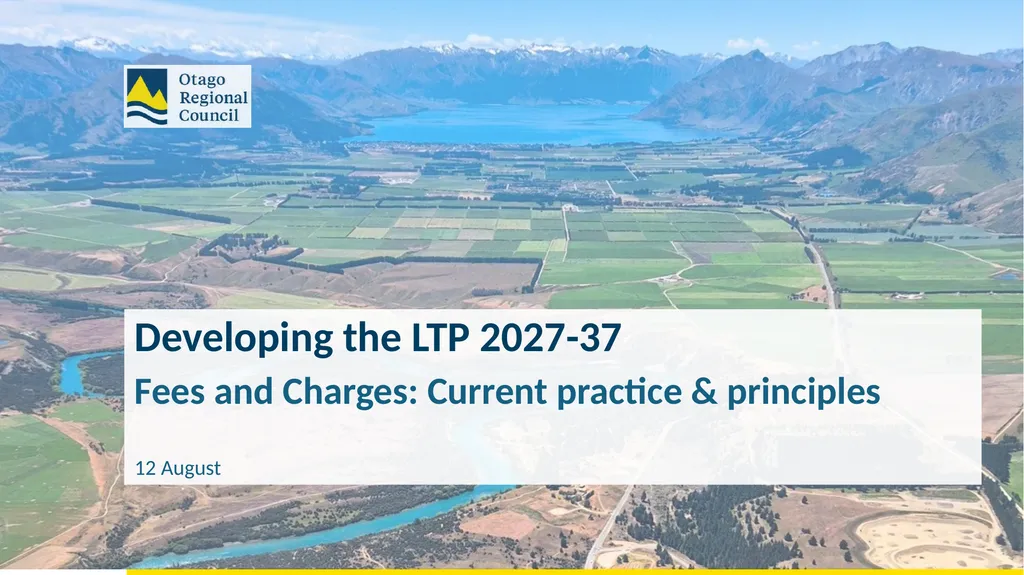
slide1. Developing the LTP 2027-37
Fees and Charges: Current practice & principles
12 August<br>
slide2. Briefing outline Introduction
Principles
Revenue and funding policy
Consent Charging
Compliance - Performance Monitoring Charging
Compliance Audit Charging
Compliance – Incidents and Enforcement Charging
Biosecurity cost recovery
Feedback LTP Development 2027-37 Fees and Charges: Current practice & principles 2026<br>
slide3. Principles
The Resource Management Act 1991 (RMA) allows councils to recover the reasonable cost of processing and monitoring resource consents (section 36(1)).
A consent provides a direct benefit to an individual, developer, business or organisation.
User pays ensures that general ratepayers are not subsidising consent activities.
Costs are charged for the work required to assess environmental effects, ensure compliance and meet statutory obligations.
Resource consent activities operate like a jam jar. The people using the service put money into the jar through fees and charges and that money is used to pay for delivering that service. If the jar is not topped up by users, the shortfall comes from ratepayers. LTP Development 2027-37 Fees and Charges: Current practice & principles 2026<br>
slide4. Cost Recovery The Courts support user pays cost recovery.
Charges must be based on actual and reasonable costs, not profit-making.
The Courts have confirmed that councils are entitled to recover the actual and reasonable costs of processing consent applications and undertaking compliance activities.
Case law has established that processing costs include the full range of activities required to assess and determine an application, not just the planner's time. This means we can recover costs for planners, technical specialists, hearings, commissioners and external consultants as required.
Charges must be reasonable, transparent and directly related to the work undertaken.<br>
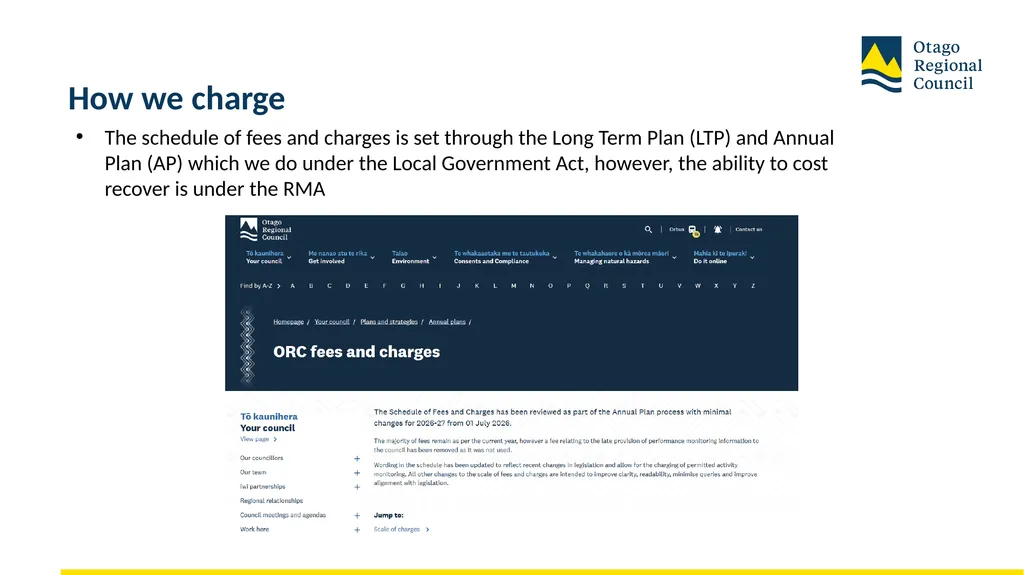
slide5. How we charge The schedule of fees and charges is set through the Long Term Plan (LTP) and Annual Plan (AP) which we do under the Local Government Act, however, the ability to cost recover is under the RMA<br>
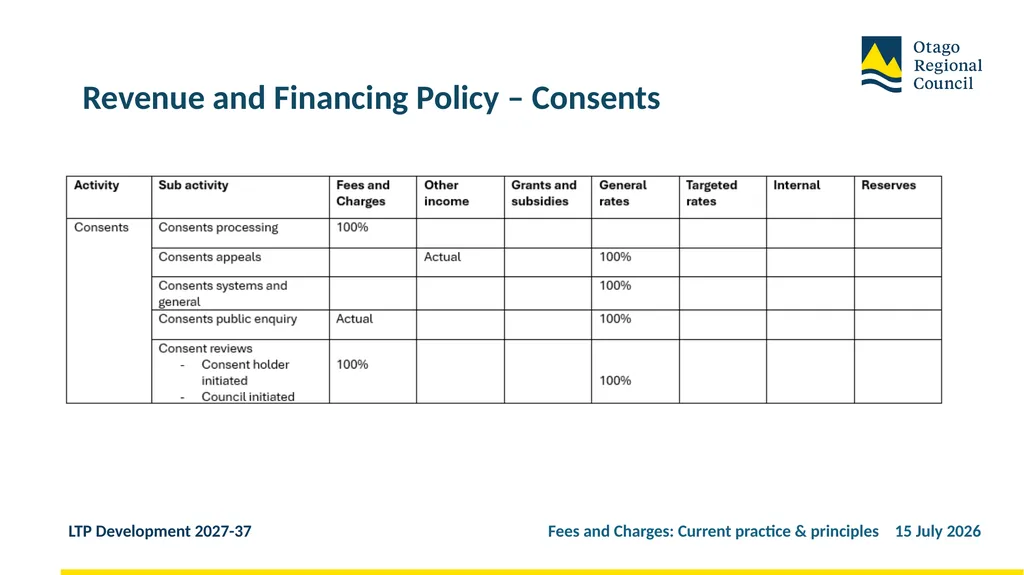
slide6. Revenue and Financing Policy – Consents LTP Development 2027-37 Fees and Charges: Current practice & principles 15 July 2026<br>
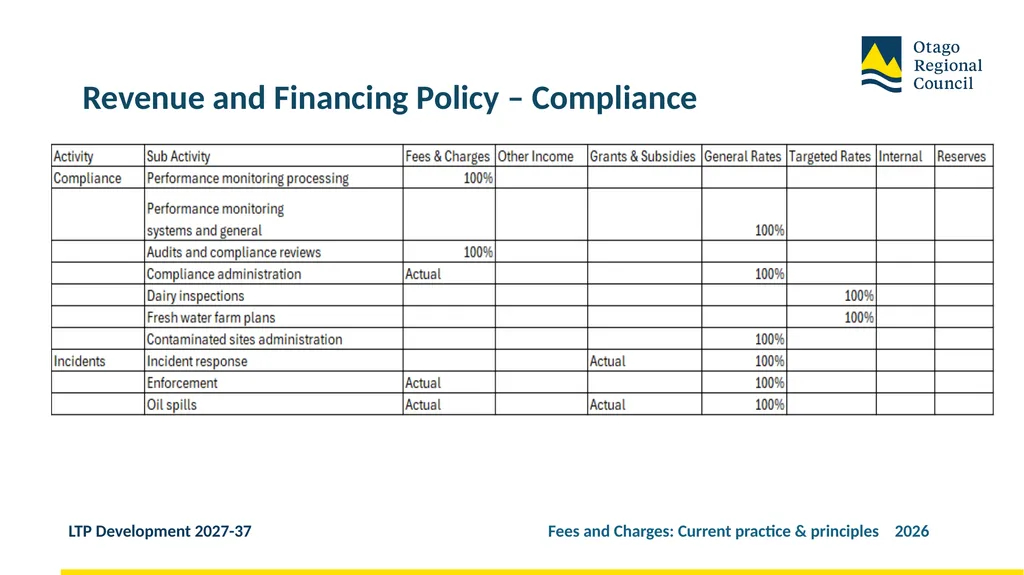
slide7. Revenue and Financing Policy – Compliance LTP Development 2027-37 Fees and Charges: Current practice & principles 2026<br>
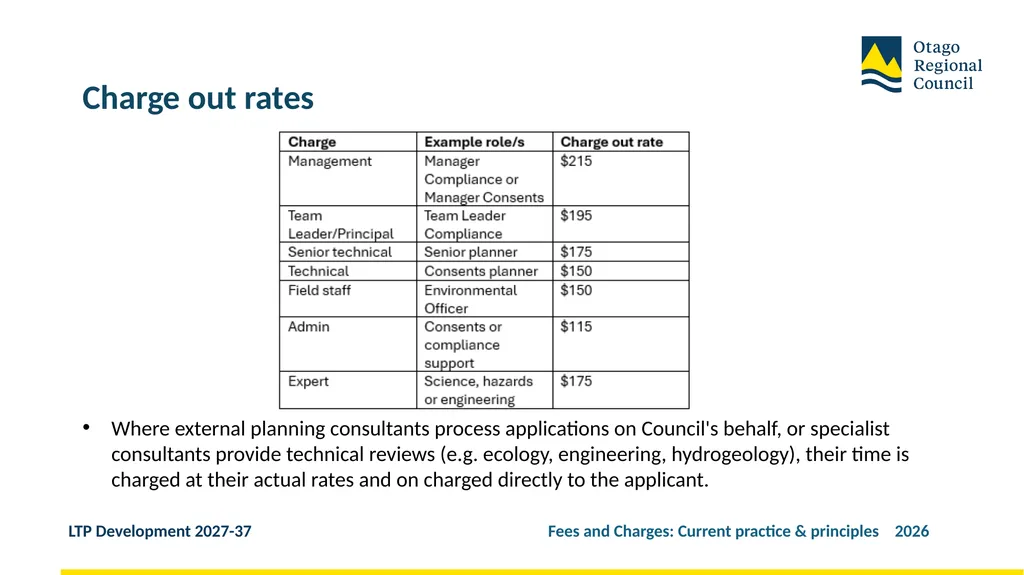
slide8. Charge out rates
Where external planning consultants process applications on Council's behalf, or specialist consultants provide technical reviews (e.g. ecology, engineering, hydrogeology), their time is charged at their actual rates and on charged directly to the applicant. LTP Development 2027-37 Fees and Charges: Current practice & principles 2026<br>
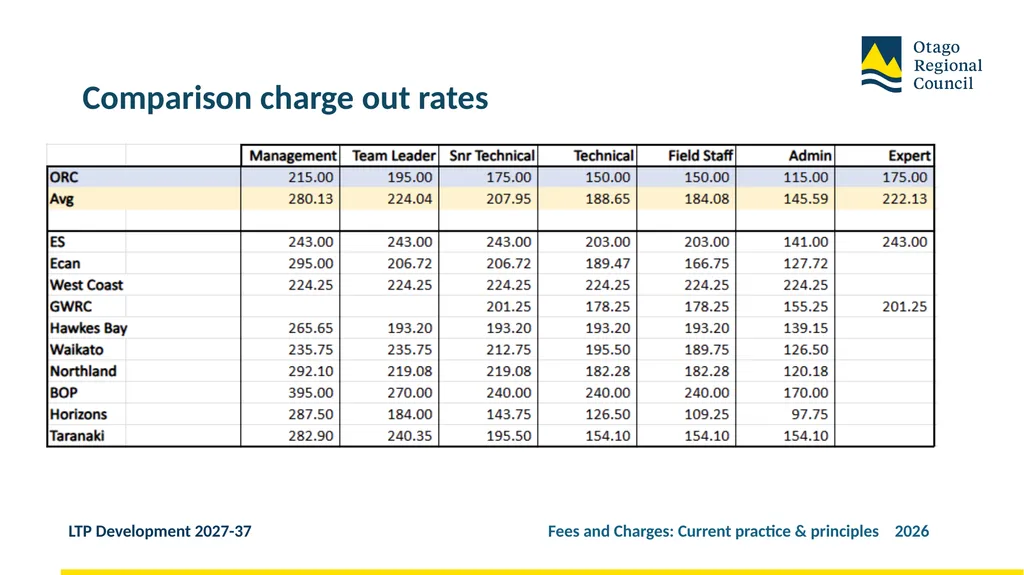
slide9. Comparison charge out rates LTP Development 2027-37 Fees and Charges: Current practice & principles 2026<br>
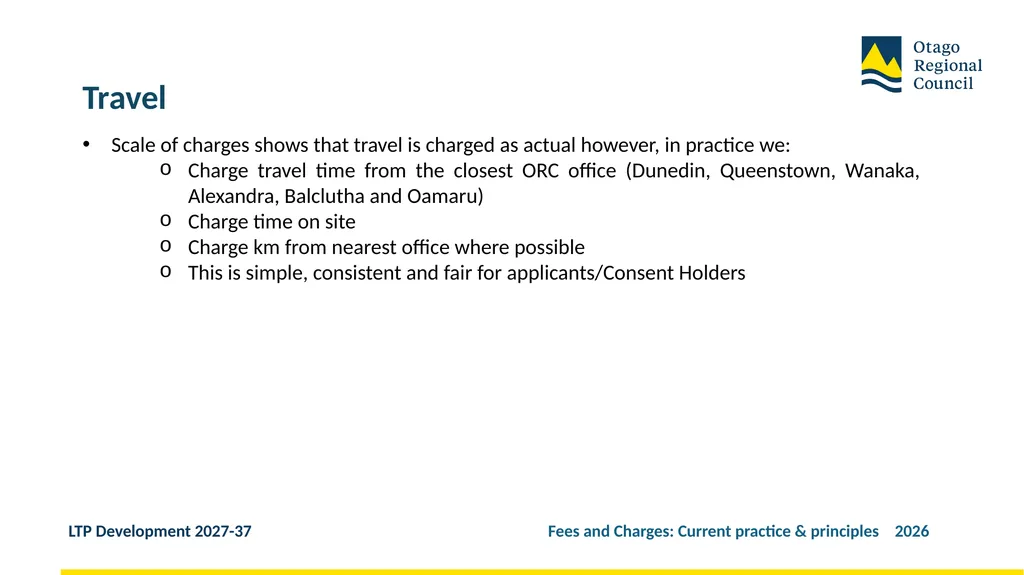
slide10. Travel
Scale of charges shows that travel is charged as actual however, in practice we:
Charge travel time from the closest ORC office (Dunedin, Queenstown, Wanaka, Alexandra, Balclutha and Oamaru)
Charge time on site
Charge km from nearest office where possible
This is simple, consistent and fair for applicants/Consent Holders LTP Development 2027-37 Fees and Charges: Current practice & principles 2026<br>
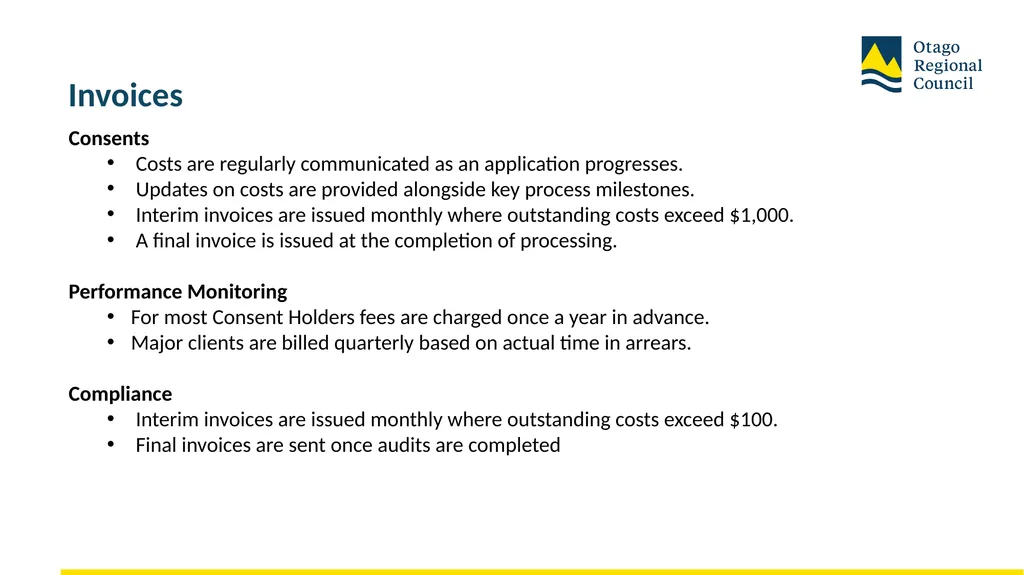
slide11. Invoices Consents
Costs are regularly communicated as an application progresses.
Updates on costs are provided alongside key process milestones.
Interim invoices are issued monthly where outstanding costs exceed $1,000.
A final invoice is issued at the completion of processing.
Performance Monitoring
For most Consent Holders fees are charged once a year in advance.
Major clients are billed quarterly based on actual time in arrears.
Compliance
Interim invoices are issued monthly where outstanding costs exceed $100.
Final invoices are sent once audits are completed<br>
slide12. 12 Budget
Consent fund
Consent processing
Fast track processing
Consent enquires
Cost recovery and efficiency Consents Presenter: Alexandra King<br>
slide13. Consents budget and actuals LTP Development 2027-37 Fees and Charges: Current practice & principles 2026<br>
slide14. Consent fund
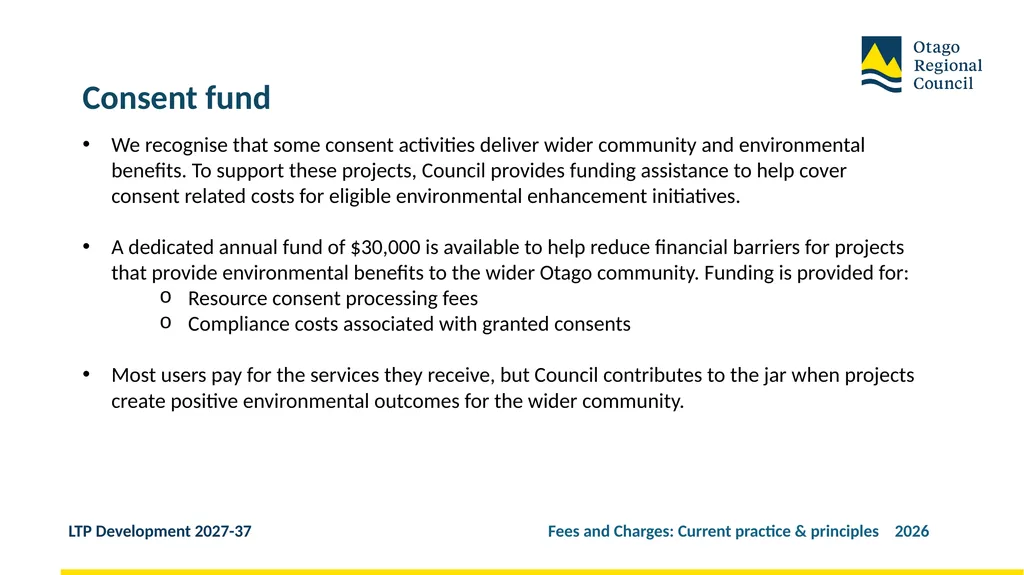
We recognise that some consent activities deliver wider community and environmental benefits. To support these projects, Council provides funding assistance to help cover consent related costs for eligible environmental enhancement initiatives.
A dedicated annual fund of $30,000 is available to help reduce financial barriers for projects that provide environmental benefits to the wider Otago community. Funding is provided for:
Resource consent processing fees
Compliance costs associated with granted consents
Most users pay for the services they receive, but Council contributes to the jar when projects create positive environmental outcomes for the wider community. LTP Development 2027-37 Fees and Charges: Current practice & principles 2026<br>
slide15. Consent processing
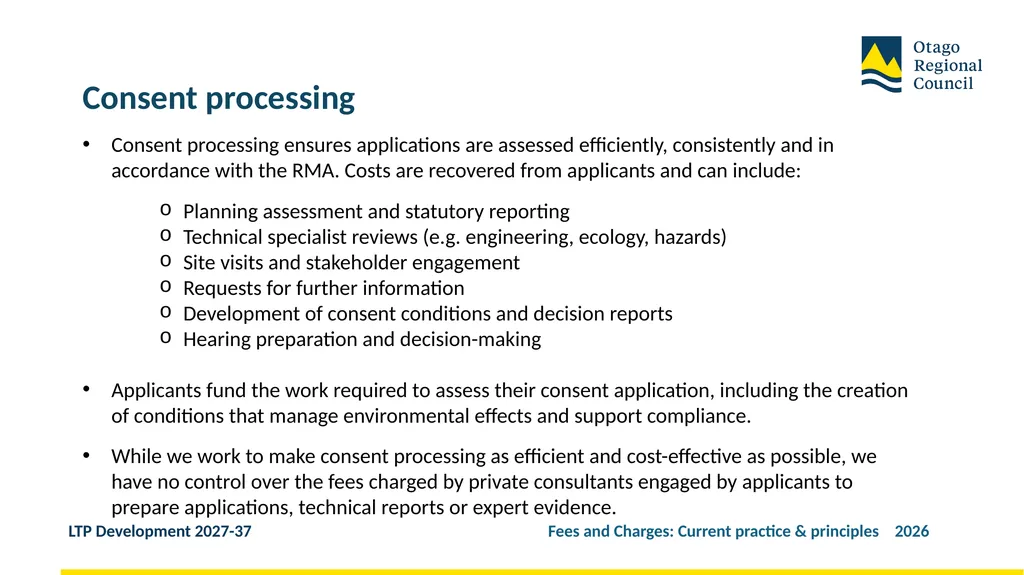
Consent processing ensures applications are assessed efficiently, consistently and in accordance with the RMA. Costs are recovered from applicants and can include:
Planning assessment and statutory reporting
Technical specialist reviews (e.g. engineering, ecology, hazards)
Site visits and stakeholder engagement
Requests for further information
Development of consent conditions and decision reports
Hearing preparation and decision-making
Applicants fund the work required to assess their consent application, including the creation of conditions that manage environmental effects and support compliance.
While we work to make consent processing as efficient and cost-effective as possible, we have no control over the fees charged by private consultants engaged by applicants to prepare applications, technical reports or expert evidence. LTP Development 2027-37 Fees and Charges: Current practice & principles 2026<br>
slide16. Consent processing
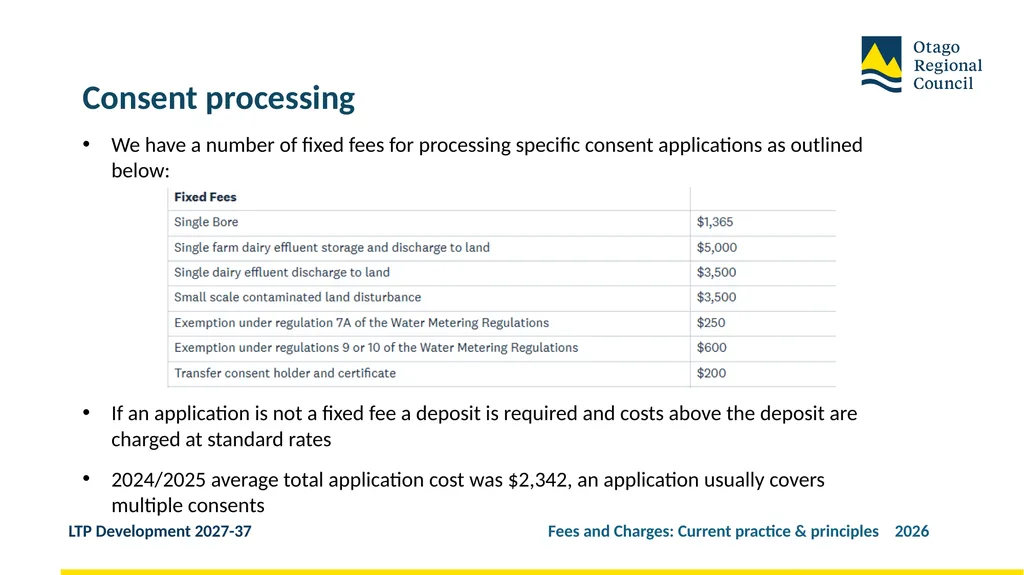
We have a number of fixed fees for processing specific consent applications as outlined below:
If an application is not a fixed fee a deposit is required and costs above the deposit are charged at standard rates
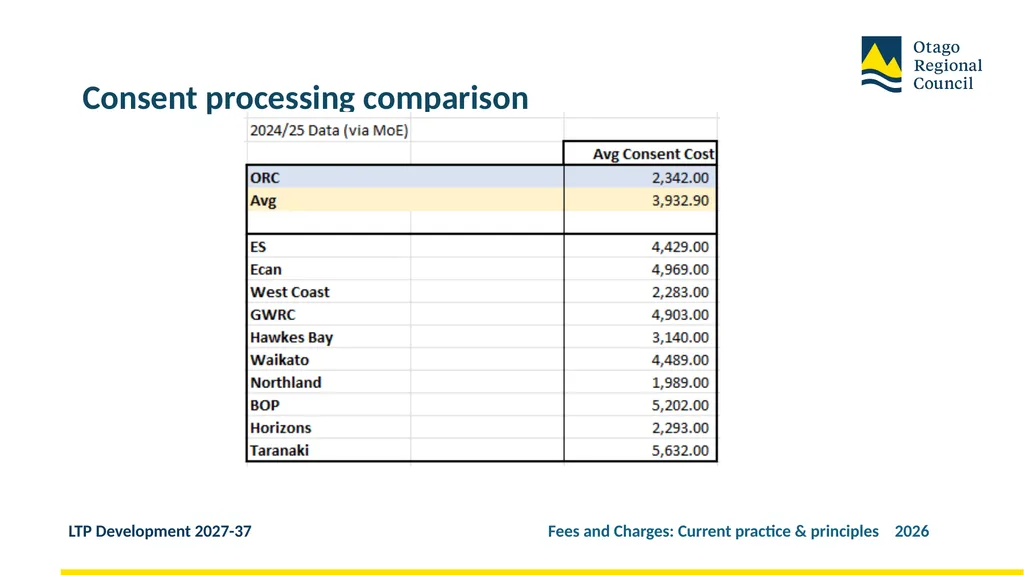
2024/2025 average total application cost was $2,342, an application usually covers multiple consents LTP Development 2027-37 Fees and Charges: Current practice & principles 2026<br>
slide17. Consent processing comparison LTP Development 2027-37 Fees and Charges: Current practice & principles 2026<br>
slide18. Pre applications
Pre application meetings allow applicants to discuss their proposal with Council staff before lodging a resource consent application. Benefits include:
Understanding what consents may be required
Identifying relevant planning and technical requirements
Clarifying information needed to support an application
Reducing processing time, costs and requests for further information
Improving the quality and completeness of applications
We provide the first 30 minutes of pre application advice free of charge. Beyond this staff time is charged at standard hourly rates. LTP Development 2027-37 Fees and Charges: Current practice & principles 2026<br>
slide19. Fast Track consent processing
Fast-track applications are assessed under the Fast-track Approvals Act 2024 (FTAA), with Council providing technical audits and advice to support decision-making by the Environmental Protection Authority and Expert Panels based on Council's Plans. Costs recovered from applicants can include:
Pre-application advice and engagement
Planning and regulatory assessments
Technical specialist reviews (e.g. engineering, ecology, water quality, hazards)
Review of environmental effects and supporting reports
Site visits and stakeholder engagement
Assessment of draft consent conditions
Preparation of Council comments and advice to Expert Panels
Applicants fund the work required for us to assess, review and provide specialist advice on Fast-track projects, ensuring costs are borne by the project rather than the wider ratepayer community. LTP Development 2027-37 Fees and Charges: Current practice & principles 2026<br>
slide20. Consent enquires
Consent enquiries is where we provide advice and guidance to landowners, businesses, consultants and the community on RMA or FTAA requirements and consenting processes. Activities can include:
Providing planning and consenting advice
Responding to enquiries from applicants, consultants and the public
Reviewing proposal concepts and identifying consent requirements
Interpreting planning rules and consent conditions
Assisting customers to navigate Council processes
Liaising with technical specialists where required
In the 2025/26 financial year, staff responded to 1,807 consent-related enquiries. Providing timely advice up front helps applicants get it right the first time, reducing downstream processing costs and improving customer outcomes.
We offer 30 minutes free and then charge at our standard hourly rates. LTP Development 2027-37 Fees and Charges: Current practice & principles 2026<br>
slide21. Cost recovery and efficiency
We continually look for ways to reduce processing costs and improve efficiency
Initiatives include:
Free 30 minute pre application advice and the consent enquires service
Tailored application forms
Guidance on when specialist reports or expert advice may be needed
Technical practice notes and guidance documents
Example consent conditions
Up to date information and self-help tools on the website
Early engagement with consultants and applicants
Implementation of regulation within the community eg. IWG and effluent
Bi-annual catch ups with key consultants and quarterly with industry groups
Communication of costs LTP Development 2027-37 Fees and Charges: Current practice & principles 2026<br>
slide22. Internal efficiencies
We continually look for ways to improve efficiency
Initiatives include:
Standardised report templates
Standard condition manual/condition library
Consistent processing workflows and business practices
Staff training and upskilling
Early engagement with applicants and consultants
Continuous process improvement and system enhancements
A pragmatic, risk-based approach to processing LTP Development 2027-37 Fees and Charges: Current practice & principles 2026<br>
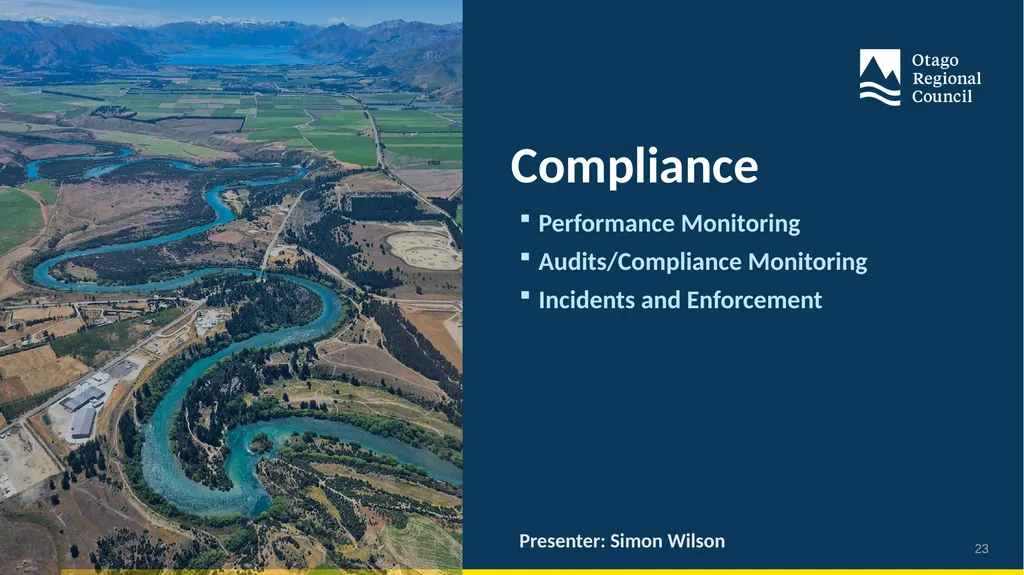
slide23. 23 Performance Monitoring
Audits/Compliance Monitoring
Incidents and Enforcement Compliance Presenter: Simon Wilson<br>
slide24. Compliance
Compliance monitoring fees cover the cost of monitoring resource consents issued by the Council.
Fees are charged in two broad categories:
Performance Monitoring Fees based on the returns a Consent Holder is required to send ORC as part of their consent. These fees are smaller and are charged to more Consent Holders.
Audit fees are charged only when a consent is audited. These fees are larger and are charged less often. LTP Development 2027-37 Fees and Charges: Current practice & principles 2026<br>
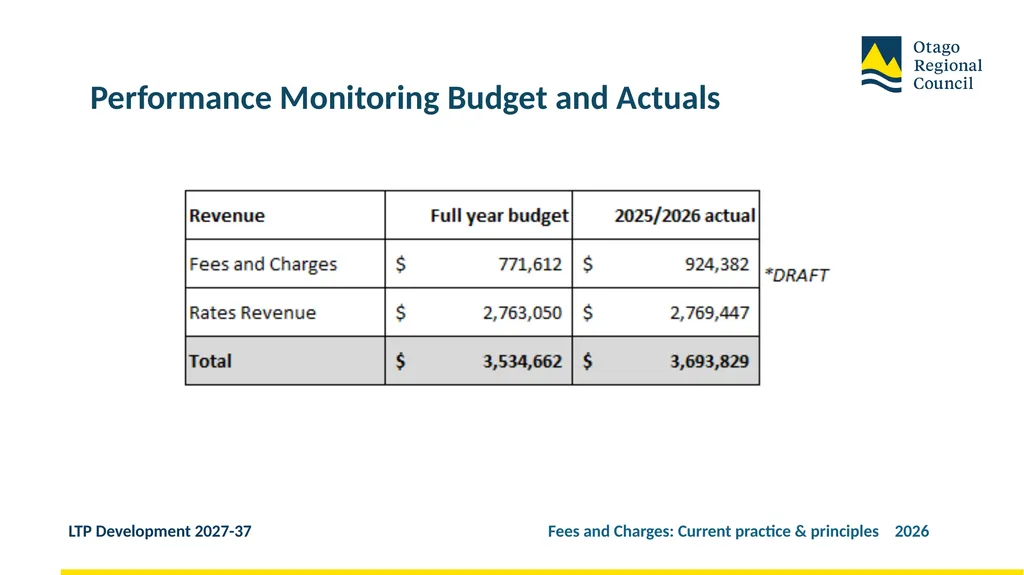
slide25. Performance Monitoring Budget and Actuals LTP Development 2027-37 Fees and Charges: Current practice & principles 2026<br>
slide26. Performance Monitoring
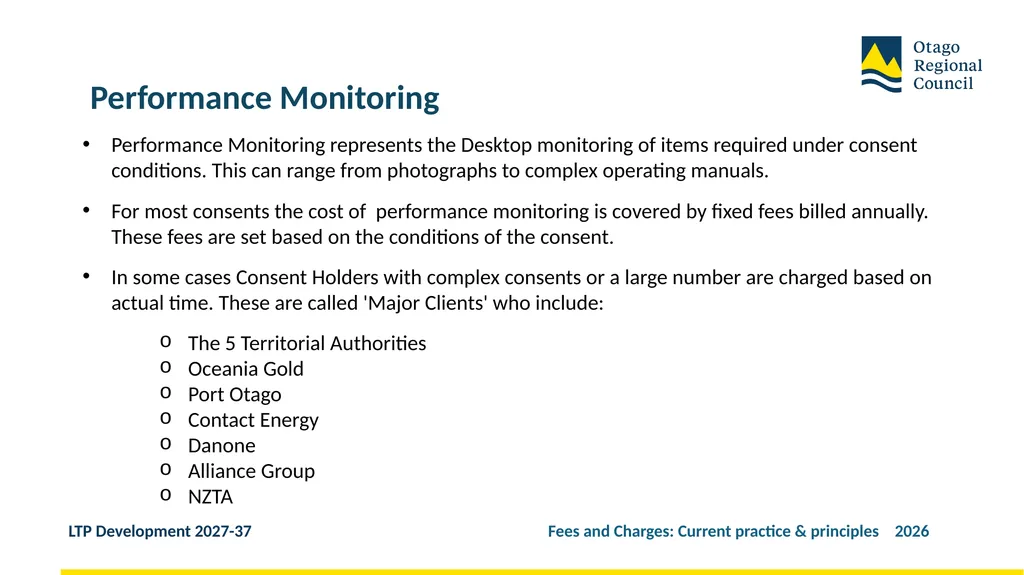
Performance Monitoring represents the Desktop monitoring of items required under consent conditions. This can range from photographs to complex operating manuals.
For most consents the cost of performance monitoring is covered by fixed fees billed annually. These fees are set based on the conditions of the consent.
In some cases Consent Holders with complex consents or a large number are charged based on actual time. These are called 'Major Clients' who include:
The 5 Territorial Authorities
Oceania Gold
Port Otago
Contact Energy
Danone
Alliance Group
NZTA LTP Development 2027-37 Fees and Charges: Current practice & principles 2026<br>
slide27. Performance Monitoring
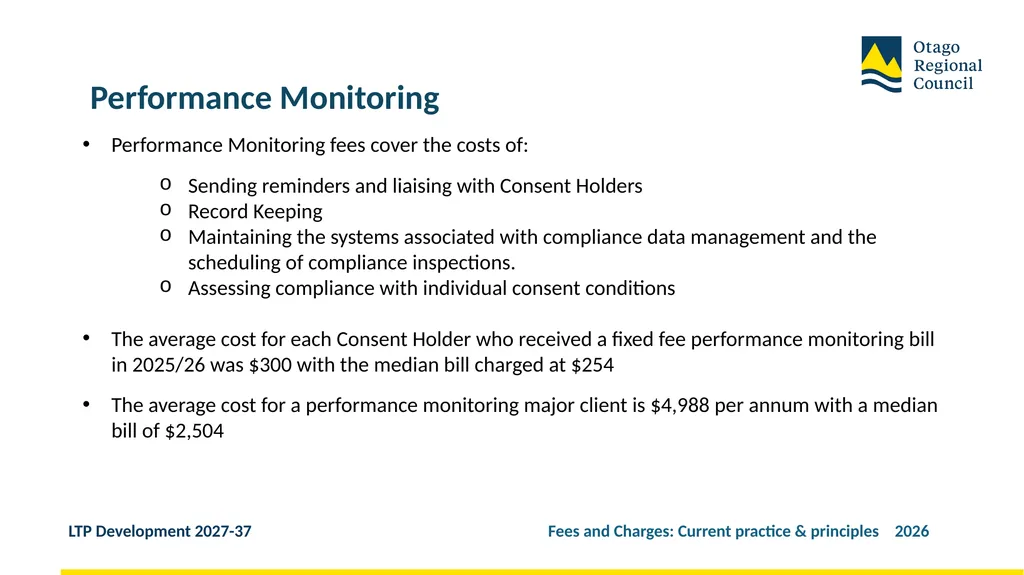
Performance Monitoring fees cover the costs of:
Sending reminders and liaising with Consent Holders
Record Keeping
Maintaining the systems associated with compliance data management and the scheduling of compliance inspections.
Assessing compliance with individual consent conditions
The average cost for each Consent Holder who received a fixed fee performance monitoring bill in 2025/26 was $300 with the median bill charged at $254
The average cost for a performance monitoring major client is $4,988 per annum with a median bill of $2,504 LTP Development 2027-37 Fees and Charges: Current practice & principles 2026<br>
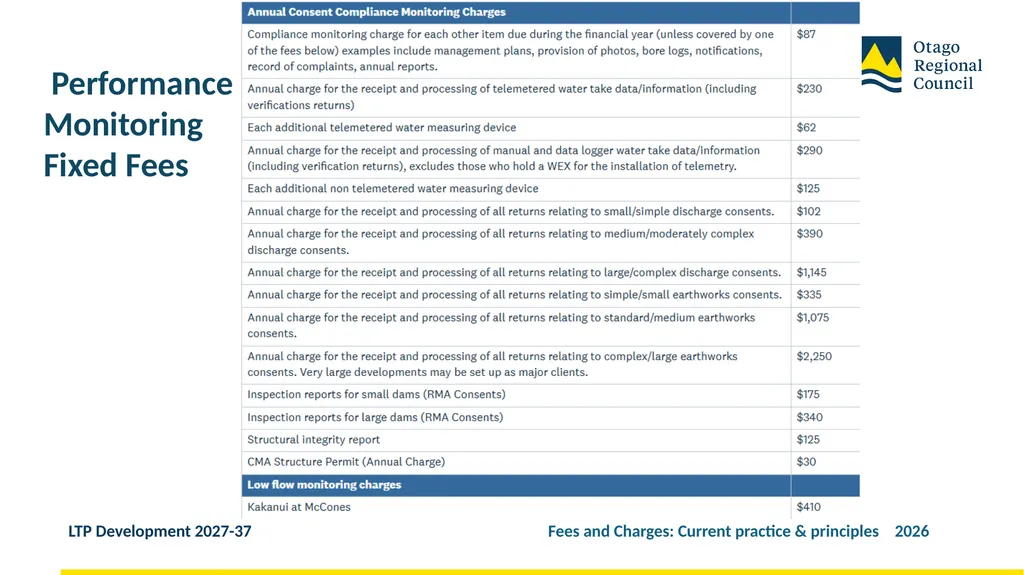
slide28. Performance Monitoring Fixed Fees LTP Development 2027-37 Fees and Charges: Current practice & principles 2026<br>
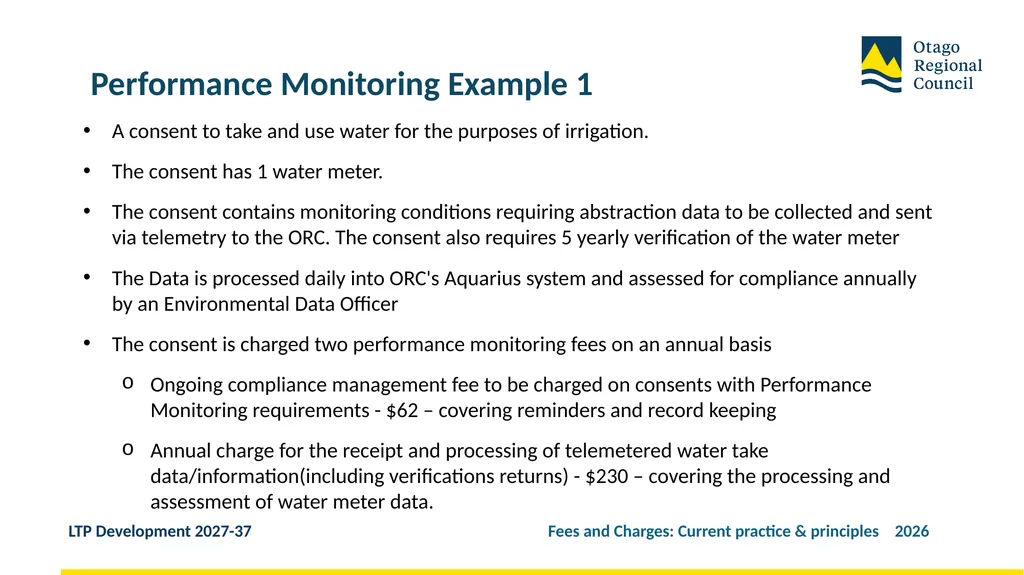
slide29. Performance Monitoring Example 1
A consent to take and use water for the purposes of irrigation.
The consent has 1 water meter.
The consent contains monitoring conditions requiring abstraction data to be collected and sent via telemetry to the ORC. The consent also requires 5 yearly verification of the water meter
The Data is processed daily into ORC's Aquarius system and assessed for compliance annually by an Environmental Data Officer
The consent is charged two performance monitoring fees on an annual basis
Ongoing compliance management fee to be charged on consents with Performance Monitoring requirements - $62 – covering reminders and record keeping
Annual charge for the receipt and processing of telemetered water take data/information(including verifications returns) - $230 – covering the processing and assessment of water meter data. LTP Development 2027-37 Fees and Charges: Current practice & principles 2026<br>
slide30. Performance Monitoring Example 2
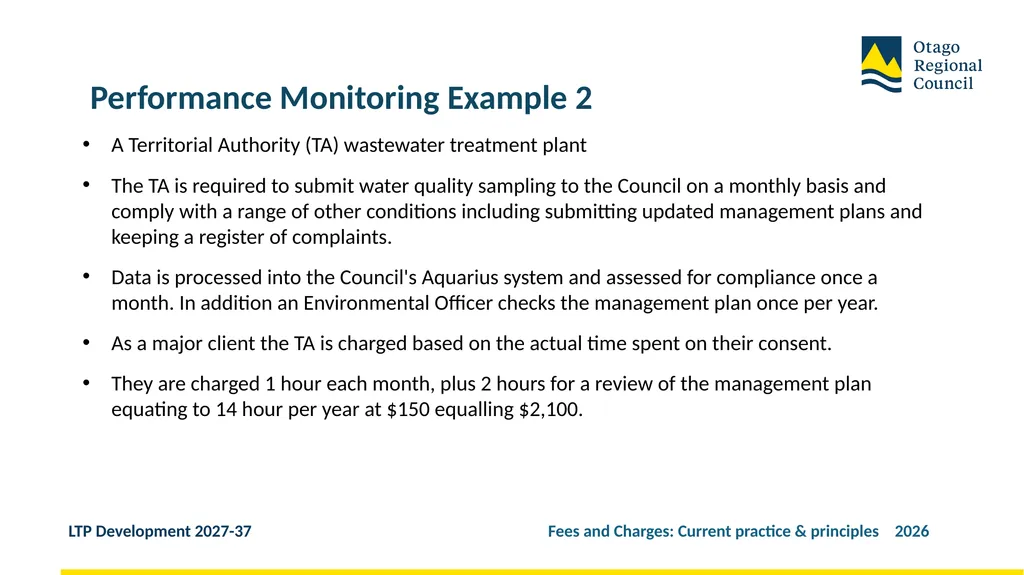
A Territorial Authority (TA) wastewater treatment plant
The TA is required to submit water quality sampling to the Council on a monthly basis and comply with a range of other conditions including submitting updated management plans and keeping a register of complaints.
Data is processed into the Council's Aquarius system and assessed for compliance once a month. In addition an Environmental Officer checks the management plan once per year.
As a major client the TA is charged based on the actual time spent on their consent.
They are charged 1 hour each month, plus 2 hours for a review of the management plan equating to 14 hour per year at $150 equalling $2,100. LTP Development 2027-37 Fees and Charges: Current practice & principles 2026<br>
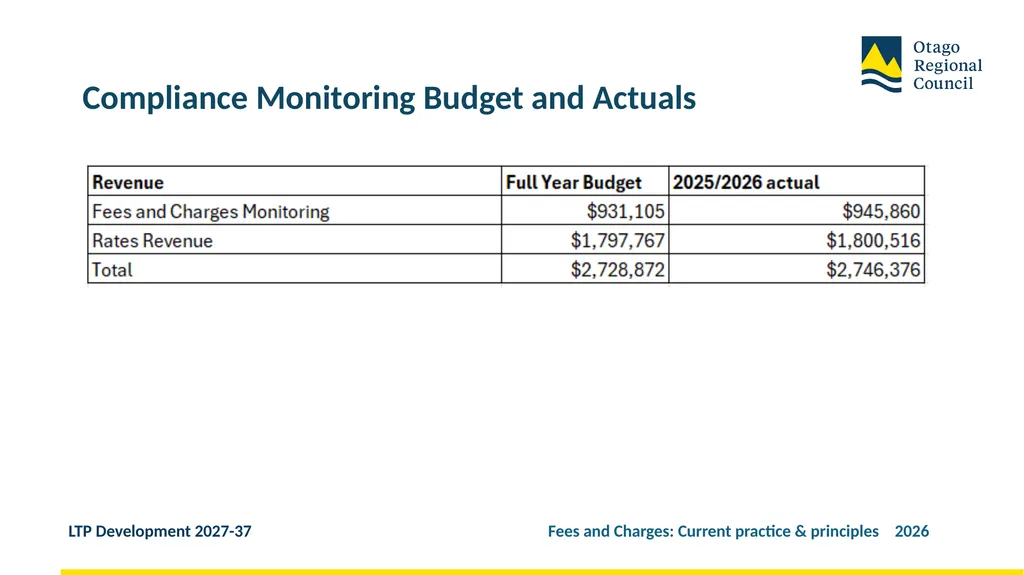
slide31. Compliance Monitoring Budget and Actuals LTP Development 2027-37 Fees and Charges: Current practice & principles 2026<br>
slide32. Compliance Audits
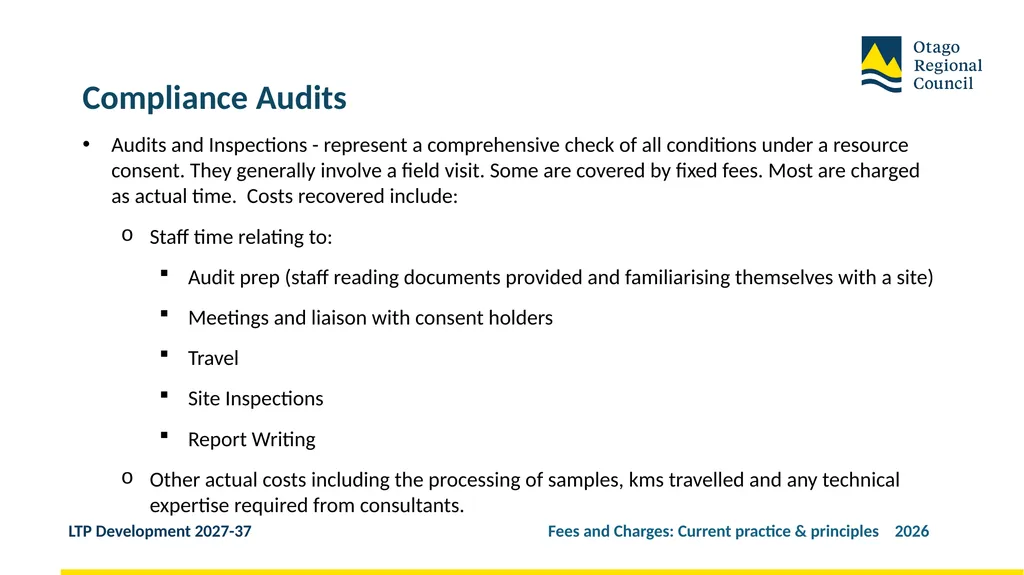
Audits and Inspections - represent a comprehensive check of all conditions under a resource consent. They generally involve a field visit. Some are covered by fixed fees. Most are charged as actual time. Costs recovered include:
Staff time relating to:
Audit prep (staff reading documents provided and familiarising themselves with a site)
Meetings and liaison with consent holders
Travel
Site Inspections
Report Writing
Other actual costs including the processing of samples, kms travelled and any technical expertise required from consultants. LTP Development 2027-37 Fees and Charges: Current practice & principles 2026<br>
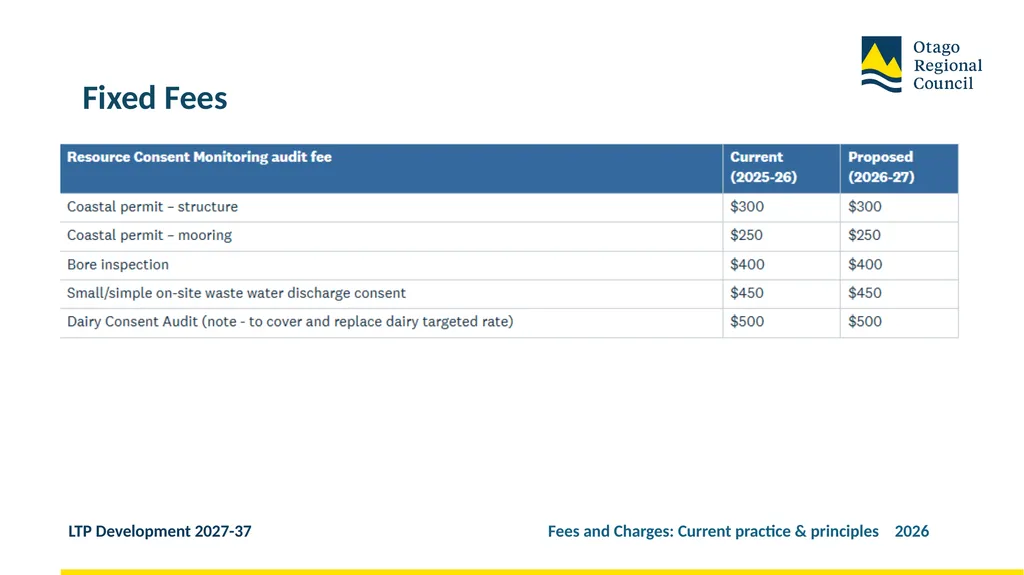
slide33. Fixed Fees LTP Development 2027-37 Fees and Charges: Current practice & principles 2026<br>
slide34. Compliance Audit Example 1
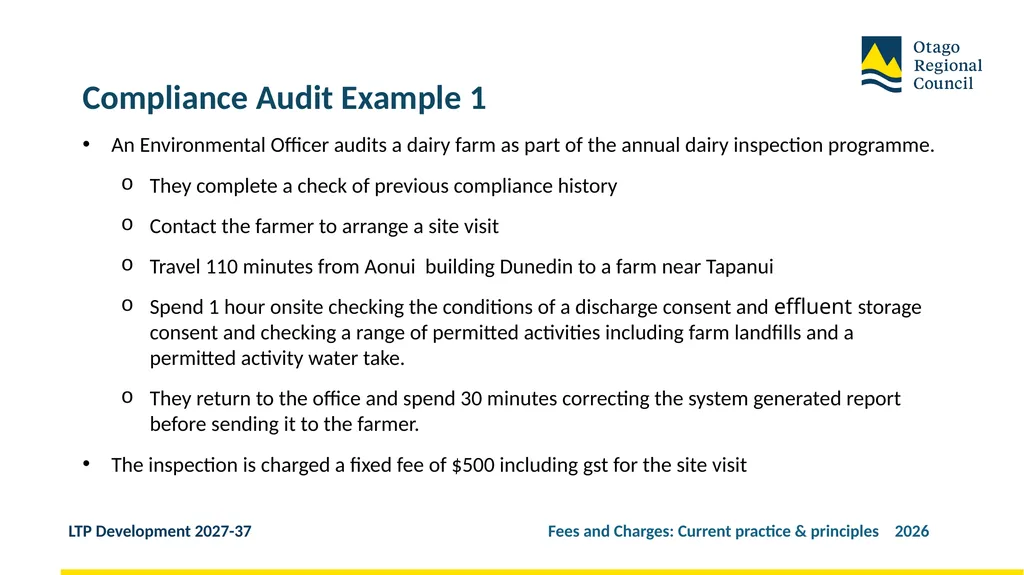
An Environmental Officer audits a dairy farm as part of the annual dairy inspection programme.
They complete a check of previous compliance history
Contact the farmer to arrange a site visit
Travel 110 minutes from Aonui building Dunedin to a farm near Tapanui
Spend 1 hour onsite checking the conditions of a discharge consent and effluent storage consent and checking a range of permitted activities including farm landfills and a permitted activity water take.
They return to the office and spend 30 minutes correcting the system generated report before sending it to the farmer.
The inspection is charged a fixed fee of $500 including gst for the site visit LTP Development 2027-37 Fees and Charges: Current practice & principles 2026<br>
slide35. Compliance Audits Example 2
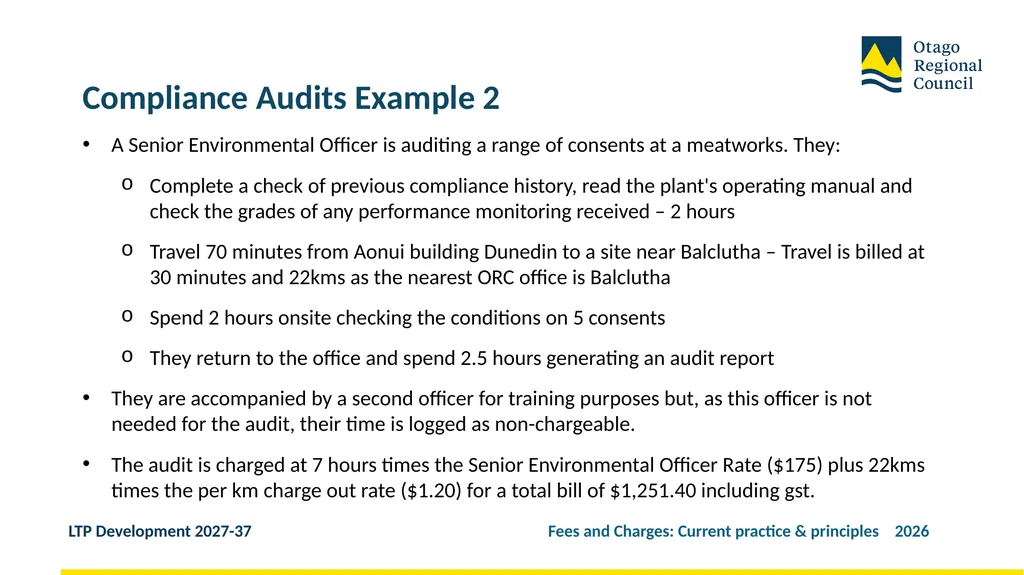
A Senior Environmental Officer is auditing a range of consents at a meatworks. They:
Complete a check of previous compliance history, read the plant's operating manual and check the grades of any performance monitoring received – 2 hours
Travel 70 minutes from Aonui building Dunedin to a site near Balclutha – Travel is billed at 30 minutes and 22kms as the nearest ORC office is Balclutha
Spend 2 hours onsite checking the conditions on 5 consents
They return to the office and spend 2.5 hours generating an audit report
They are accompanied by a second officer for training purposes but, as this officer is not needed for the audit, their time is logged as non-chargeable.
The audit is charged at 7 hours times the Senior Environmental Officer Rate ($175) plus 22kms times the per km charge out rate ($1.20) for a total bill of $1,251.40 including gst. LTP Development 2027-37 Fees and Charges: Current practice & principles 2026<br>
slide36. Compliance Monitoring
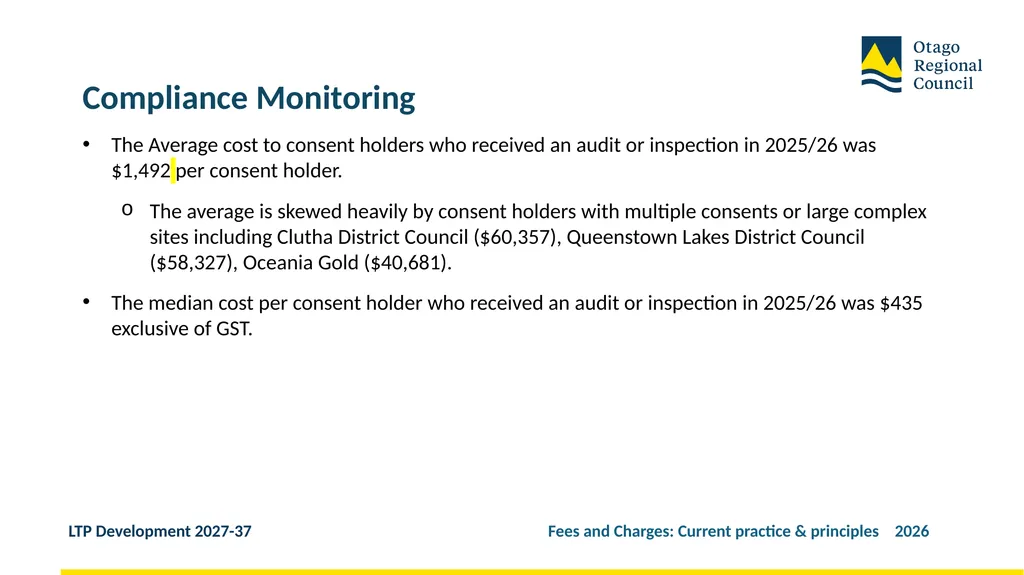
The Average cost to consent holders who received an audit or inspection in 2025/26 was $1,492 per consent holder.
The average is skewed heavily by consent holders with multiple consents or large complex sites including Clutha District Council ($60,357), Queenstown Lakes District Council ($58,327), Oceania Gold ($40,681).
The median cost per consent holder who received an audit or inspection in 2025/26 was $435 exclusive of GST. LTP Development 2027-37 Fees and Charges: Current practice & principles 2026<br>
slide37. Compliance Monitoring Comparison
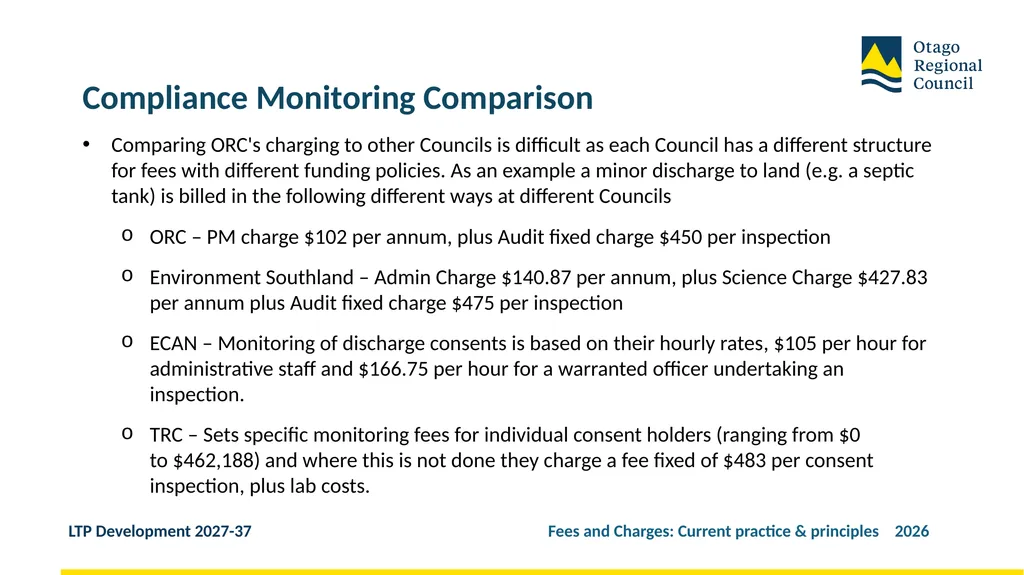
Comparing ORC's charging to other Councils is difficult as each Council has a different structure for fees with different funding policies. As an example a minor discharge to land (e.g. a septic tank) is billed in the following different ways at different Councils
ORC – PM charge $102 per annum, plus Audit fixed charge $450 per inspection
Environment Southland – Admin Charge $140.87 per annum, plus Science Charge $427.83 per annum plus Audit fixed charge $475 per inspection
ECAN – Monitoring of discharge consents is based on their hourly rates, $105 per hour for administrative staff and $166.75 per hour for a warranted officer undertaking an inspection.
TRC – Sets specific monitoring fees for individual consent holders (ranging from $0 to $462,188) and where this is not done they charge a fee fixed of $483 per consent inspection, plus lab costs. LTP Development 2027-37 Fees and Charges: Current practice & principles 2026<br>
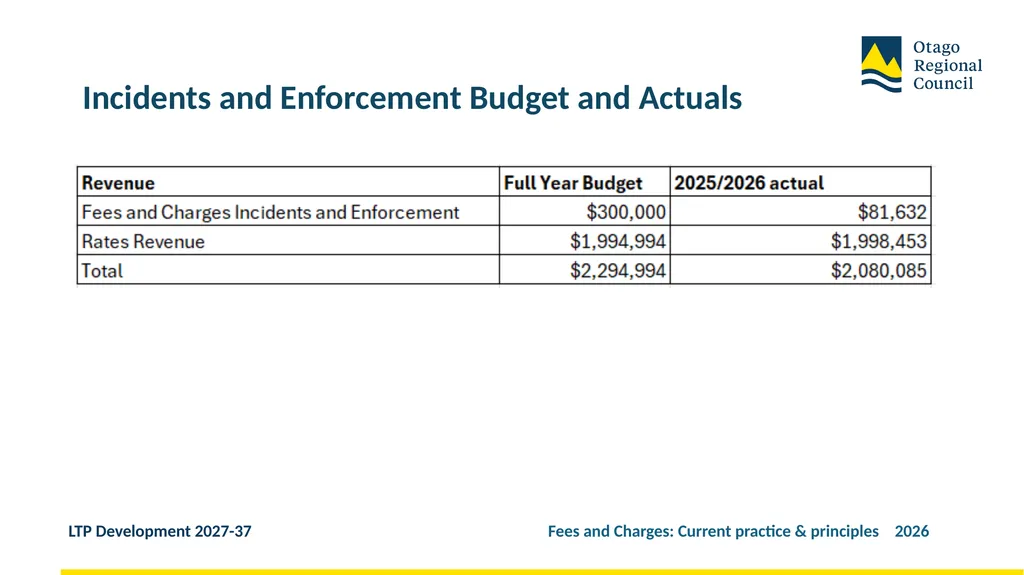
slide38. Incidents and Enforcement Budget and Actuals LTP Development 2027-37 Fees and Charges: Current practice & principles 2026<br>
slide39. Incidents and Enforcement
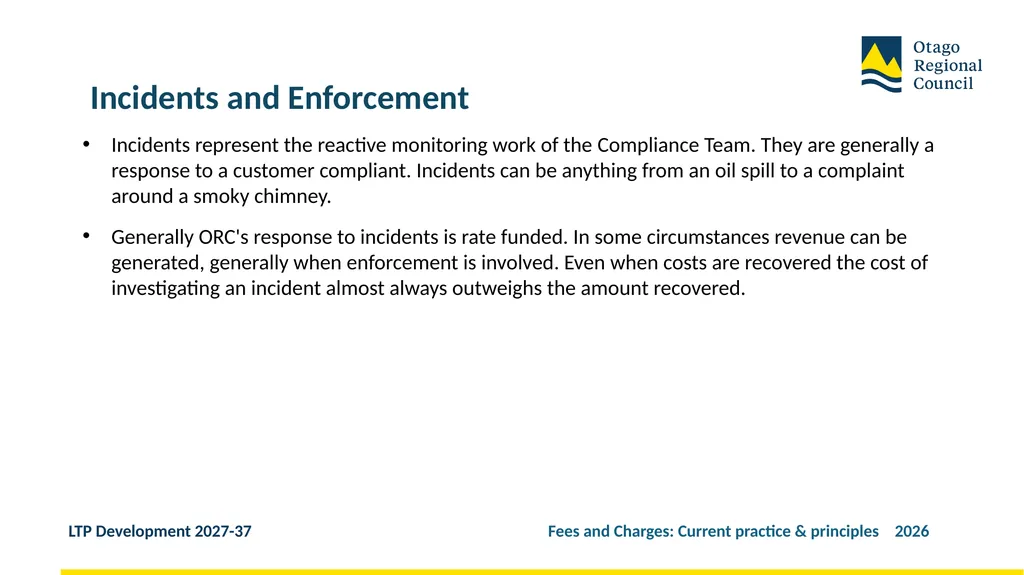
Incidents represent the reactive monitoring work of the Compliance Team. They are generally a response to a customer compliant. Incidents can be anything from an oil spill to a complaint around a smoky chimney.
Generally ORC's response to incidents is rate funded. In some circumstances revenue can be generated, generally when enforcement is involved. Even when costs are recovered the cost of investigating an incident almost always outweighs the amount recovered. LTP Development 2027-37 Fees and Charges: Current practice & principles 2026<br>
slide40. Incidents and Enforcement
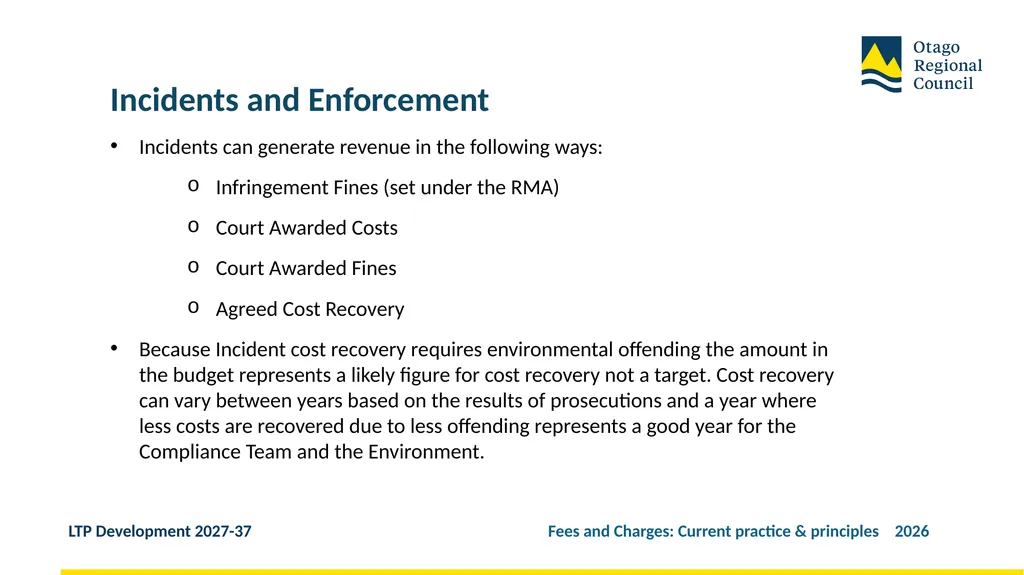
Incidents can generate revenue in the following ways:
Infringement Fines (set under the RMA)
Court Awarded Costs
Court Awarded Fines
Agreed Cost Recovery
Because Incident cost recovery requires environmental offending the amount in the budget represents a likely figure for cost recovery not a target. Cost recovery can vary between years based on the results of prosecutions and a year where less costs are recovered due to less offending represents a good year for the Compliance Team and the Environment. LTP Development 2027-37 Fees and Charges: Current practice & principles 2026<br>
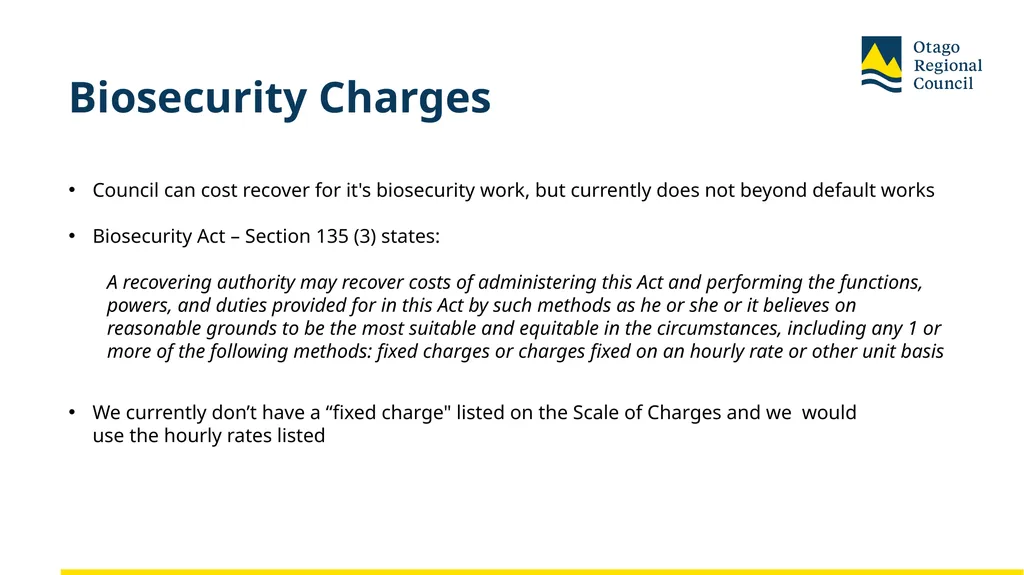
slide41. Biosecurity Charges Council can cost recover for it's biosecurity work, but currently does not beyond default works
Biosecurity Act – Section 135 (3) states:
A recovering authority may recover costs of administering this Act and performing the functions, powers, and duties provided for in this Act by such methods as he or she or it believes on reasonable grounds to be the most suitable and equitable in the circumstances, including any 1 or more of the following methods: fixed charges or charges fixed on an hourly rate or other unit basis We currently don’t have a “fixed charge" listed on the Scale of Charges and we would use the hourly rates listed<br>
slide42. What we have heard from you to date Maintain a user pays model. This minimises the impact of consent and compliance activities on the wider ratepayer.
Should this be extended to biosecurity compliance work?
Costs should be carefully managed, with on-going focus on improving process, reducing unnecessary cost and delivering value for money.
How we charge is just as important as what we charge:
Maintain equity in travel cost recovery – charge from the nearest ORC site or a flat fee for everyone?
Continue not to charge staff training time, or 'getting up to speed' time.
Incentivise compliance by reducing annual costs for those who are fully compliant.
Keep charge out rates as low as possible.
Any other areas ?<br>
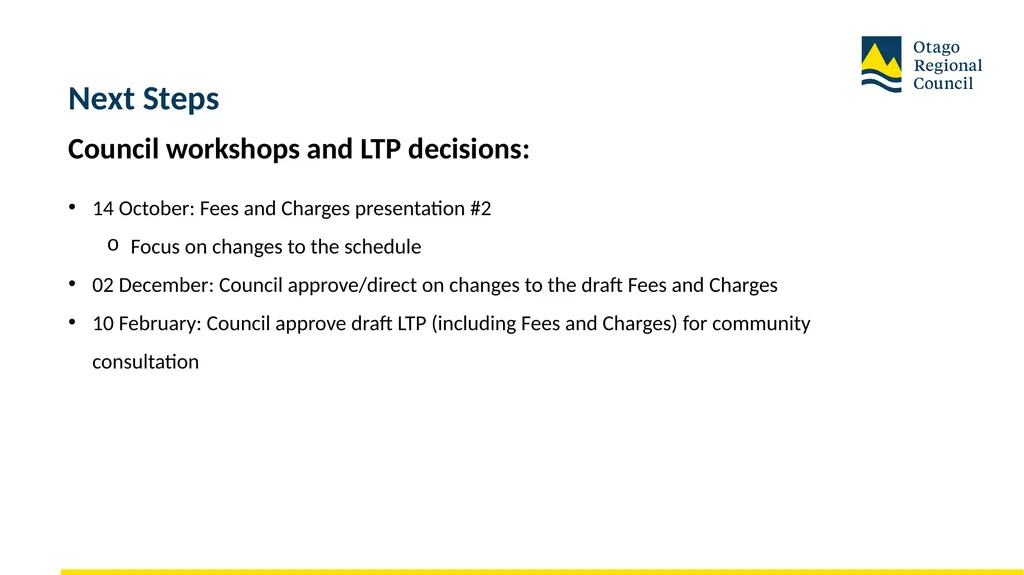
slide43. Next Steps Council workshops and LTP decisions: 14 October: Fees and Charges presentation #2
Focus on changes to the schedule
02 December: Council approve/direct on changes to the draft Fees and Charges
10 February: Council approve draft LTP (including Fees and Charges) for community consultation<br>
slide44. 44 End<br>
Fees and Charges: Current practice & principles
12 August<br>
slide2. Briefing outline Introduction
Principles
Revenue and funding policy
Consent Charging
Compliance - Performance Monitoring Charging
Compliance Audit Charging
Compliance – Incidents and Enforcement Charging
Biosecurity cost recovery
Feedback LTP Development 2027-37 Fees and Charges: Current practice & principles 2026<br>
slide3. Principles
The Resource Management Act 1991 (RMA) allows councils to recover the reasonable cost of processing and monitoring resource consents (section 36(1)).
A consent provides a direct benefit to an individual, developer, business or organisation.
User pays ensures that general ratepayers are not subsidising consent activities.
Costs are charged for the work required to assess environmental effects, ensure compliance and meet statutory obligations.
Resource consent activities operate like a jam jar. The people using the service put money into the jar through fees and charges and that money is used to pay for delivering that service. If the jar is not topped up by users, the shortfall comes from ratepayers. LTP Development 2027-37 Fees and Charges: Current practice & principles 2026<br>
slide4. Cost Recovery The Courts support user pays cost recovery.
Charges must be based on actual and reasonable costs, not profit-making.
The Courts have confirmed that councils are entitled to recover the actual and reasonable costs of processing consent applications and undertaking compliance activities.
Case law has established that processing costs include the full range of activities required to assess and determine an application, not just the planner's time. This means we can recover costs for planners, technical specialists, hearings, commissioners and external consultants as required.
Charges must be reasonable, transparent and directly related to the work undertaken.<br>
slide5. How we charge The schedule of fees and charges is set through the Long Term Plan (LTP) and Annual Plan (AP) which we do under the Local Government Act, however, the ability to cost recover is under the RMA<br>
slide6. Revenue and Financing Policy – Consents LTP Development 2027-37 Fees and Charges: Current practice & principles 15 July 2026<br>
slide7. Revenue and Financing Policy – Compliance LTP Development 2027-37 Fees and Charges: Current practice & principles 2026<br>
slide8. Charge out rates
Where external planning consultants process applications on Council's behalf, or specialist consultants provide technical reviews (e.g. ecology, engineering, hydrogeology), their time is charged at their actual rates and on charged directly to the applicant. LTP Development 2027-37 Fees and Charges: Current practice & principles 2026<br>
slide9. Comparison charge out rates LTP Development 2027-37 Fees and Charges: Current practice & principles 2026<br>
slide10. Travel
Scale of charges shows that travel is charged as actual however, in practice we:
Charge travel time from the closest ORC office (Dunedin, Queenstown, Wanaka, Alexandra, Balclutha and Oamaru)
Charge time on site
Charge km from nearest office where possible
This is simple, consistent and fair for applicants/Consent Holders LTP Development 2027-37 Fees and Charges: Current practice & principles 2026<br>
slide11. Invoices Consents
Costs are regularly communicated as an application progresses.
Updates on costs are provided alongside key process milestones.
Interim invoices are issued monthly where outstanding costs exceed $1,000.
A final invoice is issued at the completion of processing.
Performance Monitoring
For most Consent Holders fees are charged once a year in advance.
Major clients are billed quarterly based on actual time in arrears.
Compliance
Interim invoices are issued monthly where outstanding costs exceed $100.
Final invoices are sent once audits are completed<br>
slide12. 12 Budget
Consent fund
Consent processing
Fast track processing
Consent enquires
Cost recovery and efficiency Consents Presenter: Alexandra King<br>
slide13. Consents budget and actuals LTP Development 2027-37 Fees and Charges: Current practice & principles 2026<br>
slide14. Consent fund
We recognise that some consent activities deliver wider community and environmental benefits. To support these projects, Council provides funding assistance to help cover consent related costs for eligible environmental enhancement initiatives.
A dedicated annual fund of $30,000 is available to help reduce financial barriers for projects that provide environmental benefits to the wider Otago community. Funding is provided for:
Resource consent processing fees
Compliance costs associated with granted consents
Most users pay for the services they receive, but Council contributes to the jar when projects create positive environmental outcomes for the wider community. LTP Development 2027-37 Fees and Charges: Current practice & principles 2026<br>
slide15. Consent processing
Consent processing ensures applications are assessed efficiently, consistently and in accordance with the RMA. Costs are recovered from applicants and can include:
Planning assessment and statutory reporting
Technical specialist reviews (e.g. engineering, ecology, hazards)
Site visits and stakeholder engagement
Requests for further information
Development of consent conditions and decision reports
Hearing preparation and decision-making
Applicants fund the work required to assess their consent application, including the creation of conditions that manage environmental effects and support compliance.
While we work to make consent processing as efficient and cost-effective as possible, we have no control over the fees charged by private consultants engaged by applicants to prepare applications, technical reports or expert evidence. LTP Development 2027-37 Fees and Charges: Current practice & principles 2026<br>
slide16. Consent processing
We have a number of fixed fees for processing specific consent applications as outlined below:
If an application is not a fixed fee a deposit is required and costs above the deposit are charged at standard rates
2024/2025 average total application cost was $2,342, an application usually covers multiple consents LTP Development 2027-37 Fees and Charges: Current practice & principles 2026<br>
slide17. Consent processing comparison LTP Development 2027-37 Fees and Charges: Current practice & principles 2026<br>
slide18. Pre applications
Pre application meetings allow applicants to discuss their proposal with Council staff before lodging a resource consent application. Benefits include:
Understanding what consents may be required
Identifying relevant planning and technical requirements
Clarifying information needed to support an application
Reducing processing time, costs and requests for further information
Improving the quality and completeness of applications
We provide the first 30 minutes of pre application advice free of charge. Beyond this staff time is charged at standard hourly rates. LTP Development 2027-37 Fees and Charges: Current practice & principles 2026<br>
slide19. Fast Track consent processing
Fast-track applications are assessed under the Fast-track Approvals Act 2024 (FTAA), with Council providing technical audits and advice to support decision-making by the Environmental Protection Authority and Expert Panels based on Council's Plans. Costs recovered from applicants can include:
Pre-application advice and engagement
Planning and regulatory assessments
Technical specialist reviews (e.g. engineering, ecology, water quality, hazards)
Review of environmental effects and supporting reports
Site visits and stakeholder engagement
Assessment of draft consent conditions
Preparation of Council comments and advice to Expert Panels
Applicants fund the work required for us to assess, review and provide specialist advice on Fast-track projects, ensuring costs are borne by the project rather than the wider ratepayer community. LTP Development 2027-37 Fees and Charges: Current practice & principles 2026<br>
slide20. Consent enquires
Consent enquiries is where we provide advice and guidance to landowners, businesses, consultants and the community on RMA or FTAA requirements and consenting processes. Activities can include:
Providing planning and consenting advice
Responding to enquiries from applicants, consultants and the public
Reviewing proposal concepts and identifying consent requirements
Interpreting planning rules and consent conditions
Assisting customers to navigate Council processes
Liaising with technical specialists where required
In the 2025/26 financial year, staff responded to 1,807 consent-related enquiries. Providing timely advice up front helps applicants get it right the first time, reducing downstream processing costs and improving customer outcomes.
We offer 30 minutes free and then charge at our standard hourly rates. LTP Development 2027-37 Fees and Charges: Current practice & principles 2026<br>
slide21. Cost recovery and efficiency
We continually look for ways to reduce processing costs and improve efficiency
Initiatives include:
Free 30 minute pre application advice and the consent enquires service
Tailored application forms
Guidance on when specialist reports or expert advice may be needed
Technical practice notes and guidance documents
Example consent conditions
Up to date information and self-help tools on the website
Early engagement with consultants and applicants
Implementation of regulation within the community eg. IWG and effluent
Bi-annual catch ups with key consultants and quarterly with industry groups
Communication of costs LTP Development 2027-37 Fees and Charges: Current practice & principles 2026<br>
slide22. Internal efficiencies
We continually look for ways to improve efficiency
Initiatives include:
Standardised report templates
Standard condition manual/condition library
Consistent processing workflows and business practices
Staff training and upskilling
Early engagement with applicants and consultants
Continuous process improvement and system enhancements
A pragmatic, risk-based approach to processing LTP Development 2027-37 Fees and Charges: Current practice & principles 2026<br>
slide23. 23 Performance Monitoring
Audits/Compliance Monitoring
Incidents and Enforcement Compliance Presenter: Simon Wilson<br>
slide24. Compliance
Compliance monitoring fees cover the cost of monitoring resource consents issued by the Council.
Fees are charged in two broad categories:
Performance Monitoring Fees based on the returns a Consent Holder is required to send ORC as part of their consent. These fees are smaller and are charged to more Consent Holders.
Audit fees are charged only when a consent is audited. These fees are larger and are charged less often. LTP Development 2027-37 Fees and Charges: Current practice & principles 2026<br>
slide25. Performance Monitoring Budget and Actuals LTP Development 2027-37 Fees and Charges: Current practice & principles 2026<br>
slide26. Performance Monitoring
Performance Monitoring represents the Desktop monitoring of items required under consent conditions. This can range from photographs to complex operating manuals.
For most consents the cost of performance monitoring is covered by fixed fees billed annually. These fees are set based on the conditions of the consent.
In some cases Consent Holders with complex consents or a large number are charged based on actual time. These are called 'Major Clients' who include:
The 5 Territorial Authorities
Oceania Gold
Port Otago
Contact Energy
Danone
Alliance Group
NZTA LTP Development 2027-37 Fees and Charges: Current practice & principles 2026<br>
slide27. Performance Monitoring
Performance Monitoring fees cover the costs of:
Sending reminders and liaising with Consent Holders
Record Keeping
Maintaining the systems associated with compliance data management and the scheduling of compliance inspections.
Assessing compliance with individual consent conditions
The average cost for each Consent Holder who received a fixed fee performance monitoring bill in 2025/26 was $300 with the median bill charged at $254
The average cost for a performance monitoring major client is $4,988 per annum with a median bill of $2,504 LTP Development 2027-37 Fees and Charges: Current practice & principles 2026<br>
slide28. Performance Monitoring Fixed Fees LTP Development 2027-37 Fees and Charges: Current practice & principles 2026<br>
slide29. Performance Monitoring Example 1
A consent to take and use water for the purposes of irrigation.
The consent has 1 water meter.
The consent contains monitoring conditions requiring abstraction data to be collected and sent via telemetry to the ORC. The consent also requires 5 yearly verification of the water meter
The Data is processed daily into ORC's Aquarius system and assessed for compliance annually by an Environmental Data Officer
The consent is charged two performance monitoring fees on an annual basis
Ongoing compliance management fee to be charged on consents with Performance Monitoring requirements - $62 – covering reminders and record keeping
Annual charge for the receipt and processing of telemetered water take data/information(including verifications returns) - $230 – covering the processing and assessment of water meter data. LTP Development 2027-37 Fees and Charges: Current practice & principles 2026<br>
slide30. Performance Monitoring Example 2
A Territorial Authority (TA) wastewater treatment plant
The TA is required to submit water quality sampling to the Council on a monthly basis and comply with a range of other conditions including submitting updated management plans and keeping a register of complaints.
Data is processed into the Council's Aquarius system and assessed for compliance once a month. In addition an Environmental Officer checks the management plan once per year.
As a major client the TA is charged based on the actual time spent on their consent.
They are charged 1 hour each month, plus 2 hours for a review of the management plan equating to 14 hour per year at $150 equalling $2,100. LTP Development 2027-37 Fees and Charges: Current practice & principles 2026<br>
slide31. Compliance Monitoring Budget and Actuals LTP Development 2027-37 Fees and Charges: Current practice & principles 2026<br>
slide32. Compliance Audits
Audits and Inspections - represent a comprehensive check of all conditions under a resource consent. They generally involve a field visit. Some are covered by fixed fees. Most are charged as actual time. Costs recovered include:
Staff time relating to:
Audit prep (staff reading documents provided and familiarising themselves with a site)
Meetings and liaison with consent holders
Travel
Site Inspections
Report Writing
Other actual costs including the processing of samples, kms travelled and any technical expertise required from consultants. LTP Development 2027-37 Fees and Charges: Current practice & principles 2026<br>
slide33. Fixed Fees LTP Development 2027-37 Fees and Charges: Current practice & principles 2026<br>
slide34. Compliance Audit Example 1
An Environmental Officer audits a dairy farm as part of the annual dairy inspection programme.
They complete a check of previous compliance history
Contact the farmer to arrange a site visit
Travel 110 minutes from Aonui building Dunedin to a farm near Tapanui
Spend 1 hour onsite checking the conditions of a discharge consent and effluent storage consent and checking a range of permitted activities including farm landfills and a permitted activity water take.
They return to the office and spend 30 minutes correcting the system generated report before sending it to the farmer.
The inspection is charged a fixed fee of $500 including gst for the site visit LTP Development 2027-37 Fees and Charges: Current practice & principles 2026<br>
slide35. Compliance Audits Example 2
A Senior Environmental Officer is auditing a range of consents at a meatworks. They:
Complete a check of previous compliance history, read the plant's operating manual and check the grades of any performance monitoring received – 2 hours
Travel 70 minutes from Aonui building Dunedin to a site near Balclutha – Travel is billed at 30 minutes and 22kms as the nearest ORC office is Balclutha
Spend 2 hours onsite checking the conditions on 5 consents
They return to the office and spend 2.5 hours generating an audit report
They are accompanied by a second officer for training purposes but, as this officer is not needed for the audit, their time is logged as non-chargeable.
The audit is charged at 7 hours times the Senior Environmental Officer Rate ($175) plus 22kms times the per km charge out rate ($1.20) for a total bill of $1,251.40 including gst. LTP Development 2027-37 Fees and Charges: Current practice & principles 2026<br>
slide36. Compliance Monitoring
The Average cost to consent holders who received an audit or inspection in 2025/26 was $1,492 per consent holder.
The average is skewed heavily by consent holders with multiple consents or large complex sites including Clutha District Council ($60,357), Queenstown Lakes District Council ($58,327), Oceania Gold ($40,681).
The median cost per consent holder who received an audit or inspection in 2025/26 was $435 exclusive of GST. LTP Development 2027-37 Fees and Charges: Current practice & principles 2026<br>
slide37. Compliance Monitoring Comparison
Comparing ORC's charging to other Councils is difficult as each Council has a different structure for fees with different funding policies. As an example a minor discharge to land (e.g. a septic tank) is billed in the following different ways at different Councils
ORC – PM charge $102 per annum, plus Audit fixed charge $450 per inspection
Environment Southland – Admin Charge $140.87 per annum, plus Science Charge $427.83 per annum plus Audit fixed charge $475 per inspection
ECAN – Monitoring of discharge consents is based on their hourly rates, $105 per hour for administrative staff and $166.75 per hour for a warranted officer undertaking an inspection.
TRC – Sets specific monitoring fees for individual consent holders (ranging from $0 to $462,188) and where this is not done they charge a fee fixed of $483 per consent inspection, plus lab costs. LTP Development 2027-37 Fees and Charges: Current practice & principles 2026<br>
slide38. Incidents and Enforcement Budget and Actuals LTP Development 2027-37 Fees and Charges: Current practice & principles 2026<br>
slide39. Incidents and Enforcement
Incidents represent the reactive monitoring work of the Compliance Team. They are generally a response to a customer compliant. Incidents can be anything from an oil spill to a complaint around a smoky chimney.
Generally ORC's response to incidents is rate funded. In some circumstances revenue can be generated, generally when enforcement is involved. Even when costs are recovered the cost of investigating an incident almost always outweighs the amount recovered. LTP Development 2027-37 Fees and Charges: Current practice & principles 2026<br>
slide40. Incidents and Enforcement
Incidents can generate revenue in the following ways:
Infringement Fines (set under the RMA)
Court Awarded Costs
Court Awarded Fines
Agreed Cost Recovery
Because Incident cost recovery requires environmental offending the amount in the budget represents a likely figure for cost recovery not a target. Cost recovery can vary between years based on the results of prosecutions and a year where less costs are recovered due to less offending represents a good year for the Compliance Team and the Environment. LTP Development 2027-37 Fees and Charges: Current practice & principles 2026<br>
slide41. Biosecurity Charges Council can cost recover for it's biosecurity work, but currently does not beyond default works
Biosecurity Act – Section 135 (3) states:
A recovering authority may recover costs of administering this Act and performing the functions, powers, and duties provided for in this Act by such methods as he or she or it believes on reasonable grounds to be the most suitable and equitable in the circumstances, including any 1 or more of the following methods: fixed charges or charges fixed on an hourly rate or other unit basis We currently don’t have a “fixed charge" listed on the Scale of Charges and we would use the hourly rates listed<br>
slide42. What we have heard from you to date Maintain a user pays model. This minimises the impact of consent and compliance activities on the wider ratepayer.
Should this be extended to biosecurity compliance work?
Costs should be carefully managed, with on-going focus on improving process, reducing unnecessary cost and delivering value for money.
How we charge is just as important as what we charge:
Maintain equity in travel cost recovery – charge from the nearest ORC site or a flat fee for everyone?
Continue not to charge staff training time, or 'getting up to speed' time.
Incentivise compliance by reducing annual costs for those who are fully compliant.
Keep charge out rates as low as possible.
Any other areas ?<br>
slide43. Next Steps Council workshops and LTP decisions: 14 October: Fees and Charges presentation #2
Focus on changes to the schedule
02 December: Council approve/direct on changes to the draft Fees and Charges
10 February: Council approve draft LTP (including Fees and Charges) for community consultation<br>
slide44. 44 End<br>