Developing toolkits to embed equity in quality improvement LKN Health Equity Group Toolkit SubGroup Led by Sajeda Youssouf September 2023 1 What are we trying to achieve? What is equity in healthcare? Equity in healthcare can be thought of
"Developing toolkits to embed equity in quality" is the property of its rightful owner. Permission is granted to
download and print the materials on this website for personal, non-commercial use only, and to display it
on your personal computer provided you do not modify the materials and that you retain all copyright
notices contained in the materials. By downloading content from our website, you accept the terms of this
agreement.
Presentation Transcript
01
Developing toolkits to embed equity
in quality improvement
LKN Health Equity Group Toolkit SubGroup
Led by Sajeda Youssouf
September 2023 1<br>
02
What are we trying to achieve? What is equity in healthcare?
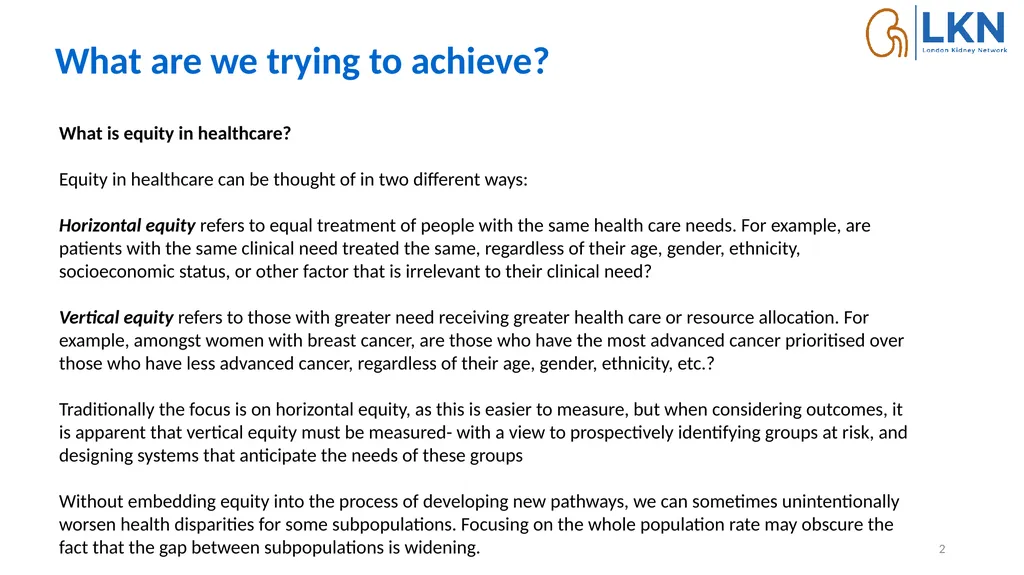
Equity in healthcare can be thought of in two different ways:
Horizontal equity refers to equal treatment of people with the same health care needs. For example, are patients with the same clinical need treated the same, regardless of their age, gender, ethnicity, socioeconomic status, or other factor that is irrelevant to their clinical need?
Vertical equity refers to those with greater need receiving greater health care or resource allocation. For example, amongst women with breast cancer, are those who have the most advanced cancer prioritised over those who have less advanced cancer, regardless of their age, gender, ethnicity, etc.?
Traditionally the focus is on horizontal equity, as this is easier to measure, but when considering outcomes, it is apparent that vertical equity must be measured- with a view to prospectively identifying groups at risk, and designing systems that anticipate the needs of these groups
Without embedding equity into the process of developing new pathways, we can sometimes unintentionally worsen health disparities for some subpopulations. Focusing on the whole population rate may obscure the fact that the gap between subpopulations is widening. 2<br>
03
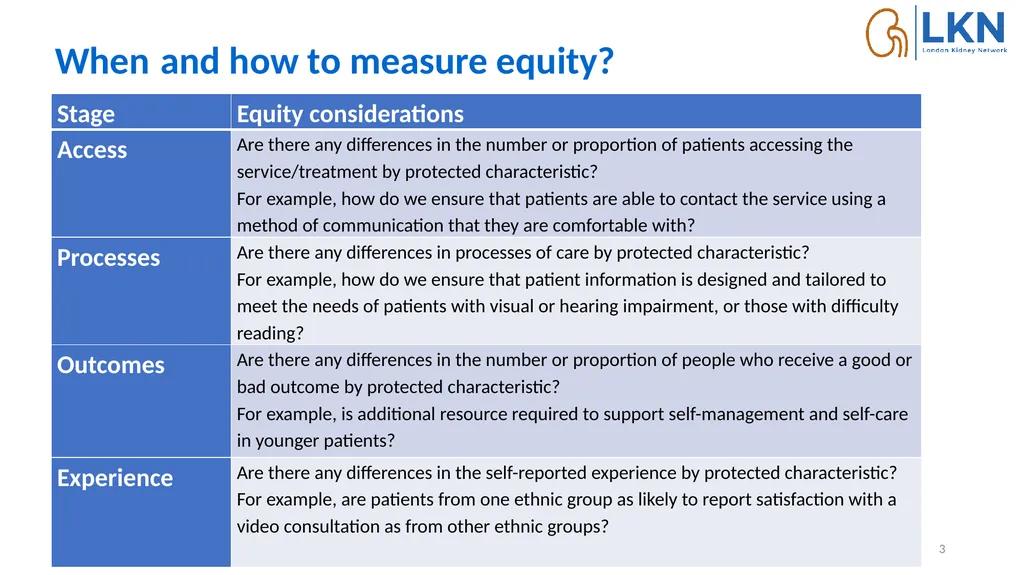
When and how to measure equity? 3<br>
04
Defining barriers to delivering equitable care 4 Structural
Models of delivery (case finding vs patients going to clinician)
Access to services- geographical, type of appointment
Models of care- services and treatments are disease/condition focussed
Social determinants of health
Funding
Commissioning of services is very tightly structured with defined deliverable and may inadvertently contribute to inequality
Digital inequality
Access to educational resources online
Access to services is predominantly done online now
Leadership and engagement
Not a priority in a pressured NHS environment
Lack of awareness and knowledge<br>
05
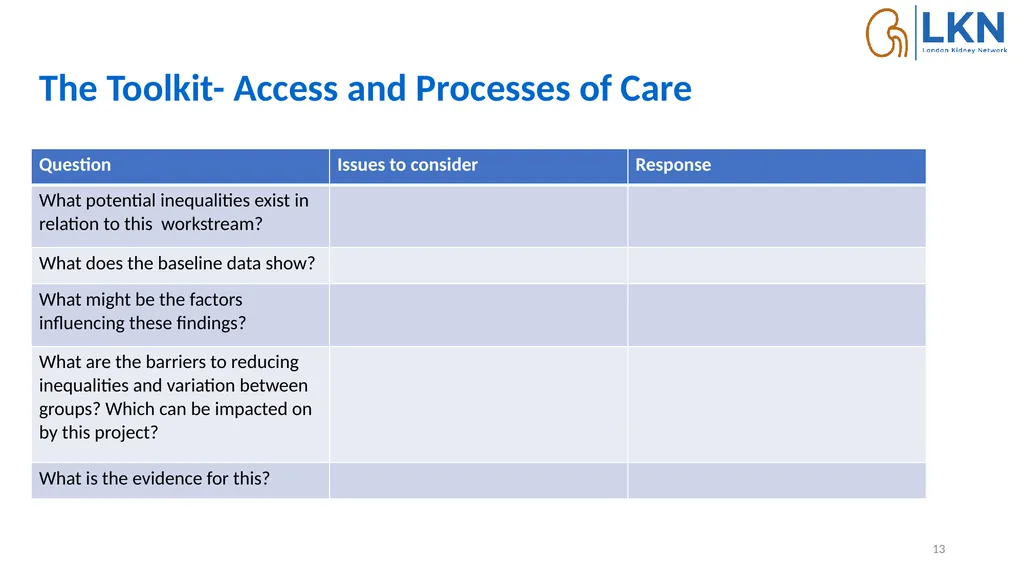
Developing a toolkit- what we need to do Baseline equity audit
This is key to identifying which groups are likely to require more resource to meet their needs
Often measurement doesn’t identify the cause- groups may need to do further qualitative analyses to understand their data
Different workstreams will have different challenges to meet
Defining measures and tools for measurement
Legally protected characteristics- age, gender, ethnicity, disability, religion or belief, sexual orientation, pregnancy and maternity, gender reassignment, marriage and civil partnership.
Other equity dimensions could include- deprivation (socioeconomic status), language, having a serious mental illness, learning difficulties, being a carer, being homeless or a refugee
Training/Learning Resources for QI groups
Capacity building to support teams to anticipate and address challenges in ensuring equitable care
Focusing Resources
To build systems that are responsive and flexible
Not all inequities can be mitigated by changing a process or system- but we should be able to adapt to meet the needs of different groups 5<br>
06
Developing a toolkit- how to do it Baseline equity audit
LKN Health equity group work that is ongoing which can be presented to the LKN workstreams to use as a basis for measurement
Coding and accuracy of ethnicity and comorbidity recording
Defining measures and tools for measurement
There are things we can influence, and things we can’t
Each workstream should be supported to develop QI capability (training, QI coaching support) which can then be used to measure progress, identify and use variation
Ensure equity considerations are embedded in process, outcome and balancing measures used by workstreams
Core20plus5 resources
Training/Learning Resources for QI groups
Do workstreams have the resources they need to deliver?
Do they have the (QI) knowledge and skills? 6<br>
07
Developing a toolkit- how to do it Focusing Resources
To build systems that are responsive and flexible
Not all inequities can be mitigated by changing a process or system- but we should be able to adapt to meet the needs of different groups
Structural barriers
Models of care
MECC
Pathway design (co-locating services, one stop clinics)
Outreach
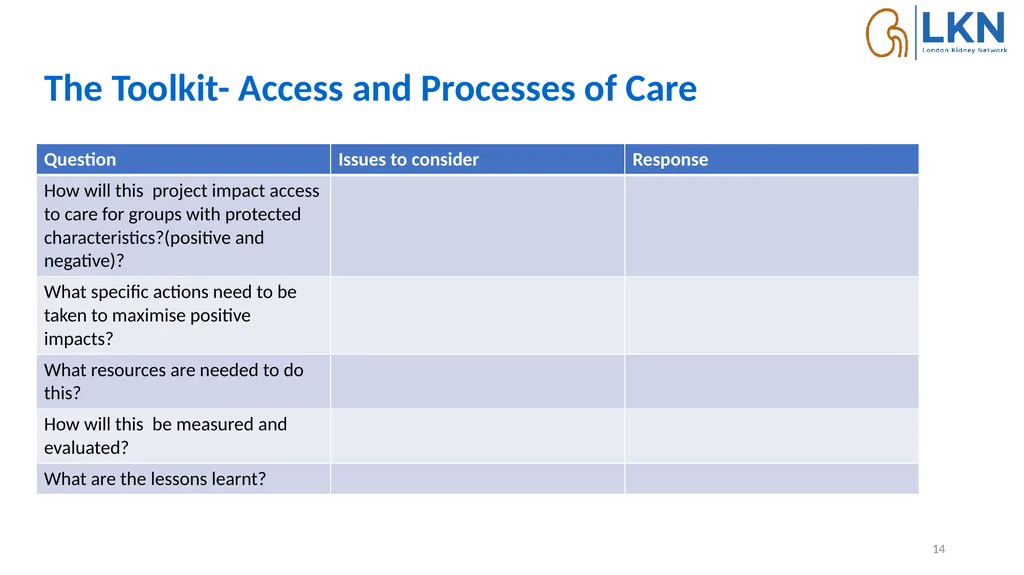
Develop approaches to ensure that everyone has an equal opportunity to:
Access services
Have a good experience of services
Benefit from interventions (equality of outcomes) 7<br>
08
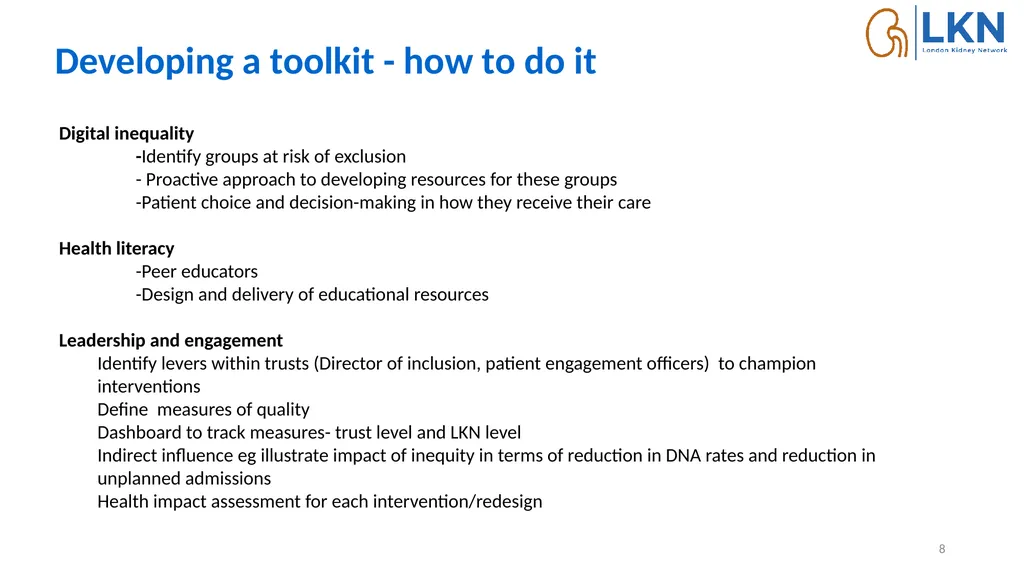
Developing a toolkit - how to do it Digital inequality
-Identify groups at risk of exclusion
- Proactive approach to developing resources for these groups
-Patient choice and decision-making in how they receive their care
Health literacy
-Peer educators
-Design and delivery of educational resources
Leadership and engagement
Identify levers within trusts (Director of inclusion, patient engagement officers) to champion interventions
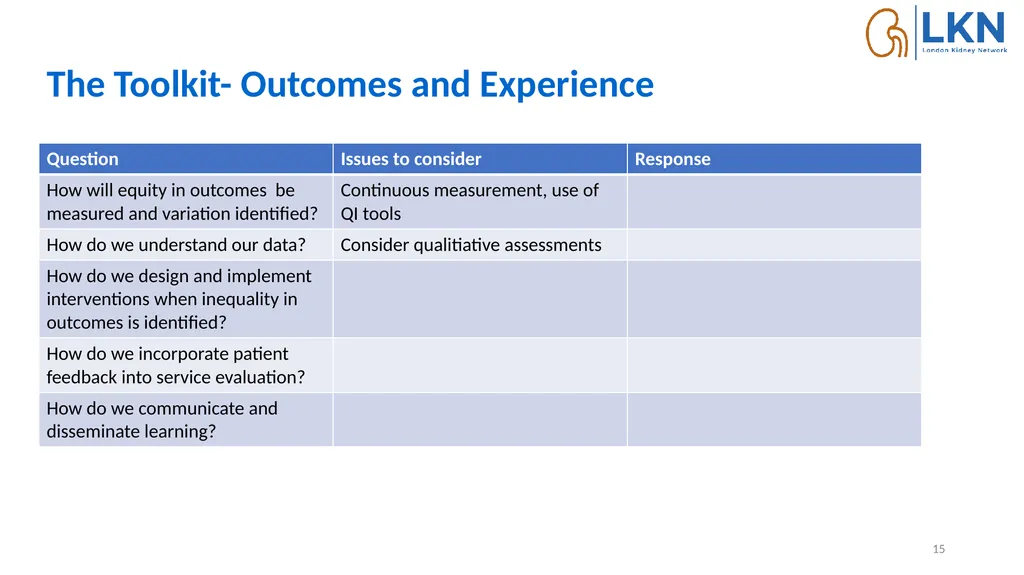
Define measures of quality
Dashboard to track measures- trust level and LKN level
Indirect influence eg illustrate impact of inequity in terms of reduction in DNA rates and reduction in unplanned admissions
Health impact assessment for each intervention/redesign 8<br>
09
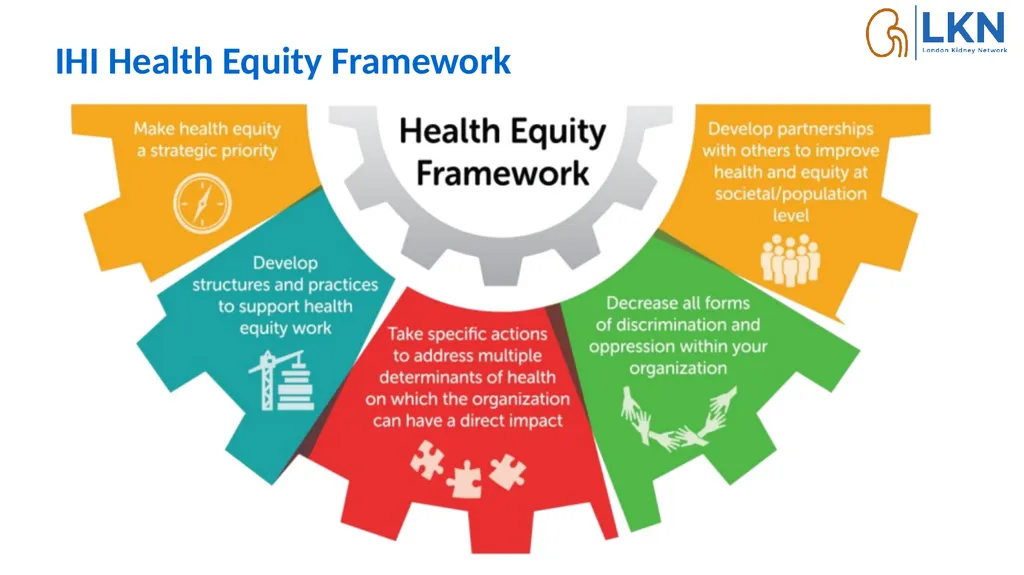
IHI Health Equity Framework 9<br>
10
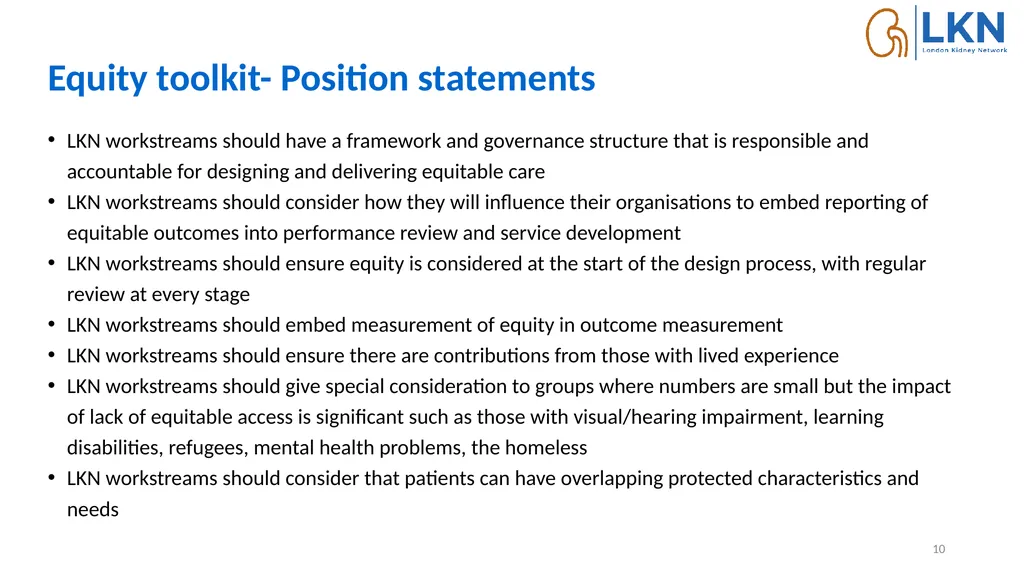
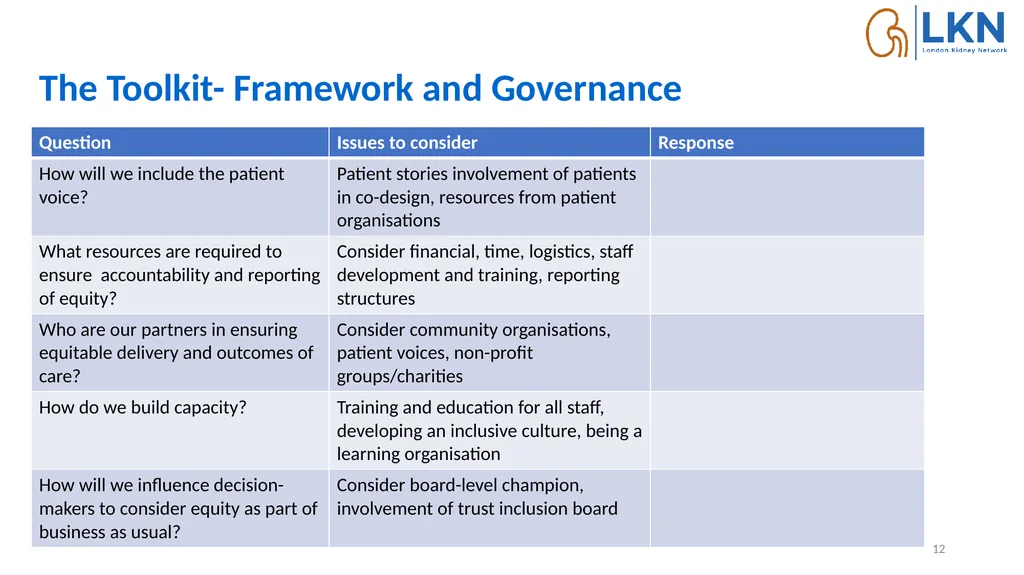
Equity toolkit- Position statements LKN workstreams should have a framework and governance structure that is responsible and accountable for designing and delivering equitable care
LKN workstreams should consider how they will influence their organisations to embed reporting of equitable outcomes into performance review and service development
LKN workstreams should ensure equity is considered at the start of the design process, with regular review at every stage
LKN workstreams should embed measurement of equity in outcome measurement
LKN workstreams should ensure there are contributions from those with lived experience
LKN workstreams should give special consideration to groups where numbers are small but the impact of lack of equitable access is significant such as those with visual/hearing impairment, learning disabilities, refugees, mental health problems, the homeless
LKN workstreams should consider that patients can have overlapping protected characteristics and needs 10<br>