
Development and Validation of the AAQ for Exercise
TD
Published · 26 slides · 0 views

1 / 1
Description
Development and Validation of the AAQ for Exercise (AAQ-Ex) Sarah B. Staats, M.A. Wichita State ACBS WC 2014 Please stand and do 5-10 jumping jacks if you are physically able to do so and your doctor would approve. What if I asked
Related Topics
Share
Embed code
Download this presentation From Below
"Development and Validation of the AAQ for Exercise" is the property of its rightful owner. Permission is granted to download and print the materials on this website for personal, non-commercial use only, and to display it on your personal computer provided you do not modify the materials and that you retain all copyright notices contained in the materials. By downloading content from our website, you accept the terms of this agreement.
Presentation Transcript
01
Development and Validation of the AAQ for Exercise (AAQ-Ex) Sarah B. Staats, M.A. / Wichita State / ACBS WC 2014<br>
02
Please stand and do 5-10 jumping jacks… …if you are physically able to do so and your doctor would approve. What if I asked you…<br>
03
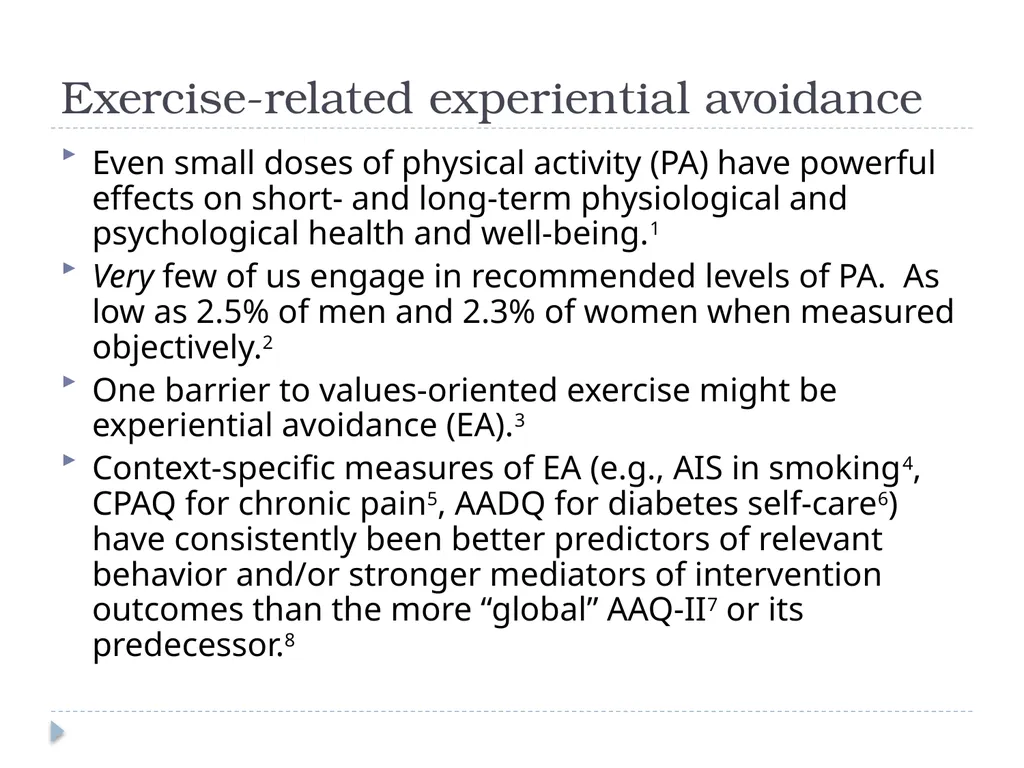
Exercise-related experiential avoidance Even small doses of physical activity (PA) have powerful effects on short- and long-term physiological and psychological health and well-being.1
Very few of us engage in recommended levels of PA. As low as 2.5% of men and 2.3% of women when measured objectively.2
One barrier to values-oriented exercise might be experiential avoidance (EA).3
Context-specific measures of EA (e.g., AIS in smoking4, CPAQ for chronic pain5, AADQ for diabetes self-care6) have consistently been better predictors of relevant behavior and/or stronger mediators of intervention outcomes than the more “global” AAQ-II7 or its predecessor.8<br>
Very few of us engage in recommended levels of PA. As low as 2.5% of men and 2.3% of women when measured objectively.2
One barrier to values-oriented exercise might be experiential avoidance (EA).3
Context-specific measures of EA (e.g., AIS in smoking4, CPAQ for chronic pain5, AADQ for diabetes self-care6) have consistently been better predictors of relevant behavior and/or stronger mediators of intervention outcomes than the more “global” AAQ-II7 or its predecessor.8<br>
04
Roadmap Briefly highlight some of the more interesting findings from series of seven studies conducted with AAQ-Ex
Discuss the final study in terms of its attempt to intervene
Discuss: How can this work inform large-scale change?<br>
Discuss the final study in terms of its attempt to intervene
Discuss: How can this work inform large-scale change?<br>
05
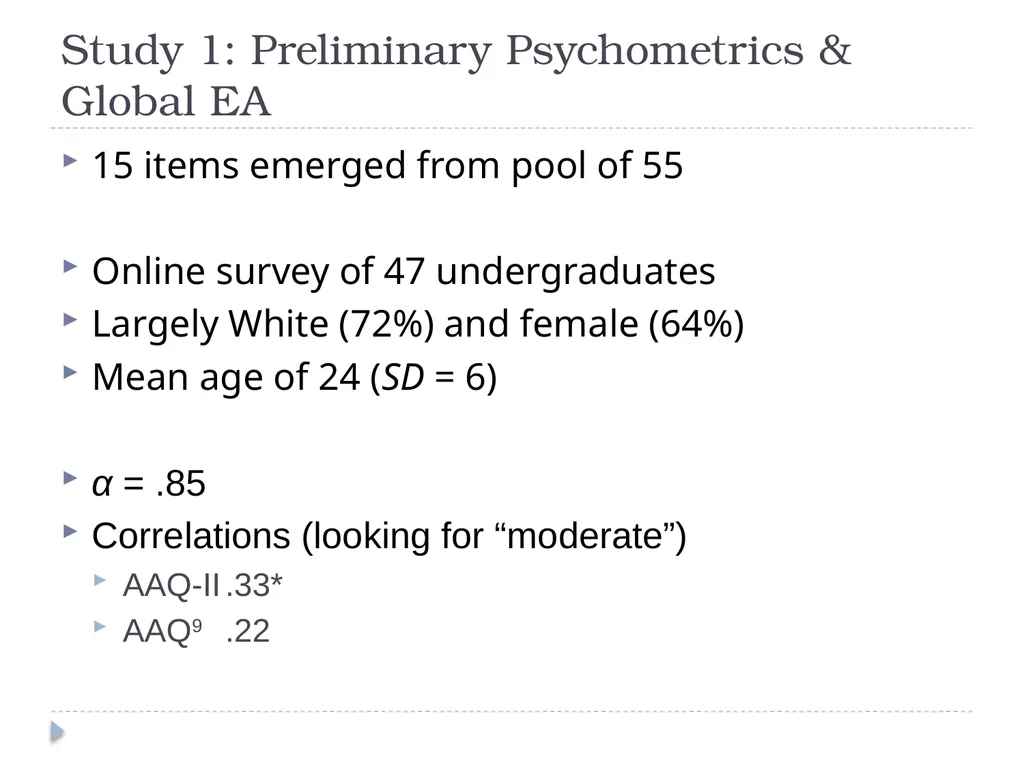
Study 1: Preliminary Psychometrics & Global EA 15 items emerged from pool of 55
Online survey of 47 undergraduates
Largely White (72%) and female (64%)
Mean age of 24 (SD = 6)
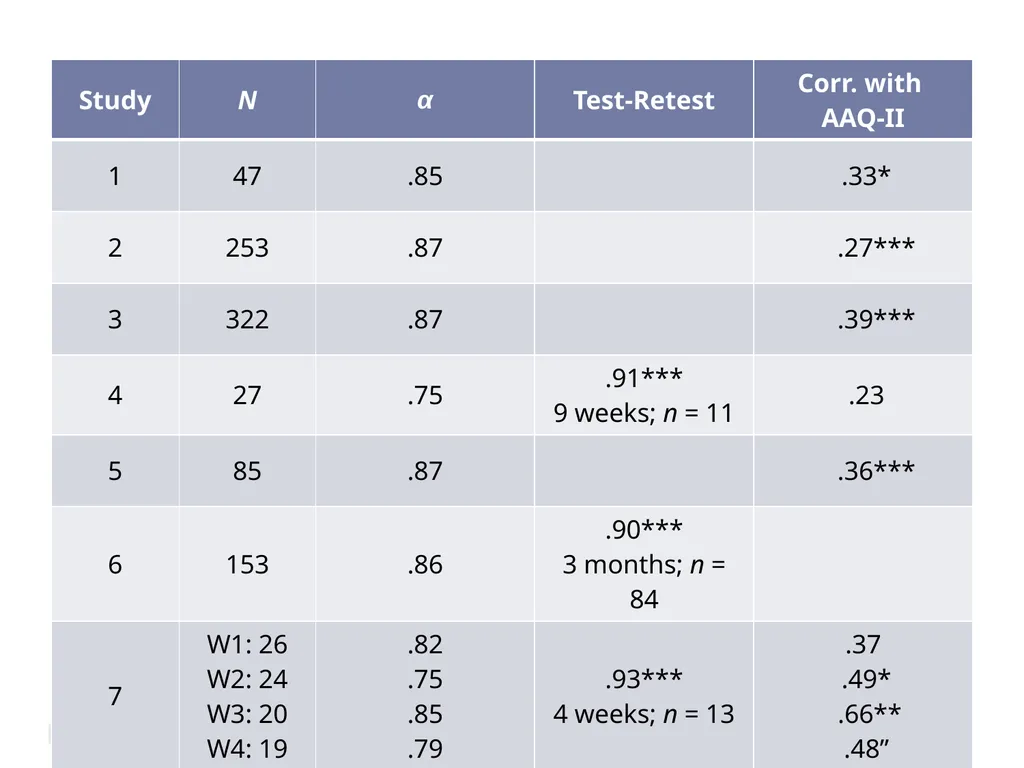
α = .85
Correlations (looking for “moderate”)
AAQ-II .33*
AAQ9 .22<br>
Online survey of 47 undergraduates
Largely White (72%) and female (64%)
Mean age of 24 (SD = 6)
α = .85
Correlations (looking for “moderate”)
AAQ-II .33*
AAQ9 .22<br>
06
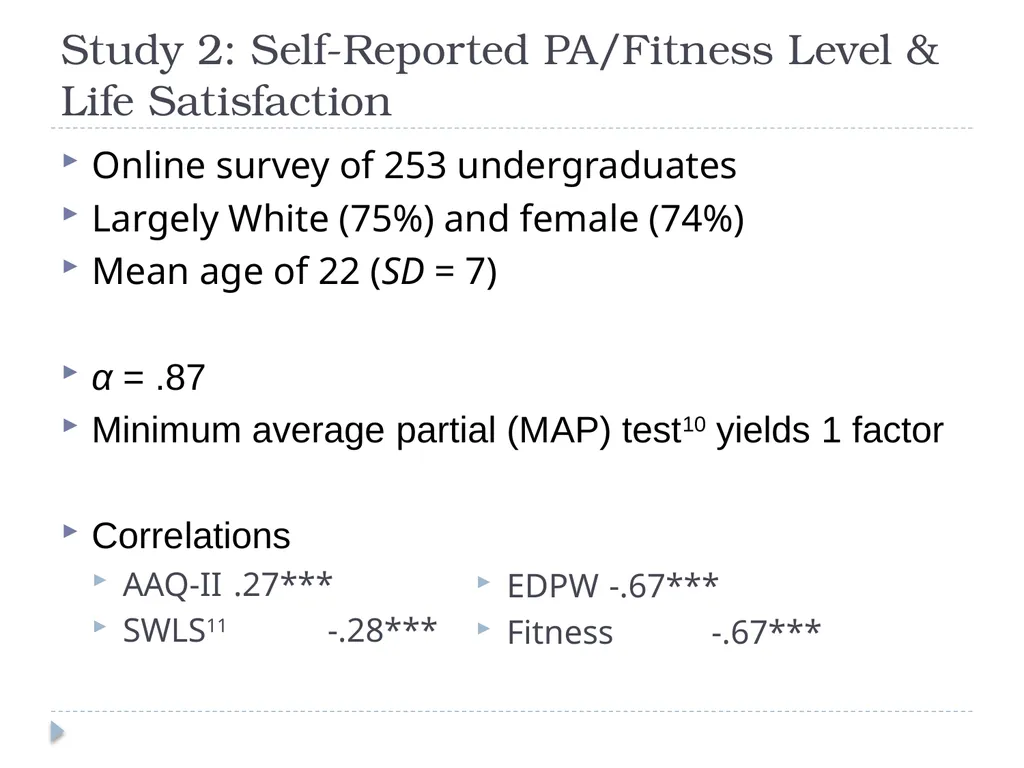
Study 2: Self-Reported PA/Fitness Level &
Life Satisfaction Online survey of 253 undergraduates
Largely White (75%) and female (74%)
Mean age of 22 (SD = 7)
α = .87
Minimum average partial (MAP) test10 yields 1 factor
Correlations
AAQ-II .27***
SWLS11 -.28*** EDPW -.67***
Fitness -.67***<br>
Largely White (75%) and female (74%)
Mean age of 22 (SD = 7)
α = .87
Minimum average partial (MAP) test10 yields 1 factor
Correlations
AAQ-II .27***
SWLS11 -.28*** EDPW -.67***
Fitness -.67***<br>
07
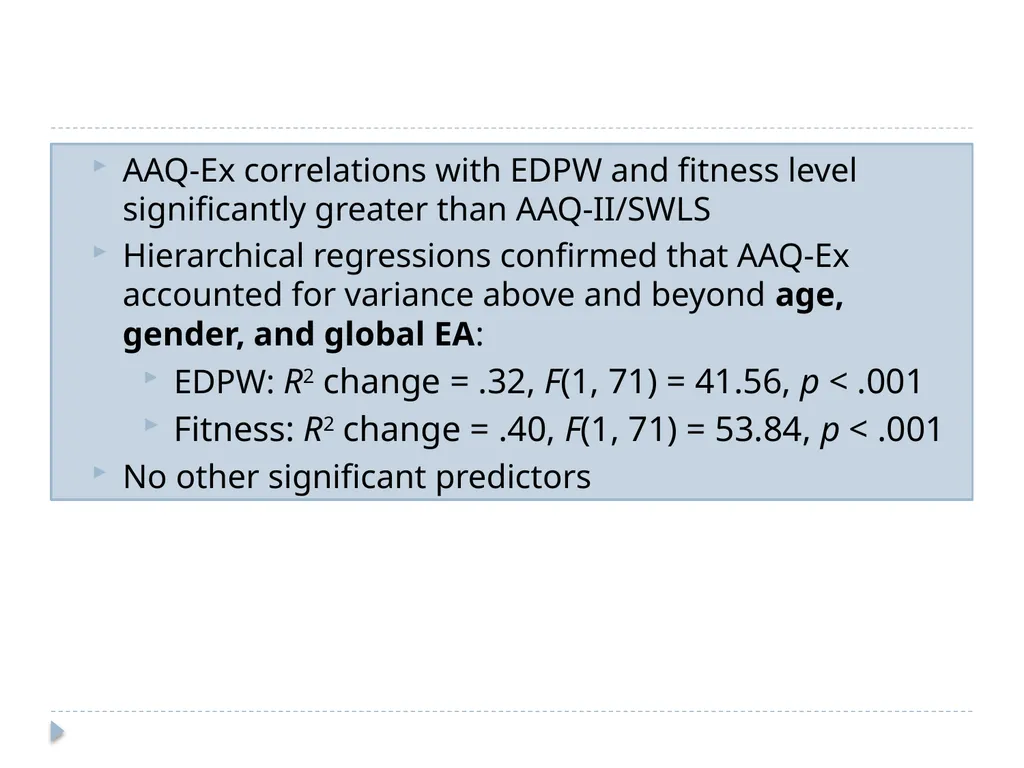
AAQ-Ex correlations with EDPW and fitness level significantly greater than AAQ-II/SWLS
Hierarchical regressions confirmed that AAQ-Ex accounted for variance above and beyond age, gender, and global EA:
EDPW: R2 change = .32, F(1, 71) = 41.56, p < .001
Fitness: R2 change = .40, F(1, 71) = 53.84, p < .001
No other significant predictors<br>
Hierarchical regressions confirmed that AAQ-Ex accounted for variance above and beyond age, gender, and global EA:
EDPW: R2 change = .32, F(1, 71) = 41.56, p < .001
Fitness: R2 change = .40, F(1, 71) = 53.84, p < .001
No other significant predictors<br>
08
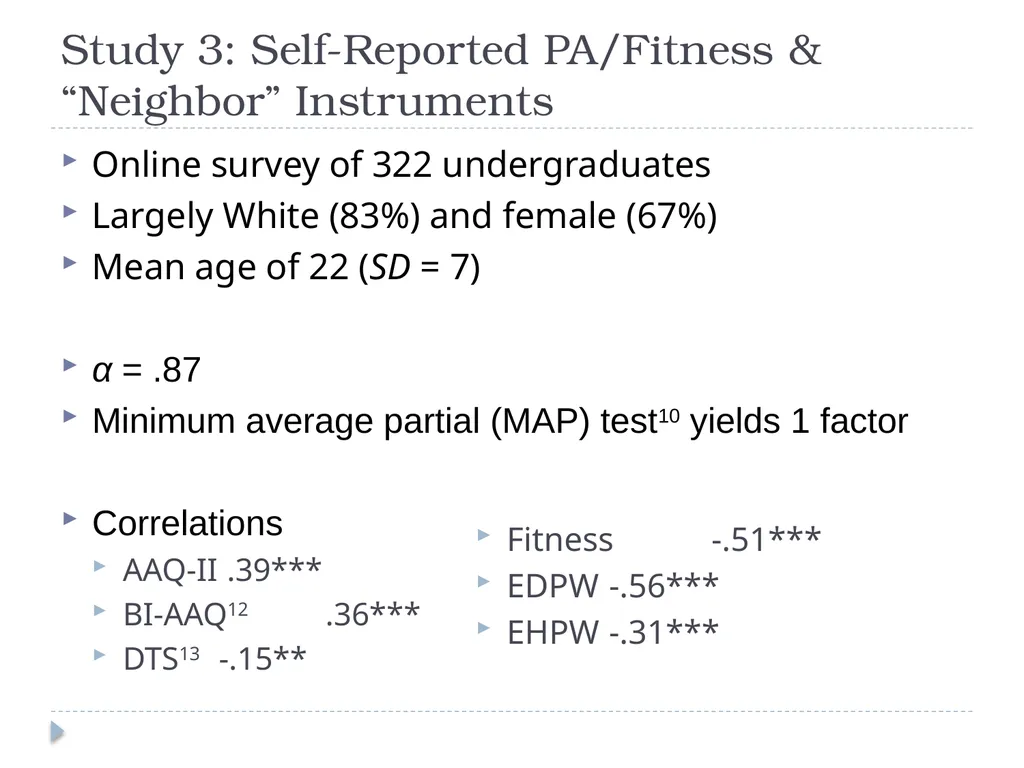
Study 3: Self-Reported PA/Fitness & “Neighbor” Instruments Online survey of 322 undergraduates
Largely White (83%) and female (67%)
Mean age of 22 (SD = 7)
α = .87
Minimum average partial (MAP) test10 yields 1 factor
Correlations
AAQ-II .39***
BI-AAQ12 .36***
DTS13 -.15** Fitness -.51***
EDPW -.56***
EHPW -.31***<br>
Largely White (83%) and female (67%)
Mean age of 22 (SD = 7)
α = .87
Minimum average partial (MAP) test10 yields 1 factor
Correlations
AAQ-II .39***
BI-AAQ12 .36***
DTS13 -.15** Fitness -.51***
EDPW -.56***
EHPW -.31***<br>
09
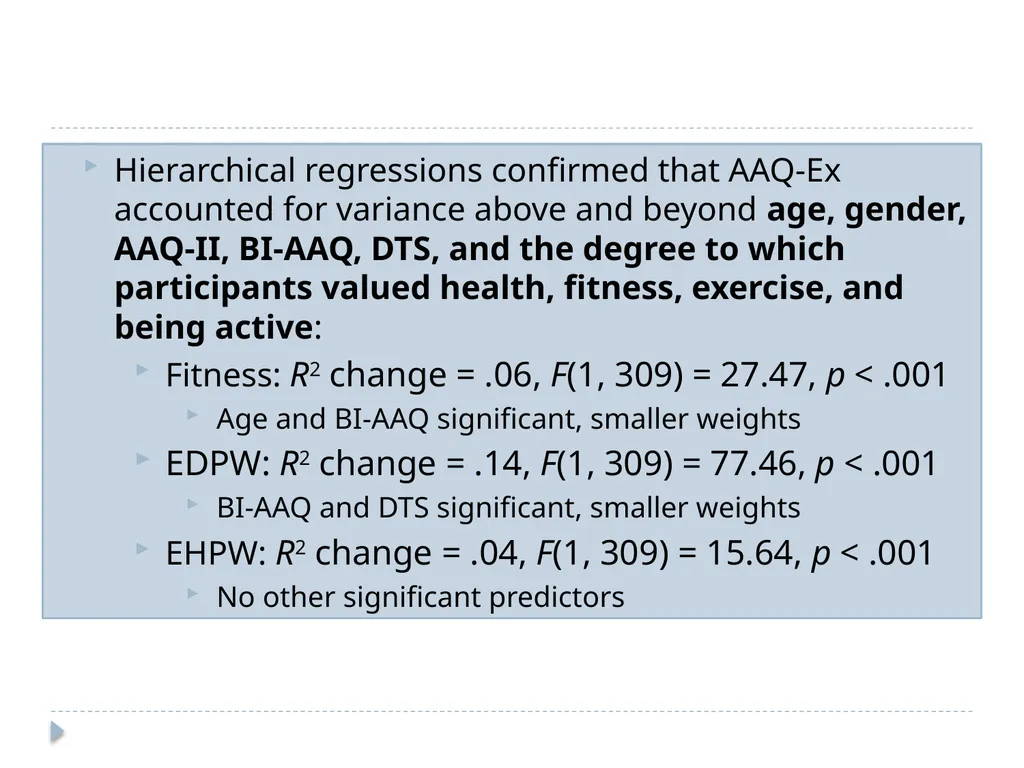
Hierarchical regressions confirmed that AAQ-Ex accounted for variance above and beyond age, gender, AAQ-II, BI-AAQ, DTS, and the degree to which participants valued health, fitness, exercise, and being active:
Fitness: R2 change = .06, F(1, 309) = 27.47, p < .001
Age and BI-AAQ significant, smaller weights
EDPW: R2 change = .14, F(1, 309) = 77.46, p < .001
BI-AAQ and DTS significant, smaller weights
EHPW: R2 change = .04, F(1, 309) = 15.64, p < .001
No other significant predictors<br>
Fitness: R2 change = .06, F(1, 309) = 27.47, p < .001
Age and BI-AAQ significant, smaller weights
EDPW: R2 change = .14, F(1, 309) = 77.46, p < .001
BI-AAQ and DTS significant, smaller weights
EHPW: R2 change = .04, F(1, 309) = 15.64, p < .001
No other significant predictors<br>
10
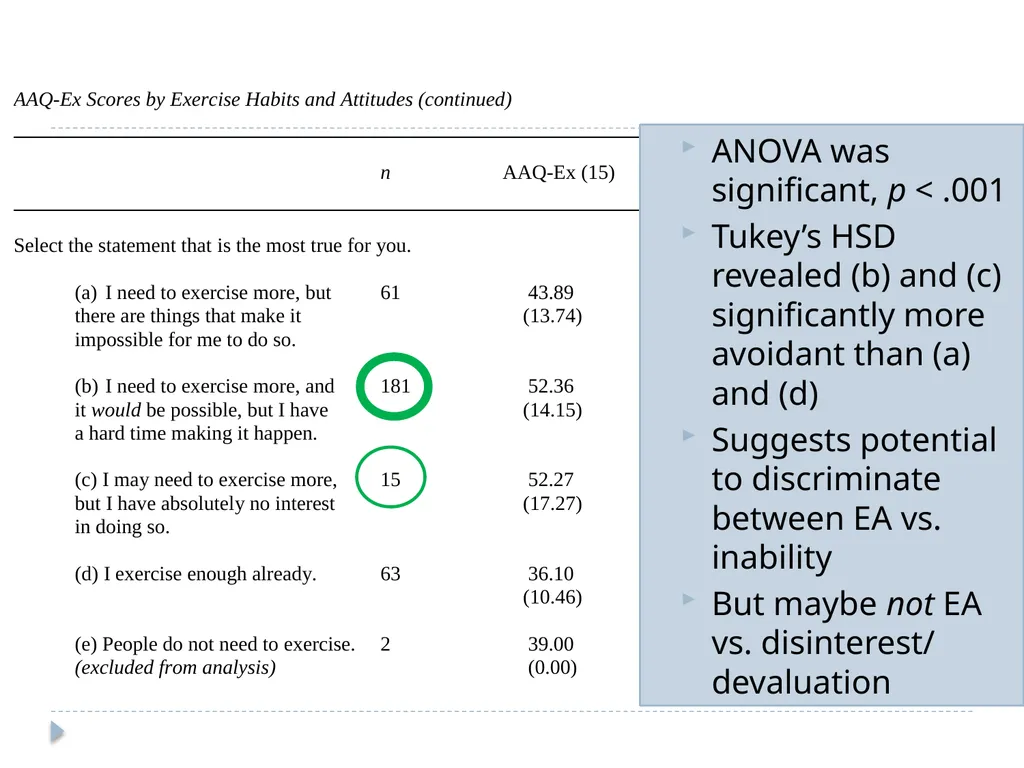
ANOVA was significant, p < .001
Tukey’s HSD revealed (b) and (c) significantly more avoidant than (a) and (d)
Suggests potential to discriminate between EA vs. inability
But maybe not EA vs. disinterest/ devaluation<br>
Tukey’s HSD revealed (b) and (c) significantly more avoidant than (a) and (d)
Suggests potential to discriminate between EA vs. inability
But maybe not EA vs. disinterest/ devaluation<br>
11
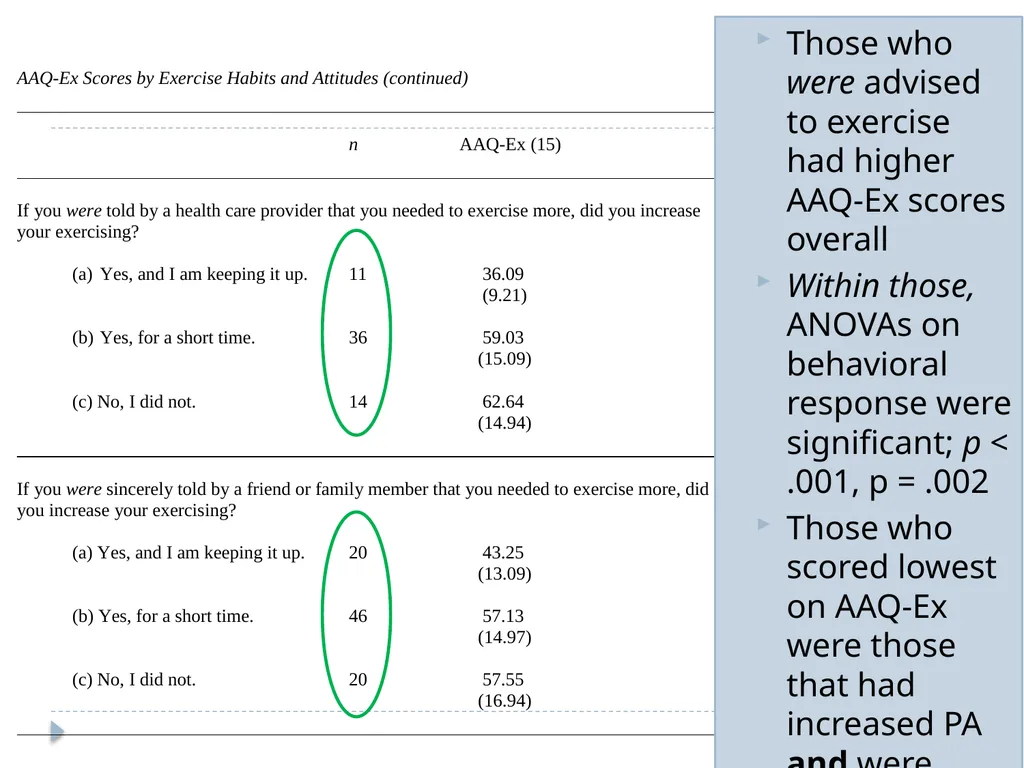
Those who were advised to exercise had higher AAQ-Ex scores overall
Within those, ANOVAs on behavioral response were significant; p < .001, p = .002
Those who scored lowest on AAQ-Ex were those that had increased PA and were keeping it up.<br>
Within those, ANOVAs on behavioral response were significant; p < .001, p = .002
Those who scored lowest on AAQ-Ex were those that had increased PA and were keeping it up.<br>
12
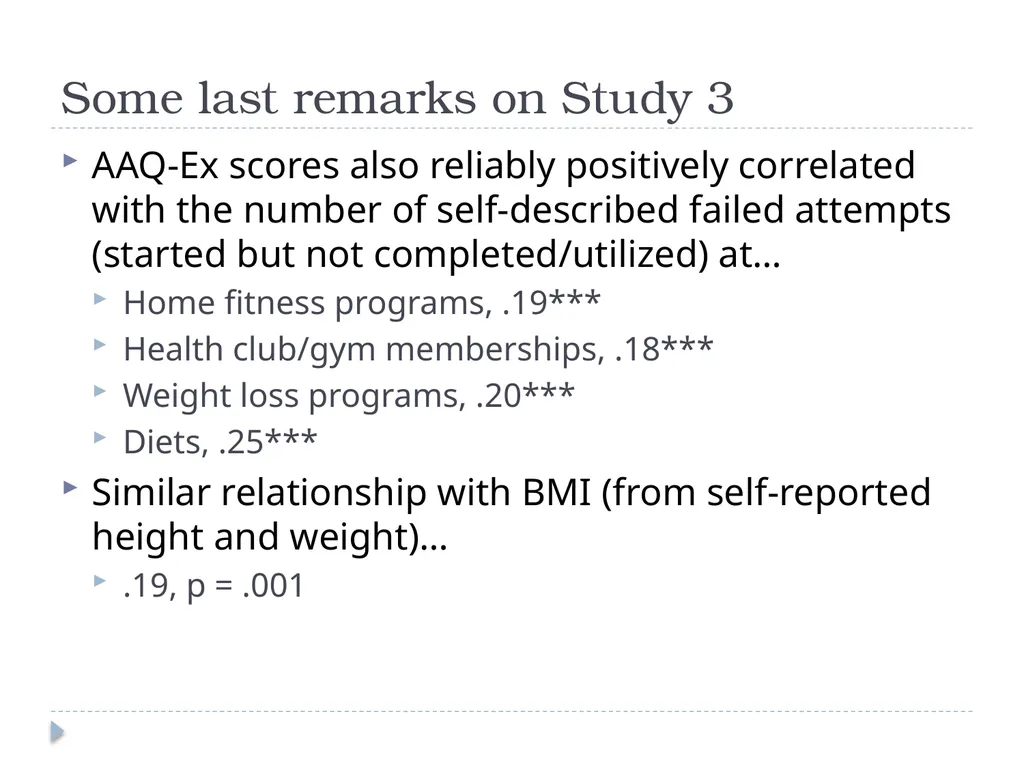
Some last remarks on Study 3 AAQ-Ex scores also reliably positively correlated with the number of self-described failed attempts (started but not completed/utilized) at…
Home fitness programs, .19***
Health club/gym memberships, .18***
Weight loss programs, .20***
Diets, .25***
Similar relationship with BMI (from self-reported height and weight)…
.19, p = .001<br>
Home fitness programs, .19***
Health club/gym memberships, .18***
Weight loss programs, .20***
Diets, .25***
Similar relationship with BMI (from self-reported height and weight)…
.19, p = .001<br>
13
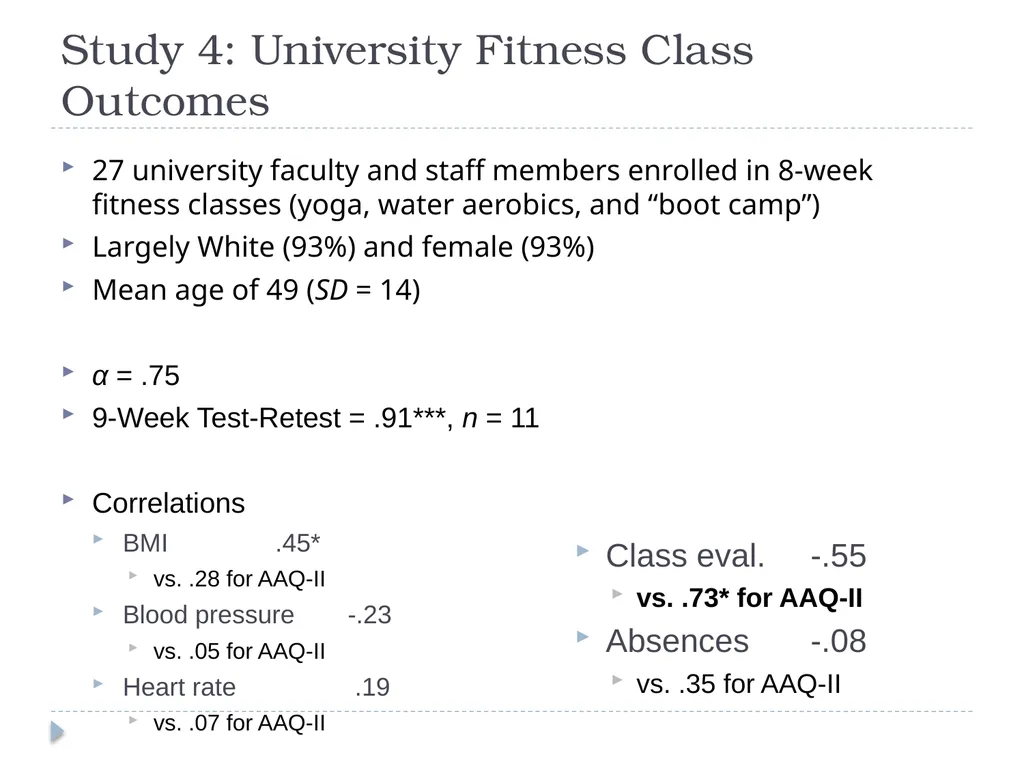
Study 4: University Fitness Class Outcomes 27 university faculty and staff members enrolled in 8-week fitness classes (yoga, water aerobics, and “boot camp”)
Largely White (93%) and female (93%)
Mean age of 49 (SD = 14)
α = .75
9-Week Test-Retest = .91***, n = 11
Correlations
BMI .45*
vs. .28 for AAQ-II
Blood pressure -.23
vs. .05 for AAQ-II
Heart rate .19
vs. .07 for AAQ-II Class eval. -.55
vs. .73* for AAQ-II
Absences -.08
vs. .35 for AAQ-II<br>
Largely White (93%) and female (93%)
Mean age of 49 (SD = 14)
α = .75
9-Week Test-Retest = .91***, n = 11
Correlations
BMI .45*
vs. .28 for AAQ-II
Blood pressure -.23
vs. .05 for AAQ-II
Heart rate .19
vs. .07 for AAQ-II Class eval. -.55
vs. .73* for AAQ-II
Absences -.08
vs. .35 for AAQ-II<br>
14
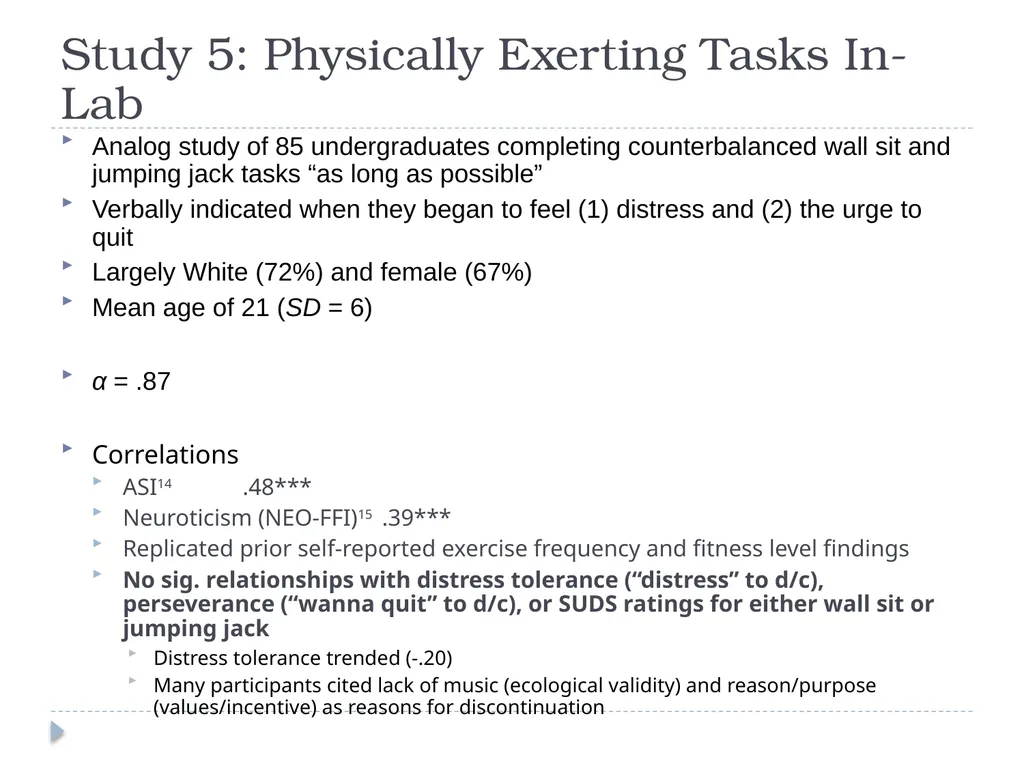
Study 5: Physically Exerting Tasks In-Lab Analog study of 85 undergraduates completing counterbalanced wall sit and jumping jack tasks “as long as possible”
Verbally indicated when they began to feel (1) distress and (2) the urge to quit
Largely White (72%) and female (67%)
Mean age of 21 (SD = 6)
α = .87
Correlations
ASI14 .48***
Neuroticism (NEO-FFI)15 .39***
Replicated prior self-reported exercise frequency and fitness level findings
No sig. relationships with distress tolerance (“distress” to d/c), perseverance (“wanna quit” to d/c), or SUDS ratings for either wall sit or jumping jack
Distress tolerance trended (-.20)
Many participants cited lack of music (ecological validity) and reason/purpose (values/incentive) as reasons for discontinuation<br>
Verbally indicated when they began to feel (1) distress and (2) the urge to quit
Largely White (72%) and female (67%)
Mean age of 21 (SD = 6)
α = .87
Correlations
ASI14 .48***
Neuroticism (NEO-FFI)15 .39***
Replicated prior self-reported exercise frequency and fitness level findings
No sig. relationships with distress tolerance (“distress” to d/c), perseverance (“wanna quit” to d/c), or SUDS ratings for either wall sit or jumping jack
Distress tolerance trended (-.20)
Many participants cited lack of music (ecological validity) and reason/purpose (values/incentive) as reasons for discontinuation<br>
15
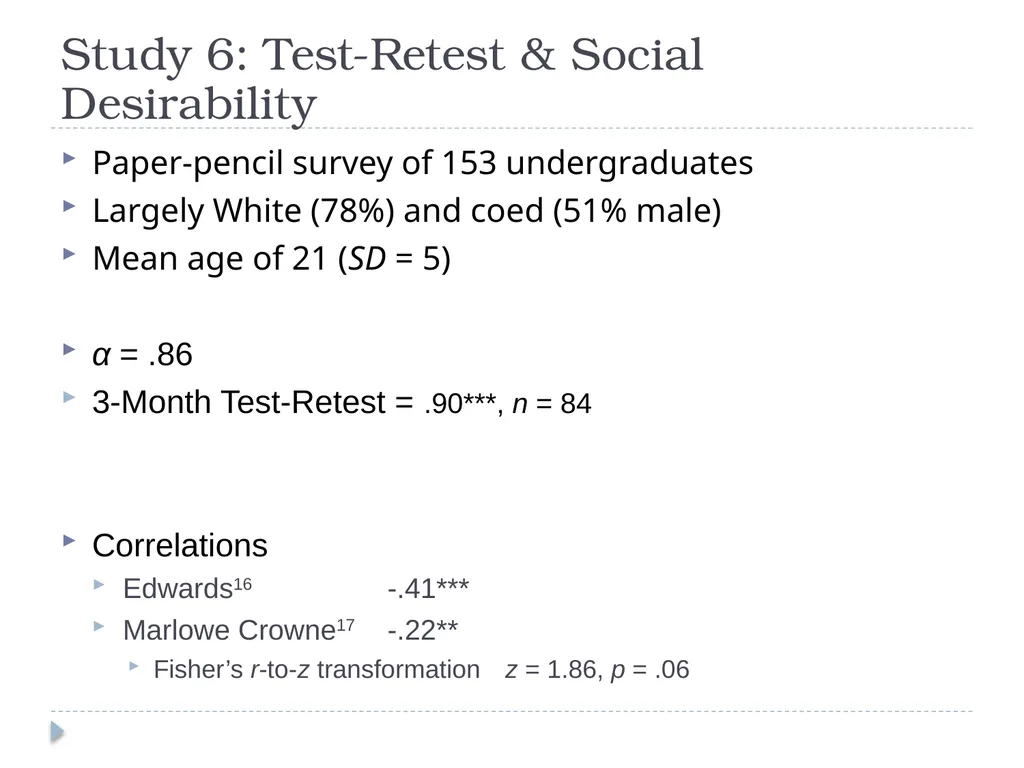
Study 6: Test-Retest & Social Desirability Paper-pencil survey of 153 undergraduates
Largely White (78%) and coed (51% male)
Mean age of 21 (SD = 5)
α = .86
3-Month Test-Retest = .90***, n = 84
Correlations
Edwards16 -.41***
Marlowe Crowne17 -.22**
Fisher’s r-to-z transformation z = 1.86, p = .06<br>
Largely White (78%) and coed (51% male)
Mean age of 21 (SD = 5)
α = .86
3-Month Test-Retest = .90***, n = 84
Correlations
Edwards16 -.41***
Marlowe Crowne17 -.22**
Fisher’s r-to-z transformation z = 1.86, p = .06<br>
16
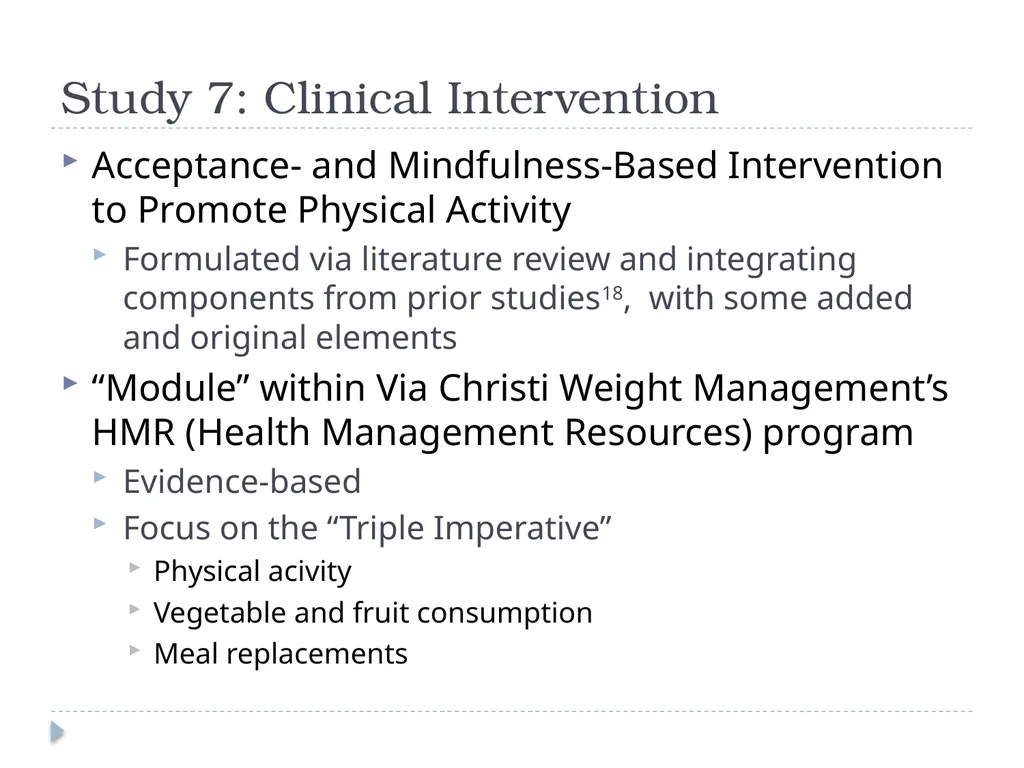
Study 7: Clinical Intervention Acceptance- and Mindfulness-Based Intervention to Promote Physical Activity
Formulated via literature review and integrating components from prior studies18, with some added and original elements
“Module” within Via Christi Weight Management’s HMR (Health Management Resources) program
Evidence-based
Focus on the “Triple Imperative”
Physical acivity
Vegetable and fruit consumption
Meal replacements<br>
Formulated via literature review and integrating components from prior studies18, with some added and original elements
“Module” within Via Christi Weight Management’s HMR (Health Management Resources) program
Evidence-based
Focus on the “Triple Imperative”
Physical acivity
Vegetable and fruit consumption
Meal replacements<br>
17
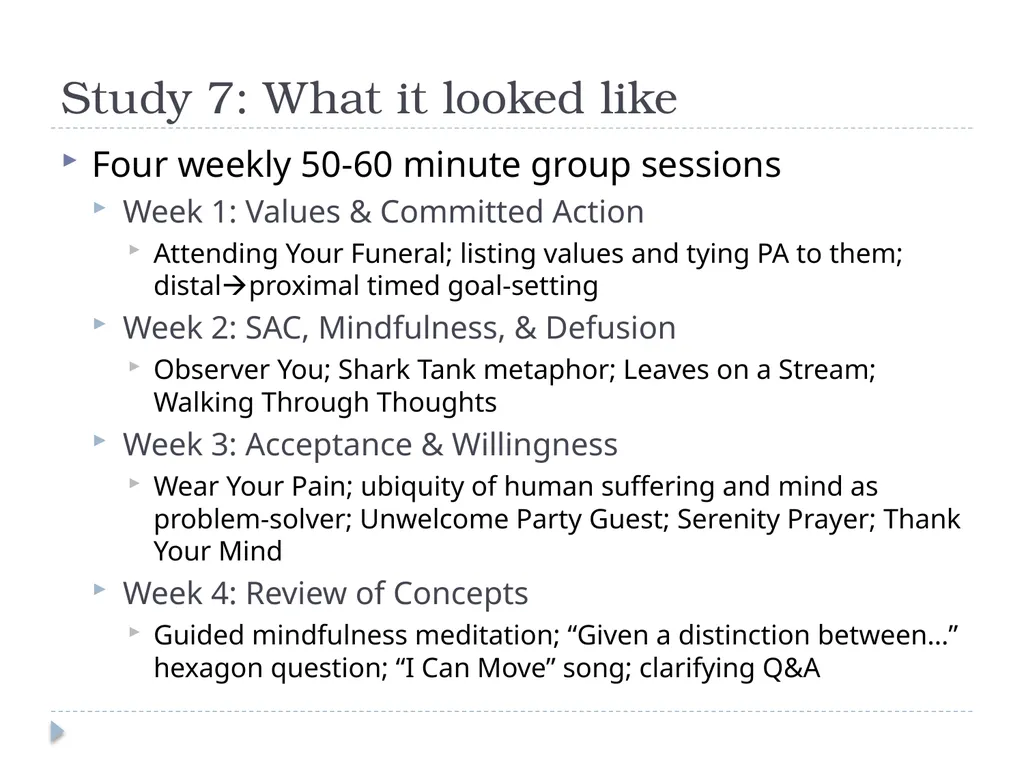
Study 7: What it looked like Four weekly 50-60 minute group sessions
Week 1: Values & Committed Action
Attending Your Funeral; listing values and tying PA to them; distalproximal timed goal-setting
Week 2: SAC, Mindfulness, & Defusion
Observer You; Shark Tank metaphor; Leaves on a Stream; Walking Through Thoughts
Week 3: Acceptance & Willingness
Wear Your Pain; ubiquity of human suffering and mind as problem-solver; Unwelcome Party Guest; Serenity Prayer; Thank Your Mind
Week 4: Review of Concepts
Guided mindfulness meditation; “Given a distinction between…” hexagon question; “I Can Move” song; clarifying Q&A<br>
Week 1: Values & Committed Action
Attending Your Funeral; listing values and tying PA to them; distalproximal timed goal-setting
Week 2: SAC, Mindfulness, & Defusion
Observer You; Shark Tank metaphor; Leaves on a Stream; Walking Through Thoughts
Week 3: Acceptance & Willingness
Wear Your Pain; ubiquity of human suffering and mind as problem-solver; Unwelcome Party Guest; Serenity Prayer; Thank Your Mind
Week 4: Review of Concepts
Guided mindfulness meditation; “Given a distinction between…” hexagon question; “I Can Move” song; clarifying Q&A<br>
18
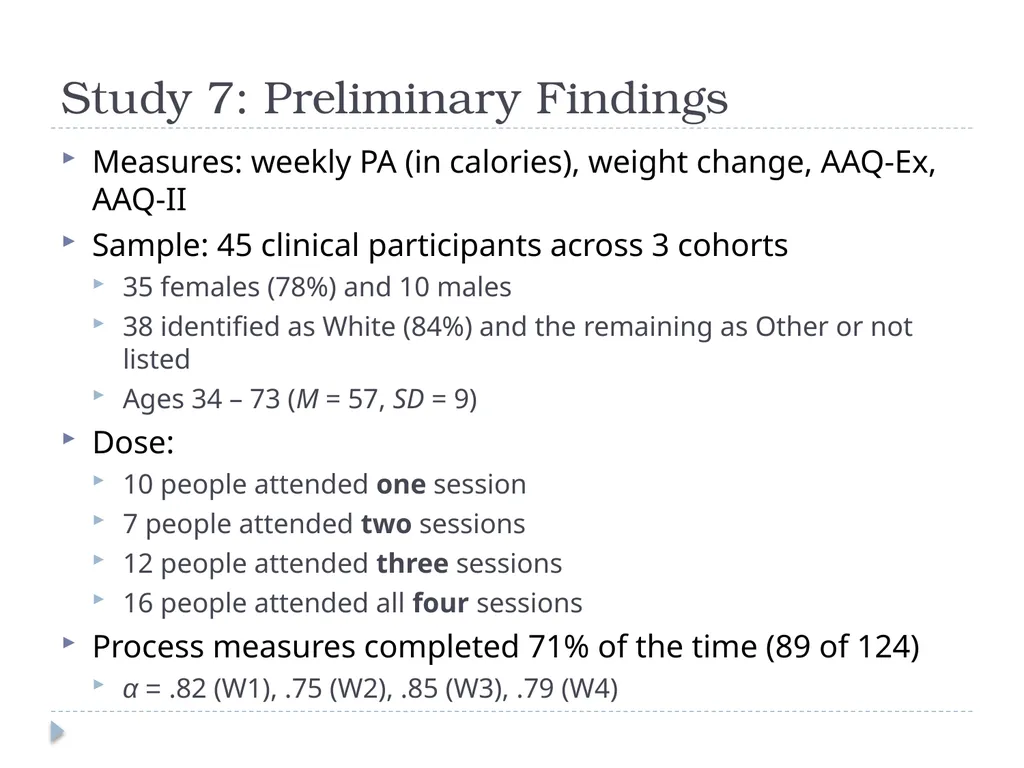
Study 7: Preliminary Findings Measures: weekly PA (in calories), weight change, AAQ-Ex, AAQ-II
Sample: 45 clinical participants across 3 cohorts
35 females (78%) and 10 males
38 identified as White (84%) and the remaining as Other or not listed
Ages 34 – 73 (M = 57, SD = 9)
Dose:
10 people attended one session
7 people attended two sessions
12 people attended three sessions
16 people attended all four sessions
Process measures completed 71% of the time (89 of 124)
α = .82 (W1), .75 (W2), .85 (W3), .79 (W4)<br>
Sample: 45 clinical participants across 3 cohorts
35 females (78%) and 10 males
38 identified as White (84%) and the remaining as Other or not listed
Ages 34 – 73 (M = 57, SD = 9)
Dose:
10 people attended one session
7 people attended two sessions
12 people attended three sessions
16 people attended all four sessions
Process measures completed 71% of the time (89 of 124)
α = .82 (W1), .75 (W2), .85 (W3), .79 (W4)<br>
19
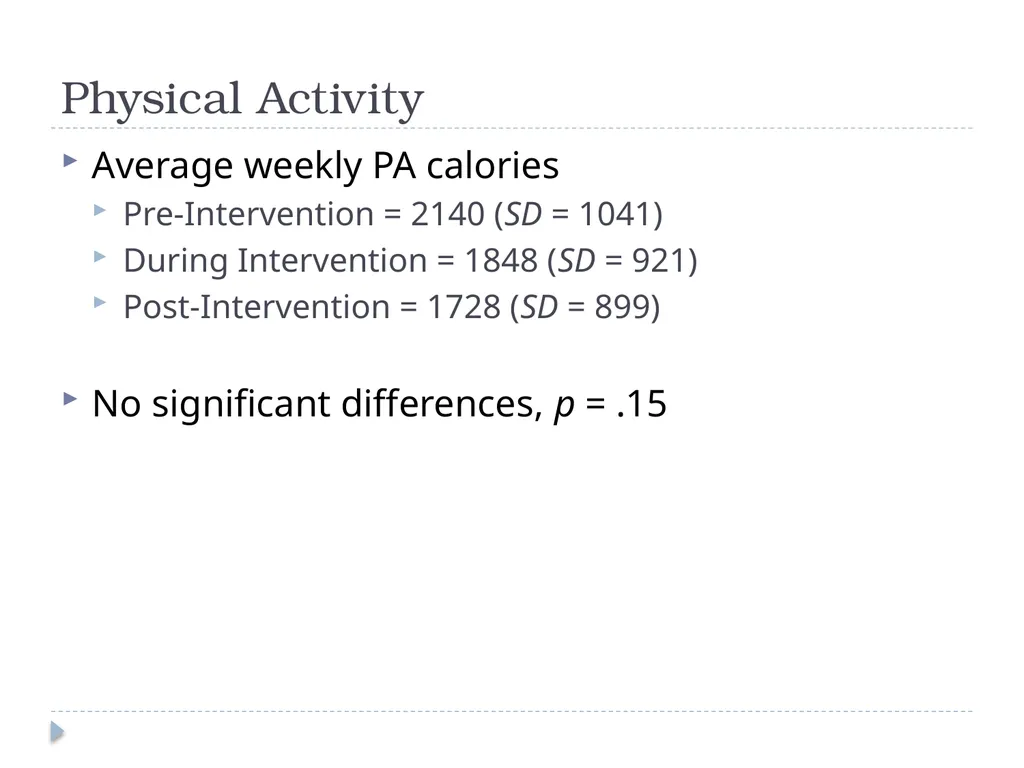
Physical Activity Average weekly PA calories
Pre-Intervention = 2140 (SD = 1041)
During Intervention = 1848 (SD = 921)
Post-Intervention = 1728 (SD = 899)
No significant differences, p = .15<br>
Pre-Intervention = 2140 (SD = 1041)
During Intervention = 1848 (SD = 921)
Post-Intervention = 1728 (SD = 899)
No significant differences, p = .15<br>
20
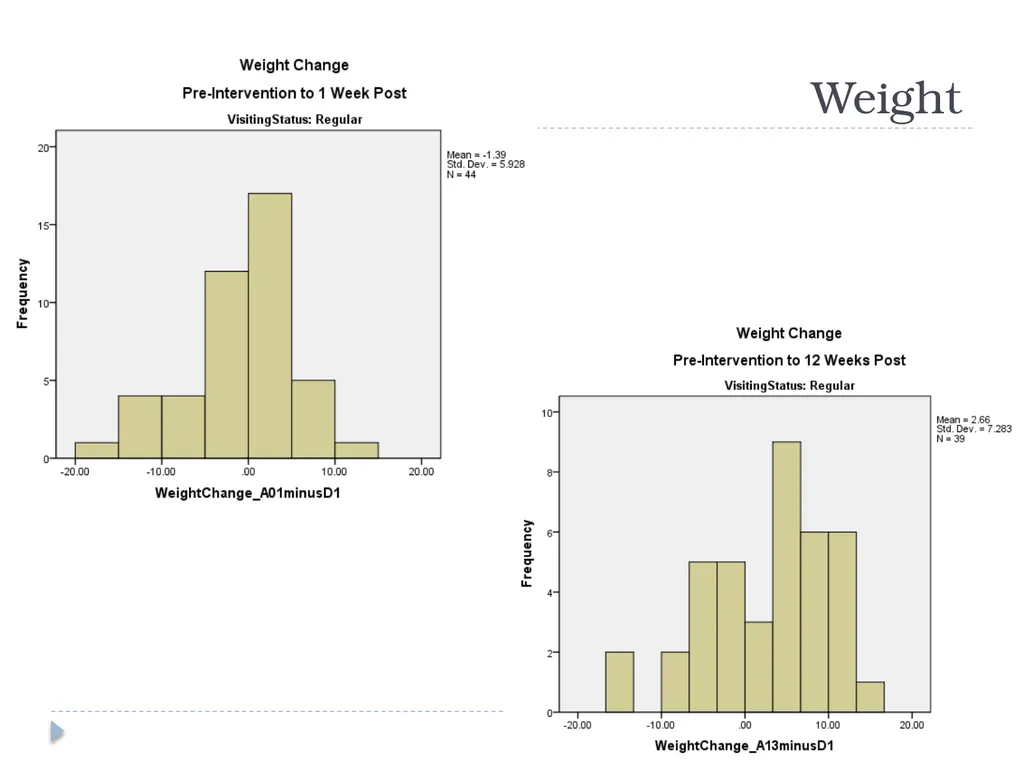
Weight<br>
21
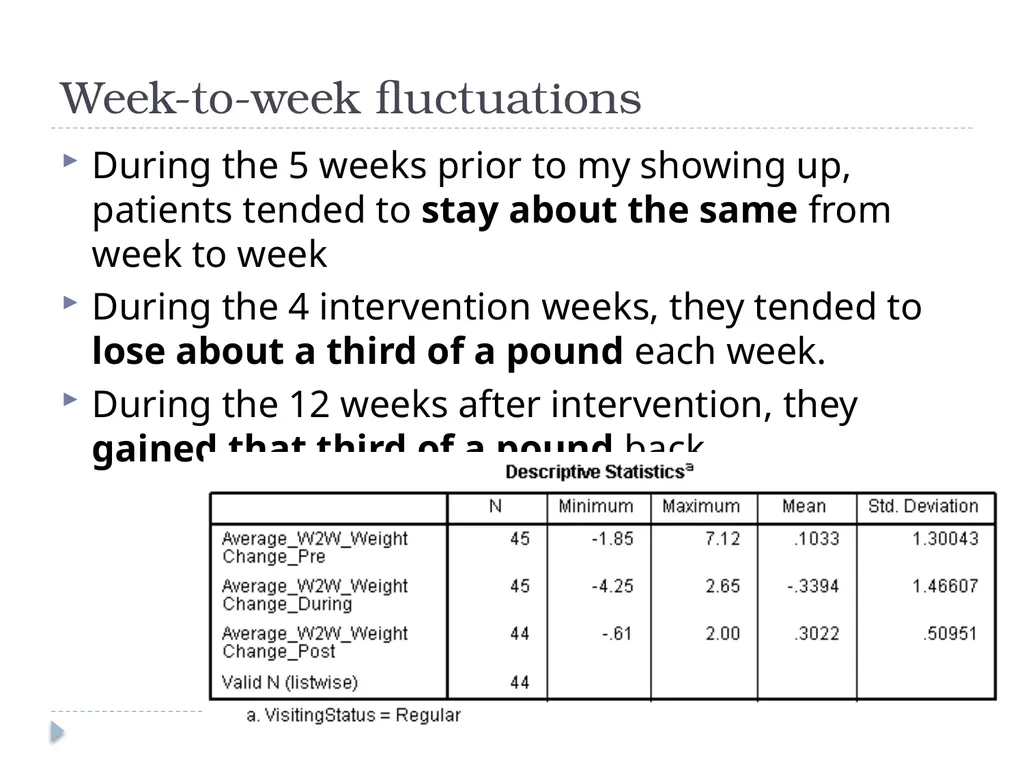
Week-to-week fluctuations During the 5 weeks prior to my showing up, patients tended to stay about the same from week to week
During the 4 intervention weeks, they tended to lose about a third of a pound each week.
During the 12 weeks after intervention, they gained that third of a pound back.<br>
During the 4 intervention weeks, they tended to lose about a third of a pound each week.
During the 12 weeks after intervention, they gained that third of a pound back.<br>
22
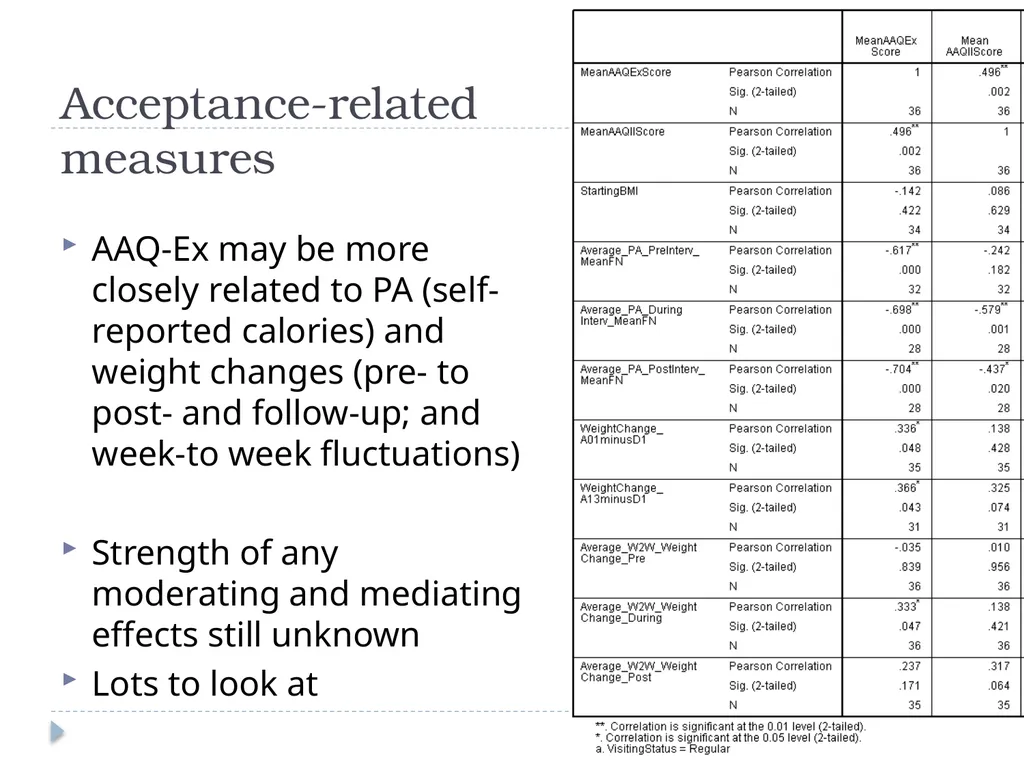
Acceptance-related measures AAQ-Ex may be more closely related to PA (self-reported calories) and weight changes (pre- to post- and follow-up; and week-to week fluctuations)
Strength of any moderating and mediating effects still unknown
Lots to look at<br>
Strength of any moderating and mediating effects still unknown
Lots to look at<br>
23
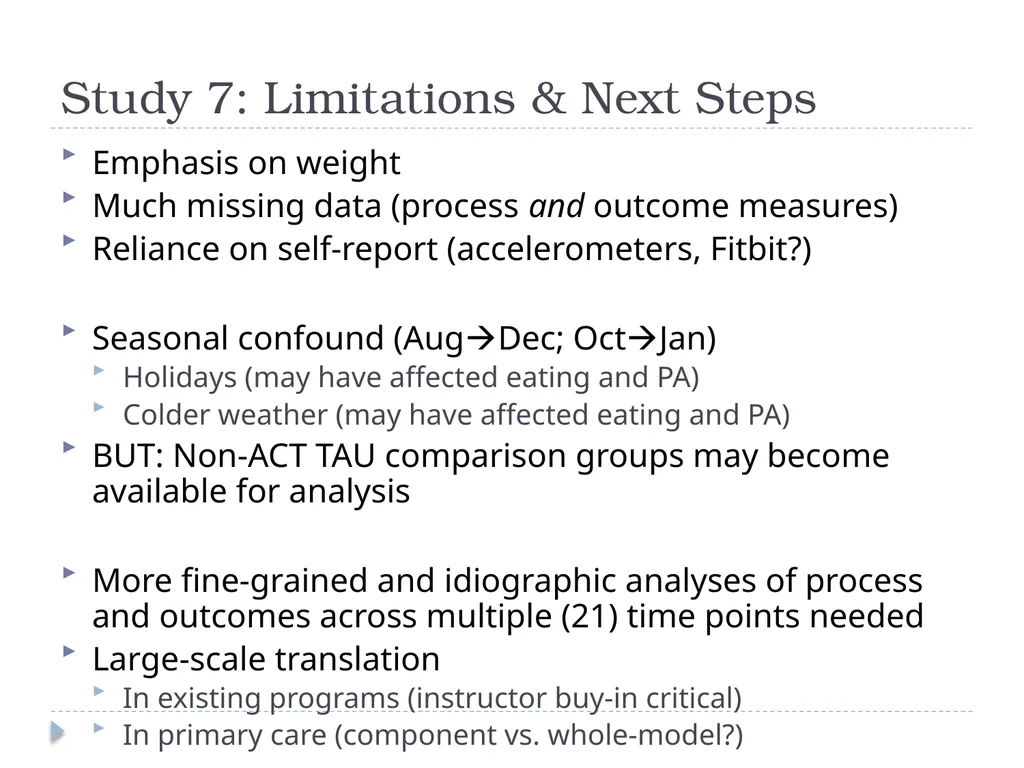
Study 7: Limitations & Next Steps Emphasis on weight
Much missing data (process and outcome measures)
Reliance on self-report (accelerometers, Fitbit?)
Seasonal confound (AugDec; OctJan)
Holidays (may have affected eating and PA)
Colder weather (may have affected eating and PA)
BUT: Non-ACT TAU comparison groups may become available for analysis
More fine-grained and idiographic analyses of process and outcomes across multiple (21) time points needed
Large-scale translation
In existing programs (instructor buy-in critical)
In primary care (component vs. whole-model?)<br>
Much missing data (process and outcome measures)
Reliance on self-report (accelerometers, Fitbit?)
Seasonal confound (AugDec; OctJan)
Holidays (may have affected eating and PA)
Colder weather (may have affected eating and PA)
BUT: Non-ACT TAU comparison groups may become available for analysis
More fine-grained and idiographic analyses of process and outcomes across multiple (21) time points needed
Large-scale translation
In existing programs (instructor buy-in critical)
In primary care (component vs. whole-model?)<br>
24
References 1Katzmarzyk & Janssen, 2004; Brown, Heath, & Levin Martin, 2010; Little, Safdar, Wilkin, Tarnopolsky, & Gibala, 2010
2Roger et al., 2011; Prince et al., 2008; Troiano et al., 2008
3Hayes, Strosahl, & Wilson, 2012
4Gifford, Antonuccio, Kohlenberg, Hayes, & Piasecki, 2002
5McCracken, Vowles, & Eccleston, 2004
6Gregg, Callaghan, Hayes, & Glenn-Lawson, 2007
7Bond et al., 2011
8Bond, Lloyd, & Guenole, 2013; Lillis & Hayes, 2008; Lillis, Hayes, Bunting, & Masuda, 2009; Luoma, Drake, Hayes, & Kohlenberg, 2011; MacKenzie & Kocovski, 2010; Sandoz, 2010; Westin, Hayes, & Andersson, 2008
9Hayes et al., 2004
10Velicer, 1976
11Diener, Emmons, Larsen, & Griffin, 1985
12Sandoz, 2010
13Simons & Gaher, 2005
14Reiss, Peterson, Gursky, & McNally, 1986
15Costa & McCrae, 1992
16Edwards, 1957
17Crowne & Marlow, 1960
18Forman, Butryn, Hoffman, & Herbert, 2009; Lillis, Hayes, Bunting, & Masuda, 2009; Tapper, Shaw, Ilsley, Hill, Bond, & Moore, 2009; Butryn, Forman, Hoffman, Shaw, & Juarascio, 2011; Goodwin, Forman, Herbert, Butryn, & Ledley, 2011; Niemeier, Leahey, Palm Reed, Brown, & Wing, 2012<br>
2Roger et al., 2011; Prince et al., 2008; Troiano et al., 2008
3Hayes, Strosahl, & Wilson, 2012
4Gifford, Antonuccio, Kohlenberg, Hayes, & Piasecki, 2002
5McCracken, Vowles, & Eccleston, 2004
6Gregg, Callaghan, Hayes, & Glenn-Lawson, 2007
7Bond et al., 2011
8Bond, Lloyd, & Guenole, 2013; Lillis & Hayes, 2008; Lillis, Hayes, Bunting, & Masuda, 2009; Luoma, Drake, Hayes, & Kohlenberg, 2011; MacKenzie & Kocovski, 2010; Sandoz, 2010; Westin, Hayes, & Andersson, 2008
9Hayes et al., 2004
10Velicer, 1976
11Diener, Emmons, Larsen, & Griffin, 1985
12Sandoz, 2010
13Simons & Gaher, 2005
14Reiss, Peterson, Gursky, & McNally, 1986
15Costa & McCrae, 1992
16Edwards, 1957
17Crowne & Marlow, 1960
18Forman, Butryn, Hoffman, & Herbert, 2009; Lillis, Hayes, Bunting, & Masuda, 2009; Tapper, Shaw, Ilsley, Hill, Bond, & Moore, 2009; Butryn, Forman, Hoffman, Shaw, & Juarascio, 2011; Goodwin, Forman, Herbert, Butryn, & Ledley, 2011; Niemeier, Leahey, Palm Reed, Brown, & Wing, 2012<br>
25
Thank you so much! sarahbethstaats@gmail.com
Campus Box 4, 1845 Fairmount, Wichita, Kansas 67260<br>
Campus Box 4, 1845 Fairmount, Wichita, Kansas 67260<br>