Differences between English and Danish
Description: Differences between English and Danish pronunciation Goals Learn to pronounce the most important sounds correctly. Understand that mispronunciation can lead to misunderstanding, irritation or amusement for native speakers. Understand the
Related Topics
Download Presentation
"Differences between English and Danish" is the property of its rightful owner. Permission is granted to download and print the materials on this website for personal, non-commercial use only, and to display it on your personal computer provided you do not modify the materials and that you retain all copyright notices contained in the materials. By downloading content from our website, you accept the terms of this agreement.
Presentation Transcript
slide1. Differences between English and Danish pronunciation<br>
slide2. Goals Learn to pronounce the most important sounds correctly.
Understand that mispronunciation can lead to misunderstanding, irritation or amusement for native speakers.
Understand the phonetic concepts of place, manner and strong/weak contrasts.<br>
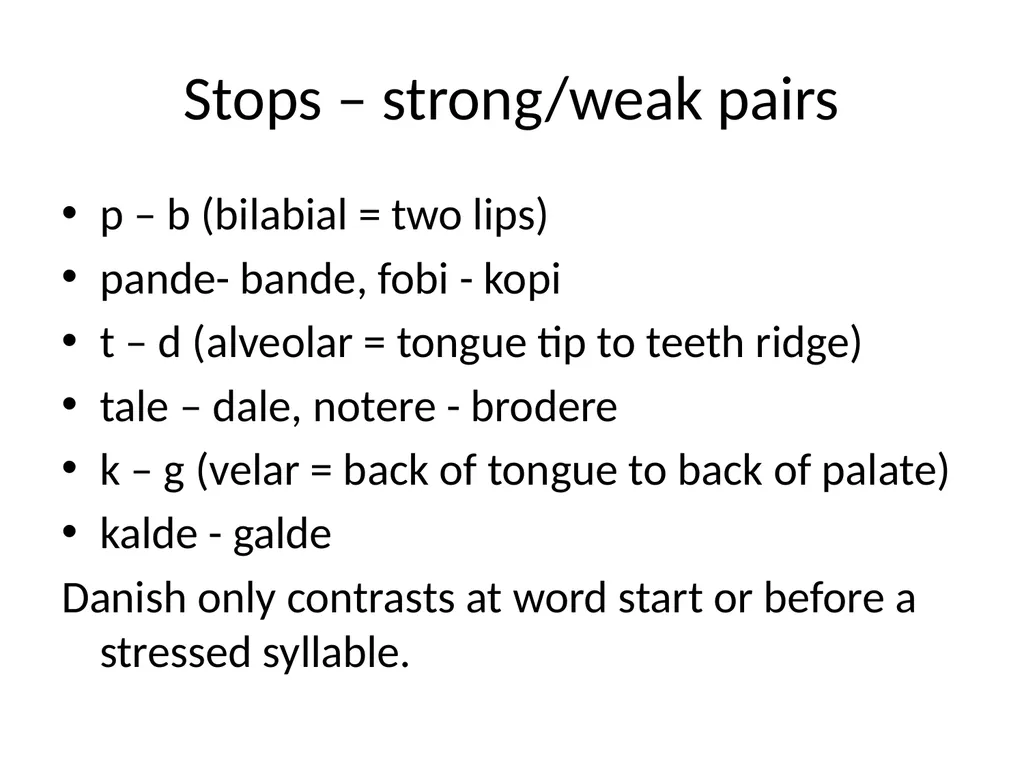
slide3. Stops – strong/weak pairs p – b (bilabial = two lips)
pande- bande, fobi - kopi
t – d (alveolar = tongue tip to teeth ridge)
tale – dale, notere - brodere
k – g (velar = back of tongue to back of palate)
kalde - galde
Danish only contrasts at word start or before a stressed syllable.<br>
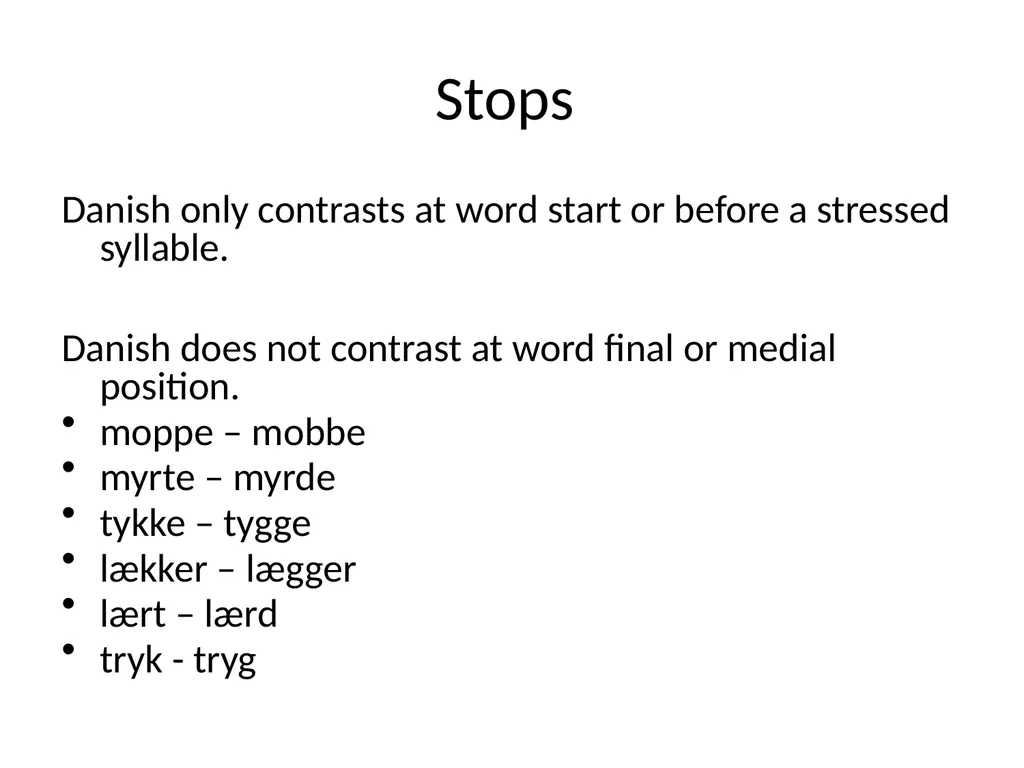
slide4. Stops Danish only contrasts at word start or before a stressed syllable.
Danish does not contrast at word final or medial position.
moppe – mobbe
myrte – myrde
tykke – tygge
lækker – lægger
lært – lærd
tryk - tryg<br>
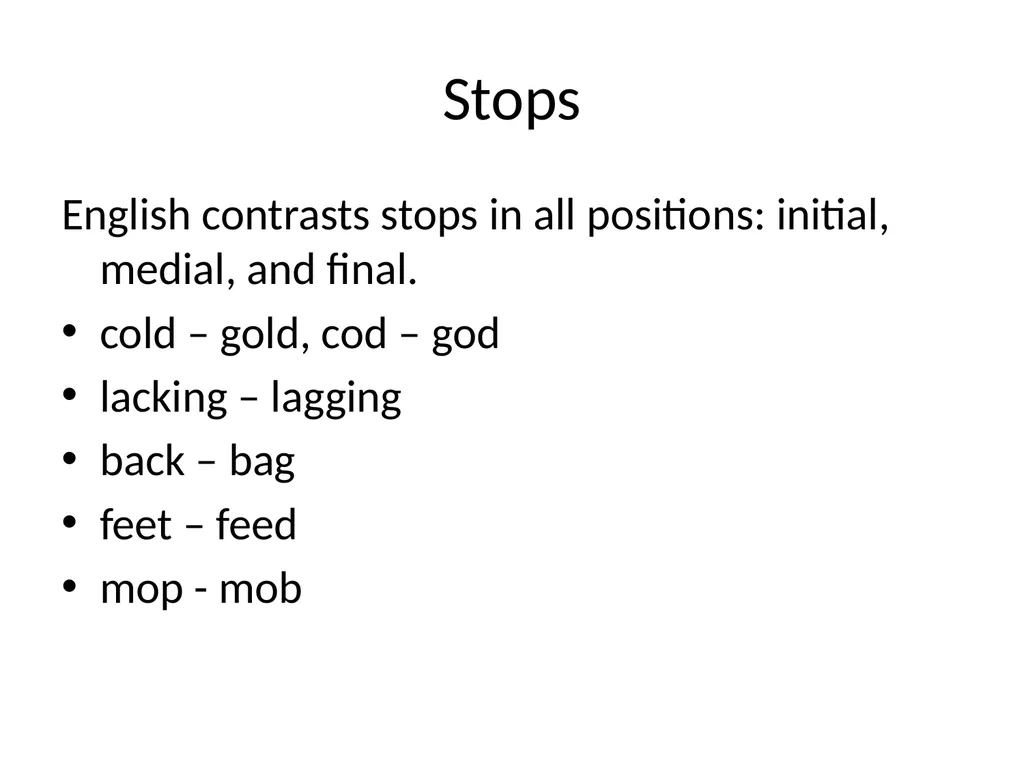
slide5. Stops English contrasts stops in all positions: initial, medial, and final.
cold – gold, cod – god
lacking – lagging
back – bag
feet – feed
mop - mob<br>
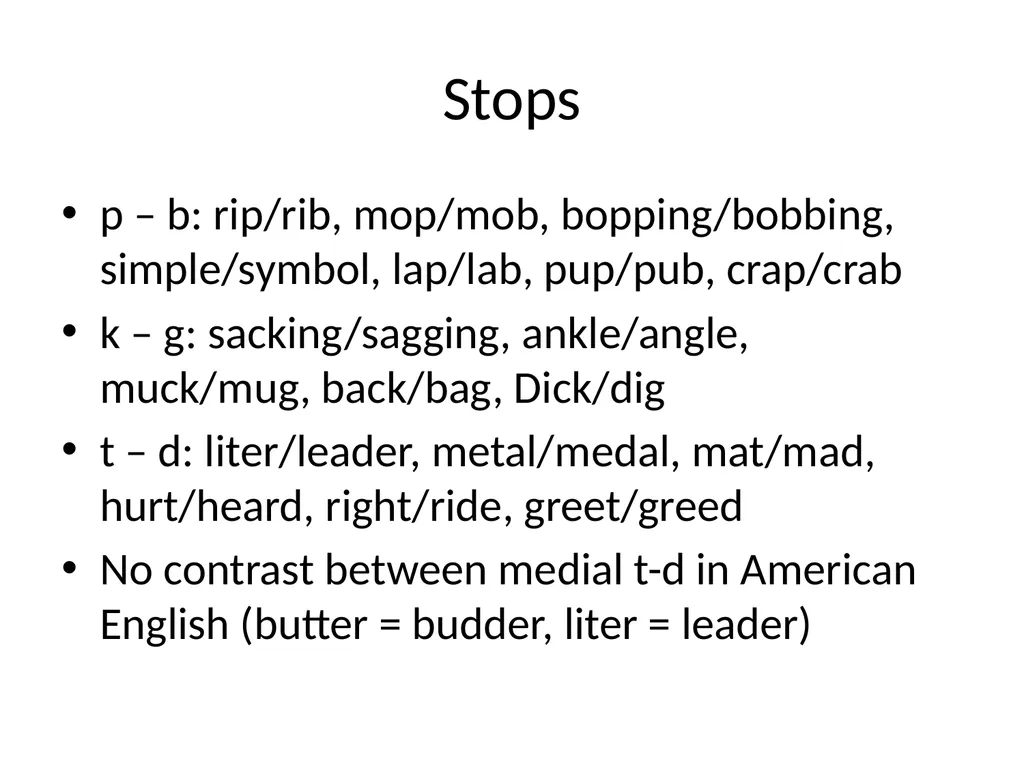
slide6. Stops p – b: rip/rib, mop/mob, bopping/bobbing, simple/symbol, lap/lab, pup/pub, crap/crab
k – g: sacking/sagging, ankle/angle, muck/mug, back/bag, Dick/dig
t – d: liter/leader, metal/medal, mat/mad, hurt/heard, right/ride, greet/greed
No contrast between medial t-d in American English (butter = budder, liter = leader)<br>
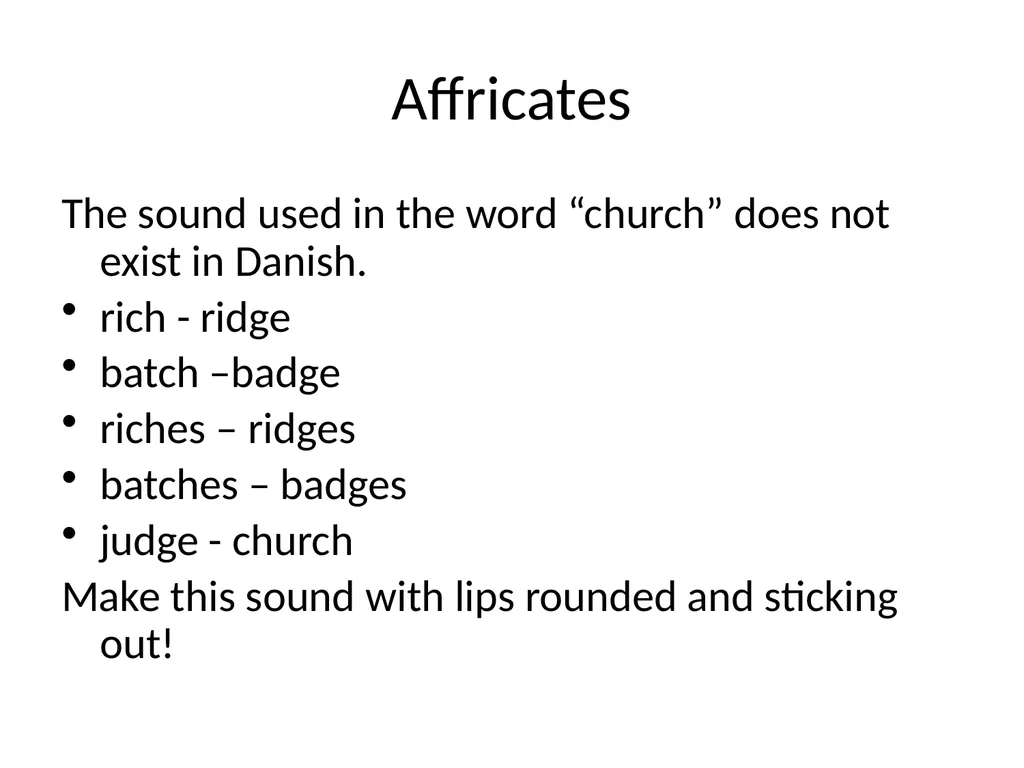
slide7. Affricates The sound used in the word “church” does not exist in Danish.
rich - ridge
batch –badge
riches – ridges
batches – badges
judge - church
Make this sound with lips rounded and sticking out!<br>
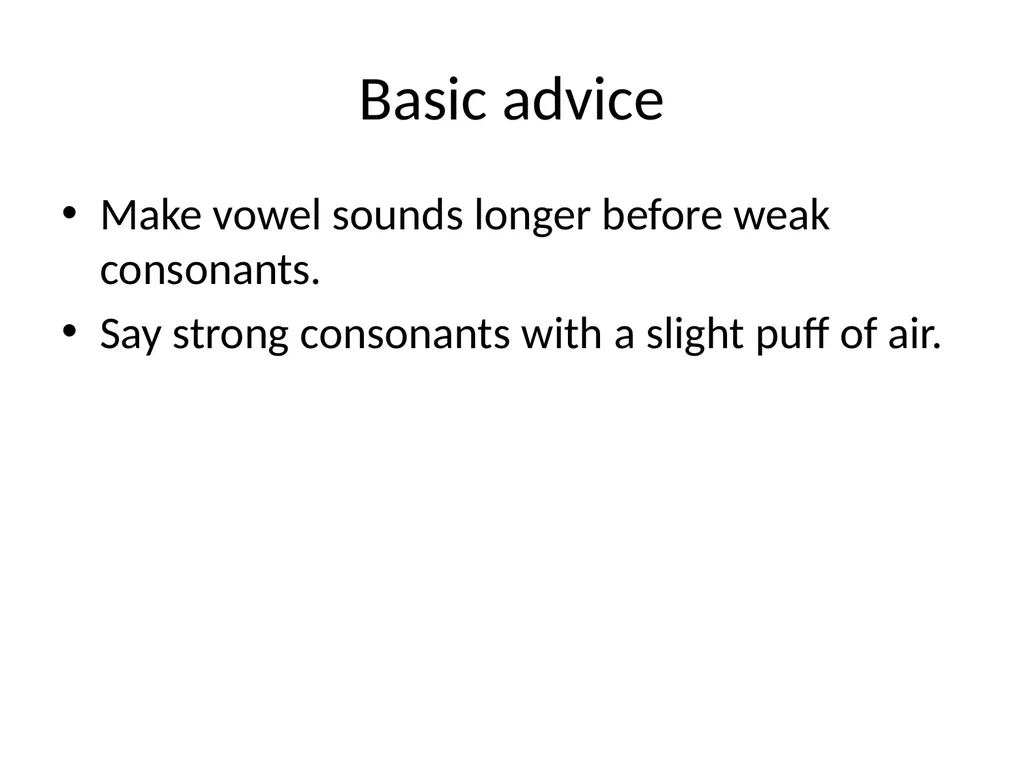
slide8. Basic advice Make vowel sounds longer before weak consonants.
Say strong consonants with a slight puff of air.<br>
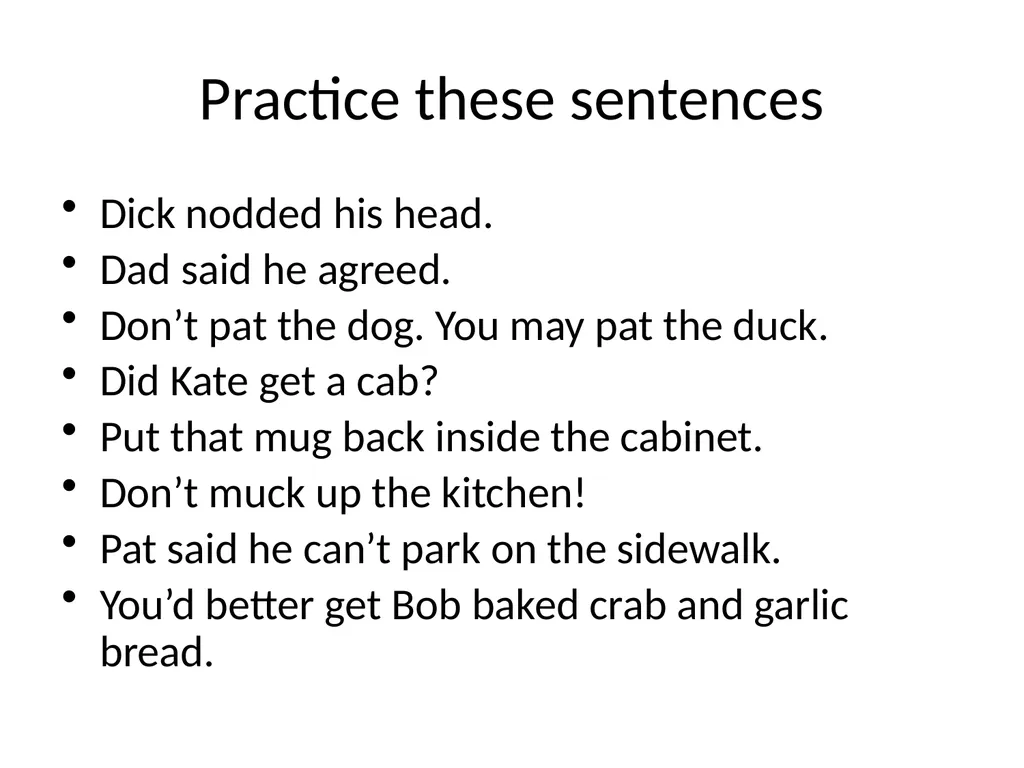
slide9. Practice these sentences Dick nodded his head.
Dad said he agreed.
Don’t pat the dog. You may pat the duck.
Did Kate get a cab?
Put that mug back inside the cabinet.
Don’t muck up the kitchen!
Pat said he can’t park on the sidewalk.
You’d better get Bob baked crab and garlic bread.<br>
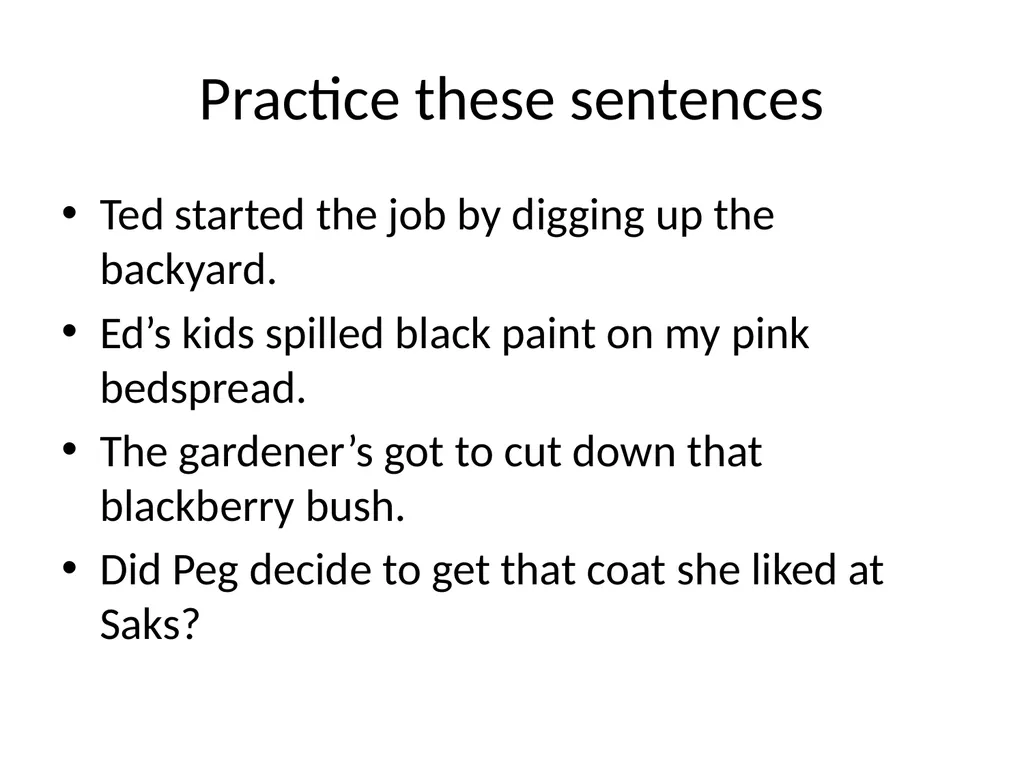
slide10. Practice these sentences Ted started the job by digging up the backyard.
Ed’s kids spilled black paint on my pink bedspread.
The gardener’s got to cut down that blackberry bush.
Did Peg decide to get that coat she liked at Saks?<br>
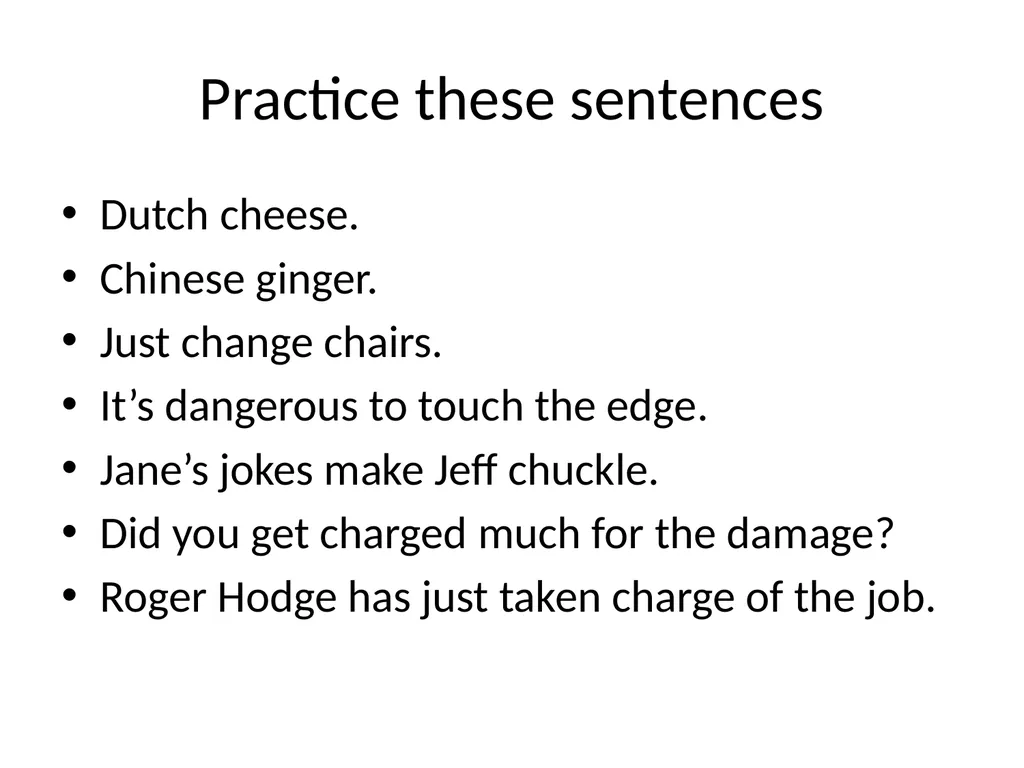
slide11. Practice these sentences Dutch cheese.
Chinese ginger.
Just change chairs.
It’s dangerous to touch the edge.
Jane’s jokes make Jeff chuckle.
Did you get charged much for the damage?
Roger Hodge has just taken charge of the job.<br>
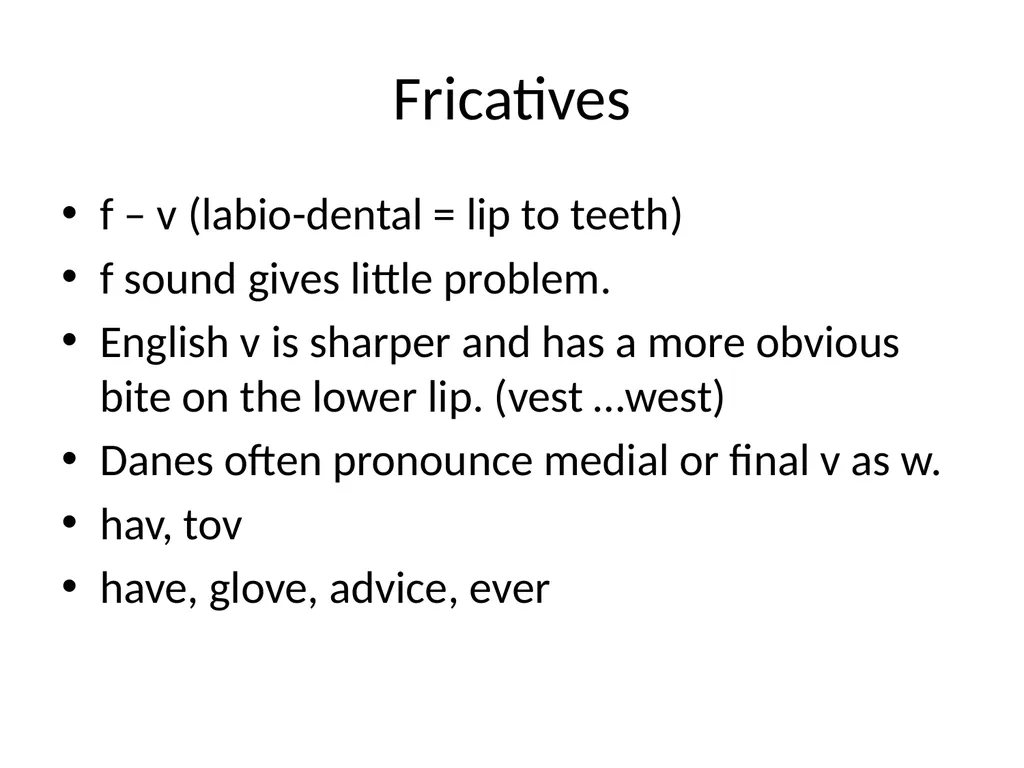
slide12. Fricatives f – v (labio-dental = lip to teeth)
f sound gives little problem.
English v is sharper and has a more obvious bite on the lower lip. (vest …west)
Danes often pronounce medial or final v as w.
hav, tov
have, glove, advice, ever<br>
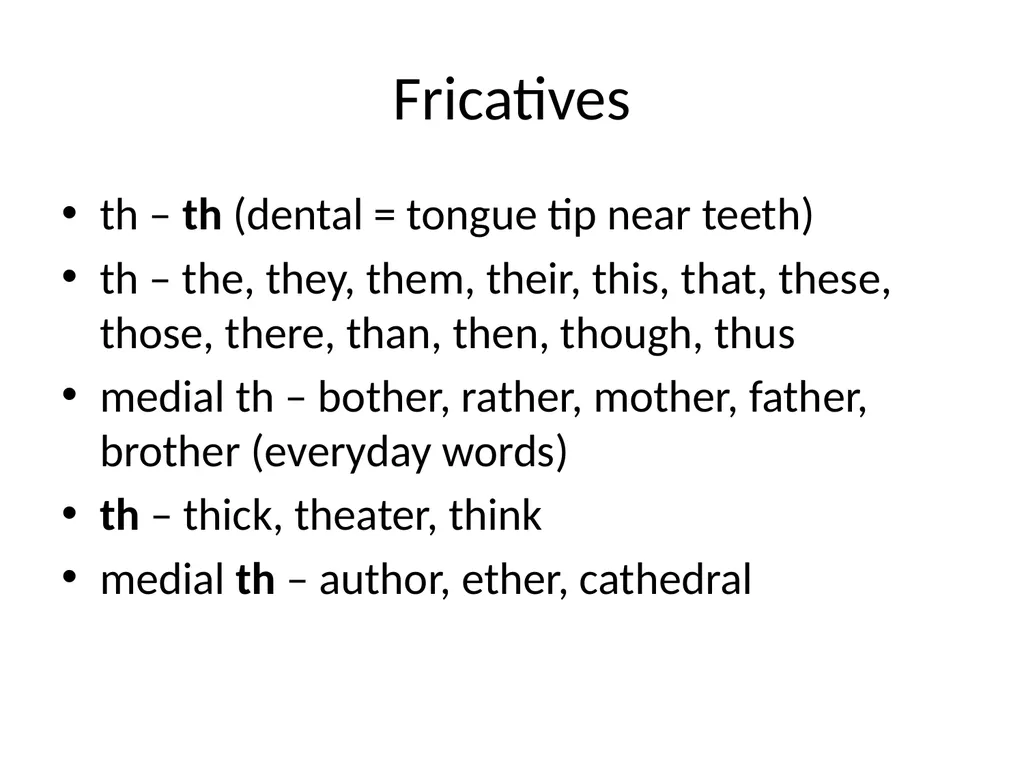
slide13. Fricatives th – th (dental = tongue tip near teeth)
th – the, they, them, their, this, that, these, those, there, than, then, though, thus
medial th – bother, rather, mother, father, brother (everyday words)
th – thick, theater, think
medial th – author, ether, cathedral<br>
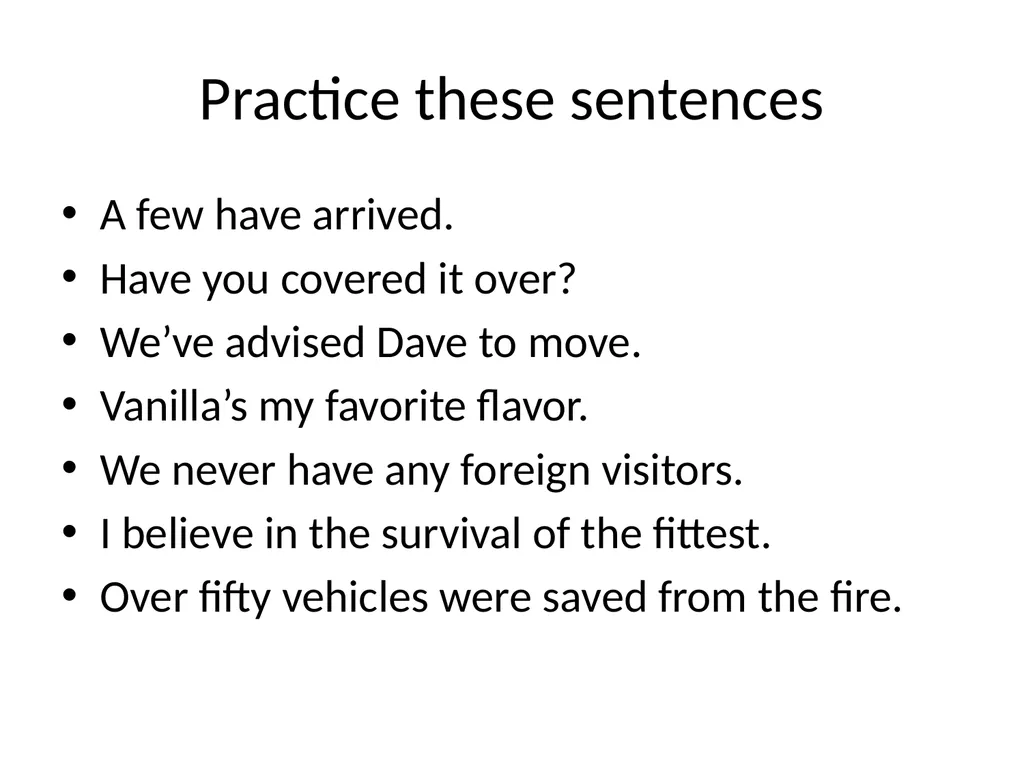
slide14. Practice these sentences A few have arrived.
Have you covered it over?
We’ve advised Dave to move.
Vanilla’s my favorite flavor.
We never have any foreign visitors.
I believe in the survival of the fittest.
Over fifty vehicles were saved from the fire.<br>
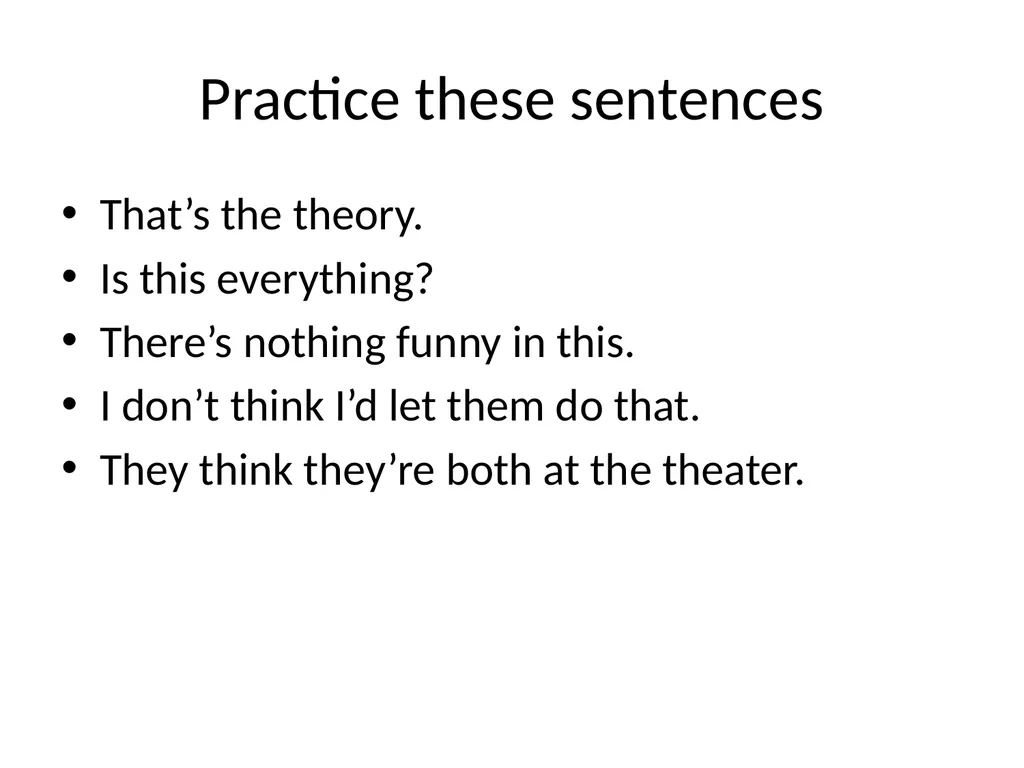
slide15. Practice these sentences That’s the theory.
Is this everything?
There’s nothing funny in this.
I don’t think I’d let them do that.
They think they’re both at the theater.<br>

slide2. Goals Learn to pronounce the most important sounds correctly.
Understand that mispronunciation can lead to misunderstanding, irritation or amusement for native speakers.
Understand the phonetic concepts of place, manner and strong/weak contrasts.<br>
slide3. Stops – strong/weak pairs p – b (bilabial = two lips)
pande- bande, fobi - kopi
t – d (alveolar = tongue tip to teeth ridge)
tale – dale, notere - brodere
k – g (velar = back of tongue to back of palate)
kalde - galde
Danish only contrasts at word start or before a stressed syllable.<br>
slide4. Stops Danish only contrasts at word start or before a stressed syllable.
Danish does not contrast at word final or medial position.
moppe – mobbe
myrte – myrde
tykke – tygge
lækker – lægger
lært – lærd
tryk - tryg<br>
slide5. Stops English contrasts stops in all positions: initial, medial, and final.
cold – gold, cod – god
lacking – lagging
back – bag
feet – feed
mop - mob<br>
slide6. Stops p – b: rip/rib, mop/mob, bopping/bobbing, simple/symbol, lap/lab, pup/pub, crap/crab
k – g: sacking/sagging, ankle/angle, muck/mug, back/bag, Dick/dig
t – d: liter/leader, metal/medal, mat/mad, hurt/heard, right/ride, greet/greed
No contrast between medial t-d in American English (butter = budder, liter = leader)<br>
slide7. Affricates The sound used in the word “church” does not exist in Danish.
rich - ridge
batch –badge
riches – ridges
batches – badges
judge - church
Make this sound with lips rounded and sticking out!<br>
slide8. Basic advice Make vowel sounds longer before weak consonants.
Say strong consonants with a slight puff of air.<br>
slide9. Practice these sentences Dick nodded his head.
Dad said he agreed.
Don’t pat the dog. You may pat the duck.
Did Kate get a cab?
Put that mug back inside the cabinet.
Don’t muck up the kitchen!
Pat said he can’t park on the sidewalk.
You’d better get Bob baked crab and garlic bread.<br>
slide10. Practice these sentences Ted started the job by digging up the backyard.
Ed’s kids spilled black paint on my pink bedspread.
The gardener’s got to cut down that blackberry bush.
Did Peg decide to get that coat she liked at Saks?<br>
slide11. Practice these sentences Dutch cheese.
Chinese ginger.
Just change chairs.
It’s dangerous to touch the edge.
Jane’s jokes make Jeff chuckle.
Did you get charged much for the damage?
Roger Hodge has just taken charge of the job.<br>
slide12. Fricatives f – v (labio-dental = lip to teeth)
f sound gives little problem.
English v is sharper and has a more obvious bite on the lower lip. (vest …west)
Danes often pronounce medial or final v as w.
hav, tov
have, glove, advice, ever<br>
slide13. Fricatives th – th (dental = tongue tip near teeth)
th – the, they, them, their, this, that, these, those, there, than, then, though, thus
medial th – bother, rather, mother, father, brother (everyday words)
th – thick, theater, think
medial th – author, ether, cathedral<br>
slide14. Practice these sentences A few have arrived.
Have you covered it over?
We’ve advised Dave to move.
Vanilla’s my favorite flavor.
We never have any foreign visitors.
I believe in the survival of the fittest.
Over fifty vehicles were saved from the fire.<br>
slide15. Practice these sentences That’s the theory.
Is this everything?
There’s nothing funny in this.
I don’t think I’d let them do that.
They think they’re both at the theater.<br>