
DIFFERENT Types OF WEAVES Subject : Basic Textiles
JO
Published · 18 slides · 0 views
1 / 1
Description
DIFFERENT Types OF WEAVES Subject : Basic Textiles (TFT 108) Class: B.Voc TFT I Dr Khushwinder Gill Assistant Professor Deptt of Fashion Designing Definition Weaving is a method of textile production in which two distinct sets of yarns or
Related Topics
Share
Embed code
Download this presentation From Below
"DIFFERENT Types OF WEAVES Subject : Basic Textiles" is the property of its rightful owner. Permission is granted to download and print the materials on this website for personal, non-commercial use only, and to display it on your personal computer provided you do not modify the materials and that you retain all copyright notices contained in the materials. By downloading content from our website, you accept the terms of this agreement.
Presentation Transcript
01
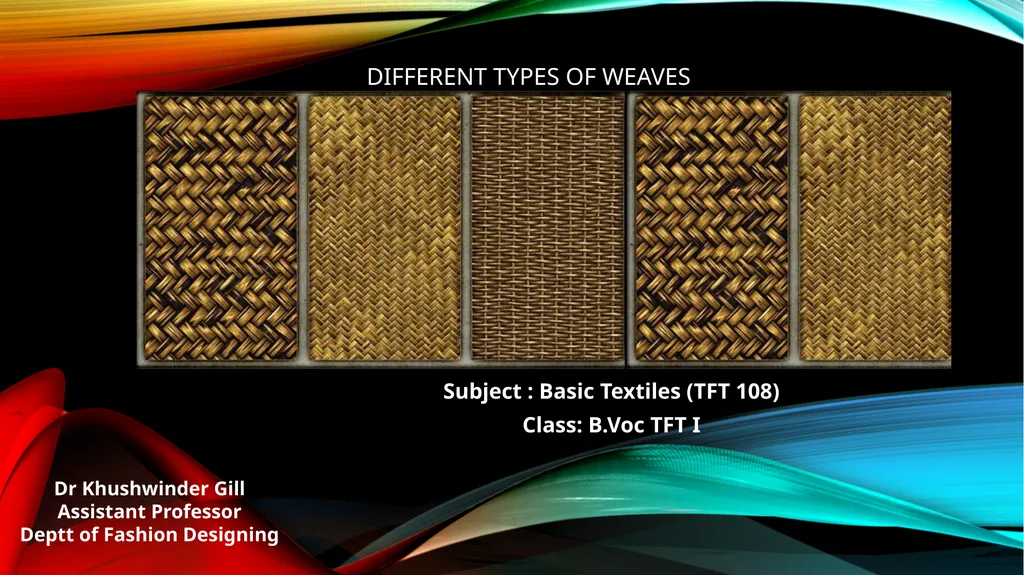
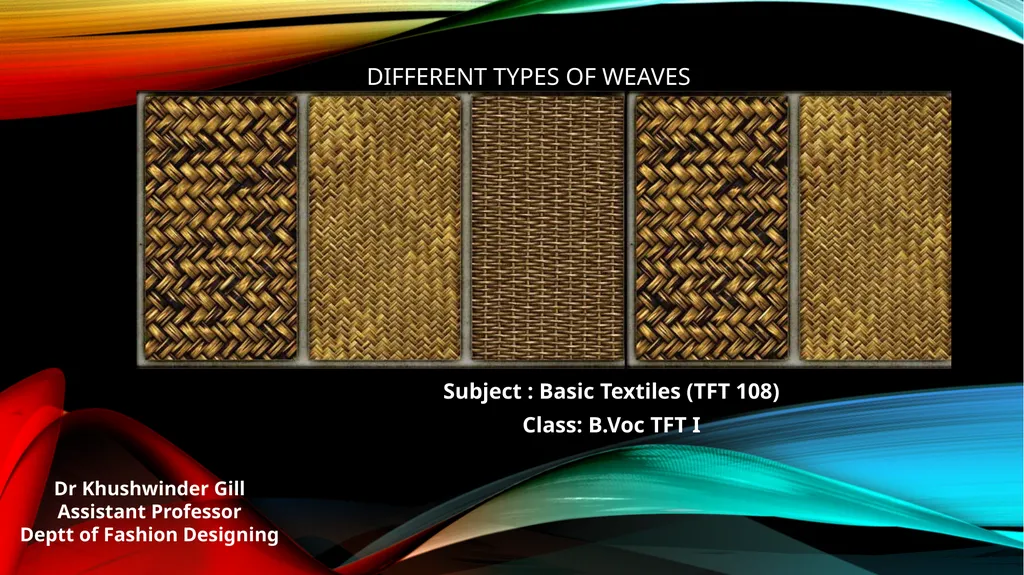
DIFFERENT Types OF WEAVES Subject : Basic Textiles (TFT 108)
Class: B.Voc TFT I Dr Khushwinder Gill
Assistant Professor
Deptt of Fashion Designing<br>
Class: B.Voc TFT I Dr Khushwinder Gill
Assistant Professor
Deptt of Fashion Designing<br>
02
Definition Weaving is a method of textile production in which two distinct sets of yarns or threads are interlaced at right angles to form a fabric or cloth.
The way the warp and filling threads interlace with each other is called the weave.
The majority of woven products are created with one of three basic weaves: plain weave, satin weave, or twill. Woven cloth can be plain (in one colour or a simple pattern), or can be woven in decorative or artistic design. Fabric are manufactured in wide varieties and design. And the different design and effect is produced on the fabric with the help for various mechanism which is helpful to from different weaves and lots of design which enhances the look of apparels. This PPT was aimed at investigating the different types of weaves and also overview the fabrics come under the different weave categories.<br>
03
Types of Weaves Plain weave
Basket waeve
Twill weave
Satin Weave
Jacquard weave
Leno or gauze weave
Pile weave<br>
Basket waeve
Twill weave
Satin Weave
Jacquard weave
Leno or gauze weave
Pile weave<br>
04
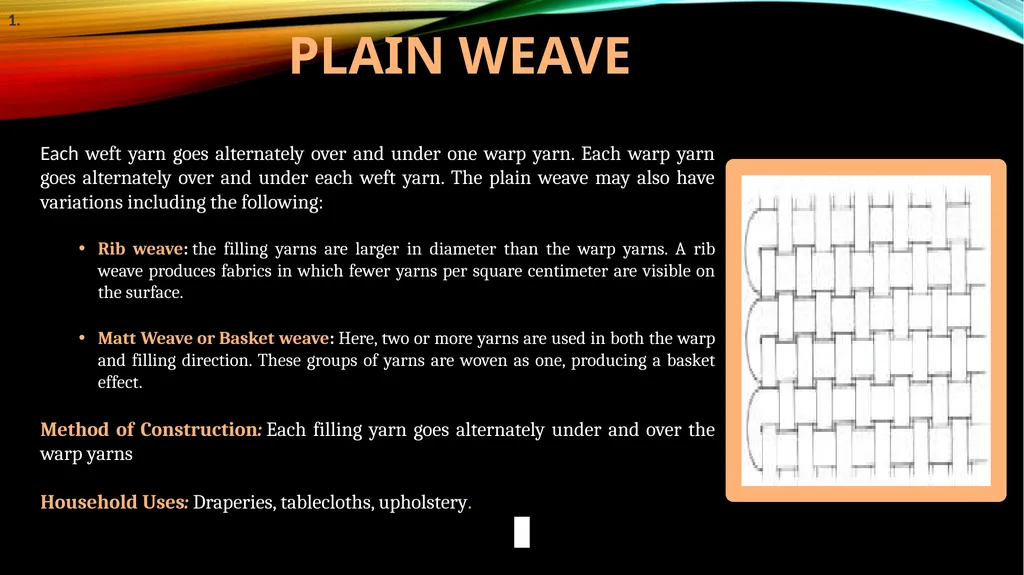
Plain Weave Each weft yarn goes alternately over and under one warp yarn. Each warp yarn goes alternately over and under each weft yarn. The plain weave may also have variations including the following:
Rib weave: the filling yarns are larger in diameter than the warp yarns. A rib weave produces fabrics in which fewer yarns per square centimeter are visible on the surface.
Matt Weave or Basket weave: Here, two or more yarns are used in both the warp and filling direction. These groups of yarns are woven as one, producing a basket effect.
Method of Construction: Each filling yarn goes alternately under and over the warp yarns
Household Uses: Draperies, tablecloths, upholstery. 1.<br>
05
EXAMPLES OF PLAIN WEAVE Chiffon: A very soft and filling plain woven Silk texture consisting of the Finest Singles which are hard twisted and woven in the gum condition. The cloth is afterward degummed.
Georgette: A cotton Crepe fabric made in imitation of silk georgette, with hard twisted warp and weft yarn. A good Cloth is woven plain with right and left twist thread arranged in 2 and 2 order in warp and weft.
Shantung: Coarse Silk fabric with Slubs. Mostly Tussah Silk but can be Polyester, nylon and viscose.
Seersucker: It is created by holding some warp yarns at tight tension, some at slack tension. Those at Slack Tension puff up to form a sort of Blis-ter-effect, often slack and tight yarn of different colour.<br>
06
Basket Weave Basket weave is the amplification in height and width of plain weave. Two or more yarns have to be lifted or lowered over or under two or more picks for each plain weave point. There two types of weave come under this category i.e. regular and irregular weave.
Regular Basket Weave: This is commonly used for edges in drapery, or as a bottom in very small weave repeats, because the texture is too loose-fitting for big weave repeats; moreover, yarns of different groups can slip, group and overlap, spoiling the appearance. This is why only basket weaves 2-2, 3-3 and 4-4 exist.
Irregular Basket Weave: This is generally a combination of irregular warp and weft ribs.
Method of Construction: Two or more warps simultaneously interlaced with one or more fillings.
Household Uses: Wall hangings, pillow<br>
07
Example of Basket weave Monks cloth: Heavy cotton Cloth in a coarse basket weave, chiefly used for draperies.
Oxford; Oxford weave fabric consists of two, thin warp yarns woven to very soft, thicker yarn in the filling direction. The unbalanced construction of the fabric causes the thin yarns to break and leave tiny holes. The primary use of oxford weave fabric is in cotton shirting. It is also used in other forms of apparel.<br>
Oxford; Oxford weave fabric consists of two, thin warp yarns woven to very soft, thicker yarn in the filling direction. The unbalanced construction of the fabric causes the thin yarns to break and leave tiny holes. The primary use of oxford weave fabric is in cotton shirting. It is also used in other forms of apparel.<br>
08
Twill Weave Creates a diagonal, chevron, hounds tooth, corkscrew, or other design. The design is enhanced with colored yarn is strong and may develop a shine. Twill weave is characterized by diagonal ridges formed by the yarns, which are exposed on the surface. These may vary in angle from a low slope to a very steep slope. Twill weaves are more closely woven, heavier and stronger than weaves of comparable fiber and yarn size. They can be produced in fancy designs.
Method of Construction: Three or more shafts; warp or filling floats over two or more counterpart yarns in progressive steps right or left
Household Uses: Upholstery, comforters, pillows.<br>
Method of Construction: Three or more shafts; warp or filling floats over two or more counterpart yarns in progressive steps right or left
Household Uses: Upholstery, comforters, pillows.<br>
09
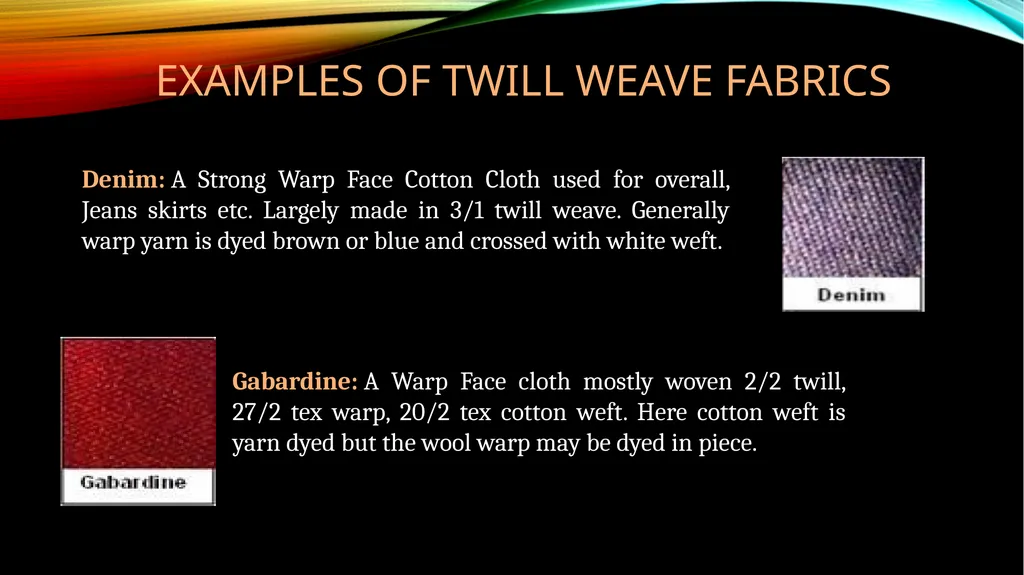
Examples of twill weave fabrics Denim: A Strong Warp Face Cotton Cloth used for overall, Jeans skirts etc. Largely made in 3/1 twill weave. Generally warp yarn is dyed brown or blue and crossed with white weft. Gabardine: A Warp Face cloth mostly woven 2/2 twill, 27/2 tex warp, 20/2 tex cotton weft. Here cotton weft is yarn dyed but the wool warp may be dyed in piece.<br>
10
Satin weave Smooth, soft luster
Excellent drapability
Floats snag easily
Method of Construction:
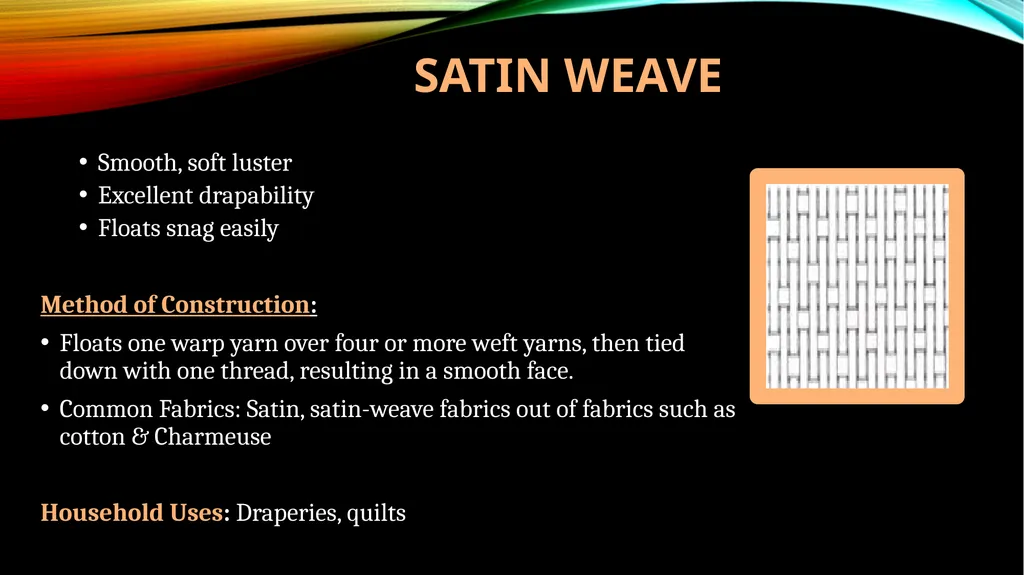
Floats one warp yarn over four or more weft yarns, then tied down with one thread, resulting in a smooth face.
Common Fabrics: Satin, satin-weave fabrics out of fabrics such as cotton & Charmeuse
Household Uses: Draperies, quilts<br>
Excellent drapability
Floats snag easily
Method of Construction:
Floats one warp yarn over four or more weft yarns, then tied down with one thread, resulting in a smooth face.
Common Fabrics: Satin, satin-weave fabrics out of fabrics such as cotton & Charmeuse
Household Uses: Draperies, quilts<br>
11
EXMAPLES of stain weave fabrics Satin: Used for ribbons, trimmings, dresses, linings etc, and originally was all silk fabric with a fine rich glossy surface formed in a warp satin weave. Double faced Satins are made on the reversible warp backed principle, with one side differently colour from the other.
Sateen: A cotton fabric is made in 5 thread weft face sateen, and woven like cotton. It is sold in bleached, mercerized or printed condition.
Charmeuse: It is a light weight fabric woven with a satin weave ,where the warp threads cross over three or more of the backing (weft) threads. The front side of the fabric has a satin finish-lustrous and reflective-whereas the back has a dull finish.<br>
12
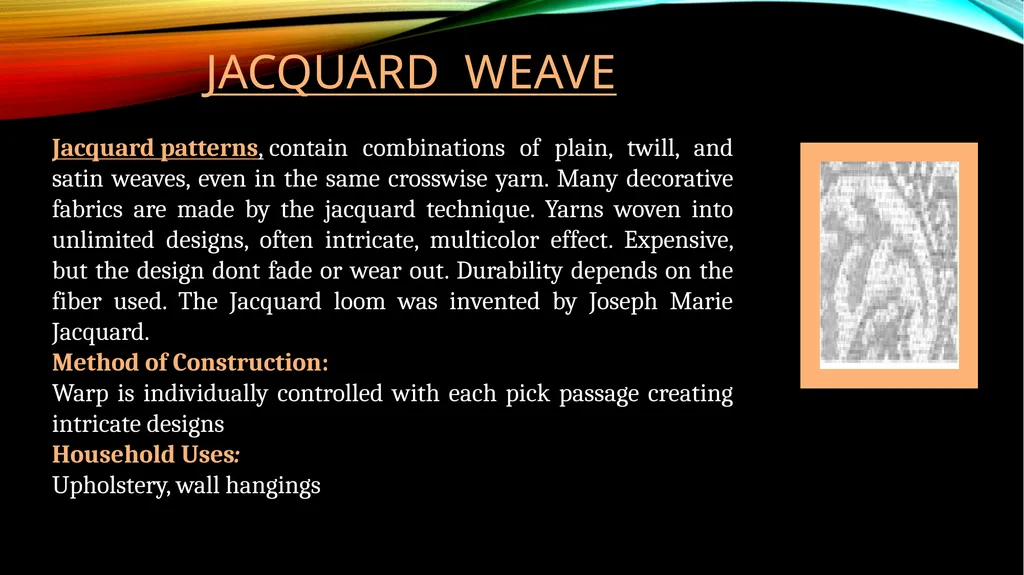
Jacquard patterns, contain combinations of plain, twill, and satin weaves, even in the same crosswise yarn. Many decorative fabrics are made by the jacquard technique. Yarns woven into unlimited designs, often intricate, multicolor effect. Expensive, but the design dont fade or wear out. Durability depends on the fiber used. The Jacquard loom was invented by Joseph Marie Jacquard.
Method of Construction:
Warp is individually controlled with each pick passage creating intricate designs
Household Uses:
Upholstery, wall hangings JACQUARD WEAVE<br>
Method of Construction:
Warp is individually controlled with each pick passage creating intricate designs
Household Uses:
Upholstery, wall hangings JACQUARD WEAVE<br>
13
Types of Jacquard weave fabric Brocade: Originally a heavy rich silk fiber ornaments with raised figures formed by extra threads or by embroidery. Mostly used for upholstery fabrics and draperies.
Damask: Fabric with a weft sateen figures on a warp satin, twist or plain grained, made of silk, cotton, rayon and linen yarns Damasks are reversible. Cotton and linen damasks are made either with four yarn float or a seven yarn float in the satin weave. The Longer floats are more lustrous, but the shorter floats are more durable.<br>
Damask: Fabric with a weft sateen figures on a warp satin, twist or plain grained, made of silk, cotton, rayon and linen yarns Damasks are reversible. Cotton and linen damasks are made either with four yarn float or a seven yarn float in the satin weave. The Longer floats are more lustrous, but the shorter floats are more durable.<br>
14
Leno or Gauze Weave In leno or gauze weave pairs of warps are twisted over each other with each passing of filling yarn. The leno weave is the modern descendant of a technique called twining that was used thousands of years ago for making fabrics. In leno-weave fabrics, the warp yarns are paired.
Method of Construction: A pair of warp threads is twisted over each other with each passing of filling yarn in a figure or an hourglass twist, creating a geometric pattern
Household Uses: Thermal Blankets, curtains<br>
Method of Construction: A pair of warp threads is twisted over each other with each passing of filling yarn in a figure or an hourglass twist, creating a geometric pattern
Household Uses: Thermal Blankets, curtains<br>
15
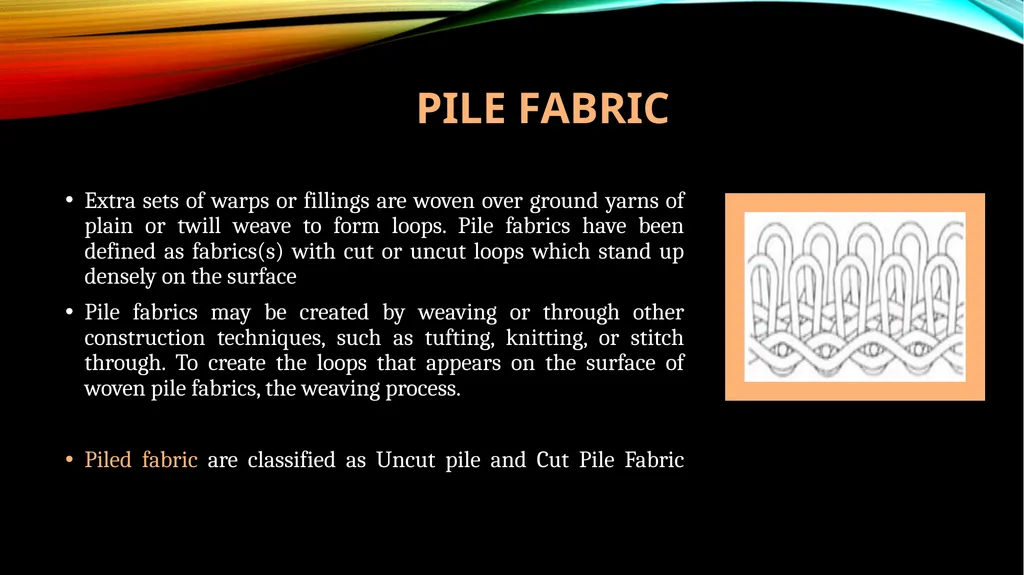
Pile Fabric Extra sets of warps or fillings are woven over ground yarns of plain or twill weave to form loops. Pile fabrics have been defined as fabrics(s) with cut or uncut loops which stand up densely on the surface
Pile fabrics may be created by weaving or through other construction techniques, such as tufting, knitting, or stitch through. To create the loops that appears on the surface of woven pile fabrics, the weaving process.
Piled fabric are classified as Uncut pile and Cut Pile Fabric<br>
Pile fabrics may be created by weaving or through other construction techniques, such as tufting, knitting, or stitch through. To create the loops that appears on the surface of woven pile fabrics, the weaving process.
Piled fabric are classified as Uncut pile and Cut Pile Fabric<br>
16
Uncut Pile Loops are possible on both sides of fabric
Soft and absorbent, relatively inexpensive
Can snag if loops are caught
Method of Construction (Wire Method or double cloth Method):
Generally a plain or twill weaves with a third dimension--additional warp yarn or filling yarn is introduced into the basic structure and forms a loop at regular intervals.
Common Fabrics: Frieze, terry cloth
Household Uses: Upholstery, towels, carpet, area rugs<br>
17
Cut Pile Soft and warm, resilient, absorbent
May have a nap that must be matched
May be expensive and need professional cleaning
Method of Construction:
Similar to uncut pile, but loops have been cut
Household uses: Upholstery, stage draperies.<br>
May have a nap that must be matched
May be expensive and need professional cleaning
Method of Construction:
Similar to uncut pile, but loops have been cut
Household uses: Upholstery, stage draperies.<br>
18
Different types of Cut pile Fabric Corduroy: Corded velveteen Structures in which a weft pile forms longitudinal lines or chords, strong heavy clothes being used for trouser-rings, smoking jackets and lighter fabrics for dress materials.
Velvet: A cut warp pile fabric with a short, soft, dense pile.
Velveteen: A Short heavily weft cotton fabric uniformly covered with a short dense pile of fibers which formed after the cloth has been woven by cutting certain picks of weft that float somewhat loosely on the surface.<br>
Velvet: A cut warp pile fabric with a short, soft, dense pile.
Velveteen: A Short heavily weft cotton fabric uniformly covered with a short dense pile of fibers which formed after the cloth has been woven by cutting certain picks of weft that float somewhat loosely on the surface.<br>