Diffusing Capacity of the Lung for Carbon Monoxide Saadiq Moolla Division of Pulmonology Tygerberg Hospital 01032023 DLCO Gas exchange1 Uptake of O2 and excretion of CO2 Numerous interacting processes of: Diffusion (high low partial
"Diffusing Capacity of the Lung for Carbon Monoxide" is the property of its rightful owner. Permission is granted to
download and print the materials on this website for personal, non-commercial use only, and to display it
on your personal computer provided you do not modify the materials and that you retain all copyright
notices contained in the materials. By downloading content from our website, you accept the terms of this
agreement.
Presentation Transcript
01
Diffusing Capacity of the Lung for Carbon Monoxide Saadiq Moolla
Division of Pulmonology
Tygerberg Hospital
01/03/2023<br>
02
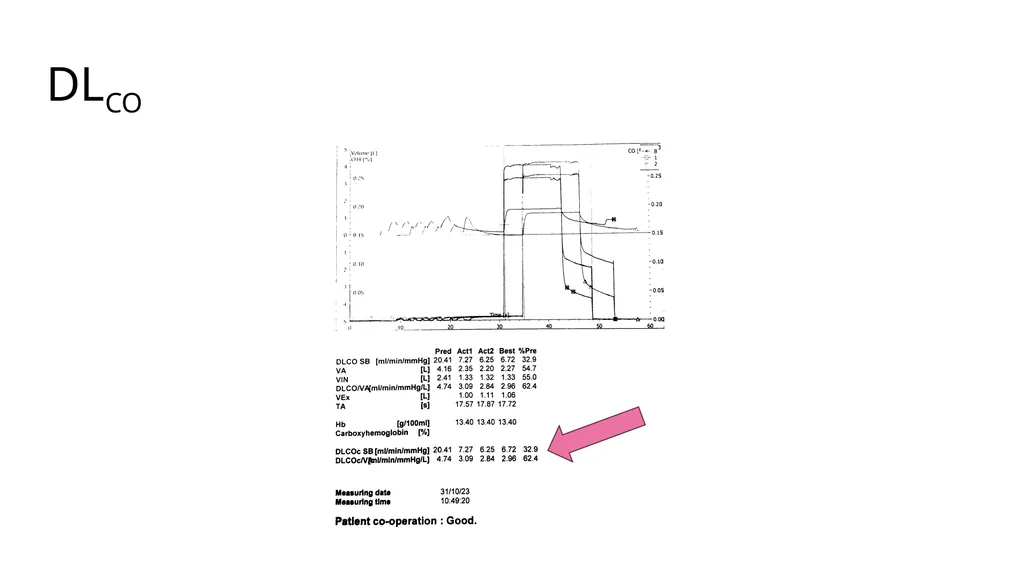
DLCO<br>
03
Gas exchange1 Uptake of O2 and excretion of CO2
Numerous interacting processes of:
Diffusion (high → low partial pressure)
Chemical reactions (slow)
Rapid exchange in the lungs
375 L/day O2
Blood transit 0.75 s at rest and 0.5 s during exercise 1. Klocke in Fishman’s (6e).<br>
04
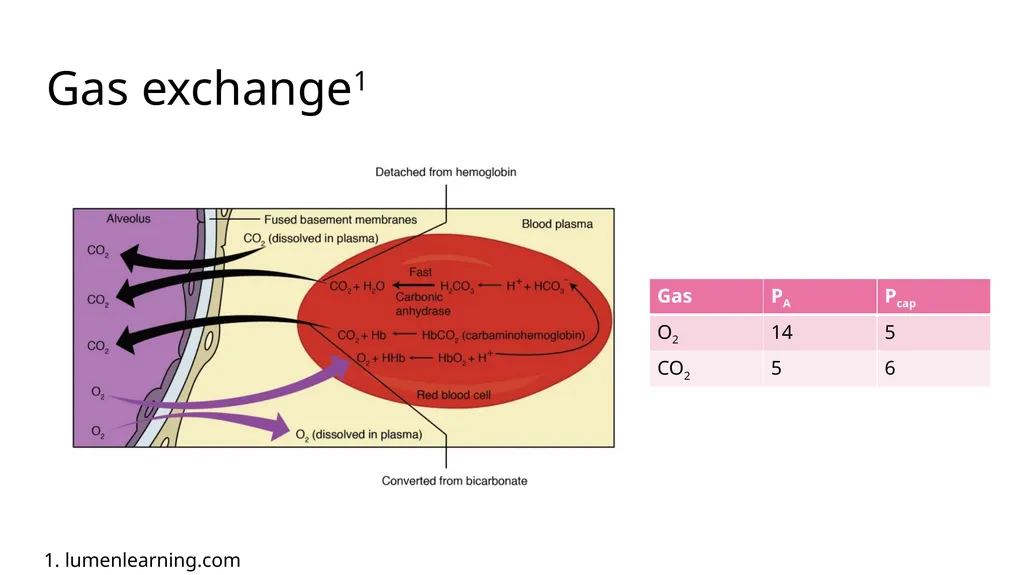
Gas exchange1 1. lumenlearning.com<br>
05
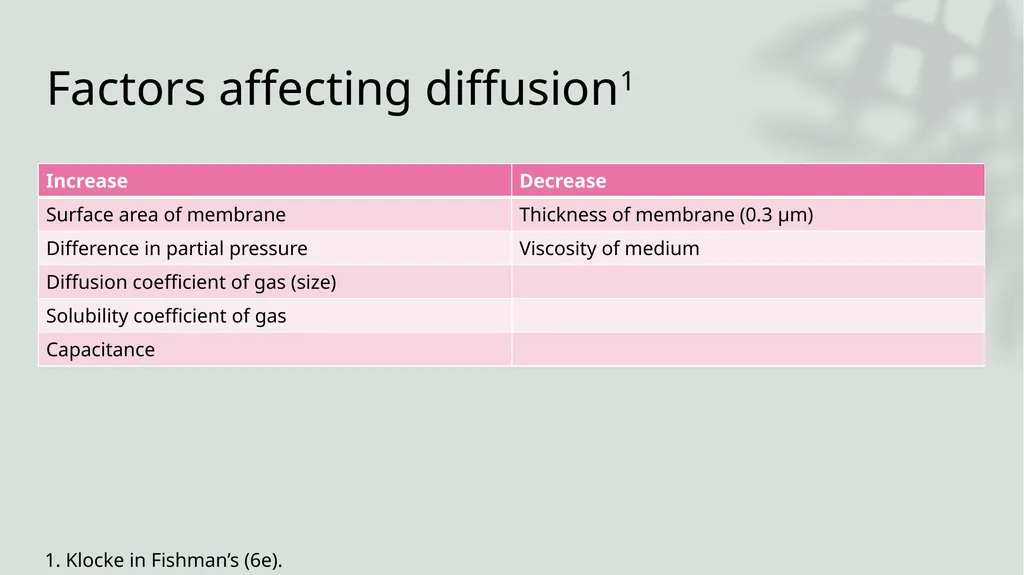
Factors affecting diffusion1 1. Klocke in Fishman’s (6e).<br>
06
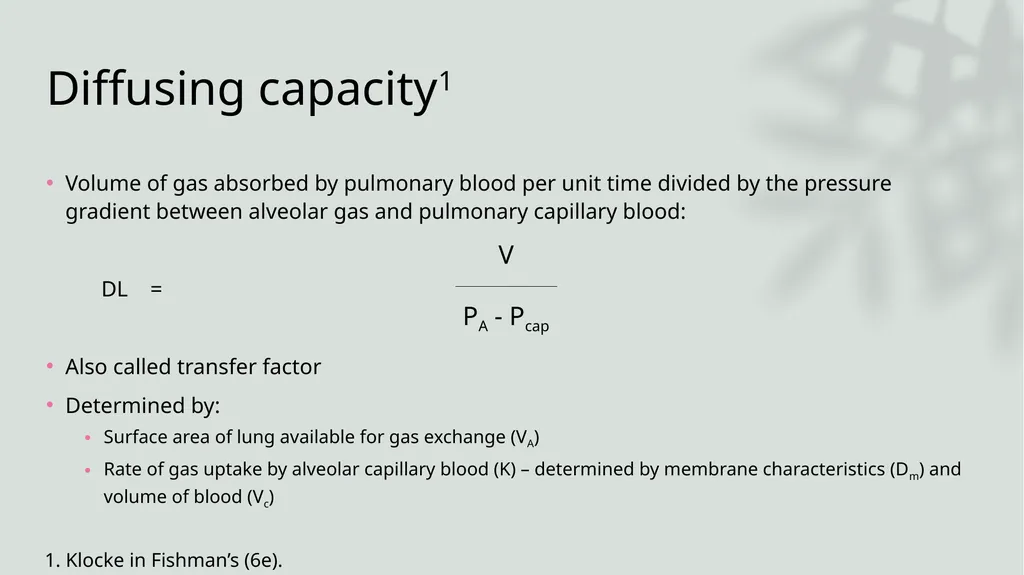
Diffusing capacity1 Volume of gas absorbed by pulmonary blood per unit time divided by the pressure gradient between alveolar gas and pulmonary capillary blood:
DL =
Also called transfer factor
Determined by:
Surface area of lung available for gas exchange (VA)
Rate of gas uptake by alveolar capillary blood (K) – determined by membrane characteristics (Dm) and volume of blood (Vc) 1. Klocke in Fishman’s (6e). V
PA - Pcap<br>
07
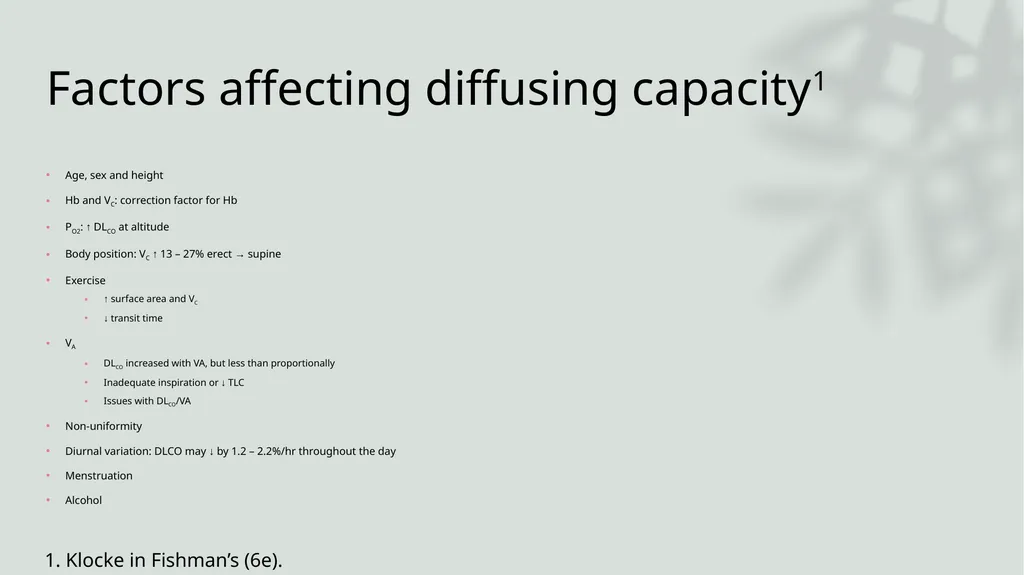
Factors affecting diffusing capacity1 Age, sex and height
Hb and VC: correction factor for Hb
PO2: ↑ DLCO at altitude
Body position: VC ↑ 13 – 27% erect → supine
Exercise
↑ surface area and VC
↓ transit time
VA
DLCO increased with VA, but less than proportionally
Inadequate inspiration or ↓ TLC
Issues with DLCO/VA
Non-uniformity
Diurnal variation: DLCO may ↓ by 1.2 – 2.2%/hr throughout the day
Menstruation
Alcohol 1. Klocke in Fishman’s (6e).<br>
08
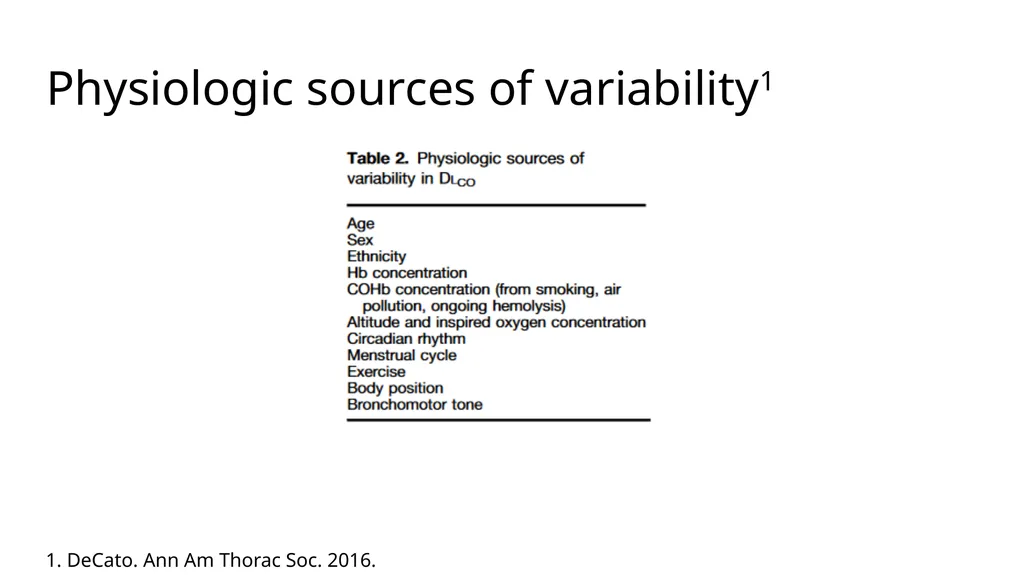
Physiologic sources of variability1 1. DeCato. Ann Am Thorac Soc. 2016.<br>
09
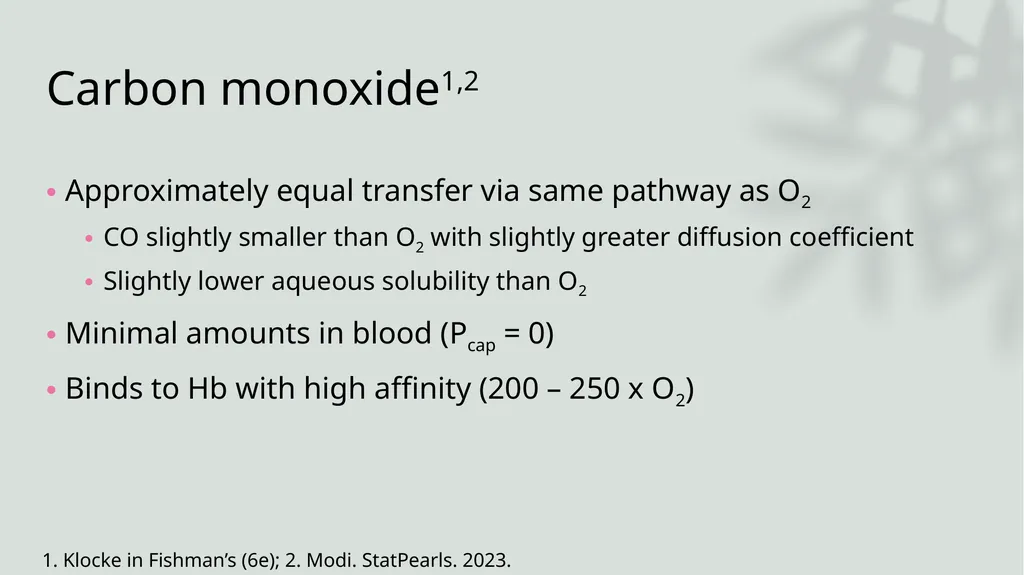
Carbon monoxide1,2 Approximately equal transfer via same pathway as O2
CO slightly smaller than O2 with slightly greater diffusion coefficient
Slightly lower aqueous solubility than O2
Minimal amounts in blood (Pcap = 0)
Binds to Hb with high affinity (200 – 250 x O2) 1. Klocke in Fishman’s (6e); 2. Modi. StatPearls. 2023.<br>
10
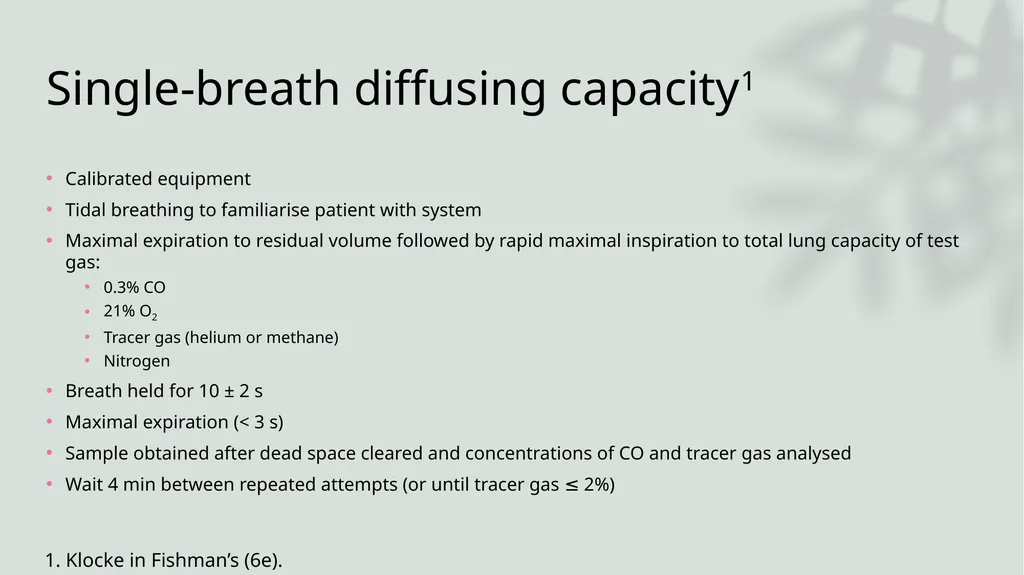
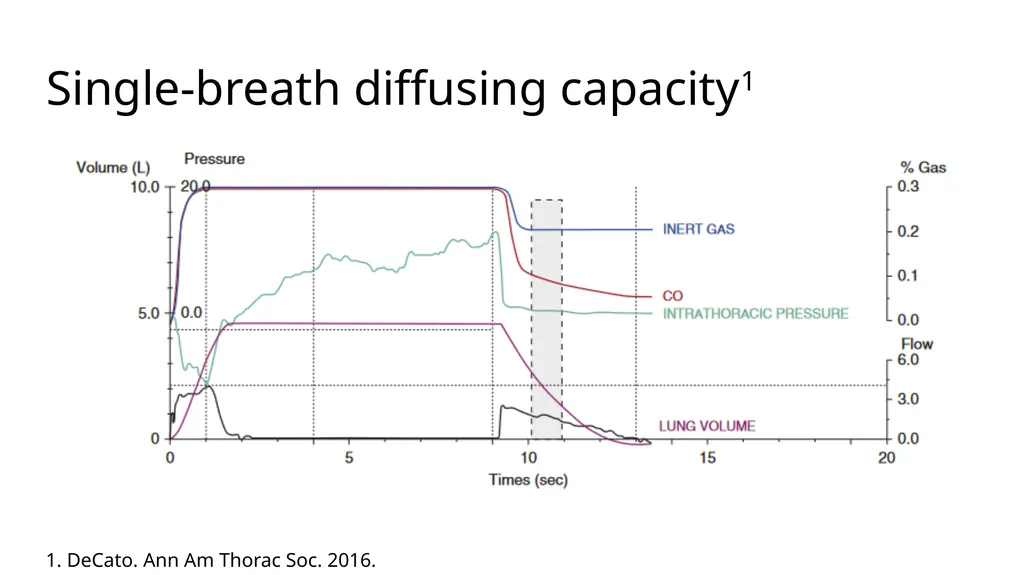
Single-breath diffusing capacity1 Calibrated equipment
Tidal breathing to familiarise patient with system
Maximal expiration to residual volume followed by rapid maximal inspiration to total lung capacity of test gas:
0.3% CO
21% O2
Tracer gas (helium or methane)
Nitrogen
Breath held for 10 ± 2 s
Maximal expiration (< 3 s)
Sample obtained after dead space cleared and concentrations of CO and tracer gas analysed
Wait 4 min between repeated attempts (or until tracer gas ≤ 2%) 1. Klocke in Fishman’s (6e).<br>
11
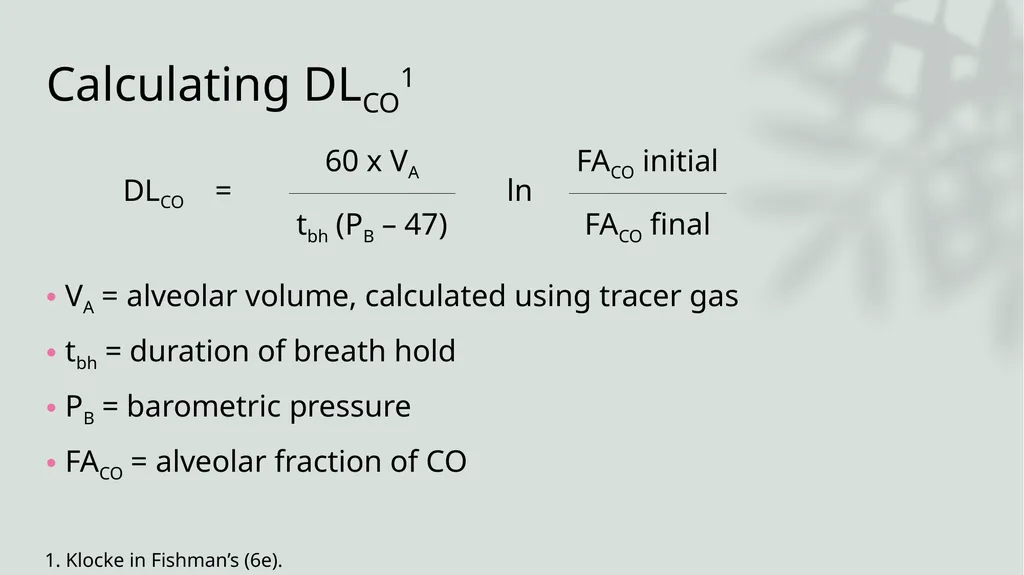
Calculating DLCO1 DLCO = ln
VA = alveolar volume, calculated using tracer gas
tbh = duration of breath hold
PB = barometric pressure
FACO = alveolar fraction of CO 1. Klocke in Fishman’s (6e). 60 x VA
tbh (PB – 47) FACO initial
FACO final<br>
12
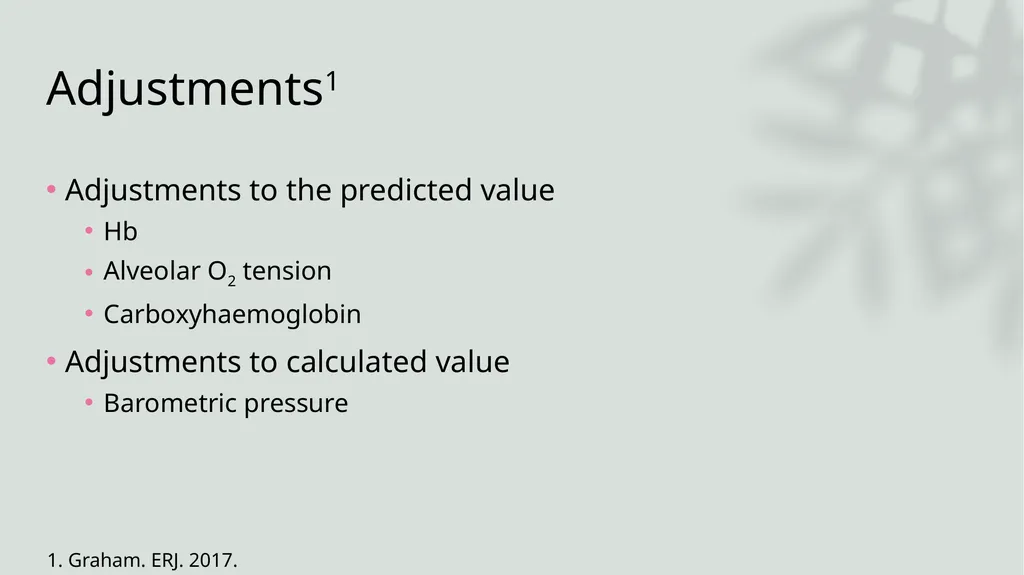
Adjustments1 Adjustments to the predicted value
Hb
Alveolar O2 tension
Carboxyhaemoglobin
Adjustments to calculated value
Barometric pressure 1. Graham. ERJ. 2017.<br>
13
Single-breath diffusing capacity1 1. DeCato. Ann Am Thorac Soc. 2016.<br>
14
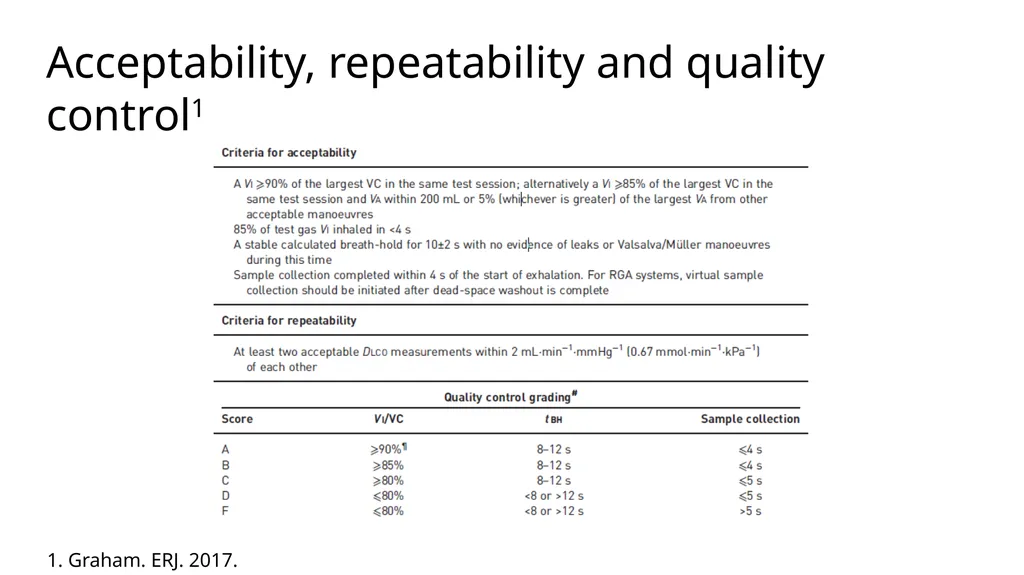
Acceptability, repeatability and quality control1 1. Graham. ERJ. 2017.<br>
15
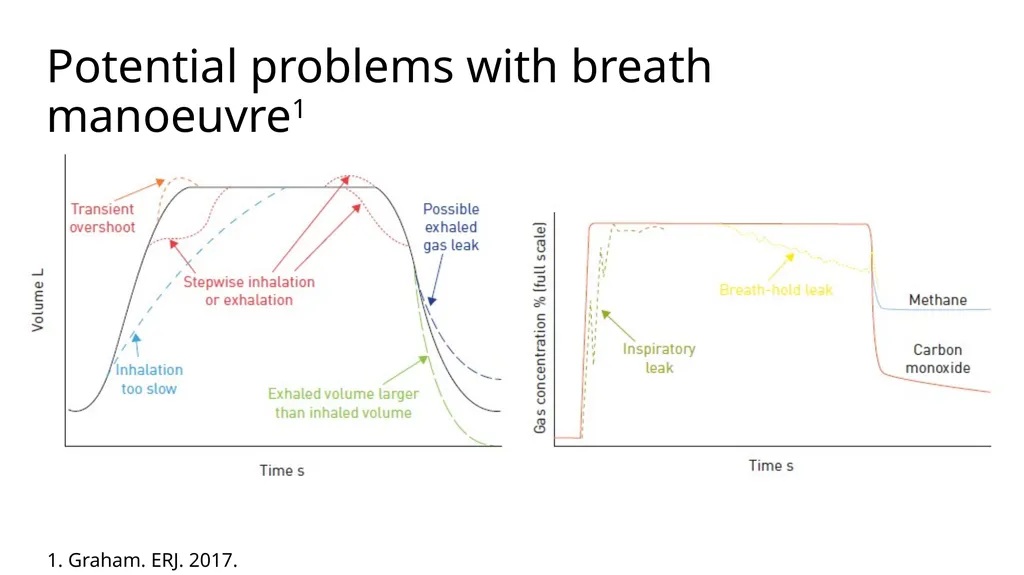
Potential problems with breath manoeuvre1 1. Graham. ERJ. 2017.<br>
16
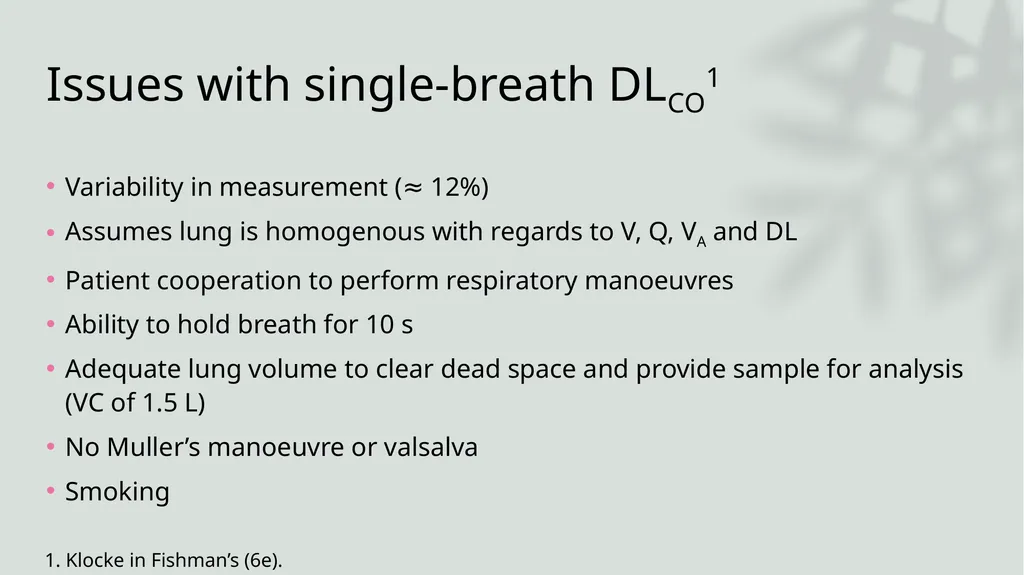
Issues with single-breath DLCO1 Variability in measurement (≈ 12%)
Assumes lung is homogenous with regards to V, Q, VA and DL
Patient cooperation to perform respiratory manoeuvres
Ability to hold breath for 10 s
Adequate lung volume to clear dead space and provide sample for analysis (VC of 1.5 L)
No Muller’s manoeuvre or valsalva
Smoking 1. Klocke in Fishman’s (6e).<br>
17
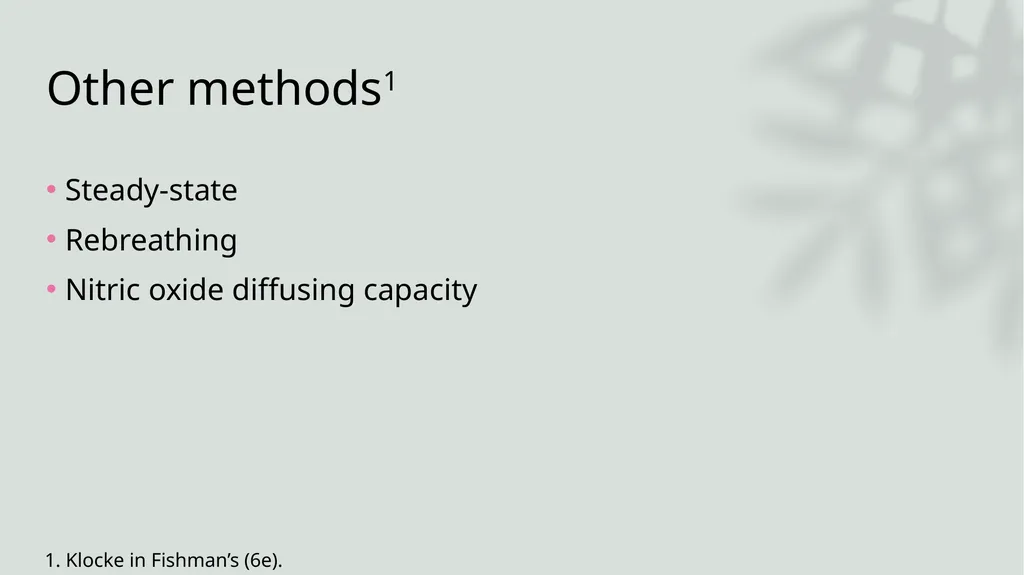
Other methods1 Steady-state
Rebreathing
Nitric oxide diffusing capacity 1. Klocke in Fishman’s (6e).<br>
18
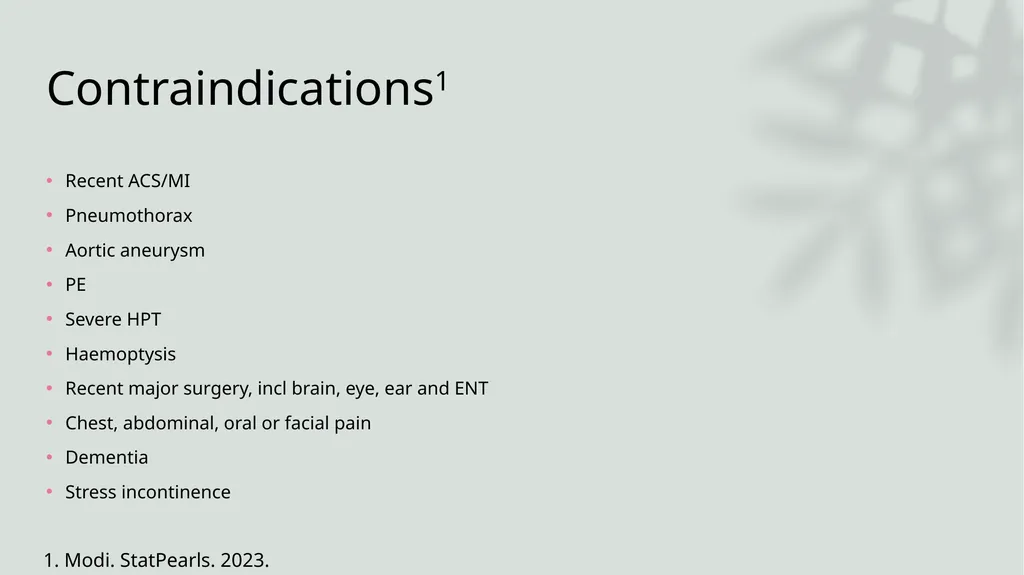
Contraindications1 Recent ACS/MI
Pneumothorax
Aortic aneurysm
PE
Severe HPT
Haemoptysis
Recent major surgery, incl brain, eye, ear and ENT
Chest, abdominal, oral or facial pain
Dementia
Stress incontinence 1. Modi. StatPearls. 2023.<br>
19
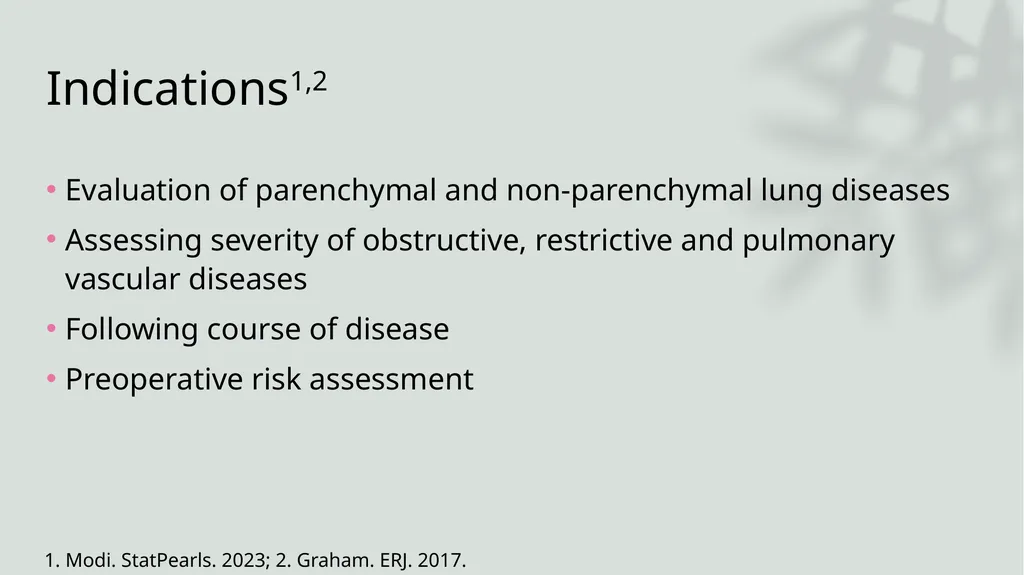
Indications1,2 Evaluation of parenchymal and non-parenchymal lung diseases
Assessing severity of obstructive, restrictive and pulmonary vascular diseases
Following course of disease
Preoperative risk assessment 1. Modi. StatPearls. 2023; 2. Graham. ERJ. 2017.<br>
20
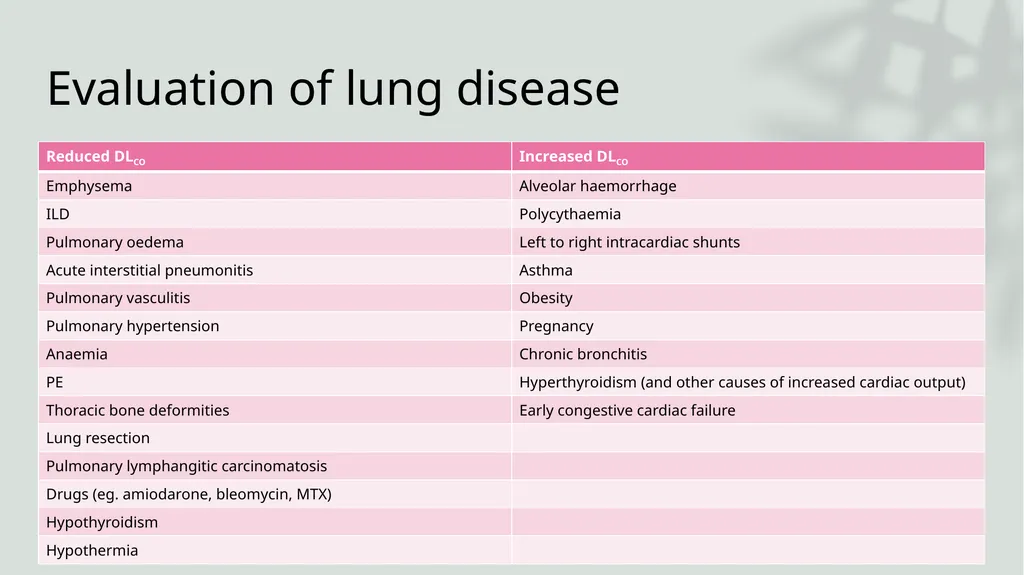
Evaluation of lung disease<br>
21
Evaluation of lung disease1 1. Pellegrino. ERJ. 2005.<br>
22
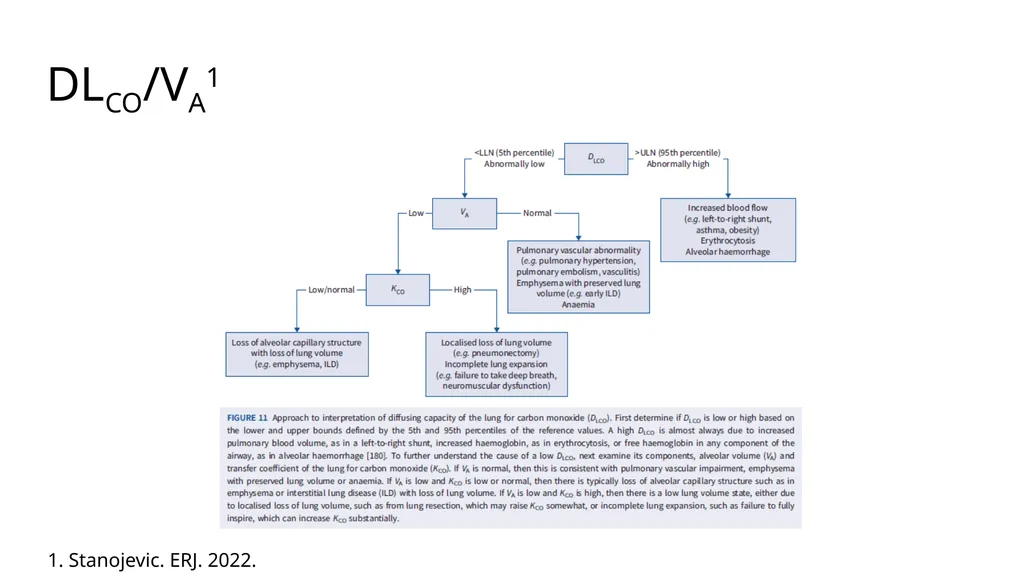
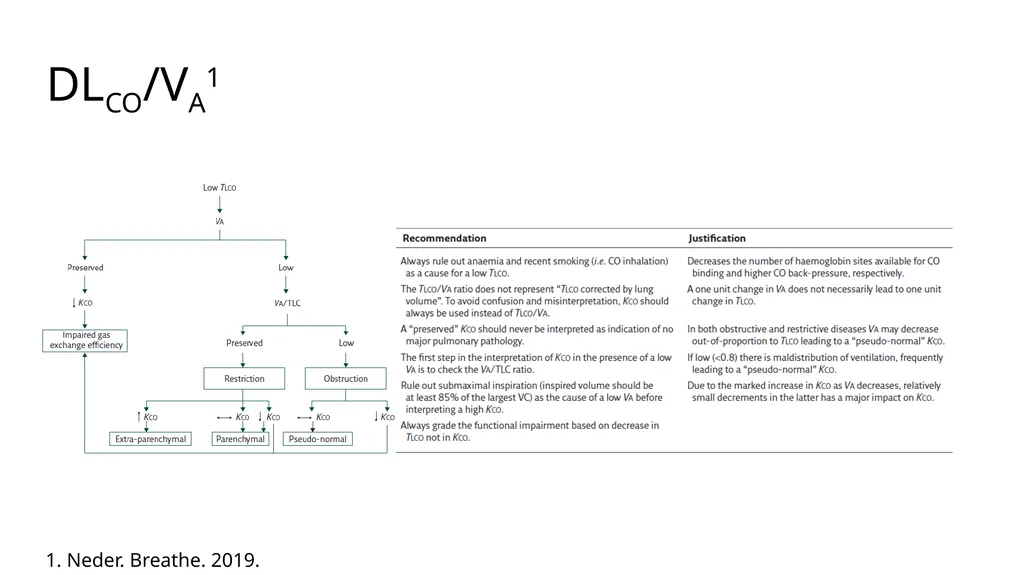
DLCO/VA DLCO = VA x KCO
KCO = Dm x VC
Not a correction factor
Can suggest cause<br>
23
DLCO/VA1 1. Stanojevic. ERJ. 2022.<br>
24
DLCO/VA1 1. Neder. Breathe. 2019.<br>
25
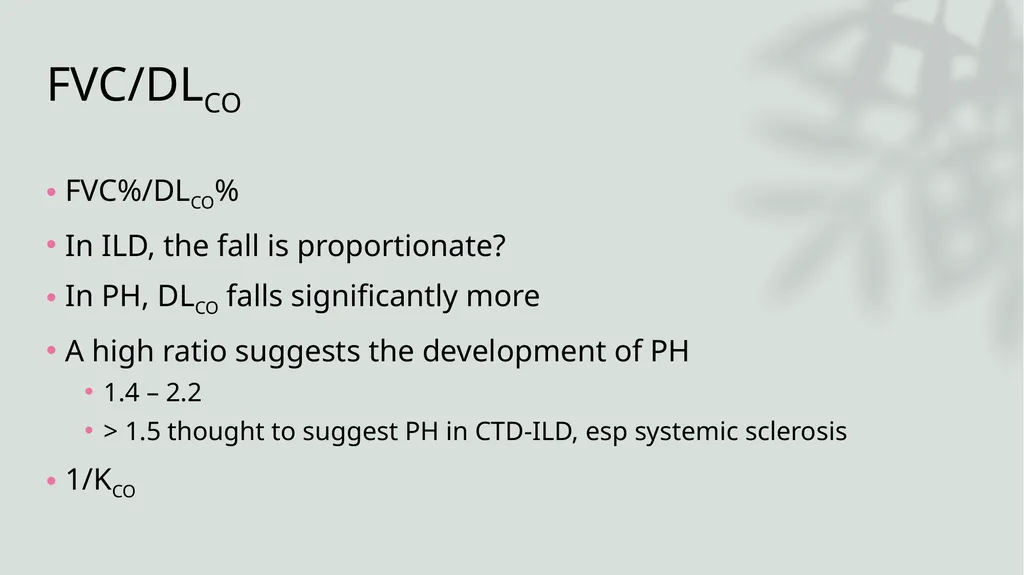
FVC/DLCO FVC%/DLCO%
In ILD, the fall is proportionate?
In PH, DLCO falls significantly more
A high ratio suggests the development of PH
1.4 – 2.2
> 1.5 thought to suggest PH in CTD-ILD, esp systemic sclerosis
1/KCO<br>