
Direct Tax Implication on immovable properties and













Description: Direct Tax Implication on immovable properties and Development Projects 24 May 2024 Adv. Dharan V. Gandhi 1 23-05-2024 National Conference Indore, 2024 Why development redevelopment of land building? Old buildings bungalows are in
Related Topics
Download Presentation
"Direct Tax Implication on immovable properties and" is the property of its rightful owner. Permission is granted to download and print the materials on this website for personal, non-commercial use only, and to display it on your personal computer provided you do not modify the materials and that you retain all copyright notices contained in the materials. By downloading content from our website, you accept the terms of this agreement.
Presentation Transcript
slide1. Direct Tax Implication on immovable properties and Development Projects 24 May 2024 Adv. Dharan V. Gandhi 1 23-05-2024 National Conference – Indore, 2024<br>
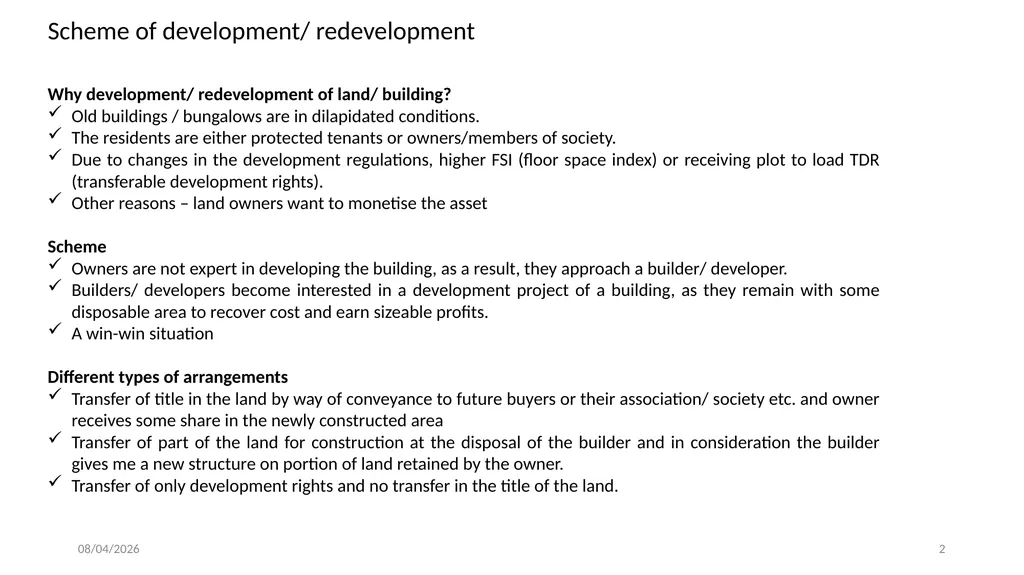
slide2. Why development/ redevelopment of land/ building?
Old buildings / bungalows are in dilapidated conditions.
The residents are either protected tenants or owners/members of society.
Due to changes in the development regulations, higher FSI (floor space index) or receiving plot to load TDR (transferable development rights).
Other reasons – land owners want to monetise the asset
Scheme
Owners are not expert in developing the building, as a result, they approach a builder/ developer.
Builders/ developers become interested in a development project of a building, as they remain with some disposable area to recover cost and earn sizeable profits.
A win-win situation
Different types of arrangements
Transfer of title in the land by way of conveyance to future buyers or their association/ society etc. and owner receives some share in the newly constructed area
Transfer of part of the land for construction at the disposal of the builder and in consideration the builder gives me a new structure on portion of land retained by the owner.
Transfer of only development rights and no transfer in the title of the land. Scheme of development/ redevelopment 23-05-2024 2<br>
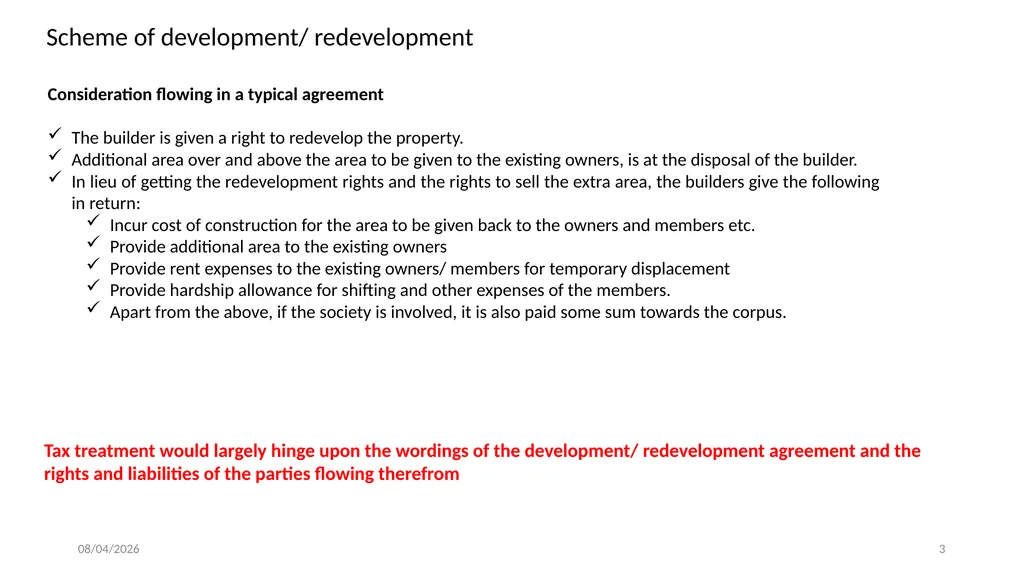
slide3. Consideration flowing in a typical agreement
The builder is given a right to redevelop the property.
Additional area over and above the area to be given to the existing owners, is at the disposal of the builder.
In lieu of getting the redevelopment rights and the rights to sell the extra area, the builders give the following in return:
Incur cost of construction for the area to be given back to the owners and members etc.
Provide additional area to the existing owners
Provide rent expenses to the existing owners/ members for temporary displacement
Provide hardship allowance for shifting and other expenses of the members.
Apart from the above, if the society is involved, it is also paid some sum towards the corpus. Scheme of development/ redevelopment 23-05-2024 3 Tax treatment would largely hinge upon the wordings of the development/ redevelopment agreement and the rights and liabilities of the parties flowing therefrom<br>
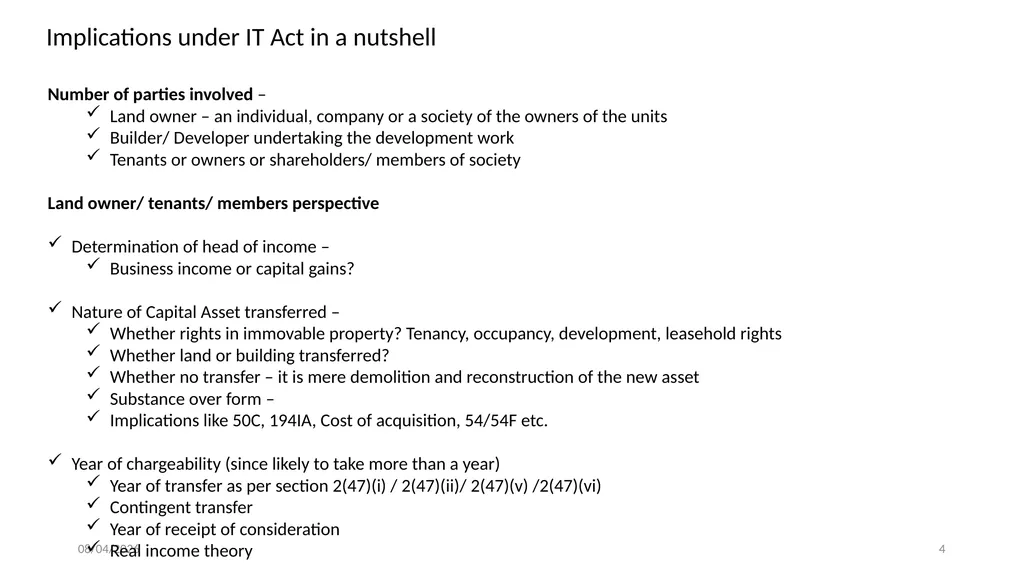
slide4. Number of parties involved –
Land owner – an individual, company or a society of the owners of the units
Builder/ Developer undertaking the development work
Tenants or owners or shareholders/ members of society
Land owner/ tenants/ members perspective
Determination of head of income –
Business income or capital gains?
Nature of Capital Asset transferred –
Whether rights in immovable property? Tenancy, occupancy, development, leasehold rights
Whether land or building transferred?
Whether no transfer – it is mere demolition and reconstruction of the new asset
Substance over form –
Implications like 50C, 194IA, Cost of acquisition, 54/54F etc.
Year of chargeability (since likely to take more than a year)
Year of transfer as per section 2(47)(i) / 2(47)(ii)/ 2(47)(v) /2(47)(vi)
Contingent transfer
Year of receipt of consideration
Real income theory Implications under IT Act in a nutshell 23-05-2024 4<br>
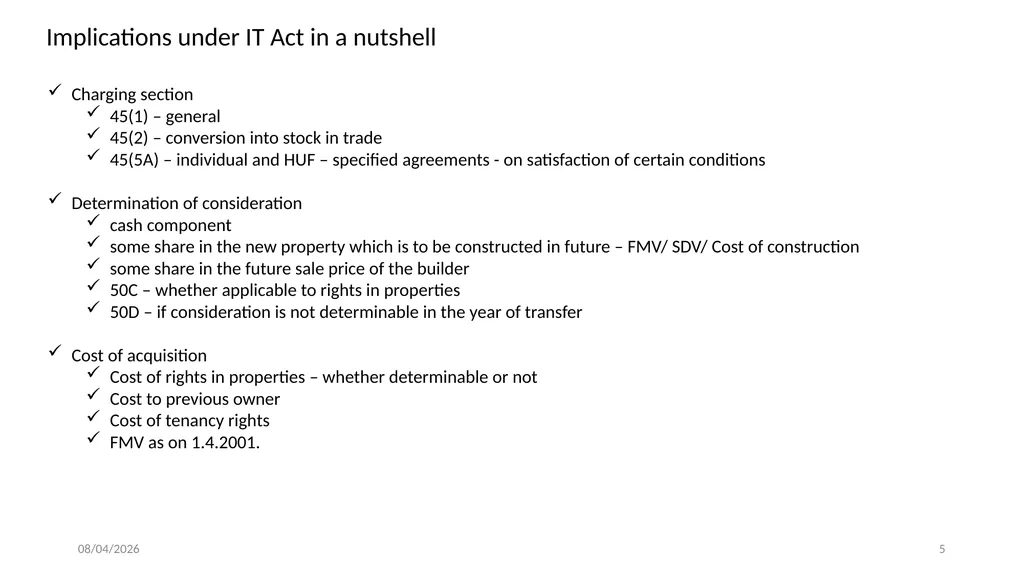
slide5. Charging section
45(1) – general
45(2) – conversion into stock in trade
45(5A) – individual and HUF – specified agreements - on satisfaction of certain conditions
Determination of consideration
cash component
some share in the new property which is to be constructed in future – FMV/ SDV/ Cost of construction
some share in the future sale price of the builder
50C – whether applicable to rights in properties
50D – if consideration is not determinable in the year of transfer
Cost of acquisition
Cost of rights in properties – whether determinable or not
Cost to previous owner
Cost of tenancy rights
FMV as on 1.4.2001. Implications under IT Act in a nutshell 23-05-2024 5<br>
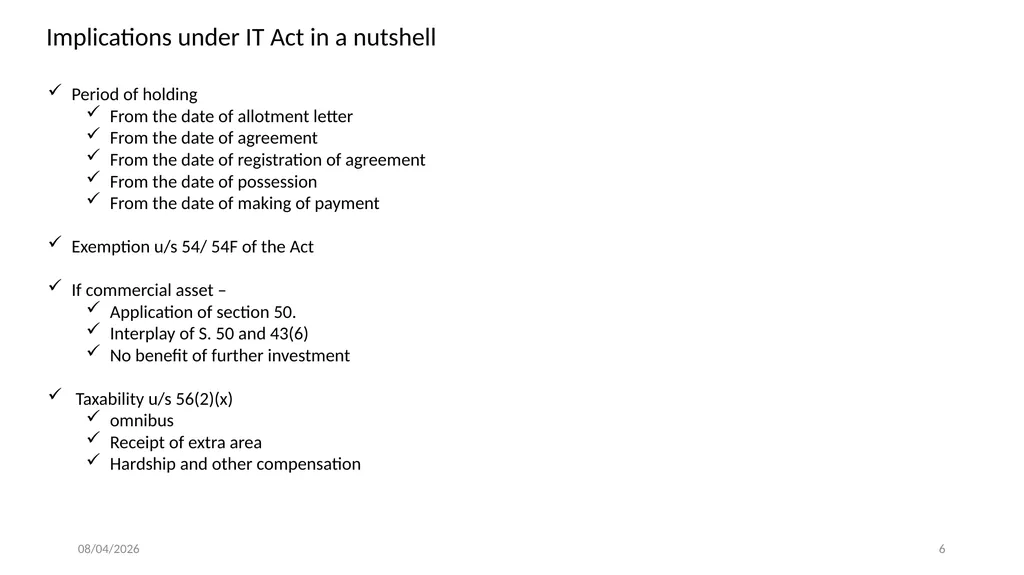
slide6. Period of holding
From the date of allotment letter
From the date of agreement
From the date of registration of agreement
From the date of possession
From the date of making of payment
Exemption u/s 54/ 54F of the Act
If commercial asset –
Application of section 50.
Interplay of S. 50 and 43(6)
No benefit of further investment
Taxability u/s 56(2)(x)
omnibus
Receipt of extra area
Hardship and other compensation Implications under IT Act in a nutshell 23-05-2024 6<br>
slide7. Stamp Duty implications
GST implications Following issues are not covered 23-05-2024 7<br>
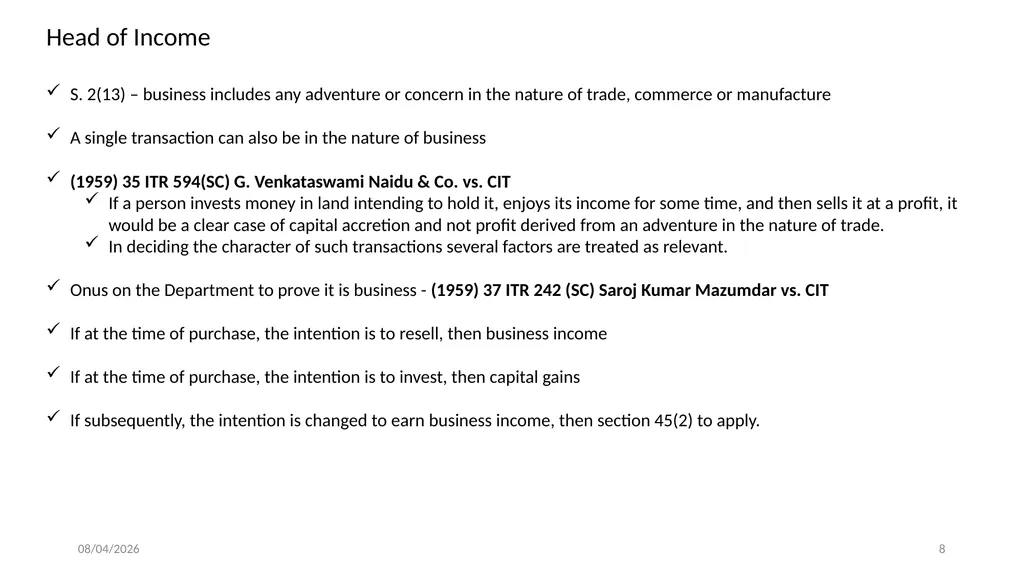
slide8. S. 2(13) – business includes any adventure or concern in the nature of trade, commerce or manufacture
A single transaction can also be in the nature of business
(1959) 35 ITR 594(SC) G. Venkataswami Naidu & Co. vs. CIT
If a person invests money in land intending to hold it, enjoys its income for some time, and then sells it at a profit, it would be a clear case of capital accretion and not profit derived from an adventure in the nature of trade.
In deciding the character of such transactions several factors are treated as relevant.
Onus on the Department to prove it is business - (1959) 37 ITR 242 (SC) Saroj Kumar Mazumdar vs. CIT
If at the time of purchase, the intention is to resell, then business income
If at the time of purchase, the intention is to invest, then capital gains
If subsequently, the intention is changed to earn business income, then section 45(2) to apply. Head of Income 23-05-2024 8<br>
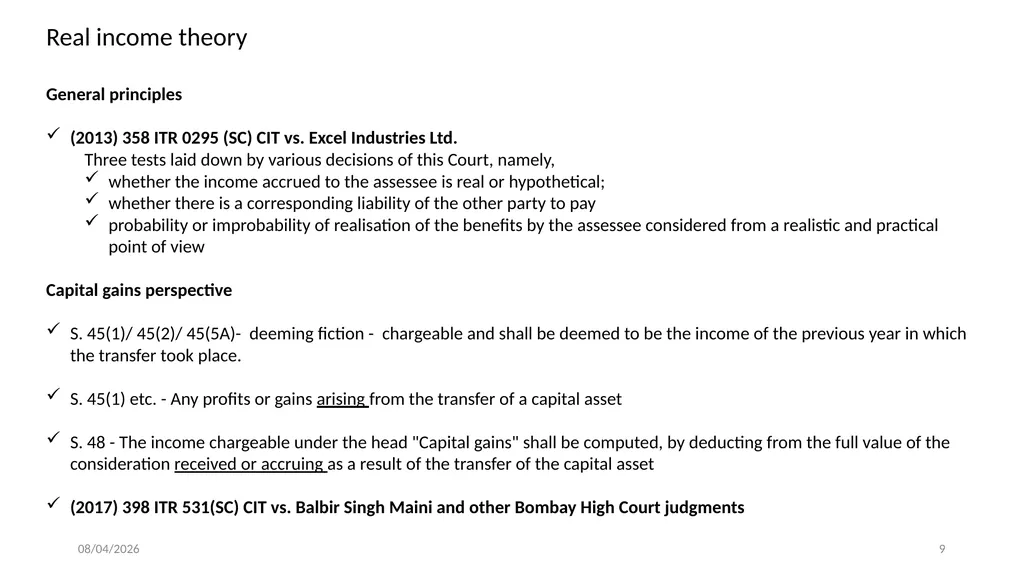
slide9. General principles
(2013) 358 ITR 0295 (SC) CIT vs. Excel Industries Ltd.
Three tests laid down by various decisions of this Court, namely,
whether the income accrued to the assessee is real or hypothetical;
whether there is a corresponding liability of the other party to pay
probability or improbability of realisation of the benefits by the assessee considered from a realistic and practical point of view
Capital gains perspective
S. 45(1)/ 45(2)/ 45(5A)- deeming fiction - chargeable and shall be deemed to be the income of the previous year in which the transfer took place.
S. 45(1) etc. - Any profits or gains arising from the transfer of a capital asset
S. 48 - The income chargeable under the head "Capital gains" shall be computed, by deducting from the full value of the consideration received or accruing as a result of the transfer of the capital asset
(2017) 398 ITR 531(SC) CIT vs. Balbir Singh Maini and other Bombay High Court judgments Real income theory 23-05-2024 9<br>
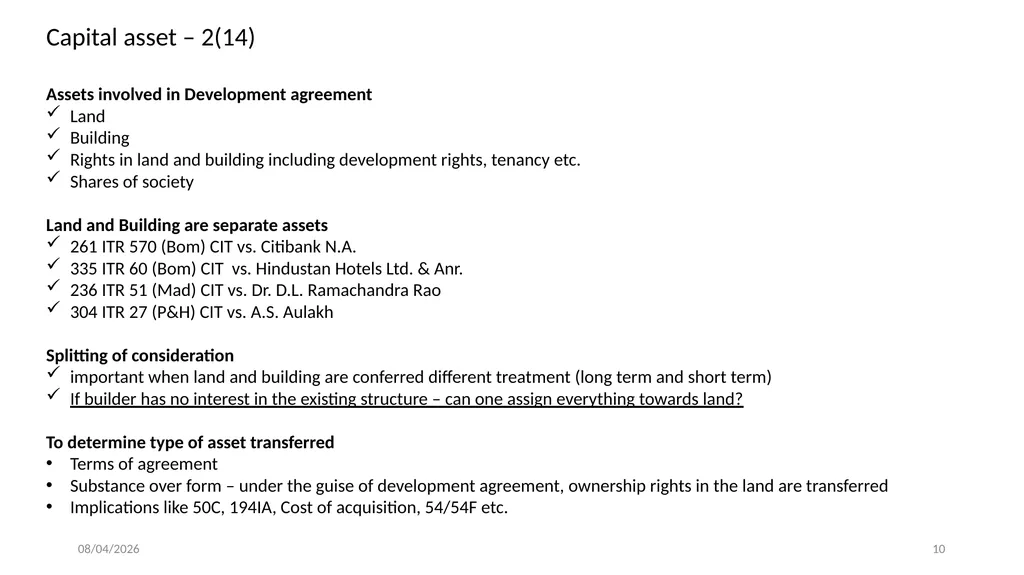
slide10. Assets involved in Development agreement
Land
Building
Rights in land and building including development rights, tenancy etc.
Shares of society
Land and Building are separate assets
261 ITR 570 (Bom) CIT vs. Citibank N.A.
335 ITR 60 (Bom) CIT vs. Hindustan Hotels Ltd. & Anr.
236 ITR 51 (Mad) CIT vs. Dr. D.L. Ramachandra Rao
304 ITR 27 (P&H) CIT vs. A.S. Aulakh
Splitting of consideration
important when land and building are conferred different treatment (long term and short term)
If builder has no interest in the existing structure – can one assign everything towards land?
To determine type of asset transferred
Terms of agreement
Substance over form – under the guise of development agreement, ownership rights in the land are transferred
Implications like 50C, 194IA, Cost of acquisition, 54/54F etc. Capital asset – 2(14) 23-05-2024 10<br>
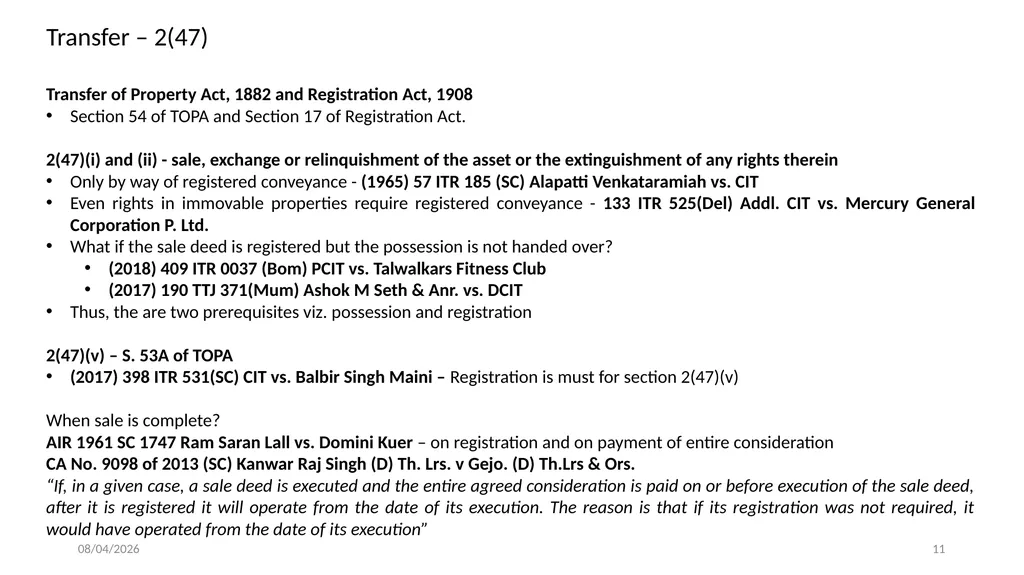
slide11. Transfer of Property Act, 1882 and Registration Act, 1908
Section 54 of TOPA and Section 17 of Registration Act.
2(47)(i) and (ii) - sale, exchange or relinquishment of the asset or the extinguishment of any rights therein
Only by way of registered conveyance - (1965) 57 ITR 185 (SC) Alapatti Venkataramiah vs. CIT
Even rights in immovable properties require registered conveyance - 133 ITR 525(Del) Addl. CIT vs. Mercury General Corporation P. Ltd.
What if the sale deed is registered but the possession is not handed over?
(2018) 409 ITR 0037 (Bom) PCIT vs. Talwalkars Fitness Club
(2017) 190 TTJ 371(Mum) Ashok M Seth & Anr. vs. DCIT
Thus, the are two prerequisites viz. possession and registration
2(47)(v) – S. 53A of TOPA
(2017) 398 ITR 531(SC) CIT vs. Balbir Singh Maini – Registration is must for section 2(47)(v)
When sale is complete?
AIR 1961 SC 1747 Ram Saran Lall vs. Domini Kuer – on registration and on payment of entire consideration
CA No. 9098 of 2013 (SC) Kanwar Raj Singh (D) Th. Lrs. v Gejo. (D) Th.Lrs & Ors.
“If, in a given case, a sale deed is executed and the entire agreed consideration is paid on or before execution of the sale deed, after it is registered it will operate from the date of its execution. The reason is that if its registration was not required, it would have operated from the date of its execution” Transfer – 2(47) 23-05-2024 11<br>
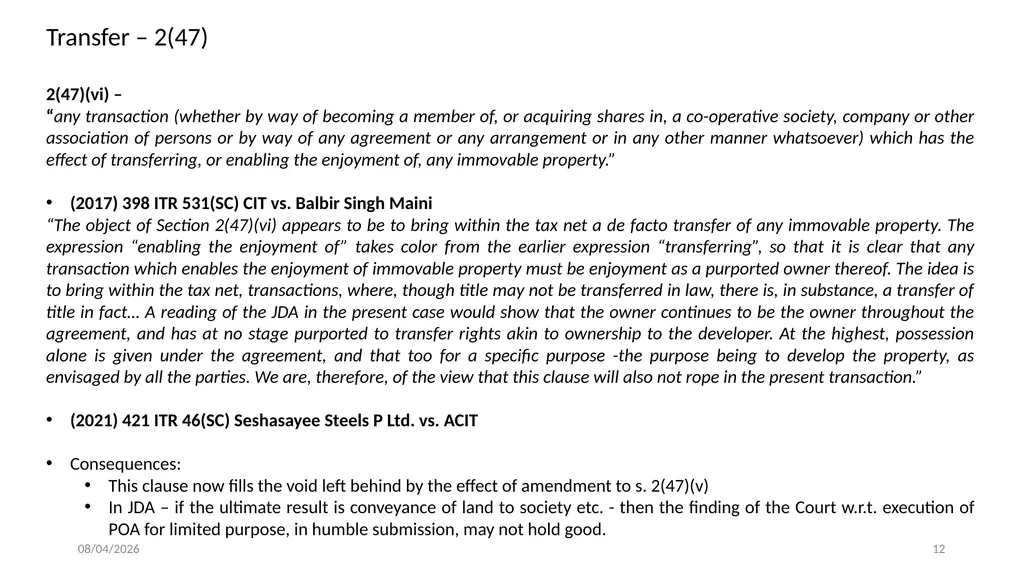
slide12. 2(47)(vi) –
“any transaction (whether by way of becoming a member of, or acquiring shares in, a co-operative society, company or other association of persons or by way of any agreement or any arrangement or in any other manner whatsoever) which has the effect of transferring, or enabling the enjoyment of, any immovable property.”
(2017) 398 ITR 531(SC) CIT vs. Balbir Singh Maini
“The object of Section 2(47)(vi) appears to be to bring within the tax net a de facto transfer of any immovable property. The expression “enabling the enjoyment of” takes color from the earlier expression “transferring”, so that it is clear that any transaction which enables the enjoyment of immovable property must be enjoyment as a purported owner thereof. The idea is to bring within the tax net, transactions, where, though title may not be transferred in law, there is, in substance, a transfer of title in fact… A reading of the JDA in the present case would show that the owner continues to be the owner throughout the agreement, and has at no stage purported to transfer rights akin to ownership to the developer. At the highest, possession alone is given under the agreement, and that too for a specific purpose -the purpose being to develop the property, as envisaged by all the parties. We are, therefore, of the view that this clause will also not rope in the present transaction.”
(2021) 421 ITR 46(SC) Seshasayee Steels P Ltd. vs. ACIT
Consequences:
This clause now fills the void left behind by the effect of amendment to s. 2(47)(v)
In JDA – if the ultimate result is conveyance of land to society etc. - then the finding of the Court w.r.t. execution of POA for limited purpose, in humble submission, may not hold good. Transfer – 2(47) 23-05-2024 12<br>
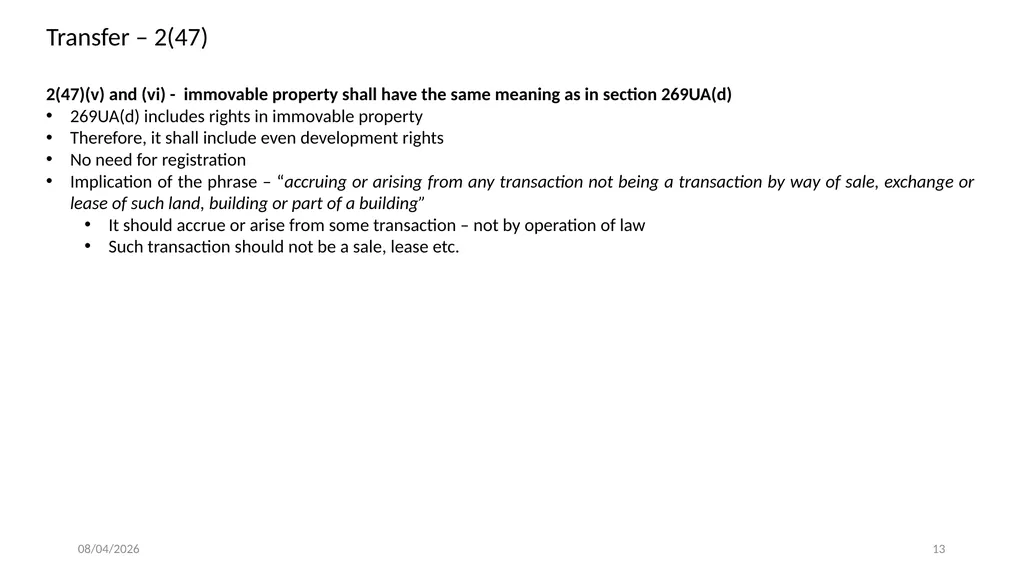
slide13. 2(47)(v) and (vi) - immovable property shall have the same meaning as in section 269UA(d)
269UA(d) includes rights in immovable property
Therefore, it shall include even development rights
No need for registration
Implication of the phrase – “accruing or arising from any transaction not being a transaction by way of sale, exchange or lease of such land, building or part of a building”
It should accrue or arise from some transaction – not by operation of law
Such transaction should not be a sale, lease etc. Transfer – 2(47) 23-05-2024 13<br>
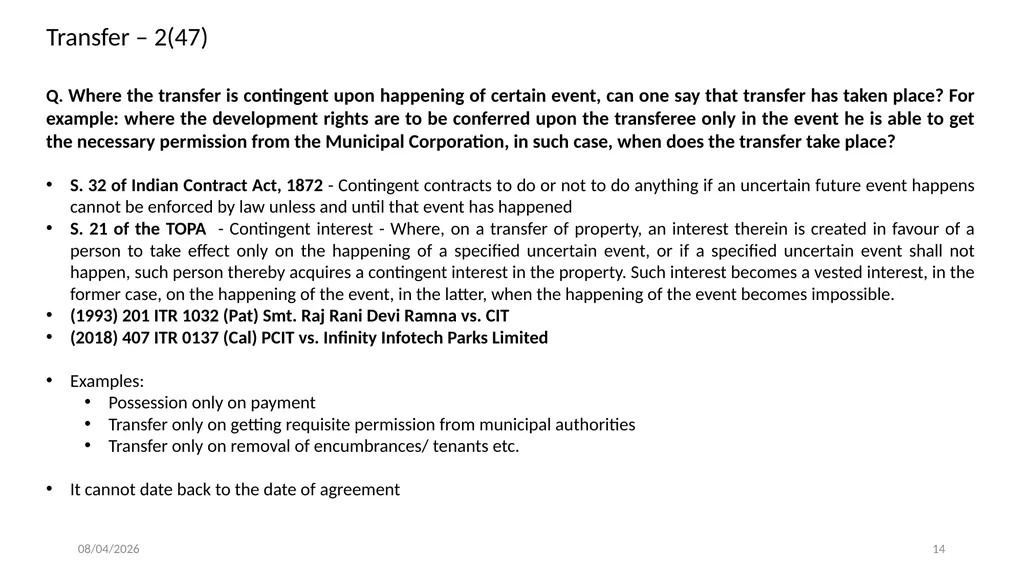
slide14. Q. Where the transfer is contingent upon happening of certain event, can one say that transfer has taken place? For example: where the development rights are to be conferred upon the transferee only in the event he is able to get the necessary permission from the Municipal Corporation, in such case, when does the transfer take place?
S. 32 of Indian Contract Act, 1872 - Contingent contracts to do or not to do anything if an uncertain future event happens cannot be enforced by law unless and until that event has happened
S. 21 of the TOPA - Contingent interest - Where, on a transfer of property, an interest therein is created in favour of a person to take effect only on the happening of a specified uncertain event, or if a specified uncertain event shall not happen, such person thereby acquires a contingent interest in the property. Such interest becomes a vested interest, in the former case, on the happening of the event, in the latter, when the happening of the event becomes impossible.
(1993) 201 ITR 1032 (Pat) Smt. Raj Rani Devi Ramna vs. CIT
(2018) 407 ITR 0137 (Cal) PCIT vs. Infinity Infotech Parks Limited
Examples:
Possession only on payment
Transfer only on getting requisite permission from municipal authorities
Transfer only on removal of encumbrances/ tenants etc.
It cannot date back to the date of agreement Transfer – 2(47) 23-05-2024 14<br>
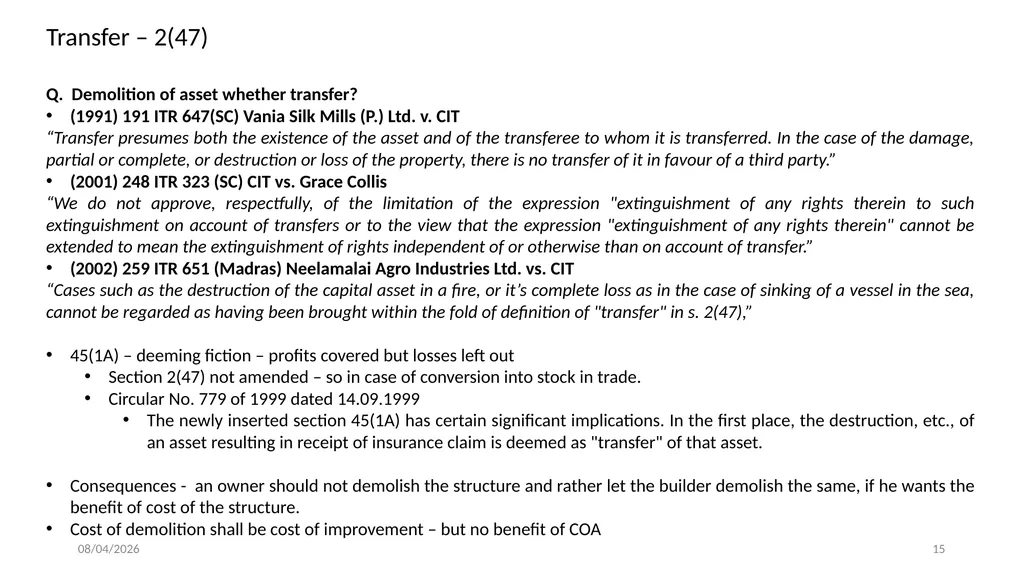
slide15. Q. Demolition of asset whether transfer?
(1991) 191 ITR 647(SC) Vania Silk Mills (P.) Ltd. v. CIT
“Transfer presumes both the existence of the asset and of the transferee to whom it is transferred. In the case of the damage, partial or complete, or destruction or loss of the property, there is no transfer of it in favour of a third party.”
(2001) 248 ITR 323 (SC) CIT vs. Grace Collis
“We do not approve, respectfully, of the limitation of the expression "extinguishment of any rights therein to such extinguishment on account of transfers or to the view that the expression "extinguishment of any rights therein" cannot be extended to mean the extinguishment of rights independent of or otherwise than on account of transfer.”
(2002) 259 ITR 651 (Madras) Neelamalai Agro Industries Ltd. vs. CIT
“Cases such as the destruction of the capital asset in a fire, or it’s complete loss as in the case of sinking of a vessel in the sea, cannot be regarded as having been brought within the fold of definition of "transfer" in s. 2(47),”
45(1A) – deeming fiction – profits covered but losses left out
Section 2(47) not amended – so in case of conversion into stock in trade.
Circular No. 779 of 1999 dated 14.09.1999
The newly inserted section 45(1A) has certain significant implications. In the first place, the destruction, etc., of an asset resulting in receipt of insurance claim is deemed as "transfer" of that asset.
Consequences - an owner should not demolish the structure and rather let the builder demolish the same, if he wants the benefit of cost of the structure.
Cost of demolition shall be cost of improvement – but no benefit of COA Transfer – 2(47) 23-05-2024 15<br>
slide16. S. 45(1)
Any profits or gains arising from the transfer of a capital asset effected in the previous year shall, be chargeable to income-tax under the head "Capital gains", and shall be deemed to be the income of the previous year in which the transfer took place.
(1959) 37 ITR 26 (Mad) - T.V. Sundaram Iyengar & Sons Ltd. vs. CIT
“Sec. 12B does not require that the profits should have been received. It is sufficient if they have arisen. If it subsequently happens that the money is not actually received, that would be a capital loss arising in the year when the money became irrecoverable. Even if the assessees found it difficult to receive in full the price for which they transferred their assets and that in consequence they decided to accept paid up shares in the transferee company, that would be a capital loss which arose outside the accounting year, and, therefore, cannot be taken notice of for the relevant accounting year. To attract liability to tax under s. 12B it is sufficient if profits have arisen, that is to say, if the assessee has a right to receive the profits” Charging section 23-05-2024 16<br>
slide17. year of receipt
(2013) 218 Taxman 473(All) CIT vs. Smt. Najoo Dara Deboo - The capital gain can be charged only on receipt of the sale consideration and not otherwise, when only an agreement is signed and no money is received.
(1982) 133 ITR 0169 (Del) R. Dalmia (Decd) vs. CIT - If the quantum of gains cannot be ascertained - capital gains have only to be included at the time they are ascertained
Real Income theory and section 50D
Real income theory
(2017) 398 ITR 531(SC) CIT vs. Balbir Singh Maini
(2016) 239 Taxman 0176 (Bombay) CIT vs. Hemal Raju Shete
(2015) 371 ITR 0427 (Bom) CIT vs. Chemosyn Ltd.
[2020] 269 Taxman 212 (Bombay) PCIT vs. Rohan Projects
Events occurring after BS date
Contingent contract vs. real income vs. events occurring after the accrual date
(2017) 398 ITR 531(SC) CIT vs. Balbir Singh Maini
See contra – (1959) 37 ITR 26 (Mad) - T.V. Sundaram Iyengar & Sons Ltd. vs. CIT -cannot apply since transfer was still there
Advance money can be taxed either u/s 51 or 56(2)(ix) only if the no transfer at all
Practically – offer to tax, only to the extent received
accrual in year 2 but no transfer in such year
Deeming fiction
Compare with business income Charging section 23-05-2024 17<br>
slide18. S. 2(47)(iv) and S. 45(1A)
Conversion into stock is a transfer
chargeable to income-tax as his income of the previous year in which such stock-in-trade is sold or otherwise transferred
Logic - the difference between the fair market value of the asset and the original cost went untaxed – (1962) 46 ITR 86(SC) CIT vs. Bai Shirinbai K. Kooka; (1979) 116 ITR 125(SC) CIT vs. Groz Beckert Saboo Ltd.
Development agreement –
land owner, who is not a developer/ builder, may think of getting actively involved in the activity of redevelopment either independently or along with an experienced developer. He may undertake following activities
Conversion of agricultural land into a Non-agricultural plot
Getting some permissions or
Take the risk of selling some constructed area in the new property and earn profits.
Revenue sharing agreement
When is the stock transferred?
When the development rights are given to builder?
When the flats which are received are transferred?
As per method of accounting (percentage completion or project completion) 45(2) – conversion into stock-in-trade 23-05-2024 18<br>
slide19. When is the stock transferred? What is the stock-in-trade
1st view
Land / building is the stock-in-trade
On the date of entering into development agreement, such land and building is transferred
Therefore, capital gains and business income is taxable in the year of entering into development agreement
2nd view
Land / building is the stock-in-trade
On the date of entering into development agreement, such land and building is not transferred
But the same is transferred when the society is formed and the land is conveyed in favour of the society.
Therefore, capital gains and business income is taxable in the year of conveyance to society
See contra in J.S. & M.F. Builders vs. A.K. Chauhan (supra)
3rd view
The stock-in-trade is transferred when the units are transferred.
The CG is to be taxed as and when the units are transferred.
(2020) 426 ITR 0460 (Bom) J.S. & M.F. Builders vs. A.K. Chauhan
(2010) 133 TTJ 595(Che) R. Gopinath (HUF) vs. ACIT – execution of sale deed 45(2) 23-05-2024 19<br>
slide20. When do we say that the flats are transferred:
ITA No. 853 of 2015(Bom) CIT vs. Millennium Estates Private Ltd. - in the year of transfer of possession and not in the year of giving of allotment letter
(2015) 155 ITD 905(Hyd) ACIT vs. Medravathi Agro Farms (P) Ltd. - date of registration of agreement or possession of units as the date of sale of units
4th view
CG to be offered to tax in accordance with the method of accounting employed and as and when business income is offered to tax, capital gains are to be offered to tax.
Therefore, if completed contract method is followed, then on completion of contract. (on receipt of CC)
Computation same as 3rd view.
(2001) 78 ITD 213(Mum) DCIT vs. Crest Hotels Ltd.
(2017) 51 CCH 0277 (Mum) Bombay Dyeing & Mfg. Co. Ltd. vs. DCIT
(2018) 171 ITD 0532 (Pune) ITO vs. Vilas Babanrao Rukari (HUF) 45(2) 23-05-2024 20<br>
slide21. (2011) 133 ITD 363(Mum) Vidhyavihar Containers Ltd. vs. DCIT
Passing a special resolution in the meeting of shareholders authorizing commencement of new business of real estate development
Filed resolution with ROC
Permission sought for use of land for development purposes
Proposal/scheme filed with authority for the redevelopment of the property
Permission from Labour department for issue of NOC
Resolution passed in the meeting of BOD converting the land owned by it into stock-in-trade
Entering into JDA
(2012) 150 TTJ 725(Mum) Ramesh Abaji Walavalkar vs.Addl. CIT
necessary approval of authority for the proposed development of the property
NOC as well as commencement certificate issued by authority
an Affidavit-cum-Declaration was made by the assessee before a Notary evidencing the conversion of land into stock in trade. 45(2) – conversion into stock-in-trade 23-05-2024 21<br>
slide22. Conditions
applies only to an individual or a HUF
transfer of a capital asset, being land or building or both
It should be by way of a registered agreement in which a person owning land or building or both, agrees to allow another person to develop a real estate project on such land or building or both, - vs. 45(5A) – transfer of land or building or both.
Consideration should be by way of a share, being land or building or both in such project, whether with or without payment of part of the consideration in cash
Taxable in the year in which whole or part CC is issued
SDV on such date + cash consideration = FVC (judgments of Cost of construction to be taken)
Circular No. 2/2018 dated 15.02.2018
With a view to minimise the genuine hardship which the owner of land may face in paying capital gains tax in the year of transfer
Proviso – if transferor transfers his share on or before the date of issue of said certificate of completion, the capital gains is deemed to be the income of the previous year in which such transfer takes place and the provisions of the Act, other than the provisions of this sub-section, will apply for the purpose of determination of full value of consideration. (Contradictory to Circular 2/2018)
45(5A) mandatory or optional? 45(5A) 23-05-2024 22<br>
slide23. Q. An owner of a land has transferred development rights to a builder. Builder is to construct commercial units on the ground floor and residential units on the other floor. The owner is to get a share in the residential part of the building. The Builder get part CC for the commercial units in 2019 and the balance CC is obtained in the year 2021. In which year, the owner has to pay tax?
Taxability in the year in which CC for the whole or part of the project is issued by the competent authority
Therefore, taxability in the year 2019
But if purposive construction, then should be 2021
Each building within the larger project constitute a separate housing project – in context of section 80IB(10) – (2013) 353 ITR 36 (Bom) CIT vs. Vandana Properties; (2013) 255 CTR 149(Mad) Viswas Promoters Private Limited vs. ACIT
Same logic should also apply in case of Proviso to 45(5A)
Q. Can a company rely upon the treatment prescribed u/s 45(5A) and the Circular or he has to pay tax in the year of transfer?
Applicable only to individual or HUF
Company shall fall in 45(1) – taxable in the year of transfer, unless contingent or real income theory etc.
If there are incidents of business income, then 45(2).
45(5A) and 45(2) same basis – to remove hardship 45(5A) 23-05-2024 23<br>
slide24. Proviso to 45(5A)
where the assessee transfers his share in the project on or before the date of issue of the said certificate of completion –
capital gains shall be deemed to be the income of the previous year in which such transfer takes place and
the provisions of this Act, other than the provisions of this sub-section, shall apply for the purpose of determination of full value of consideration received or accruing as a result of such transfer.
What if - transferred part of the share and not complete share
Does the proviso envisage – part share? No (see the main sub-section where ‘whole or part’ is mentioned)
Also see logic – minimise hardship but does not allow to transfer – how can I transfer in the year of CC and get money
Proportionality –
Vs. Negative provision?
Alternate view
If even part transfer is contemplated then, proviso to apply:
Entire capital gains taxable in the year of transfer
For computing FVC one can take cost of construction 45(5A) 23-05-2024 24<br>
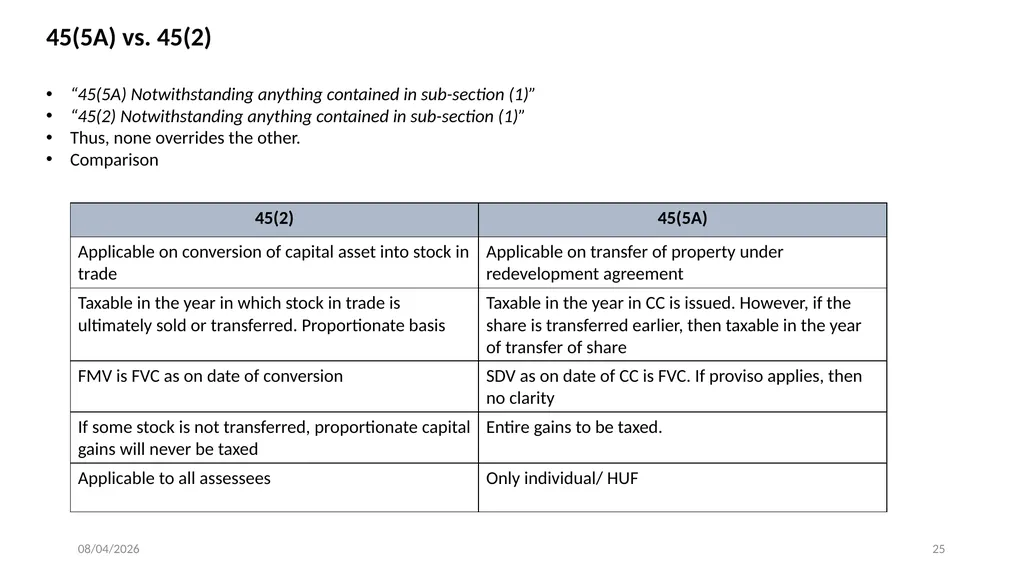
slide25. “45(5A) Notwithstanding anything contained in sub-section (1)”
“45(2) Notwithstanding anything contained in sub-section (1)”
Thus, none overrides the other.
Comparison 45(5A) vs. 45(2) 23-05-2024 25<br>
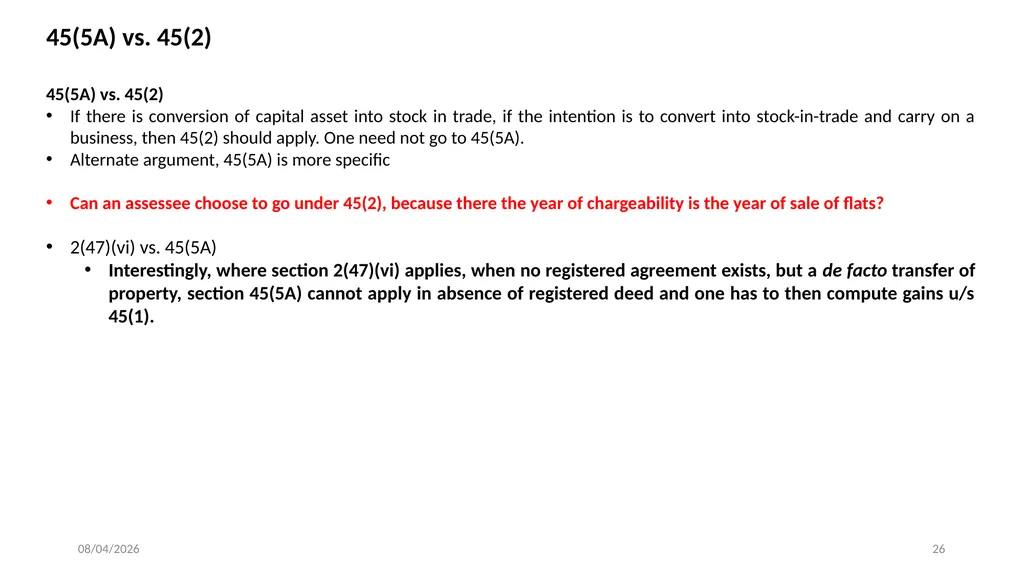
slide26. 45(5A) vs. 45(2)
If there is conversion of capital asset into stock in trade, if the intention is to convert into stock-in-trade and carry on a business, then 45(2) should apply. One need not go to 45(5A).
Alternate argument, 45(5A) is more specific
Can an assessee choose to go under 45(2), because there the year of chargeability is the year of sale of flats?
2(47)(vi) vs. 45(5A)
Interestingly, where section 2(47)(vi) applies, when no registered agreement exists, but a de facto transfer of property, section 45(5A) cannot apply in absence of registered deed and one has to then compute gains u/s 45(1). 45(5A) vs. 45(2) 23-05-2024 26<br>
slide27. Mr. Shetkari is an agriculturist owning 50 acres of agricultural land. The market value of land owned by Mr. Shetkari as on the date of entering into Development Agreement would be Rs. 50 crores if it were non-agricultural land whereas it would be Rs. 20 crores if it were sold as agricultural land.
Mr. Shetkari enters into a joint development agreement with reputed developer on 2nd April 2020 for development of land and dividing it into a residential bungalow plot (NA Plots). The stamp duty authorities have levied stamp duty by considering the value to be Rs. 40 crores.
The developer will sell the plots only and will not undertake the construction of bungalows.
The main terms of joint development agreement are as under:
Entire development cost will be on account of developer.
The plots will be sold during the period when development work is on.
The sale proceeds of plots will be shared in the ratio of 50% - 50% through escrow mechanism.
The project has commenced in June 2020 upon Mr. Shetkari getting the land converted into NA and is expected to complete in March 2024. Case study 23-05-2024 27<br>
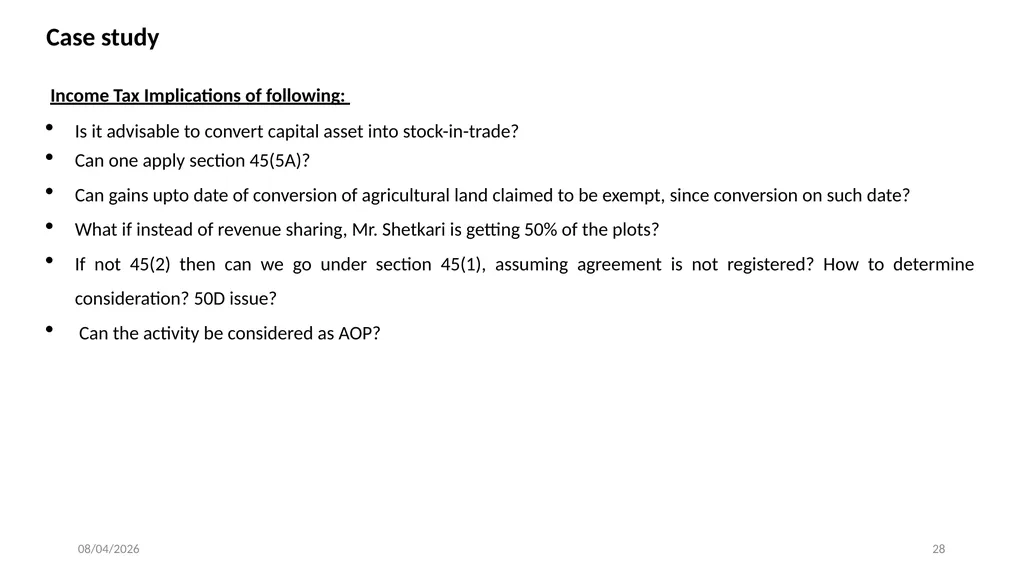
slide28. Income Tax Implications of following:
Is it advisable to convert capital asset into stock-in-trade?
Can one apply section 45(5A)?
Can gains upto date of conversion of agricultural land claimed to be exempt, since conversion on such date?
What if instead of revenue sharing, Mr. Shetkari is getting 50% of the plots?
If not 45(2) then can we go under section 45(1), assuming agreement is not registered? How to determine consideration? 50D issue?
Can the activity be considered as AOP? Case study 23-05-2024 28<br>
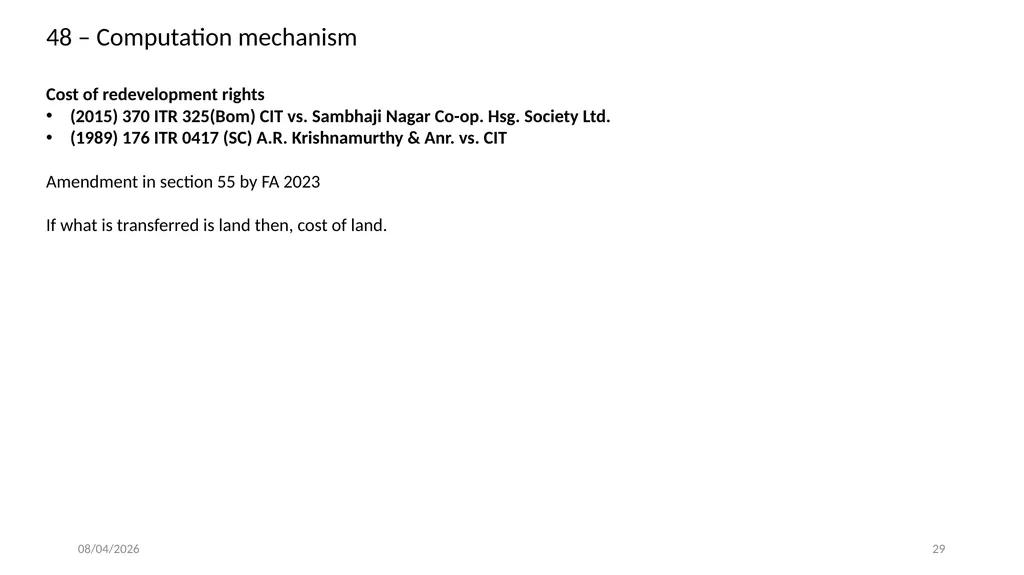
slide29. Cost of redevelopment rights
(2015) 370 ITR 325(Bom) CIT vs. Sambhaji Nagar Co-op. Hsg. Society Ltd.
(1989) 176 ITR 0417 (SC) A.R. Krishnamurthy & Anr. vs. CIT
Amendment in section 55 by FA 2023
If what is transferred is land then, cost of land. 48 – Computation mechanism 23-05-2024 29<br>
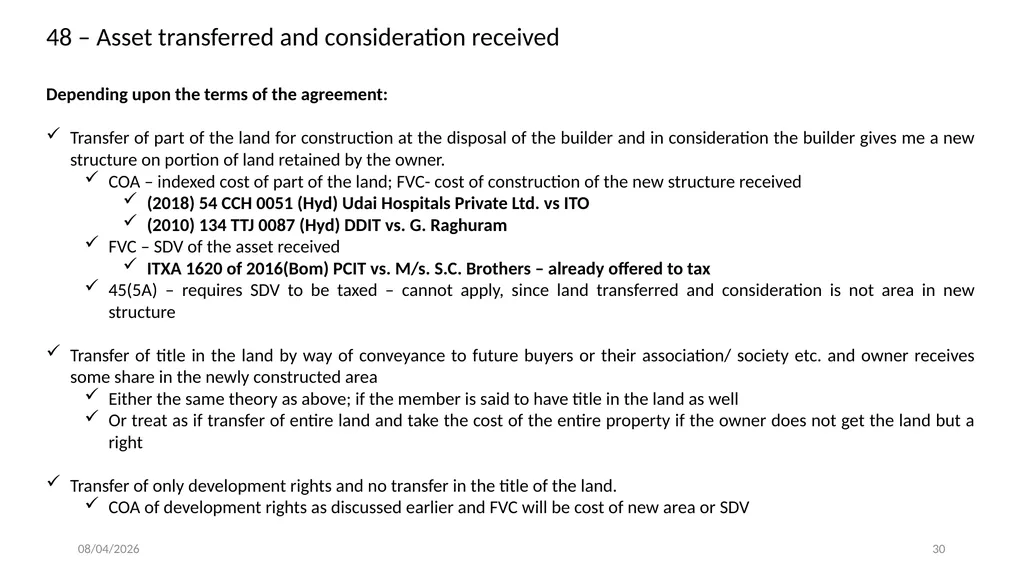
slide30. Depending upon the terms of the agreement:
Transfer of part of the land for construction at the disposal of the builder and in consideration the builder gives me a new structure on portion of land retained by the owner.
COA – indexed cost of part of the land; FVC- cost of construction of the new structure received
(2018) 54 CCH 0051 (Hyd) Udai Hospitals Private Ltd. vs ITO
(2010) 134 TTJ 0087 (Hyd) DDIT vs. G. Raghuram
FVC – SDV of the asset received
ITXA 1620 of 2016(Bom) PCIT vs. M/s. S.C. Brothers – already offered to tax
45(5A) – requires SDV to be taxed – cannot apply, since land transferred and consideration is not area in new structure
Transfer of title in the land by way of conveyance to future buyers or their association/ society etc. and owner receives some share in the newly constructed area
Either the same theory as above; if the member is said to have title in the land as well
Or treat as if transfer of entire land and take the cost of the entire property if the owner does not get the land but a right
Transfer of only development rights and no transfer in the title of the land.
COA of development rights as discussed earlier and FVC will be cost of new area or SDV 48 – Asset transferred and consideration received 23-05-2024 30<br>
slide31. Where the capital asset is an asset forming part of a block of assets
full value of the consideration received or accruing as a result of the transfer of the assets in the block will be reduced by
expenditure incurred wholly and exclusively in connection with such transfer or transfers;
the written down value of the block of assets at the beginning of the previous year; and
the actual cost of any asset falling within the block of assets acquired during the previous year,
Shall be deemed to be the capital gains arising from the transfer of short-term capital assets;
Rate of tax
LTCA, (2016) 387 ITR 354(SC) CIT vs. V.S. Dempo Company Ltd.
therefore, rate of 20% - (2014) 152 ITD 417(Mum) Smita Conductors Ltd. vs. DCIT and (2016) 76 taxmann.com 15 (Mumbai - Trib.) Castrol India Ltd. vs. DCIT
can claim deduction u/s 54F/ 54EC etc.
Wordings of section 43(6) vs. section 50
Moneys payable – (1999) 237 ITR 24(SC) CIT vs. Kasturi & Sons Ltd.
In redevelopment – no question of money’s payable, therefore, 43(6) to not apply. Section 50 vs. 43(6) 23-05-2024 31<br>
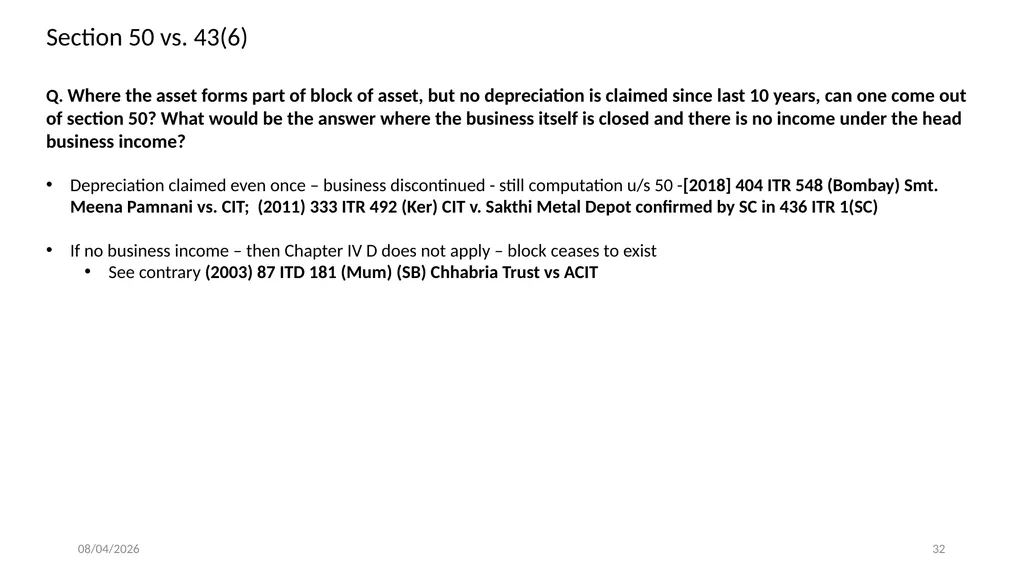
slide32. Q. Where the asset forms part of block of asset, but no depreciation is claimed since last 10 years, can one come out of section 50? What would be the answer where the business itself is closed and there is no income under the head business income?
Depreciation claimed even once – business discontinued - still computation u/s 50 -[2018] 404 ITR 548 (Bombay) Smt. Meena Pamnani vs. CIT; (2011) 333 ITR 492 (Ker) CIT v. Sakthi Metal Depot confirmed by SC in 436 ITR 1(SC)
If no business income – then Chapter IV D does not apply – block ceases to exist
See contrary (2003) 87 ITD 181 (Mum) (SB) Chhabria Trust vs ACIT Section 50 vs. 43(6) 23-05-2024 32<br>
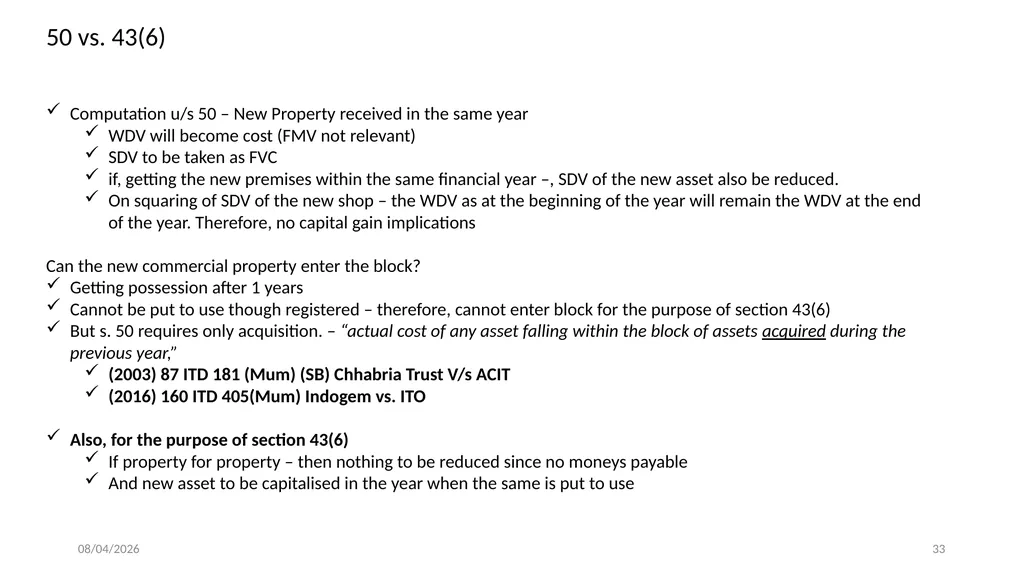
slide33. Computation u/s 50 – New Property received in the same year
WDV will become cost (FMV not relevant)
SDV to be taken as FVC
if, getting the new premises within the same financial year –, SDV of the new asset also be reduced.
On squaring of SDV of the new shop – the WDV as at the beginning of the year will remain the WDV at the end of the year. Therefore, no capital gain implications
Can the new commercial property enter the block?
Getting possession after 1 years
Cannot be put to use though registered – therefore, cannot enter block for the purpose of section 43(6)
But s. 50 requires only acquisition. – “actual cost of any asset falling within the block of assets acquired during the previous year,”
(2003) 87 ITD 181 (Mum) (SB) Chhabria Trust V/s ACIT
(2016) 160 ITD 405(Mum) Indogem vs. ITO
Also, for the purpose of section 43(6)
If property for property – then nothing to be reduced since no moneys payable
And new asset to be capitalised in the year when the same is put to use 50 vs. 43(6) 23-05-2024 33<br>
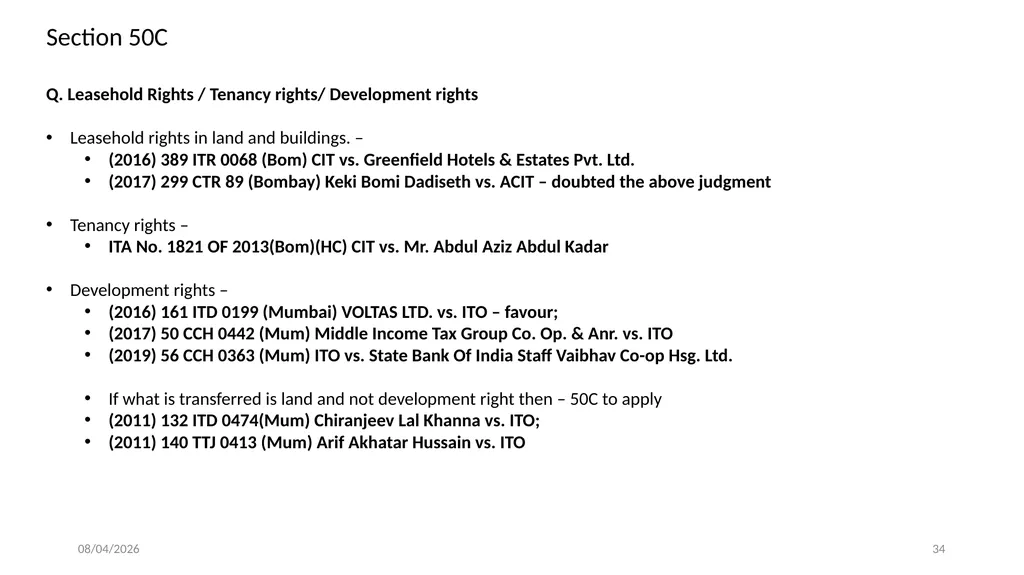
slide34. Q. Leasehold Rights / Tenancy rights/ Development rights
Leasehold rights in land and buildings. –
(2016) 389 ITR 0068 (Bom) CIT vs. Greenfield Hotels & Estates Pvt. Ltd.
(2017) 299 CTR 89 (Bombay) Keki Bomi Dadiseth vs. ACIT – doubted the above judgment
Tenancy rights –
ITA No. 1821 OF 2013(Bom)(HC) CIT vs. Mr. Abdul Aziz Abdul Kadar
Development rights –
(2016) 161 ITD 0199 (Mumbai) VOLTAS LTD. vs. ITO – favour;
(2017) 50 CCH 0442 (Mum) Middle Income Tax Group Co. Op. & Anr. vs. ITO
(2019) 56 CCH 0363 (Mum) ITO vs. State Bank Of India Staff Vaibhav Co-op Hsg. Ltd.
If what is transferred is land and not development right then – 50C to apply
(2011) 132 ITD 0474(Mum) Chiranjeev Lal Khanna vs. ITO;
(2011) 140 TTJ 0413 (Mum) Arif Akhatar Hussain vs. ITO Section 50C 23-05-2024 34<br>
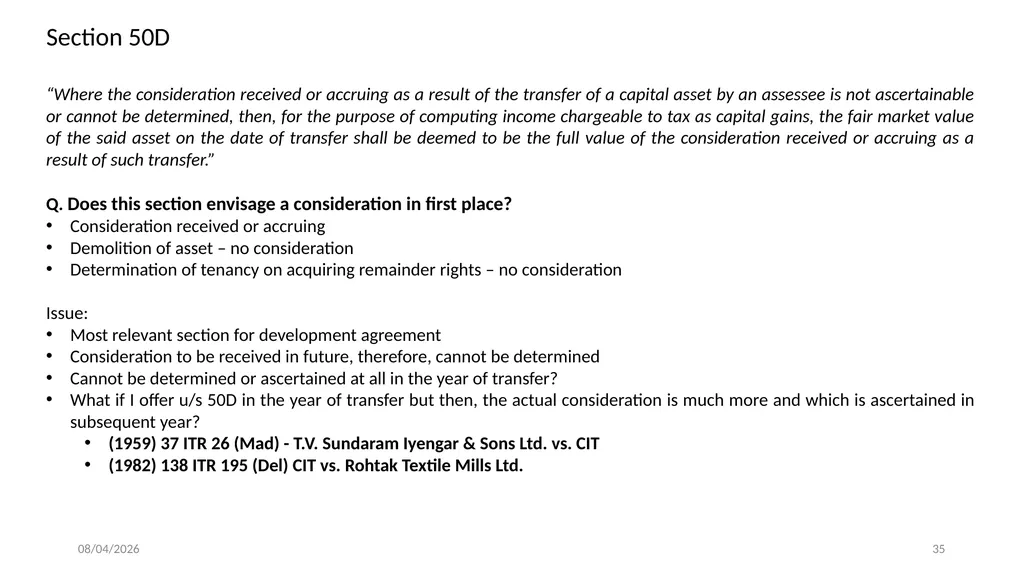
slide35. “Where the consideration received or accruing as a result of the transfer of a capital asset by an assessee is not ascertainable or cannot be determined, then, for the purpose of computing income chargeable to tax as capital gains, the fair market value of the said asset on the date of transfer shall be deemed to be the full value of the consideration received or accruing as a result of such transfer.”
Q. Does this section envisage a consideration in first place?
Consideration received or accruing
Demolition of asset – no consideration
Determination of tenancy on acquiring remainder rights – no consideration
Issue:
Most relevant section for development agreement
Consideration to be received in future, therefore, cannot be determined
Cannot be determined or ascertained at all in the year of transfer?
What if I offer u/s 50D in the year of transfer but then, the actual consideration is much more and which is ascertained in subsequent year?
(1959) 37 ITR 26 (Mad) - T.V. Sundaram Iyengar & Sons Ltd. vs. CIT
(1982) 138 ITR 195 (Del) CIT vs. Rohtak Textile Mills Ltd. Section 50D 23-05-2024 35<br>
slide36. Q. If there is an exchange of capital asset, what should apply - section 45(1) or section 56(2)(x)? What is more specific, section 45(1) or section 56(2)(x)?
Capital gains since 2(47)(i) includes exchange
Difference between FMV of asset received and indexed COA of asset transferred
56(2)(x) – receipt of property for inadequate consideration
Difference between FMV of asset received and FMV of asset transferred
If asset received is not a capital asset – then 56(2)(x) shall not apply
Both section or Double taxation?
Different incidence of tax – ex: SDV 150, ICOA: 100 FMV: 80
Residuary head of income
Q. Whether the consideration which a person is parting with can be anything which is not in monetary form? What if the consideration cannot be ascertained?
2(d) of Indian Contract Act, 1872 - When, at the desire of the promisor, the promisee or any other person has done or abstained from doing, or does or abstains from doing, or promises to do or to abstain from doing, something, such act or abstinence or promise is called a consideration for the promise
Hardship compensation
Consideration cannot be ascertained – since in kind – machinery provision fails.
In case of receipt of money – need some consideration not adequate consideration 56(2)(x) 23-05-2024 36<br>
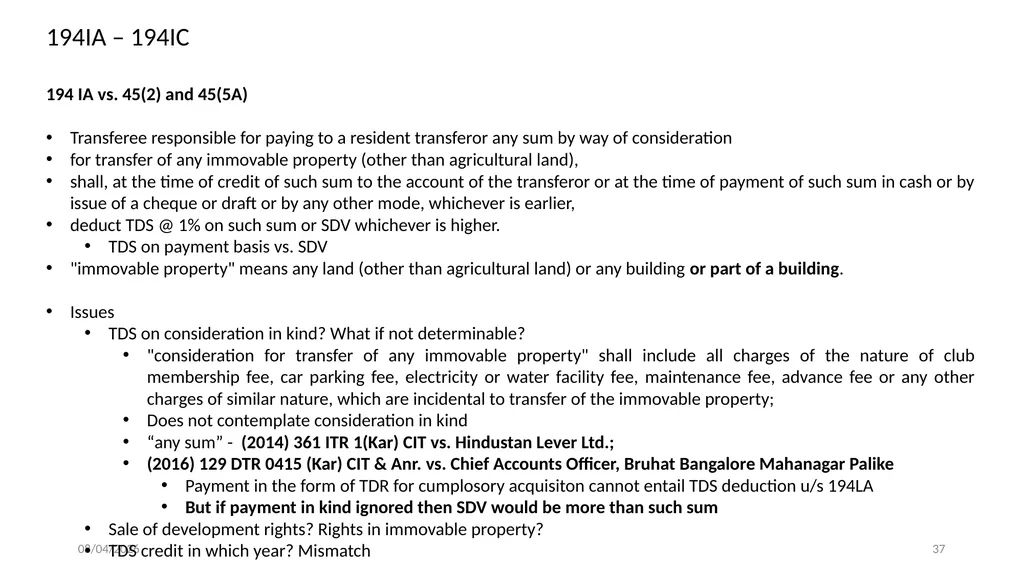
slide37. 194 IA vs. 45(2) and 45(5A)
Transferee responsible for paying to a resident transferor any sum by way of consideration
for transfer of any immovable property (other than agricultural land),
shall, at the time of credit of such sum to the account of the transferor or at the time of payment of such sum in cash or by issue of a cheque or draft or by any other mode, whichever is earlier,
deduct TDS @ 1% on such sum or SDV whichever is higher.
TDS on payment basis vs. SDV
"immovable property" means any land (other than agricultural land) or any building or part of a building.
Issues
TDS on consideration in kind? What if not determinable?
"consideration for transfer of any immovable property" shall include all charges of the nature of club membership fee, car parking fee, electricity or water facility fee, maintenance fee, advance fee or any other charges of similar nature, which are incidental to transfer of the immovable property;
Does not contemplate consideration in kind
“any sum” - (2014) 361 ITR 1(Kar) CIT vs. Hindustan Lever Ltd.;
(2016) 129 DTR 0415 (Kar) CIT & Anr. vs. Chief Accounts Officer, Bruhat Bangalore Mahanagar Palike
Payment in the form of TDR for cumplosory acquisiton cannot entail TDS deduction u/s 194LA
But if payment in kind ignored then SDV would be more than such sum
Sale of development rights? Rights in immovable property?
TDS credit in which year? Mismatch 194IA – 194IC 23-05-2024 37<br>
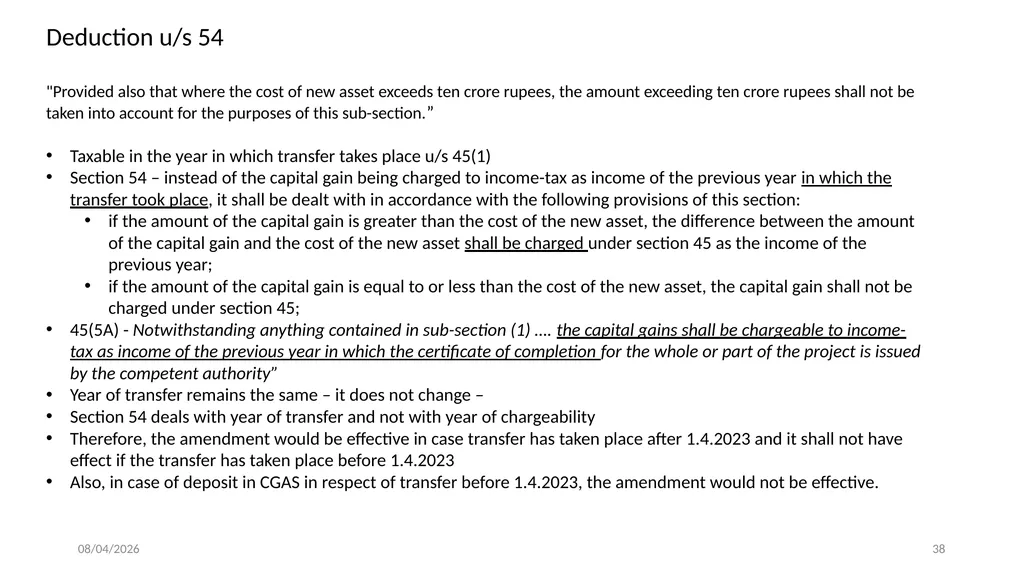
slide38. "Provided also that where the cost of new asset exceeds ten crore rupees, the amount exceeding ten crore rupees shall not be taken into account for the purposes of this sub-section.”
Taxable in the year in which transfer takes place u/s 45(1)
Section 54 – instead of the capital gain being charged to income-tax as income of the previous year in which the transfer took place, it shall be dealt with in accordance with the following provisions of this section:
if the amount of the capital gain is greater than the cost of the new asset, the difference between the amount of the capital gain and the cost of the new asset shall be charged under section 45 as the income of the previous year;
if the amount of the capital gain is equal to or less than the cost of the new asset, the capital gain shall not be charged under section 45;
45(5A) - Notwithstanding anything contained in sub-section (1) …. the capital gains shall be chargeable to income-tax as income of the previous year in which the certificate of completion for the whole or part of the project is issued by the competent authority”
Year of transfer remains the same – it does not change –
Section 54 deals with year of transfer and not with year of chargeability
Therefore, the amendment would be effective in case transfer has taken place after 1.4.2023 and it shall not have effect if the transfer has taken place before 1.4.2023
Also, in case of deposit in CGAS in respect of transfer before 1.4.2023, the amendment would not be effective. Deduction u/s 54 23-05-2024 38<br>
slide39. Accounting and Income-tax - Method of accounting – Section 145/ 145A - ICDS and section 43CB
43CA
Interest on WIP
Notional rent Agenda for builders and developers 23-05-2024 39<br>
slide40. Method of accounting – Section 145/ 145A 40 23-05-2024<br>
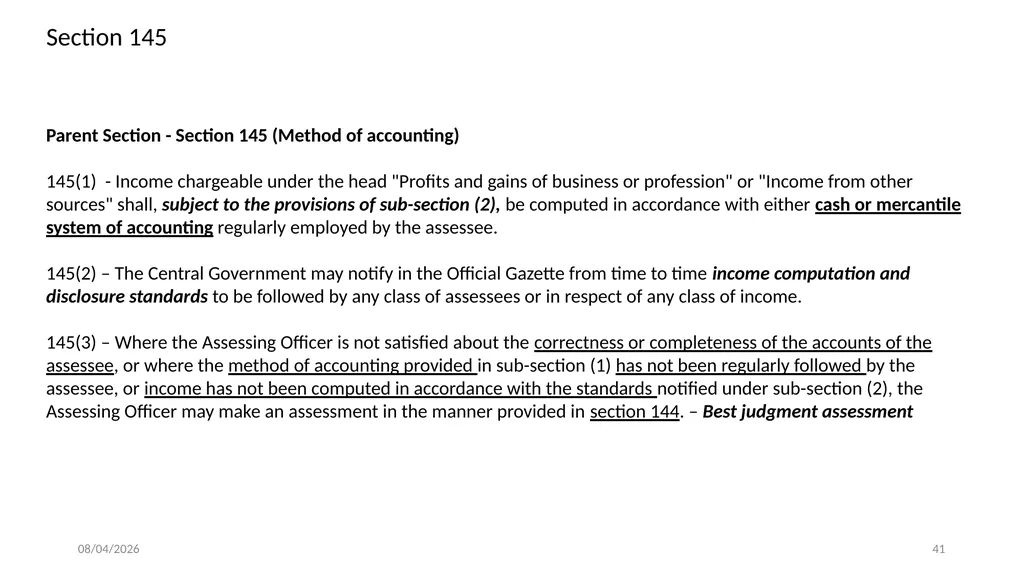
slide41. Section 145 Parent Section - Section 145 (Method of accounting) 145(1) - Income chargeable under the head "Profits and gains of business or profession" or "Income from other sources" shall, subject to the provisions of sub-section (2), be computed in accordance with either cash or mercantile system of accounting regularly employed by the assessee.
145(2) – The Central Government may notify in the Official Gazette from time to time income computation and disclosure standards to be followed by any class of assessees or in respect of any class of income.
145(3) – Where the Assessing Officer is not satisfied about the correctness or completeness of the accounts of the assessee, or where the method of accounting provided in sub-section (1) has not been regularly followed by the assessee, or income has not been computed in accordance with the standards notified under sub-section (2), the Assessing Officer may make an assessment in the manner provided in section 144. – Best judgment assessment 41 23-05-2024<br>
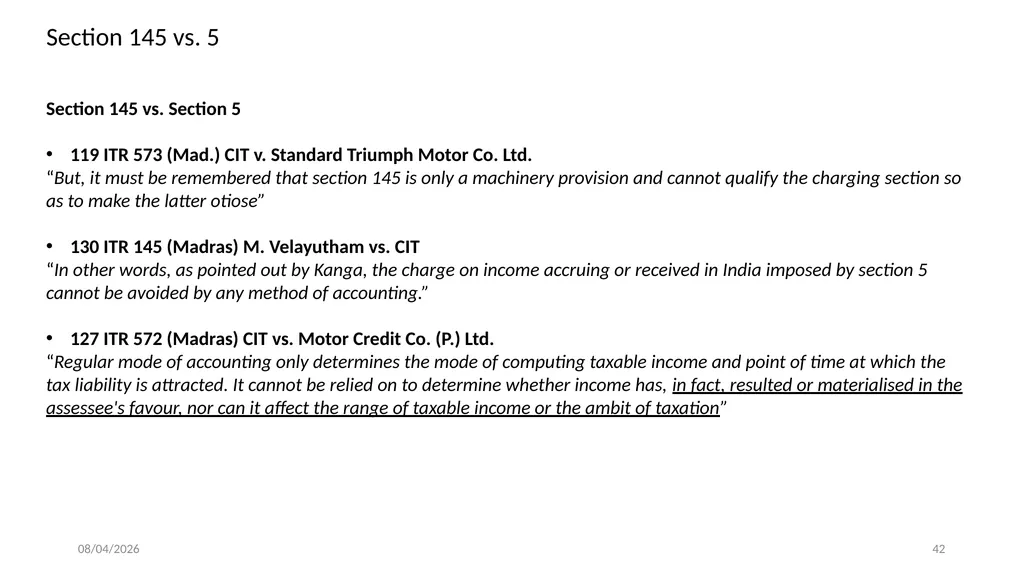
slide42. Section 145 vs. 5 Section 145 vs. Section 5
119 ITR 573 (Mad.) CIT v. Standard Triumph Motor Co. Ltd.
“But, it must be remembered that section 145 is only a machinery provision and cannot qualify the charging section so as to make the latter otiose”
130 ITR 145 (Madras) M. Velayutham vs. CIT
“In other words, as pointed out by Kanga, the charge on income accruing or received in India imposed by section 5 cannot be avoided by any method of accounting.”
127 ITR 572 (Madras) CIT vs. Motor Credit Co. (P.) Ltd.
“Regular mode of accounting only determines the mode of computing taxable income and point of time at which the tax liability is attracted. It cannot be relied on to determine whether income has, in fact, resulted or materialised in the assessee's favour, nor can it affect the range of taxable income or the ambit of taxation” 42 23-05-2024<br>
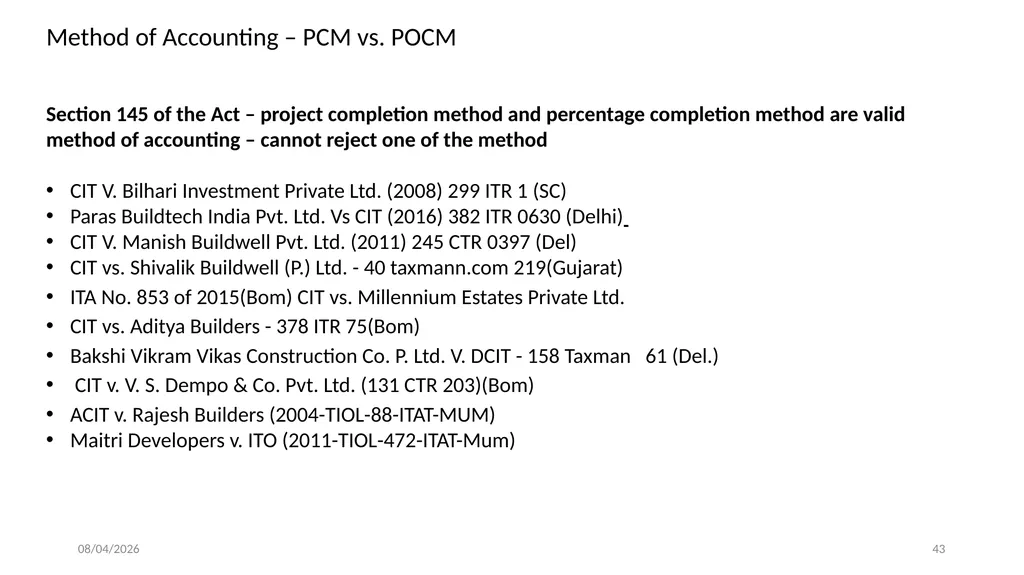
slide43. Method of Accounting – PCM vs. POCM Section 145 of the Act – project completion method and percentage completion method are valid method of accounting – cannot reject one of the method
CIT V. Bilhari Investment Private Ltd. (2008) 299 ITR 1 (SC)
Paras Buildtech India Pvt. Ltd. Vs CIT (2016) 382 ITR 0630 (Delhi)
CIT V. Manish Buildwell Pvt. Ltd. (2011) 245 CTR 0397 (Del)
CIT vs. Shivalik Buildwell (P.) Ltd. - 40 taxmann.com 219(Gujarat)
ITA No. 853 of 2015(Bom) CIT vs. Millennium Estates Private Ltd.
CIT vs. Aditya Builders - 378 ITR 75(Bom)
Bakshi Vikram Vikas Construction Co. P. Ltd. V. DCIT - 158 Taxman 61 (Del.)
CIT v. V. S. Dempo & Co. Pvt. Ltd. (131 CTR 203)(Bom)
ACIT v. Rajesh Builders (2004-TIOL-88-ITAT-MUM)
Maitri Developers v. ITO (2011-TIOL-472-ITAT-Mum) 43 23-05-2024<br>
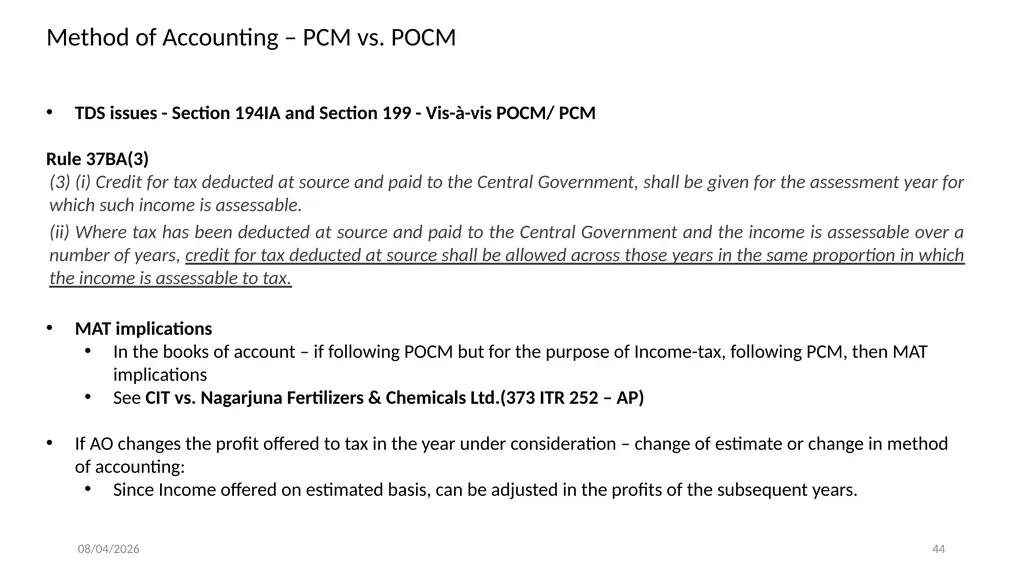
slide44. Method of Accounting – PCM vs. POCM TDS issues - Section 194IA and Section 199 - Vis-à-vis POCM/ PCM
Rule 37BA(3)
(3) (i) Credit for tax deducted at source and paid to the Central Government, shall be given for the assessment year for which such income is assessable.
(ii) Where tax has been deducted at source and paid to the Central Government and the income is assessable over a number of years, credit for tax deducted at source shall be allowed across those years in the same proportion in which the income is assessable to tax.
MAT implications
In the books of account – if following POCM but for the purpose of Income-tax, following PCM, then MAT implications
See CIT vs. Nagarjuna Fertilizers & Chemicals Ltd.(373 ITR 252 – AP)
If AO changes the profit offered to tax in the year under consideration – change of estimate or change in method of accounting:
Since Income offered on estimated basis, can be adjusted in the profits of the subsequent years. 44 23-05-2024<br>
slide45. The treatment to retention money under Paragraph 10 (a) in ICDS-III will have to be determined on a case to case basis by applying settled principles of accrual of income. By deploying ICDS-III in a manner that seeks to bring to tax the retention money the receipt of which is uncertain/ conditional, at the earliest possible stage, the Government would be acting contrary to the settled position in law.
Para 12 of ICDS III read with para 5 of ICDS IX, dealing with borrowing costs, which makes it clear that no incidental income can be reduced from borrowing cost is contrary to the decision of the Supreme Court in CIT v. Bokaro Steel Limited (1999) 236 ITR 315.
para 6 of ICDS-IV permits only one of the methods, i.e., proportionate completion method for recognising revenue from service contracts and is contrary to the CIT v. Bilhari Investment Pvt. Ltd. (2008) 299 ITR 1 (SC), CIT v. Manish Buildwell Pvt. Ltd. (2011) 245 CTR 397 (Del) and Paras Buildtech India Pvt. Ltd. V. CIT (2016) 382 ITR 630 (Del). – Should apply equally to ICDS III
Held: ICDS III is held to be ultra vires to the extent as stated above and struck down as such.
Also, corresponding amendments in Form 3CD and any clarification in the Circular is struck down Finding of Delhi High Court on ICDS 3 45 23-05-2024<br>
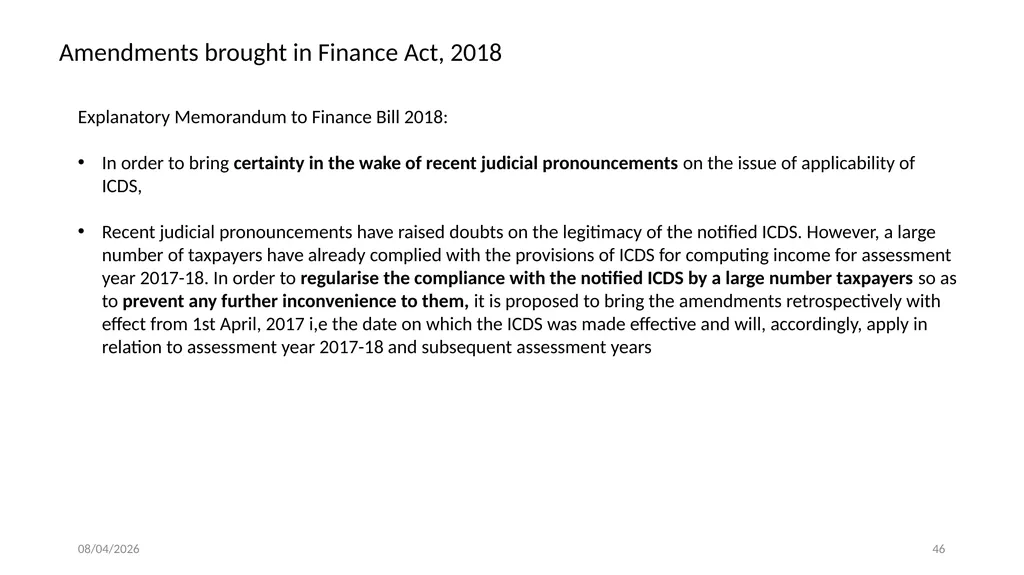
slide46. 23-05-2024 46 Amendments brought in Finance Act, 2018 Explanatory Memorandum to Finance Bill 2018:
In order to bring certainty in the wake of recent judicial pronouncements on the issue of applicability of ICDS,
Recent judicial pronouncements have raised doubts on the legitimacy of the notified ICDS. However, a large number of taxpayers have already complied with the provisions of ICDS for computing income for assessment year 2017-18. In order to regularise the compliance with the notified ICDS by a large number taxpayers so as to prevent any further inconvenience to them, it is proposed to bring the amendments retrospectively with effect from 1st April, 2017 i,e the date on which the ICDS was made effective and will, accordingly, apply in relation to assessment year 2017-18 and subsequent assessment years<br>
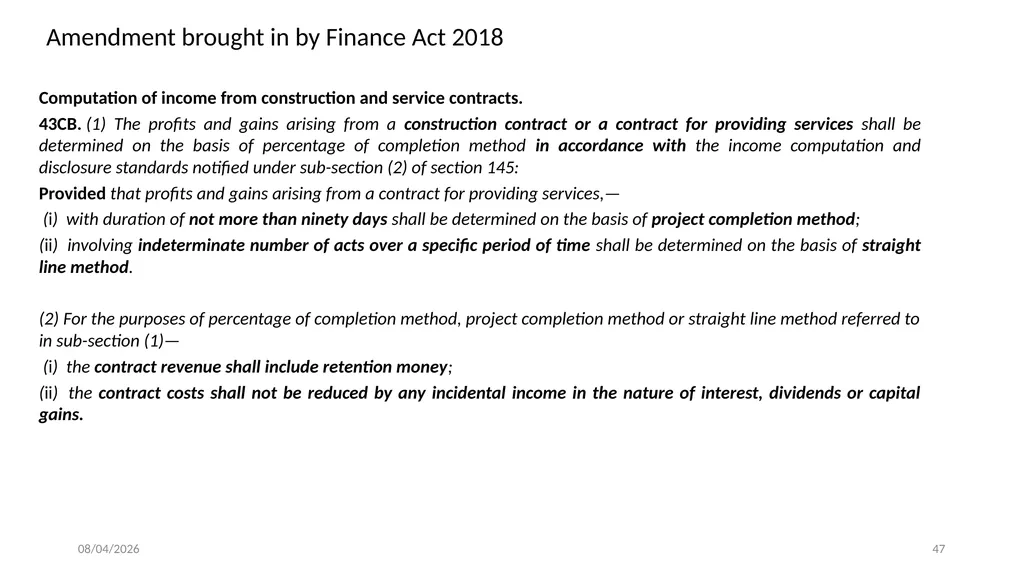
slide47. 23-05-2024 47 Computation of income from construction and service contracts.
43CB. (1) The profits and gains arising from a construction contract or a contract for providing services shall be determined on the basis of percentage of completion method in accordance with the income computation and disclosure standards notified under sub-section (2) of section 145:
Provided that profits and gains arising from a contract for providing services,—
(i) with duration of not more than ninety days shall be determined on the basis of project completion method;
(ii) involving indeterminate number of acts over a specific period of time shall be determined on the basis of straight line method.
(2) For the purposes of percentage of completion method, project completion method or straight line method referred to in sub-section (1)—
(i) the contract revenue shall include retention money;
(ii) the contract costs shall not be reduced by any incidental income in the nature of interest, dividends or capital gains. Amendment brought in by Finance Act 2018<br>
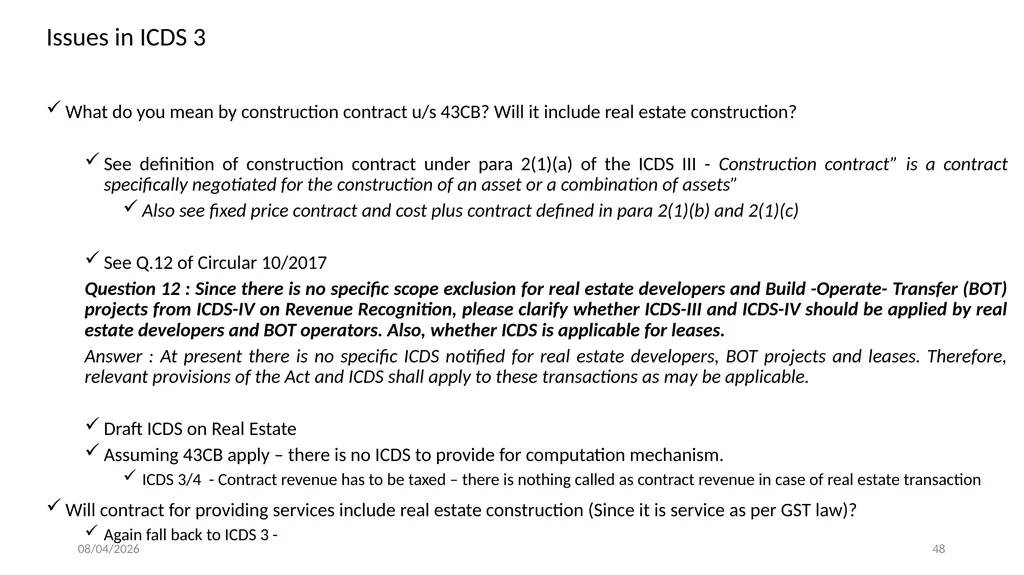
slide48. What do you mean by construction contract u/s 43CB? Will it include real estate construction?
See definition of construction contract under para 2(1)(a) of the ICDS III - Construction contract” is a contract specifically negotiated for the construction of an asset or a combination of assets”
Also see fixed price contract and cost plus contract defined in para 2(1)(b) and 2(1)(c)
See Q.12 of Circular 10/2017
Question 12 : Since there is no specific scope exclusion for real estate developers and Build -Operate- Transfer (BOT) projects from ICDS-IV on Revenue Recognition, please clarify whether ICDS-III and ICDS-IV should be applied by real estate developers and BOT operators. Also, whether ICDS is applicable for leases.
Answer : At present there is no specific ICDS notified for real estate developers, BOT projects and leases. Therefore, relevant provisions of the Act and ICDS shall apply to these transactions as may be applicable.
Draft ICDS on Real Estate
Assuming 43CB apply – there is no ICDS to provide for computation mechanism.
ICDS 3/4 - Contract revenue has to be taxed – there is nothing called as contract revenue in case of real estate transaction
Will contract for providing services include real estate construction (Since it is service as per GST law)?
Again fall back to ICDS 3 - Issues in ICDS 3 48 23-05-2024<br>
slide49. Section 43CA 49 23-05-2024<br>
slide50. W.e.f. AY 14-15
SDV shall be deemed to be consideration received if consideration less than SDV
Safe harbour limit – 10% increased to 20% upto 30.06.2021 on fulfilment of certain conditions
Retrospective? ITA NO.5752/Mum/2019 Stalwart Impex Pvt. Ltd. vs. ITO
43CA to apply in year of transfer or in year of recognition of income as per method of accounting?
Objection and reference to DVO / Date of agreement different from date of registration, then SDV as on date of agreement
Rights in land or building
(2016) 389 ITR 0068 (Bom) CIT vs. Greenfield Hotels & Estates Pvt. Ltd.
ITA No. 1821 OF 2013(Bom)(HC) CIT vs. Mr. Abdul Aziz Abdul Kadar
(2016) 161 ITD 0199 (Mumbai) VOLTAS LTD. vs. ITO – favour;
Does not apply to under construction land and building – 178 ITD 98(Mum) 43CA 23-05-2024 50<br>
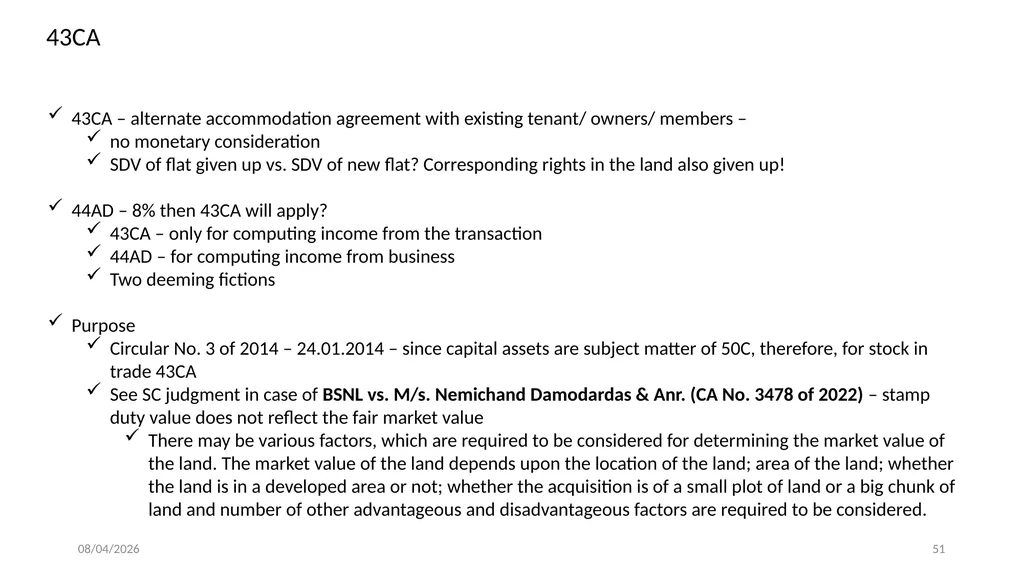
slide51. 43CA – alternate accommodation agreement with existing tenant/ owners/ members –
no monetary consideration
SDV of flat given up vs. SDV of new flat? Corresponding rights in the land also given up!
44AD – 8% then 43CA will apply?
43CA – only for computing income from the transaction
44AD – for computing income from business
Two deeming fictions
Purpose
Circular No. 3 of 2014 – 24.01.2014 – since capital assets are subject matter of 50C, therefore, for stock in trade 43CA
See SC judgment in case of BSNL vs. M/s. Nemichand Damodardas & Anr. (CA No. 3478 of 2022) – stamp duty value does not reflect the fair market value
There may be various factors, which are required to be considered for determining the market value of the land. The market value of the land depends upon the location of the land; area of the land; whether the land is in a developed area or not; whether the acquisition is of a small plot of land or a big chunk of land and number of other advantageous and disadvantageous factors are required to be considered. 43CA 23-05-2024 51<br>
slide52. Interest on WIP 52 23-05-2024<br>
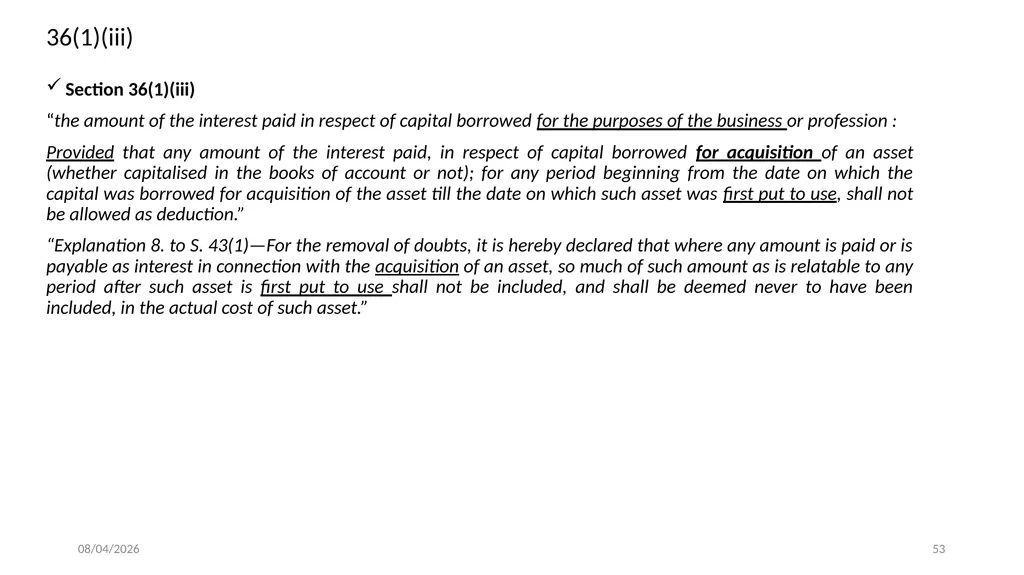
slide53. Section 36(1)(iii)
“the amount of the interest paid in respect of capital borrowed for the purposes of the business or profession :
Provided that any amount of the interest paid, in respect of capital borrowed for acquisition of an asset (whether capitalised in the books of account or not); for any period beginning from the date on which the capital was borrowed for acquisition of the asset till the date on which such asset was first put to use, shall not be allowed as deduction.”
“Explanation 8. to S. 43(1)—For the removal of doubts, it is hereby declared that where any amount is paid or is payable as interest in connection with the acquisition of an asset, so much of such amount as is relatable to any period after such asset is first put to use shall not be included, and shall be deemed never to have been included, in the actual cost of such asset.” 36(1)(iii) 53 23-05-2024<br>
slide54. Scope
This ICDS deals with treatment of borrowing cost
Definition
“Qualifying asset” means:
land, building, machinery, plant or furniture, being tangible assets;
know-how, patents, copyrights, trade marks, licences, franchises or any other business or commercial rights of similar nature, being intangible assets;
inventories that require a period of twelve months or more to bring them to a saleable condition.
Recognition
Borrowing costs that are directly attributable to the acquisition, construction or production of a qualifying asset shall be capitalised as part of the cost of that asset.
“capitalisation” in the context of inventory means addition of borrowing cost to the cost of inventory
No delegation u/s 36(1)(iii) – therefore, ICDS 9 is a piece of backdoor legislation ICDS 9 23-05-2024 54<br>
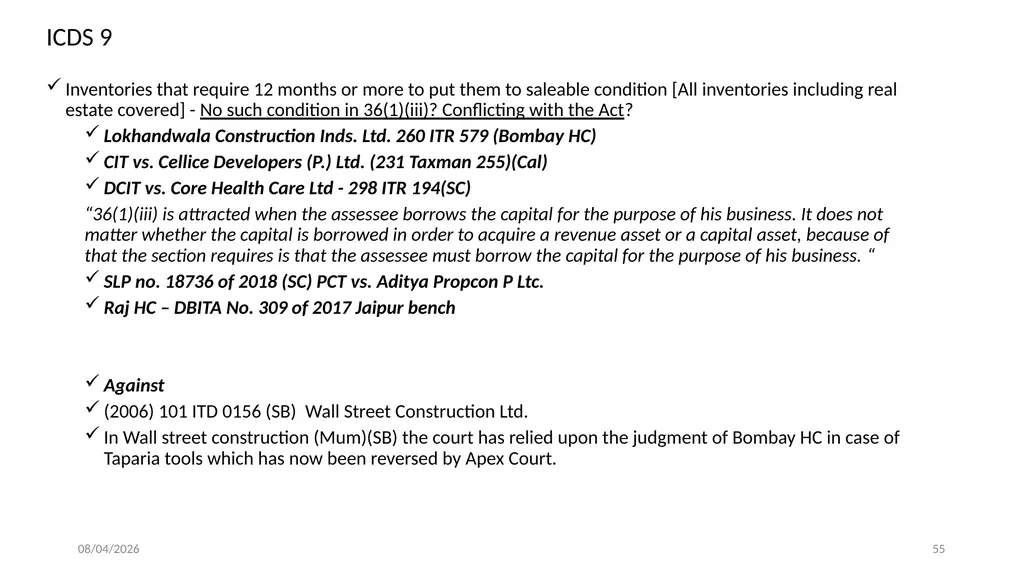
slide55. Inventories that require 12 months or more to put them to saleable condition [All inventories including real estate covered] - No such condition in 36(1)(iii)? Conflicting with the Act?
Lokhandwala Construction Inds. Ltd. 260 ITR 579 (Bombay HC)
CIT vs. Cellice Developers (P.) Ltd. (231 Taxman 255)(Cal)
DCIT vs. Core Health Care Ltd - 298 ITR 194(SC)
“36(1)(iii) is attracted when the assessee borrows the capital for the purpose of his business. It does not matter whether the capital is borrowed in order to acquire a revenue asset or a capital asset, because of that the section requires is that the assessee must borrow the capital for the purpose of his business. “
SLP no. 18736 of 2018 (SC) PCT vs. Aditya Propcon P Ltc.
Raj HC – DBITA No. 309 of 2017 Jaipur bench
Against
(2006) 101 ITD 0156 (SB) Wall Street Construction Ltd.
In Wall street construction (Mum)(SB) the court has relied upon the judgment of Bombay HC in case of Taparia tools which has now been reversed by Apex Court. ICDS 9 55 23-05-2024<br>
slide56. Notional Rent 56 23-05-2024<br>
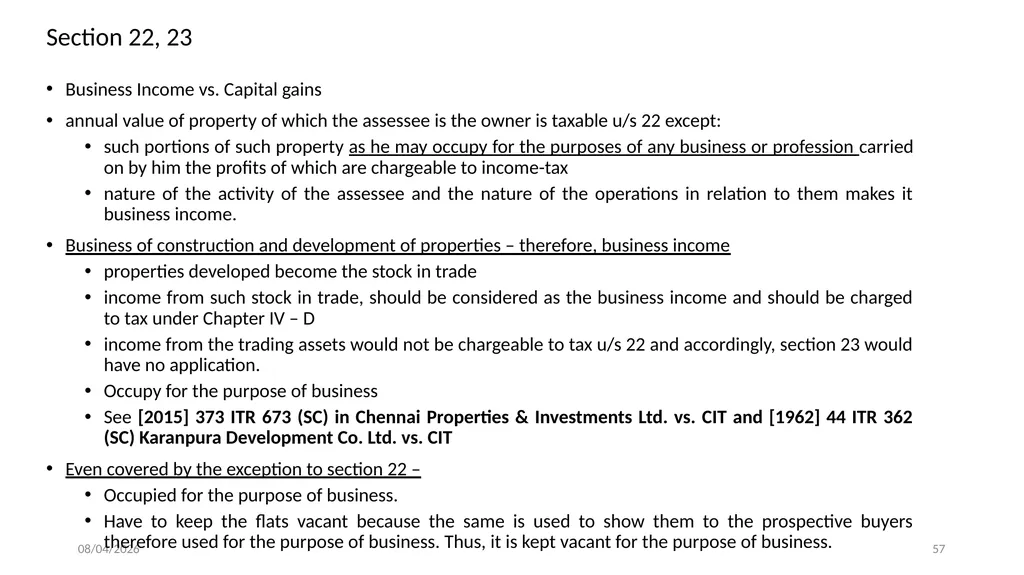
slide57. Business Income vs. Capital gains
annual value of property of which the assessee is the owner is taxable u/s 22 except:
such portions of such property as he may occupy for the purposes of any business or profession carried on by him the profits of which are chargeable to income-tax
nature of the activity of the assessee and the nature of the operations in relation to them makes it business income.
Business of construction and development of properties – therefore, business income
properties developed become the stock in trade
income from such stock in trade, should be considered as the business income and should be charged to tax under Chapter IV – D
income from the trading assets would not be chargeable to tax u/s 22 and accordingly, section 23 would have no application.
Occupy for the purpose of business
See [2015] 373 ITR 673 (SC) in Chennai Properties & Investments Ltd. vs. CIT and [1962] 44 ITR 362 (SC) Karanpura Development Co. Ltd. vs. CIT
Even covered by the exception to section 22 –
Occupied for the purpose of business.
Have to keep the flats vacant because the same is used to show them to the prospective buyers therefore used for the purpose of business. Thus, it is kept vacant for the purpose of business. Section 22, 23 57 23-05-2024<br>
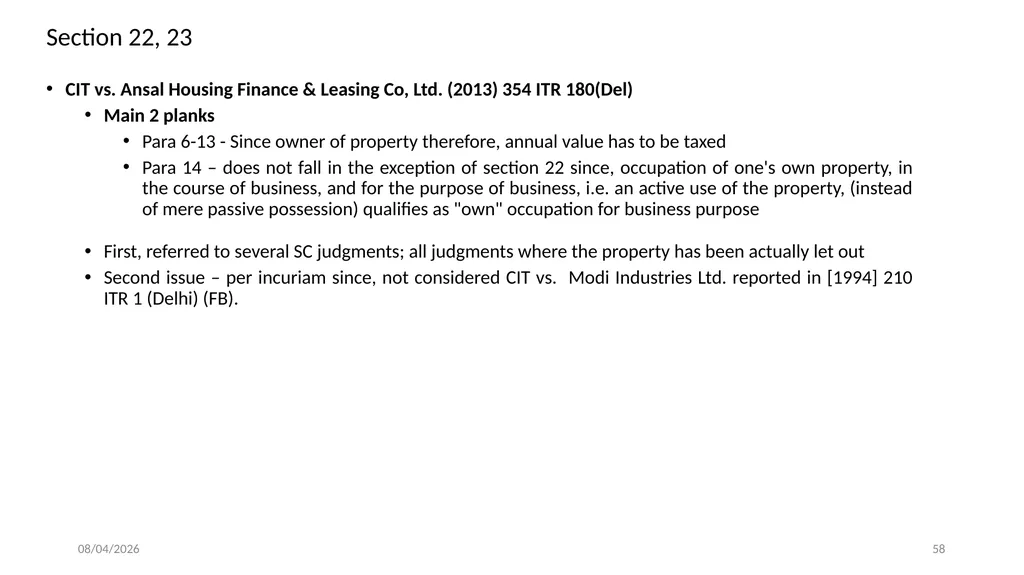
slide58. CIT vs. Ansal Housing Finance & Leasing Co, Ltd. (2013) 354 ITR 180(Del)
Main 2 planks
Para 6-13 - Since owner of property therefore, annual value has to be taxed
Para 14 – does not fall in the exception of section 22 since, occupation of one's own property, in the course of business, and for the purpose of business, i.e. an active use of the property, (instead of mere passive possession) qualifies as "own" occupation for business purpose
First, referred to several SC judgments; all judgments where the property has been actually let out
Second issue – per incuriam since, not considered CIT vs. Modi Industries Ltd. reported in [1994] 210 ITR 1 (Delhi) (FB). Section 22, 23 58 23-05-2024<br>
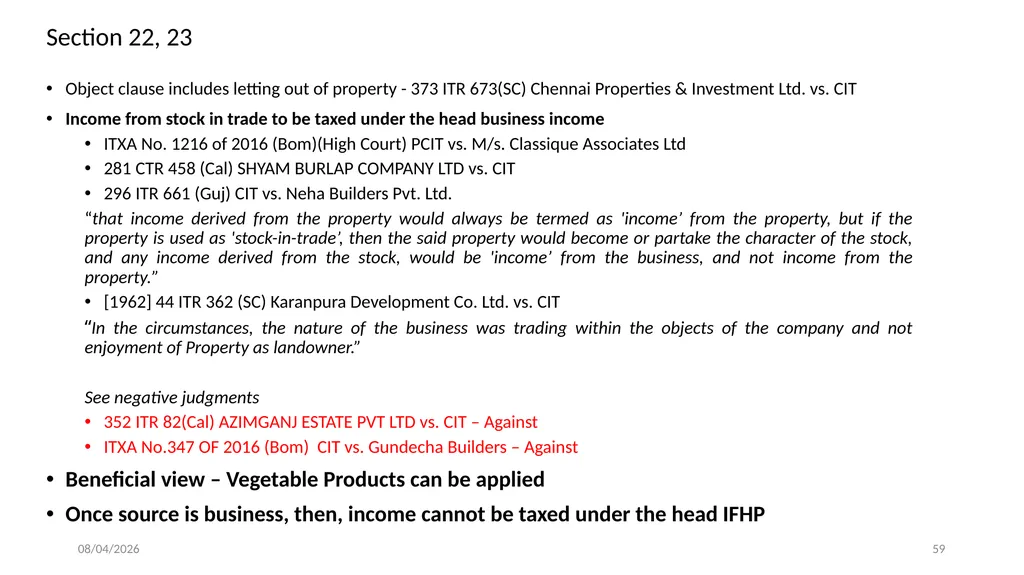
slide59. Object clause includes letting out of property - 373 ITR 673(SC) Chennai Properties & Investment Ltd. vs. CIT
Income from stock in trade to be taxed under the head business income
ITXA No. 1216 of 2016 (Bom)(High Court) PCIT vs. M/s. Classique Associates Ltd
281 CTR 458 (Cal) SHYAM BURLAP COMPANY LTD vs. CIT
296 ITR 661 (Guj) CIT vs. Neha Builders Pvt. Ltd.
“that income derived from the property would always be termed as 'income’ from the property, but if the property is used as 'stock-in-trade’, then the said property would become or partake the character of the stock, and any income derived from the stock, would be 'income’ from the business, and not income from the property.”
[1962] 44 ITR 362 (SC) Karanpura Development Co. Ltd. vs. CIT
“In the circumstances, the nature of the business was trading within the objects of the company and not enjoyment of Property as landowner.”
See negative judgments
352 ITR 82(Cal) AZIMGANJ ESTATE PVT LTD vs. CIT – Against
ITXA No.347 OF 2016 (Bom) CIT vs. Gundecha Builders – Against
Beneficial view – Vegetable Products can be applied
Once source is business, then, income cannot be taxed under the head IFHP Section 22, 23 59 23-05-2024<br>
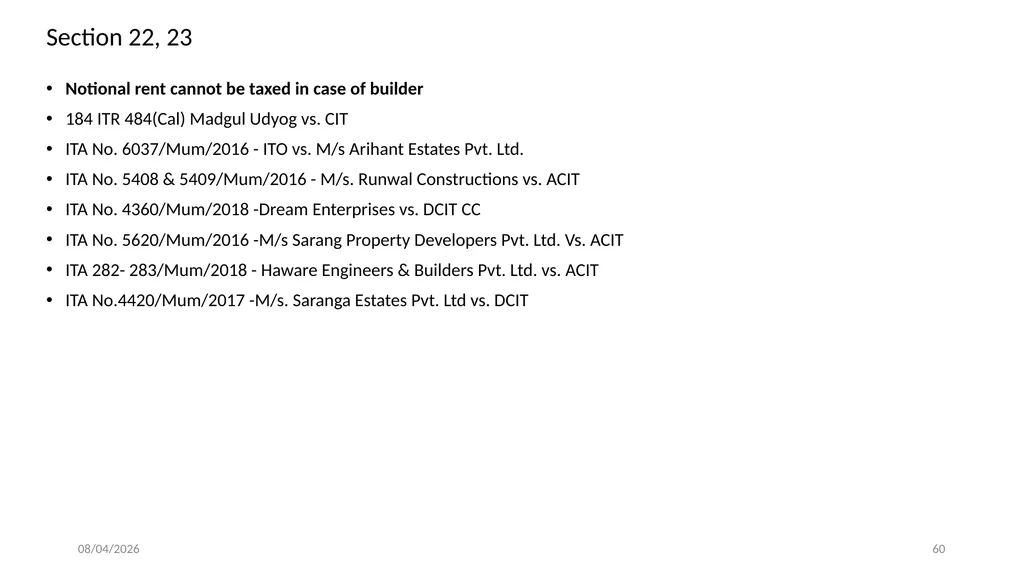
slide60. Notional rent cannot be taxed in case of builder
184 ITR 484(Cal) Madgul Udyog vs. CIT
ITA No. 6037/Mum/2016 - ITO vs. M/s Arihant Estates Pvt. Ltd.
ITA No. 5408 & 5409/Mum/2016 - M/s. Runwal Constructions vs. ACIT
ITA No. 4360/Mum/2018 -Dream Enterprises vs. DCIT CC
ITA No. 5620/Mum/2016 -M/s Sarang Property Developers Pvt. Ltd. Vs. ACIT
ITA 282- 283/Mum/2018 - Haware Engineers & Builders Pvt. Ltd. vs. ACIT
ITA No.4420/Mum/2017 -M/s. Saranga Estates Pvt. Ltd vs. DCIT Section 22, 23 60 23-05-2024<br>
slide61. 23(5)
Where the property consisting of any building or land appurtenant thereto is held as stock-in-trade and the property or any part of the property is not let during the whole or any part of the previous year, the annual value of such property or part of the property, for the period up to two years from the end of the financial year in which the certificate of completion of construction of the property is obtained from the competent authority, shall be taken to be nil.
W.e.f AY 18-19
Only if section 22 triggers – then 23(5) can apply – 23 is a machinery provision
Constitutional validity?
Intention of the Act to penalise the builders who are not able to sell the shops/ flats by taxing them with notional rent on such unsold stock
Forcing the assessee to let out the properties
What if stock in trade is let out and rent earned is offered to tax as IFHP?
See section 28 – conversion of stock in trade as capital asset? Section 22, 23 61 23-05-2024<br>
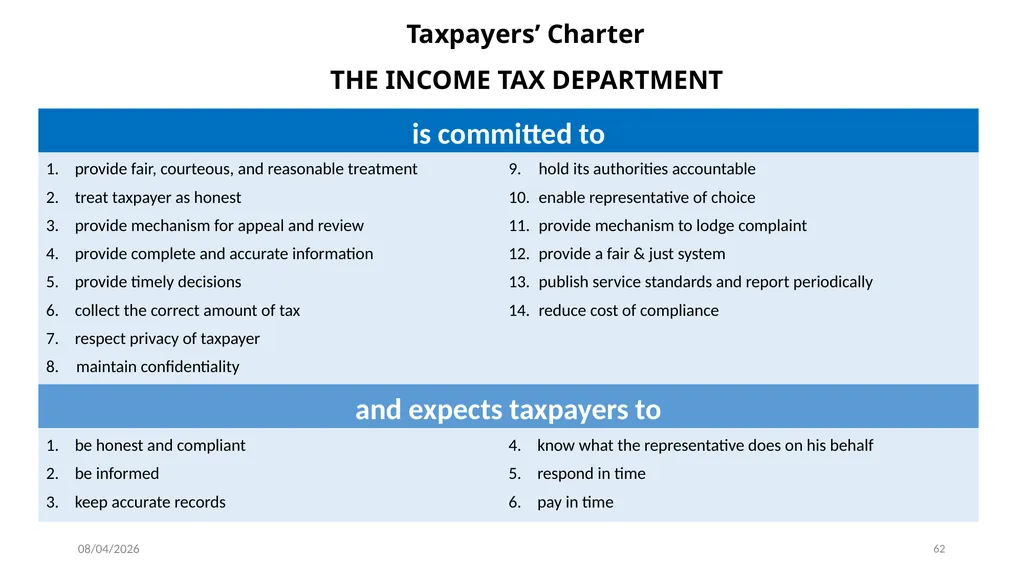
slide62. Taxpayers’ Charter is committed to provide fair, courteous, and reasonable treatment
treat taxpayer as honest
provide mechanism for appeal and review
provide complete and accurate information
provide timely decisions
collect the correct amount of tax
respect privacy of taxpayer
maintain confidentiality
hold its authorities accountable
enable representative of choice
provide mechanism to lodge complaint
provide a fair & just system
publish service standards and report periodically
reduce cost of compliance THE INCOME TAX DEPARTMENT and expects taxpayers to be honest and compliant
be informed
keep accurate records
know what the representative does on his behalf
respond in time
pay in time 62 23-05-2024<br>
slide63. THANK YOU Dharan V. Gandhi
(B.Com, CA, LL.B.)
Advocate, Bombay High Court
709, Sharda Chambers, New Marine Lines,
Behind Aaykar Bhavan, Mumbai – 400020.
Tel : +91 22 79692153 Cell: +91 9820068466
Email: adv.dharangandhi@outlook.com 63 QUESTIONS, IF ANY? 23-05-2024 Apex Court in case of CIT vs. J.H. Gotla [(1985) 156 ITR 323 (SC)] has held that “Though equity and taxation are often strangers, attempts should be made that these do not remain always so and if a construction results in equity rather than in injustice, then such construction should be preferred to the literal construction.”<br>
slide2. Why development/ redevelopment of land/ building?
Old buildings / bungalows are in dilapidated conditions.
The residents are either protected tenants or owners/members of society.
Due to changes in the development regulations, higher FSI (floor space index) or receiving plot to load TDR (transferable development rights).
Other reasons – land owners want to monetise the asset
Scheme
Owners are not expert in developing the building, as a result, they approach a builder/ developer.
Builders/ developers become interested in a development project of a building, as they remain with some disposable area to recover cost and earn sizeable profits.
A win-win situation
Different types of arrangements
Transfer of title in the land by way of conveyance to future buyers or their association/ society etc. and owner receives some share in the newly constructed area
Transfer of part of the land for construction at the disposal of the builder and in consideration the builder gives me a new structure on portion of land retained by the owner.
Transfer of only development rights and no transfer in the title of the land. Scheme of development/ redevelopment 23-05-2024 2<br>
slide3. Consideration flowing in a typical agreement
The builder is given a right to redevelop the property.
Additional area over and above the area to be given to the existing owners, is at the disposal of the builder.
In lieu of getting the redevelopment rights and the rights to sell the extra area, the builders give the following in return:
Incur cost of construction for the area to be given back to the owners and members etc.
Provide additional area to the existing owners
Provide rent expenses to the existing owners/ members for temporary displacement
Provide hardship allowance for shifting and other expenses of the members.
Apart from the above, if the society is involved, it is also paid some sum towards the corpus. Scheme of development/ redevelopment 23-05-2024 3 Tax treatment would largely hinge upon the wordings of the development/ redevelopment agreement and the rights and liabilities of the parties flowing therefrom<br>
slide4. Number of parties involved –
Land owner – an individual, company or a society of the owners of the units
Builder/ Developer undertaking the development work
Tenants or owners or shareholders/ members of society
Land owner/ tenants/ members perspective
Determination of head of income –
Business income or capital gains?
Nature of Capital Asset transferred –
Whether rights in immovable property? Tenancy, occupancy, development, leasehold rights
Whether land or building transferred?
Whether no transfer – it is mere demolition and reconstruction of the new asset
Substance over form –
Implications like 50C, 194IA, Cost of acquisition, 54/54F etc.
Year of chargeability (since likely to take more than a year)
Year of transfer as per section 2(47)(i) / 2(47)(ii)/ 2(47)(v) /2(47)(vi)
Contingent transfer
Year of receipt of consideration
Real income theory Implications under IT Act in a nutshell 23-05-2024 4<br>
slide5. Charging section
45(1) – general
45(2) – conversion into stock in trade
45(5A) – individual and HUF – specified agreements - on satisfaction of certain conditions
Determination of consideration
cash component
some share in the new property which is to be constructed in future – FMV/ SDV/ Cost of construction
some share in the future sale price of the builder
50C – whether applicable to rights in properties
50D – if consideration is not determinable in the year of transfer
Cost of acquisition
Cost of rights in properties – whether determinable or not
Cost to previous owner
Cost of tenancy rights
FMV as on 1.4.2001. Implications under IT Act in a nutshell 23-05-2024 5<br>
slide6. Period of holding
From the date of allotment letter
From the date of agreement
From the date of registration of agreement
From the date of possession
From the date of making of payment
Exemption u/s 54/ 54F of the Act
If commercial asset –
Application of section 50.
Interplay of S. 50 and 43(6)
No benefit of further investment
Taxability u/s 56(2)(x)
omnibus
Receipt of extra area
Hardship and other compensation Implications under IT Act in a nutshell 23-05-2024 6<br>
slide7. Stamp Duty implications
GST implications Following issues are not covered 23-05-2024 7<br>
slide8. S. 2(13) – business includes any adventure or concern in the nature of trade, commerce or manufacture
A single transaction can also be in the nature of business
(1959) 35 ITR 594(SC) G. Venkataswami Naidu & Co. vs. CIT
If a person invests money in land intending to hold it, enjoys its income for some time, and then sells it at a profit, it would be a clear case of capital accretion and not profit derived from an adventure in the nature of trade.
In deciding the character of such transactions several factors are treated as relevant.
Onus on the Department to prove it is business - (1959) 37 ITR 242 (SC) Saroj Kumar Mazumdar vs. CIT
If at the time of purchase, the intention is to resell, then business income
If at the time of purchase, the intention is to invest, then capital gains
If subsequently, the intention is changed to earn business income, then section 45(2) to apply. Head of Income 23-05-2024 8<br>
slide9. General principles
(2013) 358 ITR 0295 (SC) CIT vs. Excel Industries Ltd.
Three tests laid down by various decisions of this Court, namely,
whether the income accrued to the assessee is real or hypothetical;
whether there is a corresponding liability of the other party to pay
probability or improbability of realisation of the benefits by the assessee considered from a realistic and practical point of view
Capital gains perspective
S. 45(1)/ 45(2)/ 45(5A)- deeming fiction - chargeable and shall be deemed to be the income of the previous year in which the transfer took place.
S. 45(1) etc. - Any profits or gains arising from the transfer of a capital asset
S. 48 - The income chargeable under the head "Capital gains" shall be computed, by deducting from the full value of the consideration received or accruing as a result of the transfer of the capital asset
(2017) 398 ITR 531(SC) CIT vs. Balbir Singh Maini and other Bombay High Court judgments Real income theory 23-05-2024 9<br>
slide10. Assets involved in Development agreement
Land
Building
Rights in land and building including development rights, tenancy etc.
Shares of society
Land and Building are separate assets
261 ITR 570 (Bom) CIT vs. Citibank N.A.
335 ITR 60 (Bom) CIT vs. Hindustan Hotels Ltd. & Anr.
236 ITR 51 (Mad) CIT vs. Dr. D.L. Ramachandra Rao
304 ITR 27 (P&H) CIT vs. A.S. Aulakh
Splitting of consideration
important when land and building are conferred different treatment (long term and short term)
If builder has no interest in the existing structure – can one assign everything towards land?
To determine type of asset transferred
Terms of agreement
Substance over form – under the guise of development agreement, ownership rights in the land are transferred
Implications like 50C, 194IA, Cost of acquisition, 54/54F etc. Capital asset – 2(14) 23-05-2024 10<br>
slide11. Transfer of Property Act, 1882 and Registration Act, 1908
Section 54 of TOPA and Section 17 of Registration Act.
2(47)(i) and (ii) - sale, exchange or relinquishment of the asset or the extinguishment of any rights therein
Only by way of registered conveyance - (1965) 57 ITR 185 (SC) Alapatti Venkataramiah vs. CIT
Even rights in immovable properties require registered conveyance - 133 ITR 525(Del) Addl. CIT vs. Mercury General Corporation P. Ltd.
What if the sale deed is registered but the possession is not handed over?
(2018) 409 ITR 0037 (Bom) PCIT vs. Talwalkars Fitness Club
(2017) 190 TTJ 371(Mum) Ashok M Seth & Anr. vs. DCIT
Thus, the are two prerequisites viz. possession and registration
2(47)(v) – S. 53A of TOPA
(2017) 398 ITR 531(SC) CIT vs. Balbir Singh Maini – Registration is must for section 2(47)(v)
When sale is complete?
AIR 1961 SC 1747 Ram Saran Lall vs. Domini Kuer – on registration and on payment of entire consideration
CA No. 9098 of 2013 (SC) Kanwar Raj Singh (D) Th. Lrs. v Gejo. (D) Th.Lrs & Ors.
“If, in a given case, a sale deed is executed and the entire agreed consideration is paid on or before execution of the sale deed, after it is registered it will operate from the date of its execution. The reason is that if its registration was not required, it would have operated from the date of its execution” Transfer – 2(47) 23-05-2024 11<br>
slide12. 2(47)(vi) –
“any transaction (whether by way of becoming a member of, or acquiring shares in, a co-operative society, company or other association of persons or by way of any agreement or any arrangement or in any other manner whatsoever) which has the effect of transferring, or enabling the enjoyment of, any immovable property.”
(2017) 398 ITR 531(SC) CIT vs. Balbir Singh Maini
“The object of Section 2(47)(vi) appears to be to bring within the tax net a de facto transfer of any immovable property. The expression “enabling the enjoyment of” takes color from the earlier expression “transferring”, so that it is clear that any transaction which enables the enjoyment of immovable property must be enjoyment as a purported owner thereof. The idea is to bring within the tax net, transactions, where, though title may not be transferred in law, there is, in substance, a transfer of title in fact… A reading of the JDA in the present case would show that the owner continues to be the owner throughout the agreement, and has at no stage purported to transfer rights akin to ownership to the developer. At the highest, possession alone is given under the agreement, and that too for a specific purpose -the purpose being to develop the property, as envisaged by all the parties. We are, therefore, of the view that this clause will also not rope in the present transaction.”
(2021) 421 ITR 46(SC) Seshasayee Steels P Ltd. vs. ACIT
Consequences:
This clause now fills the void left behind by the effect of amendment to s. 2(47)(v)
In JDA – if the ultimate result is conveyance of land to society etc. - then the finding of the Court w.r.t. execution of POA for limited purpose, in humble submission, may not hold good. Transfer – 2(47) 23-05-2024 12<br>
slide13. 2(47)(v) and (vi) - immovable property shall have the same meaning as in section 269UA(d)
269UA(d) includes rights in immovable property
Therefore, it shall include even development rights
No need for registration
Implication of the phrase – “accruing or arising from any transaction not being a transaction by way of sale, exchange or lease of such land, building or part of a building”
It should accrue or arise from some transaction – not by operation of law
Such transaction should not be a sale, lease etc. Transfer – 2(47) 23-05-2024 13<br>
slide14. Q. Where the transfer is contingent upon happening of certain event, can one say that transfer has taken place? For example: where the development rights are to be conferred upon the transferee only in the event he is able to get the necessary permission from the Municipal Corporation, in such case, when does the transfer take place?
S. 32 of Indian Contract Act, 1872 - Contingent contracts to do or not to do anything if an uncertain future event happens cannot be enforced by law unless and until that event has happened
S. 21 of the TOPA - Contingent interest - Where, on a transfer of property, an interest therein is created in favour of a person to take effect only on the happening of a specified uncertain event, or if a specified uncertain event shall not happen, such person thereby acquires a contingent interest in the property. Such interest becomes a vested interest, in the former case, on the happening of the event, in the latter, when the happening of the event becomes impossible.
(1993) 201 ITR 1032 (Pat) Smt. Raj Rani Devi Ramna vs. CIT
(2018) 407 ITR 0137 (Cal) PCIT vs. Infinity Infotech Parks Limited
Examples:
Possession only on payment
Transfer only on getting requisite permission from municipal authorities
Transfer only on removal of encumbrances/ tenants etc.
It cannot date back to the date of agreement Transfer – 2(47) 23-05-2024 14<br>
slide15. Q. Demolition of asset whether transfer?
(1991) 191 ITR 647(SC) Vania Silk Mills (P.) Ltd. v. CIT
“Transfer presumes both the existence of the asset and of the transferee to whom it is transferred. In the case of the damage, partial or complete, or destruction or loss of the property, there is no transfer of it in favour of a third party.”
(2001) 248 ITR 323 (SC) CIT vs. Grace Collis
“We do not approve, respectfully, of the limitation of the expression "extinguishment of any rights therein to such extinguishment on account of transfers or to the view that the expression "extinguishment of any rights therein" cannot be extended to mean the extinguishment of rights independent of or otherwise than on account of transfer.”
(2002) 259 ITR 651 (Madras) Neelamalai Agro Industries Ltd. vs. CIT
“Cases such as the destruction of the capital asset in a fire, or it’s complete loss as in the case of sinking of a vessel in the sea, cannot be regarded as having been brought within the fold of definition of "transfer" in s. 2(47),”
45(1A) – deeming fiction – profits covered but losses left out
Section 2(47) not amended – so in case of conversion into stock in trade.
Circular No. 779 of 1999 dated 14.09.1999
The newly inserted section 45(1A) has certain significant implications. In the first place, the destruction, etc., of an asset resulting in receipt of insurance claim is deemed as "transfer" of that asset.
Consequences - an owner should not demolish the structure and rather let the builder demolish the same, if he wants the benefit of cost of the structure.
Cost of demolition shall be cost of improvement – but no benefit of COA Transfer – 2(47) 23-05-2024 15<br>
slide16. S. 45(1)
Any profits or gains arising from the transfer of a capital asset effected in the previous year shall, be chargeable to income-tax under the head "Capital gains", and shall be deemed to be the income of the previous year in which the transfer took place.
(1959) 37 ITR 26 (Mad) - T.V. Sundaram Iyengar & Sons Ltd. vs. CIT
“Sec. 12B does not require that the profits should have been received. It is sufficient if they have arisen. If it subsequently happens that the money is not actually received, that would be a capital loss arising in the year when the money became irrecoverable. Even if the assessees found it difficult to receive in full the price for which they transferred their assets and that in consequence they decided to accept paid up shares in the transferee company, that would be a capital loss which arose outside the accounting year, and, therefore, cannot be taken notice of for the relevant accounting year. To attract liability to tax under s. 12B it is sufficient if profits have arisen, that is to say, if the assessee has a right to receive the profits” Charging section 23-05-2024 16<br>
slide17. year of receipt
(2013) 218 Taxman 473(All) CIT vs. Smt. Najoo Dara Deboo - The capital gain can be charged only on receipt of the sale consideration and not otherwise, when only an agreement is signed and no money is received.
(1982) 133 ITR 0169 (Del) R. Dalmia (Decd) vs. CIT - If the quantum of gains cannot be ascertained - capital gains have only to be included at the time they are ascertained
Real Income theory and section 50D
Real income theory
(2017) 398 ITR 531(SC) CIT vs. Balbir Singh Maini
(2016) 239 Taxman 0176 (Bombay) CIT vs. Hemal Raju Shete
(2015) 371 ITR 0427 (Bom) CIT vs. Chemosyn Ltd.
[2020] 269 Taxman 212 (Bombay) PCIT vs. Rohan Projects
Events occurring after BS date
Contingent contract vs. real income vs. events occurring after the accrual date
(2017) 398 ITR 531(SC) CIT vs. Balbir Singh Maini
See contra – (1959) 37 ITR 26 (Mad) - T.V. Sundaram Iyengar & Sons Ltd. vs. CIT -cannot apply since transfer was still there
Advance money can be taxed either u/s 51 or 56(2)(ix) only if the no transfer at all
Practically – offer to tax, only to the extent received
accrual in year 2 but no transfer in such year
Deeming fiction
Compare with business income Charging section 23-05-2024 17<br>
slide18. S. 2(47)(iv) and S. 45(1A)
Conversion into stock is a transfer
chargeable to income-tax as his income of the previous year in which such stock-in-trade is sold or otherwise transferred
Logic - the difference between the fair market value of the asset and the original cost went untaxed – (1962) 46 ITR 86(SC) CIT vs. Bai Shirinbai K. Kooka; (1979) 116 ITR 125(SC) CIT vs. Groz Beckert Saboo Ltd.
Development agreement –
land owner, who is not a developer/ builder, may think of getting actively involved in the activity of redevelopment either independently or along with an experienced developer. He may undertake following activities
Conversion of agricultural land into a Non-agricultural plot
Getting some permissions or
Take the risk of selling some constructed area in the new property and earn profits.
Revenue sharing agreement
When is the stock transferred?
When the development rights are given to builder?
When the flats which are received are transferred?
As per method of accounting (percentage completion or project completion) 45(2) – conversion into stock-in-trade 23-05-2024 18<br>
slide19. When is the stock transferred? What is the stock-in-trade
1st view
Land / building is the stock-in-trade
On the date of entering into development agreement, such land and building is transferred
Therefore, capital gains and business income is taxable in the year of entering into development agreement
2nd view
Land / building is the stock-in-trade
On the date of entering into development agreement, such land and building is not transferred
But the same is transferred when the society is formed and the land is conveyed in favour of the society.
Therefore, capital gains and business income is taxable in the year of conveyance to society
See contra in J.S. & M.F. Builders vs. A.K. Chauhan (supra)
3rd view
The stock-in-trade is transferred when the units are transferred.
The CG is to be taxed as and when the units are transferred.
(2020) 426 ITR 0460 (Bom) J.S. & M.F. Builders vs. A.K. Chauhan
(2010) 133 TTJ 595(Che) R. Gopinath (HUF) vs. ACIT – execution of sale deed 45(2) 23-05-2024 19<br>
slide20. When do we say that the flats are transferred:
ITA No. 853 of 2015(Bom) CIT vs. Millennium Estates Private Ltd. - in the year of transfer of possession and not in the year of giving of allotment letter
(2015) 155 ITD 905(Hyd) ACIT vs. Medravathi Agro Farms (P) Ltd. - date of registration of agreement or possession of units as the date of sale of units
4th view
CG to be offered to tax in accordance with the method of accounting employed and as and when business income is offered to tax, capital gains are to be offered to tax.
Therefore, if completed contract method is followed, then on completion of contract. (on receipt of CC)
Computation same as 3rd view.
(2001) 78 ITD 213(Mum) DCIT vs. Crest Hotels Ltd.
(2017) 51 CCH 0277 (Mum) Bombay Dyeing & Mfg. Co. Ltd. vs. DCIT
(2018) 171 ITD 0532 (Pune) ITO vs. Vilas Babanrao Rukari (HUF) 45(2) 23-05-2024 20<br>
slide21. (2011) 133 ITD 363(Mum) Vidhyavihar Containers Ltd. vs. DCIT
Passing a special resolution in the meeting of shareholders authorizing commencement of new business of real estate development
Filed resolution with ROC
Permission sought for use of land for development purposes
Proposal/scheme filed with authority for the redevelopment of the property
Permission from Labour department for issue of NOC
Resolution passed in the meeting of BOD converting the land owned by it into stock-in-trade
Entering into JDA
(2012) 150 TTJ 725(Mum) Ramesh Abaji Walavalkar vs.Addl. CIT
necessary approval of authority for the proposed development of the property
NOC as well as commencement certificate issued by authority
an Affidavit-cum-Declaration was made by the assessee before a Notary evidencing the conversion of land into stock in trade. 45(2) – conversion into stock-in-trade 23-05-2024 21<br>
slide22. Conditions
applies only to an individual or a HUF
transfer of a capital asset, being land or building or both
It should be by way of a registered agreement in which a person owning land or building or both, agrees to allow another person to develop a real estate project on such land or building or both, - vs. 45(5A) – transfer of land or building or both.
Consideration should be by way of a share, being land or building or both in such project, whether with or without payment of part of the consideration in cash
Taxable in the year in which whole or part CC is issued
SDV on such date + cash consideration = FVC (judgments of Cost of construction to be taken)
Circular No. 2/2018 dated 15.02.2018
With a view to minimise the genuine hardship which the owner of land may face in paying capital gains tax in the year of transfer
Proviso – if transferor transfers his share on or before the date of issue of said certificate of completion, the capital gains is deemed to be the income of the previous year in which such transfer takes place and the provisions of the Act, other than the provisions of this sub-section, will apply for the purpose of determination of full value of consideration. (Contradictory to Circular 2/2018)
45(5A) mandatory or optional? 45(5A) 23-05-2024 22<br>
slide23. Q. An owner of a land has transferred development rights to a builder. Builder is to construct commercial units on the ground floor and residential units on the other floor. The owner is to get a share in the residential part of the building. The Builder get part CC for the commercial units in 2019 and the balance CC is obtained in the year 2021. In which year, the owner has to pay tax?
Taxability in the year in which CC for the whole or part of the project is issued by the competent authority
Therefore, taxability in the year 2019
But if purposive construction, then should be 2021
Each building within the larger project constitute a separate housing project – in context of section 80IB(10) – (2013) 353 ITR 36 (Bom) CIT vs. Vandana Properties; (2013) 255 CTR 149(Mad) Viswas Promoters Private Limited vs. ACIT
Same logic should also apply in case of Proviso to 45(5A)
Q. Can a company rely upon the treatment prescribed u/s 45(5A) and the Circular or he has to pay tax in the year of transfer?
Applicable only to individual or HUF
Company shall fall in 45(1) – taxable in the year of transfer, unless contingent or real income theory etc.
If there are incidents of business income, then 45(2).
45(5A) and 45(2) same basis – to remove hardship 45(5A) 23-05-2024 23<br>
slide24. Proviso to 45(5A)
where the assessee transfers his share in the project on or before the date of issue of the said certificate of completion –
capital gains shall be deemed to be the income of the previous year in which such transfer takes place and
the provisions of this Act, other than the provisions of this sub-section, shall apply for the purpose of determination of full value of consideration received or accruing as a result of such transfer.
What if - transferred part of the share and not complete share
Does the proviso envisage – part share? No (see the main sub-section where ‘whole or part’ is mentioned)
Also see logic – minimise hardship but does not allow to transfer – how can I transfer in the year of CC and get money
Proportionality –
Vs. Negative provision?
Alternate view
If even part transfer is contemplated then, proviso to apply:
Entire capital gains taxable in the year of transfer
For computing FVC one can take cost of construction 45(5A) 23-05-2024 24<br>
slide25. “45(5A) Notwithstanding anything contained in sub-section (1)”
“45(2) Notwithstanding anything contained in sub-section (1)”
Thus, none overrides the other.
Comparison 45(5A) vs. 45(2) 23-05-2024 25<br>
slide26. 45(5A) vs. 45(2)
If there is conversion of capital asset into stock in trade, if the intention is to convert into stock-in-trade and carry on a business, then 45(2) should apply. One need not go to 45(5A).
Alternate argument, 45(5A) is more specific
Can an assessee choose to go under 45(2), because there the year of chargeability is the year of sale of flats?
2(47)(vi) vs. 45(5A)
Interestingly, where section 2(47)(vi) applies, when no registered agreement exists, but a de facto transfer of property, section 45(5A) cannot apply in absence of registered deed and one has to then compute gains u/s 45(1). 45(5A) vs. 45(2) 23-05-2024 26<br>
slide27. Mr. Shetkari is an agriculturist owning 50 acres of agricultural land. The market value of land owned by Mr. Shetkari as on the date of entering into Development Agreement would be Rs. 50 crores if it were non-agricultural land whereas it would be Rs. 20 crores if it were sold as agricultural land.
Mr. Shetkari enters into a joint development agreement with reputed developer on 2nd April 2020 for development of land and dividing it into a residential bungalow plot (NA Plots). The stamp duty authorities have levied stamp duty by considering the value to be Rs. 40 crores.
The developer will sell the plots only and will not undertake the construction of bungalows.
The main terms of joint development agreement are as under:
Entire development cost will be on account of developer.
The plots will be sold during the period when development work is on.
The sale proceeds of plots will be shared in the ratio of 50% - 50% through escrow mechanism.
The project has commenced in June 2020 upon Mr. Shetkari getting the land converted into NA and is expected to complete in March 2024. Case study 23-05-2024 27<br>
slide28. Income Tax Implications of following:
Is it advisable to convert capital asset into stock-in-trade?
Can one apply section 45(5A)?
Can gains upto date of conversion of agricultural land claimed to be exempt, since conversion on such date?
What if instead of revenue sharing, Mr. Shetkari is getting 50% of the plots?
If not 45(2) then can we go under section 45(1), assuming agreement is not registered? How to determine consideration? 50D issue?
Can the activity be considered as AOP? Case study 23-05-2024 28<br>
slide29. Cost of redevelopment rights
(2015) 370 ITR 325(Bom) CIT vs. Sambhaji Nagar Co-op. Hsg. Society Ltd.
(1989) 176 ITR 0417 (SC) A.R. Krishnamurthy & Anr. vs. CIT
Amendment in section 55 by FA 2023
If what is transferred is land then, cost of land. 48 – Computation mechanism 23-05-2024 29<br>
slide30. Depending upon the terms of the agreement:
Transfer of part of the land for construction at the disposal of the builder and in consideration the builder gives me a new structure on portion of land retained by the owner.
COA – indexed cost of part of the land; FVC- cost of construction of the new structure received
(2018) 54 CCH 0051 (Hyd) Udai Hospitals Private Ltd. vs ITO
(2010) 134 TTJ 0087 (Hyd) DDIT vs. G. Raghuram
FVC – SDV of the asset received
ITXA 1620 of 2016(Bom) PCIT vs. M/s. S.C. Brothers – already offered to tax
45(5A) – requires SDV to be taxed – cannot apply, since land transferred and consideration is not area in new structure
Transfer of title in the land by way of conveyance to future buyers or their association/ society etc. and owner receives some share in the newly constructed area
Either the same theory as above; if the member is said to have title in the land as well
Or treat as if transfer of entire land and take the cost of the entire property if the owner does not get the land but a right
Transfer of only development rights and no transfer in the title of the land.
COA of development rights as discussed earlier and FVC will be cost of new area or SDV 48 – Asset transferred and consideration received 23-05-2024 30<br>
slide31. Where the capital asset is an asset forming part of a block of assets
full value of the consideration received or accruing as a result of the transfer of the assets in the block will be reduced by
expenditure incurred wholly and exclusively in connection with such transfer or transfers;
the written down value of the block of assets at the beginning of the previous year; and
the actual cost of any asset falling within the block of assets acquired during the previous year,
Shall be deemed to be the capital gains arising from the transfer of short-term capital assets;
Rate of tax
LTCA, (2016) 387 ITR 354(SC) CIT vs. V.S. Dempo Company Ltd.
therefore, rate of 20% - (2014) 152 ITD 417(Mum) Smita Conductors Ltd. vs. DCIT and (2016) 76 taxmann.com 15 (Mumbai - Trib.) Castrol India Ltd. vs. DCIT
can claim deduction u/s 54F/ 54EC etc.
Wordings of section 43(6) vs. section 50
Moneys payable – (1999) 237 ITR 24(SC) CIT vs. Kasturi & Sons Ltd.
In redevelopment – no question of money’s payable, therefore, 43(6) to not apply. Section 50 vs. 43(6) 23-05-2024 31<br>
slide32. Q. Where the asset forms part of block of asset, but no depreciation is claimed since last 10 years, can one come out of section 50? What would be the answer where the business itself is closed and there is no income under the head business income?
Depreciation claimed even once – business discontinued - still computation u/s 50 -[2018] 404 ITR 548 (Bombay) Smt. Meena Pamnani vs. CIT; (2011) 333 ITR 492 (Ker) CIT v. Sakthi Metal Depot confirmed by SC in 436 ITR 1(SC)
If no business income – then Chapter IV D does not apply – block ceases to exist
See contrary (2003) 87 ITD 181 (Mum) (SB) Chhabria Trust vs ACIT Section 50 vs. 43(6) 23-05-2024 32<br>
slide33. Computation u/s 50 – New Property received in the same year
WDV will become cost (FMV not relevant)
SDV to be taken as FVC
if, getting the new premises within the same financial year –, SDV of the new asset also be reduced.
On squaring of SDV of the new shop – the WDV as at the beginning of the year will remain the WDV at the end of the year. Therefore, no capital gain implications
Can the new commercial property enter the block?
Getting possession after 1 years
Cannot be put to use though registered – therefore, cannot enter block for the purpose of section 43(6)
But s. 50 requires only acquisition. – “actual cost of any asset falling within the block of assets acquired during the previous year,”
(2003) 87 ITD 181 (Mum) (SB) Chhabria Trust V/s ACIT
(2016) 160 ITD 405(Mum) Indogem vs. ITO
Also, for the purpose of section 43(6)
If property for property – then nothing to be reduced since no moneys payable
And new asset to be capitalised in the year when the same is put to use 50 vs. 43(6) 23-05-2024 33<br>
slide34. Q. Leasehold Rights / Tenancy rights/ Development rights
Leasehold rights in land and buildings. –
(2016) 389 ITR 0068 (Bom) CIT vs. Greenfield Hotels & Estates Pvt. Ltd.
(2017) 299 CTR 89 (Bombay) Keki Bomi Dadiseth vs. ACIT – doubted the above judgment
Tenancy rights –
ITA No. 1821 OF 2013(Bom)(HC) CIT vs. Mr. Abdul Aziz Abdul Kadar
Development rights –
(2016) 161 ITD 0199 (Mumbai) VOLTAS LTD. vs. ITO – favour;
(2017) 50 CCH 0442 (Mum) Middle Income Tax Group Co. Op. & Anr. vs. ITO
(2019) 56 CCH 0363 (Mum) ITO vs. State Bank Of India Staff Vaibhav Co-op Hsg. Ltd.
If what is transferred is land and not development right then – 50C to apply
(2011) 132 ITD 0474(Mum) Chiranjeev Lal Khanna vs. ITO;
(2011) 140 TTJ 0413 (Mum) Arif Akhatar Hussain vs. ITO Section 50C 23-05-2024 34<br>
slide35. “Where the consideration received or accruing as a result of the transfer of a capital asset by an assessee is not ascertainable or cannot be determined, then, for the purpose of computing income chargeable to tax as capital gains, the fair market value of the said asset on the date of transfer shall be deemed to be the full value of the consideration received or accruing as a result of such transfer.”
Q. Does this section envisage a consideration in first place?
Consideration received or accruing
Demolition of asset – no consideration
Determination of tenancy on acquiring remainder rights – no consideration
Issue:
Most relevant section for development agreement
Consideration to be received in future, therefore, cannot be determined
Cannot be determined or ascertained at all in the year of transfer?
What if I offer u/s 50D in the year of transfer but then, the actual consideration is much more and which is ascertained in subsequent year?
(1959) 37 ITR 26 (Mad) - T.V. Sundaram Iyengar & Sons Ltd. vs. CIT
(1982) 138 ITR 195 (Del) CIT vs. Rohtak Textile Mills Ltd. Section 50D 23-05-2024 35<br>
slide36. Q. If there is an exchange of capital asset, what should apply - section 45(1) or section 56(2)(x)? What is more specific, section 45(1) or section 56(2)(x)?
Capital gains since 2(47)(i) includes exchange
Difference between FMV of asset received and indexed COA of asset transferred
56(2)(x) – receipt of property for inadequate consideration
Difference between FMV of asset received and FMV of asset transferred
If asset received is not a capital asset – then 56(2)(x) shall not apply
Both section or Double taxation?
Different incidence of tax – ex: SDV 150, ICOA: 100 FMV: 80
Residuary head of income
Q. Whether the consideration which a person is parting with can be anything which is not in monetary form? What if the consideration cannot be ascertained?
2(d) of Indian Contract Act, 1872 - When, at the desire of the promisor, the promisee or any other person has done or abstained from doing, or does or abstains from doing, or promises to do or to abstain from doing, something, such act or abstinence or promise is called a consideration for the promise
Hardship compensation
Consideration cannot be ascertained – since in kind – machinery provision fails.
In case of receipt of money – need some consideration not adequate consideration 56(2)(x) 23-05-2024 36<br>
slide37. 194 IA vs. 45(2) and 45(5A)
Transferee responsible for paying to a resident transferor any sum by way of consideration
for transfer of any immovable property (other than agricultural land),
shall, at the time of credit of such sum to the account of the transferor or at the time of payment of such sum in cash or by issue of a cheque or draft or by any other mode, whichever is earlier,
deduct TDS @ 1% on such sum or SDV whichever is higher.
TDS on payment basis vs. SDV
"immovable property" means any land (other than agricultural land) or any building or part of a building.
Issues
TDS on consideration in kind? What if not determinable?
"consideration for transfer of any immovable property" shall include all charges of the nature of club membership fee, car parking fee, electricity or water facility fee, maintenance fee, advance fee or any other charges of similar nature, which are incidental to transfer of the immovable property;
Does not contemplate consideration in kind
“any sum” - (2014) 361 ITR 1(Kar) CIT vs. Hindustan Lever Ltd.;
(2016) 129 DTR 0415 (Kar) CIT & Anr. vs. Chief Accounts Officer, Bruhat Bangalore Mahanagar Palike
Payment in the form of TDR for cumplosory acquisiton cannot entail TDS deduction u/s 194LA
But if payment in kind ignored then SDV would be more than such sum
Sale of development rights? Rights in immovable property?
TDS credit in which year? Mismatch 194IA – 194IC 23-05-2024 37<br>
slide38. "Provided also that where the cost of new asset exceeds ten crore rupees, the amount exceeding ten crore rupees shall not be taken into account for the purposes of this sub-section.”
Taxable in the year in which transfer takes place u/s 45(1)
Section 54 – instead of the capital gain being charged to income-tax as income of the previous year in which the transfer took place, it shall be dealt with in accordance with the following provisions of this section:
if the amount of the capital gain is greater than the cost of the new asset, the difference between the amount of the capital gain and the cost of the new asset shall be charged under section 45 as the income of the previous year;
if the amount of the capital gain is equal to or less than the cost of the new asset, the capital gain shall not be charged under section 45;
45(5A) - Notwithstanding anything contained in sub-section (1) …. the capital gains shall be chargeable to income-tax as income of the previous year in which the certificate of completion for the whole or part of the project is issued by the competent authority”
Year of transfer remains the same – it does not change –
Section 54 deals with year of transfer and not with year of chargeability
Therefore, the amendment would be effective in case transfer has taken place after 1.4.2023 and it shall not have effect if the transfer has taken place before 1.4.2023
Also, in case of deposit in CGAS in respect of transfer before 1.4.2023, the amendment would not be effective. Deduction u/s 54 23-05-2024 38<br>
slide39. Accounting and Income-tax - Method of accounting – Section 145/ 145A - ICDS and section 43CB
43CA
Interest on WIP
Notional rent Agenda for builders and developers 23-05-2024 39<br>
slide40. Method of accounting – Section 145/ 145A 40 23-05-2024<br>
slide41. Section 145 Parent Section - Section 145 (Method of accounting) 145(1) - Income chargeable under the head "Profits and gains of business or profession" or "Income from other sources" shall, subject to the provisions of sub-section (2), be computed in accordance with either cash or mercantile system of accounting regularly employed by the assessee.
145(2) – The Central Government may notify in the Official Gazette from time to time income computation and disclosure standards to be followed by any class of assessees or in respect of any class of income.
145(3) – Where the Assessing Officer is not satisfied about the correctness or completeness of the accounts of the assessee, or where the method of accounting provided in sub-section (1) has not been regularly followed by the assessee, or income has not been computed in accordance with the standards notified under sub-section (2), the Assessing Officer may make an assessment in the manner provided in section 144. – Best judgment assessment 41 23-05-2024<br>
slide42. Section 145 vs. 5 Section 145 vs. Section 5
119 ITR 573 (Mad.) CIT v. Standard Triumph Motor Co. Ltd.
“But, it must be remembered that section 145 is only a machinery provision and cannot qualify the charging section so as to make the latter otiose”
130 ITR 145 (Madras) M. Velayutham vs. CIT
“In other words, as pointed out by Kanga, the charge on income accruing or received in India imposed by section 5 cannot be avoided by any method of accounting.”
127 ITR 572 (Madras) CIT vs. Motor Credit Co. (P.) Ltd.
“Regular mode of accounting only determines the mode of computing taxable income and point of time at which the tax liability is attracted. It cannot be relied on to determine whether income has, in fact, resulted or materialised in the assessee's favour, nor can it affect the range of taxable income or the ambit of taxation” 42 23-05-2024<br>
slide43. Method of Accounting – PCM vs. POCM Section 145 of the Act – project completion method and percentage completion method are valid method of accounting – cannot reject one of the method
CIT V. Bilhari Investment Private Ltd. (2008) 299 ITR 1 (SC)
Paras Buildtech India Pvt. Ltd. Vs CIT (2016) 382 ITR 0630 (Delhi)
CIT V. Manish Buildwell Pvt. Ltd. (2011) 245 CTR 0397 (Del)
CIT vs. Shivalik Buildwell (P.) Ltd. - 40 taxmann.com 219(Gujarat)
ITA No. 853 of 2015(Bom) CIT vs. Millennium Estates Private Ltd.
CIT vs. Aditya Builders - 378 ITR 75(Bom)
Bakshi Vikram Vikas Construction Co. P. Ltd. V. DCIT - 158 Taxman 61 (Del.)
CIT v. V. S. Dempo & Co. Pvt. Ltd. (131 CTR 203)(Bom)
ACIT v. Rajesh Builders (2004-TIOL-88-ITAT-MUM)
Maitri Developers v. ITO (2011-TIOL-472-ITAT-Mum) 43 23-05-2024<br>
slide44. Method of Accounting – PCM vs. POCM TDS issues - Section 194IA and Section 199 - Vis-à-vis POCM/ PCM
Rule 37BA(3)
(3) (i) Credit for tax deducted at source and paid to the Central Government, shall be given for the assessment year for which such income is assessable.
(ii) Where tax has been deducted at source and paid to the Central Government and the income is assessable over a number of years, credit for tax deducted at source shall be allowed across those years in the same proportion in which the income is assessable to tax.
MAT implications
In the books of account – if following POCM but for the purpose of Income-tax, following PCM, then MAT implications
See CIT vs. Nagarjuna Fertilizers & Chemicals Ltd.(373 ITR 252 – AP)
If AO changes the profit offered to tax in the year under consideration – change of estimate or change in method of accounting:
Since Income offered on estimated basis, can be adjusted in the profits of the subsequent years. 44 23-05-2024<br>
slide45. The treatment to retention money under Paragraph 10 (a) in ICDS-III will have to be determined on a case to case basis by applying settled principles of accrual of income. By deploying ICDS-III in a manner that seeks to bring to tax the retention money the receipt of which is uncertain/ conditional, at the earliest possible stage, the Government would be acting contrary to the settled position in law.
Para 12 of ICDS III read with para 5 of ICDS IX, dealing with borrowing costs, which makes it clear that no incidental income can be reduced from borrowing cost is contrary to the decision of the Supreme Court in CIT v. Bokaro Steel Limited (1999) 236 ITR 315.
para 6 of ICDS-IV permits only one of the methods, i.e., proportionate completion method for recognising revenue from service contracts and is contrary to the CIT v. Bilhari Investment Pvt. Ltd. (2008) 299 ITR 1 (SC), CIT v. Manish Buildwell Pvt. Ltd. (2011) 245 CTR 397 (Del) and Paras Buildtech India Pvt. Ltd. V. CIT (2016) 382 ITR 630 (Del). – Should apply equally to ICDS III
Held: ICDS III is held to be ultra vires to the extent as stated above and struck down as such.
Also, corresponding amendments in Form 3CD and any clarification in the Circular is struck down Finding of Delhi High Court on ICDS 3 45 23-05-2024<br>
slide46. 23-05-2024 46 Amendments brought in Finance Act, 2018 Explanatory Memorandum to Finance Bill 2018:
In order to bring certainty in the wake of recent judicial pronouncements on the issue of applicability of ICDS,
Recent judicial pronouncements have raised doubts on the legitimacy of the notified ICDS. However, a large number of taxpayers have already complied with the provisions of ICDS for computing income for assessment year 2017-18. In order to regularise the compliance with the notified ICDS by a large number taxpayers so as to prevent any further inconvenience to them, it is proposed to bring the amendments retrospectively with effect from 1st April, 2017 i,e the date on which the ICDS was made effective and will, accordingly, apply in relation to assessment year 2017-18 and subsequent assessment years<br>
slide47. 23-05-2024 47 Computation of income from construction and service contracts.
43CB. (1) The profits and gains arising from a construction contract or a contract for providing services shall be determined on the basis of percentage of completion method in accordance with the income computation and disclosure standards notified under sub-section (2) of section 145:
Provided that profits and gains arising from a contract for providing services,—
(i) with duration of not more than ninety days shall be determined on the basis of project completion method;
(ii) involving indeterminate number of acts over a specific period of time shall be determined on the basis of straight line method.
(2) For the purposes of percentage of completion method, project completion method or straight line method referred to in sub-section (1)—
(i) the contract revenue shall include retention money;
(ii) the contract costs shall not be reduced by any incidental income in the nature of interest, dividends or capital gains. Amendment brought in by Finance Act 2018<br>
slide48. What do you mean by construction contract u/s 43CB? Will it include real estate construction?
See definition of construction contract under para 2(1)(a) of the ICDS III - Construction contract” is a contract specifically negotiated for the construction of an asset or a combination of assets”
Also see fixed price contract and cost plus contract defined in para 2(1)(b) and 2(1)(c)
See Q.12 of Circular 10/2017
Question 12 : Since there is no specific scope exclusion for real estate developers and Build -Operate- Transfer (BOT) projects from ICDS-IV on Revenue Recognition, please clarify whether ICDS-III and ICDS-IV should be applied by real estate developers and BOT operators. Also, whether ICDS is applicable for leases.
Answer : At present there is no specific ICDS notified for real estate developers, BOT projects and leases. Therefore, relevant provisions of the Act and ICDS shall apply to these transactions as may be applicable.
Draft ICDS on Real Estate
Assuming 43CB apply – there is no ICDS to provide for computation mechanism.
ICDS 3/4 - Contract revenue has to be taxed – there is nothing called as contract revenue in case of real estate transaction
Will contract for providing services include real estate construction (Since it is service as per GST law)?
Again fall back to ICDS 3 - Issues in ICDS 3 48 23-05-2024<br>
slide49. Section 43CA 49 23-05-2024<br>
slide50. W.e.f. AY 14-15
SDV shall be deemed to be consideration received if consideration less than SDV
Safe harbour limit – 10% increased to 20% upto 30.06.2021 on fulfilment of certain conditions
Retrospective? ITA NO.5752/Mum/2019 Stalwart Impex Pvt. Ltd. vs. ITO
43CA to apply in year of transfer or in year of recognition of income as per method of accounting?
Objection and reference to DVO / Date of agreement different from date of registration, then SDV as on date of agreement
Rights in land or building
(2016) 389 ITR 0068 (Bom) CIT vs. Greenfield Hotels & Estates Pvt. Ltd.
ITA No. 1821 OF 2013(Bom)(HC) CIT vs. Mr. Abdul Aziz Abdul Kadar
(2016) 161 ITD 0199 (Mumbai) VOLTAS LTD. vs. ITO – favour;
Does not apply to under construction land and building – 178 ITD 98(Mum) 43CA 23-05-2024 50<br>
slide51. 43CA – alternate accommodation agreement with existing tenant/ owners/ members –
no monetary consideration
SDV of flat given up vs. SDV of new flat? Corresponding rights in the land also given up!
44AD – 8% then 43CA will apply?
43CA – only for computing income from the transaction
44AD – for computing income from business
Two deeming fictions
Purpose
Circular No. 3 of 2014 – 24.01.2014 – since capital assets are subject matter of 50C, therefore, for stock in trade 43CA
See SC judgment in case of BSNL vs. M/s. Nemichand Damodardas & Anr. (CA No. 3478 of 2022) – stamp duty value does not reflect the fair market value
There may be various factors, which are required to be considered for determining the market value of the land. The market value of the land depends upon the location of the land; area of the land; whether the land is in a developed area or not; whether the acquisition is of a small plot of land or a big chunk of land and number of other advantageous and disadvantageous factors are required to be considered. 43CA 23-05-2024 51<br>
slide52. Interest on WIP 52 23-05-2024<br>
slide53. Section 36(1)(iii)
“the amount of the interest paid in respect of capital borrowed for the purposes of the business or profession :
Provided that any amount of the interest paid, in respect of capital borrowed for acquisition of an asset (whether capitalised in the books of account or not); for any period beginning from the date on which the capital was borrowed for acquisition of the asset till the date on which such asset was first put to use, shall not be allowed as deduction.”
“Explanation 8. to S. 43(1)—For the removal of doubts, it is hereby declared that where any amount is paid or is payable as interest in connection with the acquisition of an asset, so much of such amount as is relatable to any period after such asset is first put to use shall not be included, and shall be deemed never to have been included, in the actual cost of such asset.” 36(1)(iii) 53 23-05-2024<br>
slide54. Scope
This ICDS deals with treatment of borrowing cost
Definition
“Qualifying asset” means:
land, building, machinery, plant or furniture, being tangible assets;
know-how, patents, copyrights, trade marks, licences, franchises or any other business or commercial rights of similar nature, being intangible assets;
inventories that require a period of twelve months or more to bring them to a saleable condition.
Recognition
Borrowing costs that are directly attributable to the acquisition, construction or production of a qualifying asset shall be capitalised as part of the cost of that asset.
“capitalisation” in the context of inventory means addition of borrowing cost to the cost of inventory
No delegation u/s 36(1)(iii) – therefore, ICDS 9 is a piece of backdoor legislation ICDS 9 23-05-2024 54<br>
slide55. Inventories that require 12 months or more to put them to saleable condition [All inventories including real estate covered] - No such condition in 36(1)(iii)? Conflicting with the Act?
Lokhandwala Construction Inds. Ltd. 260 ITR 579 (Bombay HC)
CIT vs. Cellice Developers (P.) Ltd. (231 Taxman 255)(Cal)
DCIT vs. Core Health Care Ltd - 298 ITR 194(SC)
“36(1)(iii) is attracted when the assessee borrows the capital for the purpose of his business. It does not matter whether the capital is borrowed in order to acquire a revenue asset or a capital asset, because of that the section requires is that the assessee must borrow the capital for the purpose of his business. “
SLP no. 18736 of 2018 (SC) PCT vs. Aditya Propcon P Ltc.
Raj HC – DBITA No. 309 of 2017 Jaipur bench
Against
(2006) 101 ITD 0156 (SB) Wall Street Construction Ltd.
In Wall street construction (Mum)(SB) the court has relied upon the judgment of Bombay HC in case of Taparia tools which has now been reversed by Apex Court. ICDS 9 55 23-05-2024<br>
slide56. Notional Rent 56 23-05-2024<br>
slide57. Business Income vs. Capital gains
annual value of property of which the assessee is the owner is taxable u/s 22 except:
such portions of such property as he may occupy for the purposes of any business or profession carried on by him the profits of which are chargeable to income-tax
nature of the activity of the assessee and the nature of the operations in relation to them makes it business income.
Business of construction and development of properties – therefore, business income
properties developed become the stock in trade
income from such stock in trade, should be considered as the business income and should be charged to tax under Chapter IV – D
income from the trading assets would not be chargeable to tax u/s 22 and accordingly, section 23 would have no application.
Occupy for the purpose of business
See [2015] 373 ITR 673 (SC) in Chennai Properties & Investments Ltd. vs. CIT and [1962] 44 ITR 362 (SC) Karanpura Development Co. Ltd. vs. CIT
Even covered by the exception to section 22 –
Occupied for the purpose of business.
Have to keep the flats vacant because the same is used to show them to the prospective buyers therefore used for the purpose of business. Thus, it is kept vacant for the purpose of business. Section 22, 23 57 23-05-2024<br>
slide58. CIT vs. Ansal Housing Finance & Leasing Co, Ltd. (2013) 354 ITR 180(Del)
Main 2 planks
Para 6-13 - Since owner of property therefore, annual value has to be taxed
Para 14 – does not fall in the exception of section 22 since, occupation of one's own property, in the course of business, and for the purpose of business, i.e. an active use of the property, (instead of mere passive possession) qualifies as "own" occupation for business purpose
First, referred to several SC judgments; all judgments where the property has been actually let out
Second issue – per incuriam since, not considered CIT vs. Modi Industries Ltd. reported in [1994] 210 ITR 1 (Delhi) (FB). Section 22, 23 58 23-05-2024<br>
slide59. Object clause includes letting out of property - 373 ITR 673(SC) Chennai Properties & Investment Ltd. vs. CIT
Income from stock in trade to be taxed under the head business income
ITXA No. 1216 of 2016 (Bom)(High Court) PCIT vs. M/s. Classique Associates Ltd
281 CTR 458 (Cal) SHYAM BURLAP COMPANY LTD vs. CIT
296 ITR 661 (Guj) CIT vs. Neha Builders Pvt. Ltd.
“that income derived from the property would always be termed as 'income’ from the property, but if the property is used as 'stock-in-trade’, then the said property would become or partake the character of the stock, and any income derived from the stock, would be 'income’ from the business, and not income from the property.”
[1962] 44 ITR 362 (SC) Karanpura Development Co. Ltd. vs. CIT
“In the circumstances, the nature of the business was trading within the objects of the company and not enjoyment of Property as landowner.”
See negative judgments
352 ITR 82(Cal) AZIMGANJ ESTATE PVT LTD vs. CIT – Against
ITXA No.347 OF 2016 (Bom) CIT vs. Gundecha Builders – Against
Beneficial view – Vegetable Products can be applied
Once source is business, then, income cannot be taxed under the head IFHP Section 22, 23 59 23-05-2024<br>
slide60. Notional rent cannot be taxed in case of builder
184 ITR 484(Cal) Madgul Udyog vs. CIT
ITA No. 6037/Mum/2016 - ITO vs. M/s Arihant Estates Pvt. Ltd.
ITA No. 5408 & 5409/Mum/2016 - M/s. Runwal Constructions vs. ACIT
ITA No. 4360/Mum/2018 -Dream Enterprises vs. DCIT CC
ITA No. 5620/Mum/2016 -M/s Sarang Property Developers Pvt. Ltd. Vs. ACIT
ITA 282- 283/Mum/2018 - Haware Engineers & Builders Pvt. Ltd. vs. ACIT
ITA No.4420/Mum/2017 -M/s. Saranga Estates Pvt. Ltd vs. DCIT Section 22, 23 60 23-05-2024<br>
slide61. 23(5)
Where the property consisting of any building or land appurtenant thereto is held as stock-in-trade and the property or any part of the property is not let during the whole or any part of the previous year, the annual value of such property or part of the property, for the period up to two years from the end of the financial year in which the certificate of completion of construction of the property is obtained from the competent authority, shall be taken to be nil.
W.e.f AY 18-19
Only if section 22 triggers – then 23(5) can apply – 23 is a machinery provision
Constitutional validity?
Intention of the Act to penalise the builders who are not able to sell the shops/ flats by taxing them with notional rent on such unsold stock
Forcing the assessee to let out the properties
What if stock in trade is let out and rent earned is offered to tax as IFHP?
See section 28 – conversion of stock in trade as capital asset? Section 22, 23 61 23-05-2024<br>
slide62. Taxpayers’ Charter is committed to provide fair, courteous, and reasonable treatment
treat taxpayer as honest
provide mechanism for appeal and review
provide complete and accurate information
provide timely decisions
collect the correct amount of tax
respect privacy of taxpayer
maintain confidentiality
hold its authorities accountable
enable representative of choice
provide mechanism to lodge complaint
provide a fair & just system
publish service standards and report periodically
reduce cost of compliance THE INCOME TAX DEPARTMENT and expects taxpayers to be honest and compliant
be informed
keep accurate records
know what the representative does on his behalf
respond in time
pay in time 62 23-05-2024<br>
slide63. THANK YOU Dharan V. Gandhi
(B.Com, CA, LL.B.)
Advocate, Bombay High Court
709, Sharda Chambers, New Marine Lines,
Behind Aaykar Bhavan, Mumbai – 400020.
Tel : +91 22 79692153 Cell: +91 9820068466
Email: adv.dharangandhi@outlook.com 63 QUESTIONS, IF ANY? 23-05-2024 Apex Court in case of CIT vs. J.H. Gotla [(1985) 156 ITR 323 (SC)] has held that “Though equity and taxation are often strangers, attempts should be made that these do not remain always so and if a construction results in equity rather than in injustice, then such construction should be preferred to the literal construction.”<br>