
Disability Recognition & Suggested Responses For
DJ
Published · 37 slides · 0 views
1 / 1
Description
Disability Recognition Suggested Responses For First Responders City of Thornton Presented by The Arc of Adams County April 2013 Introduction Individuals with autism spectrum disorder (ASD) have difficulty picking up social cues (social
Related Topics
Share
Embed code
Download this presentation From Below
"Disability Recognition & Suggested Responses For" is the property of its rightful owner. Permission is granted to download and print the materials on this website for personal, non-commercial use only, and to display it on your personal computer provided you do not modify the materials and that you retain all copyright notices contained in the materials. By downloading content from our website, you accept the terms of this agreement.
Presentation Transcript
01
Disability Recognition & Suggested Responses For
First Responders City of Thornton
Presented by
The Arc of Adams County
April 2013<br>
Presented by
The Arc of Adams County
April 2013<br>
02
Introduction Individuals with autism spectrum disorder (ASD) have difficulty picking up social cues (social referencing) and understanding other individual’s thoughts and intentions, making them vulnerable to a range of crimes, from fraud and theft to more violent crimes. Individuals with ASD are also generally taught compliance from a young age, making them easy targets for abuse and victimization. When assisting a person on the autism spectrum, First Responders should take specific actions to communicate and support the individual.<br>
03
Outcomes for the training: Increase ability to recognize a person with a disability, especially a person with Autism Spectrum Disorder
Increase awareness of challenges associated with this population
Increase interaction success<br>
Increase awareness of challenges associated with this population
Increase interaction success<br>
04
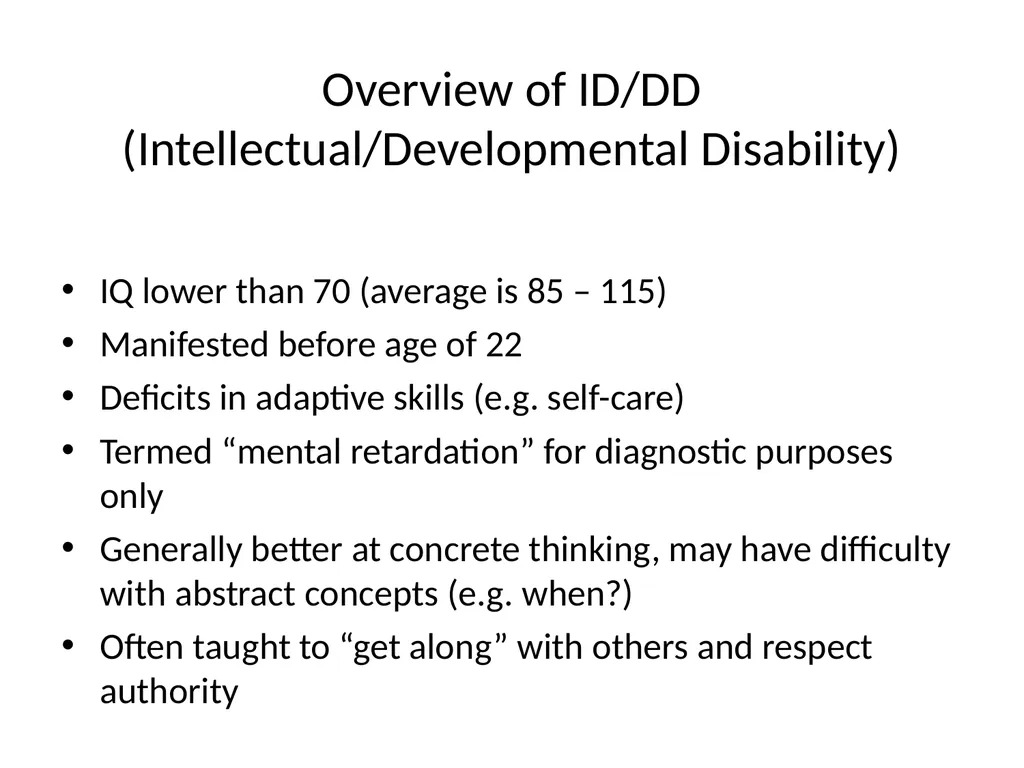
Overview of ID/DD (Intellectual/Developmental Disability) IQ lower than 70 (average is 85 – 115)
Manifested before age of 22
Deficits in adaptive skills (e.g. self-care)
Termed “mental retardation” for diagnostic purposes only
Generally better at concrete thinking, may have difficulty with abstract concepts (e.g. when?)
Often taught to “get along” with others and respect authority<br>
Manifested before age of 22
Deficits in adaptive skills (e.g. self-care)
Termed “mental retardation” for diagnostic purposes only
Generally better at concrete thinking, may have difficulty with abstract concepts (e.g. when?)
Often taught to “get along” with others and respect authority<br>
05
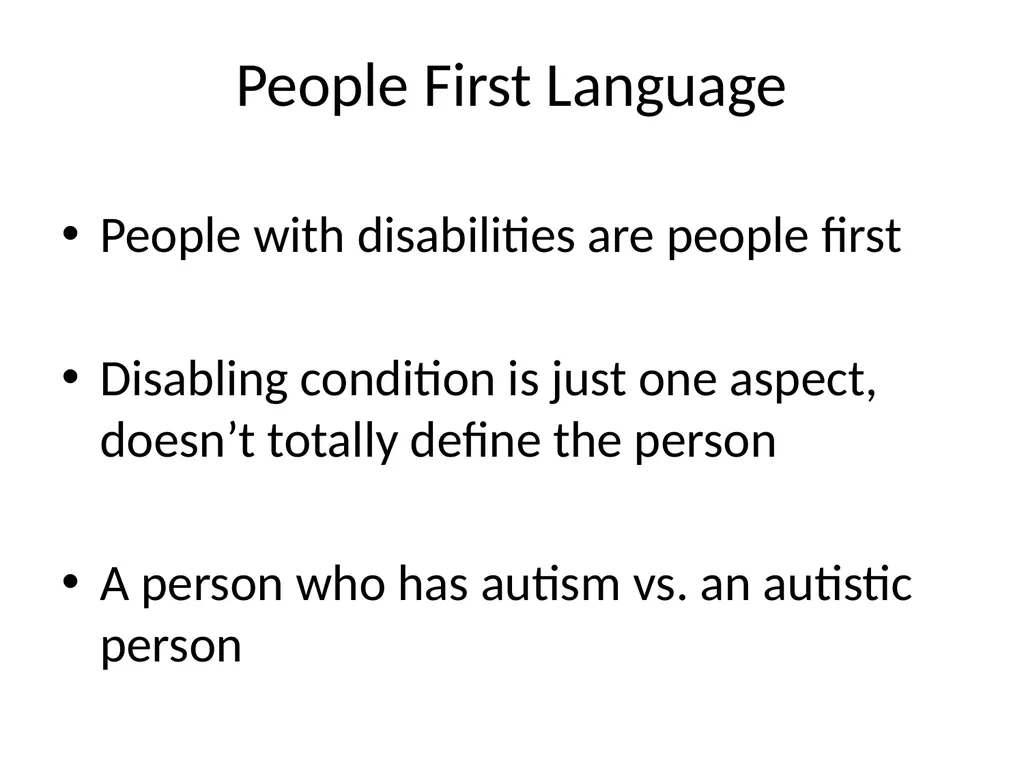
People First Language People with disabilities are people first
Disabling condition is just one aspect, doesn’t totally define the person
A person who has autism vs. an autistic person<br>
Disabling condition is just one aspect, doesn’t totally define the person
A person who has autism vs. an autistic person<br>
06
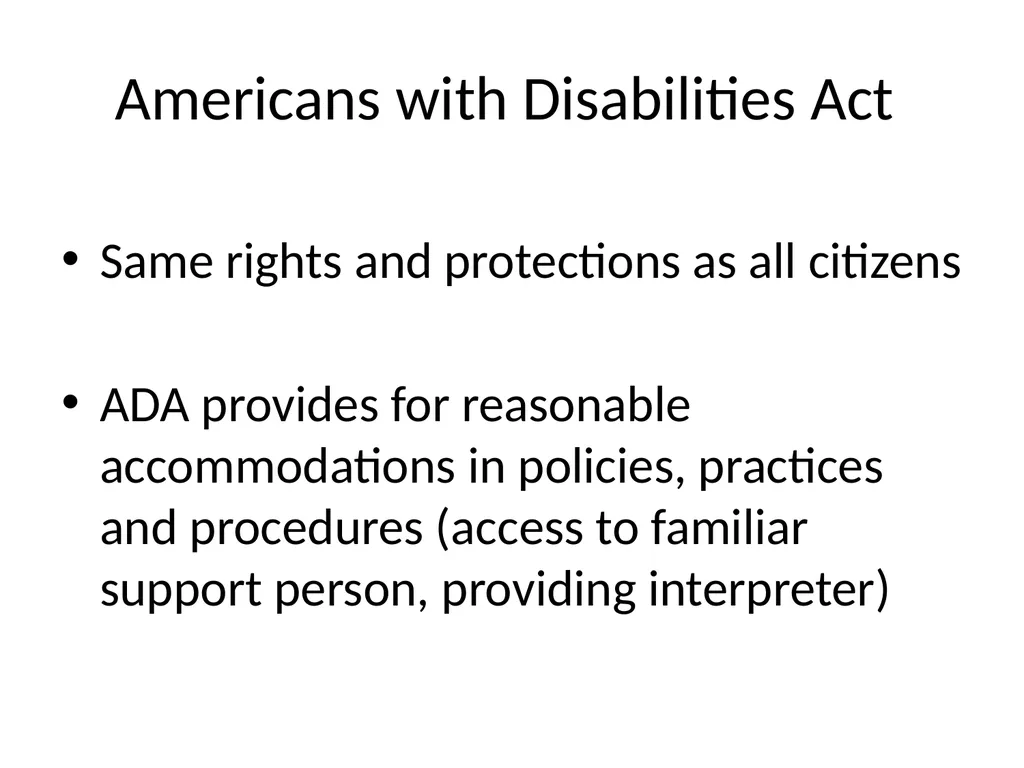
Americans with Disabilities Act Same rights and protections as all citizens
ADA provides for reasonable accommodations in policies, practices and procedures (access to familiar support person, providing interpreter)<br>
ADA provides for reasonable accommodations in policies, practices and procedures (access to familiar support person, providing interpreter)<br>
07
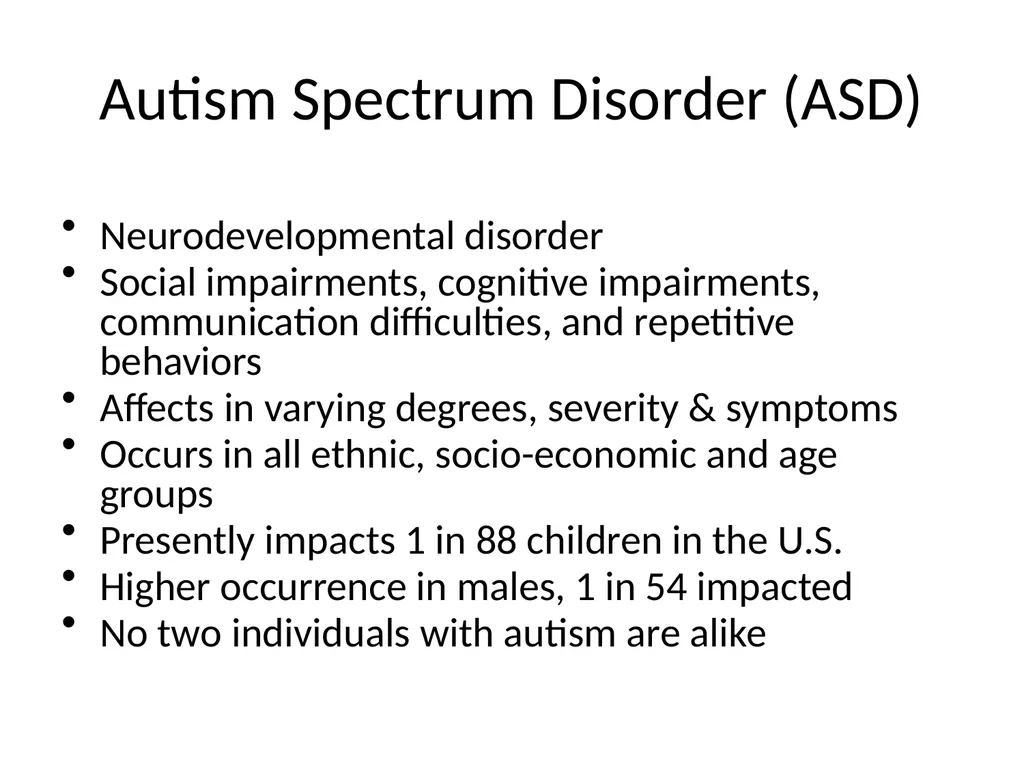
Autism Spectrum Disorder (ASD) Neurodevelopmental disorder
Social impairments, cognitive impairments, communication difficulties, and repetitive behaviors
Affects in varying degrees, severity & symptoms
Occurs in all ethnic, socio-economic and age groups
Presently impacts 1 in 88 children in the U.S.
Higher occurrence in males, 1 in 54 impacted
No two individuals with autism are alike<br>
Social impairments, cognitive impairments, communication difficulties, and repetitive behaviors
Affects in varying degrees, severity & symptoms
Occurs in all ethnic, socio-economic and age groups
Presently impacts 1 in 88 children in the U.S.
Higher occurrence in males, 1 in 54 impacted
No two individuals with autism are alike<br>
08
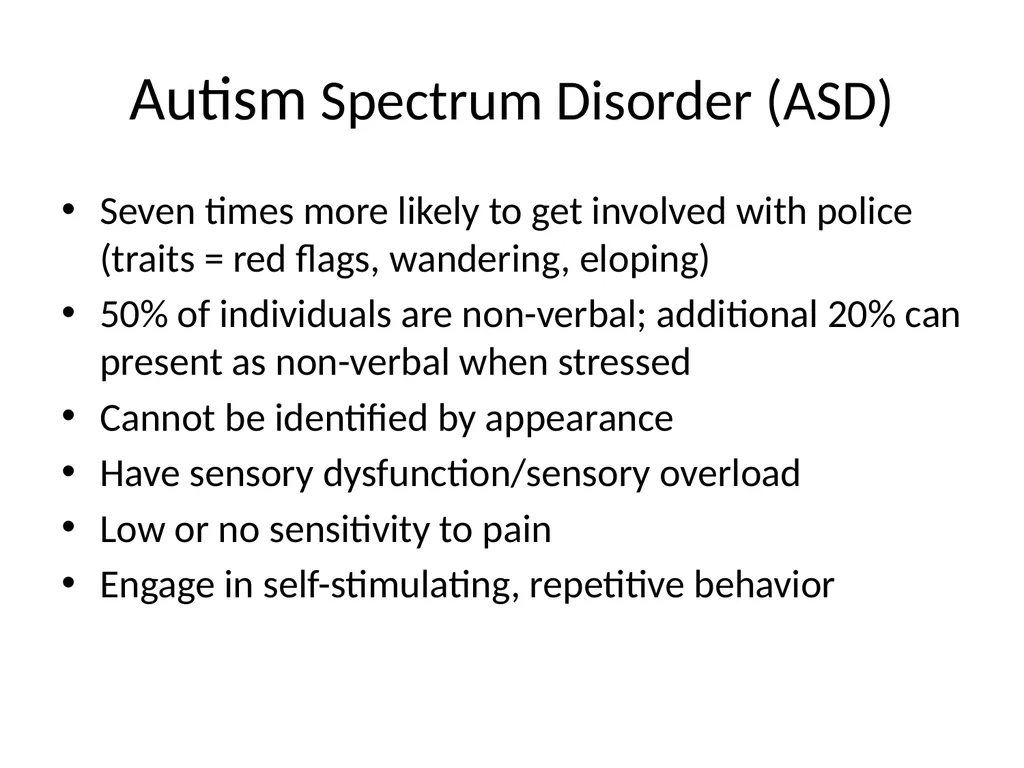
Autism Spectrum Disorder (ASD) Seven times more likely to get involved with police (traits = red flags, wandering, eloping)
50% of individuals are non-verbal; additional 20% can present as non-verbal when stressed
Cannot be identified by appearance
Have sensory dysfunction/sensory overload
Low or no sensitivity to pain
Engage in self-stimulating, repetitive behavior<br>
50% of individuals are non-verbal; additional 20% can present as non-verbal when stressed
Cannot be identified by appearance
Have sensory dysfunction/sensory overload
Low or no sensitivity to pain
Engage in self-stimulating, repetitive behavior<br>
09
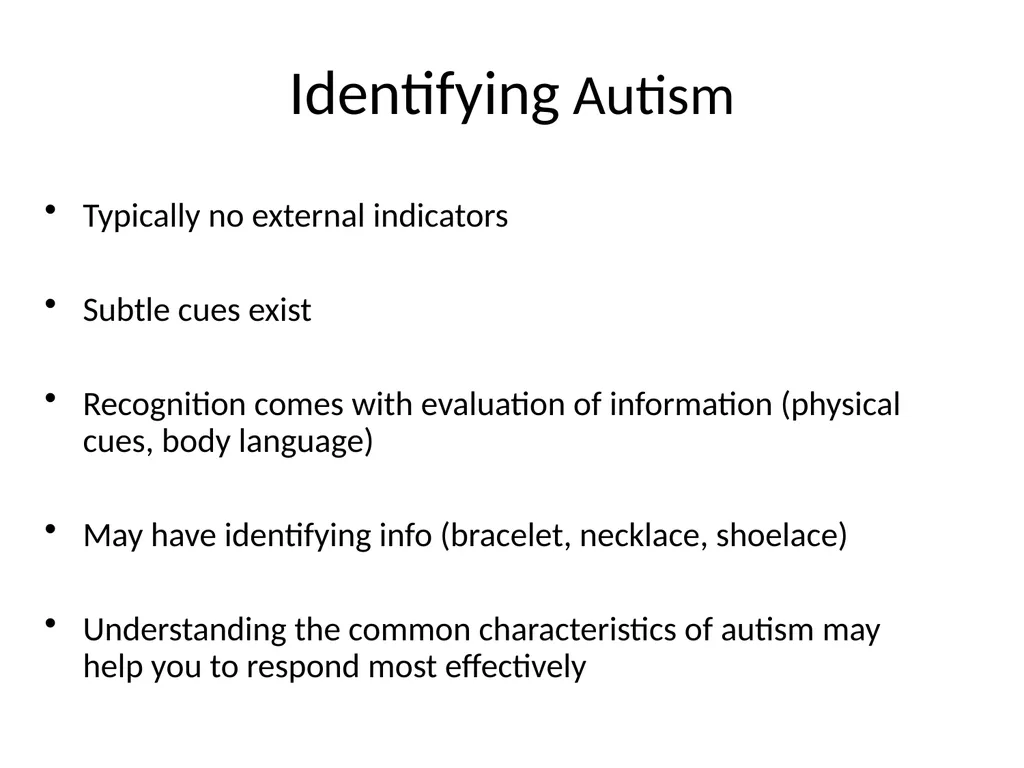
Identifying Autism Typically no external indicators
Subtle cues exist
Recognition comes with evaluation of information (physical cues, body language)
May have identifying info (bracelet, necklace, shoelace)
Understanding the common characteristics of autism may help you to respond most effectively<br>
Subtle cues exist
Recognition comes with evaluation of information (physical cues, body language)
May have identifying info (bracelet, necklace, shoelace)
Understanding the common characteristics of autism may help you to respond most effectively<br>
10
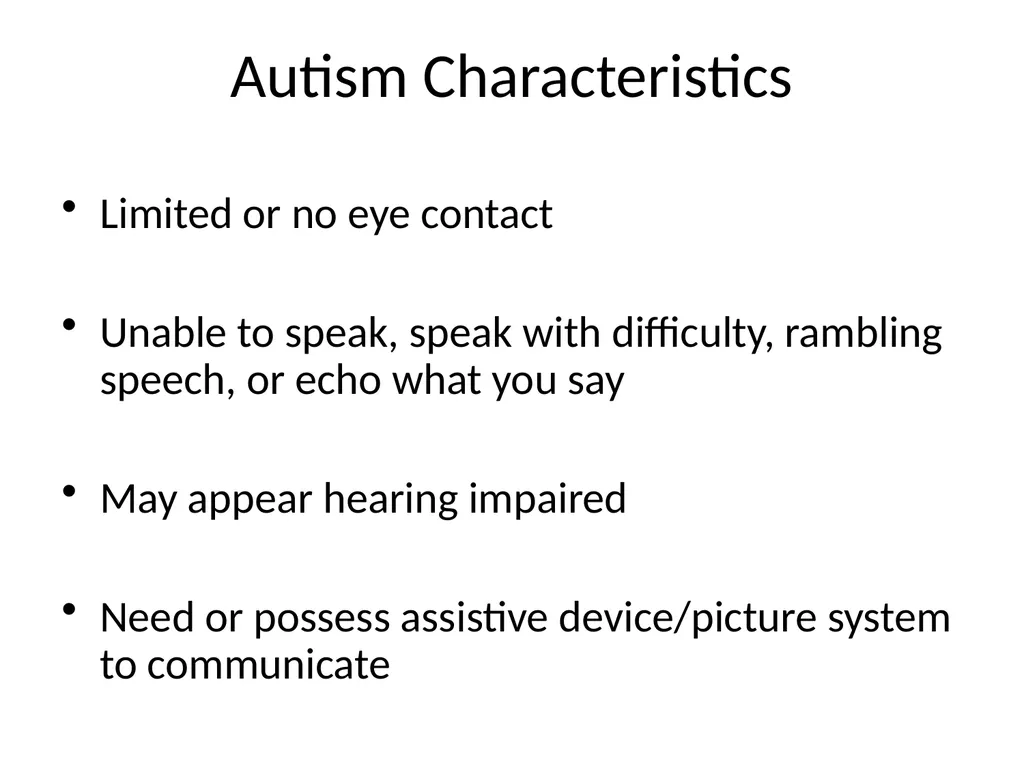
Autism Characteristics Limited or no eye contact
Unable to speak, speak with difficulty, rambling speech, or echo what you say
May appear hearing impaired
Need or possess assistive device/picture system to communicate<br>
Unable to speak, speak with difficulty, rambling speech, or echo what you say
May appear hearing impaired
Need or possess assistive device/picture system to communicate<br>
11
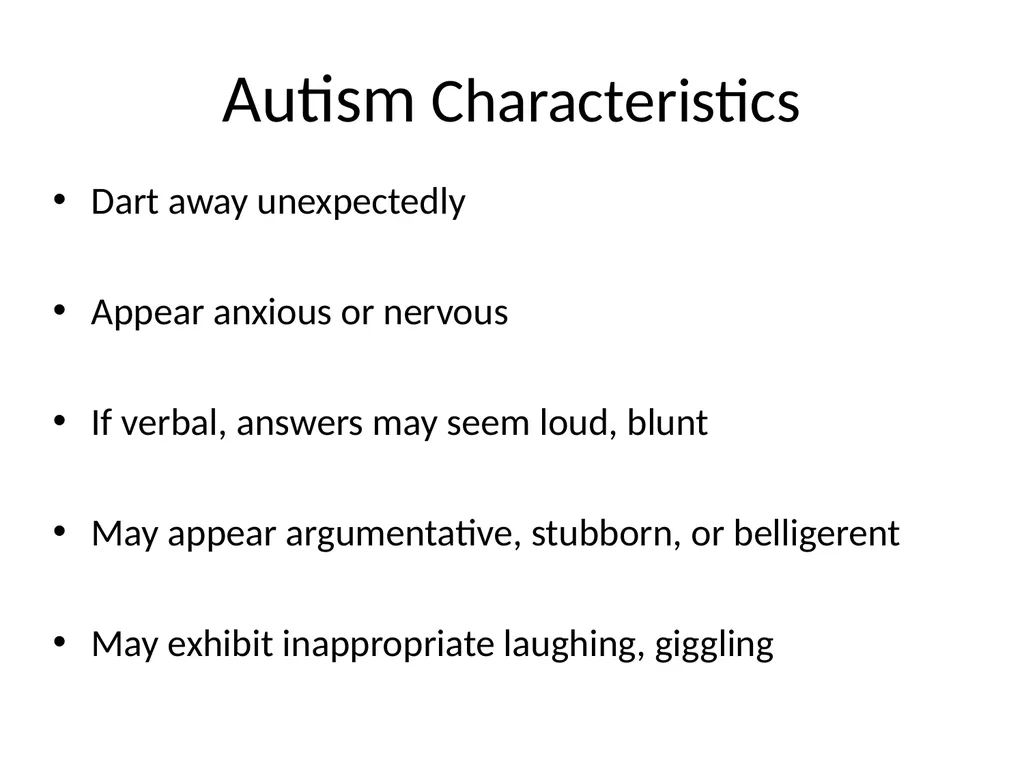
Autism Characteristics Dart away unexpectedly
Appear anxious or nervous
If verbal, answers may seem loud, blunt
May appear argumentative, stubborn, or belligerent
May exhibit inappropriate laughing, giggling<br>
Appear anxious or nervous
If verbal, answers may seem loud, blunt
May appear argumentative, stubborn, or belligerent
May exhibit inappropriate laughing, giggling<br>
12
Autism Characteristics Exhibit forms of self-injurious behavior
Little or no sensitivity to pain
Have no fear of danger or consequence
Sensory dysfunction (loud noises, bright lights)
Display discomfort with change, new situations<br>
Little or no sensitivity to pain
Have no fear of danger or consequence
Sensory dysfunction (loud noises, bright lights)
Display discomfort with change, new situations<br>
13
Autism Risks May not know what to do, how to get help
May not be able to communicate
May not respond to a uniform, badge, or other emergency response symbols
Avoid eye contact (not disrespectful)
Make repetitive motions or sounds (comfort)<br>
May not be able to communicate
May not respond to a uniform, badge, or other emergency response symbols
Avoid eye contact (not disrespectful)
Make repetitive motions or sounds (comfort)<br>
14
Autism Risks Do not question “rules” or those in charge
Are not assertive
Agree with authority figures out of necessity
Always honor others’ opinions
Taught to be obedient and dependent<br>
Are not assertive
Agree with authority figures out of necessity
Always honor others’ opinions
Taught to be obedient and dependent<br>
15
Autism Risks May not understand what is expected of them
Become upset when touched (warn why)
Not provide I.D. when asked.
Lack awareness of danger (may bolt into traffic)<br>
Become upset when touched (warn why)
Not provide I.D. when asked.
Lack awareness of danger (may bolt into traffic)<br>
16
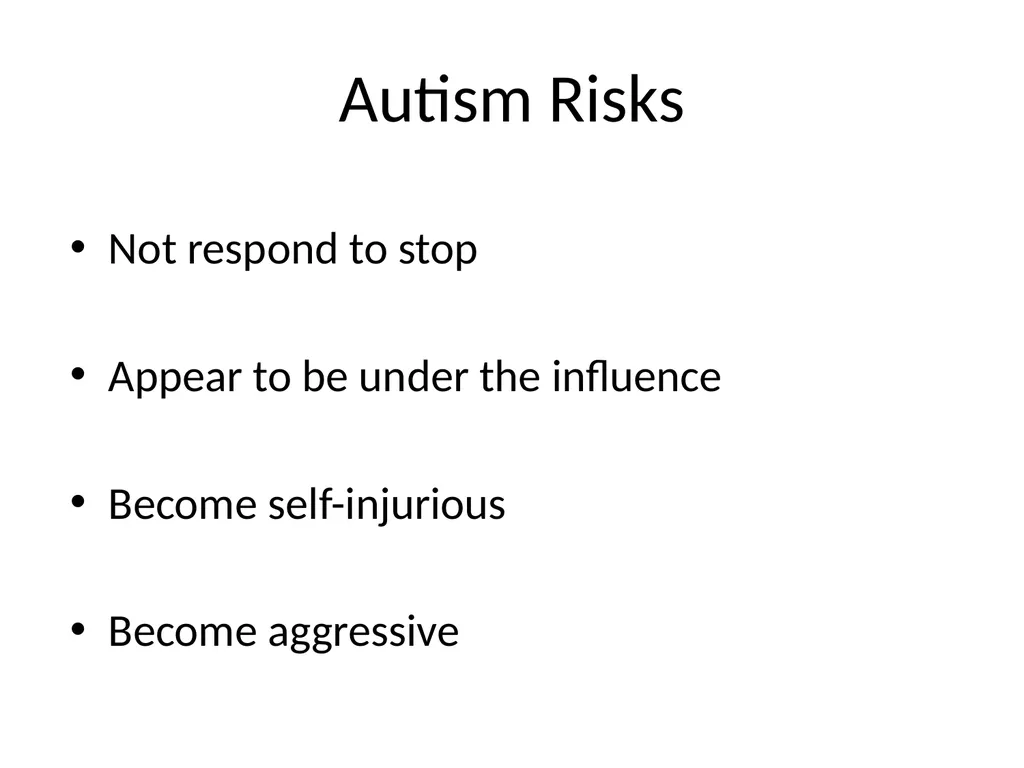
Autism Risks Not respond to stop
Appear to be under the influence
Become self-injurious
Become aggressive<br>
Appear to be under the influence
Become self-injurious
Become aggressive<br>
17
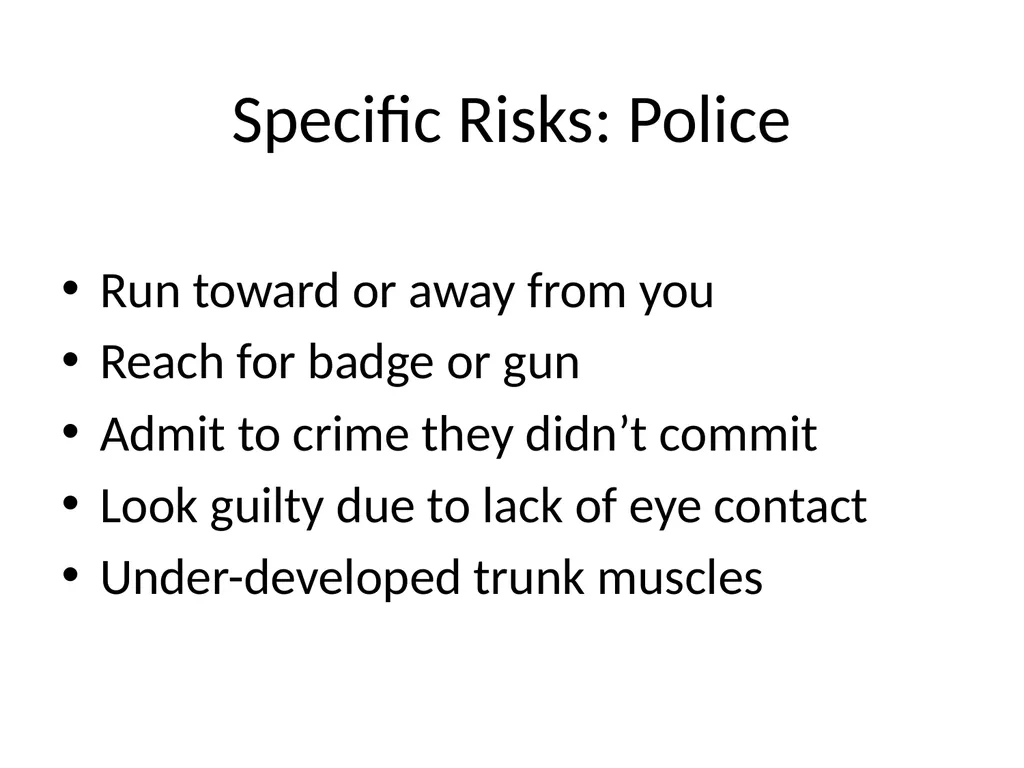
Specific Risks: Police Run toward or away from you
Reach for badge or gun
Admit to crime they didn’t commit
Look guilty due to lack of eye contact
Under-developed trunk muscles<br>
Reach for badge or gun
Admit to crime they didn’t commit
Look guilty due to lack of eye contact
Under-developed trunk muscles<br>
18
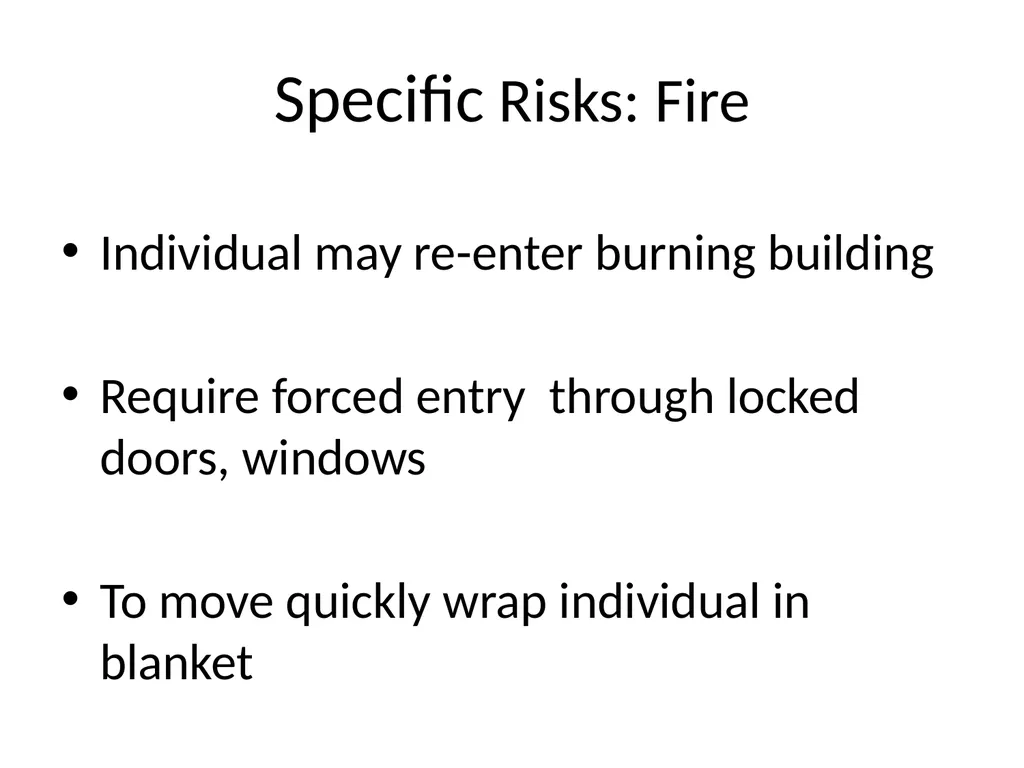
Specific Risks: Fire Individual may re-enter burning building
Require forced entry through locked doors, windows
To move quickly wrap individual in blanket<br>
Require forced entry through locked doors, windows
To move quickly wrap individual in blanket<br>
19
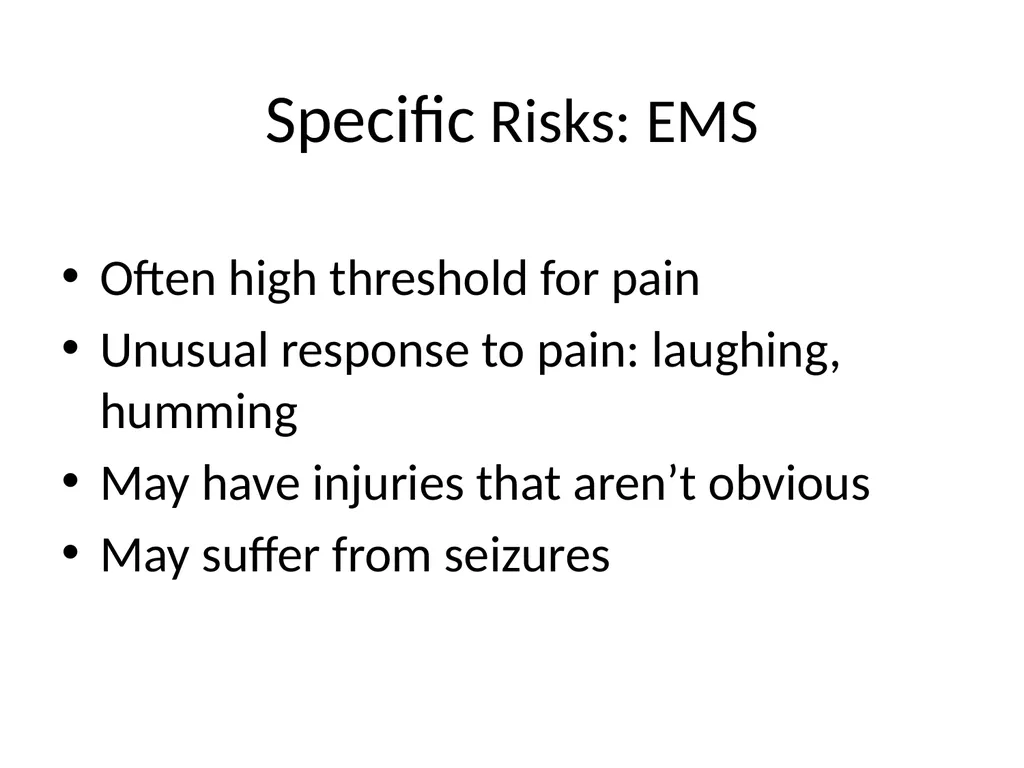
Specific Risks: EMS Often high threshold for pain
Unusual response to pain: laughing, humming
May have injuries that aren’t obvious
May suffer from seizures<br>
Unusual response to pain: laughing, humming
May have injuries that aren’t obvious
May suffer from seizures<br>
20
Challenges for Persons with ASD Difficulty managing and controlling frustration
Difficulty “thinking through” ways of resolving frustrating situations
Persist in inflexibility and ineffective response even in the face of meaningful consequences
Explosive episode may seem out of the blue<br>
Difficulty “thinking through” ways of resolving frustrating situations
Persist in inflexibility and ineffective response even in the face of meaningful consequences
Explosive episode may seem out of the blue<br>
21
Executive Brain Function Deficits Executive function = actions we perform to ourselves, direct at ourselves to accomplish self-control, goal-oriented behavior
Executive function compares to conductor’s role in orchestra
Deficits cause difficulties managing and controlling emotion<br>
Executive function compares to conductor’s role in orchestra
Deficits cause difficulties managing and controlling emotion<br>
22
Agitation, Escalation and Meltdown Early phase “vapor lock”; frustration cases breakdown in ability to think clearly
Strategies to enable calming and refocus
Meltdown – “neural high jacking”, rational thought gone, debilitated state of incoherence
If possible, if safe, wait it out<br>
Strategies to enable calming and refocus
Meltdown – “neural high jacking”, rational thought gone, debilitated state of incoherence
If possible, if safe, wait it out<br>
23
Sensory Over-Stimulation Sensory over-stimulation = Sensory overload
Occurs when sensory experiences are too much for an individual’s nervous system
Cannot process all the input in order to make meaning of the sensory experience
Sensory overload can be physically painful
Negative response: shutdown, escalate, run away<br>
Occurs when sensory experiences are too much for an individual’s nervous system
Cannot process all the input in order to make meaning of the sensory experience
Sensory overload can be physically painful
Negative response: shutdown, escalate, run away<br>
24
Sensory Over-Stimulation Hearing: Loud noise, sound from multiple sources (several people talking at once)
Sight: Bright lights or environments with lots of movement (crowds or fast scene changes on TV).
Smell and Taste: Strong aromas or spicy foods.
Touch: Tactile sensations (touched by another person, the feel of cloth on skin)<br>
Sight: Bright lights or environments with lots of movement (crowds or fast scene changes on TV).
Smell and Taste: Strong aromas or spicy foods.
Touch: Tactile sensations (touched by another person, the feel of cloth on skin)<br>
25
Is Sensory Over-Stimulation a Factor? Look for outward behaviors
Move person to quiet place
Calm creates calm
Geographic containment
Restraint last resort
Avoid face down take down<br>
Move person to quiet place
Calm creates calm
Geographic containment
Restraint last resort
Avoid face down take down<br>
26
Why are First Responders Called? Suspicious behavior
Inappropriate public contact
Wandering<br>
Inappropriate public contact
Wandering<br>
27
Autism and Wandering:
(leading reason for first response contact) Over 20% individuals with ASD encounter First Responders due to wandering/eloping
About half of children with an ASD attempt to elope from a safe environment (4x rate of unaffected)
In 2009 – 2011 accidental drowning accounted for 91% total deaths of children with ASD
32% of parents reported a “close call” with a possible drowning<br>
About half of children with an ASD attempt to elope from a safe environment (4x rate of unaffected)
In 2009 – 2011 accidental drowning accounted for 91% total deaths of children with ASD
32% of parents reported a “close call” with a possible drowning<br>
28
Other Common Reasons
for First Response Parent or caregiver actions misinterpreted
Escalated behaviors at home, retail, schools
Person trespassing, unaware
Person appears to be a threat due to suspected substance abuse<br>
Escalated behaviors at home, retail, schools
Person trespassing, unaware
Person appears to be a threat due to suspected substance abuse<br>
29
Interaction Guidelines If possible locate caregiver or support person
Seek to restrict sensory input (lights, # of people)
Ignore any odd behaviors unless dangerous
If in meltdown, let them de-escalate on their own if safe; be alert for seizures
Restraining a person with autism may result in fight or flight, which can look like intentional aggression<br>
Seek to restrict sensory input (lights, # of people)
Ignore any odd behaviors unless dangerous
If in meltdown, let them de-escalate on their own if safe; be alert for seizures
Restraining a person with autism may result in fight or flight, which can look like intentional aggression<br>
30
Interaction Guidelines Whenever possible, constrain by geographic containment vs. physical force
Avoid chest-down holds as weak chest muscles = difficulty supporting airways
If physical restraint is required, handcuff in front, officer on each side holding upper arms
Generally “firm pressure touch” is preferred<br>
Avoid chest-down holds as weak chest muscles = difficulty supporting airways
If physical restraint is required, handcuff in front, officer on each side holding upper arms
Generally “firm pressure touch” is preferred<br>
31
Interaction Guidelines Use a calm voice, calming body language
Ignore any unusual behavior or disrespectful words
Speak slowly using simple concrete words
Ask one question at a time/ one instruction at a time
Allow 15 – 30 seconds process/response time
Avoid touching if at all possible<br>
Ignore any unusual behavior or disrespectful words
Speak slowly using simple concrete words
Ask one question at a time/ one instruction at a time
Allow 15 – 30 seconds process/response time
Avoid touching if at all possible<br>
32
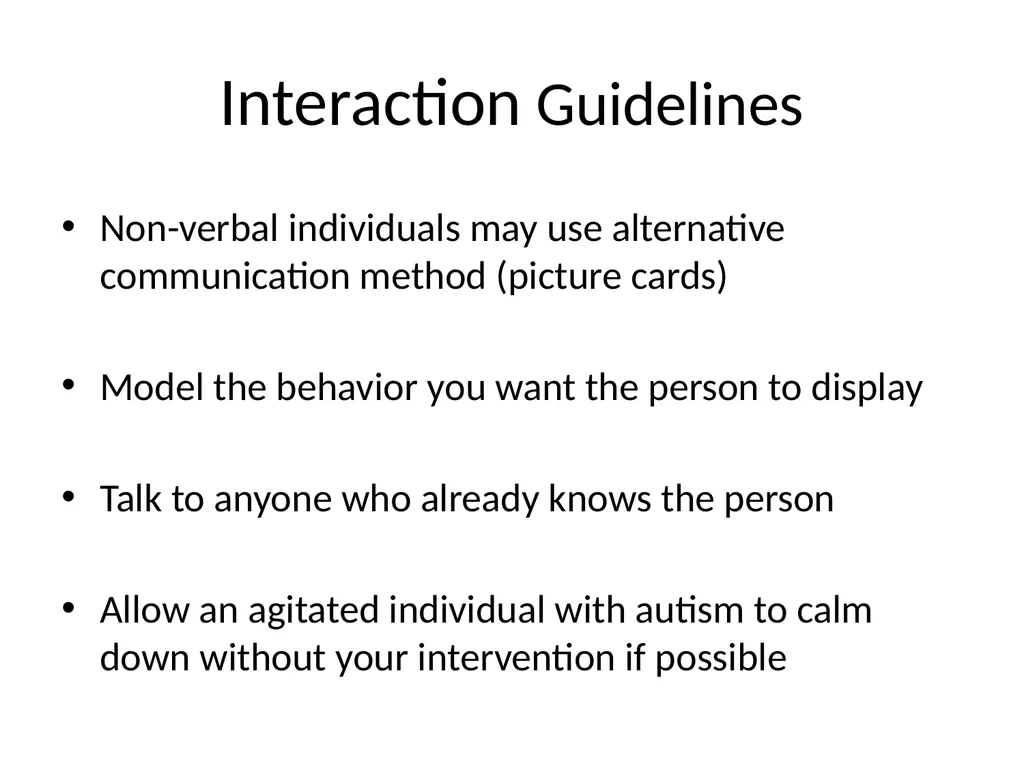
Interaction Guidelines Non-verbal individuals may use alternative communication method (picture cards)
Model the behavior you want the person to display
Talk to anyone who already knows the person
Allow an agitated individual with autism to calm down without your intervention if possible<br>
Model the behavior you want the person to display
Talk to anyone who already knows the person
Allow an agitated individual with autism to calm down without your intervention if possible<br>
33
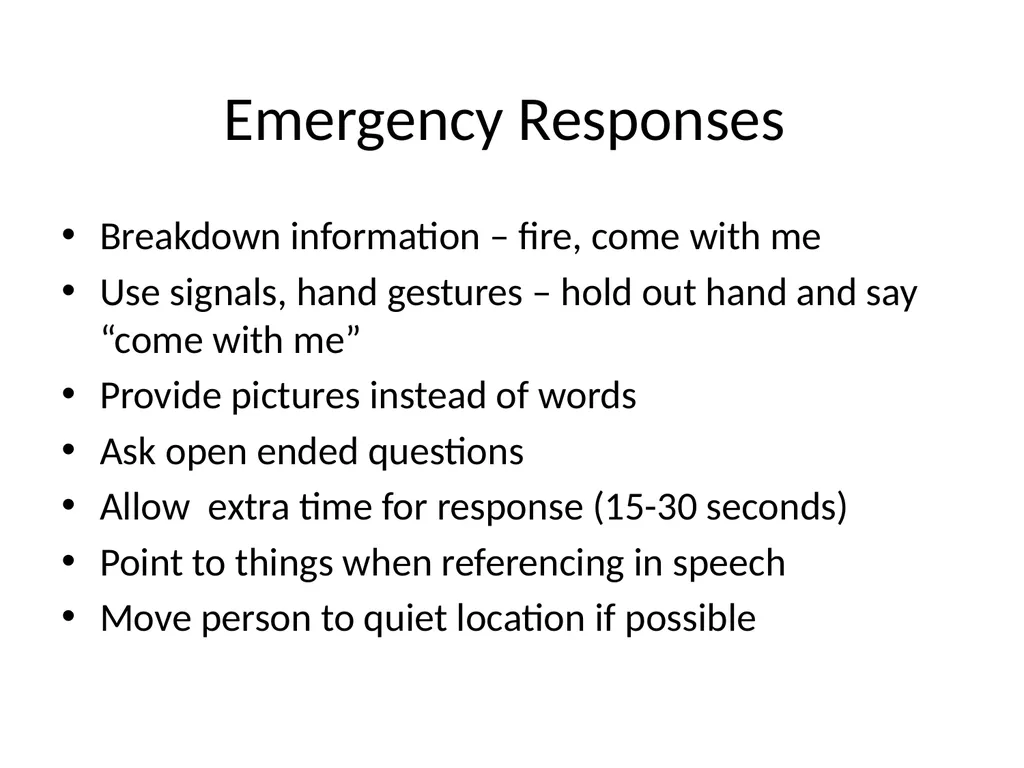
Emergency Responses Breakdown information – fire, come with me
Use signals, hand gestures – hold out hand and say “come with me”
Provide pictures instead of words
Ask open ended questions
Allow extra time for response (15-30 seconds)
Point to things when referencing in speech
Move person to quiet location if possible<br>
Use signals, hand gestures – hold out hand and say “come with me”
Provide pictures instead of words
Ask open ended questions
Allow extra time for response (15-30 seconds)
Point to things when referencing in speech
Move person to quiet location if possible<br>
34
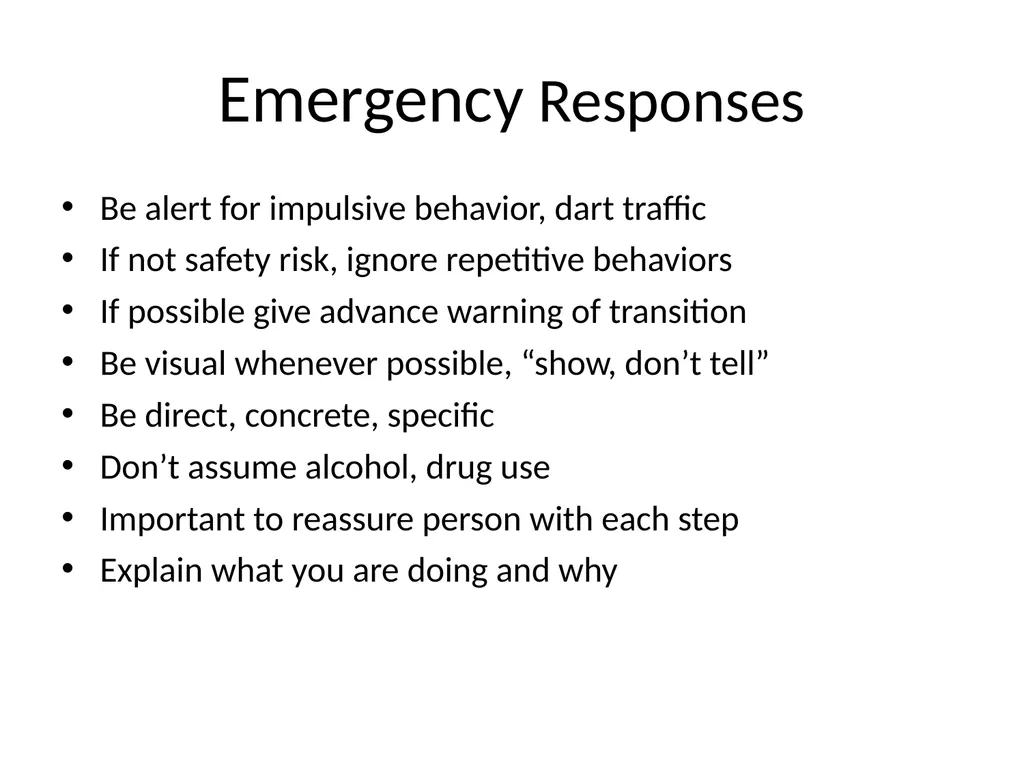
Emergency Responses Be alert for impulsive behavior, dart traffic
If not safety risk, ignore repetitive behaviors
If possible give advance warning of transition
Be visual whenever possible, “show, don’t tell”
Be direct, concrete, specific
Don’t assume alcohol, drug use
Important to reassure person with each step
Explain what you are doing and why<br>
If not safety risk, ignore repetitive behaviors
If possible give advance warning of transition
Be visual whenever possible, “show, don’t tell”
Be direct, concrete, specific
Don’t assume alcohol, drug use
Important to reassure person with each step
Explain what you are doing and why<br>
35
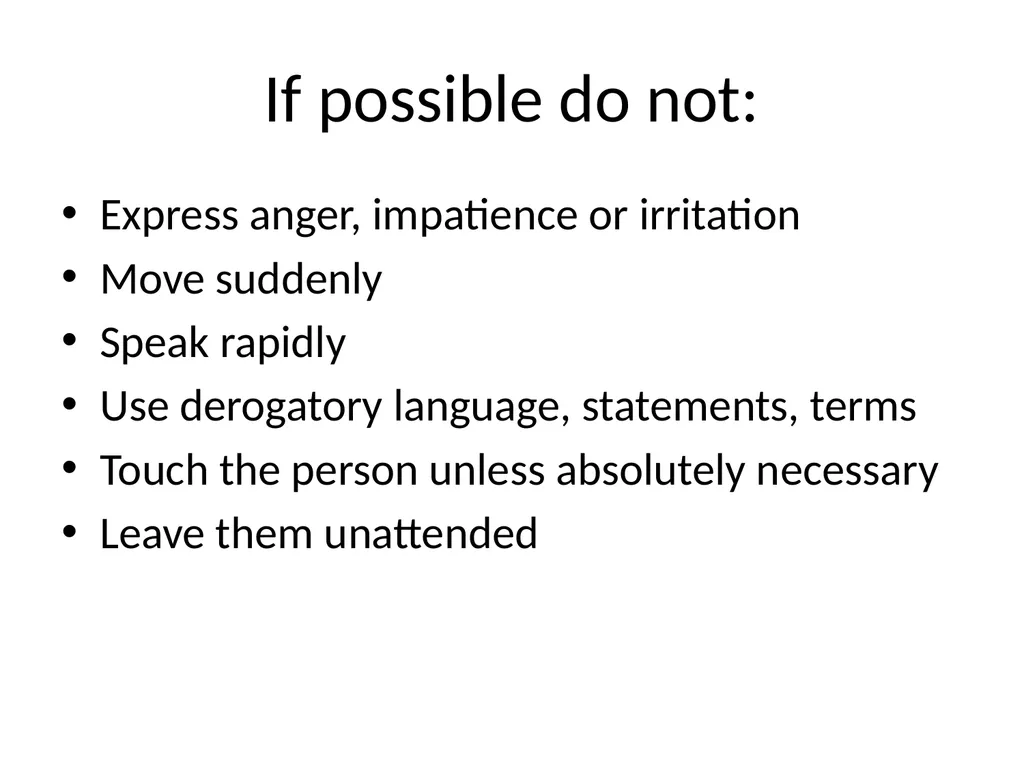
If possible do not: Express anger, impatience or irritation
Move suddenly
Speak rapidly
Use derogatory language, statements, terms
Touch the person unless absolutely necessary
Leave them unattended<br>
Move suddenly
Speak rapidly
Use derogatory language, statements, terms
Touch the person unless absolutely necessary
Leave them unattended<br>
36
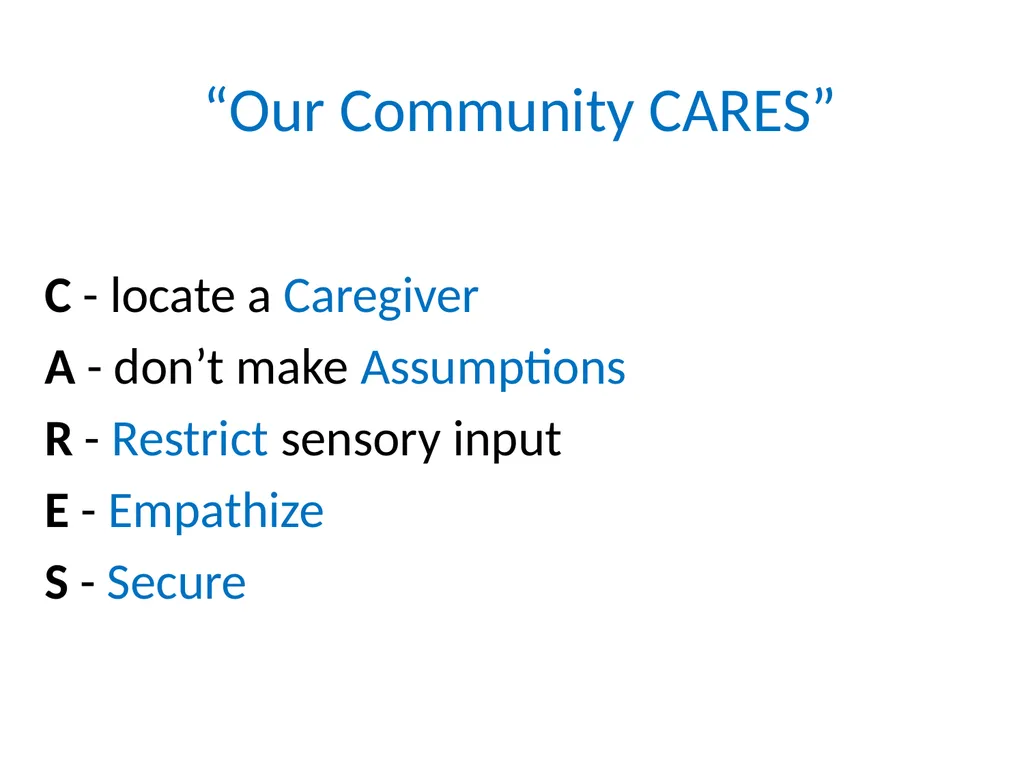
“Our Community CARES” C - locate a Caregiver
A - don’t make Assumptions
R - Restrict sensory input
E - Empathize
S - Secure<br>
A - don’t make Assumptions
R - Restrict sensory input
E - Empathize
S - Secure<br>