
DISASTER MANAGEMENT The Disaster is a sudden,
SB
Published · 22 slides · 0 views

1 / 1
Description
DISASTER MANAGEMENT The Disaster is a sudden, calamitous event bringing great damage, loss, destruction and devastation to life and property. damage caused by disaster is immeasurable and varies with the geographical location, climate and
Related Topics
Share
Embed code
Download this presentation From Below
"DISASTER MANAGEMENT The Disaster is a sudden," is the property of its rightful owner. Permission is granted to download and print the materials on this website for personal, non-commercial use only, and to display it on your personal computer provided you do not modify the materials and that you retain all copyright notices contained in the materials. By downloading content from our website, you accept the terms of this agreement.
Presentation Transcript
01
DISASTER MANAGEMENT The Disaster is a sudden, calamitous event bringing great damage, loss, destruction and devastation to life and property.
damage caused by disaster is immeasurable and varies with the geographical location, climate and the type of the earth surface.
This influences the mental, socio-economic, political and cultural state of the affected area. Generally, disaster has the following effects in the concerned Areas,
1. It completely disrupts the normal day to day life
2. It negatively influences the emergency systems
3. Normal needs and processes like food, shelter, health, etc. are affected and deteriorate depending on the intensity and severity of the disaster.
It may also be termed as “a serious disruption of the functioning of society, causing widespread
human, material or environmental losses which exceed the ability of the affected society to cope using its own resources.”<br>
damage caused by disaster is immeasurable and varies with the geographical location, climate and the type of the earth surface.
This influences the mental, socio-economic, political and cultural state of the affected area. Generally, disaster has the following effects in the concerned Areas,
1. It completely disrupts the normal day to day life
2. It negatively influences the emergency systems
3. Normal needs and processes like food, shelter, health, etc. are affected and deteriorate depending on the intensity and severity of the disaster.
It may also be termed as “a serious disruption of the functioning of society, causing widespread
human, material or environmental losses which exceed the ability of the affected society to cope using its own resources.”<br>
02
Types of Disaster
Generally, disasters are of two types – Natural and Manmade. Based on the devastation, these are further classified into major/minor natural disaster and major/minor manmade disasters. Some of the disasters are listed below.<br>
Generally, disasters are of two types – Natural and Manmade. Based on the devastation, these are further classified into major/minor natural disaster and major/minor manmade disasters. Some of the disasters are listed below.<br>
03
NATURAL DISASTER Major natural disasters:
• Flood
• Cyclone
• Drought
• Earthquake
Minor natural disasters:
• Cold wave
• Thunderstorms
• Heat waves
• Mud slides
• Storm<br>
• Flood
• Cyclone
• Drought
• Earthquake
Minor natural disasters:
• Cold wave
• Thunderstorms
• Heat waves
• Mud slides
• Storm<br>
04
MANMADE DISASTER Major manmade disaster:
• Setting of fires
• Epidemic
• Deforestation
• Pollution due to prawn cultivation
• Chemical pollution.
• Wars
Minor manmade disaster:
• Road / train accidents, riots
• Food poisoning
• Industrial disaster/ crisis
• Environmental pollution<br>
• Setting of fires
• Epidemic
• Deforestation
• Pollution due to prawn cultivation
• Chemical pollution.
• Wars
Minor manmade disaster:
• Road / train accidents, riots
• Food poisoning
• Industrial disaster/ crisis
• Environmental pollution<br>
05
DISASTER MANAGEMENT Disaster Management
There are no standardized rules defining the different phases of the disaster management cycle.
Different agencies use different cycles depending upon their objectives. However, while approaches
vary, it is agreed that disaster management activities should be carried out in a cycle. The following
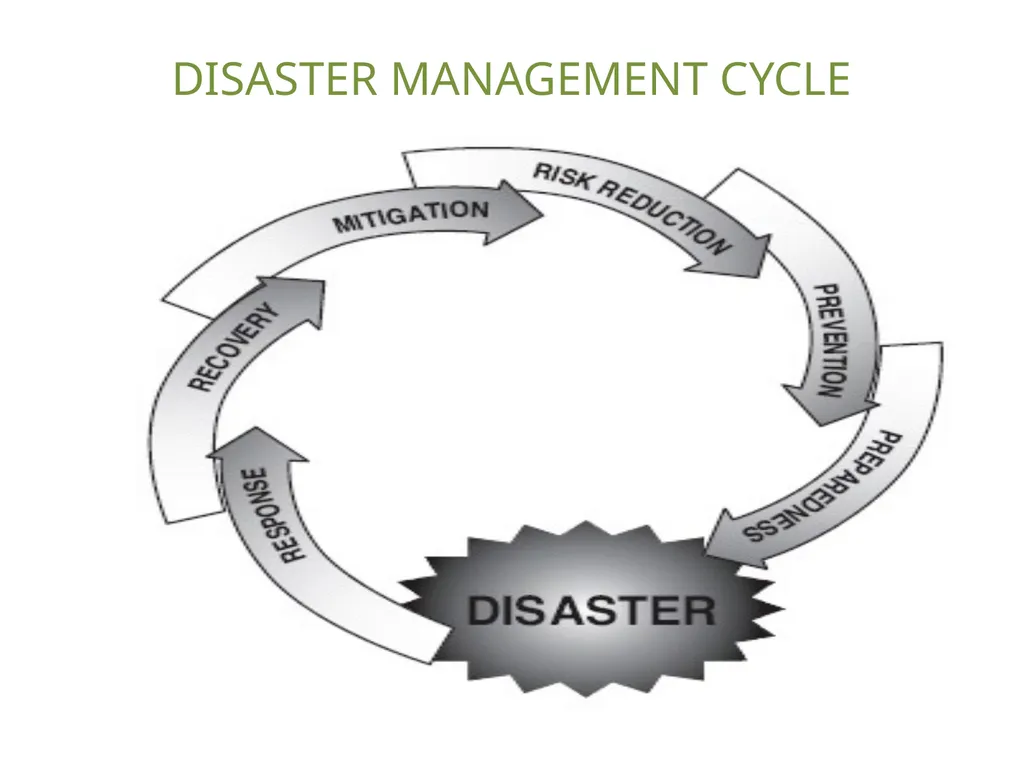
figures illustrates the phases of the disaster management cycle, which are described as follows:<br>
There are no standardized rules defining the different phases of the disaster management cycle.
Different agencies use different cycles depending upon their objectives. However, while approaches
vary, it is agreed that disaster management activities should be carried out in a cycle. The following
figures illustrates the phases of the disaster management cycle, which are described as follows:<br>
06
DISASTER MANAGEMENT CYCLE<br>
07
Disaster Warning Disaster Warning
Disaster Reduction identifies several key parties that play major roles in the disaster management process, especially in disaster warning.
Communities,
Local governments
National governments
Regional institutions and organizations
International bodies
Non-governmental organizations (NGOs)
The private sector
The media
The scientific community<br>
Disaster Reduction identifies several key parties that play major roles in the disaster management process, especially in disaster warning.
Communities,
Local governments
National governments
Regional institutions and organizations
International bodies
Non-governmental organizations (NGOs)
The private sector
The media
The scientific community<br>
08
Channels Used for Disaster Warning Radio and Television
Telephone (Fixed and Mobile)
Short Message Service
Satellite Radio
Internet/Email
GIS and Remote Sensing in Disaster Management<br>
Telephone (Fixed and Mobile)
Short Message Service
Satellite Radio
Internet/Email
GIS and Remote Sensing in Disaster Management<br>
09
Disaster management in India The National Disaster Management Authority (NDMA), headed by the Prime Minister of India, is the Apex Body for Disaster Management in India. The setting up of the NDMA and the creation of an enabling environment for institutional mechanisms at the State and District levels is mandated by the Disaster Management Act, 2005.
Evolution of NDMA
Emergence of an organization is always an evolutionary process. Establishment of NDMA has also gone through the same processes. Towards this aim, the Government of India (GOI), in recognition of the importance of Disaster Management as a national priority, has set up a High-Powered Committee (HPC) in August 1999 and also a nation committee after the 2001 Gujarat earthquake, for making recommendations on the preparation of Disaster Management plans and suggestion effective
mitigation mechanisms.<br>
Evolution of NDMA
Emergence of an organization is always an evolutionary process. Establishment of NDMA has also gone through the same processes. Towards this aim, the Government of India (GOI), in recognition of the importance of Disaster Management as a national priority, has set up a High-Powered Committee (HPC) in August 1999 and also a nation committee after the 2001 Gujarat earthquake, for making recommendations on the preparation of Disaster Management plans and suggestion effective
mitigation mechanisms.<br>
10
Floods A flood is an expanse of water submerging land.
A flood is caused by excess water in a location, usually due to rain from a storm or thunderstorm or the rapid melting of snow.
A flood happens when an area of land, usually low-lying, is covered with water. The worst floods usually occur when a river overflows its banks. The flood is constituted not only of the overflowing water but also of all other waters that are unable to drain off into water channels.<br>
A flood is caused by excess water in a location, usually due to rain from a storm or thunderstorm or the rapid melting of snow.
A flood happens when an area of land, usually low-lying, is covered with water. The worst floods usually occur when a river overflows its banks. The flood is constituted not only of the overflowing water but also of all other waters that are unable to drain off into water channels.<br>
11
Causes of floods 1) When snow on a mountain melts or when a river or a lake of some sort overflows
2) Flooding from water displacement, such as in a landslide,
3) The failure of a dam,
4) An earthquake induced tsunami,
5) A hurricane’s storm surge or melt water from volcanic activity.
6) Flooding of Coastal areas by high tides or by tsunami waves caused by undersea earthquakes.
7) A flood that rises and falls rapidly with little or no advance warning is called a flash flood. Flash
floods usually result from intense rainfall over a relatively small area.<br>
2) Flooding from water displacement, such as in a landslide,
3) The failure of a dam,
4) An earthquake induced tsunami,
5) A hurricane’s storm surge or melt water from volcanic activity.
6) Flooding of Coastal areas by high tides or by tsunami waves caused by undersea earthquakes.
7) A flood that rises and falls rapidly with little or no advance warning is called a flash flood. Flash
floods usually result from intense rainfall over a relatively small area.<br>
12
Elements at risk 1) Buildings built of earth (mud),weak foundation and water soluble material.
2) Basement of buildings.
3) Utilities such as sewerage, water supply.
4) Agricultural equipment and crops, vehicles, fishing boats etc.<br>
2) Basement of buildings.
3) Utilities such as sewerage, water supply.
4) Agricultural equipment and crops, vehicles, fishing boats etc.<br>
13
Effects of flood 1) Physical damage- structures such as buildings get damaged due to flood water. Landslides
2) can also take place. Top soil gets washed away
3) Causalities - people and livestock die due to drowning. It can also lead to epidemics and diseases.
4) Water supplies- Contamination of water. Clean drinking water becomes scarce.
5) Crops and food supplies- shortage of food crops can be caused due to loss of entire harvest.<br>
2) can also take place. Top soil gets washed away
3) Causalities - people and livestock die due to drowning. It can also lead to epidemics and diseases.
4) Water supplies- Contamination of water. Clean drinking water becomes scarce.
5) Crops and food supplies- shortage of food crops can be caused due to loss of entire harvest.<br>
14
Flood management Flood management involves the following activities:
1) Mapping- of the flood prone area.
2) Land use control- no major development should be permitted in the areas subjected to
flooding.
3) Construction of engineered structures- strong structures to withstand flood forces.
Moreover the buildings should be constructed on an elevated area and if necessary
should be build on stits.
4) Flood control- it aims to reduce flood damage. It includes:
a) Flood reduction
b) Flood diversion
c) Flood proofing
For example,
o London is protected from flooding by a huge mechanical barrier across the river
Thames, which is raised when the water level reaches a certain point.
Notable floods
o Jakarta on January 2007 till now is having a 1.5 M flood. whole city is affected. 80 people
killed.
o The floods in peninsular Malaysia, Sabha and Sumithra in December 2006 and January 2007
is considered to be the worst in 100 years, resulting in evaluation of over 100,000 people in
the worst-hit state of Johor at its peak.
o Ethiopia saw one of its worst floods in August 2006.<br>
1) Mapping- of the flood prone area.
2) Land use control- no major development should be permitted in the areas subjected to
flooding.
3) Construction of engineered structures- strong structures to withstand flood forces.
Moreover the buildings should be constructed on an elevated area and if necessary
should be build on stits.
4) Flood control- it aims to reduce flood damage. It includes:
a) Flood reduction
b) Flood diversion
c) Flood proofing
For example,
o London is protected from flooding by a huge mechanical barrier across the river
Thames, which is raised when the water level reaches a certain point.
Notable floods
o Jakarta on January 2007 till now is having a 1.5 M flood. whole city is affected. 80 people
killed.
o The floods in peninsular Malaysia, Sabha and Sumithra in December 2006 and January 2007
is considered to be the worst in 100 years, resulting in evaluation of over 100,000 people in
the worst-hit state of Johor at its peak.
o Ethiopia saw one of its worst floods in August 2006.<br>
15
CYCLONE The name cyclone was first coined by Captain Henry Piddington, Chairman of Marine Court,
Calcutta in 1848. It is derived from Greek word means coil of a snake. Cyclone is an meteorological phenomena in which an area of low pressure characterized by inward spiraling winds that rotate counter clockwise in the northern hemisphere and clockwise in the southern hemisphere of the earth.
Near the places of their origin they are only 80 Km in diameter, but well developed cyclones have their diameter ranging from 300 to 1500 km. They move at faster rate over the oceans than over the land because the irregularities of the land surface retard their speed. The six main types of cyclones are polar cyclone, polar low, extra tropical, subtropical, tropical and mesoscale.<br>
Calcutta in 1848. It is derived from Greek word means coil of a snake. Cyclone is an meteorological phenomena in which an area of low pressure characterized by inward spiraling winds that rotate counter clockwise in the northern hemisphere and clockwise in the southern hemisphere of the earth.
Near the places of their origin they are only 80 Km in diameter, but well developed cyclones have their diameter ranging from 300 to 1500 km. They move at faster rate over the oceans than over the land because the irregularities of the land surface retard their speed. The six main types of cyclones are polar cyclone, polar low, extra tropical, subtropical, tropical and mesoscale.<br>
16
EARTHQUAKE Earthquake is those movements of the earth crust which make the ground vibrate and shake backward and forward. The shaking of earth crust proceeds in the form of waves from the centre of disturbance.
Longitudinal waves, transverse waves and surface waves are the 3 types of waves. Earthquake may be caused by two types of forces.
1) Tectonic occurrence: tectonic occurrence like faulting, breaking of rocks, raising or sinking of layers of the earth, folding of the strata or vapour seeking to escape from the earth.
2) volcanic activity: violent eruptions and intrusion of igneous magma from below the earth.<br>
Longitudinal waves, transverse waves and surface waves are the 3 types of waves. Earthquake may be caused by two types of forces.
1) Tectonic occurrence: tectonic occurrence like faulting, breaking of rocks, raising or sinking of layers of the earth, folding of the strata or vapour seeking to escape from the earth.
2) volcanic activity: violent eruptions and intrusion of igneous magma from below the earth.<br>
17
Types of earthquake: Volcanic earthquake: are associated with the flow of hot magma interrupting volcanoes. These happen to be localized and seldom cause any extensive damage.
Tectonic earthquake: are those which result from structural and injustments inside the earth.
Plutonic earthquake: are those which have their origin at greater depths. They may also be generated in the same manner as the tectonic earthquake far below the surface of the earth.<br>
Tectonic earthquake: are those which result from structural and injustments inside the earth.
Plutonic earthquake: are those which have their origin at greater depths. They may also be generated in the same manner as the tectonic earthquake far below the surface of the earth.<br>
18
Effects of earthquake: Collapse of manmade structure like building, bridges, towers etc.
• Roads get affected due to subsidence of the ground and enormous fissures appear on land.
• Extensive landslides in hilly regions and rocky debris come down to block the path of streams.
• When earthquake are accompanied by volcanic activity, the destruction is very enormous.<br>
• Roads get affected due to subsidence of the ground and enormous fissures appear on land.
• Extensive landslides in hilly regions and rocky debris come down to block the path of streams.
• When earthquake are accompanied by volcanic activity, the destruction is very enormous.<br>
19
Mitigation measures: • Damage to structure can be avoided by prohibiting restriction on such earthquake prone zones.
• Power lines and pipelines can be built with extra slack where they cross such earthquake prone zones.
• New buildings should be constructed with proper earthquake resistant measures. They require secure anchoring and tight bonding of foundations, frame, outer and inner walls, floors and roofs.
• Vulnerable older building located in high risk areas might be rebuilt to withstand anticipated earth quake.<br>
• Power lines and pipelines can be built with extra slack where they cross such earthquake prone zones.
• New buildings should be constructed with proper earthquake resistant measures. They require secure anchoring and tight bonding of foundations, frame, outer and inner walls, floors and roofs.
• Vulnerable older building located in high risk areas might be rebuilt to withstand anticipated earth quake.<br>
20
Land Slides and Mitigation Measures In the recent years, intensive construction activity and the destabilizing forces of nature have aggravated the land Slide problem. Landslides refer to the downward sliding of huge quantities of land masses. Sliding occurs along steep slopes of hills of mountains.
The rate of movement of such a mass is never constant. Landslides occur as a result of changes on a slope, sudden or gradual, either in its composition, structure, hydrology or vegetation. The changes can be due to geology, climate, weathering, changing land use and earthquakes.
The causes of landslides may be grouped into two types:
• Inherent or internal causes.
• Immediate causes.<br>
The rate of movement of such a mass is never constant. Landslides occur as a result of changes on a slope, sudden or gradual, either in its composition, structure, hydrology or vegetation. The changes can be due to geology, climate, weathering, changing land use and earthquakes.
The causes of landslides may be grouped into two types:
• Inherent or internal causes.
• Immediate causes.<br>
21
Effect of landslides: Landslides are not only destructive to the man but also to the structures. One of the most disastrous landslides occurred in Switzerland in 1806, when great masses of loose rock and soil suddenly slide down into the valley form the mountainside. It resulted in killing of 800 persons. Initially the Vajont Dam, was the highest arch failed due to landslide on October 9, 1963, when a rock mass of about 600 million tons slide down into the lake.<br>
22
A significant reduction in hazards caused by landslides can be achieved by prevention of
the exposure of population and facilitates by physically controlling the landslides.
• Development programs that involve modification of the topography, exploitation of
natural resources and change in the balance load on the ground should not be
permitted.
• Some critical measures that could be undertaken to prevent further landslides are
drainage measures, erosion control measures such bamboo check-dams, terracing, jute
and coir netting and rock control measures such as grass plantation, vegetated dry
masonry walls, retaining walls and, most importantly, preventing deforestation and
improving afforestation.
• Disasters cannot be totally prevented. However, early warning systems, careful planning
and preparedness on part of the vulnerable community would help in minimizing the
loss of life and property due to these disasters.<br>
the exposure of population and facilitates by physically controlling the landslides.
• Development programs that involve modification of the topography, exploitation of
natural resources and change in the balance load on the ground should not be
permitted.
• Some critical measures that could be undertaken to prevent further landslides are
drainage measures, erosion control measures such bamboo check-dams, terracing, jute
and coir netting and rock control measures such as grass plantation, vegetated dry
masonry walls, retaining walls and, most importantly, preventing deforestation and
improving afforestation.
• Disasters cannot be totally prevented. However, early warning systems, careful planning
and preparedness on part of the vulnerable community would help in minimizing the
loss of life and property due to these disasters.<br>