04
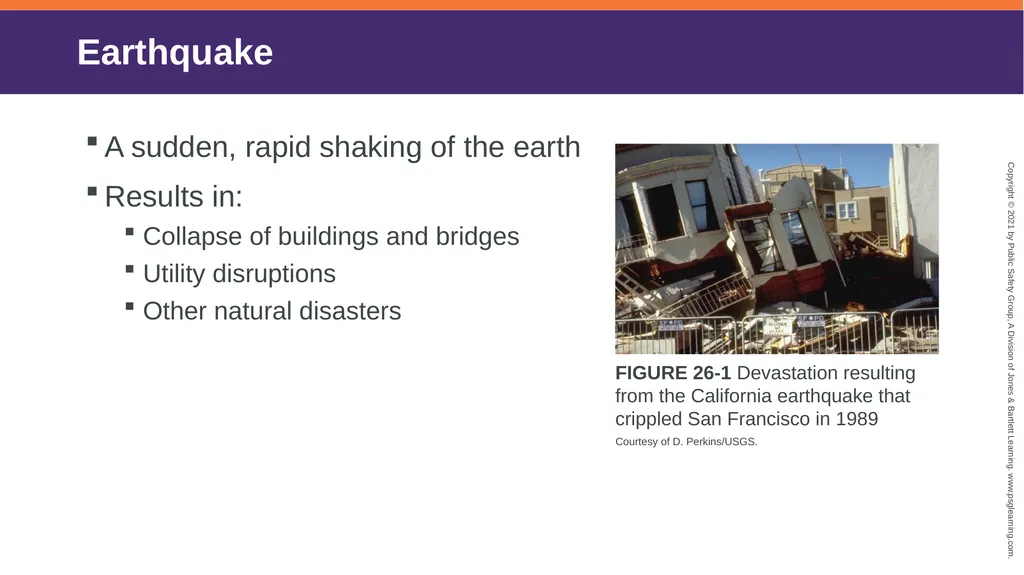
Earthquake: What to Do If indoors:
Take cover or crouch next to a large, sturdy object or against a wall.
Avoid glass, windows and outside doors.
Crouch and cover face.
Stay indoors until shaking stops.
Beware of aftershocks.<br>
05
Earthquake: What to Do (cont.) If in bed, stay there.
If in high-rise building, use stairs.
If outdoors, lie in a spot clear of buildings, trees, power lines.
If in a vehicle, pull over and stay there with your seat belt fastened.<br>
06
Earthquake: What to Do (cont.) If you are trapped in debris, DO NOT panic.
Cover mouth and nose with cloth.
Tap on wall or pipe.
Learn to turn off your gas supply.<br>
07
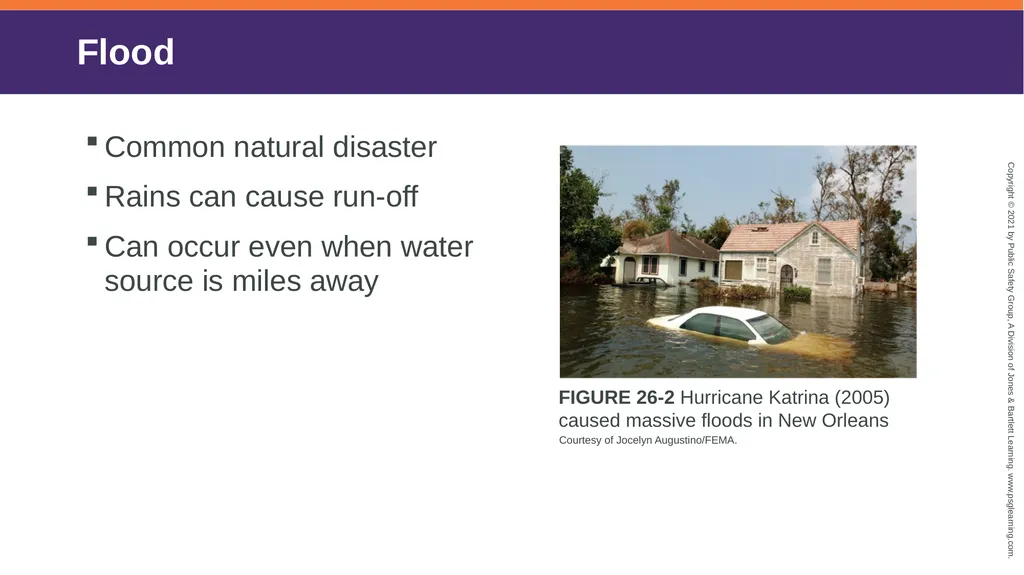
Flood Common natural disaster
Rains can cause run-off
Can occur even when water source is miles away Courtesy of Jocelyn Augustino/FEMA. FIGURE 26-2 Hurricane Katrina (2005) caused massive floods in New Orleans<br>
08
Flood: What to Do Move to higher ground.
Check radio, television, and social media.
If flood watch is issued, prepare to evacuate.
DO NOT walk through moving water.
DO NOT drive into flooded areas.
If flood water rises, abandon car.<br>
09
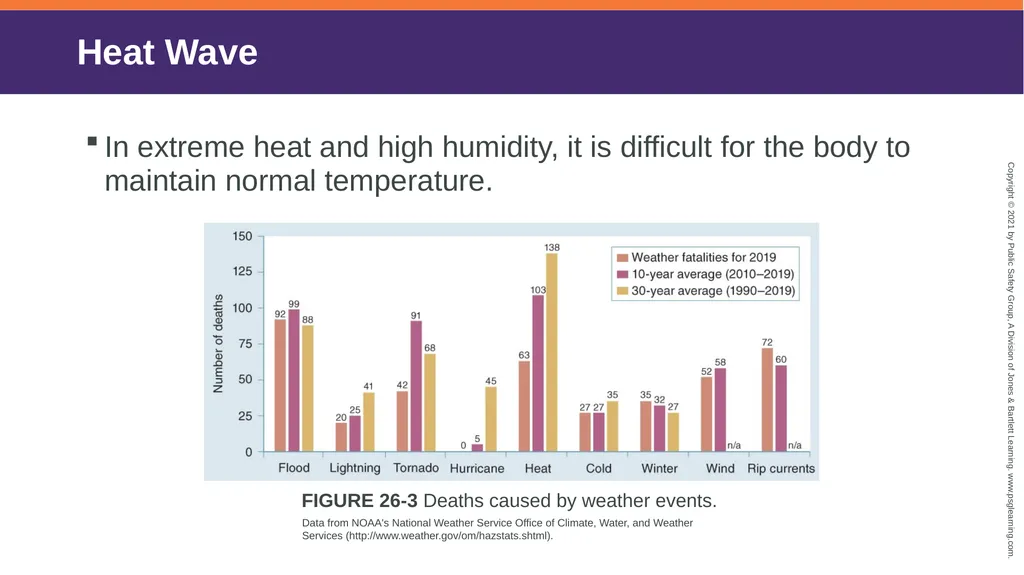
Heat Wave In extreme heat and high humidity, it is difficult for the body to maintain normal temperature. Data from NOAA's National Weather Service Office of Climate, Water, and Weather Services (http://www.weather.gov/om/hazstats.shtml). FIGURE 26-3 Deaths caused by weather events.<br>
10
Heat Wave: What to Do Stay in the coolest location.
Drink plenty of water; avoid alcohol.
Never leave children or pets in vehicles.
Dress in loose-fitting clothes.
Protect your face and head from sun.<br>
11
Heat Wave: What to Do (cont.) Avoid too much sunshine.
Avoid strenuous work during the hottest part of the day.
Spend at least 2 hours in air-conditioning.
Check on family and friends.<br>
12
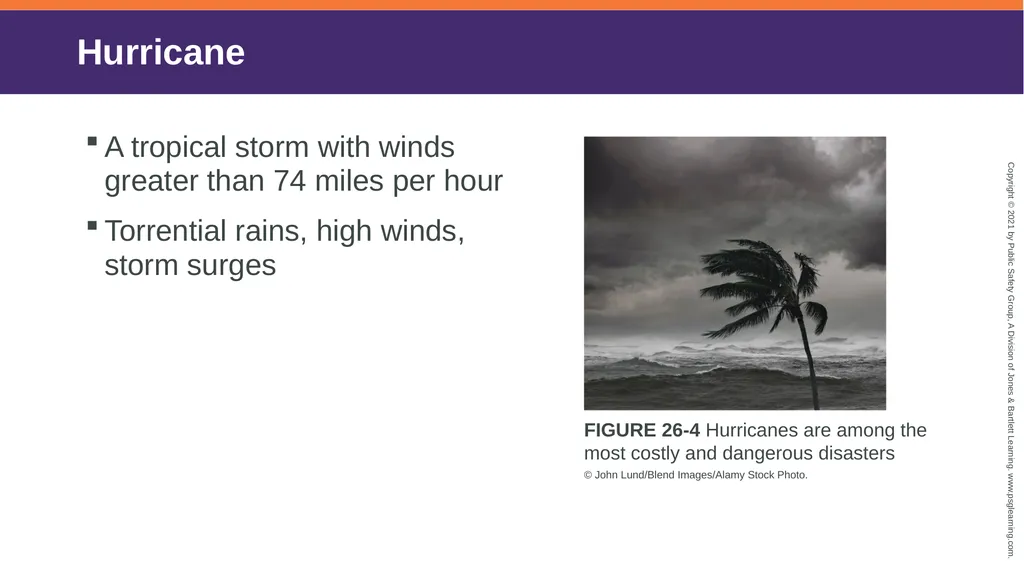
Hurricane A tropical storm with winds greater than 74 miles per hour
Torrential rains, high winds, storm surges © John Lund/Blend Images/Alamy Stock Photo. FIGURE 26-4 Hurricanes are among the most costly and dangerous disasters<br>
13
Hurricane: What to Do Check for hurricane watch.
Secure your home.
If not evacuating, prepare for the worst.
If evacuating:
Prepare backpacks with disaster supplies.
Fuel your vehicle; review evacuation routes.<br>
14
Hurricane: What to Do (cont.) Evacuate early if:
Authorities announce evacuation
You live in mobile home or high-rise
You live on or near water
You think you are in danger<br>
15
Hurricane: What to Do (cont.) If local authorities order an evacuation:
Leave immediately.
Follow evacuation routes.
If not evacuating, protect from strong wind.
Avoid using phone.<br>
16
Landslides Masses of rock, earth, or debris move down a slope.
Occur in almost every state
Small or large, fast or slow
Associated with heavy rainfall or rapid snowmelt<br>
17
Landslide: What to Do Stay alert.
Consider evacuating.
Listen for unusual sounds.
Watch for changes in water flow.
Be alert when driving.
If at home, move to second level.<br>
18
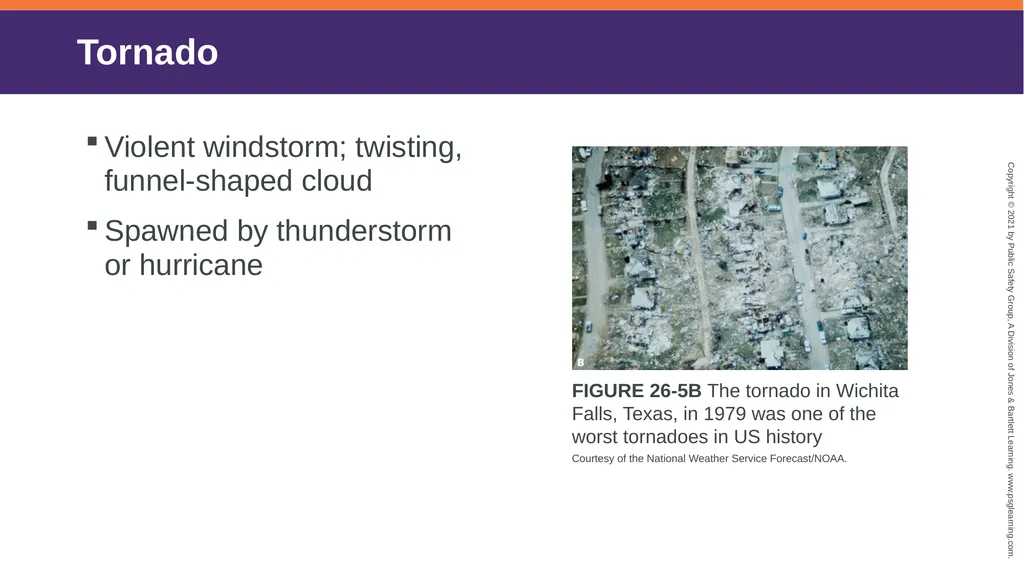
Tornado Violent windstorm; twisting, funnel-shaped cloud
Spawned by thunderstorm or hurricane Courtesy of the National Weather Service Forecast/NOAA. FIGURE 26-5B The tornado in Wichita Falls, Texas, in 1979 was one of the worst tornadoes in US history<br>
19
Tornado: What to Do Go to windowless interior or below-ground room.
Get under sturdy furniture.
If outdoors, get indoors or lie in a ditch.
If at work, go to designated shelter.
If you are in a vehicle, get out and take shelter in a nearby building.<br>
20
Tsunami Series of waves generated by an undersea disturbance
Most waves are less than 18 feet.
Risk areas are less than 50 feet above sea level and less than 1 mile from shore.<br>
21
Tsunami: What to Do Listen for emergency information.
Stay away until told it is safe to return.
DO NOT go to the shoreline.
DO NOT assume tsunami is over after first wave.<br>
22
Volcano Eruption Volcano: mountain that opens to reservoir of molten rock
Danger from ash, falling rock, landslides, and floods<br>
23
Volcano Eruption: What to Do Follow evacuation orders.
If indoors, close all windows and doors.
If outdoors, seek shelter.
Protect yourself.
Stay out of volcano area.<br>
24
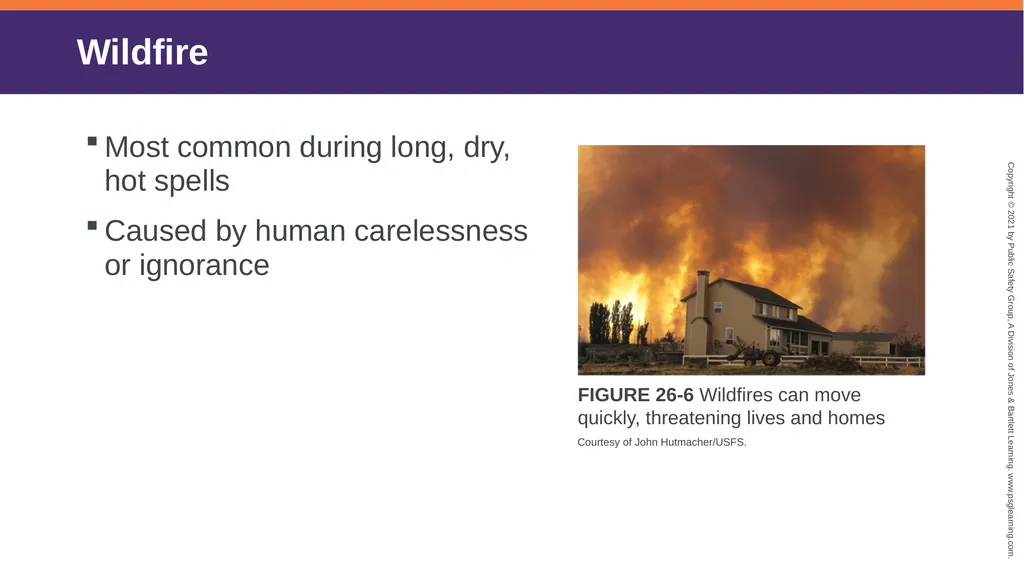
Wildfire Most common during long, dry, hot spells
Caused by human carelessness or ignorance Courtesy of John Hutmacher/USFS. FIGURE 26-6 Wildfires can move quickly, threatening lives and homes<br>
25
Wildfire: What to Do Listen for emergency information.
Follow evacuation orders.
Choose a route away from fire.
Watch for direction of fire.
DO NOT block firefighting entrance routes.<br>
26
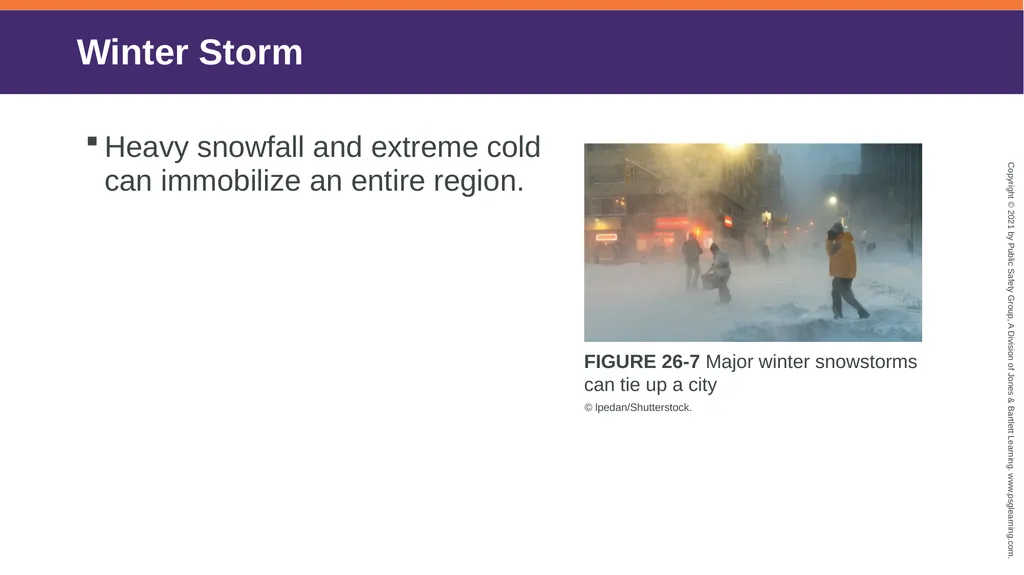
Winter Storm Heavy snowfall and extreme cold can immobilize an entire region. © lpedan/Shutterstock. FIGURE 26-7 Major winter snowstorms can tie up a city<br>
27
Winter Storm: What to Do Listen for emergency information.
Conserve fuel.
Eat and drink regularly.
Never use outside heat sources indoors.<br>
28
Winter Storm: What to Do (cont.) If outdoors:
Dress warmly in layers.
Avoid overexertion.
Be aware of signs of frostbite or hypothermia.
Change out of wet clothing.<br>
29
Winter Storm: What to Do (cont.) If trapped in a vehicle:
Pull over, turn on hazards, stay in vehicle.
Run the engine and heater 10 minutes per hour to keep warm.
Exercise.
Take turns sleeping.
Avoid dehydration.
Conserve battery power.<br>
30
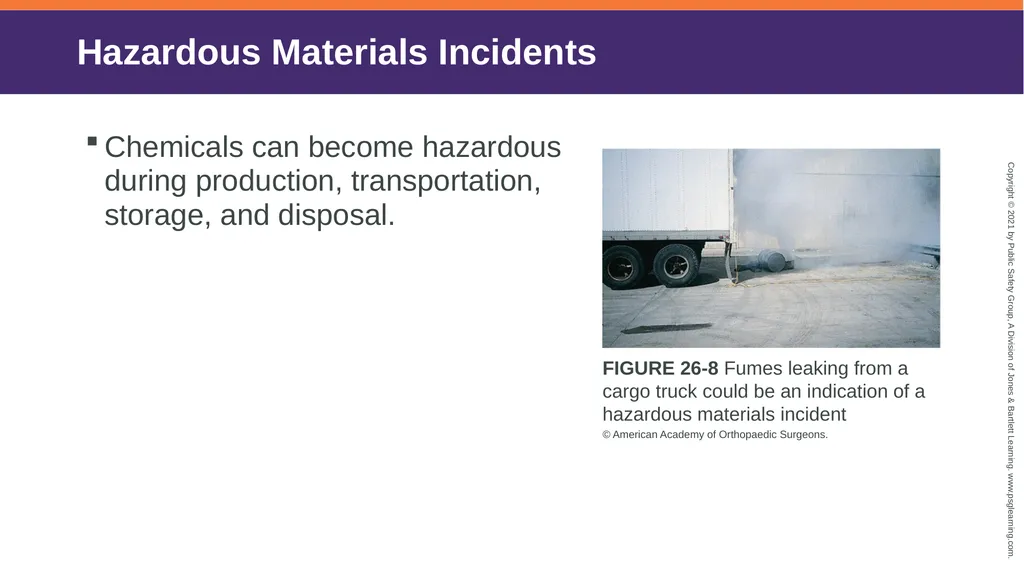
Hazardous Materials Incidents Chemicals can become hazardous during production, transportation, storage, and disposal. © American Academy of Orthopaedic Surgeons. FIGURE 26-8 Fumes leaking from a cargo truck could be an indication of a hazardous materials incident<br>
31
Hazardous Materials Incident: What to Do Call 9-1-1.
Stay away from the incident site.
Stay upstream, uphill, and upwind.
If in a vehicle, go inside or close windows and vents.
Follow evacuation instructions.<br>
32
Hazardous Materials Incident: What to Do (cont.) If requested to stay indoors:
Close doors and windows.
Shut off air-conditioning and vents.
Seal yourself in above-ground room.
Listen to emergency broadcasts.
When danger has passed, flush out air.<br>
33
Nuclear Power Plants Operate in most states
Produce 20% of power
Unintentional radiation exposures are possible.<br>
34
Nuclear Power Plant Emergency: What to Do Tune in to radio and television.
Follow evacuation orders.
Remain indoors.
Do not use phone unless necessary.
If you suspect exposure, take a shower.
Seal clothes in a plastic bag.
Seek medical treatment.<br>
35
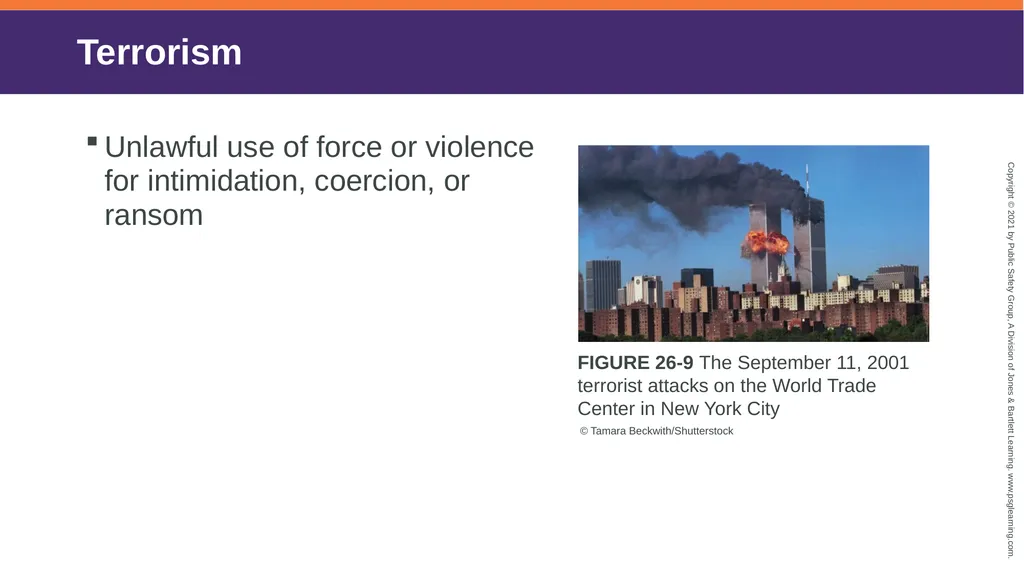
Terrorism Unlawful use of force or violence for intimidation, coercion, or ransom © Tamara Beckwith/Shutterstock FIGURE 26-9 The September 11, 2001 terrorist attacks on the World Trade Center in New York City<br>
36
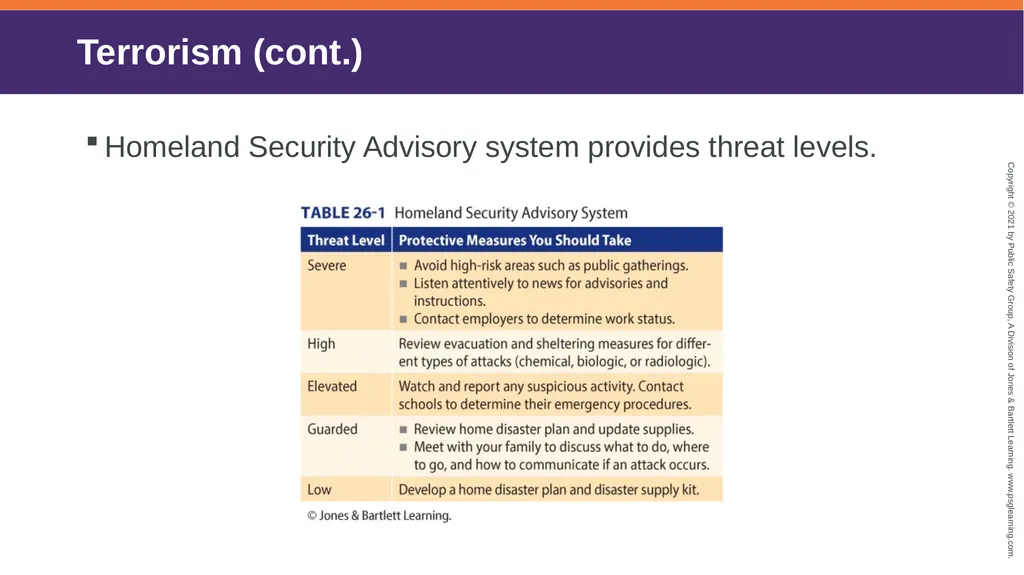
Terrorism (cont.) Homeland Security Advisory system provides threat levels.<br>
37
Chemical and Biologic Agents Chemical warfare agents are poisonous vapors, aerosols, liquids, or solids.
Biologic agents are organisms or toxins that can kill or incapacitate people, livestock, and crops.<br>
38
Chemical or Biologic Attack: What to Do Follow emergency broadcast directions.
If indoors:
Turn off all ventilation.
Go into room with fewest openings.
Seal doors and windows.
Avoid furnace or utility room.
DO NOT use major appliances.<br>
39
Chemical or Biologic Attack: What to Do (cont.) If outdoors:
Remain in protected areas.
Try and get upwind and indoors.<br>
40
Nuclear and Radiologic Weapons Nuclear explosions cause blinding light, intense heat, radiation, and fires.
A radiologic dispersion device (dirty bomb) is designed to scatter sublethal radiation.<br>
41
Nuclear or Radiologic Attack: What to Do Avoid looking at the flash or fireball.
Take cover as soon as warned.
If outside, lie on ground and cover head.
Beware of blast waves.
Protect from fallout.
Keep a battery-operated radio with you.<br>