DISASTER TYPES DISASTERS: Disruption on a massive scale, either natural or man-made, occurring in short or long periods of time is termed as Disaster. Disasters can lead to human, material, economic or environmental hardships, which can be
"DISASTER TYPES DISASTERS: Disruption on a massive" is the property of its rightful owner. Permission is granted to
download and print the materials on this website for personal, non-commercial use only, and to display it
on your personal computer provided you do not modify the materials and that you retain all copyright
notices contained in the materials. By downloading content from our website, you accept the terms of this
agreement.
Presentation Transcript
01
DISASTER TYPES<br>
02
DISASTERS:
Disruption on a massive scale, either natural or man-made, occurring in short or long periods of time is termed as Disaster. Disasters can lead to human, material, economic or environmental hardships, which can be beyond the bearable capacity of the affected society.<br>
03
NATURAL DISASTERS<br>
04
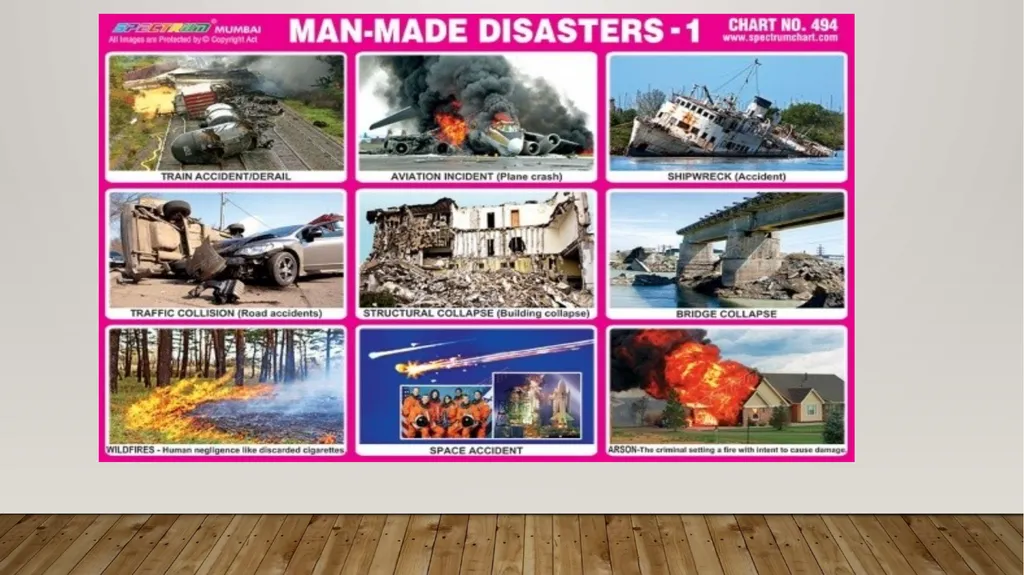
Man-made / anthropogenic disasters<br>
05
Natural Disasters
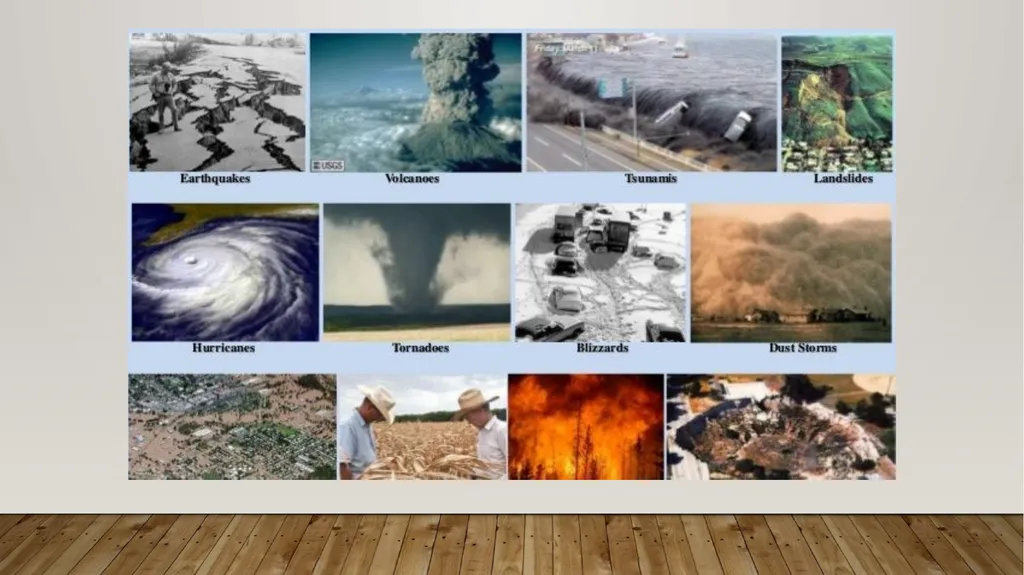
Natural disasters are defined as a natural event that occurs slowly or rapidly and causes immediate widespread devastation on human health leading to death and suffering like earthquakes cyclones floods, tsunamis,droughts etc. Some biological activities, such as rainfall, can also turn into natural disasters when they occur above the average limit. These disasters are mainly characterized by various factors such as their intensity or magnitude, area of the range, duration, speed of onset, etc.<br>
06
Geological Disasters
Geological disasters refer to catastrophic events that arise due to Earth's variations, either above or below the Earth's surface. In particular, volcanic eruptions often occur where tectonic plates make contact. On the other side, earthquakes are prone to areas with active plate tectonics.
Some common examples of geological disasters include earthquakes, avalanches, landslides, tsunamis, sinkholes, volcanic eruptions, etc.<br>
07
Hydrological Disasters
Hydrological disaster refers to instantaneous and violent events that occur below the Earth's surface or in the atmosphere due to variations in water quality, movement, or distribution. A tsunami is a large column of water or waves mainly caused by the displacement of high amounts of water. They are usually caused by biological activities, such as volcanic eruptions or earthquakes, under the sea.<br>
08
Climatological Disasters
Climatological Disasters refer to immediate and violent changes in the earth's environment related to or caused by the earth's atmosphere. It is a hazard mainly caused by long-lived/meso to macro-scale processes in the spectrum from intra-seasonal to multi-decadal climate variability. Moreover, these types of disasters can last from minutes to days. They are further classified as Extreme Temperature and Wildfire. Extreme Temperature events are identified as cold waves, heat waves, and severe winter situations (e.g., icing, avalanche, snow pressure, freezing rain, etc.). Besides, wildfire is identified as the forest fires and land fires (fires due to grass, scrub, etc.).<br>
09
Biological Disasters
Biological disasters refer to natural and unfortunate events that can cause diseases, disabilities, or even deaths at an average to a larger rate of various species, including humans and plants. Biological disasters are defined as catastrophic scenarios caused by living or non-living organisms that cause large-scale severe diseases, viruses, or infections in plants, humans, and other species. These disasters are usually caused by micro-organisms such as infectious, bacteria, toxins, viruses, etc. Some common examples of biological disasters include animal plagues and insect-borne diseases.<br>
10
Space Disasters
Space disasters are different types of disasters. These usually involve natural actions in space, such as solar flares, airburst events, and impact events. At least once, the impact events have occurred in the history of around 4.5 billion years of the Earth. It is also said that it caused the extinction of all non-avian dinosaurs several million years ago. Solar flares are defined as the sudden release of extensively large amounts of solar radiation by the sun. Airburst events are observed as the enormous energetic explosions of rays (e.g., Gamma-ray) in distant galaxies. If such an event occurs again today, it may result in many species' mass extinction, including humans.<br>