
Discovery Research For APIs: Why And How Andrew
SB
Published · 36 slides · 0 views

1 / 1
Description
Discovery Research For APIs: Why And How Andrew Fichter Product Owner VA Lighthouse APIs Maria Vidart-Delgado Sr. UX Researcher Ad Hoc LLC - VA Lighthouse APIs 2021 User Experience Summit June 23, 2021 Agenda What are VA Lighthouse APIs?
Related Topics
Download this presentation From Below
"Discovery Research For APIs: Why And How Andrew" is the property of its rightful owner. Permission is granted to download and print the materials on this website for personal, non-commercial use only, and to display it on your personal computer provided you do not modify the materials and that you retain all copyright notices contained in the materials. By downloading content from our website, you accept the terms of this agreement.
Share
Embed code
Presentation Transcript
01
Discovery Research For APIs: Why And How Andrew Fichter Product Owner VA Lighthouse APIs Maria Vidart-Delgado Sr. UX Researcher Ad Hoc LLC - VA Lighthouse APIs 2021 User Experience Summit June 23, 2021<br>
02
Agenda What are VA Lighthouse APIs?
Impact
Why discovery for APIs?
How to? (an example)
Methods
Questions
Learnings
Key Takeaways FOR INTERNAL USE ONLY Office of Information and Technology 2<br>
Impact
Why discovery for APIs?
How to? (an example)
Methods
Questions
Learnings
Key Takeaways FOR INTERNAL USE ONLY Office of Information and Technology 2<br>
03
What are VA Lighthouse APIs? 3<br>
04
APIs are digital “pipes” that connect UIs to backend systems. FOR INTERNAL USE ONLY Office of Information and Technology 4<br>
05
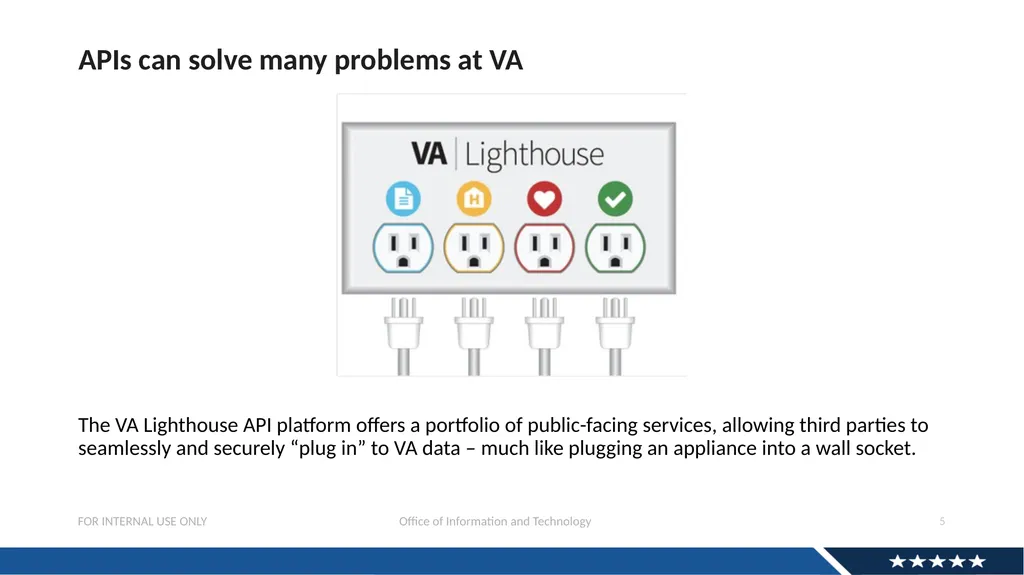
APIs can solve many problems at VA The VA Lighthouse API platform offers a portfolio of public-facing services, allowing third parties to seamlessly and securely “plug in” to VA data – much like plugging an appliance into a wall socket. FOR INTERNAL USE ONLY Office of Information and Technology 5<br>
06
APIs help solve problems at VA The Department of Veterans Affairs offers many critical benefits and services to an enormous population of Veterans.
But the process to discover, apply for, and obtain access to those benefits and services is often time-consuming, difficult, and slow.
VA Lighthouse APIs help to address this.
Veterans applying for VA benefits wait weeks (often months) for an award decision, while relying on paper mail correspondence to navigate the application process. Until recently, Veteran benefit claims applications could not be submitted digitally to VA. FOR INTERNAL USE ONLY Office of Information and Technology 6<br>
But the process to discover, apply for, and obtain access to those benefits and services is often time-consuming, difficult, and slow.
VA Lighthouse APIs help to address this.
Veterans applying for VA benefits wait weeks (often months) for an award decision, while relying on paper mail correspondence to navigate the application process. Until recently, Veteran benefit claims applications could not be submitted digitally to VA. FOR INTERNAL USE ONLY Office of Information and Technology 6<br>
07
Who integrates with VA Lighthouse Benefits and Appeals APIs? VA.gov
Third party vendors that offer specialized software for Veteran Service Organizations (VSOs)
Veteran Law Offices
County VSOs
VSOs assist Veterans with their claims. FOR INTERNAL USE ONLY Office of Information and Technology 7<br>
Third party vendors that offer specialized software for Veteran Service Organizations (VSOs)
Veteran Law Offices
County VSOs
VSOs assist Veterans with their claims. FOR INTERNAL USE ONLY Office of Information and Technology 7<br>
08
Impact 8<br>
09
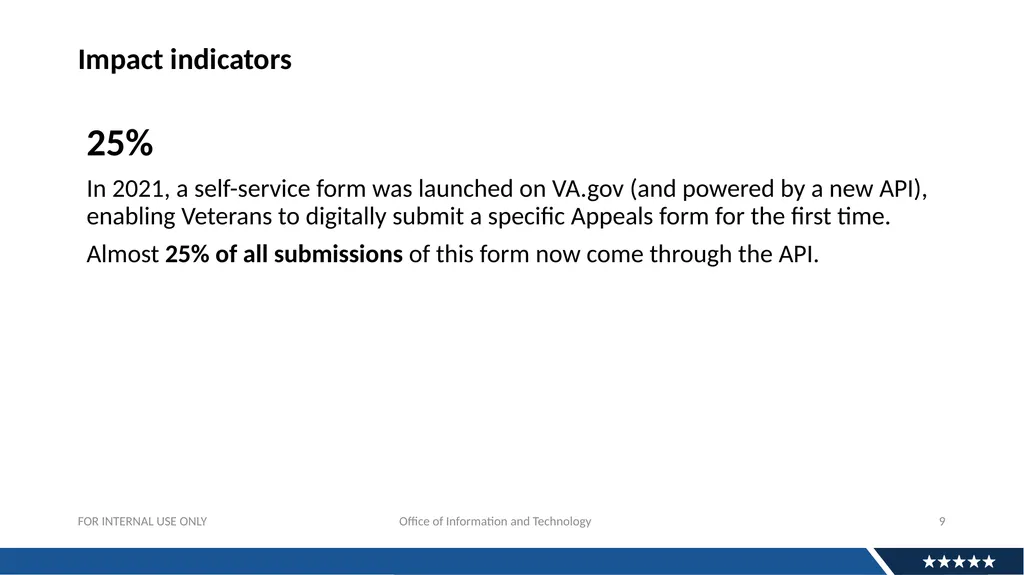
Impact indicators 25%
In 2021, a self-service form was launched on VA.gov (and powered by a new API), enabling Veterans to digitally submit a specific Appeals form for the first time.
Almost 25% of all submissions of this form now come through the API. FOR INTERNAL USE ONLY Office of Information and Technology 9<br>
In 2021, a self-service form was launched on VA.gov (and powered by a new API), enabling Veterans to digitally submit a specific Appeals form for the first time.
Almost 25% of all submissions of this form now come through the API. FOR INTERNAL USE ONLY Office of Information and Technology 9<br>
10
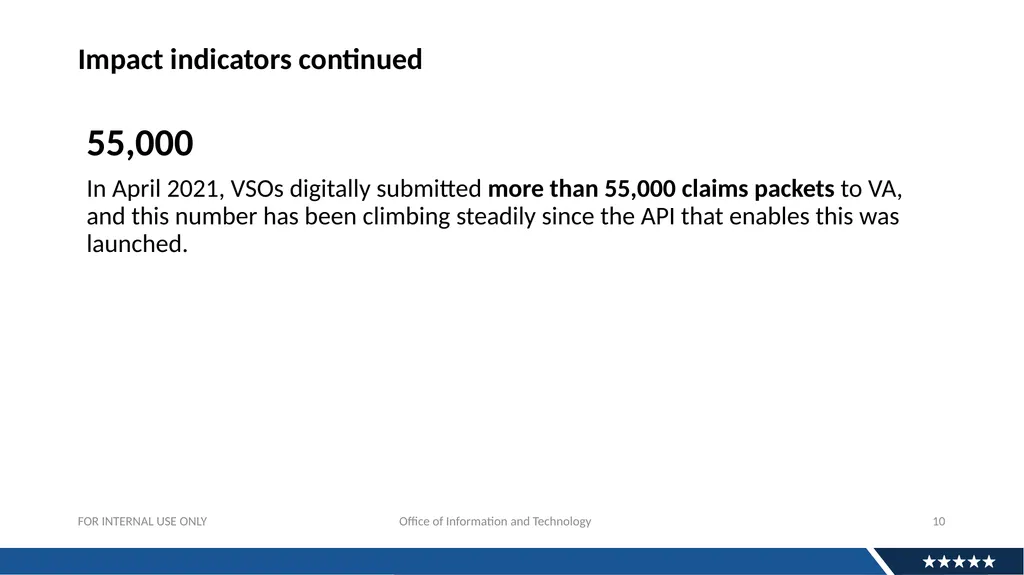
Impact indicators continued 55,000
In April 2021, VSOs digitally submitted more than 55,000 claims packets to VA, and this number has been climbing steadily since the API that enables this was launched. FOR INTERNAL USE ONLY Office of Information and Technology 10<br>
In April 2021, VSOs digitally submitted more than 55,000 claims packets to VA, and this number has been climbing steadily since the API that enables this was launched. FOR INTERNAL USE ONLY Office of Information and Technology 10<br>
11
Why discovery for APIs? 11<br>
12
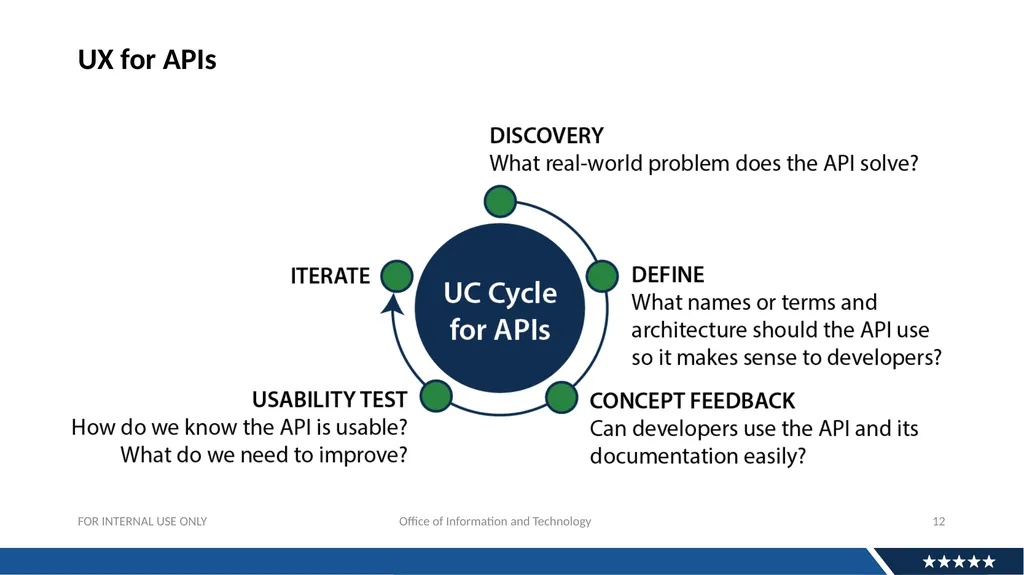
UX for APIs UC Cycle for APIs
Discover
What real-world problem does the API solve?
Define
What names or terms and architecture should the API use so it. Makes sense to developers?
Concept Feedback
Can developers use the API and its documentation easily?
Usability Test
How do we know that API is usable? What do we need to improve?
Iterate. FOR INTERNAL USE ONLY Office of Information and Technology 12<br>
Discover
What real-world problem does the API solve?
Define
What names or terms and architecture should the API use so it. Makes sense to developers?
Concept Feedback
Can developers use the API and its documentation easily?
Usability Test
How do we know that API is usable? What do we need to improve?
Iterate. FOR INTERNAL USE ONLY Office of Information and Technology 12<br>
13
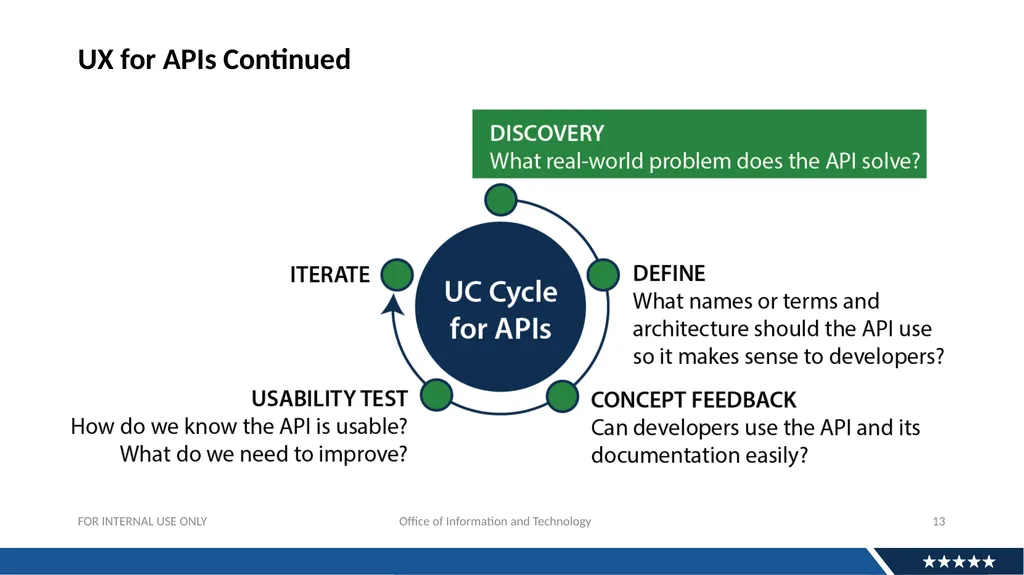
UX for APIs Continued UC Cycle for APIs
Discover
What real-world problem does the API solve?
Define
What names or terms and architecture should the API use so it. Makes sense to developers?
Concept Feedback
Can developers use the API and its documentation easily?
Usability Test
How do we know that API is usable? What do we need to improve?
Iterate. FOR INTERNAL USE ONLY Office of Information and Technology 13<br>
Discover
What real-world problem does the API solve?
Define
What names or terms and architecture should the API use so it. Makes sense to developers?
Concept Feedback
Can developers use the API and its documentation easily?
Usability Test
How do we know that API is usable? What do we need to improve?
Iterate. FOR INTERNAL USE ONLY Office of Information and Technology 13<br>
14
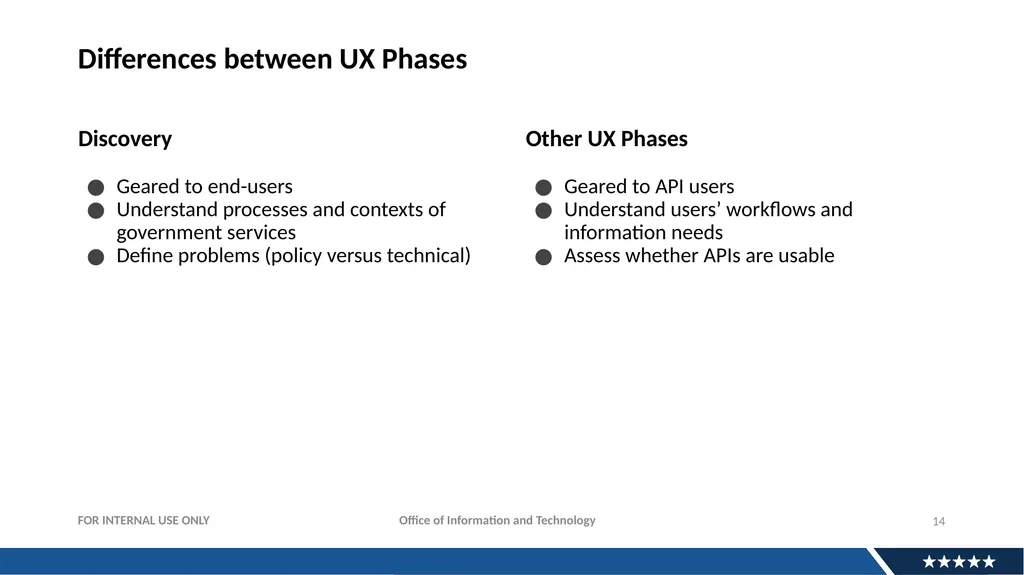
Differences between UX Phases Discovery Geared to end-users
Understand processes and contexts of government services
Define problems (policy versus technical) Other UX Phases Geared to API users
Understand users’ workflows and information needs
Assess whether APIs are usable FOR INTERNAL USE ONLY Office of Information and Technology 14<br>
Understand processes and contexts of government services
Define problems (policy versus technical) Other UX Phases Geared to API users
Understand users’ workflows and information needs
Assess whether APIs are usable FOR INTERNAL USE ONLY Office of Information and Technology 14<br>
15
Why Discovery research for APIs? (1) Ensure the API solves the right problem. FOR INTERNAL USE ONLY Office of Information and Technology 15<br>
16
Why Discovery research for APIs? (2) Ensure the API solves the right problem.
If it doesn’t, developers won’t know what to build with it. FOR INTERNAL USE ONLY Office of Information and Technology 16<br>
If it doesn’t, developers won’t know what to build with it. FOR INTERNAL USE ONLY Office of Information and Technology 16<br>
17
Why Discovery research for APIs? (3) Ensure the API solves the right problem.
If it doesn’t, developers won’t know what to build with it.
If developers don’t know what to build with it, you can’t UX your way to adoption. FOR INTERNAL USE ONLY Office of Information and Technology 17<br>
If it doesn’t, developers won’t know what to build with it.
If developers don’t know what to build with it, you can’t UX your way to adoption. FOR INTERNAL USE ONLY Office of Information and Technology 17<br>
18
How to? An Example
Methods, Questions, Learnings 18<br>
19
An Ethnographic Approach An ethnographic approach to understand the benefits and appeals application and adjudication process at VA. FOR INTERNAL USE ONLY Office of Information and Technology 19<br>
20
An Ethnographic Approach Continued An ethnographic approach to understand the benefits and appeals application and adjudication process at VA.
Ethnographic approach equals Systems thinking:
How systems are set up?
To what end?
What’s their organizing principle? FOR INTERNAL USE ONLY Office of Information and Technology 20<br>
Ethnographic approach equals Systems thinking:
How systems are set up?
To what end?
What’s their organizing principle? FOR INTERNAL USE ONLY Office of Information and Technology 20<br>
21
Ethnographic Methods (1) Over 65 interviews with VSOs, Attorneys, Claims Agents, VA staff and SMEs located all over the country. FOR INTERNAL USE ONLY Office of Information and Technology 21<br>
22
Ethnographic Methods (2) Over 65 interviews with VSOs, Attorneys, Claims Agents, VA staff and SMEs located all over the country.
Remote qualitative interviews, remote contextual inquiries, and collaborative process mapping exercises. FOR INTERNAL USE ONLY Office of Information and Technology 22<br>
Remote qualitative interviews, remote contextual inquiries, and collaborative process mapping exercises. FOR INTERNAL USE ONLY Office of Information and Technology 22<br>
23
Ethnographic Methods (3) Over 65 interviews with VSOs, Attorneys, Claims Agents, VA staff and SMEs located all over the country.
Remote qualitative interviews, remote contextual inquiries, and collaborative process mapping exercises.
Focused on understanding information needs, pain points and points of confusion. FOR INTERNAL USE ONLY Office of Information and Technology 23<br>
Remote qualitative interviews, remote contextual inquiries, and collaborative process mapping exercises.
Focused on understanding information needs, pain points and points of confusion. FOR INTERNAL USE ONLY Office of Information and Technology 23<br>
24
Example of Ethnographic Questions (1) Are there gaps between codified processes and practices on the ground? FOR INTERNAL USE ONLY Office of Information and Technology 24<br>
25
Example of Ethnographic Questions (2) Are there gaps between codified processes and practices on the ground?
Are there differences in how individuals involved interpret the process? FOR INTERNAL USE ONLY Office of Information and Technology 25<br>
Are there differences in how individuals involved interpret the process? FOR INTERNAL USE ONLY Office of Information and Technology 25<br>
26
Example of Ethnographic Questions (3) Are there gaps between codified processes and practices on the ground?
Are there differences in how individuals involved interpret the process?
What are the different goals that individuals are trying to achieve? FOR INTERNAL USE ONLY Office of Information and Technology 26<br>
Are there differences in how individuals involved interpret the process?
What are the different goals that individuals are trying to achieve? FOR INTERNAL USE ONLY Office of Information and Technology 26<br>
27
Example of Ethnographic Questions (4) Are there gaps between codified processes and practices on the ground?
Are there differences in how individuals involved interpret the process?
What are the different goals that individuals are trying to achieve?
What is a benefit claim or appeal and according to whom? FOR INTERNAL USE ONLY Office of Information and Technology 27<br>
Are there differences in how individuals involved interpret the process?
What are the different goals that individuals are trying to achieve?
What is a benefit claim or appeal and according to whom? FOR INTERNAL USE ONLY Office of Information and Technology 27<br>
28
Learnings (1) For benefits and appeals, we learned that:
Veterans, VSOs, Lawyers and Claims Assistants are looking for confirmation of receipt when they submit. FOR INTERNAL USE ONLY Office of Information and Technology 28<br>
Veterans, VSOs, Lawyers and Claims Assistants are looking for confirmation of receipt when they submit. FOR INTERNAL USE ONLY Office of Information and Technology 28<br>
29
Learnings (2) For benefits and appeals, we learned that:
Veterans, VSOs, Lawyers and Claims Assistants are looking for confirmation of receipt when they submit.
BUT...They don’t always get the information they need. So they end up submitting duplicates. FOR INTERNAL USE ONLY Office of Information and Technology 29<br>
Veterans, VSOs, Lawyers and Claims Assistants are looking for confirmation of receipt when they submit.
BUT...They don’t always get the information they need. So they end up submitting duplicates. FOR INTERNAL USE ONLY Office of Information and Technology 29<br>
30
Learnings (3) For benefits and appeals, we learned that:
Veterans, VSOs, Lawyers and Claims Assistants are looking for confirmation of receipt when they submit.
BUT...They don’t always get the information they need. So they end up submitting duplicates.
WHICH backlog processing systems and delay the review process, causing stress and anxiety for claimants. FOR INTERNAL USE ONLY Office of Information and Technology 30<br>
Veterans, VSOs, Lawyers and Claims Assistants are looking for confirmation of receipt when they submit.
BUT...They don’t always get the information they need. So they end up submitting duplicates.
WHICH backlog processing systems and delay the review process, causing stress and anxiety for claimants. FOR INTERNAL USE ONLY Office of Information and Technology 30<br>
31
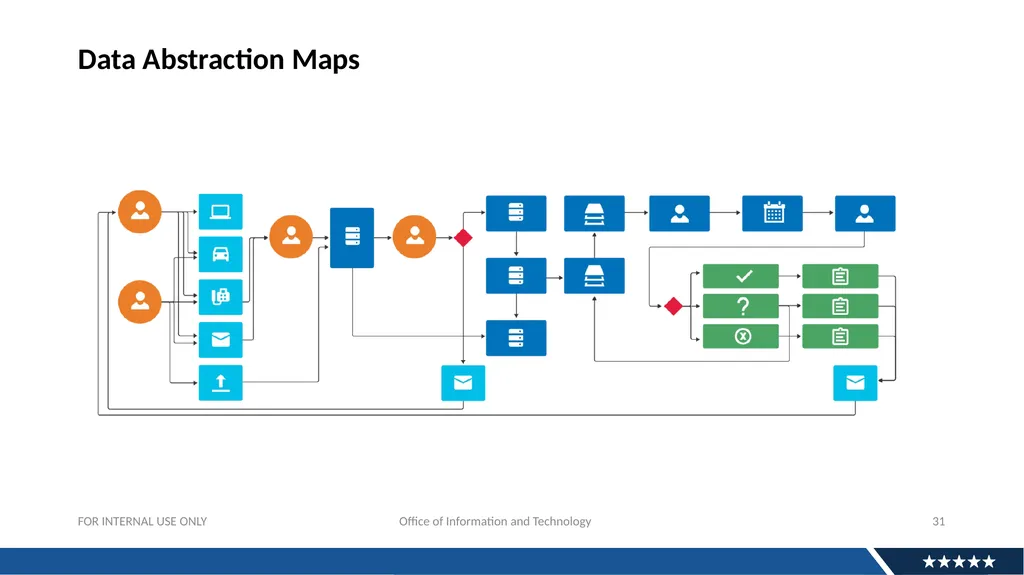
Data Abstraction Maps FOR INTERNAL USE ONLY Office of Information and Technology 31<br>
32
Solutions We mapped actions taken and by whom, systems of record used, data reviewed and mistakes encountered.
We have used these maps to architect the APIs and the validation logic.
We’re working on informative status endpoints for representatives, that are also legally compliant. FOR INTERNAL USE ONLY Office of Information and Technology 32<br>
We have used these maps to architect the APIs and the validation logic.
We’re working on informative status endpoints for representatives, that are also legally compliant. FOR INTERNAL USE ONLY Office of Information and Technology 32<br>
33
Key Takeaways 33<br>
34
Takeaways API usability entails having the right API functionality
Ethnographic approaches are powerful to understand complex service systems and how digital solutions interact with them.
Ethnographic questions, and their emphasis on understanding practices on the ground, lend to understanding how individuals interact with a system, and the information they need from an API. FOR INTERNAL USE ONLY Office of Information and Technology 34<br>
Ethnographic approaches are powerful to understand complex service systems and how digital solutions interact with them.
Ethnographic questions, and their emphasis on understanding practices on the ground, lend to understanding how individuals interact with a system, and the information they need from an API. FOR INTERNAL USE ONLY Office of Information and Technology 34<br>
35
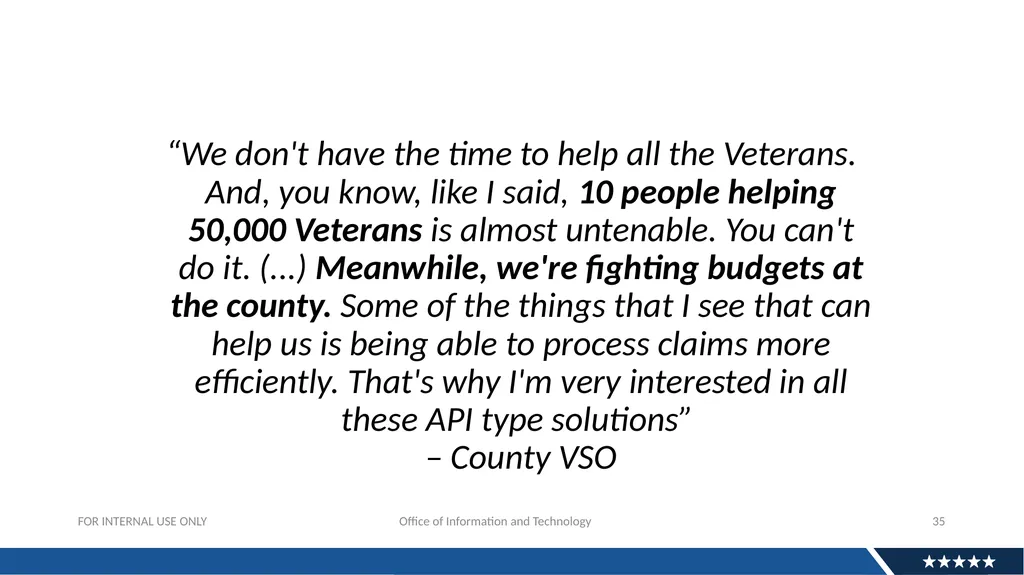
“We don't have the time to help all the Veterans. And, you know, like I said, 10 people helping 50,000 Veterans is almost untenable. You can't do it. (...) Meanwhile, we're fighting budgets at the county. Some of the things that I see that can help us is being able to process claims more efficiently. That's why I'm very interested in all these API type solutions”
– County VSO FOR INTERNAL USE ONLY Office of Information and Technology 35<br>
36
QUESTIONS? 36<br>