"Discrete Mathematics and Its Applications 1 The" is the property of its rightful owner. Permission is granted to
download and print the materials on this website for personal, non-commercial use only, and to display it
on your personal computer provided you do not modify the materials and that you retain all copyright
notices contained in the materials. By downloading content from our website, you accept the terms of this
agreement.
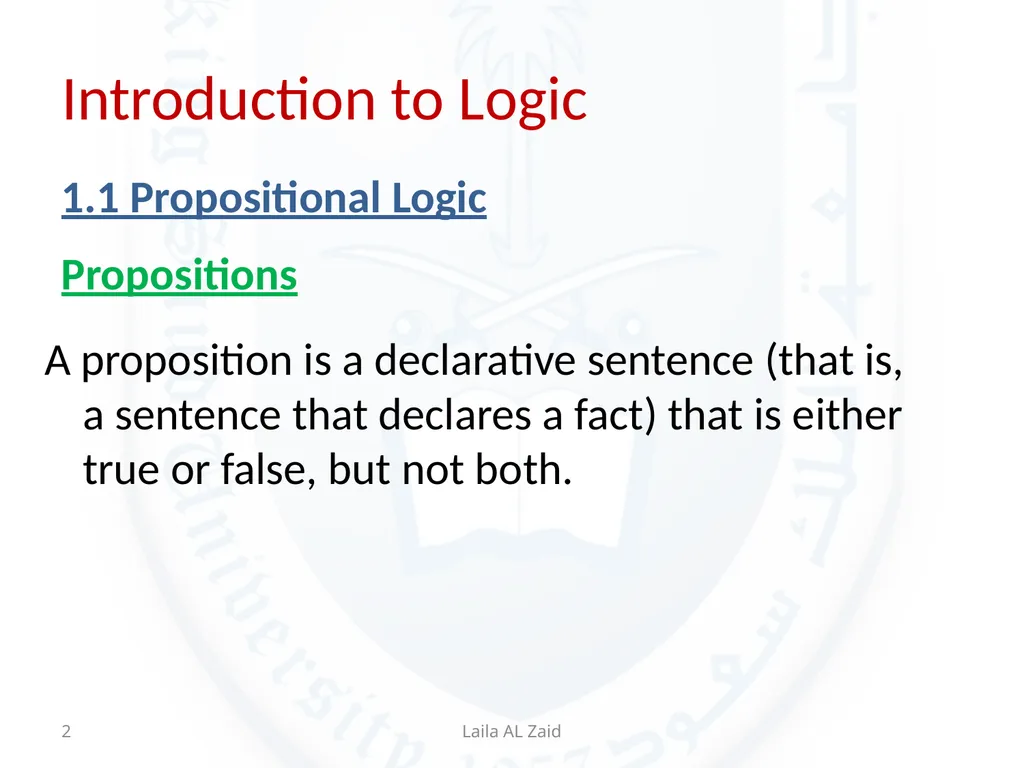
Introduction to Logic A proposition is a declarative sentence (that is, a sentence that declares a fact) that is either true or false, but not both. 1.1 Propositional Logic Propositions Laila AL Zaid 2<br>
03
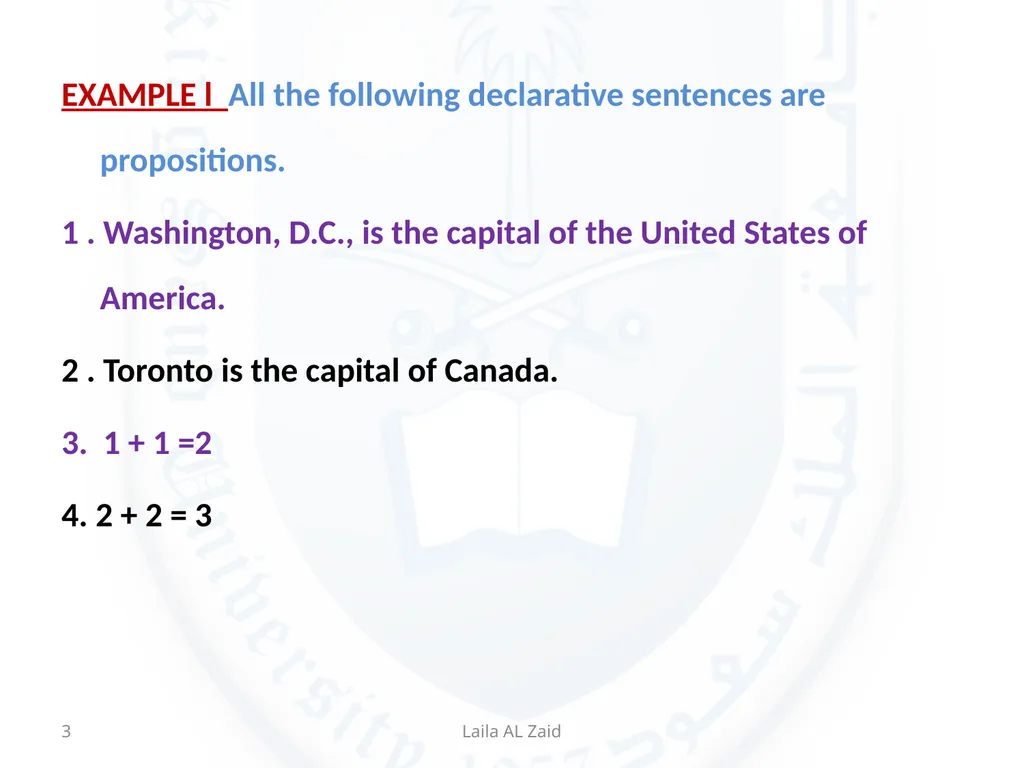
EXAMPLE l All the following declarative sentences are propositions.
1 . Washington, D.C., is the capital of the United States of America.
2 . Toronto is the capital of Canada.
3. 1 + 1 =2
4. 2 + 2 = 3 Laila AL Zaid 3<br>
04
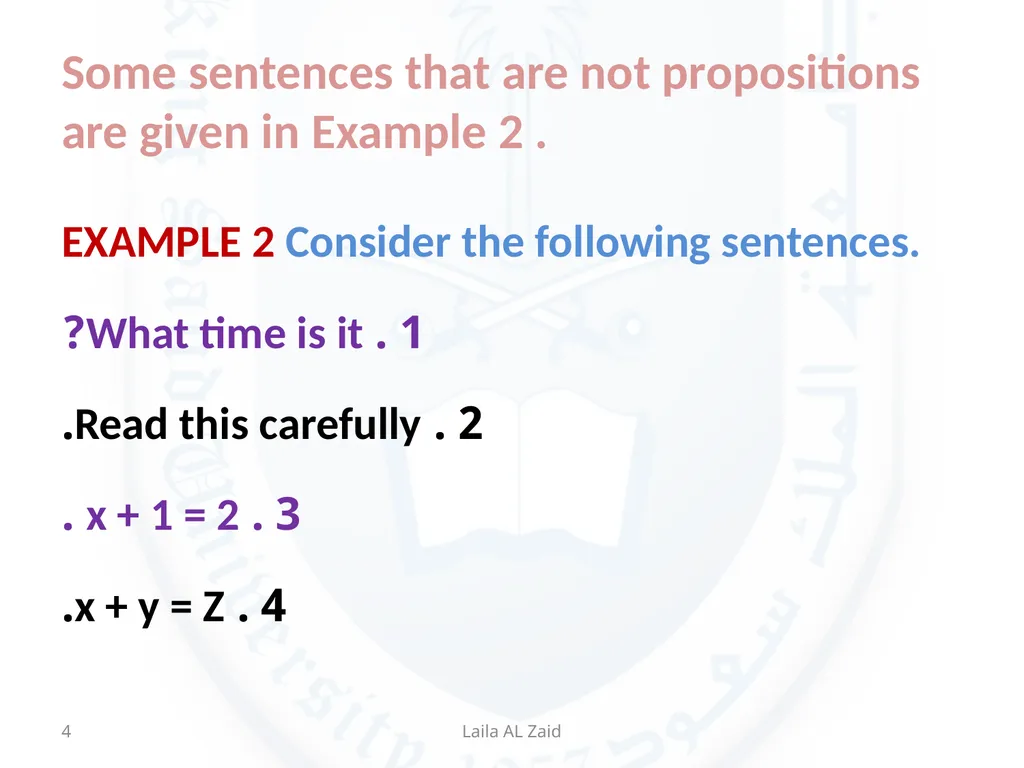
Some sentences that are not propositions are given in Example 2 . EXAMPLE 2 Consider the following sentences.
1 . What time is it?
2 . Read this carefully.
3 . x + 1 = 2 .
4 . x + y = Z. Laila AL Zaid 4<br>
05
The truth value of a proposition is true, denoted by T, if it is a true proposition and false, denoted by F, if it is a false proposition. Laila AL Zaid 5<br>
06
The area of logic that deals with propositions is called the propositional calculus or propositional logic.
New propositions, called compound propositions, are formed from existing propositions using logical operators. Laila AL Zaid 6<br>
07
DEFINITION 1 Let p be a proposition. The negation of p, denoted by ¬p (also denoted by p), is the statement
"It is not the case that p."
The proposition ¬ p is read "not p." The truth value of the negation of p, - p, is the opposite of the truth value of p. Laila AL Zaid 7<br>
08
EXAMPLE 3 Find the negation of the proposition
"Today is Friday.“ and express this in simple English.
Solution: Laila AL Zaid 8<br>
09
EXAMPLE 4 Find the negation of the proposition
"At least 10 inches of rain fell today in Miami."
and express this in simple English.
Solution: Laila AL Zaid 9<br>
10
Remark: Strictly speaking, sentences involving variable times such as those in Examples 3 and 4 are not propositions unless a fixed time is assumed. The same holds for variable places unless a fixed place is ssumed and for pronouns unless a particular person is assumed. We will always assume fixed times, fixed places, and particular people in such sentences unless otherwise noted. Laila AL Zaid 10<br>
11
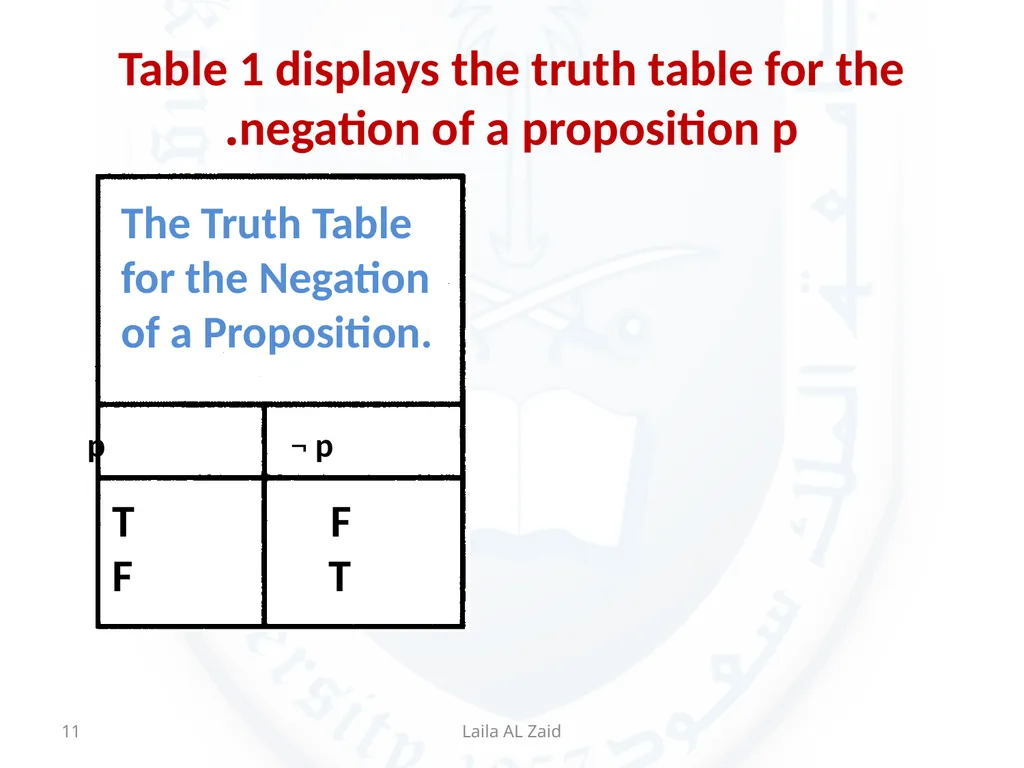
Table 1 displays the truth table for the negation of a proposition p. The Truth Table for the Negation of a Proposition. p ¬ p T F
F T Laila AL Zaid 11<br>
12
The negation of a proposition can also be considered the result of the operation of the negation operator on a proposition.
The negation operator constructs a new proposition from a single existing proposition. We will now introduce the logical operators that are used to form new propositions from two or more existing propositions. These logical operators are also called connectives. Laila AL Zaid 12<br>
13
DEFINITION 2
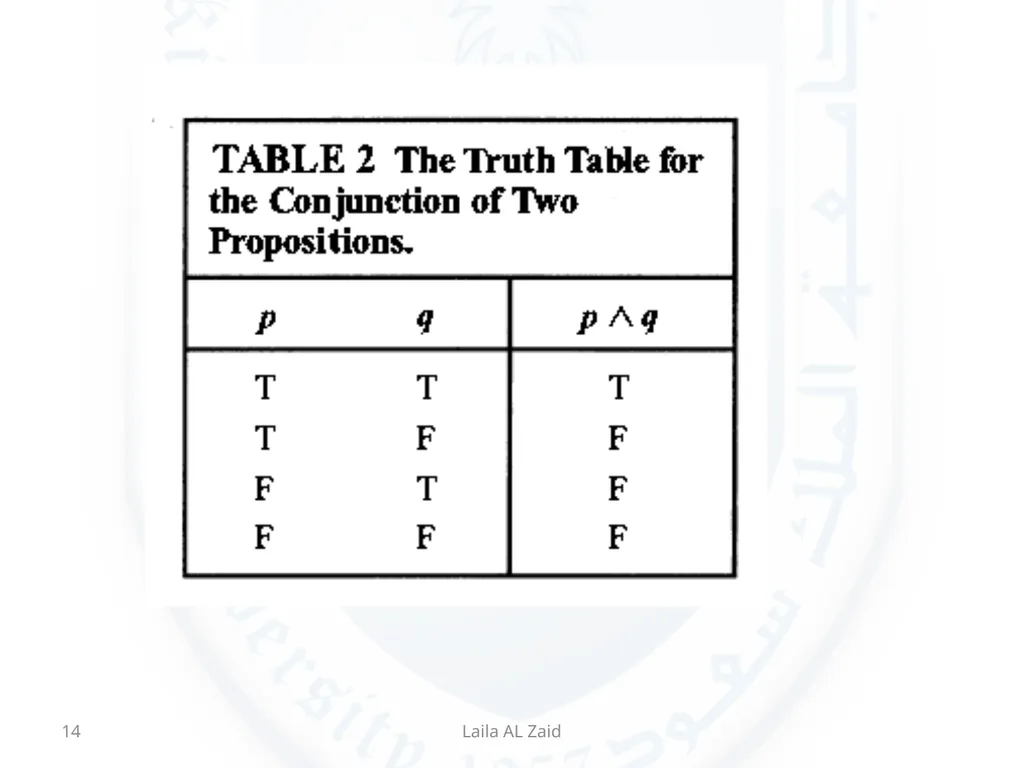
Let p and q be propositions. The conjunction of p and q, denoted by p /\ q, is the proposition "p and q ." The conjunction p /\ q is true when both p and q are true and is false otherwise. Laila AL Zaid 13<br>
14
Laila AL Zaid 14<br>
15
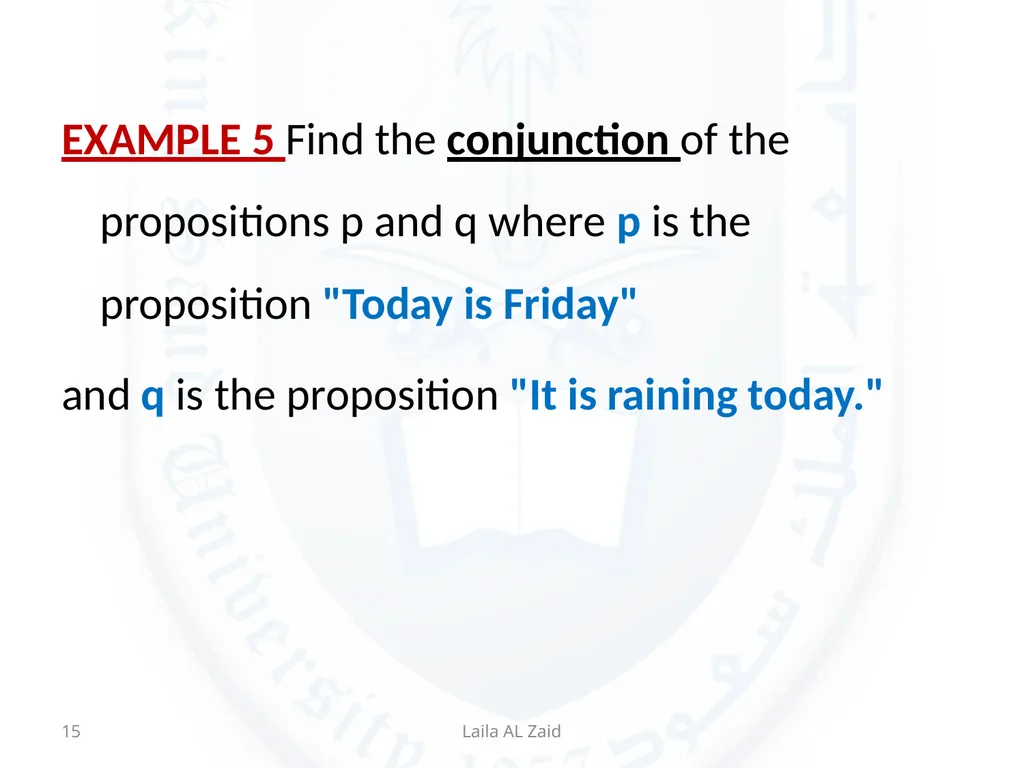
EXAMPLE 5 Find the conjunction of the propositions p and q where p is the proposition "Today is Friday"
and q is the proposition "It is raining today." Laila AL Zaid 15<br>
16
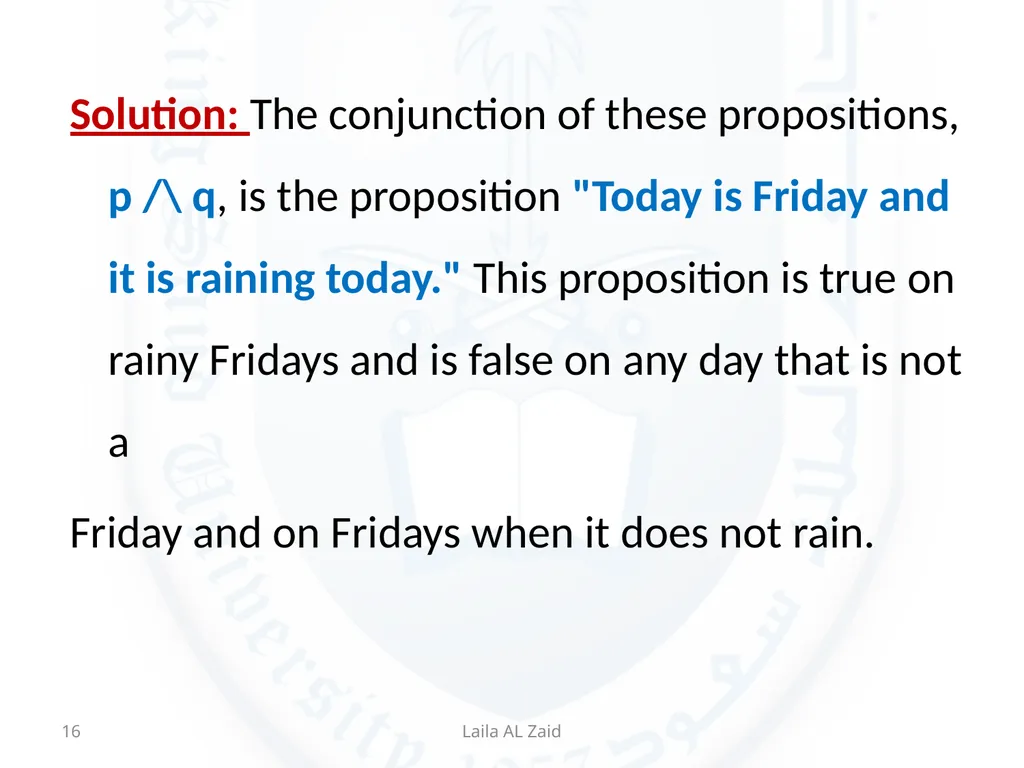
Solution: The conjunction of these propositions, p /\ q, is the proposition "Today is Friday and it is raining today." This proposition is true on rainy Fridays and is false on any day that is not a
Friday and on Fridays when it does not rain. Laila AL Zaid 16<br>
17
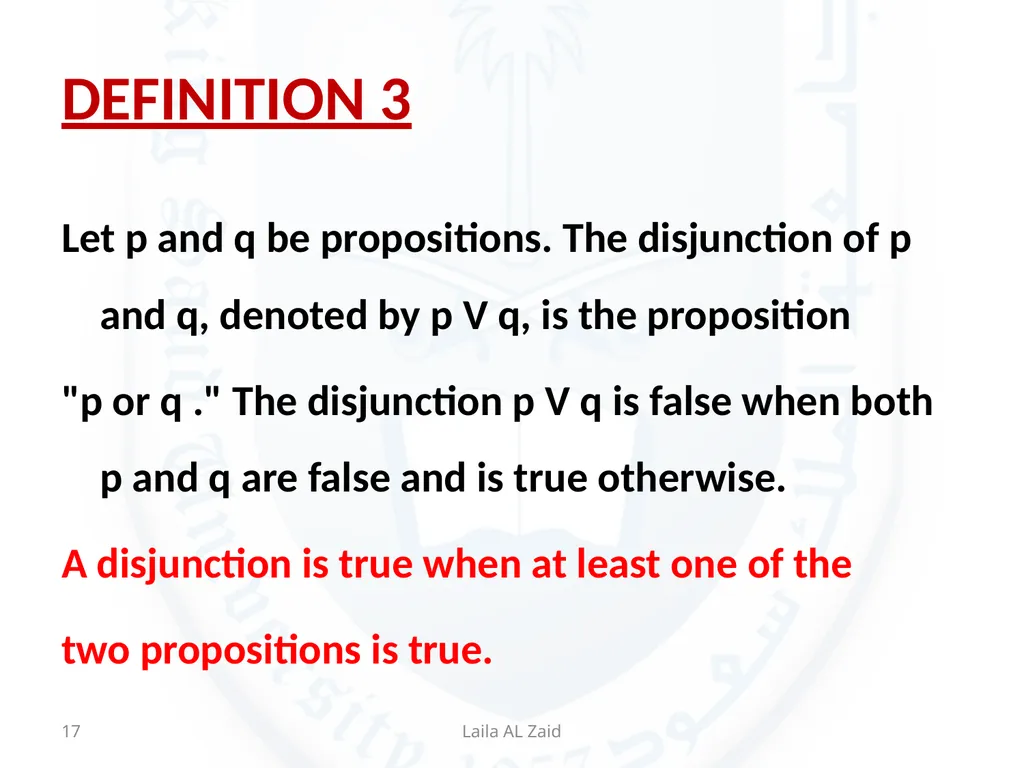
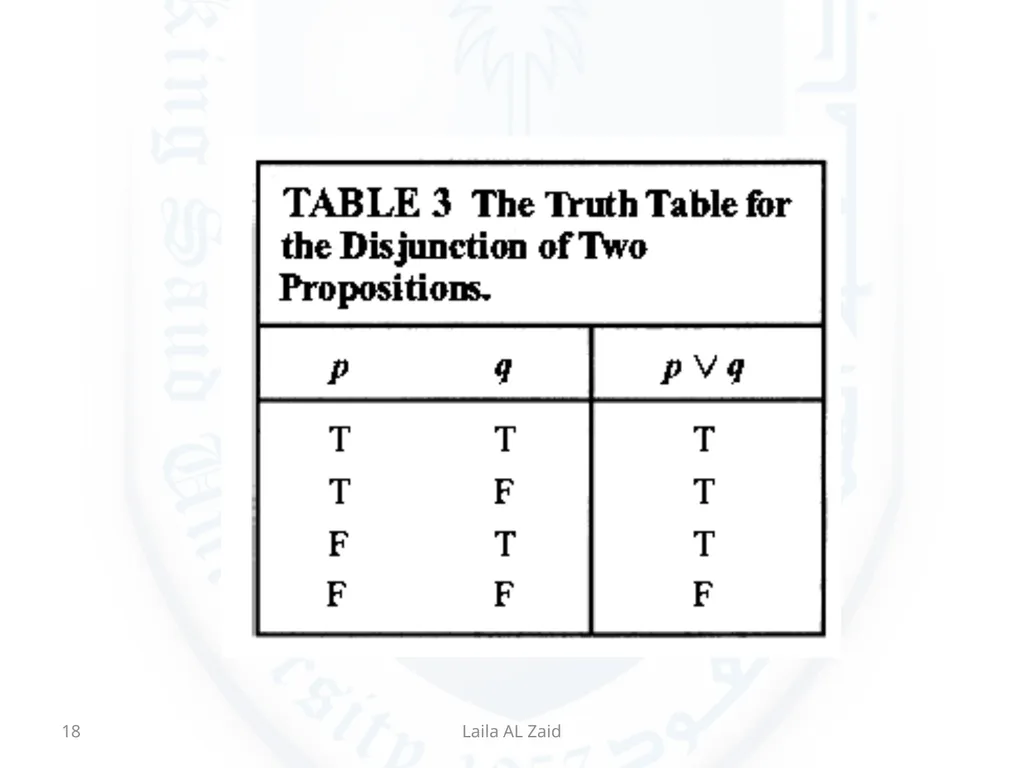
DEFINITION 3 Let p and q be propositions. The disjunction of p and q, denoted by p V q, is the proposition
"p or q ." The disjunction p V q is false when both p and q are false and is true otherwise.
A disjunction is true when at least one of the
two propositions is true. Laila AL Zaid 17<br>
18
Laila AL Zaid 18<br>
19
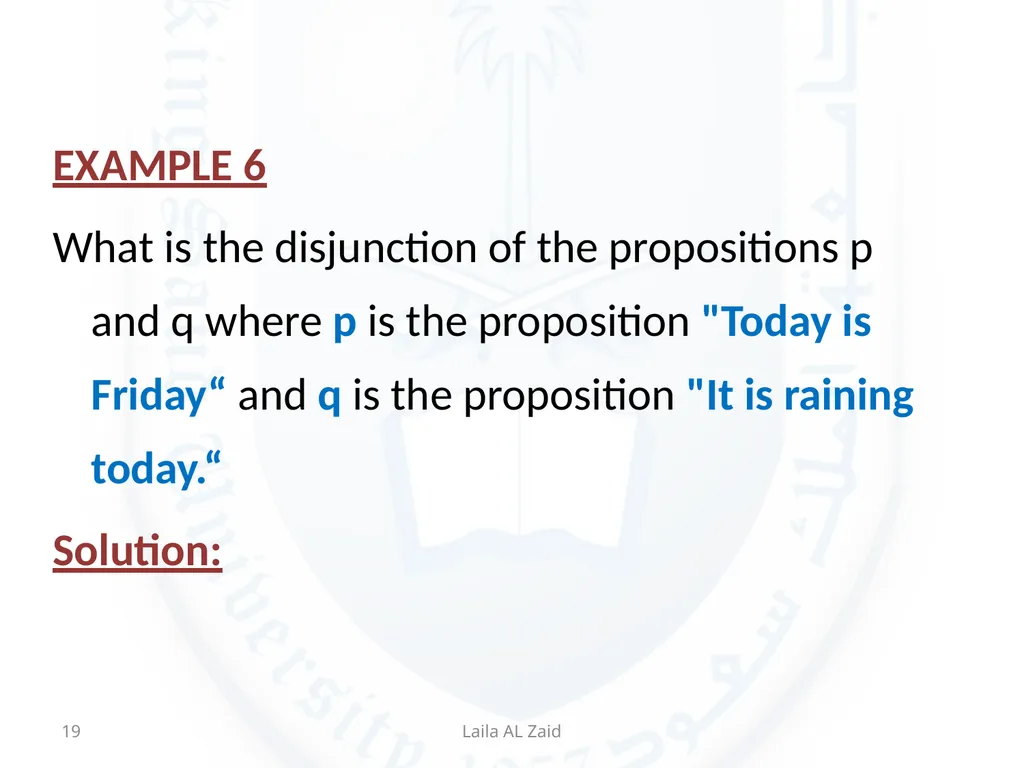
EXAMPLE 6
What is the disjunction of the propositions p and q where p is the proposition "Today is Friday“ and q is the proposition "It is raining today.“
Solution: Laila AL Zaid 19<br>
20
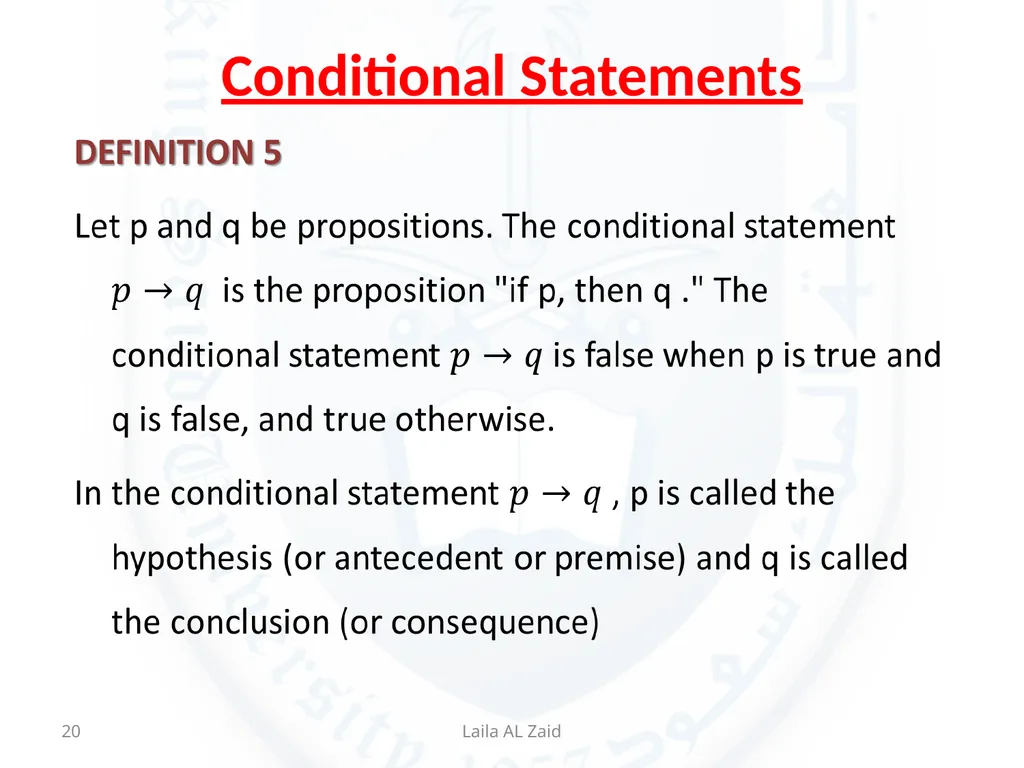
Conditional Statements Laila AL Zaid 20<br>
21
Laila AL Zaid 21<br>
22
Laila AL Zaid 22<br>
23
Laila AL Zaid 23<br>
24
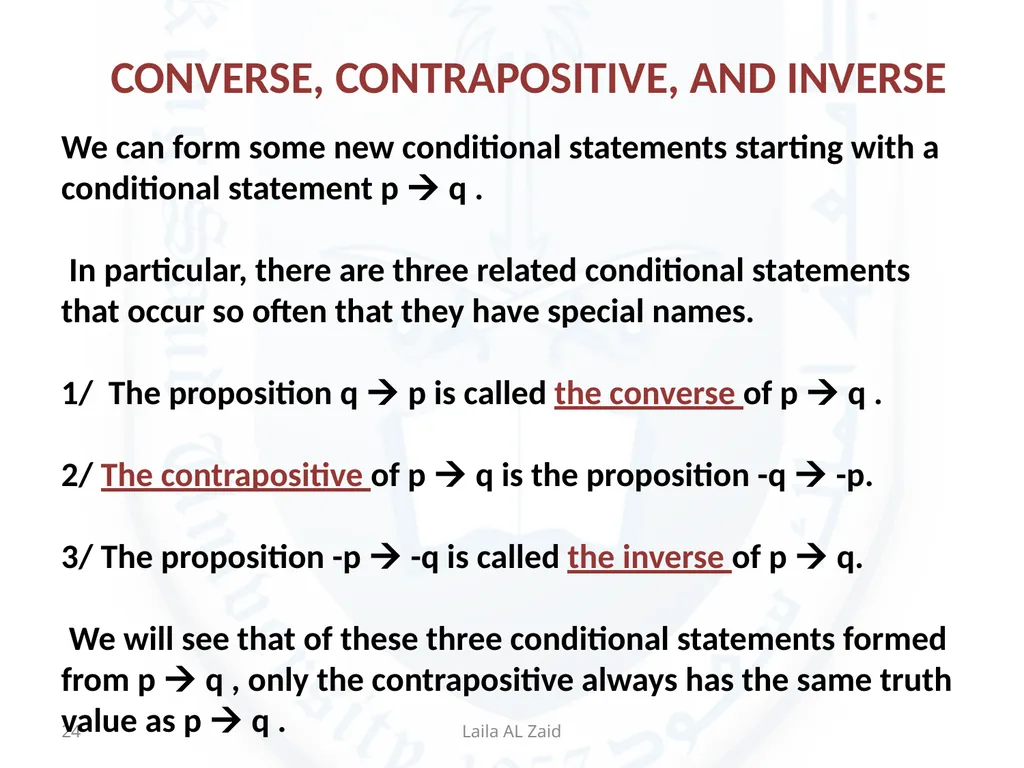
CONVERSE, CONTRAPOSITIVE, AND INVERSE We can form some new conditional statements starting with a conditional statement p q .
In particular, there are three related conditional statements that occur so often that they have special names.
1/ The proposition q p is called the converse of p q .
2/ The contrapositive of p q is the proposition -q -p.
3/ The proposition -p -q is called the inverse of p q.
We will see that of these three conditional statements formed from p q , only the contrapositive always has the same truth
value as p q . Laila AL Zaid 24<br>
25
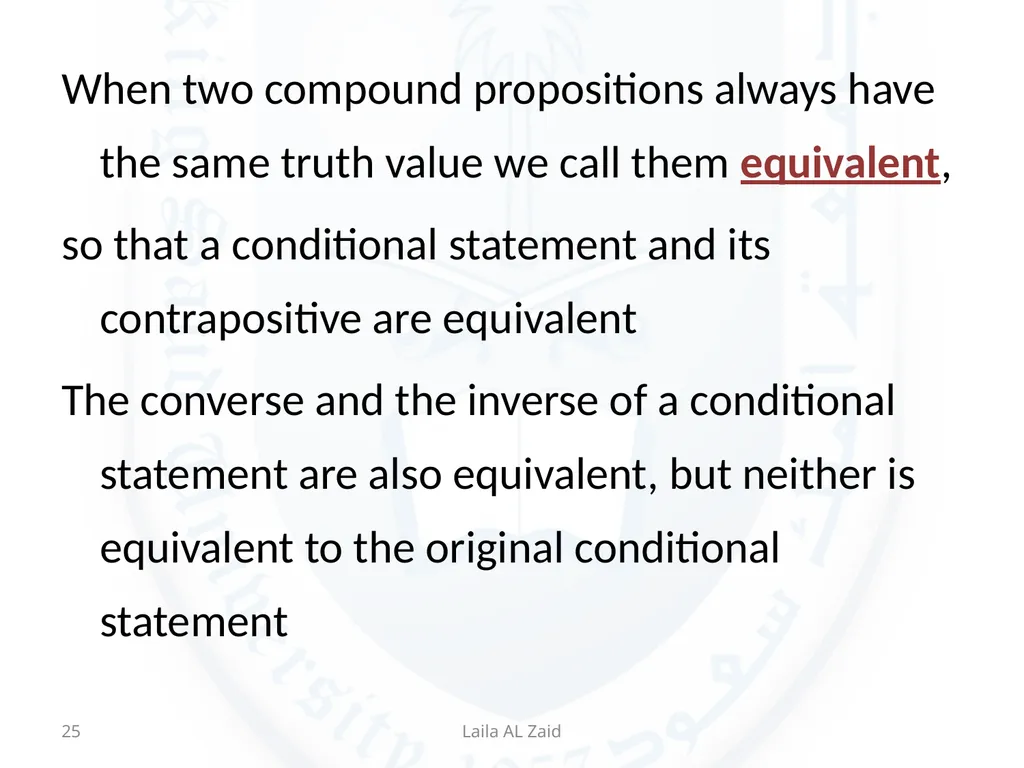
When two compound propositions always have the same truth value we call them equivalent,
so that a conditional statement and its contrapositive are equivalent
The converse and the inverse of a conditional statement are also equivalent, but neither is equivalent to the original conditional statement Laila AL Zaid 25<br>
26
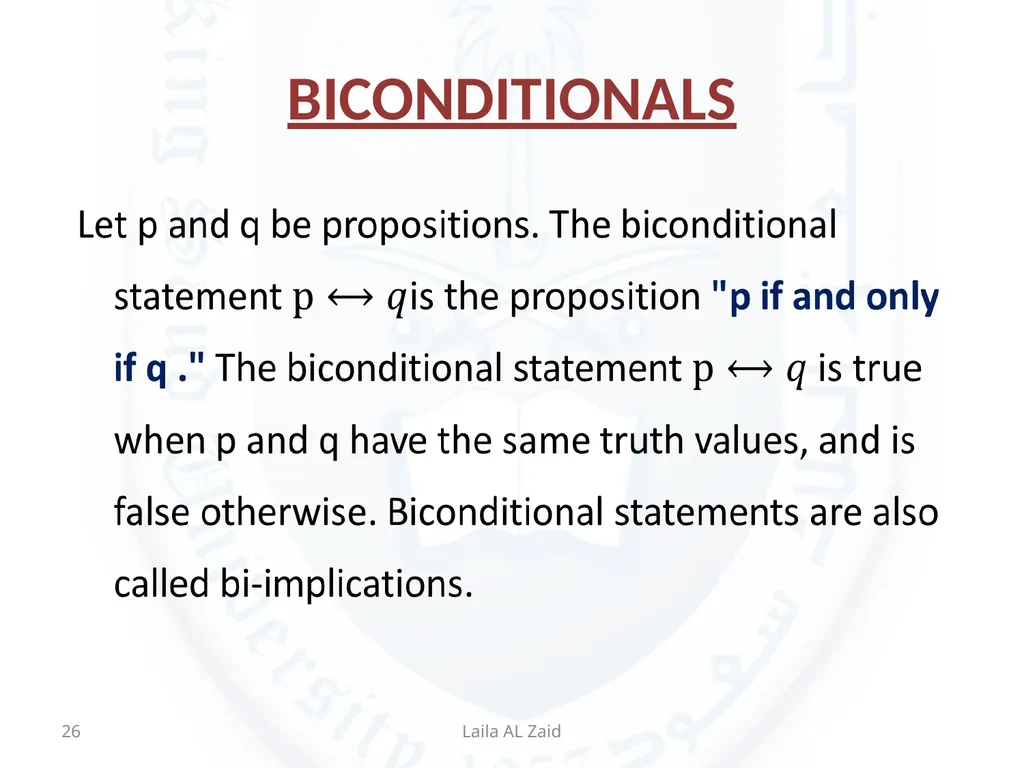
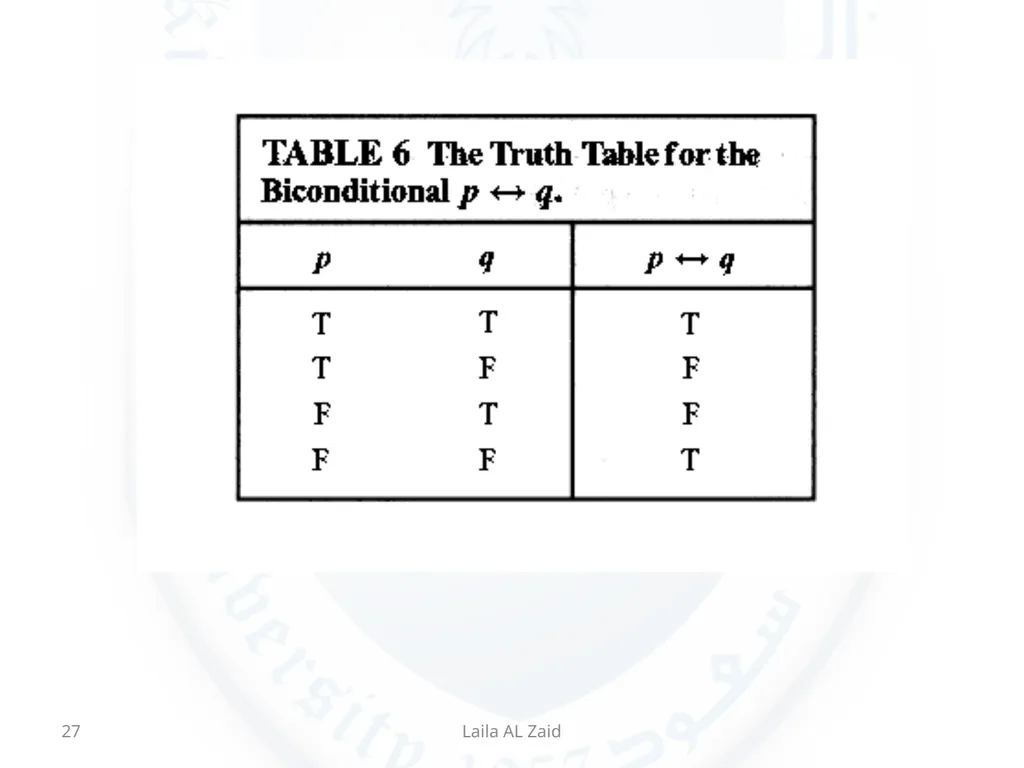
BICONDITIONALS Laila AL Zaid 26<br>
27
Laila AL Zaid 27<br>
28
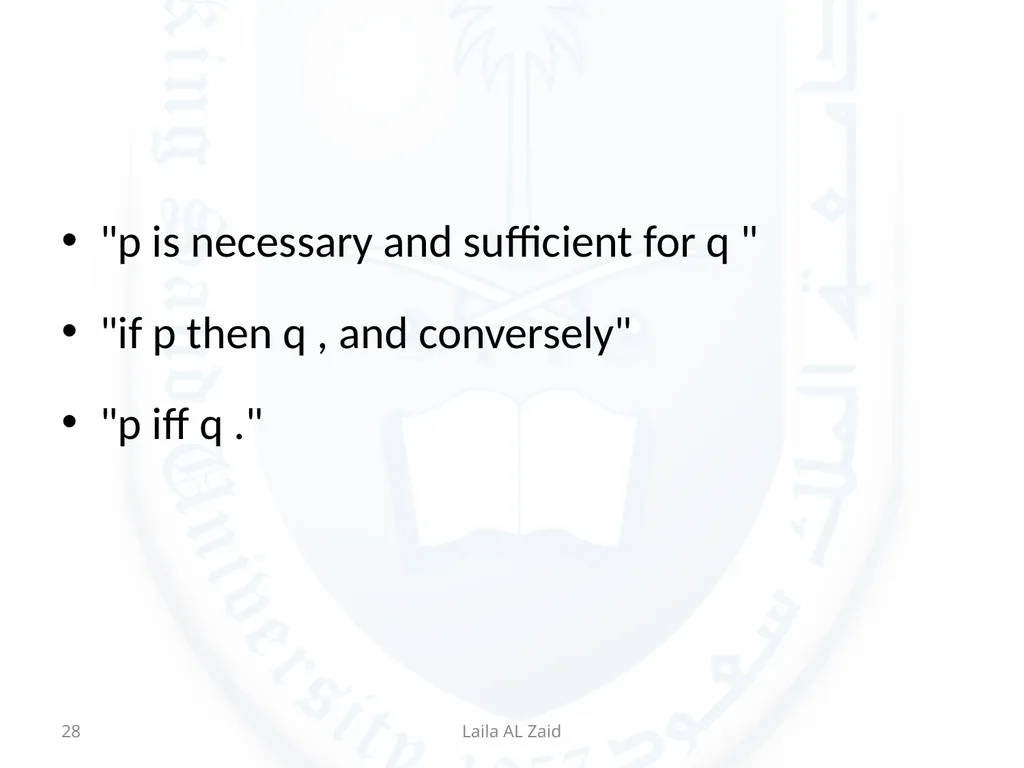
"p is necessary and sufficient for q "
"if p then q , and conversely"
"p iff q ." Laila AL Zaid 28<br>
29
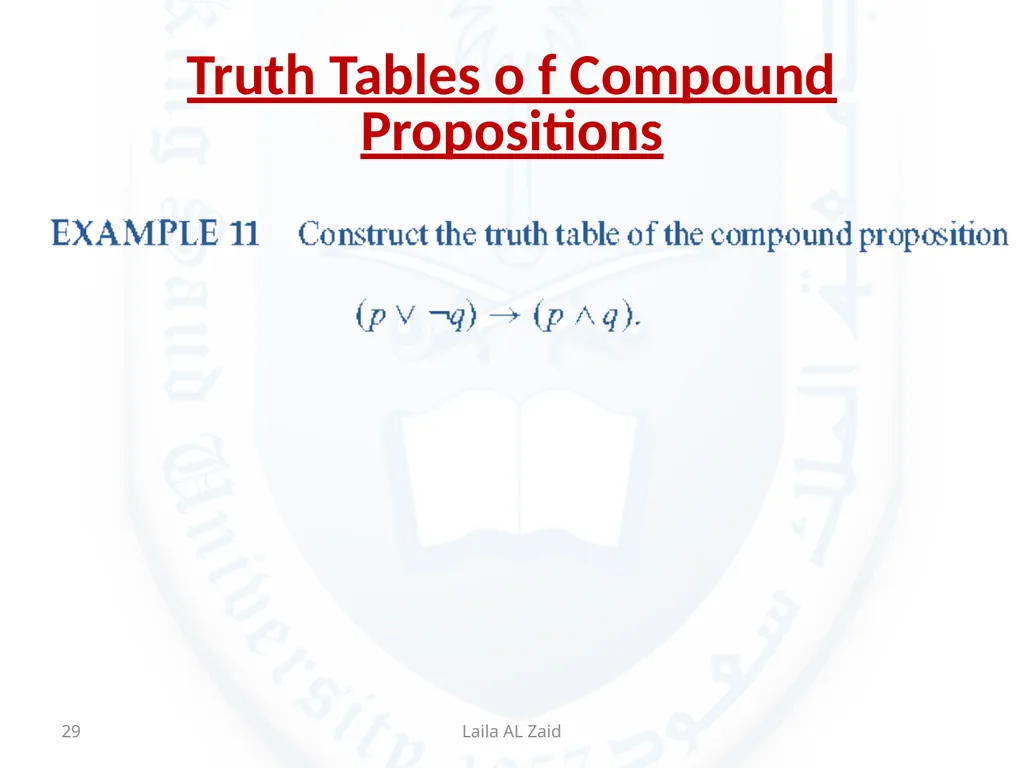
Truth Tables o f Compound Propositions Laila AL Zaid 29<br>