Discussion of an equalisation measure for deep-seabed mining in the Area Presented by: Daniel Wilde (d.wildecommonwealth.int) March 2024 1 1 The Commonwealth 2 The Commonwealth is a voluntary association of 56 independent and equal
"Discussion of an equalisation measure for" is the property of its rightful owner. Permission is granted to
download and print the materials on this website for personal, non-commercial use only, and to display it
on your personal computer provided you do not modify the materials and that you retain all copyright
notices contained in the materials. By downloading content from our website, you accept the terms of this
agreement.
Presentation Transcript
01
Discussion of an equalisation measure for deep-seabed mining in the Area Presented by: Daniel Wilde (d.wilde@commonwealth.int)
March 2024 1 1<br>
02
The Commonwealth 2 The Commonwealth is a voluntary association of 56 independent and equal countries working together for sustainable development, peace and democracy.
The Trade, Oceans and Natural Resources Directorate of the Commonwealth Secretariat has a longstanding programme providing technical assistance to member countries on extractive industry (including deep-seabed mining) taxation, regulation and revenue management.
As such, we were invited to participate in the recent Equalisation Measure Working Group (Working Group).<br>
03
What does the Implementing Agreement say? 3 The 1994 Implementing Agreement provides in Section 8.1.b that:
“The rates of payments under the system shall be within the range of those prevailing in respect of land-based mining of the same or similar minerals in order to avoid giving deep seabed miners an artificial competitive advantage or imposing on them a competitive disadvantage;”<br>
04
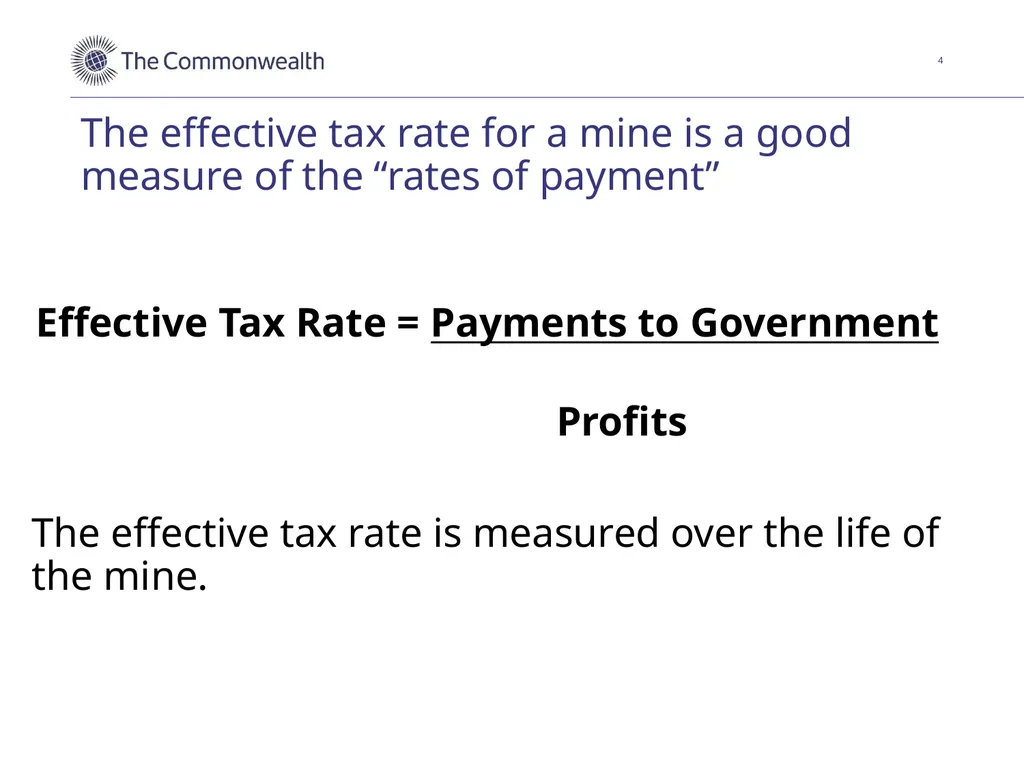
The effective tax rate for a mine is a good measure of the “rates of payment” Effective Tax Rate = Payments to Government
Profits
The effective tax rate is measured over the life of the mine. 4<br>
05
Effective tax rates for land-based mining jurisdictions* 5<br>
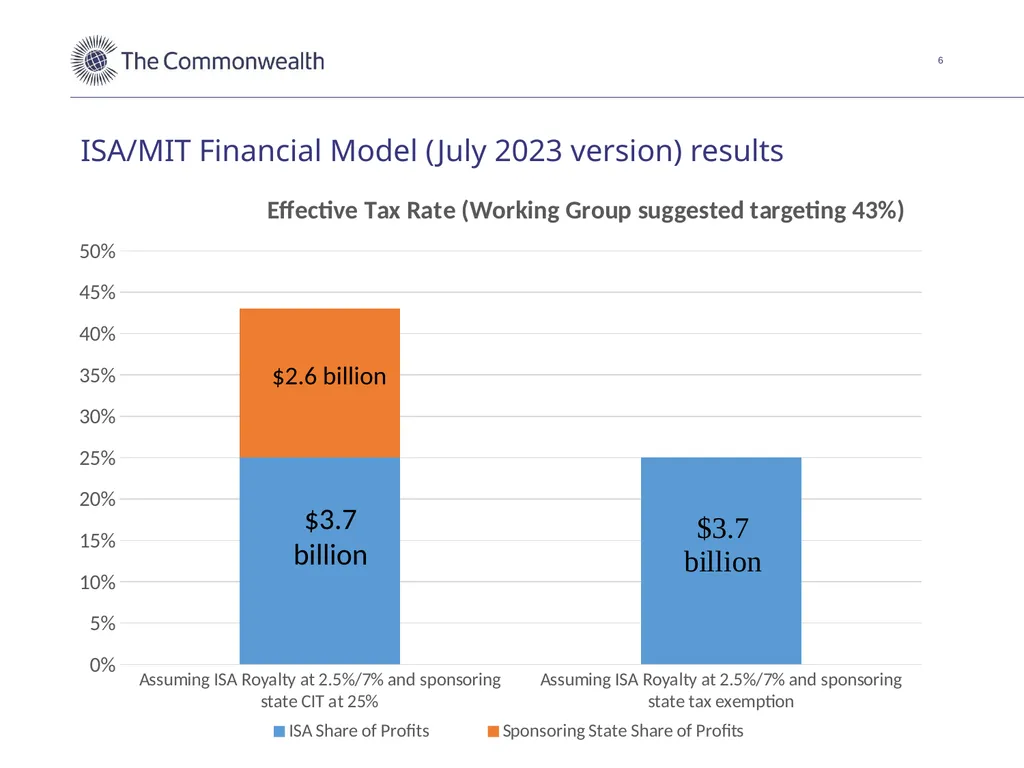
Is it correct to assume that a 25% sponsoring state corporate income tax applies? Two out of the three published sponsorship agreements provide a complete exemption from sponsoring state corporate income tax.
It is unclear whether profits from activity in the Area do or do not count as taxable profits under the territorial tax systems operated by some states.
Thus, there is a question as to whether a 25% sponsoring state corporate income tax assumption is realistic. 7<br>
08
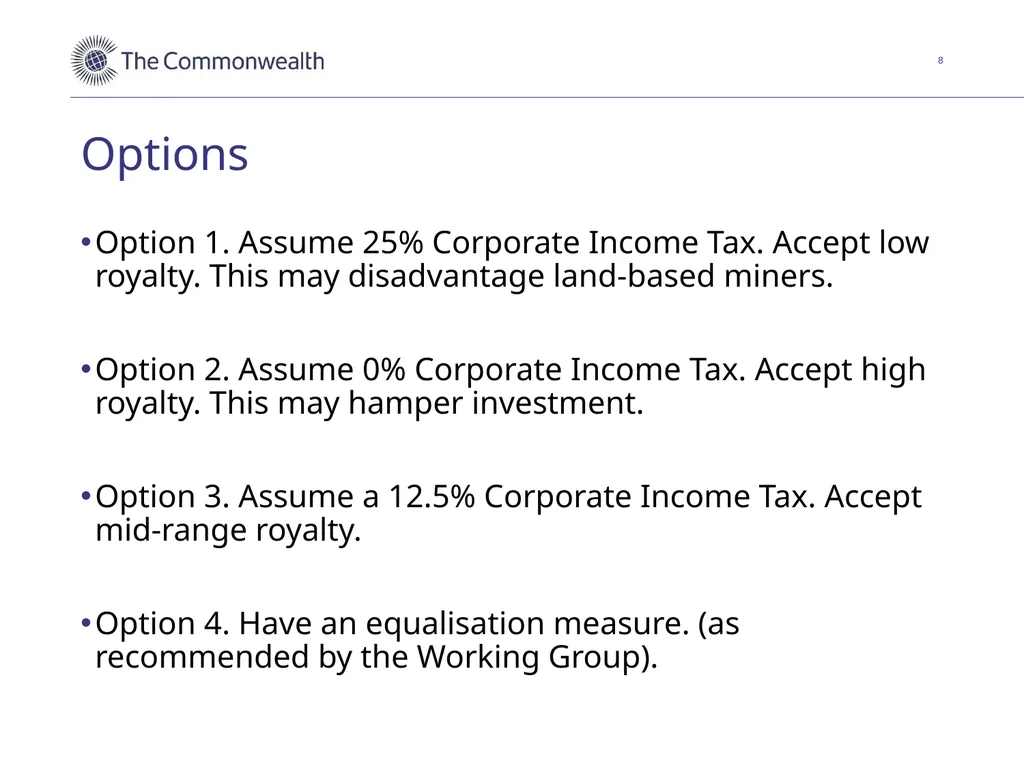
Options Option 1. Assume 25% Corporate Income Tax. Accept low royalty. This may disadvantage land-based miners.
Option 2. Assume 0% Corporate Income Tax. Accept high royalty. This may hamper investment.
Option 3. Assume a 12.5% Corporate Income Tax. Accept mid-range royalty.
Option 4. Have an equalisation measure. (as recommended by the Working Group). 8<br>
09
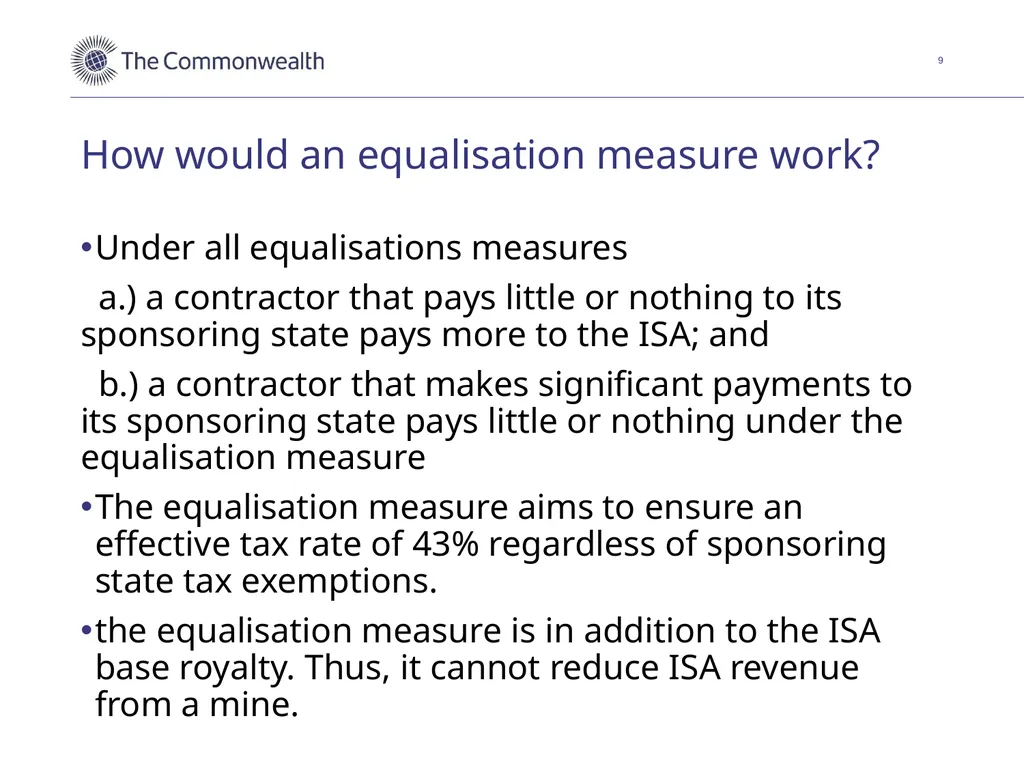
How would an equalisation measure work? Under all equalisations measures
a.) a contractor that pays little or nothing to its sponsoring state pays more to the ISA; and
b.) a contractor that makes significant payments to its sponsoring state pays little or nothing under the equalisation measure
The equalisation measure aims to ensure an effective tax rate of 43% regardless of sponsoring state tax exemptions.
the equalisation measure is in addition to the ISA base royalty. Thus, it cannot reduce ISA revenue from a mine. 9<br>
10
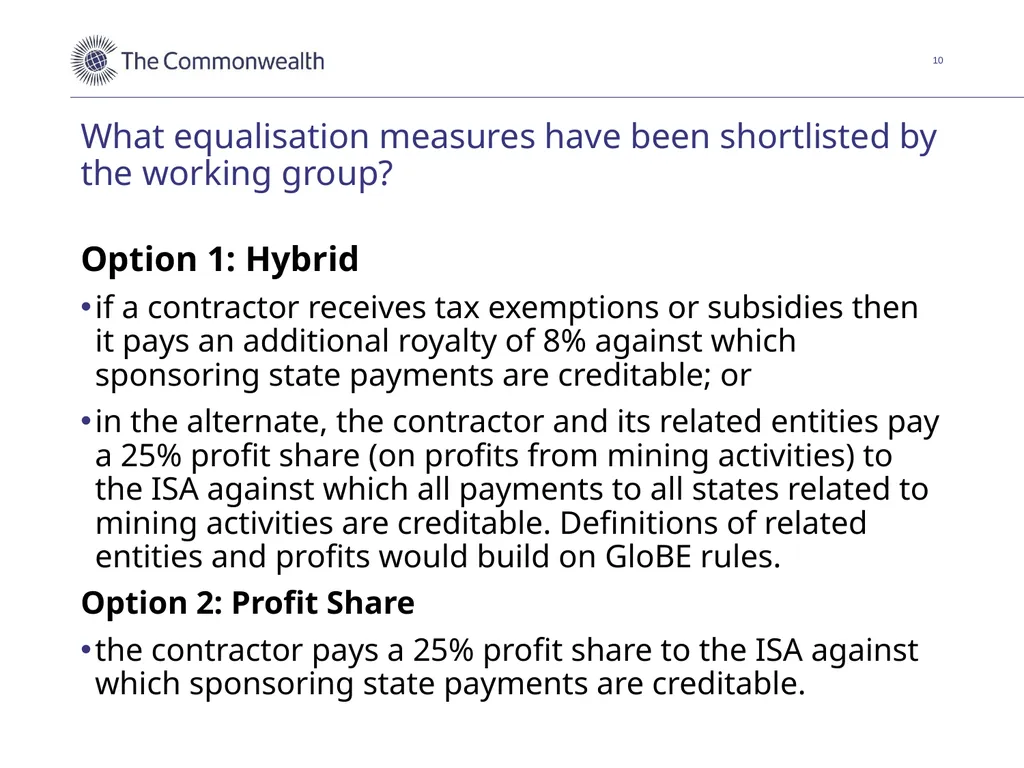
What equalisation measures have been shortlisted by the working group? Option 1: Hybrid
if a contractor receives tax exemptions or subsidies then it pays an additional royalty of 8% against which sponsoring state payments are creditable; or
in the alternate, the contractor and its related entities pay a 25% profit share (on profits from mining activities) to the ISA against which all payments to all states related to mining activities are creditable. Definitions of related entities and profits would build on GloBE rules.
Option 2: Profit Share
the contractor pays a 25% profit share to the ISA against which sponsoring state payments are creditable.
. 10<br>
11
Key benefits of both equalisation measures disincentivise sponsoring state tax avoidance.
help ensure a level playing field with land-based mining.
can increase but not decrease ISA revenues from a mine.
create a level playing field between contractors regardless of tax exemptions and subsidies. 11<br>
12
Is there draft text for options 1 and 2 Text for option 1 is included in ISA/29/C/CRP.1 ‘the suspense document’ pages 5 to 8. However, some definitions (such as mining activities) need to be defined.
Complete text for option 2 is provided in an earlier submission by the working group. It is 5 pages of text and can be downloaded at:
Draft-text-Additional-Profit-Share-Draft.pdf (isa.org.jm) 12<br>
13
Does the equalisation measure dictate sponsoring state tax policy? All states are and remain free to set all taxes and royalties at whatever rate they so choose.
The equalisation measure provides a credit for payments to sponsoring states.
Historically many countries have taxed companies on their worldwide profits and have provided a credit for foreign tax payments. This has not been regarded as controversial in tax policy and has obvious parallels with the equalisation measure. 13<br>
14
Do the Implementing Agreement and UNCLOS mandate an equalisation measure? Neither UNCLOS nor the Implementing Agreement mandate or exclude the use of an equalisation measure.
However, there is a strong argument that an equalisation measure is the best solution to the ‘rates of payment’ requirement.
UNCLOS and the Implementing Agreement do provide for a payment regime with a royalty and/or profit share, which are the instruments used by the equalisation measure. 14<br>
15
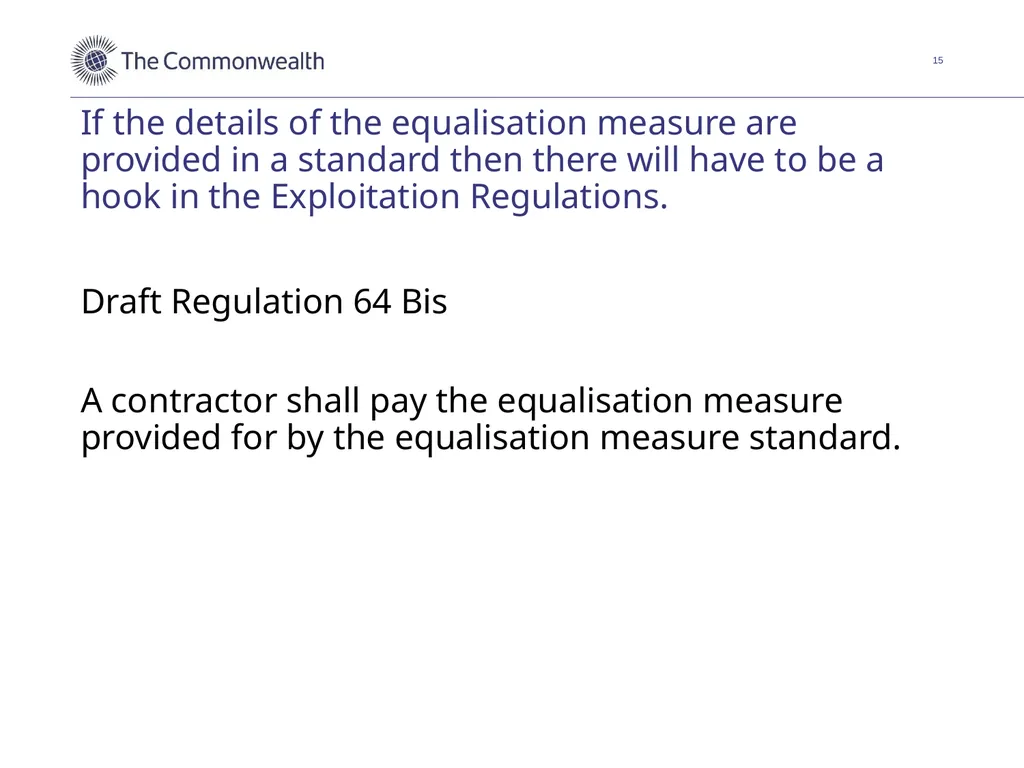
If the details of the equalisation measure are provided in a standard then there will have to be a hook in the Exploitation Regulations. Draft Regulation 64 Bis
A contractor shall pay the equalisation measure provided for by the equalisation measure standard. 15<br>
16
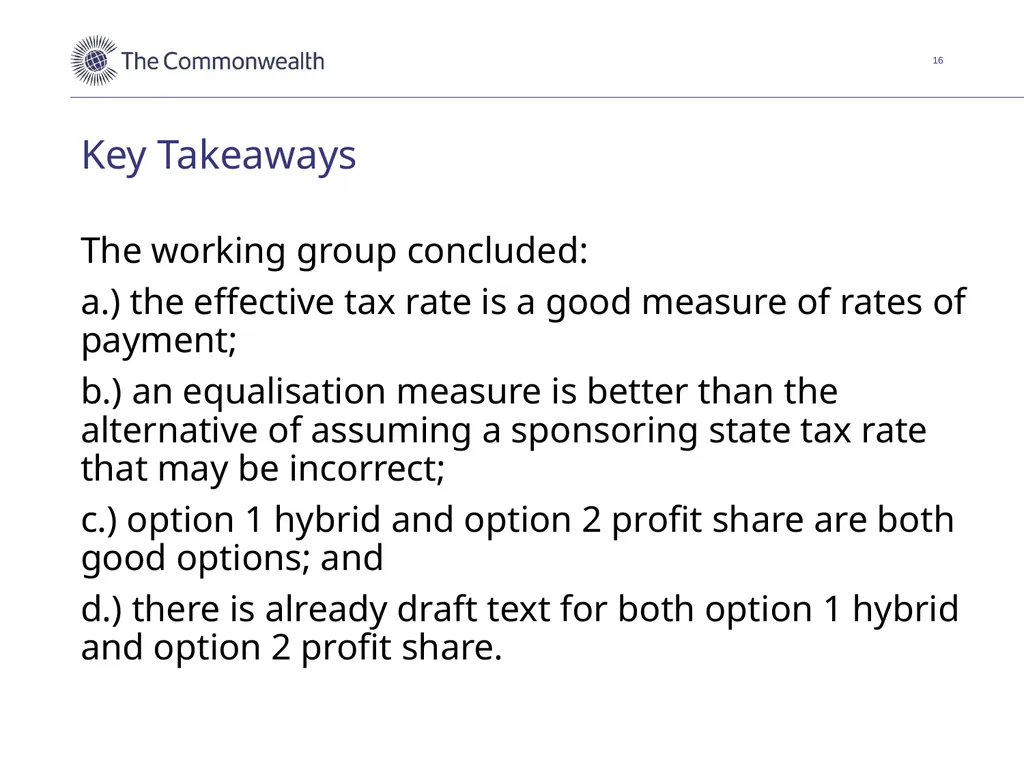
Key Takeaways The working group concluded:
a.) the effective tax rate is a good measure of rates of payment;
b.) an equalisation measure is better than the alternative of assuming a sponsoring state tax rate that may be incorrect;
c.) option 1 hybrid and option 2 profit share are both good options; and
d.) there is already draft text for both option 1 hybrid and option 2 profit share. 16<br>
17
Disclaimer The views and opinions expressed in this Presentation are those of the presenter and do not necessarily represent the views of the Commonwealth Secretariat or any Commonwealth member country. 17<br>
18
References *Wilde, D. (2022). An evaluation of the payment regime for deep seabed polymetallic nodule mining in the Area. Perspectives on Deep-Sea Mining: Sustainability, Technology, Environmental Policy and Management, 527-557. https://link.springer.com/chapter/10.1007/978-3-030-87982-2_18 18<br>