Discussion on the definition and KPIs for FSSensing Huawei Sensing definition NR wireless sensing: NR based wireless sensing technologies aiming at acquiring information about a remote object and its characteristics without physically
"Discussion on the definition and KPIs for" is the property of its rightful owner. Permission is granted to
download and print the materials on this website for personal, non-commercial use only, and to display it
on your personal computer provided you do not modify the materials and that you retain all copyright
notices contained in the materials. By downloading content from our website, you accept the terms of this
agreement.
Presentation Transcript
01
Discussion on the definition and KPIs for FS_Sensing Huawei<br>
02
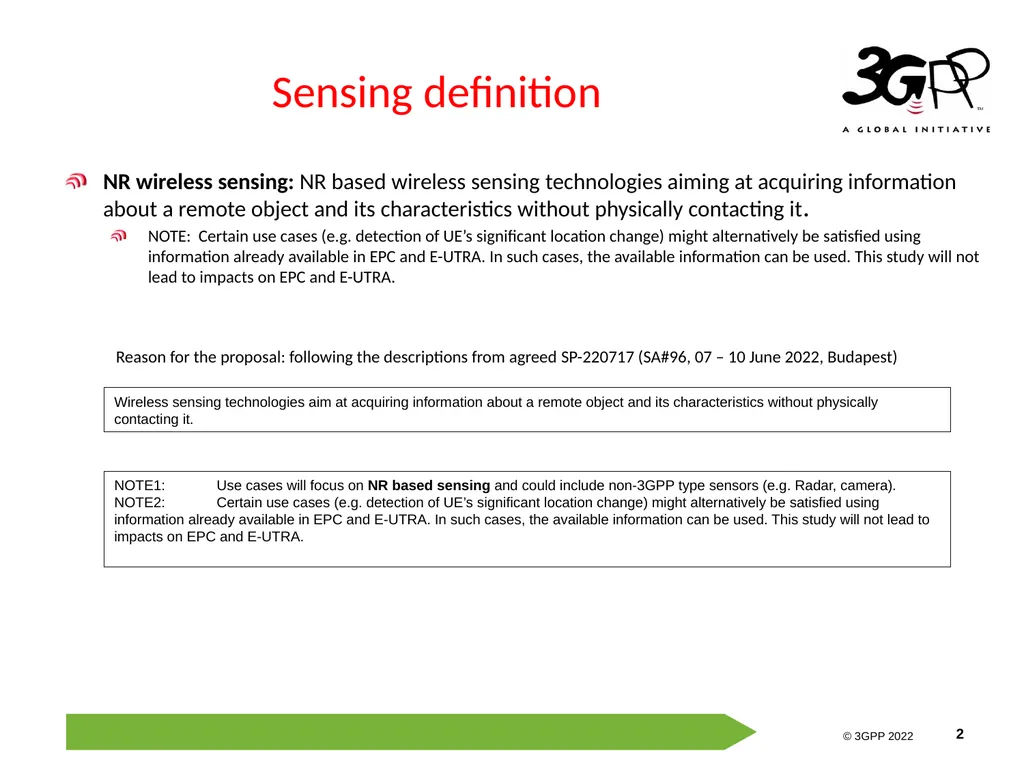
Sensing definition NR wireless sensing: NR based wireless sensing technologies aiming at acquiring information about a remote object and its characteristics without physically contacting it.
NOTE: Certain use cases (e.g. detection of UE’s significant location change) might alternatively be satisfied using information already available in EPC and E-UTRA. In such cases, the available information can be used. This study will not lead to impacts on EPC and E-UTRA.
Reason for the proposal: following the descriptions from agreed SP-220717 (SA#96, 07 – 10 June 2022, Budapest) Wireless sensing technologies aim at acquiring information about a remote object and its characteristics without physically contacting it. NOTE1: Use cases will focus on NR based sensing and could include non-3GPP type sensors (e.g. Radar, camera).
NOTE2: Certain use cases (e.g. detection of UE’s significant location change) might alternatively be satisfied using information already available in EPC and E-UTRA. In such cases, the available information can be used. This study will not lead to impacts on EPC and E-UTRA.<br>
03
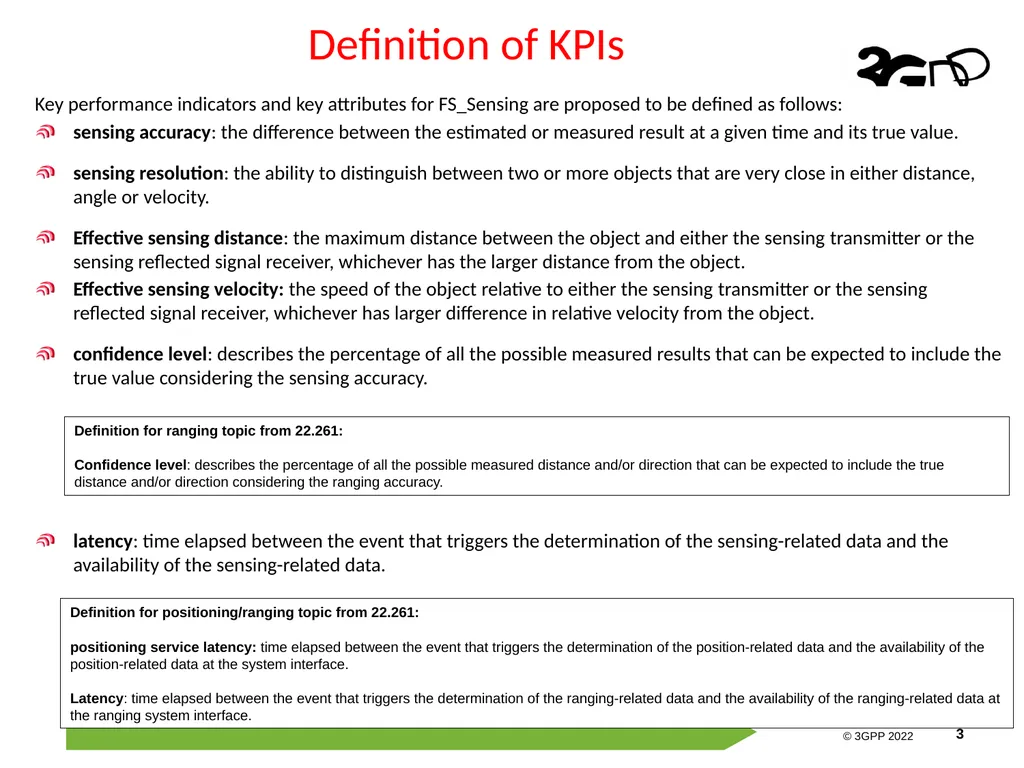
Definition of KPIs Key performance indicators and key attributes for FS_Sensing are proposed to be defined as follows:
sensing accuracy: the difference between the estimated or measured result at a given time and its true value.
sensing resolution: the ability to distinguish between two or more objects that are very close in either distance, angle or velocity.
Effective sensing distance: the maximum distance between the object and either the sensing transmitter or the sensing reflected signal receiver, whichever has the larger distance from the object.
Effective sensing velocity: the speed of the object relative to either the sensing transmitter or the sensing reflected signal receiver, whichever has larger difference in relative velocity from the object.
confidence level: describes the percentage of all the possible measured results that can be expected to include the true value considering the sensing accuracy.
latency: time elapsed between the event that triggers the determination of the sensing-related data and the availability of the sensing-related data. Definition for positioning/ranging topic from 22.261:
positioning service latency: time elapsed between the event that triggers the determination of the position-related data and the availability of the position-related data at the system interface.
Latency: time elapsed between the event that triggers the determination of the ranging-related data and the availability of the ranging-related data at the ranging system interface. Definition for ranging topic from 22.261:
Confidence level: describes the percentage of all the possible measured distance and/or direction that can be expected to include the true distance and/or direction considering the ranging accuracy.<br>
04
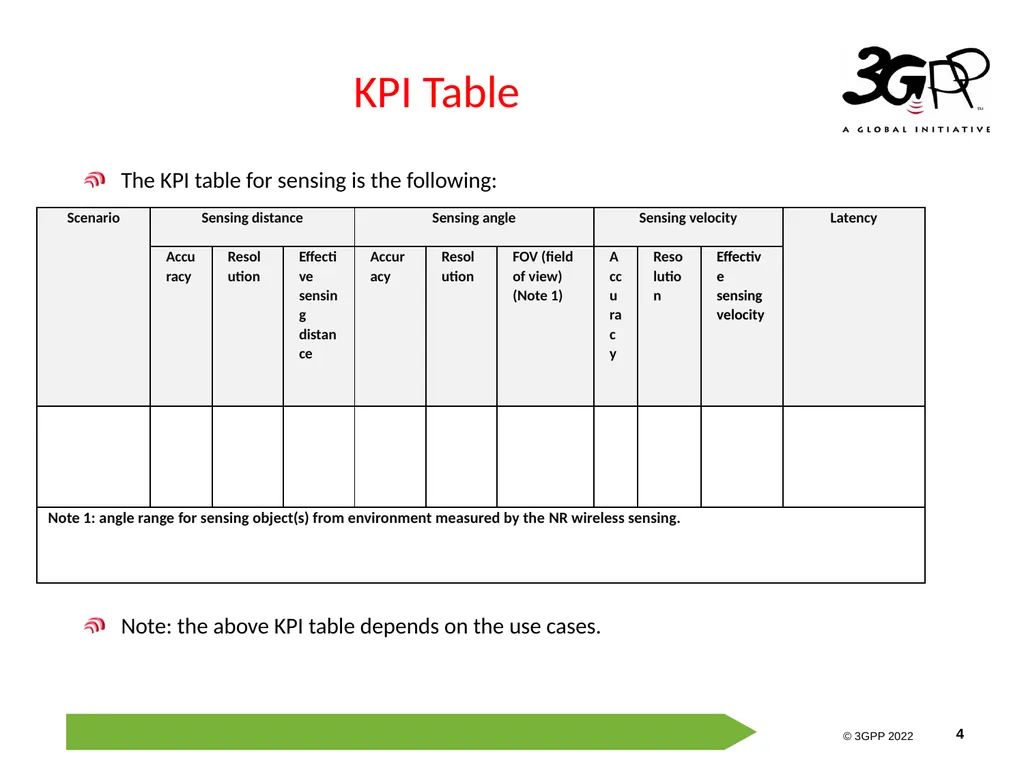
The KPI table for sensing is the following:
Note: the above KPI table depends on the use cases. KPI Table<br>