Disposal Thermal Disposal and Other Methods Adapted from the FAD PRePNAHEMS Guidelines: Disposal (2012) Thermal Disposal Methods USDA APHIS and CFSPH FAD PRePNAHEMS Guidelines: Disposal - Thermal Disposal and Other Methods
"Disposal Thermal Disposal and Other Methods" is the property of its rightful owner. Permission is granted to
download and print the materials on this website for personal, non-commercial use only, and to display it
on your personal computer provided you do not modify the materials and that you retain all copyright
notices contained in the materials. By downloading content from our website, you accept the terms of this
agreement.
Presentation Transcript
01
Disposal Thermal Disposal and Other Methods Adapted from the FAD PReP/NAHEMS Guidelines: Disposal (2012)<br>
02
Thermal Disposal Methods USDA APHIS and CFSPH FAD PReP/NAHEMS Guidelines: Disposal - Thermal Disposal and Other Methods<br>
03
High-temperature combustion
Diesel fuel, propane, furnace, waste oils
Do NOT use gasoline
Transmissible Spongiform Encephalopathy (TSE) agents rendered non-infectious by
Minimum 1560oF for 15 minutes
Higher temperatures (1830oF) ideal USDA APHIS and CFSPH FAD PReP/NAHEMS Guidelines: Disposal - Thermal Disposal and Other Methods Thermal Methods Overview<br>
04
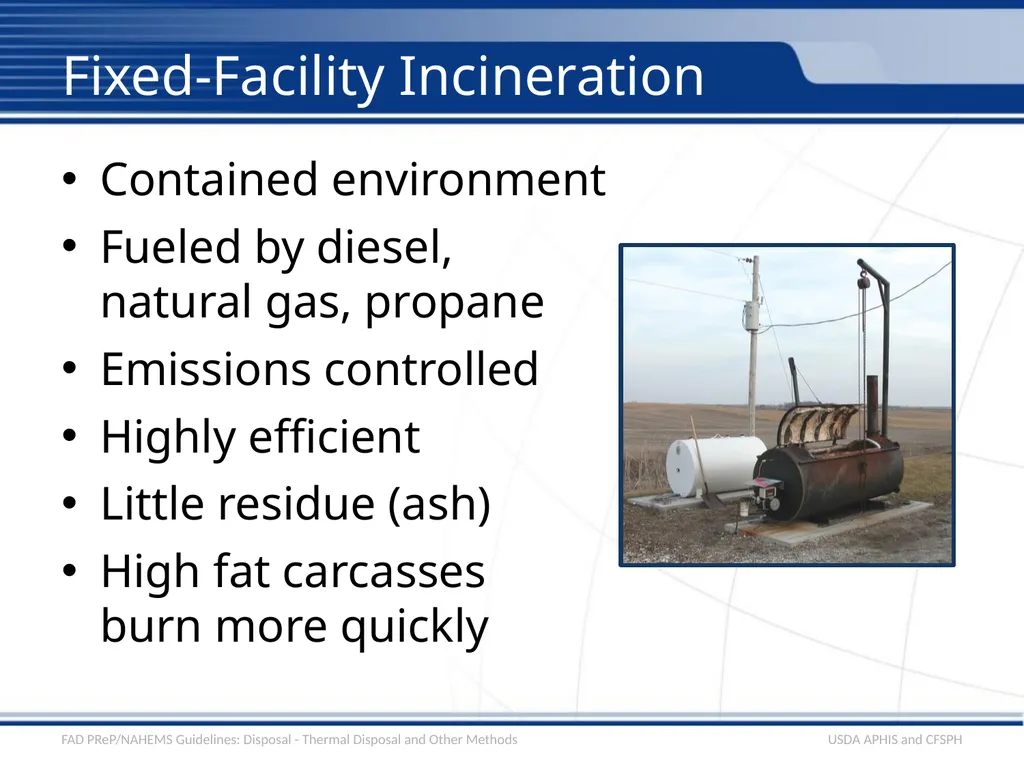
Contained environment
Fueled by diesel, natural gas, propane
Emissions controlled
Highly efficient
Little residue (ash)
High fat carcasses burn more quickly USDA APHIS and CFSPH FAD PReP/NAHEMS Guidelines: Disposal - Thermal Disposal and Other Methods Fixed-Facility Incineration<br>
05
On-site incinerators
Large animal production facilities, vet schools/diagnostic laboratories, etc.
Limited continuous capacity
Other waste incineration facilities
Municipal solid waste facilities, etc.
Unlikely to accept animal carcasses
Batch feed, and low heating value USDA APHIS and CFSPH FAD PReP/NAHEMS Guidelines: Disposal - Thermal Disposal and Other Methods Fixed-Facility Incineration<br>
06
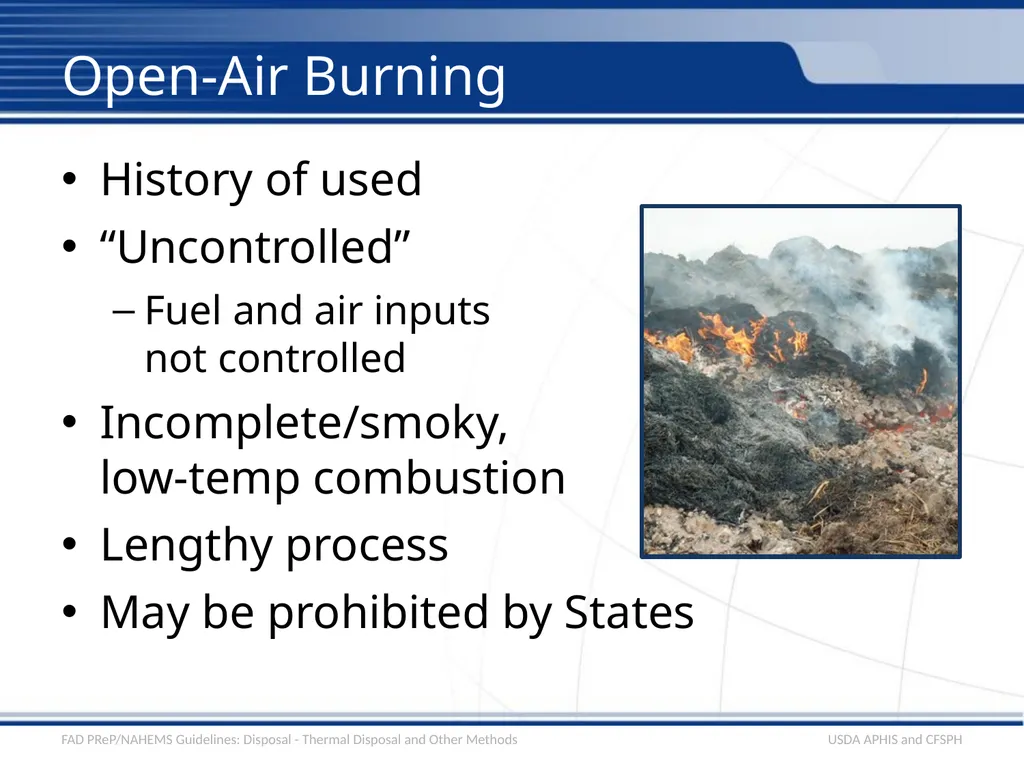
History of used
“Uncontrolled”
Fuel and air inputs not controlled
Incomplete/smoky, low-temp combustion
Lengthy process
May be prohibited by States USDA APHIS and CFSPH FAD PReP/NAHEMS Guidelines: Disposal - Thermal Disposal and Other Methods Open-Air Burning<br>
07
Negative public perception
Use isolated areas
Use trained personnel
Involve fire authorities
Open fields, pyres
Combustible materials
Hay, straw, dry timbers
Ash disposal / pathogen escape USDA APHIS and CFSPH FAD PReP/NAHEMS Guidelines: Disposal - Thermal Disposal and Other Methods Open-Air Burning<br>
08
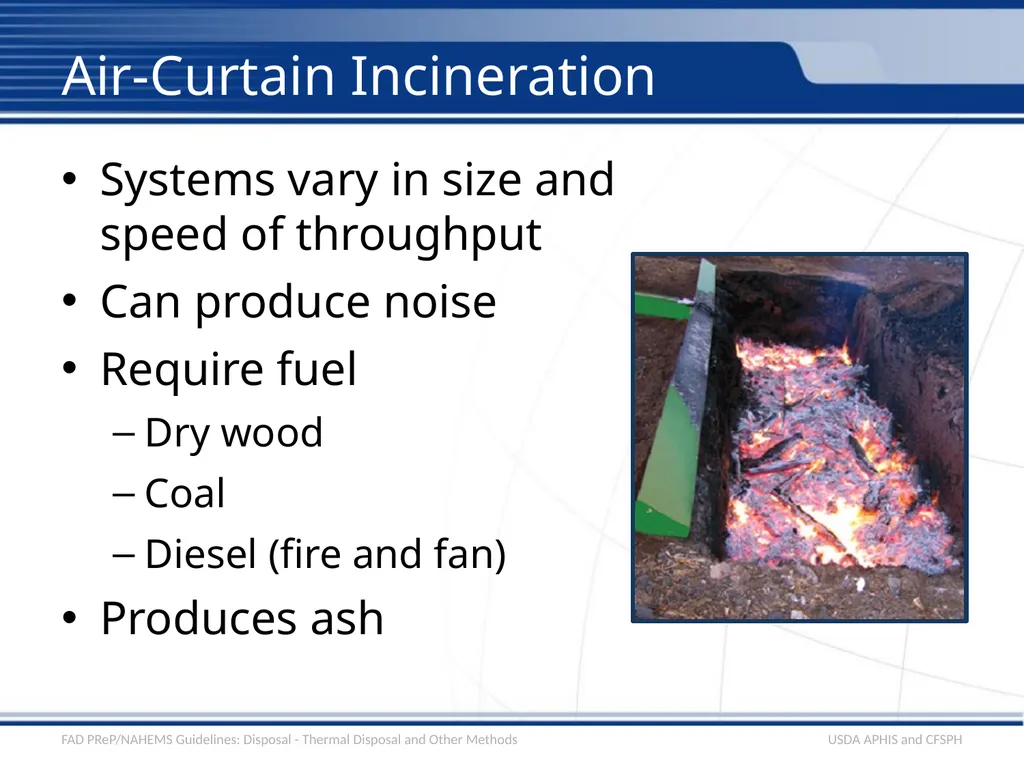
Combination of forced air and fuel used to burn carcasses or waste
Increased temperature
Accelerated combustion (up to 6x faster than open-air burning)
Fan/manifold delivers high-velocity air into metal box or burn pit
Mobile or fixed technology USDA APHIS and CFSPH FAD PReP/NAHEMS Guidelines: Disposal - Thermal Disposal and Other Methods Air-Curtain Incineration<br>
09
Systems vary in size and speed of throughput
Can produce noise
Require fuel
Dry wood
Coal
Diesel (fire and fan)
Produces ash USDA APHIS and CFSPH FAD PReP/NAHEMS Guidelines: Disposal - Thermal Disposal and Other Methods Air-Curtain Incineration<br>
10
Other Disposal Procedures USDA APHIS and CFSPH FAD PReP/NAHEMS Guidelines: Disposal - Thermal Disposal and Other Methods<br>
11
Process
High temperatures (steam heat), pressure, and pH (strong base)
Solid by-products and sterile aqueous solution produced
On-site or fixed location
Low carcass capacity, but effective against pathogens such as TSEs USDA APHIS and CFSPH FAD PReP/NAHEMS Guidelines: Disposal - Thermal Disposal and Other Methods Alkaline Hydrolysis<br>
12
Lactic acid fermentation
Ground carcasses mixed with lactic acid bacteria and fermentable carbohydrates
Produces water, methane, CO2
Does not inactivate prions
Process takes 7-10 days
Produces odors, store in sealed and controlled-vented containers USDA APHIS and CFSPH FAD PReP/NAHEMS Guidelines: Disposal - Thermal Disposal and Other Methods Anaerobic Digestion<br>
13
Emerging thermal technology
Slow heating occurs in containers
Gasification and combustion chambers
Batch or continuous process
Converts carcasses into gasses and ash
Carbon dioxide, carbon monoxide, methane
Process takes up to 12 hours USDA APHIS and CFSPH FAD PReP/NAHEMS Guidelines: Disposal - Thermal Disposal and Other Methods Gasification<br>
14
Electrically generated heat used to ionize compressed air
High temperatures (7000°C +)
Water is vaporized
Reduces biomass by 97%
Converts carcasses to rock-like solid residue
Resistant to leaching USDA APHIS and CFSPH FAD PReP/NAHEMS Guidelines: Disposal - Thermal Disposal and Other Methods Plasma Vitrification<br>
15
FAD PReP/NAHEMS Guidelines & SOP: Disposal (2012)
http://www.aphis.usda.gov/animal_health/emergency_management/
Disposal web-based training module
http://naherc.sws.iastate.edu/ USDA APHIS and CFSPH FAD PReP/NAHEMS Guidelines: Disposal - Thermal Disposal and Other Methods For More Information<br>
16
Authors
Reneé Dewell, DVM, MS (CFSPH)
Tom Glanville, PhD (Iowa State University)
Significant contributions to the content were provided by USDA APHIS VS:
Lori P. Miller, PE
Darrel K. Styles, DVM, PhD USDA APHIS and CFSPH FAD PReP/NAHEMS Guidelines: Disposal - Thermal Disposal and Other Methods Guidelines Content<br>
17
Acknowledgments Development of this presentation was by the Center for Food Security and Public Health at Iowa State University through funding from the USDA APHIS Veterinary Services PPT Author: Kerry Leedom Larson, DVM, MPH, PhD, DACVPM Reviewers: Janice Mogan, DVM; Reneé Dewell DVM, MS<br>