Disruption in HIV, Hepatitis and STI services due to COVID-19 Presentation with latest results as of November, 2020 . Global HIV, Hepatitis and STI Programmes World Health Organization ARV multi month dispensing ARV MMD policy is adopted in
"Disruption in HIV, Hepatitis and STI services due" is the property of its rightful owner. Permission is granted to
download and print the materials on this website for personal, non-commercial use only, and to display it
on your personal computer provided you do not modify the materials and that you retain all copyright
notices contained in the materials. By downloading content from our website, you accept the terms of this
agreement.
Presentation Transcript
01
Disruption in HIV, Hepatitis and STI services due to COVID-19 Presentation with latest results as of November, 2020 . Global HIV, Hepatitis and STI Programmes World Health Organization<br>
02
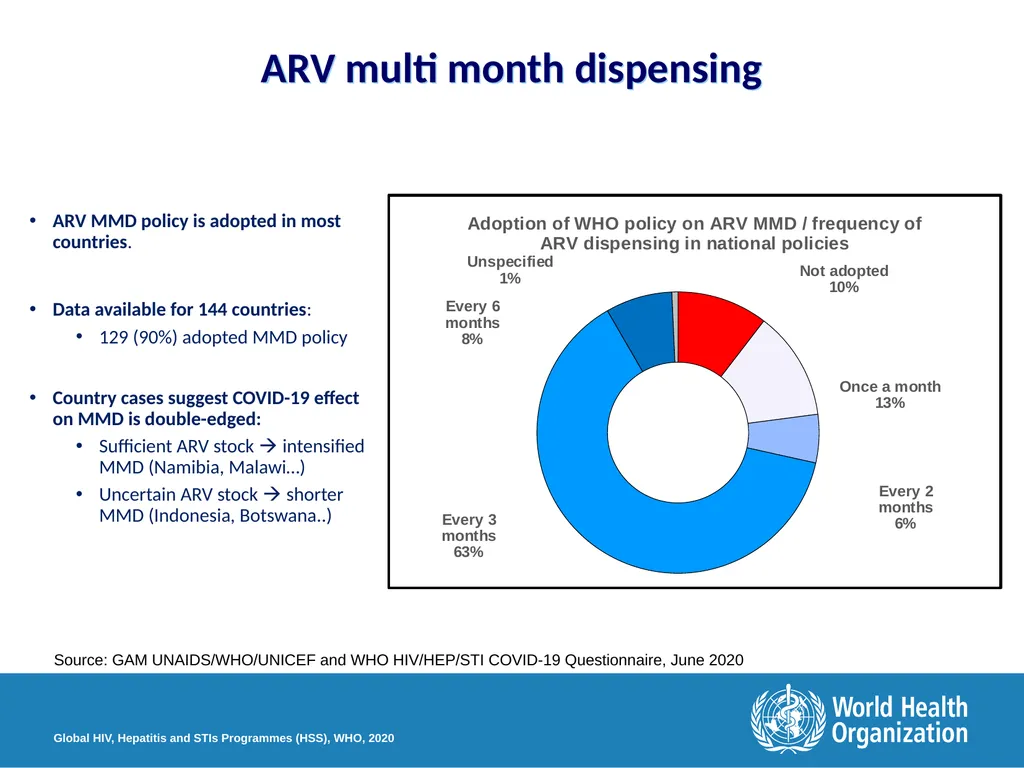
ARV multi month dispensing ARV MMD policy is adopted in most countries.
Data available for 144 countries:
129 (90%) adopted MMD policy
Country cases suggest COVID-19 effect on MMD is double-edged:
Sufficient ARV stock intensified MMD (Namibia, Malawi…)
Uncertain ARV stock shorter MMD (Indonesia, Botswana..) Source: GAM UNAIDS/WHO/UNICEF and WHO HIV/HEP/STI COVID-19 Questionnaire Source: GAM UNAIDS/WHO/UNICEF and WHO HIV/HEP/STI COVID-19 Questionnaire, June 2020 Global HIV, Hepatitis and STIs Programmes (HSS), WHO, 2020<br>
03
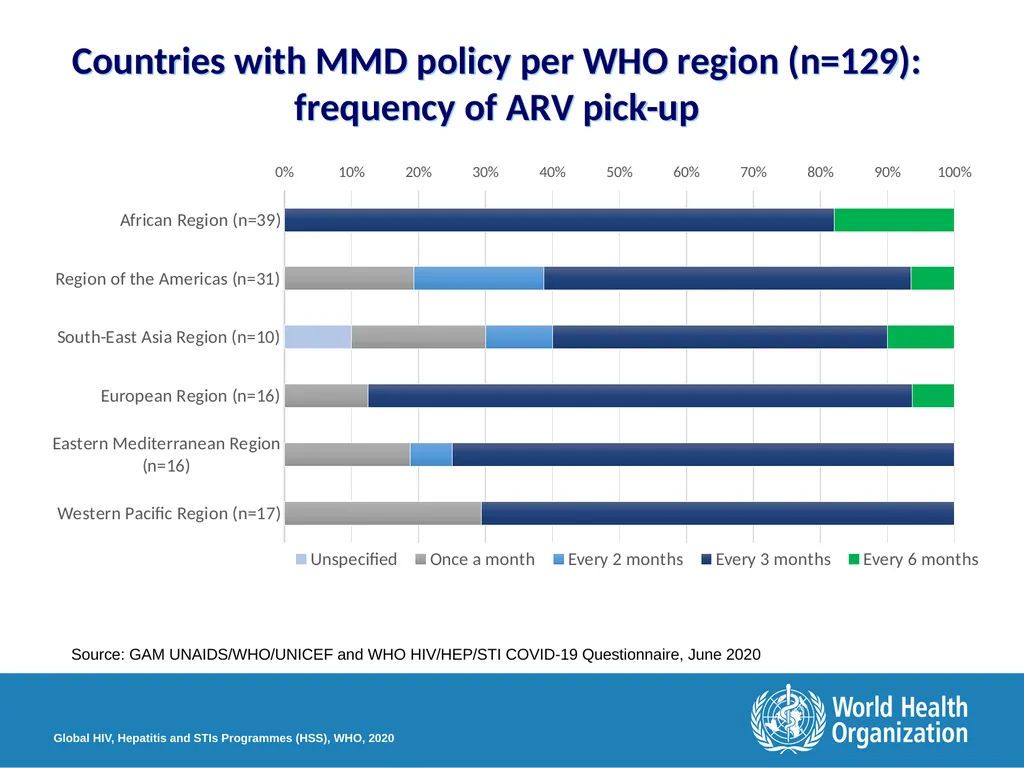
Countries with MMD policy per WHO region (n=129): frequency of ARV pick-up Source: GAM UNAIDS/WHO/UNICEF and WHO HIV/HEP/STI COVID-19 Questionnaire Source: GAM UNAIDS/WHO/UNICEF and WHO HIV/HEP/STI COVID-19 Questionnaire, June 2020 Global HIV, Hepatitis and STIs Programmes (HSS), WHO, 2020<br>
04
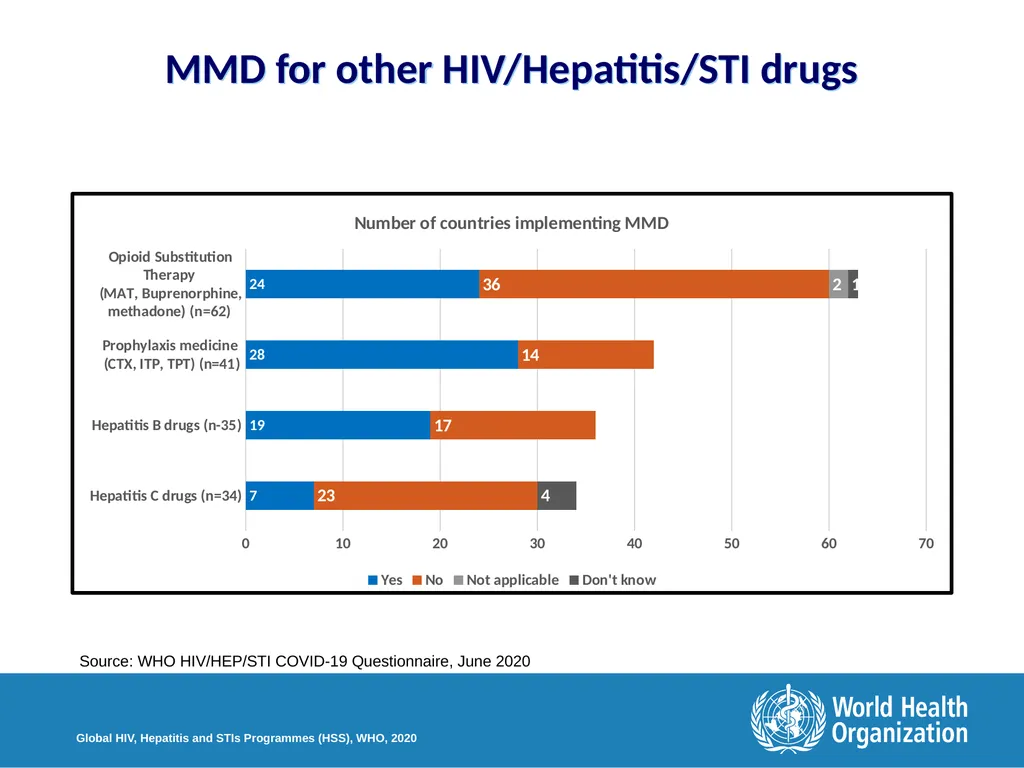
MMD for other HIV/Hepatitis/STI drugs Source: WHO HIV/HEP/STI COVID-19 Questionnaire Source: WHO HIV/HEP/STI COVID-19 Questionnaire, June 2020 Global HIV, Hepatitis and STIs Programmes (HSS), WHO, 2020<br>
05
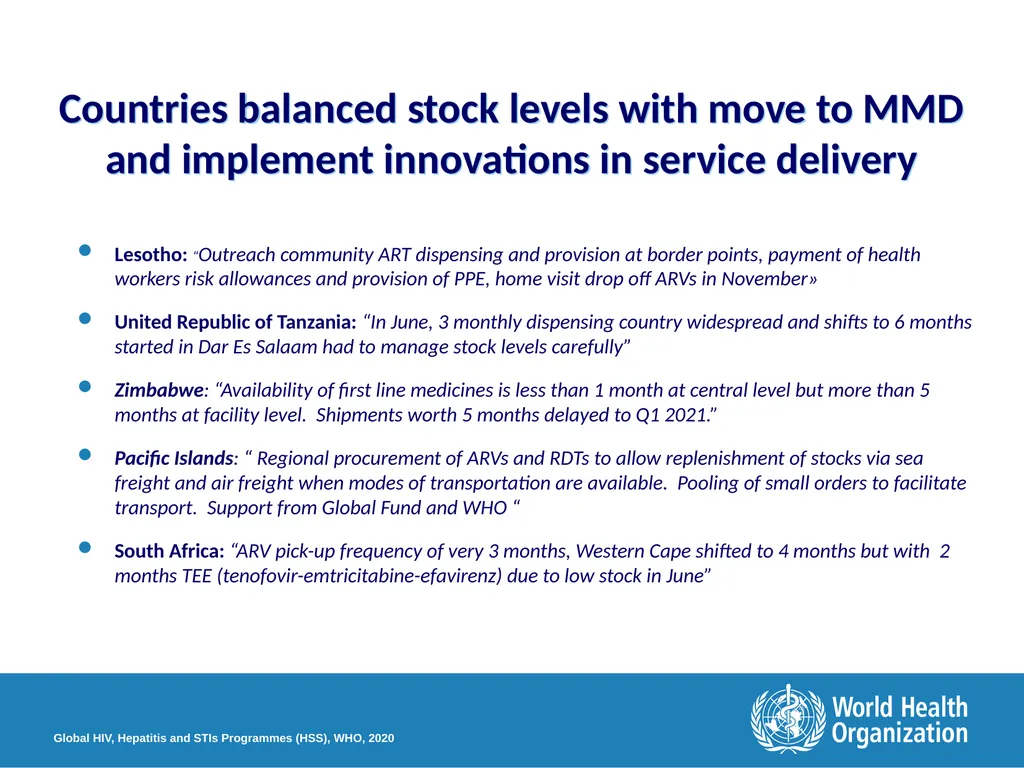
Countries balanced stock levels with move to MMD and implement innovations in service delivery Lesotho: “Outreach community ART dispensing and provision at border points, payment of health workers risk allowances and provision of PPE, home visit drop off ARVs in November»
United Republic of Tanzania: “In June, 3 monthly dispensing country widespread and shifts to 6 months started in Dar Es Salaam had to manage stock levels carefully”
Zimbabwe: “Availability of first line medicines is less than 1 month at central level but more than 5 months at facility level. Shipments worth 5 months delayed to Q1 2021.”
Pacific Islands: “ Regional procurement of ARVs and RDTs to allow replenishment of stocks via sea freight and air freight when modes of transportation are available. Pooling of small orders to facilitate transport. Support from Global Fund and WHO “
South Africa: “ARV pick-up frequency of very 3 months, Western Cape shifted to 4 months but with 2 months TEE (tenofovir-emtricitabine-efavirenz) due to low stock in June” Source: WHO HIV/HEP/STI COVID-19 Questionnaire Global HIV, Hepatitis and STIs Programmes (HSS), WHO, 2020<br>
06
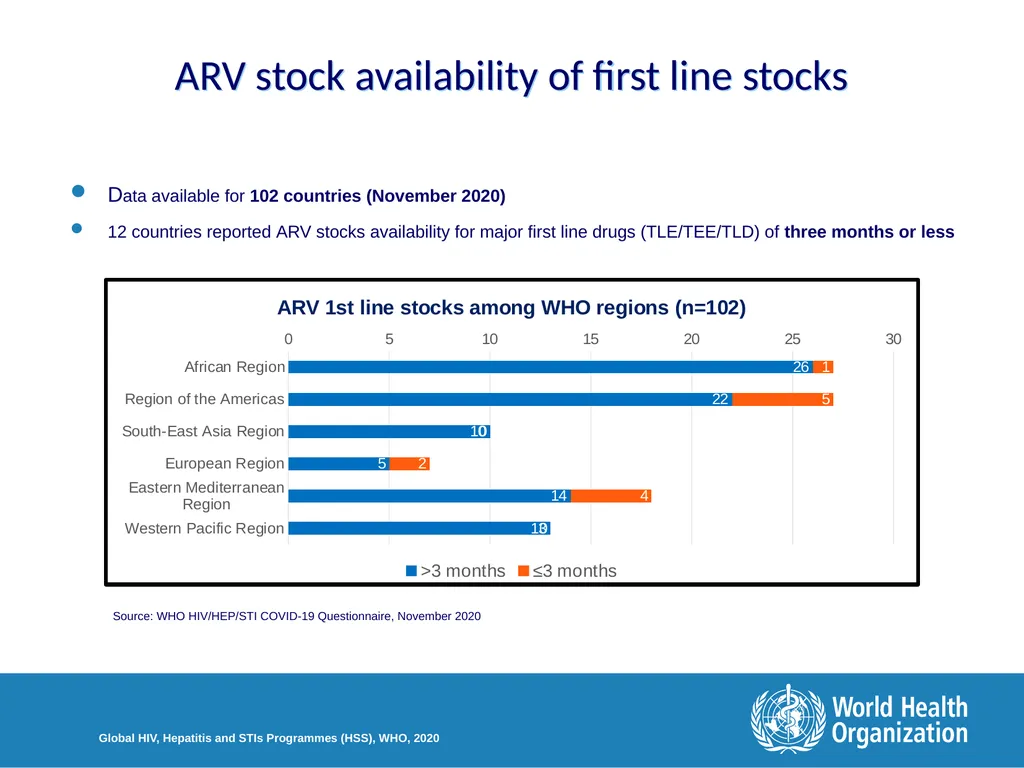
ARV stock availability of first line stocks Data available for 102 countries (November 2020)
12 countries reported ARV stocks availability for major first line drugs (TLE/TEE/TLD) of three months or less Source: WHO HIV/HEP/STI COVID-19 Questionnaire, November 2020 Global HIV, Hepatitis and STIs Programmes (HSS), WHO, 2020<br>
07
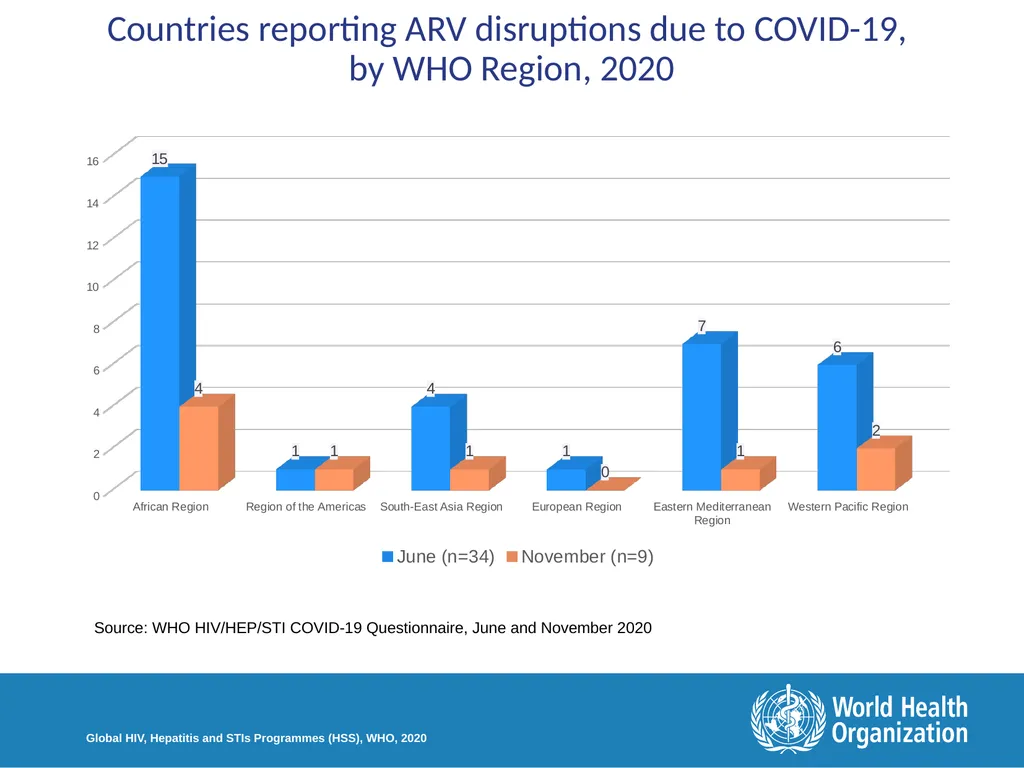
Countries reporting ARV disruptions due to COVID-19,
by WHO Region, 2020 Global HIV, Hepatitis and STIs Programmes (HSS), WHO, 2020 Source: WHO HIV/HEP/STI COVID-19 Questionnaire, June and November 2020<br>
08
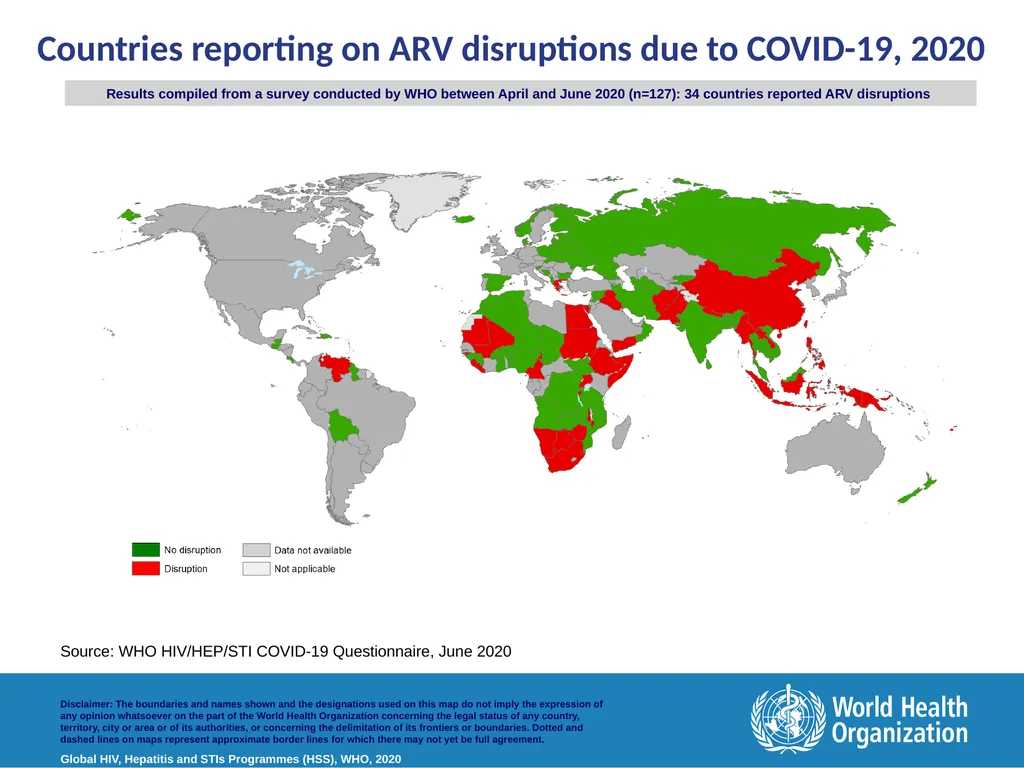
Disclaimer: The boundaries and names shown and the designations used on this map do not imply the expression of any opinion whatsoever on the part of the World Health Organization concerning the legal status of any country, territory, city or area or of its authorities, or concerning the delimitation of its frontiers or boundaries. Dotted and dashed lines on maps represent approximate border lines for which there may not yet be full agreement. Countries reporting on ARV disruptions due to COVID-19, 2020 Global HIV, Hepatitis and STIs Programmes (HSS), WHO, 2020 Results compiled from a survey conducted by WHO between April and June 2020 (n=127): 34 countries reported ARV disruptions Source: WHO HIV/HEP/STI COVID-19 Questionnaire, June 2020<br>
09
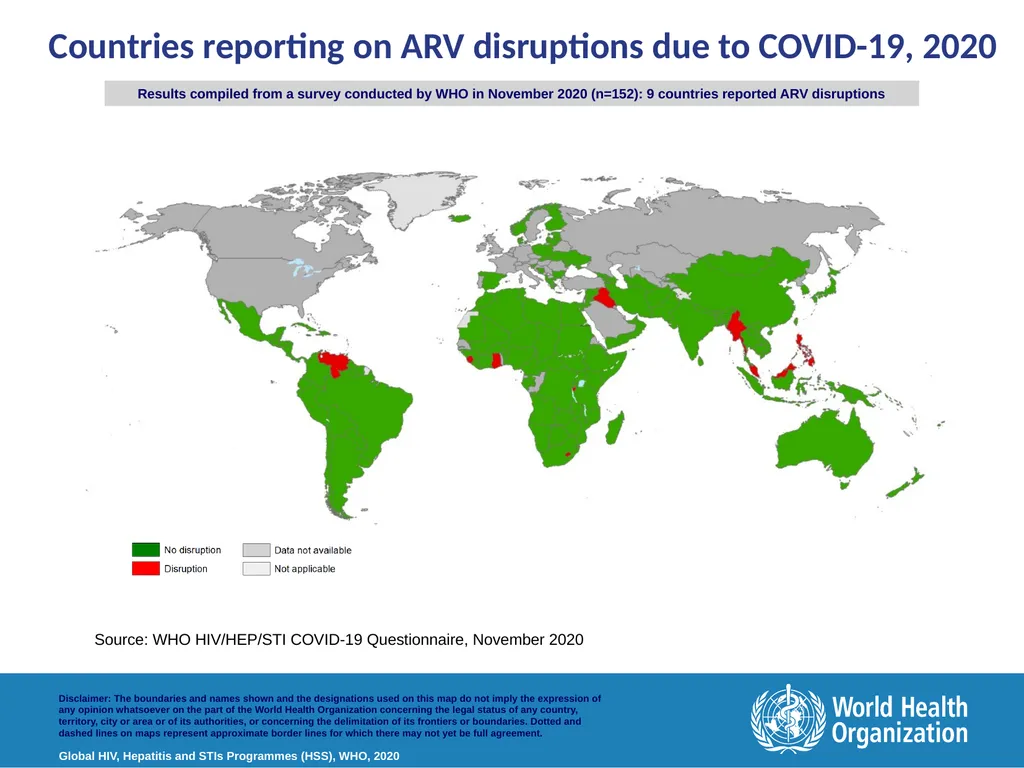
Disclaimer: The boundaries and names shown and the designations used on this map do not imply the expression of any opinion whatsoever on the part of the World Health Organization concerning the legal status of any country, territory, city or area or of its authorities, or concerning the delimitation of its frontiers or boundaries. Dotted and dashed lines on maps represent approximate border lines for which there may not yet be full agreement. Countries reporting on ARV disruptions due to COVID-19, 2020 Global HIV, Hepatitis and STIs Programmes (HSS), WHO, 2020 Results compiled from a survey conducted by WHO in November 2020 (n=152): 9 countries reported ARV disruptions Source: WHO HIV/HEP/STI COVID-19 Questionnaire, November 2020<br>
10
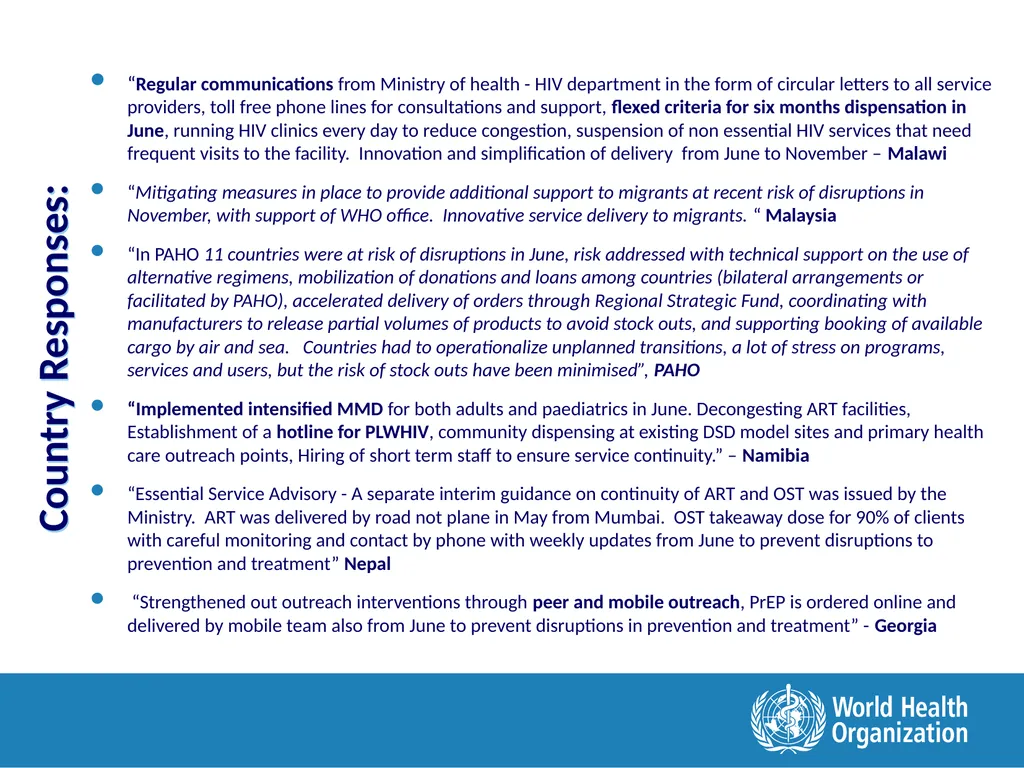
Country Responses: “Regular communications from Ministry of health - HIV department in the form of circular letters to all service providers, toll free phone lines for consultations and support, flexed criteria for six months dispensation in June, running HIV clinics every day to reduce congestion, suspension of non essential HIV services that need frequent visits to the facility. Innovation and simplification of delivery from June to November – Malawi
“Mitigating measures in place to provide additional support to migrants at recent risk of disruptions in November, with support of WHO office. Innovative service delivery to migrants. “ Malaysia
“In PAHO 11 countries were at risk of disruptions in June, risk addressed with technical support on the use of alternative regimens, mobilization of donations and loans among countries (bilateral arrangements or facilitated by PAHO), accelerated delivery of orders through Regional Strategic Fund, coordinating with manufacturers to release partial volumes of products to avoid stock outs, and supporting booking of available cargo by air and sea. Countries had to operationalize unplanned transitions, a lot of stress on programs, services and users, but the risk of stock outs have been minimised”, PAHO
“Implemented intensified MMD for both adults and paediatrics in June. Decongesting ART facilities, Establishment of a hotline for PLWHIV, community dispensing at existing DSD model sites and primary health care outreach points, Hiring of short term staff to ensure service continuity.” – Namibia
“Essential Service Advisory - A separate interim guidance on continuity of ART and OST was issued by the Ministry. ART was delivered by road not plane in May from Mumbai. OST takeaway dose for 90% of clients with careful monitoring and contact by phone with weekly updates from June to prevent disruptions to prevention and treatment” Nepal
“Strengthened out outreach interventions through peer and mobile outreach, PrEP is ordered online and delivered by mobile team also from June to prevent disruptions in prevention and treatment” - Georgia<br>
11
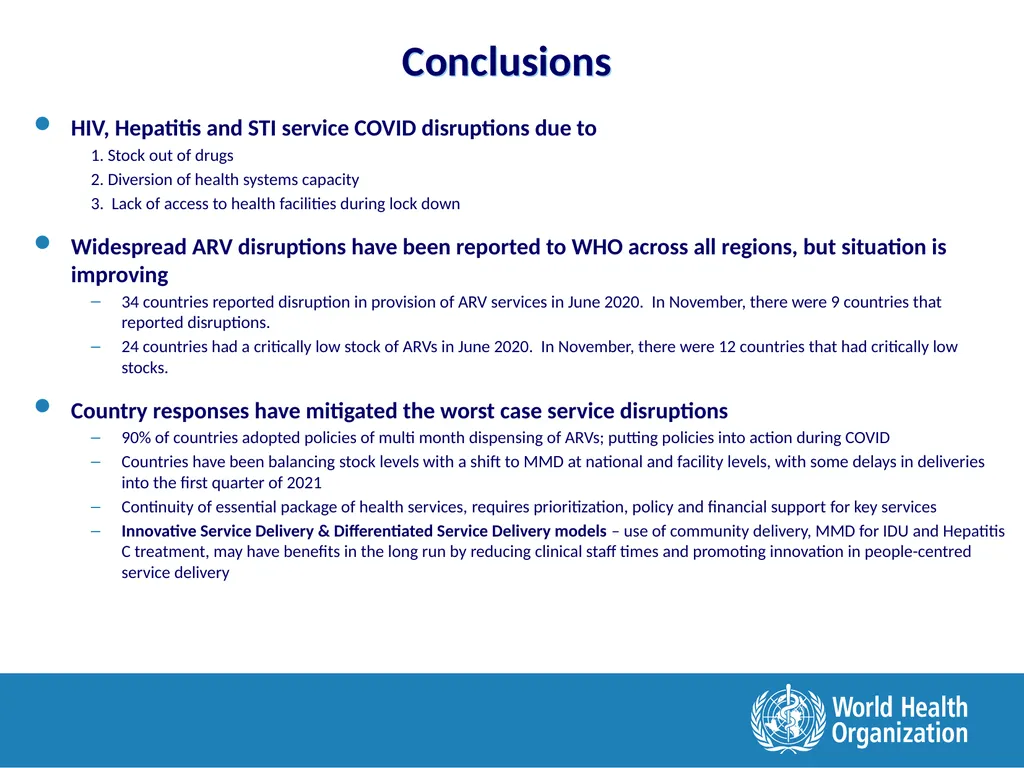
Conclusions HIV, Hepatitis and STI service COVID disruptions due to
1. Stock out of drugs
2. Diversion of health systems capacity
3. Lack of access to health facilities during lock down
Widespread ARV disruptions have been reported to WHO across all regions, but situation is improving
34 countries reported disruption in provision of ARV services in June 2020. In November, there were 9 countries that reported disruptions.
24 countries had a critically low stock of ARVs in June 2020. In November, there were 12 countries that had critically low stocks.
Country responses have mitigated the worst case service disruptions
90% of countries adopted policies of multi month dispensing of ARVs; putting policies into action during COVID
Countries have been balancing stock levels with a shift to MMD at national and facility levels, with some delays in deliveries into the first quarter of 2021
Continuity of essential package of health services, requires prioritization, policy and financial support for key services
Innovative Service Delivery & Differentiated Service Delivery models – use of community delivery, MMD for IDU and Hepatitis C treatment, may have benefits in the long run by reducing clinical staff times and promoting innovation in people-centred service delivery<br>