
Distributed Interactive Simulation (DIS) 201 Bob
TF
Published · 38 slides · 0 views
1 / 1

Description
Distributed Interactive Simulation (DIS) 201 Bob Murray DIS PDG Vice Chair bob.murrayboeing.com Extensibility Dead Reckoning 30 March 2013 Overview DIS Extensibility Why we need PDU customization Compatibility with previous DIS standards
Related Topics
Share
Embed code
Download this presentation From Below
"Distributed Interactive Simulation (DIS) 201 Bob" is the property of its rightful owner. Permission is granted to download and print the materials on this website for personal, non-commercial use only, and to display it on your personal computer provided you do not modify the materials and that you retain all copyright notices contained in the materials. By downloading content from our website, you accept the terms of this agreement.
Presentation Transcript
01
Distributed Interactive Simulation (DIS) 201 Bob Murray
DIS PDG Vice Chair
bob.murray@boeing.com Extensibility & Dead Reckoning 30 March 2013<br>
DIS PDG Vice Chair
bob.murray@boeing.com Extensibility & Dead Reckoning 30 March 2013<br>
02
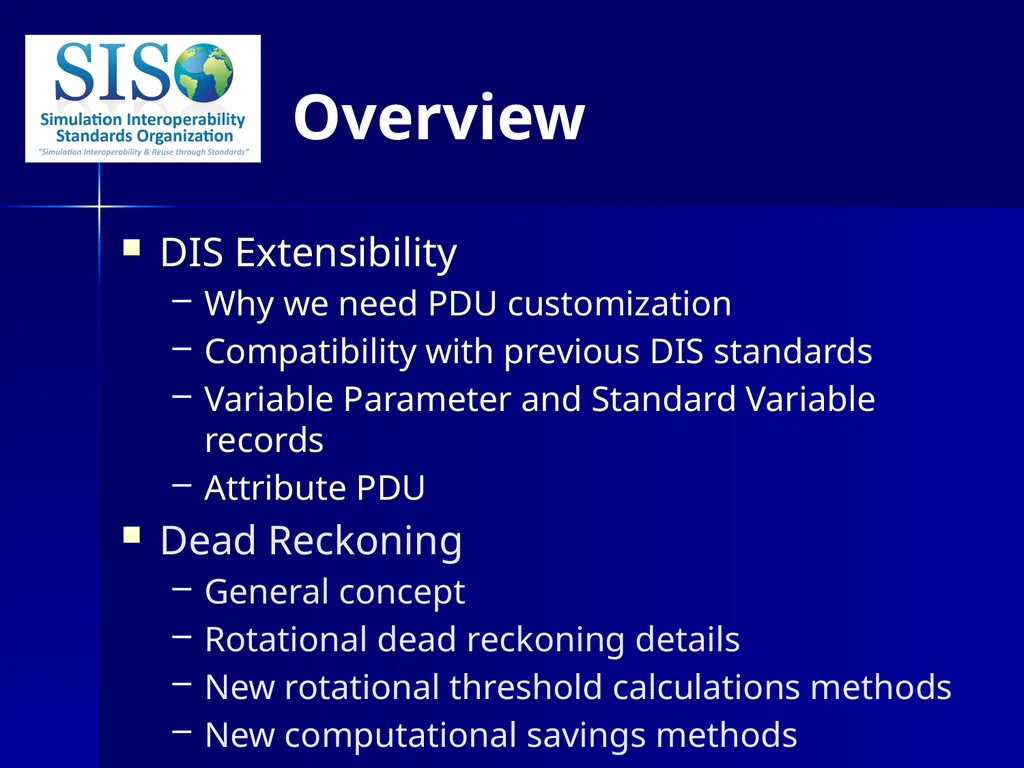
Overview DIS Extensibility
Why we need PDU customization
Compatibility with previous DIS standards
Variable Parameter and Standard Variable records
Attribute PDU
Dead Reckoning
General concept
Rotational dead reckoning details
New rotational threshold calculations methods
New computational savings methods<br>
Why we need PDU customization
Compatibility with previous DIS standards
Variable Parameter and Standard Variable records
Attribute PDU
Dead Reckoning
General concept
Rotational dead reckoning details
New rotational threshold calculations methods
New computational savings methods<br>
03
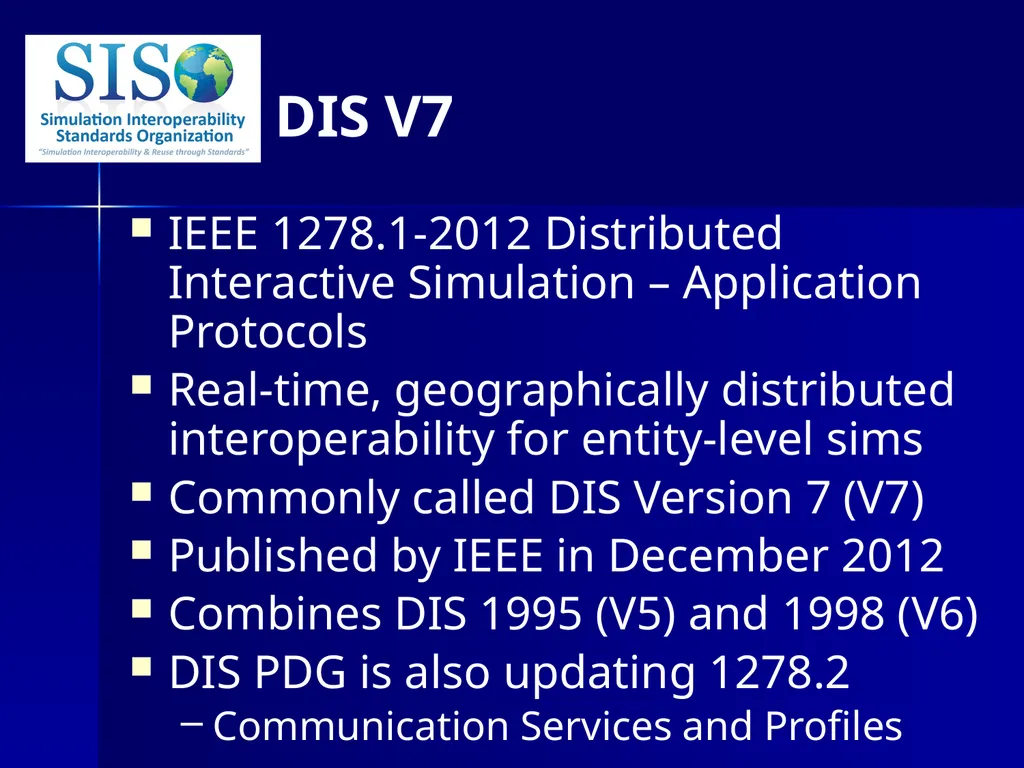
DIS V7 IEEE 1278.1-2012 Distributed Interactive Simulation – Application Protocols
Real-time, geographically distributed interoperability for entity-level sims
Commonly called DIS Version 7 (V7)
Published by IEEE in December 2012
Combines DIS 1995 (V5) and 1998 (V6)
DIS PDG is also updating 1278.2
Communication Services and Profiles<br>
Real-time, geographically distributed interoperability for entity-level sims
Commonly called DIS Version 7 (V7)
Published by IEEE in December 2012
Combines DIS 1995 (V5) and 1998 (V6)
DIS PDG is also updating 1278.2
Communication Services and Profiles<br>
04
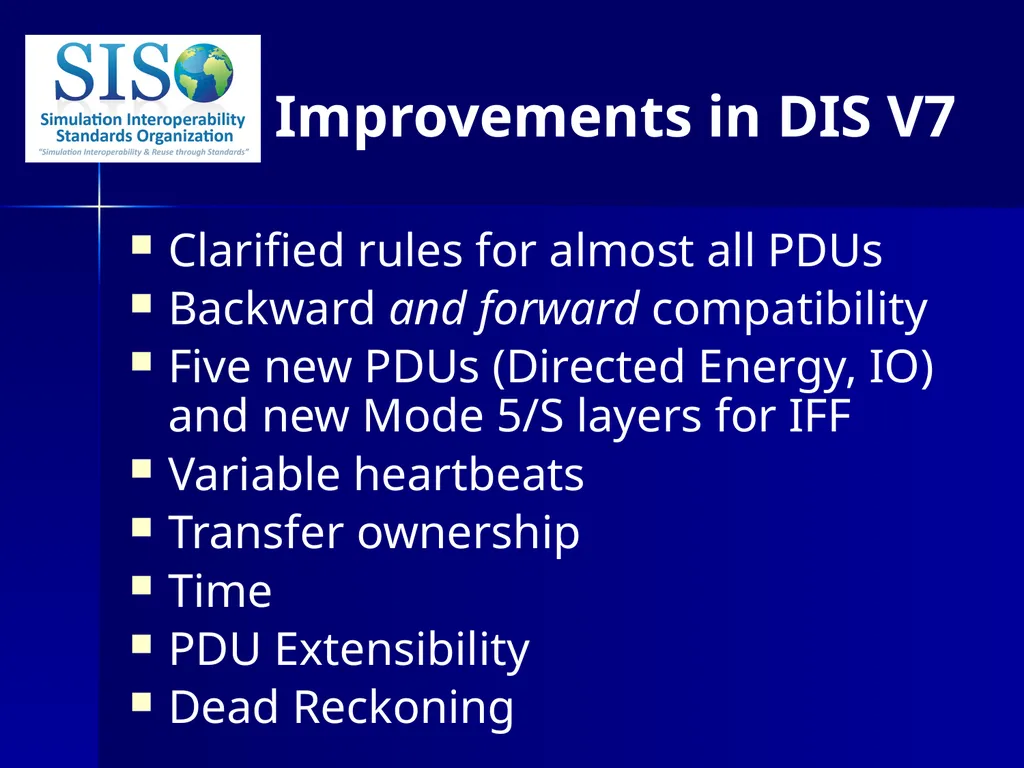
Improvements in DIS V7 Clarified rules for almost all PDUs
Backward and forward compatibility
Five new PDUs (Directed Energy, IO) and new Mode 5/S layers for IFF
Variable heartbeats
Transfer ownership
Time
PDU Extensibility
Dead Reckoning<br>
Backward and forward compatibility
Five new PDUs (Directed Energy, IO) and new Mode 5/S layers for IFF
Variable heartbeats
Transfer ownership
Time
PDU Extensibility
Dead Reckoning<br>
05
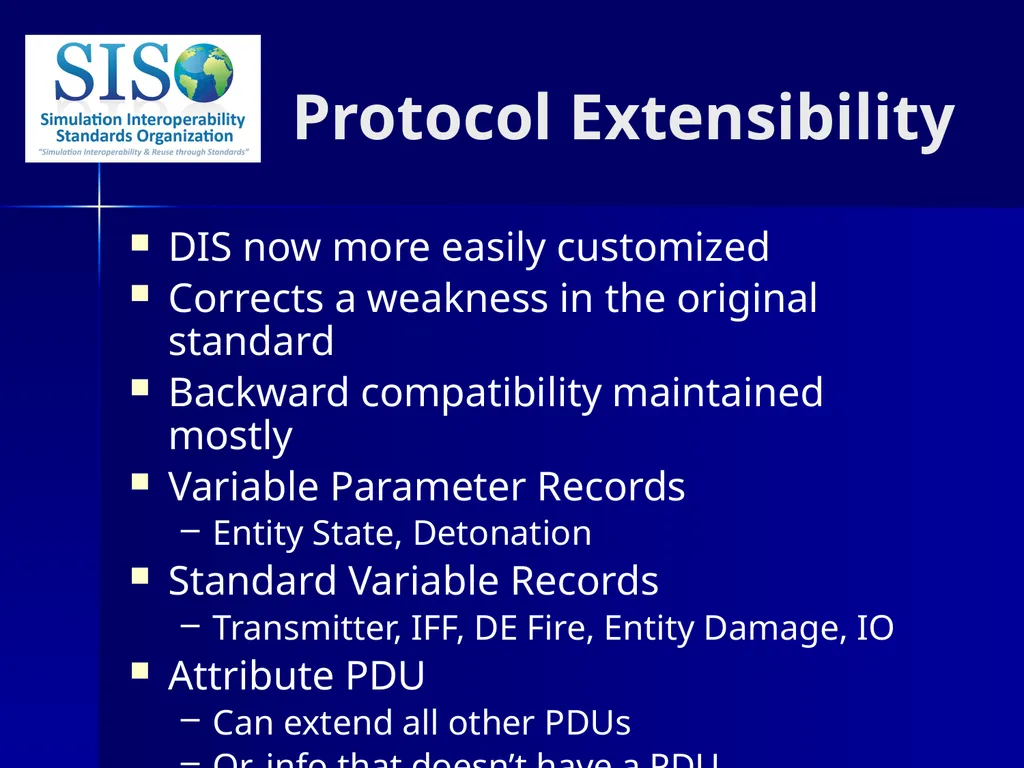
Protocol Extensibility DIS now more easily customized
Corrects a weakness in the original standard
Backward compatibility maintained mostly
Variable Parameter Records
Entity State, Detonation
Standard Variable Records
Transmitter, IFF, DE Fire, Entity Damage, IO
Attribute PDU
Can extend all other PDUs
Or, info that doesn’t have a PDU<br>
Corrects a weakness in the original standard
Backward compatibility maintained mostly
Variable Parameter Records
Entity State, Detonation
Standard Variable Records
Transmitter, IFF, DE Fire, Entity Damage, IO
Attribute PDU
Can extend all other PDUs
Or, info that doesn’t have a PDU<br>
06
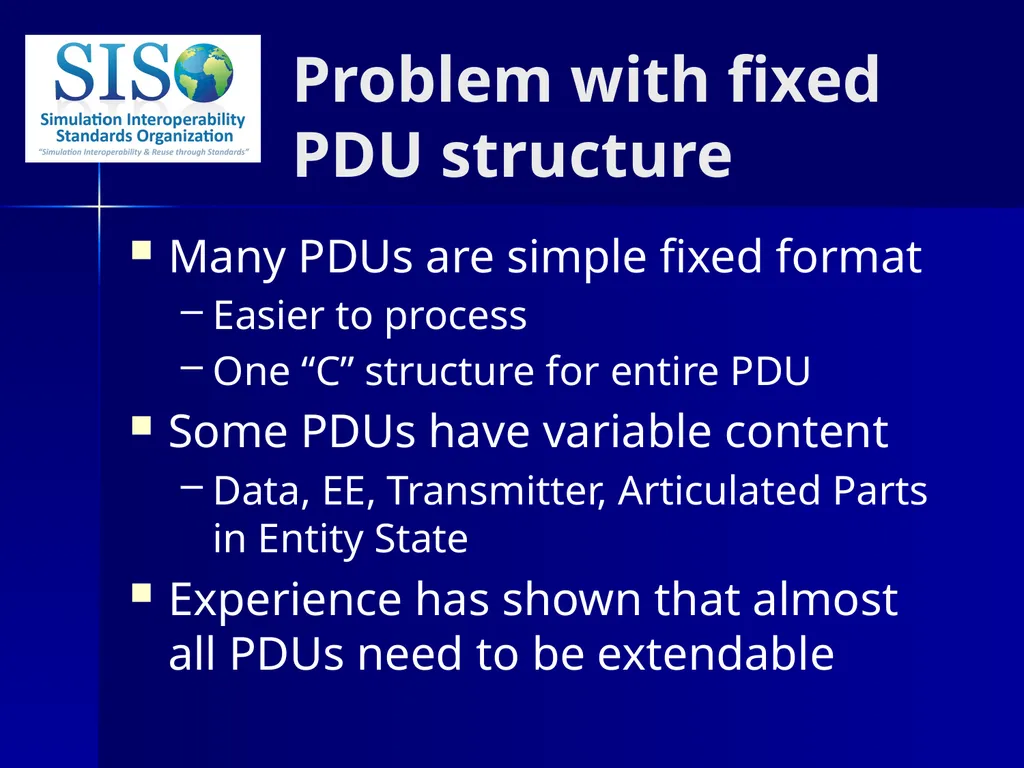
Problem with fixed PDU structure Many PDUs are simple fixed format
Easier to process
One “C” structure for entire PDU
Some PDUs have variable content
Data, EE, Transmitter, Articulated Parts in Entity State
Experience has shown that almost all PDUs need to be extendable<br>
Easier to process
One “C” structure for entire PDU
Some PDUs have variable content
Data, EE, Transmitter, Articulated Parts in Entity State
Experience has shown that almost all PDUs need to be extendable<br>
07
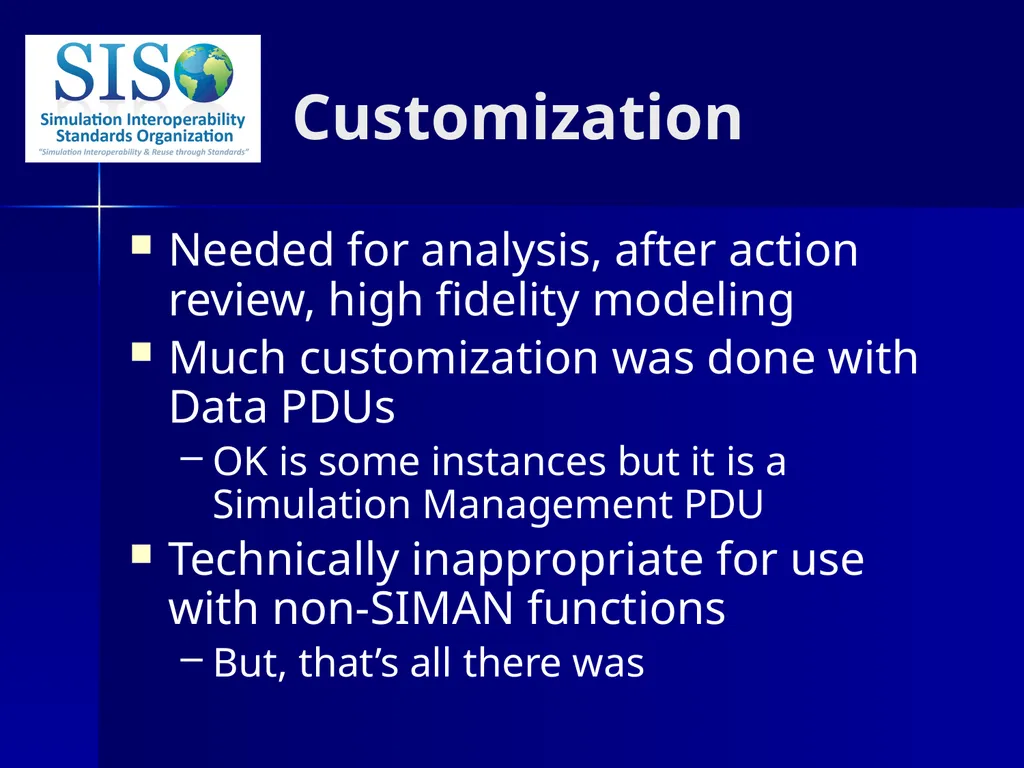
Customization Needed for analysis, after action review, high fidelity modeling
Much customization was done with Data PDUs
OK is some instances but it is a Simulation Management PDU
Technically inappropriate for use with non-SIMAN functions
But, that’s all there was<br>
Much customization was done with Data PDUs
OK is some instances but it is a Simulation Management PDU
Technically inappropriate for use with non-SIMAN functions
But, that’s all there was<br>
08
Variable Records Extensibility was recognized as a needed improvement in DIS
The idea of a “variable datum” is good
The trick is how to apply it to all PDUs without breaking compatibility
Variable Record Tiger Team was formed to solve the problem<br>
The idea of a “variable datum” is good
The trick is how to apply it to all PDUs without breaking compatibility
Variable Record Tiger Team was formed to solve the problem<br>
09
Compatibility All decisions to alter DIS PDUs had the issue of compatibility to older versions
New standards are slow to be accepted if not compatible with legacy
Compatibility won in almost all cases
Backward compatibility is easier
New sims can process old PDUs
Forward compatibility is tricky
How can old sims process new PDUs?<br>
New standards are slow to be accepted if not compatible with legacy
Compatibility won in almost all cases
Backward compatibility is easier
New sims can process old PDUs
Forward compatibility is tricky
How can old sims process new PDUs?<br>
10
Forward Compatibility Surprisingly, almost all modifications to PDUs are forward compatible
Assume old sims will simply discard the five brand new PDUs
Functionality added in padding
Old sims should ignore padding
DIS always had a rule to set pads to zero
Zero value defined as old function so new sims interpret old PDUs properly<br>
Assume old sims will simply discard the five brand new PDUs
Functionality added in padding
Old sims should ignore padding
DIS always had a rule to set pads to zero
Zero value defined as old function so new sims interpret old PDUs properly<br>
11
Variable Parameter records Made use of existing Articulated / Attached parts in Entity State and Detonate PDUs
Renamed Variable Parameter records
Maintains forward/backward compatibility
Name is misleading: format is variable but length must remain fixed at 16 bytes
First 8 bits denotes record
Other 120 bits open for definition<br>
Renamed Variable Parameter records
Maintains forward/backward compatibility
Name is misleading: format is variable but length must remain fixed at 16 bytes
First 8 bits denotes record
Other 120 bits open for definition<br>
12
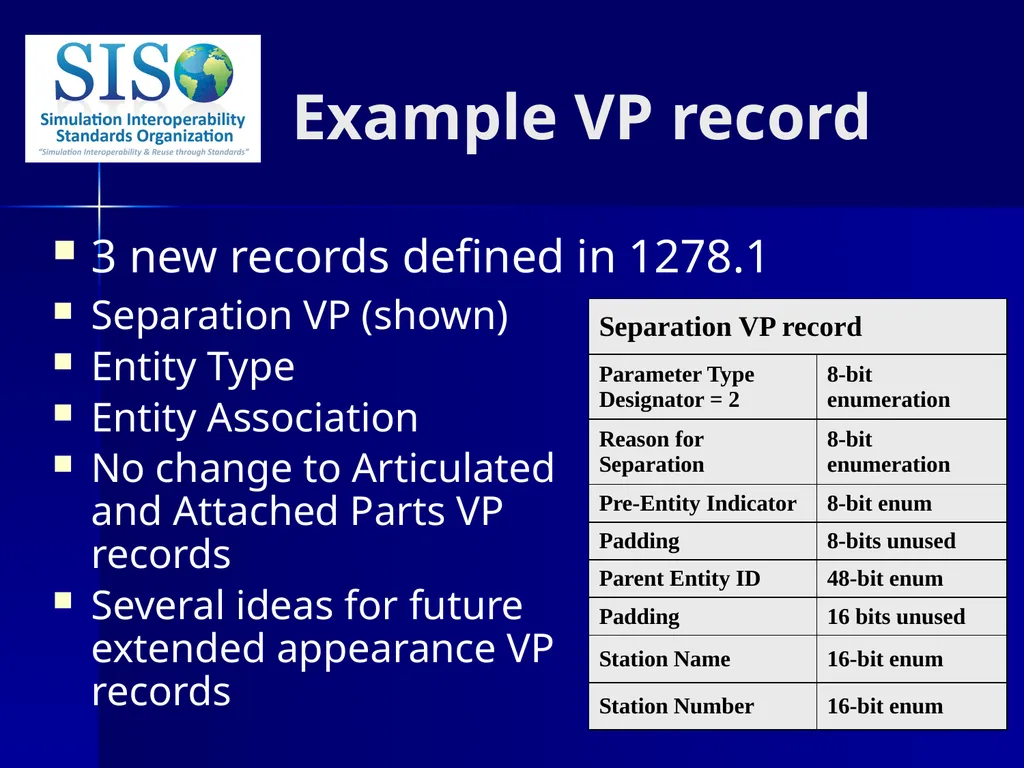
Example VP record 3 new records defined in 1278.1 Separation VP (shown)
Entity Type
Entity Association
No change to Articulated and Attached Parts VP records
Several ideas for future extended appearance VP records<br>
Entity Type
Entity Association
No change to Articulated and Attached Parts VP records
Several ideas for future extended appearance VP records<br>
13
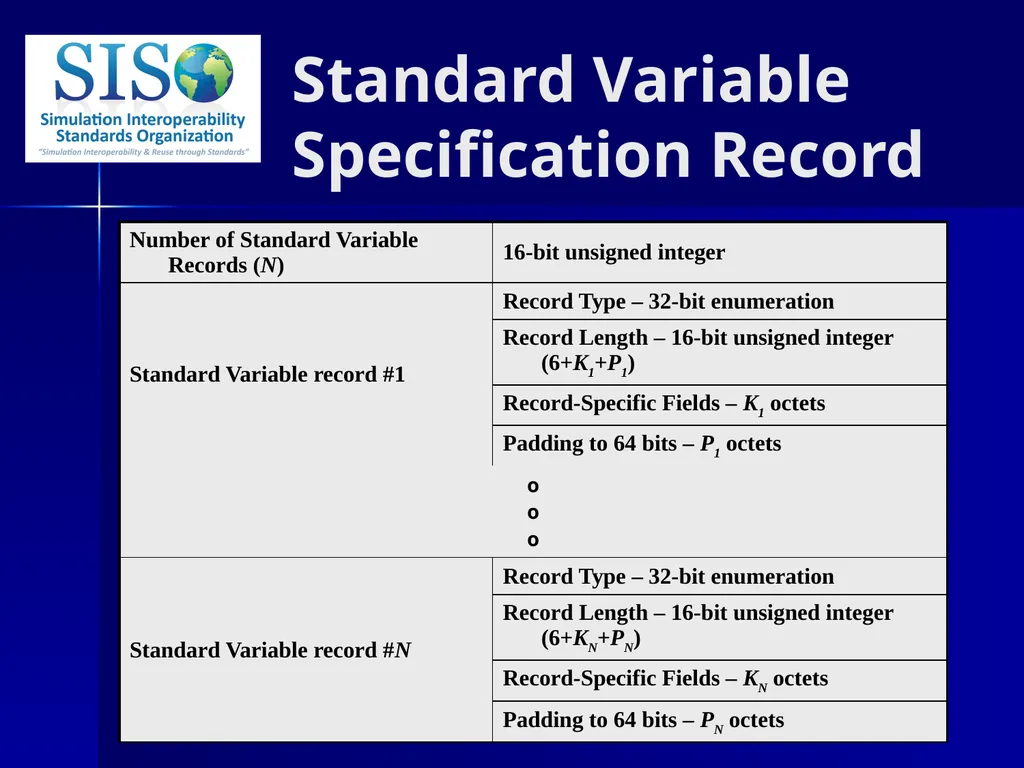
Standard Variable Specification Record<br>
14
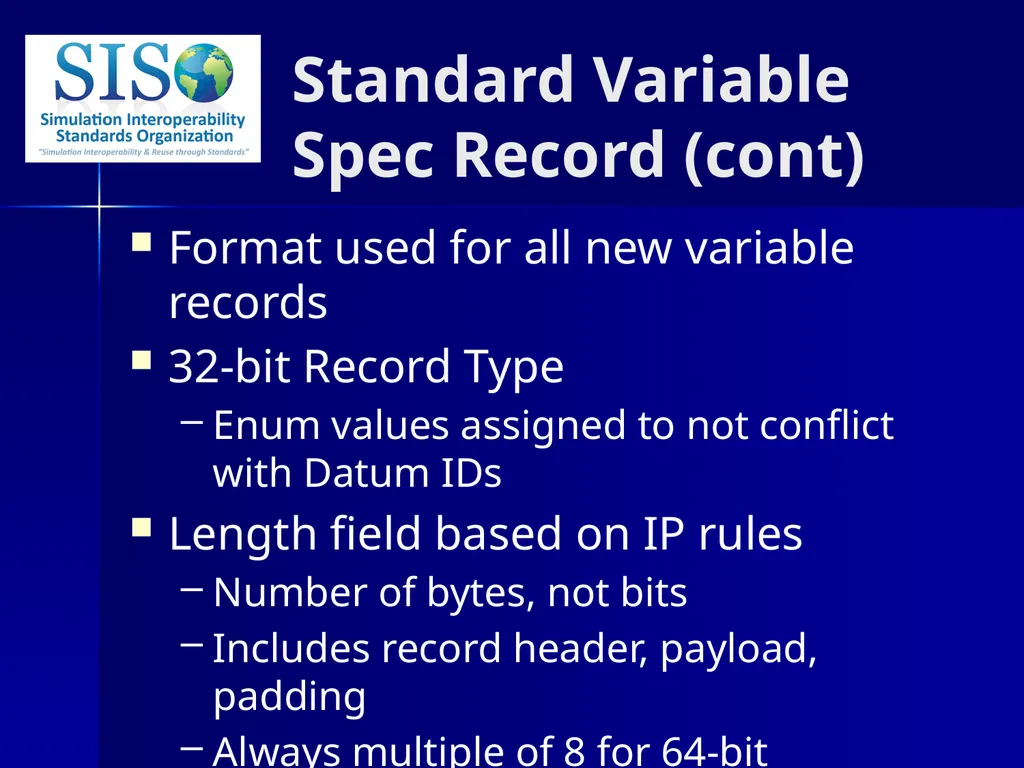
Standard Variable Spec Record (cont) Format used for all new variable records
32-bit Record Type
Enum values assigned to not conflict with Datum IDs
Length field based on IP rules
Number of bytes, not bits
Includes record header, payload, padding
Always multiple of 8 for 64-bit alignment<br>
32-bit Record Type
Enum values assigned to not conflict with Datum IDs
Length field based on IP rules
Number of bytes, not bits
Includes record header, payload, padding
Always multiple of 8 for 64-bit alignment<br>
15
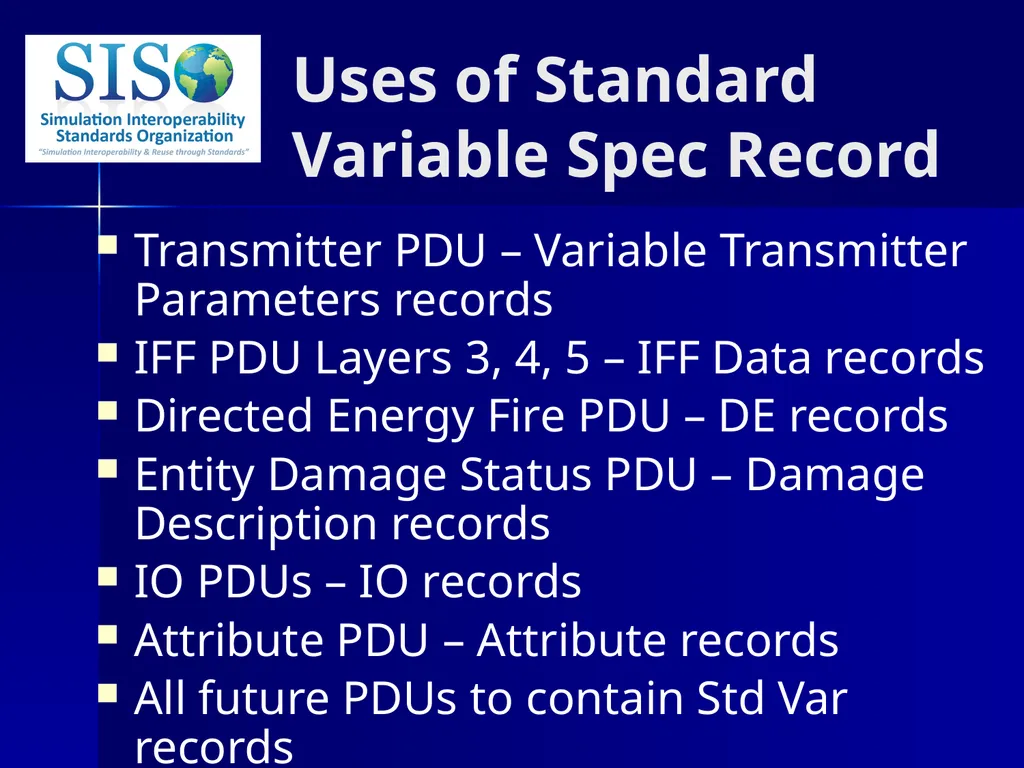
Uses of Standard Variable Spec Record Transmitter PDU – Variable Transmitter Parameters records
IFF PDU Layers 3, 4, 5 – IFF Data records
Directed Energy Fire PDU – DE records
Entity Damage Status PDU – Damage Description records
IO PDUs – IO records
Attribute PDU – Attribute records
All future PDUs to contain Std Var records<br>
IFF PDU Layers 3, 4, 5 – IFF Data records
Directed Energy Fire PDU – DE records
Entity Damage Status PDU – Damage Description records
IO PDUs – IO records
Attribute PDU – Attribute records
All future PDUs to contain Std Var records<br>
16
The Attribute PDU Allows existing PDUs to be extended without breaking forward or backward compatibility
Not allowed to contain information that already exists in other PDUs
Otherwise, there would be confusion about which PDU to use
Attribute records conform to Standard Variable Spec record format<br>
Not allowed to contain information that already exists in other PDUs
Otherwise, there would be confusion about which PDU to use
Attribute records conform to Standard Variable Spec record format<br>
17
Attribute Record Sets The PDU contains sets of Attribute records
Effectively a two-dimensional array of Attribute records
Each set is tied to an entity or object
Envisioned for constructive sims to update attributes of many entities in one PDU
Can still filter whole sets by Entity ID<br>
Effectively a two-dimensional array of Attribute records
Each set is tied to an entity or object
Envisioned for constructive sims to update attributes of many entities in one PDU
Can still filter whole sets by Entity ID<br>
18
Coupled Extension A transient PDU can be extended by attaching an Attribute PDU to it
This is called Coupled Extension
PDU Status bit indicates PDU is followed by an Attribute PDU in a PDU bundle
The two PDUs shall not be separated
Stateful PDUs can be extended by sending Attribute PDUs at any time
Or, the Attribute PDU can be coupled if desired<br>
This is called Coupled Extension
PDU Status bit indicates PDU is followed by an Attribute PDU in a PDU bundle
The two PDUs shall not be separated
Stateful PDUs can be extended by sending Attribute PDUs at any time
Or, the Attribute PDU can be coupled if desired<br>
19
Attribute Heartbeats Attributes for stateful PDUs have same heartbeat rules as PDUs they extend
If not coupled, a separate timer could be kept for main PDU and attributes
Or, simpler implementation would be to update main PDU and attributes together
Uses same heartbeat timer
But risks excessive updates<br>
If not coupled, a separate timer could be kept for main PDU and attributes
Or, simpler implementation would be to update main PDU and attributes together
Uses same heartbeat timer
But risks excessive updates<br>
20
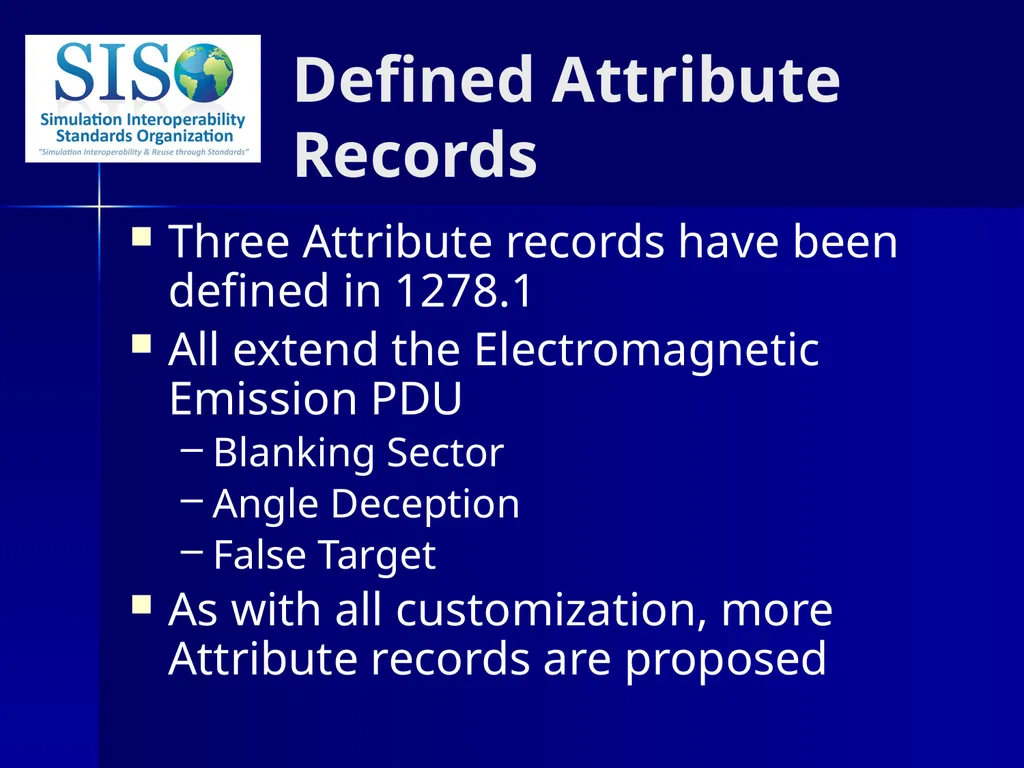
Defined Attribute Records Three Attribute records have been defined in 1278.1
All extend the Electromagnetic Emission PDU
Blanking Sector
Angle Deception
False Target
As with all customization, more Attribute records are proposed<br>
All extend the Electromagnetic Emission PDU
Blanking Sector
Angle Deception
False Target
As with all customization, more Attribute records are proposed<br>
21
Managing Extensions to DIS SISO-REF-030 has been assigned as a document to catalog DIS extensions
Produced by DIS Product Support Group
Will manage all changes proposed in Problem/Change Requests (PCRs), not just customization
DIS PSG has started regular telecons
Always looking for volunteers to get it moving faster<br>
Produced by DIS Product Support Group
Will manage all changes proposed in Problem/Change Requests (PCRs), not just customization
DIS PSG has started regular telecons
Always looking for volunteers to get it moving faster<br>
22
Ideas for DIS V8 Formal language to describe records
Probably XML-based
Cleaner PDU structure that can be more easily described formally
Single “discriminator” format for variable content
Suitable for auto code generators
But would break PDU compatibility
So need easy gateway translation<br>
Probably XML-based
Cleaner PDU structure that can be more easily described formally
Single “discriminator” format for variable content
Suitable for auto code generators
But would break PDU compatibility
So need easy gateway translation<br>
23
Overview DIS Extensibility
Why we need PDU customization
Compatibility with previous DIS standards
Variable Parameter and Standard Variable records
Attribute PDU
Dead Reckoning
General concept
Rotational dead reckoning details
New rotational threshold calculations methods
New computational savings methods<br>
Why we need PDU customization
Compatibility with previous DIS standards
Variable Parameter and Standard Variable records
Attribute PDU
Dead Reckoning
General concept
Rotational dead reckoning details
New rotational threshold calculations methods
New computational savings methods<br>
24
Dead Reckoning Basics Entity sender publishes state and extra information to predict state over time
Velocity (rate of change), acceleration
Receivers dead reckon (extrapolate) between updates
Entity also keeps a local extrapolation model to know what receivers see
Updates PDU when error between that model and truth exceeds a set threshold<br>
Velocity (rate of change), acceleration
Receivers dead reckon (extrapolate) between updates
Entity also keeps a local extrapolation model to know what receivers see
Updates PDU when error between that model and truth exceeds a set threshold<br>
25
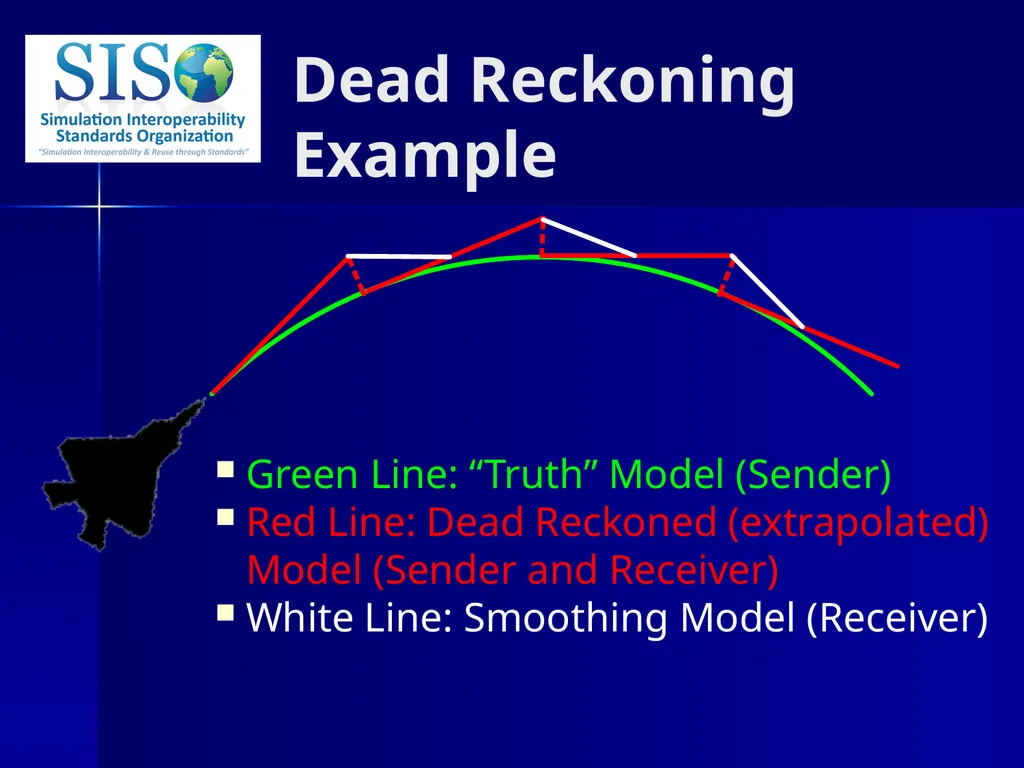
Dead Reckoning Example Green Line: “Truth” Model (Sender)
Red Line: Dead Reckoned (extrapolated) Model (Sender and Receiver)
White Line: Smoothing Model (Receiver)<br>
Red Line: Dead Reckoned (extrapolated) Model (Sender and Receiver)
White Line: Smoothing Model (Receiver)<br>
26
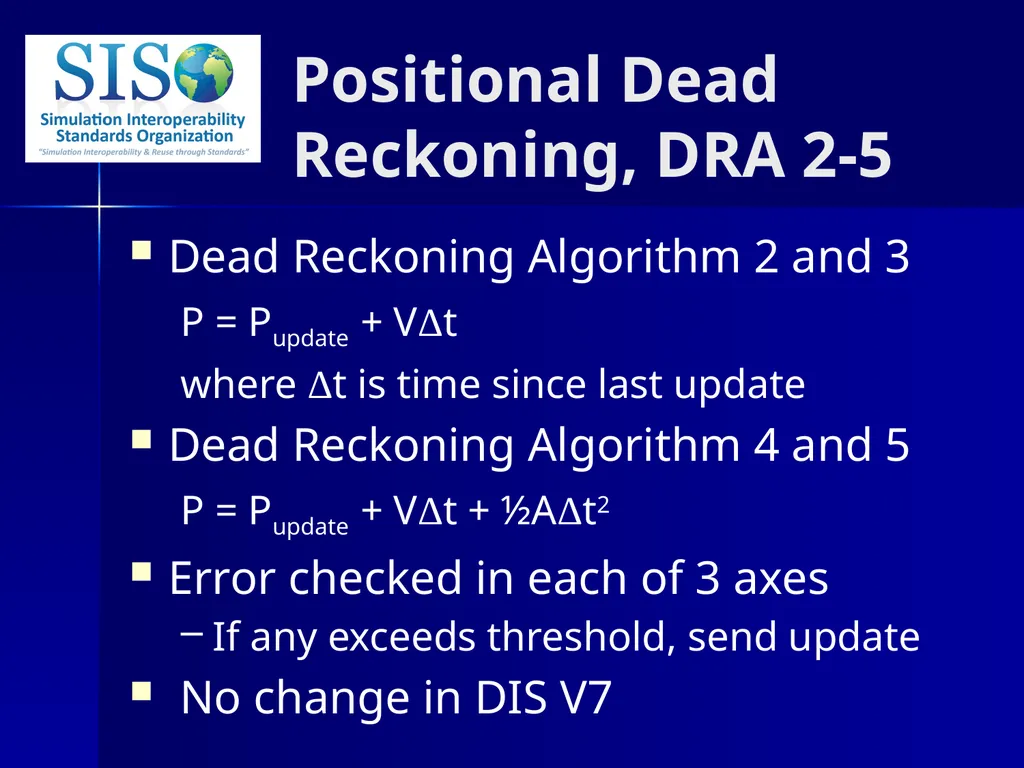
Positional Dead Reckoning, DRA 2-5 Dead Reckoning Algorithm 2 and 3
P = Pupdate + VΔt
where Δt is time since last update
Dead Reckoning Algorithm 4 and 5
P = Pupdate + VΔt + ½AΔt2
Error checked in each of 3 axes
If any exceeds threshold, send update
No change in DIS V7<br>
P = Pupdate + VΔt
where Δt is time since last update
Dead Reckoning Algorithm 4 and 5
P = Pupdate + VΔt + ½AΔt2
Error checked in each of 3 axes
If any exceeds threshold, send update
No change in DIS V7<br>
27
Positional Dead Reckoning, DRA 6-9 DRA 6-9 use rotation rate and body coordinate velocity and acceleration to achieve better prediction
Math is more complicated and not used as much as DRA 2-5
But it is effective, should be used more
No change in DIS V7 but errors in the math formulas were fixed
See E.7.3 in the DIS V7 standard<br>
Math is more complicated and not used as much as DRA 2-5
But it is effective, should be used more
No change in DIS V7 but errors in the math formulas were fixed
See E.7.3 in the DIS V7 standard<br>
28
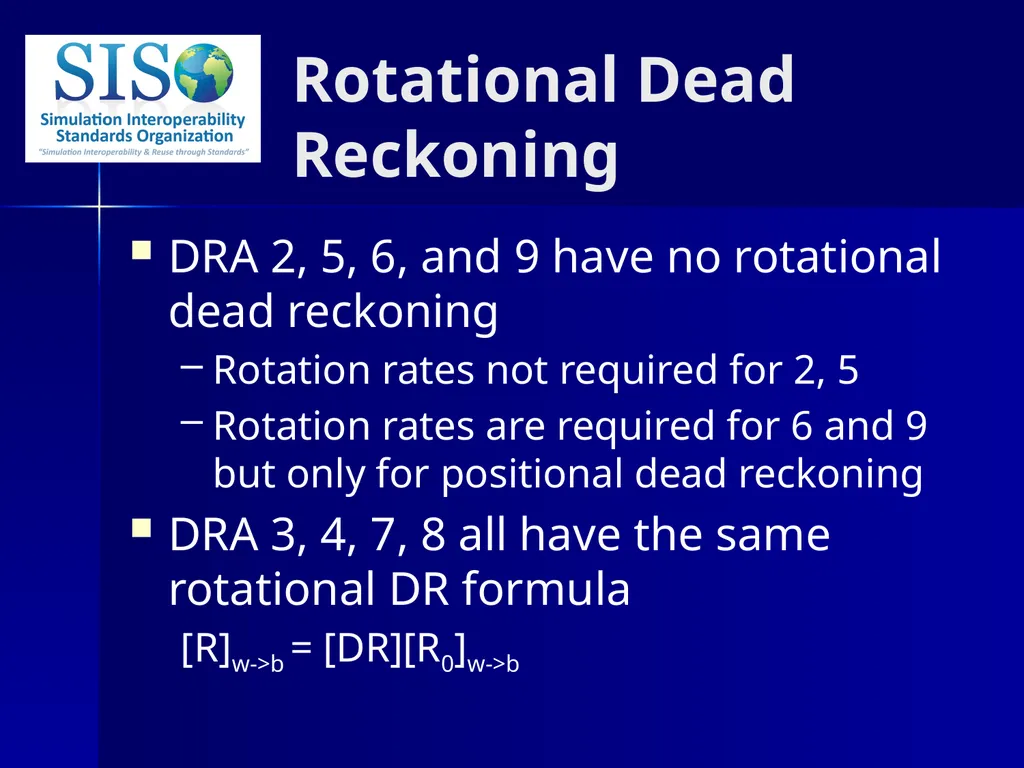
Rotational Dead Reckoning DRA 2, 5, 6, and 9 have no rotational dead reckoning
Rotation rates not required for 2, 5
Rotation rates are required for 6 and 9 but only for positional dead reckoning
DRA 3, 4, 7, 8 all have the same rotational DR formula
[R]w->b = [DR][R0]w->b<br>
Rotation rates not required for 2, 5
Rotation rates are required for 6 and 9 but only for positional dead reckoning
DRA 3, 4, 7, 8 all have the same rotational DR formula
[R]w->b = [DR][R0]w->b<br>
29
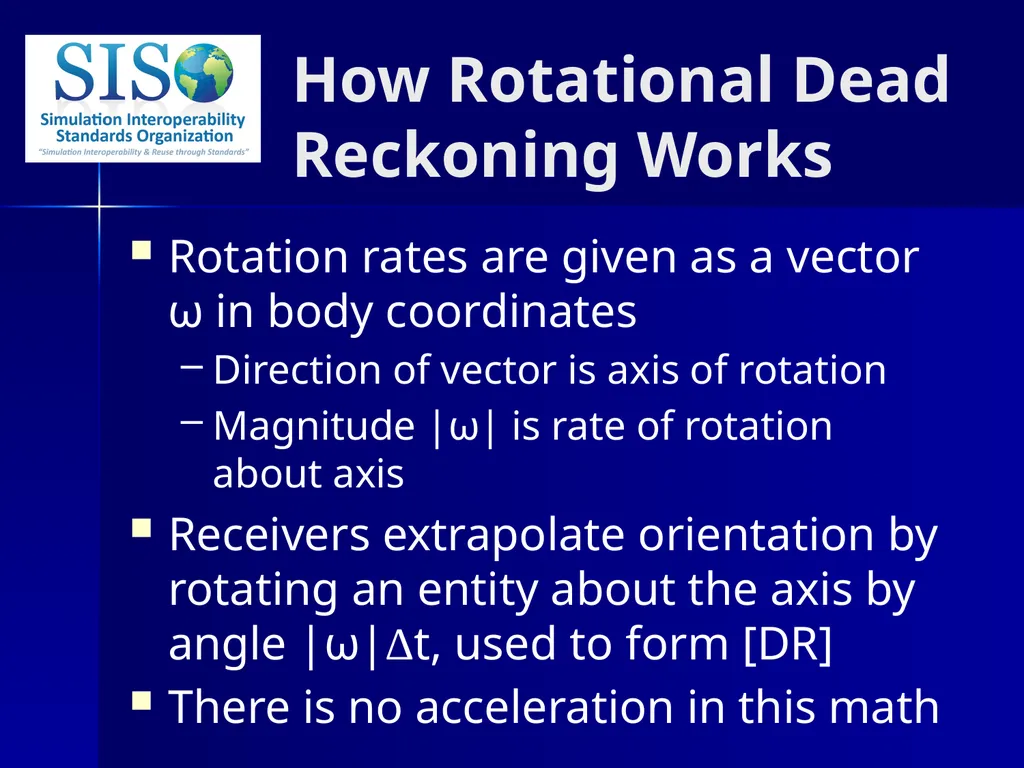
How Rotational Dead Reckoning Works Rotation rates are given as a vector ω in body coordinates
Direction of vector is axis of rotation
Magnitude |ω| is rate of rotation about axis
Receivers extrapolate orientation by rotating an entity about the axis by angle |ω|Δt, used to form [DR]
There is no acceleration in this math<br>
Direction of vector is axis of rotation
Magnitude |ω| is rate of rotation about axis
Receivers extrapolate orientation by rotating an entity about the axis by angle |ω|Δt, used to form [DR]
There is no acceleration in this math<br>
30
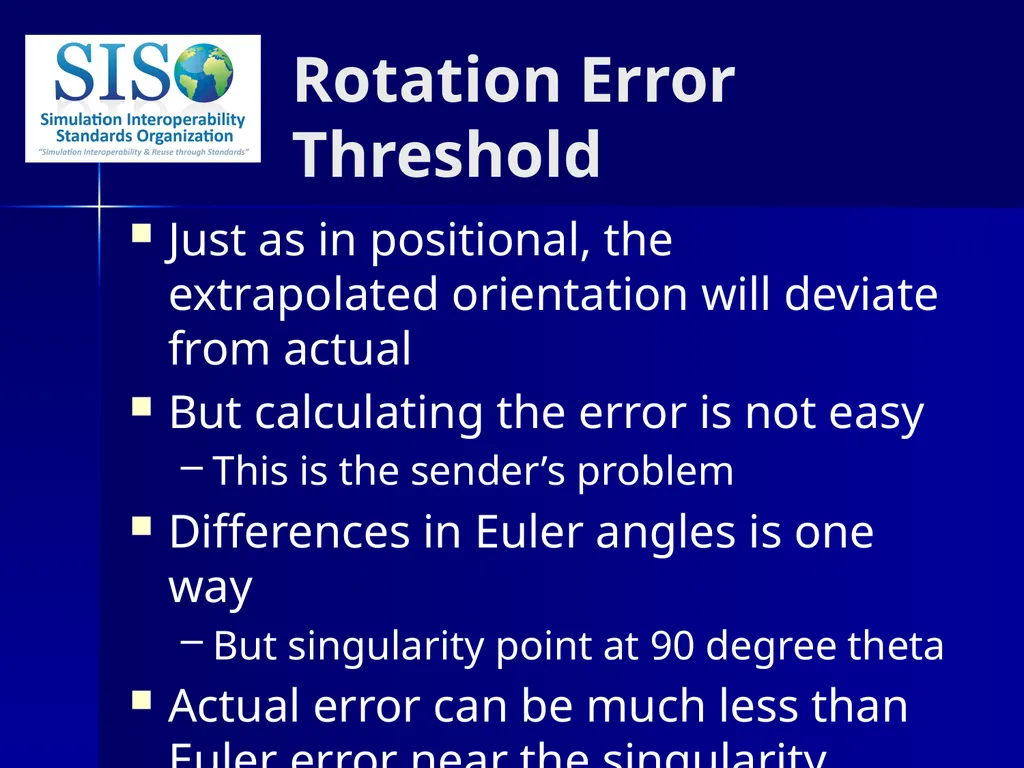
Rotation Error Threshold Just as in positional, the extrapolated orientation will deviate from actual
But calculating the error is not easy
This is the sender’s problem
Differences in Euler angles is one way
But singularity point at 90 degree theta
Actual error can be much less than Euler error near the singularity
Causes excessive updates<br>
But calculating the error is not easy
This is the sender’s problem
Differences in Euler angles is one way
But singularity point at 90 degree theta
Actual error can be much less than Euler error near the singularity
Causes excessive updates<br>
31
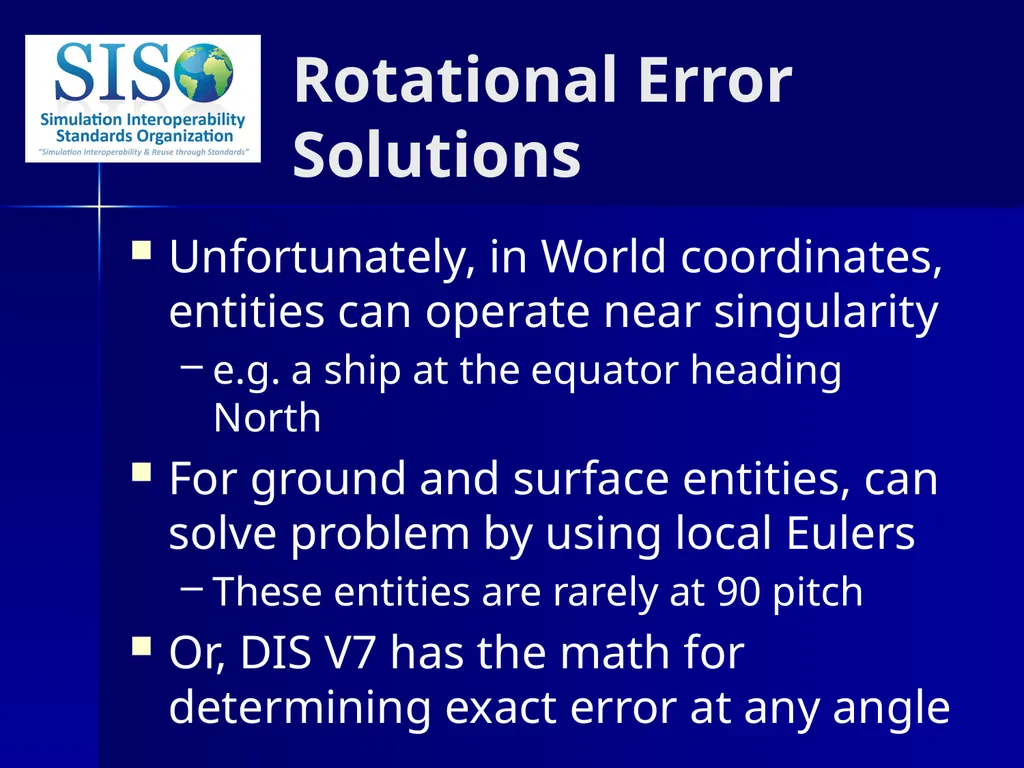
Rotational Error Solutions Unfortunately, in World coordinates, entities can operate near singularity
e.g. a ship at the equator heading North
For ground and surface entities, can solve problem by using local Eulers
These entities are rarely at 90 pitch
Or, DIS V7 has the math for determining exact error at any angle<br>
e.g. a ship at the equator heading North
For ground and surface entities, can solve problem by using local Eulers
These entities are rarely at 90 pitch
Or, DIS V7 has the math for determining exact error at any angle<br>
32
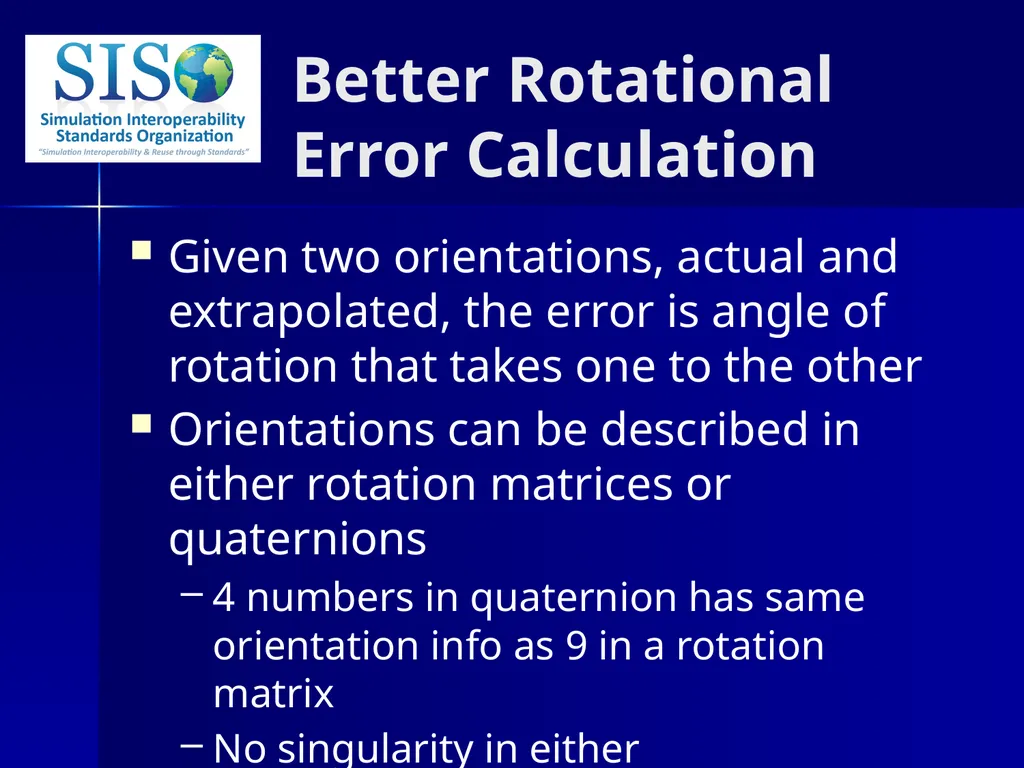
Better Rotational Error Calculation Given two orientations, actual and extrapolated, the error is angle of rotation that takes one to the other
Orientations can be described in either rotation matrices or quaternions
4 numbers in quaternion has same orientation info as 9 in a rotation matrix
No singularity in either
Math details described in Annex E.7.5<br>
Orientations can be described in either rotation matrices or quaternions
4 numbers in quaternion has same orientation info as 9 in a rotation matrix
No singularity in either
Math details described in Annex E.7.5<br>
33
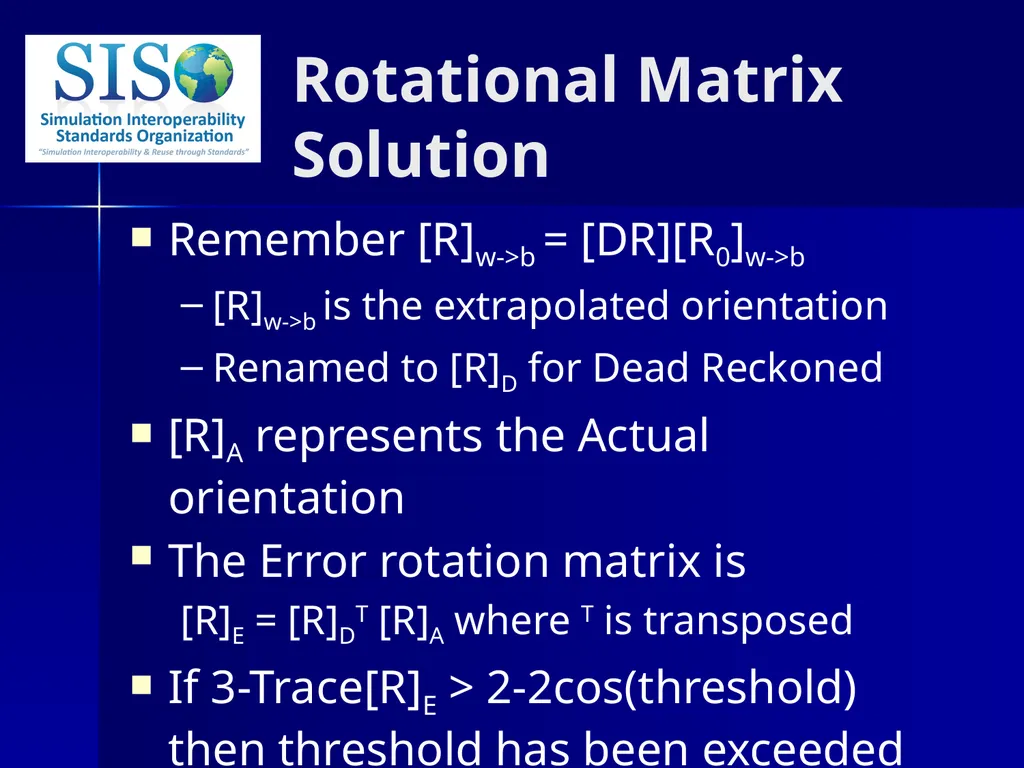
Rotational Matrix Solution Remember [R]w->b = [DR][R0]w->b
[R]w->b is the extrapolated orientation
Renamed to [R]D for Dead Reckoned
[R]A represents the Actual orientation
The Error rotation matrix is
[R]E = [R]DT [R]A where T is transposed
If 3-Trace[R]E > 2-2cos(threshold) then threshold has been exceeded
Trace is just sum of main diagonal<br>
[R]w->b is the extrapolated orientation
Renamed to [R]D for Dead Reckoned
[R]A represents the Actual orientation
The Error rotation matrix is
[R]E = [R]DT [R]A where T is transposed
If 3-Trace[R]E > 2-2cos(threshold) then threshold has been exceeded
Trace is just sum of main diagonal<br>
34
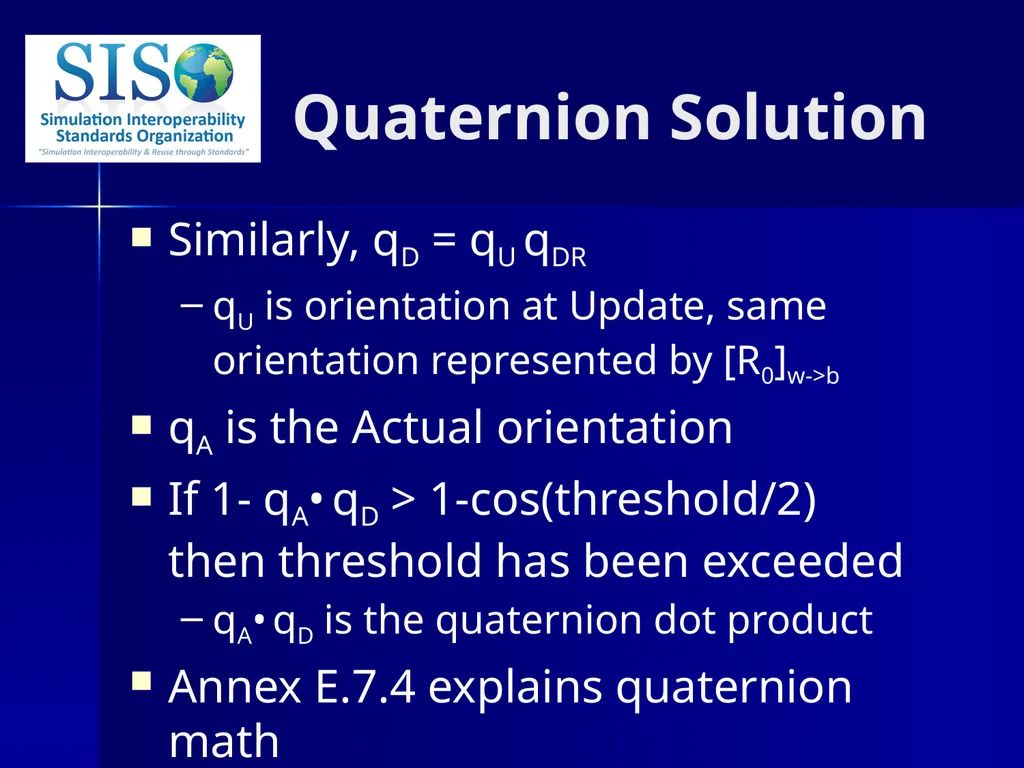
Quaternion Solution Similarly, qD = qU qDR
qU is orientation at Update, same orientation represented by [R0]w->b
qA is the Actual orientation
If 1- qA• qD > 1-cos(threshold/2) then threshold has been exceeded
qA• qD is the quaternion dot product
Annex E.7.4 explains quaternion math
Euler angle to/from quaternion, etc.<br>
qU is orientation at Update, same orientation represented by [R0]w->b
qA is the Actual orientation
If 1- qA• qD > 1-cos(threshold/2) then threshold has been exceeded
qA• qD is the quaternion dot product
Annex E.7.4 explains quaternion math
Euler angle to/from quaternion, etc.<br>
35
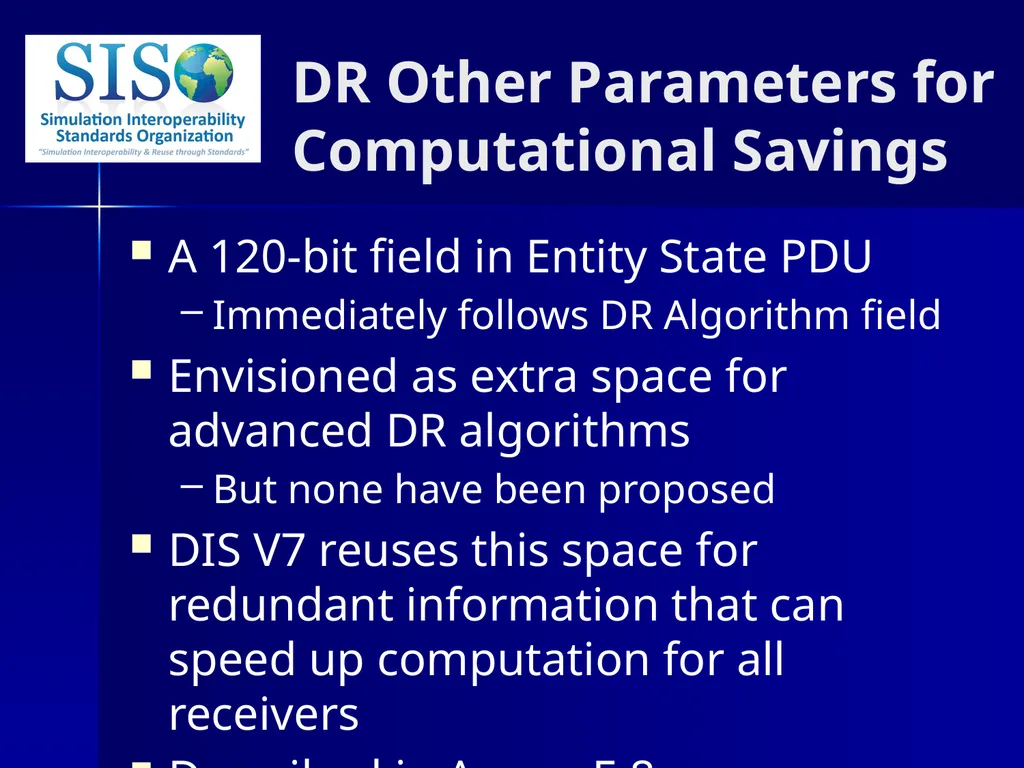
DR Other Parameters for Computational Savings A 120-bit field in Entity State PDU
Immediately follows DR Algorithm field
Envisioned as extra space for advanced DR algorithms
But none have been proposed
DIS V7 reuses this space for redundant information that can speed up computation for all receivers
Described in Annex E.8<br>
Immediately follows DR Algorithm field
Envisioned as extra space for advanced DR algorithms
But none have been proposed
DIS V7 reuses this space for redundant information that can speed up computation for all receivers
Described in Annex E.8<br>
36
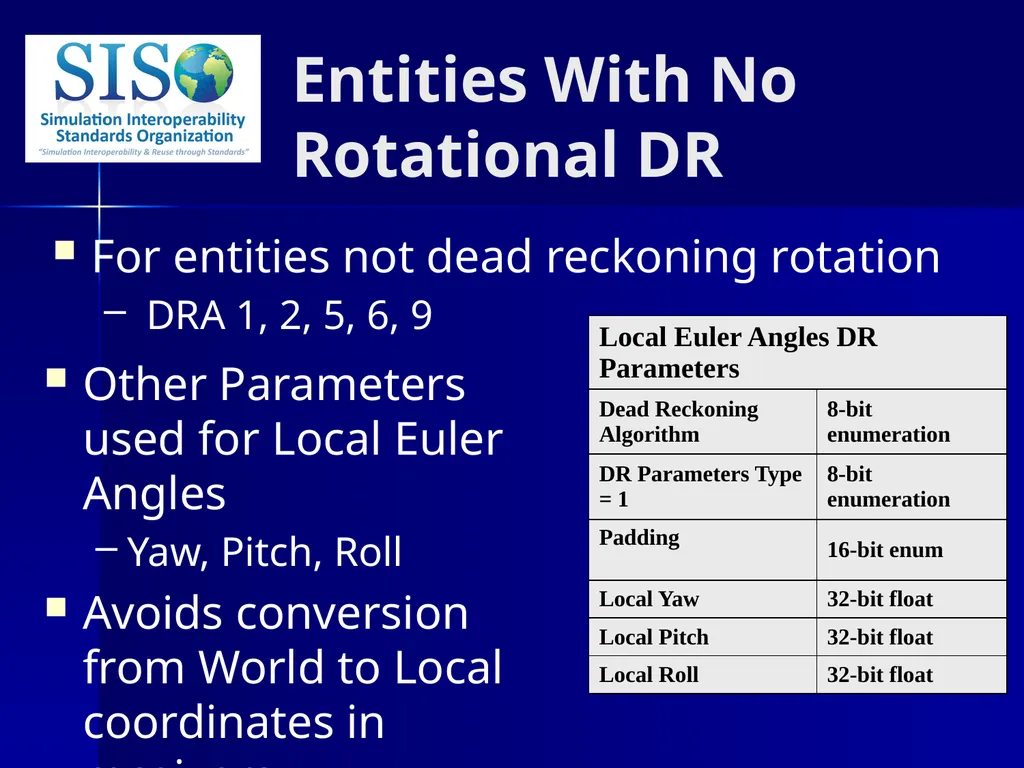
Entities With No Rotational DR For entities not dead reckoning rotation
DRA 1, 2, 5, 6, 9 Other Parameters used for Local Euler Angles
Yaw, Pitch, Roll
Avoids conversion from World to Local coordinates in receivers<br>
DRA 1, 2, 5, 6, 9 Other Parameters used for Local Euler Angles
Yaw, Pitch, Roll
Avoids conversion from World to Local coordinates in receivers<br>
37
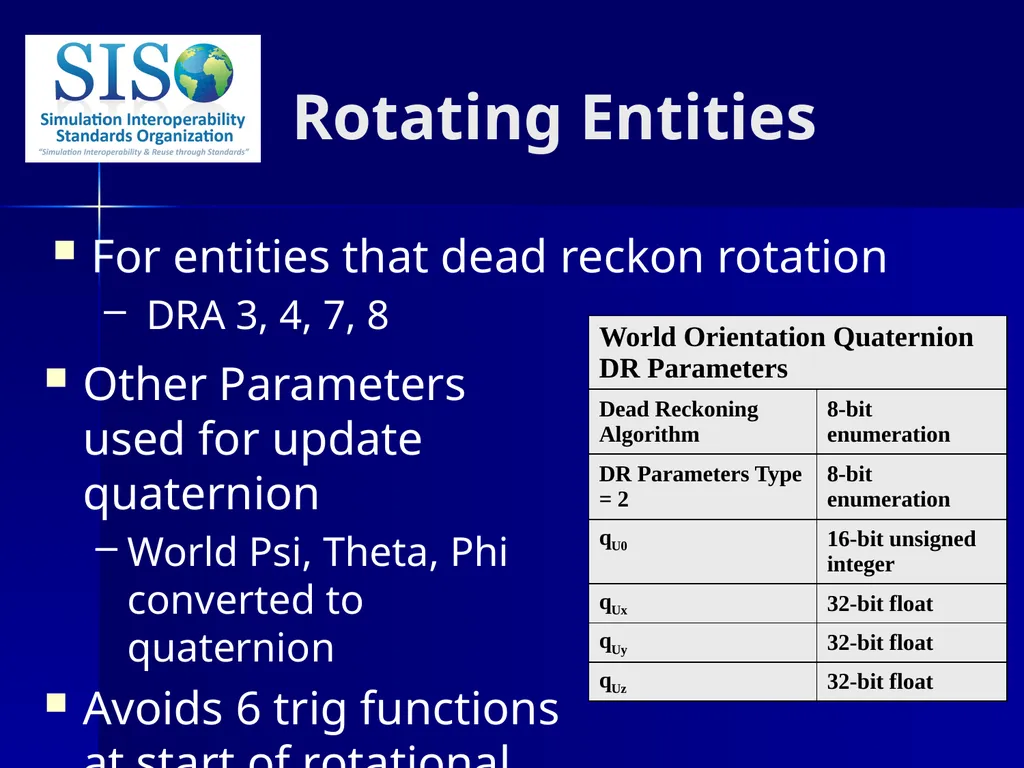
Rotating Entities For entities that dead reckon rotation
DRA 3, 4, 7, 8 Other Parameters used for update quaternion
World Psi, Theta, Phi converted to quaternion
Avoids 6 trig functions at start of rotational dead reckoning<br>
DRA 3, 4, 7, 8 Other Parameters used for update quaternion
World Psi, Theta, Phi converted to quaternion
Avoids 6 trig functions at start of rotational dead reckoning<br>
38
Questions?<br>