
Distributed Systems CS 15-440 Caching – Part II
DJ
Published · 38 slides · 0 views
1 / 1
Description
Distributed Systems CS 15-440 Caching Part II Lecture 21, November 28, 2018 Mohammad Hammoud Today Last Lecture: One-copy semantic and cache consistency Todays Lecture: Continue with cache consistency Announcements: Project 4 will be
Related Topics
Share
Embed code
Download this presentation From Below
"Distributed Systems CS 15-440 Caching – Part II" is the property of its rightful owner. Permission is granted to download and print the materials on this website for personal, non-commercial use only, and to display it on your personal computer provided you do not modify the materials and that you retain all copyright notices contained in the materials. By downloading content from our website, you accept the terms of this agreement.
Presentation Transcript
01
Distributed Systems
CS 15-440 Caching – Part II
Lecture 21, November 28, 2018
Mohammad Hammoud<br>
Lecture 21, November 28, 2018
Mohammad Hammoud<br>
02
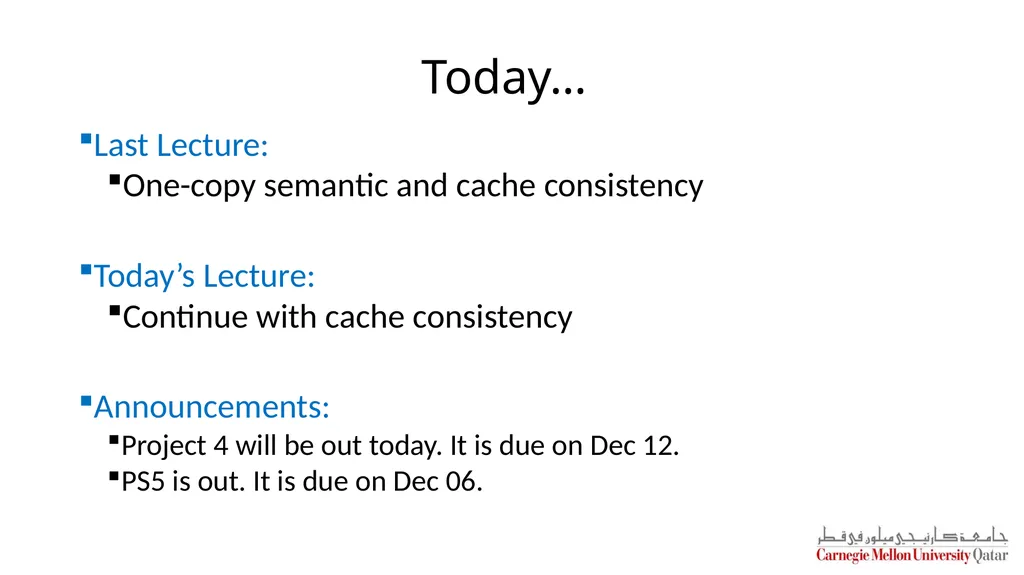
Today… Last Lecture:
One-copy semantic and cache consistency
Today’s Lecture:
Continue with cache consistency
Announcements:
Project 4 will be out today. It is due on Dec 12.
PS5 is out. It is due on Dec 06.<br>
One-copy semantic and cache consistency
Today’s Lecture:
Continue with cache consistency
Announcements:
Project 4 will be out today. It is due on Dec 12.
PS5 is out. It is due on Dec 06.<br>
03
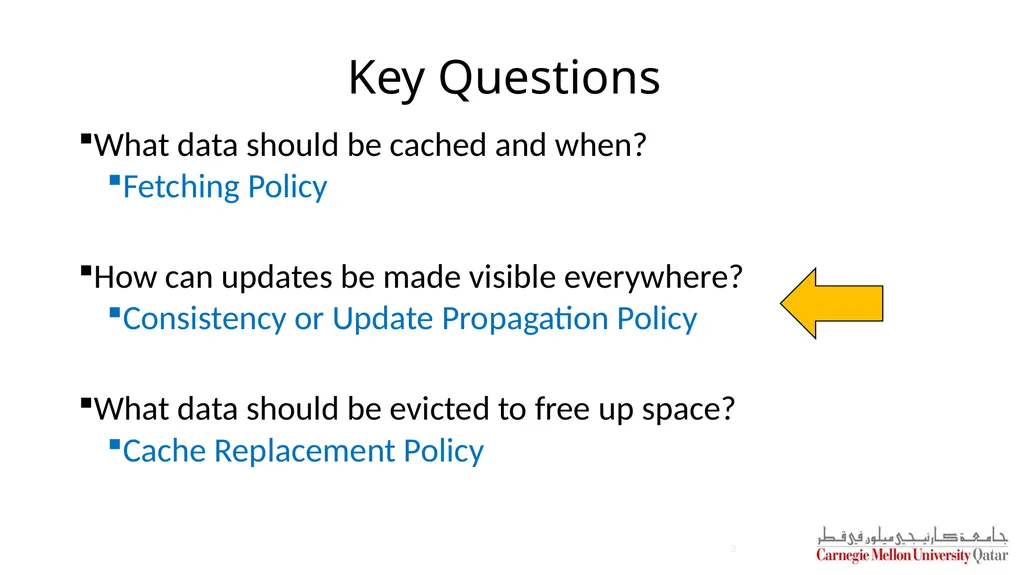
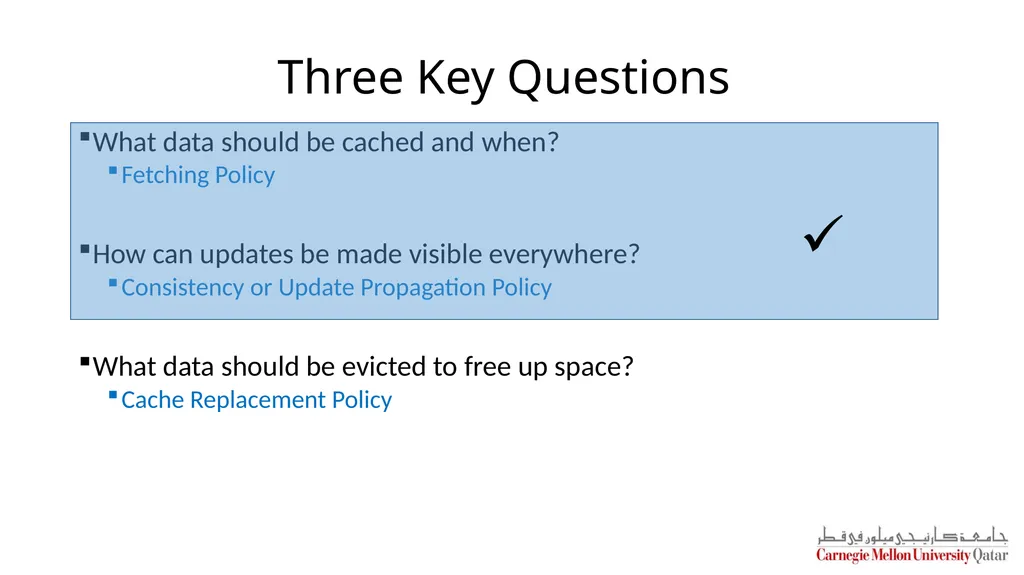
Key Questions What data should be cached and when?
Fetching Policy
How can updates be made visible everywhere?
Consistency or Update Propagation Policy
What data should be evicted to free up space?
Cache Replacement Policy 3<br>
Fetching Policy
How can updates be made visible everywhere?
Consistency or Update Propagation Policy
What data should be evicted to free up space?
Cache Replacement Policy 3<br>
04
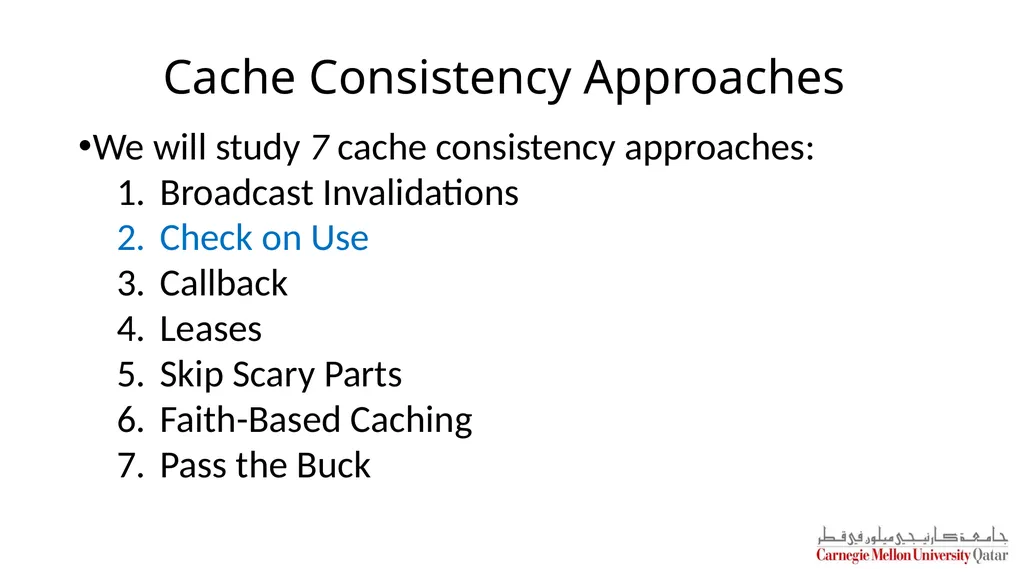
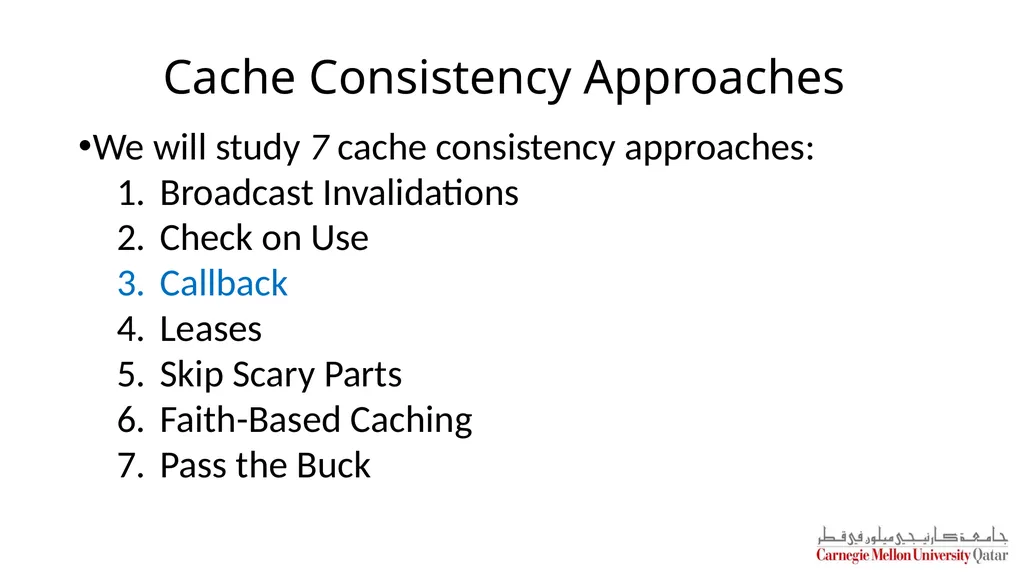
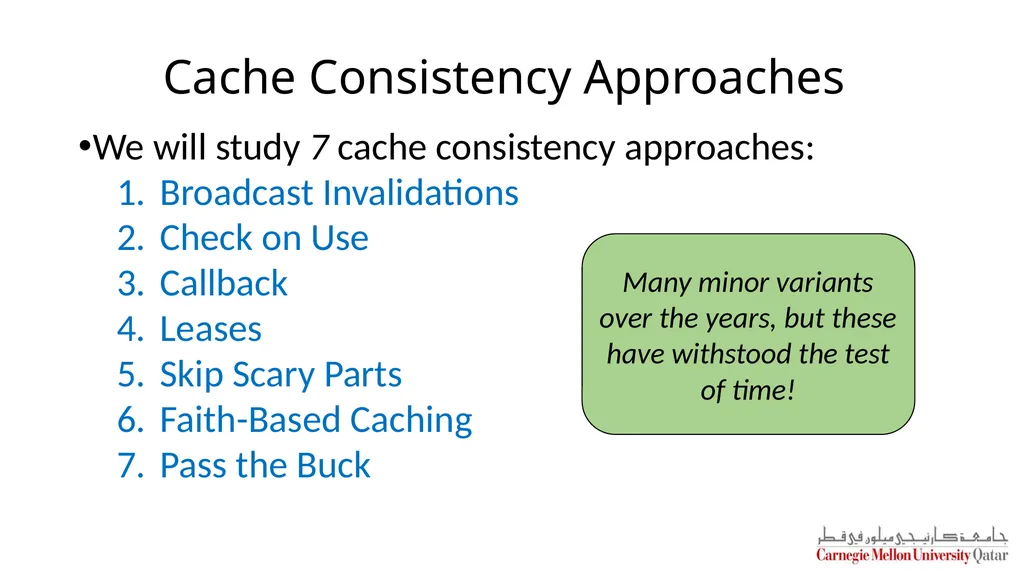
Cache Consistency Approaches We will study 7 cache consistency approaches:
Broadcast Invalidations
Check on Use
Callback
Leases
Skip Scary Parts
Faith-Based Caching
Pass the Buck<br>
Broadcast Invalidations
Check on Use
Callback
Leases
Skip Scary Parts
Faith-Based Caching
Pass the Buck<br>
05
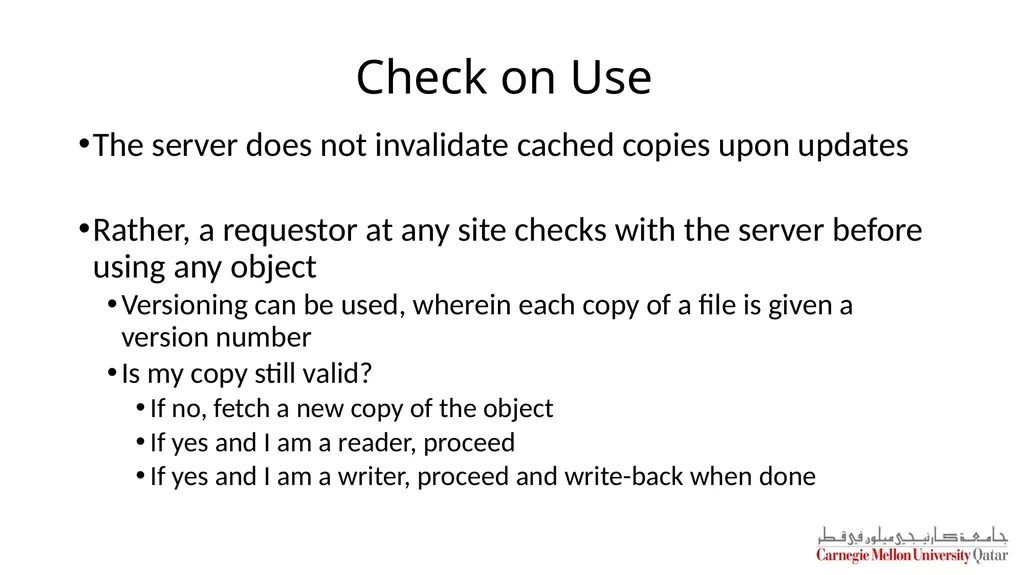
Check on Use The server does not invalidate cached copies upon updates
Rather, a requestor at any site checks with the server before using any object
Versioning can be used, wherein each copy of a file is given a version number
Is my copy still valid?
If no, fetch a new copy of the object
If yes and I am a reader, proceed
If yes and I am a writer, proceed and write-back when done<br>
Rather, a requestor at any site checks with the server before using any object
Versioning can be used, wherein each copy of a file is given a version number
Is my copy still valid?
If no, fetch a new copy of the object
If yes and I am a reader, proceed
If yes and I am a writer, proceed and write-back when done<br>
06
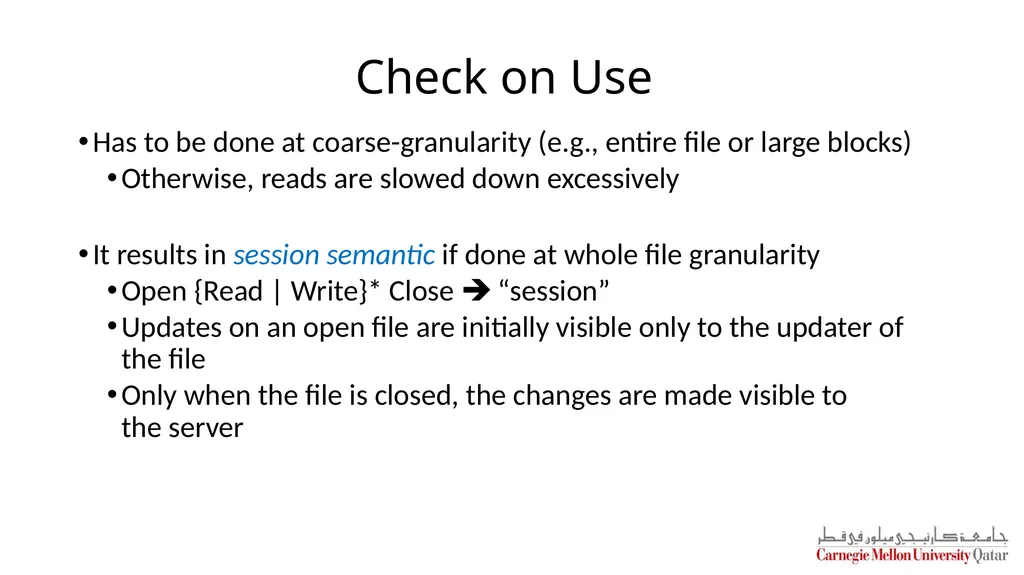
Check on Use Has to be done at coarse-granularity (e.g., entire file or large blocks)
Otherwise, reads are slowed down excessively
It results in session semantic if done at whole file granularity
Open {Read | Write}* Close “session”
Updates on an open file are initially visible only to the updater of the file
Only when the file is closed, the changes are made visible to the server<br>
Otherwise, reads are slowed down excessively
It results in session semantic if done at whole file granularity
Open {Read | Write}* Close “session”
Updates on an open file are initially visible only to the updater of the file
Only when the file is closed, the changes are made visible to the server<br>
07
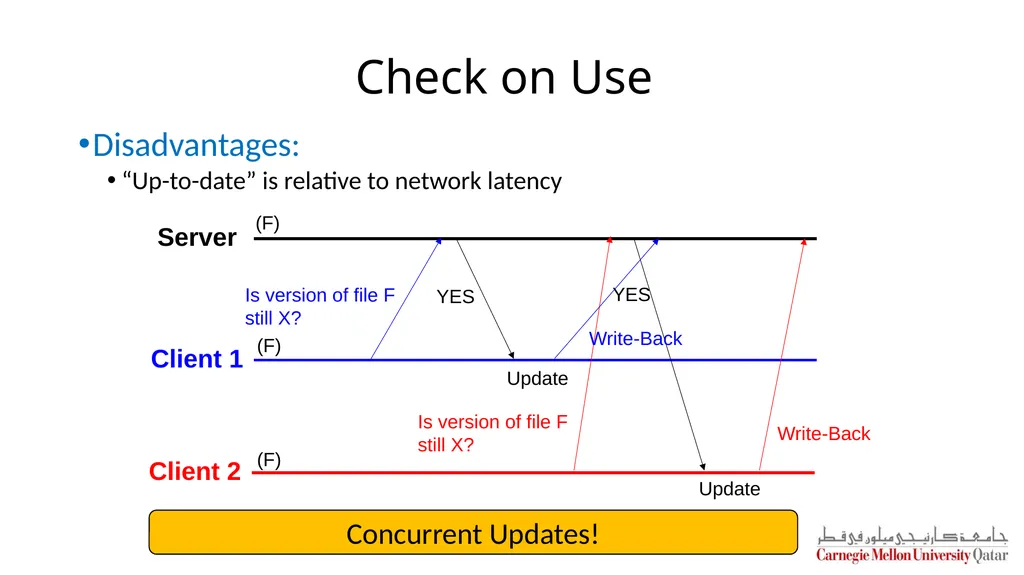
Check on Use Disadvantages:
“Up-to-date” is relative to network latency Server Client 1 Is version of file F
still X? Client 2 YES YES Update Update Concurrent Updates! Write-Back Write-Back Is version of file F
still X? (F) (F) (F)<br>
“Up-to-date” is relative to network latency Server Client 1 Is version of file F
still X? Client 2 YES YES Update Update Concurrent Updates! Write-Back Write-Back Is version of file F
still X? (F) (F) (F)<br>
08
Check on Use Disadvantages:
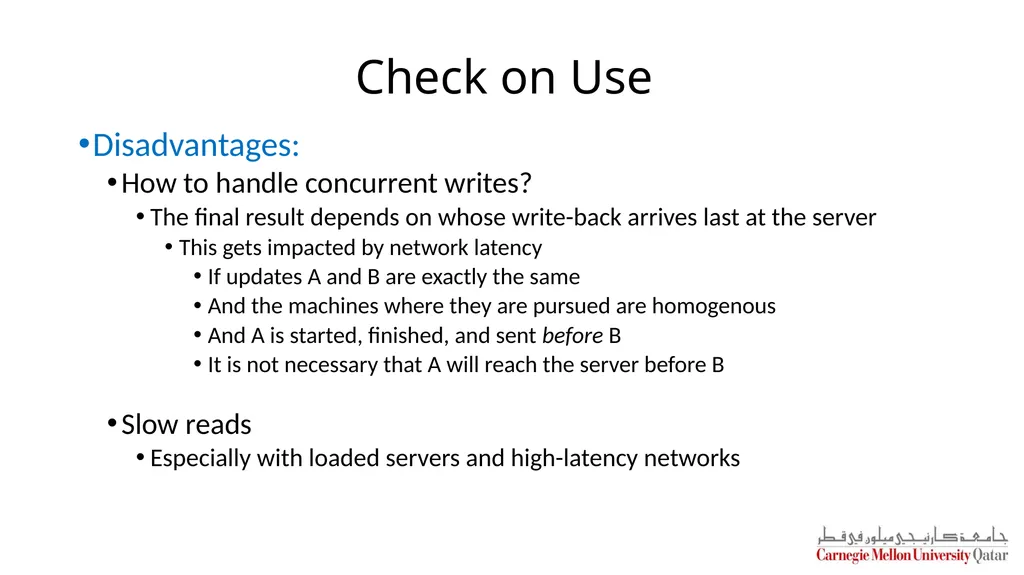
How to handle concurrent writes?
The final result depends on whose write-back arrives last at the server
This gets impacted by network latency
If updates A and B are exactly the same
And the machines where they are pursued are homogenous
And A is started, finished, and sent before B
It is not necessary that A will reach the server before B
Slow reads
Especially with loaded servers and high-latency networks<br>
How to handle concurrent writes?
The final result depends on whose write-back arrives last at the server
This gets impacted by network latency
If updates A and B are exactly the same
And the machines where they are pursued are homogenous
And A is started, finished, and sent before B
It is not necessary that A will reach the server before B
Slow reads
Especially with loaded servers and high-latency networks<br>
09
Check on Use Disadvantages:
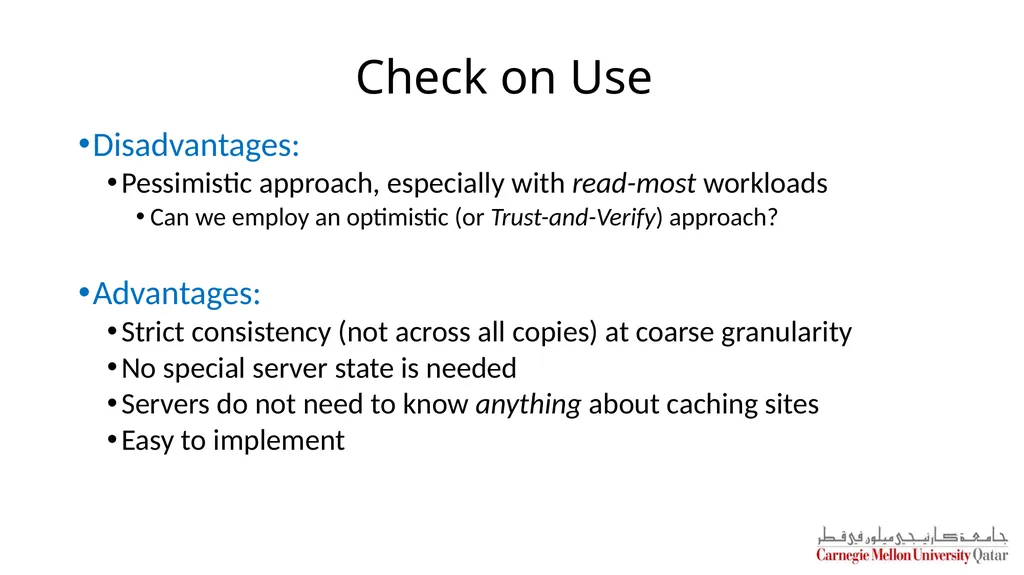
Pessimistic approach, especially with read-most workloads
Can we employ an optimistic (or Trust-and-Verify) approach?
Advantages:
Strict consistency (not across all copies) at coarse granularity
No special server state is needed
Servers do not need to know anything about caching sites
Easy to implement<br>
Pessimistic approach, especially with read-most workloads
Can we employ an optimistic (or Trust-and-Verify) approach?
Advantages:
Strict consistency (not across all copies) at coarse granularity
No special server state is needed
Servers do not need to know anything about caching sites
Easy to implement<br>
10
Cache Consistency Approaches We will study 7 cache consistency approaches:
Broadcast Invalidations
Check on Use
Callback
Leases
Skip Scary Parts
Faith-Based Caching
Pass the Buck<br>
Broadcast Invalidations
Check on Use
Callback
Leases
Skip Scary Parts
Faith-Based Caching
Pass the Buck<br>
11
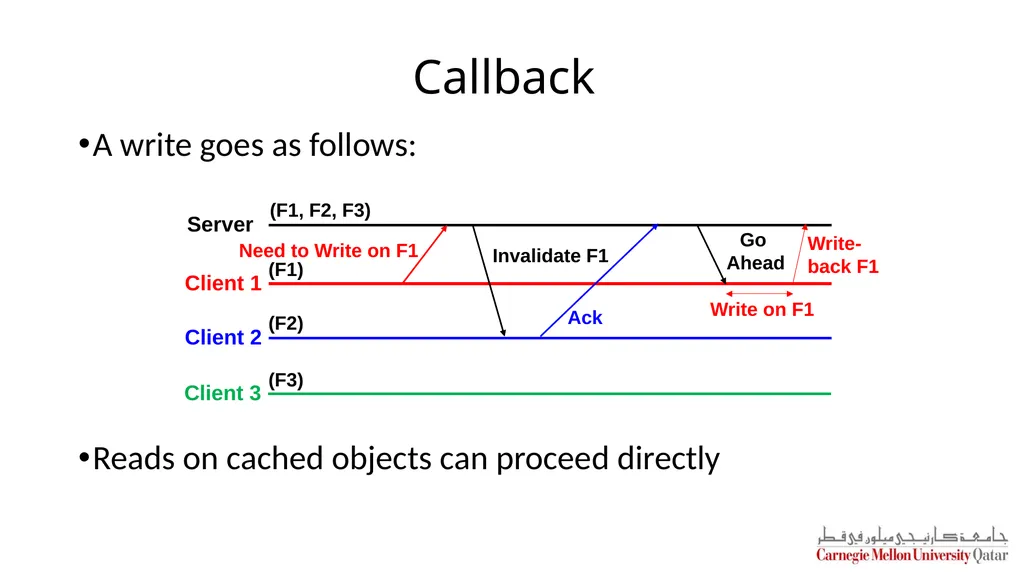
Callback A write goes as follows:
Reads on cached objects can proceed directly Server Client 1 Client 2 Client 3 Need to Write on F1 (F1, F2, F3) (F1) (F1, F2) (F3) Invalidate F1 Ack Go
Ahead Write on F1 Write-
back F1 (F2)<br>
Reads on cached objects can proceed directly Server Client 1 Client 2 Client 3 Need to Write on F1 (F1, F2, F3) (F1) (F1, F2) (F3) Invalidate F1 Ack Go
Ahead Write on F1 Write-
back F1 (F2)<br>
12
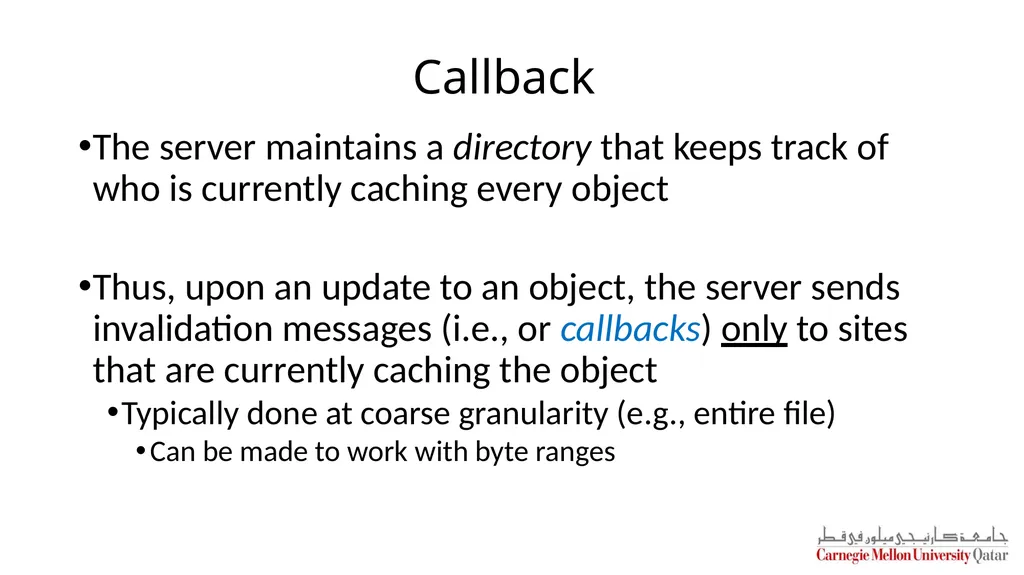
Callback The server maintains a directory that keeps track of who is currently caching every object
Thus, upon an update to an object, the server sends invalidation messages (i.e., or callbacks) only to sites that are currently caching the object
Typically done at coarse granularity (e.g., entire file)
Can be made to work with byte ranges<br>
Thus, upon an update to an object, the server sends invalidation messages (i.e., or callbacks) only to sites that are currently caching the object
Typically done at coarse granularity (e.g., entire file)
Can be made to work with byte ranges<br>
13
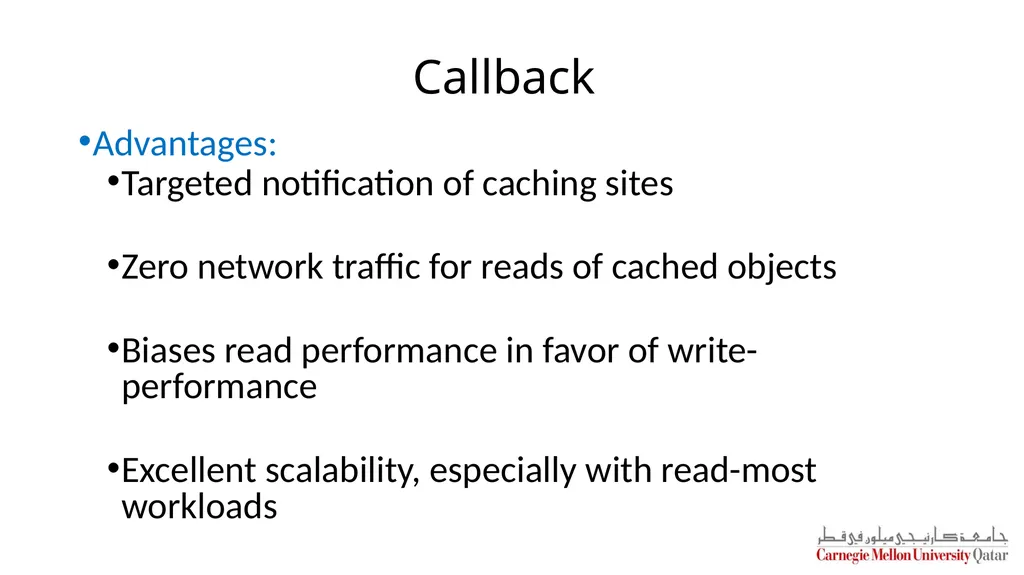
Callback Advantages:
Targeted notification of caching sites
Zero network traffic for reads of cached objects
Biases read performance in favor of write-performance
Excellent scalability, especially with read-most workloads<br>
Targeted notification of caching sites
Zero network traffic for reads of cached objects
Biases read performance in favor of write-performance
Excellent scalability, especially with read-most workloads<br>
14
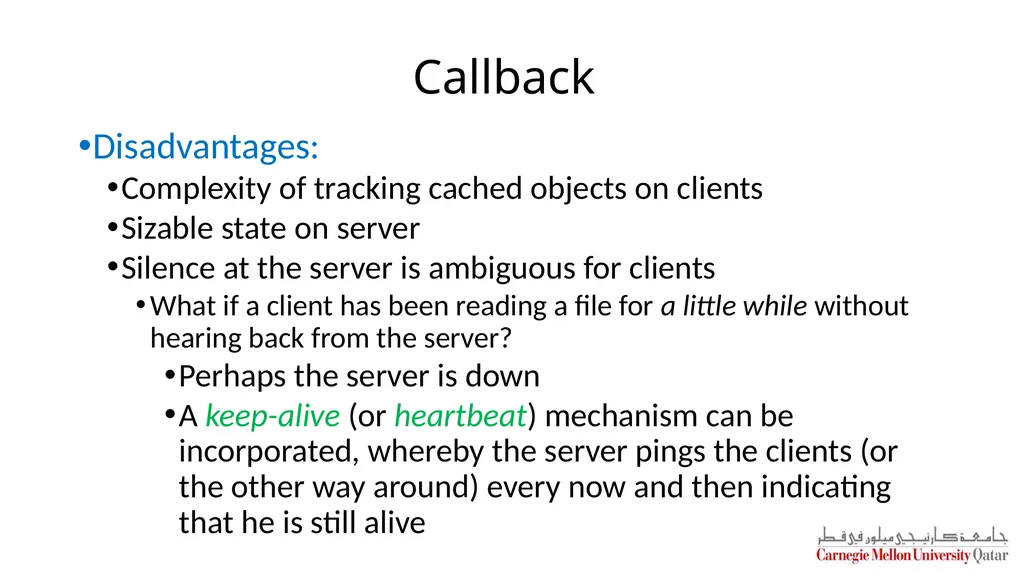
Callback Disadvantages:
Complexity of tracking cached objects on clients
Sizable state on server
Silence at the server is ambiguous for clients
What if a client has been reading a file for a little while without hearing back from the server?
Perhaps the server is down
A keep-alive (or heartbeat) mechanism can be incorporated, whereby the server pings the clients (or the other way around) every now and then indicating that he is still alive<br>
Complexity of tracking cached objects on clients
Sizable state on server
Silence at the server is ambiguous for clients
What if a client has been reading a file for a little while without hearing back from the server?
Perhaps the server is down
A keep-alive (or heartbeat) mechanism can be incorporated, whereby the server pings the clients (or the other way around) every now and then indicating that he is still alive<br>
15
Cache Consistency Approaches We will study 7 cache consistency approaches:
Broadcast Invalidations
Check on Use
Callback
Leases
Skip Scary Parts
Faith-Based Caching
Pass the Buck<br>
Broadcast Invalidations
Check on Use
Callback
Leases
Skip Scary Parts
Faith-Based Caching
Pass the Buck<br>
16
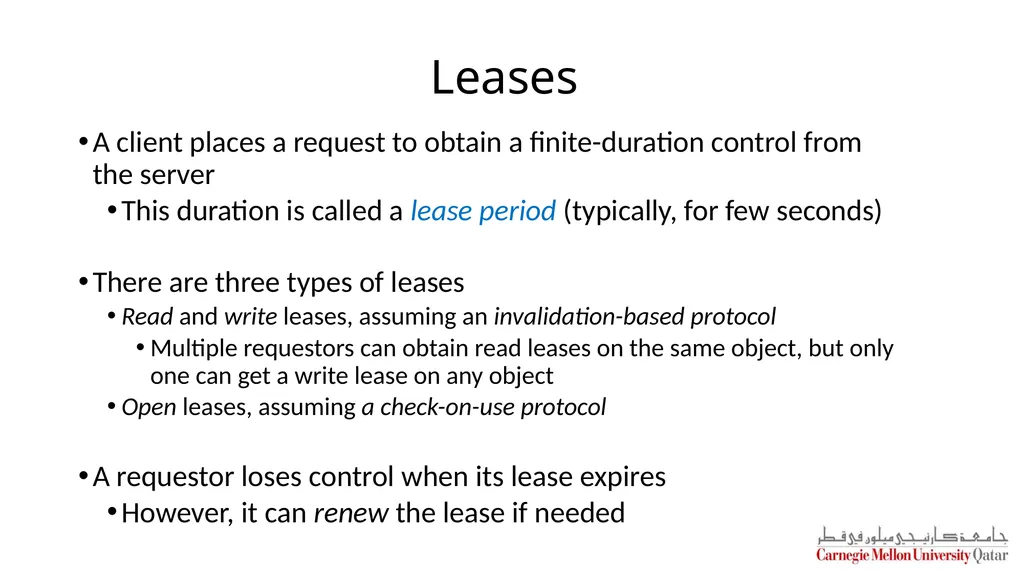
Leases A client places a request to obtain a finite-duration control from the server
This duration is called a lease period (typically, for few seconds)
There are three types of leases
Read and write leases, assuming an invalidation-based protocol
Multiple requestors can obtain read leases on the same object, but only one can get a write lease on any object
Open leases, assuming a check-on-use protocol
A requestor loses control when its lease expires
However, it can renew the lease if needed<br>
This duration is called a lease period (typically, for few seconds)
There are three types of leases
Read and write leases, assuming an invalidation-based protocol
Multiple requestors can obtain read leases on the same object, but only one can get a write lease on any object
Open leases, assuming a check-on-use protocol
A requestor loses control when its lease expires
However, it can renew the lease if needed<br>
17
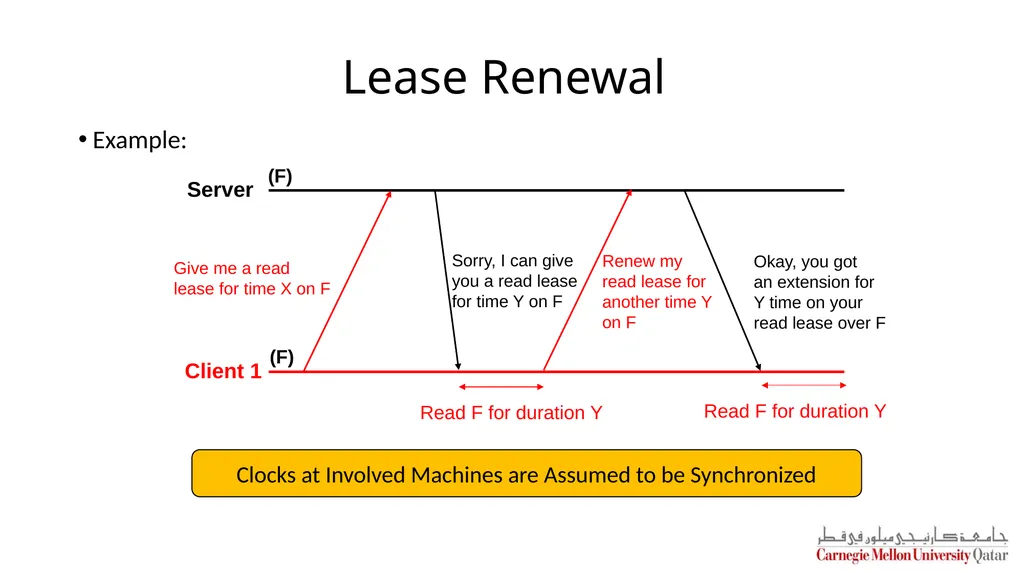
Lease Renewal Example: Server Client 1 Give me a read
lease for time X on F (F) (F) Sorry, I can give
you a read lease
for time Y on F Renew my read lease for another time Y
on F Okay, you got
an extension for
Y time on your
read lease over F Read F for duration Y Read F for duration Y Clocks at Involved Machines are Assumed to be Synchronized<br>
lease for time X on F (F) (F) Sorry, I can give
you a read lease
for time Y on F Renew my read lease for another time Y
on F Okay, you got
an extension for
Y time on your
read lease over F Read F for duration Y Read F for duration Y Clocks at Involved Machines are Assumed to be Synchronized<br>
18
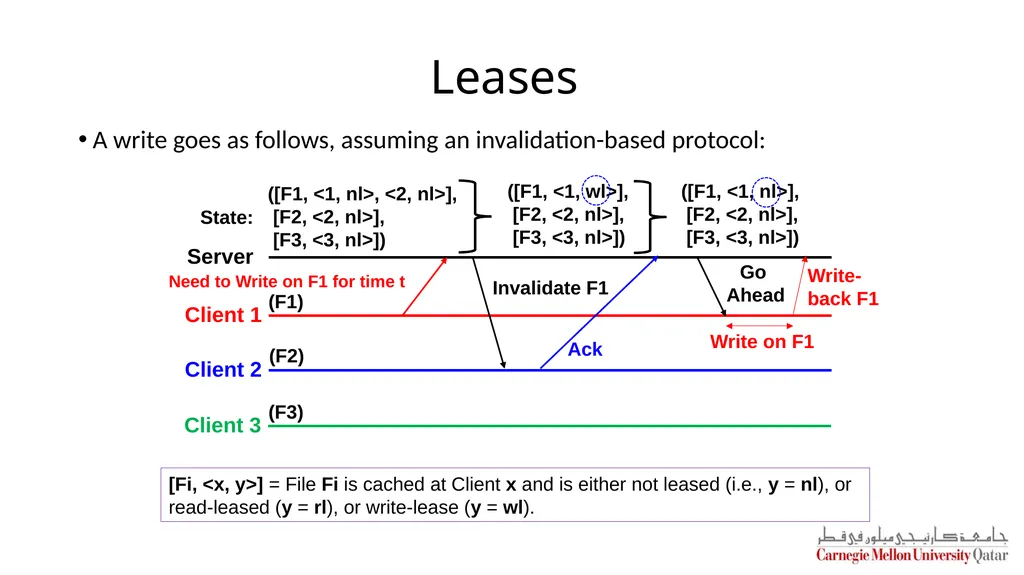
Leases A write goes as follows, assuming an invalidation-based protocol: Server Client 1 Client 2 Client 3 Need to Write on F1 for time t ([F1, <1, nl>, <2, nl>],
[F2, <2, nl>],
[F3, <3, nl>]) (F1) (F1, F2) (F3) Invalidate F1 Ack Go
Ahead Write on F1 Write-
back F1 [Fi, <x, y>] = File Fi is cached at Client x and is either not leased (i.e., y = nl), or
read-leased (y = rl), or write-lease (y = wl). ([F1, <1, wl>],
[F2, <2, nl>],
[F3, <3, nl>]) ([F1, <1, nl>],
[F2, <2, nl>],
[F3, <3, nl>]) State: (F2)<br>
[F2, <2, nl>],
[F3, <3, nl>]) (F1) (F1, F2) (F3) Invalidate F1 Ack Go
Ahead Write on F1 Write-
back F1 [Fi, <x, y>] = File Fi is cached at Client x and is either not leased (i.e., y = nl), or
read-leased (y = rl), or write-lease (y = wl). ([F1, <1, wl>],
[F2, <2, nl>],
[F3, <3, nl>]) ([F1, <1, nl>],
[F2, <2, nl>],
[F3, <3, nl>]) State: (F2)<br>
19
Leases What if a write request arrives to the server in between?
It can be queued, until the previous request is satisfied
Only one write can go at a time and multiple requests can be queued and serviced in a specific order (e.g., FIFO order)
When serviced, the up-to-date copy has to be shipped to its site (as its copy has been invalidated before allowing the previous write to proceed)
What if a read request arrives to the server in between?
It can be queued as well
After write is done, either another write is pursued singlehandedly, or one or more reads go in parallel
In any case, the up-to-date copy has to be shipped as well<br>
It can be queued, until the previous request is satisfied
Only one write can go at a time and multiple requests can be queued and serviced in a specific order (e.g., FIFO order)
When serviced, the up-to-date copy has to be shipped to its site (as its copy has been invalidated before allowing the previous write to proceed)
What if a read request arrives to the server in between?
It can be queued as well
After write is done, either another write is pursued singlehandedly, or one or more reads go in parallel
In any case, the up-to-date copy has to be shipped as well<br>
20
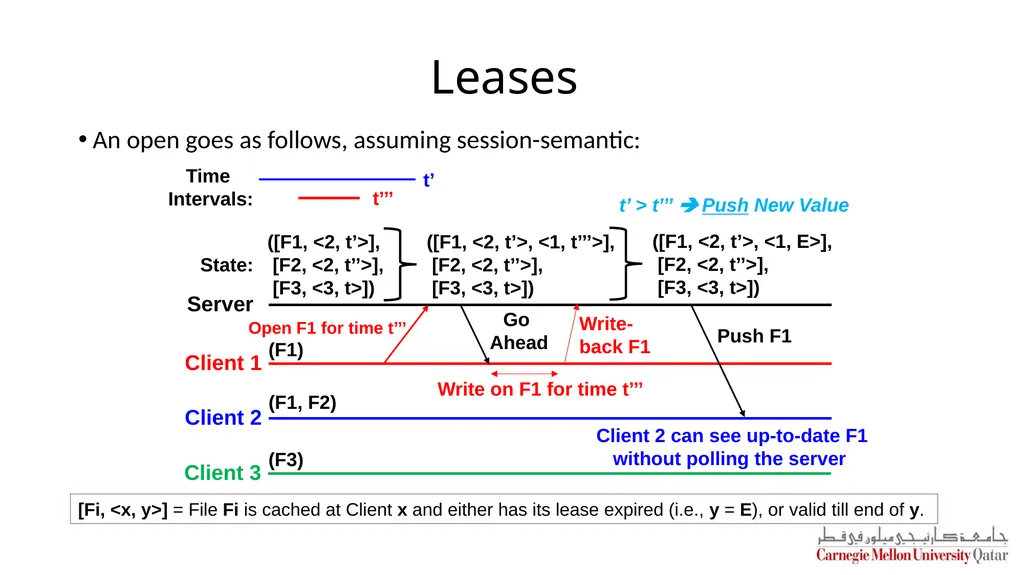
Leases An open goes as follows, assuming session-semantic: Server Client 1 Client 2 Client 3 Open F1 for time t’’’ ([F1, <2, t’>],
[F2, <2, t’’>],
[F3, <3, t>]) (F1) (F1, F2) (F3) Go
Ahead Write on F1 for time t’’’ Write-
back F1 [Fi, <x, y>] = File Fi is cached at Client x and either has its lease expired (i.e., y = E), or valid till end of y. State: t’ t’’’ ([F1, <2, t’>, <1, t’’’>],
[F2, <2, t’’>],
[F3, <3, t>]) Time
Intervals: ([F1, <2, t’>, <1, E>],
[F2, <2, t’’>],
[F3, <3, t>]) t’ > t’’’ Push New Value Push F1 Client 2 can see up-to-date F1
without polling the server<br>
[F2, <2, t’’>],
[F3, <3, t>]) (F1) (F1, F2) (F3) Go
Ahead Write on F1 for time t’’’ Write-
back F1 [Fi, <x, y>] = File Fi is cached at Client x and either has its lease expired (i.e., y = E), or valid till end of y. State: t’ t’’’ ([F1, <2, t’>, <1, t’’’>],
[F2, <2, t’’>],
[F3, <3, t>]) Time
Intervals: ([F1, <2, t’>, <1, E>],
[F2, <2, t’’>],
[F3, <3, t>]) t’ > t’’’ Push New Value Push F1 Client 2 can see up-to-date F1
without polling the server<br>
21
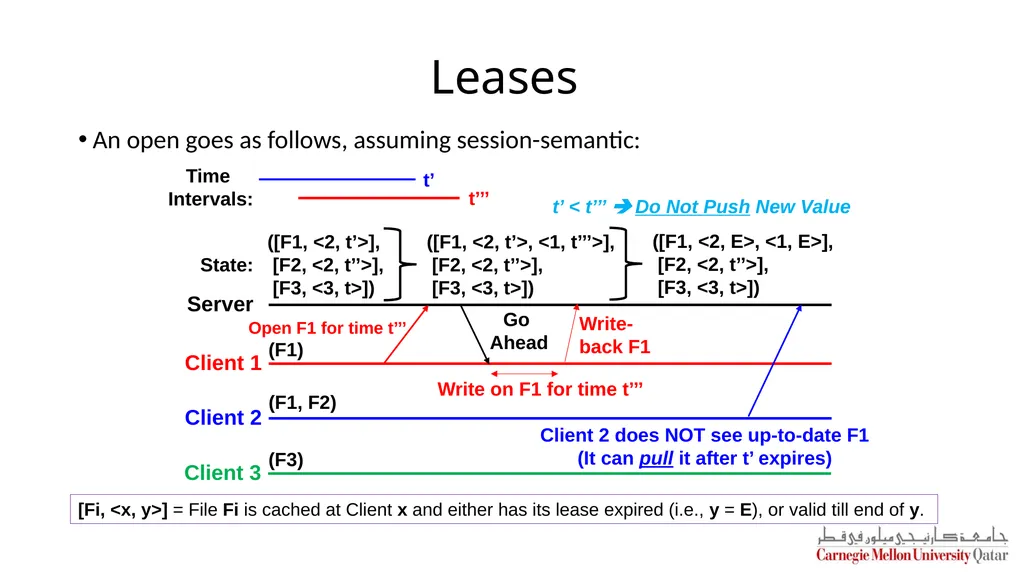
Leases An open goes as follows, assuming session-semantic: Server Client 1 Client 2 Client 3 Open F1 for time t’’’ ([F1, <2, t’>],
[F2, <2, t’’>],
[F3, <3, t>]) (F1) (F1, F2) (F3) Go
Ahead Write on F1 for time t’’’ Write-
back F1 State: t’ t’’’ ([F1, <2, t’>, <1, t’’’>],
[F2, <2, t’’>],
[F3, <3, t>]) Time
Intervals: ([F1, <2, E>, <1, E>],
[F2, <2, t’’>],
[F3, <3, t>]) t’ < t’’’ Do Not Push New Value Client 2 does NOT see up-to-date F1
(It can pull it after t’ expires) [Fi, <x, y>] = File Fi is cached at Client x and either has its lease expired (i.e., y = E), or valid till end of y.<br>
[F2, <2, t’’>],
[F3, <3, t>]) (F1) (F1, F2) (F3) Go
Ahead Write on F1 for time t’’’ Write-
back F1 State: t’ t’’’ ([F1, <2, t’>, <1, t’’’>],
[F2, <2, t’’>],
[F3, <3, t>]) Time
Intervals: ([F1, <2, E>, <1, E>],
[F2, <2, t’’>],
[F3, <3, t>]) t’ < t’’’ Do Not Push New Value Client 2 does NOT see up-to-date F1
(It can pull it after t’ expires) [Fi, <x, y>] = File Fi is cached at Client x and either has its lease expired (i.e., y = E), or valid till end of y.<br>
22
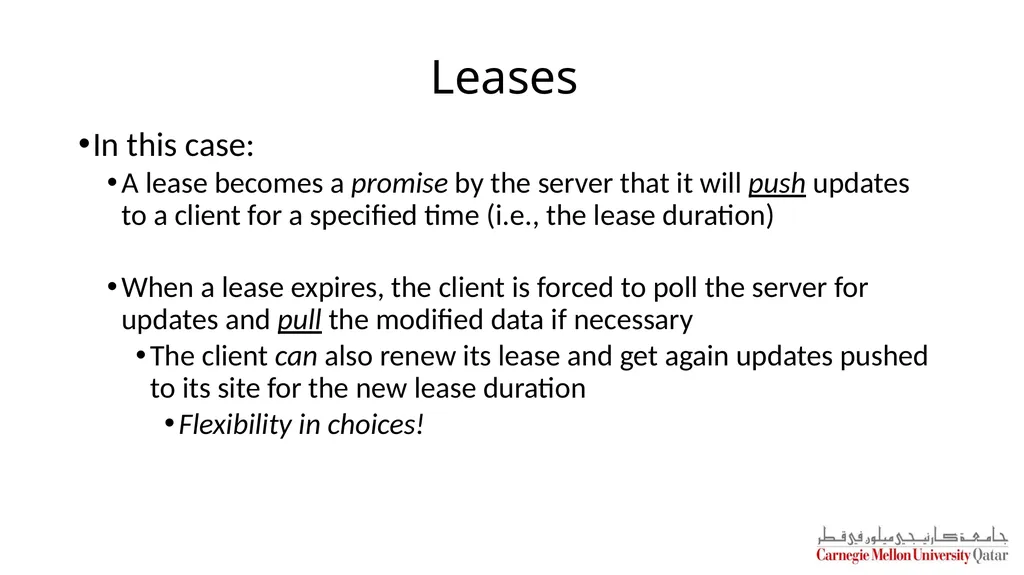
Leases In this case:
A lease becomes a promise by the server that it will push updates to a client for a specified time (i.e., the lease duration)
When a lease expires, the client is forced to poll the server for updates and pull the modified data if necessary
The client can also renew its lease and get again updates pushed to its site for the new lease duration
Flexibility in choices!<br>
A lease becomes a promise by the server that it will push updates to a client for a specified time (i.e., the lease duration)
When a lease expires, the client is forced to poll the server for updates and pull the modified data if necessary
The client can also renew its lease and get again updates pushed to its site for the new lease duration
Flexibility in choices!<br>
23
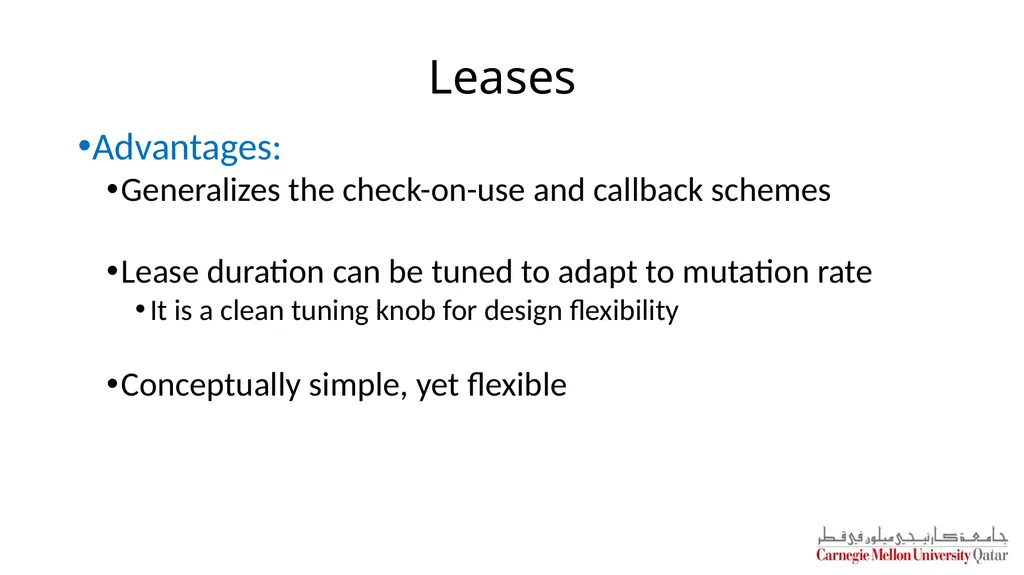
Leases Advantages:
Generalizes the check-on-use and callback schemes
Lease duration can be tuned to adapt to mutation rate
It is a clean tuning knob for design flexibility
Conceptually simple, yet flexible<br>
Generalizes the check-on-use and callback schemes
Lease duration can be tuned to adapt to mutation rate
It is a clean tuning knob for design flexibility
Conceptually simple, yet flexible<br>
24
Leases Disadvantages:
Lease-holder has total autonomy during lease
Load/priorities can change at the server
Revocation (where a lease is withdrawn by the server from the lease-holder) can be incorporated
In an invalidation-based, lease-based protocol:
Writers will be delayed on an object until all the read leases on that object are expired
Keep-alive callbacks are needed
Stateful server, which typically implies inferior fault-tolerance and scalability (in terms of capacity and communication)<br>
Lease-holder has total autonomy during lease
Load/priorities can change at the server
Revocation (where a lease is withdrawn by the server from the lease-holder) can be incorporated
In an invalidation-based, lease-based protocol:
Writers will be delayed on an object until all the read leases on that object are expired
Keep-alive callbacks are needed
Stateful server, which typically implies inferior fault-tolerance and scalability (in terms of capacity and communication)<br>
25
Cache Consistency Approaches We will study 7 cache consistency approaches:
Broadcast Invalidations
Check on Use
Callback
Leases
Skip Scary Parts
Faith-Based Caching
Pass the Buck<br>
Broadcast Invalidations
Check on Use
Callback
Leases
Skip Scary Parts
Faith-Based Caching
Pass the Buck<br>
26
Skip Scary Parts Basic Idea:
When write-sharing is detected, caching is turned off
Afterwards, all references go directly to the master copy
Caching is resumed when write-sharing ends
Advantages:
Precise single-copy semantics (even at byte-level consistency)
Excellent fallback strategy
Exemplifies good engineering: “Handle average case well; worst case safely”
Good adaptation of caching aggressiveness to workload characteristics (i.e., patterns of reads and writes)<br>
When write-sharing is detected, caching is turned off
Afterwards, all references go directly to the master copy
Caching is resumed when write-sharing ends
Advantages:
Precise single-copy semantics (even at byte-level consistency)
Excellent fallback strategy
Exemplifies good engineering: “Handle average case well; worst case safely”
Good adaptation of caching aggressiveness to workload characteristics (i.e., patterns of reads and writes)<br>
27
Skip Scary Parts Disadvantages:
Server needs to be aware of every use of data
Assuming it is used in conjunction with check-on-use
Either clients expose their wills of making writes upon opening files
Or the server relies on clients’ write-backs upon closing files (which indicate writes on files)
Server maintains some monitoring state<br>
Server needs to be aware of every use of data
Assuming it is used in conjunction with check-on-use
Either clients expose their wills of making writes upon opening files
Or the server relies on clients’ write-backs upon closing files (which indicate writes on files)
Server maintains some monitoring state<br>
28
Cache Consistency Approaches We will study 7 cache consistency approaches:
Broadcast Invalidations
Check on Use
Callback
Leases
Skip Scary Parts
Faith-Based Caching
Pass the Buck<br>
Broadcast Invalidations
Check on Use
Callback
Leases
Skip Scary Parts
Faith-Based Caching
Pass the Buck<br>
29
A Primer: Eventual Consistency Many applications can tolerate inconsistency for a long time
Webpage updates, Web Search – Crawling, indexing and ranking, Updates to DNS Server
In such applications, it is acceptable and efficient if updates are infrequently propagated
A caching scheme is termed as eventually consistent if:
All replicas will gradually become consistent in the absence of updates<br>
Webpage updates, Web Search – Crawling, indexing and ranking, Updates to DNS Server
In such applications, it is acceptable and efficient if updates are infrequently propagated
A caching scheme is termed as eventually consistent if:
All replicas will gradually become consistent in the absence of updates<br>
30
A Primer: Eventual Consistency Caching schemes typically apply eventual consistency if:
Write-write conflicts are rare
Very rare for two processes to write to the same object
Generally, one client updates the data object
E.g., One DNS server updates the name-to-IP mappings
Rare conflicts can be handled through simple mechanisms, such as mutual exclusion
Read-write conflicts are more frequent
Conflicts where one process is reading an object, while another process is writing (or attempting to write) to a replica of it
Eventually consistent schemes have to focus on efficiently resolving these conflicts<br>
Write-write conflicts are rare
Very rare for two processes to write to the same object
Generally, one client updates the data object
E.g., One DNS server updates the name-to-IP mappings
Rare conflicts can be handled through simple mechanisms, such as mutual exclusion
Read-write conflicts are more frequent
Conflicts where one process is reading an object, while another process is writing (or attempting to write) to a replica of it
Eventually consistent schemes have to focus on efficiently resolving these conflicts<br>
31
Faith-Based Caching Basic Idea (an implementation of eventual consistency):
A client blindly assumes cached data is valid for a while
Referred to as “trust period”
E.g., In Sun NFSv3 cached files are assumed current for 3 seconds, while directories for 30 seconds
A small variant is to set a time-to-live (TTL) field for each object
It periodically checks (based on time since last check) the validity of cached data
No communication occurs during trust period
Advantages:
Simple implementation
Server is stateless<br>
A client blindly assumes cached data is valid for a while
Referred to as “trust period”
E.g., In Sun NFSv3 cached files are assumed current for 3 seconds, while directories for 30 seconds
A small variant is to set a time-to-live (TTL) field for each object
It periodically checks (based on time since last check) the validity of cached data
No communication occurs during trust period
Advantages:
Simple implementation
Server is stateless<br>
32
Faith-Based Caching Disadvantages:
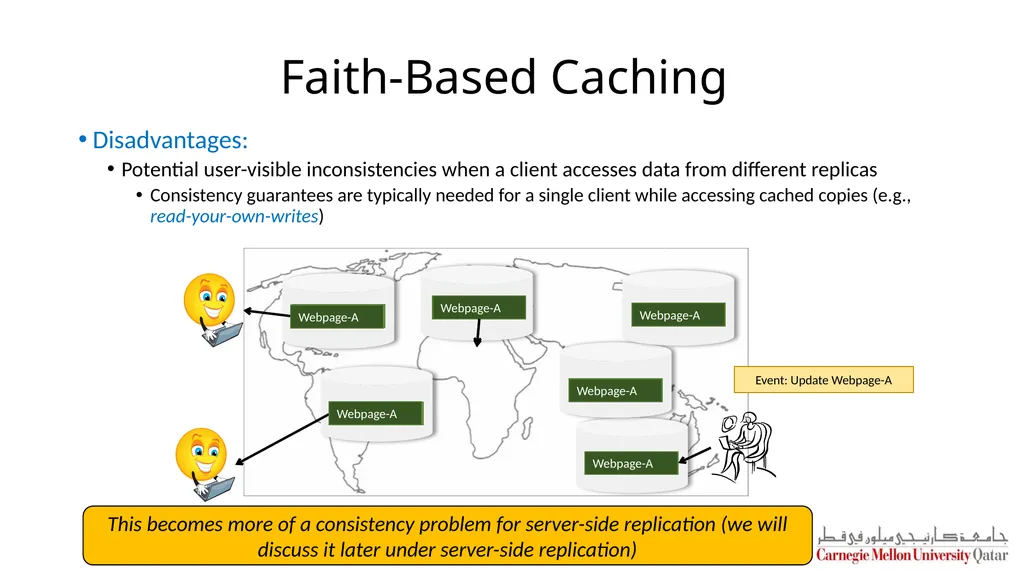
Potential user-visible inconsistencies when a client accesses data from different replicas
Consistency guarantees are typically needed for a single client while accessing cached copies (e.g., read-your-own-writes) Webpage-A Event: Update Webpage-A Webpage-A Webpage-A Webpage-A Webpage-A Webpage-A Webpage-A Webpage-A Webpage-A Webpage-A Webpage-A Webpage-A This becomes more of a consistency problem for server-side replication (we will discuss it later under server-side replication)<br>
Potential user-visible inconsistencies when a client accesses data from different replicas
Consistency guarantees are typically needed for a single client while accessing cached copies (e.g., read-your-own-writes) Webpage-A Event: Update Webpage-A Webpage-A Webpage-A Webpage-A Webpage-A Webpage-A Webpage-A Webpage-A Webpage-A Webpage-A Webpage-A Webpage-A This becomes more of a consistency problem for server-side replication (we will discuss it later under server-side replication)<br>
33
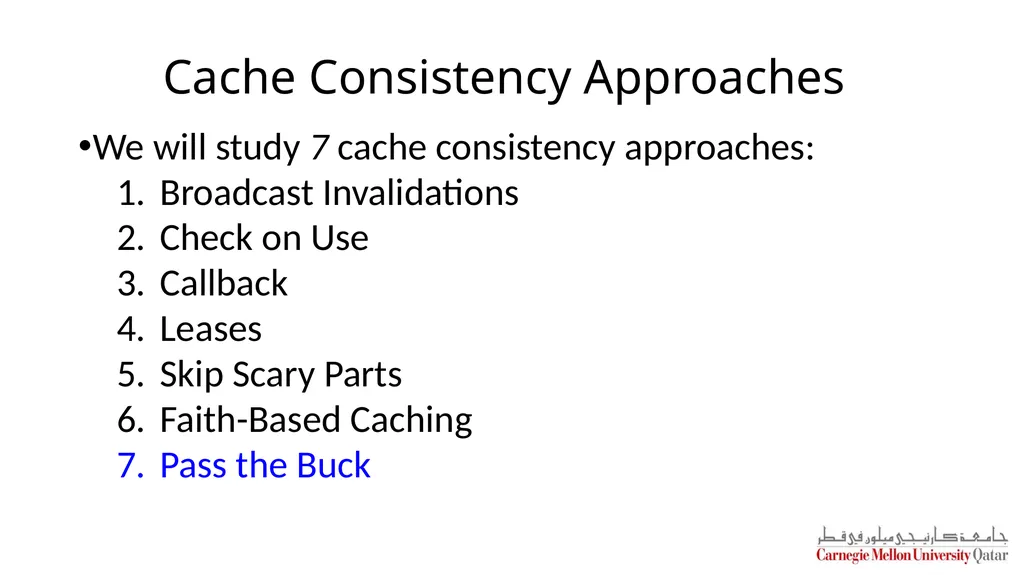
Cache Consistency Approaches We will study 7 cache consistency approaches:
Broadcast Invalidations
Check on Use
Callback
Leases
Skip Scary Parts
Faith-Based Caching
Pass the Buck<br>
Broadcast Invalidations
Check on Use
Callback
Leases
Skip Scary Parts
Faith-Based Caching
Pass the Buck<br>
34
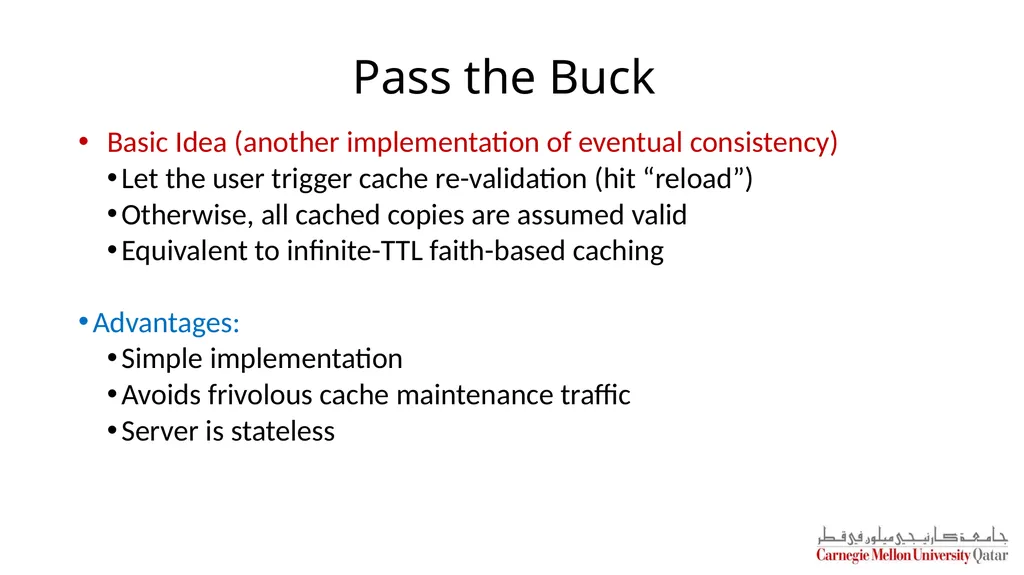
Pass the Buck Basic Idea (another implementation of eventual consistency)
Let the user trigger cache re-validation (hit “reload”)
Otherwise, all cached copies are assumed valid
Equivalent to infinite-TTL faith-based caching
Advantages:
Simple implementation
Avoids frivolous cache maintenance traffic
Server is stateless<br>
Let the user trigger cache re-validation (hit “reload”)
Otherwise, all cached copies are assumed valid
Equivalent to infinite-TTL faith-based caching
Advantages:
Simple implementation
Avoids frivolous cache maintenance traffic
Server is stateless<br>
35
Pass the Buck Disadvantages:
Places burden on users
Users may be clueless about levels of consistency needed
Assumes existence of users
Pain for write scripts/programs<br>
Places burden on users
Users may be clueless about levels of consistency needed
Assumes existence of users
Pain for write scripts/programs<br>
36
Cache Consistency Approaches We will study 7 cache consistency approaches:
Broadcast Invalidations
Check on Use
Callback
Leases
Skip Scary Parts
Faith-Based Caching
Pass the Buck Many minor variants over the years, but these have withstood the test of time!<br>
Broadcast Invalidations
Check on Use
Callback
Leases
Skip Scary Parts
Faith-Based Caching
Pass the Buck Many minor variants over the years, but these have withstood the test of time!<br>
37
Three Key Questions What data should be cached and when?
Fetching Policy
How can updates be made visible everywhere?
Consistency or Update Propagation Policy
What data should be evicted to free up space?
Cache Replacement Policy<br>
Fetching Policy
How can updates be made visible everywhere?
Consistency or Update Propagation Policy
What data should be evicted to free up space?
Cache Replacement Policy<br>
38
Next Class Discuss cache replacement policies<br>