
distributed with permission from author ©gloria l.
LO
Published · 19 slides · 0 views

1 / 1

Description
distributed with permission from author gloria l. schaab, ssj, phd February 5, 2015 A Model Institution of Catholic Higher Education Barry University: The Mission of Catholic Higher Education Like other Catholic colleges and universities,
Related Topics
Share
Embed code
Download this presentation From Below
"distributed with permission from author ©gloria l." is the property of its rightful owner. Permission is granted to download and print the materials on this website for personal, non-commercial use only, and to display it on your personal computer provided you do not modify the materials and that you retain all copyright notices contained in the materials. By downloading content from our website, you accept the terms of this agreement.
Presentation Transcript
01
distributed with permission from author
©gloria l. schaab, ssj, phd
February 5, 2015<br>
©gloria l. schaab, ssj, phd
February 5, 2015<br>
02
A Model Institution of Catholic Higher Education Barry University:<br>
03
The Mission of Catholic Higher Education Like other Catholic colleges and universities,
Barry University has a unique mission.
“The heart and soul of these institutions (Catholic) are transformative in nature, not just transactional. They are not just credit bearing, but life giving. These institutions teach people not only how to earn a living but how to live life in a moral sense, an ethical sense, in a value sense. They give a moral compass that enables students to get through life’s crisis.
“As those who serve in such institutions we have the gift of being able to educate the whole person in a better way. Our mission goes to developing leaders in a world an context where you need values and a faith dimension – leaders who understand that there is a God and that God is good.”
Melanie Morey and John Piderit, Catholic Higher Education<br>
Barry University has a unique mission.
“The heart and soul of these institutions (Catholic) are transformative in nature, not just transactional. They are not just credit bearing, but life giving. These institutions teach people not only how to earn a living but how to live life in a moral sense, an ethical sense, in a value sense. They give a moral compass that enables students to get through life’s crisis.
“As those who serve in such institutions we have the gift of being able to educate the whole person in a better way. Our mission goes to developing leaders in a world an context where you need values and a faith dimension – leaders who understand that there is a God and that God is good.”
Melanie Morey and John Piderit, Catholic Higher Education<br>
04
Implementing, Enhancing & Assessing Barry’s Mission What kind of Alumni do we what to form through transformative education?
What kind of student applicants do we want to attract?
What kind of strategies do we have in place to achieve or mission of “Engaging the World through Transformative Catholic Higher Education?<br>
What kind of student applicants do we want to attract?
What kind of strategies do we have in place to achieve or mission of “Engaging the World through Transformative Catholic Higher Education?<br>
05
MODELS OF CATHOLIC HIGHER EDUCATION Melanie M. Morey and John J. Piderit in
Catholic Higher Education: A Culture in Crisis
propose four models of Catholic higher education in reflecting on our mission, education and recruitment goals and strategies:
~ Catholic immersion
~ Catholic persuasion
~ Catholic diaspora
~ Catholic cohort<br>
Catholic Higher Education: A Culture in Crisis
propose four models of Catholic higher education in reflecting on our mission, education and recruitment goals and strategies:
~ Catholic immersion
~ Catholic persuasion
~ Catholic diaspora
~ Catholic cohort<br>
06
Catholic Immersion Education: This model “seeks to provide undergraduates with an education that prepares them to be well informed and significant leaders not only in society but also in the Catholic Church.”
Recruitment: The majority of students that such an institution seeks to attract are already committed Catholics, those who seek to become committed Catholics, or those whose parents wish them to become so.<br>
Recruitment: The majority of students that such an institution seeks to attract are already committed Catholics, those who seek to become committed Catholics, or those whose parents wish them to become so.<br>
07
Catholic Persuasion Education: This model “seeks to give all students knowledge and appreciation of the Catholic tradition, regardless of whether they are Catholic themselves.”
Recruitment: The underlying assumption is that, while not committed Catholics as yet, the students interested in this university are nonetheless Catholic with a need or desire for greater understanding of the teachings of the Church.<br>
Recruitment: The underlying assumption is that, while not committed Catholics as yet, the students interested in this university are nonetheless Catholic with a need or desire for greater understanding of the teachings of the Church.<br>
08
Catholic Diaspora Those universities whose goal is the Catholic diaspora have a dual intention in achieving their educational goals:
First, in a situation of religious diversity, the university seeks to ensure that “all students become more open and accepting to religious beliefs.”
Second, such universities are committed to observing the standards of Catholic belief in all university activities.
Recruitment Goal: To attract religiously diverse students with a small proportion of Catholic students.<br>
First, in a situation of religious diversity, the university seeks to ensure that “all students become more open and accepting to religious beliefs.”
Second, such universities are committed to observing the standards of Catholic belief in all university activities.
Recruitment Goal: To attract religiously diverse students with a small proportion of Catholic students.<br>
09
Catholic Cohort This model “seeks to influence the formation of two student groups (in achieving their educational goals).”
The first group attends the university with the goal of acquiring the knowledge and skills for a particular business or profession. The university intends that this group gain a deeper appreciation of religious diversity.
The second group is the “cohort.” They may practice similar live styles and articulate similar professional goals but they also gain the capacity “to advance broad segments of the Catholic tradition” toward support for a Catholic social agenda shaped, for example, by themes such as Catholic Social Teaching.
Recruitment Goal: To attract students with high academic ability and demonstrated leadership skills with and without religious aims.<br>
The first group attends the university with the goal of acquiring the knowledge and skills for a particular business or profession. The university intends that this group gain a deeper appreciation of religious diversity.
The second group is the “cohort.” They may practice similar live styles and articulate similar professional goals but they also gain the capacity “to advance broad segments of the Catholic tradition” toward support for a Catholic social agenda shaped, for example, by themes such as Catholic Social Teaching.
Recruitment Goal: To attract students with high academic ability and demonstrated leadership skills with and without religious aims.<br>
10
Principal Components of Institutional Life and their Strategies Academic Programming
Residential Life
Student & Athletic Activities
Religious Activities
Personnel<br>
Residential Life
Student & Athletic Activities
Religious Activities
Personnel<br>
11
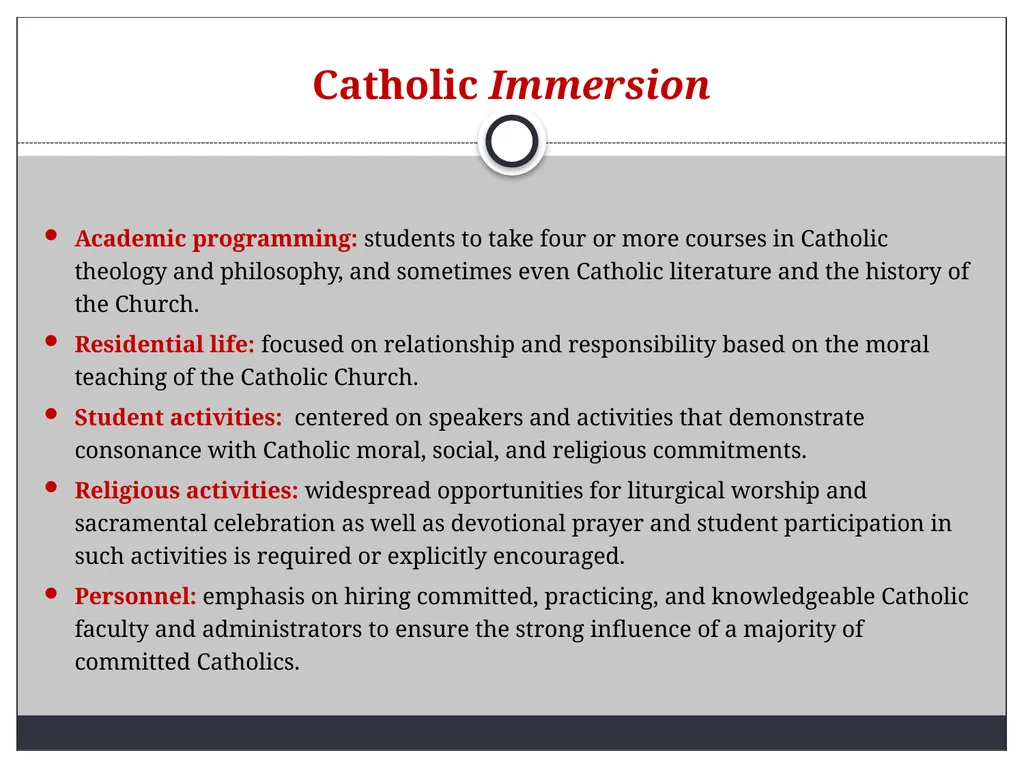
Catholic Immersion Academic programming: students to take four or more courses in Catholic theology and philosophy, and sometimes even Catholic literature and the history of the Church.
Residential life: focused on relationship and responsibility based on the moral teaching of the Catholic Church.
Student activities: centered on speakers and activities that demonstrate consonance with Catholic moral, social, and religious commitments.
Religious activities: widespread opportunities for liturgical worship and sacramental celebration as well as devotional prayer and student participation in such activities is required or explicitly encouraged.
Personnel: emphasis on hiring committed, practicing, and knowledgeable Catholic faculty and administrators to ensure the strong influence of a majority of committed Catholics.<br>
Residential life: focused on relationship and responsibility based on the moral teaching of the Catholic Church.
Student activities: centered on speakers and activities that demonstrate consonance with Catholic moral, social, and religious commitments.
Religious activities: widespread opportunities for liturgical worship and sacramental celebration as well as devotional prayer and student participation in such activities is required or explicitly encouraged.
Personnel: emphasis on hiring committed, practicing, and knowledgeable Catholic faculty and administrators to ensure the strong influence of a majority of committed Catholics.<br>
12
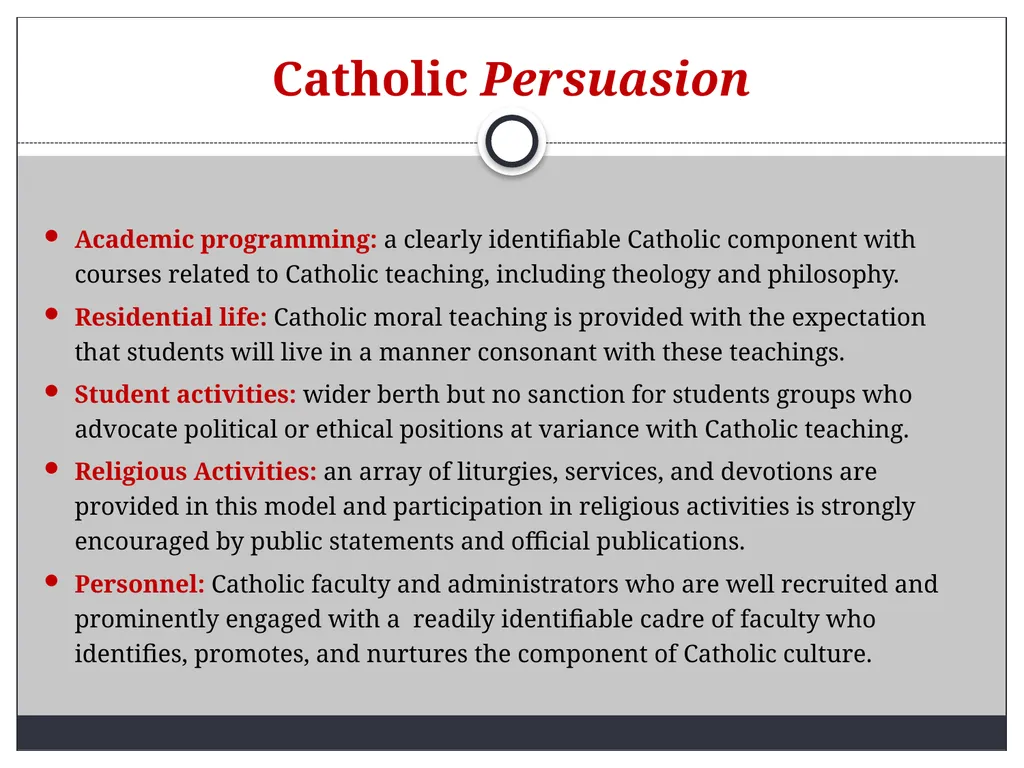
Catholic Persuasion Academic programming: a clearly identifiable Catholic component with courses related to Catholic teaching, including theology and philosophy.
Residential life: Catholic moral teaching is provided with the expectation that students will live in a manner consonant with these teachings.
Student activities: wider berth but no sanction for students groups who advocate political or ethical positions at variance with Catholic teaching.
Religious Activities: an array of liturgies, services, and devotions are provided in this model and participation in religious activities is strongly encouraged by public statements and official publications.
Personnel: Catholic faculty and administrators who are well recruited and prominently engaged with a readily identifiable cadre of faculty who identifies, promotes, and nurtures the component of Catholic culture.<br>
Residential life: Catholic moral teaching is provided with the expectation that students will live in a manner consonant with these teachings.
Student activities: wider berth but no sanction for students groups who advocate political or ethical positions at variance with Catholic teaching.
Religious Activities: an array of liturgies, services, and devotions are provided in this model and participation in religious activities is strongly encouraged by public statements and official publications.
Personnel: Catholic faculty and administrators who are well recruited and prominently engaged with a readily identifiable cadre of faculty who identifies, promotes, and nurtures the component of Catholic culture.<br>
13
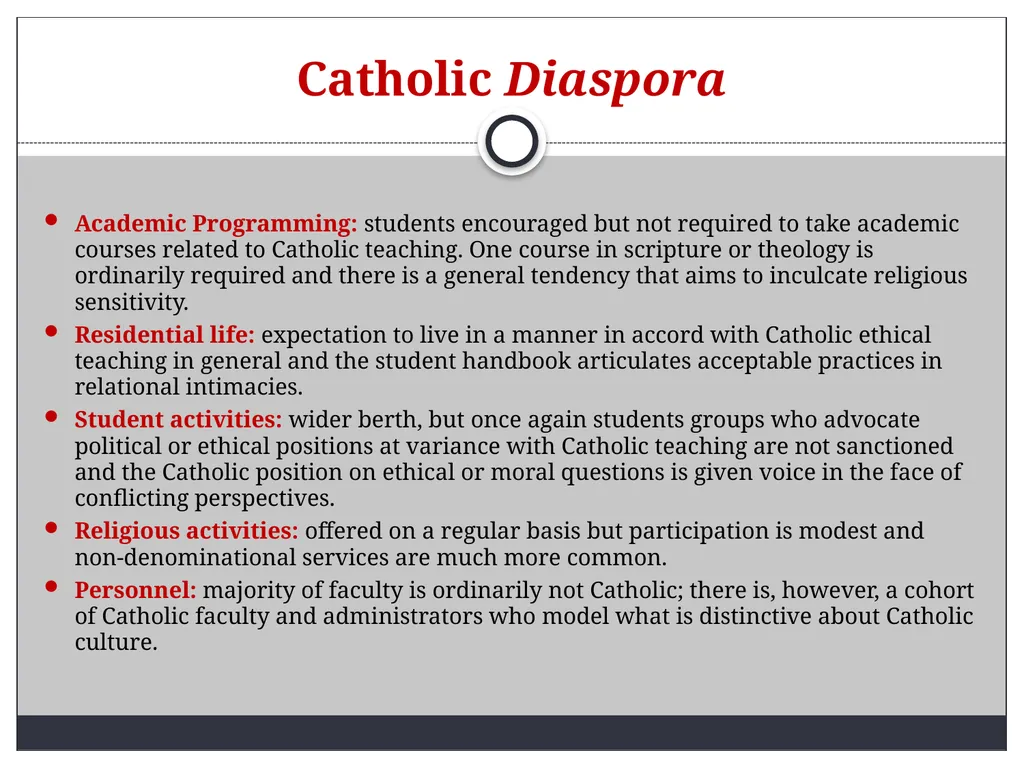
Catholic Diaspora Academic Programming: students encouraged but not required to take academic courses related to Catholic teaching. One course in scripture or theology is ordinarily required and there is a general tendency that aims to inculcate religious sensitivity.
Residential life: expectation to live in a manner in accord with Catholic ethical teaching in general and the student handbook articulates acceptable practices in relational intimacies.
Student activities: wider berth, but once again students groups who advocate political or ethical positions at variance with Catholic teaching are not sanctioned and the Catholic position on ethical or moral questions is given voice in the face of conflicting perspectives.
Religious activities: offered on a regular basis but participation is modest and non-denominational services are much more common.
Personnel: majority of faculty is ordinarily not Catholic; there is, however, a cohort of Catholic faculty and administrators who model what is distinctive about Catholic culture.<br>
Residential life: expectation to live in a manner in accord with Catholic ethical teaching in general and the student handbook articulates acceptable practices in relational intimacies.
Student activities: wider berth, but once again students groups who advocate political or ethical positions at variance with Catholic teaching are not sanctioned and the Catholic position on ethical or moral questions is given voice in the face of conflicting perspectives.
Religious activities: offered on a regular basis but participation is modest and non-denominational services are much more common.
Personnel: majority of faculty is ordinarily not Catholic; there is, however, a cohort of Catholic faculty and administrators who model what is distinctive about Catholic culture.<br>
14
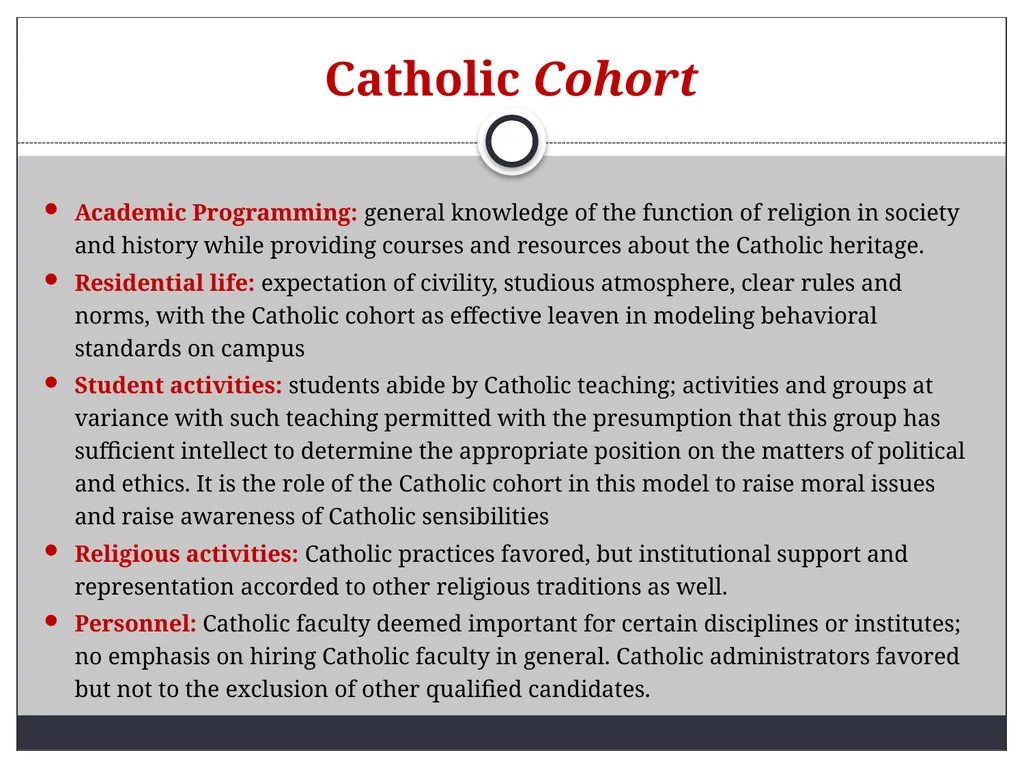
Catholic Cohort Academic Programming: general knowledge of the function of religion in society and history while providing courses and resources about the Catholic heritage.
Residential life: expectation of civility, studious atmosphere, clear rules and norms, with the Catholic cohort as effective leaven in modeling behavioral standards on campus
Student activities: students abide by Catholic teaching; activities and groups at variance with such teaching permitted with the presumption that this group has sufficient intellect to determine the appropriate position on the matters of political and ethics. It is the role of the Catholic cohort in this model to raise moral issues and raise awareness of Catholic sensibilities
Religious activities: Catholic practices favored, but institutional support and representation accorded to other religious traditions as well.
Personnel: Catholic faculty deemed important for certain disciplines or institutes; no emphasis on hiring Catholic faculty in general. Catholic administrators favored but not to the exclusion of other qualified candidates.<br>
Residential life: expectation of civility, studious atmosphere, clear rules and norms, with the Catholic cohort as effective leaven in modeling behavioral standards on campus
Student activities: students abide by Catholic teaching; activities and groups at variance with such teaching permitted with the presumption that this group has sufficient intellect to determine the appropriate position on the matters of political and ethics. It is the role of the Catholic cohort in this model to raise moral issues and raise awareness of Catholic sensibilities
Religious activities: Catholic practices favored, but institutional support and representation accorded to other religious traditions as well.
Personnel: Catholic faculty deemed important for certain disciplines or institutes; no emphasis on hiring Catholic faculty in general. Catholic administrators favored but not to the exclusion of other qualified candidates.<br>
15
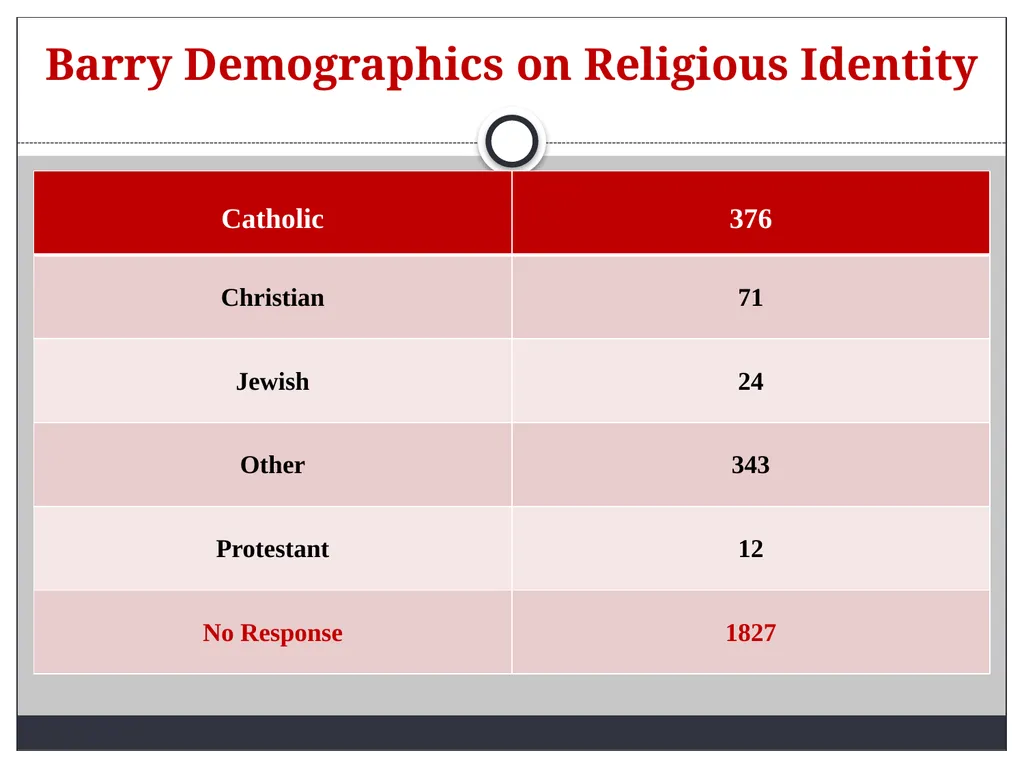
Barry Demographics on Religious Identity<br>
16
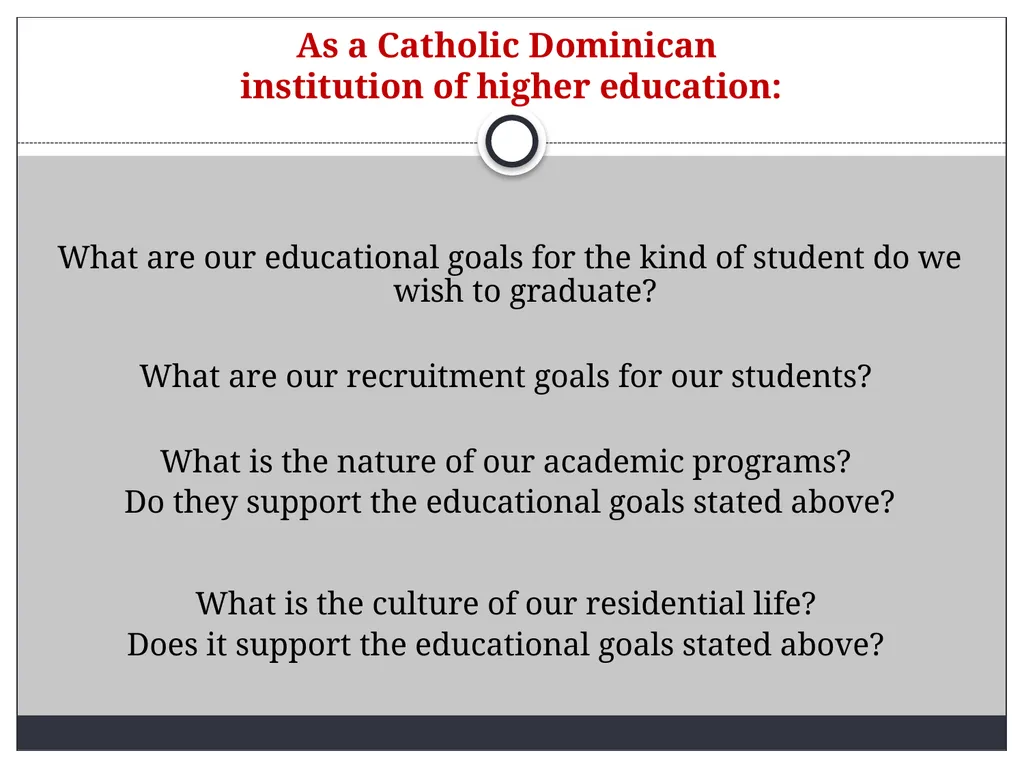
As a Catholic Dominican
institution of higher education: What are our educational goals for the kind of student do we wish to graduate?
What are our recruitment goals for our students?
What is the nature of our academic programs?
Do they support the educational goals stated above?
What is the culture of our residential life?
Does it support the educational goals stated above?<br>
What are our recruitment goals for our students?
What is the nature of our academic programs?
Do they support the educational goals stated above?
What is the culture of our residential life?
Does it support the educational goals stated above?<br>
17
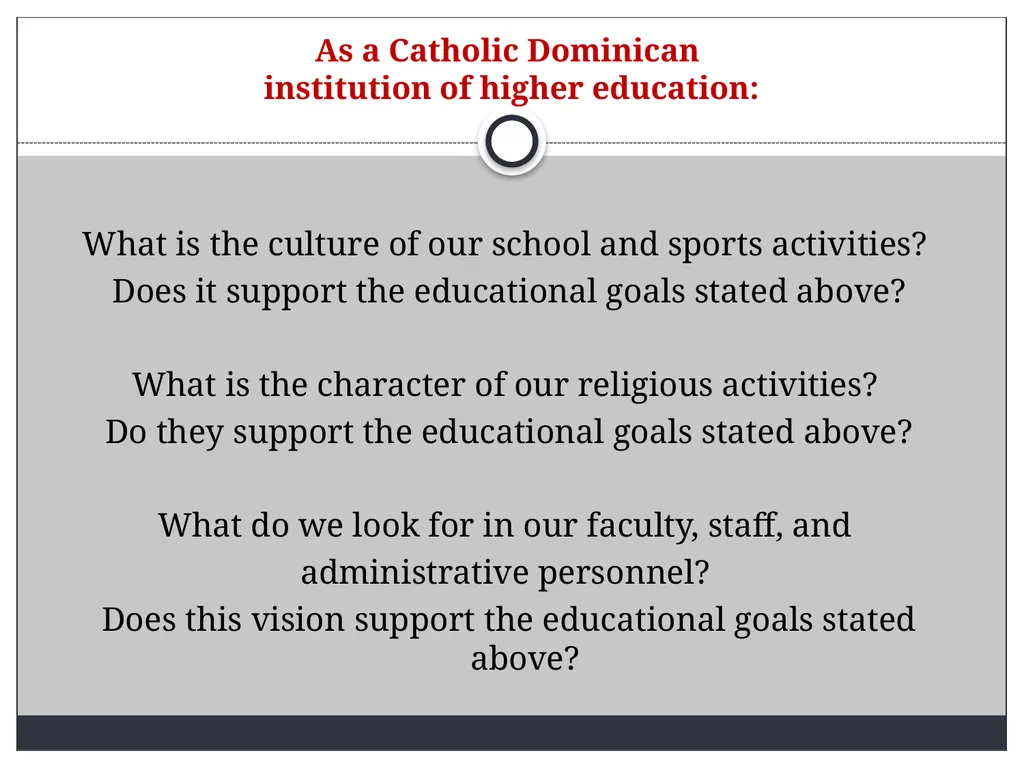
As a Catholic Dominican
institution of higher education: What is the culture of our school and sports activities?
Does it support the educational goals stated above?
What is the character of our religious activities?
Do they support the educational goals stated above?
What do we look for in our faculty, staff, and
administrative personnel?
Does this vision support the educational goals stated above?<br>
Does it support the educational goals stated above?
What is the character of our religious activities?
Do they support the educational goals stated above?
What do we look for in our faculty, staff, and
administrative personnel?
Does this vision support the educational goals stated above?<br>
18
Questions for Reflection and Discussion What makes Catholic institutions distinctive?
How are they distinguished from non-sectarian institutions?
What makes Barry University different from the other
universities throughout South Florida or the United States?
Into what model of Catholic higher education does
Barry fit?
Is this where we want to be?
If not, what must we change for the future?<br>
How are they distinguished from non-sectarian institutions?
What makes Barry University different from the other
universities throughout South Florida or the United States?
Into what model of Catholic higher education does
Barry fit?
Is this where we want to be?
If not, what must we change for the future?<br>
19
“Educational institutions are not inert.
They adjust, they launch new initiatives,
they allow former ways to fall into desuetude,
they seek new types of students
and they constantly attract new
students and new faculty members.
Such changes might be intentional; however, it is also
possible for mission to drift far from its original moorings.
The preservation of the Catholic identity, culture, and
mission of our institutions demands
that we manage our mission and manage it well.”<br>
They adjust, they launch new initiatives,
they allow former ways to fall into desuetude,
they seek new types of students
and they constantly attract new
students and new faculty members.
Such changes might be intentional; however, it is also
possible for mission to drift far from its original moorings.
The preservation of the Catholic identity, culture, and
mission of our institutions demands
that we manage our mission and manage it well.”<br>