
DISTRIBUTION STATEMENT A. Approved for public
MS
Published · 9 slides · 0 views
1 / 1
Description
DISTRIBUTION STATEMENT A. Approved for public release. Countering Foreign Influence Program (CFIP) Wes Bennett Director Contracts Management Office Kevin Flaherty Assistant Director, Policy and Oversight Security Intelligence
Related Topics
Share
Embed code
Download this presentation From Below
"DISTRIBUTION STATEMENT A. Approved for public" is the property of its rightful owner. Permission is granted to download and print the materials on this website for personal, non-commercial use only, and to display it on your personal computer provided you do not modify the materials and that you retain all copyright notices contained in the materials. By downloading content from our website, you accept the terms of this agreement.
Presentation Transcript
01
DISTRIBUTION STATEMENT A. Approved for public release. Countering Foreign Influence Program (CFIP) Wes Bennett
Director
Contracts Management Office
&
Kevin Flaherty
Assistant Director, Policy and Oversight
Security & Intelligence Directorate December 8, 2021<br>
Director
Contracts Management Office
&
Kevin Flaherty
Assistant Director, Policy and Oversight
Security & Intelligence Directorate December 8, 2021<br>
02
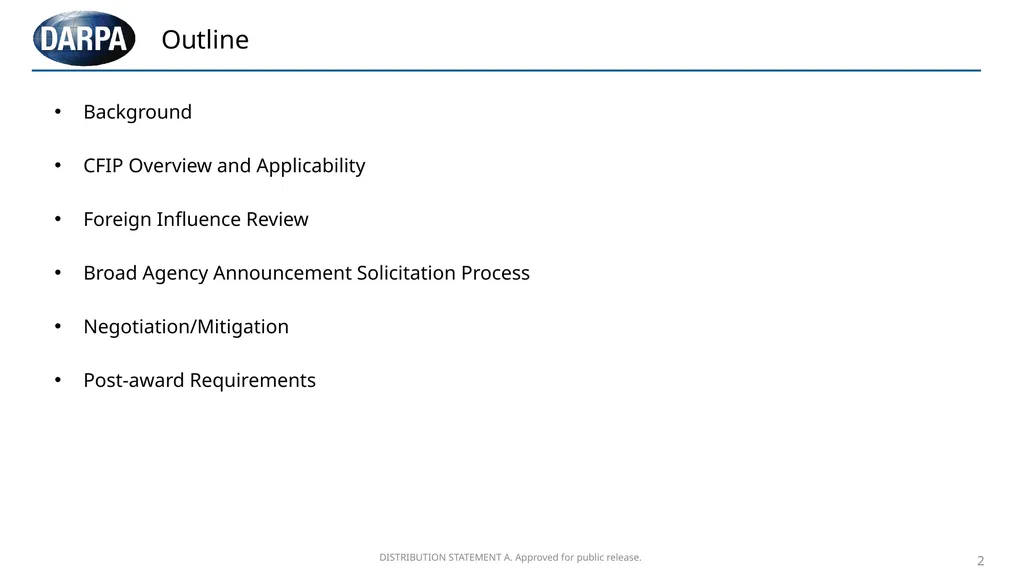
2 Background
CFIP Overview and Applicability
Foreign Influence Review
Broad Agency Announcement Solicitation Process
Negotiation/Mitigation
Post-award Requirements Outline DISTRIBUTION STATEMENT A. Approved for public release.<br>
CFIP Overview and Applicability
Foreign Influence Review
Broad Agency Announcement Solicitation Process
Negotiation/Mitigation
Post-award Requirements Outline DISTRIBUTION STATEMENT A. Approved for public release.<br>
03
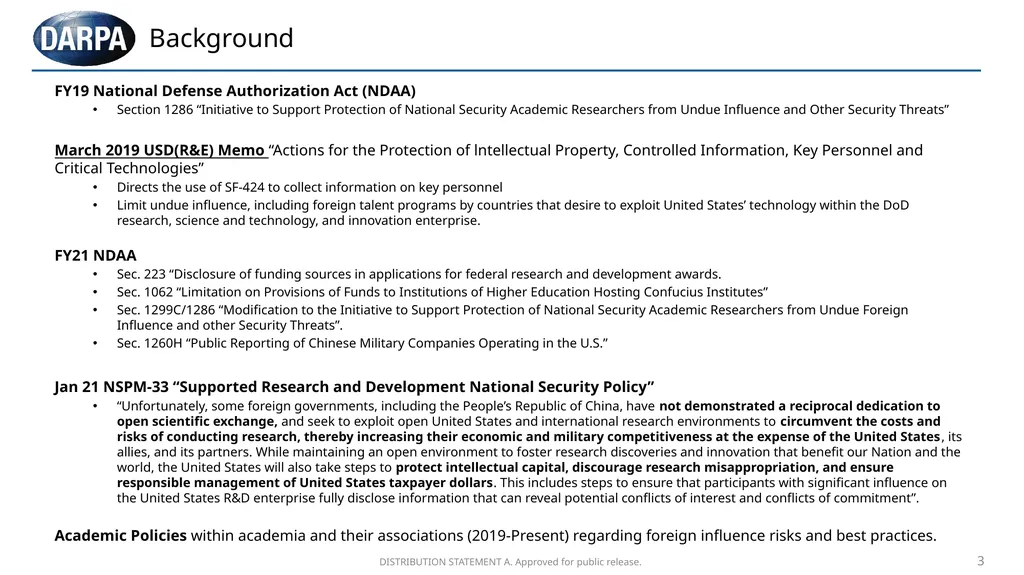
3 FY19 National Defense Authorization Act (NDAA)
Section 1286 “Initiative to Support Protection of National Security Academic Researchers from Undue Influence and Other Security Threats”
March 2019 USD(R&E) Memo “Actions for the Protection of lntellectual Property, Controlled Information, Key Personnel and Critical Technologies”
Directs the use of SF-424 to collect information on key personnel
Limit undue influence, including foreign talent programs by countries that desire to exploit United States’ technology within the DoD research, science and technology, and innovation enterprise.
FY21 NDAA
Sec. 223 “Disclosure of funding sources in applications for federal research and development awards.
Sec. 1062 “Limitation on Provisions of Funds to Institutions of Higher Education Hosting Confucius Institutes”
Sec. 1299C/1286 “Modification to the Initiative to Support Protection of National Security Academic Researchers from Undue Foreign Influence and other Security Threats”.
Sec. 1260H “Public Reporting of Chinese Military Companies Operating in the U.S.”
Jan 21 NSPM-33 “Supported Research and Development National Security Policy”
“Unfortunately, some foreign governments, including the People’s Republic of China, have not demonstrated a reciprocal dedication to open scientific exchange, and seek to exploit open United States and international research environments to circumvent the costs and risks of conducting research, thereby increasing their economic and military competitiveness at the expense of the United States, its allies, and its partners. While maintaining an open environment to foster research discoveries and innovation that benefit our Nation and the world, the United States will also take steps to protect intellectual capital, discourage research misappropriation, and ensure responsible management of United States taxpayer dollars. This includes steps to ensure that participants with significant influence on the United States R&D enterprise fully disclose information that can reveal potential conflicts of interest and conflicts of commitment”.
Academic Policies within academia and their associations (2019-Present) regarding foreign influence risks and best practices. Background DISTRIBUTION STATEMENT A. Approved for public release.<br>
Section 1286 “Initiative to Support Protection of National Security Academic Researchers from Undue Influence and Other Security Threats”
March 2019 USD(R&E) Memo “Actions for the Protection of lntellectual Property, Controlled Information, Key Personnel and Critical Technologies”
Directs the use of SF-424 to collect information on key personnel
Limit undue influence, including foreign talent programs by countries that desire to exploit United States’ technology within the DoD research, science and technology, and innovation enterprise.
FY21 NDAA
Sec. 223 “Disclosure of funding sources in applications for federal research and development awards.
Sec. 1062 “Limitation on Provisions of Funds to Institutions of Higher Education Hosting Confucius Institutes”
Sec. 1299C/1286 “Modification to the Initiative to Support Protection of National Security Academic Researchers from Undue Foreign Influence and other Security Threats”.
Sec. 1260H “Public Reporting of Chinese Military Companies Operating in the U.S.”
Jan 21 NSPM-33 “Supported Research and Development National Security Policy”
“Unfortunately, some foreign governments, including the People’s Republic of China, have not demonstrated a reciprocal dedication to open scientific exchange, and seek to exploit open United States and international research environments to circumvent the costs and risks of conducting research, thereby increasing their economic and military competitiveness at the expense of the United States, its allies, and its partners. While maintaining an open environment to foster research discoveries and innovation that benefit our Nation and the world, the United States will also take steps to protect intellectual capital, discourage research misappropriation, and ensure responsible management of United States taxpayer dollars. This includes steps to ensure that participants with significant influence on the United States R&D enterprise fully disclose information that can reveal potential conflicts of interest and conflicts of commitment”.
Academic Policies within academia and their associations (2019-Present) regarding foreign influence risks and best practices. Background DISTRIBUTION STATEMENT A. Approved for public release.<br>
04
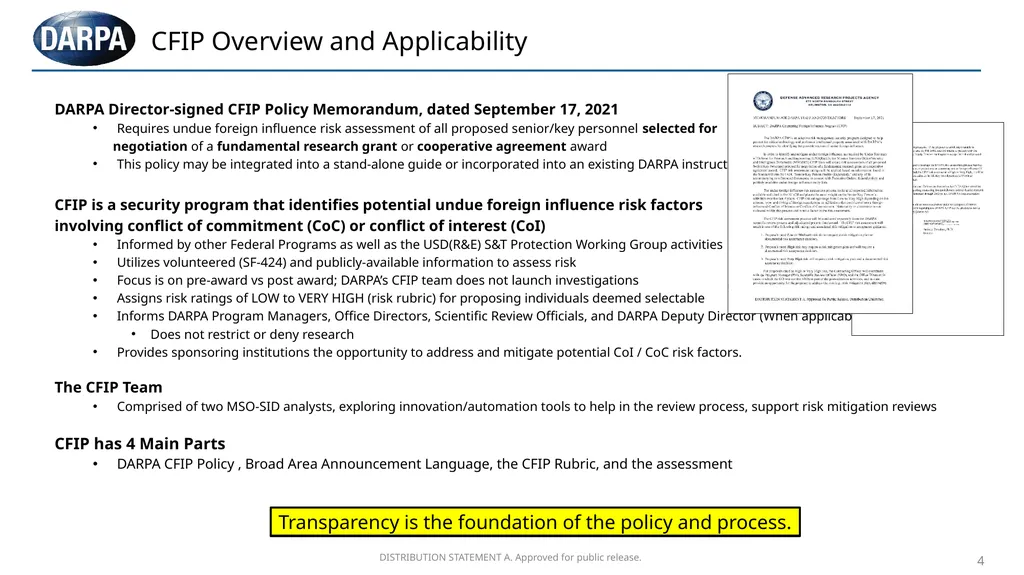
4 DARPA Director-signed CFIP Policy Memorandum, dated September 17, 2021
Requires undue foreign influence risk assessment of all proposed senior/key personnel selected for
negotiation of a fundamental research grant or cooperative agreement award
This policy may be integrated into a stand-alone guide or incorporated into an existing DARPA instruction
CFIP is a security program that identifies potential undue foreign influence risk factors
involving conflict of commitment (CoC) or conflict of interest (CoI)
Informed by other Federal Programs as well as the USD(R&E) S&T Protection Working Group activities
Utilizes volunteered (SF-424) and publicly-available information to assess risk
Focus is on pre-award vs post award; DARPA’s CFIP team does not launch investigations
Assigns risk ratings of LOW to VERY HIGH (risk rubric) for proposing individuals deemed selectable
Informs DARPA Program Managers, Office Directors, Scientific Review Officials, and DARPA Deputy Director (When applicable)
Does not restrict or deny research
Provides sponsoring institutions the opportunity to address and mitigate potential CoI / CoC risk factors.
The CFIP Team
Comprised of two MSO-SID analysts, exploring innovation/automation tools to help in the review process, support risk mitigation reviews
CFIP has 4 Main Parts
DARPA CFIP Policy , Broad Area Announcement Language, the CFIP Rubric, and the assessment CFIP Overview and Applicability Transparency is the foundation of the policy and process. DISTRIBUTION STATEMENT A. Approved for public release.<br>
Requires undue foreign influence risk assessment of all proposed senior/key personnel selected for
negotiation of a fundamental research grant or cooperative agreement award
This policy may be integrated into a stand-alone guide or incorporated into an existing DARPA instruction
CFIP is a security program that identifies potential undue foreign influence risk factors
involving conflict of commitment (CoC) or conflict of interest (CoI)
Informed by other Federal Programs as well as the USD(R&E) S&T Protection Working Group activities
Utilizes volunteered (SF-424) and publicly-available information to assess risk
Focus is on pre-award vs post award; DARPA’s CFIP team does not launch investigations
Assigns risk ratings of LOW to VERY HIGH (risk rubric) for proposing individuals deemed selectable
Informs DARPA Program Managers, Office Directors, Scientific Review Officials, and DARPA Deputy Director (When applicable)
Does not restrict or deny research
Provides sponsoring institutions the opportunity to address and mitigate potential CoI / CoC risk factors.
The CFIP Team
Comprised of two MSO-SID analysts, exploring innovation/automation tools to help in the review process, support risk mitigation reviews
CFIP has 4 Main Parts
DARPA CFIP Policy , Broad Area Announcement Language, the CFIP Rubric, and the assessment CFIP Overview and Applicability Transparency is the foundation of the policy and process. DISTRIBUTION STATEMENT A. Approved for public release.<br>
05
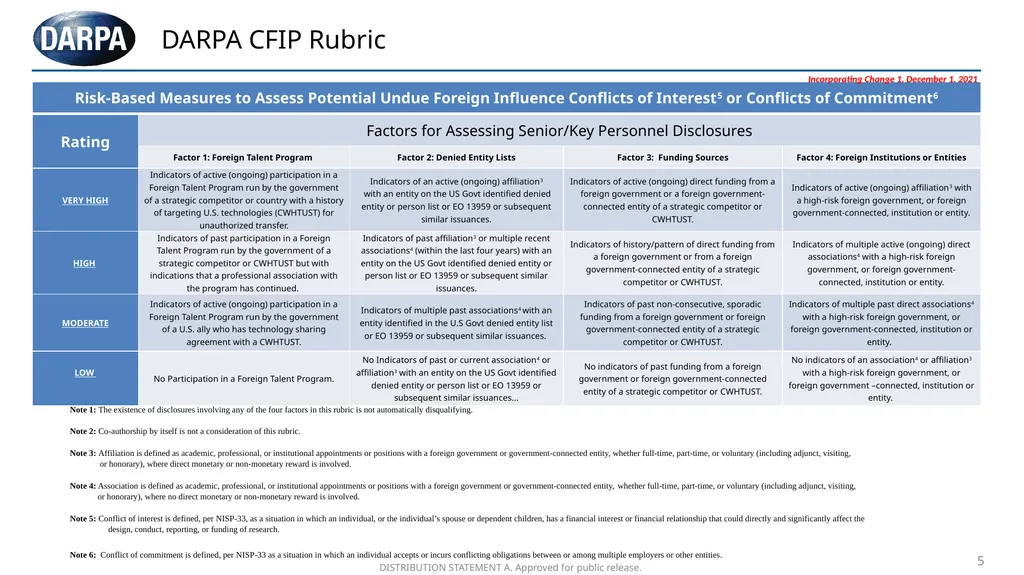
5 DARPA CFIP Rubric Note 1: The existence of disclosures involving any of the four factors in this rubric is not automatically disqualifying.
Note 2: Co-authorship by itself is not a consideration of this rubric.
Note 3: Affiliation is defined as academic, professional, or institutional appointments or positions with a foreign government or government-connected entity, whether full-time, part-time, or voluntary (including adjunct, visiting,
or honorary), where direct monetary or non-monetary reward is involved.
Note 4: Association is defined as academic, professional, or institutional appointments or positions with a foreign government or government-connected entity, whether full-time, part-time, or voluntary (including adjunct, visiting,
or honorary), where no direct monetary or non-monetary reward is involved.
Note 5: Conflict of interest is defined, per NISP-33, as a situation in which an individual, or the individual’s spouse or dependent children, has a financial interest or financial relationship that could directly and significantly affect the design, conduct, reporting, or funding of research.
Note 6: Conflict of commitment is defined, per NISP-33 as a situation in which an individual accepts or incurs conflicting obligations between or among multiple employers or other entities. Incorporating Change 1, December 1, 2021 DISTRIBUTION STATEMENT A. Approved for public release.<br>
Note 2: Co-authorship by itself is not a consideration of this rubric.
Note 3: Affiliation is defined as academic, professional, or institutional appointments or positions with a foreign government or government-connected entity, whether full-time, part-time, or voluntary (including adjunct, visiting,
or honorary), where direct monetary or non-monetary reward is involved.
Note 4: Association is defined as academic, professional, or institutional appointments or positions with a foreign government or government-connected entity, whether full-time, part-time, or voluntary (including adjunct, visiting,
or honorary), where no direct monetary or non-monetary reward is involved.
Note 5: Conflict of interest is defined, per NISP-33, as a situation in which an individual, or the individual’s spouse or dependent children, has a financial interest or financial relationship that could directly and significantly affect the design, conduct, reporting, or funding of research.
Note 6: Conflict of commitment is defined, per NISP-33 as a situation in which an individual accepts or incurs conflicting obligations between or among multiple employers or other entities. Incorporating Change 1, December 1, 2021 DISTRIBUTION STATEMENT A. Approved for public release.<br>
06
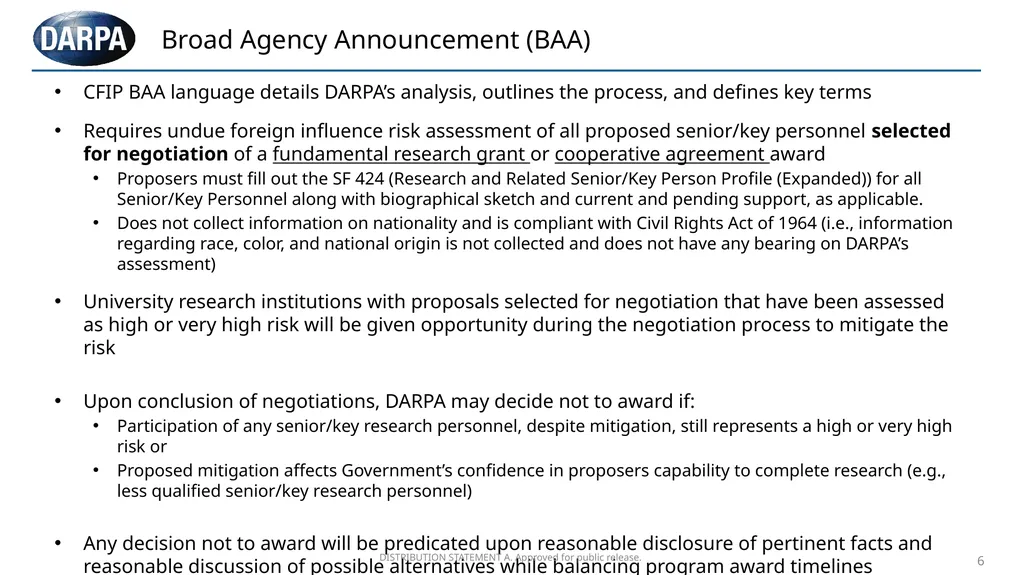
6 CFIP BAA language details DARPA’s analysis, outlines the process, and defines key terms
Requires undue foreign influence risk assessment of all proposed senior/key personnel selected for negotiation of a fundamental research grant or cooperative agreement award
Proposers must fill out the SF 424 (Research and Related Senior/Key Person Profile (Expanded)) for all Senior/Key Personnel along with biographical sketch and current and pending support, as applicable.
Does not collect information on nationality and is compliant with Civil Rights Act of 1964 (i.e., information regarding race, color, and national origin is not collected and does not have any bearing on DARPA’s assessment)
University research institutions with proposals selected for negotiation that have been assessed as high or very high risk will be given opportunity during the negotiation process to mitigate the risk
Upon conclusion of negotiations, DARPA may decide not to award if:
Participation of any senior/key research personnel, despite mitigation, still represents a high or very high risk or
Proposed mitigation affects Government’s confidence in proposers capability to complete research (e.g., less qualified senior/key research personnel)
Any decision not to award will be predicated upon reasonable disclosure of pertinent facts and reasonable discussion of possible alternatives while balancing program award timelines Broad Agency Announcement (BAA) DISTRIBUTION STATEMENT A. Approved for public release.<br>
Requires undue foreign influence risk assessment of all proposed senior/key personnel selected for negotiation of a fundamental research grant or cooperative agreement award
Proposers must fill out the SF 424 (Research and Related Senior/Key Person Profile (Expanded)) for all Senior/Key Personnel along with biographical sketch and current and pending support, as applicable.
Does not collect information on nationality and is compliant with Civil Rights Act of 1964 (i.e., information regarding race, color, and national origin is not collected and does not have any bearing on DARPA’s assessment)
University research institutions with proposals selected for negotiation that have been assessed as high or very high risk will be given opportunity during the negotiation process to mitigate the risk
Upon conclusion of negotiations, DARPA may decide not to award if:
Participation of any senior/key research personnel, despite mitigation, still represents a high or very high risk or
Proposed mitigation affects Government’s confidence in proposers capability to complete research (e.g., less qualified senior/key research personnel)
Any decision not to award will be predicated upon reasonable disclosure of pertinent facts and reasonable discussion of possible alternatives while balancing program award timelines Broad Agency Announcement (BAA) DISTRIBUTION STATEMENT A. Approved for public release.<br>
07
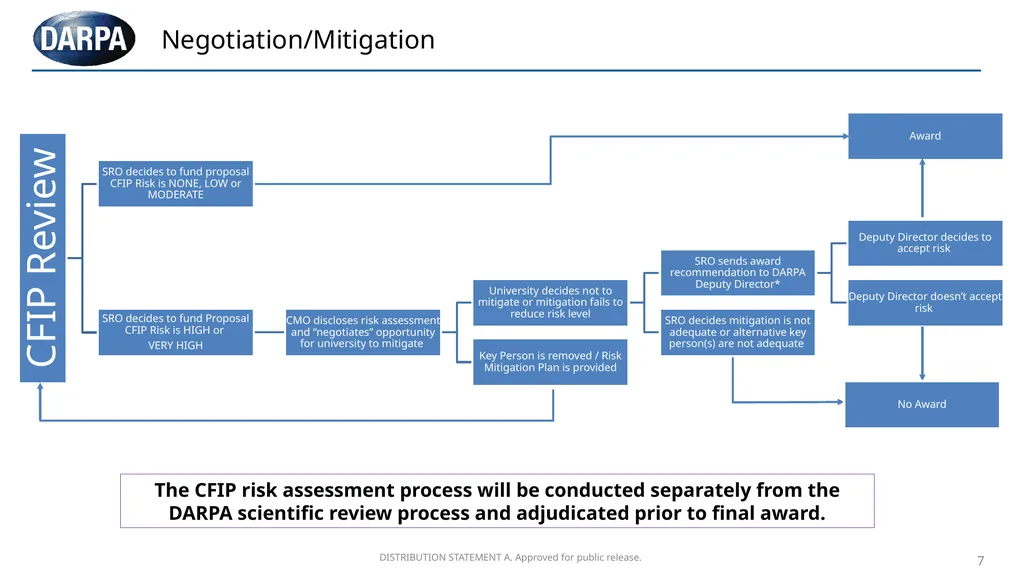
7 Negotiation/Mitigation The CFIP risk assessment process will be conducted separately from the DARPA scientific review process and adjudicated prior to final award. DISTRIBUTION STATEMENT A. Approved for public release.<br>
08
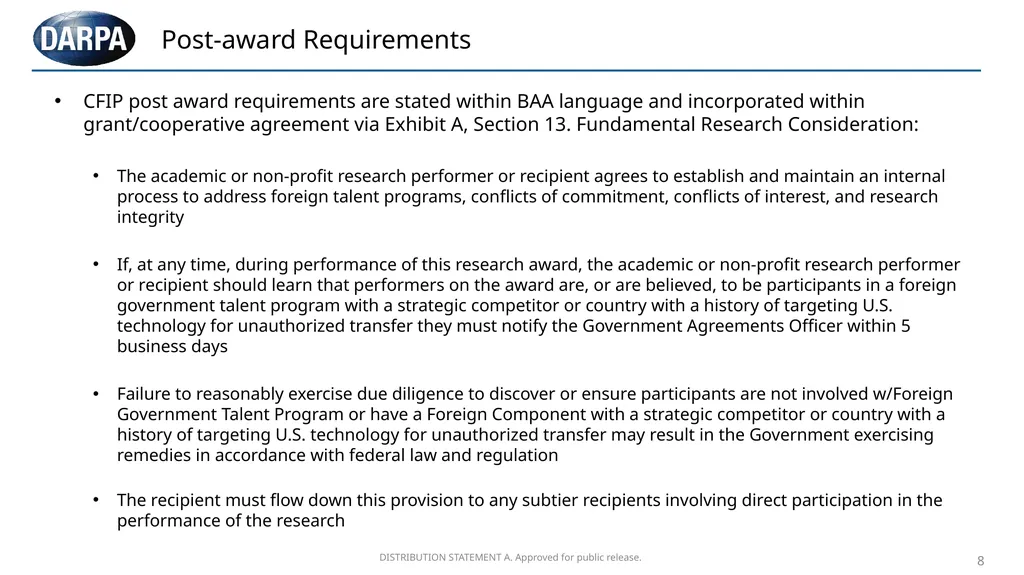
8 CFIP post award requirements are stated within BAA language and incorporated within grant/cooperative agreement via Exhibit A, Section 13. Fundamental Research Consideration:
The academic or non-profit research performer or recipient agrees to establish and maintain an internal process to address foreign talent programs, conflicts of commitment, conflicts of interest, and research integrity
If, at any time, during performance of this research award, the academic or non-profit research performer or recipient should learn that performers on the award are, or are believed, to be participants in a foreign government talent program with a strategic competitor or country with a history of targeting U.S. technology for unauthorized transfer they must notify the Government Agreements Officer within 5 business days
Failure to reasonably exercise due diligence to discover or ensure participants are not involved w/Foreign Government Talent Program or have a Foreign Component with a strategic competitor or country with a history of targeting U.S. technology for unauthorized transfer may result in the Government exercising remedies in accordance with federal law and regulation
The recipient must flow down this provision to any subtier recipients involving direct participation in the performance of the research Post-award Requirements DISTRIBUTION STATEMENT A. Approved for public release.<br>
The academic or non-profit research performer or recipient agrees to establish and maintain an internal process to address foreign talent programs, conflicts of commitment, conflicts of interest, and research integrity
If, at any time, during performance of this research award, the academic or non-profit research performer or recipient should learn that performers on the award are, or are believed, to be participants in a foreign government talent program with a strategic competitor or country with a history of targeting U.S. technology for unauthorized transfer they must notify the Government Agreements Officer within 5 business days
Failure to reasonably exercise due diligence to discover or ensure participants are not involved w/Foreign Government Talent Program or have a Foreign Component with a strategic competitor or country with a history of targeting U.S. technology for unauthorized transfer may result in the Government exercising remedies in accordance with federal law and regulation
The recipient must flow down this provision to any subtier recipients involving direct participation in the performance of the research Post-award Requirements DISTRIBUTION STATEMENT A. Approved for public release.<br>
09
9 Questions DISTRIBUTION STATEMENT A. Approved for public release.<br>