Do more. Share more. Be more. Scouts Hereford and Worcester Assessing Learning (25) Welcome and Introduction Module Objectives By the end of this module learners should be able to: Describe the Adult Training Scheme Nights Away Permit
"Do more. Share more. Be more. Scouts Hereford and" is the property of its rightful owner. Permission is granted to
download and print the materials on this website for personal, non-commercial use only, and to display it
on your personal computer provided you do not modify the materials and that you retain all copyright
notices contained in the materials. By downloading content from our website, you accept the terms of this
agreement.
Presentation Transcript
01
Do more.
Share more.
Be more. Scouts Hereford and Worcester Assessing Learning (25)<br>
02
Welcome and Introduction<br>
03
Module Objectives
By the end of this module learners should be able to:
Describe the Adult Training Scheme / Nights Away Permit Scheme / Adventurous Activity Scheme / Scout Show Recognition and how they operate.
Explain their own and others’ roles within the Schemes.
Identify the learning or development needs of the people they support / assess.
Undertake appropriate assessments and validations.
Provide constructive feedback on positive areas and areas to develop.
Explain how they can demonstrate the values and methods of The Scout Association in their role.
Plan to meet their own subject knowledge needs.<br>
04
Session 1 – Split into three groups depending on roles – How the schemes work
Session 2 – Where learners come from and assessing learners’ needs. Learning methods.
Session 3 – Assessment and validation methods.
Session 4 – What is your role?
Session 5 – Module summary and validation – moving forwards.<br>
05
Session 1a – How the training scheme works<br>
06
Session 1a Key Messages
The training scheme is modular and flexible
The modules required are different depending on the role being undertaken.
Learning is optional, depending on the prior knowledge, skills and experience of the learner, but every required module must be validated.<br>
07
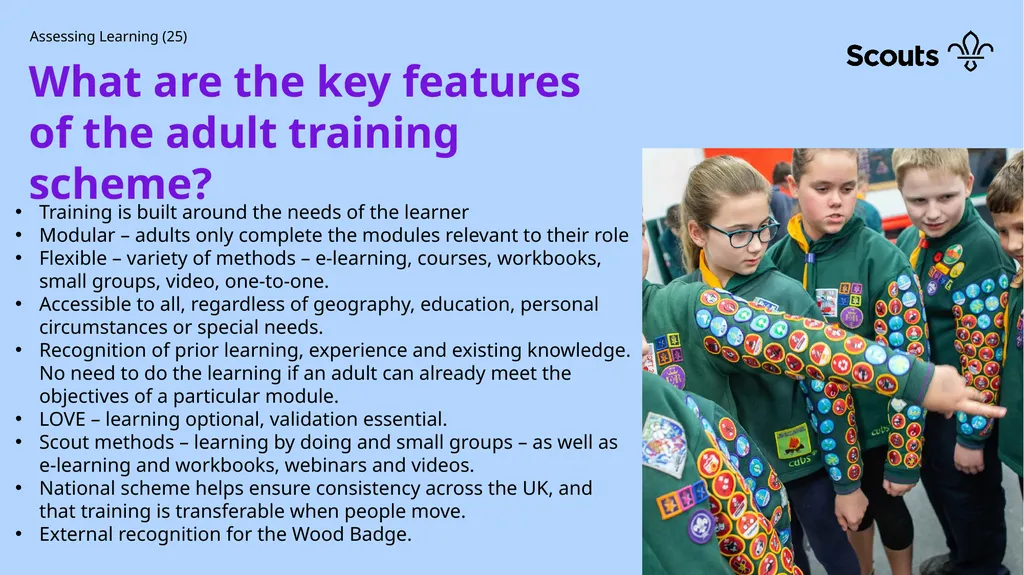
Assessing Learning (25) What are the key features of the adult training scheme? Training is built around the needs of the learner
Modular – adults only complete the modules relevant to their role
Flexible – variety of methods – e-learning, courses, workbooks, small groups, video, one-to-one.
Accessible to all, regardless of geography, education, personal circumstances or special needs.
Recognition of prior learning, experience and existing knowledge. No need to do the learning if an adult can already meet the objectives of a particular module.
LOVE – learning optional, validation essential.
Scout methods – learning by doing and small groups – as well as e-learning and workbooks, webinars and videos.
National scheme helps ensure consistency across the UK, and that training is transferable when people move.
External recognition for the Wood Badge.<br>
08
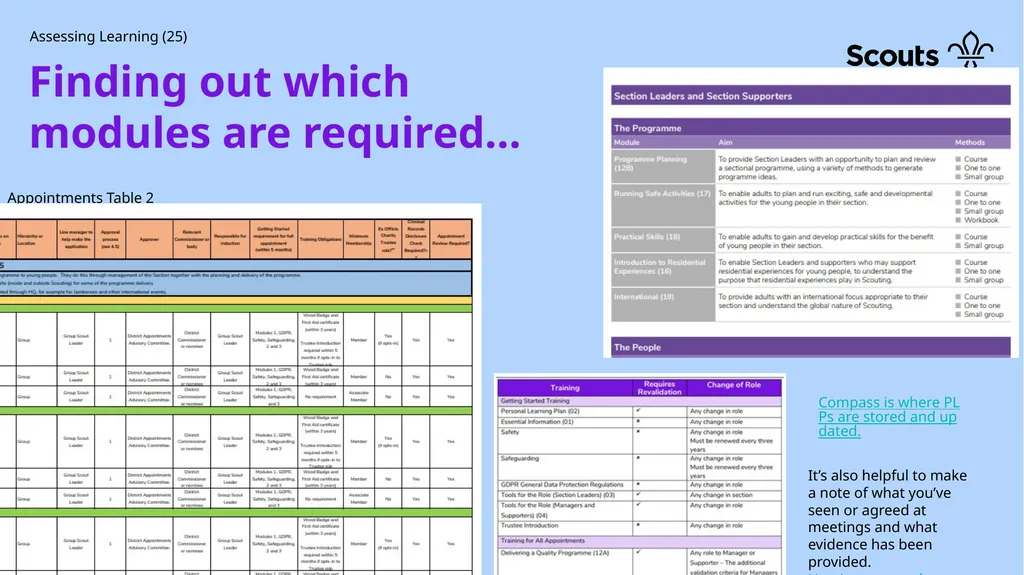
Assessing Learning (25) Finding out which modules are required… Appointments Table 2 Compass is where PLPs are stored and updated. It’s also helpful to make a note of what you’ve seen or agreed at meetings and what evidence has been provided. Here’s an example.<br>
09
Assessing Learning (25) What should we all be doing? For a new volunteer, the most important time is the first few months. It’s crucial that they get the support and training that they need at this time. Working in groups, start with a timeline of when somebody first volunteers, and consider what each of these people should be doing, and in what order, to create a good experience for the learner. Learner
Training Adviser
Line Manager
Appointments Advisory Committee
Local Training Manager
County Training Manager<br>
10
Session 1a Key Messages Revisited
The training scheme is modular and flexible
The modules required are different depending on the role being undertaken.
Learning is optional, depending on the prior knowledge, skills and experience of the learner, but every required module must be validated.<br>
11
Session 2 – Where learners come from and assessing needs<br>
12
Session 2 Key Messages
Learners come from a variety of places and have varied experience and skills before they come to you. This must be taken into account when deciding what learning or development they might need.
There are other roles that you need to work with in assessing and supporting learners.
The first meeting is very important in making an initial assessment and working with the learner to decide on their learning needs.<br>
13
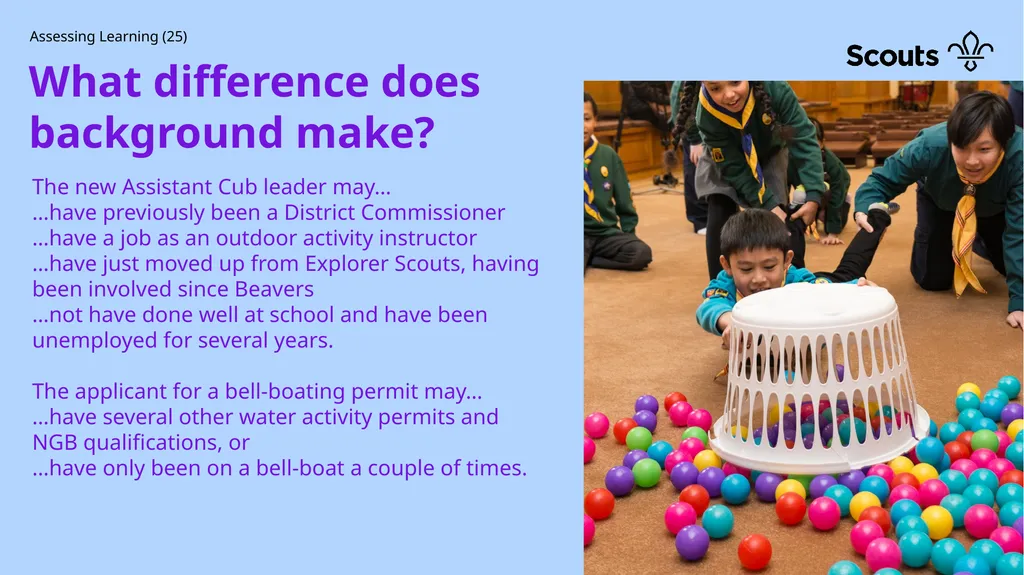
Assessing Learning (25) What difference does background make? The new Assistant Cub leader may…
…have previously been a District Commissioner
…have a job as an outdoor activity instructor
…have just moved up from Explorer Scouts, having been involved since Beavers
…not have done well at school and have been unemployed for several years.
The applicant for a bell-boating permit may…
…have several other water activity permits and NGB qualifications, or
…have only been on a bell-boat a couple of times.<br>
14
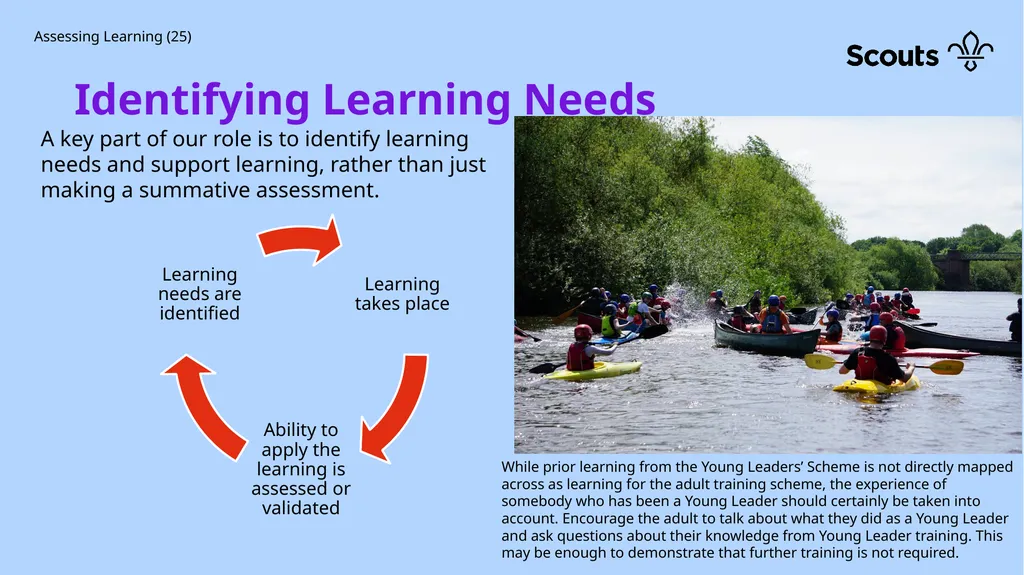
Assessing Learning (25) Identifying Learning Needs A key part of our role is to identify learning needs and support learning, rather than just making a summative assessment. While prior learning from the Young Leaders’ Scheme is not directly mapped across as learning for the adult training scheme, the experience of somebody who has been a Young Leader should certainly be taken into account. Encourage the adult to talk about what they did as a Young Leader and ask questions about their knowledge from Young Leader training. This may be enough to demonstrate that further training is not required.<br>
15
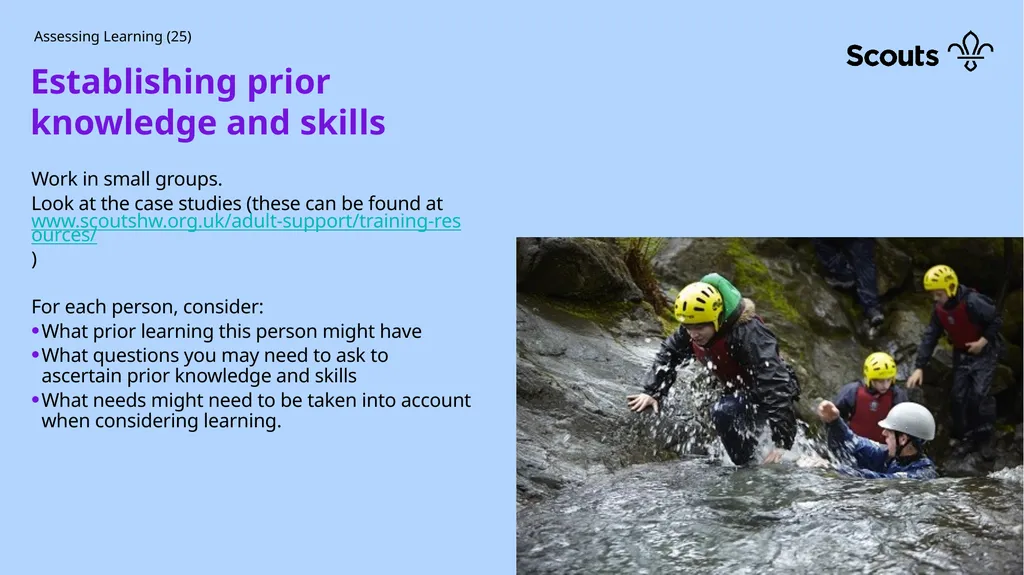
Assessing Learning (25) Establishing prior knowledge and skills
Work in small groups.
Look at the case studies (these can be found at www.scoutshw.org.uk/adult-support/training-resources/)
For each person, consider:
What prior learning this person might have
What questions you may need to ask to ascertain prior knowledge and skills
What needs might need to be taken into account when considering learning.<br>
16
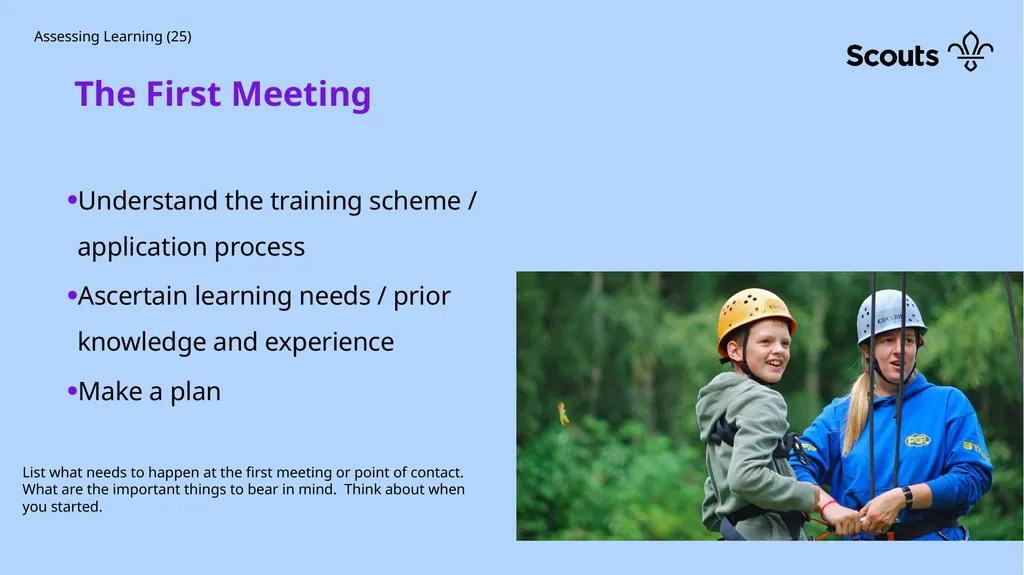
Assessing Learning (25) The First Meeting List what needs to happen at the first meeting or point of contact. What are the important things to bear in mind. Think about when you started. Understand the training scheme / application process
Ascertain learning needs / prior knowledge and experience
Make a plan<br>
17
Session 2 Key Messages revisited
Learners come from variety of places and have varied experience and skills before they come to you. This must be taken into account when deciding what learning or development they might need.
There are other roles that you need to work with in assessing and supporting learners.
The first meeting is very important in making an initial assessment and working with the learner to decide on their learning needs.<br>