
Do the Math APES APES Review Cookies Do the Math
PT
Published · 33 slides · 0 views

1 / 1








Description
Do the Math APES APES Review Cookies Do the Math Video? How is AP Test scored? FRQ- go over student responses scoring Jeopardy CH 1 What is a hectare? It is estimated the world loses 12,614,400 forested hectares per year based on an
Related Topics
Share
Embed code
Download this presentation From Below
"Do the Math APES APES Review Cookies Do the Math" is the property of its rightful owner. Permission is granted to download and print the materials on this website for personal, non-commercial use only, and to display it on your personal computer provided you do not modify the materials and that you retain all copyright notices contained in the materials. By downloading content from our website, you accept the terms of this agreement.
Presentation Transcript
01
Do the Math APES<br>
02
APES Review Cookies
Do the Math
Video?
How is AP Test scored?
FRQ- go over student responses & scoring
Jeopardy<br>
Do the Math
Video?
How is AP Test scored?
FRQ- go over student responses & scoring
Jeopardy<br>
03
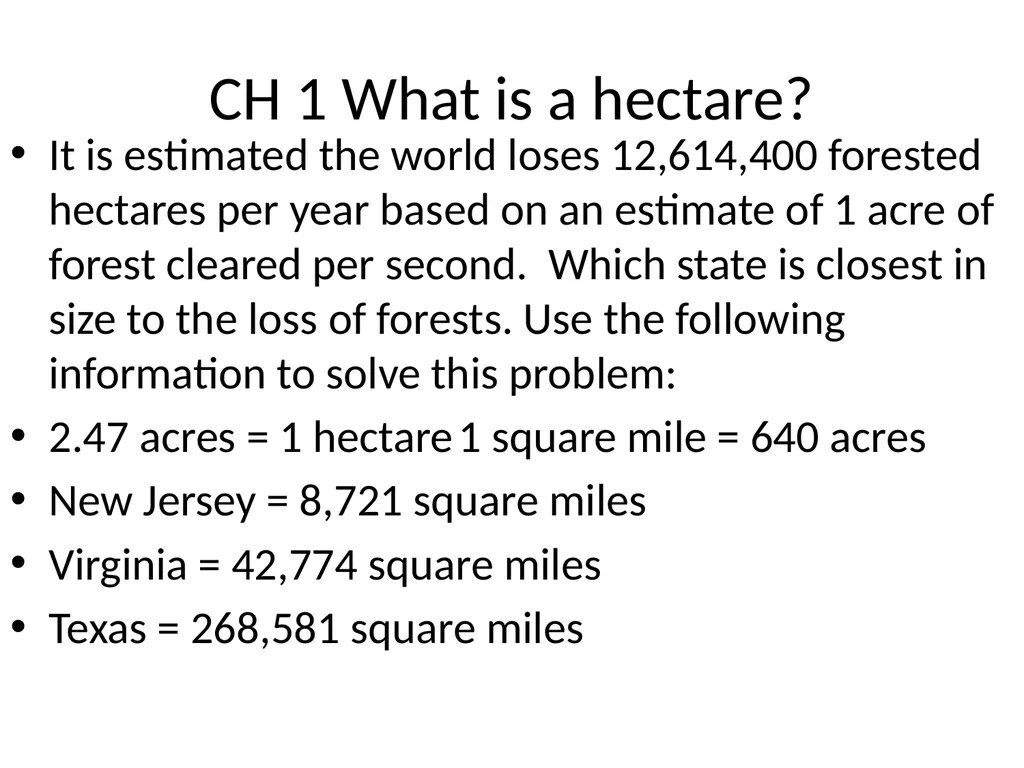
CH 1 What is a hectare? It is estimated the world loses 12,614,400 forested hectares per year based on an estimate of 1 acre of forest cleared per second. Which state is closest in size to the loss of forests. Use the following information to solve this problem:
2.47 acres = 1 hectare 1 square mile = 640 acres
New Jersey = 8,721 square miles
Virginia = 42,774 square miles
Texas = 268,581 square miles<br>
2.47 acres = 1 hectare 1 square mile = 640 acres
New Jersey = 8,721 square miles
Virginia = 42,774 square miles
Texas = 268,581 square miles<br>
04
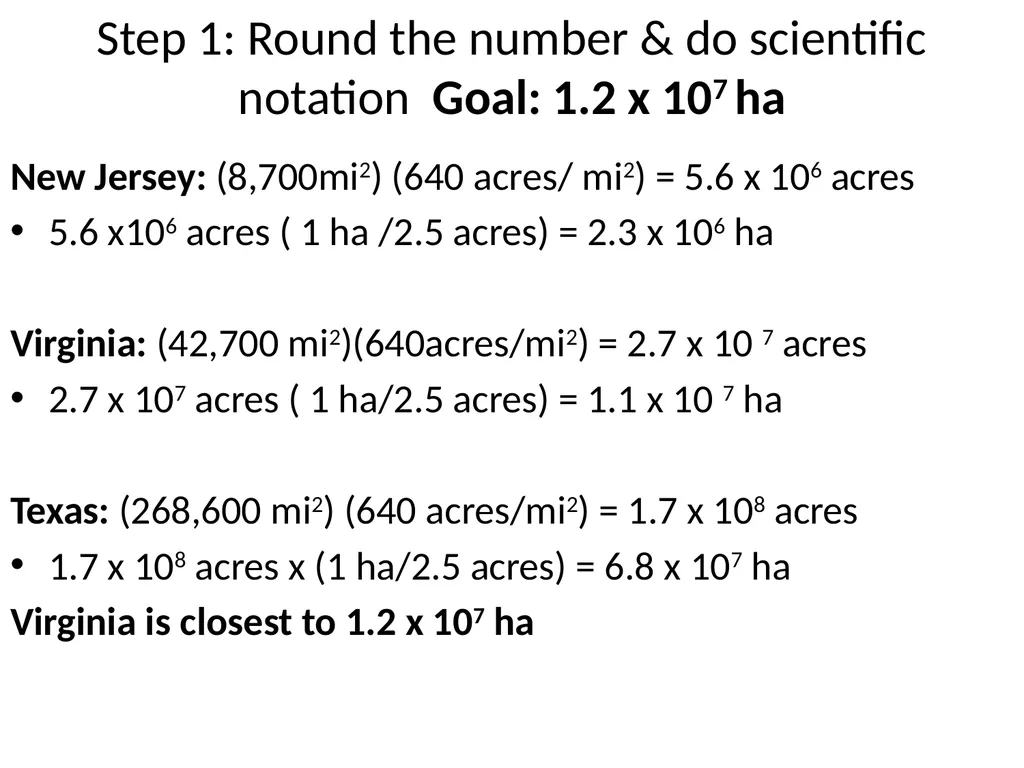
Step 1: Round the number & do scientific notation Goal: 1.2 x 10⁷ ha New Jersey: (8,700mi2) (640 acres/ mi2) = 5.6 x 10⁶ acres
5.6 x10⁶ acres ( 1 ha /2.5 acres) = 2.3 x 10⁶ ha
Virginia: (42,700 mi2)(640acres/mi2) = 2.7 x 10 7 acres
2.7 x 10⁷ acres ( 1 ha/2.5 acres) = 1.1 x 10 7 ha
Texas: (268,600 mi2) (640 acres/mi2) = 1.7 x 10⁸ acres
1.7 x 10⁸ acres x (1 ha/2.5 acres) = 6.8 x 10⁷ ha
Virginia is closest to 1.2 x 10⁷ ha<br>
5.6 x10⁶ acres ( 1 ha /2.5 acres) = 2.3 x 10⁶ ha
Virginia: (42,700 mi2)(640acres/mi2) = 2.7 x 10 7 acres
2.7 x 10⁷ acres ( 1 ha/2.5 acres) = 1.1 x 10 7 ha
Texas: (268,600 mi2) (640 acres/mi2) = 1.7 x 10⁸ acres
1.7 x 10⁸ acres x (1 ha/2.5 acres) = 6.8 x 10⁷ ha
Virginia is closest to 1.2 x 10⁷ ha<br>
05
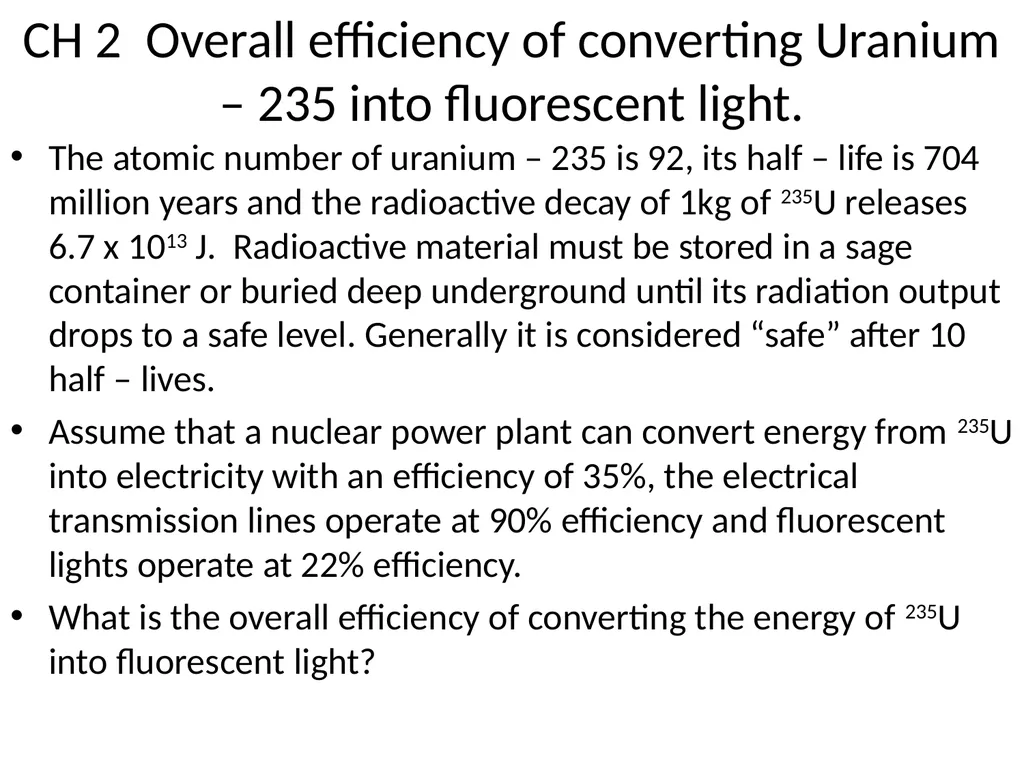
CH 2 Overall efficiency of converting Uranium – 235 into fluorescent light. The atomic number of uranium – 235 is 92, its half – life is 704 million years and the radioactive decay of 1kg of 235U releases 6.7 x 10¹³ J. Radioactive material must be stored in a sage container or buried deep underground until its radiation output drops to a safe level. Generally it is considered “safe” after 10 half – lives.
Assume that a nuclear power plant can convert energy from 235U into electricity with an efficiency of 35%, the electrical transmission lines operate at 90% efficiency and fluorescent lights operate at 22% efficiency.
What is the overall efficiency of converting the energy of 235U into fluorescent light?<br>
Assume that a nuclear power plant can convert energy from 235U into electricity with an efficiency of 35%, the electrical transmission lines operate at 90% efficiency and fluorescent lights operate at 22% efficiency.
What is the overall efficiency of converting the energy of 235U into fluorescent light?<br>
06
.35 x 0.90 x 0.22 = 0.069 or 6.9% efficiency How much energy from 1 kg of 235U is converted into fluorescent light?
8.9 x 10¹³ joules/kg x 0.069 (1 kg U- 235) =
6.2 x 10¹² joules
How long would it take for the radiation form a sample of 235 U to reach a safe level?
10 half-lives x 704 million year/ half-life = 7.04 x 10⁹ years<br>
8.9 x 10¹³ joules/kg x 0.069 (1 kg U- 235) =
6.2 x 10¹² joules
How long would it take for the radiation form a sample of 235 U to reach a safe level?
10 half-lives x 704 million year/ half-life = 7.04 x 10⁹ years<br>
07
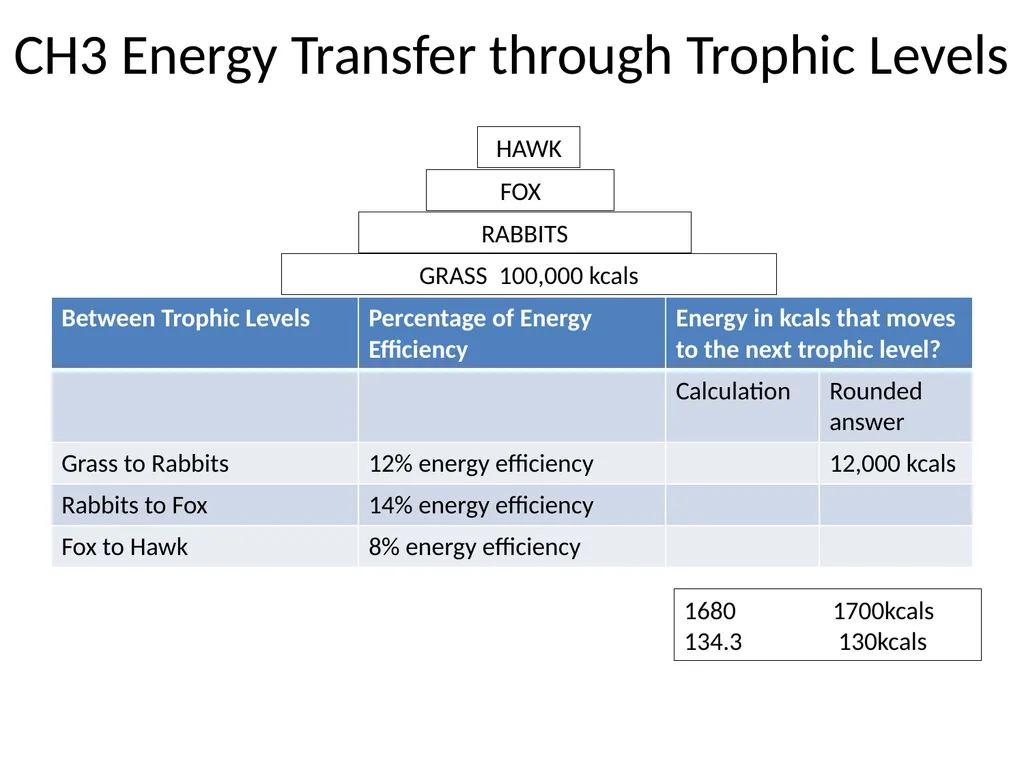
CH3 Energy Transfer through Trophic Levels GRASS 100,000 kcals RABBITS FOX HAWK 1680 1700kcals
134.3 130kcals<br>
134.3 130kcals<br>
08
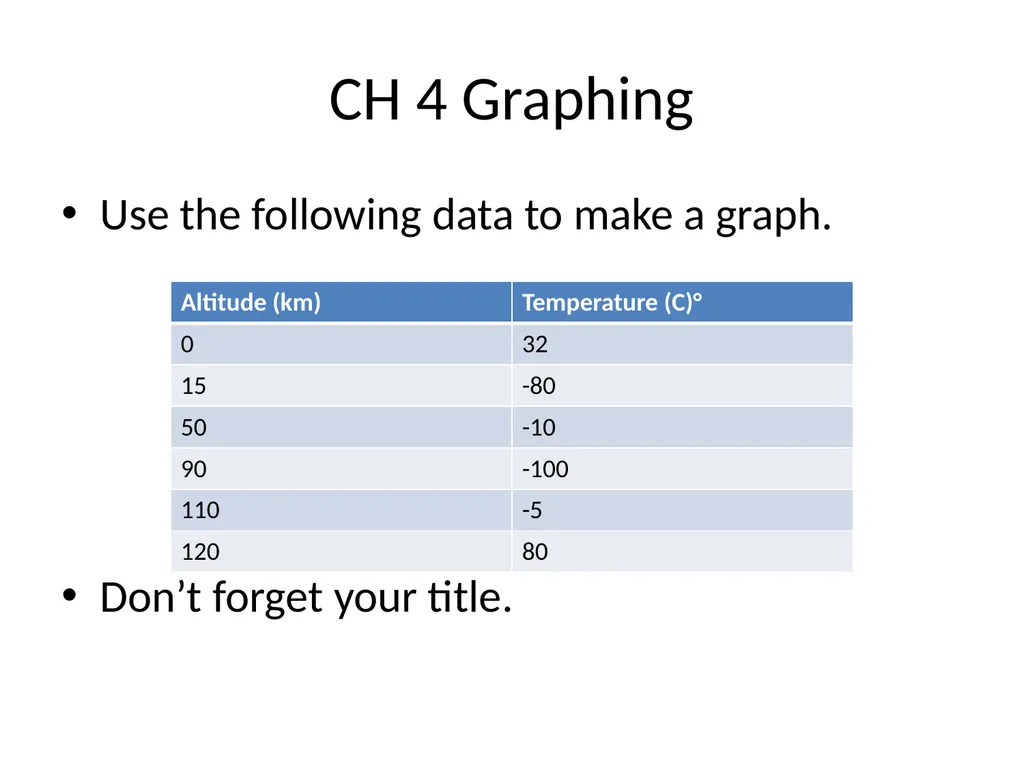
CH 4 Graphing Use the following data to make a graph.
Don’t forget your title.<br>
Don’t forget your title.<br>
09
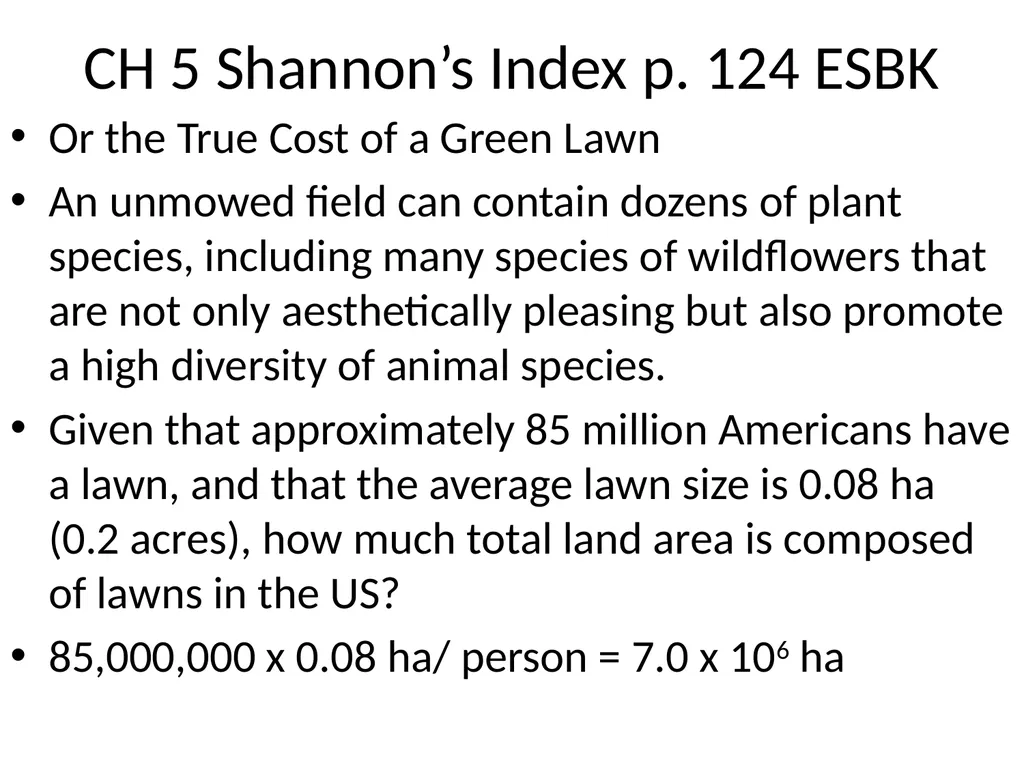
CH 5 Shannon’s Index p. 124 ESBK Or the True Cost of a Green Lawn
An unmowed field can contain dozens of plant species, including many species of wildflowers that are not only aesthetically pleasing but also promote a high diversity of animal species.
Given that approximately 85 million Americans have a lawn, and that the average lawn size is 0.08 ha (0.2 acres), how much total land area is composed of lawns in the US?
85,000,000 x 0.08 ha/ person = 7.0 x 10⁶ ha<br>
An unmowed field can contain dozens of plant species, including many species of wildflowers that are not only aesthetically pleasing but also promote a high diversity of animal species.
Given that approximately 85 million Americans have a lawn, and that the average lawn size is 0.08 ha (0.2 acres), how much total land area is composed of lawns in the US?
85,000,000 x 0.08 ha/ person = 7.0 x 10⁶ ha<br>
10
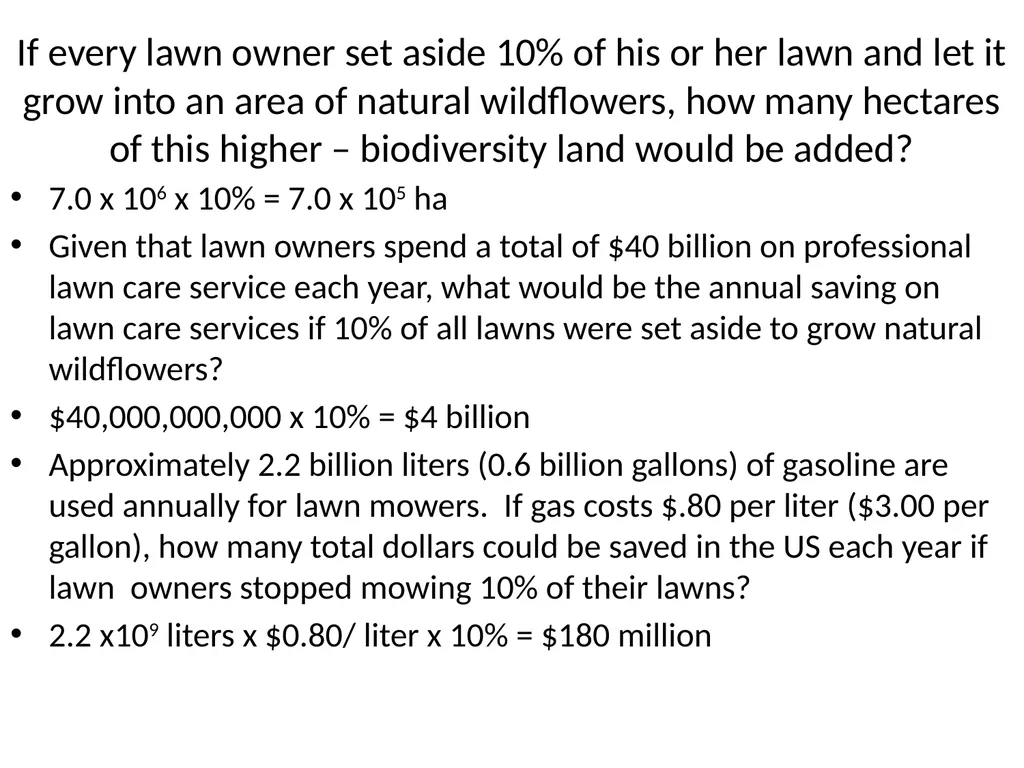
If every lawn owner set aside 10% of his or her lawn and let it grow into an area of natural wildflowers, how many hectares of this higher – biodiversity land would be added? 7.0 x 106 x 10% = 7.0 x 10⁵ ha
Given that lawn owners spend a total of $40 billion on professional lawn care service each year, what would be the annual saving on lawn care services if 10% of all lawns were set aside to grow natural wildflowers?
$40,000,000,000 x 10% = $4 billion
Approximately 2.2 billion liters (0.6 billion gallons) of gasoline are used annually for lawn mowers. If gas costs $.80 per liter ($3.00 per gallon), how many total dollars could be saved in the US each year if lawn owners stopped mowing 10% of their lawns?
2.2 x10⁹ liters x $0.80/ liter x 10% = $180 million<br>
Given that lawn owners spend a total of $40 billion on professional lawn care service each year, what would be the annual saving on lawn care services if 10% of all lawns were set aside to grow natural wildflowers?
$40,000,000,000 x 10% = $4 billion
Approximately 2.2 billion liters (0.6 billion gallons) of gasoline are used annually for lawn mowers. If gas costs $.80 per liter ($3.00 per gallon), how many total dollars could be saved in the US each year if lawn owners stopped mowing 10% of their lawns?
2.2 x10⁹ liters x $0.80/ liter x 10% = $180 million<br>
11
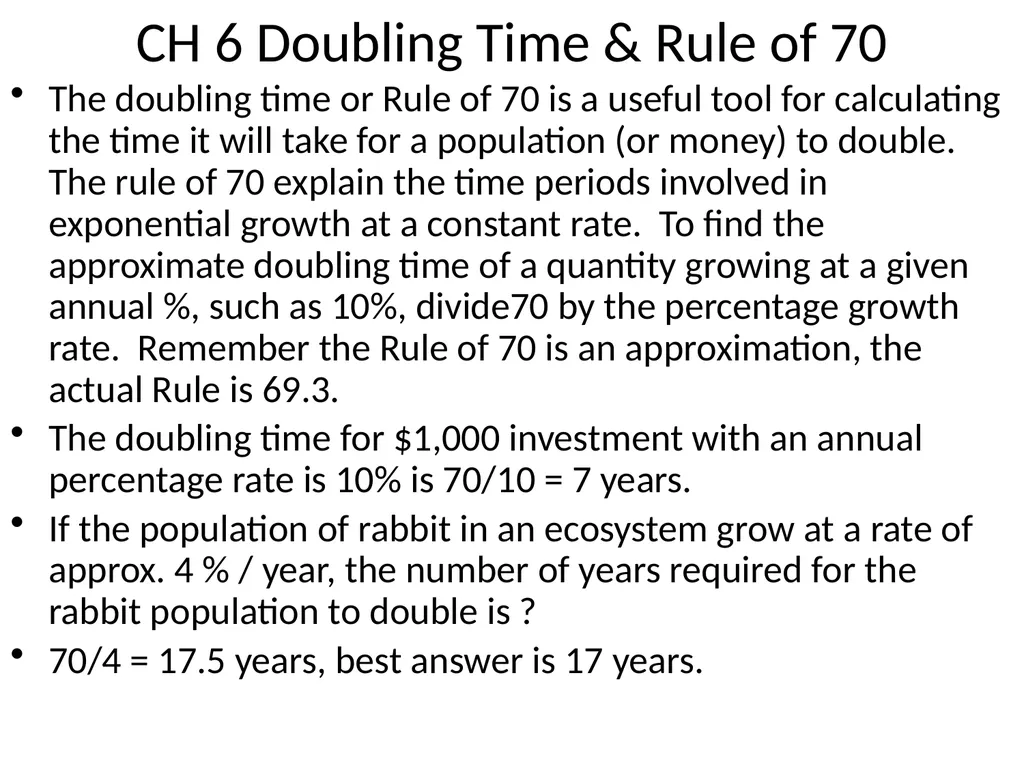
CH 6 Doubling Time & Rule of 70 The doubling time or Rule of 70 is a useful tool for calculating the time it will take for a population (or money) to double. The rule of 70 explain the time periods involved in exponential growth at a constant rate. To find the approximate doubling time of a quantity growing at a given annual %, such as 10%, divide70 by the percentage growth rate. Remember the Rule of 70 is an approximation, the actual Rule is 69.3.
The doubling time for $1,000 investment with an annual percentage rate is 10% is 70/10 = 7 years.
If the population of rabbit in an ecosystem grow at a rate of approx. 4 % / year, the number of years required for the rabbit population to double is ?
70/4 = 17.5 years, best answer is 17 years.<br>
The doubling time for $1,000 investment with an annual percentage rate is 10% is 70/10 = 7 years.
If the population of rabbit in an ecosystem grow at a rate of approx. 4 % / year, the number of years required for the rabbit population to double is ?
70/4 = 17.5 years, best answer is 17 years.<br>
12
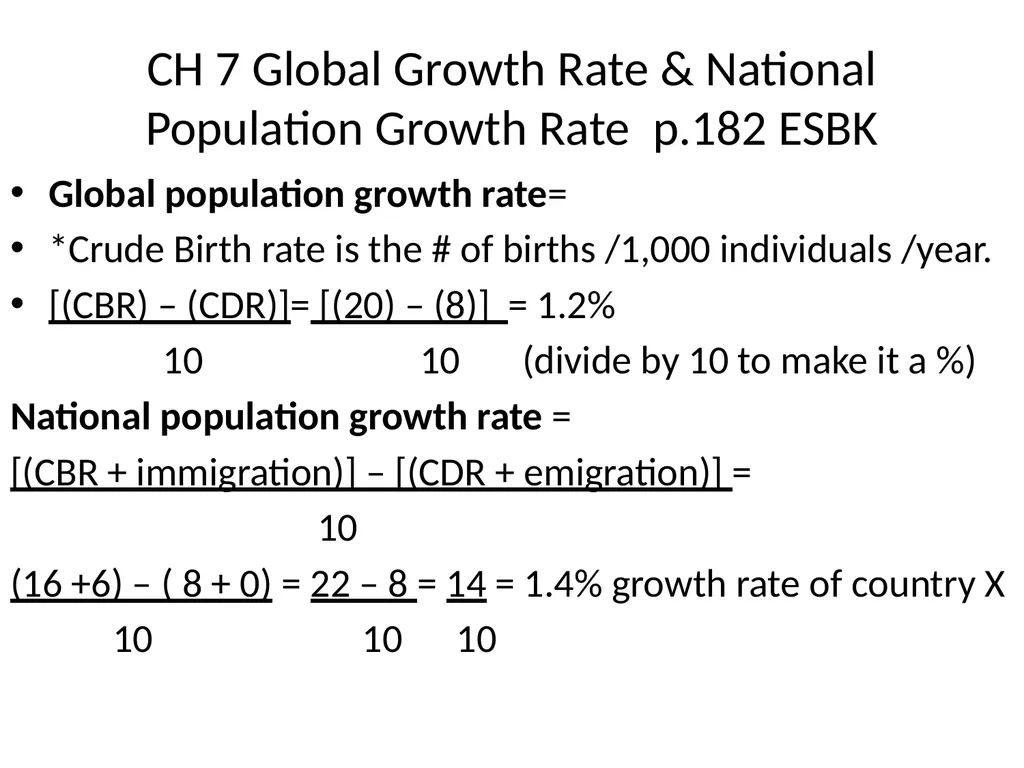
CH 7 Global Growth Rate & National Population Growth Rate p.182 ESBK Global population growth rate=
*Crude Birth rate is the # of births /1,000 individuals /year.
[(CBR) – (CDR)]= [(20) – (8)] = 1.2%
10 10 (divide by 10 to make it a %)
National population growth rate =
[(CBR + immigration)] – [(CDR + emigration)] =
10
(16 +6) – ( 8 + 0) = 22 – 8 = 14 = 1.4% growth rate of country X
10 10 10<br>
*Crude Birth rate is the # of births /1,000 individuals /year.
[(CBR) – (CDR)]= [(20) – (8)] = 1.2%
10 10 (divide by 10 to make it a %)
National population growth rate =
[(CBR + immigration)] – [(CDR + emigration)] =
10
(16 +6) – ( 8 + 0) = 22 – 8 = 14 = 1.4% growth rate of country X
10 10 10<br>
13
CH 8 Average speed of crustal movement of Hawaiian islands. What is the average speed of the crustal plate over the past 5,100,000 years?<br>
14
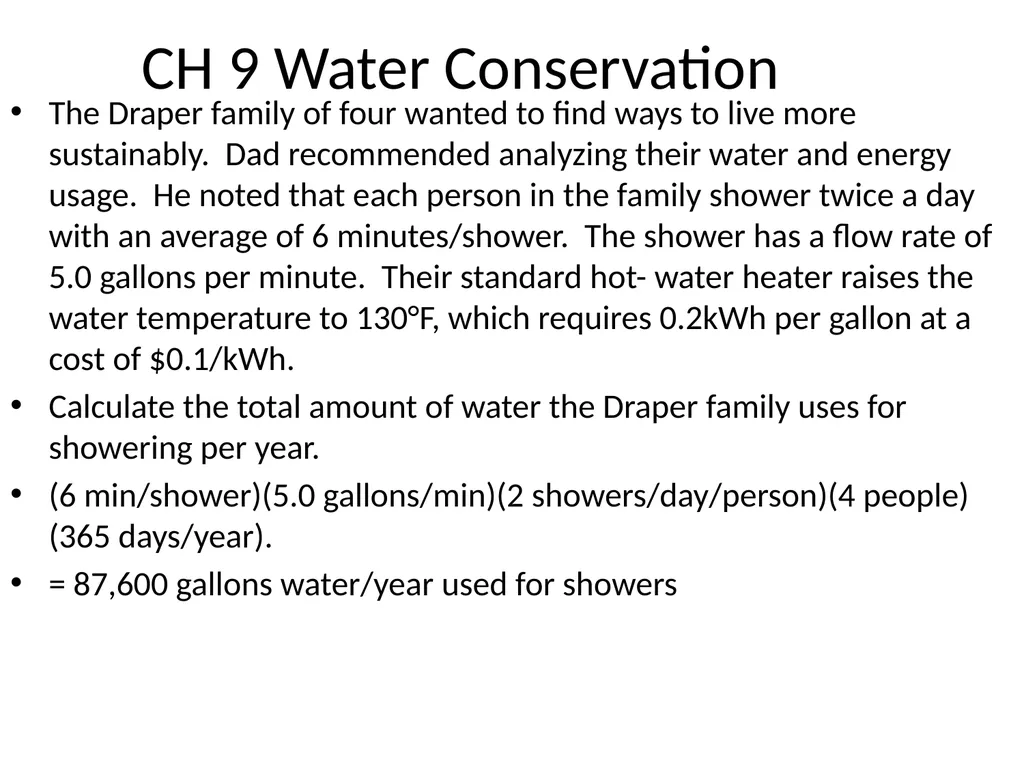
CH 9 Water Conservation The Draper family of four wanted to find ways to live more sustainably. Dad recommended analyzing their water and energy usage. He noted that each person in the family shower twice a day with an average of 6 minutes/shower. The shower has a flow rate of 5.0 gallons per minute. Their standard hot- water heater raises the water temperature to 130°F, which requires 0.2kWh per gallon at a cost of $0.1/kWh.
Calculate the total amount of water the Draper family uses for showering per year.
(6 min/shower)(5.0 gallons/min)(2 showers/day/person)(4 people)(365 days/year).
= 87,600 gallons water/year used for showers<br>
Calculate the total amount of water the Draper family uses for showering per year.
(6 min/shower)(5.0 gallons/min)(2 showers/day/person)(4 people)(365 days/year).
= 87,600 gallons water/year used for showers<br>
15
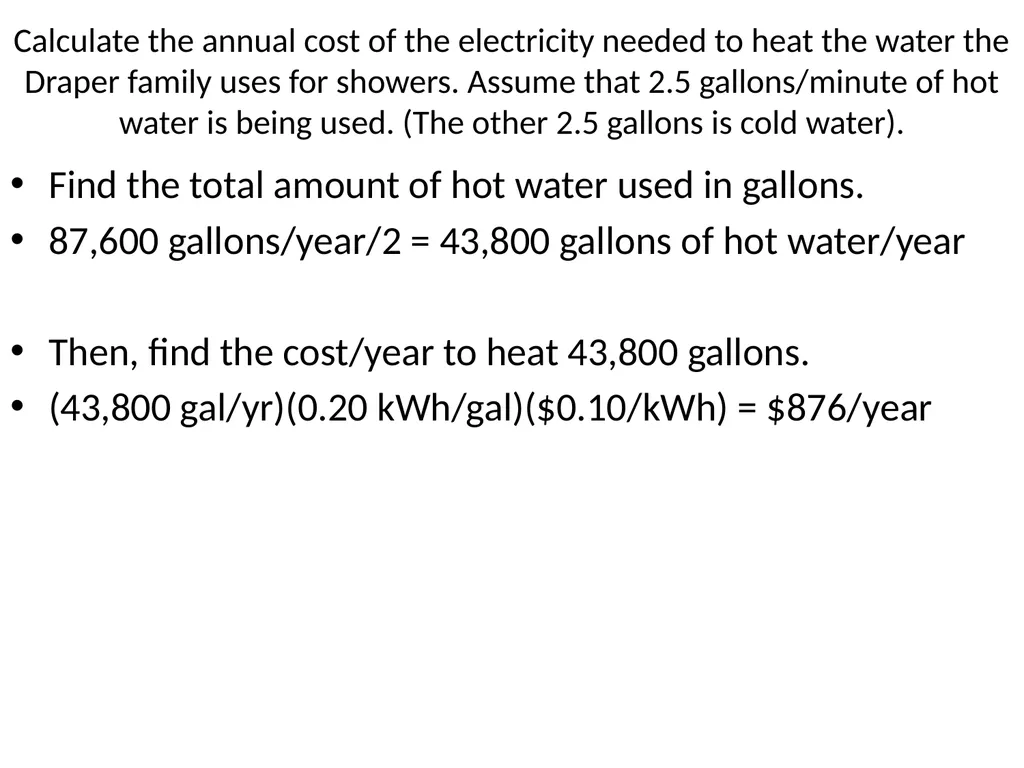
Calculate the annual cost of the electricity needed to heat the water the Draper family uses for showers. Assume that 2.5 gallons/minute of hot water is being used. (The other 2.5 gallons is cold water). Find the total amount of hot water used in gallons.
87,600 gallons/year/2 = 43,800 gallons of hot water/year
Then, find the cost/year to heat 43,800 gallons.
(43,800 gal/yr)(0.20 kWh/gal)($0.10/kWh) = $876/year<br>
87,600 gallons/year/2 = 43,800 gallons of hot water/year
Then, find the cost/year to heat 43,800 gallons.
(43,800 gal/yr)(0.20 kWh/gal)($0.10/kWh) = $876/year<br>
16
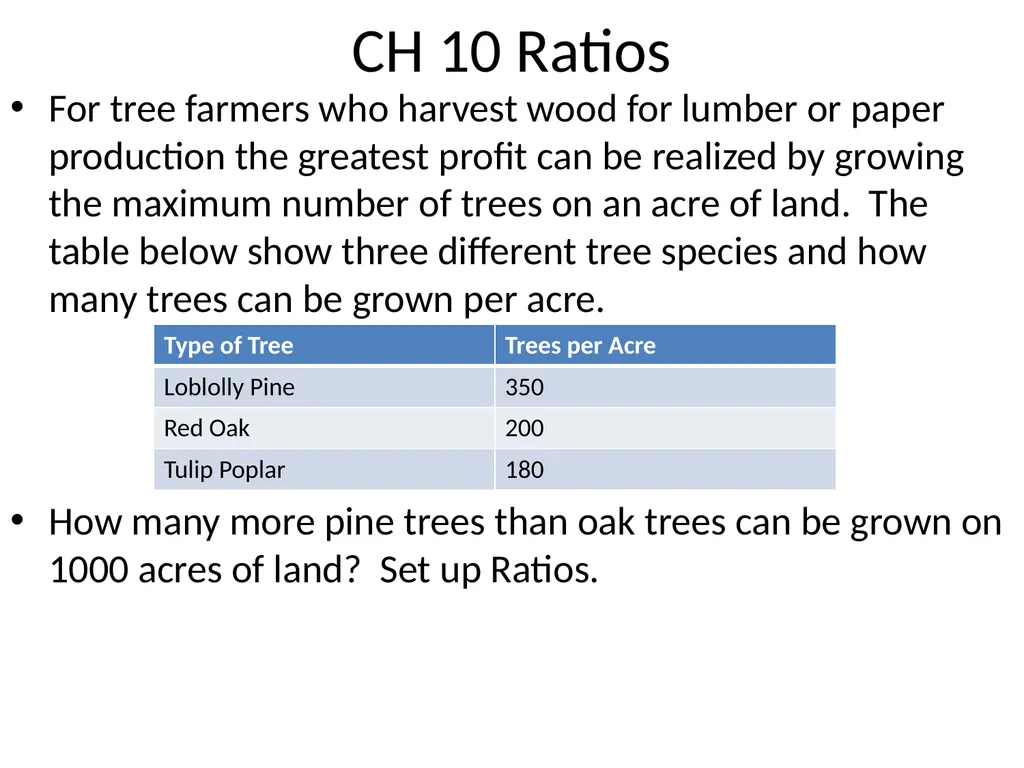
CH 10 Ratios For tree farmers who harvest wood for lumber or paper production the greatest profit can be realized by growing the maximum number of trees on an acre of land. The table below show three different tree species and how many trees can be grown per acre.
How many more pine trees than oak trees can be grown on 1000 acres of land? Set up Ratios.<br>
How many more pine trees than oak trees can be grown on 1000 acres of land? Set up Ratios.<br>
17
350,000 pines – 200,000 oaks = 150,000 more pine trees than oaks that can be grown on 1000 acres.
350,000 pines – 180,000 poplars = 170,000 more pine trees than poplars that can be grown on 1,000 acres.<br>
350,000 pines – 180,000 poplars = 170,000 more pine trees than poplars that can be grown on 1,000 acres.<br>
18
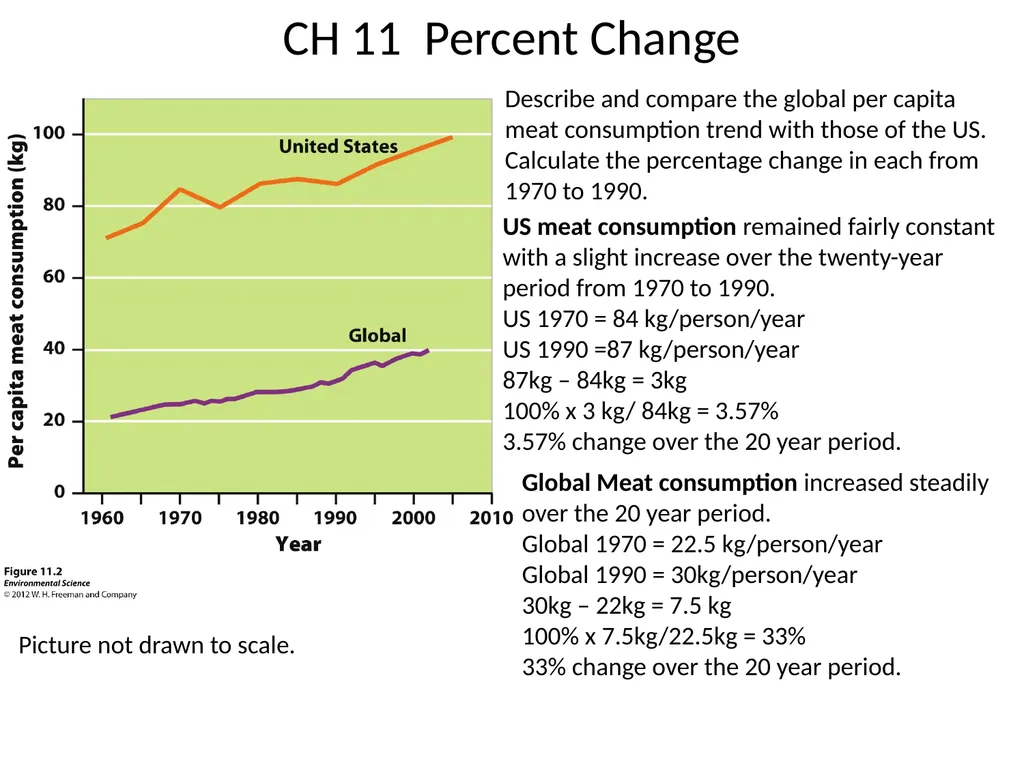
CH 11 Percent Change Describe and compare the global per capita meat consumption trend with those of the US. Calculate the percentage change in each from 1970 to 1990. US meat consumption remained fairly constant with a slight increase over the twenty-year period from 1970 to 1990.
US 1970 = 84 kg/person/year
US 1990 =87 kg/person/year
87kg – 84kg = 3kg
100% x 3 kg/ 84kg = 3.57%
3.57% change over the 20 year period. Global Meat consumption increased steadily over the 20 year period.
Global 1970 = 22.5 kg/person/year
Global 1990 = 30kg/person/year
30kg – 22kg = 7.5 kg
100% x 7.5kg/22.5kg = 33%
33% change over the 20 year period. Picture not drawn to scale.<br>
US 1970 = 84 kg/person/year
US 1990 =87 kg/person/year
87kg – 84kg = 3kg
100% x 3 kg/ 84kg = 3.57%
3.57% change over the 20 year period. Global Meat consumption increased steadily over the 20 year period.
Global 1970 = 22.5 kg/person/year
Global 1990 = 30kg/person/year
30kg – 22kg = 7.5 kg
100% x 7.5kg/22.5kg = 33%
33% change over the 20 year period. Picture not drawn to scale.<br>
19
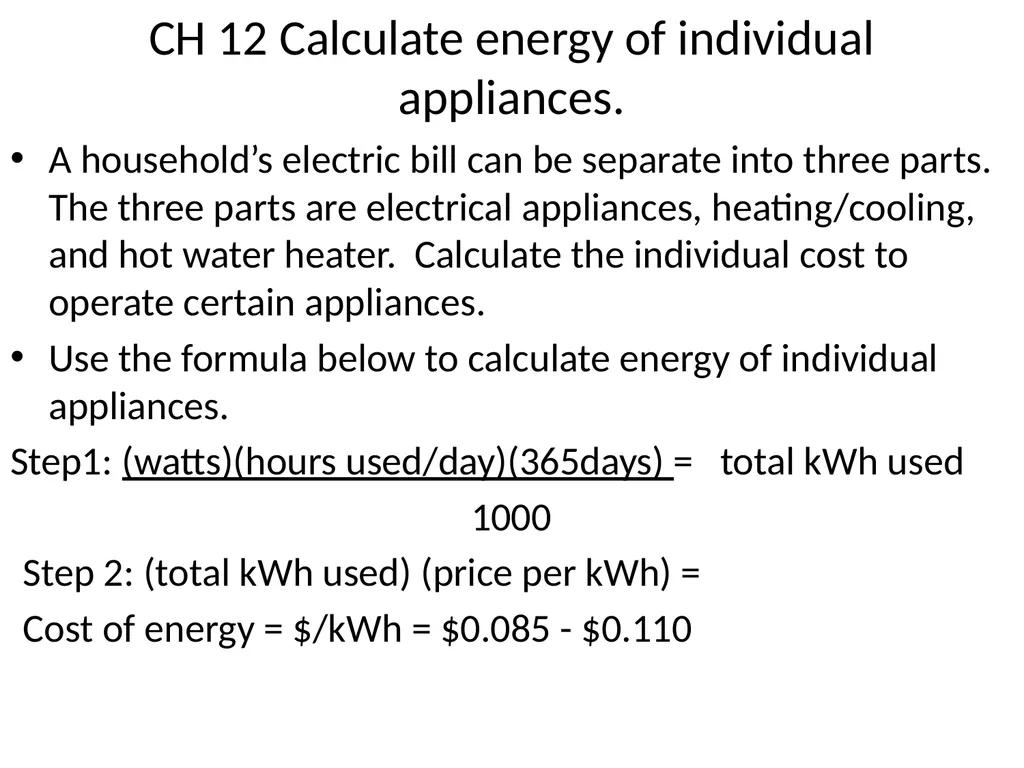
CH 12 Calculate energy of individual appliances. A household’s electric bill can be separate into three parts. The three parts are electrical appliances, heating/cooling, and hot water heater. Calculate the individual cost to operate certain appliances.
Use the formula below to calculate energy of individual appliances.
Step1: (watts)(hours used/day)(365days) = total kWh used
1000
Step 2: (total kWh used) (price per kWh) =
Cost of energy = $/kWh = $0.085 - $0.110<br>
Use the formula below to calculate energy of individual appliances.
Step1: (watts)(hours used/day)(365days) = total kWh used
1000
Step 2: (total kWh used) (price per kWh) =
Cost of energy = $/kWh = $0.085 - $0.110<br>
20
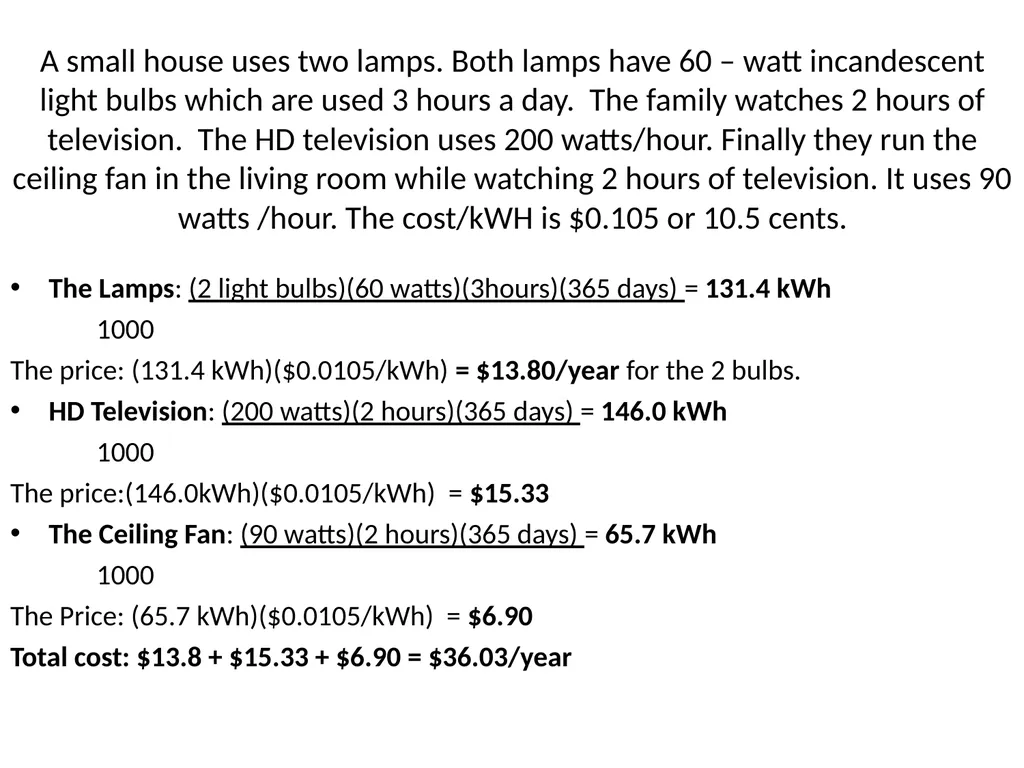
A small house uses two lamps. Both lamps have 60 – watt incandescent light bulbs which are used 3 hours a day. The family watches 2 hours of television. The HD television uses 200 watts/hour. Finally they run the ceiling fan in the living room while watching 2 hours of television. It uses 90 watts /hour. The cost/kWH is $0.105 or 10.5 cents. The Lamps: (2 light bulbs)(60 watts)(3hours)(365 days) = 131.4 kWh
1000
The price: (131.4 kWh)($0.0105/kWh) = $13.80/year for the 2 bulbs.
HD Television: (200 watts)(2 hours)(365 days) = 146.0 kWh
1000
The price:(146.0kWh)($0.0105/kWh) = $15.33
The Ceiling Fan: (90 watts)(2 hours)(365 days) = 65.7 kWh
1000
The Price: (65.7 kWh)($0.0105/kWh) = $6.90
Total cost: $13.8 + $15.33 + $6.90 = $36.03/year<br>
1000
The price: (131.4 kWh)($0.0105/kWh) = $13.80/year for the 2 bulbs.
HD Television: (200 watts)(2 hours)(365 days) = 146.0 kWh
1000
The price:(146.0kWh)($0.0105/kWh) = $15.33
The Ceiling Fan: (90 watts)(2 hours)(365 days) = 65.7 kWh
1000
The Price: (65.7 kWh)($0.0105/kWh) = $6.90
Total cost: $13.8 + $15.33 + $6.90 = $36.03/year<br>
21
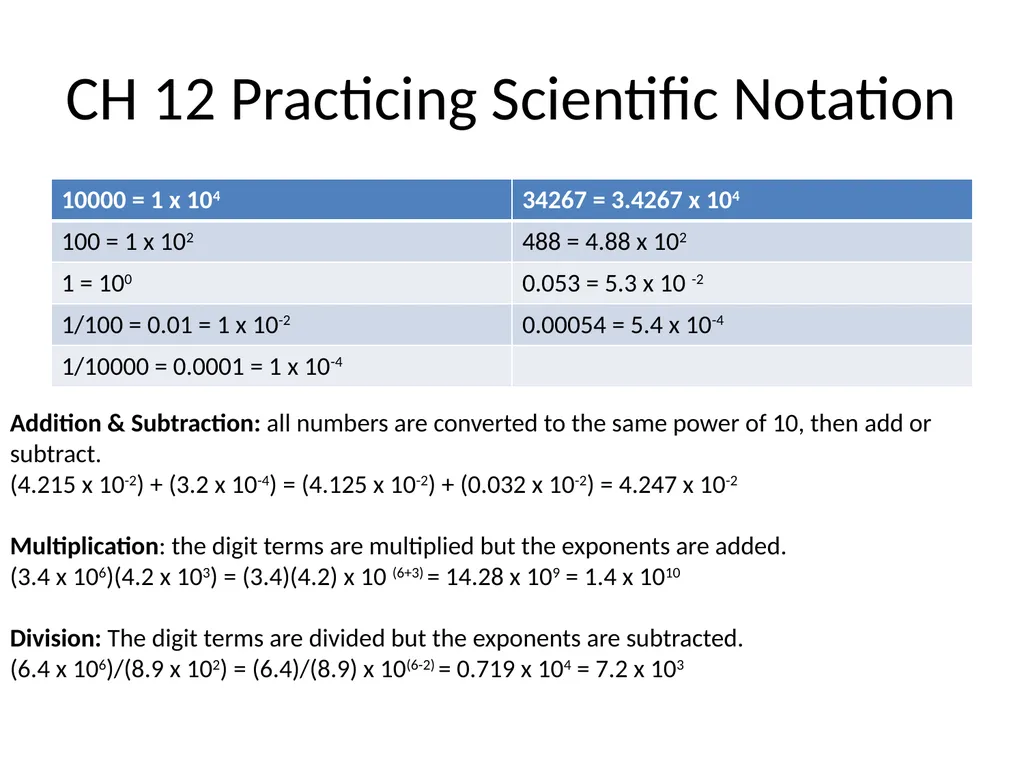
CH 12 Practicing Scientific Notation Addition & Subtraction: all numbers are converted to the same power of 10, then add or subtract.
(4.215 x 10⁻²) + (3.2 x 10⁻⁴) = (4.125 x 10⁻²) + (0.032 x 10⁻²) = 4.247 x 10⁻²
Multiplication: the digit terms are multiplied but the exponents are added.
(3.4 x 10⁶)(4.2 x 10³) = (3.4)(4.2) x 10 (6+3) = 14.28 x 109 = 1.4 x 10¹⁰
Division: The digit terms are divided but the exponents are subtracted.
(6.4 x 10⁶)/(8.9 x 102) = (6.4)/(8.9) x 10(6-2) = 0.719 x 104 = 7.2 x 10³<br>
(4.215 x 10⁻²) + (3.2 x 10⁻⁴) = (4.125 x 10⁻²) + (0.032 x 10⁻²) = 4.247 x 10⁻²
Multiplication: the digit terms are multiplied but the exponents are added.
(3.4 x 10⁶)(4.2 x 10³) = (3.4)(4.2) x 10 (6+3) = 14.28 x 109 = 1.4 x 10¹⁰
Division: The digit terms are divided but the exponents are subtracted.
(6.4 x 10⁶)/(8.9 x 102) = (6.4)/(8.9) x 10(6-2) = 0.719 x 104 = 7.2 x 10³<br>
22
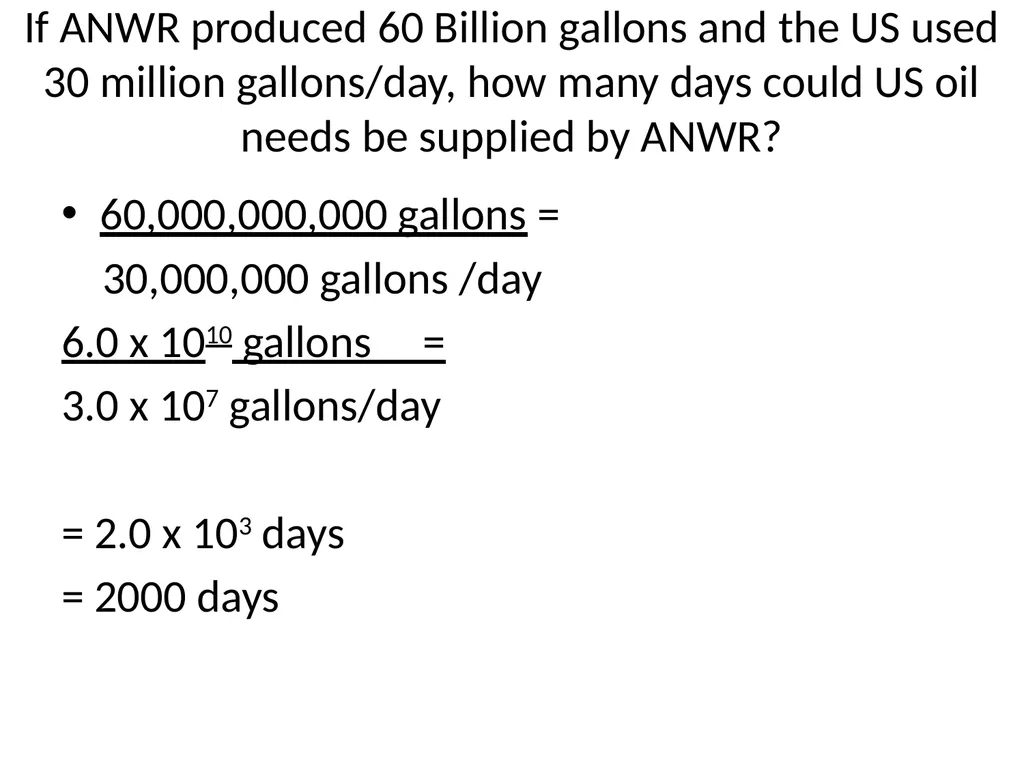
If ANWR produced 60 Billion gallons and the US used 30 million gallons/day, how many days could US oil needs be supplied by ANWR? 60,000,000,000 gallons =
30,000,000 gallons /day
6.0 x 10¹⁰ gallons =
3.0 x 10⁷ gallons/day
= 2.0 x 10³ days
= 2000 days<br>
30,000,000 gallons /day
6.0 x 10¹⁰ gallons =
3.0 x 10⁷ gallons/day
= 2.0 x 10³ days
= 2000 days<br>
23
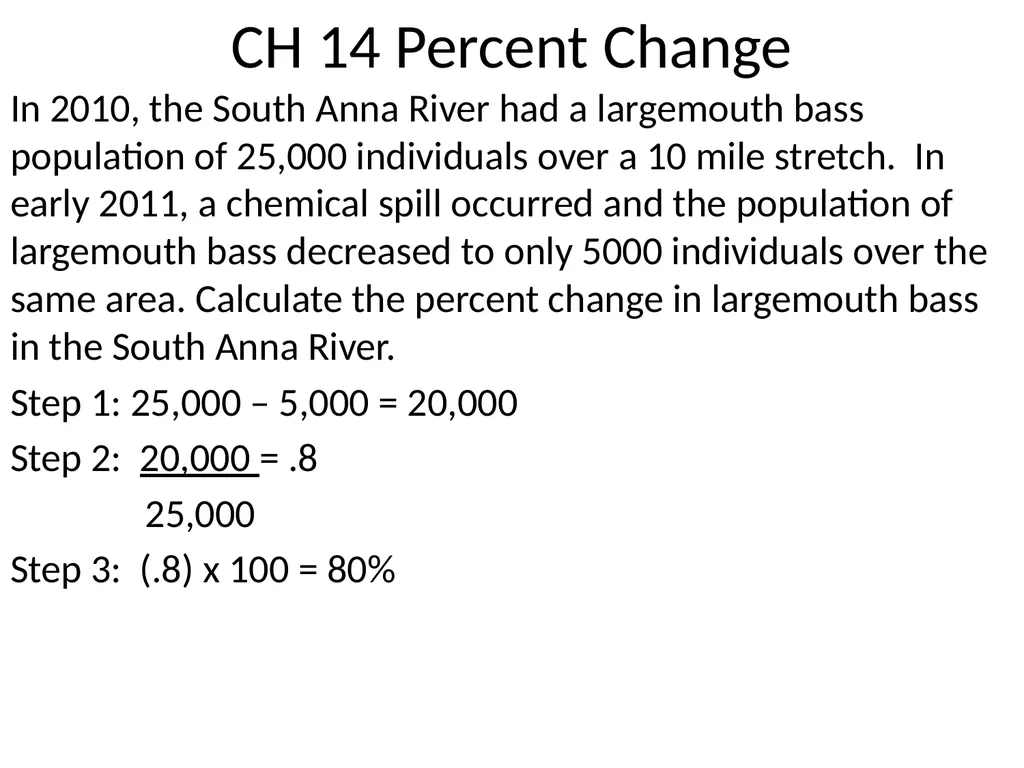
CH 14 Percent Change In 2010, the South Anna River had a largemouth bass population of 25,000 individuals over a 10 mile stretch. In early 2011, a chemical spill occurred and the population of largemouth bass decreased to only 5000 individuals over the same area. Calculate the percent change in largemouth bass in the South Anna River.
Step 1: 25,000 – 5,000 = 20,000
Step 2: 20,000 = .8
25,000
Step 3: (.8) x 100 = 80%<br>
Step 1: 25,000 – 5,000 = 20,000
Step 2: 20,000 = .8
25,000
Step 3: (.8) x 100 = 80%<br>
24
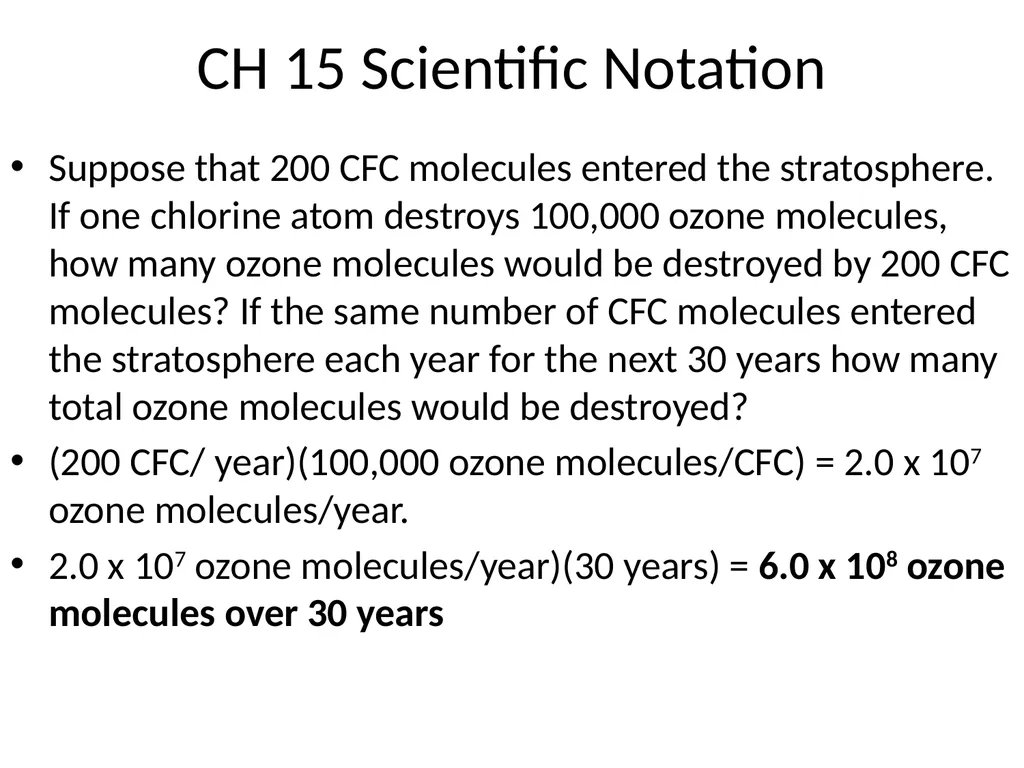
CH 15 Scientific Notation Suppose that 200 CFC molecules entered the stratosphere. If one chlorine atom destroys 100,000 ozone molecules, how many ozone molecules would be destroyed by 200 CFC molecules? If the same number of CFC molecules entered the stratosphere each year for the next 30 years how many total ozone molecules would be destroyed?
(200 CFC/ year)(100,000 ozone molecules/CFC) = 2.0 x 10⁷ ozone molecules/year.
2.0 x 10⁷ ozone molecules/year)(30 years) = 6.0 x 10⁸ ozone molecules over 30 years<br>
(200 CFC/ year)(100,000 ozone molecules/CFC) = 2.0 x 10⁷ ozone molecules/year.
2.0 x 10⁷ ozone molecules/year)(30 years) = 6.0 x 10⁸ ozone molecules over 30 years<br>
25
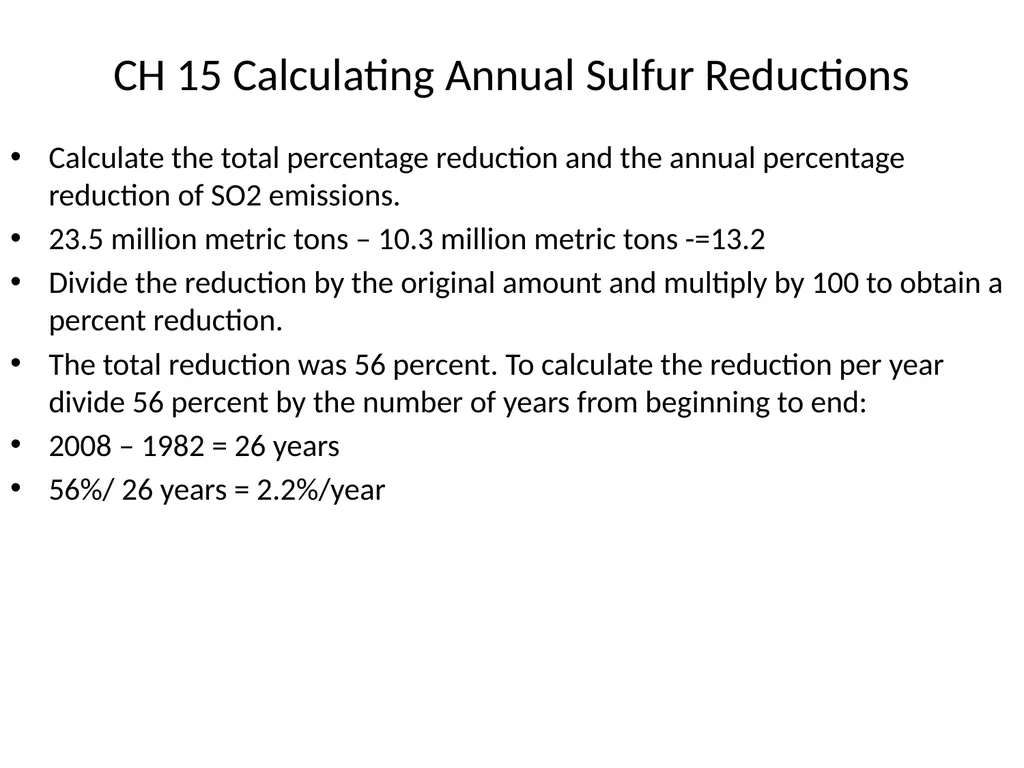
CH 15 Calculating Annual Sulfur Reductions Calculate the total percentage reduction and the annual percentage reduction of SO2 emissions.
23.5 million metric tons – 10.3 million metric tons -=13.2
Divide the reduction by the original amount and multiply by 100 to obtain a percent reduction.
The total reduction was 56 percent. To calculate the reduction per year divide 56 percent by the number of years from beginning to end:
2008 – 1982 = 26 years
56%/ 26 years = 2.2%/year<br>
23.5 million metric tons – 10.3 million metric tons -=13.2
Divide the reduction by the original amount and multiply by 100 to obtain a percent reduction.
The total reduction was 56 percent. To calculate the reduction per year divide 56 percent by the number of years from beginning to end:
2008 – 1982 = 26 years
56%/ 26 years = 2.2%/year<br>
26
CH 16 Calculating Solid Waste Footprint The Draper family is looking at ways to reduce its solid waste footprint. Each of the four members of the family produces 3 lbs. of solid waste per day. If the Draper Family decides to compost all organic materials (food scraps, yard waste, etc.) they would reduce their solid waste footprint by 20%.
Calculate the amount of waste the Draper Family produces in one year.
Calculate the total solid waste after implementing composting.<br>
Calculate the amount of waste the Draper Family produces in one year.
Calculate the total solid waste after implementing composting.<br>
27
The amount of waste/year:
(3.0 lbs./person)(4 people)(365 days) = 4,386 lbs/year Draper family.
Implementing Composting:
(4,386 lbs./year)(0.2 percent composted) = 876 lbs. solid waste composted
4,386 lbs./year – 876 lbs. composted = 3,510 lbs./year Solid Waste Footprint.<br>
(3.0 lbs./person)(4 people)(365 days) = 4,386 lbs/year Draper family.
Implementing Composting:
(4,386 lbs./year)(0.2 percent composted) = 876 lbs. solid waste composted
4,386 lbs./year – 876 lbs. composted = 3,510 lbs./year Solid Waste Footprint.<br>
28
CH 17 LD- 50 p.475 ESBK LD-50 is the measure used to indicate the “lethal dose” of a material that , when given at once, kills 50% of a group of test animals such as laboratory rats.
Assume that for a certain pestcide, the LD – 50 dosage level for laboratory rats is determined to be 200 mg/kg of body mass.
Calculate the amount of the pesticide that would be considered safe for animals to ingest?
Calculate what amount of pesticide would be considered safe for humans to ingest?
“For most animals, a safe concentration is obtained by taking the LD – 50 value and divided it by 10. The logic is that if the LD – 50 value causes 50% of the animals to die, then 10%of the LD – 50 value should cause few or no animals to die.”<br>
Assume that for a certain pestcide, the LD – 50 dosage level for laboratory rats is determined to be 200 mg/kg of body mass.
Calculate the amount of the pesticide that would be considered safe for animals to ingest?
Calculate what amount of pesticide would be considered safe for humans to ingest?
“For most animals, a safe concentration is obtained by taking the LD – 50 value and divided it by 10. The logic is that if the LD – 50 value causes 50% of the animals to die, then 10%of the LD – 50 value should cause few or no animals to die.”<br>
29
200mg/kg = 20 mg/kg of mass is considered safe for mammals.
10 P. 475 “LD – 50 & ED- 50 values obtained from rats and mice are divided by 1,000 to set the safe values for humans”
200 mg/kg = .20mg/kg of mass is considered safe for humans.
1000<br>
200 mg/kg = .20mg/kg of mass is considered safe for humans.
1000<br>
30
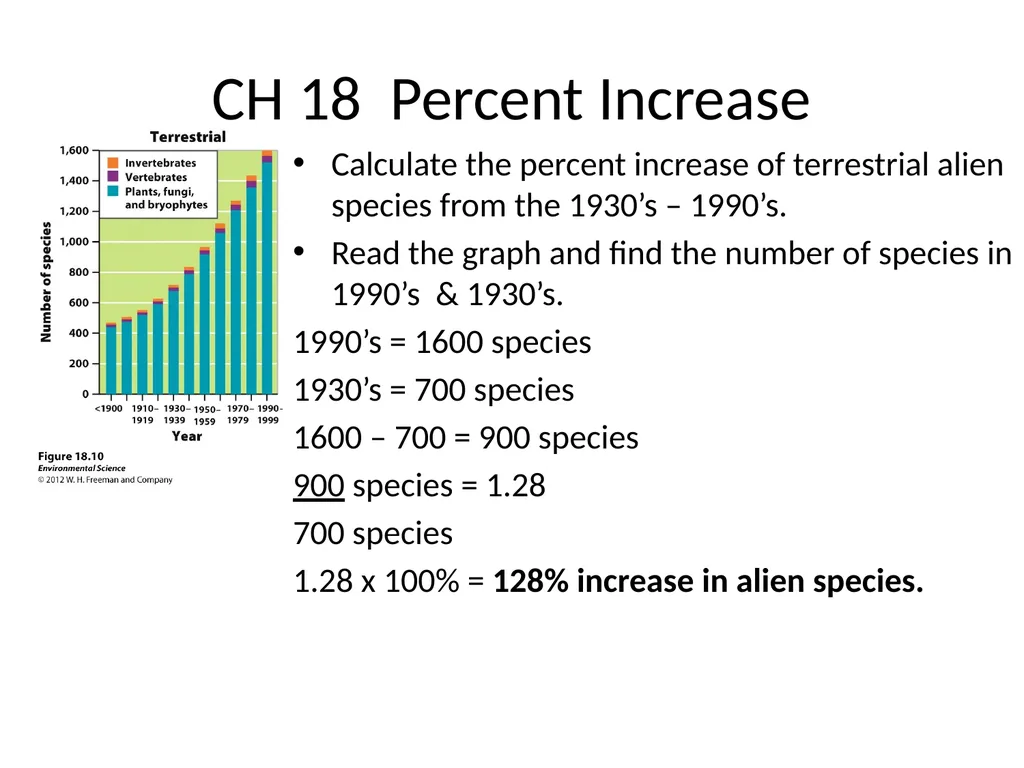
CH 18 Percent Increase Calculate the percent increase of terrestrial alien species from the 1930’s – 1990’s.
Read the graph and find the number of species in 1990’s & 1930’s.
1990’s = 1600 species
1930’s = 700 species
1600 – 700 = 900 species
900 species = 1.28
700 species
1.28 x 100% = 128% increase in alien species.<br>
Read the graph and find the number of species in 1990’s & 1930’s.
1990’s = 1600 species
1930’s = 700 species
1600 – 700 = 900 species
900 species = 1.28
700 species
1.28 x 100% = 128% increase in alien species.<br>
31
CH 19 Quantitative Skills In recent years many scientific studies have shown the relationship between the global mean atmospheric temperature at Earth’s surface and rising sea levels. The increase in the global mean atmospheric temperature during the past two hundred years have been accompanied by a gradual increase in sea level. The average rate of increase in sea level over the past 200 years is 2.5 mm/yr.
Calculate the expected increase in sea level, in meters, for 10years, 100 years, 200 years.
10 years: 2.5 mm/yr x 10 years = 25 mm = .025 m
100 years: 2.5 mm/yr x 100 years = 250 mm = 0.25 m
200 years:2.5 mm/yr x 200 years = 500 mm = .5 m<br>
Calculate the expected increase in sea level, in meters, for 10years, 100 years, 200 years.
10 years: 2.5 mm/yr x 10 years = 25 mm = .025 m
100 years: 2.5 mm/yr x 100 years = 250 mm = 0.25 m
200 years:2.5 mm/yr x 200 years = 500 mm = .5 m<br>
32
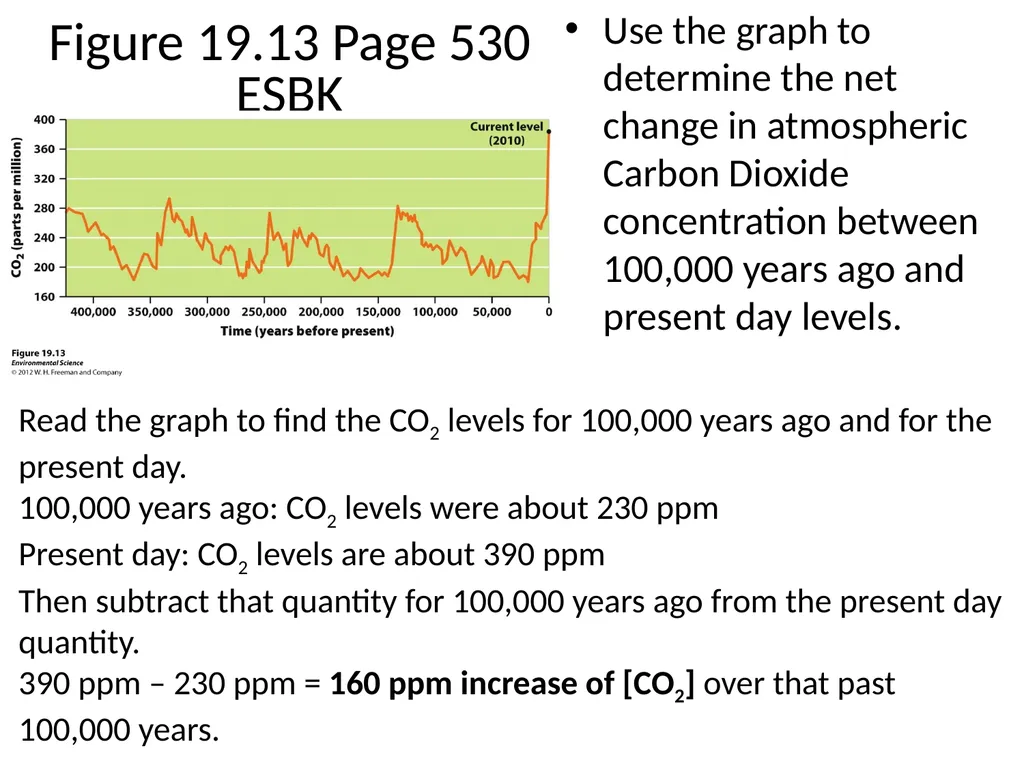
Figure 19.13 Page 530 ESBK Use the graph to determine the net change in atmospheric Carbon Dioxide concentration between 100,000 years ago and present day levels. Read the graph to find the CO2 levels for 100,000 years ago and for the present day.
100,000 years ago: CO2 levels were about 230 ppm
Present day: CO2 levels are about 390 ppm
Then subtract that quantity for 100,000 years ago from the present day quantity.
390 ppm – 230 ppm = 160 ppm increase of [CO2] over that past 100,000 years.<br>
100,000 years ago: CO2 levels were about 230 ppm
Present day: CO2 levels are about 390 ppm
Then subtract that quantity for 100,000 years ago from the present day quantity.
390 ppm – 230 ppm = 160 ppm increase of [CO2] over that past 100,000 years.<br>
33
CH 20 – No Math! <br>