
Dog Leg Severity (DLS) & Side Load (SL)
EM
Published · 32 slides · 0 views
1 / 1
Description
Dog Leg Severity (DLS) Side Load (SL) Recommendations to Drilling Lynn Rowlan, Norman W. Hein, Jr., Oil Gas Optimization Specialists, Ltd. 2019 Sucker Rod Pumping Workshop Cox Convention Center, Oklahoma City, OK September 9 - 12, 2019
Related Topics
Share
Embed code
Download this presentation From Below
"Dog Leg Severity (DLS) & Side Load (SL)" is the property of its rightful owner. Permission is granted to download and print the materials on this website for personal, non-commercial use only, and to display it on your personal computer provided you do not modify the materials and that you retain all copyright notices contained in the materials. By downloading content from our website, you accept the terms of this agreement.
Presentation Transcript
01
Dog Leg Severity (DLS) & Side Load (SL) Recommendations to Drilling Lynn Rowlan,
Norman W. Hein, Jr., Oil & Gas Optimization Specialists, Ltd. 2019 Sucker Rod Pumping Workshop
Cox Convention Center, Oklahoma City, OK
September 9 - 12, 2019<br>
Norman W. Hein, Jr., Oil & Gas Optimization Specialists, Ltd. 2019 Sucker Rod Pumping Workshop
Cox Convention Center, Oklahoma City, OK
September 9 - 12, 2019<br>
02
Dog Leg Severity (DLS) had been used as recommendations to drill oil and gas wells Dog Leg Severity (DLS) Recommended Limits:
Provide "trouble free" operating conditions
Historically based on vertical, shallow (<5000 ft.) deep wells
With the current drilling and operating practices of deviated and/or horizontal wells, these recommendations may no longer be applicable
Deviation measurement interval (degrees/100 ft.) may no longer be representative of downhole problems using existing rod string design software
Paper provides new recommendations for drilling wells for better, longer term, less problematic operation of operating Sucker Rod Lifted (SRL) vertical, deviated and horizontal wells 2 2019 Sucker Rod Pumping Workshop
Oklahoma City, OK Sept. 9 - 12, 2019<br>
Provide "trouble free" operating conditions
Historically based on vertical, shallow (<5000 ft.) deep wells
With the current drilling and operating practices of deviated and/or horizontal wells, these recommendations may no longer be applicable
Deviation measurement interval (degrees/100 ft.) may no longer be representative of downhole problems using existing rod string design software
Paper provides new recommendations for drilling wells for better, longer term, less problematic operation of operating Sucker Rod Lifted (SRL) vertical, deviated and horizontal wells 2 2019 Sucker Rod Pumping Workshop
Oklahoma City, OK Sept. 9 - 12, 2019<br>
03
Dogleg severity friction is mechanical friction forces that are applied at a point in the well For vertical wells a Rule of Thumb if Dog Leg Severity (DLS):
Deviation 0 to 3 degrees/100 ft. – no problem !@#$%^&
Deviation 3 to 5 degrees/100 ft. – increased wear & friction
Deviation >5 degrees/100 ft. – will have problems (doesn’t mean can’t pump, just extra precautions may be required or may have increased operating costs, failures, decreased run time/life,etc.)
Now, with improved deviation measuring equipment
Degrees per 100 ft may have insufficient accuracy
DLS may not be as important as applied side load 2 2019 Sucker Rod Pumping Workshop
Oklahoma City, OK Sept. 9 - 12, 2019<br>
Deviation 0 to 3 degrees/100 ft. – no problem !@#$%^&
Deviation 3 to 5 degrees/100 ft. – increased wear & friction
Deviation >5 degrees/100 ft. – will have problems (doesn’t mean can’t pump, just extra precautions may be required or may have increased operating costs, failures, decreased run time/life,etc.)
Now, with improved deviation measuring equipment
Degrees per 100 ft may have insufficient accuracy
DLS may not be as important as applied side load 2 2019 Sucker Rod Pumping Workshop
Oklahoma City, OK Sept. 9 - 12, 2019<br>
04
2019 Sucker Rod Pumping Workshop
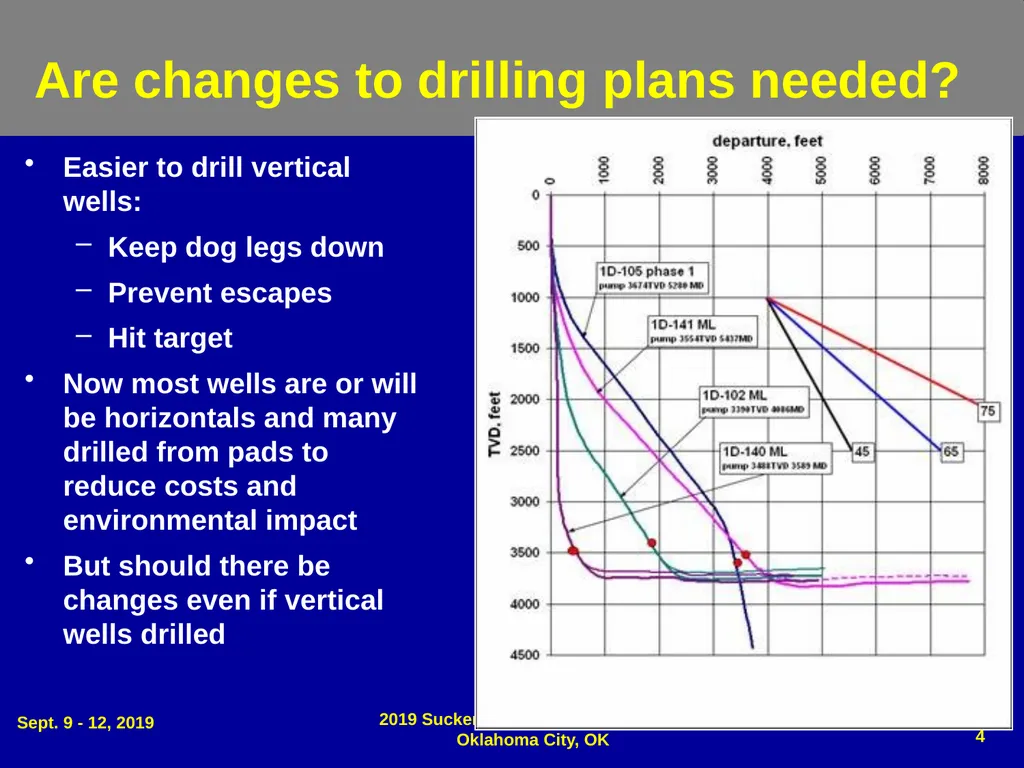
Oklahoma City, OK Sept. 9 - 12, 2019 Are changes to drilling plans needed? Easier to drill vertical wells:
Keep dog legs down
Prevent escapes
Hit target
Now most wells are or will be horizontals and many drilled from pads to reduce costs and environmental impact
But should there be changes even if vertical wells drilled 4<br>
Oklahoma City, OK Sept. 9 - 12, 2019 Are changes to drilling plans needed? Easier to drill vertical wells:
Keep dog legs down
Prevent escapes
Hit target
Now most wells are or will be horizontals and many drilled from pads to reduce costs and environmental impact
But should there be changes even if vertical wells drilled 4<br>
05
Drilling (cont.) Not only does dog leg severity (DLS) have to be considered but so does resulting side loads (SL)
Side load is not only dependent on the local DLS but also have to consider the rod string loads at the relative depth the side load occurs
While we still have to consider downhole DLS and side load, which is where typically wear and hole in tubing (HIT) normally occurs for vertical wells, but, also have to consider side load at the surface at or near well pad 4 2019 Sucker Rod Pumping Workshop
Oklahoma City, OK Sept. 9 - 12, 2019<br>
Side load is not only dependent on the local DLS but also have to consider the rod string loads at the relative depth the side load occurs
While we still have to consider downhole DLS and side load, which is where typically wear and hole in tubing (HIT) normally occurs for vertical wells, but, also have to consider side load at the surface at or near well pad 4 2019 Sucker Rod Pumping Workshop
Oklahoma City, OK Sept. 9 - 12, 2019<br>
06
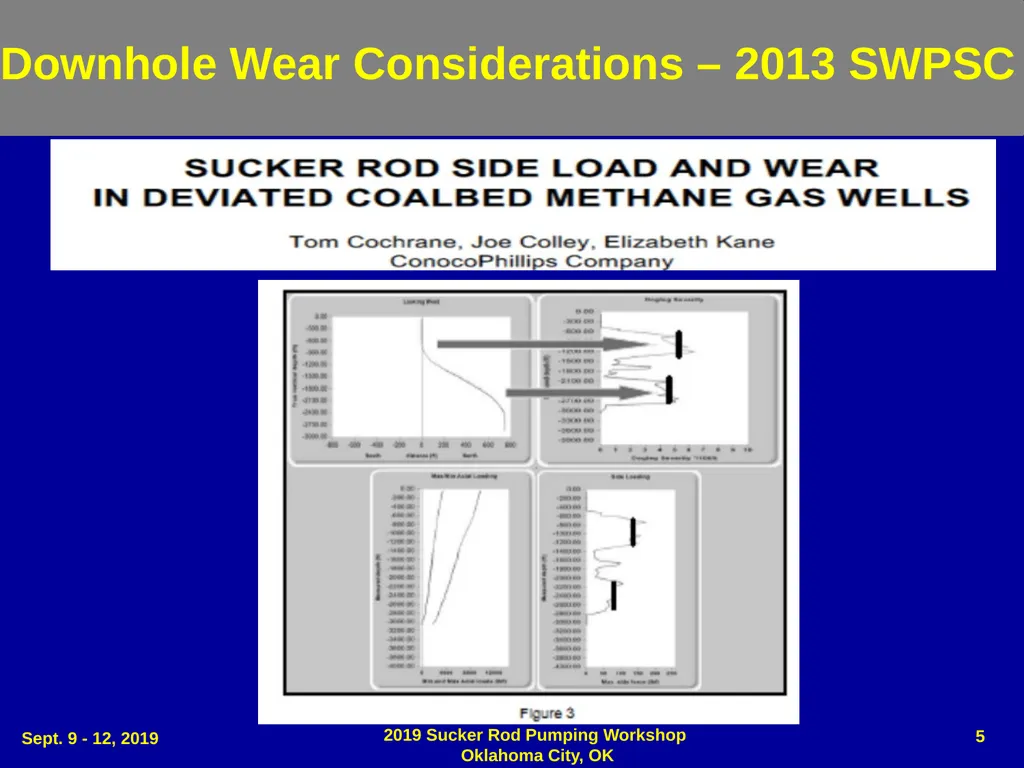
Downhole Wear Considerations – 2013 SWPSC 5 2019 Sucker Rod Pumping Workshop
Oklahoma City, OK Sept. 9 - 12, 2019<br>
Oklahoma City, OK Sept. 9 - 12, 2019<br>
07
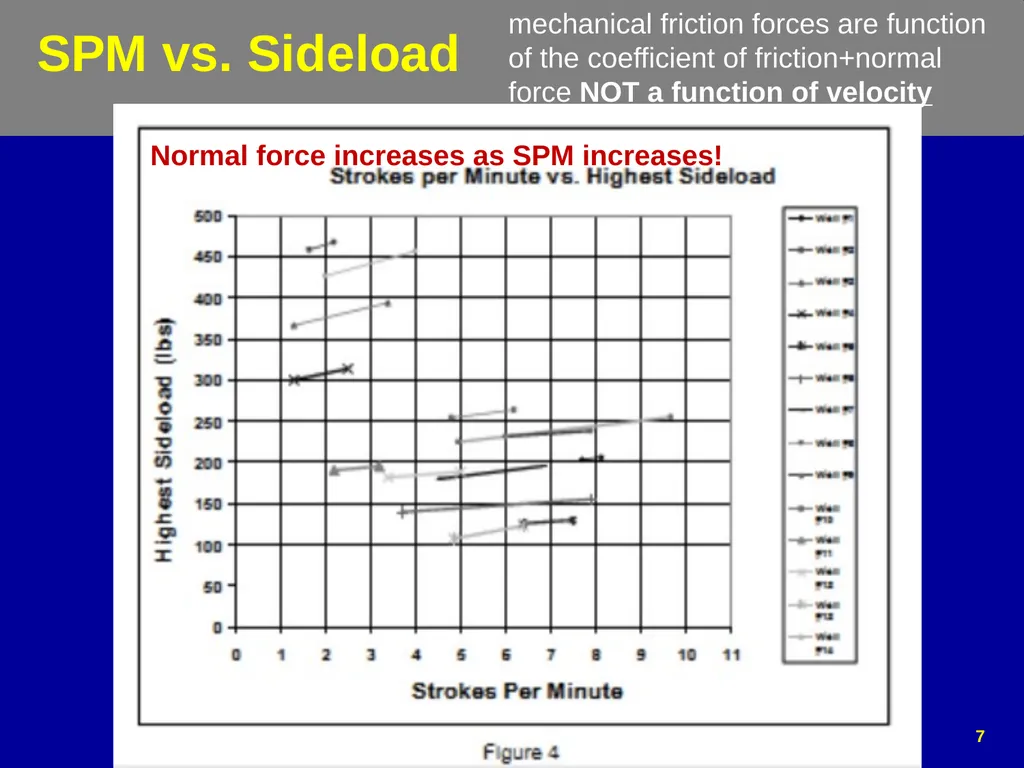
SPM vs. Sideload 7 mechanical friction forces are function of the coefficient of friction+normal force NOT a function of velocity Normal force increases as SPM increases!<br>
08
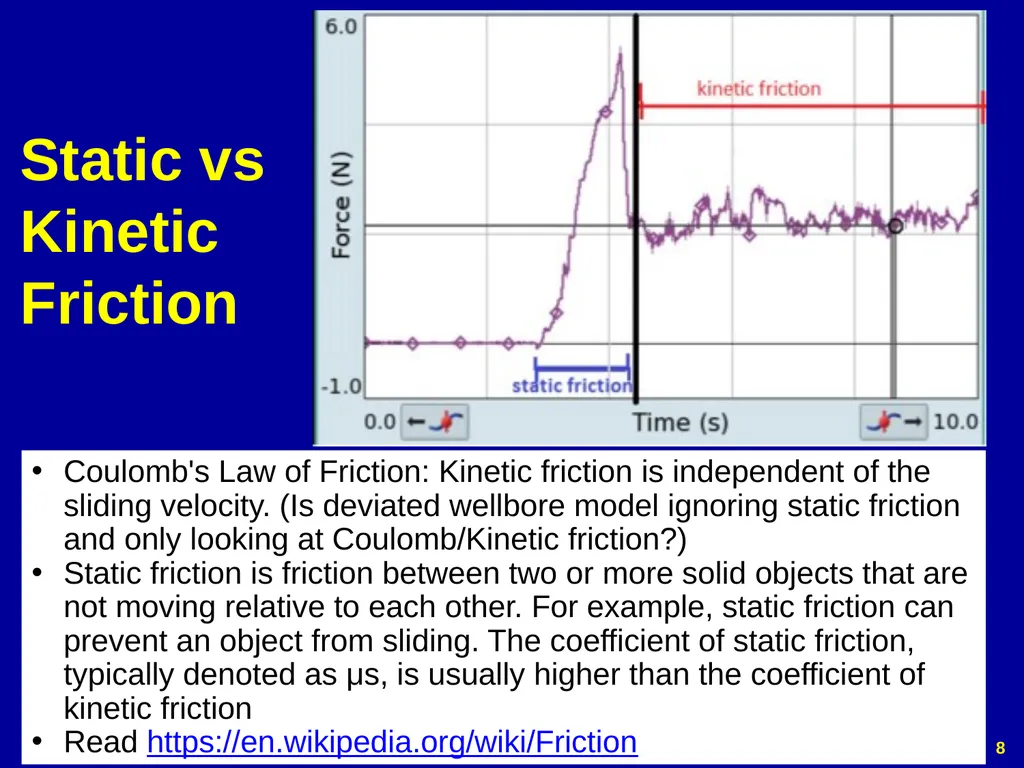
Static vs Kinetic Friction 8 Coulomb's Law of Friction: Kinetic friction is independent of the sliding velocity. (Is deviated wellbore model ignoring static friction and only looking at Coulomb/Kinetic friction?)
Static friction is friction between two or more solid objects that are not moving relative to each other. For example, static friction can prevent an object from sliding. The coefficient of static friction, typically denoted as μs, is usually higher than the coefficient of kinetic friction
Read https://en.wikipedia.org/wiki/Friction<br>
Static friction is friction between two or more solid objects that are not moving relative to each other. For example, static friction can prevent an object from sliding. The coefficient of static friction, typically denoted as μs, is usually higher than the coefficient of kinetic friction
Read https://en.wikipedia.org/wiki/Friction<br>
09
2019 Sucker Rod Pumping Workshop
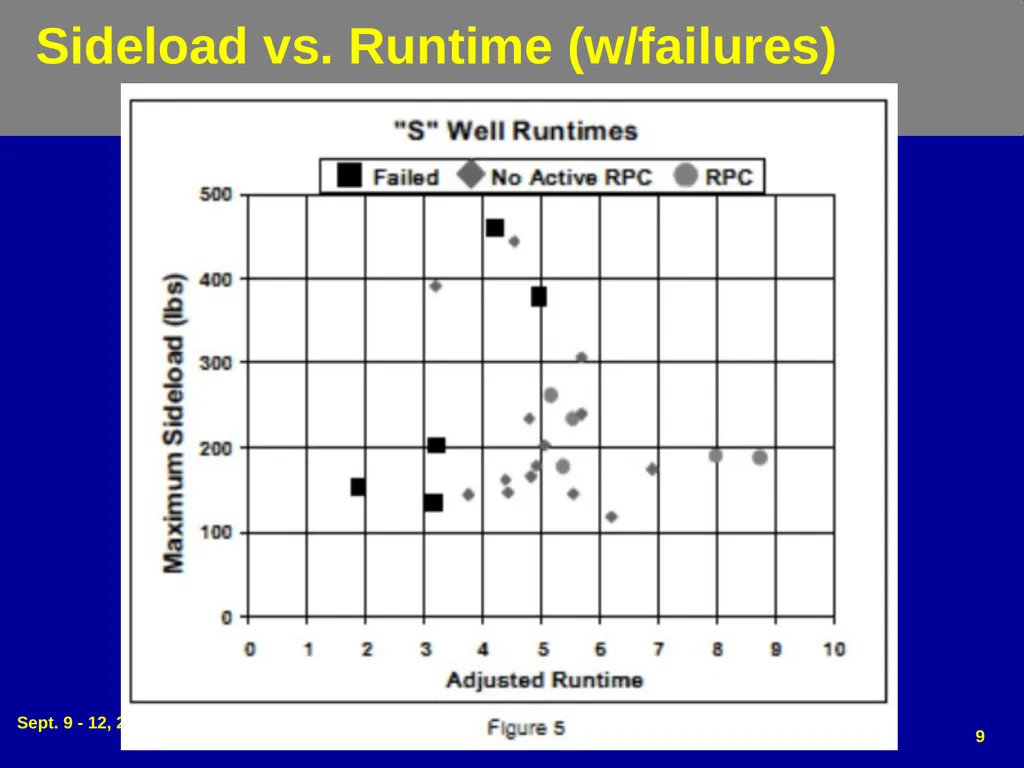
Oklahoma City, OK Sept. 9 - 12, 2019 Sideload vs. Runtime (w/failures) 9<br>
Oklahoma City, OK Sept. 9 - 12, 2019 Sideload vs. Runtime (w/failures) 9<br>
10
2019 Sucker Rod Pumping Workshop
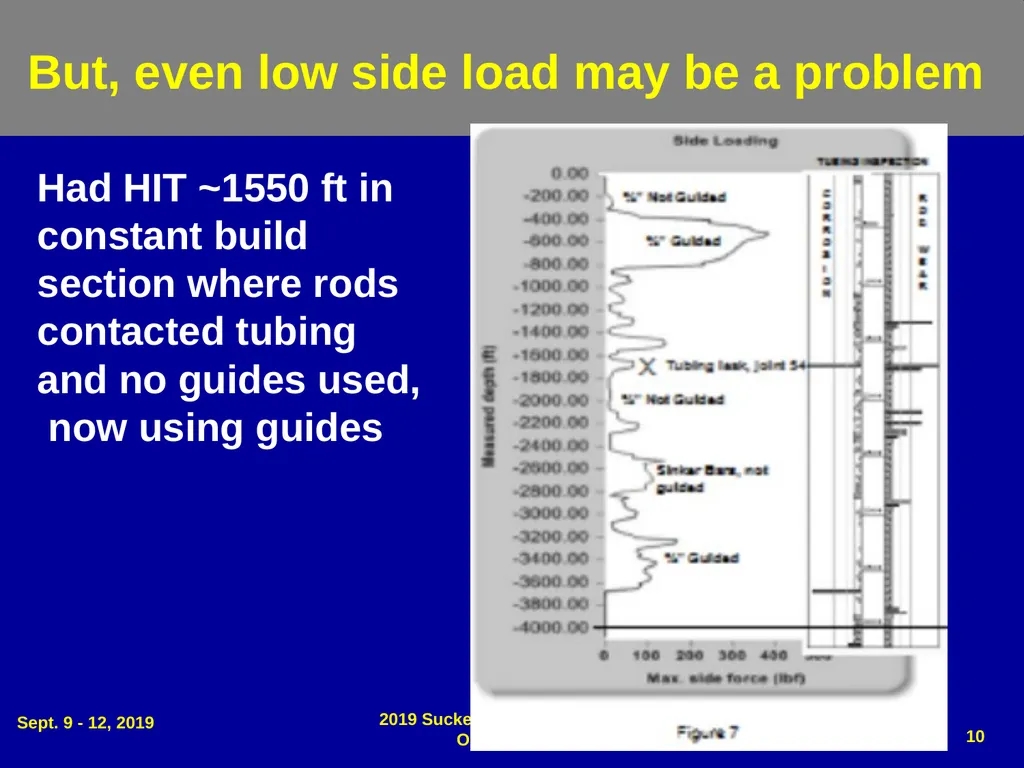
Oklahoma City, OK Sept. 9 - 12, 2019 But, even low side load may be a problem Had HIT ~1550 ft in constant build section where rods contacted tubing and no guides used, now using guides 10<br>
Oklahoma City, OK Sept. 9 - 12, 2019 But, even low side load may be a problem Had HIT ~1550 ft in constant build section where rods contacted tubing and no guides used, now using guides 10<br>
11
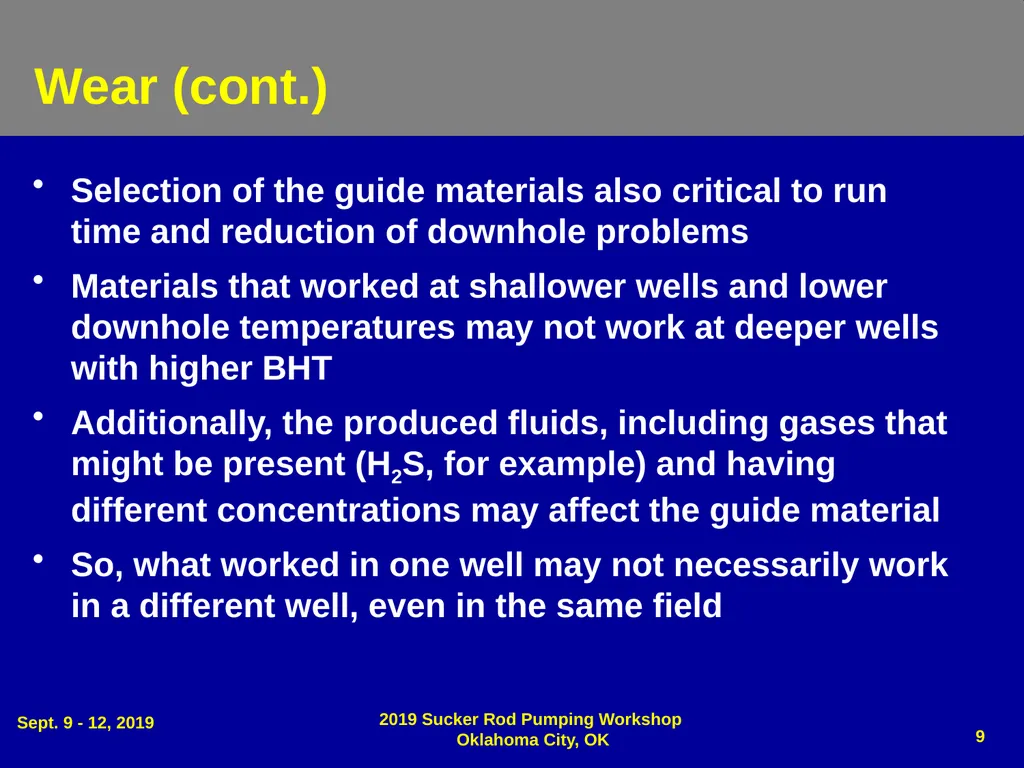
Wear (cont.) Selection of the guide materials also critical to run time and reduction of downhole problems
Materials that worked at shallower wells and lower downhole temperatures may not work at deeper wells with higher BHT
Additionally, the produced fluids, including gases that might be present (H2S, for example) and having different concentrations may affect the guide material
So, what worked in one well may not necessarily work in a different well, even in the same field 9 2019 Sucker Rod Pumping Workshop
Oklahoma City, OK Sept. 9 - 12, 2019<br>
Materials that worked at shallower wells and lower downhole temperatures may not work at deeper wells with higher BHT
Additionally, the produced fluids, including gases that might be present (H2S, for example) and having different concentrations may affect the guide material
So, what worked in one well may not necessarily work in a different well, even in the same field 9 2019 Sucker Rod Pumping Workshop
Oklahoma City, OK Sept. 9 - 12, 2019<br>
12
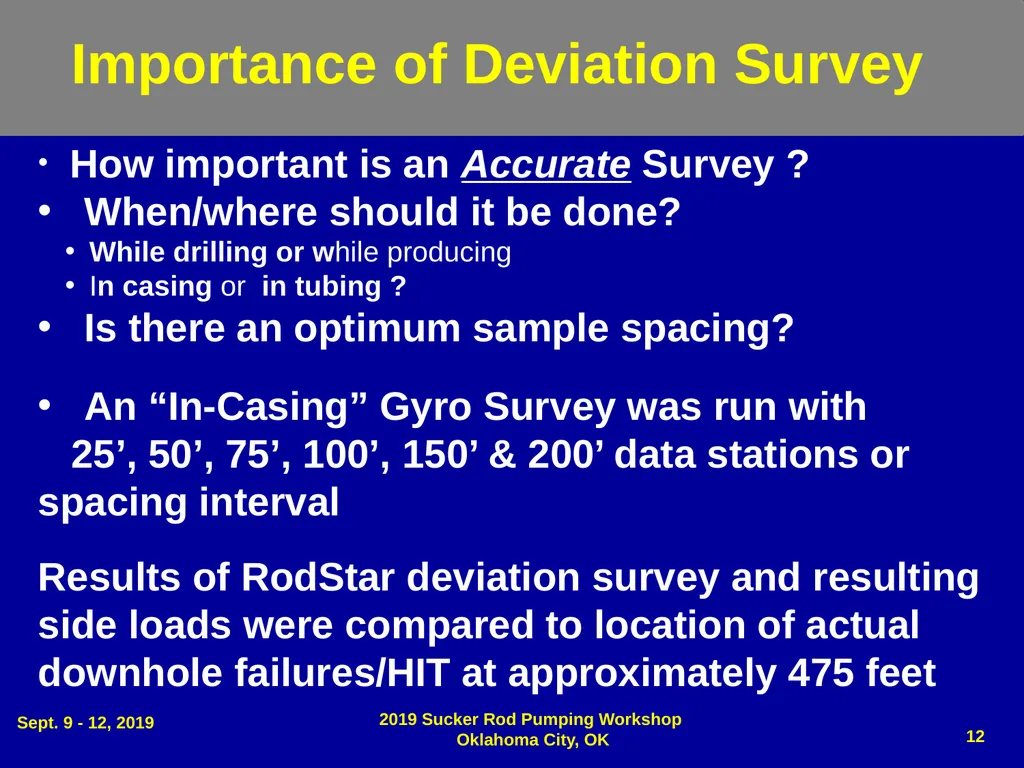
Importance of Deviation Survey How important is an Accurate Survey ?
When/where should it be done?
While drilling or while producing
In casing or in tubing ?
Is there an optimum sample spacing?
An “In-Casing” Gyro Survey was run with
25’, 50’, 75’, 100’, 150’ & 200’ data stations or spacing interval
Results of RodStar deviation survey and resulting side loads were compared to location of actual downhole failures/HIT at approximately 475 feet 12 2019 Sucker Rod Pumping Workshop
Oklahoma City, OK Sept. 9 - 12, 2019<br>
When/where should it be done?
While drilling or while producing
In casing or in tubing ?
Is there an optimum sample spacing?
An “In-Casing” Gyro Survey was run with
25’, 50’, 75’, 100’, 150’ & 200’ data stations or spacing interval
Results of RodStar deviation survey and resulting side loads were compared to location of actual downhole failures/HIT at approximately 475 feet 12 2019 Sucker Rod Pumping Workshop
Oklahoma City, OK Sept. 9 - 12, 2019<br>
13
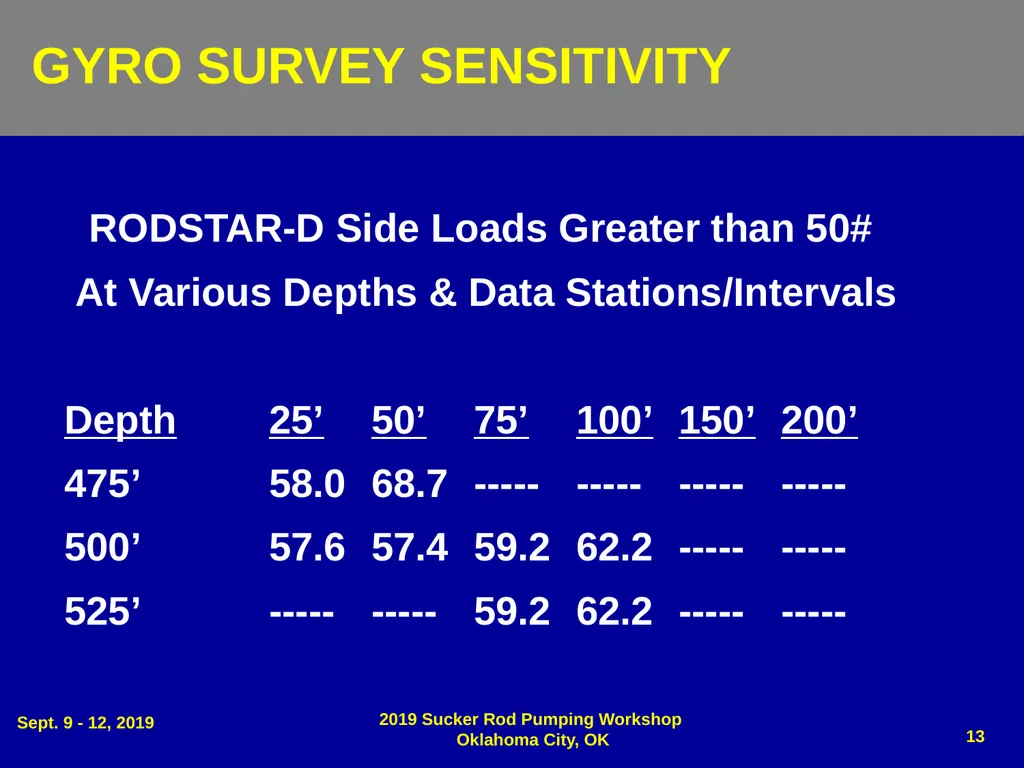
Gyro Survey Sensitivity RODSTAR-D Side Loads Greater than 50#
At Various Depths & Data Stations/Intervals
Depth 25’ 50’ 75’ 100’ 150’ 200’
475’ 58.0 68.7 ----- ----- ----- -----
500’ 57.6 57.4 59.2 62.2 ----- -----
525’ ----- ----- 59.2 62.2 ----- ----- 13 2019 Sucker Rod Pumping Workshop
Oklahoma City, OK Sept. 9 - 12, 2019<br>
At Various Depths & Data Stations/Intervals
Depth 25’ 50’ 75’ 100’ 150’ 200’
475’ 58.0 68.7 ----- ----- ----- -----
500’ 57.6 57.4 59.2 62.2 ----- -----
525’ ----- ----- 59.2 62.2 ----- ----- 13 2019 Sucker Rod Pumping Workshop
Oklahoma City, OK Sept. 9 - 12, 2019<br>
14
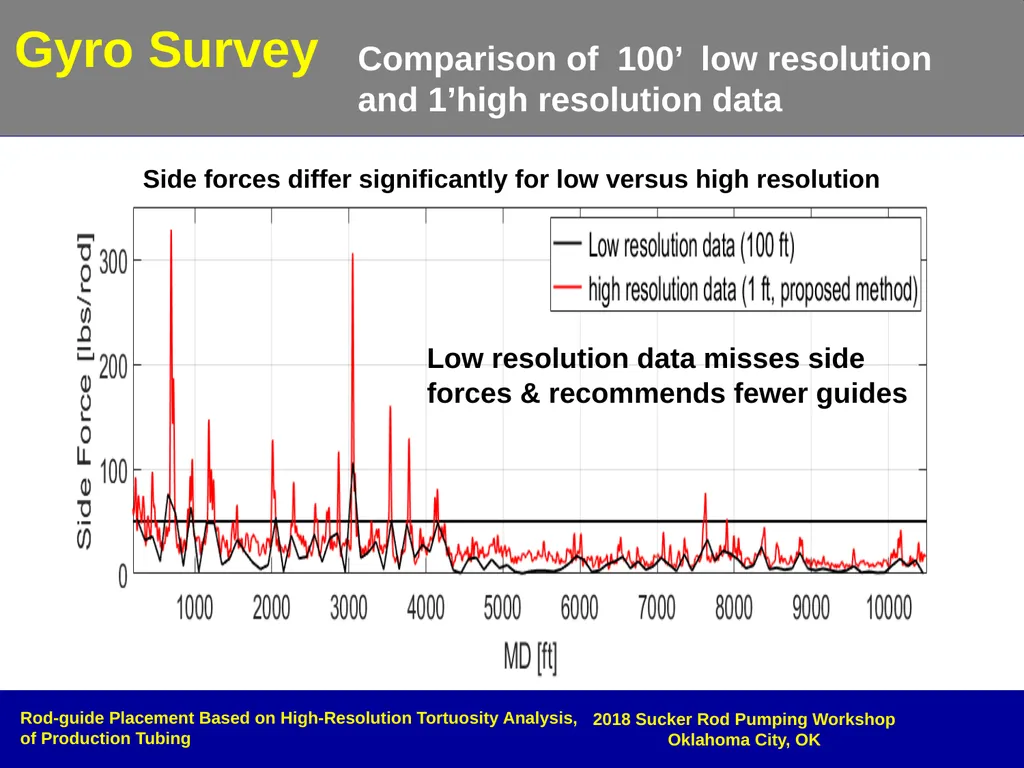
Gyro Survey Rod-guide Placement Based on High-Resolution Tortuosity Analysis, of Production Tubing Comparison of 100’ low resolution and 1’high resolution data Low resolution data misses side forces & recommends fewer guides 2018 Sucker Rod Pumping Workshop
Oklahoma City, OK Side forces differ significantly for low versus high resolution<br>
Oklahoma City, OK Side forces differ significantly for low versus high resolution<br>
15
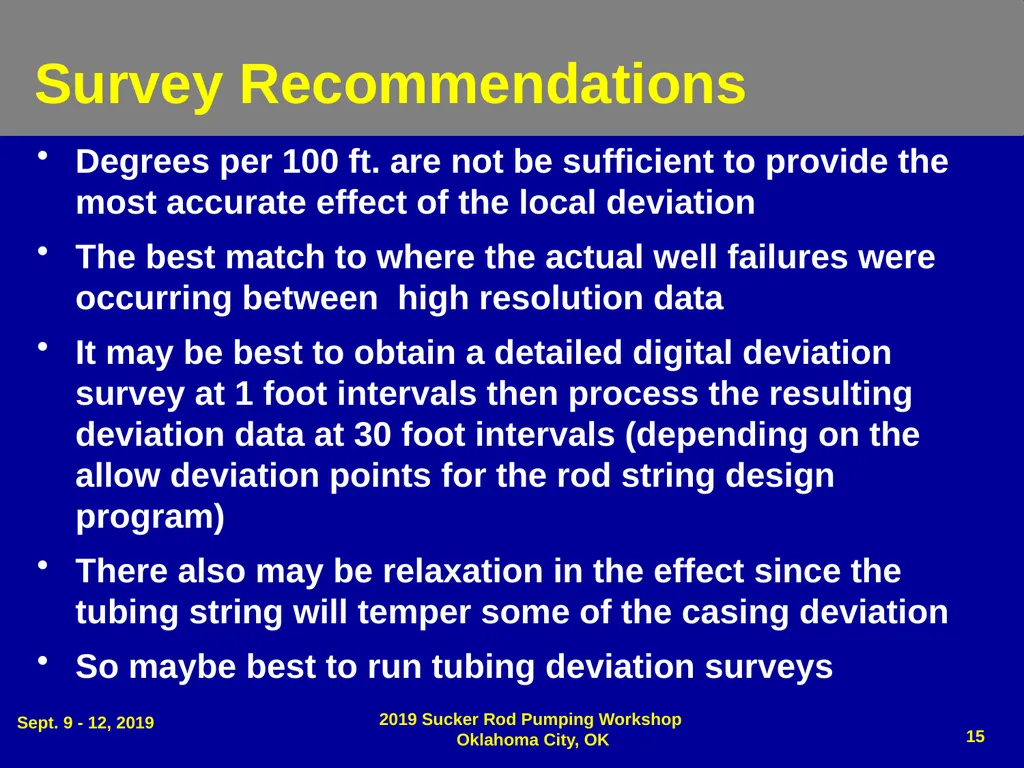
Survey Recommendations Degrees per 100 ft. are not be sufficient to provide the most accurate effect of the local deviation
The best match to where the actual well failures were occurring between high resolution data
It may be best to obtain a detailed digital deviation survey at 1 foot intervals then process the resulting deviation data at 30 foot intervals (depending on the allow deviation points for the rod string design program)
There also may be relaxation in the effect since the tubing string will temper some of the casing deviation
So maybe best to run tubing deviation surveys 15 2019 Sucker Rod Pumping Workshop
Oklahoma City, OK Sept. 9 - 12, 2019<br>
The best match to where the actual well failures were occurring between high resolution data
It may be best to obtain a detailed digital deviation survey at 1 foot intervals then process the resulting deviation data at 30 foot intervals (depending on the allow deviation points for the rod string design program)
There also may be relaxation in the effect since the tubing string will temper some of the casing deviation
So maybe best to run tubing deviation surveys 15 2019 Sucker Rod Pumping Workshop
Oklahoma City, OK Sept. 9 - 12, 2019<br>
16
2019 Sucker Rod Pumping Workshop
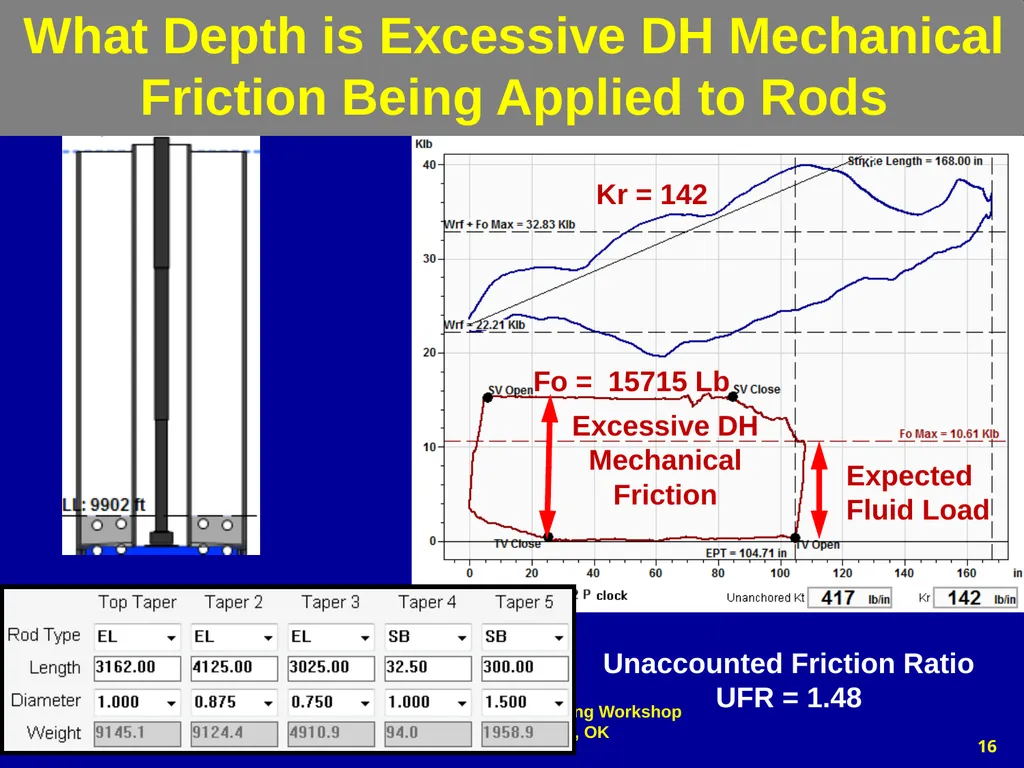
Oklahoma City, OK Sept. 9 - 12, 2019 What Depth is Excessive DH Mechanical Friction Being Applied to Rods 16 Excessive DH Mechanical Friction Expected Fluid Load Kr = 142 Fo = 15715 Lb Unaccounted Friction Ratio
UFR = 1.48<br>
Oklahoma City, OK Sept. 9 - 12, 2019 What Depth is Excessive DH Mechanical Friction Being Applied to Rods 16 Excessive DH Mechanical Friction Expected Fluid Load Kr = 142 Fo = 15715 Lb Unaccounted Friction Ratio
UFR = 1.48<br>
17
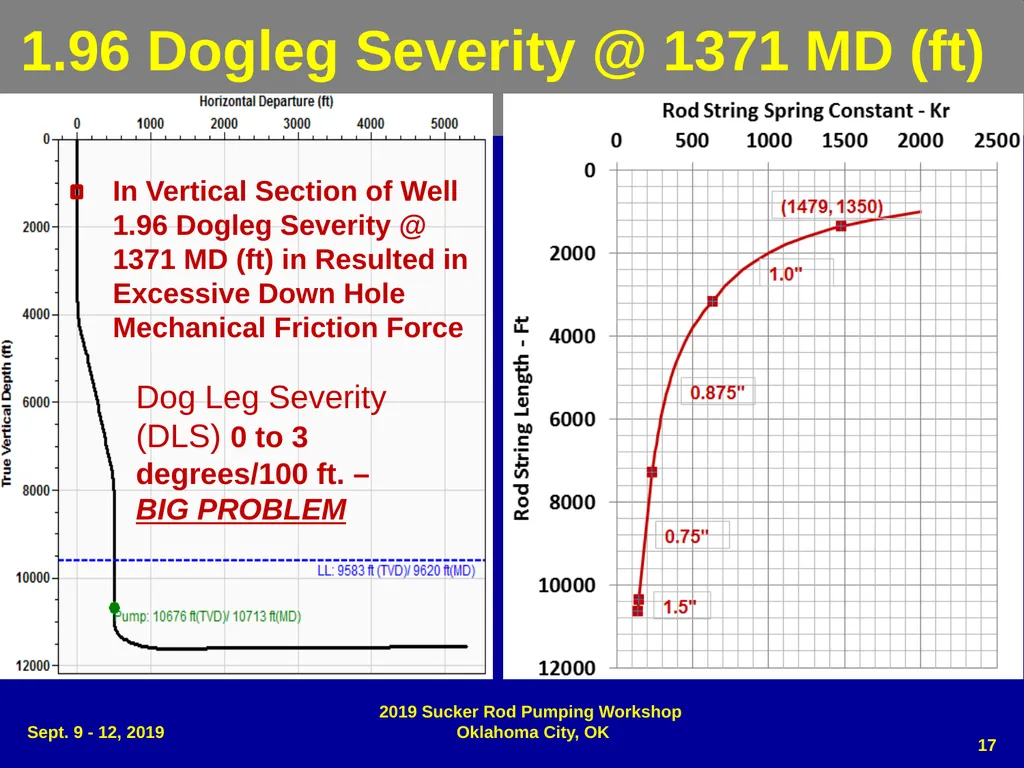
1.96 Dogleg Severity @ 1371 MD (ft) 17 In Vertical Section of Well 1.96 Dogleg Severity @ 1371 MD (ft) in Resulted in Excessive Down Hole Mechanical Friction Force Dog Leg Severity (DLS) 0 to 3 degrees/100 ft. – BIG PROBLEM 2019 Sucker Rod Pumping Workshop
Oklahoma City, OK Sept. 9 - 12, 2019<br>
Oklahoma City, OK Sept. 9 - 12, 2019<br>
18
2019 Sucker Rod Pumping Workshop
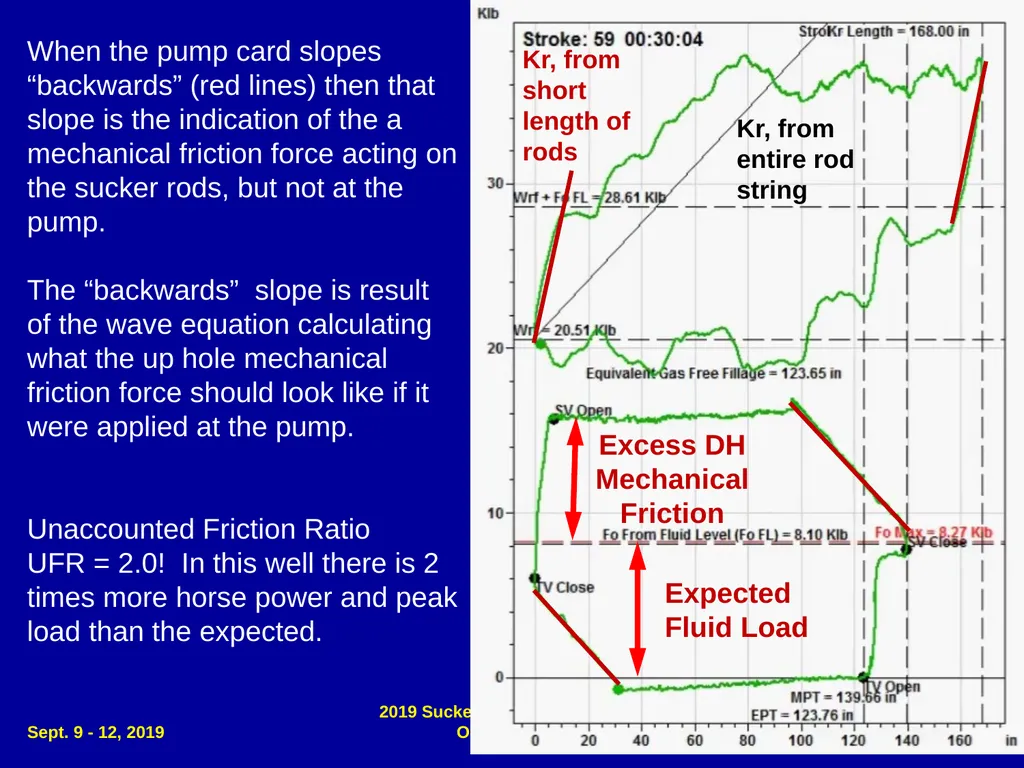
Oklahoma City, OK Sept. 9 - 12, 2019 When the pump card slopes “backwards” (red lines) then that slope is the indication of the a mechanical friction force acting on the sucker rods, but not at the pump.
The “backwards” slope is result of the wave equation calculating what the up hole mechanical friction force should look like if it were applied at the pump.
Unaccounted Friction Ratio
UFR = 2.0! In this well there is 2 times more horse power and peak load than the expected. Kr, from short length of rods Kr, from entire rod string Excess DH Mechanical Friction Expected Fluid Load<br>
Oklahoma City, OK Sept. 9 - 12, 2019 When the pump card slopes “backwards” (red lines) then that slope is the indication of the a mechanical friction force acting on the sucker rods, but not at the pump.
The “backwards” slope is result of the wave equation calculating what the up hole mechanical friction force should look like if it were applied at the pump.
Unaccounted Friction Ratio
UFR = 2.0! In this well there is 2 times more horse power and peak load than the expected. Kr, from short length of rods Kr, from entire rod string Excess DH Mechanical Friction Expected Fluid Load<br>
19
2019 Sucker Rod Pumping Workshop
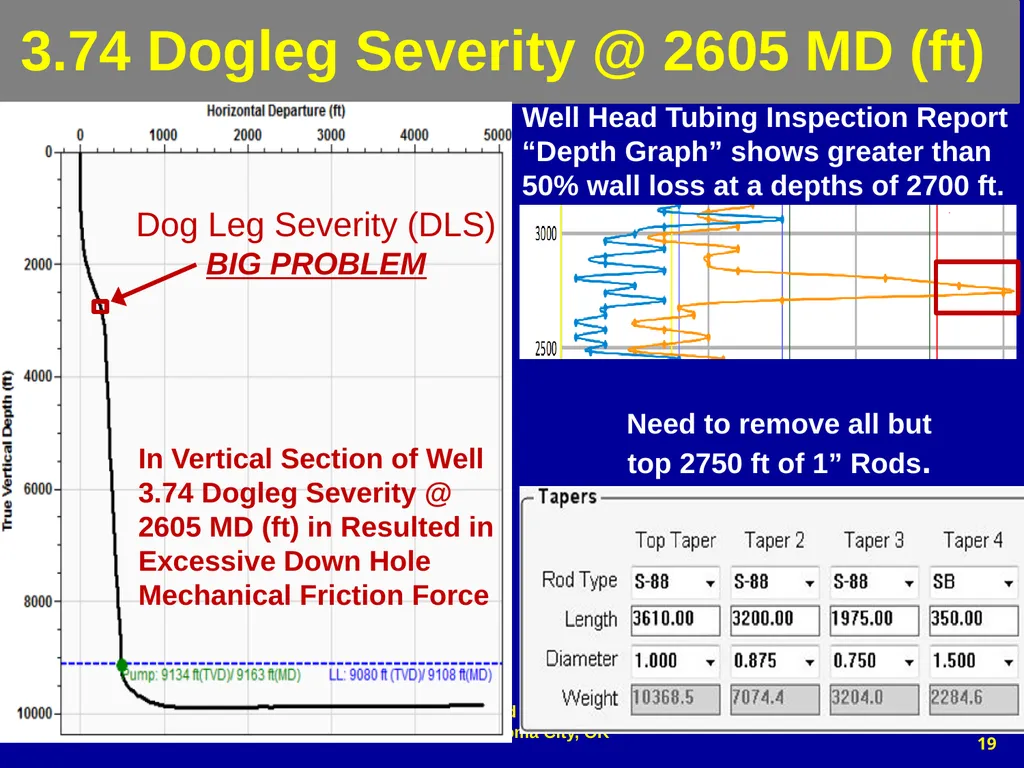
Oklahoma City, OK Sept. 9 - 12, 2019 3.74 Dogleg Severity @ 2605 MD (ft) 19 In Vertical Section of Well 3.74 Dogleg Severity @ 2605 MD (ft) in Resulted in Excessive Down Hole Mechanical Friction Force Dog Leg Severity (DLS) BIG PROBLEM Well Head Tubing Inspection Report “Depth Graph” shows greater than 50% wall loss at a depths of 2700 ft. Need to remove all but top 2750 ft of 1” Rods.<br>
Oklahoma City, OK Sept. 9 - 12, 2019 3.74 Dogleg Severity @ 2605 MD (ft) 19 In Vertical Section of Well 3.74 Dogleg Severity @ 2605 MD (ft) in Resulted in Excessive Down Hole Mechanical Friction Force Dog Leg Severity (DLS) BIG PROBLEM Well Head Tubing Inspection Report “Depth Graph” shows greater than 50% wall loss at a depths of 2700 ft. Need to remove all but top 2750 ft of 1” Rods.<br>
20
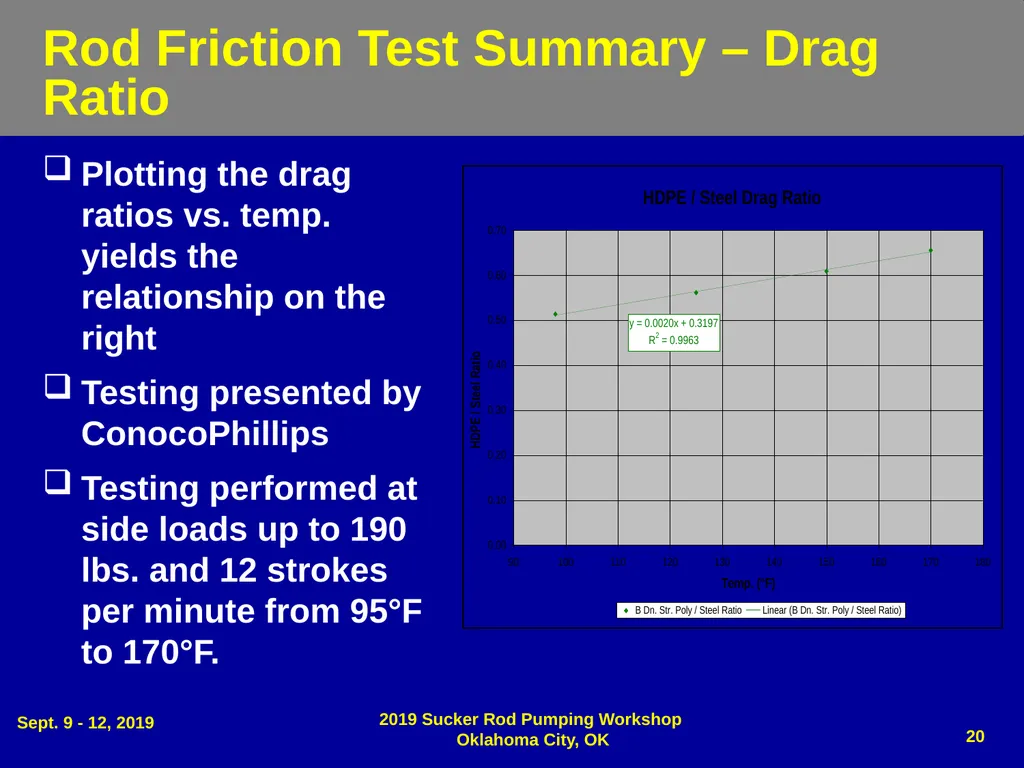
Rod Friction Test Summary – Drag Ratio Plotting the drag ratios vs. temp. yields the relationship on the right
Testing presented by ConocoPhillips
Testing performed at side loads up to 190 lbs. and 12 strokes per minute from 95°F to 170°F. 20 2019 Sucker Rod Pumping Workshop
Oklahoma City, OK Sept. 9 - 12, 2019<br>
Testing presented by ConocoPhillips
Testing performed at side loads up to 190 lbs. and 12 strokes per minute from 95°F to 170°F. 20 2019 Sucker Rod Pumping Workshop
Oklahoma City, OK Sept. 9 - 12, 2019<br>
21
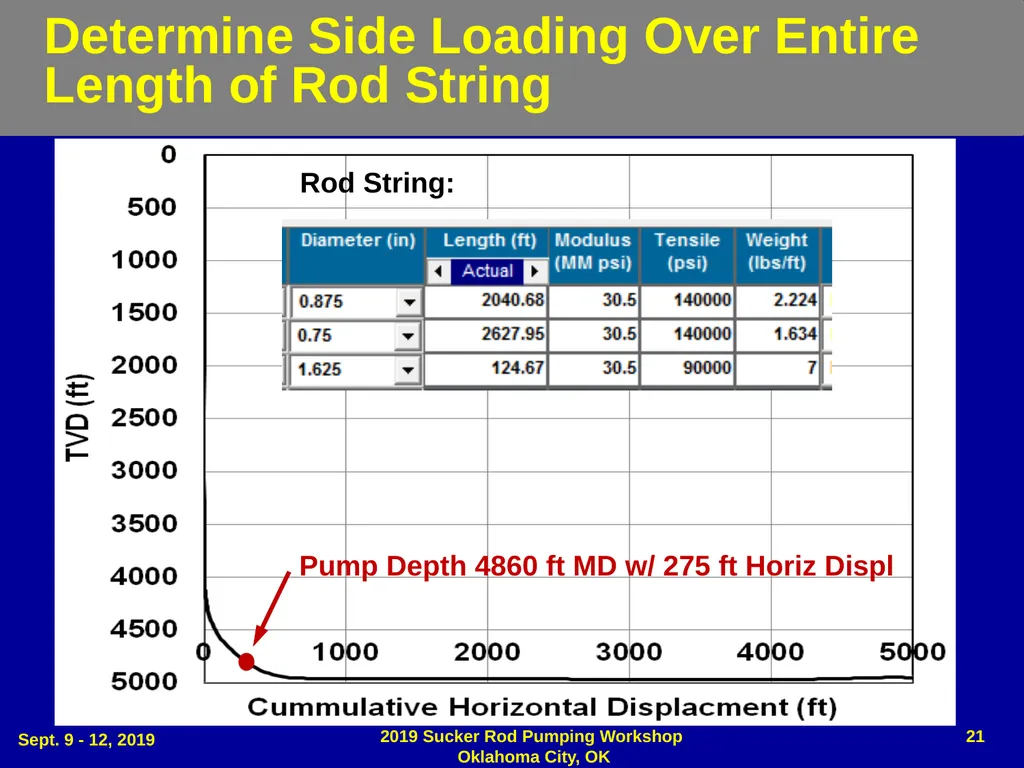
Determine Side Loading Over Entire Length of Rod String Rod String: Pump Depth 4860 ft MD w/ 275 ft Horiz Displ 21 2019 Sucker Rod Pumping Workshop
Oklahoma City, OK Sept. 9 - 12, 2019<br>
Oklahoma City, OK Sept. 9 - 12, 2019<br>
22
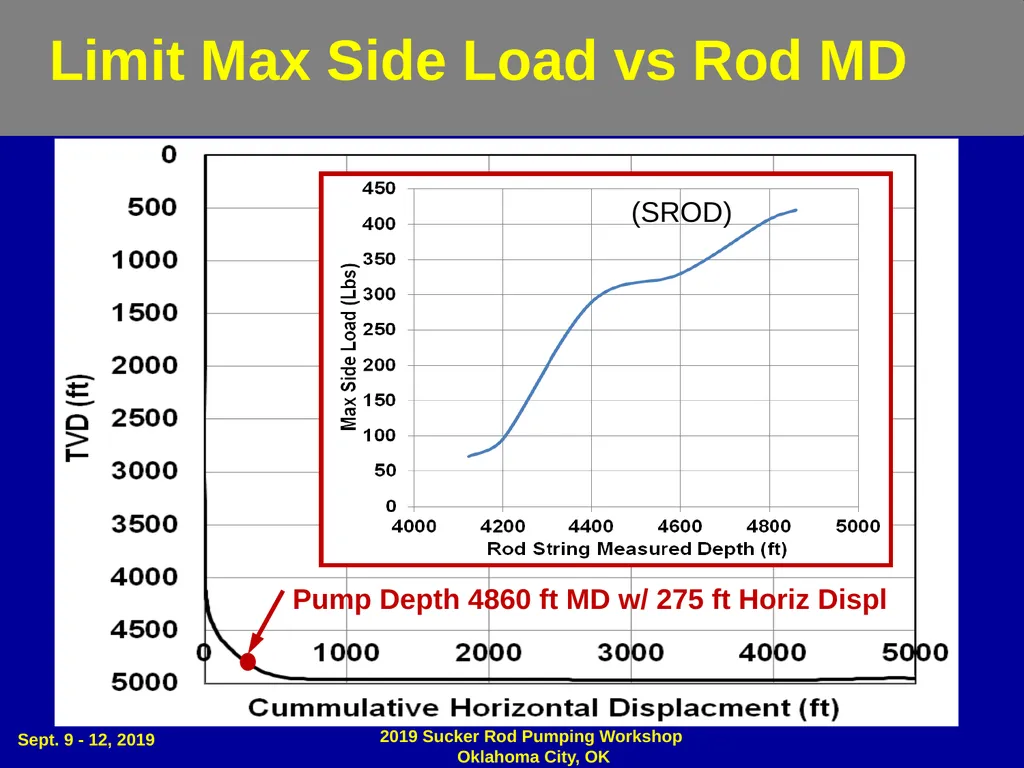
Limit Max Side Load vs Rod MD Pump Depth 4860 ft MD w/ 275 ft Horiz Displ (SROD) 2019 Sucker Rod Pumping Workshop
Oklahoma City, OK Sept. 9 - 12, 2019<br>
Oklahoma City, OK Sept. 9 - 12, 2019<br>
23
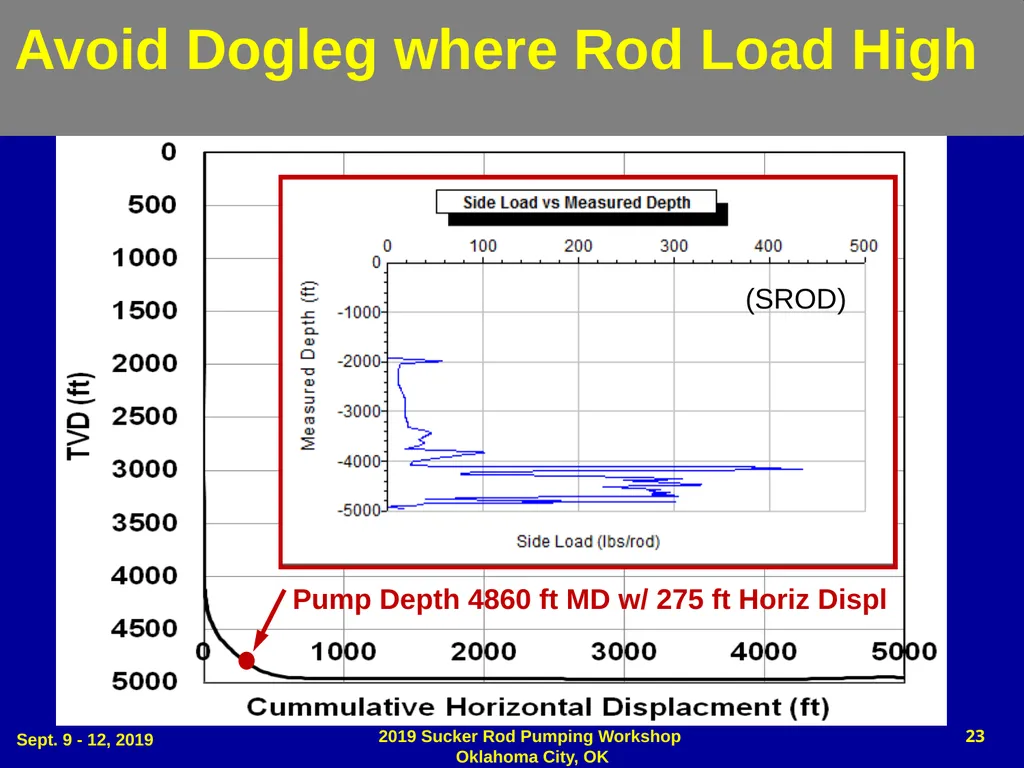
Avoid Dogleg where Rod Load High Pump Depth 4860 ft MD w/ 275 ft Horiz Displ (SROD) 23 2019 Sucker Rod Pumping Workshop
Oklahoma City, OK Sept. 9 - 12, 2019<br>
Oklahoma City, OK Sept. 9 - 12, 2019<br>
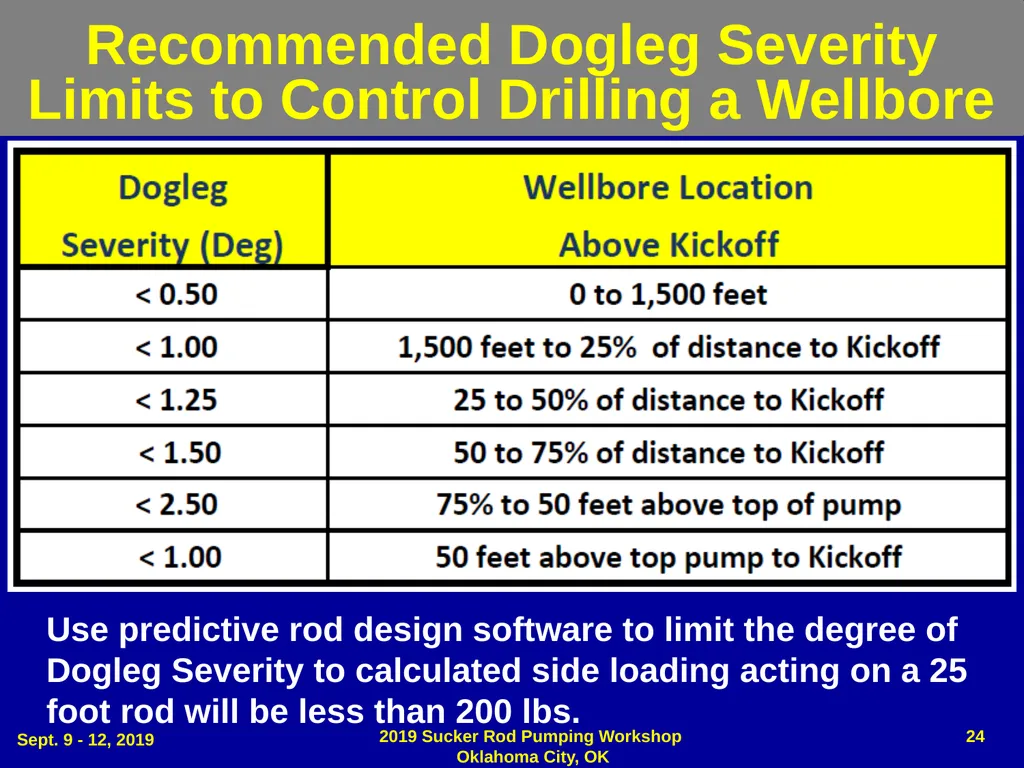
24
Recommended Dogleg Severity Limits to Control Drilling a Wellbore Use predictive rod design software to limit the degree of Dogleg Severity to calculated side loading acting on a 25 foot rod will be less than 200 lbs. 24 2019 Sucker Rod Pumping Workshop
Oklahoma City, OK Sept. 9 - 12, 2019<br>
Oklahoma City, OK Sept. 9 - 12, 2019<br>
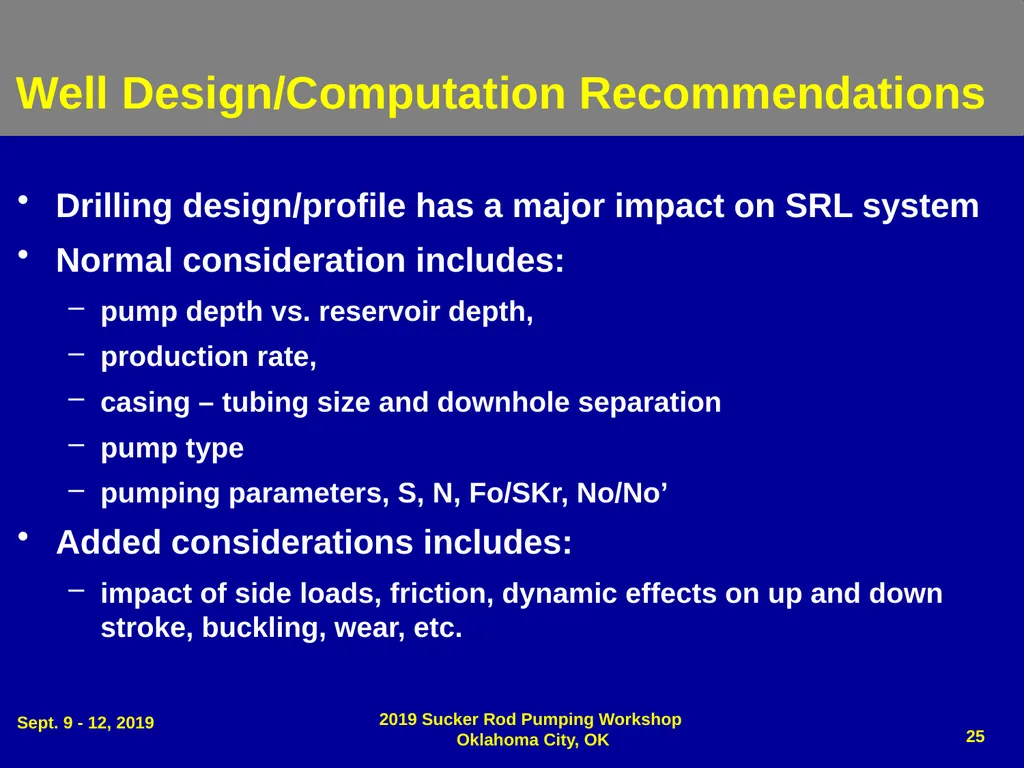
25
Well Design/Computation Recommendations Drilling design/profile has a major impact on SRL system
Normal consideration includes:
pump depth vs. reservoir depth,
production rate,
casing – tubing size and downhole separation
pump type
pumping parameters, S, N, Fo/SKr, No/No’
Added considerations includes:
impact of side loads, friction, dynamic effects on up and down stroke, buckling, wear, etc. 25 2019 Sucker Rod Pumping Workshop
Oklahoma City, OK Sept. 9 - 12, 2019<br>
Normal consideration includes:
pump depth vs. reservoir depth,
production rate,
casing – tubing size and downhole separation
pump type
pumping parameters, S, N, Fo/SKr, No/No’
Added considerations includes:
impact of side loads, friction, dynamic effects on up and down stroke, buckling, wear, etc. 25 2019 Sucker Rod Pumping Workshop
Oklahoma City, OK Sept. 9 - 12, 2019<br>
26
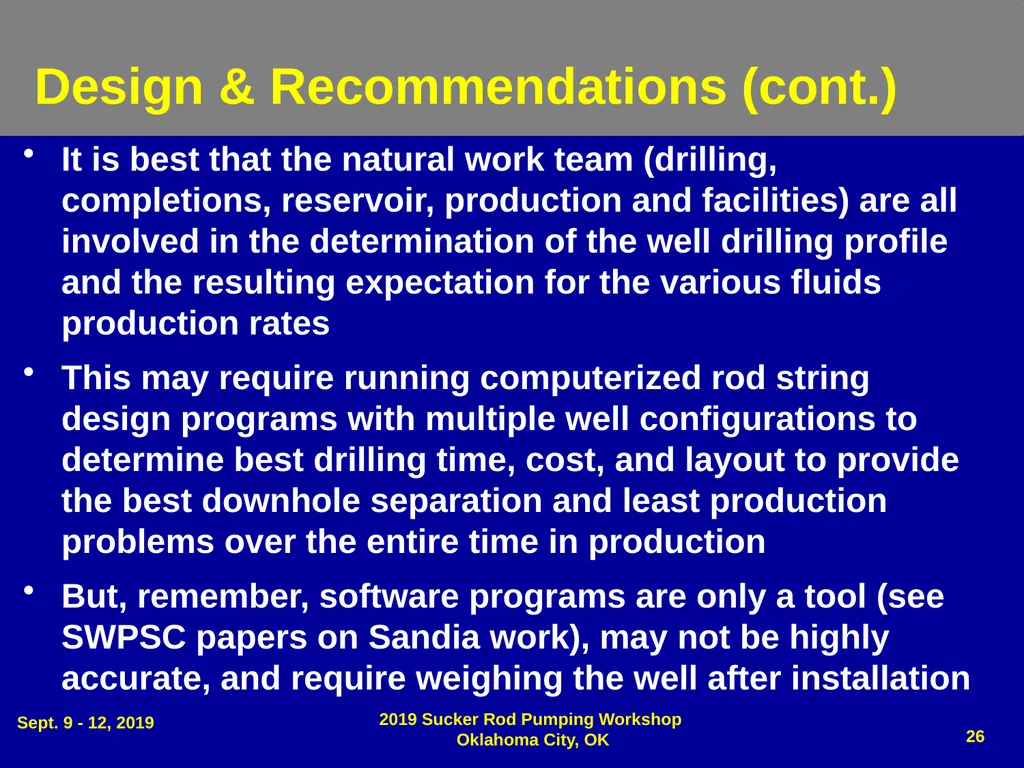
Design & Recommendations (cont.) It is best that the natural work team (drilling, completions, reservoir, production and facilities) are all involved in the determination of the well drilling profile and the resulting expectation for the various fluids production rates
This may require running computerized rod string design programs with multiple well configurations to determine best drilling time, cost, and layout to provide the best downhole separation and least production problems over the entire time in production
But, remember, software programs are only a tool (see SWPSC papers on Sandia work), may not be highly accurate, and require weighing the well after installation 26 2019 Sucker Rod Pumping Workshop
Oklahoma City, OK Sept. 9 - 12, 2019<br>
This may require running computerized rod string design programs with multiple well configurations to determine best drilling time, cost, and layout to provide the best downhole separation and least production problems over the entire time in production
But, remember, software programs are only a tool (see SWPSC papers on Sandia work), may not be highly accurate, and require weighing the well after installation 26 2019 Sucker Rod Pumping Workshop
Oklahoma City, OK Sept. 9 - 12, 2019<br>
27
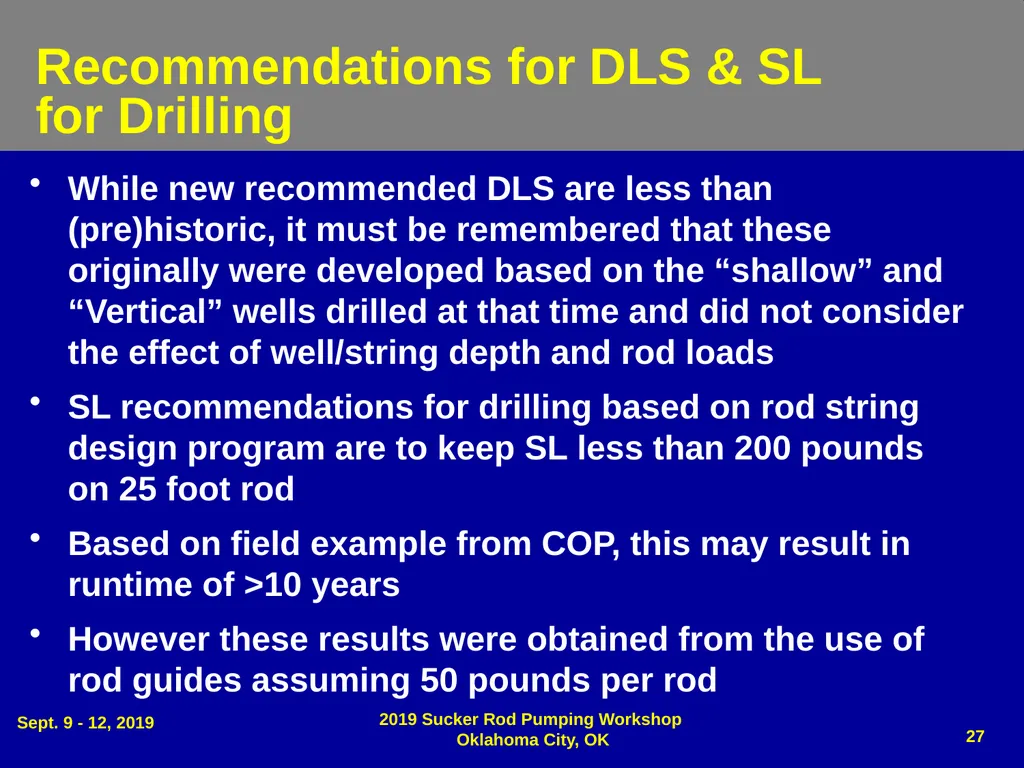
Recommendations for DLS & SL for Drilling While new recommended DLS are less than (pre)historic, it must be remembered that these originally were developed based on the “shallow” and “Vertical” wells drilled at that time and did not consider the effect of well/string depth and rod loads
SL recommendations for drilling based on rod string design program are to keep SL less than 200 pounds on 25 foot rod
Based on field example from COP, this may result in runtime of >10 years
However these results were obtained from the use of rod guides assuming 50 pounds per rod 27 2019 Sucker Rod Pumping Workshop
Oklahoma City, OK Sept. 9 - 12, 2019<br>
SL recommendations for drilling based on rod string design program are to keep SL less than 200 pounds on 25 foot rod
Based on field example from COP, this may result in runtime of >10 years
However these results were obtained from the use of rod guides assuming 50 pounds per rod 27 2019 Sucker Rod Pumping Workshop
Oklahoma City, OK Sept. 9 - 12, 2019<br>
28
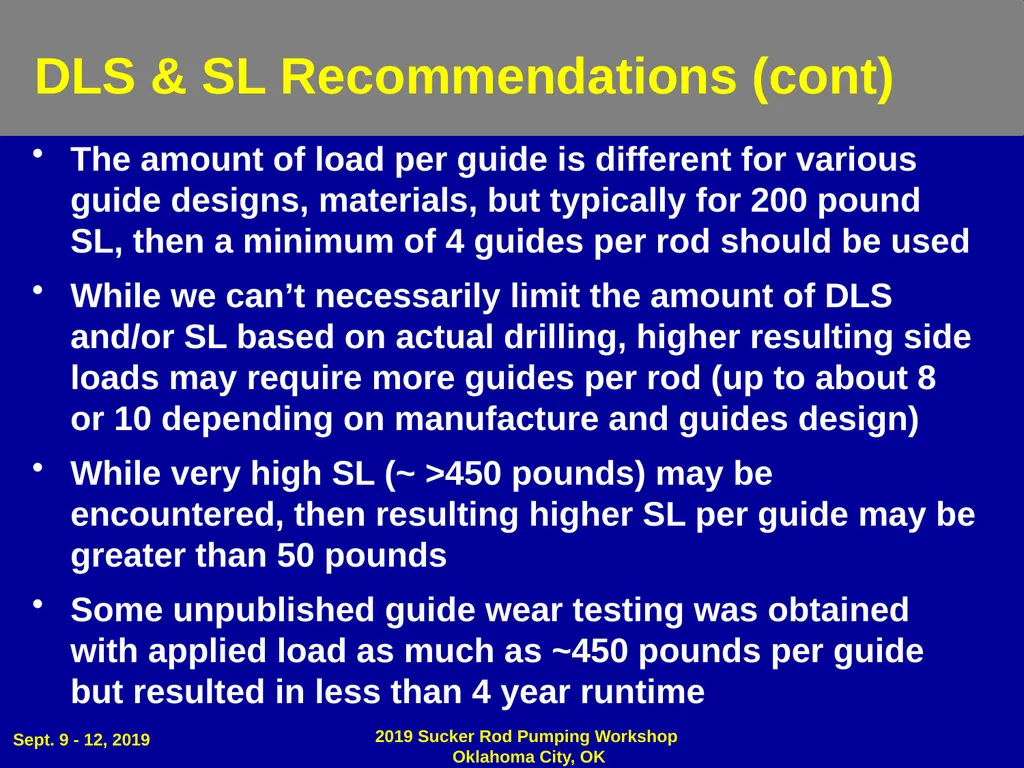
DLS & SL Recommendations (cont) The amount of load per guide is different for various guide designs, materials, but typically for 200 pound SL, then a minimum of 4 guides per rod should be used
While we can’t necessarily limit the amount of DLS and/or SL based on actual drilling, higher resulting side loads may require more guides per rod (up to about 8 or 10 depending on manufacture and guides design)
While very high SL (~ >450 pounds) may be encountered, then resulting higher SL per guide may be greater than 50 pounds
Some unpublished guide wear testing was obtained with applied load as much as ~450 pounds per guide but resulted in less than 4 year runtime 2019 Sucker Rod Pumping Workshop
Oklahoma City, OK Sept. 9 - 12, 2019<br>
While we can’t necessarily limit the amount of DLS and/or SL based on actual drilling, higher resulting side loads may require more guides per rod (up to about 8 or 10 depending on manufacture and guides design)
While very high SL (~ >450 pounds) may be encountered, then resulting higher SL per guide may be greater than 50 pounds
Some unpublished guide wear testing was obtained with applied load as much as ~450 pounds per guide but resulted in less than 4 year runtime 2019 Sucker Rod Pumping Workshop
Oklahoma City, OK Sept. 9 - 12, 2019<br>
29
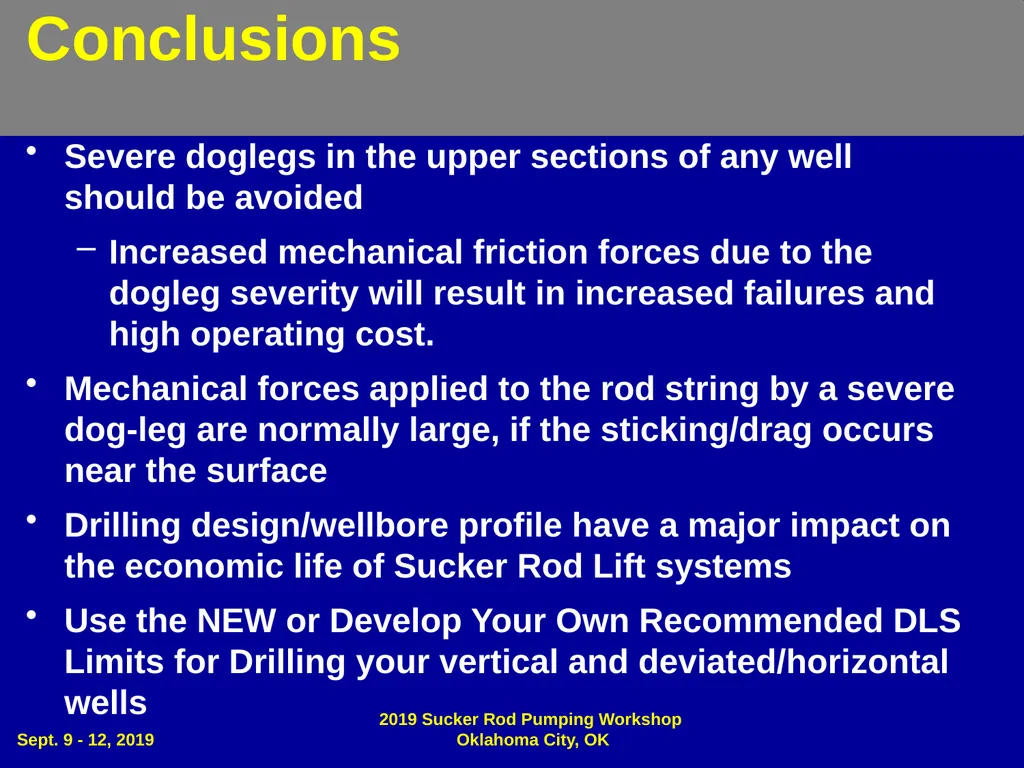
Conclusions Severe doglegs in the upper sections of any well should be avoided
Increased mechanical friction forces due to the dogleg severity will result in increased failures and high operating cost.
Mechanical forces applied to the rod string by a severe dog-leg are normally large, if the sticking/drag occurs near the surface
Drilling design/wellbore profile have a major impact on the economic life of Sucker Rod Lift systems
Use the NEW or Develop Your Own Recommended DLS Limits for Drilling your vertical and deviated/horizontal wells 2019 Sucker Rod Pumping Workshop
Oklahoma City, OK Sept. 9 - 12, 2019<br>
Increased mechanical friction forces due to the dogleg severity will result in increased failures and high operating cost.
Mechanical forces applied to the rod string by a severe dog-leg are normally large, if the sticking/drag occurs near the surface
Drilling design/wellbore profile have a major impact on the economic life of Sucker Rod Lift systems
Use the NEW or Develop Your Own Recommended DLS Limits for Drilling your vertical and deviated/horizontal wells 2019 Sucker Rod Pumping Workshop
Oklahoma City, OK Sept. 9 - 12, 2019<br>
30
CONTACTS Norman W. Hein, Jr.
President
Oil & Gas Optimization Specialists, LTD
Bethel Park, PA
412.833.3620 (Best contact) / nwhein@prodigy.net
O. Lynn Rowlan
Engineer
Echometer
Wichita Falls, TX
940.767.4334 x115 / lynn@Echometer.com 30 2019 Sucker Rod Pumping Workshop
Oklahoma City, OK Sept. 9 - 12, 2019<br>
President
Oil & Gas Optimization Specialists, LTD
Bethel Park, PA
412.833.3620 (Best contact) / nwhein@prodigy.net
O. Lynn Rowlan
Engineer
Echometer
Wichita Falls, TX
940.767.4334 x115 / lynn@Echometer.com 30 2019 Sucker Rod Pumping Workshop
Oklahoma City, OK Sept. 9 - 12, 2019<br>
31
Copyright Rights to this presentation are owned by the company(ies) and/or author(s) listed on the title page. By submitting this presentation to the Sucker Rod Pumping Workshop, they grant to the Workshop, the Artificial Lift Research and Development Council (ALRDC), and the Southwestern Petroleum Short Course (SWPSC), rights to:
Display the presentation at the Workshop.
Place it on the www.alrdc.com web site, with access to the site to be as directed by the Workshop Steering Committee.
Place it on a CD for distribution and/or sale as directed by the Workshop Steering Committee.
Other use of this presentation is prohibited without the expressed written permission of the author(s). The owner company(ies) and/or author(s) may publish this material in other journals or magazines if they refer to the Sucker Rod Pumping Workshop where it was first presented. 31 2019 Sucker Rod Pumping Workshop
Oklahoma City, OK Sept. 9 - 12, 2019<br>
Display the presentation at the Workshop.
Place it on the www.alrdc.com web site, with access to the site to be as directed by the Workshop Steering Committee.
Place it on a CD for distribution and/or sale as directed by the Workshop Steering Committee.
Other use of this presentation is prohibited without the expressed written permission of the author(s). The owner company(ies) and/or author(s) may publish this material in other journals or magazines if they refer to the Sucker Rod Pumping Workshop where it was first presented. 31 2019 Sucker Rod Pumping Workshop
Oklahoma City, OK Sept. 9 - 12, 2019<br>
32
Disclaimer 32 2019 Sucker Rod Pumping Workshop
Oklahoma City, OK Sept. 9 - 12, 2019 The following disclaimer shall be included as the last page of a Technical Presentation or Continuing Education Course. A similar disclaimer is included on the front page of the Sucker Rod Pumping Web Site.
The Artificial Lift Research and Development Council and its officers and trustees, and the Sucker Rod Pumping Steering Committee members, and their supporting organizations and companies (here-in-after referred to as the Sponsoring Organizations), and the author(s) of this Technical Presentation or Continuing Education Training Course and their company(ies), provide this presentation and/or training material at the Sucker Rod Pumping Workshop "as is" without any warranty of any kind, express or implied, as to the accuracy of the information or the products or services referred to by any presenter (in so far as such warranties may be excluded under any relevant law) and these members and their companies will not be liable for unlawful actions and any losses or damage that may result from use of any presentation as a consequence of any inaccuracies in, or any omission from, the information which therein may be contained.
The views, opinions, and conclusions expressed in these presentations and/or training materials are those of the author and not necessarily those of the Sponsoring Organizations. The author is solely responsible for the content of the materials.
The Sponsoring Organizations cannot and do not warrant the accuracy of these documents beyond the source documents, although we do make every attempt to work from authoritative sources. The Sponsoring Organizations provide these presentations and/or training materials as a service. The Sponsoring Organizations make no representations or warranties, express or implied, with respect to the presentations and/or training materials, or any part thereof, including any warrantees of title, non-infringement of copyright or patent rights of others, merchantability, or fitness or suitability for any purpose.<br>
Oklahoma City, OK Sept. 9 - 12, 2019 The following disclaimer shall be included as the last page of a Technical Presentation or Continuing Education Course. A similar disclaimer is included on the front page of the Sucker Rod Pumping Web Site.
The Artificial Lift Research and Development Council and its officers and trustees, and the Sucker Rod Pumping Steering Committee members, and their supporting organizations and companies (here-in-after referred to as the Sponsoring Organizations), and the author(s) of this Technical Presentation or Continuing Education Training Course and their company(ies), provide this presentation and/or training material at the Sucker Rod Pumping Workshop "as is" without any warranty of any kind, express or implied, as to the accuracy of the information or the products or services referred to by any presenter (in so far as such warranties may be excluded under any relevant law) and these members and their companies will not be liable for unlawful actions and any losses or damage that may result from use of any presentation as a consequence of any inaccuracies in, or any omission from, the information which therein may be contained.
The views, opinions, and conclusions expressed in these presentations and/or training materials are those of the author and not necessarily those of the Sponsoring Organizations. The author is solely responsible for the content of the materials.
The Sponsoring Organizations cannot and do not warrant the accuracy of these documents beyond the source documents, although we do make every attempt to work from authoritative sources. The Sponsoring Organizations provide these presentations and/or training materials as a service. The Sponsoring Organizations make no representations or warranties, express or implied, with respect to the presentations and/or training materials, or any part thereof, including any warrantees of title, non-infringement of copyright or patent rights of others, merchantability, or fitness or suitability for any purpose.<br>