
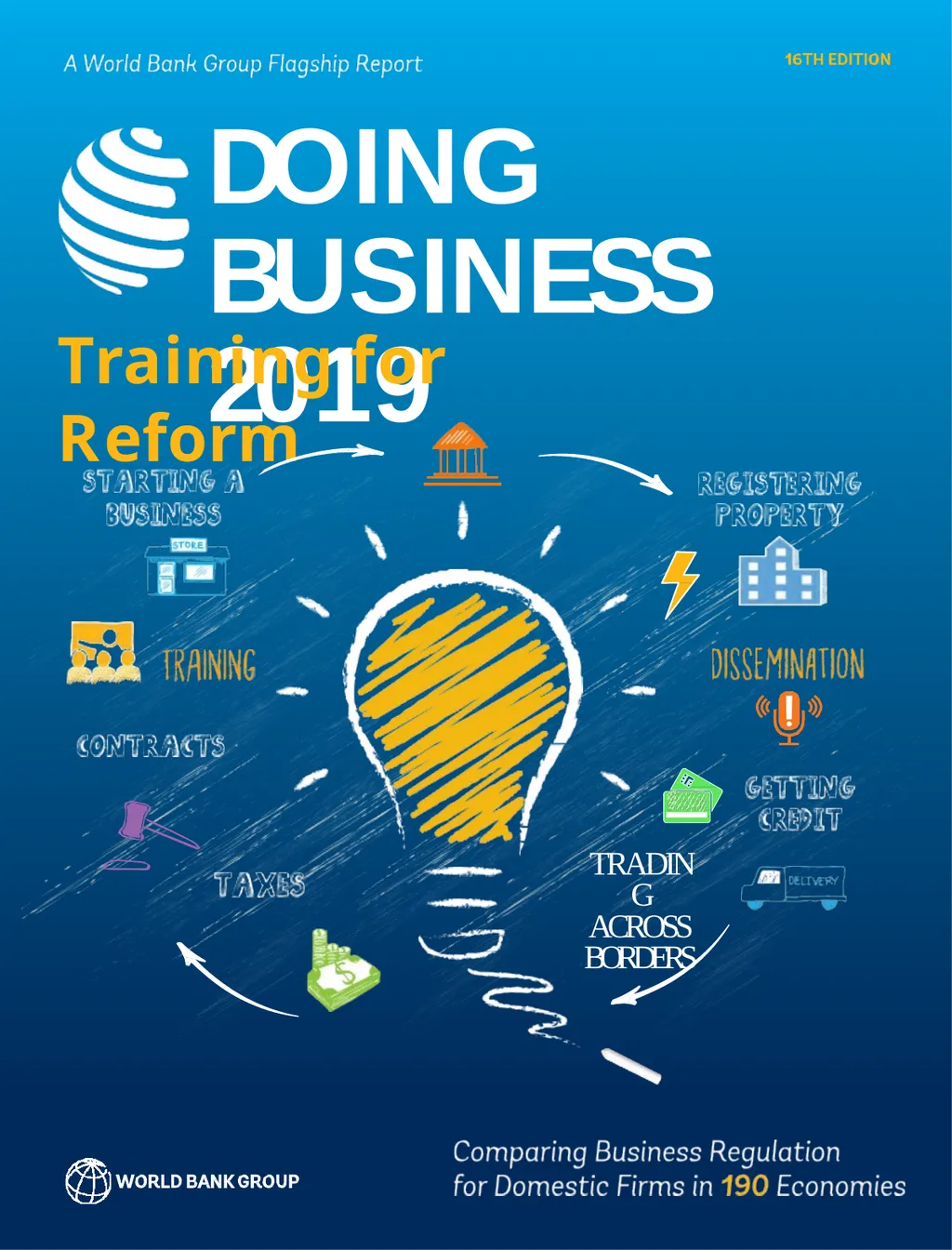
DOING BUSINESS 2019 Training for Reform TRADING
LV
Published · 72 slides · 0 views

1 / 1
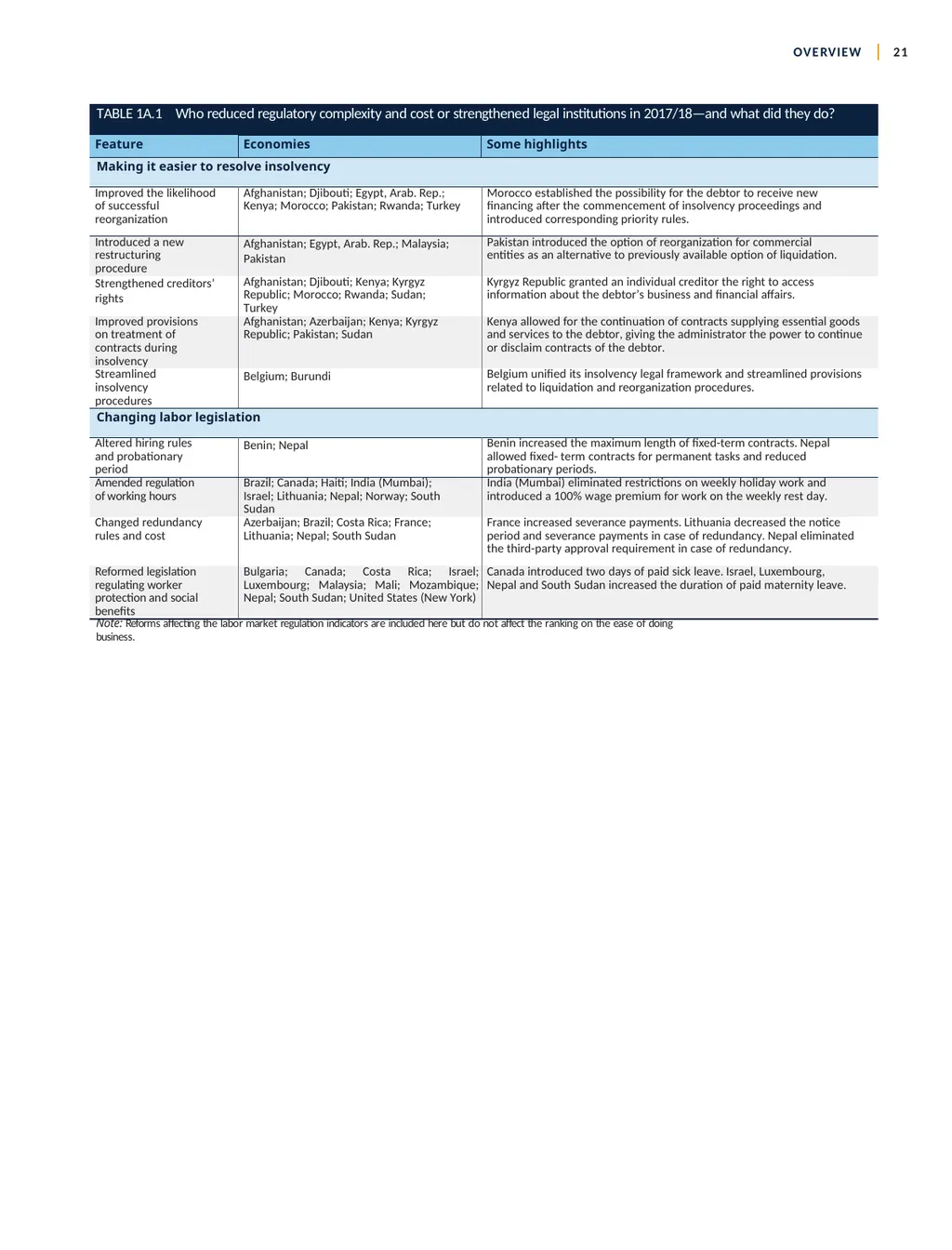
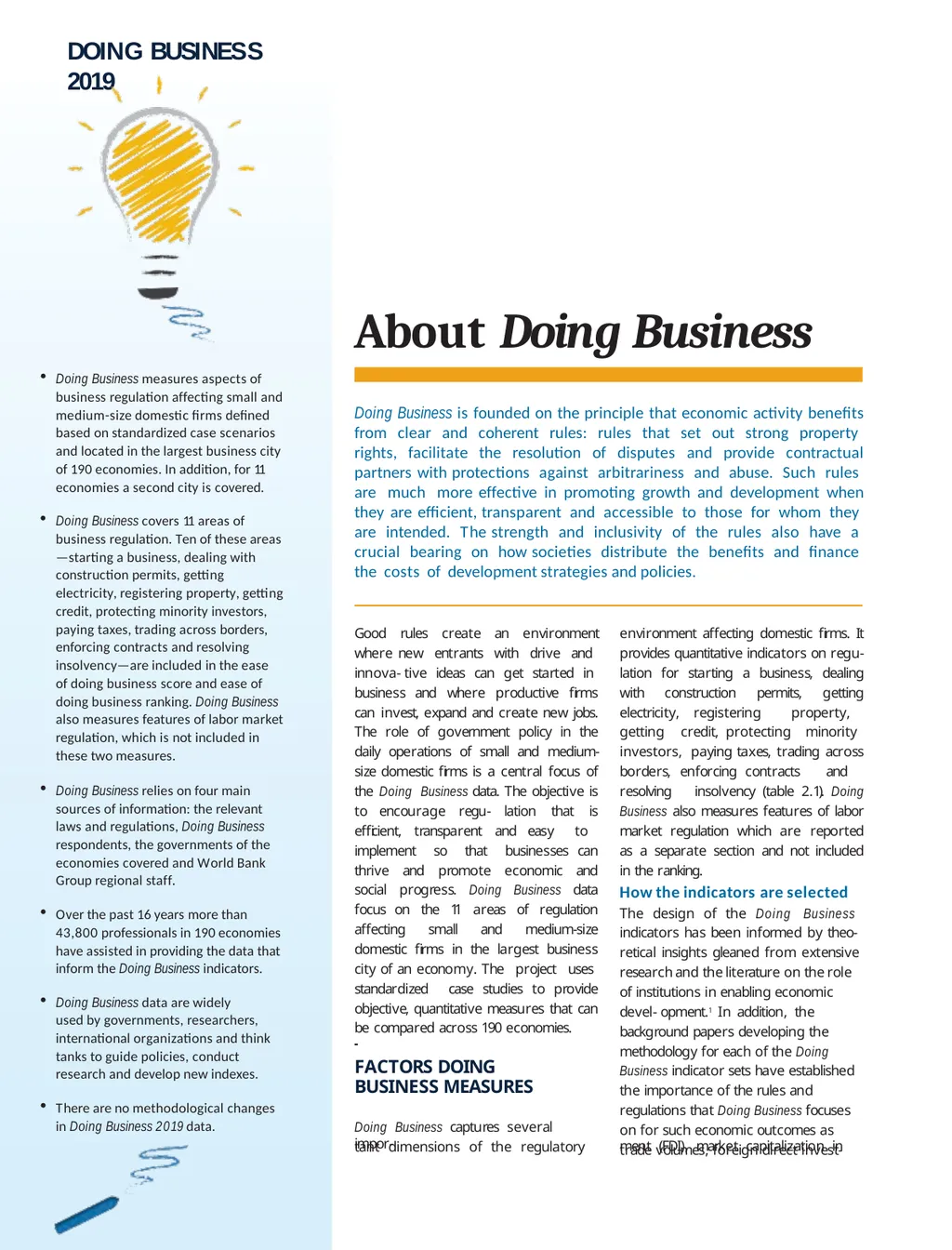
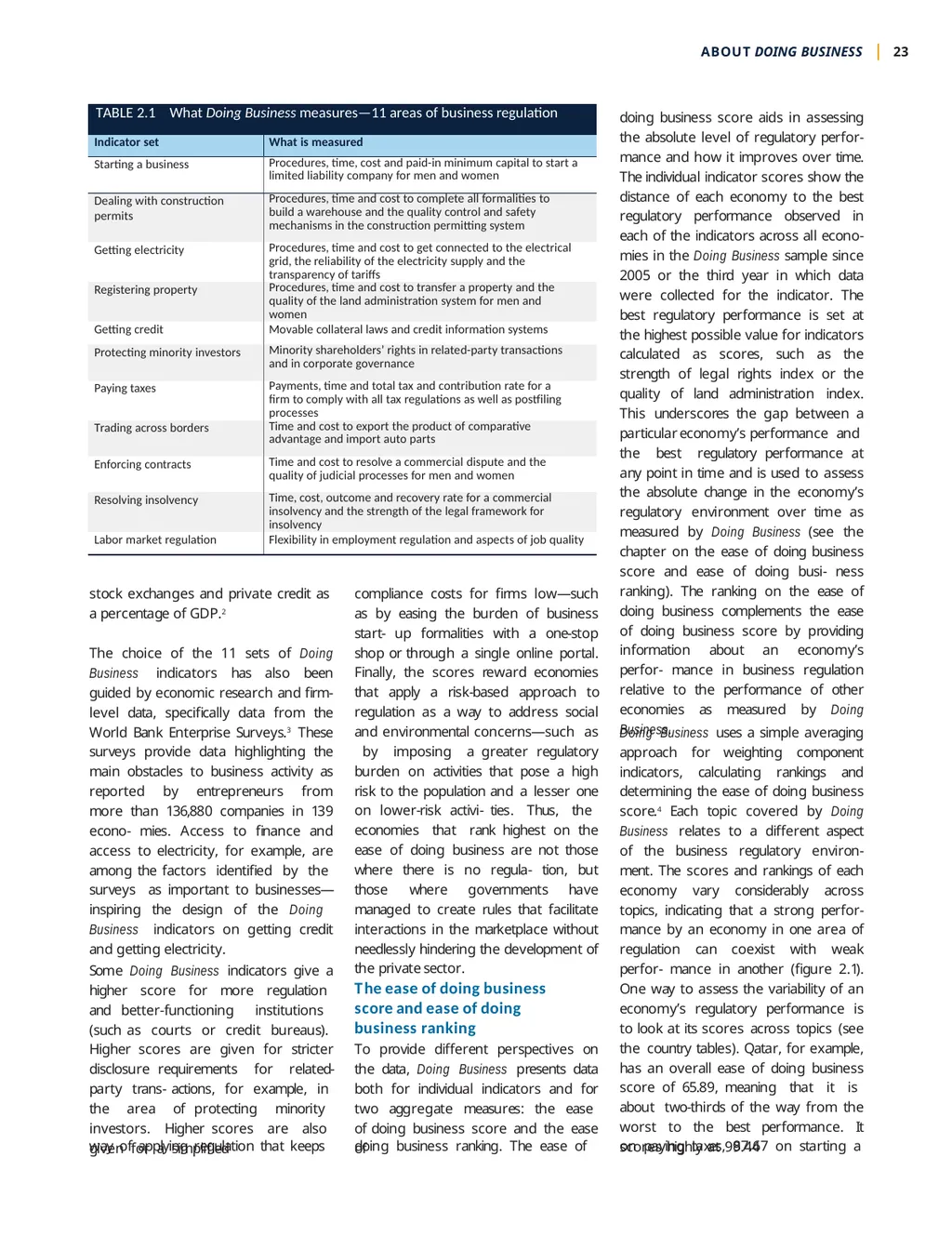
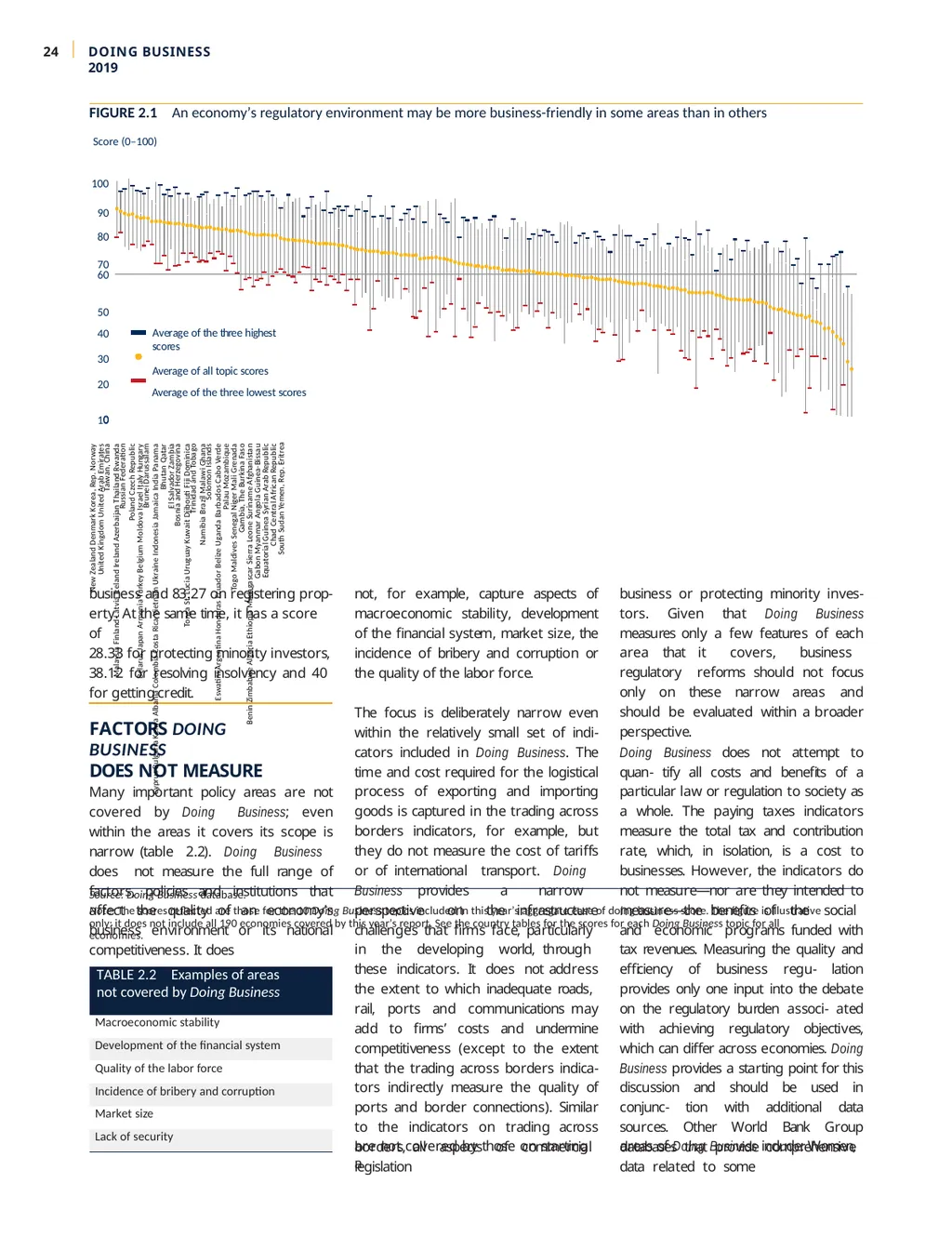
Description
DOING BUSINESS 2019 Training for Reform TRADING ACROSS BORDERS DOING BUSINESS 2019 Doing Business 2019 is the 16th in a series of annual reports investigating the regulations that enhance business activity and those that constrain it. Doing
Related Topics
Share
Embed code
Download this presentation From Below
"DOING BUSINESS 2019 Training for Reform TRADING" is the property of its rightful owner. Permission is granted to download and print the materials on this website for personal, non-commercial use only, and to display it on your personal computer provided you do not modify the materials and that you retain all copyright notices contained in the materials. By downloading content from our website, you accept the terms of this agreement.
Presentation Transcript
01
DOING
BUSINESS 2019 Training for Reform TRADING ACROSS BORDERS<br>
BUSINESS 2019 Training for Reform TRADING ACROSS BORDERS<br>
02
DOING BUSINESS 2019 Doing Business 2019 is the 16th in a series of annual reports investigating the regulations that enhance business activity and those that constrain it.
Doing Business presents quantitative indicators on business regulation and the protection of property rights that can be compared across 190 economies—from Afghanistan to Zimbabwe—and over time.
Regulations affecting 11 areas of the life of a business are covered: starting a business, dealing with construction permits, getting electricity, registering property, getting credit, protecting
minority investors, paying taxes, trading across borders, enforcing contracts, resolving insolvency and labor market regulation. The labor market regulation data are not included in this year’s ranking on the ease of doing business.
Data in Doing Business 2019 are current as of May 1, 2018. The indicators are used to analyze economic outcomes and identify what reforms of business regulation have worked, where and why. iv Foreword
1 Overview
22 About Doing Business
Case studies
33 Starting a Business and Registering Property:
The role of training in facilitating entrepreneurship and property rights
39 Getting Electricity:
Understanding the benefits of wiring regulation
46 Trading Across Borders:
Training for trade facilitation
53 Enforcing Contracts and Resolving Insolvency:
Training and efficiency in the judicial system
61 Annex: Labor Market Regulation:
Trends from Doing Business data
67 References
73 Data Notes
126 Ease of Doing Business Score and Ease of Doing Business Ranking
133 Summaries of Doing Business Reforms in 2017/18
152 Country Tables
216 Acknowledgments Contents<br>
Doing Business presents quantitative indicators on business regulation and the protection of property rights that can be compared across 190 economies—from Afghanistan to Zimbabwe—and over time.
Regulations affecting 11 areas of the life of a business are covered: starting a business, dealing with construction permits, getting electricity, registering property, getting credit, protecting
minority investors, paying taxes, trading across borders, enforcing contracts, resolving insolvency and labor market regulation. The labor market regulation data are not included in this year’s ranking on the ease of doing business.
Data in Doing Business 2019 are current as of May 1, 2018. The indicators are used to analyze economic outcomes and identify what reforms of business regulation have worked, where and why. iv Foreword
1 Overview
22 About Doing Business
Case studies
33 Starting a Business and Registering Property:
The role of training in facilitating entrepreneurship and property rights
39 Getting Electricity:
Understanding the benefits of wiring regulation
46 Trading Across Borders:
Training for trade facilitation
53 Enforcing Contracts and Resolving Insolvency:
Training and efficiency in the judicial system
61 Annex: Labor Market Regulation:
Trends from Doing Business data
67 References
73 Data Notes
126 Ease of Doing Business Score and Ease of Doing Business Ranking
133 Summaries of Doing Business Reforms in 2017/18
152 Country Tables
216 Acknowledgments Contents<br>
03
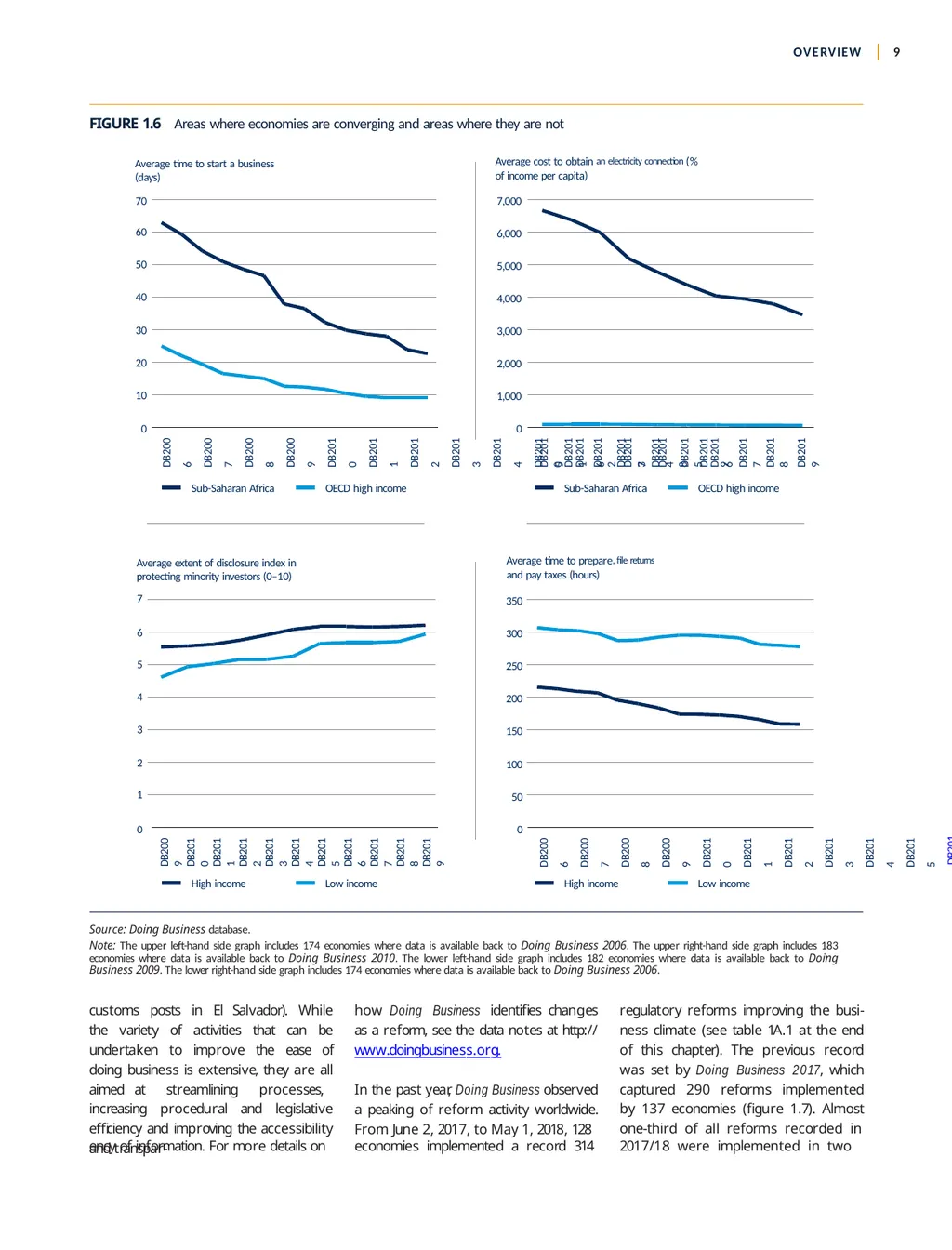
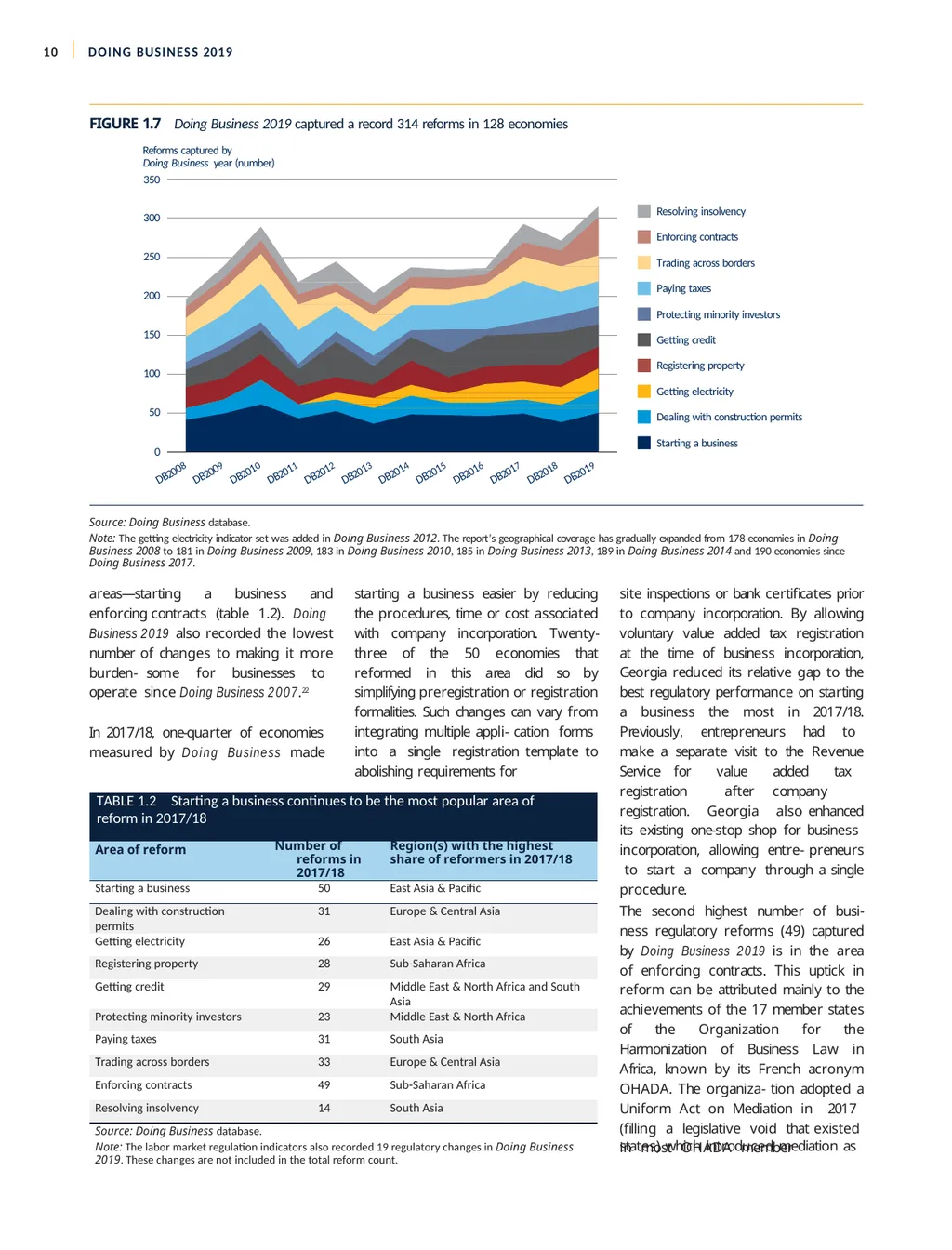
DOING BUSINESS 2019 What gets measured gets done. Over the past 15 years, no report has illustrated this aphorism better than Doing Business. Anchored in rigorous research and methodology, Doing Business gathers detailed and objective data on 11 areas of business regulation, helping govern- ments diagnose issues in administrative procedures and correct them. The report measures complex regulatory pro- cesses by zeroing in on their quantifiable components, which can be contested, compared—over time and across econo- mies—and, ultimately, reformed. Doing Business has inspired thousands of articles published in peer-reviewed jour- nals and created a platform for informed debate about regulatory and institutional frameworks for economic development. Many Doing Business indicators have been incorporated into the indexes of other institutions, which has spurred more debate about the ideal business climate to drive inclusive, sustainable economic growth. Since its launch in 2003, Doing Business has inspired more than 3,500 reforms in the 10 areas of business regulation measured by the report. This year, we observed a peak in reform activity worldwide—128 economies undertook a record 314 reforms in 2017/18. Around the world, registering a business now takes an average of 20 days and costs 23% of income per capita, compared to 47 days and 76% of income per capita in 2006. Even more telling, today the average paid-in minimum capital that entrepreneurs must deposit is 6% of income per capita, compared with 145% of income per capita in 2006. The global average time to prepare, file and pay taxes has fallen from 324 hours in 2005 to 237 hours in 2017. Sub-Saharan Africa has been the region with the highest number of reforms each year since 2012. This year, Doing Business captured a record 107 reforms across 40 economies in Sub-Saharan Africa, and the region’s private sector is feeling the impact of these improvements. The aver- age time and cost to register a business, for example, has declined from 59 days and 192% of income per capita in 2006 to 23 days and 40% of income per capita today. Furthermore, the average paid-in minimum capital has fallen from 212% of income per capita to 11% of income per capita in the same period. This year’s 10 top improvers include a range of economies—large and small; rich and poor—from five regions. The diversity shows that, regardless of background, any economy can improve business regulation when the will of policy makers is strong. With 13 reforms between them, China and India—two of the world’s largest economies—are among the 10 top improvers. At the same Foreword<br>
04
v FOREWORD Jim Yong Kim
President World Bank Group time Djibouti, a small economy, is also on the list with six reforms. And with a total of 12 business regulatory reforms between them, Afghanistan and Turkey are on the list of 10 top improvers for the first time in the report’s history. Perhaps most notably, four of the 10 top improvers—Afghanistan, Djibouti, Côte d’Ivoire and Togo—are countries suffering from fragility, conflict and vio- lence. The World Bank Group and other organizations have worked closely with these economies to address pressing humanitarian and developmental needs, while also strengthening their legal and economic institutions. Doing Business taught us that even with comprehensive evidence, reforms do not necessarily follow. A ranking helps put the information in front of leaders and makes it hard to ignore. The report helped inspire the Human Capital Index (HCI), which we launched at the 2018 Annual Meetings in Indonesia. Like Doing Business, the HCI is based on the idea that, regardless of how complex an area may be, with solid research and methodology it can be measured. These types of data promote reform, not only because they are easy to analyze, trace and act on, but also because they increase transparency and accountability.
Governments have the enormous task of fostering an enabling environ- ment for entrepreneurs and small and medium-size enterprises. Sound and efficient business regulation is critical for entrepreneurship and a thriving private sector. Without them, we have no chance to end extreme poverty and boost shared prosperity around the world. International institutions and research centers can play a central role by build- ing a solid base of knowledge and data to inform governments, researchers and the general public. With Doing Business, the World Bank Group is fully commit- ted to this mission. The reforms that the report inspires will help people reach their aspirations; drive inclusive, sustain- able economic growth; and bring us one step closer to ending poverty on the face of the earth.<br>
President World Bank Group time Djibouti, a small economy, is also on the list with six reforms. And with a total of 12 business regulatory reforms between them, Afghanistan and Turkey are on the list of 10 top improvers for the first time in the report’s history. Perhaps most notably, four of the 10 top improvers—Afghanistan, Djibouti, Côte d’Ivoire and Togo—are countries suffering from fragility, conflict and vio- lence. The World Bank Group and other organizations have worked closely with these economies to address pressing humanitarian and developmental needs, while also strengthening their legal and economic institutions. Doing Business taught us that even with comprehensive evidence, reforms do not necessarily follow. A ranking helps put the information in front of leaders and makes it hard to ignore. The report helped inspire the Human Capital Index (HCI), which we launched at the 2018 Annual Meetings in Indonesia. Like Doing Business, the HCI is based on the idea that, regardless of how complex an area may be, with solid research and methodology it can be measured. These types of data promote reform, not only because they are easy to analyze, trace and act on, but also because they increase transparency and accountability.
Governments have the enormous task of fostering an enabling environ- ment for entrepreneurs and small and medium-size enterprises. Sound and efficient business regulation is critical for entrepreneurship and a thriving private sector. Without them, we have no chance to end extreme poverty and boost shared prosperity around the world. International institutions and research centers can play a central role by build- ing a solid base of knowledge and data to inform governments, researchers and the general public. With Doing Business, the World Bank Group is fully commit- ted to this mission. The reforms that the report inspires will help people reach their aspirations; drive inclusive, sustain- able economic growth; and bring us one step closer to ending poverty on the face of the earth.<br>
05
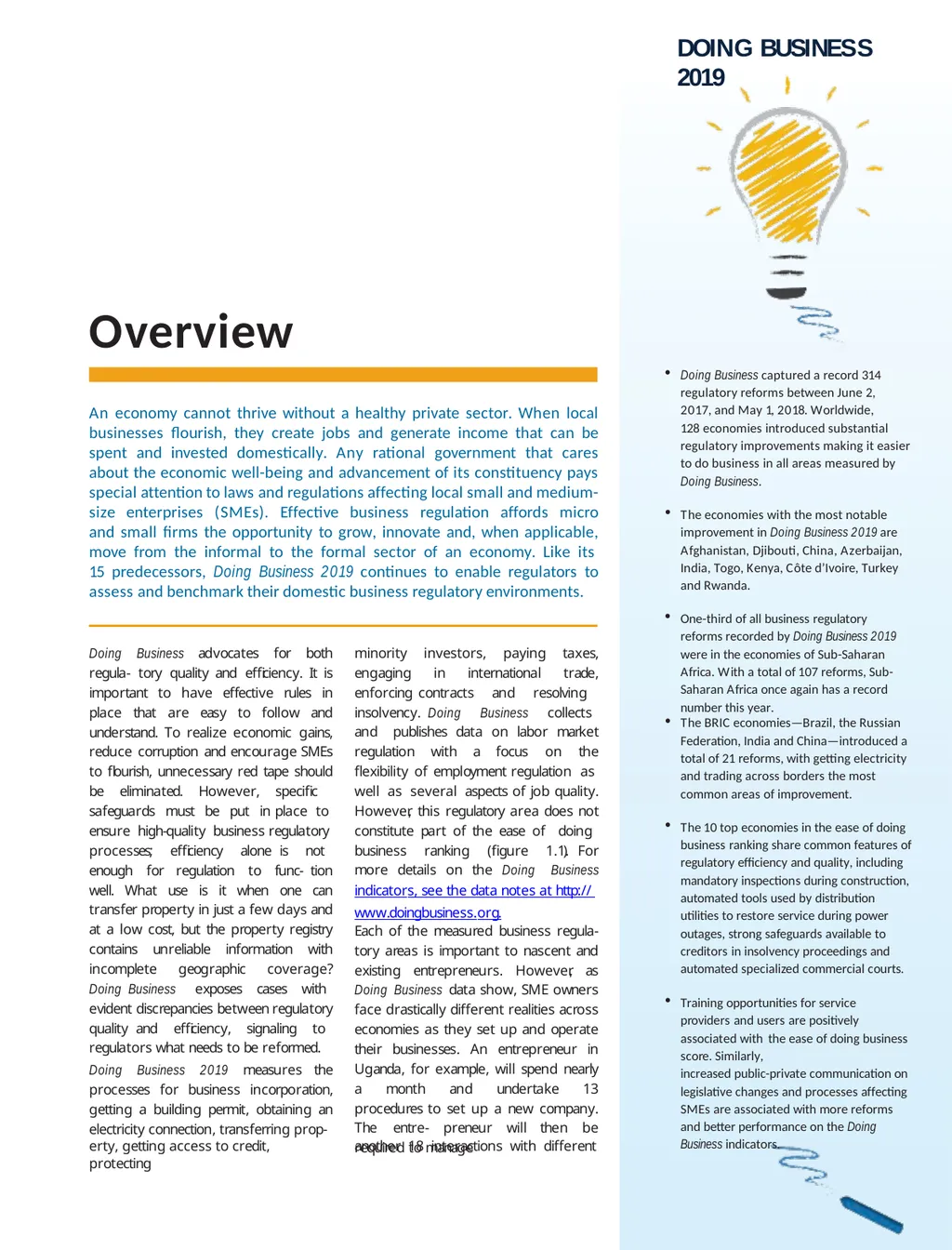
DOING BUSINESS 2019 An economy cannot thrive without a healthy private sector. When local businesses flourish, they create jobs and generate income that can be spent and invested domestically. Any rational government that cares about the economic well-being and advancement of its constituency pays special attention to laws and regulations affecting local small and medium- size enterprises (SMEs). Effective business regulation affords micro and small firms the opportunity to grow, innovate and, when applicable, move from the informal to the formal sector of an economy. Like its 15 predecessors, Doing Business 2019 continues to enable regulators to assess and benchmark their domestic business regulatory environments. erty, getting access to credit, protecting another 18 interactions with different Doing Business advocates for both regula- tory quality and efficiency. It is important to have effective rules in place that are easy to follow and understand. To realize economic gains, reduce corruption and encourage SMEs to flourish, unnecessary red tape should be eliminated. However, specific safeguards must be put in place to ensure high-quality business regulatory processes; efficiency alone is not enough for regulation to func- tion well. What use is it when one can transfer property in just a few days and at a low cost, but the property registry contains unreliable information with incomplete geographic coverage? Doing Business exposes cases with evident discrepancies between regulatory quality and efficiency, signaling to regulators what needs to be reformed. Doing Business 2019 measures the processes for business incorporation, getting a building permit, obtaining an electricity connection, transferring prop- minority investors, paying taxes, engaging in international trade, enforcing contracts and resolving insolvency. Doing Business collects and publishes data on labor market regulation with a focus on the flexibility of employment regulation as well as several aspects of job quality. However, this regulatory area does not constitute part of the ease of doing business ranking (figure 1.1). For more details on the Doing Business indicators, see the data notes at http:// www.doingbusiness.org. Each of the measured business regula- tory areas is important to nascent and existing entrepreneurs. However, as Doing Business data show, SME owners face drastically different realities across economies as they set up and operate their businesses. An entrepreneur in Uganda, for example, will spend nearly a month and undertake 13 procedures to set up a new company. The entre- preneur will then be required to manage Overview Doing Business captured a record 314 regulatory reforms between June 2, 2017, and May 1, 2018. Worldwide, 128 economies introduced substantial
regulatory improvements making it easier to do business in all areas measured by Doing Business. The economies with the most notable improvement in Doing Business 2019 are Afghanistan, Djibouti, China, Azerbaijan, India, Togo, Kenya, Côte d’Ivoire, Turkey and Rwanda. One-third of all business regulatory reforms recorded by Doing Business 2019 were in the economies of Sub-Saharan Africa. With a total of 107 reforms, Sub-Saharan Africa once again has a record number this year. The BRIC economies—Brazil, the Russian Federation, India and China—introduced a total of 21 reforms, with getting electricity and trading across borders the most common areas of improvement. The 10 top economies in the ease of doing business ranking share common features of regulatory efficiency and quality, including mandatory inspections during construction, automated tools used by distribution utilities to restore service during power outages, strong safeguards available to creditors in insolvency proceedings and automated specialized commercial courts. Training opportunities for service providers and users are positively associated with the ease of doing business score. Similarly,
increased public-private communication on legislative changes and processes affecting SMEs are associated with more reforms and better performance on the Doing Business indicators.<br>
regulatory improvements making it easier to do business in all areas measured by Doing Business. The economies with the most notable improvement in Doing Business 2019 are Afghanistan, Djibouti, China, Azerbaijan, India, Togo, Kenya, Côte d’Ivoire, Turkey and Rwanda. One-third of all business regulatory reforms recorded by Doing Business 2019 were in the economies of Sub-Saharan Africa. With a total of 107 reforms, Sub-Saharan Africa once again has a record number this year. The BRIC economies—Brazil, the Russian Federation, India and China—introduced a total of 21 reforms, with getting electricity and trading across borders the most common areas of improvement. The 10 top economies in the ease of doing business ranking share common features of regulatory efficiency and quality, including mandatory inspections during construction, automated tools used by distribution utilities to restore service during power outages, strong safeguards available to creditors in insolvency proceedings and automated specialized commercial courts. Training opportunities for service providers and users are positively associated with the ease of doing business score. Similarly,
increased public-private communication on legislative changes and processes affecting SMEs are associated with more reforms and better performance on the Doing Business indicators.<br>
06
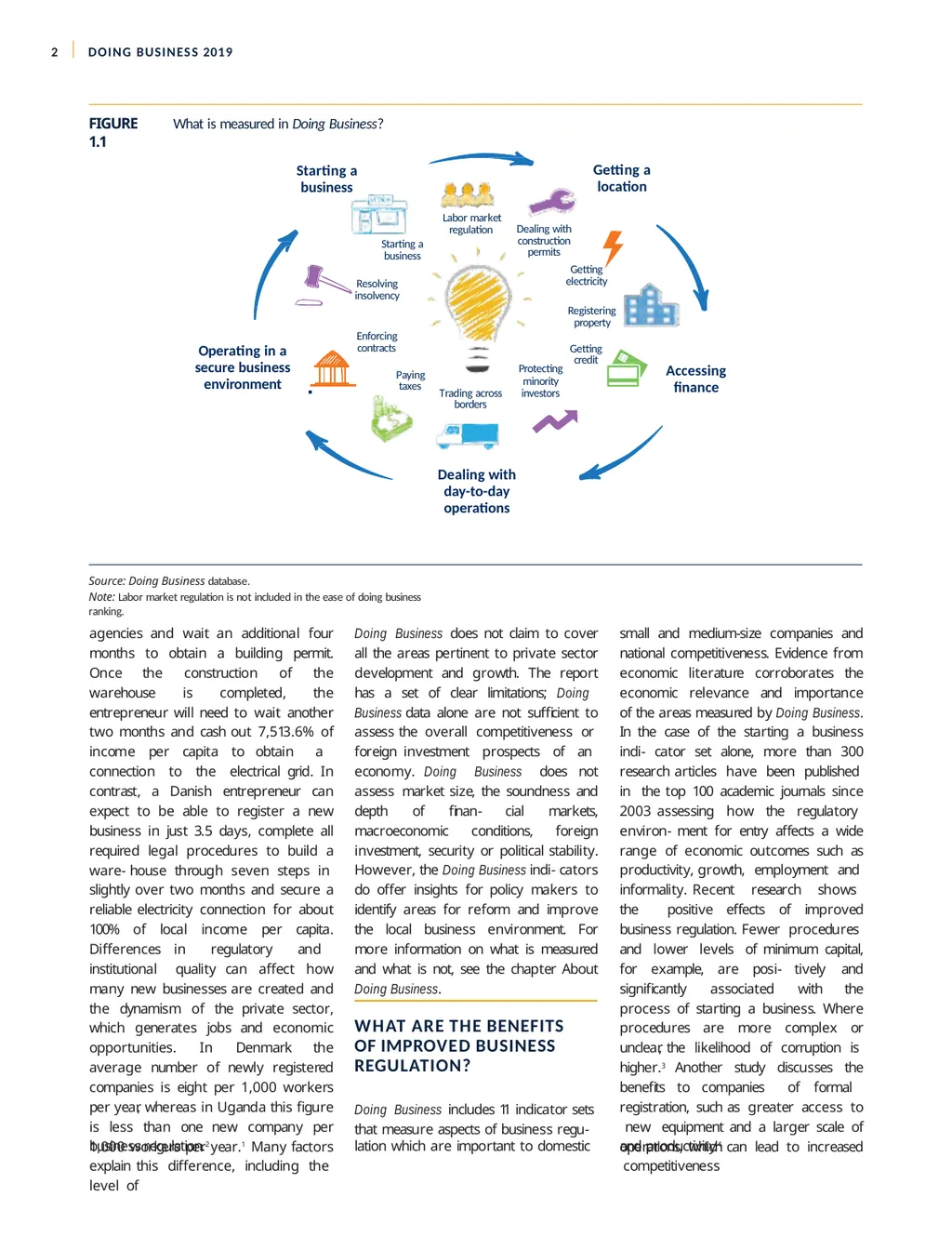
DOING BUSINESS 2019 2 agencies and wait an additional four months to obtain a building permit. Once the construction of the warehouse is completed, the entrepreneur will need to wait another two months and cash out 7,513.6% of income per capita to obtain a connection to the electrical grid. In contrast, a Danish entrepreneur can expect to be able to register a new business in just 3.5 days, complete all required legal procedures to build a ware- house through seven steps in slightly over two months and secure a reliable electricity connection for about 100% of local income per capita. Differences in regulatory and institutional quality can affect how many new businesses are created and the dynamism of the private sector, which generates jobs and economic opportunities. In Denmark the average number of newly registered companies is eight per 1,000 workers per year, whereas in Uganda this figure is less than one new company per 1,000 workers per year.1 Many factors explain this difference, including the level of Doing Business does not claim to cover all the areas pertinent to private sector development and growth. The report has a set of clear limitations; Doing Business data alone are not sufficient to assess the overall competitiveness or foreign investment prospects of an economy. Doing Business does not assess market size, the soundness and depth of finan- cial markets, macroeconomic conditions, foreign investment, security or political stability. However, the Doing Business indi- cators do offer insights for policy makers to identify areas for reform and improve the local business environment. For more information on what is measured and what is not, see the chapter About Doing Business. WHAT ARE THE BENEFITS OF IMPROVED BUSINESS REGULATION? Doing Business includes 11 indicator sets that measure aspects of business regu- small and medium-size companies and national competitiveness. Evidence from economic literature corroborates the economic relevance and importance of the areas measured by Doing Business. In the case of the starting a business indi- cator set alone, more than 300 research articles have been published in the top 100 academic journals since 2003 assessing how the regulatory environ- ment for entry affects a wide range of economic outcomes such as productivity, growth, employment and informality. Recent research shows the positive effects of improved business regulation. Fewer procedures and lower levels of minimum capital, for example, are posi- tively and significantly associated with the process of starting a business. Where procedures are more complex or unclear, the likelihood of corruption is higher.3 Another study discusses the benefits to companies of formal registration, such as greater access to new equipment and a larger scale of operations, which can lead to increased competitiveness FIGURE 1.1 What is measured in Doing Business? Operating in a secure business environment Starting a business Starting a business Dealing with construction permits
Getting electricity Registering property Getting credit
Protecting
minority investors Trading across borders Paying taxes Enforcing contracts Resolving insolvency Labor market regulation Getting a location Accessing finance Dealing with day-to-day operations Source: Doing Business database.
Note: Labor market regulation is not included in the ease of doing business ranking. business regulation.2 lation which are important to domestic and productivity.4<br>
Getting electricity Registering property Getting credit
Protecting
minority investors Trading across borders Paying taxes Enforcing contracts Resolving insolvency Labor market regulation Getting a location Accessing finance Dealing with day-to-day operations Source: Doing Business database.
Note: Labor market regulation is not included in the ease of doing business ranking. business regulation.2 lation which are important to domestic and productivity.4<br>
07
3 OVERVIEW In the context of construction permit- ting, simplicity and transparency are key in allowing businesses to expand and build new and safe infrastruc- ture. Research shows that regulatory burdens often pose substantial obstacles for investors. Discrepancies among existing laws, for example, can lead to unnecessary and even contradictory compliance requirements.5 Furthermore, lengthy processing times for required approvals—as is the case in Ghana—can drive up costs and spur the development of an informal construction sector, where falsified construction permits result in unsafe infrastructure.6 Electricity is a necessity for any business to function properly and expand. It is also an important element in the competitive- ness and strengthening of human capital in an economy. Research data indicate that higher electricity costs tend to have an adverse impact on businesses. As prices rise, firms shift their focus to less electricity-intensive production processes, resulting in reduced output and productivity.7 Equally important is the reliability of a power connection. Recent research finds that power outages and deficient power infrastructure in Sub-Saharan Africa had a measurable negative impact on economic growth over the period 1995−2007.8 Similarly, clearly defined regulation and equal access to property rights are essential for enabling businesses to expand their operations. If governments do not put in place adequate land owner- ship protections and leave investors open to land disputes or property seizures, stakeholders would be disinclined to put money into land and property develop- ment projects. A recent study exploring whether political institutions have an impact on the effectiveness of economic reforms in promoting growth finds that financial and trade reforms are more effective in developing economies with sound property rights. This evidence suggests that sufficiently developed reaping the growth benefits of reform.9 Ample literature on the importance of property rights finds a strong association between investment, access to finance, productivity and economic growth.10 Another area measured by Doing Business is the protection of minority investors. Greater protection helps foster trust and confidence and, in turn, spurs greater access to finance for entre- preneurs.11 The indicator set focuses on how policy makers mitigate the risk that corporate executives, directors and majority shareholders will use their posi- tion to advance their own interests at the expense of the company and other shareholders. Clear rules, robust rights and increased transparency are some of the regulatory instruments at their disposal. Corporate governance is a key determinant of investment efficiency,12 while shareholders’ ability to sue and hold directors accountable are essential checks and balances.13 Finally, the regulation of labor markets is critical as policy makers work to create more and better jobs for their citizens. Labor regulation is also an area of interest to researchers as they strive to assess the optimal balance between adequate worker protections and labor market efficiency. In India, for example, research shows that when faced with restrictive labor laws, firms choose to circumvent such legislation by hiring workers indirectly through contrac- tors, especially in times of economic uncertainty.14 Another study on foreign investment and the organization of global firms suggests that firms consider the strength of worker bargaining power when making sourcing decisions.15
Doing Business 2014 presented a synthesis of the fast-growing literature published in top-ranking economic jour- nals using Doing Business data for analysis or motivation.16 The chapter reviews the different estimation methods used in economic analysis and summarizes the methodology, including firm entry and labor market regulation, trade regula- tions and cost and tax regulations. Doing Business 2016 also presented an extended review of the literature published in 70 top academic law journals focusing on four sets of indicators: enforcing contracts, getting credit (legal rights), protecting minority investors and resolving insol- vency.17 For further research insights, updated annually, see the chapter About Doing Business and the Doing Business website at http://www.doingbusiness
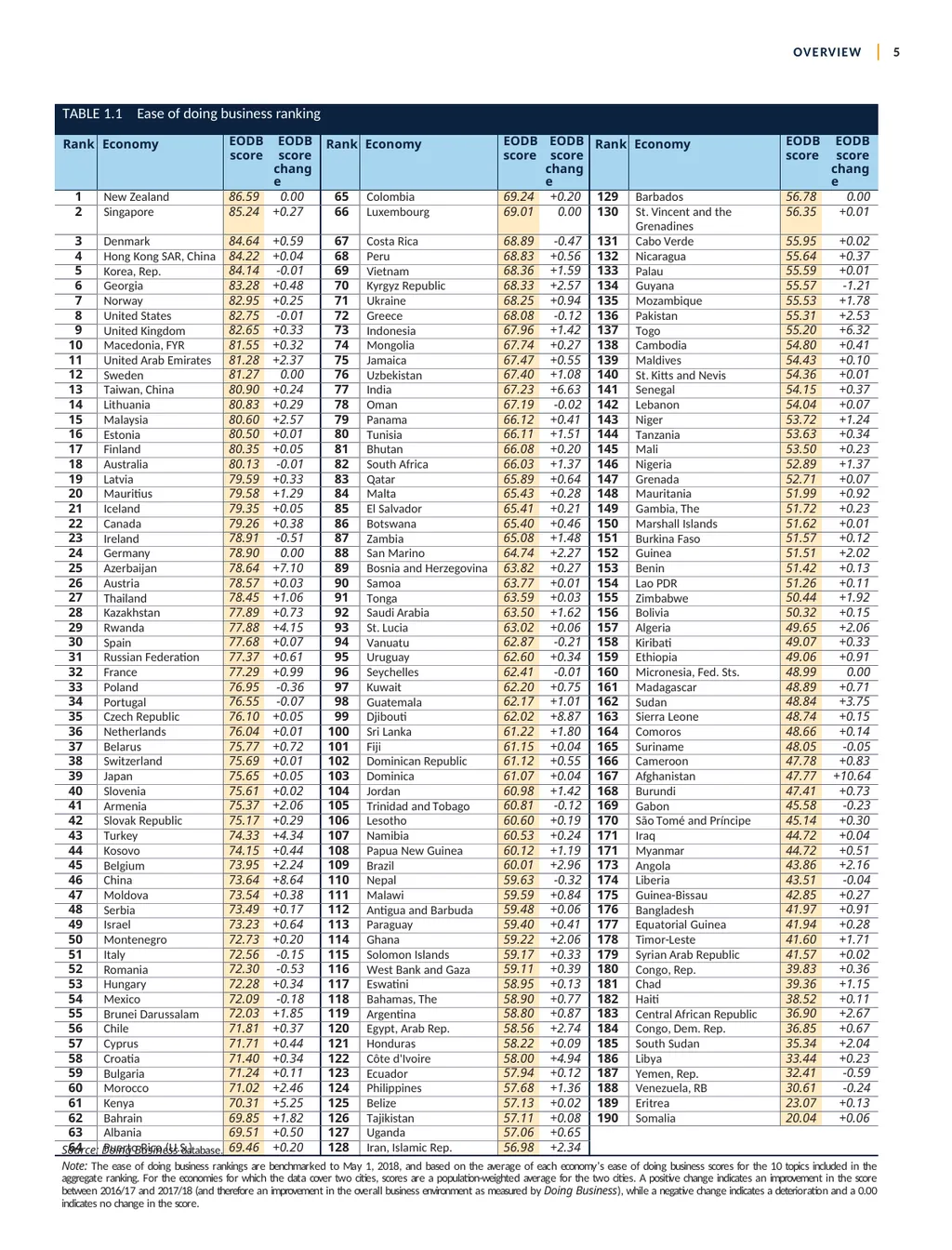
.org/research. property rights may be a precondition for recent research by area of study and Mauritius, which joins the group of WHERE IS BUSINESS REGULATION BETTER? Doing Business benchmarks aspects of business regulation and practice using specific case studies with stan- dardized assumptions. Based on an economy’s performance in each of the 11 measured areas, the report scores the efficiency and quality of the business environment. This approach facilitates the comparison of regula- tion and practice across economies and allows for changes to be tracked over time. The ease of doing business score (box 1.1) serves as the basis for ranking economies on their business environment: to obtain the ranking, economies are sorted by their scores. The ease of doing business score shows an economy’s absolute position to the best regulatory practice, while the ease of doing business ranking is an indica- tion of an economy’s position relative to that of other economies. The economies that rank highest in the ease of doing business (table 1.1) are those that have consistently well- designed business regulation or whose regulatory environments have thrived thanks to comprehensive reform over the years. The top three economies this year—New Zealand, Singapore and Denmark—exemplify a business- friendly environment. Meanwhile,<br>
Doing Business 2014 presented a synthesis of the fast-growing literature published in top-ranking economic jour- nals using Doing Business data for analysis or motivation.16 The chapter reviews the different estimation methods used in economic analysis and summarizes the methodology, including firm entry and labor market regulation, trade regula- tions and cost and tax regulations. Doing Business 2016 also presented an extended review of the literature published in 70 top academic law journals focusing on four sets of indicators: enforcing contracts, getting credit (legal rights), protecting minority investors and resolving insol- vency.17 For further research insights, updated annually, see the chapter About Doing Business and the Doing Business website at http://www.doingbusiness
.org/research. property rights may be a precondition for recent research by area of study and Mauritius, which joins the group of WHERE IS BUSINESS REGULATION BETTER? Doing Business benchmarks aspects of business regulation and practice using specific case studies with stan- dardized assumptions. Based on an economy’s performance in each of the 11 measured areas, the report scores the efficiency and quality of the business environment. This approach facilitates the comparison of regula- tion and practice across economies and allows for changes to be tracked over time. The ease of doing business score (box 1.1) serves as the basis for ranking economies on their business environment: to obtain the ranking, economies are sorted by their scores. The ease of doing business score shows an economy’s absolute position to the best regulatory practice, while the ease of doing business ranking is an indica- tion of an economy’s position relative to that of other economies. The economies that rank highest in the ease of doing business (table 1.1) are those that have consistently well- designed business regulation or whose regulatory environments have thrived thanks to comprehensive reform over the years. The top three economies this year—New Zealand, Singapore and Denmark—exemplify a business- friendly environment. Meanwhile,<br>
08
DOING BUSINESS 2019 4 top 20 economies this year (the only Sub-Saharan African economy to do so), has reformed its business environ- ment methodically over time. Indeed, over the past decade Mauritius has reformed more than once in almost all areas measured by Doing Business.18 Following seven reforms in the area of property registration captured by Doing Business since 2005, for example, the time needed to register property has decreased more than 12 times; the time needed for business incorporation has decreased almost 10 times as a result of four reforms in starting a business.19 A continuous and focused reform agenda keeps an economy competi- tive and vigilant, as others also keep improving. Two economies that enter the top 20 this year—the United Arab Emirates and Malaysia—have main- tained such a reform momentum. The United Arab Emirates is the highest- ranking economy in the Middle East and North Africa region, with reforms captured in four areas. Six reforms in Malaysia were measured by Doing Business, resulting in the second highest regional improvement in the ease of doing business score. Twelve of the top 20 economies are from the OECD high-income group; four are from East Asia and the Pacific, two are from Europe and Central Asia and and the Middle East and North Africa. Except for low-income economies, all income groups are represented. The regional diversity and varying income levels among the top 20 economies underscore the point that any economy can make it to the top, as long as it has few bureaucratic hurdles and strong laws and regulation. The efficiency and quality of regulation are what matter most for a good performance in the ease of doing business ranking. The top 20 economies share a number of international good practices. In the area of starting a business, 13 of these economies have at least one procedure that can be completed online in 0.5 days. The electricity distribution utilities in all but one of the top 20 economies use automated tools, allowing for faster, more efficient and more secure restora- tion of service during power outages. In the areas of construction and land administration, in all top 20 economies mandatory inspections are always done in practice during the construction of a warehouse, and the majority have comprehensive geographic coverage. The quality of legal infrastructure and the strength of legal institutions is also robust. In all top 20 economies, for example, the insolvency framework stipulates that a creditor has the right to object to decisions accepting or rejecting creditors’ claims, providing insolvency proceedings. Court automa- tion is prevalent, and judgments are enforced twice as fast on average (95.6 days) than in the remaining economies (200 days). These economies also have strong disclosure requirements in place to prevent the misuse of corporate assets by directors for personal gain. Most mandate that a shareholder must immediately disclose transactions—as well as any conflicts of interest— to other shareholders. To date, no economy has reached the best regu- latory performance on all indicators; every economy can progress further by learning from the experience of others. More trends emerge from the list of the top 50 economies. Regionally, almost 60% of the top 50 economies are from the OECD high-income group, followed by Europe and Central Asia (24%) and East Asia and the Pacific (12%). South Asia and Latin America and the Caribbean are the two regions absent from the top 50 ranking. Upper- middle-income economies represent almost 26% of the top 50 economies. Georgia, Kosovo and Moldova are the three lower-middle-income economies on the list and Rwanda is the only low- income economy. There is, however, a large variation between regions’ regula- tory efficiency and regulatory quality (figure 1.2). While four of the 10 top improvers in Doing Business 2019 are BOX 1.1 What is the ease of doing business score?
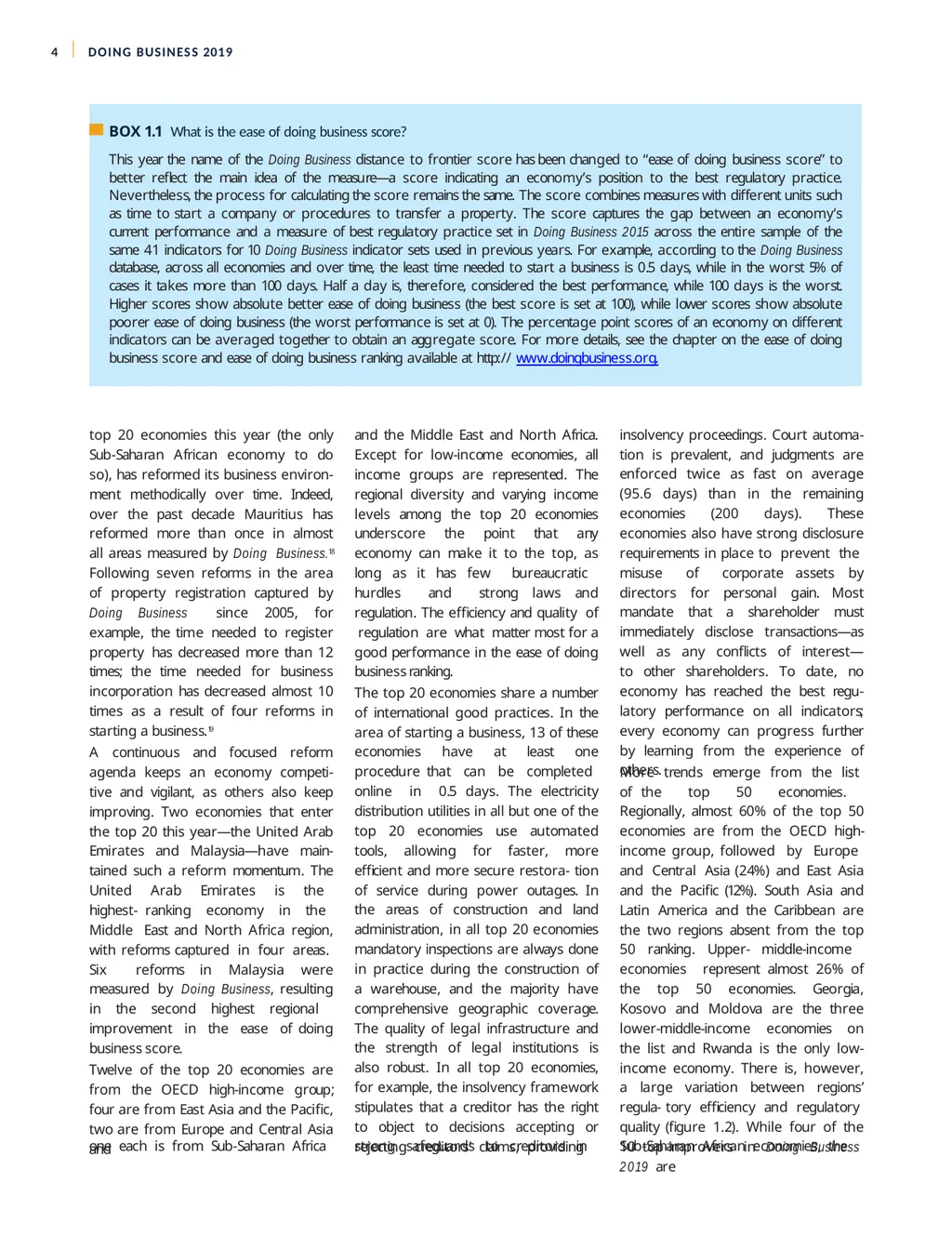
This year the name of the Doing Business distance to frontier score has been changed to “ease of doing business score” to better reflect the main idea of the measure—a score indicating an economy’s position to the best regulatory practice. Nevertheless, the process for calculating the score remains the same. The score combines measures with different units such as time to start a company or procedures to transfer a property. The score captures the gap between an economy’s current performance and a measure of best regulatory practice set in Doing Business 2015 across the entire sample of the same 41 indicators for 10 Doing Business indicator sets used in previous years. For example, according to the Doing Business database, across all economies and over time, the least time needed to start a business is 0.5 days, while in the worst 5% of cases it takes more than 100 days. Half a day is, therefore, considered the best performance, while 100 days is the worst. Higher scores show absolute better ease of doing business (the best score is set at 100), while lower scores show absolute poorer ease of doing business (the worst performance is set at 0). The percentage point scores of an economy on different indicators can be averaged together to obtain an aggregate score. For more details, see the chapter on the ease of doing business score and ease of doing business ranking available at http:// www.doingbusiness.org. one each is from Sub-Saharan Africa strong safeguards to creditors in Sub-Saharan African economies, the<br>
This year the name of the Doing Business distance to frontier score has been changed to “ease of doing business score” to better reflect the main idea of the measure—a score indicating an economy’s position to the best regulatory practice. Nevertheless, the process for calculating the score remains the same. The score combines measures with different units such as time to start a company or procedures to transfer a property. The score captures the gap between an economy’s current performance and a measure of best regulatory practice set in Doing Business 2015 across the entire sample of the same 41 indicators for 10 Doing Business indicator sets used in previous years. For example, according to the Doing Business database, across all economies and over time, the least time needed to start a business is 0.5 days, while in the worst 5% of cases it takes more than 100 days. Half a day is, therefore, considered the best performance, while 100 days is the worst. Higher scores show absolute better ease of doing business (the best score is set at 100), while lower scores show absolute poorer ease of doing business (the worst performance is set at 0). The percentage point scores of an economy on different indicators can be averaged together to obtain an aggregate score. For more details, see the chapter on the ease of doing business score and ease of doing business ranking available at http:// www.doingbusiness.org. one each is from Sub-Saharan Africa strong safeguards to creditors in Sub-Saharan African economies, the<br>
09
5 OVERVIEW Source: Doing Business database.
Note: The ease of doing business rankings are benchmarked to May 1, 2018, and based on the average of each economy’s ease of doing business scores for the 10 topics included in the aggregate ranking. For the economies for which the data cover two cities, scores are a population-weighted average for the two cities. A positive change indicates an improvement in the score between 2016/17 and 2017/18 (and therefore an improvement in the overall business environment as measured by Doing Business), while a negative change indicates a deterioration and a 0.00 indicates no change in the score.<br>
Note: The ease of doing business rankings are benchmarked to May 1, 2018, and based on the average of each economy’s ease of doing business scores for the 10 topics included in the aggregate ranking. For the economies for which the data cover two cities, scores are a population-weighted average for the two cities. A positive change indicates an improvement in the score between 2016/17 and 2017/18 (and therefore an improvement in the overall business environment as measured by Doing Business), while a negative change indicates a deterioration and a 0.00 indicates no change in the score.<br>
10
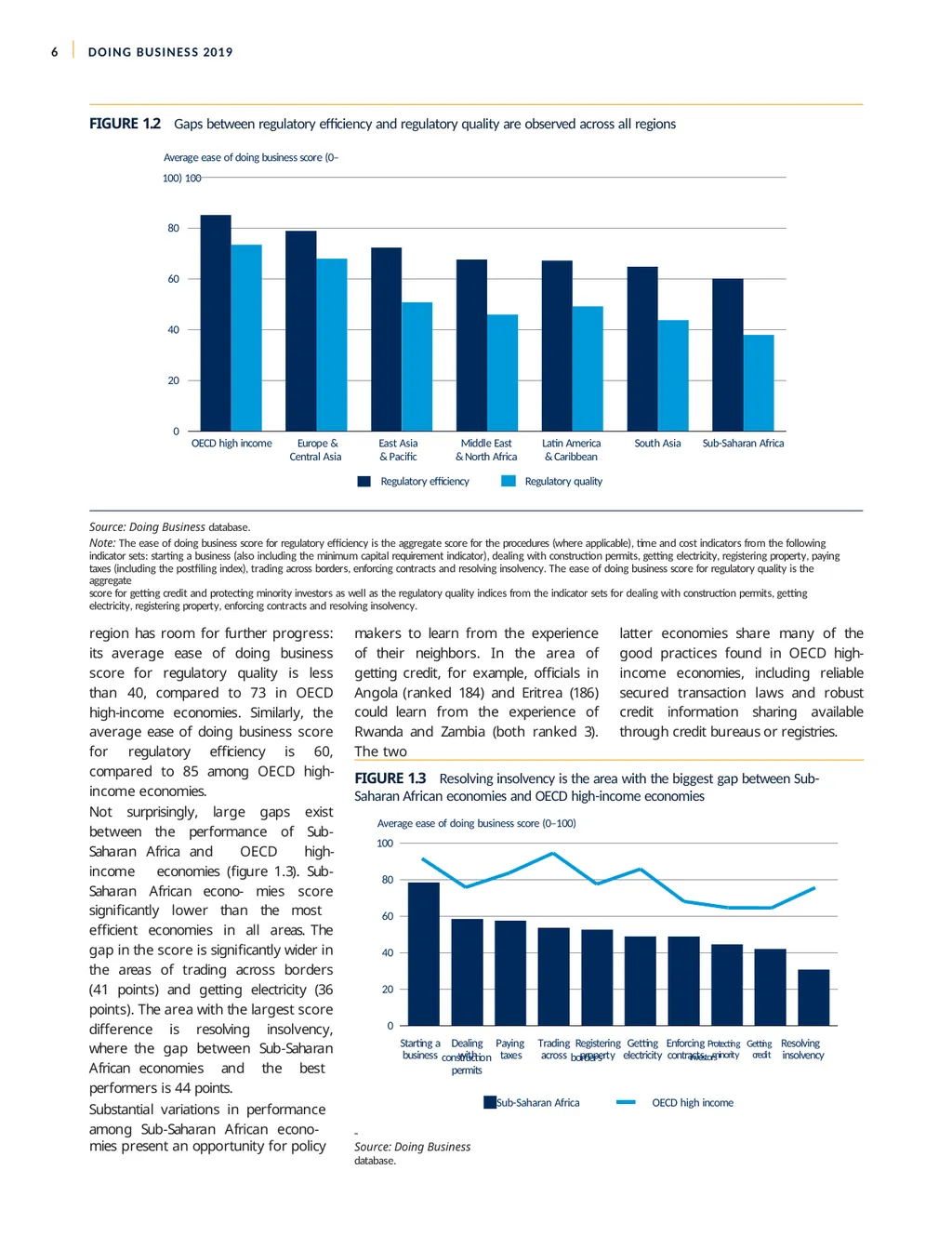
DOING BUSINESS 2019 6 region has room for further progress: its average ease of doing business score for regulatory quality is less than 40, compared to 73 in OECD high-income economies. Similarly, the average ease of doing business score for regulatory efficiency is 60, compared to 85 among OECD high-income economies. Not surprisingly, large gaps exist between the performance of Sub-Saharan Africa and OECD high-income economies (figure 1.3). Sub-Saharan African econo- mies score significantly lower than the most efficient economies in all areas. The gap in the score is significantly wider in the areas of trading across borders (41 points) and getting electricity (36 points). The area with the largest score difference is resolving insolvency, where the gap between Sub-Saharan African economies and the best performers is 44 points. Substantial variations in performance among Sub-Saharan African econo- Sub-Saharan Africa OECD high income makers to learn from the experience of their neighbors. In the area of getting credit, for example, officials in Angola (ranked 184) and Eritrea (186) could learn from the experience of Rwanda and Zambia (both ranked 3). The two latter economies share many of the good practices found in OECD high- income economies, including reliable secured transaction laws and robust credit information sharing available through credit bureaus or registries. FIGURE 1.2 Gaps between regulatory efficiency and regulatory quality are observed across all regions
Average ease of doing business score (0–100) 100 Sub-Saharan Africa South Asia Latin America
& Caribbean Middle East
& North Africa East Asia
& Pacific OECD high income Europe &
Central Asia Regulatory efficiency Regulatory quality 0 20 40 60 80 Source: Doing Business database.
Note: The ease of doing business score for regulatory efficiency is the aggregate score for the procedures (where applicable), time and cost indicators from the following indicator sets: starting a business (also including the minimum capital requirement indicator), dealing with construction permits, getting electricity, registering property, paying taxes (including the postfiling index), trading across borders, enforcing contracts and resolving insolvency. The ease of doing business score for regulatory quality is the aggregate
score for getting credit and protecting minority investors as well as the regulatory quality indices from the indicator sets for dealing with construction permits, getting electricity, registering property, enforcing contracts and resolving insolvency. FIGURE 1.3 Resolving insolvency is the area with the biggest gap between Sub- Saharan African economies and OECD high-income economies
Average ease of doing business score (0–100) Starting a Dealing Paying Trading Registering Getting Enforcing Protecting Getting Resolving business with taxes across property electricity contracts minority credit insolvency construction borders investors permits 0 20 40 60 80 100 mies present an opportunity for policy Source: Doing Business database.<br>
Average ease of doing business score (0–100) 100 Sub-Saharan Africa South Asia Latin America
& Caribbean Middle East
& North Africa East Asia
& Pacific OECD high income Europe &
Central Asia Regulatory efficiency Regulatory quality 0 20 40 60 80 Source: Doing Business database.
Note: The ease of doing business score for regulatory efficiency is the aggregate score for the procedures (where applicable), time and cost indicators from the following indicator sets: starting a business (also including the minimum capital requirement indicator), dealing with construction permits, getting electricity, registering property, paying taxes (including the postfiling index), trading across borders, enforcing contracts and resolving insolvency. The ease of doing business score for regulatory quality is the aggregate
score for getting credit and protecting minority investors as well as the regulatory quality indices from the indicator sets for dealing with construction permits, getting electricity, registering property, enforcing contracts and resolving insolvency. FIGURE 1.3 Resolving insolvency is the area with the biggest gap between Sub- Saharan African economies and OECD high-income economies
Average ease of doing business score (0–100) Starting a Dealing Paying Trading Registering Getting Enforcing Protecting Getting Resolving business with taxes across property electricity contracts minority credit insolvency construction borders investors permits 0 20 40 60 80 100 mies present an opportunity for policy Source: Doing Business database.<br>
11
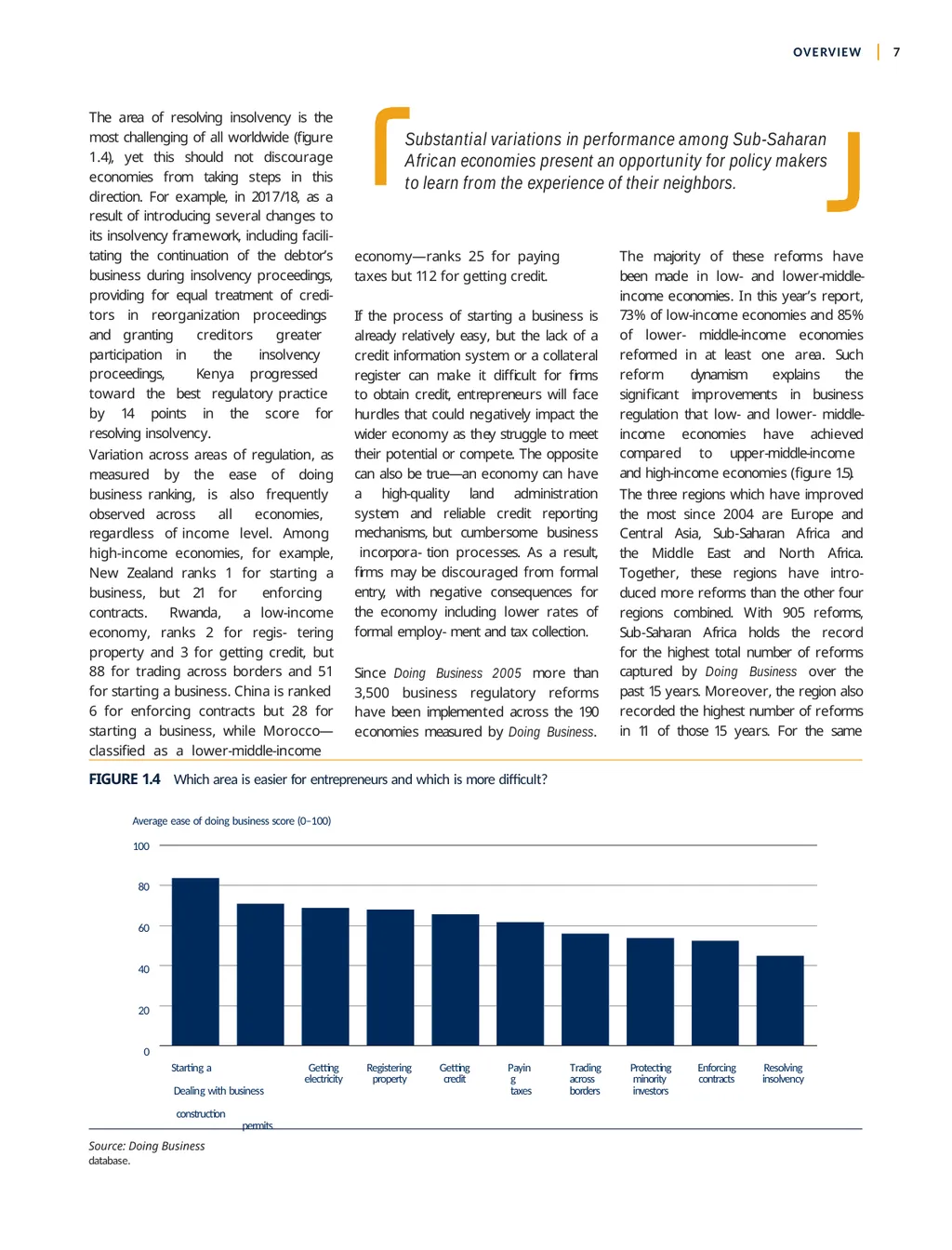
7 OVERVIEW The area of resolving insolvency is the most challenging of all worldwide (figure 1.4), yet this should not discourage economies from taking steps in this direction. For example, in 2017/18, as a result of introducing several changes to its insolvency framework, including facili- tating the continuation of the debtor’s business during insolvency proceedings, providing for equal treatment of credi- tors in reorganization proceedings and granting creditors greater participation in the insolvency proceedings, Kenya progressed toward the best regulatory practice by 14 points in the score for resolving insolvency. Variation across areas of regulation, as measured by the ease of doing business ranking, is also frequently observed across all economies, regardless of income level. Among high-income economies, for example, New Zealand ranks 1 for starting a business, but 21 for enforcing contracts. Rwanda, a low-income economy, ranks 2 for regis- tering property and 3 for getting credit, but 88 for trading across borders and 51 for starting a business. China is ranked
6 for enforcing contracts but 28 for starting a business, while Morocco— classified as a lower-middle-income economy—ranks 25 for paying taxes but 112 for getting credit. If the process of starting a business is already relatively easy, but the lack of a credit information system or a collateral register can make it difficult for firms to obtain credit, entrepreneurs will face hurdles that could negatively impact the wider economy as they struggle to meet their potential or compete. The opposite can also be true—an economy can have a high-quality land administration system and reliable credit reporting mechanisms, but cumbersome business incorpora- tion processes. As a result, firms may be discouraged from formal entry, with negative consequences for the economy including lower rates of formal employ- ment and tax collection. Since Doing Business 2005 more than 3,500 business regulatory reforms have been implemented across the 190 economies measured by Doing Business. The majority of these reforms have been made in low- and lower-middle-income economies. In this year’s report, 73% of low-income economies and 85% of lower- middle-income economies reformed in at least one area. Such reform dynamism explains the significant improvements in business regulation that low- and lower- middle-income economies have achieved compared to upper-middle-income and high-income economies (figure 1.5). The three regions which have improved the most since 2004 are Europe and Central Asia, Sub-Saharan Africa and the Middle East and North Africa. Together, these regions have intro- duced more reforms than the other four regions combined. With 905 reforms, Sub-Saharan Africa holds the record for the highest total number of reforms captured by Doing Business over the past 15 years. Moreover, the region also recorded the highest number of reforms in 11 of those 15 years. For the same FIGURE 1.4 Which area is easier for entrepreneurs and which is more difficult?
Average ease of doing business score (0–100) 100
80
60
40
20
0 Starting a Dealing with business construction
permits Getting electricity Registering property Getting credit Paying taxes Trading across borders Protecting minority investors Enforcing contracts Resolving insolvency Substantial variations in performance among Sub-Saharan African economies present an opportunity for policy makers Source: Doing Business database. to learn from the experience of their neighbors.<br>
6 for enforcing contracts but 28 for starting a business, while Morocco— classified as a lower-middle-income economy—ranks 25 for paying taxes but 112 for getting credit. If the process of starting a business is already relatively easy, but the lack of a credit information system or a collateral register can make it difficult for firms to obtain credit, entrepreneurs will face hurdles that could negatively impact the wider economy as they struggle to meet their potential or compete. The opposite can also be true—an economy can have a high-quality land administration system and reliable credit reporting mechanisms, but cumbersome business incorpora- tion processes. As a result, firms may be discouraged from formal entry, with negative consequences for the economy including lower rates of formal employ- ment and tax collection. Since Doing Business 2005 more than 3,500 business regulatory reforms have been implemented across the 190 economies measured by Doing Business. The majority of these reforms have been made in low- and lower-middle-income economies. In this year’s report, 73% of low-income economies and 85% of lower- middle-income economies reformed in at least one area. Such reform dynamism explains the significant improvements in business regulation that low- and lower- middle-income economies have achieved compared to upper-middle-income and high-income economies (figure 1.5). The three regions which have improved the most since 2004 are Europe and Central Asia, Sub-Saharan Africa and the Middle East and North Africa. Together, these regions have intro- duced more reforms than the other four regions combined. With 905 reforms, Sub-Saharan Africa holds the record for the highest total number of reforms captured by Doing Business over the past 15 years. Moreover, the region also recorded the highest number of reforms in 11 of those 15 years. For the same FIGURE 1.4 Which area is easier for entrepreneurs and which is more difficult?
Average ease of doing business score (0–100) 100
80
60
40
20
0 Starting a Dealing with business construction
permits Getting electricity Registering property Getting credit Paying taxes Trading across borders Protecting minority investors Enforcing contracts Resolving insolvency Substantial variations in performance among Sub-Saharan African economies present an opportunity for policy makers Source: Doing Business database. to learn from the experience of their neighbors.<br>
12
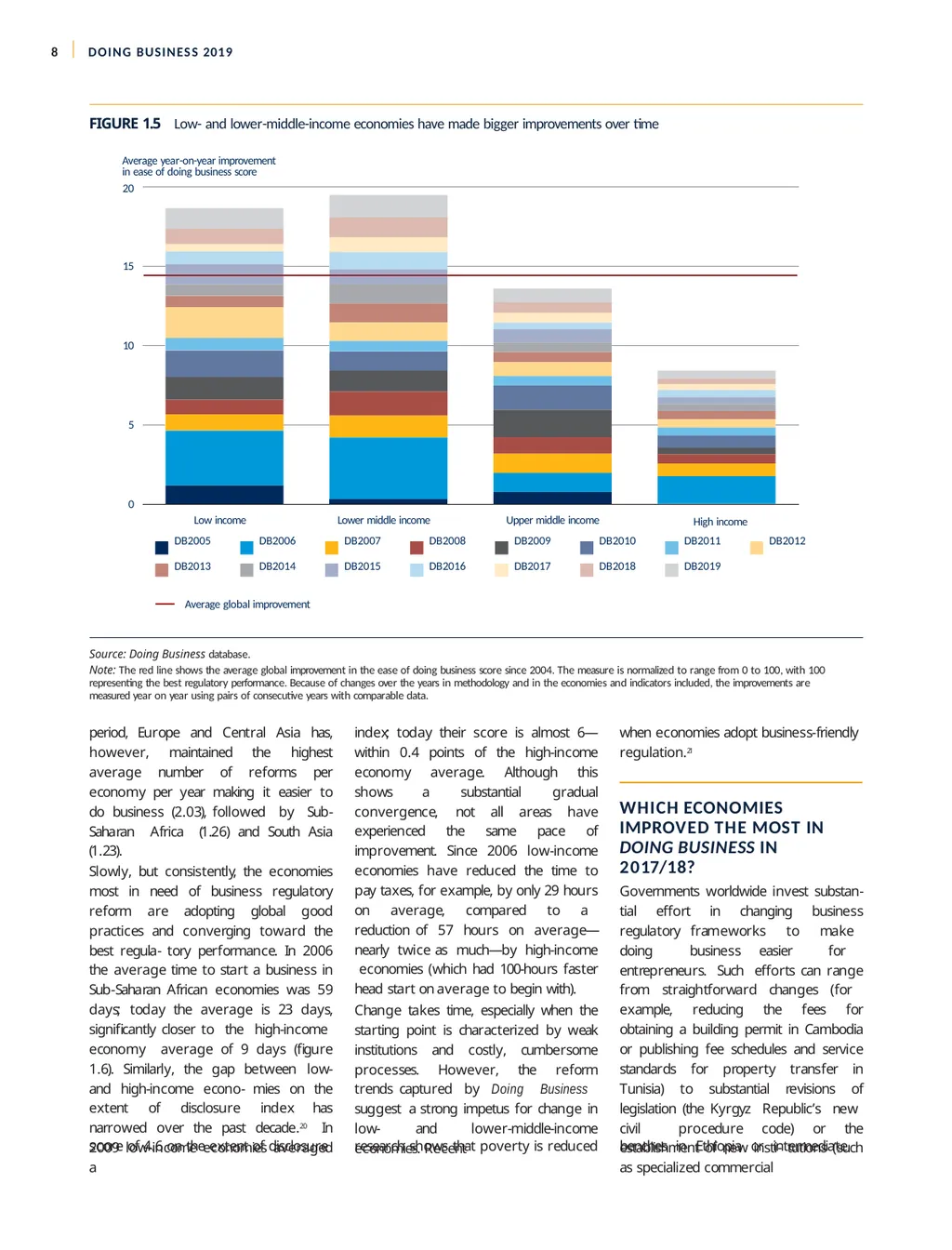
DOING BUSINESS 2019 8 period, Europe and Central Asia has, however, maintained the highest average number of reforms per economy per year making it easier to do business (2.03), followed by Sub-Saharan Africa (1.26) and South Asia (1.23). Slowly, but consistently, the economies most in need of business regulatory reform are adopting global good practices and converging toward the best regula- tory performance. In 2006 the average time to start a business in Sub-Saharan African economies was 59 days; today the average is 23 days, significantly closer to the high-income economy average of 9 days (figure 1.6). Similarly, the gap between low- and high-income econo- mies on the extent of disclosure index has narrowed over the past decade.20 In 2009 low-income economies averaged a index; today their score is almost 6— within 0.4 points of the high-income economy average. Although this shows a substantial gradual convergence, not all areas have experienced the same pace of improvement. Since 2006 low-income economies have reduced the time to pay taxes, for example, by only 29 hours on average, compared to a reduction of 57 hours on average—nearly twice as much—by high-income economies (which had 100-hours faster head start on average to begin with). Change takes time, especially when the starting point is characterized by weak institutions and costly, cumbersome processes. However, the reform trends captured by Doing Business suggest a strong impetus for change in low- and lower-middle-income economies. Recent when economies adopt business-friendly regulation.21 WHICH ECONOMIES IMPROVED THE MOST IN DOING BUSINESS IN 2017/18? Governments worldwide invest substan- tial effort in changing business regulatory frameworks to make doing business easier for entrepreneurs. Such efforts can range from straightforward changes (for example, reducing the fees for obtaining a building permit in Cambodia or publishing fee schedules and service standards for property transfer in Tunisia) to substantial revisions of legislation (the Kyrgyz Republic’s new civil procedure code) or the establishment of new insti- tutions (such as specialized commercial FIGURE 1.5 Low- and lower-middle-income economies have made bigger improvements over time
Average year-on-year improvement in ease of doing business score
20 Average global improvement Low income Lower middle income Upper middle income High income 0 5 10 15 Source: Doing Business database.
Note: The red line shows the average global improvement in the ease of doing business score since 2004. The measure is normalized to range from 0 to 100, with 100 representing the best regulatory performance. Because of changes over the years in methodology and in the economies and indicators included, the improvements are measured year on year using pairs of consecutive years with comparable data. score of 4.6 on the extent of disclosure research shows that poverty is reduced benches in Ethiopia or intermediate<br>
Average year-on-year improvement in ease of doing business score
20 Average global improvement Low income Lower middle income Upper middle income High income 0 5 10 15 Source: Doing Business database.
Note: The red line shows the average global improvement in the ease of doing business score since 2004. The measure is normalized to range from 0 to 100, with 100 representing the best regulatory performance. Because of changes over the years in methodology and in the economies and indicators included, the improvements are measured year on year using pairs of consecutive years with comparable data. score of 4.6 on the extent of disclosure research shows that poverty is reduced benches in Ethiopia or intermediate<br>
13
9 OVERVIEW customs posts in El Salvador). While the variety of activities that can be undertaken to improve the ease of doing business is extensive, they are all aimed at streamlining processes, increasing procedural and legislative efficiency and improving the accessibility and transpar- how Doing Business identifies changes as a reform, see the data notes at http:// www.doingbusiness.org. In the past year, Doing Business observed a peaking of reform activity worldwide. From June 2, 2017, to May 1, 2018, 128 regulatory reforms improving the busi- ness climate (see table 1A.1 at the end of this chapter). The previous record was set by Doing Business 2017, which captured 290 reforms implemented by 137 economies (figure 1.7). Almost one-third of all reforms recorded in FIGURE 1.6 Areas where economies are converging and areas where they are not DB2006 DB2007 DB2008 DB2009 DB2010 DB2011 DB2012 DB2013 DB2014 DB2015 DB2016 DB2017 DB2018 DB2019 DB2010 DB2011 DB2012 DB2013 DB2014 DB2015 DB2019 DB2018 DB2017 DB2016 Average time to start a business (days) Average cost to obtain an electricity connection (% of income per capita) Sub-Saharan Africa OECD high income Sub-Saharan Africa OECD high income Average extent of disclosure index in protecting minority investors (0–10) Average time to prepare, file returns and pay taxes (hours) High income Low income High income Low income DB2006 DB2007 DB2008 DB2009 DB2010 DB2011 DB2012 DB2013 DB2014 DB2015 DB2016 DB2017 DB2018 DB2019 DB2009 DB2010 DB2011 DB2012 DB2013 DB2014 DB2015 DB2019 DB2018 DB2017 DB2016 0 10 20 30 40 50 60 70 0 1,000 2,000 3,000 4,000 5,000 6,000 7,000 0 1 2 3 4 5 6 7 0 50 100 150 200 250 300 350 Source: Doing Business database.
Note: The upper left-hand side graph includes 174 economies where data is available back to Doing Business 2006. The upper right-hand side graph includes 183 economies where data is available back to Doing Business 2010. The lower left-hand side graph includes 182 economies where data is available back to Doing Business 2009. The lower right-hand side graph includes 174 economies where data is available back to Doing Business 2006. ency of information. For more details on economies implemented a record 314 2017/18 were implemented in two<br>
Note: The upper left-hand side graph includes 174 economies where data is available back to Doing Business 2006. The upper right-hand side graph includes 183 economies where data is available back to Doing Business 2010. The lower left-hand side graph includes 182 economies where data is available back to Doing Business 2009. The lower right-hand side graph includes 174 economies where data is available back to Doing Business 2006. ency of information. For more details on economies implemented a record 314 2017/18 were implemented in two<br>
14
DOING BUSINESS 2019 10 areas—starting a business and enforcing contracts (table 1.2). Doing Business 2019 also recorded the lowest number of changes to making it more burden- some for businesses to operate since Doing Business 2007.22 In 2017/18, one-quarter of economies measured by Doing Business made starting a business easier by reducing the procedures, time or cost associated with company incorporation. Twenty-three of the 50 economies that reformed in this area did so by simplifying preregistration or registration formalities. Such changes can vary from integrating multiple appli- cation forms into a single registration template to abolishing requirements for site inspections or bank certificates prior to company incorporation. By allowing voluntary value added tax registration at the time of business incorporation, Georgia reduced its relative gap to the best regulatory performance on starting a business the most in 2017/18. Previously, entrepreneurs had to make a separate visit to the Revenue Service for value added tax registration after company registration. Georgia also enhanced its existing one-stop shop for business incorporation, allowing entre- preneurs to start a company through a single procedure. The second highest number of busi- ness regulatory reforms (49) captured by Doing Business 2019 is in the area of enforcing contracts. This uptick in reform can be attributed mainly to the achievements of the 17 member states of the Organization for the Harmonization of Business Law in Africa, known by its French acronym OHADA. The organiza- tion adopted a Uniform Act on Mediation in 2017 (filling a legislative void that existed in most OHADA member DB2008 DB2009 DB2010 DB2011 DB2012 DB2013 DB2014 DB2015 DB2016 DB2017 DB2018 DB2019 FIGURE 1.7 Doing Business 2019 captured a record 314 reforms in 128 economies
Reforms captured by
Doing Business year (number)
350 0 50 100 150 200 250 300 Starting a business Dealing with construction permits Getting electricity Getting credit Registering property Protecting minority investors Paying taxes Trading across borders Resolving insolvency Enforcing contracts Source: Doing Business database.
Note: The getting electricity indicator set was added in Doing Business 2012. The report’s geographical coverage has gradually expanded from 178 economies in Doing Business 2008 to 181 in Doing Business 2009, 183 in Doing Business 2010, 185 in Doing Business 2013, 189 in Doing Business 2014 and 190 economies since Doing Business 2017. states) which introduced mediation as<br>
Reforms captured by
Doing Business year (number)
350 0 50 100 150 200 250 300 Starting a business Dealing with construction permits Getting electricity Getting credit Registering property Protecting minority investors Paying taxes Trading across borders Resolving insolvency Enforcing contracts Source: Doing Business database.
Note: The getting electricity indicator set was added in Doing Business 2012. The report’s geographical coverage has gradually expanded from 178 economies in Doing Business 2008 to 181 in Doing Business 2009, 183 in Doing Business 2010, 185 in Doing Business 2013, 189 in Doing Business 2014 and 190 economies since Doing Business 2017. states) which introduced mediation as<br>
15
11 OVERVIEW an amicable mode of dispute settle- ment. The OHADA Uniform Act adopts a broad scope of application by covering conventional and judicial mediation and sets out the guiding principles for the conduct of mediation. the most improved economies is determined by the largest improvements in the ease of doing business score among those with at least three reforms. Doing Business also recorded a historic number of reforms (26) in the area of getting electricity. East Asia and the Pacific has the highest share of reformers, with 28% of economies from this region improving on the getting electricity indicators. Sub-Saharan African economies recorded eight reforms in this area, the highest number of any region worldwide. The economies of Europe and Central Asia and Sub-Saharan Africa were the most active in reforming their regula- tory frameworks in 2017/18, with four of every five economies substantially improving business regulations in both regions. Nineteen economies in Europe and Central Asia implemented a total of 54 regulatory reforms improving the business environment. A total of
107 business regulatory reforms were recorded by Doing Business across 40 economies in Sub-Saharan Africa. Both regions captured reforms in every topic measured by Doing Business. Indeed, reforms undertaken by economies in these two regions represent half of all reforms recorded globally. In 2017/18 Sub-Saharan Africa implemented the most reforms ever recorded by Doing Business and the highest total number of reforming economies.
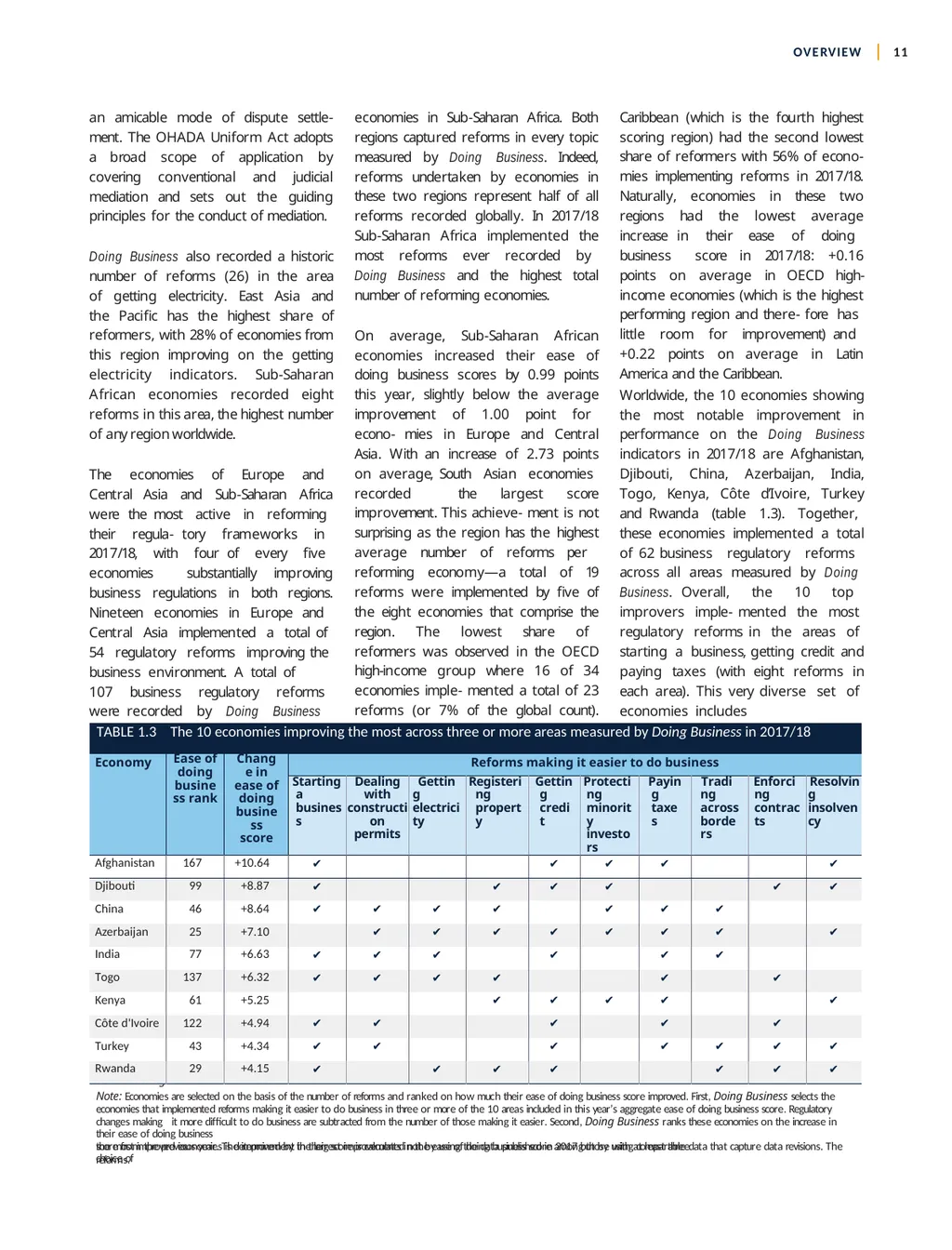
On average, Sub-Saharan African economies increased their ease of doing business scores by 0.99 points this year, slightly below the average improvement of 1.00 point for econo- mies in Europe and Central Asia. With an increase of 2.73 points on average, South Asian economies recorded the largest score improvement. This achieve- ment is not surprising as the region has the highest average number of reforms per reforming economy—a total of 19 reforms were implemented by five of the eight economies that comprise the region. The lowest share of reformers was observed in the OECD high-income group where 16 of 34 economies imple- mented a total of 23 reforms (or 7% of the global count). Latin America and the Caribbean (which is the fourth highest scoring region) had the second lowest share of reformers with 56% of econo- mies implementing reforms in 2017/18. Naturally, economies in these two regions had the lowest average increase in their ease of doing business score in 2017/18: +0.16 points on average in OECD high-income economies (which is the highest performing region and there- fore has little room for improvement) and +0.22 points on average in Latin America and the Caribbean. Worldwide, the 10 economies showing the most notable improvement in performance on the Doing Business indicators in 2017/18 are Afghanistan, Djibouti, China, Azerbaijan, India, Togo, Kenya, Côte d’Ivoire, Turkey and Rwanda (table 1.3). Together, these economies implemented a total of 62 business regulatory reforms across all areas measured by Doing Business. Overall, the 10 top improvers imple- mented the most regulatory reforms in the areas of starting a business, getting credit and paying taxes (with eight reforms in each area). This very diverse set of economies includes Source: Doing Business database.
Note: Economies are selected on the basis of the number of reforms and ranked on how much their ease of doing business score improved. First, Doing Business selects the economies that implemented reforms making it easier to do business in three or more of the 10 areas included in this year’s aggregate ease of doing business score. Regulatory changes making it more difficult to do business are subtracted from the number of those making it easier. Second, Doing Business ranks these economies on the increase in their ease of doing business
score from the previous year. The improvement in their score is calculated not by using the data published in 2017 but by using comparable data that capture data revisions. The choice of<br>
107 business regulatory reforms were recorded by Doing Business across 40 economies in Sub-Saharan Africa. Both regions captured reforms in every topic measured by Doing Business. Indeed, reforms undertaken by economies in these two regions represent half of all reforms recorded globally. In 2017/18 Sub-Saharan Africa implemented the most reforms ever recorded by Doing Business and the highest total number of reforming economies.
On average, Sub-Saharan African economies increased their ease of doing business scores by 0.99 points this year, slightly below the average improvement of 1.00 point for econo- mies in Europe and Central Asia. With an increase of 2.73 points on average, South Asian economies recorded the largest score improvement. This achieve- ment is not surprising as the region has the highest average number of reforms per reforming economy—a total of 19 reforms were implemented by five of the eight economies that comprise the region. The lowest share of reformers was observed in the OECD high-income group where 16 of 34 economies imple- mented a total of 23 reforms (or 7% of the global count). Latin America and the Caribbean (which is the fourth highest scoring region) had the second lowest share of reformers with 56% of econo- mies implementing reforms in 2017/18. Naturally, economies in these two regions had the lowest average increase in their ease of doing business score in 2017/18: +0.16 points on average in OECD high-income economies (which is the highest performing region and there- fore has little room for improvement) and +0.22 points on average in Latin America and the Caribbean. Worldwide, the 10 economies showing the most notable improvement in performance on the Doing Business indicators in 2017/18 are Afghanistan, Djibouti, China, Azerbaijan, India, Togo, Kenya, Côte d’Ivoire, Turkey and Rwanda (table 1.3). Together, these economies implemented a total of 62 business regulatory reforms across all areas measured by Doing Business. Overall, the 10 top improvers imple- mented the most regulatory reforms in the areas of starting a business, getting credit and paying taxes (with eight reforms in each area). This very diverse set of economies includes Source: Doing Business database.
Note: Economies are selected on the basis of the number of reforms and ranked on how much their ease of doing business score improved. First, Doing Business selects the economies that implemented reforms making it easier to do business in three or more of the 10 areas included in this year’s aggregate ease of doing business score. Regulatory changes making it more difficult to do business are subtracted from the number of those making it easier. Second, Doing Business ranks these economies on the increase in their ease of doing business
score from the previous year. The improvement in their score is calculated not by using the data published in 2017 but by using comparable data that capture data revisions. The choice of<br>
16
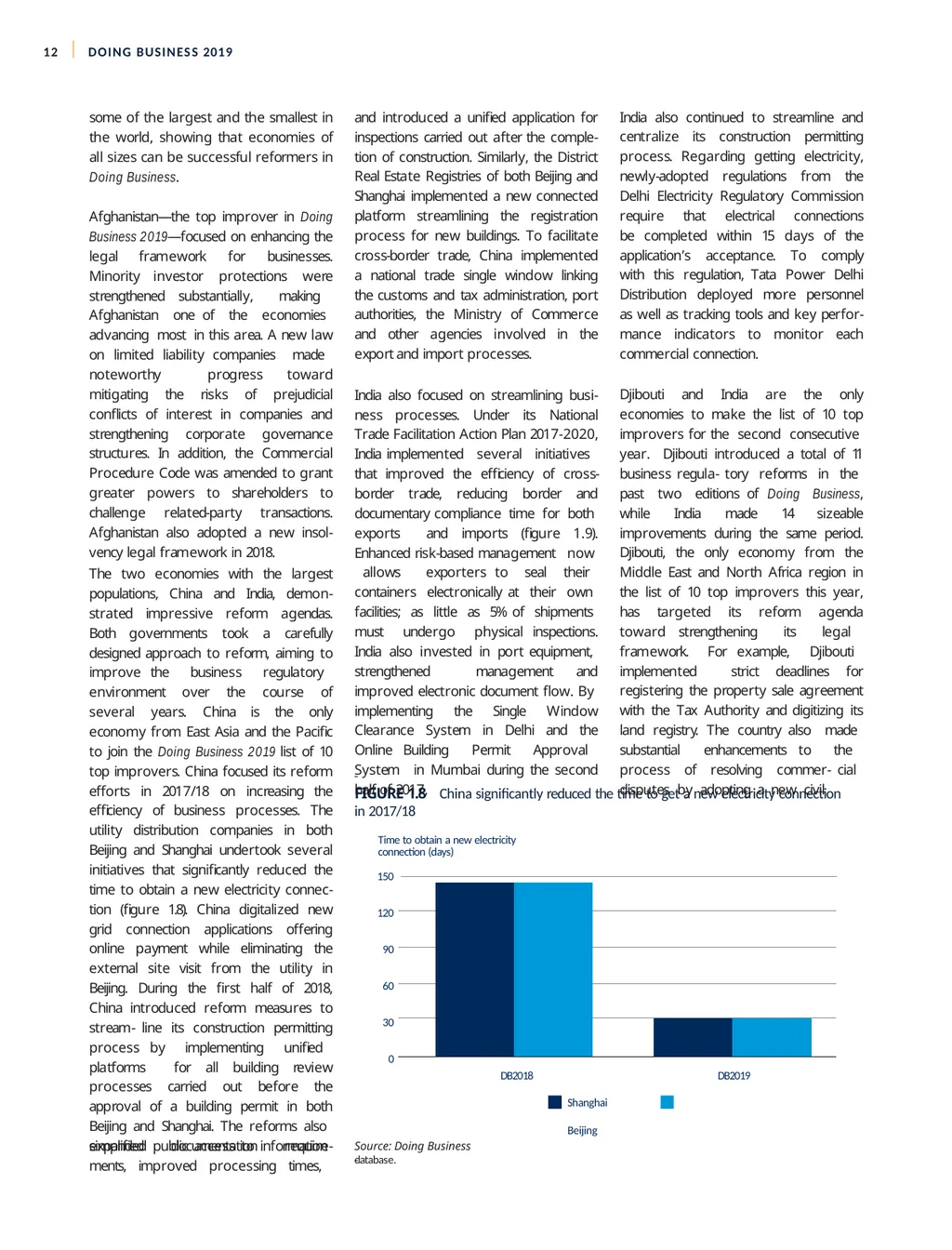
DOING BUSINESS 2019 12 some of the largest and the smallest in the world, showing that economies of all sizes can be successful reformers in Doing Business. Afghanistan—the top improver in Doing Business 2019—focused on enhancing the legal framework for businesses. Minority investor protections were strengthened substantially, making Afghanistan one of the economies advancing most in this area. A new law on limited liability companies made noteworthy progress toward mitigating the risks of prejudicial conflicts of interest in companies and strengthening corporate governance structures. In addition, the Commercial Procedure Code was amended to grant greater powers to shareholders to challenge related-party transactions. Afghanistan also adopted a new insol- vency legal framework in 2018. The two economies with the largest populations, China and India, demon- strated impressive reform agendas. Both governments took a carefully designed approach to reform, aiming to improve the business regulatory environment over the course of several years. China is the only economy from East Asia and the Pacific to join the Doing Business 2019 list of 10 top improvers. China focused its reform efforts in 2017/18 on increasing the efficiency of business processes. The utility distribution companies in both Beijing and Shanghai undertook several initiatives that significantly reduced the time to obtain a new electricity connec- tion (figure 1.8). China digitalized new grid connection applications offering online payment while eliminating the external site visit from the utility in Beijing. During the first half of 2018, China introduced reform measures to stream- line its construction permitting process by implementing unified platforms for all building review processes carried out before the approval of a building permit in both Beijing and Shanghai. The reforms also simplified documentation require- ments, improved processing times, FIGURE 1.8 China significantly reduced the time to get a new electricity connection in 2017/18 Shanghai Beijing and introduced a unified application for inspections carried out after the comple- tion of construction. Similarly, the District Real Estate Registries of both Beijing and Shanghai implemented a new connected platform streamlining the registration process for new buildings. To facilitate cross-border trade, China implemented a national trade single window linking the customs and tax administration, port authorities, the Ministry of Commerce and other agencies involved in the export and import processes. India also focused on streamlining busi- ness processes. Under its National Trade Facilitation Action Plan 2017-2020, India implemented several initiatives that improved the efficiency of cross-border trade, reducing border and documentary compliance time for both exports and imports (figure 1.9). Enhanced risk-based management now allows exporters to seal their containers electronically at their own facilities; as little as 5% of shipments must undergo physical inspections. India also invested in port equipment, strengthened management and improved electronic document flow. By implementing the Single Window Clearance System in Delhi and the Online Building Permit Approval System in Mumbai during the second half of 2017, India also continued to streamline and centralize its construction permitting process. Regarding getting electricity, newly-adopted regulations from the Delhi Electricity Regulatory Commission require that electrical connections be completed within 15 days of the application’s acceptance. To comply with this regulation, Tata Power Delhi Distribution deployed more personnel as well as tracking tools and key perfor- mance indicators to monitor each commercial connection. Djibouti and India are the only economies to make the list of 10 top improvers for the second consecutive year. Djibouti introduced a total of 11 business regula- tory reforms in the past two editions of Doing Business, while India made 14 sizeable improvements during the same period. Djibouti, the only economy from the Middle East and North Africa region in the list of 10 top improvers this year, has targeted its reform agenda toward strengthening its legal framework. For example, Djibouti implemented strict deadlines for registering the property sale agreement with the Tax Authority and digitizing its land registry. The country also made substantial enhancements to the process of resolving commer- cial disputes by adopting a new civil Time to obtain a new electricity connection (days) DB2018 DB2019 0 30 60 90 120 150 expanded public access to information Source: Doing Business database.<br>
17
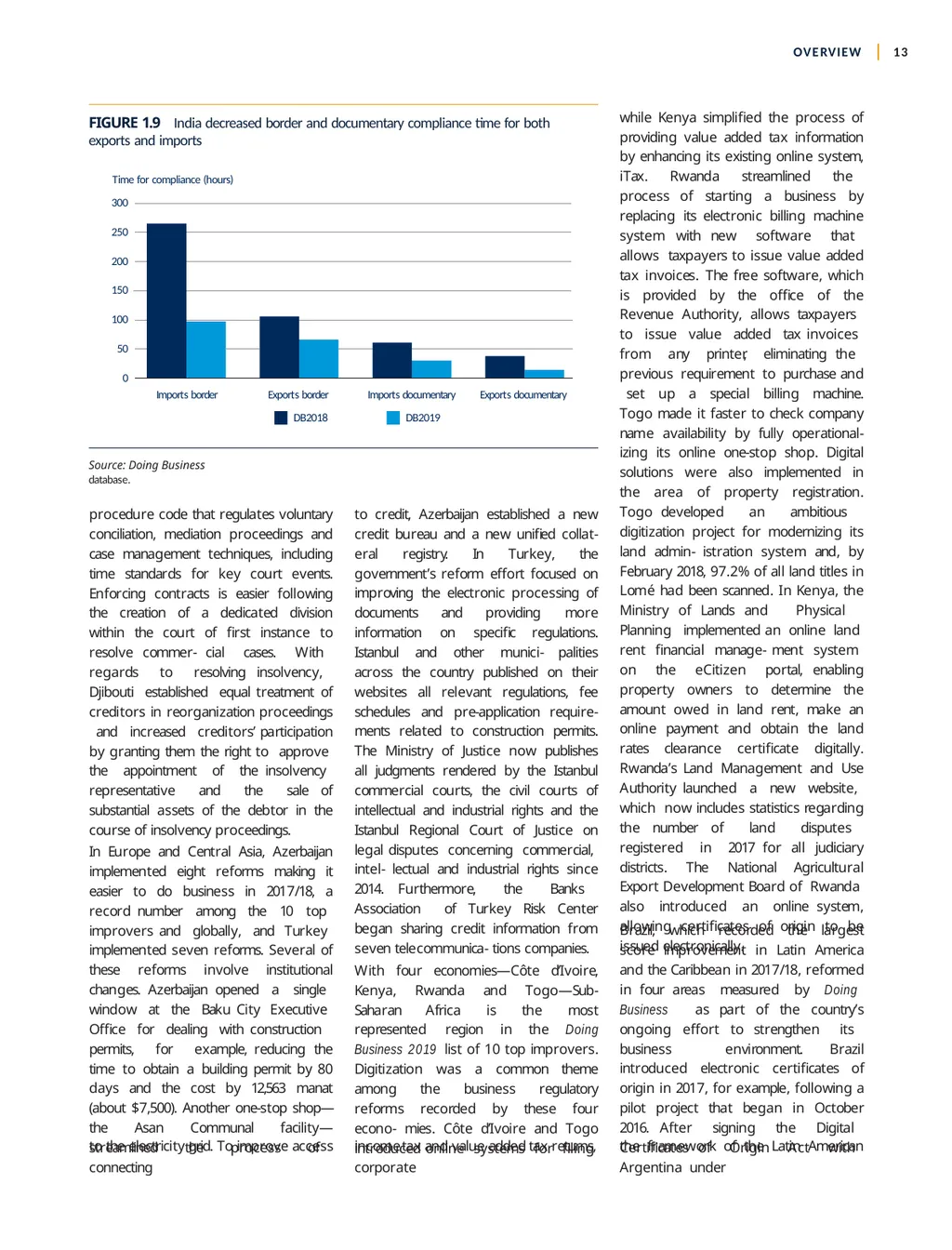
13 OVERVIEW procedure code that regulates voluntary conciliation, mediation proceedings and case management techniques, including time standards for key court events. Enforcing contracts is easier following the creation of a dedicated division within the court of first instance to resolve commer- cial cases. With regards to resolving insolvency, Djibouti established equal treatment of creditors in reorganization proceedings and increased creditors’ participation by granting them the right to approve the appointment of the insolvency representative and the sale of substantial assets of the debtor in the course of insolvency proceedings. In Europe and Central Asia, Azerbaijan implemented eight reforms making it easier to do business in 2017/18, a record number among the 10 top improvers and globally, and Turkey implemented seven reforms. Several of these reforms involve institutional changes. Azerbaijan opened a single window at the Baku City Executive Office for dealing with construction permits, for example, reducing the time to obtain a building permit by 80 days and the cost by 12,563 manat (about $7,500). Another one-stop shop—the Asan Communal facility— streamlined the process of connecting to credit, Azerbaijan established a new credit bureau and a new unified collat- eral registry. In Turkey, the government’s reform effort focused on improving the electronic processing of documents and providing more information on specific regulations. Istanbul and other munici- palities across the country published on their websites all relevant regulations, fee schedules and pre-application require- ments related to construction permits. The Ministry of Justice now publishes all judgments rendered by the Istanbul commercial courts, the civil courts of intellectual and industrial rights and the Istanbul Regional Court of Justice on legal disputes concerning commercial, intel- lectual and industrial rights since 2014. Furthermore, the Banks Association of Turkey Risk Center began sharing credit information from seven telecommunica- tions companies. With four economies—Côte d’Ivoire, Kenya, Rwanda and Togo—Sub-Saharan Africa is the most represented region in the Doing Business 2019 list of 10 top improvers. Digitization was a common theme among the business regulatory reforms recorded by these four econo- mies. Côte d’Ivoire and Togo introduced online systems for filing corporate while Kenya simplified the process of providing value added tax information by enhancing its existing online system, iTax. Rwanda streamlined the process of starting a business by replacing its electronic billing machine system with new software that allows taxpayers to issue value added tax invoices. The free software, which is provided by the office of the Revenue Authority, allows taxpayers to issue value added tax invoices from any printer, eliminating the previous requirement to purchase and set up a special billing machine. Togo made it faster to check company name availability by fully operational- izing its online one-stop shop. Digital solutions were also implemented in the area of property registration. Togo developed an ambitious digitization project for modernizing its land admin- istration system and, by February 2018, 97.2% of all land titles in Lomé had been scanned. In Kenya, the Ministry of Lands and Physical Planning implemented an online land rent financial manage- ment system on the eCitizen portal, enabling property owners to determine the amount owed in land rent, make an online payment and obtain the land rates clearance certificate digitally. Rwanda’s Land Management and Use Authority launched a new website, which now includes statistics regarding the number of land disputes registered in 2017 for all judiciary districts. The National Agricultural Export Development Board of Rwanda also introduced an online system, allowing certificates of origin to be issued electronically. Brazil, which recorded the largest score improvement in Latin America and the Caribbean in 2017/18, reformed in four areas measured by Doing Business as part of the country’s ongoing effort to strengthen its business environment. Brazil introduced electronic certificates of origin in 2017, for example, following a pilot project that began in October 2016. After signing the Digital Certificates of Origin Act with Argentina under FIGURE 1.9 India decreased border and documentary compliance time for both exports and imports Time for compliance (hours) Imports border Exports border Imports documentary Exports documentary DB2018 DB2019 0 50 100 150 200 250 300 Source: Doing Business database. to the electricity grid. To improve access income tax and value added tax returns, the framework of the Latin American<br>
18
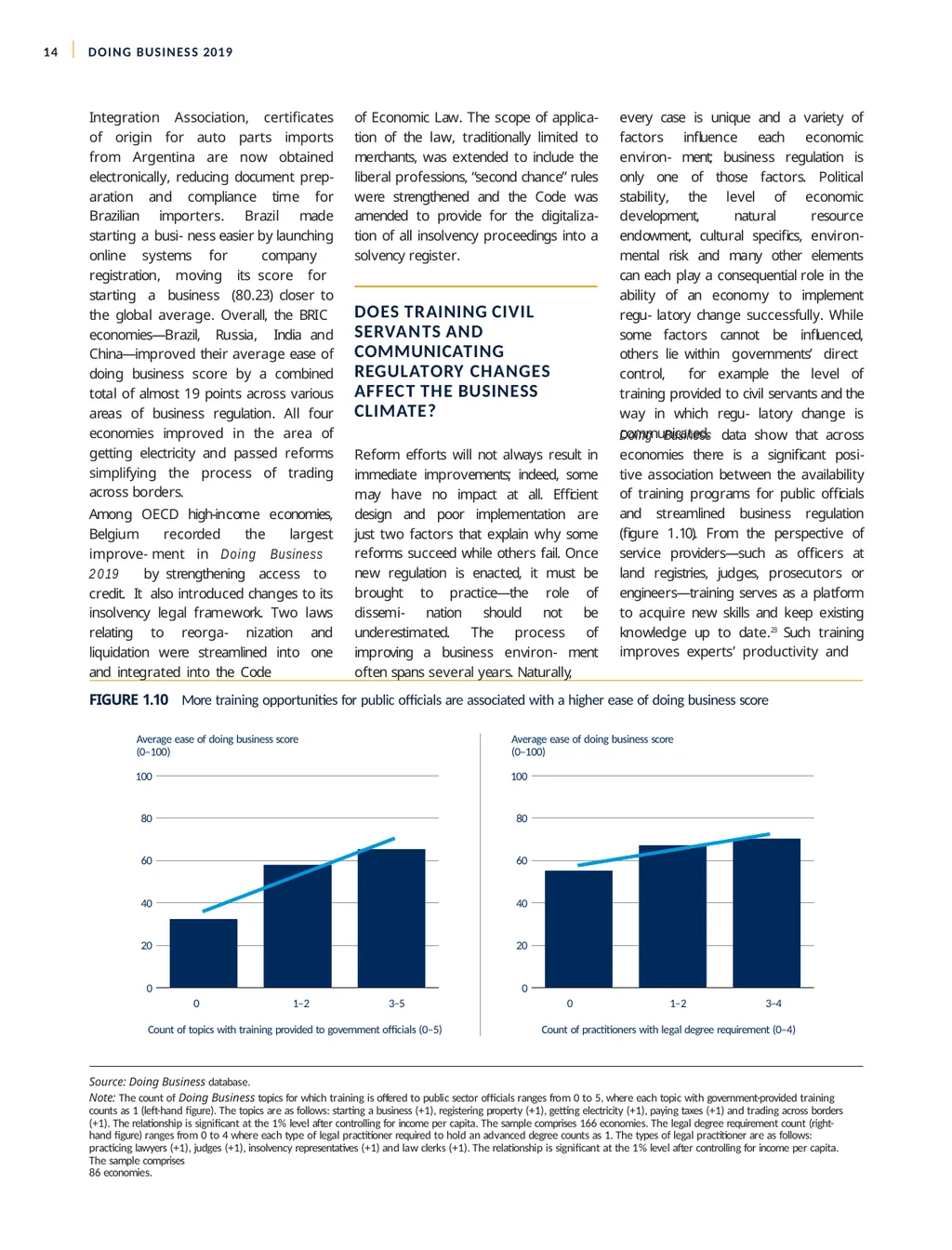
DOING BUSINESS 2019 14 Integration Association, certificates of origin for auto parts imports from Argentina are now obtained electronically, reducing document prep- aration and compliance time for Brazilian importers. Brazil made starting a busi- ness easier by launching online systems for company registration, moving its score for starting a business (80.23) closer to the global average. Overall, the BRIC economies—Brazil, Russia, India and China—improved their average ease of doing business score by a combined total of almost 19 points across various areas of business regulation. All four economies improved in the area of getting electricity and passed reforms simplifying the process of trading across borders. Among OECD high-income economies, Belgium recorded the largest improve- ment in Doing Business 2019 by strengthening access to credit. It also introduced changes to its insolvency legal framework. Two laws relating to reorga- nization and liquidation were streamlined into one and integrated into the Code of Economic Law. The scope of applica- tion of the law, traditionally limited to merchants, was extended to include the liberal professions, “second chance” rules were strengthened and the Code was amended to provide for the digitaliza- tion of all insolvency proceedings into a solvency register. DOES TRAINING CIVIL SERVANTS AND COMMUNICATING REGULATORY CHANGES AFFECT THE BUSINESS CLIMATE? Reform efforts will not always result in immediate improvements; indeed, some may have no impact at all. Efficient design and poor implementation are just two factors that explain why some reforms succeed while others fail. Once new regulation is enacted, it must be brought to practice—the role of dissemi- nation should not be underestimated. The process of improving a business environ- ment often spans several years. Naturally, every case is unique and a variety of factors influence each economic environ- ment; business regulation is only one of those factors. Political stability, the level of economic development, natural resource endowment, cultural specifics, environ- mental risk and many other elements can each play a consequential role in the ability of an economy to implement regu- latory change successfully. While some factors cannot be influenced, others lie within governments’ direct control, for example the level of training provided to civil servants and the way in which regu- latory change is communicated. Doing Business data show that across economies there is a significant posi- tive association between the availability of training programs for public officials and streamlined business regulation (figure 1.10). From the perspective of service providers—such as officers at land registries, judges, prosecutors or engineers—training serves as a platform to acquire new skills and keep existing knowledge up to date.23 Such training improves experts’ productivity and FIGURE 1.10 More training opportunities for public officials are associated with a higher ease of doing business score 0 20 40 60 80 100 0 1–2 3–5
Count of topics with training provided to government officials (0–5) Average ease of doing business score (0–100) 0 1–2 3–4
Count of practitioners with legal degree requirement (0–4) 0 20 40 60 80 100 Average ease of doing business score (0–100) Source: Doing Business database.
Note: The count of Doing Business topics for which training is offered to public sector officials ranges from 0 to 5, where each topic with government-provided training counts as 1 (left-hand figure). The topics are as follows: starting a business (+1), registering property (+1), getting electricity (+1), paying taxes (+1) and trading across borders (+1). The relationship is significant at the 1% level after controlling for income per capita. The sample comprises 166 economies. The legal degree requirement count (right-hand figure) ranges from 0 to 4 where each type of legal practitioner required to hold an advanced degree counts as 1. The types of legal practitioner are as follows: practicing lawyers (+1), judges (+1), insolvency representatives (+1) and law clerks (+1). The relationship is significant at the 1% level after controlling for income per capita. The sample comprises
86 economies.<br>
Count of topics with training provided to government officials (0–5) Average ease of doing business score (0–100) 0 1–2 3–4
Count of practitioners with legal degree requirement (0–4) 0 20 40 60 80 100 Average ease of doing business score (0–100) Source: Doing Business database.
Note: The count of Doing Business topics for which training is offered to public sector officials ranges from 0 to 5, where each topic with government-provided training counts as 1 (left-hand figure). The topics are as follows: starting a business (+1), registering property (+1), getting electricity (+1), paying taxes (+1) and trading across borders (+1). The relationship is significant at the 1% level after controlling for income per capita. The sample comprises 166 economies. The legal degree requirement count (right-hand figure) ranges from 0 to 4 where each type of legal practitioner required to hold an advanced degree counts as 1. The types of legal practitioner are as follows: practicing lawyers (+1), judges (+1), insolvency representatives (+1) and law clerks (+1). The relationship is significant at the 1% level after controlling for income per capita. The sample comprises
86 economies.<br>
19
15 OVERVIEW capacity to serve customers, who in turn become better informed about new regulatory requirements or processes. Those with a better understanding of business regulatory processes are likely to comply more often with the required rules and procedures. Improved under- standing, clarity and trust in regulatory requirements are associated with more efficiency in the regulatory framework.24 In the area of judicial performance, those economies that make the training of judges mandatory are more likely to enjoy higher resolution rates and better judicial decisions. Indeed, the training of judges is imperative for increased judicial efficiency and productivity.25, 26 Evidence from Pakistan indicates that reforms which provided judges with training are accompanied by positive effects on judicial efficiency and, conse- quently, entrepreneurship.27 Beyond training, governments have other options to enhance the implemen- tation of business regulatory reform. Economies in which governments effectively communicate changes to legislative processes tend to be associ- ated with better business regulation and more reforms. While these results cannot be interpreted as causal, they do signal to policy makers that public- private dialogue is a powerful tool for increasing the number of reforms and improving business regulatory efficiency (figure 1.11). Effective public communication of business regulatory reform not only constitutes good practice—it also improves compliance from the private sector and holds the public sector accountable for regulatory violations.28 Specifically, regulators who conduct workshops with the public or interested stakeholders are more likely to have better efficiency and quality of business legislation in their constituencies. Not surprisingly, economies where govern- ments communicate regulatory changes through media—such as broadcast advertisements and announcements, social media, and mobile applications— are likely to have a higher ease of doing business score. Governments that make changes to laws or procedures publicly available through regulatory websites are also likely to perform better on the Doing Business indicators. WHAT IS NEW IN THIS YEAR’S REPORT? To further explore the links between training and the successful implementa- tion of business regulation, Doing Business 2019 presents four case studies with a specific focus on training opportunities for public officials and communication of regulatory changes. The case study on starting a business and registering property analyzes new data on training opportunities available to public officials at the business and land registries. It finds that the provision of mandatory training for business registry officers is associated with higher registry efficiency. Similarly, holding annual training for land registry officers is associated with more effective registration procedures. Communicating changes at the business FIGURE 1.11 Communication of regulatory changes through media campaigns is associated with better business regulation and more reforms 0 80
2
60
40
1
20 100 0–1 2–4 5+ Average ease of doing business score (0–100) Count of topics with media campaign (0–6) Count of topics with media campaign (0–6) 0 3 0–1 2–4 5+ Business regulatory reforms in 2017/18 (number) Source: Doing Business database.
Note: The count of topics with media campaign ranges from 0 to 6 where each topic with a media campaign launched to announce changes to regulation counts as 1. The topics are as follows: starting a business (+1), dealing with construction permits (+1), registering property (+1), getting credit (+1), protecting minority investors (+1) or paying taxes (+1). Both the left-hand and right-hand relationships are significant at the 1% level after controlling for income per capita; both samples comprise 76 economies.<br>
2
60
40
1
20 100 0–1 2–4 5+ Average ease of doing business score (0–100) Count of topics with media campaign (0–6) Count of topics with media campaign (0–6) 0 3 0–1 2–4 5+ Business regulatory reforms in 2017/18 (number) Source: Doing Business database.
Note: The count of topics with media campaign ranges from 0 to 6 where each topic with a media campaign launched to announce changes to regulation counts as 1. The topics are as follows: starting a business (+1), dealing with construction permits (+1), registering property (+1), getting credit (+1), protecting minority investors (+1) or paying taxes (+1). Both the left-hand and right-hand relationships are significant at the 1% level after controlling for income per capita; both samples comprise 76 economies.<br>
20
DOING BUSINESS 2019 16 and land registries—through, for example, providing workshops for registry officers or information campaigns for system users—is associated with a lower time to complete transactions. The case study on getting electricity highlights the benefits of comprehensive wiring regulation. To adequately mitigate safety risks, accreditation systems for electricians are essential, as are inspec- tions of wiring installations and liability regimes. Doing Business data show that where electrical connection processes are efficient, there also tend to be robust quality control standards. Similarly, the case study on trading across borders draws on newly collected data to illus- trate that the use of regular training to educate customs clearance officials and customs brokers is positively associated with lower border and documentary compliance times. The case study on enforcing contracts and resolving insolvency explores the education and training that judges receive worldwide. It features examples of two judicial systems—Indonesia and the United Arab Emirates—each with adequate education and training frameworks in commercial and insol- vency matters. The annex presents data analysis for the labor market regulation topic, including general trends and the relationship with firm performance. NOTES Entrepreneurship Database (http://www
.doingbusiness.org/data/exploretopics
/entrepreneurship), World Bank Group.
Aghion, Fally and Scarpetta 2007; Herrendorf and Teixeira 2011.
Paunov 2016.
Demenet, Razafindrakoto and Roubaud 2016.
Sutherland 2011.
Agyeman, Abeka and Assiamah 2016.
Abeberese 2016.
Andersen and Dalgaard 2013.
Aragón 2015; Christiansen, Schindler and Tressel 2013. Berkowitz, Lin and Ma 2015; Mitton 2016.
Djankov, La Porta and others 2008.
Durnev, Errunza and Molchanov 2009.
Gutiérrez 2003.
Chaurey 2015.
Carluccio 2015.
For more information on the research on the effects of business regulation published in Doing Business 2014, see http://www
.doingbusiness.org/en/reports/global-reports
/doing-business-2014.
For more information on the legal research findings on business regulations and the law published in Doing Business 2016, see http:// www.doingbusiness.org/en/reports
/global-reports/doing-business-2016.
These areas include: starting a business (DB2019, DB2018, DB2015, DB2009, DB2008), dealing with construction permits (DB2018, DB2016, DB2008), registering property (DB2019, DB2018, DB2017, DB2013, DB2010, DB2009, DB2008), getting credit (DB2014, DB2013, DB2010, DB2009, DB2007, DB2006), protecting minority investors (DB2019), paying taxes (DB2019, DB2008), trading across borders (DB2019, DB2018, DB2010, DB2008, DB2006), enforcing contracts (DB2015, DB2014, DB2011, DB2010), resolving insolvency (DB2014, DB2010, D2008). Substantial changes were observed in labor market regulation in DB2010. Since 2005 a total of five reforms have been captured in Mauritius in the area of starting a business, but four reforms contributed to the reduction in time for business incorporation.
The extent of disclosure index ranges from 0 to 10, with higher values indicating greater disclosure.
Djankov, Georgieva and Ramalho 2018.
Twenty-three changes making it more burdensome for businesses to operate were recorded in Doing Business 2019.
DeVaro, Maxwell and Morita 2017.
Dabla-Norris, Gradstein and Inchauste 2008.
Hadfield 2008.
Ichino, Polo and Rettore 2003.
Chemin 2009.
Macchiavello 2008.<br>
.doingbusiness.org/data/exploretopics
/entrepreneurship), World Bank Group.
Aghion, Fally and Scarpetta 2007; Herrendorf and Teixeira 2011.
Paunov 2016.
Demenet, Razafindrakoto and Roubaud 2016.
Sutherland 2011.
Agyeman, Abeka and Assiamah 2016.
Abeberese 2016.
Andersen and Dalgaard 2013.
Aragón 2015; Christiansen, Schindler and Tressel 2013. Berkowitz, Lin and Ma 2015; Mitton 2016.
Djankov, La Porta and others 2008.
Durnev, Errunza and Molchanov 2009.
Gutiérrez 2003.
Chaurey 2015.
Carluccio 2015.
For more information on the research on the effects of business regulation published in Doing Business 2014, see http://www
.doingbusiness.org/en/reports/global-reports
/doing-business-2014.
For more information on the legal research findings on business regulations and the law published in Doing Business 2016, see http:// www.doingbusiness.org/en/reports
/global-reports/doing-business-2016.
These areas include: starting a business (DB2019, DB2018, DB2015, DB2009, DB2008), dealing with construction permits (DB2018, DB2016, DB2008), registering property (DB2019, DB2018, DB2017, DB2013, DB2010, DB2009, DB2008), getting credit (DB2014, DB2013, DB2010, DB2009, DB2007, DB2006), protecting minority investors (DB2019), paying taxes (DB2019, DB2008), trading across borders (DB2019, DB2018, DB2010, DB2008, DB2006), enforcing contracts (DB2015, DB2014, DB2011, DB2010), resolving insolvency (DB2014, DB2010, D2008). Substantial changes were observed in labor market regulation in DB2010. Since 2005 a total of five reforms have been captured in Mauritius in the area of starting a business, but four reforms contributed to the reduction in time for business incorporation.
The extent of disclosure index ranges from 0 to 10, with higher values indicating greater disclosure.
Djankov, Georgieva and Ramalho 2018.
Twenty-three changes making it more burdensome for businesses to operate were recorded in Doing Business 2019.
DeVaro, Maxwell and Morita 2017.
Dabla-Norris, Gradstein and Inchauste 2008.
Hadfield 2008.
Ichino, Polo and Rettore 2003.
Chemin 2009.
Macchiavello 2008.<br>
21
17 OVERVIEW<br>
22
DOING BUSINESS 2019 18<br>
23
19 OVERVIEW<br>
24
DOING BUSINESS 2019 20<br>
25
21 OVERVIEW Source: Doing Business database.
Note: Reforms affecting the labor market regulation indicators are included here but do not affect the ranking on the ease of doing business.<br>
Note: Reforms affecting the labor market regulation indicators are included here but do not affect the ranking on the ease of doing business.<br>
26
DOING BUSINESS 2019 Doing Business is founded on the principle that economic activity benefits from clear and coherent rules: rules that set out strong property rights, facilitate the resolution of disputes and provide contractual partners with protections against arbitrariness and abuse. Such rules are much more effective in promoting growth and development when they are efficient, transparent and accessible to those for whom they are intended. The strength and inclusivity of the rules also have a crucial bearing on how societies distribute the benefits and finance the costs of development strategies and policies. tant dimensions of the regulatory ment (FDI), market capitalization in Good rules create an environment where new entrants with drive and innova- tive ideas can get started in business and where productive firms can invest, expand and create new jobs. The role of government policy in the daily operations of small and medium-size domestic firms is a central focus of the Doing Business data. The objective is to encourage regu- lation that is efficient, transparent and easy to implement so that businesses can thrive and promote economic and social progress. Doing Business data focus on the 11 areas of regulation affecting small and medium-size domestic firms in the largest business city of an economy. The project uses standardized case studies to provide objective, quantitative measures that can be compared across 190 economies. FACTORS DOING BUSINESS MEASURES Doing Business captures several impor- environment affecting domestic firms. It provides quantitative indicators on regu- lation for starting a business, dealing with construction permits, getting electricity, registering property, getting credit, protecting minority investors, paying taxes, trading across borders, enforcing contracts and resolving insolvency (table 2.1). Doing Business also measures features of labor market regulation which are reported as a separate section and not included in the ranking. How the indicators are selected The design of the Doing Business indicators has been informed by theo- retical insights gleaned from extensive research and the literature on the role of institutions in enabling economic devel- opment.1 In addition, the background papers developing the methodology for each of the Doing Business indicator sets have established the importance of the rules and regulations that Doing Business focuses on for such economic outcomes as trade volumes, foreign direct invest- About Doing Business Doing Business measures aspects of business regulation affecting small and medium-size domestic firms defined based on standardized case scenarios and located in the largest business city of 190 economies. In addition, for 11 economies a second city is covered. Doing Business covers 11 areas of business regulation. Ten of these areas—starting a business, dealing with construction permits, getting electricity, registering property, getting credit, protecting minority investors, paying taxes, trading across borders, enforcing contracts and resolving insolvency—are included in the ease
of doing business score and ease of doing business ranking. Doing Business also measures features of labor market regulation, which is not included in these two measures. Doing Business relies on four main sources of information: the relevant laws and regulations, Doing Business respondents, the governments of the economies covered and World Bank Group regional staff. Over the past 16 years more than 43,800 professionals in 190 economies have assisted in providing the data that inform the Doing Business indicators. Doing Business data are widely used by governments, researchers,
international organizations and think tanks to guide policies, conduct research and develop new indexes. There are no methodological changes in Doing Business 2019 data.<br>
of doing business score and ease of doing business ranking. Doing Business also measures features of labor market regulation, which is not included in these two measures. Doing Business relies on four main sources of information: the relevant laws and regulations, Doing Business respondents, the governments of the economies covered and World Bank Group regional staff. Over the past 16 years more than 43,800 professionals in 190 economies have assisted in providing the data that inform the Doing Business indicators. Doing Business data are widely used by governments, researchers,
international organizations and think tanks to guide policies, conduct research and develop new indexes. There are no methodological changes in Doing Business 2019 data.<br>
27
23 ABOUT DOING BUSINESS stock exchanges and private credit as a percentage of GDP.2 way of applying regulation that keeps doing business ranking. The ease of on paying taxes, 87.67 on starting a The choice of the 11 sets of Doing Business indicators has also been guided by economic research and firm- level data, specifically data from the World Bank Enterprise Surveys.3 These surveys provide data highlighting the main obstacles to business activity as reported by entrepreneurs from more than 136,880 companies in 139 econo- mies. Access to finance and access to electricity, for example, are among the factors identified by the surveys as important to businesses—inspiring the design of the Doing Business indicators on getting credit and getting electricity. Some Doing Business indicators give a higher score for more regulation and better-functioning institutions (such as courts or credit bureaus). Higher scores are given for stricter disclosure requirements for related-party trans- actions, for example, in the area of protecting minority investors. Higher scores are also given for a simplified compliance costs for firms low—such as by easing the burden of business start- up formalities with a one-stop shop or through a single online portal. Finally, the scores reward economies that apply a risk-based approach to regulation as a way to address social and environmental concerns—such as by imposing a greater regulatory burden on activities that pose a high risk to the population and a lesser one on lower-risk activi- ties. Thus, the economies that rank highest on the ease of doing business are not those where there is no regula- tion, but those where governments have managed to create rules that facilitate interactions in the marketplace without needlessly hindering the development of the private sector. The ease of doing business score and ease of doing business ranking
To provide different perspectives on the data, Doing Business presents data both for individual indicators and for two aggregate measures: the ease of doing business score and the ease of doing business score aids in assessing the absolute level of regulatory perfor- mance and how it improves over time. The individual indicator scores show the distance of each economy to the best regulatory performance observed in each of the indicators across all econo- mies in the Doing Business sample since 2005 or the third year in which data were collected for the indicator. The best regulatory performance is set at the highest possible value for indicators calculated as scores, such as the strength of legal rights index or the quality of land administration index. This underscores the gap between a particular economy’s performance and the best regulatory performance at any point in time and is used to assess the absolute change in the economy’s regulatory environment over time as measured by Doing Business (see the chapter on the ease of doing business score and ease of doing busi- ness ranking). The ranking on the ease of doing business complements the ease of doing business score by providing information about an economy’s perfor- mance in business regulation relative to the performance of other economies as measured by Doing Business. Doing Business uses a simple averaging approach for weighting component indicators, calculating rankings and determining the ease of doing business score.4 Each topic covered by Doing Business relates to a different aspect of the business regulatory environ- ment. The scores and rankings of each economy vary considerably across topics, indicating that a strong perfor- mance by an economy in one area of regulation can coexist with weak perfor- mance in another (figure 2.1). One way to assess the variability of an economy’s regulatory performance is to look at its scores across topics (see the country tables). Qatar, for example, has an overall ease of doing business score of 65.89, meaning that it is about two-thirds of the way from the worst to the best performance. It scores highly at 99.44<br>
To provide different perspectives on the data, Doing Business presents data both for individual indicators and for two aggregate measures: the ease of doing business score and the ease of doing business score aids in assessing the absolute level of regulatory perfor- mance and how it improves over time. The individual indicator scores show the distance of each economy to the best regulatory performance observed in each of the indicators across all econo- mies in the Doing Business sample since 2005 or the third year in which data were collected for the indicator. The best regulatory performance is set at the highest possible value for indicators calculated as scores, such as the strength of legal rights index or the quality of land administration index. This underscores the gap between a particular economy’s performance and the best regulatory performance at any point in time and is used to assess the absolute change in the economy’s regulatory environment over time as measured by Doing Business (see the chapter on the ease of doing business score and ease of doing busi- ness ranking). The ranking on the ease of doing business complements the ease of doing business score by providing information about an economy’s perfor- mance in business regulation relative to the performance of other economies as measured by Doing Business. Doing Business uses a simple averaging approach for weighting component indicators, calculating rankings and determining the ease of doing business score.4 Each topic covered by Doing Business relates to a different aspect of the business regulatory environ- ment. The scores and rankings of each economy vary considerably across topics, indicating that a strong perfor- mance by an economy in one area of regulation can coexist with weak perfor- mance in another (figure 2.1). One way to assess the variability of an economy’s regulatory performance is to look at its scores across topics (see the country tables). Qatar, for example, has an overall ease of doing business score of 65.89, meaning that it is about two-thirds of the way from the worst to the best performance. It scores highly at 99.44<br>
28
DOING BUSINESS 2019 24 business and 83.27 on registering prop- erty. At the same time, it has a score of
28.33 for protecting minority investors,
38.12 for resolving insolvency and 40 for getting credit. FACTORS DOING BUSINESS
DOES NOT MEASURE Many important policy areas are not covered by Doing Business; even within the areas it covers its scope is narrow (table 2.2). Doing Business does not measure the full range of factors, policies and institutions that affect the quality of an economy’s business environment or its national competitiveness. It does not, for example, capture aspects of macroeconomic stability, development of the financial system, market size, the incidence of bribery and corruption or the quality of the labor force. The focus is deliberately narrow even within the relatively small set of indi- cators included in Doing Business. The time and cost required for the logistical process of exporting and importing goods is captured in the trading across borders indicators, for example, but they do not measure the cost of tariffs or of international transport. Doing Business provides a narrow perspective on the infrastructure challenges that firms face, particularly in the developing world, through these indicators. It does not address the extent to which inadequate roads, rail, ports and communications may add to firms’ costs and undermine competitiveness (except to the extent that the trading across borders indica- tors indirectly measure the quality of ports and border connections). Similar to the indicators on trading across borders, all aspects of commercial legislation business or protecting minority inves- tors. Given that Doing Business measures only a few features of each area that it covers, business regulatory reforms should not focus only on these narrow areas and should be evaluated within a broader perspective. Doing Business does not attempt to quan- tify all costs and benefits of a particular law or regulation to society as a whole. The paying taxes indicators measure the total tax and contribution rate, which, in isolation, is a cost to businesses. However, the indicators do not measure—nor are they intended to measure—the benefits of the social and economic programs funded with tax revenues. Measuring the quality and efficiency of business regu- lation provides only one input into the debate on the regulatory burden associ- ated with achieving regulatory objectives, which can differ across economies. Doing Business provides a starting point for this discussion and should be used in conjunc- tion with additional data sources. Other World Bank Group databases that provide comprehensive data related to some 0 Average of the three highest scores are not covered by those on starting a areas of Doing Business include: Women,<br>
28.33 for protecting minority investors,
38.12 for resolving insolvency and 40 for getting credit. FACTORS DOING BUSINESS
DOES NOT MEASURE Many important policy areas are not covered by Doing Business; even within the areas it covers its scope is narrow (table 2.2). Doing Business does not measure the full range of factors, policies and institutions that affect the quality of an economy’s business environment or its national competitiveness. It does not, for example, capture aspects of macroeconomic stability, development of the financial system, market size, the incidence of bribery and corruption or the quality of the labor force. The focus is deliberately narrow even within the relatively small set of indi- cators included in Doing Business. The time and cost required for the logistical process of exporting and importing goods is captured in the trading across borders indicators, for example, but they do not measure the cost of tariffs or of international transport. Doing Business provides a narrow perspective on the infrastructure challenges that firms face, particularly in the developing world, through these indicators. It does not address the extent to which inadequate roads, rail, ports and communications may add to firms’ costs and undermine competitiveness (except to the extent that the trading across borders indica- tors indirectly measure the quality of ports and border connections). Similar to the indicators on trading across borders, all aspects of commercial legislation business or protecting minority inves- tors. Given that Doing Business measures only a few features of each area that it covers, business regulatory reforms should not focus only on these narrow areas and should be evaluated within a broader perspective. Doing Business does not attempt to quan- tify all costs and benefits of a particular law or regulation to society as a whole. The paying taxes indicators measure the total tax and contribution rate, which, in isolation, is a cost to businesses. However, the indicators do not measure—nor are they intended to measure—the benefits of the social and economic programs funded with tax revenues. Measuring the quality and efficiency of business regu- lation provides only one input into the debate on the regulatory burden associ- ated with achieving regulatory objectives, which can differ across economies. Doing Business provides a starting point for this discussion and should be used in conjunc- tion with additional data sources. Other World Bank Group databases that provide comprehensive data related to some 0 Average of the three highest scores are not covered by those on starting a areas of Doing Business include: Women,<br>
29
25 ABOUT DOING BUSINESS Business and the Law, which measures legal restrictions on women’s economic opportunities in 189 economies; the Logistic Performance Index, which benchmarks the performance of trade logistics in 160 economies; the World Governance Indicators, which provides data on different dimensions of gover- nance in 214 economies; and Country Policy and Institutional Assessments, which measure the quality of policies and institutions in International Development Association (IDA) economies.5 ADVANTAGES AND
LIMITATIONS OF THE METHODOLOGY
The Doing Business methodology is designed to be an easily replicable way to benchmark specific characteristics of business regulation—how they are implemented by governments and expe- rienced by private firms on the ground. Its advantages and limitations should be understood when using the data (table 2.3). Ensuring comparability of the data across a global set of economies is a central consideration for the Doing Business indicators, which are developed using standardized case scenarios with specific assumptions. One such assumption is the location of a standardized business— the subject of the Doing Business case study—in the largest business city of the economy. Therealityisthatbusinessregu- lations and their enforcement may differ within a country, particularly in federal states and large economies. But gath- ering data for every relevant jurisdiction in each of the 190 economies covered by Doing Business is infeasible. Nevertheless, where policy makers are interested in generating data at the local level, beyond the largest business city, and learning from local good practices, Doing Business has complemented its global indicators with subnational studies (box 2.1). Also, coverage was extended to the second largest business city in economies with a population of more than 100 million (as of 2013) in Doing Business 2015. Doing Business recognizes the limi- tations of the standardized case scenarios and assumptions. But while such assumptions come at the expense of generality, they also help to ensure the comparability of data. Some Doing Business topics are complex, and so it is important that the standardized cases are defined carefully. For example, the standardized case scenario usually involves a limited liability company or its legal equivalent. There are two reasons for this assumption. First, private limited liability companies are the most prevalent business form (for firms with more than one owner) in many economies around the world. Second, this choice reflects the focus of Doing Business on expanding opportuni- ties for entrepreneurship: investors are encouraged to venture into business when potential losses are limited to their capital participation. Another assumption underlying the Doing Business indicators is that entre- preneurs have knowledge of and comply with applicable regulations. In practice, entrepreneurs may not be aware of what needs to be done or how to comply with regulations and may lose considerable time trying to find out. Alternatively, they may intentionally avoid compliance—by not registering for social security, for example. Firms may opt for bribery and other informal arrangements intended to bypass the rules where regulation is particularly onerous—an aspect that helps explain differences between the de jure data provided by Doing Business and the de facto insights offered by the World Bank Enterprise Surveys.6 Levels of informality tend to be higher in economies with particularly burdensome regulation. Compared with their formal sector counterparts, firms in the informal sector typically grow more slowly, have poorer access to credit and employ fewer workers—and these workers remain outside the protections of labor law and, more generally, other legal protec- tions embedded in the law.7 Firms in the informal sector are also less likely to pay taxes. Doing Business measures one set of factors that help explain the occur- rence of informality and provides policy makers with insights into potential areas of regulatory reform. a. In economies with a population of more than 100 million as of 2013, Doing Business covers business regulation in both the largest and second largest business city.<br>
LIMITATIONS OF THE METHODOLOGY
The Doing Business methodology is designed to be an easily replicable way to benchmark specific characteristics of business regulation—how they are implemented by governments and expe- rienced by private firms on the ground. Its advantages and limitations should be understood when using the data (table 2.3). Ensuring comparability of the data across a global set of economies is a central consideration for the Doing Business indicators, which are developed using standardized case scenarios with specific assumptions. One such assumption is the location of a standardized business— the subject of the Doing Business case study—in the largest business city of the economy. Therealityisthatbusinessregu- lations and their enforcement may differ within a country, particularly in federal states and large economies. But gath- ering data for every relevant jurisdiction in each of the 190 economies covered by Doing Business is infeasible. Nevertheless, where policy makers are interested in generating data at the local level, beyond the largest business city, and learning from local good practices, Doing Business has complemented its global indicators with subnational studies (box 2.1). Also, coverage was extended to the second largest business city in economies with a population of more than 100 million (as of 2013) in Doing Business 2015. Doing Business recognizes the limi- tations of the standardized case scenarios and assumptions. But while such assumptions come at the expense of generality, they also help to ensure the comparability of data. Some Doing Business topics are complex, and so it is important that the standardized cases are defined carefully. For example, the standardized case scenario usually involves a limited liability company or its legal equivalent. There are two reasons for this assumption. First, private limited liability companies are the most prevalent business form (for firms with more than one owner) in many economies around the world. Second, this choice reflects the focus of Doing Business on expanding opportuni- ties for entrepreneurship: investors are encouraged to venture into business when potential losses are limited to their capital participation. Another assumption underlying the Doing Business indicators is that entre- preneurs have knowledge of and comply with applicable regulations. In practice, entrepreneurs may not be aware of what needs to be done or how to comply with regulations and may lose considerable time trying to find out. Alternatively, they may intentionally avoid compliance—by not registering for social security, for example. Firms may opt for bribery and other informal arrangements intended to bypass the rules where regulation is particularly onerous—an aspect that helps explain differences between the de jure data provided by Doing Business and the de facto insights offered by the World Bank Enterprise Surveys.6 Levels of informality tend to be higher in economies with particularly burdensome regulation. Compared with their formal sector counterparts, firms in the informal sector typically grow more slowly, have poorer access to credit and employ fewer workers—and these workers remain outside the protections of labor law and, more generally, other legal protec- tions embedded in the law.7 Firms in the informal sector are also less likely to pay taxes. Doing Business measures one set of factors that help explain the occur- rence of informality and provides policy makers with insights into potential areas of regulatory reform. a. In economies with a population of more than 100 million as of 2013, Doing Business covers business regulation in both the largest and second largest business city.<br>
30
DOING BUSINESS 2019 26 BOX 2.1 Subnational Doing Business indicators: the European Union series
Doing Business in the European Union is a series of subnational reports being produced by the World Bank Group at the request of and funded by the European Commission’s Directorate-General for Regional and Urban Policy (DG REGIO). A first edi- tion, covering 22 cities in Bulgaria, Hungary and Romania, was released in 2017. This year, 25 more cities in Croatia, the Czech Republic, Portugal and the Slovak Republic were benchmarked (see map). The next study in the subnational series will cover 24 cities in Greece, Ireland and Italy. The ambition is to continue this series until all member states with at least 4 million inhabitants have been covered. The focus of the series is on indicator sets that measure the complexity and cost of regulatory processes as well as the strength of legal institutions, affecting five stages in the life of a small to medium-size domestic firm: starting a busi- ness, dealing with construction permits, getting electricity, registering property and enforcing contracts through a local court.
Because many regulations and administrative measures are implemented or determined by local authorities, subnational Doing Business studies give a nuanced and comprehensive representation of the business regulatory system and the efficacy of the bureaucracy at the local administrative unit level. By providing a factual baseline, along with local examples of good practices, the studies promote peer learning—both within national boundaries and beyond—and convergence among locations toward regula- tory good practices.
The results are revealing. The studies show that there remain substantial differences in the business environment both between and within EU member states. And these differences matter. A study that looked at cities in Italy, Poland, Romania and Spain found that firms located in places with a better business environment have a stronger performance in sales, employment and productivity growth as well as in investments.a Reducing the cost for local firms to do business would enhance their efficiency and competitiveness abroad and encourage investments, which are critical for regional growth. A European Commission report on competitiveness in low-income and low-growth regions also emphasizes the need to improve public administration and make procedures more transparent.b
The findings of the studies indicate how reform-minded officials can make tangible improvements by replicating good practices already existing in other cities in their country. For example, by adopting all the good practices found at the subnational level, all four member states benchmarked in 2018 would move substantially closer to the regulatory best performance.
The insights from the subnational Doing Business in the European Union series will be relevant for the individual country reports produced for the European Semester (the European Union’s economic and fiscal policy coordination framework) and for the Cohesion Policy (the EU’s main investment policy) and will be closely linked with the European Commission’s “lagging regions” initiative, which studies constraints to growth and investment in the low-income and low-growth regions of the European Union. Farole and others 2017.
European Commission 2017. Azores
Madeira<br>
Doing Business in the European Union is a series of subnational reports being produced by the World Bank Group at the request of and funded by the European Commission’s Directorate-General for Regional and Urban Policy (DG REGIO). A first edi- tion, covering 22 cities in Bulgaria, Hungary and Romania, was released in 2017. This year, 25 more cities in Croatia, the Czech Republic, Portugal and the Slovak Republic were benchmarked (see map). The next study in the subnational series will cover 24 cities in Greece, Ireland and Italy. The ambition is to continue this series until all member states with at least 4 million inhabitants have been covered. The focus of the series is on indicator sets that measure the complexity and cost of regulatory processes as well as the strength of legal institutions, affecting five stages in the life of a small to medium-size domestic firm: starting a busi- ness, dealing with construction permits, getting electricity, registering property and enforcing contracts through a local court.
Because many regulations and administrative measures are implemented or determined by local authorities, subnational Doing Business studies give a nuanced and comprehensive representation of the business regulatory system and the efficacy of the bureaucracy at the local administrative unit level. By providing a factual baseline, along with local examples of good practices, the studies promote peer learning—both within national boundaries and beyond—and convergence among locations toward regula- tory good practices.
The results are revealing. The studies show that there remain substantial differences in the business environment both between and within EU member states. And these differences matter. A study that looked at cities in Italy, Poland, Romania and Spain found that firms located in places with a better business environment have a stronger performance in sales, employment and productivity growth as well as in investments.a Reducing the cost for local firms to do business would enhance their efficiency and competitiveness abroad and encourage investments, which are critical for regional growth. A European Commission report on competitiveness in low-income and low-growth regions also emphasizes the need to improve public administration and make procedures more transparent.b
The findings of the studies indicate how reform-minded officials can make tangible improvements by replicating good practices already existing in other cities in their country. For example, by adopting all the good practices found at the subnational level, all four member states benchmarked in 2018 would move substantially closer to the regulatory best performance.
The insights from the subnational Doing Business in the European Union series will be relevant for the individual country reports produced for the European Semester (the European Union’s economic and fiscal policy coordination framework) and for the Cohesion Policy (the EU’s main investment policy) and will be closely linked with the European Commission’s “lagging regions” initiative, which studies constraints to growth and investment in the low-income and low-growth regions of the European Union. Farole and others 2017.
European Commission 2017. Azores
Madeira<br>
31
27 ABOUT DOING BUSINESS DATA COLLECTION IN PRACTICE The Doing Business data are based on a detailed reading of domestic laws, regu- lations and administrative requirements as well as their implementation in prac- tice as experienced by private firms. The report covers 190 economies—including some of the smallest and poorest economies, for which little or no data are available from other sources. The data are collected through several rounds of communication with expert respondents (both private sector practitioners and government officials), through responses to questionnaires, conference calls, written correspondence and visits by the team. Doing Business relies on four main sources of information: the relevant laws and regulations, Doing Business respon- dents, the governments of the economies covered and the World Bank Group regional staff (figure 2.2). For a detailed explanation of the Doing Business meth- odology, see the data notes at http:// www.doingbusiness.org. Relevant laws and regulations
The Doing Business indicators are based mostly on laws and regulations: approximately two-thirds of the data embedded in the Doing Business indica- tors are based on a reading of the law. In addition to filling out questionnaires, Doing Business respondents submit references to the relevant laws, regu- lations and fee schedules. The Doing Business team collects the texts of the relevant laws and regulations and checks the questionnaire responses for accuracy. The team will examine the civil procedure code, for example, to check the maximum number of adjournments in a commercial court dispute, and read the insolvency code to identify if the debtor can initiate liquidation or reorganization proceed- ings. These and other types of laws are available on the Doing Business law library website.8 Since the data collec- tion process involves an annual update of an established database, having a very large sample of respondents is not strictly necessary. In principle, the role of the contributors is largely advi- sory—helping the Doing Business team to locate and understand the laws and regulations. There are quickly dimin- ishing returns to an expanded pool of contributors. This notwithstanding, the number of contributors rose by 70% between 2010 and 2018. Extensive consultations with multiple contributors are conducted by the team to minimize measurement errors for the rest of the data. For some indica- tors—for example, those on dealing with construction permits, enforcing contracts and resolving insolvency—the time component and part of the cost component (where fee schedules are lacking) are based on actual practice rather than the law on the books. This introduces a degree of judgment by respondents on what actual practice looks like. When respondents disagree, the time indicators reported by Doing Business represent the median values of several responses given under the assumptions of the standardized case. Doing Business respondents More than 43,800 professionals in 190 economies have assisted in providing the data that inform the Doing Business indicators over the past 16 years.9 This year’s report draws on the inputs of more than 13,800 professionals.10 The Doing Business website shows the number of respondents for each economy and each indicator set. Selected on the basis of their exper- tise in these areas, respondents are FIGURE 2.2 How Doing Business collects and verifies the data
Nov. Dec. Jan. Feb. Mar. Apr. Report launch Questionnaire development Data collection and analysis Data verification May Jun. Jul. Aug. Sept. Oct. The Doing Business team updates the questionnaires and consults with internal and external experts. The Doing Business team distributes the questionnaires and analyzes the relevant laws and regulations along with the information in the questionnaires.
The Doing Business team travels to approximately 30 economies.
The Doing Business team engages in conference calls, video conferences and in-person meetings with government officials and private sector practitioners.
Governments and World Bank Group regional teams submit information on regulatory changes that could potentially be included in the global count of regulatory reforms. The Doing Business team shares preliminary information on reforms with World Bank Group regional teams for their feedback.
The Doing Business team analyzes the data and writes the report. Comments on the report and data are received from across the World Bank Group through an internal review process. The report is published, followed by media outreach and findings dissemination.<br>
The Doing Business indicators are based mostly on laws and regulations: approximately two-thirds of the data embedded in the Doing Business indica- tors are based on a reading of the law. In addition to filling out questionnaires, Doing Business respondents submit references to the relevant laws, regu- lations and fee schedules. The Doing Business team collects the texts of the relevant laws and regulations and checks the questionnaire responses for accuracy. The team will examine the civil procedure code, for example, to check the maximum number of adjournments in a commercial court dispute, and read the insolvency code to identify if the debtor can initiate liquidation or reorganization proceed- ings. These and other types of laws are available on the Doing Business law library website.8 Since the data collec- tion process involves an annual update of an established database, having a very large sample of respondents is not strictly necessary. In principle, the role of the contributors is largely advi- sory—helping the Doing Business team to locate and understand the laws and regulations. There are quickly dimin- ishing returns to an expanded pool of contributors. This notwithstanding, the number of contributors rose by 70% between 2010 and 2018. Extensive consultations with multiple contributors are conducted by the team to minimize measurement errors for the rest of the data. For some indica- tors—for example, those on dealing with construction permits, enforcing contracts and resolving insolvency—the time component and part of the cost component (where fee schedules are lacking) are based on actual practice rather than the law on the books. This introduces a degree of judgment by respondents on what actual practice looks like. When respondents disagree, the time indicators reported by Doing Business represent the median values of several responses given under the assumptions of the standardized case. Doing Business respondents More than 43,800 professionals in 190 economies have assisted in providing the data that inform the Doing Business indicators over the past 16 years.9 This year’s report draws on the inputs of more than 13,800 professionals.10 The Doing Business website shows the number of respondents for each economy and each indicator set. Selected on the basis of their exper- tise in these areas, respondents are FIGURE 2.2 How Doing Business collects and verifies the data
Nov. Dec. Jan. Feb. Mar. Apr. Report launch Questionnaire development Data collection and analysis Data verification May Jun. Jul. Aug. Sept. Oct. The Doing Business team updates the questionnaires and consults with internal and external experts. The Doing Business team distributes the questionnaires and analyzes the relevant laws and regulations along with the information in the questionnaires.
The Doing Business team travels to approximately 30 economies.
The Doing Business team engages in conference calls, video conferences and in-person meetings with government officials and private sector practitioners.
Governments and World Bank Group regional teams submit information on regulatory changes that could potentially be included in the global count of regulatory reforms. The Doing Business team shares preliminary information on reforms with World Bank Group regional teams for their feedback.
The Doing Business team analyzes the data and writes the report. Comments on the report and data are received from across the World Bank Group through an internal review process. The report is published, followed by media outreach and findings dissemination.<br>
32
DOING BUSINESS 2019 28 professionals who routinely admin- ister or advise on the legal and regulatory requirements in the specific areas covered by Doing Business. Because of the focus on legal and regulatory arrangements, most of the respondents are legal professionals such as lawyers, judges or notaries. In addition, officials of the credit bureau or registry complete the credit information questionnaire. Accountants, architects, engineers, freight forwarders and other profes- sionals answer the questionnaires related to paying taxes, dealing with construc- tion permits, trading across borders and getting electricity. Information that is incorporated into the indicators is also provided by certain public officials (such as registrars from the company or property registry). The Doing Business approach is to work with legal practitioners or other profes- sionals who regularly undertake the transactions involved. Following the standard methodological approach for time-and-motion studies, Doing Business breaks down each process or transac- tion, such as starting a business or registering a building, into separate steps to ensure a better estimate of time. The time estimate for each step is given by practitioners with significant and routine experience in the transaction. There are two main reasons that Doing Business does not survey firms. The first relates to the frequency with which firms engage in the transactions captured by the indicators, which is generally low. For example, a firm goes through the start-up process once in its existence, while an incorporation lawyer may carry out 10 such transactions each month. The incorporation lawyers and other experts providing information to to assess the process of starting a busi- ness than are individual firms. They also have access to current regulations and practices, while a firm may have faced a different set of rules when incorporating years before. The second reason is that the Doing Business questionnaires mostly gather legal information, which firms are unlikely to be fully familiar with. For example, few firms will know about all the main legal procedures involved in resolving a commercial dispute through the courts, even if they have gone through the process themselves. But a litigation lawyer should have little difficulty in providing the requested information on all the procedures. Governments and World Bank Group regional staff
After receiving the completed ques- tionnaires from the Doing Business respondents, verifying the information against the law and conducting follow- up inquiries to ensure that all relevant information is captured, the Doing Business team shares the preliminary descriptions of regulatory reforms with the Country Management Units (CMUs) of the World Bank Group in different regions. At a later stage, the team sends the final versions of the reform descriptions to the World Bank Group’s Board of Executive Directors, which then informs the governments of the reforms in their economies. Through this process, government authorities and World Bank Group staff working on the economies covered by Doing Business can alert the team about, for example, regulatory reforms not reported by the respondents or additional achievements of regulatory reforms. In addition, the team responds formally to the comments of govern- ments or regional staff and provides Data adjustments
Information on data corrections is provided in the data notes available at the Doing Business website. A transparent complaint procedure allows anyone to challenge the data. From November 2017 to October 2018 the team received and responded to over 150 queries on the data. USES OF THE DOING BUSINESS DATA Doing Business was designed with two main types of users in mind: policy makers and researchers. It is a tool that govern- ments can use to design sound business regulatory policies. Nevertheless, the Doing Business data are limited in scope and should be complemented with other sources of information. Doing Business focuses on a few specific rules relevant to the specific case studies analyzed. These rules and case studies are chosen to be illustrative of the business regulatory environment, but they are not a compre- hensive description of that environment. By providing a unique data set that enables analysis aimed at better under- standing the role of business regulation in economic development, Doing Business is also an important source of information for researchers. Governments and policy makers Doing Business offers policy makers a benchmarking tool useful in stimulating policy debate, both by exposing potential challenges and by identifying good prac- tices and lessons learned. Despite the narrow focus of the indicators, the initial debate in an economy on the results they highlight typically turns into a deeper discussion on areas where business regu- latory reform is needed, including areas well beyond those measured by Doing Business. In economies where subnational studies are conducted, the Doing Business indicators go one step further in offering policy makers a tool to identify good practices that can be adopted within their Doing Business offers policy makers a benchmarking tool useful in stimulating policy debate. Doing Business are therefore better able explanations of the scoring decisions. economies (see box 2.1).<br>
After receiving the completed ques- tionnaires from the Doing Business respondents, verifying the information against the law and conducting follow- up inquiries to ensure that all relevant information is captured, the Doing Business team shares the preliminary descriptions of regulatory reforms with the Country Management Units (CMUs) of the World Bank Group in different regions. At a later stage, the team sends the final versions of the reform descriptions to the World Bank Group’s Board of Executive Directors, which then informs the governments of the reforms in their economies. Through this process, government authorities and World Bank Group staff working on the economies covered by Doing Business can alert the team about, for example, regulatory reforms not reported by the respondents or additional achievements of regulatory reforms. In addition, the team responds formally to the comments of govern- ments or regional staff and provides Data adjustments
Information on data corrections is provided in the data notes available at the Doing Business website. A transparent complaint procedure allows anyone to challenge the data. From November 2017 to October 2018 the team received and responded to over 150 queries on the data. USES OF THE DOING BUSINESS DATA Doing Business was designed with two main types of users in mind: policy makers and researchers. It is a tool that govern- ments can use to design sound business regulatory policies. Nevertheless, the Doing Business data are limited in scope and should be complemented with other sources of information. Doing Business focuses on a few specific rules relevant to the specific case studies analyzed. These rules and case studies are chosen to be illustrative of the business regulatory environment, but they are not a compre- hensive description of that environment. By providing a unique data set that enables analysis aimed at better under- standing the role of business regulation in economic development, Doing Business is also an important source of information for researchers. Governments and policy makers Doing Business offers policy makers a benchmarking tool useful in stimulating policy debate, both by exposing potential challenges and by identifying good prac- tices and lessons learned. Despite the narrow focus of the indicators, the initial debate in an economy on the results they highlight typically turns into a deeper discussion on areas where business regu- latory reform is needed, including areas well beyond those measured by Doing Business. In economies where subnational studies are conducted, the Doing Business indicators go one step further in offering policy makers a tool to identify good practices that can be adopted within their Doing Business offers policy makers a benchmarking tool useful in stimulating policy debate. Doing Business are therefore better able explanations of the scoring decisions. economies (see box 2.1).<br>
33
29 ABOUT DOING BUSINESS Many Doing Business indicators can be considered “actionable.” For example, governments can set the minimum capital requirement for new firms, invest in company and property registries to increase their efficiency, or improve the efficiency of tax administration by adopting the latest technology to facili- tate the preparation, filing and payment of taxes by the business community. And they can undertake court reforms to shorten delays in the enforcement of contracts. But some Doing Business indicators capture procedures, time and costs that involve private sector participants, such as lawyers, nota- ries, architects, electricians or freight forwarders. Governments may have little influence in the short run over the fees these professions charge, though much can be achieved by strengthening professional licensing regimes and preventing anticompetitive behavior. And governments have no control over the geographic location of their economy, a factor that can adversely affect businesses. While many Doing Business indicators are actionable, this does not necessarily mean that they are all “action-worthy” in a particular context. Business regulatory reformsareonlyoneelementofastrategy aimed at improving competitiveness and establishing a solid foundation for sustainable economic growth. There are many other important goals to pursue— such as effective management of public finances, adequate attention to educa- tion and training, adoption of the latest technologies to boost economic produc- tivity and the quality of public services, and appropriate regard for air and water quality to safeguard public health. Governments must decide what set of priorities best suits their needs. To say that governments should work toward a sensible set of rules for private sector activity (as embodied, for example, in the Doing Business indicators) does not suggest that doing so should come at the expense of other worthy Over the past decade governments have increasingly turned to Doing Business as a repository of actionable, objective data providing unique insights into good prac- tices worldwide as they have come to understand the importance of business regulation as a driving force of competi- tiveness. To ensure the coordination of efforts across agencies, economies such as Colombia, Malaysia and the Russian Federation have formed regulatory reform committees. These committees use the Doing Business indicators as one input to inform their programs for improving the business environment. More than 70 other economies have also formed such committees. In East Asia and the Pacific, they include Brunei Darussalam; Indonesia; the Republic of Korea; Myanmar; the Philippines; Sri Lanka; Taiwan, China; and Thailand. In the Middle East and North Africa: Algeria, the Arab Republic of Egypt, Israel, Kuwait, Morocco, Qatar, Saudi Arabia and the United Arab Emirates. In South Asia: Afghanistan, Bangladesh, India and Pakistan. In Europe and Central Asia: Albania, Azerbaijan, Croatia, Georgia, Kazakhstan, Kosovo, the Kyrgyz Republic, the former Yugoslav Republic of Macedonia, Moldova, Montenegro, Poland, Tajikistan, Turkey, Ukraine and Uzbekistan. In Sub-Saharan Africa: Benin, Burundi, the Comoros, the Democratic Republic of Congo, the Republic of Congo, Côte d’Ivoire, Guinea, Guinea-Bissau, Kenya, Liberia, Madagascar, Malawi, Mali, Mauritius, Niger, Nigeria, Rwanda, Senegal, Sierra Leone, Sudan, Tanzania, Togo, Zambia and Zimbabwe. And in Latin America and the Caribbean: Argentina, Brazil, Chile, Costa Rica, the Dominican Republic, Guatemala, Jamaica, Mexico, Nicaragua, Panama, Peru and St. Lucia. Governments have reported more than 3,500 regulatory reforms, 1,116 of which have been informed by Doing Business
since 2003.11 Many economies share knowledge on the regulatory reform process related to the areas measured by Doing Business. Among the most common venues for this knowledge sharing are peer-to-peer learning events—workshops where offi- cials from different governments across a region or even across the globe meet to discuss the challenges of regulatory reform and to share their experiences. Researchers
Doing Business data are widely used by researchers in academia, think tanks, international organizations and other institutions. Since 2003, thousands of researchers have utilized Doing Business data or its conceptual framework to analyze the impact of business regula- tion on various economic outcomes. This section provides a brief overview of studies published in the top 100 jour- nals during the last 10 years or recently distributed as a working paper of a well-
established institution.12 The papers cited here are just a few examples of research done in the areas measured by Doing Business.13 A comprehensive review of the literature is provided in the research chapters of Doing Business 2014 and Doing Business 2015. Regulation of firm entry is one of the most investigated areas of business regulation. The results of this body of research suggest that excessive regula- tion of entry increases the number of informal businesses and employment. A natural experimental study in Mexico found that reforms that simplified busi- ness registration increased registration by 5% and wage employment by 2.2%.14 These reforms also resulted in 14.9% of informal business owners shifting to the Thousands of researchers have utilized Doing Business data or its conceptual framework to analyze the impact of business regulation on various economic outcomes. policy goals.<br>
since 2003.11 Many economies share knowledge on the regulatory reform process related to the areas measured by Doing Business. Among the most common venues for this knowledge sharing are peer-to-peer learning events—workshops where offi- cials from different governments across a region or even across the globe meet to discuss the challenges of regulatory reform and to share their experiences. Researchers
Doing Business data are widely used by researchers in academia, think tanks, international organizations and other institutions. Since 2003, thousands of researchers have utilized Doing Business data or its conceptual framework to analyze the impact of business regula- tion on various economic outcomes. This section provides a brief overview of studies published in the top 100 jour- nals during the last 10 years or recently distributed as a working paper of a well-
established institution.12 The papers cited here are just a few examples of research done in the areas measured by Doing Business.13 A comprehensive review of the literature is provided in the research chapters of Doing Business 2014 and Doing Business 2015. Regulation of firm entry is one of the most investigated areas of business regulation. The results of this body of research suggest that excessive regula- tion of entry increases the number of informal businesses and employment. A natural experimental study in Mexico found that reforms that simplified busi- ness registration increased registration by 5% and wage employment by 2.2%.14 These reforms also resulted in 14.9% of informal business owners shifting to the Thousands of researchers have utilized Doing Business data or its conceptual framework to analyze the impact of business regulation on various economic outcomes. policy goals.<br>
34
DOING BUSINESS 2019 30 formal economy.15 In Portugal, reforms reducing the time and cost for company formalization increased the number of business start-ups by 17% and created seven new jobs per 100,000 inhabit- ants per month. These new start-ups were more likely to be female-owned, were smaller and headed by less experi- enced and less-educated entrepreneurs compared to others, suggesting that the reform created a more inclusive environ- ment for aspiring entrepreneurs.16 infrastructure and a healthy business that insolvency resolution is one of the direction, and the magnitude of the Efficient and non-distortionary business regulations are crucial for productivity. A study on India, for example, shows that inefficient licensing and size restrictions cause a misallocation of resources, reducing total factor produc- tivity (TFP) by preventing efficient firms from achieving their optimal scale and allowing inefficient firms to remain in the market.17 The study concludes that removing these restrictions would boost TFP by 40-60%. In the European Union and Japan, implicit taxes on capital use were shown to reduce the average size of firms by 20%, output by 8.1% and output per firm by 25.6%.18 A recent study on Côte d’Ivoire, Ethiopia, Ghana and Kenya demonstrates large productivity gains following the removal of firm-level distor- tions caused by uneven regulations and a poor business environment.19 Research also shows that raising the efficiency level of bankruptcy laws in select OECD high-income economies to that of the United States would increase the TFP of the former by about 30% through a rise in bank loans to large firms.20 In many economies, companies engaged in international trade struggle with high trade costs arising from transport, logis- tics and regulations that impede their competitiveness and growth potential. With the Doing Business indicators on trading across borders, several empirical studies have assessed how trade costs affect the export and import perfor- mance of economies. A rich body of empirical research shows that efficient environment are positively linked to export performance.21 According to a study, a 1-day increase in transit time reduces exports by an average of 7% in Sub-Saharan Africa.22 Another study found that a 1-day delay in transport time for landlocked economies and for time- sensitive agricultural and manufacturing products reduce trade by more than 1% for each day of delay.23 Delays in customs clearance also negatively impact a firm’s ability to export, particularly when goods are destined for new clients.24 In econo- mies with flexible entry regulations, a 1% increase in trade is associated with an increase of more than 0.5% in income per capita but has no positive income effects in economies with more rigid regulation.25 Research has also shown that potential gains for consumers from import compe- tition are reduced in economies with cumbersome regulation.26 Even though Doing Business measures aspects of business regulation affecting domestic firms, several studies indi- cate that better business regulation is associated with higher levels of FDI.27 Also, the impact of FDI on domestic investment depends on how business- friendly entry regulations are in the host economy. A study shows that FDI can crowd out domestic investment in economies with costly processes for starting a business.28 Another study points out that economies with simpler processes for starting a business have higher international market integration on average.29 A well-designed insolvency framework is a vital determinant of debt recovery. A reform making bankruptcy laws more efficient in Colombia, for example, improved the recovery rate of viable firms significantly.30 In India the establishment of debt recovery tribunals reduced non- performing loans by 28% and lowered interest rates on larger loans, suggesting that faster processing of debt recovery cases cut the cost of credit.31 A recent study using Doing Business data showed main drivers behind “missing” corporate bond markets in many economies.32 More borrowers gain access to credit in economies with a robust legal system that supports the use of movable assets as collateral and a well-developed credit information sharing system. In a multi- economy study, the introduction of collateral registries for movable assets was shown to increase firms’ access to finance by approximately 8%.33 Creditors’ ability to use movable assets, vis-à-vis real estate, is shown to increase the debt capacity of firms.34 An in-depth review of global bank flows revealed that firms in economies with better credit information sharing systems and higher branch penetration evade taxes to a lesser degree.35 There is also a large body of work inves- tigating the distortionary effects of high tax rates and cumbersome tax codes and procedures. After a tax reform in Brazil, business licensing among retail firms rose by 13%.36 Research shows that a 10% reduction in tax complexity is comparable to a 1% reduction in effec- tive corporate tax rates37 and higher tax rates discourage entry.38 A recent study finds that a lower tax compliance burden has a positive impact on the productivity of small and young firms.39 Labor market regulation—as measured by Doing Business—has been shown to have important implications for economies. According to one study, graduating from school during a time of adverse economic conditions has a persistent, harmful effect on workers’ subsequent employment opportunities. The persistence of this negative effect is stronger in economies with stricter employment protection legislation.40 Rigid employment protection legislation can also have negative distributional consequences. A study analyzing the labor market regulation literature points out that the impact of labor market regu- lation on productivity could be in either<br>
35
31 ABOUT DOING BUSINESS impact is modest. The study provides clear evidence that labor market regula- tion equalizes the income of the covered workers, but youth, women and less- skilled workers generally are left outside this coverage and the benefits.41 Indexes
Doing Business identified 20 different data projects or indexes that use Doing Business as one of its sources of data.42 Most of these projects or institu- tions use indicator level data and not the aggregate ease of doing business ranking. The indicator set most widely used is starting a business, followed by labor market regulation and paying taxes. These indexes typically combine Doing Business data with data from other sources to assess an economy along a particular aggregate dimension such as competitiveness or innova- tion. The Heritage Foundation’s Index of Economic Freedom, for example, has used 22 Doing Business indicators to measure the degree of economic freedom in the world in four areas, including rule of law, government size, regulatory efficiency and market open-
ness.43 Economies that score better in these four areas also tend to have a high degree of economic freedom. Similarly, the World Economic Forum uses Doing Business data in its Global Competitiveness Index to demonstrate how competitiveness is a global driver of economic growth. The organization also uses 13 Doing Business indicators in five indexes that measure institutions, product market efficiency, labor market efficiency, financial market development and business dynamism. These publicly accessible sources expand the general business environment data generated by Doing Business by incorporating it into the study of other important social and economic issues across economies and regions. They prove that, taken individu- ally, Doing Business indicators remain a useful starting point for a rich body of analysis across different areas and WHAT IS NEXT? The Doing Business team is developing a new indicator set—contracting with the government—that benchmarks the efficiency, quality, transparency, account- ability and integrity of public procurement systems around the world. Public procurement refers to the process by which public authorities purchase goods or services from firms. Globally, public procurement accounts for between 10 and 25% of GDP on average, with govern- ments cumulatively spending about $9.5 trillion in public contracts every year. The government is the biggest buyer on many national markets and the policy issues endorsed through public procure- ment can be a catalyst for economic development, innovation, employment and growth. Inefficient public procure- ment, on the other hand, is extremely costly. It compromises competition, thus raising the prices paid by governments for goods and services. Also, given the magnitude of the resources involved, the unique purchasing power of govern- ments, the multitude of stakeholders and the complexity of processes, public procurement is particularly vulnerable to fraud and corruption. In the European Union alone, annual losses due to corrup- tion in public procurement could equal approximately €5 billion ($5.7 billion), higher than the GDP of more than 30% of Sub-Saharan African economies.44 Data are collected using a questionnaire that follows the life cycle of a procure- ment contract in the road infrastructure sector. The questionnaire was built to reflect internationally-recognized good practices in public procurement, peer-reviewed and piloted in 18 econo- mies in late 2017. The team is in the process of collecting data for approxi- mately 85 economies with the aim of publishing the results in the Doing Business website by early 2019 along- side the indicator set’s preliminary methodology. Data collection will then sample of 190 economies during the Doing Business 2020 report cycle, when the indicators will be considered for inclusion in the Doing Business rankings. dimensions in the research world. be scaled-up to the full Doing Business one Doing Business indicator set. Indeed, the Doing Business recognizes that the comparability of data over time is vital for both researchers and policy makers. The team has not, therefore, made any methodological changes in this year’s data. This decision is also supported by the Doing Business External Audit Report 2018, which can be accessed at http:// www.doingbusiness.org/. NOTES Djankov 2016.
These papers are available on the Doing Business website at http://www
.doingbusiness.org/methodology.
For more on the World Bank Enterprise Surveys, see the website at http://www
.enterprisesurveys.org.
For getting credit, indicators are weighted proportionally, according to their contribution to the total score, with a weight of 60% assigned to the strength of legal rights index and 40% to the depth of credit information index. In this way, each point included in these indexes has the same value independent of the component it belongs to. Indicators for
all other topics are assigned equal weights. For more details, see the chapter on the ease of doing business score and ease of doing business ranking available at http://www
.doingbusiness.org.
For more information on these databases, see their websites: Women, Business and the Law (https://wbl.worldbank.org/); Logistic Performance Index (https://lpi.worldbank. org/); World Governance Indicators (http://
info.worldbank.org/governance/wgi/#home); Country Policy and Institutional Assessments (https://datacatalog.worldbank.org/dataset
/country-policy-and-institutional
-assessment).
Hallward-Driemeier and Pritchett 2015.
Schneider 2005; La Porta and Shleifer 2008.
For the law library, see the website at http:// www.doingbusiness.org/law-library.
The annual data collection exercise is an update of the database. The Doing Business team and the contributors examine the extent to which the regulatory framework has changed in ways relevant for the features
captured by the indicators. The data collection process should therefore be seen as adding each year to an existing stock of knowledge reflected in the previous year’s report, not as creating an entirely new data set. 10. While about 13,800 contributors provided data for this year’s report, many of them completed a questionnaire for more than<br>
Doing Business identified 20 different data projects or indexes that use Doing Business as one of its sources of data.42 Most of these projects or institu- tions use indicator level data and not the aggregate ease of doing business ranking. The indicator set most widely used is starting a business, followed by labor market regulation and paying taxes. These indexes typically combine Doing Business data with data from other sources to assess an economy along a particular aggregate dimension such as competitiveness or innova- tion. The Heritage Foundation’s Index of Economic Freedom, for example, has used 22 Doing Business indicators to measure the degree of economic freedom in the world in four areas, including rule of law, government size, regulatory efficiency and market open-
ness.43 Economies that score better in these four areas also tend to have a high degree of economic freedom. Similarly, the World Economic Forum uses Doing Business data in its Global Competitiveness Index to demonstrate how competitiveness is a global driver of economic growth. The organization also uses 13 Doing Business indicators in five indexes that measure institutions, product market efficiency, labor market efficiency, financial market development and business dynamism. These publicly accessible sources expand the general business environment data generated by Doing Business by incorporating it into the study of other important social and economic issues across economies and regions. They prove that, taken individu- ally, Doing Business indicators remain a useful starting point for a rich body of analysis across different areas and WHAT IS NEXT? The Doing Business team is developing a new indicator set—contracting with the government—that benchmarks the efficiency, quality, transparency, account- ability and integrity of public procurement systems around the world. Public procurement refers to the process by which public authorities purchase goods or services from firms. Globally, public procurement accounts for between 10 and 25% of GDP on average, with govern- ments cumulatively spending about $9.5 trillion in public contracts every year. The government is the biggest buyer on many national markets and the policy issues endorsed through public procure- ment can be a catalyst for economic development, innovation, employment and growth. Inefficient public procure- ment, on the other hand, is extremely costly. It compromises competition, thus raising the prices paid by governments for goods and services. Also, given the magnitude of the resources involved, the unique purchasing power of govern- ments, the multitude of stakeholders and the complexity of processes, public procurement is particularly vulnerable to fraud and corruption. In the European Union alone, annual losses due to corrup- tion in public procurement could equal approximately €5 billion ($5.7 billion), higher than the GDP of more than 30% of Sub-Saharan African economies.44 Data are collected using a questionnaire that follows the life cycle of a procure- ment contract in the road infrastructure sector. The questionnaire was built to reflect internationally-recognized good practices in public procurement, peer-reviewed and piloted in 18 econo- mies in late 2017. The team is in the process of collecting data for approxi- mately 85 economies with the aim of publishing the results in the Doing Business website by early 2019 along- side the indicator set’s preliminary methodology. Data collection will then sample of 190 economies during the Doing Business 2020 report cycle, when the indicators will be considered for inclusion in the Doing Business rankings. dimensions in the research world. be scaled-up to the full Doing Business one Doing Business indicator set. Indeed, the Doing Business recognizes that the comparability of data over time is vital for both researchers and policy makers. The team has not, therefore, made any methodological changes in this year’s data. This decision is also supported by the Doing Business External Audit Report 2018, which can be accessed at http:// www.doingbusiness.org/. NOTES Djankov 2016.
These papers are available on the Doing Business website at http://www
.doingbusiness.org/methodology.
For more on the World Bank Enterprise Surveys, see the website at http://www
.enterprisesurveys.org.
For getting credit, indicators are weighted proportionally, according to their contribution to the total score, with a weight of 60% assigned to the strength of legal rights index and 40% to the depth of credit information index. In this way, each point included in these indexes has the same value independent of the component it belongs to. Indicators for
all other topics are assigned equal weights. For more details, see the chapter on the ease of doing business score and ease of doing business ranking available at http://www
.doingbusiness.org.
For more information on these databases, see their websites: Women, Business and the Law (https://wbl.worldbank.org/); Logistic Performance Index (https://lpi.worldbank. org/); World Governance Indicators (http://
info.worldbank.org/governance/wgi/#home); Country Policy and Institutional Assessments (https://datacatalog.worldbank.org/dataset
/country-policy-and-institutional
-assessment).
Hallward-Driemeier and Pritchett 2015.
Schneider 2005; La Porta and Shleifer 2008.
For the law library, see the website at http:// www.doingbusiness.org/law-library.
The annual data collection exercise is an update of the database. The Doing Business team and the contributors examine the extent to which the regulatory framework has changed in ways relevant for the features
captured by the indicators. The data collection process should therefore be seen as adding each year to an existing stock of knowledge reflected in the previous year’s report, not as creating an entirely new data set. 10. While about 13,800 contributors provided data for this year’s report, many of them completed a questionnaire for more than<br>
36
DOING BUSINESS 2019 32 total number of contributions received for this year’s report is more than 17,200, which represents a true measure of the inputs
received. The average number of contributions per indicator set and economy is more than seven. For more details, see http://www
.doingbusiness.org/contributors/doing
-business.
These are reforms for which Doing Business is aware that information provided by Doing Business was used in shaping the reform agenda.
The journal and institution rankings are from Research Papers in Economics (RePEc) and cover the last 10 years. They can be accessed at https://ideas.repec.org/top/top.journals
.simple10.html and https://ideas.repec.org
/top/top.inst.allbest10.html.
Since 2003, when the Doing Business report was first published, more than 3,400 research articles discussing how regulation in the
areas measured by Doing Business influence economic outcomes have been published in peer-reviewed academic journals and 1,360 of these are published in the top 100 journals. Another 9,450 are published as working papers, books, reports, dissertations or research notes.
Bruhn 2011.
Bruhn 2013.
Branstetter and others 2014.
Hsieh and Klenow 2009.
Guner, Ventura and Xu 2008.
Cirera, Fattal Jaef and Maemir 2017.
Neira 2017.
Portugal-Perez and Wilson 2011.
Freund and Rocha 2011.
Djankov, Freund and Pham 2010.
Martincus, Carballo and Graziano 2015.
Freund and Bolaky 2008.
Amiti and Khandelwal 2011.
Corcoran and Gillanders 2015.
Munemo 2014.
Norbäck, Persson and Douhan 2014.
Giné and Love 2010.
Visaria 2009.
Becker and Josephson 2016.
Love, Martínez Pería and Singh 2016.
Calomiris and others 2017.
Beck, Lin and Ma 2014.
Monteiro and Assunção 2012.
Lawless 2013.
Belitski, Chowdhury and Desai 2016.
Dabla-Norris and others 2017.
Kawaguchi and Murao 2014.
Betcherman 2015.
The projects or indexes using Doing Business as a source of data are the following: Citi and Imperial College London’s Digital Money Index; Cornell University and the World Intellectual Property Organization’s Global Innovation Index (GII); DHL’s Global
Connectedness Index (GCI); Fraser Institute’s Economic Freedom of the World (EFW) index; Heritage Foundation’s Index of Economic Freedom (IEF); INSEAD’s Global Talent Competitiveness Index (GTCI); International Institute for Management Development’s World Competitiveness Yearbook; KPMG’s Change Readiness Index (CRI); Legatum Institute’s Legatum Prosperity Index; Millennium Challenge Corporation’s Open Data Catalog; Oxford University’s International Civil Service Effectiveness (InCiSE) Index; PricewaterhouseCoopers’ Paying Taxes
2018: In-depth Analysis on Tax Systems in 190 Economies Report; TRACE’s Bribery Risk Matrix; U.S. Chamber of Commerce’s
Global Rule of Law and Business Dashboard; University of Gothenburg’s Quality of Government (QoG) Standard Dataset; and World Economic Forum’s Enabling Trade Index (ETI), Global Competitiveness Index
(GCI); Human Capital Index (HCI), Networked Readiness Index (NRI) and Travel and Tourism Competitiveness Index (TTCI).
For more on the Heritage Foundation’s Index of Economic Freedom, see the website at http://heritage.org/index.
European Parliament 2016.<br>
received. The average number of contributions per indicator set and economy is more than seven. For more details, see http://www
.doingbusiness.org/contributors/doing
-business.
These are reforms for which Doing Business is aware that information provided by Doing Business was used in shaping the reform agenda.
The journal and institution rankings are from Research Papers in Economics (RePEc) and cover the last 10 years. They can be accessed at https://ideas.repec.org/top/top.journals
.simple10.html and https://ideas.repec.org
/top/top.inst.allbest10.html.
Since 2003, when the Doing Business report was first published, more than 3,400 research articles discussing how regulation in the
areas measured by Doing Business influence economic outcomes have been published in peer-reviewed academic journals and 1,360 of these are published in the top 100 journals. Another 9,450 are published as working papers, books, reports, dissertations or research notes.
Bruhn 2011.
Bruhn 2013.
Branstetter and others 2014.
Hsieh and Klenow 2009.
Guner, Ventura and Xu 2008.
Cirera, Fattal Jaef and Maemir 2017.
Neira 2017.
Portugal-Perez and Wilson 2011.
Freund and Rocha 2011.
Djankov, Freund and Pham 2010.
Martincus, Carballo and Graziano 2015.
Freund and Bolaky 2008.
Amiti and Khandelwal 2011.
Corcoran and Gillanders 2015.
Munemo 2014.
Norbäck, Persson and Douhan 2014.
Giné and Love 2010.
Visaria 2009.
Becker and Josephson 2016.
Love, Martínez Pería and Singh 2016.
Calomiris and others 2017.
Beck, Lin and Ma 2014.
Monteiro and Assunção 2012.
Lawless 2013.
Belitski, Chowdhury and Desai 2016.
Dabla-Norris and others 2017.
Kawaguchi and Murao 2014.
Betcherman 2015.
The projects or indexes using Doing Business as a source of data are the following: Citi and Imperial College London’s Digital Money Index; Cornell University and the World Intellectual Property Organization’s Global Innovation Index (GII); DHL’s Global
Connectedness Index (GCI); Fraser Institute’s Economic Freedom of the World (EFW) index; Heritage Foundation’s Index of Economic Freedom (IEF); INSEAD’s Global Talent Competitiveness Index (GTCI); International Institute for Management Development’s World Competitiveness Yearbook; KPMG’s Change Readiness Index (CRI); Legatum Institute’s Legatum Prosperity Index; Millennium Challenge Corporation’s Open Data Catalog; Oxford University’s International Civil Service Effectiveness (InCiSE) Index; PricewaterhouseCoopers’ Paying Taxes
2018: In-depth Analysis on Tax Systems in 190 Economies Report; TRACE’s Bribery Risk Matrix; U.S. Chamber of Commerce’s
Global Rule of Law and Business Dashboard; University of Gothenburg’s Quality of Government (QoG) Standard Dataset; and World Economic Forum’s Enabling Trade Index (ETI), Global Competitiveness Index
(GCI); Human Capital Index (HCI), Networked Readiness Index (NRI) and Travel and Tourism Competitiveness Index (TTCI).
For more on the Heritage Foundation’s Index of Economic Freedom, see the website at http://heritage.org/index.
European Parliament 2016.<br>
37
DOING BUSINESS 2019 By keeping records of a company’s formal existence and of land ownership rights, business and land registries play a critical role in any economy’s business environment. Registering a new company or a property right is best done when registry officers are well trained and knowledgeable. A combination of targeted training and effective communication to both civil servants and the public can improve the overall quality of the public goods and services provided by business and land registries. For the first time this year Doing Business collected data on the training and commu- nication of changes provided to both the officers and the users of business and land registries. Regarding registry officers, Doing Business research covered qualifi- cation requirements for civil servants, the mandatory training of officers, the frequency and duration of training and how changes in the registries are commu- nicated to them. Data were also collected on training for registry users, including the workshops offered to new business owners and the targeted communication of registry changes to the general public. This case study examines how training contributes to business activity by improving the quality of services provided by business registries (to entrepreneurs) and land registries (to property owners). quality services to new entrepreneurs. among others.1 TRAINING REGISTRY OFFICERS Business and land registry officers play a key role in facilitating the delivery of high- The systematic training of registry officers is, therefore, vital for a well-func- tioning registry system and the effective implementation of government policies to promote entrepreneurship. Relevance of training in business and land registries
Well-trained staff are more efficient and less prone to making errors when assessing transactions or assisting entrepreneurs. Business registrars typically undertake a series of training programs and examinations to gain the qualifications required to perform their duties. The Canadian province of Alberta, for example, requires aspiring business registrars to complete three levels of exams to receive the highest accreditation for the Corporate Registry Electronic System. To pass these exams, students complete three online courses (costing 365 Canadian dollars—about
$282—each) through which they learn how to perform procedures such as registering limited liability partnerships and amending corporate structures, Starting a Business and Registering Property The role of training in facilitating entrepreneurship and property rights This year Doing Business collected data on training provided to business and land registry officers and users in 183 economies. Training opportunities at business and land registries are only provided in a limited number of economies. Only 24% of the economies measured for this case study legally require professional training for business registry officers. Mandatory training for business registry officers is associated with higher business registry efficiency while annual training for land registry officers is also associated with higher land registry efficiency. Communication of changes at the business and land registries—through workshops for registry officers and dissemination campaigns for registry users—is associated with a lower transaction completion time.<br>
Well-trained staff are more efficient and less prone to making errors when assessing transactions or assisting entrepreneurs. Business registrars typically undertake a series of training programs and examinations to gain the qualifications required to perform their duties. The Canadian province of Alberta, for example, requires aspiring business registrars to complete three levels of exams to receive the highest accreditation for the Corporate Registry Electronic System. To pass these exams, students complete three online courses (costing 365 Canadian dollars—about
$282—each) through which they learn how to perform procedures such as registering limited liability partnerships and amending corporate structures, Starting a Business and Registering Property The role of training in facilitating entrepreneurship and property rights This year Doing Business collected data on training provided to business and land registry officers and users in 183 economies. Training opportunities at business and land registries are only provided in a limited number of economies. Only 24% of the economies measured for this case study legally require professional training for business registry officers. Mandatory training for business registry officers is associated with higher business registry efficiency while annual training for land registry officers is also associated with higher land registry efficiency. Communication of changes at the business and land registries—through workshops for registry officers and dissemination campaigns for registry users—is associated with a lower transaction completion time.<br>
38
DOING BUSINESS 2019 34 Land registrars also play a fundamental role in guaranteeing legal certainty to property rights transactions. To perform their duties local land officers need a range of technical and communication skills that can be attained through staff training programs.2 Most economies regulate the position of land registrar, typically through minimum skill or educa- tion requirements. Of the 183 economies included in this case study, 74% require that land registrars attain a minimum level of education (usually a university degree in law), 47% require a profes- sional qualification and 44% mandate a minimum number of years of experi- ence. Only 15% of economies require a combination of four criteria—typically a minimum level of education, minimum years of experience, professional qualification and being a civil servant. Prospective land registrars in Bulgaria, for example, must have a university degree in law, a license to practice law, evidence of moral integrity and professional standing, no record of intentional criminal offenses, and the candidate must not be an elected member of the Supreme Judicial Council. Continuous training in business and land registries
Most economies do not have legally binding regulation that mandates training for business registry officers (figure 3.1). Indeed, just 24% of the economies measured for this case study legally require professional training for business registry officers. Such requirements vary significantly among regions—nearly two- thirds (59%) of economies in Europe and Central Asia have a legal requirement for training, but only 11% of economies in the Middle East and North Africa
do.3 Although group classes are the most common form of training, online
learning tools are used in about 5% of provide training to business registry officers. The content of the training is diverse, varying from technical skills (legislative changes, types of entities and incorporation requirements, IT skills) to soft skills (professional ethics, commu- nication skills). In Spain, the Professional Association of Registrars offers online and in-person courses free of charge for registry officers. Topics include the legal forms and corporate structure of a company and the processes of registering or dissolving each type of company, among others.4 Slightly more than half of the economies that legally mandate training also define a minimum frequency or duration of that training. In China and Romania, for example, mandatory training programs must be held annually. Registry staff typi- cally make decisions on the duration and frequency of training programs. The Land Administration Guidelines from the United Nations Economic Commission for Europe suggest that continuous training for land registry officers be practical, available to all who require it and range from univer- sity-level courses for comprehensive professional training to short-term courses for the introduction of new techniques.5 Land registries should provide both formal and in-house training for employees and ensure that staff have adequate time to take advantage of training opportunities.6 Training is essential to convey registry service standards (procedural times, for example) so that staff understand their duties and are equipped to handle problems when they arise.7 Training should not be limited to managers and supervisors. Land registry staff that interact with the public on a daily basis should also be well trained. Capacity-building training programs— such as that provided for the staff of Turkey’s land and cadaster agency in 2018 or the workshop on land records management in Thailand held in 2017— can be important for maintaining the quality of land registry services.8 Although most economies do not legally require continuous training, one-third of economies measured by this case study hold regular training programs on FIGURE 3.1 Most economies do not legally require training for business registry officers 24% 9% 27% 21% 43% 76% Training required Only minimum time
Only minimum frequency Minimum time and frequency No minimum time or frequency Training not required Training required Training registry officers about upcoming changes
is associated with a positive impact on the business operating environment. economies with a legal requirement to Source: Doing Business database.<br>
Most economies do not have legally binding regulation that mandates training for business registry officers (figure 3.1). Indeed, just 24% of the economies measured for this case study legally require professional training for business registry officers. Such requirements vary significantly among regions—nearly two- thirds (59%) of economies in Europe and Central Asia have a legal requirement for training, but only 11% of economies in the Middle East and North Africa
do.3 Although group classes are the most common form of training, online
learning tools are used in about 5% of provide training to business registry officers. The content of the training is diverse, varying from technical skills (legislative changes, types of entities and incorporation requirements, IT skills) to soft skills (professional ethics, commu- nication skills). In Spain, the Professional Association of Registrars offers online and in-person courses free of charge for registry officers. Topics include the legal forms and corporate structure of a company and the processes of registering or dissolving each type of company, among others.4 Slightly more than half of the economies that legally mandate training also define a minimum frequency or duration of that training. In China and Romania, for example, mandatory training programs must be held annually. Registry staff typi- cally make decisions on the duration and frequency of training programs. The Land Administration Guidelines from the United Nations Economic Commission for Europe suggest that continuous training for land registry officers be practical, available to all who require it and range from univer- sity-level courses for comprehensive professional training to short-term courses for the introduction of new techniques.5 Land registries should provide both formal and in-house training for employees and ensure that staff have adequate time to take advantage of training opportunities.6 Training is essential to convey registry service standards (procedural times, for example) so that staff understand their duties and are equipped to handle problems when they arise.7 Training should not be limited to managers and supervisors. Land registry staff that interact with the public on a daily basis should also be well trained. Capacity-building training programs— such as that provided for the staff of Turkey’s land and cadaster agency in 2018 or the workshop on land records management in Thailand held in 2017— can be important for maintaining the quality of land registry services.8 Although most economies do not legally require continuous training, one-third of economies measured by this case study hold regular training programs on FIGURE 3.1 Most economies do not legally require training for business registry officers 24% 9% 27% 21% 43% 76% Training required Only minimum time
Only minimum frequency Minimum time and frequency No minimum time or frequency Training not required Training required Training registry officers about upcoming changes
is associated with a positive impact on the business operating environment. economies with a legal requirement to Source: Doing Business database.<br>
39
35 STARTING A BUSINESS AND REGISTERING PROPERTY a variety of topics for land registry offi- cials. Routine training is offered in 45% of OECD high-income economies but just 24% of economies in Sub-Saharan Africa.9 While the topics of these training programs vary, they commonly include administrative processes (offered in 35% of economies with training), property rights (30%), new systems or innova- tions (27%) and customer service and coordination with other agencies such as the cadaster or tax authority (22%). Business and land registry efficiency tends to be higher in economies where training is offered to registry staff. Economies with mandatory training for business registry officers have a score for starting a business that is 6 points higher on average than those without it (figure 3.2). Furthermore, economies with annual training programs at the land registry have a higher score (by 7 points on average) for registering property than economies without it. Yes No
Source: Doing Business database.
Note: For training at the business registry, this relationship is significant at the 1% level after controlling for income per capita. For training at the land registry, this relationship is significant at the 5% level after controlling for income per capita. Communicating changes to registry officers
Changes to regulations or processes at business and land registries can be communicated to staff in various ways. At business registries, officers learn about changes to the business start-up process through workshops in 66% of economies; in 39% of economies they are informed via pilot tests. Workshops and pilot tests are also the most common means of informing staff of changes to regulations or processes at land regis- tries; 56% of economies mainly use workshops for this purpose while 24% use pilot tests (figure 3.3). By using pilot testing, business and land registries can identify and address potential challenges before the full implementation of new processes. Pilot tests are most commonly implemented in registries in Europe and Central Asia, where 55% of business registries and 41% of land registries use pilot testing. A significant share of registries and East Asia and the Pacific also run pilot tests before implementing new processes. Pilot testing is used in less than 20% of economies in Latin America and the Caribbean, the Middle East and North Africa, South Asia and Sub-Saharan Africa. Training registry officers about upcoming changes is associated with a positive impact on the business operating envi- ronment. Doing Business data indicate that it takes 12 days less on average to incorporate a business and 29 days less on average to transfer a property in FIGURE 3.2 Economies with training programs tend to score better than those without
Score for starting a business, registering property (0–100)
100 50 60 70 80 90 Training at the business registry Training at the land registry FIGURE 3.3 Workshops are the most common channel for communicating changes to registry
Share of economies using communication channel (%) 0 10 20 30 40 50 60 70 Workshops Business registries Land registries Pilot tests Dissemination campaigns Public broadcast Source: Doing Business database.
Note: An economy can use multiple channels of communication as listed above. Economies where changes are not communicated (two economies) are excluded from the sample. Workshops refer to the use of presentations for a group of people. Pilot tests refer to the use of small-scale experiments or tests to introduce changes. Dissemination campaigns refer to the use of social media or billboards. Public broadcast refers to using television or radio in the OECD high-income economies transmission to convey changes.<br>
Source: Doing Business database.
Note: For training at the business registry, this relationship is significant at the 1% level after controlling for income per capita. For training at the land registry, this relationship is significant at the 5% level after controlling for income per capita. Communicating changes to registry officers
Changes to regulations or processes at business and land registries can be communicated to staff in various ways. At business registries, officers learn about changes to the business start-up process through workshops in 66% of economies; in 39% of economies they are informed via pilot tests. Workshops and pilot tests are also the most common means of informing staff of changes to regulations or processes at land regis- tries; 56% of economies mainly use workshops for this purpose while 24% use pilot tests (figure 3.3). By using pilot testing, business and land registries can identify and address potential challenges before the full implementation of new processes. Pilot tests are most commonly implemented in registries in Europe and Central Asia, where 55% of business registries and 41% of land registries use pilot testing. A significant share of registries and East Asia and the Pacific also run pilot tests before implementing new processes. Pilot testing is used in less than 20% of economies in Latin America and the Caribbean, the Middle East and North Africa, South Asia and Sub-Saharan Africa. Training registry officers about upcoming changes is associated with a positive impact on the business operating envi- ronment. Doing Business data indicate that it takes 12 days less on average to incorporate a business and 29 days less on average to transfer a property in FIGURE 3.2 Economies with training programs tend to score better than those without
Score for starting a business, registering property (0–100)
100 50 60 70 80 90 Training at the business registry Training at the land registry FIGURE 3.3 Workshops are the most common channel for communicating changes to registry
Share of economies using communication channel (%) 0 10 20 30 40 50 60 70 Workshops Business registries Land registries Pilot tests Dissemination campaigns Public broadcast Source: Doing Business database.
Note: An economy can use multiple channels of communication as listed above. Economies where changes are not communicated (two economies) are excluded from the sample. Workshops refer to the use of presentations for a group of people. Pilot tests refer to the use of small-scale experiments or tests to introduce changes. Dissemination campaigns refer to the use of social media or billboards. Public broadcast refers to using television or radio in the OECD high-income economies transmission to convey changes.<br>
40
DOING BUSINESS 2019 36 economies where registry officers have received training compared to economies where no training is offered (figure 3.4). TRAINING REGISTRY USERS Registry users also benefit from training. As the popularity of entrepreneurial training programs has risen in recent years governments worldwide have taken steps to develop and expand such programs. Relevance of training for entrepreneurs
In 2014 some 230 Entrepreneurship Education and Training (ETT) programs were identified around the world; these include global initiatives like the International Labor Organization’s Know About Business and Start and Improve Your Business and regional programs like Injaz Al-Arab.10 When EET programs target budding entrepreneurs, results show significant increases in self-employment, household consumption, and income two years after the intervention.11 Over time, evalua- tions find positive and significant effects of EET on business growth such as, for example, enhancing entrepreneurs’ access to credit.12 Training programs also succeeded in teaching new entrepreneurs managerial skills useful to the opera- tion of their businesses.13 In addition, business-support interventions for small and medium-size enterprises like training programs help improve firm performance and create jobs.14 However, depending on the national context and on the audi- ence receiving the program, the impact of training programs can vary widely. An experiment in Bosnia and Herzegovina, for example, showed that individuals with an existing business tend to benefit more from training opportunities and make more investments than individuals without a business.15 For more than three decades, the New Enterprise Incentive Scheme—a program run by Australia’s Department of Jobs and Small Business—has provided accredited training and mentoring to help individuals start a business. Delivered by a network of 21 providers nationally, each year the scheme provides 8,600 people with small business training, income support and rental assistance during their first year in business.16 Guatemala’s business registry maintains a budget explicitly dedicated to training system users—the registry has an annual budget of 70,000 quetzales (about
$10,000) specifically for training nota- ries and lawyers. In recent years the land registry spent 208,000 quetzales (about
$28,000) to provide training to more than 3,000 system users, mainly notaries and lawyers. Skills training programs are more successful when the private sector is involved in curriculum development as well as providing on-the-job training via internships or apprenticeships.17 Colombia’s Jóvenes en Acción program, for example, combines classroom instruc- tion with on-the-job training at private companies. This model’s short-term outcomes—namely a higher probability of formal employment and greater earn- ings—were sustained over the long term. Training and information opportunities for registry users Registries offer training to start-up firms in just over one-half of OECD high- income economies, the highest share among the regions measured by Doing Business; registries in South Asia offer FIGURE 3.4 Starting a business and transferring property tend to take less time in economies where workshops are provided to registry staff 0 10 20 30 40 50 60 70 Workshops at the business registry Average time to start a business (days) Used Not used 0 10 20 30 40 50 60 70 Workshops at the land registry Average time to transfer property (days) Source: Doing Business database.
Note: Both relationships are significant at the 1% level after controlling for income per capita.<br>
In 2014 some 230 Entrepreneurship Education and Training (ETT) programs were identified around the world; these include global initiatives like the International Labor Organization’s Know About Business and Start and Improve Your Business and regional programs like Injaz Al-Arab.10 When EET programs target budding entrepreneurs, results show significant increases in self-employment, household consumption, and income two years after the intervention.11 Over time, evalua- tions find positive and significant effects of EET on business growth such as, for example, enhancing entrepreneurs’ access to credit.12 Training programs also succeeded in teaching new entrepreneurs managerial skills useful to the opera- tion of their businesses.13 In addition, business-support interventions for small and medium-size enterprises like training programs help improve firm performance and create jobs.14 However, depending on the national context and on the audi- ence receiving the program, the impact of training programs can vary widely. An experiment in Bosnia and Herzegovina, for example, showed that individuals with an existing business tend to benefit more from training opportunities and make more investments than individuals without a business.15 For more than three decades, the New Enterprise Incentive Scheme—a program run by Australia’s Department of Jobs and Small Business—has provided accredited training and mentoring to help individuals start a business. Delivered by a network of 21 providers nationally, each year the scheme provides 8,600 people with small business training, income support and rental assistance during their first year in business.16 Guatemala’s business registry maintains a budget explicitly dedicated to training system users—the registry has an annual budget of 70,000 quetzales (about
$10,000) specifically for training nota- ries and lawyers. In recent years the land registry spent 208,000 quetzales (about
$28,000) to provide training to more than 3,000 system users, mainly notaries and lawyers. Skills training programs are more successful when the private sector is involved in curriculum development as well as providing on-the-job training via internships or apprenticeships.17 Colombia’s Jóvenes en Acción program, for example, combines classroom instruc- tion with on-the-job training at private companies. This model’s short-term outcomes—namely a higher probability of formal employment and greater earn- ings—were sustained over the long term. Training and information opportunities for registry users Registries offer training to start-up firms in just over one-half of OECD high- income economies, the highest share among the regions measured by Doing Business; registries in South Asia offer FIGURE 3.4 Starting a business and transferring property tend to take less time in economies where workshops are provided to registry staff 0 10 20 30 40 50 60 70 Workshops at the business registry Average time to start a business (days) Used Not used 0 10 20 30 40 50 60 70 Workshops at the land registry Average time to transfer property (days) Source: Doing Business database.
Note: Both relationships are significant at the 1% level after controlling for income per capita.<br>
41
37 STARTING A BUSINESS AND REGISTERING PROPERTY the least training to entrepreneurs (figure 3.5). Where training opportunities are offered to entrepreneurs, these usually take the form of group classes, work- shops and seminars. Online courses are available in one-third of the economies that offer training. Training can be offered to anyone starting a business but, in some cases, special learning opportunities are directed to targeted groups, such as youth, elderly and woman entrepre- neurs. However, just 17% of economies that provide training implement targeted training programs. In Niger the Chamber of Commerce and Industry and the National Employment Promotion Agency run an entrepreneurship training program tailored specifically to young people, including high school students and other youths who did not complete formal education.18 Help desks play a critical role in addressing citizens concerns and inquiries regarding various processes developed by public agencies. By providing access to information help desks act as a strategic educational tool for the public; they allow citizens to have answers to specific inquiries related to procedures. Of the economies included in this case study, 57% have a help desk specifically for property registra- tion available to the public. In general, economies with a publicly-available help desk tend to have a higher score on the quality of land administration index.19 The help desk, which is entirely focused on user and customer satis- faction, improves land registry quality by providing feedback on the types of issues raised by customers, which the registry can then address. Since Peru’s Superintendencia Nacional de los Registros Públicos (SUNARP, the national public registry superintendency) established the Citizen Attention Center in 2014, the help desk has addressed more than half a million inquiries. The center’s lawyers, registration law specialists, provide guidance free of charge on registration and general procedures at the land registry. All citizens have access to this service via e-mail, chat and a free hotline, Aló SUNARP. Economies that have a help desk at the land registry tend to perform better on the ease of registering property indicator set and have a better score in the quality of land administration index.20 Communication of changes to registry users
Business and land registries inform the public of changes—for example, to requirements for registering a company or selling a property—using various chan- nels of communication. In a majority of economies, business registries commu- nicate changes to the business start-up process via a dissemination campaign using social media or physical bill- boards (63%) and public broadcasts on television or radio (65%). Training and workshops are a less-common method of conveying such changes (36%). Income level plays a role in determining which communication method is used. Business registries in around two-thirds (70%) of low- and middle-income economies use public broadcasting; those in high-income economies rely more heavily on web-based methods of dissemination, such as publication on the business registry’s website. Similarly, when a new initiative is adopted by the land registry, or when significant changes are made to the legislation or a new system is implemented, registries in 46% of economies communicate those FIGURE 3.5 Most OECD high-income economies provide registry training to entrepreneurs
Share of economies (%) 100
90
80
70
60
50
40
30
20
10
0 Training No training Source: Doing Business database.<br>
Business and land registries inform the public of changes—for example, to requirements for registering a company or selling a property—using various chan- nels of communication. In a majority of economies, business registries commu- nicate changes to the business start-up process via a dissemination campaign using social media or physical bill- boards (63%) and public broadcasts on television or radio (65%). Training and workshops are a less-common method of conveying such changes (36%). Income level plays a role in determining which communication method is used. Business registries in around two-thirds (70%) of low- and middle-income economies use public broadcasting; those in high-income economies rely more heavily on web-based methods of dissemination, such as publication on the business registry’s website. Similarly, when a new initiative is adopted by the land registry, or when significant changes are made to the legislation or a new system is implemented, registries in 46% of economies communicate those FIGURE 3.5 Most OECD high-income economies provide registry training to entrepreneurs
Share of economies (%) 100
90
80
70
60
50
40
30
20
10
0 Training No training Source: Doing Business database.<br>
42
DOING BUSINESS 2019 38 changes to the public through a dissemi- nation campaign; 61% rely most heavily on television and radio. When citizens are made aware of the changes implemented at the business and land registries, they may be more likely to assert their rights with confi- dence. Doing Business data show that it takes 13 days less on average to start a business and 19 days less on average to transfer a property when a dissemina- tion campaign is used to communicate changes to the public (figure 3.6). CONCLUSION Training can be important for ensuring the quality of business and land regis- tries. Data collected for Doing Business 2019 suggest that training initiatives are beneficial to both registry officers and entrepreneurs. Access to training for registry officials and the public can be provided through a variety of channels. Workshops, learning programs, help desks, media broadcasts and awareness campaigns can improve the efficiency of business and land registries and create a NOTES This case study was written by Cyriane Coste, Marie Lily Delion, Fatima Hewaidi, Frédéric Meunier, Albert Nogues i Comas, Nadia Novik, Nathalie Reyes, Erick Tjong and Yuriy Valentinovich Avramov. For more information, see the registries training section of the website of the Association of Alberta Registry Agents (AARA) at http://www.aaratraining.com
/index.aspx?tabid=1.
Fourie 1998.
The share of economies (as measured by this case study) with a legal requirement for training is as follows: Europe and Central
Asia (59%); East Asia and the Pacific (28%); OECD high income (27%); Latin America and the Caribbean (16%); Sub-Saharan Africa
(16%); South Asia (13%); and Middle East and North Africa (11%).
For more information, see the website of the Asociación Profesional de Registradores at http://www.apregistradores.com/.
UNECE 1996.
Williamson 2000. 7. FAO 2017.
8. For more information on the World Bank’s Land Registration and Cadastre Modernization Project in Turkey, see http://documentsworldbank.org
/curated/en/774231526581694132/pdf
/Disclosable-Version-of-the-ISR-Turkey-Land
-Registration-and-Cadastre-Modernization
-Project-P106284-Sequence-No-21.pdf. Additional information on the Workshop on Land Records Management and Information Systems:Community of Learning Exchange can be found at http://www.worldbank.org/en
/events/2017/06/12/workshop-on-land -records-management-and-information
-systems-community-of-learning-exchange#1.
9. The share of economies (as measured by this case study) that hold regular training programs for land registry officials is as follows: OECD high income (45%); East Asia and the Pacific (40%); South Asia (38%); Europe and Central Asia (32%); Middle East and North Africa (32%); Latin America and
the Caribbean (29%); and Sub-Saharan Africa (24%). Valerio, Parton and Robb 2014.
Valerio, Parton and Robb 2014.
Valerio, Parton and Robb 2014.
13. Dana 2001.
Cravo and Piza 2016.
Bruhn 2011.
For more information on Australia’s New Enterprise Incentive Scheme, see the website of the Department of Jobs and Small Business at https://www.jobs.gov.au/self-employment
-new-enterprise-incentive-scheme-neis.
Valerio, Parton and Robb 2014.
Le Sahel. 2014. “Signature de conventions de financement entre le PRODEC, la CCIAN et l’ANPE: près de 404 millions de FCFA pour soutenir la formation professionnelle et l’insertion économique des jeunes.” January
30. http://news.aniamey.com/h/11947.html.
This relationship is significant at the 1% level after controlling for income per capita.
This relationship is significant at the 1% level after controlling for income per capita. FIGURE 3.6 Starting a business and transferring property tend to be faster when registry changes are introduced through dissemination campaigns 0 10 20 30 40 50 60 Dissemination campaigns at the business registry Average time to start a business (days) Used Not used 0 10 20 30 40 50 60 Dissemination campaigns at the land registry Average time to transfer property (days) Source: Doing Business database.
Note: For the business registry, this relationship is significant at the 1% level after controlling for income per capita. For the land registry, this relationship is significant at the 5% level after controlling for income per capita. well-informed public.<br>
/index.aspx?tabid=1.
Fourie 1998.
The share of economies (as measured by this case study) with a legal requirement for training is as follows: Europe and Central
Asia (59%); East Asia and the Pacific (28%); OECD high income (27%); Latin America and the Caribbean (16%); Sub-Saharan Africa
(16%); South Asia (13%); and Middle East and North Africa (11%).
For more information, see the website of the Asociación Profesional de Registradores at http://www.apregistradores.com/.
UNECE 1996.
Williamson 2000. 7. FAO 2017.
8. For more information on the World Bank’s Land Registration and Cadastre Modernization Project in Turkey, see http://documentsworldbank.org
/curated/en/774231526581694132/pdf
/Disclosable-Version-of-the-ISR-Turkey-Land
-Registration-and-Cadastre-Modernization
-Project-P106284-Sequence-No-21.pdf. Additional information on the Workshop on Land Records Management and Information Systems:Community of Learning Exchange can be found at http://www.worldbank.org/en
/events/2017/06/12/workshop-on-land -records-management-and-information
-systems-community-of-learning-exchange#1.
9. The share of economies (as measured by this case study) that hold regular training programs for land registry officials is as follows: OECD high income (45%); East Asia and the Pacific (40%); South Asia (38%); Europe and Central Asia (32%); Middle East and North Africa (32%); Latin America and
the Caribbean (29%); and Sub-Saharan Africa (24%). Valerio, Parton and Robb 2014.
Valerio, Parton and Robb 2014.
Valerio, Parton and Robb 2014.
13. Dana 2001.
Cravo and Piza 2016.
Bruhn 2011.
For more information on Australia’s New Enterprise Incentive Scheme, see the website of the Department of Jobs and Small Business at https://www.jobs.gov.au/self-employment
-new-enterprise-incentive-scheme-neis.
Valerio, Parton and Robb 2014.
Le Sahel. 2014. “Signature de conventions de financement entre le PRODEC, la CCIAN et l’ANPE: près de 404 millions de FCFA pour soutenir la formation professionnelle et l’insertion économique des jeunes.” January
30. http://news.aniamey.com/h/11947.html.
This relationship is significant at the 1% level after controlling for income per capita.
This relationship is significant at the 1% level after controlling for income per capita. FIGURE 3.6 Starting a business and transferring property tend to be faster when registry changes are introduced through dissemination campaigns 0 10 20 30 40 50 60 Dissemination campaigns at the business registry Average time to start a business (days) Used Not used 0 10 20 30 40 50 60 Dissemination campaigns at the land registry Average time to transfer property (days) Source: Doing Business database.
Note: For the business registry, this relationship is significant at the 1% level after controlling for income per capita. For the land registry, this relationship is significant at the 5% level after controlling for income per capita. well-informed public.<br>
43
DOING BUSINESS 2019 A robust regulatory framework governing the electricity sector and accrediting the electrician profession protects public safety by helping
the market overcome asymmetry of information and moral hazards. Doing Business data show that approximately three-quarters of economies have an electrical code or regulation setting forth standards for electrical installations. Requirements for qualifications and skill development in the electrical profession can prevent electrical system failure incidents. Barely
two-thirds of the economies covered by Doing Business require electricians to have accreditations guaranteeing their qualifications to carry out a building’s internal wiring. Mandatory inspections and liability regimes introduce accountability vis-à- vis the party undertaking the internal wiring works of a building. Inspections can be carried out by utilities, certified electrical engineers or third-party inspection bodies. Such inspections are required in about 70% of economies. Doing Business data indicate that effective regulatory regimes that protect the public from electrical system failure incidents also tend to have an efficient grid connection process. An extensive fire broke out in one of Bamako’s largest markets, the Marché Rose, in December 2017. Business owners watched as their investments were destroyed.1 After the fire was extinguished, the extent of the damage was clear—hundreds of stalls had been burnt down at a cost of more than 1 billion CFA francs (approximately $1.7 million), most of which was shouldered by small firms. An investigation by the utility later found that faulty installation of electrical wiring caused the fire. Such incidents act as a reminder that electricity is inherently hazardous. However, electrification is crucial for economic development—its impact on education, labor and income is well documented. Household electrification is estimated to result in an average rise of around 7% in school enrollment, 25% in employment and 30% in income.2 Where electricity services are deficient, firm performance is negatively impacted. World Bank Enterprise Survey data for 2017 indicate that business owners in developing economies perceive a lack of reliable electricity supply as the biggest obstacle to the operation of their busi- nesses, behind only access to finance, the informal sector and political instability.3 There are myriad supply-side impedi- ments to gaining access to electricity. A complicated connection process, for example, can make obtaining a new elec- tricity connection difficult for a newly- incorporated startup.4 Furthermore, once connected to the grid, firms may face blackouts that force them to halt produc- tion5 or hikes in electricity tariffs that Safety is often absent from the discussion on access to electricity. Faulty wiring can cause direct harm or indirect injury due to fires or explosions. To adequately mitigate safety risks, electricians must be well qualified. However, without a proper accreditation system, asymmetry of information arises—the seller of a good (or service, in this case), has greater knowledge than the buyer.7 The public is unable to differentiate a good electrician from a bad one. Regulation is also neces- sary to offset negative market externali- ties that arise when a firm is not liable for the full cost of an economic decision. 8 Ultimately, the hiring decision will vary depending on the perspective of the consumer—one individual may be willing to hire an unqualified professional while the neighboring community may not (as it would bear the full cost associated with faulty wiring in the case of a fire). THE HUMAN AND ECONOMIC COST OF FAULTY WIRING Between 2011 and 2015, fire depart- Getting Electricity undermine their productivity.6 ments in the United States responded to Understanding the benefits of wiring regulation<br>
the market overcome asymmetry of information and moral hazards. Doing Business data show that approximately three-quarters of economies have an electrical code or regulation setting forth standards for electrical installations. Requirements for qualifications and skill development in the electrical profession can prevent electrical system failure incidents. Barely
two-thirds of the economies covered by Doing Business require electricians to have accreditations guaranteeing their qualifications to carry out a building’s internal wiring. Mandatory inspections and liability regimes introduce accountability vis-à- vis the party undertaking the internal wiring works of a building. Inspections can be carried out by utilities, certified electrical engineers or third-party inspection bodies. Such inspections are required in about 70% of economies. Doing Business data indicate that effective regulatory regimes that protect the public from electrical system failure incidents also tend to have an efficient grid connection process. An extensive fire broke out in one of Bamako’s largest markets, the Marché Rose, in December 2017. Business owners watched as their investments were destroyed.1 After the fire was extinguished, the extent of the damage was clear—hundreds of stalls had been burnt down at a cost of more than 1 billion CFA francs (approximately $1.7 million), most of which was shouldered by small firms. An investigation by the utility later found that faulty installation of electrical wiring caused the fire. Such incidents act as a reminder that electricity is inherently hazardous. However, electrification is crucial for economic development—its impact on education, labor and income is well documented. Household electrification is estimated to result in an average rise of around 7% in school enrollment, 25% in employment and 30% in income.2 Where electricity services are deficient, firm performance is negatively impacted. World Bank Enterprise Survey data for 2017 indicate that business owners in developing economies perceive a lack of reliable electricity supply as the biggest obstacle to the operation of their busi- nesses, behind only access to finance, the informal sector and political instability.3 There are myriad supply-side impedi- ments to gaining access to electricity. A complicated connection process, for example, can make obtaining a new elec- tricity connection difficult for a newly- incorporated startup.4 Furthermore, once connected to the grid, firms may face blackouts that force them to halt produc- tion5 or hikes in electricity tariffs that Safety is often absent from the discussion on access to electricity. Faulty wiring can cause direct harm or indirect injury due to fires or explosions. To adequately mitigate safety risks, electricians must be well qualified. However, without a proper accreditation system, asymmetry of information arises—the seller of a good (or service, in this case), has greater knowledge than the buyer.7 The public is unable to differentiate a good electrician from a bad one. Regulation is also neces- sary to offset negative market externali- ties that arise when a firm is not liable for the full cost of an economic decision. 8 Ultimately, the hiring decision will vary depending on the perspective of the consumer—one individual may be willing to hire an unqualified professional while the neighboring community may not (as it would bear the full cost associated with faulty wiring in the case of a fire). THE HUMAN AND ECONOMIC COST OF FAULTY WIRING Between 2011 and 2015, fire depart- Getting Electricity undermine their productivity.6 ments in the United States responded to Understanding the benefits of wiring regulation<br>
44
DOING BUSINESS 2019 40 nearly 200,000 fires at manufacturing or industrial properties. These fires caused the largest share of civilian deaths and direct property damage, averaging $1.2 billion annually.9 Most industrial property fires are the result of incidents associated with “electrical distribution and lighting equipment” (figure 4.1). The types of equipment most typically involved in a fire’s ignition are the wiring installation or transformer and power supply. Moreover, the leading cause of ignition is electrical failure (for example, a short circuit or an arc from a broken conductor). Deadly fires involving electrical failure are common, particularly in developing economies. In South Africa, for example, electrical fires accounted for 80% of the economic loss caused by the 46,000 fires that were attended to in 2015.10 Improper equipment often causes such fires. In 2012, a fire destroyed a shoe factory in Lahore; investigators later confirmed that a faulty electrical gen- erator was to blame. Incorrect wiring installation is another major cause of electrical fires. Peru’s National Institute of Quality (INACAL) has reported that the main causes of fires in that country are (i) electricians not conforming with wiring codes and standards, and (ii) non-certified electrical engineers per- forming wiring installation and connec- tion works. Unsurprisingly, data indicate that seven of every 10 fires in urban areas in Peru are the result of defective electricity installations, such as faulty wiring or equipment that does not comply with the norms of the National Electric Code and Norm NTP 370.304 Electrical Installations of Buildings.11 ENSURING SAFE ACCESS TO ELECTRICITY MAKES ECONOMIC SENSE The risks associated with electrical failures undermine firms. At the same time, access to the electrical grid is a key driver of firm production. A casual relationship has been established between electricity consumption and economic growth in India, Indonesia, the Philippines and Thailand.12 Across Sub- Saharan Africa, it is estimated that the economic growth drag of a weak power infrastructure is about 2 percentage points annually.13 In Nigeria, increases in energy consumption have been found to spur economic expansion.14 Small and medium-size enterprises (SMEs) are especially dependent on grid access as they often lack the resources to rely on captive power solutions. Doe and Asamoah (2014) find that without reliable energy supply, SMEs in Ghana struggle to boost output, resulting in low profitability.15 Similarly, research on electricity provision in India shows that the expansion of the electric- ity network boosts industrial develop- ment and increases the performance of smaller firms.16 Given the importance of electricity, managing the risks associated with its use is imperative. The lack of profes- sional certification requirements and quality controls that characterize an inadequately regulated electricity sector reinforce the asymmetry of information individuals face when assessing the qualifications of electricians and engi- neers. Analogous to Akerlof’s “lemons problem,”17 unqualified electricians may drive their qualified counterparts out of the market since the latter group will FIGURE 4.1 Electrical failure is the leading cause of industrial property fires in the United States
Share of industrial fires by cause (%) 60
50
40
30
20
10
0 Electrical distribution and lighting equipment Direct property damage Fires All other (or unkown) Heating equipment Torch, burner and soldering iron Exposure fire Intentional Sources: Campbell 2018; National Fire Protection Association.
Note: Data are annual averages for the period 2011–15.<br>
Share of industrial fires by cause (%) 60
50
40
30
20
10
0 Electrical distribution and lighting equipment Direct property damage Fires All other (or unkown) Heating equipment Torch, burner and soldering iron Exposure fire Intentional Sources: Campbell 2018; National Fire Protection Association.
Note: Data are annual averages for the period 2011–15.<br>
45
41 GETTING ELECTRICITY be reluctant to lower their prices if they cannot make a return on their educa- tional investment. In turn, the quality of electrician services will suffer. Furthermore, in the event that a wiring defect causes a fire, the societal costs can extend beyond the private parties onto neighboring communities. Because private companies do not assume all damages, their decisions may stand in contrast to societal interests. In short, if the electricity market is unregulated, the hiring party may find it economically justifiable to use an unqualified electri- cian rather than a well-qualified (but more expensive) technician. A robust regulatory framework govern- ing the electricity sector is necessary to maintain public safety. Regulation must be transparent and cover a broad range of areas. Examples of good practice in electricity sector regulation are high- lighted below, as are key findings from a Doing Business cross-economy compari- son of electrical wiring safety provisions. CLEAR REGULATION: THE FIRST STEP TOWARD
ENSURING PUBLIC SAFETY A regulatory foundation establishes qualification requirements and electri- cal installation norms. In nearly all economies private contractors carry out the internal wiring within buildings. And in about one-half of the economies covered by Doing Business, private firms undertake the connection works outside the building, from the switchboard to the network. It is, therefore, important that commercial interests not be placed ahead of public safety. Regulation should provide clear rules on
norming electrotechnical equipment,
stipulating professional requirements in relation to electricians and install- ers, and (iii) establishing an inspection regime to ensure wiring works are up across 190 economies, approximately three-quarters of economies have an electricity code or comprehensive legisla- tive text that covers some or all of these areas. Having clear regulation in place establishes a foundation for regulating the electrical profession. The National Electric Code of Barbados, for example, sets forth requirements for professional qualifications to carry out electrical wiring, conditions for inspections of electrical wiring and prerequisites for the professional qualifications necessary to inspect electrical wiring.
Independent regulatory agencies contribute to the design of regulation governing electrical installation safety in good practice economies. An inde- pendent regulator can ensure clarity and transparency and form the basis of a system that encourages accountability.18 In South Africa, for example, the statu- tory Bureau of Standards (SABS) has an explicit mandate to promote quality in products and services in several sectors, including engineering certifications and electrical appliances. Common standards and rules encourage shared manufacturing facilities across economies.19 It is indeed easier for private firms to operate beyond their borders in economies where regulation is similar. The European Committee for Electrotechnical Standardization (CENELEC) has strengthened regula- tory coherence by aligning the electrical installation standards of the members of the European Union through stan- dard HD 384 on Electrical Installations of Buildings. These standards provide clear guidelines on electrical installa- tions for new buildings. Similarly, the African Electrotechnical Standardization Commission (AFSEC), established in standards across Africa and aims to incorporate international good practices. It currently has 11 statutory members. Communication is just as important as regulation—market players must be informed of the rules. A first step, there- fore, is to make the laws that stipulate the required professional qualifications for electricians—as well as norms on electrical equipment and installation
—available to the public. In most econo- mies, electricity codes and regulations are not publicly available online and only half of economies measured by Doing Business provide a list of steps online which customers must complete to obtain a new connection. In the event of a legislative change to electricity sector regulation, market participants—including employees of the distribution utility and private contrac- tors—must be informed swiftly. While modes of communicating such changes vary from one economy to another, two-thirds of distribution utilities report organizing training workshops for engineers, technicians and inspec- tors involved in the connection process when a change in regulation occurs. The majority of economies, however, do not provide public funds for such programs. ENSURING ELECTRICIANS HAVE THE RIGHT SKILLS When electricians are certified and licensed, the public has proof of their professional qualification and an informed hiring decision can be made. Certification and licensing mechanisms can incentivize qualified professionals to offer their services, as their creden- tial will allow them to stand out from When electricians are certified and licensed, the public has proof of their professional qualification and an informed hiring decision can be made. to code. Doing Business data show that, 2008, promotes the harmonization of their uncertified counterparts.<br>
ENSURING PUBLIC SAFETY A regulatory foundation establishes qualification requirements and electri- cal installation norms. In nearly all economies private contractors carry out the internal wiring within buildings. And in about one-half of the economies covered by Doing Business, private firms undertake the connection works outside the building, from the switchboard to the network. It is, therefore, important that commercial interests not be placed ahead of public safety. Regulation should provide clear rules on
norming electrotechnical equipment,
stipulating professional requirements in relation to electricians and install- ers, and (iii) establishing an inspection regime to ensure wiring works are up across 190 economies, approximately three-quarters of economies have an electricity code or comprehensive legisla- tive text that covers some or all of these areas. Having clear regulation in place establishes a foundation for regulating the electrical profession. The National Electric Code of Barbados, for example, sets forth requirements for professional qualifications to carry out electrical wiring, conditions for inspections of electrical wiring and prerequisites for the professional qualifications necessary to inspect electrical wiring.
Independent regulatory agencies contribute to the design of regulation governing electrical installation safety in good practice economies. An inde- pendent regulator can ensure clarity and transparency and form the basis of a system that encourages accountability.18 In South Africa, for example, the statu- tory Bureau of Standards (SABS) has an explicit mandate to promote quality in products and services in several sectors, including engineering certifications and electrical appliances. Common standards and rules encourage shared manufacturing facilities across economies.19 It is indeed easier for private firms to operate beyond their borders in economies where regulation is similar. The European Committee for Electrotechnical Standardization (CENELEC) has strengthened regula- tory coherence by aligning the electrical installation standards of the members of the European Union through stan- dard HD 384 on Electrical Installations of Buildings. These standards provide clear guidelines on electrical installa- tions for new buildings. Similarly, the African Electrotechnical Standardization Commission (AFSEC), established in standards across Africa and aims to incorporate international good practices. It currently has 11 statutory members. Communication is just as important as regulation—market players must be informed of the rules. A first step, there- fore, is to make the laws that stipulate the required professional qualifications for electricians—as well as norms on electrical equipment and installation
—available to the public. In most econo- mies, electricity codes and regulations are not publicly available online and only half of economies measured by Doing Business provide a list of steps online which customers must complete to obtain a new connection. In the event of a legislative change to electricity sector regulation, market participants—including employees of the distribution utility and private contrac- tors—must be informed swiftly. While modes of communicating such changes vary from one economy to another, two-thirds of distribution utilities report organizing training workshops for engineers, technicians and inspec- tors involved in the connection process when a change in regulation occurs. The majority of economies, however, do not provide public funds for such programs. ENSURING ELECTRICIANS HAVE THE RIGHT SKILLS When electricians are certified and licensed, the public has proof of their professional qualification and an informed hiring decision can be made. Certification and licensing mechanisms can incentivize qualified professionals to offer their services, as their creden- tial will allow them to stand out from When electricians are certified and licensed, the public has proof of their professional qualification and an informed hiring decision can be made. to code. Doing Business data show that, 2008, promotes the harmonization of their uncertified counterparts.<br>
46
DOING BUSINESS 2019 42 Proof of professional experience and education is commonly required for professionals to carry out electrical installation works. Different approaches exist across economies, however, with regards to licensing. Licenses can be issued by a dedicated public authority
—for example, the Electrical and Mechanical Services Department in Jamaica—or the national regulatory body, as in the case of Uganda’s Electricity Regulatory Authority. Other econo- mies rely on professional organ- izations or academic institutions to issue licenses. In Pakistan, electricians performing internal installations are required to be a member of the board of engineers, a professional body that regulates the engineering profession. In the Dominican Republic, licenses are issued by the Colegio Dominicano de Ingenieros Arquitectos y Agrimensores (CODIA, a national engineering asso- ciation). In other economies, including
Brunei Darussalam and Singapore, the utility is responsible for issuing
certifications. Such cases are usually confined to smaller economies where the utility is vertically integrated and has broad national coverage. The requirements to be certified as an electrician also vary widely across economies. In Malaysia, to carry out internal wiring works, one must be registered as a professional engineer and have at least three years of pro- fessional experience, have success- fully completed the required courses as determined by the Board of Engineers Malaysia and have either undergone a professional assessment examination or be a member of the Institution of Engineers Malaysia.20 In Germany, elec- trical contractors require a certification which they can only obtain through an Ausbildung, a program that combines an apprenticeship and education. While most economies measured by Doing Business mandate a minimum level of education to undertake internal wiring installations, about 30% of economies of these economies are in Sub-Saharan Africa (figure 4.2). While entry into the electrical trade requires regulation, emphasis should also be placed on continuing par- ticipation. Many electricians are self-employed and are not associated with a professional body at the time they receive their trade license. As such, keeping them up to date on new regulation or technological changes can be challenging. Most companies lack the financial resources to offer formal training to their employees. In some economies, therefore, the onus is put on electricians to remain active to retain their license. Hong Kong SAR, China, offers an exten- sive professional training program—the Continuing Professional Development (CPD) Scheme—in which all Registered Electrical Workers (REWs) must partici- pate to renew their registration. The train- ing consists of two modules: (i) statutory requirements in electricity ordinance, wir- ing regulations and safety protocols; and (ii) dissemination of information on the design, maintenance and testing of electrical installations. The CPD Scheme requires REWs to complete the training, which is provided by various organiza- tions and agencies, within the three years prior to the expiration of their registra- tion.21 Similarly, in the United States, all licensed professional engineers in the state of California are required to obtain 32 hours of continuing education at an approved trainee school—or any federate or state apprenticeship program—every three years prior to the renewal of their license. Elsewhere, the private sector has taken an active role in organizing training programs to improve the qualifications of all construction professionals. The Korea have no requirements at all—and many<br>
—for example, the Electrical and Mechanical Services Department in Jamaica—or the national regulatory body, as in the case of Uganda’s Electricity Regulatory Authority. Other econo- mies rely on professional organ- izations or academic institutions to issue licenses. In Pakistan, electricians performing internal installations are required to be a member of the board of engineers, a professional body that regulates the engineering profession. In the Dominican Republic, licenses are issued by the Colegio Dominicano de Ingenieros Arquitectos y Agrimensores (CODIA, a national engineering asso- ciation). In other economies, including
Brunei Darussalam and Singapore, the utility is responsible for issuing
certifications. Such cases are usually confined to smaller economies where the utility is vertically integrated and has broad national coverage. The requirements to be certified as an electrician also vary widely across economies. In Malaysia, to carry out internal wiring works, one must be registered as a professional engineer and have at least three years of pro- fessional experience, have success- fully completed the required courses as determined by the Board of Engineers Malaysia and have either undergone a professional assessment examination or be a member of the Institution of Engineers Malaysia.20 In Germany, elec- trical contractors require a certification which they can only obtain through an Ausbildung, a program that combines an apprenticeship and education. While most economies measured by Doing Business mandate a minimum level of education to undertake internal wiring installations, about 30% of economies of these economies are in Sub-Saharan Africa (figure 4.2). While entry into the electrical trade requires regulation, emphasis should also be placed on continuing par- ticipation. Many electricians are self-employed and are not associated with a professional body at the time they receive their trade license. As such, keeping them up to date on new regulation or technological changes can be challenging. Most companies lack the financial resources to offer formal training to their employees. In some economies, therefore, the onus is put on electricians to remain active to retain their license. Hong Kong SAR, China, offers an exten- sive professional training program—the Continuing Professional Development (CPD) Scheme—in which all Registered Electrical Workers (REWs) must partici- pate to renew their registration. The train- ing consists of two modules: (i) statutory requirements in electricity ordinance, wir- ing regulations and safety protocols; and (ii) dissemination of information on the design, maintenance and testing of electrical installations. The CPD Scheme requires REWs to complete the training, which is provided by various organiza- tions and agencies, within the three years prior to the expiration of their registra- tion.21 Similarly, in the United States, all licensed professional engineers in the state of California are required to obtain 32 hours of continuing education at an approved trainee school—or any federate or state apprenticeship program—every three years prior to the renewal of their license. Elsewhere, the private sector has taken an active role in organizing training programs to improve the qualifications of all construction professionals. The Korea have no requirements at all—and many<br>
47
43 GETTING ELECTRICITY Electric Association, for example, which is comprised of corporations that are engaged in electricity-related businesses, provides regular training programs taught by leading experts in the industry. ENSURING THAT INTERNAL INSTALLATIONS ARE SAFE THROUGH MANDATED
INSPECTIONS OR LIABILITY REGIMES Regulatory compliance is as essential as the rules themselves. In 2009, a fire caused by ineffective grounding and aging cables destroyed the building of the Ministry of Foreign Affairs in Accra, Ghana. As is often the case in economies where there is a shortage of qualified engineers and a large informal sector, although regulation existed— Ghana’s National Wiring Code—it had not been observed. In Kenya, the infor- mal sector, also known as jua kali, is extensively involved in the manufactur- ing sector. A study of electrical safety management in Kenya’s informal sector shows that most jua kali operators do not follow electrical safety regulations and lack the appropriate equipment for electrical services.22 Despite the information prescribed in electrical codes and other regulation, technical audits often reveal faults in design, installation and maintenance. Inspections provide an incentive to com- ply with regulation. Initial inspections
—carried out before the facility becomes operational—can help identify and fix any nonconformity of the installation.23 In economies where private sector electricians make the external connec- tion to the network, nearly all require that the utility inspect the connection works ahead of the electricity turn-on. Similarly, in about 70% of economies covered by Doing Business inspections of a new building’s electrical wiring are compulsory. Inspections are typically carried out by the utility, a third-party agency or a certified electrical engineer (figure 4.3). Utilities perform this function in nearly 40% of economies where internal wiring inspections are required. In the United Arab Emirates, the Dubai Electricity and Water Authority (DEWA) checks the internal wiring of the building to ensure compliance with the approved plans. Inspections approval is communicated internally within the utility, allowing DEWA to carry out the external electri- cal works immediately without the need for the customer to be present. Third-party bodies carry out inspections in about one-third of economies with internal wiring inspection requirements. In Côte d’Ivoire, a public works institu- tion, the Laboratoire du Bâtiment et des Travaux Publics (LBTP), is tasked with ensuring that all internal electrical instal- lations comply with safety standards. To this end, an inspector examines various points on the installation—the grounding, the electrical panel, and so on. Clients can only apply for a new con- nection once the installation has been approved and a certificate of conformity has been issued. In some economies, private certified elec- trical engineers provide internal wiring inspections. In Croatia, an internal wiring certificate must be submitted before the utility, Hrvatska Elektroprivreda (HEP), installs the meter. This certificate, which FIGURE 4.3 Who conducts the inspection of the internal wiring installation prior to the electrification of a commercial building?
Share of economies with internal wiring inspection method (%)
100
90
80
70
60
50
40
30
20
10
0 South Asia Sub-Saharan Africa East Asia & Pacific Latin America & Middle East & Caribbean North Africa Europe & Central Asia OECD
high income Utility Third-party agency Certified private engineer No inspection carried out Other Source: Doing Business database.<br>
INSPECTIONS OR LIABILITY REGIMES Regulatory compliance is as essential as the rules themselves. In 2009, a fire caused by ineffective grounding and aging cables destroyed the building of the Ministry of Foreign Affairs in Accra, Ghana. As is often the case in economies where there is a shortage of qualified engineers and a large informal sector, although regulation existed— Ghana’s National Wiring Code—it had not been observed. In Kenya, the infor- mal sector, also known as jua kali, is extensively involved in the manufactur- ing sector. A study of electrical safety management in Kenya’s informal sector shows that most jua kali operators do not follow electrical safety regulations and lack the appropriate equipment for electrical services.22 Despite the information prescribed in electrical codes and other regulation, technical audits often reveal faults in design, installation and maintenance. Inspections provide an incentive to com- ply with regulation. Initial inspections
—carried out before the facility becomes operational—can help identify and fix any nonconformity of the installation.23 In economies where private sector electricians make the external connec- tion to the network, nearly all require that the utility inspect the connection works ahead of the electricity turn-on. Similarly, in about 70% of economies covered by Doing Business inspections of a new building’s electrical wiring are compulsory. Inspections are typically carried out by the utility, a third-party agency or a certified electrical engineer (figure 4.3). Utilities perform this function in nearly 40% of economies where internal wiring inspections are required. In the United Arab Emirates, the Dubai Electricity and Water Authority (DEWA) checks the internal wiring of the building to ensure compliance with the approved plans. Inspections approval is communicated internally within the utility, allowing DEWA to carry out the external electri- cal works immediately without the need for the customer to be present. Third-party bodies carry out inspections in about one-third of economies with internal wiring inspection requirements. In Côte d’Ivoire, a public works institu- tion, the Laboratoire du Bâtiment et des Travaux Publics (LBTP), is tasked with ensuring that all internal electrical instal- lations comply with safety standards. To this end, an inspector examines various points on the installation—the grounding, the electrical panel, and so on. Clients can only apply for a new con- nection once the installation has been approved and a certificate of conformity has been issued. In some economies, private certified elec- trical engineers provide internal wiring inspections. In Croatia, an internal wiring certificate must be submitted before the utility, Hrvatska Elektroprivreda (HEP), installs the meter. This certificate, which FIGURE 4.3 Who conducts the inspection of the internal wiring installation prior to the electrification of a commercial building?
Share of economies with internal wiring inspection method (%)
100
90
80
70
60
50
40
30
20
10
0 South Asia Sub-Saharan Africa East Asia & Pacific Latin America & Middle East & Caribbean North Africa Europe & Central Asia OECD
high income Utility Third-party agency Certified private engineer No inspection carried out Other Source: Doing Business database.<br>
48
DOING BUSINESS 2019 44 proves that the electrical installation has been tested, can be prepared by the client’s electrician, provided they have the required accreditation, or—in most cases—by a third-party firm if the electrician lacks the required accredita- tion. The utility issues a final connection approval once this documentation is deemed satisfactory. Because the circumstances surround- ing electrical failures vary significantly, blanket recommendations on internal wiring inspection schemes are unhelpful. Mandatory inspections may be advisable in economies with a history of faulty wiring incidents; however, a risk-based approach may be more applicable in economies where the electricity profes- sion is well-regulated and qualification standards are enforced. Despite varied practices, one recommendation holds true across all economies: inspectors should receive adequate training and have relevant qualifications. Beyond inspections, another way to ensure the safety of internal instal- lations is to implement clear liability regimes, placing an added responsibility on electricians by holding them legally responsible when incidents occur. In the Philippines, for example, the Board of Electrical Engineers can suspend elec- trical engineers for unprofessional or dishonorable conduct. The law specifies the circumstances under which an elec- trical engineer can be suspended from professional practice (for example in the case of fraudulent documents). Also, in cases of wiring regulation violations, the law gives any person, firm or asso- ciation the right to file charges result- ing in the revocation of the electrical engineer’s license. The choice of whether to employ internal wiring inspections or liability regimes (or both) varies from economy to economy as it depends on myriad fac- tors (such as existing regulation, the size of the informal sector or history of wir- electrician profession is well regulated, norms are respected and the informal sector is small, liability regimes may be sufficient to ensure public safety, pro- vided there is an efficient court system to foster accountability. Internal wiring inspections for lower risk constructions may not be necessary, as is current practice in OECD high-income econo- mies such as Germany and Sweden. These economies do not require internal wiring checks as all electricians (i) must undergo a rigorous professional certifi- cation process and (ii) are held legally responsible that the installations they carry out are up to code. ing incidents). In economies where the the manufacturer. time—in economies with internal wiring The reality in other economies, however, stands in stark contrast to that of the OECD high-income economies. Many economies lack the qualified profession- als needed to impose strict qualification requirements, making the implementa- tion of liability regimes more challenging. Even where the electrician profession is well regulated, unqualified professionals may still offer their services if the infor- mal sector is large and law enforcement is weak. Many economies with these characteristics (rightfully) require that all internal wiring installations be inspected to avoid incidents. REGULATION AND
EFFICIENCY ARE NOT MUTUALLY EXCLUSIVE Electricity sector regulation is crucial. However, regulation should be designed to transfer the regulatory burden away from end-users. In Mauritania, the util- ity requires that all electrical materials bought on the private market—including the transformer—be checked by the utility before the private electrical con- tractor can build a sub-station; this adds time and interactions to the connection process. Alternatively, in Nigeria, mate- rials must be purchased from accredited distributors, which sell transformers that already include a test certificate from Doing Business data reveal that economies that provide efficient grid connection services (as measured in terms of time or cost) also tend to have (i) clear legal standards stating the qualifications nec- essary to carry out the internal works and
(ii) a requirement for an inspection of the internal installation. At the global level, those low-income economies that meet at least one of these two criteria connect businesses to the grid in about 25% less time on average. And across income groups, economies with an internal wir- ing inspection have, on average, lower connection times. “Smart” regulation does not need to come at the expense of an efficient connection process. Dubai provides a good example of bal- ancing efficiency and wiring compliance. To be certified by the Dubai Electricity and Water Authority (DEWA), prac- ticing electrical engineers must pass the Municipality Exam for Electrical Installation. This requirement allows the utility to minimize the number of proce- dures needed to complete the process when the application is submitted without jeopardizing wiring safety standards. The internal wiring inspection is scheduled when the application to the utility is sub- mitted through the utility’s online portal by the customer’s electrical contractor. Moreover, due to the standardization of internal wiring guidelines, the external connection works are commenced at the same time the inspection is carried out, with the results communicated internally within DEWA. Doing Business data suggest that electric- ity services are in no way made worse where there is regulation that governs internal wiring inspections and qualifica- tions. For example, there are fewer power outages, on average, in economies where an internal wiring inspection is necessary, which in turn may reduce the likelihood of faulty wiring defects. Moreover, across regions and income groups, there is no significant difference in the number of procedures—or even the connection<br>
EFFICIENCY ARE NOT MUTUALLY EXCLUSIVE Electricity sector regulation is crucial. However, regulation should be designed to transfer the regulatory burden away from end-users. In Mauritania, the util- ity requires that all electrical materials bought on the private market—including the transformer—be checked by the utility before the private electrical con- tractor can build a sub-station; this adds time and interactions to the connection process. Alternatively, in Nigeria, mate- rials must be purchased from accredited distributors, which sell transformers that already include a test certificate from Doing Business data reveal that economies that provide efficient grid connection services (as measured in terms of time or cost) also tend to have (i) clear legal standards stating the qualifications nec- essary to carry out the internal works and
(ii) a requirement for an inspection of the internal installation. At the global level, those low-income economies that meet at least one of these two criteria connect businesses to the grid in about 25% less time on average. And across income groups, economies with an internal wir- ing inspection have, on average, lower connection times. “Smart” regulation does not need to come at the expense of an efficient connection process. Dubai provides a good example of bal- ancing efficiency and wiring compliance. To be certified by the Dubai Electricity and Water Authority (DEWA), prac- ticing electrical engineers must pass the Municipality Exam for Electrical Installation. This requirement allows the utility to minimize the number of proce- dures needed to complete the process when the application is submitted without jeopardizing wiring safety standards. The internal wiring inspection is scheduled when the application to the utility is sub- mitted through the utility’s online portal by the customer’s electrical contractor. Moreover, due to the standardization of internal wiring guidelines, the external connection works are commenced at the same time the inspection is carried out, with the results communicated internally within DEWA. Doing Business data suggest that electric- ity services are in no way made worse where there is regulation that governs internal wiring inspections and qualifica- tions. For example, there are fewer power outages, on average, in economies where an internal wiring inspection is necessary, which in turn may reduce the likelihood of faulty wiring defects. Moreover, across regions and income groups, there is no significant difference in the number of procedures—or even the connection<br>
49
45 GETTING ELECTRICITY inspection requirements compared to those with none (figure 4.4). CONCLUSION Established standards for electrical materials, wiring installations and electricians are not only essential for public safety—they also make economic sense. Qualification requirements for professional electricians help individuals overcome the asymmetry of information they would otherwise face. Accreditation systems that focus on both experience and education are essential. Aligning national norms with interna- tional standards can ensure regula- tory coherence and facilitate the safe use of electricity. Regulation alone is not sufficient—compliance with the law is just as important. To this end, many economies have instituted inspection regimes for internal wiring installations. Other economies have put in place liability regimes so that the electricians carrying out the wiring installation are held accountable in the case of Doing Business data demonstrate that economies with efficient electrical con- nection processes tend to have clear legal standards and quality controls for new electrical connections. In other words, regulatory regimes that protect the public from electrical failure incidents also tend to deliver good services to businesses through an efficient grid connection process or a reliable network. NOTES This case study was written by Ahmad F. AlKhuzam, Jean Arlet, Viktoriya Ereshchenko and Silvia Carolina Lopez Rocha. Le Republicain. 2017. “Violent incendie au grand marché de Bamako hier: Un mort et des centaines de magasins partis en fumée.” December 13. https://www.maliweb.net
/societe/violent-incendie-grand-marche-de
-bamako-hier-mort-centaines-de-magasins
-partis-fumee-2721832.html.
Jimenez 2017.
According to World Bank Enterprise Survey data, over 11% of business owners in developing economies perceive a lack of reliable electricity supply as their biggest obstacle, behind access to finance (15%), the informal sector (12%) and political instability (12%). For more information, see http://www
.enterprisesurveys.org.
Geginat and Ramalho 2015. Abeberese 2016.
Akerlof 1970. 8. Kapp 1950.
9. Campbell 2018. 10. Fire Protection Association of South Africa 2015. 11. International Copper Association Latin America. 2012. “El 70% de los incendios urbanos se debe a las malas instalaciones electricas.” September 4. http:// programacasasegura.org/pe/2012/09/04
/el-70-de-los-incendios-urbanos-se-debe-a
-las-malas-instalaciones-electricas/. Asafu-Adjaye 2000.
Andersen and Dalgaard 2013.
Okafor 2012.
Doe and Asamoah 2014. 16. Rud 2012.
Akerlof 1970.
Wren-Lewis 2014.
Josias 2014.
For more information, see Board of Engineers Malaysia Application for Registration as a Professional Engineer. Available at http://www
.bem.org.my/documents/20181/43352
/PEnotes.pdf.
For more information, see the Continuing Professional Development Scheme for Registered Electrical Workers of the Hong Kong SAR, China, Electrical and Mechanical Services Department. Available at https://www
.emsd.gov.hk/en/electricity_safety/cpd
_scheme_for_rew/index.html.
Mutai and others 2007.
Rangel, Queiroz and Oliveira 2015. FIGURE 4.4 The number of procedures to connect to the grid are similar across income groups whether an internal wiring inspection is required or not
Average number of procedures to obtain a new electricity connection
6
5
4
3
2
1
0 Upper middle income High income
Economies with no internal wiring inspections Low income Lower middle income
Economies with internal wiring inspections Source: Doing Business database. future incidents. 5. Scott and others 2014.<br>
/societe/violent-incendie-grand-marche-de
-bamako-hier-mort-centaines-de-magasins
-partis-fumee-2721832.html.
Jimenez 2017.
According to World Bank Enterprise Survey data, over 11% of business owners in developing economies perceive a lack of reliable electricity supply as their biggest obstacle, behind access to finance (15%), the informal sector (12%) and political instability (12%). For more information, see http://www
.enterprisesurveys.org.
Geginat and Ramalho 2015. Abeberese 2016.
Akerlof 1970. 8. Kapp 1950.
9. Campbell 2018. 10. Fire Protection Association of South Africa 2015. 11. International Copper Association Latin America. 2012. “El 70% de los incendios urbanos se debe a las malas instalaciones electricas.” September 4. http:// programacasasegura.org/pe/2012/09/04
/el-70-de-los-incendios-urbanos-se-debe-a
-las-malas-instalaciones-electricas/. Asafu-Adjaye 2000.
Andersen and Dalgaard 2013.
Okafor 2012.
Doe and Asamoah 2014. 16. Rud 2012.
Akerlof 1970.
Wren-Lewis 2014.
Josias 2014.
For more information, see Board of Engineers Malaysia Application for Registration as a Professional Engineer. Available at http://www
.bem.org.my/documents/20181/43352
/PEnotes.pdf.
For more information, see the Continuing Professional Development Scheme for Registered Electrical Workers of the Hong Kong SAR, China, Electrical and Mechanical Services Department. Available at https://www
.emsd.gov.hk/en/electricity_safety/cpd
_scheme_for_rew/index.html.
Mutai and others 2007.
Rangel, Queiroz and Oliveira 2015. FIGURE 4.4 The number of procedures to connect to the grid are similar across income groups whether an internal wiring inspection is required or not
Average number of procedures to obtain a new electricity connection
6
5
4
3
2
1
0 Upper middle income High income
Economies with no internal wiring inspections Low income Lower middle income
Economies with internal wiring inspections Source: Doing Business database. future incidents. 5. Scott and others 2014.<br>
50
DOING BUSINESS 2019 Nearly a decade ago, the World Customs Organization (WCO) highlighted the importance of education for trade facilitation by advocating for knowledge-based services, training and capacity building. The World Trade Organization’s (WTO) Trade Facilitation Agreement (TFA) that entered into force in February 2017 further emphasized the importance of these instruments in trade facilitation. The WCO foresaw that the effective use of information and tools—such as electronic platforms and risk-based inspec- tions—by customs professionals would help economies reduce the time and costs associated with trading across borders.1 In today’s globalized and highly-digitalized trading environment, however, the ability of trade profes- sionals to reap the benefits of these tools depends heavily on training and communication. Indeed, the WTO cites training as one of the most important elements in the successful implementation of trade facilitation measures.2 who deals directly with customs officials ment of the specific skills or knowledge Cross-border trade is a complex endeavor. According to the United Nations Conference on Trade and Development (UNCTAD), the average international trade operation involves between 20 and 30 parties. Trading includes not only government actors such as customs and port authorities but also brokers, commercial banks, vendors, insurance companies and freight forwarders.3 Customs clearance officials and customs brokers are two of the most important parties involved in a typical international trade transaction. They have different but interconnected roles with regards to education, training and communication since they are the providers and users of customs services, respectively. While the customs clearance official is an employee of the customs administration who acts as a law enforcement officer, the customs broker is a third-party, private entity on behalf of the exporter or importer. Customs officials perform several tasks on behalf of customs administrations including valuation, documentary checks, physical inspections of cargo and post- clearance audits. Customs brokers’ duties include preparing trade documen- tation, ensuring the proper transfer of cargo as well as advising on exporting and importing requirements. Given these tasks, communication and training on new trade processes, as well as on IT developments, are critical. Doing Business data show that education and training, together with communica- tion with customs clearance officials and customs brokers, play an important role in the successful implementation of trade-related reforms. Education and training facilitate the implementation of new policies as well as the develop- Trading Across Borders Training for trade facilitation In today’s globalized and highly digitalized trading environment, the ability of trade professionals to benefit from electronic systems largely depends on training and communication. In recent years,
Doing Business has captured reforms that highlight the fundamental role played by education, training and communication in trade facilitation. Of the economies that implemented trade reforms as captured in Doing Business 2019, 85% regularly provide training to customs clearance officials. Training of customs clearance officials and customs brokers is positively associated with lower border and documentary compliance times. Doing Business data indicate that the average time required to clear customs (for both exports and imports) is 34% lower in economies where clearance officers receive regular training compared to those where no regular training is provided. Worldwide, organizing workshops is the most commonly-used channel of communication to convey changes in practice or regulations to customs officials and customs brokers. A majority of economies do not require a formal university degree to operate as a customs broker. However, brokers are required to obtain a license in 75% of economies measured by Doing Business.<br>
Doing Business has captured reforms that highlight the fundamental role played by education, training and communication in trade facilitation. Of the economies that implemented trade reforms as captured in Doing Business 2019, 85% regularly provide training to customs clearance officials. Training of customs clearance officials and customs brokers is positively associated with lower border and documentary compliance times. Doing Business data indicate that the average time required to clear customs (for both exports and imports) is 34% lower in economies where clearance officers receive regular training compared to those where no regular training is provided. Worldwide, organizing workshops is the most commonly-used channel of communication to convey changes in practice or regulations to customs officials and customs brokers. A majority of economies do not require a formal university degree to operate as a customs broker. However, brokers are required to obtain a license in 75% of economies measured by Doing Business.<br>
51
47 TRADING ACROSS BORDERS required to make those policies opera- tional.4 Training can target various staff levels—from senior to operational staff—and encompass different types of programs, including technical training on daily operations, training linked to the implementation of new processes or the training of new staff.5 Training can support the successful implementation of trade-related reforms by communicating relevant information about new programs and their requirements—simply knowing more about reforms could make govern- ment employees more likely to adopt them. Indeed, education and training are positively associated with reform imple- mentation. Education and training can also improve communication, which is crucial for conveying pertinent informa- tion on new standards.6 A well-trained and educated workforce is equipped with the knowledge to perform their day-to-day duties as well as to increase the efficiency of the overall trade process. By developing workers’ competencies and skills, training can act as a catalyst for improved organizational productivity.7 Morocco customs has been implementing a series of reforms in the area of human resources and commu- nication since the 1990s. Together with the introduction of an online declara- tion system and strong anticorruption measures, an improved training system for customs personnel and new commu- nications channels (including a customs intranet and public website) for both staff and the public have substantially improved the efficiency of the customs service. Indeed, improved customs efficiency was associated with a 7.7% increase in customs revenue between 1998 and 2002.8 THE ROLE OF GOVERNMENT IN EDUCATING AND COMMUNICATING CHANGE Training policies typically require the support of the government to be no exception. Since trade facilita- tion catalyzes economic growth, educating stakeholders to adopt trade reforms effectively should be a central government priority.9 Bangladesh has identified its top priorities for trade facilitation as capacity building activi- ties at ports and customs offices as well as communicating with relevant actors to ensure the proper adoption of regulations.10 Education, training and communication can support the successful implementa- tion of trade-related regulatory reforms (box 5.1). India has supported its ambitious reform agenda by providing regular training to both customs offi- cials and private sector agents, as well as by establishing Customs Clearance Facilitation Committees which bring together actors involved in international trade at regular meetings. Similarly, the Islamic Republic of Iran has invested in training customs officials, setting up “expert pools” of customs officials with existing technical training who are responsible for electronic goods clearance, as assigned by the national single window. Governments are tasked with designing and implementing their national trade facilitation programs. Because of this, they are often best placed to lead stakeholder education and communica- tion strategies through their customs administrations and National Trade Facilitation Committees. They are also well positioned to provide standard- ized, harmonized training programs.11 Furthermore, governments have a stake in educating service providers and users, since the effective implementation of trade reforms will ultimately boost trade volumes. Providing adequate training— experience—can, for example, result in fewer errors when firms are completing customs documents, contributing to time savings and increased trade volumes.12 Governments provide trade- related training to customs clearance officials in 98% of economies measured by Doing Business and to customs brokers in 87%. Significant improvements to Bolivia’s foreign trade regime in 1985 were systematically offset by administrative shortcomings including high levels of bureaucracy and opacity in the public service. To address these issues, starting in 1997 the government introduced a series of initiatives to strengthen public administration, including redesigning the customs administrative struc- ture and implementing educational programs for customs officers. Of these initiatives, education-related policies had the greatest impact. The introduc- tion of a new competitive selection model for customs officers, higher qualification requirements and tech- nical evaluations through exams—as well as mandatory on-the-job training and a required minimum number of training hours—helped to further reduce customs clearance times. Furthermore, even while imports into Bolivia were declining, the effective tax rate increased,13 reflecting enhanced customs efficiency through corruption reduction and the implementation of new regulations. Governments use a variety of mecha- nisms to communicate changes in trade processes to customs officials and customs brokers. Doing Business data show that a workshop is the most commonly-used channel followed by disseminating information on a website Education, training and communication can support the successful implementation of trade-related
regulatory reforms. successful, and training in customs is especially to firms with limited trading (figure 5.1). Interestingly, 65% of<br>
regulatory reforms. successful, and training in customs is especially to firms with limited trading (figure 5.1). Interestingly, 65% of<br>
52
DOING BUSINESS 2019 48 BOX 5.1 Promoting reform implementation through education, training and communication
In recent years Doing Business has captured reforms that underscore the fundamental role played by education, training and com- munication in international trade processes. These reforms target not only the qualifications of the customs workforce but also the training provided to government officials and private sector agents when implementing new reforms, conducting pilot tests or communicating changes.
Well-trained customs professionals are more likely to navigate new trade procedures effectively. Doing Business data show that the share of governments providing regular training (at least once a year) to customs clearance officials is significantly higher in economies where reforms were implemented than in economies where they were not. A decrease in the time to clear goods at the border in El Salvador, for example, was associated with the 2017 recruitment and training of customs clearance officers. A lack of trained customs officers had previously hampered clearance efficiency, despite the introduction of numerous trade reforms.
Customs officials are more likely to receive regular training in reforming economies Training frequency of customs officials in reforming economies Training frequency of customs officials in non-reforming economies 86% 2% 3%
14%
33% 62% Regular training Only with new processes/systems One-time training No training Source: Doing Business database.
Note: Reforming economies include 56 economies that implemented trade reforms in Doing Business 2018 and Doing Business 2019. Non-reforming economies include 132 economies for which no reform was captured in Doing Business 2018 or Doing Business 2019. “No practice” economies (Eritrea and the Republic of Yemen) are excluded from the sample. One-time training refers to providing training only once over the duration of service. Results hold when comparing economies within the same income group, with one exception in high-income economies; however, the difference is relatively small. Training has been pivotal when introducing new electronic systems, such as customs management systems or national elec- tronic single windows. Doing Business data show that many economies—including Afghanistan, Grenada and Jamaica in 2016, Cabo Verde and the Comoros in 2017 and Angola and Lesotho in 2018—have experienced reductions in the time to pre- pare documentation following training programs or pilot tests when implementing the Automated System for Customs Data (ASYCUDA) World, a customs data management system developed by UNCTAD. Brazil, Brunei Darussalam and Kenya also experienced positive results following the implementation of national electronic single window systems in 2017; by increas- ing awareness of the new platforms through training and seminars, they reduced documentary compliance time as measured by Doing Business.
A pilot test period, together with effective communication between government agencies, government officials and private sec- tor agents, can also benefit reform implementation. The pilot period allows both for the testing and correction of a new system’s functionality ahead of full implementation and deepens user knowledge of the new procedures. Pilot testing can also serve to mit- igate resistance to change among public and private actors. The phased implementation of ASYCUDA in Angola (2017–18) and Lesotho (2015–18) provide good examples of successful pilot test periods. In both economies, ASYCUDA was initially launched as a pilot, allowing customs administrators the opportunity to test implementation issues and traders to get accustomed to the new system before its full launch. Subsequently, ASYCUDA has been used effectively in Angola and Lesotho, decreasing docu- mentary compliance time for exports and imports in both economies.<br>
In recent years Doing Business has captured reforms that underscore the fundamental role played by education, training and com- munication in international trade processes. These reforms target not only the qualifications of the customs workforce but also the training provided to government officials and private sector agents when implementing new reforms, conducting pilot tests or communicating changes.
Well-trained customs professionals are more likely to navigate new trade procedures effectively. Doing Business data show that the share of governments providing regular training (at least once a year) to customs clearance officials is significantly higher in economies where reforms were implemented than in economies where they were not. A decrease in the time to clear goods at the border in El Salvador, for example, was associated with the 2017 recruitment and training of customs clearance officers. A lack of trained customs officers had previously hampered clearance efficiency, despite the introduction of numerous trade reforms.
Customs officials are more likely to receive regular training in reforming economies Training frequency of customs officials in reforming economies Training frequency of customs officials in non-reforming economies 86% 2% 3%
14%
33% 62% Regular training Only with new processes/systems One-time training No training Source: Doing Business database.
Note: Reforming economies include 56 economies that implemented trade reforms in Doing Business 2018 and Doing Business 2019. Non-reforming economies include 132 economies for which no reform was captured in Doing Business 2018 or Doing Business 2019. “No practice” economies (Eritrea and the Republic of Yemen) are excluded from the sample. One-time training refers to providing training only once over the duration of service. Results hold when comparing economies within the same income group, with one exception in high-income economies; however, the difference is relatively small. Training has been pivotal when introducing new electronic systems, such as customs management systems or national elec- tronic single windows. Doing Business data show that many economies—including Afghanistan, Grenada and Jamaica in 2016, Cabo Verde and the Comoros in 2017 and Angola and Lesotho in 2018—have experienced reductions in the time to pre- pare documentation following training programs or pilot tests when implementing the Automated System for Customs Data (ASYCUDA) World, a customs data management system developed by UNCTAD. Brazil, Brunei Darussalam and Kenya also experienced positive results following the implementation of national electronic single window systems in 2017; by increas- ing awareness of the new platforms through training and seminars, they reduced documentary compliance time as measured by Doing Business.
A pilot test period, together with effective communication between government agencies, government officials and private sec- tor agents, can also benefit reform implementation. The pilot period allows both for the testing and correction of a new system’s functionality ahead of full implementation and deepens user knowledge of the new procedures. Pilot testing can also serve to mit- igate resistance to change among public and private actors. The phased implementation of ASYCUDA in Angola (2017–18) and Lesotho (2015–18) provide good examples of successful pilot test periods. In both economies, ASYCUDA was initially launched as a pilot, allowing customs administrators the opportunity to test implementation issues and traders to get accustomed to the new system before its full launch. Subsequently, ASYCUDA has been used effectively in Angola and Lesotho, decreasing docu- mentary compliance time for exports and imports in both economies.<br>
53
49 TRADING ACROSS BORDERS low-income economies use websites— only slightly below the 76% rate of high-income economies—even though the Internet penetration rate in low- income economies is just 12% (compared to a rate of 82% in high-income econo- mies). This figure can be attributed to the fact that customs officials and brokers typically have greater access to the Internet than the average citizen. Although governments remain the most important source of capacity-building training for customs officials and brokers, opportunities also exist for private sector involvement. In 2011 Mozambique imple- mented the Janela Única Electrónica (JUE), an electronic single window system, to streamline and harmonize its customs procedures. The JUE is managed by a private company which provided technical training on its use to all agents involved in international trade to ease the migration from a physical to an online system. Training sessions included specific modules for customs officials, brokers, freight forwarders, ship- ping line representatives, port operators, port authorities and banks. Additional training is available when new processes THE ROLE OF CUSTOMS CLEARANCE OFFICIALS IN INTERNATIONAL TRADE While customs agencies traditionally have been responsible for revenue collec- tion, border management and fraud prevention, they are now also expected to streamline clearance processes while ensuring border security. The new “dynamic” role of customs agencies demands that customs clearance offi- cials maintain a high level of efficiency, knowledgeability and accountability, underscoring the need for well-educated customs personnel.
Education and training support the professional development of customs clearance officials. Such training provides an opportunity for customs agencies to emphasize the importance of integrity at work, deliver anti-corruption messages and promote the agency’s code of conduct.14 Customs employees should meet the educational requirements defined by customs authorities to qualify for and effectively perform the role of clearance official. For their part, govern- programs offered by international orga- nizations—both for newly recruited employees as well as for experienced customs officers and executives.15 The future orientation of customs will require a transition toward a knowledge-based model.16 Greater investment in the education and skills development of clearance officials is important. The World Bank Group’s Customs Modernization Handbook 2005— which emphasized human resources management—identified the educa- tion and training of staff as the most important factor affecting customs performance, a view that has been reiterated by several recent studies.17 Education also improves the transfer- ability of skills18 and is key to building technology absorption capacity.19 Providing regular training to customs clearance officials is positively related to customs efficiency. Doing Business data indicate that the average time required to clear customs (for both exports and imports) is about 34% lower in econo- mies where clearance officers receive regular training compared to those FIGURE 5.1 Most economies use workshops to convey changes in trade practices or regulations to customs officials
Share of economies where government used specified communication channel (%)
100
80
60
40
20
0 High income Upper middle income Lower middle income Low income Workshop are launched or upon request. ments should take advantage of training where no regular training is provided Website Dissemination campaign Pilot Broadcast Source: Doing Business database.
Note: An economy can use several channels of communication as listed above. Economies where no communication of change is available (the Syrian Arab Republic and Timor- Leste) are excluded from the sample. Dissemination campaign refers to the use of social media or billboards. Pilot refers to the use of small-scale experiments/tests to introduce changes. Broadcast refers to using television or radio transmission to relay changes.<br>
Education and training support the professional development of customs clearance officials. Such training provides an opportunity for customs agencies to emphasize the importance of integrity at work, deliver anti-corruption messages and promote the agency’s code of conduct.14 Customs employees should meet the educational requirements defined by customs authorities to qualify for and effectively perform the role of clearance official. For their part, govern- programs offered by international orga- nizations—both for newly recruited employees as well as for experienced customs officers and executives.15 The future orientation of customs will require a transition toward a knowledge-based model.16 Greater investment in the education and skills development of clearance officials is important. The World Bank Group’s Customs Modernization Handbook 2005— which emphasized human resources management—identified the educa- tion and training of staff as the most important factor affecting customs performance, a view that has been reiterated by several recent studies.17 Education also improves the transfer- ability of skills18 and is key to building technology absorption capacity.19 Providing regular training to customs clearance officials is positively related to customs efficiency. Doing Business data indicate that the average time required to clear customs (for both exports and imports) is about 34% lower in econo- mies where clearance officers receive regular training compared to those FIGURE 5.1 Most economies use workshops to convey changes in trade practices or regulations to customs officials
Share of economies where government used specified communication channel (%)
100
80
60
40
20
0 High income Upper middle income Lower middle income Low income Workshop are launched or upon request. ments should take advantage of training where no regular training is provided Website Dissemination campaign Pilot Broadcast Source: Doing Business database.
Note: An economy can use several channels of communication as listed above. Economies where no communication of change is available (the Syrian Arab Republic and Timor- Leste) are excluded from the sample. Dissemination campaign refers to the use of social media or billboards. Pilot refers to the use of small-scale experiments/tests to introduce changes. Broadcast refers to using television or radio transmission to relay changes.<br>
54
DOING BUSINESS 2019 50 (figure 5.2). This trend holds in three of the income groups (upper middle income, lower middle income, and low income), but does not hold in high- income economies. Sub-Saharan Africa and the Middle East and North Africa are the two regions where the difference in clearance time is the most dramatic between economies where regular training is offered and where it is not. In Cabo Verde regular training of customs officials helped the country to success- fully upgrade its automated customs data management system from ASYCUDA++ to ASYCUDA World in January 2016. Throughout 2016, Cabo Verde delivered training courses to customs officials, brokers and traders, enabling these actors to take full advantage of the new system, which reduced documentary compliance time by 24 hours for both exports and imports. Training not regularly offered Training regularly offered
Source: Doing Business database.
Note: Doing Business identified 128 economies where regular training (defined as occurring more than once a year) is provided to customs clearance officials. Doing Business identified 58 economies where such training is not provided. The Europe and Central Asia region has the highest share of economies that require a university degree to operate as a customs official (70%), followed by Sub-Saharan Africa (68%). At 29%, the OECD high-income group has the lowest share (figure 5.3). However, a compar- ison among regions of the average time for export clearance shows that requiring a college degree is not necessarily asso- ciated with better customs efficiency; many other variables impact the effi- ciency of customs procedures (such as technology, legal support, infrastruc- ture, strong anti-corruption measures or membership in a trade agreement). Even though fewer OECD high-income economies require that customs officials have a university degree, candidates are required to complete customs clear- ance vocational training before their appointment. Furthermore, in economies in Sub-Saharan Africa where a univer- sity degree is not required, but regular training is provided to customs officials, the average customs clearance time for both exports and imports is approxi- mately 44% lower than in those where a university degree is required, but no Require university degree Provide regular training Export customs clearance time
Source: Doing Business database.
Note: The average customs clearance time for exports measures the number of hours needed to complete procedures required by customs authorities only and excludes the time for product-specific inspections such as phytosanitary or The experience of the Democratic Republic of Congo highlights the importance of training as well as communicating changes as catalysts to trade reform implementation in Sub-Saharan Africa. In 2016, the country introduced a single window for trade, which began as a pilot. The following year the government continued the implementation of the single window, FIGURE 5.2 Economies that offer regular training for customs clearance officials have shorter customs clearance times than those that do not
Average time to complete customs clearance (hours) 0 10 20 30 40 50 Exports Imports Sub-Saharan South Asia Latin America Middle East Africa & Caribbean & North Africa & Pacific East Asia Europe & OECD high Central Asia income 0 20 40 60 FIGURE 5.3 Requiring customs officials to have a university degree is not necessarily associated with improved customs efficiency
Average customs clearance
Share of economies (%) time for export (hours)
100 50 regular training is provided. technical standard inspections. Regular training is defined as training provided at least once a year. 80 0 10 20 30 40<br>
Source: Doing Business database.
Note: Doing Business identified 128 economies where regular training (defined as occurring more than once a year) is provided to customs clearance officials. Doing Business identified 58 economies where such training is not provided. The Europe and Central Asia region has the highest share of economies that require a university degree to operate as a customs official (70%), followed by Sub-Saharan Africa (68%). At 29%, the OECD high-income group has the lowest share (figure 5.3). However, a compar- ison among regions of the average time for export clearance shows that requiring a college degree is not necessarily asso- ciated with better customs efficiency; many other variables impact the effi- ciency of customs procedures (such as technology, legal support, infrastruc- ture, strong anti-corruption measures or membership in a trade agreement). Even though fewer OECD high-income economies require that customs officials have a university degree, candidates are required to complete customs clear- ance vocational training before their appointment. Furthermore, in economies in Sub-Saharan Africa where a univer- sity degree is not required, but regular training is provided to customs officials, the average customs clearance time for both exports and imports is approxi- mately 44% lower than in those where a university degree is required, but no Require university degree Provide regular training Export customs clearance time
Source: Doing Business database.
Note: The average customs clearance time for exports measures the number of hours needed to complete procedures required by customs authorities only and excludes the time for product-specific inspections such as phytosanitary or The experience of the Democratic Republic of Congo highlights the importance of training as well as communicating changes as catalysts to trade reform implementation in Sub-Saharan Africa. In 2016, the country introduced a single window for trade, which began as a pilot. The following year the government continued the implementation of the single window, FIGURE 5.2 Economies that offer regular training for customs clearance officials have shorter customs clearance times than those that do not
Average time to complete customs clearance (hours) 0 10 20 30 40 50 Exports Imports Sub-Saharan South Asia Latin America Middle East Africa & Caribbean & North Africa & Pacific East Asia Europe & OECD high Central Asia income 0 20 40 60 FIGURE 5.3 Requiring customs officials to have a university degree is not necessarily associated with improved customs efficiency
Average customs clearance
Share of economies (%) time for export (hours)
100 50 regular training is provided. technical standard inspections. Regular training is defined as training provided at least once a year. 80 0 10 20 30 40<br>
55
51 TRADING ACROSS BORDERS by Doing Business, customs brokers act as intermediaries between traders and other parties involved in moving goods internationally. Of these, only
56 economies mandate the use of brokers by law. Customs brokers play a pivotal role thanks to their in-depth knowledge of the industry, customs laws, tariffs and regulations; often, brokers are the only channel through which producers can sell their goods internationally. By hiring an agent, firms gain access to international markets without incurring the up-front costs and risks associated with searching for new markets or negotiating deals.20 These responsibilities are transferred to the broker, making the life of the trader easier. Many economies require brokers to be licensed or to pass an official examina- tion. Indeed, obtaining a license is the most common qualification for customs brokers; 75% of economies measured by Doing Business require brokers to be licensed. In the United States, U.S. Customs and Border Protection regu- FIGURE 5.4 Customs brokers are more expensive in economies with greater qualifications requirements Average cost to hire a customs broker ($)
160 Average income per capita
($) Three qualifications Two qualifications
Imports Exports One qualification No qualifications
Average income per capita 0 20 40 60 80 100 120 140 5,000 0 10,000 15,000 20,000 25,000 30,000 Sources: Doing Business database; World Development Indicators database (http://data.worldbank.org/data- catalog/world-development-indicators), World Bank.
Note: Doing Business collects data on whether the following qualifications are required to operate as a customs broker: university degree, pass an official exam or obtain a license. “One qualification” means that only one of these qualifications is required; “three qualifications” means that a broker must have a university degree, pass an official exam and obtain a license. The average cost to hire a customs broker is calculated based on Doing Business data for 188 economies. Of these, 24 economies do not require any qualifications, 68 require one qualification, 68 require two qualifications and 28 require three qualifications. The “no practice” economies of Eritrea and the Republic of lates customs brokers. Although there is Yemen are excluded from the sample.<br>
56 economies mandate the use of brokers by law. Customs brokers play a pivotal role thanks to their in-depth knowledge of the industry, customs laws, tariffs and regulations; often, brokers are the only channel through which producers can sell their goods internationally. By hiring an agent, firms gain access to international markets without incurring the up-front costs and risks associated with searching for new markets or negotiating deals.20 These responsibilities are transferred to the broker, making the life of the trader easier. Many economies require brokers to be licensed or to pass an official examina- tion. Indeed, obtaining a license is the most common qualification for customs brokers; 75% of economies measured by Doing Business require brokers to be licensed. In the United States, U.S. Customs and Border Protection regu- FIGURE 5.4 Customs brokers are more expensive in economies with greater qualifications requirements Average cost to hire a customs broker ($)
160 Average income per capita
($) Three qualifications Two qualifications
Imports Exports One qualification No qualifications
Average income per capita 0 20 40 60 80 100 120 140 5,000 0 10,000 15,000 20,000 25,000 30,000 Sources: Doing Business database; World Development Indicators database (http://data.worldbank.org/data- catalog/world-development-indicators), World Bank.
Note: Doing Business collects data on whether the following qualifications are required to operate as a customs broker: university degree, pass an official exam or obtain a license. “One qualification” means that only one of these qualifications is required; “three qualifications” means that a broker must have a university degree, pass an official exam and obtain a license. The average cost to hire a customs broker is calculated based on Doing Business data for 188 economies. Of these, 24 economies do not require any qualifications, 68 require one qualification, 68 require two qualifications and 28 require three qualifications. The “no practice” economies of Eritrea and the Republic of lates customs brokers. Although there is Yemen are excluded from the sample.<br>
56
DOING BUSINESS 2019 52 it is costlier to hire customs brokers. Market segmentation in the customs brokerage profession may also explain the higher cost for brokers in economies with lower income per capita, where a few large companies control a substantial market share. Most economies do not require formal higher education to work as a customs clearance official or customs broker. However, many economies do require other types of qualifications, such as obtaining a license or passing exams, to serve as a broker. More educated customs brokers are more expensive to hire, particularly for imports. A majority of customs administrations offer regular training to customs offi- cials. Interestingly, Europe and Central Requirements for licensing, examinations and training for customs brokers are fundamental, as a lack of these can lead to delays in the clearance process.22 The WCO recommends that any customs reforms or modernization be accom- panied by the necessary training and sharing of information between govern- ments and brokers. Furthermore, the International Trade and Customs Broker Association recommends the establish- ment of capacity-building initiatives for brokers through certification programs and examinations.23 In 87% of economies
FIGURE 5.5 Most economies only provide training to customs brokers when new processes or systems are introduced measured by Doing Business, customs brokers participate in training programs organized by the customs administration. Among economies where the customs administration offers training to customs brokers, 45% offer training only when new processes or systems are launched; 36% offer training on a regular basis (figure 5.5). Doing Business data indicate that the average time for documentary compli- ance is 41% lower in economies that offer training to customs brokers compared to those where training is not available. This suggests that training could be beneficial in terms of familiarizing brokers with new regulation that could enhance their effi- ciency in complying with documentary requirements. CONCLUSION Doing Business data show that educating customs officials and customs brokers through regular training is positively associated with lower border and docu- mentary compliance times. Training is also related to the successful implemen- tation of trade reforms. Indeed, most of the economies that implemented trade reforms as captured by Doing Business provide regular training to customs clear- ance officials. Source: Doing Business database.
Note: “Training is offered only once” is defined as providing training only once over the duration of regions with the highest share of econo- mies that require a university degree to operate as a customs clearance official, while the OECD high-income group has the lowest share of economies with this requirement. Economies in South Asia and Europe and Central Asia most commonly provide customs officials with regular training. NOTES This case study was written by Iryna Lagodna, Nuno Mendes dos Santos, Esperanza Pastor Nuñez de Castro, Tiffany (Rongpeng) Yang, Marilyne Youbi and Inés Zabalbeitia Múgica. 1. WCO 2008.
2. WTO 2015.
McLinden and others 2011.
Kroll and Moynihan 2015.
McLinden and others 2011.
Kroll and Moynihan 2015.
Mckinnon and others 2017; Elnaga and Imran 2013.
De Wulf and Sokol 2005.
Hampson 2002. Uzzaman and Abu Yusuf 2011.
Urciuoli 2016.
Volpe Martincus and Carballo 2010; Volpe Martincus, Carballo and Graziano 2015.
De Wulf and Sokol 2005.
De Wulf and Sokol 2005.
Examples of training programs include those offered by the World Customs Organization, such as the Virtual Customs Orientation Academy (VCOA), the CLiKC! Customs Learning and Knowledge Community and integrity development workshops. For
more information, see the WCO’s website at http://www.wcoomd.org. Similarly, the Inter-American Development Bank offers a
course on Development of Management and Leadership Capacity for Customs Supervision and Control that can be taken online.
16. WCO 2008.
17. WTO 2015; Moïsé 2013.
Winters 2004.
Abramovitz and David 1994.
Peng and York 2001. 21. WCO 2016.
22. WCO 2016.
23. Arvis and others 2011. In 87% of economies measured by Doing Business, customs brokers participate in training programs
organized by the customs administration. 45% 36% 13% 6% Economies where no training is offered
Economies where training is offered only once
Economies where training is offered only following launch of new processes or systems
Economies where training is offered regularly Asia and Sub-Saharan Africa are the two service. The sample includes 183 economies.<br>
FIGURE 5.5 Most economies only provide training to customs brokers when new processes or systems are introduced measured by Doing Business, customs brokers participate in training programs organized by the customs administration. Among economies where the customs administration offers training to customs brokers, 45% offer training only when new processes or systems are launched; 36% offer training on a regular basis (figure 5.5). Doing Business data indicate that the average time for documentary compli- ance is 41% lower in economies that offer training to customs brokers compared to those where training is not available. This suggests that training could be beneficial in terms of familiarizing brokers with new regulation that could enhance their effi- ciency in complying with documentary requirements. CONCLUSION Doing Business data show that educating customs officials and customs brokers through regular training is positively associated with lower border and docu- mentary compliance times. Training is also related to the successful implemen- tation of trade reforms. Indeed, most of the economies that implemented trade reforms as captured by Doing Business provide regular training to customs clear- ance officials. Source: Doing Business database.
Note: “Training is offered only once” is defined as providing training only once over the duration of regions with the highest share of econo- mies that require a university degree to operate as a customs clearance official, while the OECD high-income group has the lowest share of economies with this requirement. Economies in South Asia and Europe and Central Asia most commonly provide customs officials with regular training. NOTES This case study was written by Iryna Lagodna, Nuno Mendes dos Santos, Esperanza Pastor Nuñez de Castro, Tiffany (Rongpeng) Yang, Marilyne Youbi and Inés Zabalbeitia Múgica. 1. WCO 2008.
2. WTO 2015.
McLinden and others 2011.
Kroll and Moynihan 2015.
McLinden and others 2011.
Kroll and Moynihan 2015.
Mckinnon and others 2017; Elnaga and Imran 2013.
De Wulf and Sokol 2005.
Hampson 2002. Uzzaman and Abu Yusuf 2011.
Urciuoli 2016.
Volpe Martincus and Carballo 2010; Volpe Martincus, Carballo and Graziano 2015.
De Wulf and Sokol 2005.
De Wulf and Sokol 2005.
Examples of training programs include those offered by the World Customs Organization, such as the Virtual Customs Orientation Academy (VCOA), the CLiKC! Customs Learning and Knowledge Community and integrity development workshops. For
more information, see the WCO’s website at http://www.wcoomd.org. Similarly, the Inter-American Development Bank offers a
course on Development of Management and Leadership Capacity for Customs Supervision and Control that can be taken online.
16. WCO 2008.
17. WTO 2015; Moïsé 2013.
Winters 2004.
Abramovitz and David 1994.
Peng and York 2001. 21. WCO 2016.
22. WCO 2016.
23. Arvis and others 2011. In 87% of economies measured by Doing Business, customs brokers participate in training programs
organized by the customs administration. 45% 36% 13% 6% Economies where no training is offered
Economies where training is offered only once
Economies where training is offered only following launch of new processes or systems
Economies where training is offered regularly Asia and Sub-Saharan Africa are the two service. The sample includes 183 economies.<br>
57
DOING BUSINESS 2019 A well-prepared and robust judiciary is fundamental to the rule of law. The training of judges facilitates the prompt resolution of trials and can lead to judicial decisions of higher quality. Training can also foster greater uniformity and predictability of decisions and can increase public confidence in the legal system’s ability to deal effectively with specialized matters. Well-trained judges maintain the rule of law through enduring principles and predictable processes, while also responding to a rapidly changing society. Ensuring that the judiciary can handle complex commercial cases efficiently is a fundamental aspect of any rule of law system. For that reason, specialized judi- cial education and training are critical to guaranteeing the efficiency and quality of court processes. The decisions of judges trained in basic economics, for example, are significantly less likely to be appealed than decisions made by their untrained counterparts.1 Furthermore, judicial training can prevent ruling errors; courts where judges receive training show lower decision reversal rates.2 Extensive literature assesses how the regulatory environment for contract enforcement and resolving insolvency affects abroad range of economic outcomes.3 Empirical research also supports the view that efficient contract enforcement is essential to economic development and sustained growth.4 training of judges is a relatively recent complex in recent decades, the need THE CONCEPT OF JUDICIAL TRAINING Despite the long history of courts, the phenomenon. The first specialized training schools were established in France, the Netherlands and the United States in the 1960s. Previously, it was believed that judges already had all the required knowl- edge and, therefore, would not benefit from additional or continuous training. In France judges received no training throughout their careers despite suffering from a poor public image as archaic and cut off from the world and society. After they publicly expressed their distress over their lack of preparation for the growing complexity of legislation, the French National School for the Judiciary was created in 1959.5 In recent years, efforts have been made—mainly by the European Union and national judicial schools meeting at international fora—to establish a set of common principles of judicial training (table 6.1). Although these principles are not recognized as international stan- dards, they represent a first effort toward convergence by interested stakeholders. As law and litigation have grown more Enforcing Contracts and Resolving Insolvency Training and efficiency in the judicial system Worldwide only 101 of the 190 economies measured by Doing Business have a specialized commercial jurisdiction in place; only 31 have a specialized court handling insolvency cases. Judicial training programs can improve judicial performance. Economies
with training programs for judges on insolvency-related issues tend to perform better in the Doing Business resolving insolvency indicators. Judicial training is a key factor in the successful implementation and positive impact of regulatory reform
governing commercial and insolvency court proceedings. Training formed a central part of the United Arab Emirates’ strategy to modernize its judiciary and has been instrumental in the successful creation of specialized commercial
courts, the introduction of electronic case management systems and
the implementation of a new insolvency regime. Institutionalized training programs for judges in Indonesia supported the successful implementation of reforms establishing small claims courts and
the successful adoption of new insolvency laws, decreasing the time to resolve insolvency cases.<br>
with training programs for judges on insolvency-related issues tend to perform better in the Doing Business resolving insolvency indicators. Judicial training is a key factor in the successful implementation and positive impact of regulatory reform
governing commercial and insolvency court proceedings. Training formed a central part of the United Arab Emirates’ strategy to modernize its judiciary and has been instrumental in the successful creation of specialized commercial
courts, the introduction of electronic case management systems and
the implementation of a new insolvency regime. Institutionalized training programs for judges in Indonesia supported the successful implementation of reforms establishing small claims courts and
the successful adoption of new insolvency laws, decreasing the time to resolve insolvency cases.<br>
58
DOING BUSINESS 2019 54 for specialized judges has increased. However, just 101 of the 190 econo- mies measured by Doing Business have a specialized commercial jurisdiction6 in place, and only 31 economies have a specialized bankruptcy court handling insolvency cases. Having a specialized commercial jurisdiction can result in shorter resolution times (figure 6.1). Specialized courts are created to handle complex legal issues in the areas of commercial, insolvency, securities or intellectual property law. Such courts require specialized judges with training in specific and complex procedures. In an ever-changing business world, judges’ knowledge must be kept current on the rapidly-evolving business regu- latory environment (box 6.1). Bankruptcy cases, in particular, are complicated due to the demanding inter- Source: Doing Business database. including a large number and diverse type of creditors, insolvency represen- tatives, practitioners and the debtor facing financial difficulties.8 Judges that deal with these types of cases must be highly knowledgeable and develop particular skills (such as financial and accounting skills).9 Sources: Adapted from European Judicial Training Network 2016 and International Organization for Judicial Training 2017. 200
100
0 400
300 FIGURE 6.1 Solving commercial disputes is 92 days faster in economies with a specialized commercial jurisdiction
Average time to enforce contracts (days) ests of the many stakeholders involved,7 Note: The relationship is significant at the 5% level after controlling for income per capita. 600
500 800
700 Economies without specialized commercial jurisdiction Economies with specialized commercial jurisdiction<br>
100
0 400
300 FIGURE 6.1 Solving commercial disputes is 92 days faster in economies with a specialized commercial jurisdiction
Average time to enforce contracts (days) ests of the many stakeholders involved,7 Note: The relationship is significant at the 5% level after controlling for income per capita. 600
500 800
700 Economies without specialized commercial jurisdiction Economies with specialized commercial jurisdiction<br>
59
55 ENFORCING CONTRACTS AND RESOLVING INSOLVENCY BOX 6.1 Facilitating investment through enhancing specialized training for lawyers and judges
Companies, corporate finance and capital markets are increasingly complex—they impact wages, financial stability and economic growth. Together with frequent legal and technological changes, this complexity creates obstacles for firms. Businesses must be able to rely on trained, certified professionals (such as accountants, attorneys and judges) to navigate these obstacles. The judiciary’s function as a check and balance hinges upon its ability to maintain practical know-how.a Regulatory uncertainty in new, complex areas of corporate law increases the risk for information asymmetry among market players. Judges are expected to stay current on the latest investment instruments. Guaranteeing minority investor protections against accrued risks, digital currencies or initial coin offeringsb are only several examples of the novelties to which legal professionals must adapt.
Given the multidisciplinary nature of business law—it intersects with economics, finance and accounting—specialized training for judges and legal practitioners can act as a critical, mitigating tool. Indeed, the capacity of judges to fairly and efficiently resolve economic disputes is a function of their knowledge of the law and the facts before them. Training can help improve both their understanding of the law and their ability to grapple with complicated financial or technological concepts.
There is a positive correlation between an economy’s judicial capacity in commercial law and the quality of its business environ- ment, court efficacy and public confidence.c Doing Business data for 155 economies show that 120 economies offer training to practicing lawyers, but only 83 provide specialized training on commercial and corporate law. Nearly 76% of high-income econo- mies offer specialized legal training to practicing lawyers while only 24% of low-income economies do.
Mandatory training of lawyers is more common in low-income economies, but it is rarely specialized
Share of economies offering training to lawyers (%)
100
90
80
70
60
50
40
30
20
10
0 High income Upper middle income Lower middle income Low income Training is offered Training is mandatory Training is specialized Global average Source: Doing Business database.
The requirements to become a judge vary widely across economies. In 10 economies, judicial candidates to courts adjudicating commercial disputes do not require a law degree (but must satisfy alternative requirements). Only 38 economies—including France, Peru and Madagascar—require that candidates have prior experience or specialized knowledge of business law, finance or capital markets. Specialized training on business, corporate law, finance or capital markets is offered to judges in only 55 economies. Among the main reasons for the lack of specialized training globally are court workload and a lack of targeted training directly applicable to the cases for adjudication.d
continued<br>
Companies, corporate finance and capital markets are increasingly complex—they impact wages, financial stability and economic growth. Together with frequent legal and technological changes, this complexity creates obstacles for firms. Businesses must be able to rely on trained, certified professionals (such as accountants, attorneys and judges) to navigate these obstacles. The judiciary’s function as a check and balance hinges upon its ability to maintain practical know-how.a Regulatory uncertainty in new, complex areas of corporate law increases the risk for information asymmetry among market players. Judges are expected to stay current on the latest investment instruments. Guaranteeing minority investor protections against accrued risks, digital currencies or initial coin offeringsb are only several examples of the novelties to which legal professionals must adapt.
Given the multidisciplinary nature of business law—it intersects with economics, finance and accounting—specialized training for judges and legal practitioners can act as a critical, mitigating tool. Indeed, the capacity of judges to fairly and efficiently resolve economic disputes is a function of their knowledge of the law and the facts before them. Training can help improve both their understanding of the law and their ability to grapple with complicated financial or technological concepts.
There is a positive correlation between an economy’s judicial capacity in commercial law and the quality of its business environ- ment, court efficacy and public confidence.c Doing Business data for 155 economies show that 120 economies offer training to practicing lawyers, but only 83 provide specialized training on commercial and corporate law. Nearly 76% of high-income econo- mies offer specialized legal training to practicing lawyers while only 24% of low-income economies do.
Mandatory training of lawyers is more common in low-income economies, but it is rarely specialized
Share of economies offering training to lawyers (%)
100
90
80
70
60
50
40
30
20
10
0 High income Upper middle income Lower middle income Low income Training is offered Training is mandatory Training is specialized Global average Source: Doing Business database.
The requirements to become a judge vary widely across economies. In 10 economies, judicial candidates to courts adjudicating commercial disputes do not require a law degree (but must satisfy alternative requirements). Only 38 economies—including France, Peru and Madagascar—require that candidates have prior experience or specialized knowledge of business law, finance or capital markets. Specialized training on business, corporate law, finance or capital markets is offered to judges in only 55 economies. Among the main reasons for the lack of specialized training globally are court workload and a lack of targeted training directly applicable to the cases for adjudication.d
continued<br>
60
DOING BUSINESS 2019 56 Accumulating job-specific human capital in handling insolvency cases vis-à-vis the general legal knowledge of judges has an outsized effect on bankruptcy outcomes by significantly reducing the duration of the insolvency procedure and achieving more reliable results.10 To successfully carry out a reorganiza- tion proceeding, for example, a judge must demonstrate sound accounting and financial skills; therefore, insolvency judges should be designated on their merit and ability to fully understand the that is not characteristic of an ordinary commercial judge.11 In France, insolvency judges, as a rule, have a good under- standing of how the business operates, which ensures a more active involve- ment of the judges in the hearings and evidentiary stage.12 Insolvency training of the judiciary has a broader impact on the successful implementation of regulatory reforms. By providing quality- based training to judges after insolvency reforms have passed, the system is significantly more likely to operationalize REGULATORY REFORM, TRAINING OF JUDGES AND JUDICIAL EFFICIENCY GO HAND IN HAND Judicial training programs can improve judicial performance. Specialized training and continuous learning on insolvency law and practice allow the competent judge to make better, more informed decisions, taking into account elements such as the financial well-being and viability of a debt- BOX 6.1 Facilitating investment through enhancing specialized training for lawyers and judges (continued) About one-third of economies offer specialized training to judges
Share of economies offering specialized training to judges (%)
50
45
40
35
30
25
20
15
10 income Global average 0 5
0 Europe & Central Asia East Asia
& Pacific Sub-Saharan OECD high Africa Middle East & North Africa Latin America
& Caribbean South Asia Source: Doing Business database.
Justice systems should act as facilitators of investment and economic growth, not obstacles. Doing Business data suggest that specialized training of lawyers and judges is an area that could benefit from more attention and resources worldwide. Even where continuing training and education are offered, they are seldom mandatory or practical to the cases assigned and often exacerbate judges’ lack of expertise. However, imposing standardized mandatory training is not an adequate solution. Setting minimum stan- dards should not come at the cost of motivation. Instead, integrating training plans into annual judicial performance evaluations (or otherwise creating incentives to continue learning) are opportunities to enhance judicial systems’ indirect but significant role in investment.
Palumbo and others 2013; Lorizio and Gurrieri 2014; Magnuson and others 2014.
Initial coin offerings are an alternative way of raising capital through the sale of virtual coins or tokens. New businesses can create and sell their own virtual currencies without selling stocks.
For more on the EBRD’s Core Principles for Commercial Law Judicial Training in Transition Countries, see www.ebrd.com/documents/legal-reform/core-principles-for- commercial-law-judicial-training.pdf.
European Parliament 2017. financial situation of the debtor, a skill regulatory changes. or’s business, the effect of the procedures<br>
Share of economies offering specialized training to judges (%)
50
45
40
35
30
25
20
15
10 income Global average 0 5
0 Europe & Central Asia East Asia
& Pacific Sub-Saharan OECD high Africa Middle East & North Africa Latin America
& Caribbean South Asia Source: Doing Business database.
Justice systems should act as facilitators of investment and economic growth, not obstacles. Doing Business data suggest that specialized training of lawyers and judges is an area that could benefit from more attention and resources worldwide. Even where continuing training and education are offered, they are seldom mandatory or practical to the cases assigned and often exacerbate judges’ lack of expertise. However, imposing standardized mandatory training is not an adequate solution. Setting minimum stan- dards should not come at the cost of motivation. Instead, integrating training plans into annual judicial performance evaluations (or otherwise creating incentives to continue learning) are opportunities to enhance judicial systems’ indirect but significant role in investment.
Palumbo and others 2013; Lorizio and Gurrieri 2014; Magnuson and others 2014.
Initial coin offerings are an alternative way of raising capital through the sale of virtual coins or tokens. New businesses can create and sell their own virtual currencies without selling stocks.
For more on the EBRD’s Core Principles for Commercial Law Judicial Training in Transition Countries, see www.ebrd.com/documents/legal-reform/core-principles-for- commercial-law-judicial-training.pdf.
European Parliament 2017. financial situation of the debtor, a skill regulatory changes. or’s business, the effect of the procedures<br>
61
57 ENFORCING CONTRACTS AND RESOLVING INSOLVENCY on the contracts and assets of the debtor, and so on. Economies with training programs for judges score better and are closer to the best regulatory practice as measured by the Doing Business resolving insolvency indicators (figure 6.2). Training can act as an essential conduit for the introduction of new laws, methods and practices to the judiciary.13 Training can, in effect, make the decisions of judges more predictable. By providing all judges with the same information and knowledge on a particular regula- tory reform, they will be more likely to interpret the new rules similarly, resulting in more coordinated, uniform deci- sions. Chile adopted a new insolvency law in 2014 that specifically required insolvency law training for civil judges dealing with insolvency proceedings; the law also mandated that appellate courts adopt measures to guarantee the law’s successful implementation. Since then, judges nationwide have been trained on the new insolvency law and the time to resolve insolvency proceedings has decreased in Santiago. Furthermore, as captured by Doing Business 2018, the time to complete a liquidation procedure after an attempt at reorganization fell from 3.2 to two years. Doing Business data show a positive association between resolving insolvency reforms and training programs (figure 6.3). Indeed, among economies with the same income per capita, econo- mies with training programs are 11% more likely to have reformed in this area in Doing Business 2019. The cases of Indonesia and the United Arab Emirates provide two examples of economies where training programs have supported the implementation of reforms in the areas of commercial litigation and insolvency. Both countries recently intro- duced regulatory changes that made it easier to enforce contracts and to resolve insolvency as measured by Doing Business, but they also adopted robust training frameworks for judges which contributed to the successful implemen- Source: Doing Business database.
Note: The relationship is significant at the 5% level after controlling for income per capita. United Arab Emirates
The United Arab Emirates has been modernizing and improving the quality and efficiency of its judicial system since the early 1990s. The country has effectively redesigned the architecture of its judicial system by implementing court management techniques, adopting new technologies and professionalizing judicial officers within the courts. These efforts have had transformative and positive effects on the judicial system as a whole, but also in the areas of commer- cial litigation and insolvency specifically. Judicial training has played a funda- mental role in boosting the effectiveness of structural reforms, particularly the creation of specialized commercial courts in 2008, the implementation of an elec- tronic case management system in 2014 and the adoption of a new insolvency regime in 2016. Targeted and continuous FIGURE 6.2 There is a positive association between economies with training programs and a higher resolving insolvency score
Average resolving insolvency score (0–100) 0 10 20 30 40 50 60 Training available Training not available FIGURE 6.3 Economies with training programs are more likely to have reformed in
Doing Business 2019 in the area of resolving insolvency 0 10 20 30 40 50 60 70 tation of these reforms. per capita. Resolving insolvency reforms in DB2019 (14 economies) Share of economies with training programs (%) No resolving insolvency reforms in DB2019 (176 economies) Source: Doing Business database.
Note: Nine of the 14 economies that reformed in the area of resolving insolvency in 2017/18 have training programs on insolvency law. These economies are Belgium, Djibouti, the Arab Republic of Egypt, Kenya, the Kyrgyz Republic, Malaysia, Pakistan, Rwanda and Turkey. The relationship is significant at the 1% level after controlling for income<br>
Note: The relationship is significant at the 5% level after controlling for income per capita. United Arab Emirates
The United Arab Emirates has been modernizing and improving the quality and efficiency of its judicial system since the early 1990s. The country has effectively redesigned the architecture of its judicial system by implementing court management techniques, adopting new technologies and professionalizing judicial officers within the courts. These efforts have had transformative and positive effects on the judicial system as a whole, but also in the areas of commer- cial litigation and insolvency specifically. Judicial training has played a funda- mental role in boosting the effectiveness of structural reforms, particularly the creation of specialized commercial courts in 2008, the implementation of an elec- tronic case management system in 2014 and the adoption of a new insolvency regime in 2016. Targeted and continuous FIGURE 6.2 There is a positive association between economies with training programs and a higher resolving insolvency score
Average resolving insolvency score (0–100) 0 10 20 30 40 50 60 Training available Training not available FIGURE 6.3 Economies with training programs are more likely to have reformed in
Doing Business 2019 in the area of resolving insolvency 0 10 20 30 40 50 60 70 tation of these reforms. per capita. Resolving insolvency reforms in DB2019 (14 economies) Share of economies with training programs (%) No resolving insolvency reforms in DB2019 (176 economies) Source: Doing Business database.
Note: Nine of the 14 economies that reformed in the area of resolving insolvency in 2017/18 have training programs on insolvency law. These economies are Belgium, Djibouti, the Arab Republic of Egypt, Kenya, the Kyrgyz Republic, Malaysia, Pakistan, Rwanda and Turkey. The relationship is significant at the 1% level after controlling for income<br>
62
DOING BUSINESS 2019 58 training has allowed judges to put legisla- tive reforms into practice and to use new case management tools to reduce delays and improve the quality of their decisions. Although training of judicial officers has been an integral part of the strategy to modernize the judiciary since the 1990s, it was formally introduced as a fundamental component in the systems of appointment, performance measure- ment, incentives and promotion for judges with the Dubai Judicial Authority Law of 2016. The law stipulates that prospective judges must pass a training course before their appointment and that they must attend an orientation before sitting on the bench. Additionally, judges’ promotions are linked to their completion of training programs (they are required to attend a minimum number of training programs each year). Indeed, there is a positive association between the accu- racy of judgments—understood as the percentage of cases upheld as opposed to the cases overturned or amended by the appellate court—and the number of
trainees following the formal inclusion of training in the United Arab Emirates’
judicial authority law (figure 6.4). Under the direction of the Judicial Council, the general strategy for providing judicial training in the United Arab Emirates is guided by existing needs and the require- ments of the judicial inspections done on individual judges. Training is provided by the Dubai Judicial Institute, a dedi- cated institution for judicial training. The institute offers continuous and special- ized training in diverse topics such as legal awareness, Islamic economics and Judicial Council leadership as well as customized training programs. Also, all commercial court judges receive training system implemented within 12 months of the enactment of the reform. Training is also offered in the form of workshops in cooperation with other national and international public institutions and programs funded and provided directly by the courts. Monitoring and evalua- tion are part of the training system; the Dubai Judicial Institute and the Human Resources Department for the courts measure the impact of every training three months after completion. Judicial training has played a funda- mental role in the United Arab Emirates in the effective implementation of regula- tory reforms to improve judicial efficiency and quality in commercial litigation. A commercial court was established in 2008 among six specialized courts.14 Different circuits were created within the court to hear disputes related to commercial contracts, bankruptcy, intellectual property, banking, commer- cial companies, exclusive distribution licenses and maritime issues. Judges in each circuit received technical training on these matters. This training has resulted in faster resolution times, lower appeal rates and higher-quality judgments. During the past 3-4 years, around 35% of first instance judgments were appealed and, of these decisions, the appellate court upheld 87-89%.15 These results suggest that the vast majority of the deci- sions taken by the commercial court were high-quality decisions in the first place. The United Arab Emirates also invested resources in providing comprehensive training for judges on new technology. In 2014 Dubai Courts adopted a new case management system and established a Case Management Office in every court to aid the flow of cases and expedite the trial process. A Smart Petitions mobile application also facilitated the filing of petitions, court document submission and payment of court fees. High-quality training allowed these new systems to be used effectively. Following the implementation of these reforms at the commercial court, average resolution times declined. From 2014 to 2018, the average time for filing the case, going through the legal process and obtaining the final judgment decreased from 380 to 351 days. By learning how to use the online case management system, many judges stopped relying on clerks to check and print documents for the case and, by Training can act as an essential conduit for the introduction of new laws, methods and practices to the judiciary. on every legal reform or new court<br>
trainees following the formal inclusion of training in the United Arab Emirates’
judicial authority law (figure 6.4). Under the direction of the Judicial Council, the general strategy for providing judicial training in the United Arab Emirates is guided by existing needs and the require- ments of the judicial inspections done on individual judges. Training is provided by the Dubai Judicial Institute, a dedi- cated institution for judicial training. The institute offers continuous and special- ized training in diverse topics such as legal awareness, Islamic economics and Judicial Council leadership as well as customized training programs. Also, all commercial court judges receive training system implemented within 12 months of the enactment of the reform. Training is also offered in the form of workshops in cooperation with other national and international public institutions and programs funded and provided directly by the courts. Monitoring and evalua- tion are part of the training system; the Dubai Judicial Institute and the Human Resources Department for the courts measure the impact of every training three months after completion. Judicial training has played a funda- mental role in the United Arab Emirates in the effective implementation of regula- tory reforms to improve judicial efficiency and quality in commercial litigation. A commercial court was established in 2008 among six specialized courts.14 Different circuits were created within the court to hear disputes related to commercial contracts, bankruptcy, intellectual property, banking, commer- cial companies, exclusive distribution licenses and maritime issues. Judges in each circuit received technical training on these matters. This training has resulted in faster resolution times, lower appeal rates and higher-quality judgments. During the past 3-4 years, around 35% of first instance judgments were appealed and, of these decisions, the appellate court upheld 87-89%.15 These results suggest that the vast majority of the deci- sions taken by the commercial court were high-quality decisions in the first place. The United Arab Emirates also invested resources in providing comprehensive training for judges on new technology. In 2014 Dubai Courts adopted a new case management system and established a Case Management Office in every court to aid the flow of cases and expedite the trial process. A Smart Petitions mobile application also facilitated the filing of petitions, court document submission and payment of court fees. High-quality training allowed these new systems to be used effectively. Following the implementation of these reforms at the commercial court, average resolution times declined. From 2014 to 2018, the average time for filing the case, going through the legal process and obtaining the final judgment decreased from 380 to 351 days. By learning how to use the online case management system, many judges stopped relying on clerks to check and print documents for the case and, by Training can act as an essential conduit for the introduction of new laws, methods and practices to the judiciary. on every legal reform or new court<br>
63
59 ENFORCING CONTRACTS AND RESOLVING INSOLVENCY the end of 2017, more than 300,000 peti- tions had been electronically submitted and processed by Dubai Courts. Specialized training for judges on insol- vency procedures was essential for the United Arab Emirates to realize the full benefits of its new insolvency law. Seeking to create a robust legal insolvency framework, the United Arab Emirates adopted a new insolvency law in 2016 that introduced a reorganization procedure and replaced an outdated regime. The adequate application of new insolvency procedures required active court involvement; judges needed rele- vant bankruptcy experience and training to carry out this role effectively. Judges have been receiving training since the enactment of the law. In 2017 bankruptcy judges participated in two workshops on the new law—one, for 27 bankruptcy judges, was delivered by the Judicial Institute and the other, for 31 judges, was delivered by the U.S. Department of Justice. Senior judges provided additional training programs and workshops. After several years of promoting a coherent system for judicial training, the United Arab Emirates is experi- encing improvements in court efficiency and quality of decisions. Judges are embracing a culture of continuous learning and development, which allows them to acquire specialized skills. Indonesia
Shaken by the impact of the 1997 Asian financial crisis, Indonesia has worked continuously to improve its commercial with the adoption of the so-called “one roof” approach which was implemented following the transfer of administra- tive control over the courts from the
executive branch to the judiciary; funda- the organization of judicial training.17 In 2003 the Supreme Court assumed the authority to provide judicial training and became the primary counterpart for international assistance on judicial reform.18 Within the Supreme Court, the Judicial Training Center (JTC) evolved to be the central unit responsible for devel- oping and organizing judicial training.19 The JTC exercises its mandate by operating three separate training programs: integrated initial judicial training, continuing judicial education and certification training.20 The two- year integrated initial judicial training program, for judge candidates, includes a combination of courses and an intern- ship. The continuing judicial education program, which provides supplementary training for judges who have worked for 1-5 years and 6-10 years, is organized based on training needs. The certification training program is designed for ad-hoc judges and judges serving in special courts and covers specific issues such as, for example, mediation, commercial disputes and fisheries. The emphasis on training has spilled over to other areas of Indonesia’s legal system. Reforms to improve judicial efficiency were implemented by the Supreme Court, including organizational restructuring, improved work proce- dures, human resource development, new working groups and a new judicial training center, all of which contributed to reducing the number of unresolved cases from 20,314 in 2004 to 11,479 in 2009.21 A significant milestone was reached in 2015 when Indonesia intro- duced a dedicated procedure for small claims that allows for parties’ self- representation.22 Based on the estab- lished small claims procedure, the JTC also developed a five-day small claims court training for judges on efficient case administration. This training resulted in a marked increase in the clearance rate for small claims, from 79% in 2015 to 88% in 2016.23 Judicial reform and the development of judicial training in Indonesia are also reflected in the Doing Business data, which show a decrease in the time to resolve a commercial dispute through a local first-instance court, both in Jakarta and Surabaya (figure 6.5). In the area of resolving insolvency, Indonesia’s 2004 insolvency law24 included an explicit training provision for prospective judges.25 Training was also provided for existing commercial court judges with jurisdiction over insol- vency cases.26 As the judges’ expertise FIGURE 6.5 The time to resolve a commercial dispute through a local first-instance court decreased in both Jakarta and Surabaya
Average time to enforce contracts (days) 0 100 500 600 Jakarta DB2019 Surabaya DB2014 mental changes were also made to Source: Doing Business database.<br>
Shaken by the impact of the 1997 Asian financial crisis, Indonesia has worked continuously to improve its commercial with the adoption of the so-called “one roof” approach which was implemented following the transfer of administra- tive control over the courts from the
executive branch to the judiciary; funda- the organization of judicial training.17 In 2003 the Supreme Court assumed the authority to provide judicial training and became the primary counterpart for international assistance on judicial reform.18 Within the Supreme Court, the Judicial Training Center (JTC) evolved to be the central unit responsible for devel- oping and organizing judicial training.19 The JTC exercises its mandate by operating three separate training programs: integrated initial judicial training, continuing judicial education and certification training.20 The two- year integrated initial judicial training program, for judge candidates, includes a combination of courses and an intern- ship. The continuing judicial education program, which provides supplementary training for judges who have worked for 1-5 years and 6-10 years, is organized based on training needs. The certification training program is designed for ad-hoc judges and judges serving in special courts and covers specific issues such as, for example, mediation, commercial disputes and fisheries. The emphasis on training has spilled over to other areas of Indonesia’s legal system. Reforms to improve judicial efficiency were implemented by the Supreme Court, including organizational restructuring, improved work proce- dures, human resource development, new working groups and a new judicial training center, all of which contributed to reducing the number of unresolved cases from 20,314 in 2004 to 11,479 in 2009.21 A significant milestone was reached in 2015 when Indonesia intro- duced a dedicated procedure for small claims that allows for parties’ self- representation.22 Based on the estab- lished small claims procedure, the JTC also developed a five-day small claims court training for judges on efficient case administration. This training resulted in a marked increase in the clearance rate for small claims, from 79% in 2015 to 88% in 2016.23 Judicial reform and the development of judicial training in Indonesia are also reflected in the Doing Business data, which show a decrease in the time to resolve a commercial dispute through a local first-instance court, both in Jakarta and Surabaya (figure 6.5). In the area of resolving insolvency, Indonesia’s 2004 insolvency law24 included an explicit training provision for prospective judges.25 Training was also provided for existing commercial court judges with jurisdiction over insol- vency cases.26 As the judges’ expertise FIGURE 6.5 The time to resolve a commercial dispute through a local first-instance court decreased in both Jakarta and Surabaya
Average time to enforce contracts (days) 0 100 500 600 Jakarta DB2019 Surabaya DB2014 mental changes were also made to Source: Doing Business database.<br>
64
DOING BUSINESS 2019 60 increased, so did the performance of the courts, as evidenced by their swift adjudication of cases.27 The latter is also corroborated by Doing Business data. The time to resolve insolvency of small and medium-size enterprises (SMEs), for example, has steadily fallen in Jakarta, from 72 months in 2004 to 13 months in 2012, where it has remained ever since (figure 6.6). Furthermore, although the number of incoming reorganization cases in Jakarta more than doubled—from 66 applications in 2012 to 146 in 2016—the Commercial Court of Central Jakarta continued to consider them at the same pace: 55 closed cases in 2012 compared to 118 in 2016.28 Although Indonesia has established an impressive judicial training program, there is room for improvement in terms of the quality of its judicial services. Given the high rotation rate in the judi- ciary, training programs may require further development. Nonetheless, the focus of the Indonesian government on judicial training is visible, as is the economy’s improvements across the Doing Business metrics. CONCLUSION Businesses must be able to operate can rely on the court system to resolve their case in a timely fashion, with a competent judge correctly interpreting and implementing the law. Judges should be well-trained professionals that enjoy the confidence of the busi- ness community and society—and that requires a training framework which enables judges to receive comprehen- sive and continuous training. Economies worldwide have adopted effective training frameworks for judges. The United Arab Emirates has been particularly active in promoting a coherent system for judicial training with impressive results in court efficiency and quality of decisions. Indonesia’s efforts to train judges following judicial reform bore positive results through a substantial decrease in court backlogs and insolvency case resolution times. Continuous and comprehensive judi- cial and court staff training is not, however, the norm in many econo- mies. As evidenced by Doing Business data, the education and skills of court staff—including clerks, registrars and bailiffs—are often disregarded in national training programs in the justice sector, but they are no less impor- tant to ensure efficiency and quality NOTES
This case study was written by Najah Nina Dannaoui, Maksym Iavorskyi, Herve Kaddoura, Klaus Koch-Saldarriaga, Joseph Antoine Lemoine, Tiziana Londero, Raman Maroz, Madwa-Nika Phanord-Cadet, Marion Pinto, María Antonia Quesada Gámez and María Adelaida Vélez Posada. 1. Baye and Wright 2011. 2. Nees 2007.
See Dam 2006; Trebilcock and Leng 2006; Mitman 2016.
Esposito, Lanau and Pompe 2014; Ahsan 2013; Laeven and Woodruff 2007.
For more information on the École Nationale de la Magistrature, see https://www.enm
.justice.fr.
A specialized commercial jurisdiction is established by setting up a dedicated stand- alone court, a specialized commercial section within an existing court or specialized judges within a general civil court.
UNCITRAL 2001.
Rachlinski, Guthrie and Wistrich 2006.
Rachlinski, Guthrie and Wistrich 2006. Iverson and others 2018.
UNCITRAL 2001.
For more on the perspective of insolvency judges, see Broude and others 2002.
Broude and others 2002.
Dubai, Dubai Courts 2008.
Dubai, Dubai Courts 2008.
Tomasic 2013.
17. HRRC 2014.
Cox, Duituturaga and Sholikin 2012.
In addition to these tasks, the Judicial Training Center is responsible for administrative and management training within the judiciary.
Indonesia, Supreme Court 2012.
Men Yon and Hearn 2016.
These data are from the Doing Business database. For more information see http:// www.doingbusiness.org/Reforms/Overview
/Economy/indonesia.
The clearance rate is the number of decided cases as a share of incoming cases. The calculations are based on the data provided by the Commercial Court of Central Jakarta. For more information see http://pn-jakartapusat
.go.id/.
Indonesia’s insolvency law is Law No. 37 of 2004 on Bankruptcy and Suspension of Obligation for Payment of Debts.
The training provision for judges can be found in Article 302 of Law No. 37 of 2004 on Bankruptcy and Suspension of Obligation for Payment of Debts.
Indonesia, Supreme Court 2008; Indonesia, Supreme Court 2011.
Bedner 2008.
These data are from the Commercial Court of Central Jakarta database. For more
information see http://pn-jakartapusat.go.id/. FIGURE 6.6 The time to resolve insolvency of SMEs has steadily decreased in Jakarta 80
70
60
50
40
30
20
10
0 DB2005 knowing that, if a problem arises, they in the courts. DB2007 DB2009 DB2011 DB2013 Time to resolve insolvency (months) Source: Doing Business database.
Note: The time to resolve insolvency of SMEs in Jakarta as measured by Doing Business has remained 13 months since 2012.<br>
This case study was written by Najah Nina Dannaoui, Maksym Iavorskyi, Herve Kaddoura, Klaus Koch-Saldarriaga, Joseph Antoine Lemoine, Tiziana Londero, Raman Maroz, Madwa-Nika Phanord-Cadet, Marion Pinto, María Antonia Quesada Gámez and María Adelaida Vélez Posada. 1. Baye and Wright 2011. 2. Nees 2007.
See Dam 2006; Trebilcock and Leng 2006; Mitman 2016.
Esposito, Lanau and Pompe 2014; Ahsan 2013; Laeven and Woodruff 2007.
For more information on the École Nationale de la Magistrature, see https://www.enm
.justice.fr.
A specialized commercial jurisdiction is established by setting up a dedicated stand- alone court, a specialized commercial section within an existing court or specialized judges within a general civil court.
UNCITRAL 2001.
Rachlinski, Guthrie and Wistrich 2006.
Rachlinski, Guthrie and Wistrich 2006. Iverson and others 2018.
UNCITRAL 2001.
For more on the perspective of insolvency judges, see Broude and others 2002.
Broude and others 2002.
Dubai, Dubai Courts 2008.
Dubai, Dubai Courts 2008.
Tomasic 2013.
17. HRRC 2014.
Cox, Duituturaga and Sholikin 2012.
In addition to these tasks, the Judicial Training Center is responsible for administrative and management training within the judiciary.
Indonesia, Supreme Court 2012.
Men Yon and Hearn 2016.
These data are from the Doing Business database. For more information see http:// www.doingbusiness.org/Reforms/Overview
/Economy/indonesia.
The clearance rate is the number of decided cases as a share of incoming cases. The calculations are based on the data provided by the Commercial Court of Central Jakarta. For more information see http://pn-jakartapusat
.go.id/.
Indonesia’s insolvency law is Law No. 37 of 2004 on Bankruptcy and Suspension of Obligation for Payment of Debts.
The training provision for judges can be found in Article 302 of Law No. 37 of 2004 on Bankruptcy and Suspension of Obligation for Payment of Debts.
Indonesia, Supreme Court 2008; Indonesia, Supreme Court 2011.
Bedner 2008.
These data are from the Commercial Court of Central Jakarta database. For more
information see http://pn-jakartapusat.go.id/. FIGURE 6.6 The time to resolve insolvency of SMEs has steadily decreased in Jakarta 80
70
60
50
40
30
20
10
0 DB2005 knowing that, if a problem arises, they in the courts. DB2007 DB2009 DB2011 DB2013 Time to resolve insolvency (months) Source: Doing Business database.
Note: The time to resolve insolvency of SMEs in Jakarta as measured by Doing Business has remained 13 months since 2012.<br>
65
DOING BUSINESS 2019 Given the changing dynamics of work, assessing the right level of regulatory intervention in the labor market is critical. Doing Business measures some key aspects of labor market laws
and regulations. Doing Business data show that flexible labor regulation is associated with a higher number of newly registered companies. In economies with a cumbersome labor regulatory framework, a larger share of firms rely on temporary workers as a share of total workers. Low-income economies are among those with the highest severance pay upon dismissal. These economies also have the lowest incidence of unemployment protection schemes. National training funds are available in two-thirds of economies globally, the majority of which are in the OECD high-income group. Every economy in the world has a system of laws and regulations that mediates the relationship between employees, employers, trade unions and the government. On the one hand, labor market regulation protects workers from unfair treatment and brings a degree of predictability to contracting; on the other, labor markets may not operate efficiently if overregulated, resulting in productivity and employment losses.1 the burden of protecting their employees. an economy’s employment regulations The question of how economies can design efficient labor policies—that increase employment and productiv- ity without compromising employment protection—has been the subject of intense debate.2 The challenge for governments is to set labor policies on an efficiency range, or “plateau,” while avoiding distortionary interventions, or “cliffs,” which could undermine job creation through rigid policies or leave workers wholly unprotected as a result of excessively flexible ones.3 Denmark’s “flexicurity” model has been widely stud- ied because it provides employee pro- tections while maintaining labor market flexibility.4 Many economies that enact more flexible regulation, however, fail to make adequate investments to get the unemployed back into work. Without adequate social protection and active labor market policies—job assis- tance programs provided by the state, for example—workers are at the mercy of the employment contract. For firms, this can be equally challenging: instead of focus- ing on their business, they are faced with For employees, such protection is not always reliable and, furthermore, it only covers those in formal employment— everyone else is left unprotected. To extend protection to all, while easing the burden on firms, policy makers should consider enacting national labor policies that provide universal protection, instead of firm-based arrangements.5 By measuring elements of labor market regulation—hiring, working hours, redundancy rules and cost—as well as aspects of job quality (the availability of unemployment protection and sick leave, for example), Doing Business offers a rich dataset of 43 indicators for policy makers to learn from the labor market regulatory experience of 190 economies worldwide. The dataset can be used by governments, employers and researchers to measure excessive or insufficient labor market intervention and investigate the state of social pro- tection in their economies. A researcher could use Doing Business data, for example, to determine whether there is a relationship between the flexibility of Annex: Labor Market Regulation Trends from Doing Business data<br>
and regulations. Doing Business data show that flexible labor regulation is associated with a higher number of newly registered companies. In economies with a cumbersome labor regulatory framework, a larger share of firms rely on temporary workers as a share of total workers. Low-income economies are among those with the highest severance pay upon dismissal. These economies also have the lowest incidence of unemployment protection schemes. National training funds are available in two-thirds of economies globally, the majority of which are in the OECD high-income group. Every economy in the world has a system of laws and regulations that mediates the relationship between employees, employers, trade unions and the government. On the one hand, labor market regulation protects workers from unfair treatment and brings a degree of predictability to contracting; on the other, labor markets may not operate efficiently if overregulated, resulting in productivity and employment losses.1 the burden of protecting their employees. an economy’s employment regulations The question of how economies can design efficient labor policies—that increase employment and productiv- ity without compromising employment protection—has been the subject of intense debate.2 The challenge for governments is to set labor policies on an efficiency range, or “plateau,” while avoiding distortionary interventions, or “cliffs,” which could undermine job creation through rigid policies or leave workers wholly unprotected as a result of excessively flexible ones.3 Denmark’s “flexicurity” model has been widely stud- ied because it provides employee pro- tections while maintaining labor market flexibility.4 Many economies that enact more flexible regulation, however, fail to make adequate investments to get the unemployed back into work. Without adequate social protection and active labor market policies—job assis- tance programs provided by the state, for example—workers are at the mercy of the employment contract. For firms, this can be equally challenging: instead of focus- ing on their business, they are faced with For employees, such protection is not always reliable and, furthermore, it only covers those in formal employment— everyone else is left unprotected. To extend protection to all, while easing the burden on firms, policy makers should consider enacting national labor policies that provide universal protection, instead of firm-based arrangements.5 By measuring elements of labor market regulation—hiring, working hours, redundancy rules and cost—as well as aspects of job quality (the availability of unemployment protection and sick leave, for example), Doing Business offers a rich dataset of 43 indicators for policy makers to learn from the labor market regulatory experience of 190 economies worldwide. The dataset can be used by governments, employers and researchers to measure excessive or insufficient labor market intervention and investigate the state of social pro- tection in their economies. A researcher could use Doing Business data, for example, to determine whether there is a relationship between the flexibility of Annex: Labor Market Regulation Trends from Doing Business data<br>
66
DOING BUSINESS 2019 62 and the number of newly registered companies (figure 7.1). Such findings are in line with earlier research showing that stringent labor market regulation coupled with burdensome regulations on entrepreneurial activity is nega- tively correlated with the entry of new small firms.6 Faced with cumbersome labor laws that result in complex hiring proce- dures, stringent working hours or high redundancy costs, new businesses may choose to employ workers informally, effectively joining the informal economy.7 The existence of a large informal sector in developing economies is one of the central factors undermining productiv- ity and economic development.8 In Sub- Saharan Africa, informality remained at an average of 75% of total employment from 2000 to 2016.9 In Nepal, 98% of employment is informal.10 Unequivocally, the reach and impact of improvements in labor market regula- tion in economies with higher levels of informality will not be the same as in economies with lower levels of informal- ity. Nonetheless, research shows that informality is more prevalent in econo- mies with more cumbersome entry regu- lations and rigid labor laws.11 Therefore, care should be exercised when designing labor market policies to avoid a further increase in the level of informality as a result of rigid labor laws that constrain firm growth. Doing Business data show that there is an association between economies with more flexible labor regulation and a higher number of newly registered businesses. Even formally- established companies may choose to under-hire permanent employees or increase temporary workers when faced with strict regulation governing hiring and redundancy. Firm-level data also show that where labor market regulation is less flexible, more firms rely on temporary workers as a share of total workers. Conversely, lower labor costs could give more hiring space to start-ups, particularly in times of economic downturn or production shifts.12 These findings suggest that stringent labor regulation is related to an increase in temporary employment relative to permanent employment. Sub-Saharan Africa is the region with the highest proportion of firms that rely on temporary workers as a share of total workers, followed by South Asia and East Asia and the Pacific.13 Understanding these linkages and their consequences is important, given that entrepreneurial activity and job creation play a crucial role in poverty reduction and sustainable development.14 Stringent employment protection can also cause employers to create fewer Sub-Saharan Africa is the region with the highest proportion of firms that rely on temporary workers as a share of total workers, followed by South Asia and East Asia and the Pacific.<br>
67
63 ANNEX: LABOR MARKET REGULATION permanent jobs as they attempt to circumvent the cost of providing employment protection to permanent employees.15 While doing so may be a short-term solution for employers, this labor market duality presents sig- nificant risks to the economy. These risks—including no overall increase in employment,16 negative implications for employees’ professional development, the costs associated with unfair dismissal17 and weak productivity growth—are dis- cussed extensively in the literature.18 It is a challenge for any economy to develop labor policies that avoid labor market segmentation and provide a bal- ance between worker protection and flex- ibility. Measuring labor market regulation assists policy makers in making informed policy decisions. The differences in selected labor market regulation—such as that governing working hours, sever- ance payment, unemployment protection and the availability of national training funds—is discussed below. Working hours
Technological advancements and mar- ket dynamics are changing the nature of work. As a result, economies may consider revisiting legal restrictions on non-standard working hours such as night work, weekly holiday or overtime work. Understanding the impacts of regulatory restrictions, including those on working hours, is important for pro- moting entrepreneurship.19 According to Doing Business data, 40% of econo- mies have legal restrictions on night work, weekly holiday work or overtime work in the food retail industry. Of these three areas, weekly holiday work is the most restricted. The largest share of high-income economies have restrictions on work performed on a weekly rest day, followed by lower- middle-income economies (figure 7.2). In Belgium, for example, there is a gen- eral prohibition on employing personnel on Sunday; to operate on Sunday, busi- nesses must obtain authorization from the Mayor and Aldermen.20 Night work is the second most restrict- ed area according to Doing Business data. Upper-middle-income economies have the most limits on night work, followed by the lower-middle-income group. Nine economies reformed in the area of working hours in 2017/18. In India (Mumbai) the Maharashtra Shops and Establishment Act, 2017, increased overtime hours and eliminat- ed work restrictions on the weekly rest day, while introducing a compensatory day off and a 100% wage premium for work on that day. Norway also eased restrictions on night work by allowing employees to work past 9:00 p.m. and until 11:00 p.m. Non-standard work schedules allow businesses to adjust their workforce as they evolve and face new global dynamics. Weekly holiday or night work prohibitions constrain firms and give them less flexibility to meet their employment needs. Severance payment and length of employment
New data show that low- and lower- middle-income economies, which maintain the highest average severance pay as measured by Doing Business,21 tend to mandate longer minimum lengths of employment before a worker is entitled to severance pay (figure 7.3). Facing higher dismissal costs, employ- ers may be induced to choose to keep
senior workers over junior ones.22 If only FIGURE 7.2 Lower-middle-income economies have the most restrictions on night, weekly holiday and overtime work
Share of economies where work restriction is in place (%) 45
40
35
30
25
20
15
10
5
0 Low income Lower middle income Upper middle income High income Night work Weekly holiday work Overtime work Source: Doing Business database.<br>
Technological advancements and mar- ket dynamics are changing the nature of work. As a result, economies may consider revisiting legal restrictions on non-standard working hours such as night work, weekly holiday or overtime work. Understanding the impacts of regulatory restrictions, including those on working hours, is important for pro- moting entrepreneurship.19 According to Doing Business data, 40% of econo- mies have legal restrictions on night work, weekly holiday work or overtime work in the food retail industry. Of these three areas, weekly holiday work is the most restricted. The largest share of high-income economies have restrictions on work performed on a weekly rest day, followed by lower- middle-income economies (figure 7.2). In Belgium, for example, there is a gen- eral prohibition on employing personnel on Sunday; to operate on Sunday, busi- nesses must obtain authorization from the Mayor and Aldermen.20 Night work is the second most restrict- ed area according to Doing Business data. Upper-middle-income economies have the most limits on night work, followed by the lower-middle-income group. Nine economies reformed in the area of working hours in 2017/18. In India (Mumbai) the Maharashtra Shops and Establishment Act, 2017, increased overtime hours and eliminat- ed work restrictions on the weekly rest day, while introducing a compensatory day off and a 100% wage premium for work on that day. Norway also eased restrictions on night work by allowing employees to work past 9:00 p.m. and until 11:00 p.m. Non-standard work schedules allow businesses to adjust their workforce as they evolve and face new global dynamics. Weekly holiday or night work prohibitions constrain firms and give them less flexibility to meet their employment needs. Severance payment and length of employment
New data show that low- and lower- middle-income economies, which maintain the highest average severance pay as measured by Doing Business,21 tend to mandate longer minimum lengths of employment before a worker is entitled to severance pay (figure 7.3). Facing higher dismissal costs, employ- ers may be induced to choose to keep
senior workers over junior ones.22 If only FIGURE 7.2 Lower-middle-income economies have the most restrictions on night, weekly holiday and overtime work
Share of economies where work restriction is in place (%) 45
40
35
30
25
20
15
10
5
0 Low income Lower middle income Upper middle income High income Night work Weekly holiday work Overtime work Source: Doing Business database.<br>
68
DOING BUSINESS 2019 64 available to experienced employees and in economies without unemployment insurance, more vulnerable employ- ees—such as youth, for example—may be left without any income protection. Research shows that youth employ- ment can decrease by roughly 1.5 percentage points when severance pay is increased by 100%.23 The labor mar- ket can become segregated between highly protected older workers with job stability, and younger, less experi- enced workers who are unable to ben- efit from labor protection mechanisms. Therefore, more flexible regulation should be enacted only once enhanced social assistance and insurance are in place.24 Within the past year, South Sudan adopted legislation introducing severance payments for redundancy termination; France increased severance payments, while Azerbaijanand Lithuania decreased these amounts. Unemployment protection and skills development
Globally, 40% of economies measured by Doing Business provide unemployment protection, with an 8-month average employee becomes eligible. However, only 5% of low- and lower-middle- income economies require unemploy- ment protection by law. A lack of protection and benefits leaves people vulnerable to poverty, particularly during life events such as poor health or old age.25 Unemployment protection policies are critical in promoting inclusive labor markets, human capital development, productivity and economic growth.26 The need is particularly high in developing economies where informality is predomi- nant. In 2017/18, Malaysia and Nepal introduced unemployment protection schemes, while Bulgaria increased the minimum contribution period for unem- ployment protection from nine to 10 months. To ensure basic protections for all citizens, effective national level poli- cies should be designed in collaboration with social partners. Similarly, a lack of training can leave people, especially youth, unprepared for the job market. Economies should continuously improve the skills of the labor force to adapt to rapidly chang- ing business and social environments. to provide training for their employees, professional development as a national policy generates more opportunities for the wider population. India, for example, has set a target of training 500 million people by 2022 to spur employment and national development.27 National training funds are one of the main financing vehicles for putting national skills development policies into practice. Such funds, dedicated to improving the skills of citizens, typically come from a stock or flow of financing outside normal government budget channels.28 Doing Business data indicate that national training funds exist in 60% of economies worldwide at varying levels of development and geography. The OECD high-income group has the largest share of econo- mies with national training funds, fol- lowed by Sub-Saharan Africa and Latin America and the Caribbean (figure 7.4). Training funds in high-income econo- mies are most commonly financed by levies (taxes) on enterprises, while in low-income and lower-middle-income economies the funds primarily come FIGURE 7.3 Workers in low-income economies must be employed the longest to obtain severance pay
Weeks 50
40
30
20
10
0 Low income Lower middle income Upper middle income High income Length of employment to obtain severance pay Average severance pay
Source: Doing Business database.
Note: The sample size includes 177 economies for which data on the minimum length of employment are collected in Doing Business 2019. minimum contribution period before an Although firms are generally expected from international donors.29<br>
Globally, 40% of economies measured by Doing Business provide unemployment protection, with an 8-month average employee becomes eligible. However, only 5% of low- and lower-middle- income economies require unemploy- ment protection by law. A lack of protection and benefits leaves people vulnerable to poverty, particularly during life events such as poor health or old age.25 Unemployment protection policies are critical in promoting inclusive labor markets, human capital development, productivity and economic growth.26 The need is particularly high in developing economies where informality is predomi- nant. In 2017/18, Malaysia and Nepal introduced unemployment protection schemes, while Bulgaria increased the minimum contribution period for unem- ployment protection from nine to 10 months. To ensure basic protections for all citizens, effective national level poli- cies should be designed in collaboration with social partners. Similarly, a lack of training can leave people, especially youth, unprepared for the job market. Economies should continuously improve the skills of the labor force to adapt to rapidly chang- ing business and social environments. to provide training for their employees, professional development as a national policy generates more opportunities for the wider population. India, for example, has set a target of training 500 million people by 2022 to spur employment and national development.27 National training funds are one of the main financing vehicles for putting national skills development policies into practice. Such funds, dedicated to improving the skills of citizens, typically come from a stock or flow of financing outside normal government budget channels.28 Doing Business data indicate that national training funds exist in 60% of economies worldwide at varying levels of development and geography. The OECD high-income group has the largest share of econo- mies with national training funds, fol- lowed by Sub-Saharan Africa and Latin America and the Caribbean (figure 7.4). Training funds in high-income econo- mies are most commonly financed by levies (taxes) on enterprises, while in low-income and lower-middle-income economies the funds primarily come FIGURE 7.3 Workers in low-income economies must be employed the longest to obtain severance pay
Weeks 50
40
30
20
10
0 Low income Lower middle income Upper middle income High income Length of employment to obtain severance pay Average severance pay
Source: Doing Business database.
Note: The sample size includes 177 economies for which data on the minimum length of employment are collected in Doing Business 2019. minimum contribution period before an Although firms are generally expected from international donors.29<br>
69
65 ANNEX: LABOR MARKET REGULATION The benefits of national training programs are yet to be fully evaluated. However, Doing Business data show a negative and significant association between the avail- ability of national training funds and youth unemployment (figure 7.5), suggesting the youth unemployment rate is lower in economies where national training funds are available. Since its creation in 2017 Bolivia’s National Employment Plan has helped generate about 58,000 jobs for young people by providing incentives to companies including co-financing their training.30 In Brazil the Serviço Nacional de Aprendizagem Industrial (SENAI, the National Service for Industrial Training) and its associated institutions,31 which operate under the umbrella of the National Confederation of Industry, have graduated 55 million professionals since 1942. The SENAI offers approximately 3,000 courses that train workers in 28 industrial areas. Courses range from professional learning to college and graduate degrees. In Sub-Saharan Africa, Côte d’Ivoire’s Professional Training and Development Fund was created with the core mission of financing employee training initiatives to address the chal- lenge of low education and skills among workers.32 In East Asia and the Pacific, the Lao People’s Democratic Republic established a national training fund in
2010.33 The main role of the fund, which is financed through 1% mandatory employee salary contributions, is to fos- ter the development of relevant job skills in the country’s workforce. The Doing Business labor market regulation dataset serves as a tool for policy makers to identify areas for 5
CONCLUSION
0 FIGURE 7.4 South Asia has the lowest share of economies with national training funds
Share of economies with national training funds (%) 30
25
20
15
10
5
0 OECD
high income Sub-Saharan Africa Latin America
& Caribbean East Asia
& Pacific Europe & Central Asia Middle East & North Africa South Asia Source: Doing Business database. FIGURE 7.5 Availability of national training funds is associated with lower levels of youth unemployment 10 15 20 25 regulatory reform and for researchers to 116 economies. No national training funds available National training funds available
Source: Doing Business database.
Note: The relationship is significant at the 5% level after controlling for income per capita. The sample includes Total youth unemployment (% of labor force)<br>
2010.33 The main role of the fund, which is financed through 1% mandatory employee salary contributions, is to fos- ter the development of relevant job skills in the country’s workforce. The Doing Business labor market regulation dataset serves as a tool for policy makers to identify areas for 5
CONCLUSION
0 FIGURE 7.4 South Asia has the lowest share of economies with national training funds
Share of economies with national training funds (%) 30
25
20
15
10
5
0 OECD
high income Sub-Saharan Africa Latin America
& Caribbean East Asia
& Pacific Europe & Central Asia Middle East & North Africa South Asia Source: Doing Business database. FIGURE 7.5 Availability of national training funds is associated with lower levels of youth unemployment 10 15 20 25 regulatory reform and for researchers to 116 economies. No national training funds available National training funds available
Source: Doing Business database.
Note: The relationship is significant at the 5% level after controlling for income per capita. The sample includes Total youth unemployment (% of labor force)<br>
70
DOING BUSINESS 2019 66 investigate the links between changes to labor regulation and economic out- comes. Given the changing dynamics of work, determining the right level of regulatory intervention in the labor market is critical. It is important on the one hand to provide businesses with the flexibility to meet their permanent and temporary staffing needs while, on the other, ensuring worker protections and the revision of rigid labor legislation, particularly in developing economies where vulnerable groups may be left behind. Shifts in labor market demand also call for new ways of thinking about skills development and training, including national policies and funding strategies that economies can utilize to prepare their citizens for the future. (JIC 119). NOTES This case study was written by Lucia Arnal Rodriguez, Liliya F. Bulgakova and Dorina P. Georgieva. Botero and others 2004; Besley and Burgess 2004; Amin 2007.
World Bank 2012.
The World Bank’s World Development Report 2013 uses the term “plateau” to describe the balance between unemployment protection and labor market flexibility.
Ulku and Muzi 2015.
World Bank 2018.
Scarpetta and others 2002; Klapper, Laeven and Rajan 2006.
Loayza, Oviedo and Servén 2005.
La Porta and Shleifer 2014.
World Bank 2018. International Labor Organization data (http:// www.ilo.org/ilostat); employment in the informal economy as a percentage of total non-agricultural employment.
Djankov and Ramalho 2009.
World Bank 2018.
Enterprise Surveys database (http://www
.enterprisesurveys.org/), World Bank. The share of firms relying on temporary workers by region is as follows: Sub-Saharan Africa 7.2%, South Asia 6.2%, East Asia and the Pacific 5.1%, the Middle East and North Africa 4.3%, Europe and Central Asia 3.9%, and Latin America and the Caribbean 3.9%.
Djankov, Georgieva and Ramalho 2018.
Cahuc, Charlot and Malherbet 2016.
16. OECD 2013.
17. Ulku and Muzi 2015.
18. OECD 2014.
World Bank 2012.
As stipulated by Belgium’s Labour Act of March 16, 1971, and sectoral regulations Doing Business measures severance pay for workers with 1, 5 and 10 years of tenure.
Montenegro and Pagés 2007; Heckman and Pagés 2003; Montenegro and Pagés 2003.
Montenegro and Pagés 2007. 24 . World Bank 2018.
25. Alderman and Yemtsov 2013.
26 Acemoglu and Shimer 2000; Di Maggio and Kermani 2016; Kuddo, Robalino and Weber 2015.
For more information on India’s national training policy, see the UNESCO Institute for Lifelong Learning brief on India at http://uil
.unesco.org/fileadmin/keydocuments
/LifelongLearning/en/UIL_Global_Inventory
_of_NQFs_India.pdf.
Johanson 2009.
Johanson 2009.
For more information, see the website of Plan Generación de Empleo at http://www
.plandeempleo.bo/.
The SENAI was followed by four other sector- specific training institutions for commerce (Serviço Nacional de Aprendizagem Comercial, SENAC), rural areas (Serviço Nacional de Aprendizagem Rural, SENAR), small enterprises (Serviço Brasileiro de Apoio às Micro e Pequenas Empresas, SEBRAE) and transport (Serviço Nacional de Aprendizagem do Transporte, SENAT). All of these institutions operate under the same basic structure and legal framework.
For more information on the Fonds de Développement de la Formation
Professionnelle, see the website at http:// www.fdfp.ci/faq.
Lao PDR’s national training fund was established by Decree No. 036/PM of the Ministry of Labour and Social Welfare dated January 22, 2010. The fund is meant to build and develop labor skills at the national and provincial levels by creating opportunities for citizens to receive training and skills development at training centers, schools and colleges. The fund also facilitates academic scholarships, grants and short-term loans.<br>
World Bank 2012.
The World Bank’s World Development Report 2013 uses the term “plateau” to describe the balance between unemployment protection and labor market flexibility.
Ulku and Muzi 2015.
World Bank 2018.
Scarpetta and others 2002; Klapper, Laeven and Rajan 2006.
Loayza, Oviedo and Servén 2005.
La Porta and Shleifer 2014.
World Bank 2018. International Labor Organization data (http:// www.ilo.org/ilostat); employment in the informal economy as a percentage of total non-agricultural employment.
Djankov and Ramalho 2009.
World Bank 2018.
Enterprise Surveys database (http://www
.enterprisesurveys.org/), World Bank. The share of firms relying on temporary workers by region is as follows: Sub-Saharan Africa 7.2%, South Asia 6.2%, East Asia and the Pacific 5.1%, the Middle East and North Africa 4.3%, Europe and Central Asia 3.9%, and Latin America and the Caribbean 3.9%.
Djankov, Georgieva and Ramalho 2018.
Cahuc, Charlot and Malherbet 2016.
16. OECD 2013.
17. Ulku and Muzi 2015.
18. OECD 2014.
World Bank 2012.
As stipulated by Belgium’s Labour Act of March 16, 1971, and sectoral regulations Doing Business measures severance pay for workers with 1, 5 and 10 years of tenure.
Montenegro and Pagés 2007; Heckman and Pagés 2003; Montenegro and Pagés 2003.
Montenegro and Pagés 2007. 24 . World Bank 2018.
25. Alderman and Yemtsov 2013.
26 Acemoglu and Shimer 2000; Di Maggio and Kermani 2016; Kuddo, Robalino and Weber 2015.
For more information on India’s national training policy, see the UNESCO Institute for Lifelong Learning brief on India at http://uil
.unesco.org/fileadmin/keydocuments
/LifelongLearning/en/UIL_Global_Inventory
_of_NQFs_India.pdf.
Johanson 2009.
Johanson 2009.
For more information, see the website of Plan Generación de Empleo at http://www
.plandeempleo.bo/.
The SENAI was followed by four other sector- specific training institutions for commerce (Serviço Nacional de Aprendizagem Comercial, SENAC), rural areas (Serviço Nacional de Aprendizagem Rural, SENAR), small enterprises (Serviço Brasileiro de Apoio às Micro e Pequenas Empresas, SEBRAE) and transport (Serviço Nacional de Aprendizagem do Transporte, SENAT). All of these institutions operate under the same basic structure and legal framework.
For more information on the Fonds de Développement de la Formation
Professionnelle, see the website at http:// www.fdfp.ci/faq.
Lao PDR’s national training fund was established by Decree No. 036/PM of the Ministry of Labour and Social Welfare dated January 22, 2010. The fund is meant to build and develop labor skills at the national and provincial levels by creating opportunities for citizens to receive training and skills development at training centers, schools and colleges. The fund also facilitates academic scholarships, grants and short-term loans.<br>
71
125 DATA NOTES<br>
72
Doing Business 2019 is the 16th in a series of annual reports investigating the regulations that enhance business activity and those that constrain it. The report provides quantitative indicators covering 11 areas of the business environment in 190 economies. The goal of the Doing Business series is to provide objective data for use by governments in designing sound business regulatory policies and to encourage research on the important dimensions of the regulatory environment for firms. www.doingbusiness.org<br>