
Doing Literature Review: Tips and Tricks Khaled


Description: Doing Literature Review: Tips and Tricks Khaled Hussainey Professor of Accounting Financial Management University of Portsmouth, UK Structure Tips for Top-ranked Journals Tips for Literature Review Tips for Research Gaps Tips for Research
Related Topics
Download Presentation
"Doing Literature Review: Tips and Tricks Khaled" is the property of its rightful owner. Permission is granted to download and print the materials on this website for personal, non-commercial use only, and to display it on your personal computer provided you do not modify the materials and that you retain all copyright notices contained in the materials. By downloading content from our website, you accept the terms of this agreement.
Presentation Transcript
slide1. Doing Literature Review:
Tips and Tricks Khaled Hussainey
Professor of Accounting & Financial Management
University of Portsmouth, UK<br>
slide2. Structure Tips for Top-ranked Journals
Tips for Literature Review
Tips for Research Gaps
Tips for Research Contributions
Tips for Hypotheses Development
Tips for Systematic Literature Review<br>
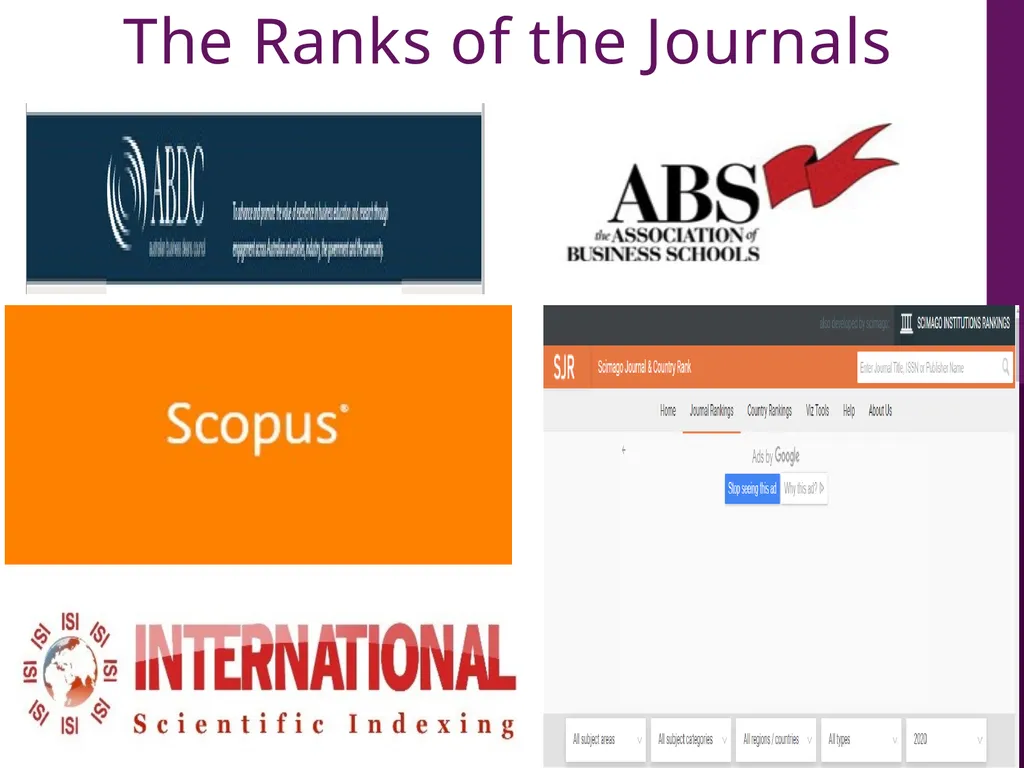
slide3. The Ranks of the Journals<br>
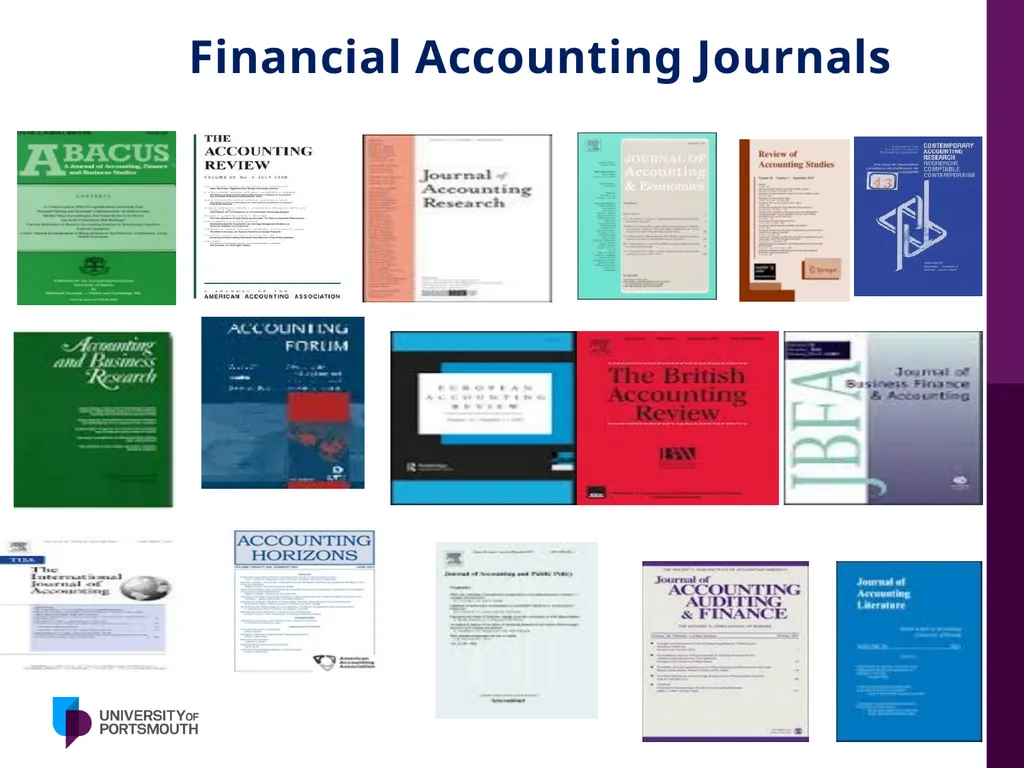
slide4. Financial Accounting Journals<br>
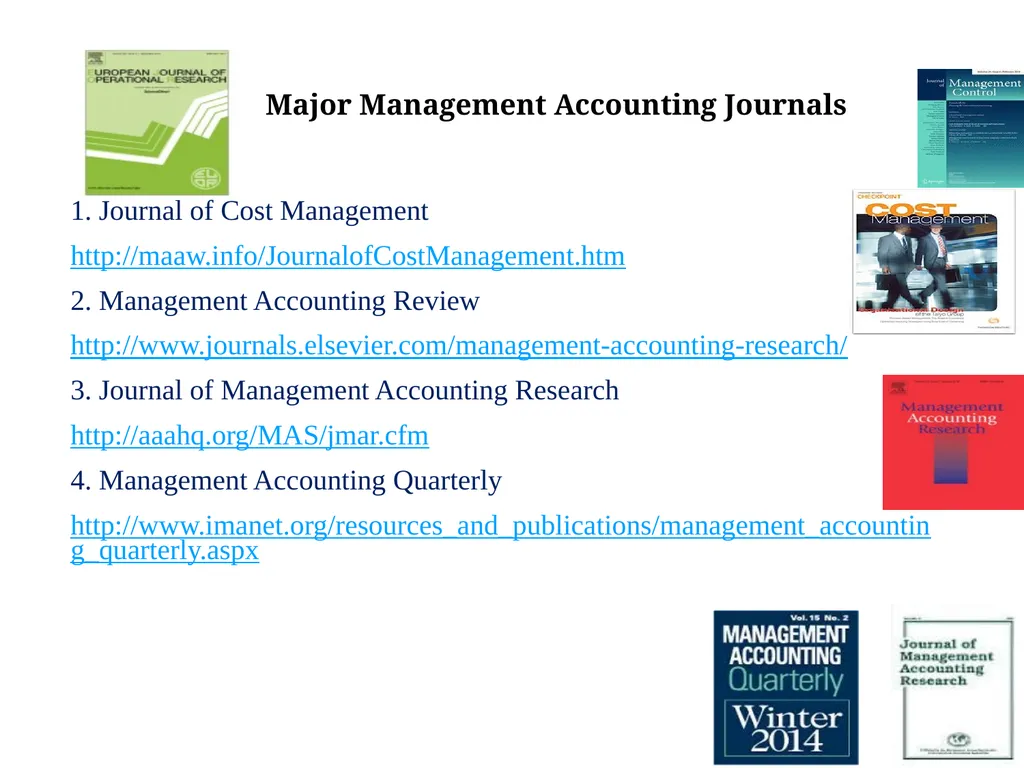
slide5. Major Management Accounting Journals 1. Journal of Cost Management
http://maaw.info/JournalofCostManagement.htm
2. Management Accounting Review
http://www.journals.elsevier.com/management-accounting-research/
3. Journal of Management Accounting Research
http://aaahq.org/MAS/jmar.cfm
4. Management Accounting Quarterly
http://www.imanet.org/resources_and_publications/management_accounting_quarterly.aspx<br>
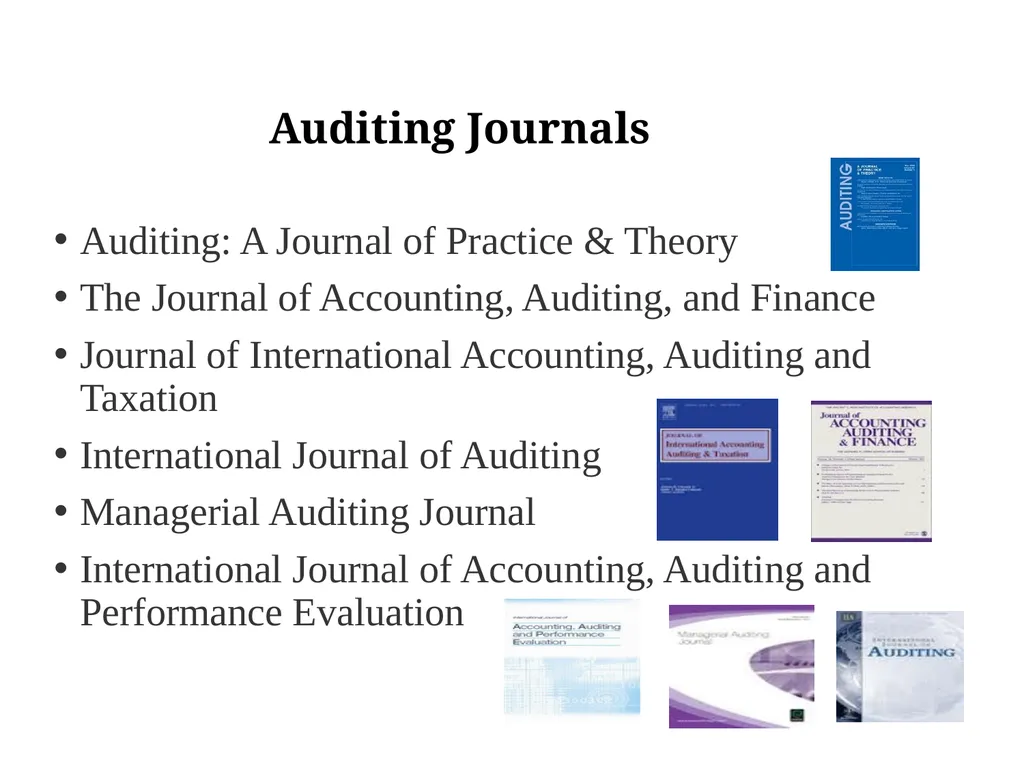
slide6. Auditing Journals Auditing: A Journal of Practice & Theory
The Journal of Accounting, Auditing, and Finance
Journal of International Accounting, Auditing and Taxation
International Journal of Auditing
Managerial Auditing Journal
International Journal of Accounting, Auditing and Performance Evaluation<br>
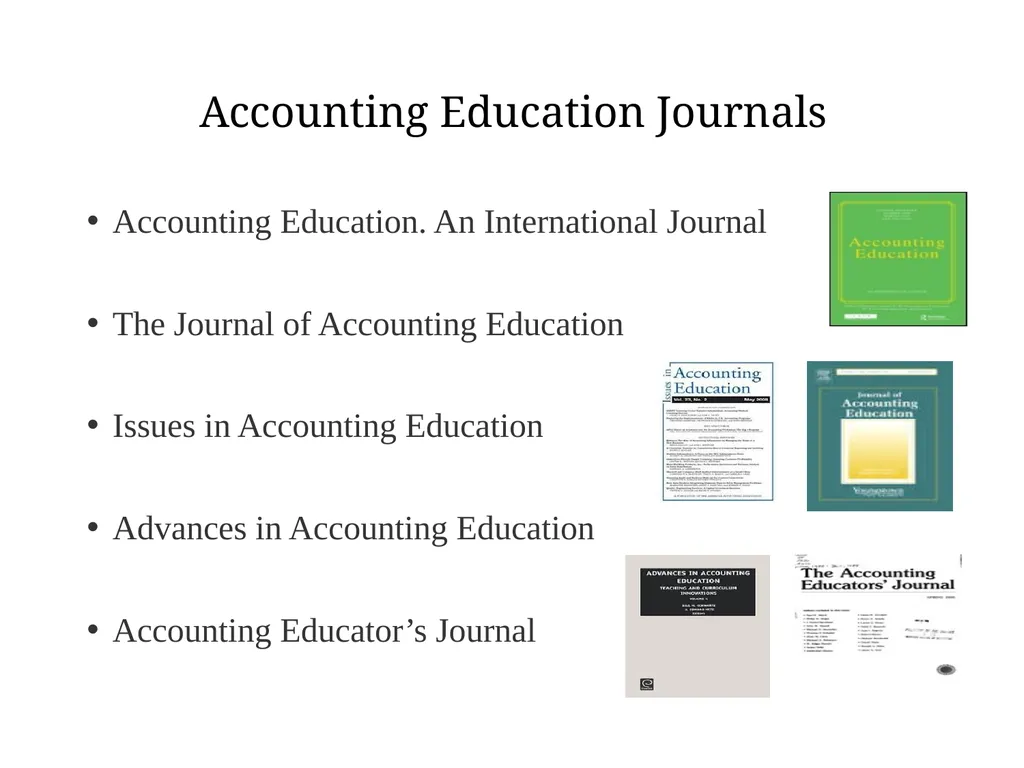
slide7. Accounting Education Journals Accounting Education. An International Journal
The Journal of Accounting Education
Issues in Accounting Education
Advances in Accounting Education
Accounting Educator’s Journal<br>
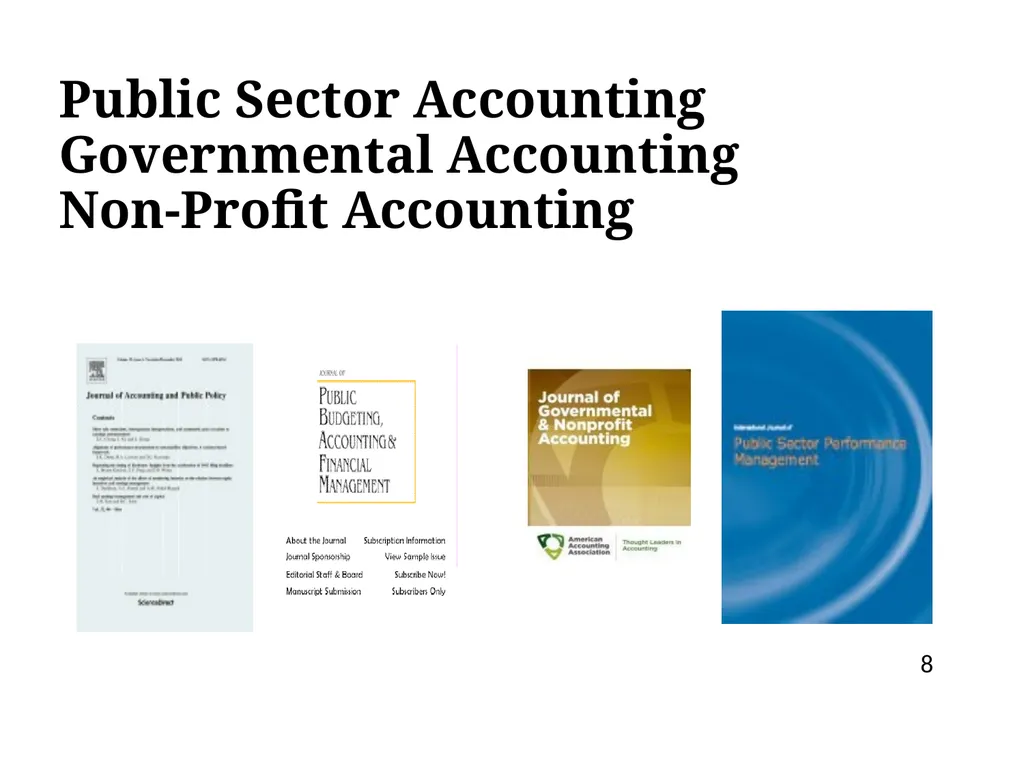
slide8. Public Sector Accounting Governmental Accounting Non-Profit Accounting 8<br>
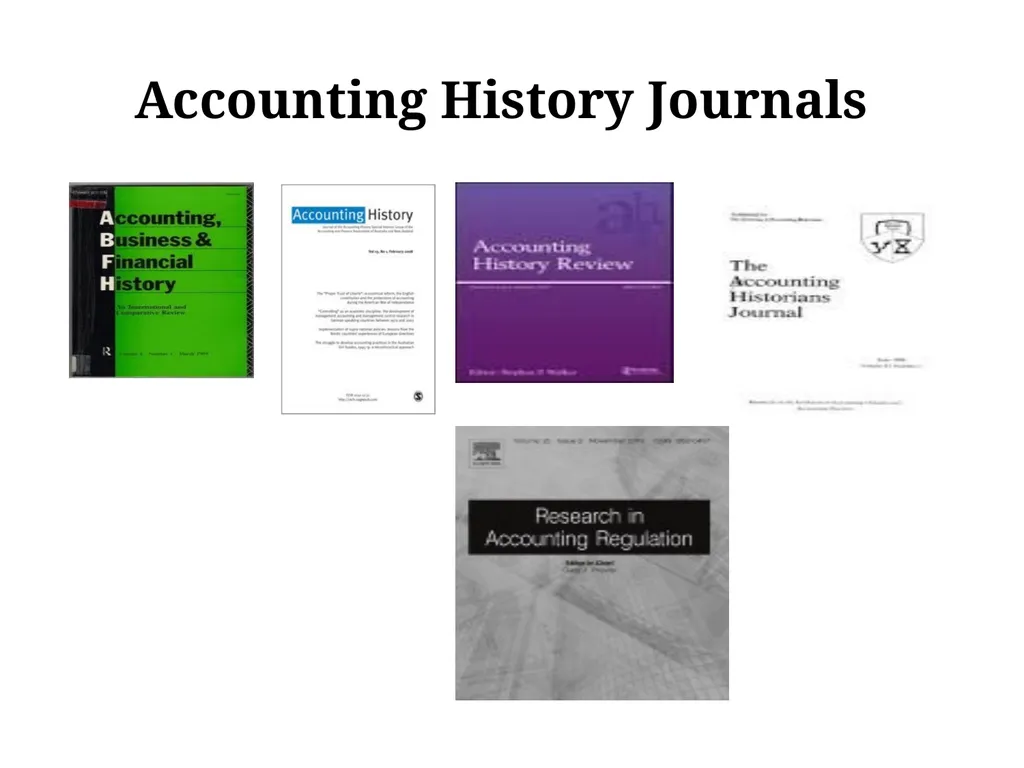
slide9. Accounting History Journals<br>
slide10. Major Islamic Accounting Journals Journal of Economic Behavior & Organization (JEBO)
http://www.journals.elsevier.com/journal-of-economic-behavior-and-organization/
Accounting, Auditing and Accountability (AAAJ)
http://www.emeraldgrouppublishing.com/products/journals/journals.htm?id=AAAJ
International Journal of Islamic Financial Services http://www.iiibf.org/journal.html
Journal of Islamic Accounting and Business Research
http://www.emeraldinsight.com/journals.htm?issn=1759-0817
Accounting Forum
http://www.sciencedirect.com/science/journal/01559982 10<br>
slide11. Major Islamic Accounting International Journal of Islamic and Middle Eastern Finance and Management
http://www.emeraldinsight.com/journals.htm?articleid=1826938
Accounting History
http://www.uk.sagepub.com/journals/Journal201764
Journal of Business Ethics
http://www.springer.com/social+sciences/applied+ethics/journal/10551
Critical Perspectives On Accounting
http://www.journals.elsevier.com/critical-perspectives-on-accounting/<br>
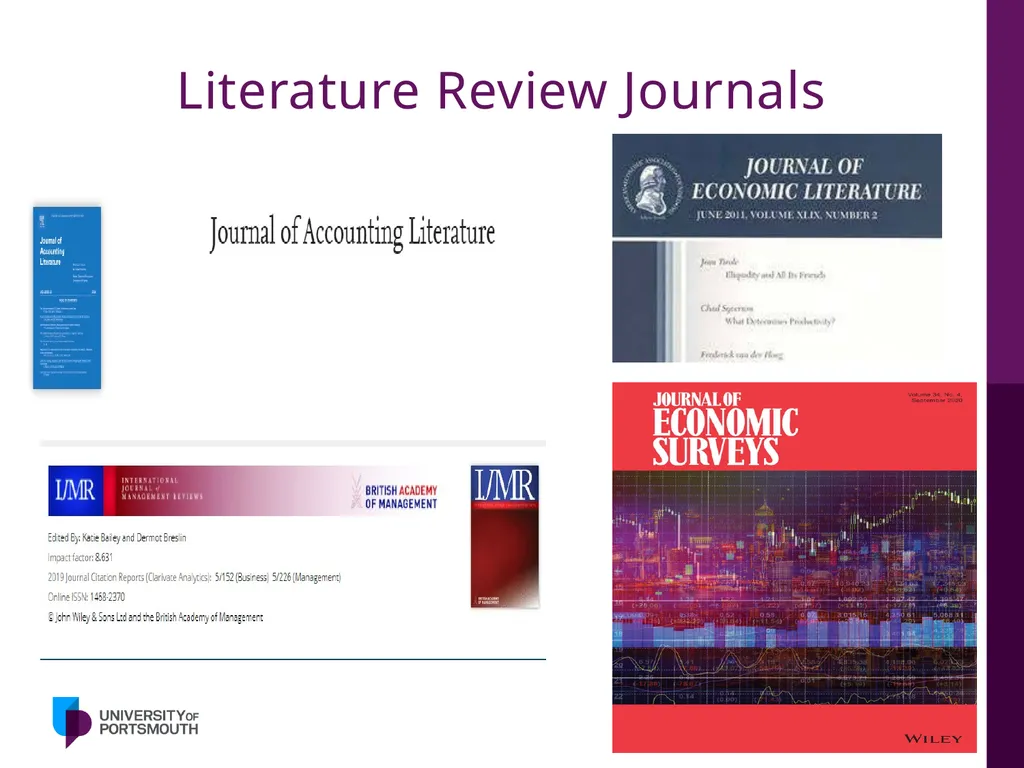
slide12. Literature Review Journals<br>
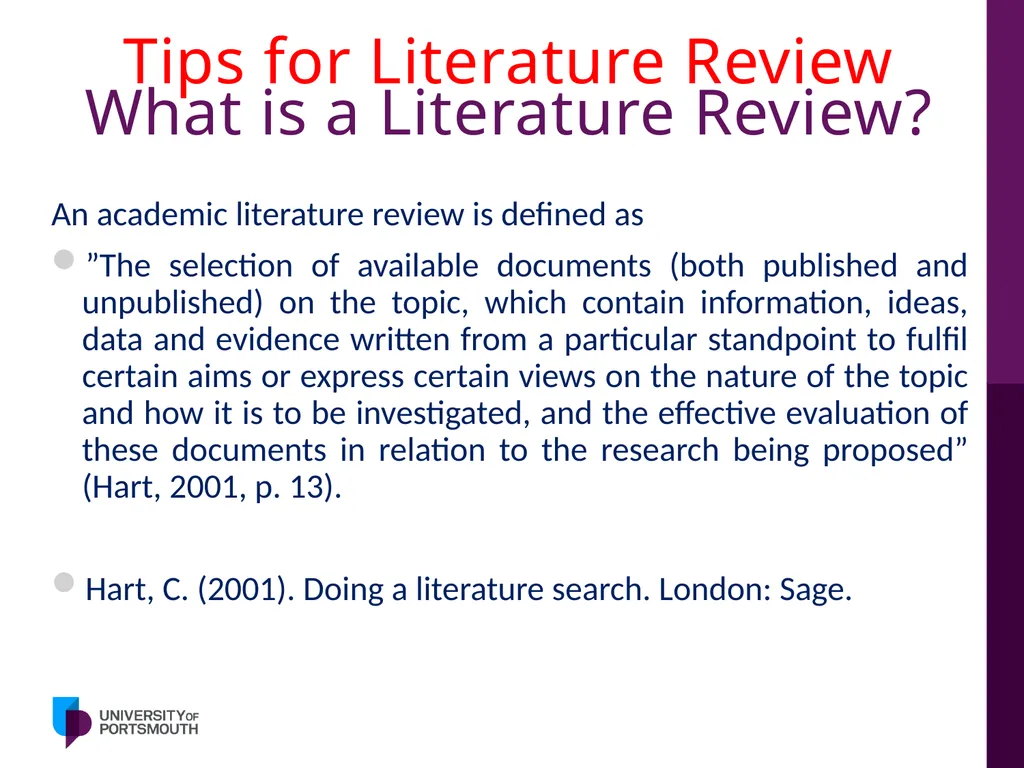
slide13. Tips for Literature Review What is a Literature Review? An academic literature review is defined as
”The selection of available documents (both published and unpublished) on the topic, which contain information, ideas, data and evidence written from a particular standpoint to fulfil certain aims or express certain views on the nature of the topic and how it is to be investigated, and the effective evaluation of these documents in relation to the research being proposed” (Hart, 2001, p. 13).
Hart, C. (2001). Doing a literature search. London: Sage.<br>
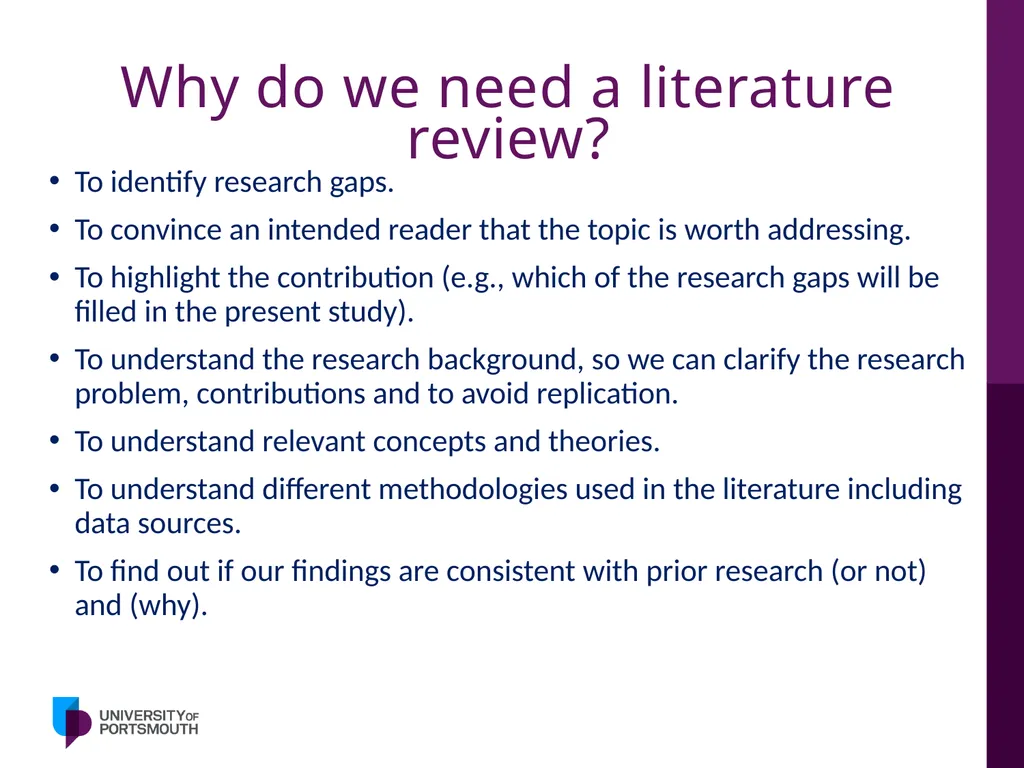
slide14. Why do we need a literature review? To identify research gaps.
To convince an intended reader that the topic is worth addressing.
To highlight the contribution (e.g., which of the research gaps will be filled in the present study).
To understand the research background, so we can clarify the research problem, contributions and to avoid replication.
To understand relevant concepts and theories.
To understand different methodologies used in the literature including data sources.
To find out if our findings are consistent with prior research (or not) and (why).<br>
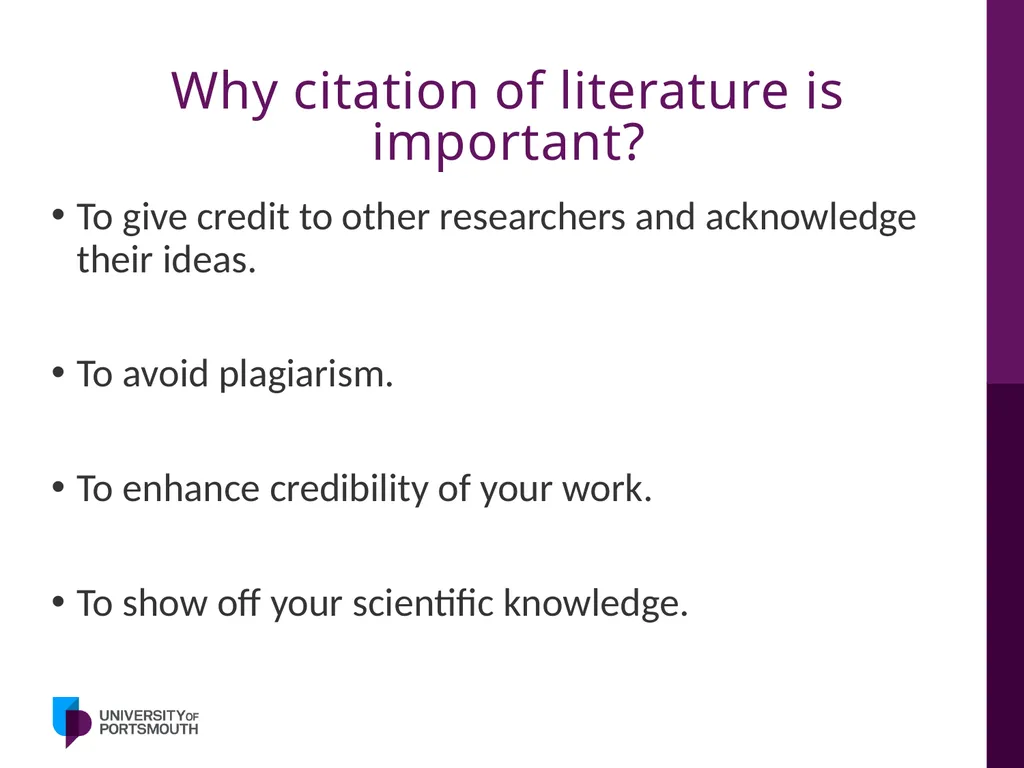
slide15. Why citation of literature is important? To give credit to other researchers and acknowledge their ideas.
To avoid plagiarism.
To enhance credibility of your work.
To show off your scientific knowledge.<br>
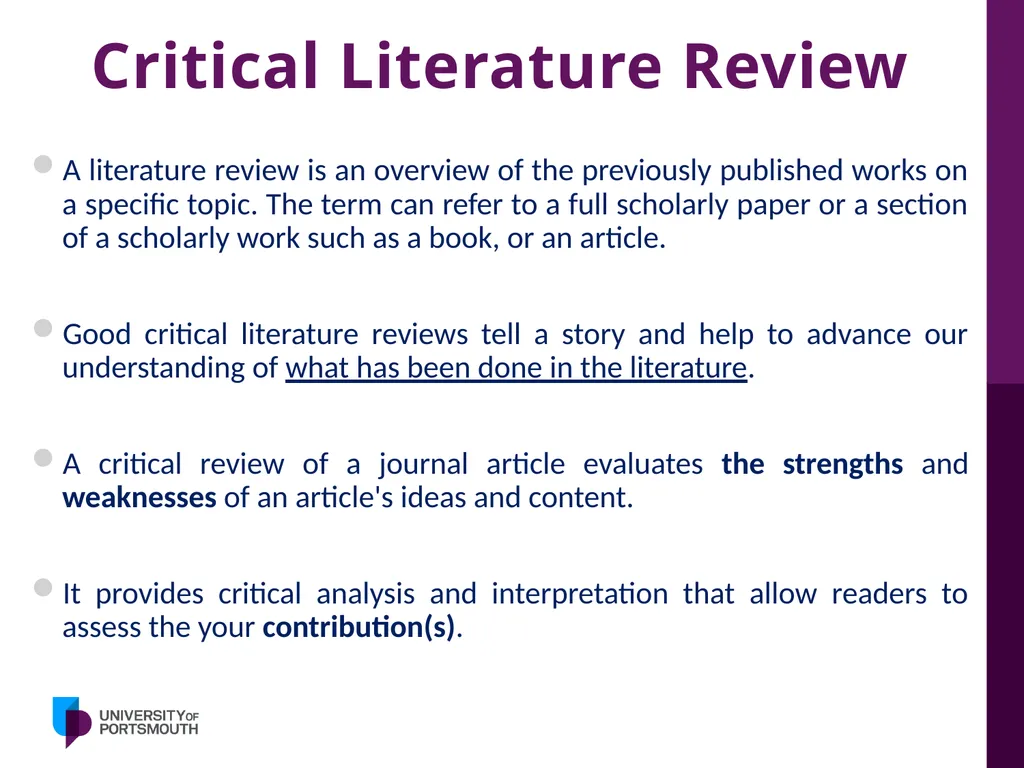
slide16. Critical Literature Review A literature review is an overview of the previously published works on a specific topic. The term can refer to a full scholarly paper or a section of a scholarly work such as a book, or an article.
Good critical literature reviews tell a story and help to advance our understanding of what has been done in the literature.
A critical review of a journal article evaluates the strengths and weaknesses of an article's ideas and content.
It provides critical analysis and interpretation that allow readers to assess the your contribution(s).<br>
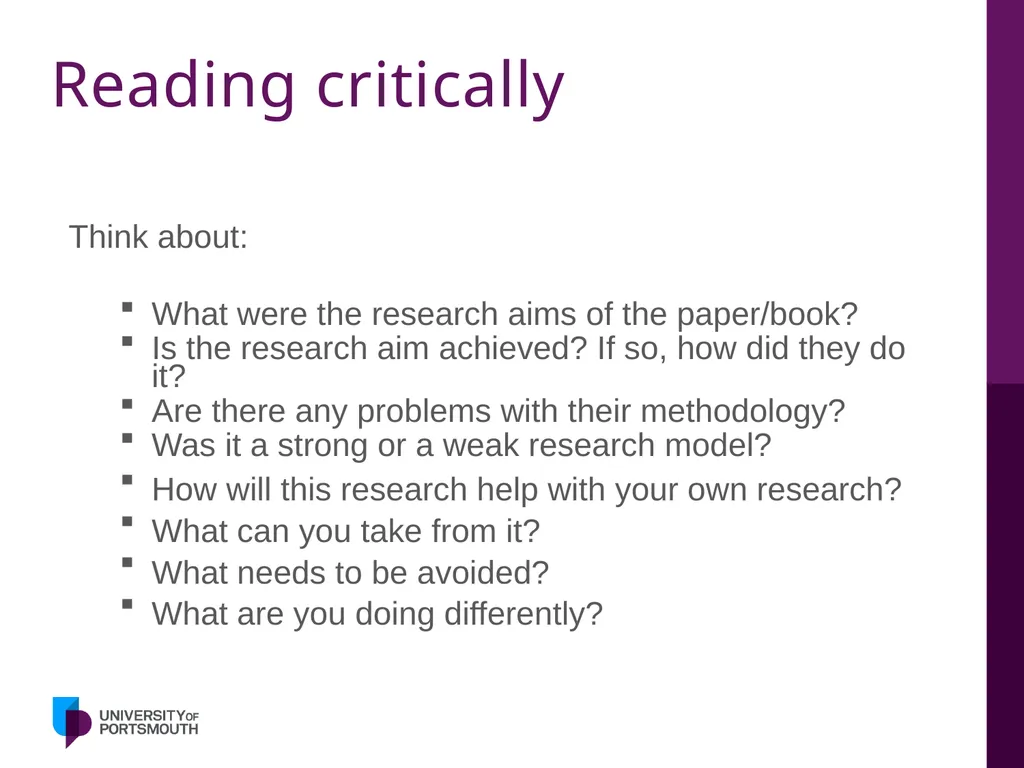
slide18. Reading critically Think about:
What were the research aims of the paper/book?
Is the research aim achieved? If so, how did they do it?
Are there any problems with their methodology?
Was it a strong or a weak research model?
How will this research help with your own research?
What can you take from it?
What needs to be avoided?
What are you doing differently?<br>
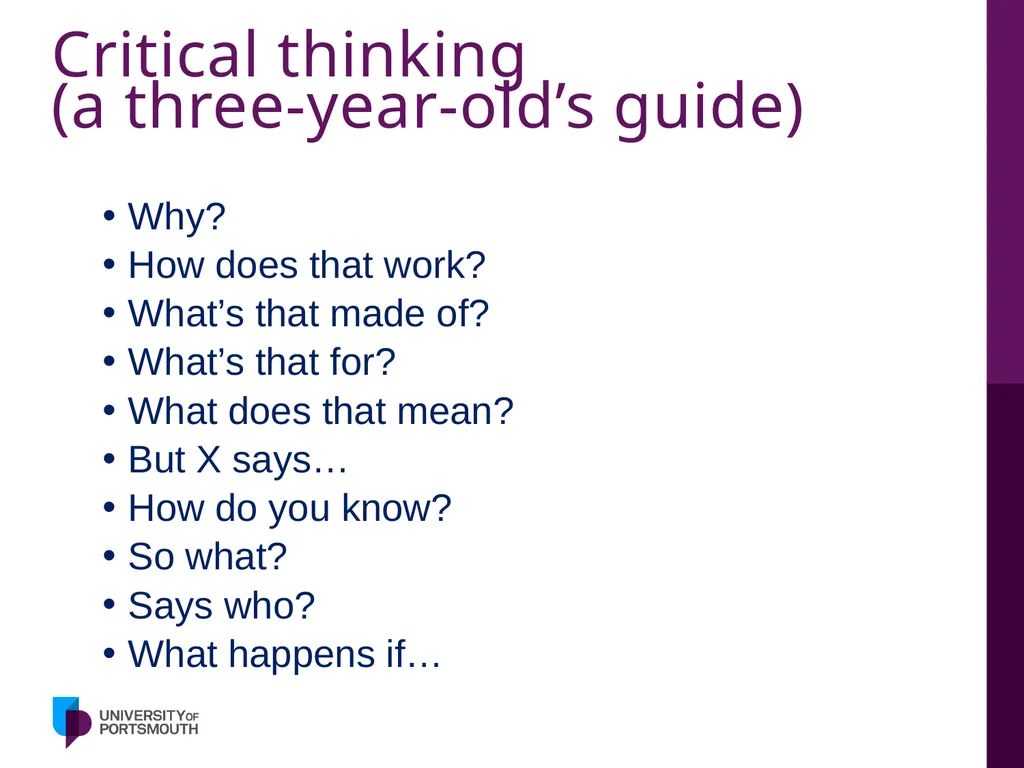
slide19. Critical thinking (a three-year-old’s guide) Why?
How does that work?
What’s that made of?
What’s that for?
What does that mean?
But X says…
How do you know?
So what?
Says who?
What happens if…<br>
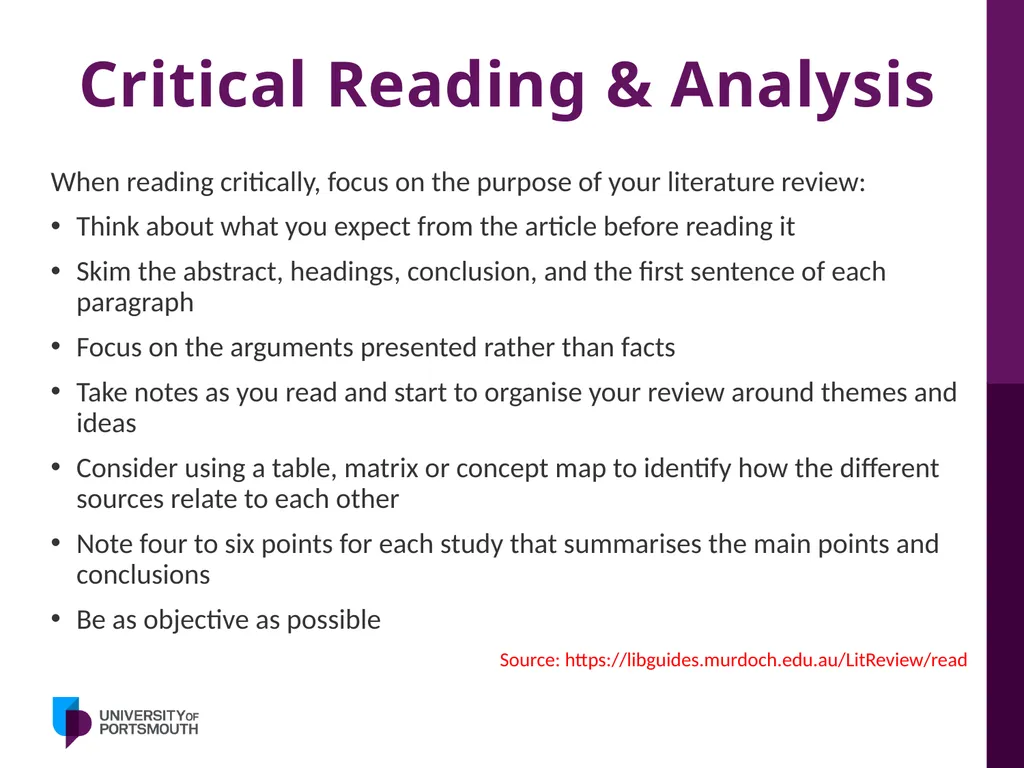
slide20. Critical Reading & Analysis When reading critically, focus on the purpose of your literature review:
Think about what you expect from the article before reading it
Skim the abstract, headings, conclusion, and the first sentence of each paragraph
Focus on the arguments presented rather than facts
Take notes as you read and start to organise your review around themes and ideas
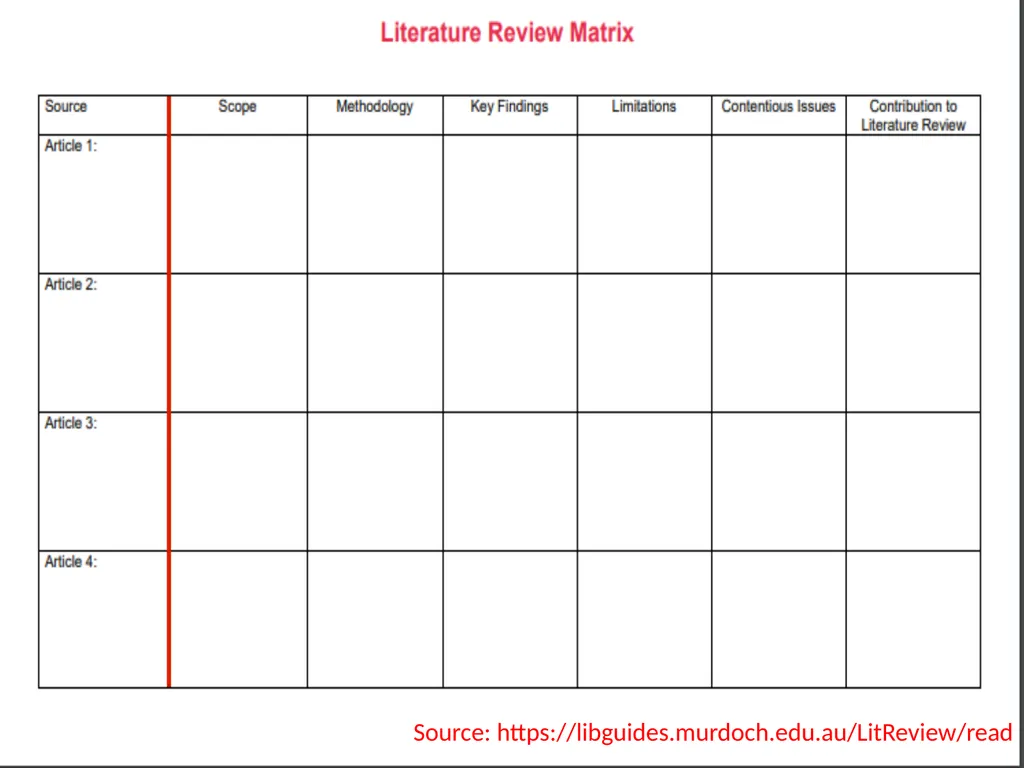
Consider using a table, matrix or concept map to identify how the different sources relate to each other
Note four to six points for each study that summarises the main points and conclusions
Be as objective as possible
Source: https://libguides.murdoch.edu.au/LitReview/read<br>
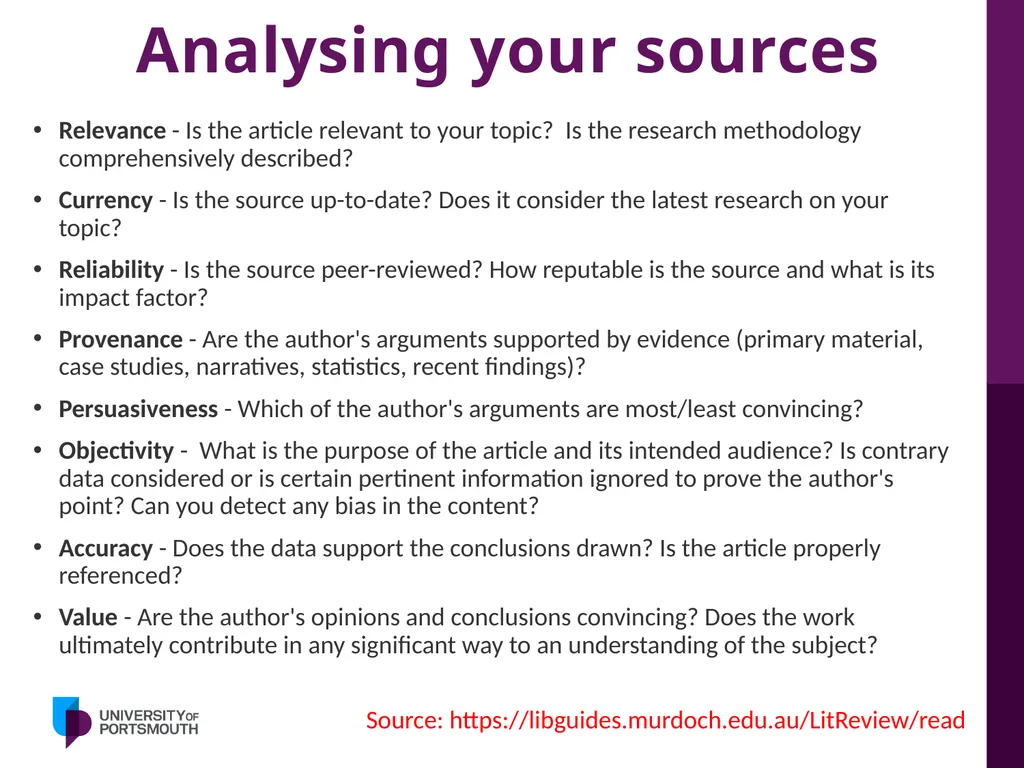
slide21. Analysing your sources Relevance - Is the article relevant to your topic? Is the research methodology comprehensively described?
Currency - Is the source up-to-date? Does it consider the latest research on your topic?
Reliability - Is the source peer-reviewed? How reputable is the source and what is its impact factor?
Provenance - Are the author's arguments supported by evidence (primary material, case studies, narratives, statistics, recent findings)?
Persuasiveness - Which of the author's arguments are most/least convincing?
Objectivity - What is the purpose of the article and its intended audience? Is contrary data considered or is certain pertinent information ignored to prove the author's point? Can you detect any bias in the content?
Accuracy - Does the data support the conclusions drawn? Is the article properly referenced?
Value - Are the author's opinions and conclusions convincing? Does the work ultimately contribute in any significant way to an understanding of the subject? Source: https://libguides.murdoch.edu.au/LitReview/read<br>
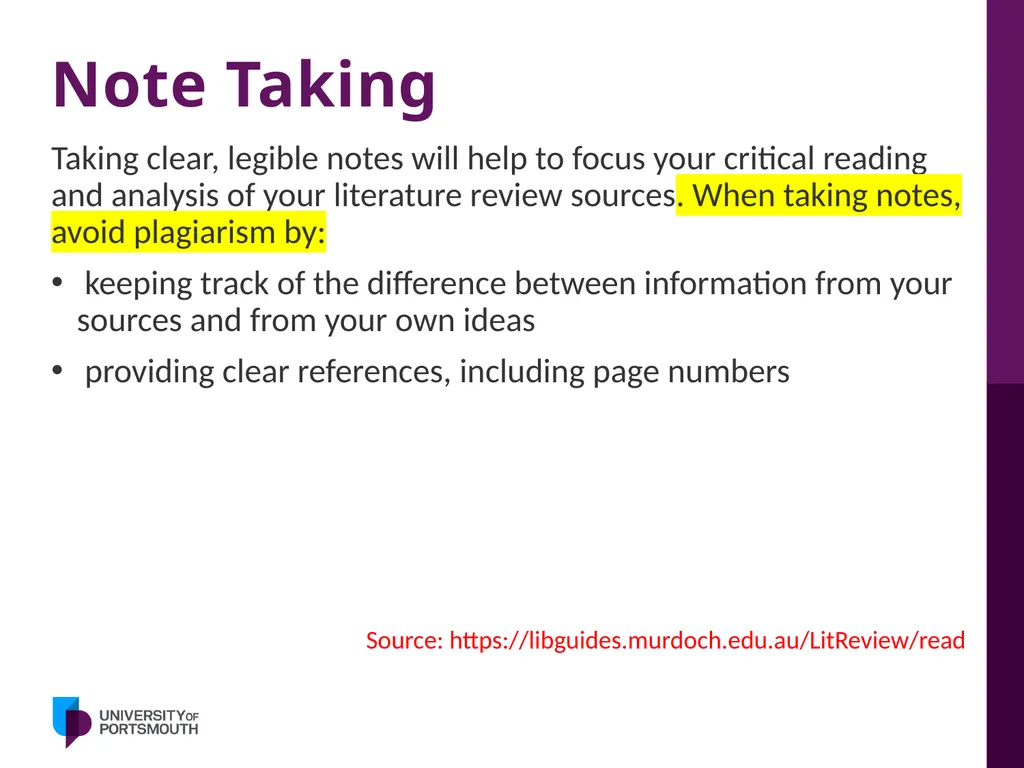
slide22. Note Taking Taking clear, legible notes will help to focus your critical reading and analysis of your literature review sources. When taking notes, avoid plagiarism by:
keeping track of the difference between information from your sources and from your own ideas
providing clear references, including page numbers Source: https://libguides.murdoch.edu.au/LitReview/read<br>
slide23. Source: https://libguides.murdoch.edu.au/LitReview/read<br>
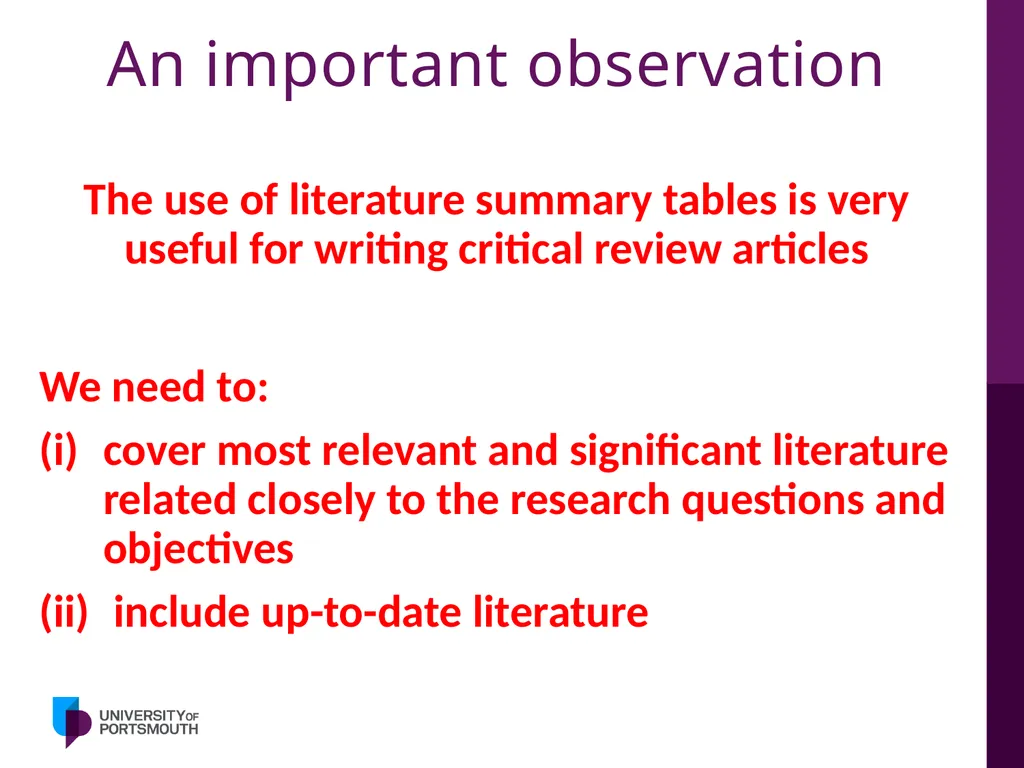
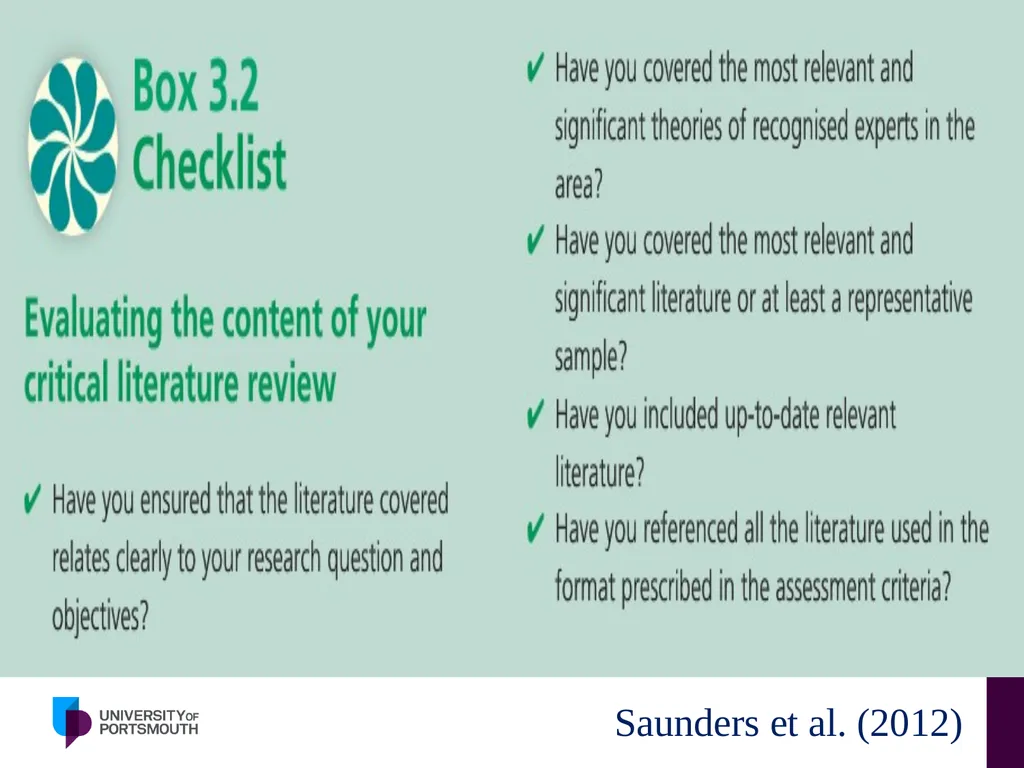
slide24. An important observation The use of literature summary tables is very useful for writing critical review articles We need to:
cover most relevant and significant literature related closely to the research questions and objectives
include up-to-date literature<br>
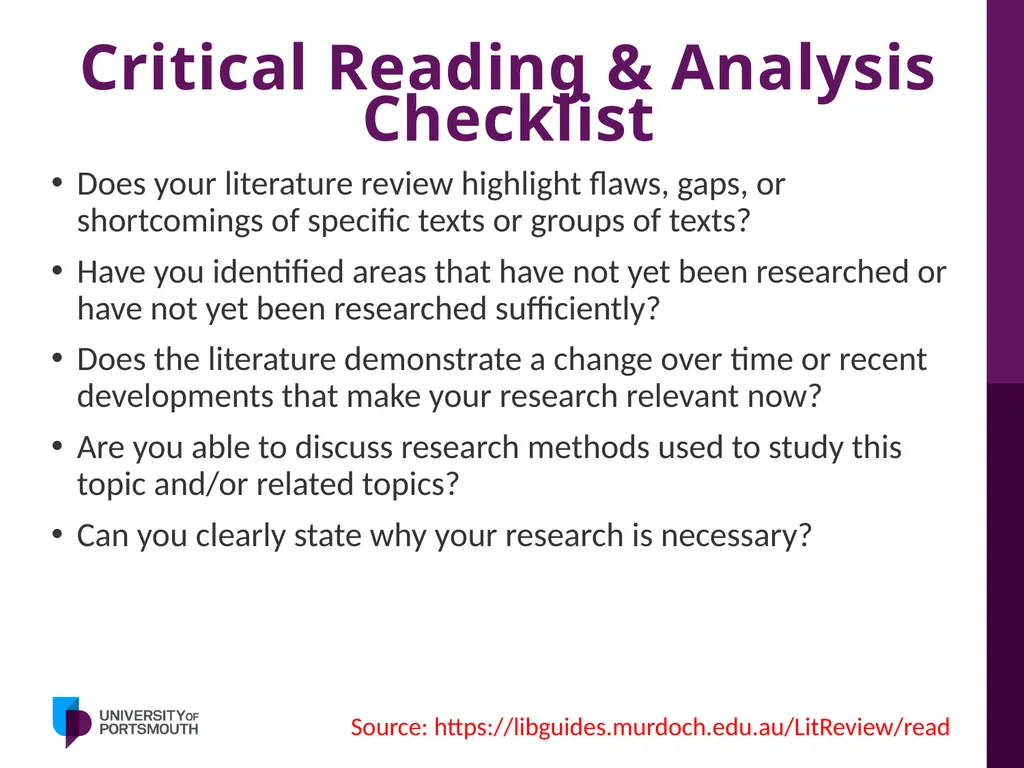
slide25. Critical Reading & Analysis Checklist Does your literature review highlight flaws, gaps, or shortcomings of specific texts or groups of texts?
Have you identified areas that have not yet been researched or have not yet been researched sufficiently?
Does the literature demonstrate a change over time or recent developments that make your research relevant now?
Are you able to discuss research methods used to study this topic and/or related topics?
Can you clearly state why your research is necessary? Source: https://libguides.murdoch.edu.au/LitReview/read<br>
slide26. Saunders et al. (2012)<br>
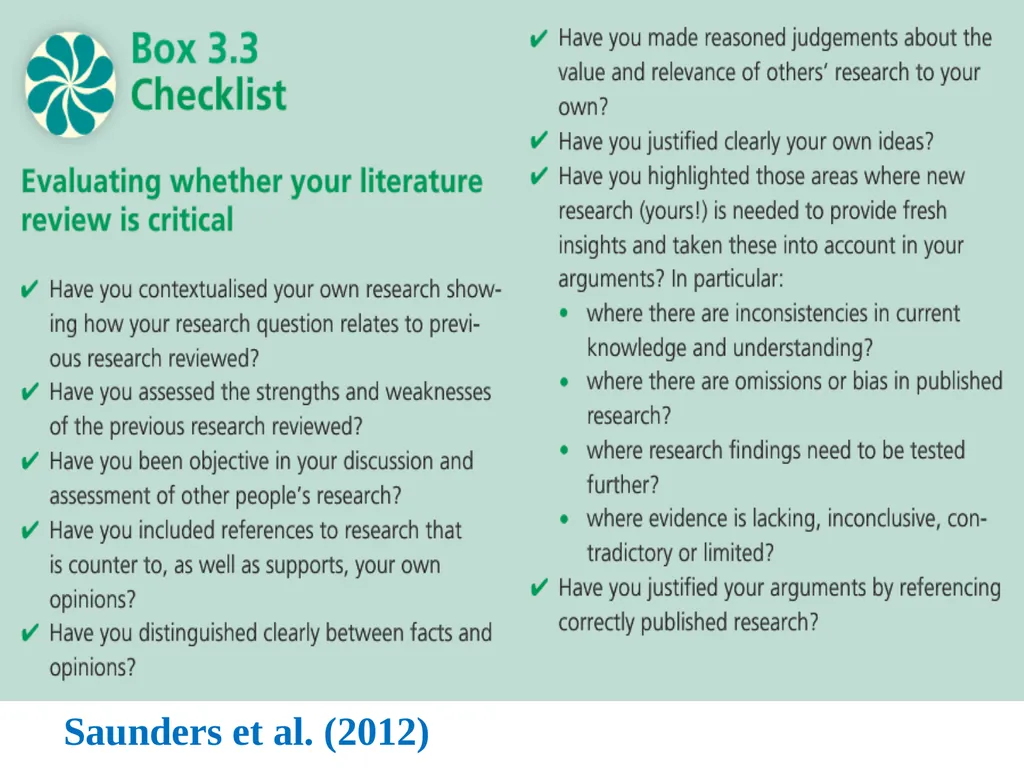
slide27. 27 Saunders et al. (2012)<br>
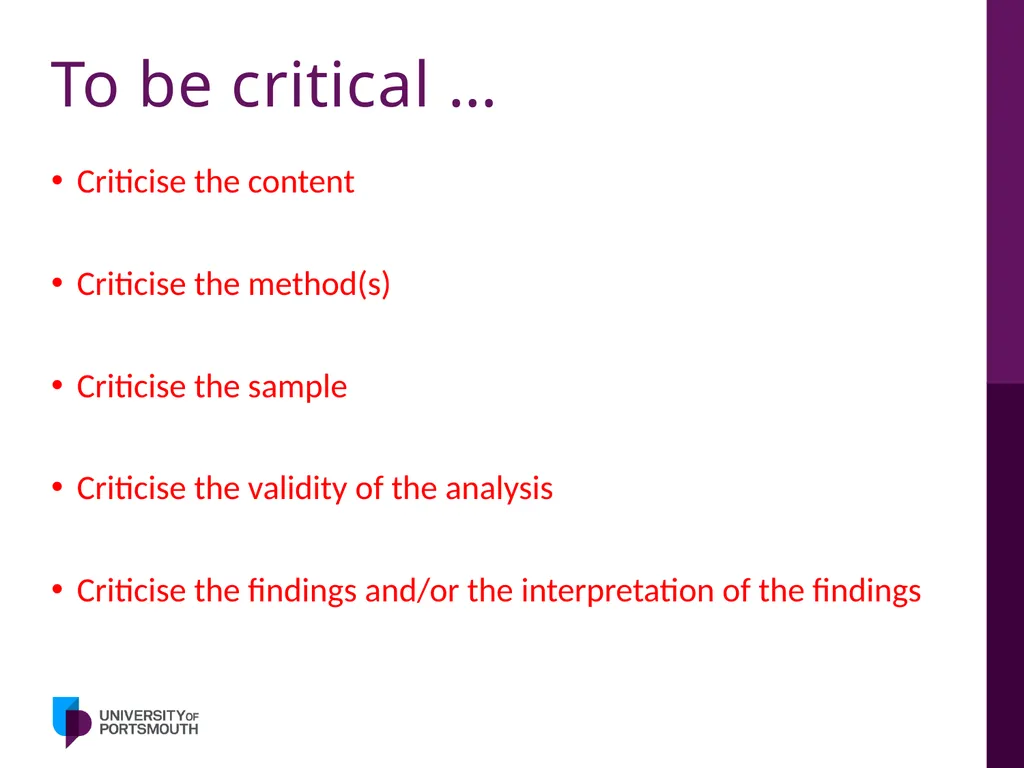
slide28. To be critical … Criticise the content
Criticise the method(s)
Criticise the sample
Criticise the validity of the analysis
Criticise the findings and/or the interpretation of the findings<br>
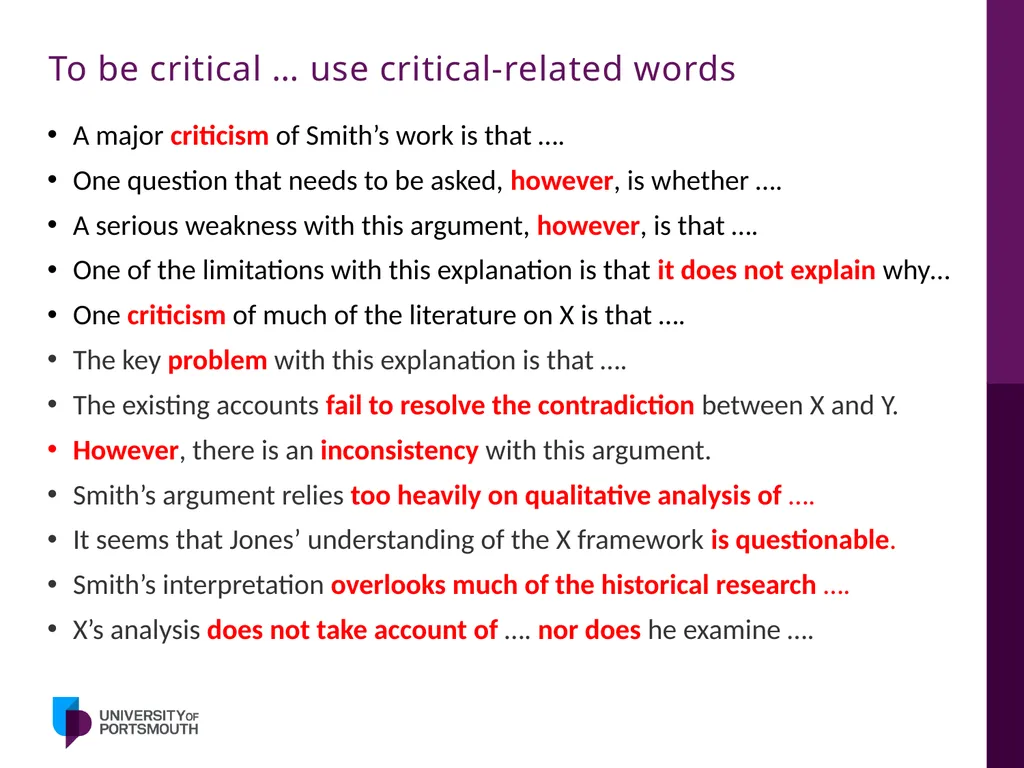
slide29. To be critical … use critical-related words A major criticism of Smith’s work is that ….
One question that needs to be asked, however, is whether ….
A serious weakness with this argument, however, is that ….
One of the limitations with this explanation is that it does not explain why…
One criticism of much of the literature on X is that ….
The key problem with this explanation is that ….
The existing accounts fail to resolve the contradiction between X and Y.
However, there is an inconsistency with this argument.
Smith’s argument relies too heavily on qualitative analysis of ….
It seems that Jones’ understanding of the X framework is questionable.
Smith’s interpretation overlooks much of the historical research ….
X’s analysis does not take account of …. nor does he examine ….<br>
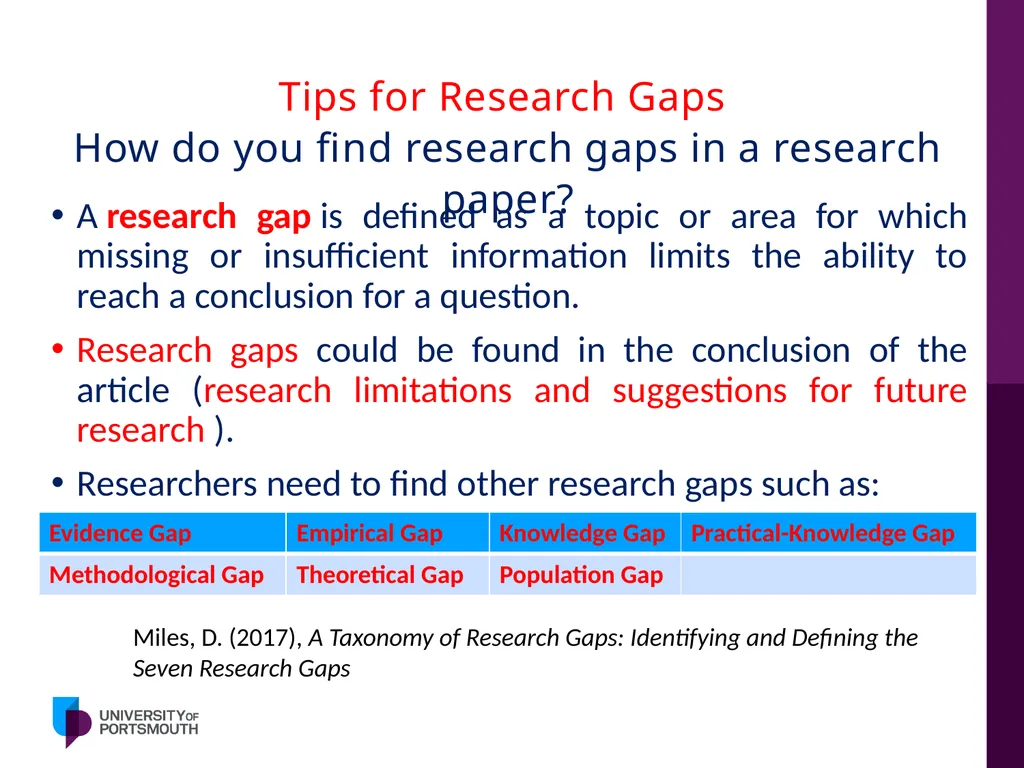
slide30. Tips for Research Gaps How do you find research gaps in a research paper? A research gap is defined as a topic or area for which missing or insufficient information limits the ability to reach a conclusion for a question.
Research gaps could be found in the conclusion of the article (research limitations and suggestions for future research ).
Researchers need to find other research gaps such as: Miles, D. (2017), A Taxonomy of Research Gaps: Identifying and Defining the Seven Research Gaps<br>
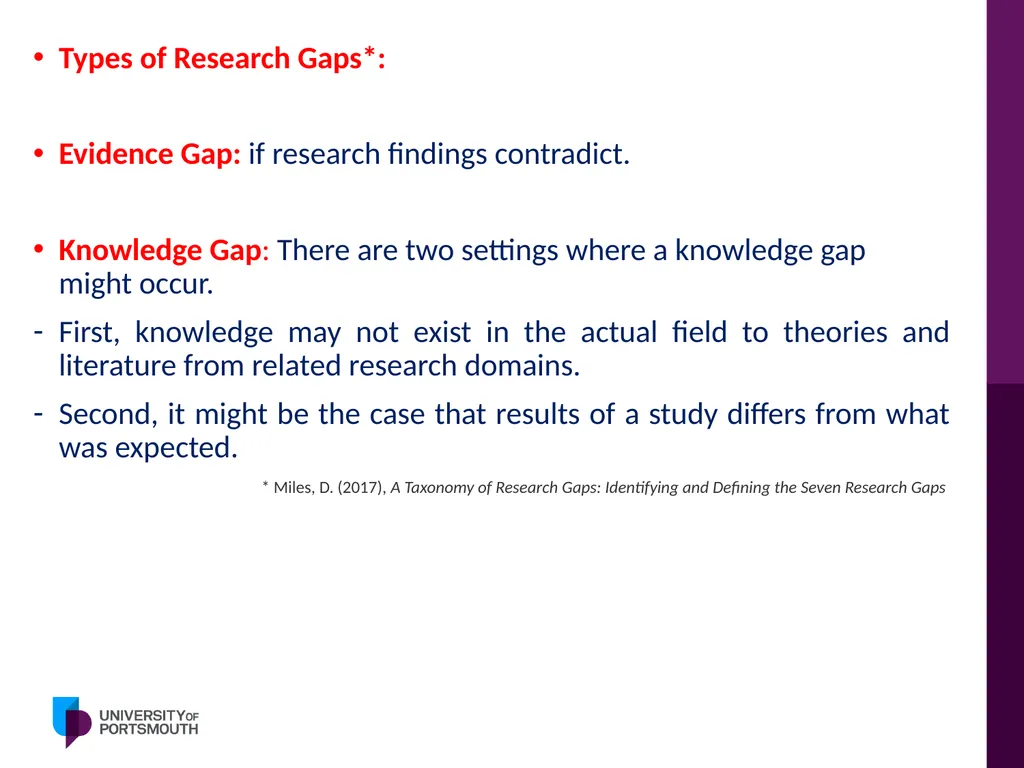
slide31. Types of Research Gaps*:
Evidence Gap: if research findings contradict.
Knowledge Gap: There are two settings where a knowledge gap might occur.
First, knowledge may not exist in the actual field to theories and literature from related research domains.
Second, it might be the case that results of a study differs from what was expected.
* Miles, D. (2017), A Taxonomy of Research Gaps: Identifying and Defining the Seven Research Gaps<br>
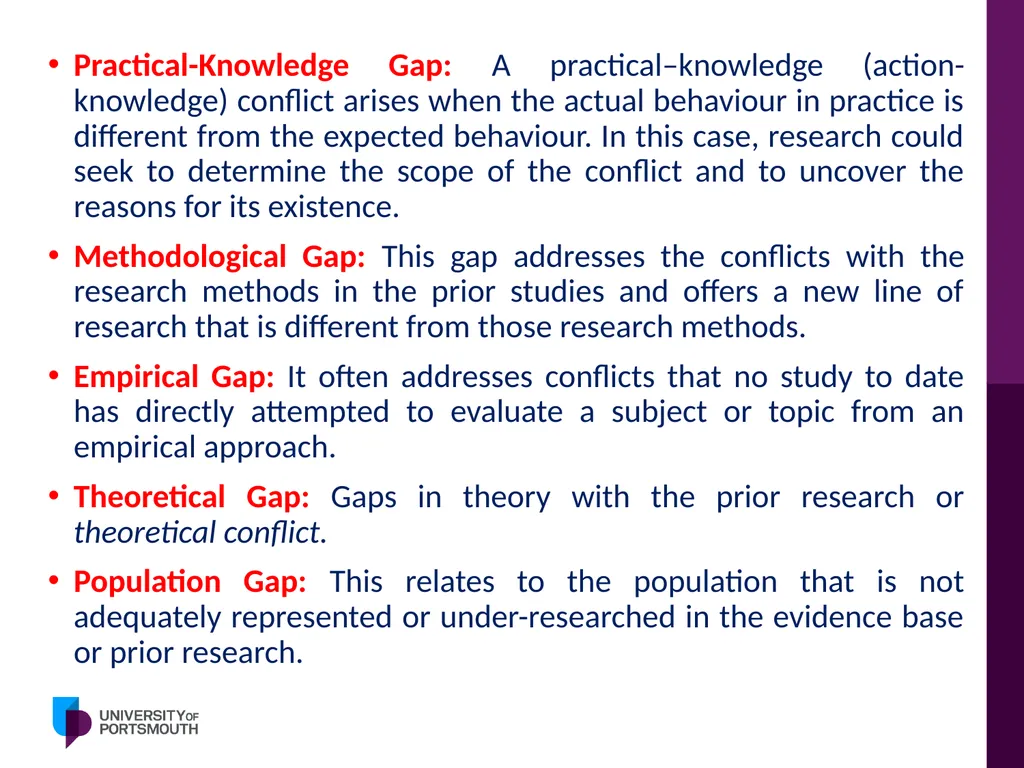
slide32. Practical-Knowledge Gap: A practical–knowledge (action-knowledge) conflict arises when the actual behaviour in practice is different from the expected behaviour. In this case, research could seek to determine the scope of the conflict and to uncover the reasons for its existence.
Methodological Gap: This gap addresses the conflicts with the research methods in the prior studies and offers a new line of research that is different from those research methods.
Empirical Gap: It often addresses conflicts that no study to date has directly attempted to evaluate a subject or topic from an empirical approach.
Theoretical Gap: Gaps in theory with the prior research or theoretical conflict.
Population Gap: This relates to the population that is not adequately represented or under-researched in the evidence base or prior research.<br>
slide33. Tips for Research Contributions What is research contribution?
How do you find contributions in a research paper?
How do you find research gaps in a research paper?
What are the types of research contributions?
How to think about research contributions with your research?
How do you know that you have made a substantial contribution with your research?
Where should you write your contribution(s)?
How do you write a contribution?<br>
slide34. What is research contribution? A ''contribution'' adds to the literature through filling a research gap.
A ''contribution‘’ shows how your study may offer new insights that previous studies might have missed.
Simply … what is new in your research?
Researchers need to identify “from which angle their research is contributing to the literature”?<br>
slide35. How do you find contributions in a research paper? In most top-ranked journals, you will find the contribution in the introduction of the paper.
Authors use contribution-related keywords such as “contribute, contributes, contribution, contributions, new evidence, novel, original, first study, new method, ….etc”.
Consider the contributions of the papers as strengths of the articles when evaluating the literature (e.g. in a critical literature review, you need to evaluate both the strengths and weaknesses of each article).<br>
slide36. What are the types of research contributions? To knowledge: This could be the first article to examine ……..
To theory: This research introduces a new theory to the field or it tests if ….. theory is applicable to …………context.
To methodology: The paper aims to introduce a new measure for ….
To Practice: The paper aims to introduce a practical solution to problem in practice.<br>
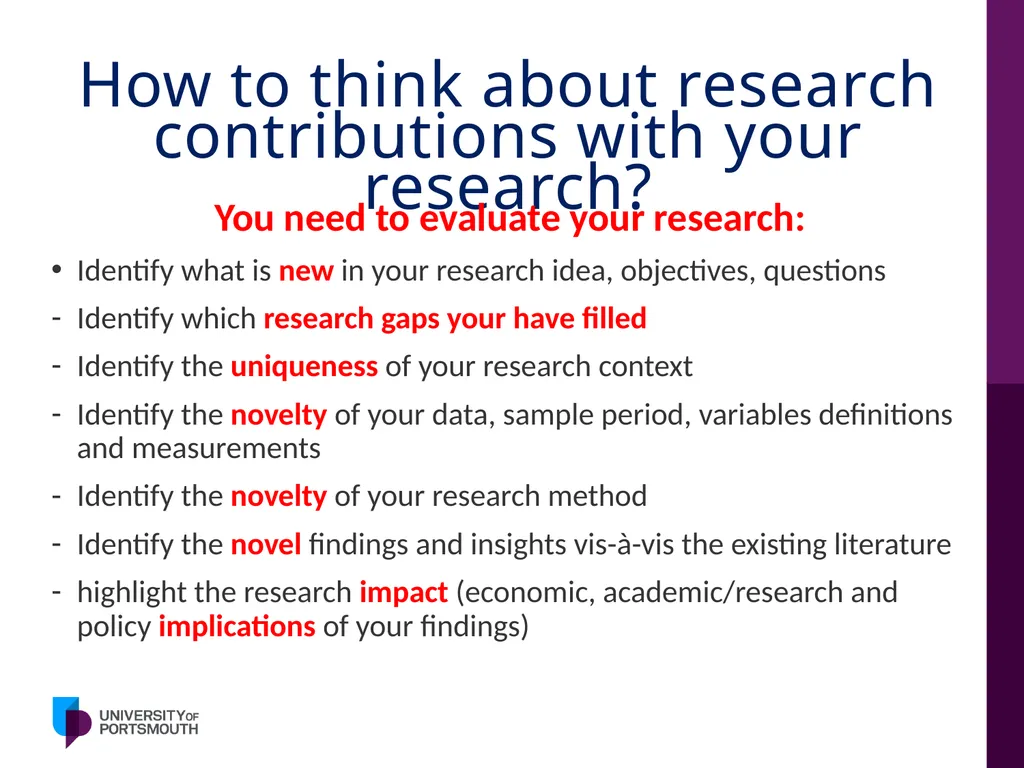
slide37. How to think about research contributions with your research? You need to evaluate your research:
Identify what is new in your research idea, objectives, questions
Identify which research gaps your have filled
Identify the uniqueness of your research context
Identify the novelty of your data, sample period, variables definitions and measurements
Identify the novelty of your research method
Identify the novel findings and insights vis-à-vis the existing literature
highlight the research impact (economic, academic/research and policy implications of your findings)<br>
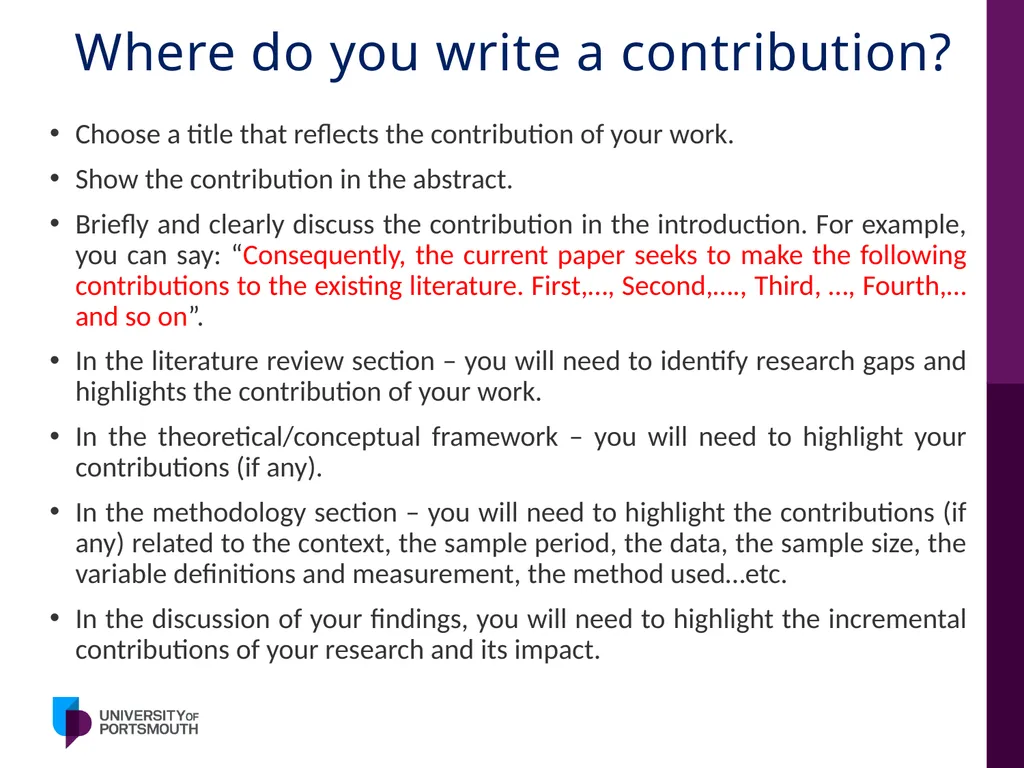
slide38. Where do you write a contribution? Choose a title that reflects the contribution of your work.
Show the contribution in the abstract.
Briefly and clearly discuss the contribution in the introduction. For example, you can say: “Consequently, the current paper seeks to make the following contributions to the existing literature. First,…, Second,…., Third, …, Fourth,… and so on”.
In the literature review section – you will need to identify research gaps and highlights the contribution of your work.
In the theoretical/conceptual framework – you will need to highlight your contributions (if any).
In the methodology section – you will need to highlight the contributions (if any) related to the context, the sample period, the data, the sample size, the variable definitions and measurement, the method used…etc.
In the discussion of your findings, you will need to highlight the incremental contributions of your research and its impact.<br>
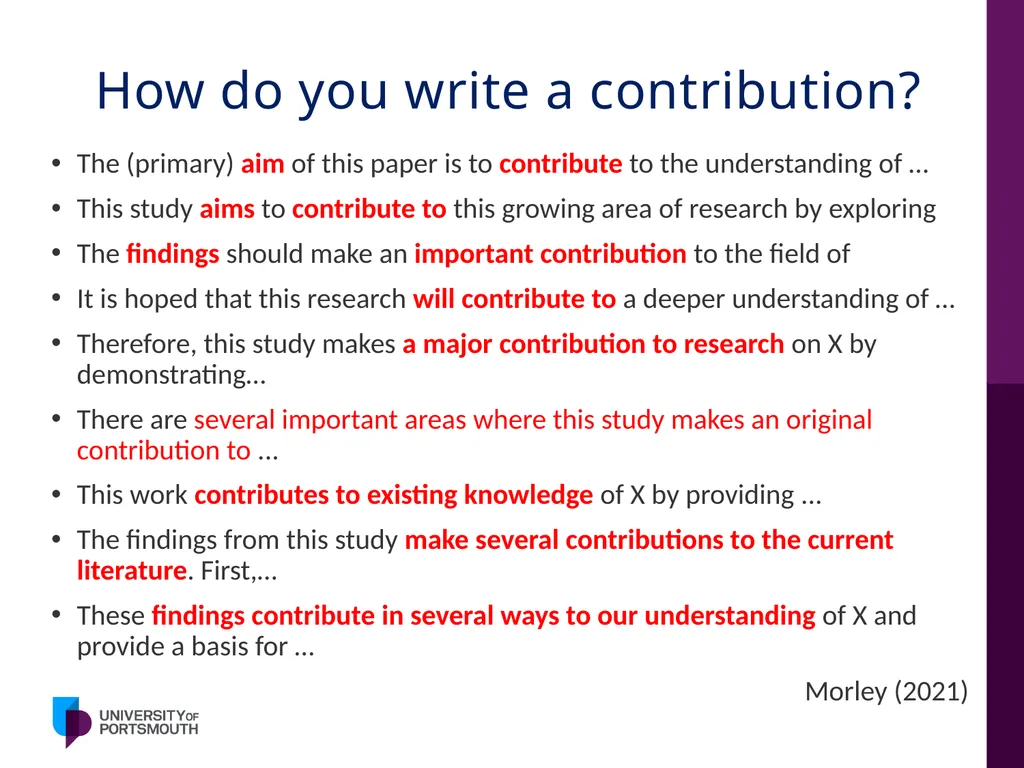
slide39. How do you write a contribution? The (primary) aim of this paper is to contribute to the understanding of …
This study aims to contribute to this growing area of research by exploring
The findings should make an important contribution to the field of
It is hoped that this research will contribute to a deeper understanding of …
Therefore, this study makes a major contribution to research on X by demonstrating…
There are several important areas where this study makes an original contribution to ...
This work contributes to existing knowledge of X by providing ...
The findings from this study make several contributions to the current literature. First,…
These findings contribute in several ways to our understanding of X and provide a basis for …
Morley (2021)<br>
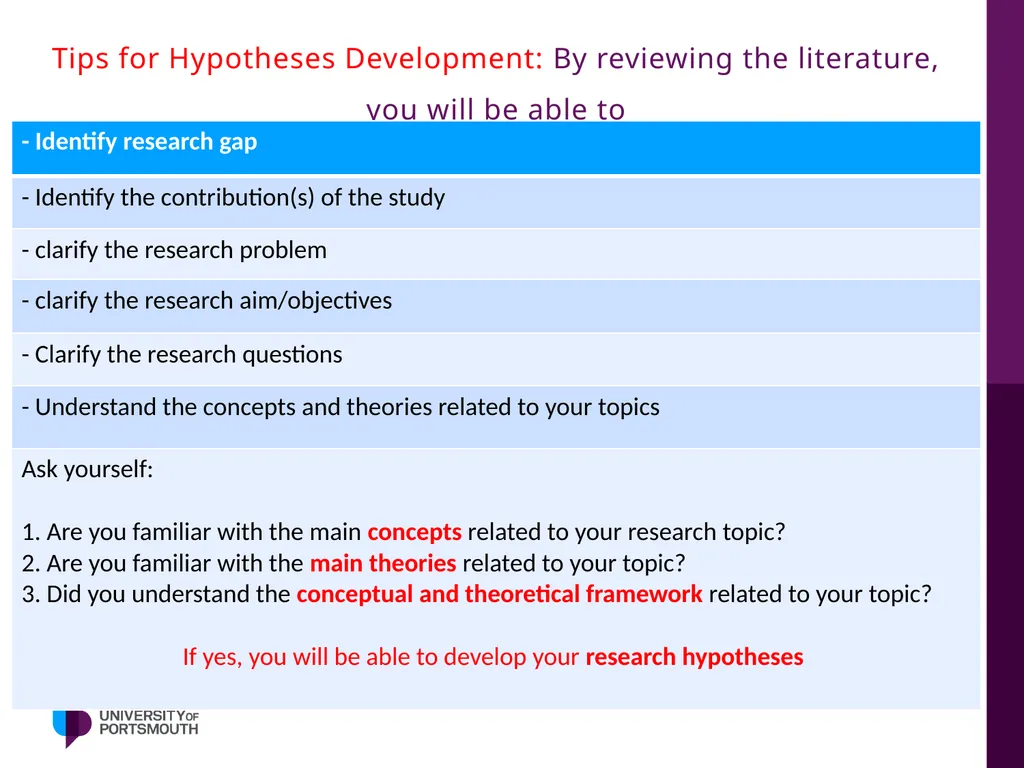
slide40. Tips for Hypotheses Development: By reviewing the literature, you will be able to<br>
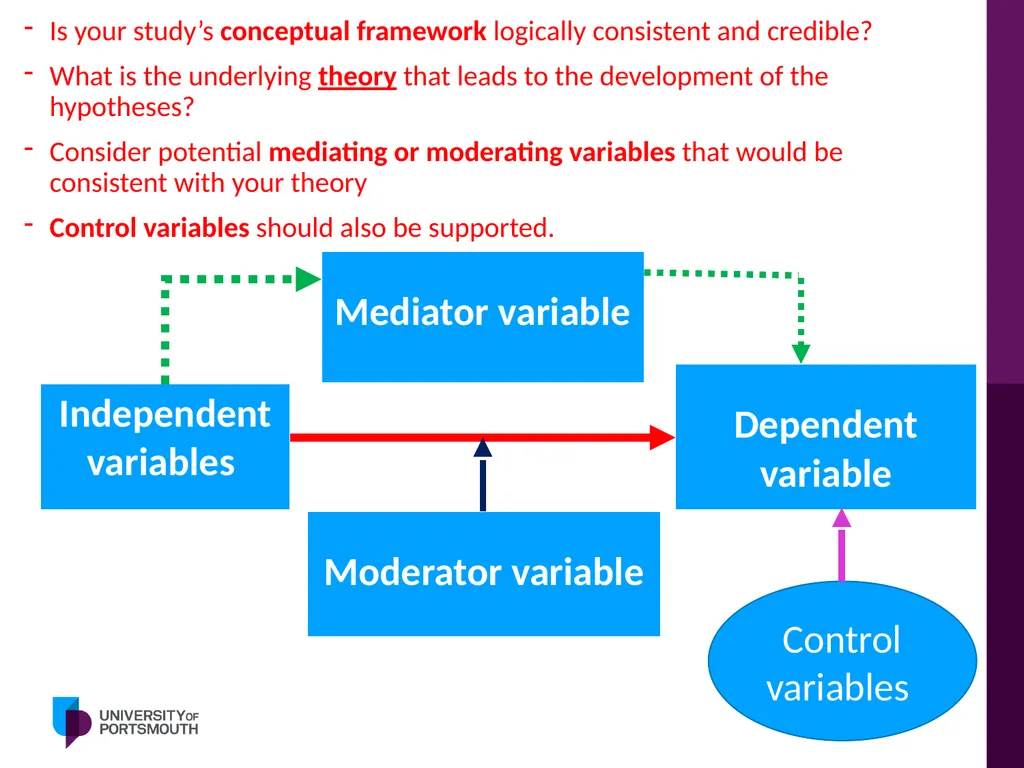
slide41. Is your study’s conceptual framework logically consistent and credible?
What is the underlying theory that leads to the development of the hypotheses?
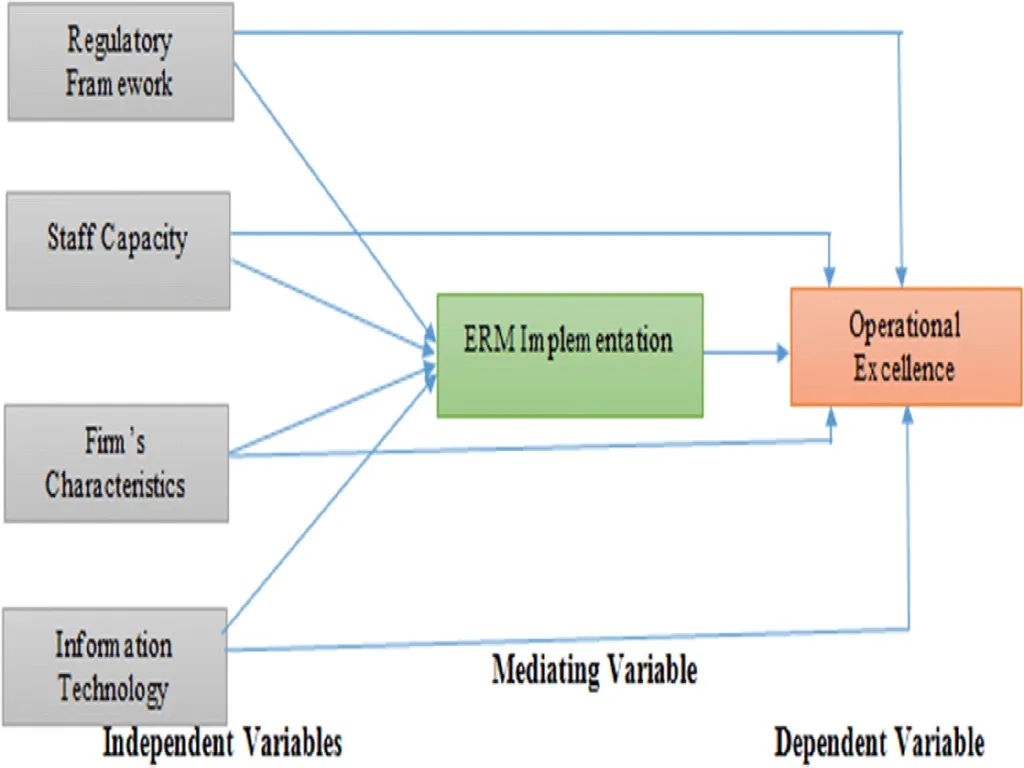
Consider potential mediating or moderating variables that would be consistent with your theory
Control variables should also be supported. Control variables<br>
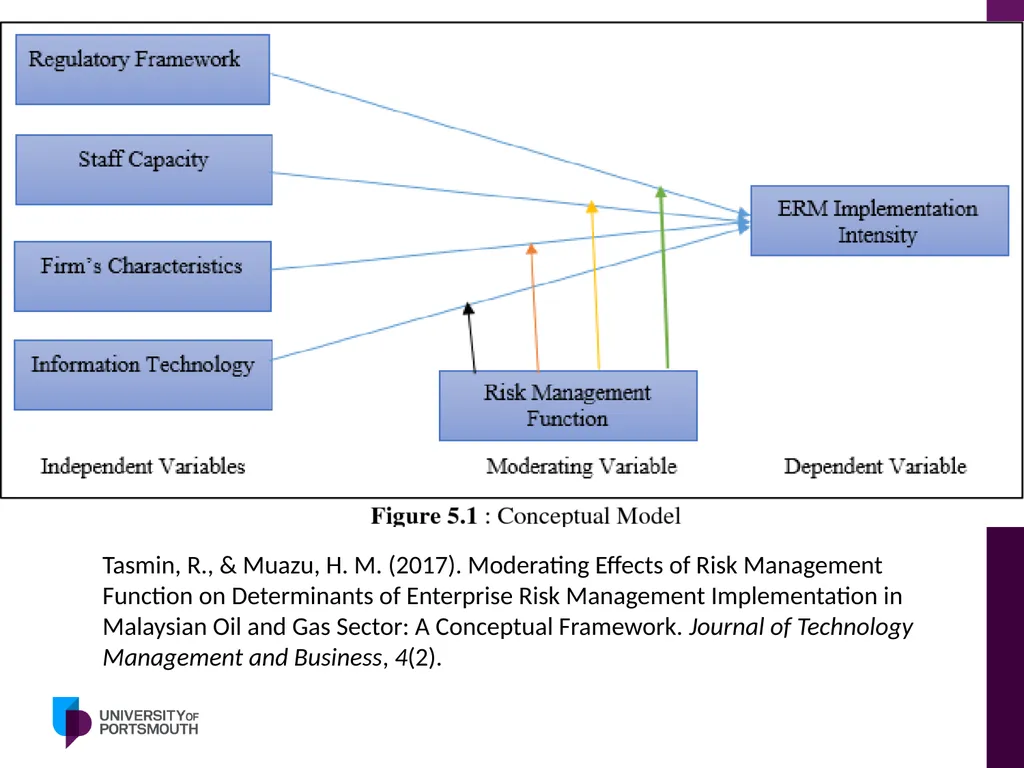
slide42. Tasmin, R., & Muazu, H. M. (2017). Moderating Effects of Risk Management Function on Determinants of Enterprise Risk Management Implementation in Malaysian Oil and Gas Sector: A Conceptual Framework. Journal of Technology Management and Business, 4(2).<br>
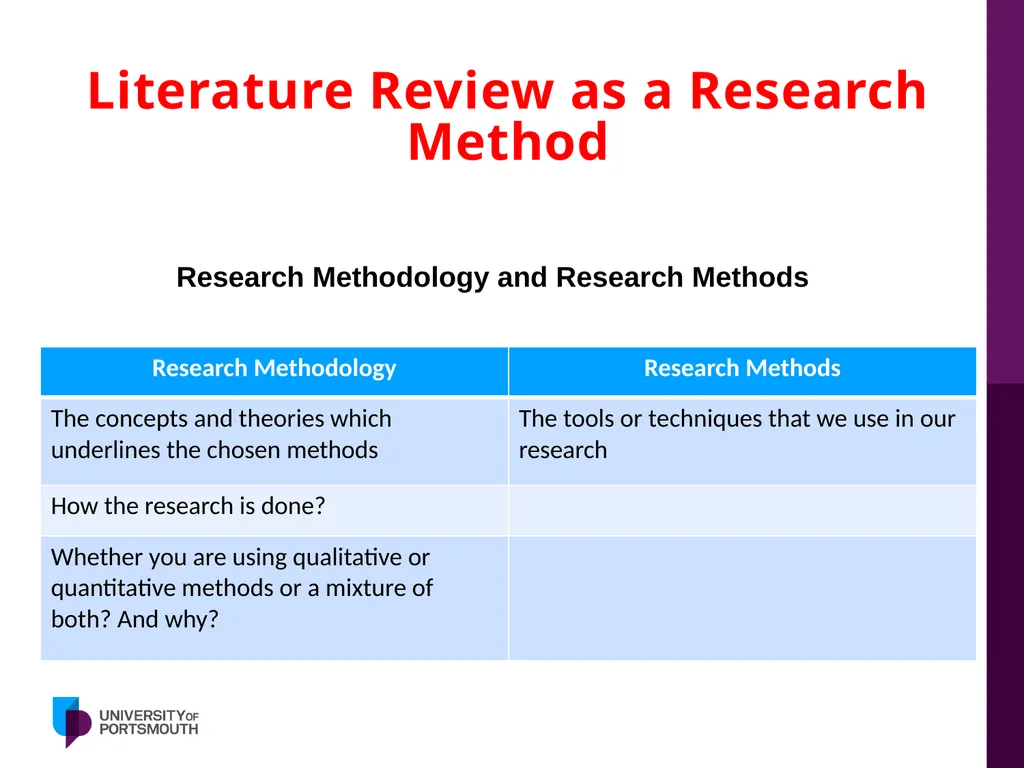
slide44. Literature Review as a Research Method Research Methodology and Research Methods<br>
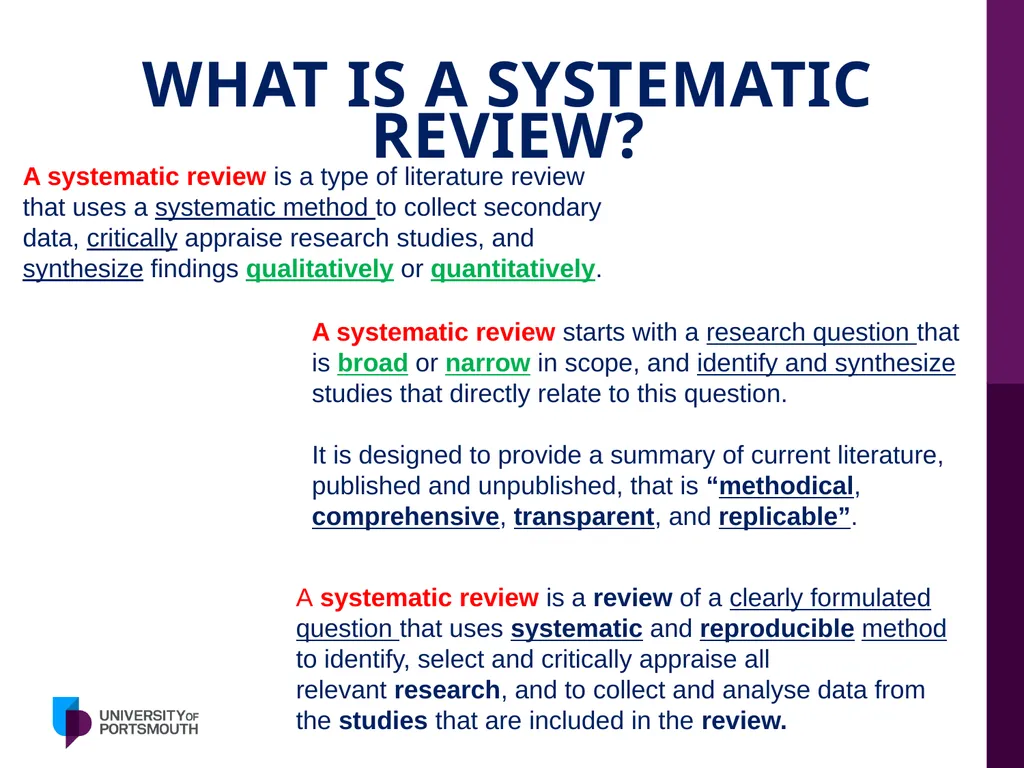
slide45. WHAT IS A SYSTEMATIC REVIEW? A systematic review is a type of literature review that uses a systematic method to collect secondary data, critically appraise research studies, and synthesize findings qualitatively or quantitatively. A systematic review starts with a research question that is broad or narrow in scope, and identify and synthesize studies that directly relate to this question.
It is designed to provide a summary of current literature, published and unpublished, that is “methodical, comprehensive, transparent, and replicable”. A systematic review is a review of a clearly formulated question that uses systematic and reproducible method to identify, select and critically appraise all relevant research, and to collect and analyse data from the studies that are included in the review.<br>
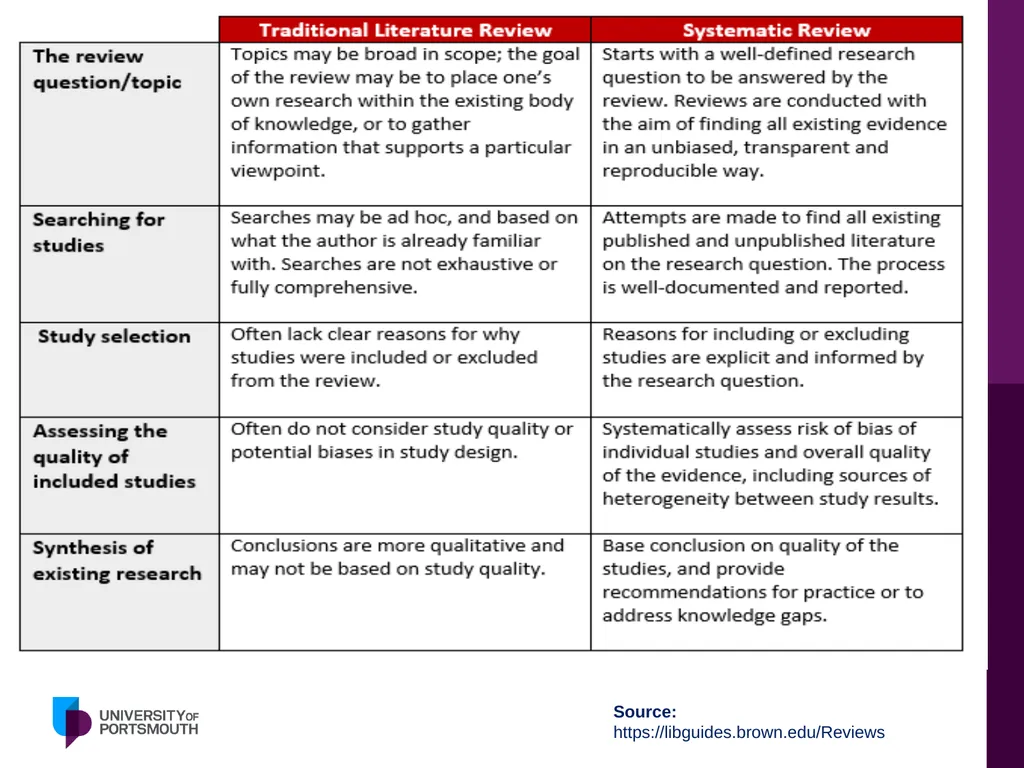
slide46. Source: https://libguides.brown.edu/Reviews<br>
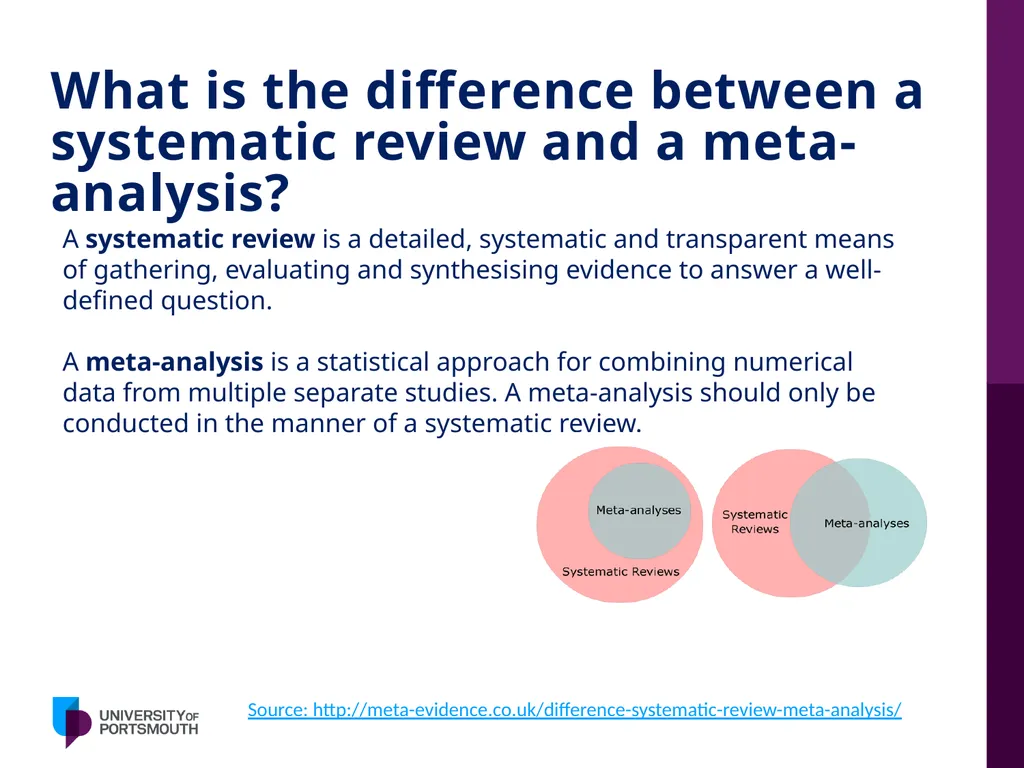
slide47. What is the difference between a systematic review and a meta-analysis? A systematic review is a detailed, systematic and transparent means of gathering, evaluating and synthesising evidence to answer a well-defined question.
A meta-analysis is a statistical approach for combining numerical data from multiple separate studies. A meta-analysis should only be conducted in the manner of a systematic review. Source: http://meta-evidence.co.uk/difference-systematic-review-meta-analysis/<br>
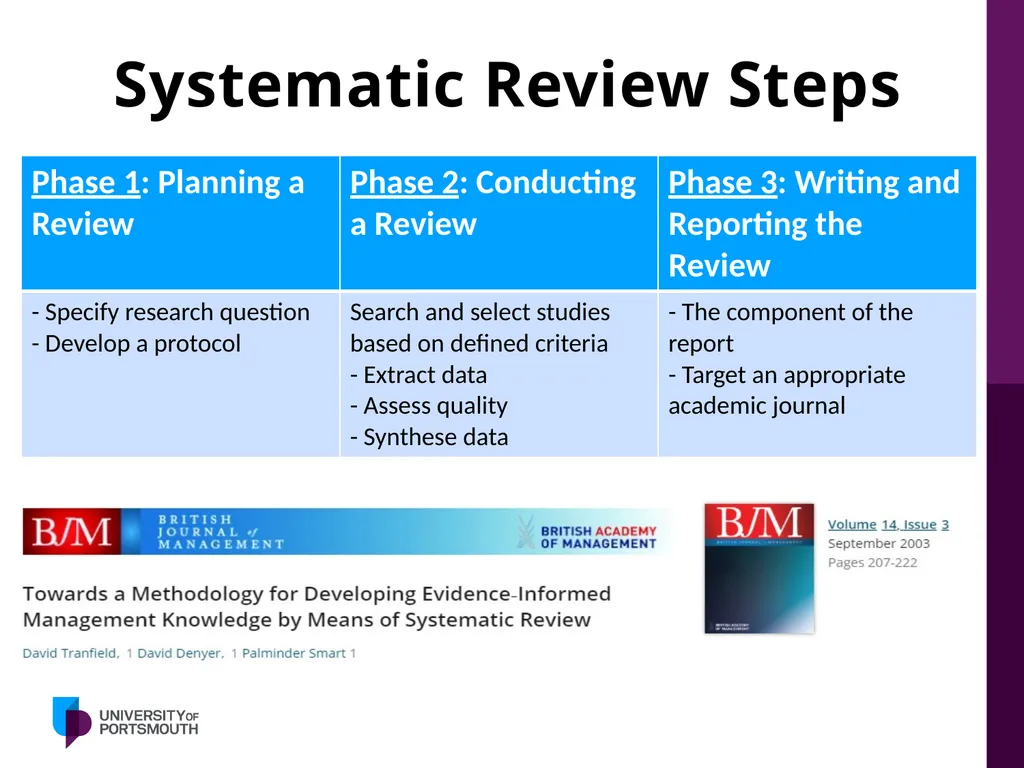
slide49. Systematic Review Steps<br>
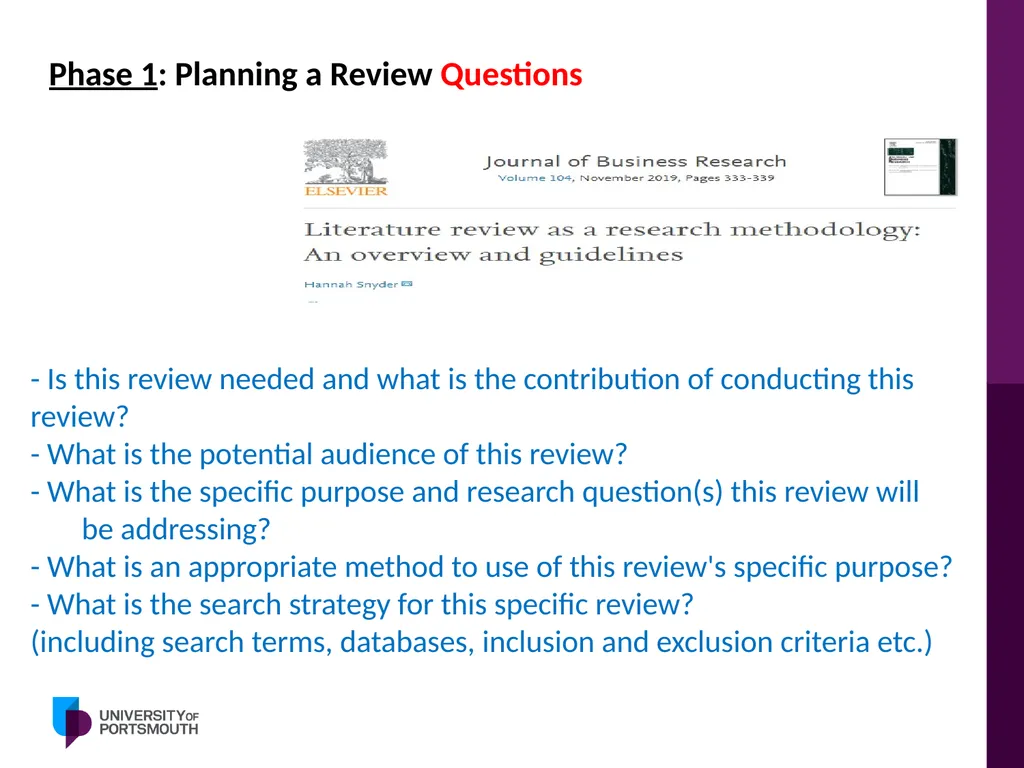
slide50. Phase 1: Planning a Review Questions - Is this review needed and what is the contribution of conducting this review?
- What is the potential audience of this review?
- What is the specific purpose and research question(s) this review will be addressing?
- What is an appropriate method to use of this review's specific purpose?
- What is the search strategy for this specific review?
(including search terms, databases, inclusion and exclusion criteria etc.)<br>
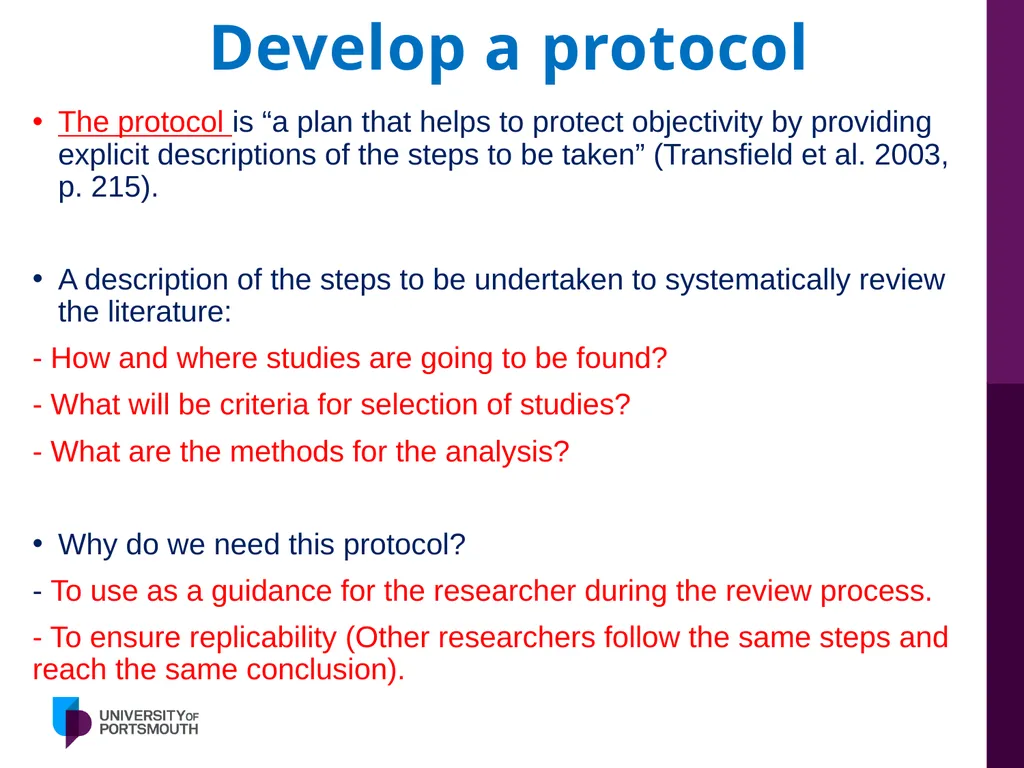
slide51. Develop a protocol The protocol is “a plan that helps to protect objectivity by providing explicit descriptions of the steps to be taken” (Transfield et al. 2003, p. 215).
A description of the steps to be undertaken to systematically review the literature:
- How and where studies are going to be found?
- What will be criteria for selection of studies?
- What are the methods for the analysis?
Why do we need this protocol?
- To use as a guidance for the researcher during the review process.
- To ensure replicability (Other researchers follow the same steps and reach the same conclusion).<br>
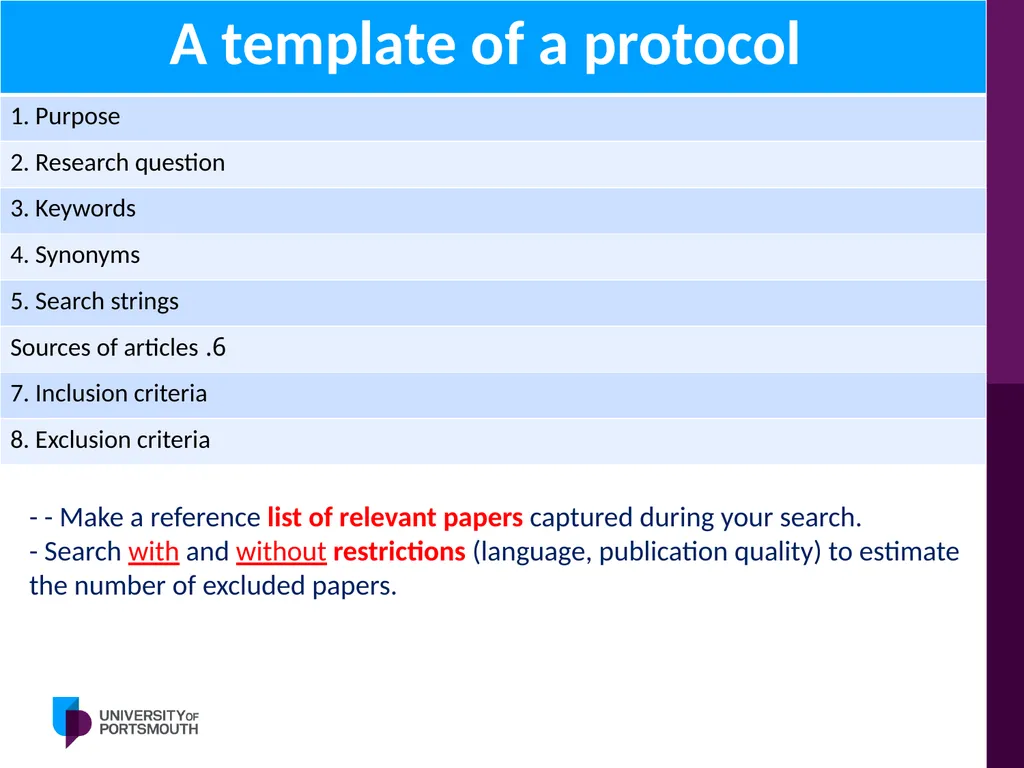
slide52. - - Make a reference list of relevant papers captured during your search.
- Search with and without restrictions (language, publication quality) to estimate the number of excluded papers.<br>
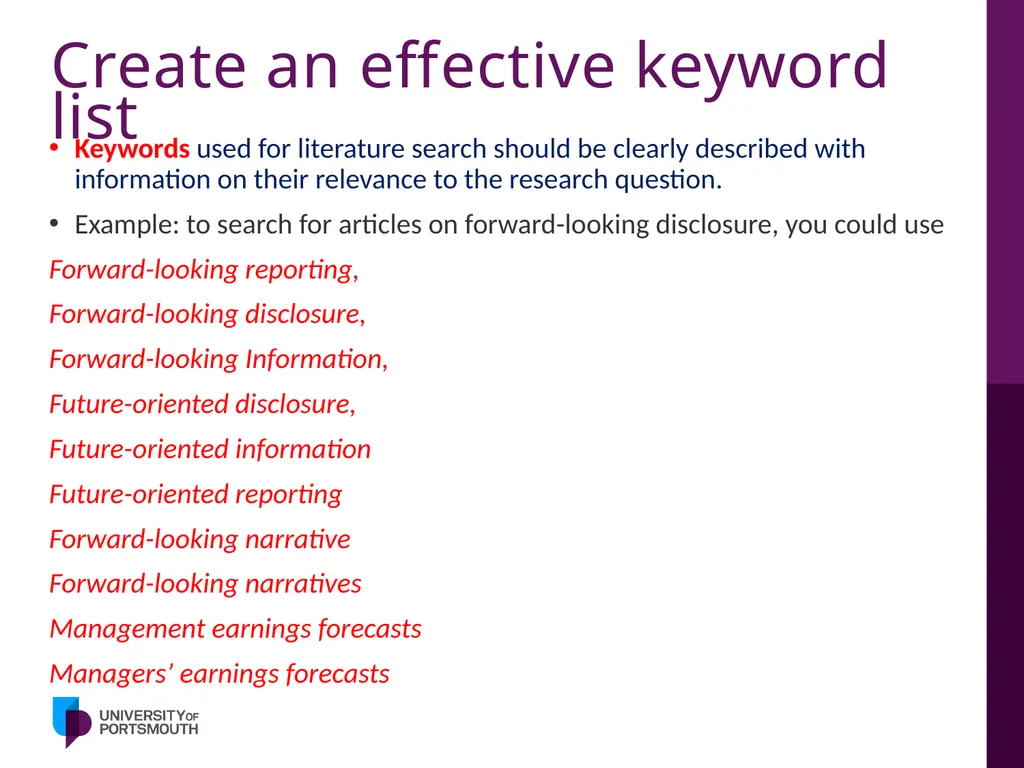
slide53. Create an effective keyword list Keywords used for literature search should be clearly described with information on their relevance to the research question.
Example: to search for articles on forward-looking disclosure, you could use
Forward-looking reporting,
Forward-looking disclosure,
Forward-looking Information,
Future-oriented disclosure,
Future-oriented information
Future-oriented reporting
Forward-looking narrative
Forward-looking narratives
Management earnings forecasts
Managers’ earnings forecasts<br>
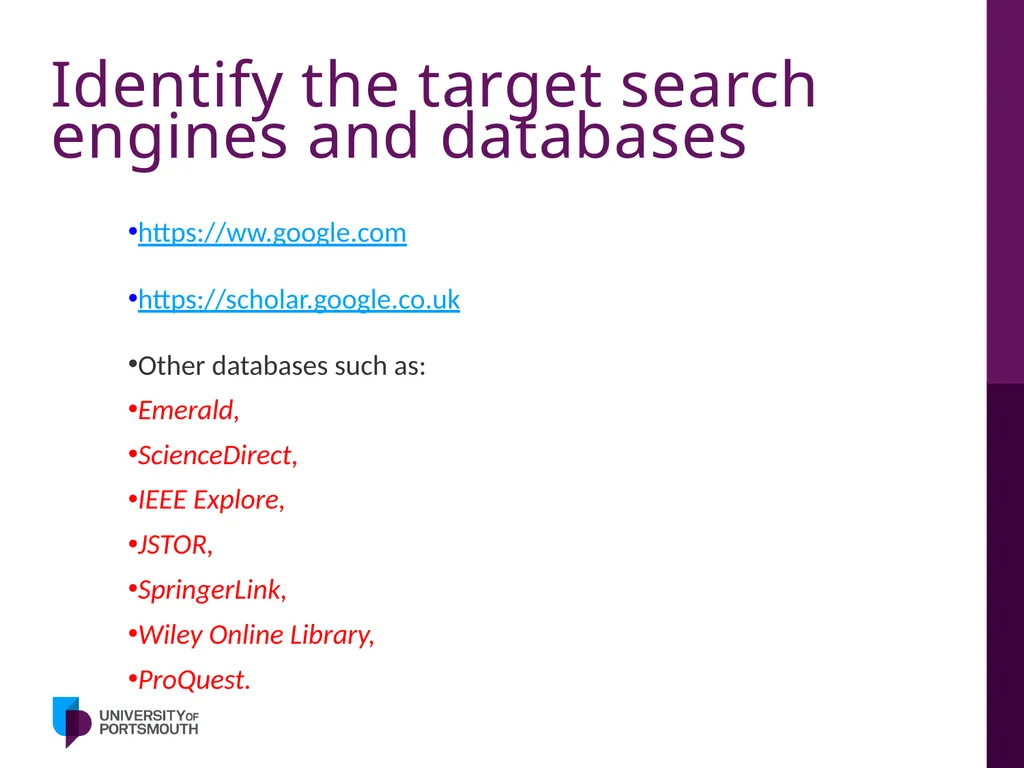
slide54. Identify the target search engines and databases https://ww.google.com
https://scholar.google.co.uk
Other databases such as:
Emerald,
ScienceDirect,
IEEE Explore,
JSTOR,
SpringerLink,
Wiley Online Library,
ProQuest.<br>
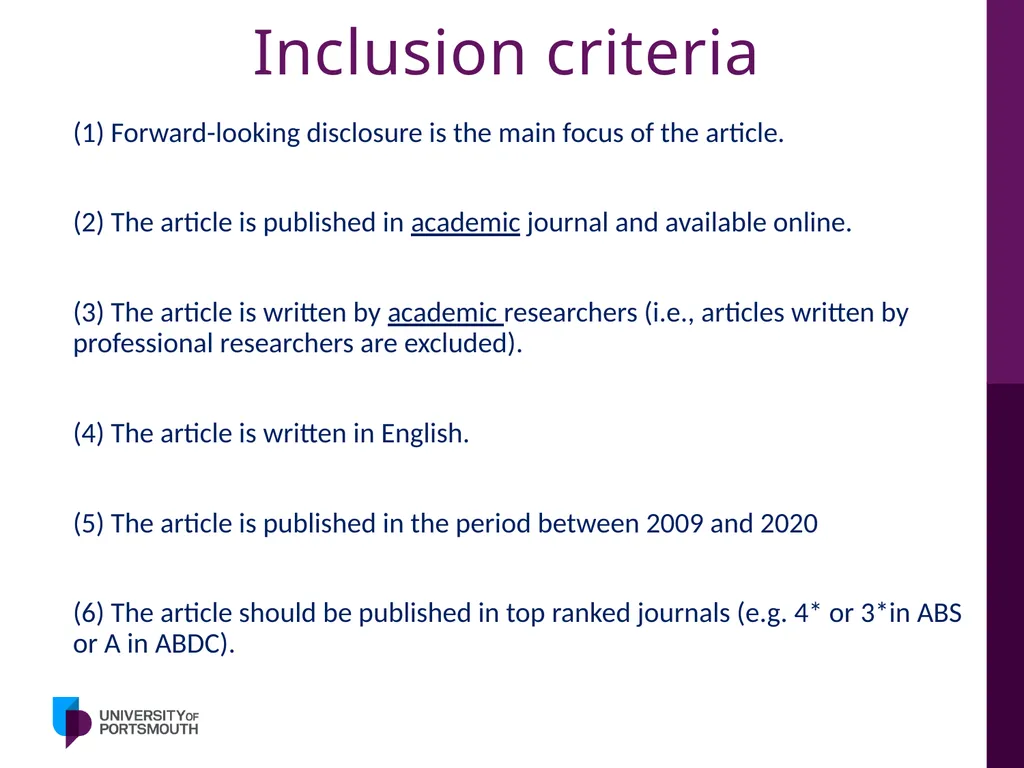
slide55. Inclusion criteria (1) Forward-looking disclosure is the main focus of the article.
(2) The article is published in academic journal and available online.
(3) The article is written by academic researchers (i.e., articles written by professional researchers are excluded).
(4) The article is written in English.
(5) The article is published in the period between 2009 and 2020
(6) The article should be published in top ranked journals (e.g. 4* or 3*in ABS or A in ABDC).<br>
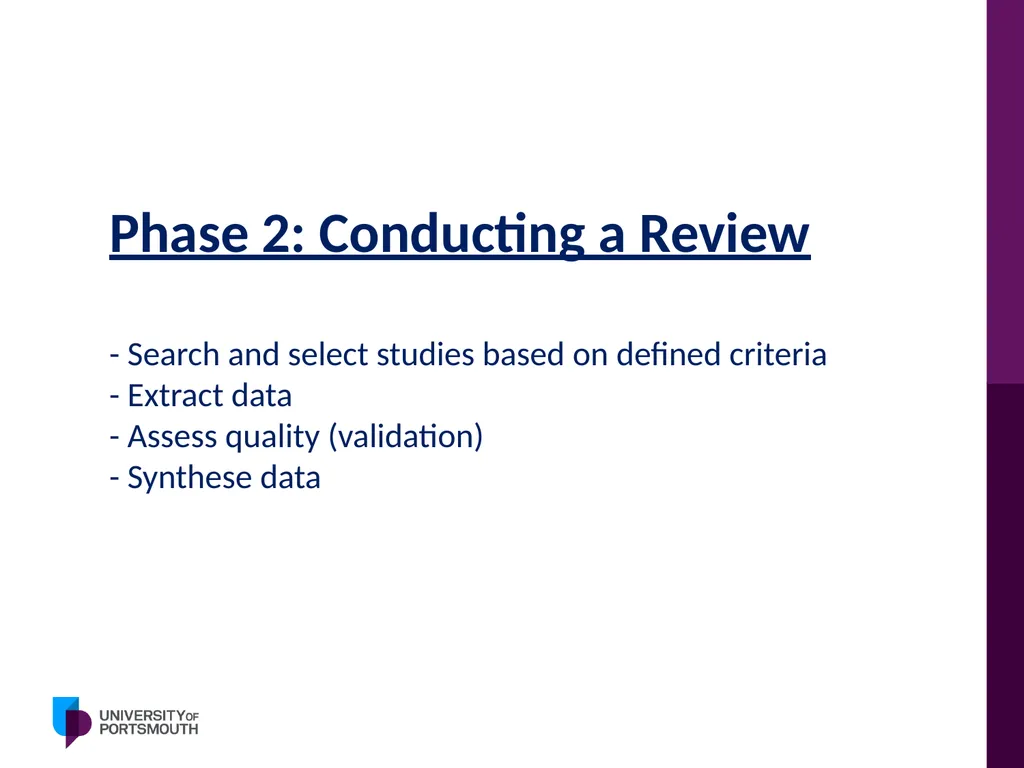
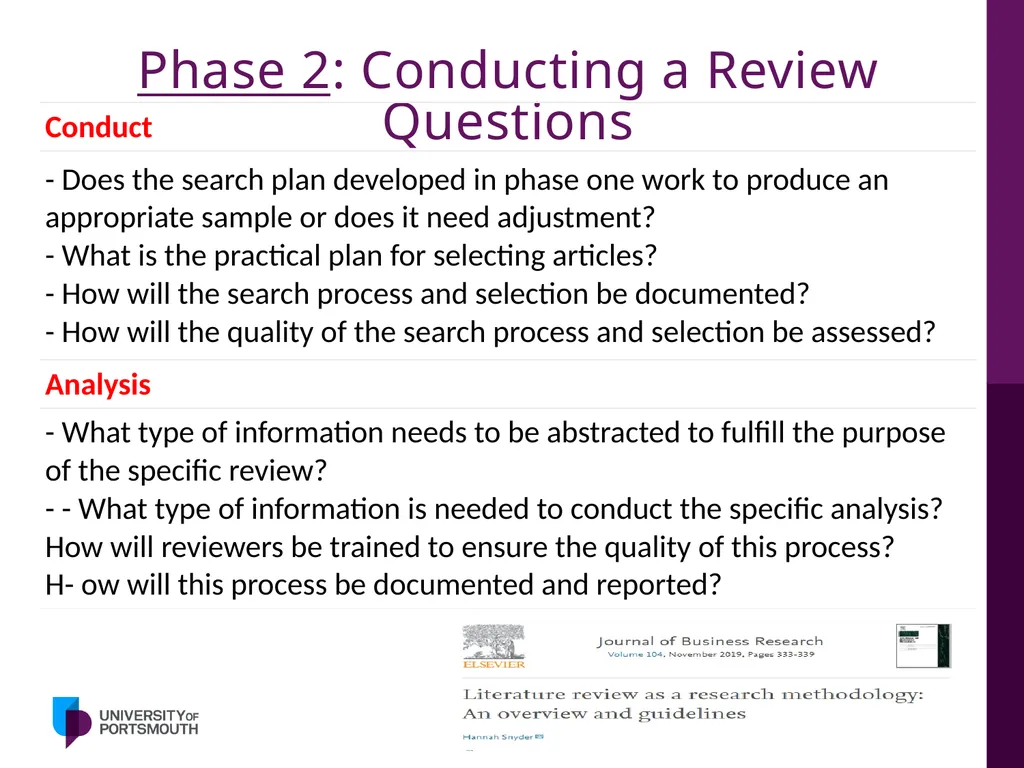
slide56. Phase 2: Conducting a Review
- Search and select studies based on defined criteria
- Extract data
- Assess quality (validation)
- Synthese data<br>
slide57. Phase 2: Conducting a Review Questions<br>
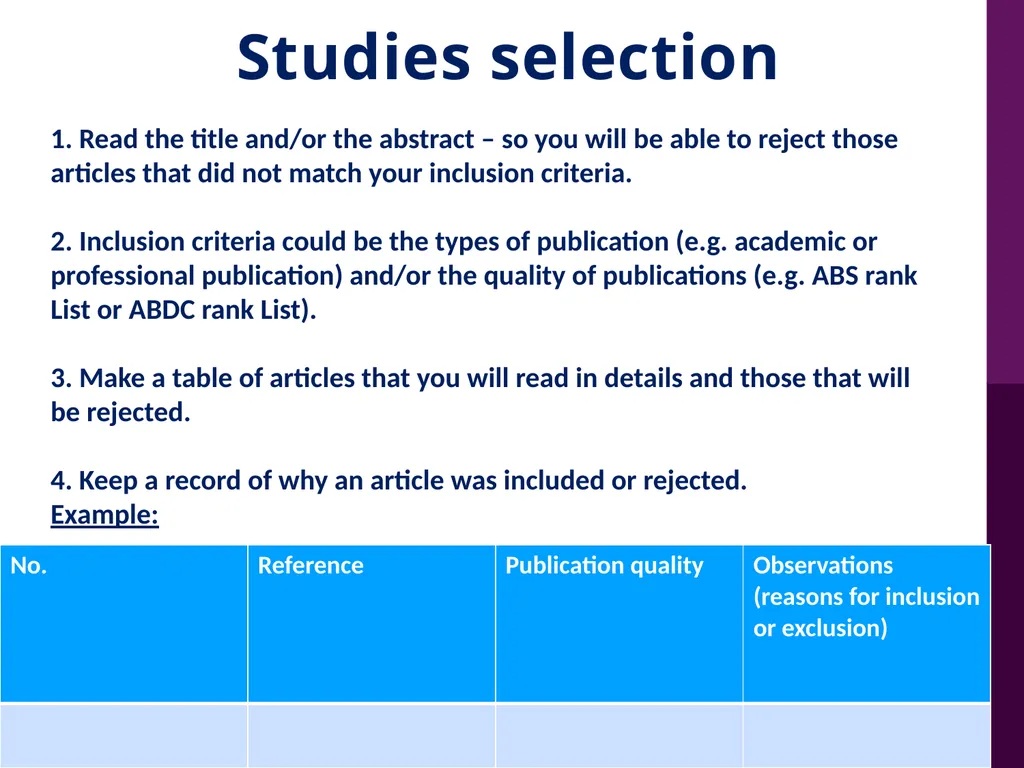
slide58. Studies selection 1. Read the title and/or the abstract – so you will be able to reject those articles that did not match your inclusion criteria.
2. Inclusion criteria could be the types of publication (e.g. academic or professional publication) and/or the quality of publications (e.g. ABS rank List or ABDC rank List).
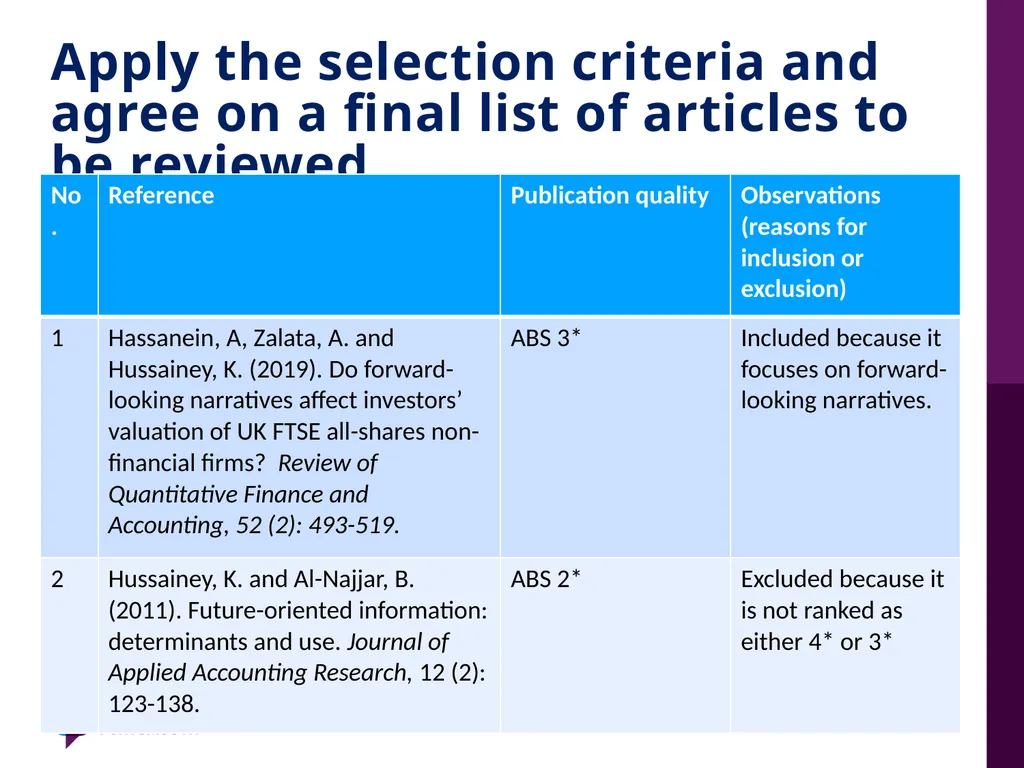
3. Make a table of articles that you will read in details and those that will be rejected.
4. Keep a record of why an article was included or rejected.
Example:<br>
slide59. Apply the selection criteria and agree on a final list of articles to be reviewed<br>
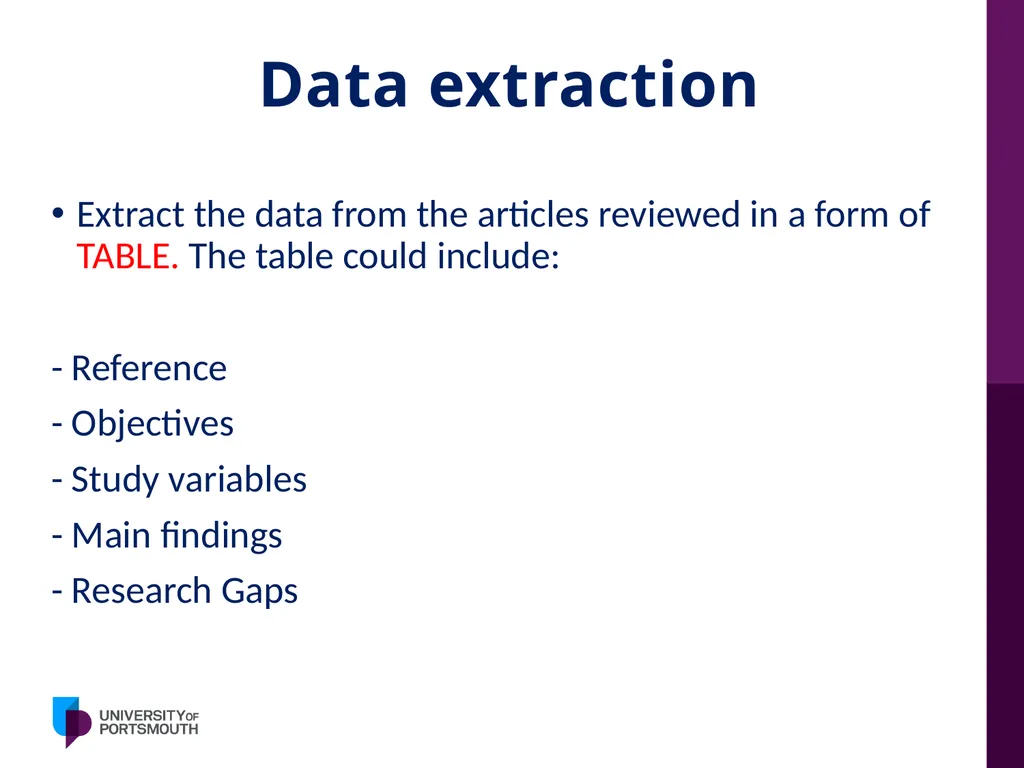
slide60. Data extraction Extract the data from the articles reviewed in a form of TABLE. The table could include:
- Reference
- Objectives
- Study variables
- Main findings
- Research Gaps<br>
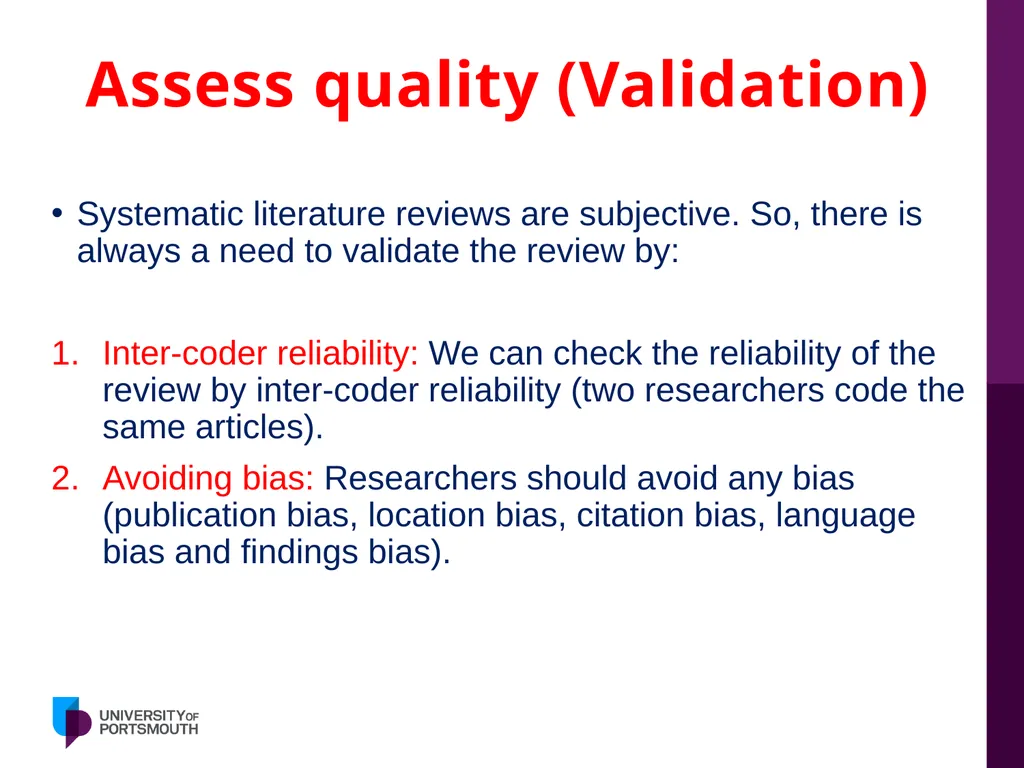
slide61. Assess quality (Validation) Systematic literature reviews are subjective. So, there is always a need to validate the review by:
Inter-coder reliability: We can check the reliability of the review by inter-coder reliability (two researchers code the same articles).
Avoiding bias: Researchers should avoid any bias (publication bias, location bias, citation bias, language bias and findings bias).<br>
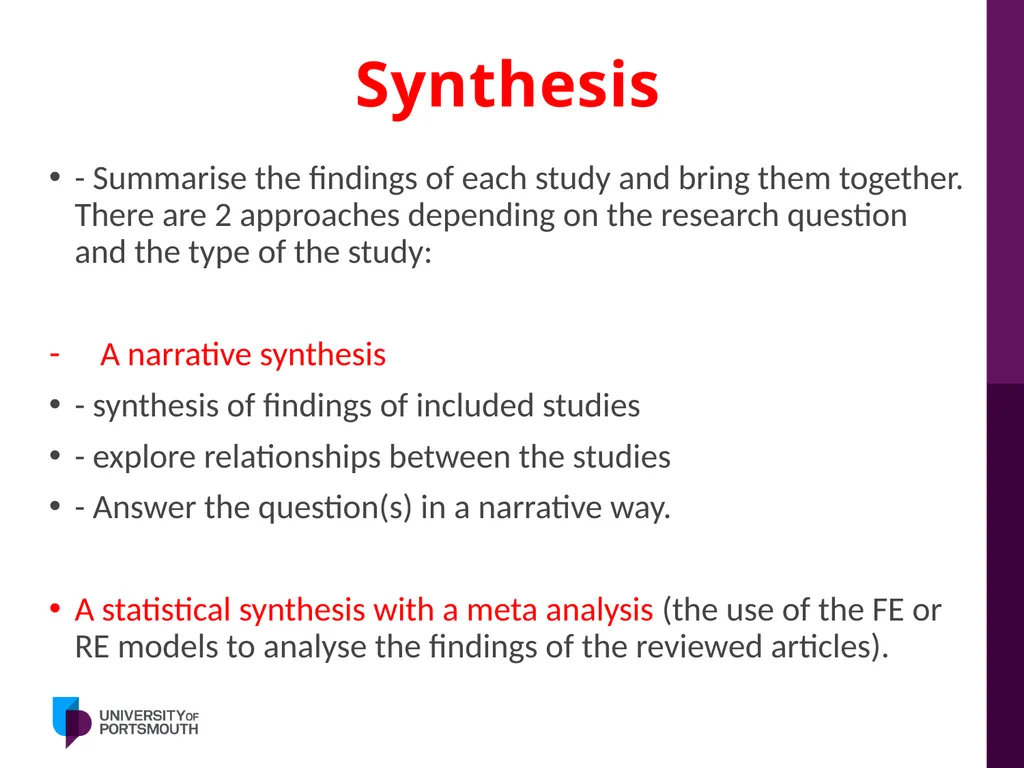
slide62. Synthesis - Summarise the findings of each study and bring them together. There are 2 approaches depending on the research question and the type of the study:
A narrative synthesis
- synthesis of findings of included studies
- explore relationships between the studies
- Answer the question(s) in a narrative way.
A statistical synthesis with a meta analysis (the use of the FE or RE models to analyse the findings of the reviewed articles).<br>
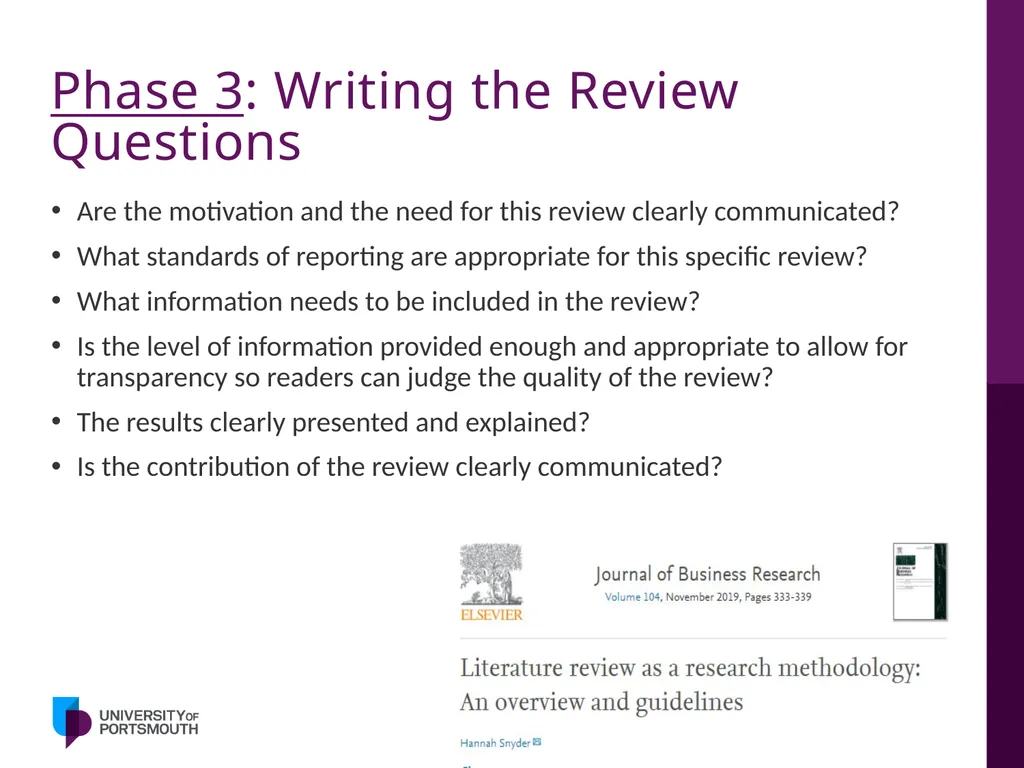
slide63. Phase 3: Writing the Review Questions Are the motivation and the need for this review clearly communicated?
What standards of reporting are appropriate for this specific review?
What information needs to be included in the review?
Is the level of information provided enough and appropriate to allow for transparency so readers can judge the quality of the review?
The results clearly presented and explained?
Is the contribution of the review clearly communicated?<br>
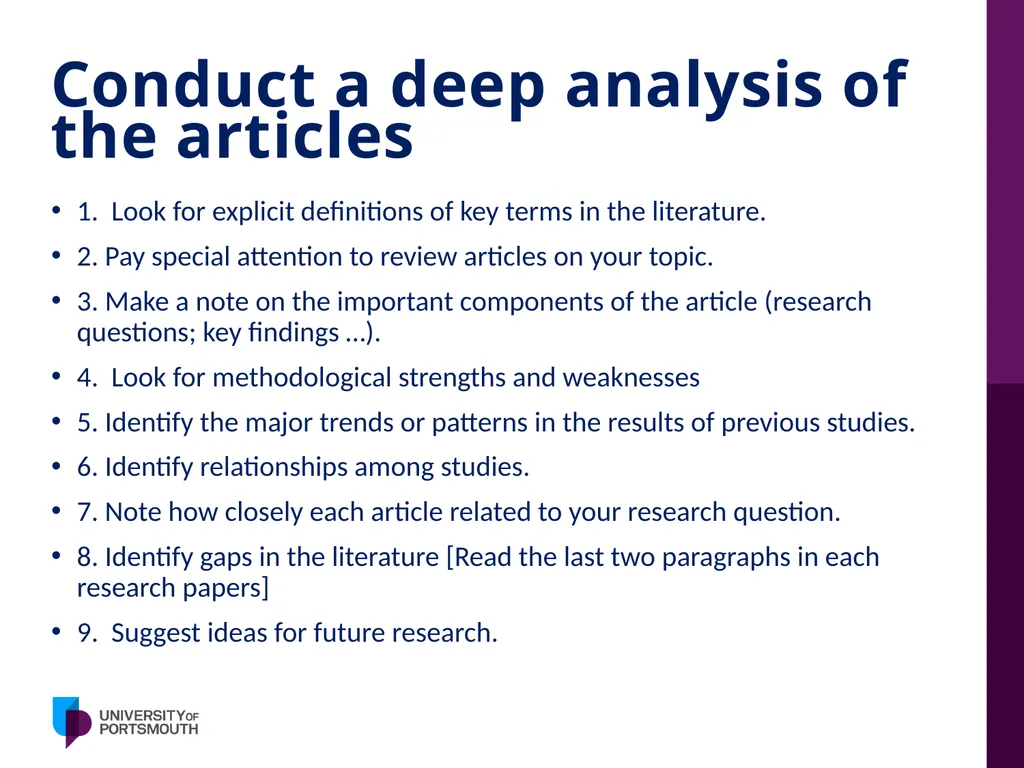
slide64. Conduct a deep analysis of the articles 1. Look for explicit definitions of key terms in the literature.
2. Pay special attention to review articles on your topic.
3. Make a note on the important components of the article (research questions; key findings …).
4. Look for methodological strengths and weaknesses
5. Identify the major trends or patterns in the results of previous studies.
6. Identify relationships among studies.
7. Note how closely each article related to your research question.
8. Identify gaps in the literature [Read the last two paragraphs in each research papers]
9. Suggest ideas for future research.<br>
slide65. Writing the review The component of the review article:
- A title
- An abstract
Keywords
Introduction
- Methodology
The findings (The answer to the research question, the implications; gaps in the literature and suggestions for future research)
References
Tables<br>
slide66. Khaled Hussainey
Professor of Accounting and Financial Management
Portsmouth Business School
Portsmouth University
Telephone: Mobile 07727190105 Office 02392844715
Email: khaled.hussainey@port.ac.uk<br>
Professor of Accounting & Financial Management
University of Portsmouth, UK<br>
slide2. Structure Tips for Top-ranked Journals
Tips for Literature Review
Tips for Research Gaps
Tips for Research Contributions
Tips for Hypotheses Development
Tips for Systematic Literature Review<br>
slide3. The Ranks of the Journals<br>
slide4. Financial Accounting Journals<br>
slide5. Major Management Accounting Journals 1. Journal of Cost Management
http://maaw.info/JournalofCostManagement.htm
2. Management Accounting Review
http://www.journals.elsevier.com/management-accounting-research/
3. Journal of Management Accounting Research
http://aaahq.org/MAS/jmar.cfm
4. Management Accounting Quarterly
http://www.imanet.org/resources_and_publications/management_accounting_quarterly.aspx<br>
slide6. Auditing Journals Auditing: A Journal of Practice & Theory
The Journal of Accounting, Auditing, and Finance
Journal of International Accounting, Auditing and Taxation
International Journal of Auditing
Managerial Auditing Journal
International Journal of Accounting, Auditing and Performance Evaluation<br>
slide7. Accounting Education Journals Accounting Education. An International Journal
The Journal of Accounting Education
Issues in Accounting Education
Advances in Accounting Education
Accounting Educator’s Journal<br>
slide8. Public Sector Accounting Governmental Accounting Non-Profit Accounting 8<br>
slide9. Accounting History Journals<br>
slide10. Major Islamic Accounting Journals Journal of Economic Behavior & Organization (JEBO)
http://www.journals.elsevier.com/journal-of-economic-behavior-and-organization/
Accounting, Auditing and Accountability (AAAJ)
http://www.emeraldgrouppublishing.com/products/journals/journals.htm?id=AAAJ
International Journal of Islamic Financial Services http://www.iiibf.org/journal.html
Journal of Islamic Accounting and Business Research
http://www.emeraldinsight.com/journals.htm?issn=1759-0817
Accounting Forum
http://www.sciencedirect.com/science/journal/01559982 10<br>
slide11. Major Islamic Accounting International Journal of Islamic and Middle Eastern Finance and Management
http://www.emeraldinsight.com/journals.htm?articleid=1826938
Accounting History
http://www.uk.sagepub.com/journals/Journal201764
Journal of Business Ethics
http://www.springer.com/social+sciences/applied+ethics/journal/10551
Critical Perspectives On Accounting
http://www.journals.elsevier.com/critical-perspectives-on-accounting/<br>
slide12. Literature Review Journals<br>
slide13. Tips for Literature Review What is a Literature Review? An academic literature review is defined as
”The selection of available documents (both published and unpublished) on the topic, which contain information, ideas, data and evidence written from a particular standpoint to fulfil certain aims or express certain views on the nature of the topic and how it is to be investigated, and the effective evaluation of these documents in relation to the research being proposed” (Hart, 2001, p. 13).
Hart, C. (2001). Doing a literature search. London: Sage.<br>
slide14. Why do we need a literature review? To identify research gaps.
To convince an intended reader that the topic is worth addressing.
To highlight the contribution (e.g., which of the research gaps will be filled in the present study).
To understand the research background, so we can clarify the research problem, contributions and to avoid replication.
To understand relevant concepts and theories.
To understand different methodologies used in the literature including data sources.
To find out if our findings are consistent with prior research (or not) and (why).<br>
slide15. Why citation of literature is important? To give credit to other researchers and acknowledge their ideas.
To avoid plagiarism.
To enhance credibility of your work.
To show off your scientific knowledge.<br>
slide16. Critical Literature Review A literature review is an overview of the previously published works on a specific topic. The term can refer to a full scholarly paper or a section of a scholarly work such as a book, or an article.
Good critical literature reviews tell a story and help to advance our understanding of what has been done in the literature.
A critical review of a journal article evaluates the strengths and weaknesses of an article's ideas and content.
It provides critical analysis and interpretation that allow readers to assess the your contribution(s).<br>
slide18. Reading critically Think about:
What were the research aims of the paper/book?
Is the research aim achieved? If so, how did they do it?
Are there any problems with their methodology?
Was it a strong or a weak research model?
How will this research help with your own research?
What can you take from it?
What needs to be avoided?
What are you doing differently?<br>
slide19. Critical thinking (a three-year-old’s guide) Why?
How does that work?
What’s that made of?
What’s that for?
What does that mean?
But X says…
How do you know?
So what?
Says who?
What happens if…<br>
slide20. Critical Reading & Analysis When reading critically, focus on the purpose of your literature review:
Think about what you expect from the article before reading it
Skim the abstract, headings, conclusion, and the first sentence of each paragraph
Focus on the arguments presented rather than facts
Take notes as you read and start to organise your review around themes and ideas
Consider using a table, matrix or concept map to identify how the different sources relate to each other
Note four to six points for each study that summarises the main points and conclusions
Be as objective as possible
Source: https://libguides.murdoch.edu.au/LitReview/read<br>
slide21. Analysing your sources Relevance - Is the article relevant to your topic? Is the research methodology comprehensively described?
Currency - Is the source up-to-date? Does it consider the latest research on your topic?
Reliability - Is the source peer-reviewed? How reputable is the source and what is its impact factor?
Provenance - Are the author's arguments supported by evidence (primary material, case studies, narratives, statistics, recent findings)?
Persuasiveness - Which of the author's arguments are most/least convincing?
Objectivity - What is the purpose of the article and its intended audience? Is contrary data considered or is certain pertinent information ignored to prove the author's point? Can you detect any bias in the content?
Accuracy - Does the data support the conclusions drawn? Is the article properly referenced?
Value - Are the author's opinions and conclusions convincing? Does the work ultimately contribute in any significant way to an understanding of the subject? Source: https://libguides.murdoch.edu.au/LitReview/read<br>
slide22. Note Taking Taking clear, legible notes will help to focus your critical reading and analysis of your literature review sources. When taking notes, avoid plagiarism by:
keeping track of the difference between information from your sources and from your own ideas
providing clear references, including page numbers Source: https://libguides.murdoch.edu.au/LitReview/read<br>
slide23. Source: https://libguides.murdoch.edu.au/LitReview/read<br>
slide24. An important observation The use of literature summary tables is very useful for writing critical review articles We need to:
cover most relevant and significant literature related closely to the research questions and objectives
include up-to-date literature<br>
slide25. Critical Reading & Analysis Checklist Does your literature review highlight flaws, gaps, or shortcomings of specific texts or groups of texts?
Have you identified areas that have not yet been researched or have not yet been researched sufficiently?
Does the literature demonstrate a change over time or recent developments that make your research relevant now?
Are you able to discuss research methods used to study this topic and/or related topics?
Can you clearly state why your research is necessary? Source: https://libguides.murdoch.edu.au/LitReview/read<br>
slide26. Saunders et al. (2012)<br>
slide27. 27 Saunders et al. (2012)<br>
slide28. To be critical … Criticise the content
Criticise the method(s)
Criticise the sample
Criticise the validity of the analysis
Criticise the findings and/or the interpretation of the findings<br>
slide29. To be critical … use critical-related words A major criticism of Smith’s work is that ….
One question that needs to be asked, however, is whether ….
A serious weakness with this argument, however, is that ….
One of the limitations with this explanation is that it does not explain why…
One criticism of much of the literature on X is that ….
The key problem with this explanation is that ….
The existing accounts fail to resolve the contradiction between X and Y.
However, there is an inconsistency with this argument.
Smith’s argument relies too heavily on qualitative analysis of ….
It seems that Jones’ understanding of the X framework is questionable.
Smith’s interpretation overlooks much of the historical research ….
X’s analysis does not take account of …. nor does he examine ….<br>
slide30. Tips for Research Gaps How do you find research gaps in a research paper? A research gap is defined as a topic or area for which missing or insufficient information limits the ability to reach a conclusion for a question.
Research gaps could be found in the conclusion of the article (research limitations and suggestions for future research ).
Researchers need to find other research gaps such as: Miles, D. (2017), A Taxonomy of Research Gaps: Identifying and Defining the Seven Research Gaps<br>
slide31. Types of Research Gaps*:
Evidence Gap: if research findings contradict.
Knowledge Gap: There are two settings where a knowledge gap might occur.
First, knowledge may not exist in the actual field to theories and literature from related research domains.
Second, it might be the case that results of a study differs from what was expected.
* Miles, D. (2017), A Taxonomy of Research Gaps: Identifying and Defining the Seven Research Gaps<br>
slide32. Practical-Knowledge Gap: A practical–knowledge (action-knowledge) conflict arises when the actual behaviour in practice is different from the expected behaviour. In this case, research could seek to determine the scope of the conflict and to uncover the reasons for its existence.
Methodological Gap: This gap addresses the conflicts with the research methods in the prior studies and offers a new line of research that is different from those research methods.
Empirical Gap: It often addresses conflicts that no study to date has directly attempted to evaluate a subject or topic from an empirical approach.
Theoretical Gap: Gaps in theory with the prior research or theoretical conflict.
Population Gap: This relates to the population that is not adequately represented or under-researched in the evidence base or prior research.<br>
slide33. Tips for Research Contributions What is research contribution?
How do you find contributions in a research paper?
How do you find research gaps in a research paper?
What are the types of research contributions?
How to think about research contributions with your research?
How do you know that you have made a substantial contribution with your research?
Where should you write your contribution(s)?
How do you write a contribution?<br>
slide34. What is research contribution? A ''contribution'' adds to the literature through filling a research gap.
A ''contribution‘’ shows how your study may offer new insights that previous studies might have missed.
Simply … what is new in your research?
Researchers need to identify “from which angle their research is contributing to the literature”?<br>
slide35. How do you find contributions in a research paper? In most top-ranked journals, you will find the contribution in the introduction of the paper.
Authors use contribution-related keywords such as “contribute, contributes, contribution, contributions, new evidence, novel, original, first study, new method, ….etc”.
Consider the contributions of the papers as strengths of the articles when evaluating the literature (e.g. in a critical literature review, you need to evaluate both the strengths and weaknesses of each article).<br>
slide36. What are the types of research contributions? To knowledge: This could be the first article to examine ……..
To theory: This research introduces a new theory to the field or it tests if ….. theory is applicable to …………context.
To methodology: The paper aims to introduce a new measure for ….
To Practice: The paper aims to introduce a practical solution to problem in practice.<br>
slide37. How to think about research contributions with your research? You need to evaluate your research:
Identify what is new in your research idea, objectives, questions
Identify which research gaps your have filled
Identify the uniqueness of your research context
Identify the novelty of your data, sample period, variables definitions and measurements
Identify the novelty of your research method
Identify the novel findings and insights vis-à-vis the existing literature
highlight the research impact (economic, academic/research and policy implications of your findings)<br>
slide38. Where do you write a contribution? Choose a title that reflects the contribution of your work.
Show the contribution in the abstract.
Briefly and clearly discuss the contribution in the introduction. For example, you can say: “Consequently, the current paper seeks to make the following contributions to the existing literature. First,…, Second,…., Third, …, Fourth,… and so on”.
In the literature review section – you will need to identify research gaps and highlights the contribution of your work.
In the theoretical/conceptual framework – you will need to highlight your contributions (if any).
In the methodology section – you will need to highlight the contributions (if any) related to the context, the sample period, the data, the sample size, the variable definitions and measurement, the method used…etc.
In the discussion of your findings, you will need to highlight the incremental contributions of your research and its impact.<br>
slide39. How do you write a contribution? The (primary) aim of this paper is to contribute to the understanding of …
This study aims to contribute to this growing area of research by exploring
The findings should make an important contribution to the field of
It is hoped that this research will contribute to a deeper understanding of …
Therefore, this study makes a major contribution to research on X by demonstrating…
There are several important areas where this study makes an original contribution to ...
This work contributes to existing knowledge of X by providing ...
The findings from this study make several contributions to the current literature. First,…
These findings contribute in several ways to our understanding of X and provide a basis for …
Morley (2021)<br>
slide40. Tips for Hypotheses Development: By reviewing the literature, you will be able to<br>
slide41. Is your study’s conceptual framework logically consistent and credible?
What is the underlying theory that leads to the development of the hypotheses?
Consider potential mediating or moderating variables that would be consistent with your theory
Control variables should also be supported. Control variables<br>
slide42. Tasmin, R., & Muazu, H. M. (2017). Moderating Effects of Risk Management Function on Determinants of Enterprise Risk Management Implementation in Malaysian Oil and Gas Sector: A Conceptual Framework. Journal of Technology Management and Business, 4(2).<br>
slide44. Literature Review as a Research Method Research Methodology and Research Methods<br>
slide45. WHAT IS A SYSTEMATIC REVIEW? A systematic review is a type of literature review that uses a systematic method to collect secondary data, critically appraise research studies, and synthesize findings qualitatively or quantitatively. A systematic review starts with a research question that is broad or narrow in scope, and identify and synthesize studies that directly relate to this question.
It is designed to provide a summary of current literature, published and unpublished, that is “methodical, comprehensive, transparent, and replicable”. A systematic review is a review of a clearly formulated question that uses systematic and reproducible method to identify, select and critically appraise all relevant research, and to collect and analyse data from the studies that are included in the review.<br>
slide46. Source: https://libguides.brown.edu/Reviews<br>
slide47. What is the difference between a systematic review and a meta-analysis? A systematic review is a detailed, systematic and transparent means of gathering, evaluating and synthesising evidence to answer a well-defined question.
A meta-analysis is a statistical approach for combining numerical data from multiple separate studies. A meta-analysis should only be conducted in the manner of a systematic review. Source: http://meta-evidence.co.uk/difference-systematic-review-meta-analysis/<br>
slide49. Systematic Review Steps<br>
slide50. Phase 1: Planning a Review Questions - Is this review needed and what is the contribution of conducting this review?
- What is the potential audience of this review?
- What is the specific purpose and research question(s) this review will be addressing?
- What is an appropriate method to use of this review's specific purpose?
- What is the search strategy for this specific review?
(including search terms, databases, inclusion and exclusion criteria etc.)<br>
slide51. Develop a protocol The protocol is “a plan that helps to protect objectivity by providing explicit descriptions of the steps to be taken” (Transfield et al. 2003, p. 215).
A description of the steps to be undertaken to systematically review the literature:
- How and where studies are going to be found?
- What will be criteria for selection of studies?
- What are the methods for the analysis?
Why do we need this protocol?
- To use as a guidance for the researcher during the review process.
- To ensure replicability (Other researchers follow the same steps and reach the same conclusion).<br>
slide52. - - Make a reference list of relevant papers captured during your search.
- Search with and without restrictions (language, publication quality) to estimate the number of excluded papers.<br>
slide53. Create an effective keyword list Keywords used for literature search should be clearly described with information on their relevance to the research question.
Example: to search for articles on forward-looking disclosure, you could use
Forward-looking reporting,
Forward-looking disclosure,
Forward-looking Information,
Future-oriented disclosure,
Future-oriented information
Future-oriented reporting
Forward-looking narrative
Forward-looking narratives
Management earnings forecasts
Managers’ earnings forecasts<br>
slide54. Identify the target search engines and databases https://ww.google.com
https://scholar.google.co.uk
Other databases such as:
Emerald,
ScienceDirect,
IEEE Explore,
JSTOR,
SpringerLink,
Wiley Online Library,
ProQuest.<br>
slide55. Inclusion criteria (1) Forward-looking disclosure is the main focus of the article.
(2) The article is published in academic journal and available online.
(3) The article is written by academic researchers (i.e., articles written by professional researchers are excluded).
(4) The article is written in English.
(5) The article is published in the period between 2009 and 2020
(6) The article should be published in top ranked journals (e.g. 4* or 3*in ABS or A in ABDC).<br>
slide56. Phase 2: Conducting a Review
- Search and select studies based on defined criteria
- Extract data
- Assess quality (validation)
- Synthese data<br>
slide57. Phase 2: Conducting a Review Questions<br>
slide58. Studies selection 1. Read the title and/or the abstract – so you will be able to reject those articles that did not match your inclusion criteria.
2. Inclusion criteria could be the types of publication (e.g. academic or professional publication) and/or the quality of publications (e.g. ABS rank List or ABDC rank List).
3. Make a table of articles that you will read in details and those that will be rejected.
4. Keep a record of why an article was included or rejected.
Example:<br>
slide59. Apply the selection criteria and agree on a final list of articles to be reviewed<br>
slide60. Data extraction Extract the data from the articles reviewed in a form of TABLE. The table could include:
- Reference
- Objectives
- Study variables
- Main findings
- Research Gaps<br>
slide61. Assess quality (Validation) Systematic literature reviews are subjective. So, there is always a need to validate the review by:
Inter-coder reliability: We can check the reliability of the review by inter-coder reliability (two researchers code the same articles).
Avoiding bias: Researchers should avoid any bias (publication bias, location bias, citation bias, language bias and findings bias).<br>
slide62. Synthesis - Summarise the findings of each study and bring them together. There are 2 approaches depending on the research question and the type of the study:
A narrative synthesis
- synthesis of findings of included studies
- explore relationships between the studies
- Answer the question(s) in a narrative way.
A statistical synthesis with a meta analysis (the use of the FE or RE models to analyse the findings of the reviewed articles).<br>
slide63. Phase 3: Writing the Review Questions Are the motivation and the need for this review clearly communicated?
What standards of reporting are appropriate for this specific review?
What information needs to be included in the review?
Is the level of information provided enough and appropriate to allow for transparency so readers can judge the quality of the review?
The results clearly presented and explained?
Is the contribution of the review clearly communicated?<br>
slide64. Conduct a deep analysis of the articles 1. Look for explicit definitions of key terms in the literature.
2. Pay special attention to review articles on your topic.
3. Make a note on the important components of the article (research questions; key findings …).
4. Look for methodological strengths and weaknesses
5. Identify the major trends or patterns in the results of previous studies.
6. Identify relationships among studies.
7. Note how closely each article related to your research question.
8. Identify gaps in the literature [Read the last two paragraphs in each research papers]
9. Suggest ideas for future research.<br>
slide65. Writing the review The component of the review article:
- A title
- An abstract
Keywords
Introduction
- Methodology
The findings (The answer to the research question, the implications; gaps in the literature and suggestions for future research)
References
Tables<br>
slide66. Khaled Hussainey
Professor of Accounting and Financial Management
Portsmouth Business School
Portsmouth University
Telephone: Mobile 07727190105 Office 02392844715
Email: khaled.hussainey@port.ac.uk<br>