
Donning & Doffing Personal Protective Equipment
MS
Published · 25 slides · 0 views
1 / 1
Description
Donning Doffing Personal Protective Equipment (PPE) One part of an employers comprehensive safety program with a focus on an exposure control plan and procedures when using basic personal protective equipment May 2021 Housekeeping
Related Topics
Share
Embed code
Download this presentation From Below
"Donning & Doffing Personal Protective Equipment" is the property of its rightful owner. Permission is granted to download and print the materials on this website for personal, non-commercial use only, and to display it on your personal computer provided you do not modify the materials and that you retain all copyright notices contained in the materials. By downloading content from our website, you accept the terms of this agreement.
Presentation Transcript
01
Donning & Doffing
Personal Protective Equipment (PPE)
One part of an employer’s comprehensive safety program
with a focus on an exposure control plan and procedures
when using basic personal protective equipment
May 2021<br>
Personal Protective Equipment (PPE)
One part of an employer’s comprehensive safety program
with a focus on an exposure control plan and procedures
when using basic personal protective equipment
May 2021<br>
02
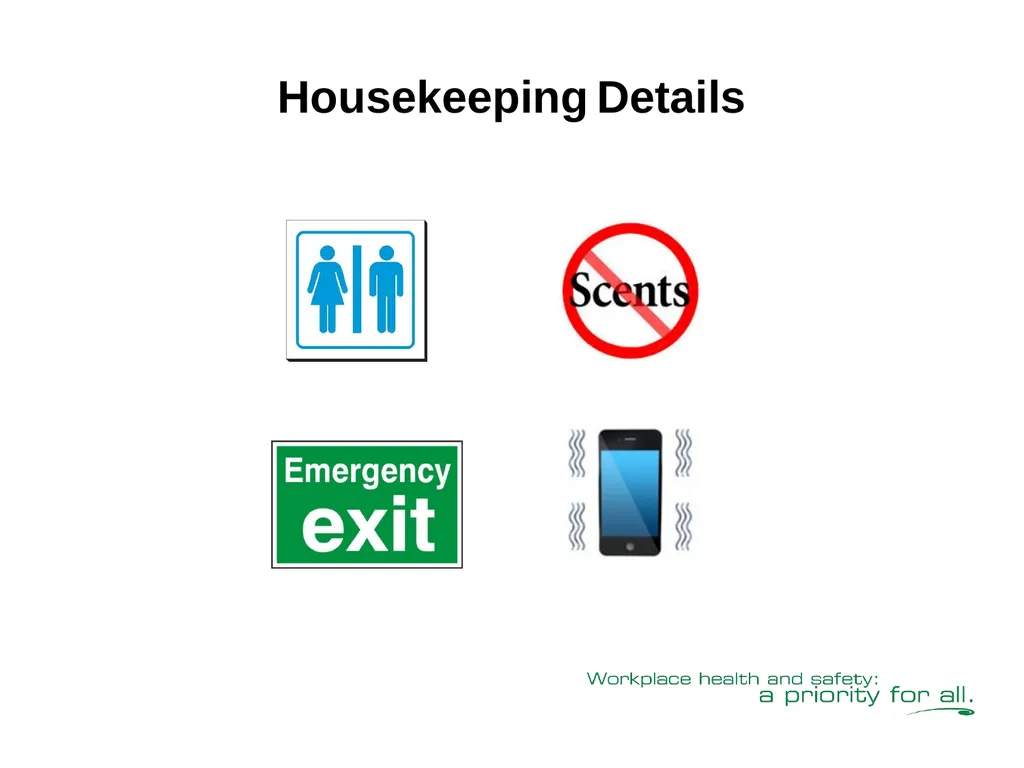
Housekeeping Details<br>
03
Welcome & Introduction Welcome to Donning & Doffing Personal Protective Equipment
Successful completion of this program includes:
active involvement in discussion
return demonstration of donning and doffing techniques with appropriate hand hygiene
Evaluation – pre session<br>
Successful completion of this program includes:
active involvement in discussion
return demonstration of donning and doffing techniques with appropriate hand hygiene
Evaluation – pre session<br>
04
What You Will Learn The employer legislated responsibilities for personal protective equipment and education/training
Legislated responsibilities and rights as a worker
Legislated requirements for personal protective equipment
Appropriate donning (putting on) and doffing (removing) of PPE (namely; gowns, gloves, procedure/surgical mask/respirator, goggles/face shield) and why the order is important
Appropriate hand hygiene (with alcohol based hand rub and soap & water)<br>
Legislated responsibilities and rights as a worker
Legislated requirements for personal protective equipment
Appropriate donning (putting on) and doffing (removing) of PPE (namely; gowns, gloves, procedure/surgical mask/respirator, goggles/face shield) and why the order is important
Appropriate hand hygiene (with alcohol based hand rub and soap & water)<br>
05
Legislation Saskatchewan’s OH&S legislation (Saskatchewan Employment Act) states:
“Train” means to give information and explanation to a worker with respect to a particular subject-matter and require a practical demonstration that the worker has acquired knowledge or skill related to the subject matter;<br>
“Train” means to give information and explanation to a worker with respect to a particular subject-matter and require a practical demonstration that the worker has acquired knowledge or skill related to the subject matter;<br>
06
Legislation The Occupational Health and Safety Regulations, 2020, Regulation 3-1(c) states:
General duties of employers
(c) the provision of any information, instruction, training and supervision that is necessary to protect the health and safety of workers at work;<br>
General duties of employers
(c) the provision of any information, instruction, training and supervision that is necessary to protect the health and safety of workers at work;<br>
07
Legislation The Occupational Health and Safety Regulations, 2020, Regulation 3-2 states:
A worker shall:
(a) use the safeguards, safety appliances and personal protective equipment provided in accordance with these regulations and any other regulations made pursuant to the Act; and
(b) follow the safe work practices and procedures required by or developed pursuant to these regulations and any other regulations made pursuant to the Act.<br>
A worker shall:
(a) use the safeguards, safety appliances and personal protective equipment provided in accordance with these regulations and any other regulations made pursuant to the Act; and
(b) follow the safe work practices and procedures required by or developed pursuant to these regulations and any other regulations made pursuant to the Act.<br>
08
Legislation Every worker has three rights:
1. Right to Know the hazards at their workplace, to be trained to recognize them, and to be trained to protect themselves.
2. Right to Participate in their own safety as well as the safety program in their workplace.
3. Right to Refuse an act or series of acts where the worker has reasonable grounds to believe that it is unusually dangerous. This is a refusal of an individual worker, not a group of workers.<br>
1. Right to Know the hazards at their workplace, to be trained to recognize them, and to be trained to protect themselves.
2. Right to Participate in their own safety as well as the safety program in their workplace.
3. Right to Refuse an act or series of acts where the worker has reasonable grounds to believe that it is unusually dangerous. This is a refusal of an individual worker, not a group of workers.<br>
09
Legislation The Occupational Health and Safety Regulations, 2020, Part 7, is all about personal protective equipment.
use of PPE
inspection of PPE
eye and face protection
use of PPE when workers are exposed to hazardous substances<br>
use of PPE
inspection of PPE
eye and face protection
use of PPE when workers are exposed to hazardous substances<br>
10
Accountability What does accountability mean to you?
The general definition of “accountability” includes:
being bound to give an explanation of your conduct
being responsible; answerable.
How should we be held accountable?<br>
The general definition of “accountability” includes:
being bound to give an explanation of your conduct
being responsible; answerable.
How should we be held accountable?<br>
11
Training, Practice, Competence, Observation Training: this is considered your training session. Ask questions.
Practice: Perfect practice makes perfect. This will take time, we’ll practice very slow and deliberate - this is a task that we will not rush through.
Competence: this is your “know how”, your ability to use what you will be taught today. So “know how” to don and doff with appropriate hand hygiene before you leave this session.
Observation: this is where I am going to watch and coach each of you don and doff every piece of PPE and perform hand hygiene.<br>
Practice: Perfect practice makes perfect. This will take time, we’ll practice very slow and deliberate - this is a task that we will not rush through.
Competence: this is your “know how”, your ability to use what you will be taught today. So “know how” to don and doff with appropriate hand hygiene before you leave this session.
Observation: this is where I am going to watch and coach each of you don and doff every piece of PPE and perform hand hygiene.<br>
12
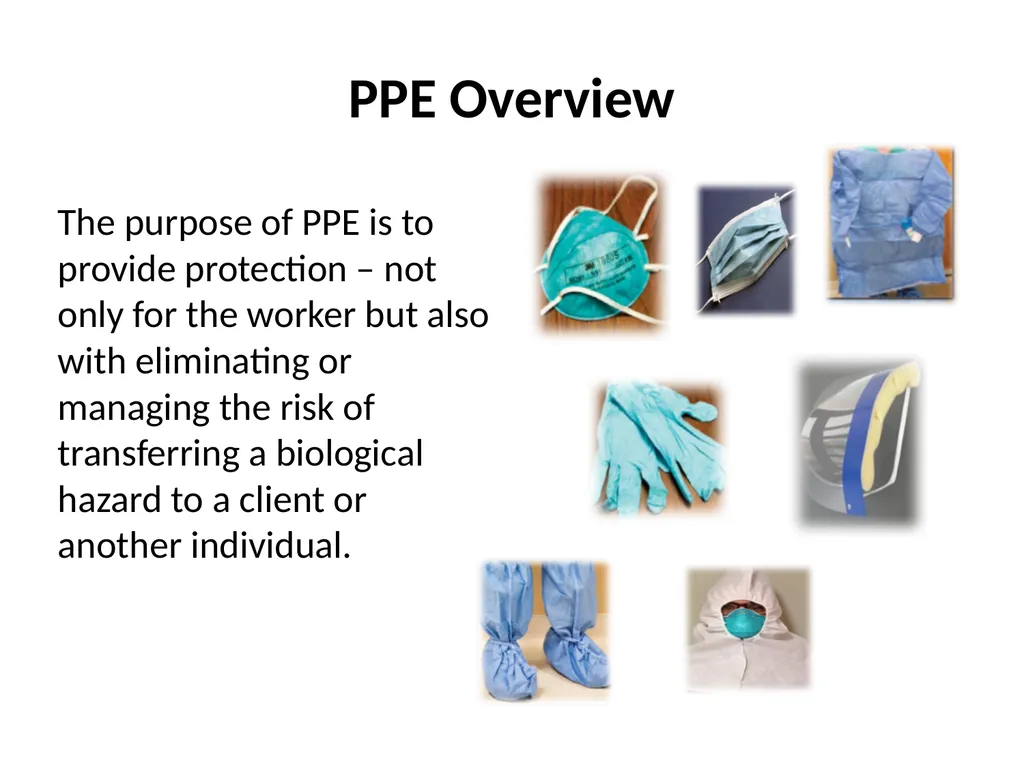
PPE Overview The purpose of PPE is to provide protection – not only for the worker but also with eliminating or managing the risk of transferring a biological hazard to a client or another individual.<br>
13
Principles of PPE Donning - PPE must be donned correctly in proper order.
During Patient Care - PPE must remain in place and be worn correctly for the duration of exposure to potentially contaminated areas. PPE should not be adjusted. Don’t adjust your eyeglasses, hair, etc. Don’t touch any part of your face.
In some situations, having a “buddy” with you will help to check for a partial or total breach in PPE.
Doffing - Can be a high-risk process that requires a structured procedure; may require a trained co-worker when using procedures; designated area for removal to ensure protection.
PPE must be removed slowly and deliberately in the correct sequence to reduce the possibility of self-contamination or environmental contamination.<br>
During Patient Care - PPE must remain in place and be worn correctly for the duration of exposure to potentially contaminated areas. PPE should not be adjusted. Don’t adjust your eyeglasses, hair, etc. Don’t touch any part of your face.
In some situations, having a “buddy” with you will help to check for a partial or total breach in PPE.
Doffing - Can be a high-risk process that requires a structured procedure; may require a trained co-worker when using procedures; designated area for removal to ensure protection.
PPE must be removed slowly and deliberately in the correct sequence to reduce the possibility of self-contamination or environmental contamination.<br>
14
Remember! Always move slowly – it is a step by step task
Do not rush when donning PPE
Have your hair tied back/out of the way
Avoid touching PPE once donned
Avoid touching face, exposed skin
Do not rush when doffing PPE
Use appropriate waste receptacle (preferably hands-free) and discard carefully<br>
Do not rush when donning PPE
Have your hair tied back/out of the way
Avoid touching PPE once donned
Avoid touching face, exposed skin
Do not rush when doffing PPE
Use appropriate waste receptacle (preferably hands-free) and discard carefully<br>
15
Hand Hygiene Proper hand hygiene is critical and used during the donning and doffing process. Before touching the PPE; clean your hands with alcohol based hand rub (ABHR) or soap and water - and ensure you rub/scrub each part of your hand.
Removing rings/bracelets or refraining from wearing these items during work supports good infection control.
When your hands are visibly dirty, always use soap and water.<br>
Removing rings/bracelets or refraining from wearing these items during work supports good infection control.
When your hands are visibly dirty, always use soap and water.<br>
16
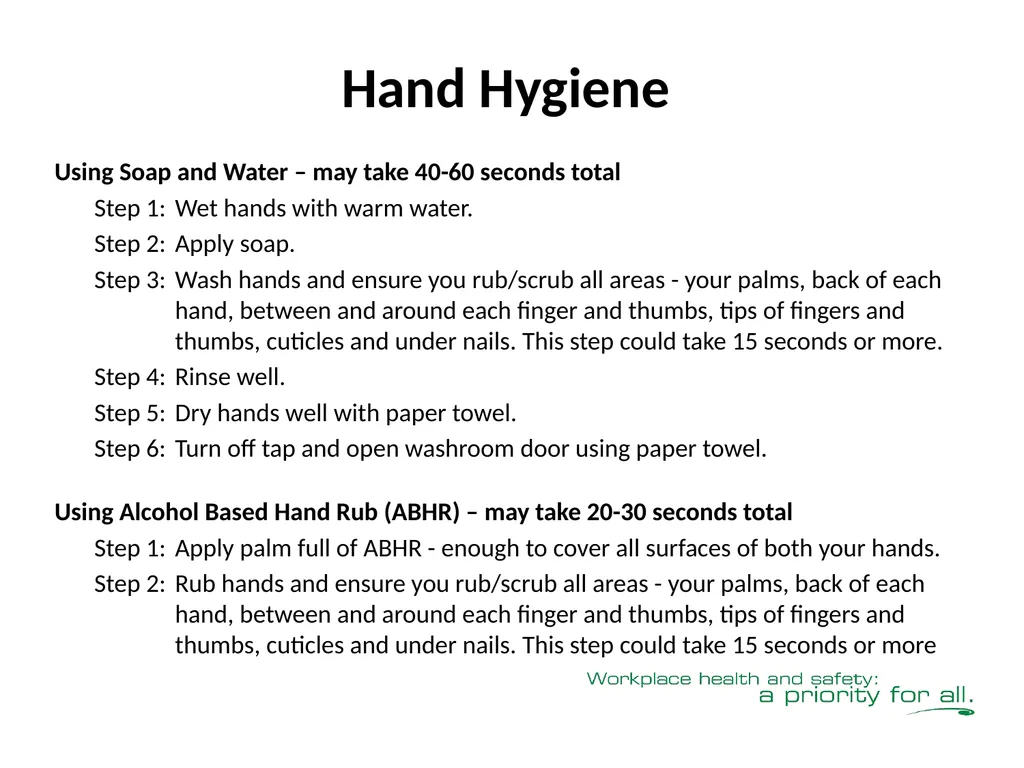
Hand Hygiene Using Soap and Water – may take 40-60 seconds total
Step 1: Wet hands with warm water.
Step 2: Apply soap.
Step 3: Wash hands and ensure you rub/scrub all areas - your palms, back of each hand, between and around each finger and thumbs, tips of fingers and thumbs, cuticles and under nails. This step could take 15 seconds or more.
Step 4: Rinse well.
Step 5: Dry hands well with paper towel.
Step 6: Turn off tap and open washroom door using paper towel.
Using Alcohol Based Hand Rub (ABHR) – may take 20-30 seconds total
Step 1: Apply palm full of ABHR - enough to cover all surfaces of both your hands.
Step 2: Rub hands and ensure you rub/scrub all areas - your palms, back of each hand, between and around each finger and thumbs, tips of fingers and thumbs, cuticles and under nails. This step could take 15 seconds or more<br>
Step 1: Wet hands with warm water.
Step 2: Apply soap.
Step 3: Wash hands and ensure you rub/scrub all areas - your palms, back of each hand, between and around each finger and thumbs, tips of fingers and thumbs, cuticles and under nails. This step could take 15 seconds or more.
Step 4: Rinse well.
Step 5: Dry hands well with paper towel.
Step 6: Turn off tap and open washroom door using paper towel.
Using Alcohol Based Hand Rub (ABHR) – may take 20-30 seconds total
Step 1: Apply palm full of ABHR - enough to cover all surfaces of both your hands.
Step 2: Rub hands and ensure you rub/scrub all areas - your palms, back of each hand, between and around each finger and thumbs, tips of fingers and thumbs, cuticles and under nails. This step could take 15 seconds or more<br>
17
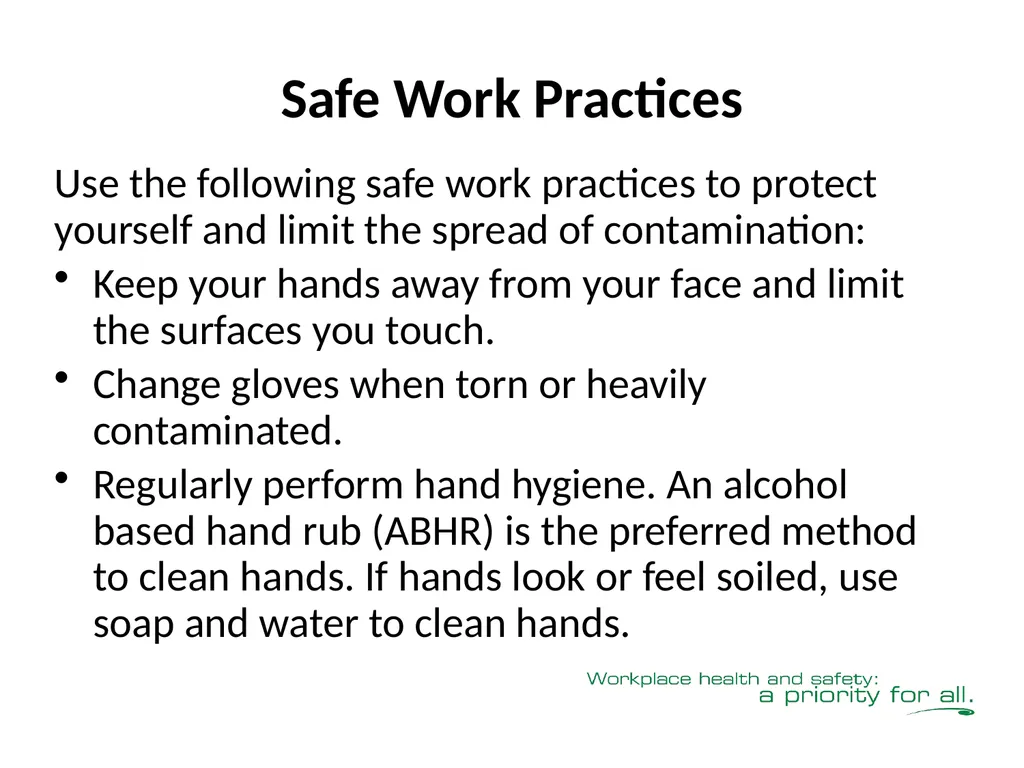
Safe Work Practices Use the following safe work practices to protect yourself and limit the spread of contamination:
Keep your hands away from your face and limit the surfaces you touch.
Change gloves when torn or heavily contaminated.
Regularly perform hand hygiene. An alcohol based hand rub (ABHR) is the preferred method to clean hands. If hands look or feel soiled, use soap and water to clean hands.<br>
Keep your hands away from your face and limit the surfaces you touch.
Change gloves when torn or heavily contaminated.
Regularly perform hand hygiene. An alcohol based hand rub (ABHR) is the preferred method to clean hands. If hands look or feel soiled, use soap and water to clean hands.<br>
18
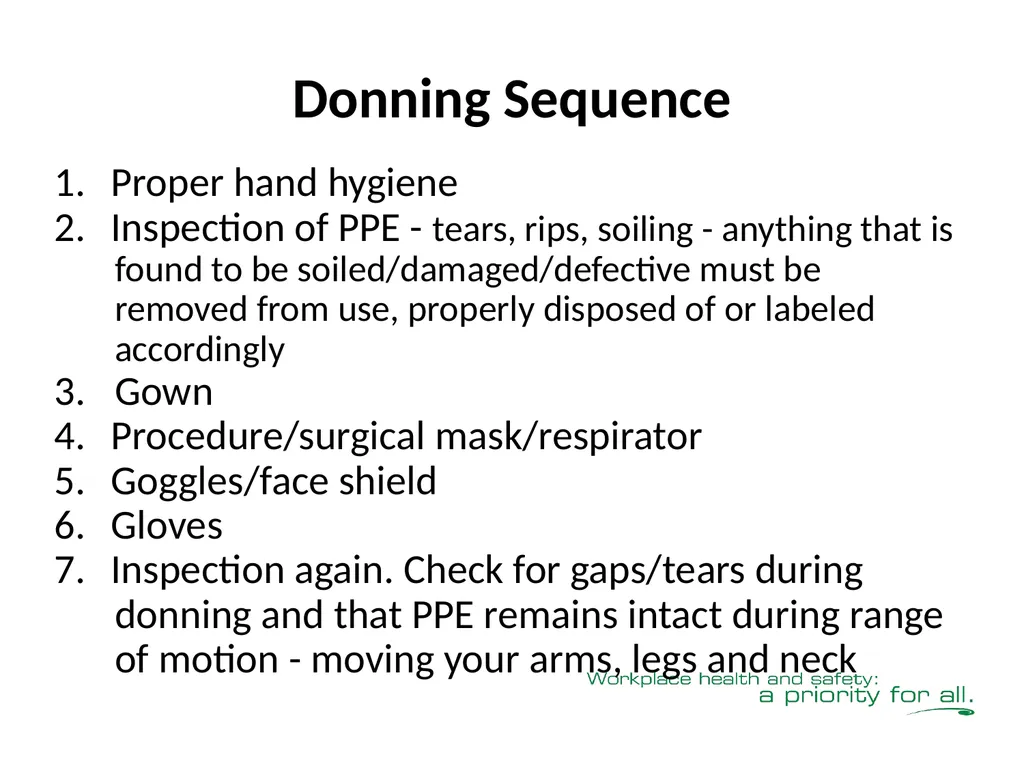
Donning Sequence 1. Proper hand hygiene
2. Inspection of PPE - tears, rips, soiling - anything that is found to be soiled/damaged/defective must be removed from use, properly disposed of or labeled accordingly
Gown
4. Procedure/surgical mask/respirator
5. Goggles/face shield
6. Gloves
7. Inspection again. Check for gaps/tears during donning and that PPE remains intact during range of motion - moving your arms, legs and neck<br>
2. Inspection of PPE - tears, rips, soiling - anything that is found to be soiled/damaged/defective must be removed from use, properly disposed of or labeled accordingly
Gown
4. Procedure/surgical mask/respirator
5. Goggles/face shield
6. Gloves
7. Inspection again. Check for gaps/tears during donning and that PPE remains intact during range of motion - moving your arms, legs and neck<br>
19
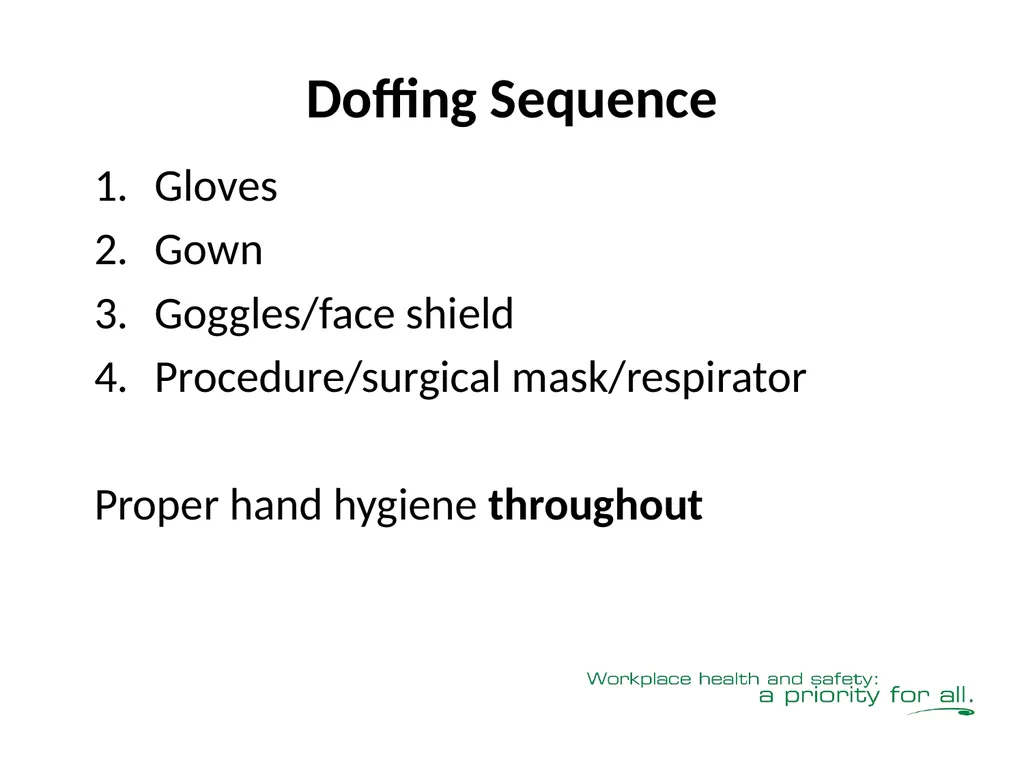
Doffing Sequence 1. Gloves
2. Gown
3. Goggles/face shield
4. Procedure/surgical mask/respirator
Proper hand hygiene throughout<br>
2. Gown
3. Goggles/face shield
4. Procedure/surgical mask/respirator
Proper hand hygiene throughout<br>
20
An Approach is to Coach A “Coach” may be beneficial to assist workers with donning and doffing PPE. The sequence and actions involved in each donning and doffing step are critical to avoiding exposure.
The coach:
is a dedicated individual with the responsibility of ensuring adherence to the entire donning and doffing process
will be knowledgeable about all PPE recommended in the facility’s protocol and the correct donning and doffing procedures, including disposal of used PPE
may read aloud to the worker each step in the procedure checklist and visually confirm that the step has been completed correctly
will ensure the worker avoids touching their face/exposed skin during the donning and doffing procedure
inspects PPE for gaps and adjusts if necessary
conducts range of motion activities to ensure PPE stays intact and the worker is comfortable
should know the exposure management plan in the event of an unintentional break in procedure<br>
The coach:
is a dedicated individual with the responsibility of ensuring adherence to the entire donning and doffing process
will be knowledgeable about all PPE recommended in the facility’s protocol and the correct donning and doffing procedures, including disposal of used PPE
may read aloud to the worker each step in the procedure checklist and visually confirm that the step has been completed correctly
will ensure the worker avoids touching their face/exposed skin during the donning and doffing procedure
inspects PPE for gaps and adjusts if necessary
conducts range of motion activities to ensure PPE stays intact and the worker is comfortable
should know the exposure management plan in the event of an unintentional break in procedure<br>
21
Re-evaluation Every worker trained in SASWH’s Donning & Doffing PPE course should be re-evaluated at least once every 2 years. The re-evaluation would include practice and return demonstration on donning and doffing basic PPE with appropriate hand hygiene.
Ongoing support, Safety Talks, using the Coach Approach would assist with maintaining skills following training.
Employers are required to keep records of worker training and is to ensure that training remains current.<br>
Ongoing support, Safety Talks, using the Coach Approach would assist with maintaining skills following training.
Employers are required to keep records of worker training and is to ensure that training remains current.<br>
22
Summary and Infection Control Summary
Specific steps are required when donning (putting on) and doffing (removing) PPE. There may be additional specific steps depending on the PPE you are using for the specific situation.
Infection Control (IC)
There are specific infection control precautions and procedures that healthcare workers are required to follow. Please refer to/consult the following resources for further information:
1. the approved infection control manual/policies/procedures for your agency/health region;
2. the designated agency/health region IC professional; or
3. your supervisor.<br>
Specific steps are required when donning (putting on) and doffing (removing) PPE. There may be additional specific steps depending on the PPE you are using for the specific situation.
Infection Control (IC)
There are specific infection control precautions and procedures that healthcare workers are required to follow. Please refer to/consult the following resources for further information:
1. the approved infection control manual/policies/procedures for your agency/health region;
2. the designated agency/health region IC professional; or
3. your supervisor.<br>
23
To Protect Yourself, You Can: Ask for training on PPE
Use the appropriate PPE
Keep yourself current on PPE
Practice - perfect practice makes perfect
Know your employer’s current policy and procedures
…<br>
Use the appropriate PPE
Keep yourself current on PPE
Practice - perfect practice makes perfect
Know your employer’s current policy and procedures
…<br>
24
Bringing It All Together PPE will be provided by the employer
Staff will be trained on appropriate donning and doffing techniques that includes hand hygiene
Follow guidelines in place; keep your documents handy for reference
Ask for help if you need it
Buddy up - have a trained worker observe you and do the same for them - coach and mentor each other<br>
Staff will be trained on appropriate donning and doffing techniques that includes hand hygiene
Follow guidelines in place; keep your documents handy for reference
Ask for help if you need it
Buddy up - have a trained worker observe you and do the same for them - coach and mentor each other<br>
25
Stay Safe Completion of the evaluation form
Thank You for attending….
Be Aware – Be Healthy – Be Safe<br>
Thank You for attending….
Be Aware – Be Healthy – Be Safe<br>