
Doubting and Believing: At Rest, Methodological







Description: Doubting and Believing: At Rest, Methodological and In Motion: Assessing Credibility in Asylum Cases Jean Koh Peters 2012 Doubting and Believing Locating yourself on the Spectrum Methodological Doubt, Methodological Belief Tracking your
Related Topics
Download Presentation
"Doubting and Believing: At Rest, Methodological" is the property of its rightful owner. Permission is granted to download and print the materials on this website for personal, non-commercial use only, and to display it on your personal computer provided you do not modify the materials and that you retain all copyright notices contained in the materials. By downloading content from our website, you accept the terms of this agreement.
Presentation Transcript
slide1. Doubting and Believing:
At Rest, Methodological and In Motion:
Assessing Credibility in Asylum Cases
Jean Koh Peters 2012<br>
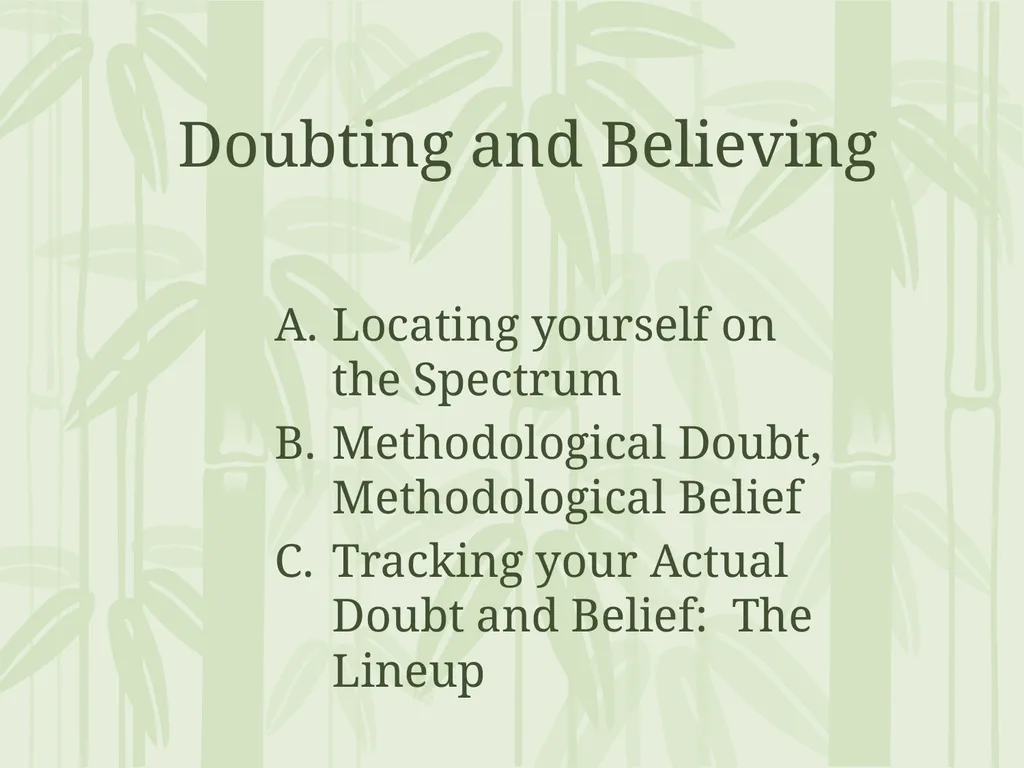
slide2. Doubting and Believing Locating yourself on the Spectrum
Methodological Doubt, Methodological Belief
Tracking your Actual Doubt and Belief: The Lineup<br>
slide3. THE WEST WING Excerpts from Episode
“Shibboleth” A. Locating yourself on the spectrum<br>
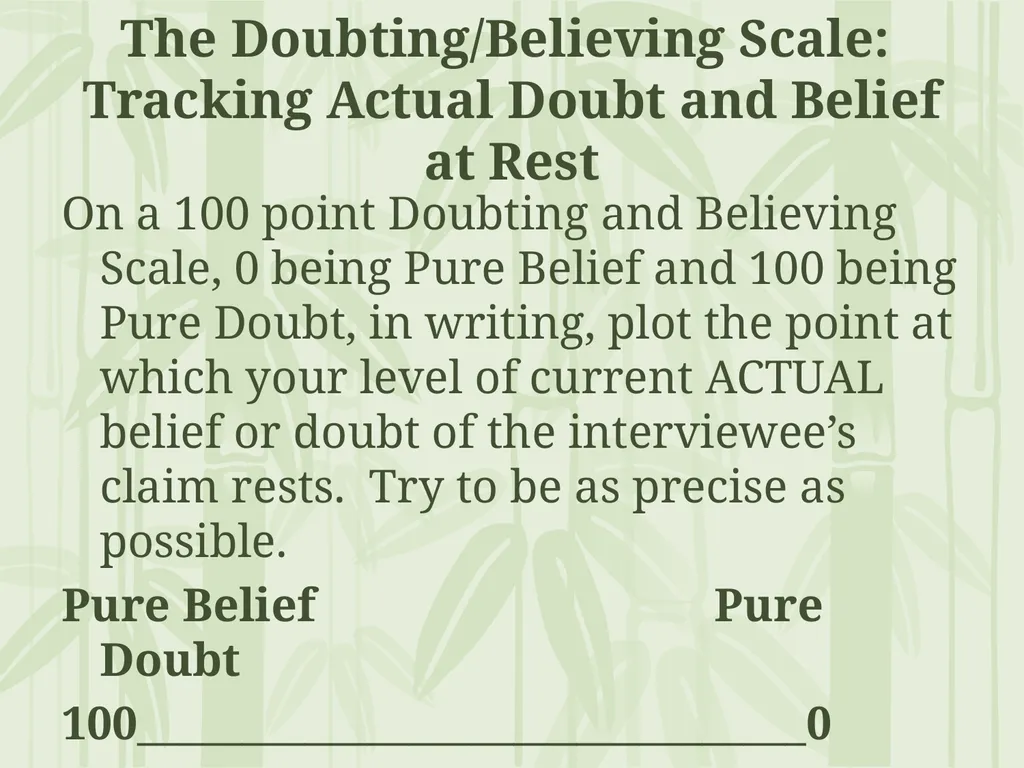
slide4. The Doubting/Believing Scale: Tracking Actual Doubt and Belief at Rest On a 100 point Doubting and Believing Scale, 0 being Pure Belief and 100 being Pure Doubt, in writing, plot the point at which your level of current ACTUAL belief or doubt of the interviewee’s claim rests. Try to be as precise as possible.
Pure Belief Pure Doubt
100________________________________0 Source: Mark Weisberg and Jean Koh Peters<br>
slide5. Questions about the Doubting and Believing Scale<br>
slide6. B. Methodological Doubt and Belief KEY: undertake pure doubt and pure belief:
consciously
systematically
explicitly
with discipline
Source: Methodological Doubting and Believing: Contraries in Inquiry, in Peter Elbow, EMBRACING CONTRARIES: EXPLORATIONS IN LEARNING AND TEACHING 258 (1986)<br>
slide7. In re JYC (BIA, 2007) JYC, a Chinese Christian, was arrested and detained for 48 hours after visiting a church for the first time. He was beaten and mistreated in jail, and asked about the leader of the home church.<br>
slide8. 5 Concerns Applicant said: he was arrested Jan 1, 2005 and held for 2 days. His sister said: she saw him on Jan 1, and had been told by their father that he had been held for 20 hours and released several days before.
Applicant then said sister was mistaken, and that he had not gone directly home the day of his release, as he had testified before, but rather went to his “godsister’s” home and then his own. IJ noted that the Applicant’s “rapid manner” of testimony suggested that this explanation was fabricated.<br>
slide9. 5 Concerns Cont’d . . . 3. Applicant said he had a home church meeting at their house on April 10, 2005, which sister attended. Sister said she was home for less than 15 mins and “did not corroborate that any type of religious activity took place.”
4. At airport, Applicant said his passport, given by smugglers and destroyed during flight, was green and bore someone else’s name. At hearing, Applicant testified that it was black or grey and bore his name.
5. At airport, Applicant could not identify the Bible as the book of Christian teachings. At hearing he testified that he had been given a Bible by his friend and told to read it, and also that he had not attended church in the US.<br>
slide10. Individual Exercise: Methodological Doubt Consider the applicant’s account and
doubt everything,
no matter how compelling it might seem
to find flaws or contradictions we might otherwise miss.<br>
slide11. Group Exercise: Methodological Belief Consider the applicant’s story and
believe everything,
no matter how unlikely or repellent it might seem
to find virtues or strengths we might otherwise miss.<br>
slide12. Introduction to Poetry Billy Collins I ask them to take a poem and hold it up to the light like a color slide
or press an ear against its hive.
I say drop a mouse into a poem and watch him probe his way out,
or walk inside the poem's room and feel the walls for a light switch.
I want them to waterski across the surface of a poem waving at the author's name on the shore.
But all they want to do is tie the poem to a chair with rope and torture a confession out of it.
They begin beating it with a hose to find out what it really means.
The Apple that Astonished Paris, 1996, University of Arkansas Press, Fayetteville, Ar<br>
slide13. 3 Observations about Methodological Doubt and Belief Disciplines you to be wary of acting BEFORE you have subjected your action plan to both methodological doubt and belief.
Creates a practice for deeply exploring closely, passionately held views.
Balances out the widely held misconception that rigorous thinking requires doubt alone.<br>
slide14. Questions about Methodological Doubt and Belief<br>
slide15. The BIA Decision The BIA upheld the IJ’s finding that JYC’s testimony contained inconsistencies, problems with demeanor, and implausibilities, as well as lack of corroborating evidence. Under the totality of the circumstances, the entire account was properly found incredible.<br>
slide16. Contrast West Wing Clip and Other Cases JYC (BIA 2007) employed multiple Real ID factors, compounding each other.
Courts have been more reluctant to uphold adverse credibility findings based on single factors, especially implausibilities generated by IJ tests of knowledge: e.g., quizzes on Christian doctrine (Huang, 7th); “Bible quiz and academic trivia context (Cosa, 9th); doctrinal testing (Rizal, 2d)<br>
slide17. C. Doubting/Believing Spectrum: Tracking Actual Doubt and Belief in Flux Source: Sue Bryant and Jean Koh Peters<br>
slide18. Based upon Niang v. Mukasey, 2d Cir 2007: Undisputed Facts Niang entered the U.S. on a fraudulent Senegalese passport.
He claimed Mauritanian citizenship on his I-589 application.
In 1989 and 1990, ethnic tensions in southern Mauritania culminated in mass expulsions.<br>
slide19. Niang v. Mukasey: Petitioner’s Claims He left Mauritania in 1989, when he was 12 years old.
“White militaries” came to his family’s home and told them to leave.
His father was beaten and tied up for resisting, and his brother was shot and killed.
He, his parents, and sister were then taken across the river to Senegal and told they would be killed or imprisoned if they ever returned.<br>
slide20. Petitioner’s Claims Cont’d . . . Once in Senegal, the family went to a refugee camp where his mother and father eventually died.
He moved to Dakar, where he worked for the family of a friend named Momadou Ba.
He used Ba’s F-1 visa and passport to enter the U.S.
He mailed the F-1 visa and passport back to Ba.<br>
slide21. Niang v. Mukasey: Identity Documents A copy of a Mauritanian identity document
Issue #1: The document lists “commercant” under “profession,” even though Niang was only 11 years old when it was issued.
Niang explained that his father procured the document when they lived in Mauritania, and his father was a merchant.
Issue #2: Niang could not produce the original.
Niang explained that the document was tattered, so he brought it to the head of the refugee camp, who made copies. That was the last he saw of the original.<br>
slide22. Niang v. Mukasey: Identity Documents A copy of a Mauritanian identity document
Issue #3: 2 different type writers had apparently been used for different parts of the document.
Niang explained that he did not know how the document was made.
Issue #4: The government attorney claimed the photo in this document looked like someone significantly older than Niang was at the time
Niang said this is what he looked like at age 16.<br>
slide23. Niang v. Mukasey: Identity Documents Senegalese refugee identity card
Issue #1: Niang claimed to be 12 when the photo was taken, but the government attorney thought he looked older.
Niang explained: “maybe it’s the picture is like that.”
Issue #2: Niang claimed he left the refugee card behind at the camp when he left the Senegal. Ba later retrieved the card for him.
Niang explained that Ba was able to retrieve the card because he had a copy of Niang’s Mauritanian ID card.<br>
slide24. Niang v. Mukasey: The IJ Decision The IJ denied Niang’s claim based on an adverse credibility determination based solely upon the IJ’s belief that the identity documents were not genuine. The IJ denied the claim even though he felt Niang’s testimony was “totally consistent with somebody who had lived through what he said he did.”
The IJ found all 5 of Niang’s explanations concerning the documents incredible.
The BIA agreed and upheld the decision.<br>
slide25. Niang v. Mukasey: The Second Circuit Decision The Second Circuit vacated and remanded.
“An adverse credibility finding must be based on specific, cogent reasons that bear a legitimate nexus to the findings.”
“. . . [A]n IJ may appropriately base an adverse credibility finding on the fraudulent submission of a document . . . . but neither in Borovikova or Siewe did we hold that concerns about document authenticity, as contrasted with a valid finding of fraud, could provide a sufficient basis for discrediting otherwise credible testimony.”<br>
slide2. Doubting and Believing Locating yourself on the Spectrum
Methodological Doubt, Methodological Belief
Tracking your Actual Doubt and Belief: The Lineup<br>
slide3. THE WEST WING Excerpts from Episode
“Shibboleth” A. Locating yourself on the spectrum<br>
slide4. The Doubting/Believing Scale: Tracking Actual Doubt and Belief at Rest On a 100 point Doubting and Believing Scale, 0 being Pure Belief and 100 being Pure Doubt, in writing, plot the point at which your level of current ACTUAL belief or doubt of the interviewee’s claim rests. Try to be as precise as possible.
Pure Belief Pure Doubt
100________________________________0 Source: Mark Weisberg and Jean Koh Peters<br>
slide5. Questions about the Doubting and Believing Scale<br>
slide6. B. Methodological Doubt and Belief KEY: undertake pure doubt and pure belief:
consciously
systematically
explicitly
with discipline
Source: Methodological Doubting and Believing: Contraries in Inquiry, in Peter Elbow, EMBRACING CONTRARIES: EXPLORATIONS IN LEARNING AND TEACHING 258 (1986)<br>
slide7. In re JYC (BIA, 2007) JYC, a Chinese Christian, was arrested and detained for 48 hours after visiting a church for the first time. He was beaten and mistreated in jail, and asked about the leader of the home church.<br>
slide8. 5 Concerns Applicant said: he was arrested Jan 1, 2005 and held for 2 days. His sister said: she saw him on Jan 1, and had been told by their father that he had been held for 20 hours and released several days before.
Applicant then said sister was mistaken, and that he had not gone directly home the day of his release, as he had testified before, but rather went to his “godsister’s” home and then his own. IJ noted that the Applicant’s “rapid manner” of testimony suggested that this explanation was fabricated.<br>
slide9. 5 Concerns Cont’d . . . 3. Applicant said he had a home church meeting at their house on April 10, 2005, which sister attended. Sister said she was home for less than 15 mins and “did not corroborate that any type of religious activity took place.”
4. At airport, Applicant said his passport, given by smugglers and destroyed during flight, was green and bore someone else’s name. At hearing, Applicant testified that it was black or grey and bore his name.
5. At airport, Applicant could not identify the Bible as the book of Christian teachings. At hearing he testified that he had been given a Bible by his friend and told to read it, and also that he had not attended church in the US.<br>
slide10. Individual Exercise: Methodological Doubt Consider the applicant’s account and
doubt everything,
no matter how compelling it might seem
to find flaws or contradictions we might otherwise miss.<br>
slide11. Group Exercise: Methodological Belief Consider the applicant’s story and
believe everything,
no matter how unlikely or repellent it might seem
to find virtues or strengths we might otherwise miss.<br>
slide12. Introduction to Poetry Billy Collins I ask them to take a poem and hold it up to the light like a color slide
or press an ear against its hive.
I say drop a mouse into a poem and watch him probe his way out,
or walk inside the poem's room and feel the walls for a light switch.
I want them to waterski across the surface of a poem waving at the author's name on the shore.
But all they want to do is tie the poem to a chair with rope and torture a confession out of it.
They begin beating it with a hose to find out what it really means.
The Apple that Astonished Paris, 1996, University of Arkansas Press, Fayetteville, Ar<br>
slide13. 3 Observations about Methodological Doubt and Belief Disciplines you to be wary of acting BEFORE you have subjected your action plan to both methodological doubt and belief.
Creates a practice for deeply exploring closely, passionately held views.
Balances out the widely held misconception that rigorous thinking requires doubt alone.<br>
slide14. Questions about Methodological Doubt and Belief<br>
slide15. The BIA Decision The BIA upheld the IJ’s finding that JYC’s testimony contained inconsistencies, problems with demeanor, and implausibilities, as well as lack of corroborating evidence. Under the totality of the circumstances, the entire account was properly found incredible.<br>
slide16. Contrast West Wing Clip and Other Cases JYC (BIA 2007) employed multiple Real ID factors, compounding each other.
Courts have been more reluctant to uphold adverse credibility findings based on single factors, especially implausibilities generated by IJ tests of knowledge: e.g., quizzes on Christian doctrine (Huang, 7th); “Bible quiz and academic trivia context (Cosa, 9th); doctrinal testing (Rizal, 2d)<br>
slide17. C. Doubting/Believing Spectrum: Tracking Actual Doubt and Belief in Flux Source: Sue Bryant and Jean Koh Peters<br>
slide18. Based upon Niang v. Mukasey, 2d Cir 2007: Undisputed Facts Niang entered the U.S. on a fraudulent Senegalese passport.
He claimed Mauritanian citizenship on his I-589 application.
In 1989 and 1990, ethnic tensions in southern Mauritania culminated in mass expulsions.<br>
slide19. Niang v. Mukasey: Petitioner’s Claims He left Mauritania in 1989, when he was 12 years old.
“White militaries” came to his family’s home and told them to leave.
His father was beaten and tied up for resisting, and his brother was shot and killed.
He, his parents, and sister were then taken across the river to Senegal and told they would be killed or imprisoned if they ever returned.<br>
slide20. Petitioner’s Claims Cont’d . . . Once in Senegal, the family went to a refugee camp where his mother and father eventually died.
He moved to Dakar, where he worked for the family of a friend named Momadou Ba.
He used Ba’s F-1 visa and passport to enter the U.S.
He mailed the F-1 visa and passport back to Ba.<br>
slide21. Niang v. Mukasey: Identity Documents A copy of a Mauritanian identity document
Issue #1: The document lists “commercant” under “profession,” even though Niang was only 11 years old when it was issued.
Niang explained that his father procured the document when they lived in Mauritania, and his father was a merchant.
Issue #2: Niang could not produce the original.
Niang explained that the document was tattered, so he brought it to the head of the refugee camp, who made copies. That was the last he saw of the original.<br>
slide22. Niang v. Mukasey: Identity Documents A copy of a Mauritanian identity document
Issue #3: 2 different type writers had apparently been used for different parts of the document.
Niang explained that he did not know how the document was made.
Issue #4: The government attorney claimed the photo in this document looked like someone significantly older than Niang was at the time
Niang said this is what he looked like at age 16.<br>
slide23. Niang v. Mukasey: Identity Documents Senegalese refugee identity card
Issue #1: Niang claimed to be 12 when the photo was taken, but the government attorney thought he looked older.
Niang explained: “maybe it’s the picture is like that.”
Issue #2: Niang claimed he left the refugee card behind at the camp when he left the Senegal. Ba later retrieved the card for him.
Niang explained that Ba was able to retrieve the card because he had a copy of Niang’s Mauritanian ID card.<br>
slide24. Niang v. Mukasey: The IJ Decision The IJ denied Niang’s claim based on an adverse credibility determination based solely upon the IJ’s belief that the identity documents were not genuine. The IJ denied the claim even though he felt Niang’s testimony was “totally consistent with somebody who had lived through what he said he did.”
The IJ found all 5 of Niang’s explanations concerning the documents incredible.
The BIA agreed and upheld the decision.<br>
slide25. Niang v. Mukasey: The Second Circuit Decision The Second Circuit vacated and remanded.
“An adverse credibility finding must be based on specific, cogent reasons that bear a legitimate nexus to the findings.”
“. . . [A]n IJ may appropriately base an adverse credibility finding on the fraudulent submission of a document . . . . but neither in Borovikova or Siewe did we hold that concerns about document authenticity, as contrasted with a valid finding of fraud, could provide a sufficient basis for discrediting otherwise credible testimony.”<br>