
Downstream Recovery The five stages are:
AM
Published · 33 slides · 0 views

1 / 1



Description
Downstream Recovery The five stages are: Solid-Liquid Separation Release of Intracellular Products Concentration Purification by Chromatography Formulation. 1. Solid-Liquid Separation: The first step in product recovery is the separation of
Related Topics
Share
Embed code
Download this presentation From Below
"Downstream Recovery The five stages are:" is the property of its rightful owner. Permission is granted to download and print the materials on this website for personal, non-commercial use only, and to display it on your personal computer provided you do not modify the materials and that you retain all copyright notices contained in the materials. By downloading content from our website, you accept the terms of this agreement.
Presentation Transcript
01
Downstream Recovery
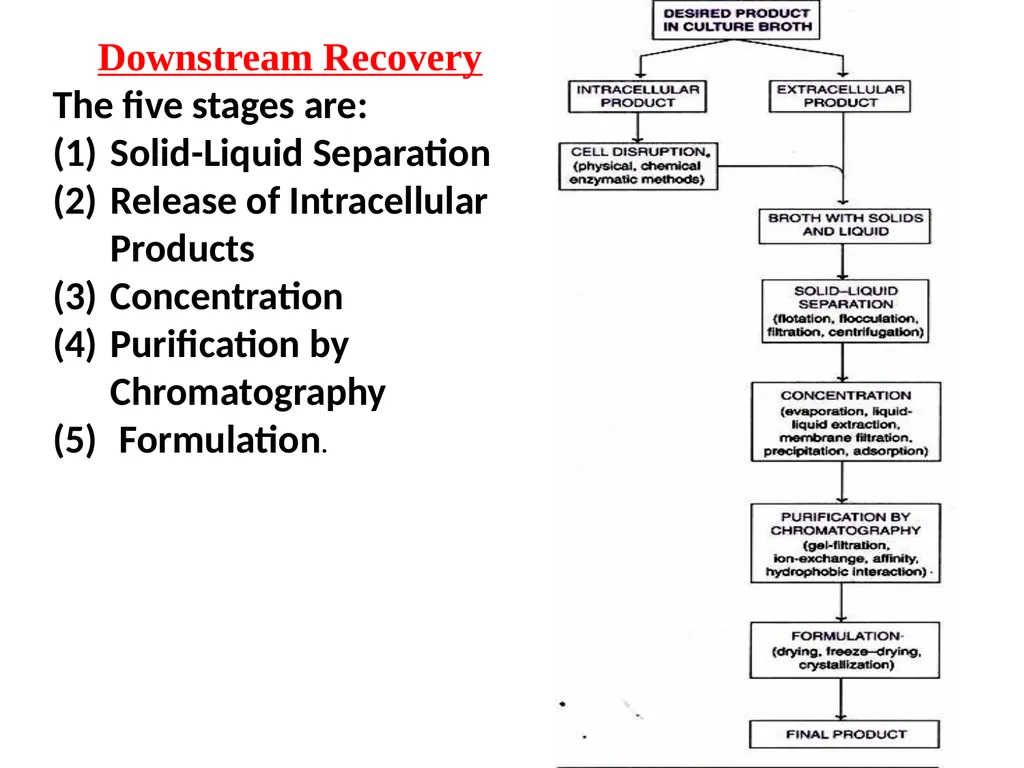
The five stages are:
Solid-Liquid Separation
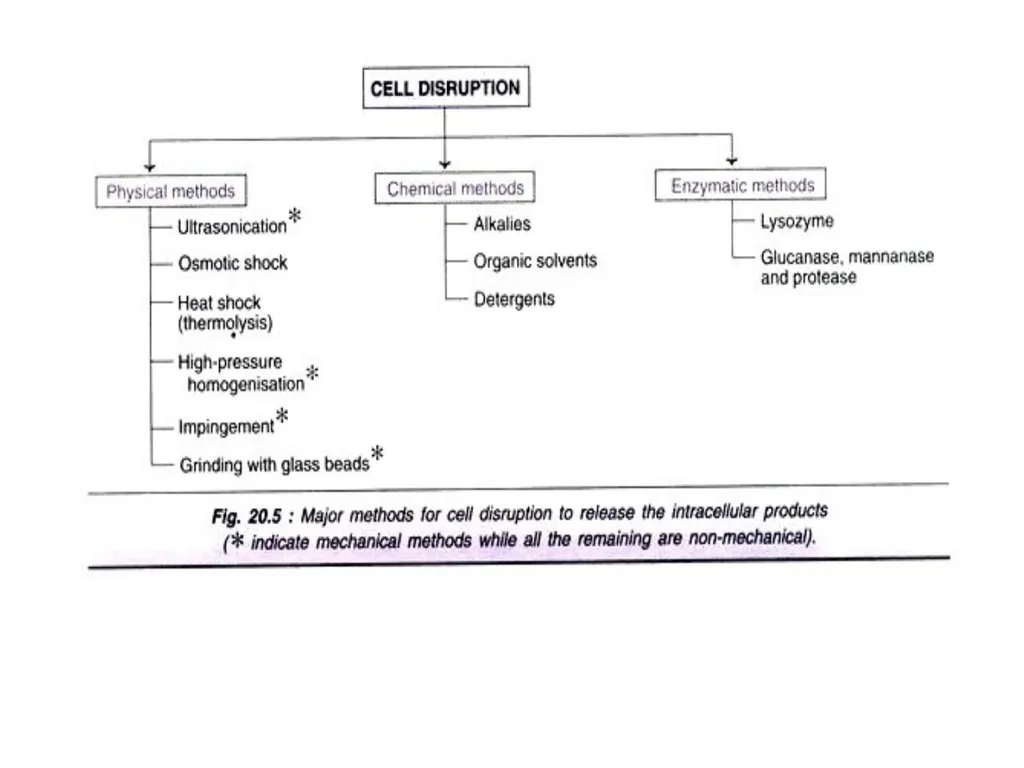
Release of Intracellular Products
Concentration
Purification by Chromatography
Formulation.<br>
The five stages are:
Solid-Liquid Separation
Release of Intracellular Products
Concentration
Purification by Chromatography
Formulation.<br>
02
1. Solid-Liquid Separation:
The first step in product recovery is the separation of whole cells (cell biomass) and other insoluble ingredients from the culture broth.
Several methods are in use for solid-liquid separation.
These include flotation, flocculation, filtration and centrifugation.
Flotation:
The cells and other solid particles get adsorbed on gas bubbles.
These bubbles rise to the foam layer which can be collected and removed.
The presence of certain substances, referred to as collector substances, facilitates stable foam formation e.g., long chain fatty acids, amines.
b) Flocculation:
The cells (or cell debris) form large aggregates to settle down for easy removal.
The process of flocculation depends on the nature of cells and the ionic constituents of the medium.
Addition of flocculating agents (inorganic salt, organic polyelectrolyte, mineral hydrocolloid) is often necessary to achieve appropriate flocculation.<br>
The first step in product recovery is the separation of whole cells (cell biomass) and other insoluble ingredients from the culture broth.
Several methods are in use for solid-liquid separation.
These include flotation, flocculation, filtration and centrifugation.
Flotation:
The cells and other solid particles get adsorbed on gas bubbles.
These bubbles rise to the foam layer which can be collected and removed.
The presence of certain substances, referred to as collector substances, facilitates stable foam formation e.g., long chain fatty acids, amines.
b) Flocculation:
The cells (or cell debris) form large aggregates to settle down for easy removal.
The process of flocculation depends on the nature of cells and the ionic constituents of the medium.
Addition of flocculating agents (inorganic salt, organic polyelectrolyte, mineral hydrocolloid) is often necessary to achieve appropriate flocculation.<br>
03
c) Filtration:
Filtration is the most commonly used technique for separating the biomass and culture filtrate.
The efficiency of filtration depends on many factors— the size of the organism, presence of other organisms, viscosity of the medium, and temperature.
Several filters such as depth filters, absolute filters, rotary drum vacuum filters and membrane filters are in use.
(A)Continous Filtration
(i) Depth Filters
They are composed of a filamentous matrix such as glass wool, asbestos or filter paper.
The particles are trapped within the matrix and the fluid passes out. Filamentous fungi can be removed by using depth filters.
(ii) Absolute Filters:
These filters are with specific pore sizes that are smaller than the particles to be removed.
Bacteria from culture medium can be removed by absolute filters.<br>
Filtration is the most commonly used technique for separating the biomass and culture filtrate.
The efficiency of filtration depends on many factors— the size of the organism, presence of other organisms, viscosity of the medium, and temperature.
Several filters such as depth filters, absolute filters, rotary drum vacuum filters and membrane filters are in use.
(A)Continous Filtration
(i) Depth Filters
They are composed of a filamentous matrix such as glass wool, asbestos or filter paper.
The particles are trapped within the matrix and the fluid passes out. Filamentous fungi can be removed by using depth filters.
(ii) Absolute Filters:
These filters are with specific pore sizes that are smaller than the particles to be removed.
Bacteria from culture medium can be removed by absolute filters.<br>
04
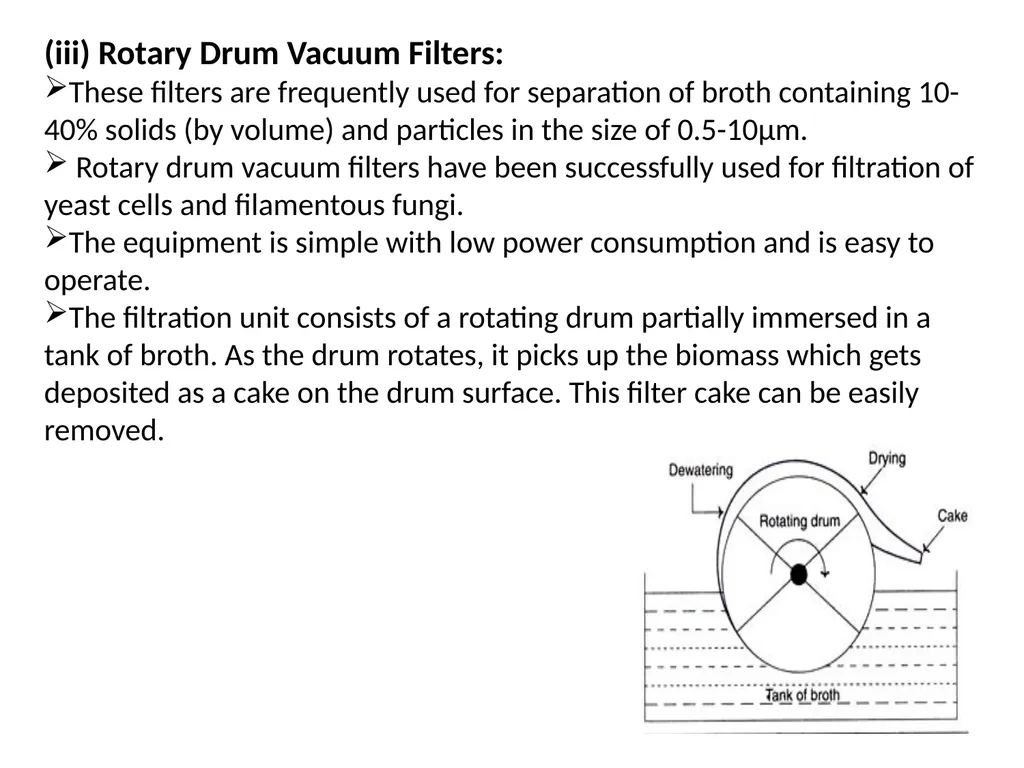
(iii) Rotary Drum Vacuum Filters:
These filters are frequently used for separation of broth containing 10-40% solids (by volume) and particles in the size of 0.5-10µm.
Rotary drum vacuum filters have been successfully used for filtration of yeast cells and filamentous fungi.
The equipment is simple with low power consumption and is easy to operate.
The filtration unit consists of a rotating drum partially immersed in a tank of broth. As the drum rotates, it picks up the biomass which gets deposited as a cake on the drum surface. This filter cake can be easily removed.<br>
These filters are frequently used for separation of broth containing 10-40% solids (by volume) and particles in the size of 0.5-10µm.
Rotary drum vacuum filters have been successfully used for filtration of yeast cells and filamentous fungi.
The equipment is simple with low power consumption and is easy to operate.
The filtration unit consists of a rotating drum partially immersed in a tank of broth. As the drum rotates, it picks up the biomass which gets deposited as a cake on the drum surface. This filter cake can be easily removed.<br>
05
(iv) Membrane Filters:
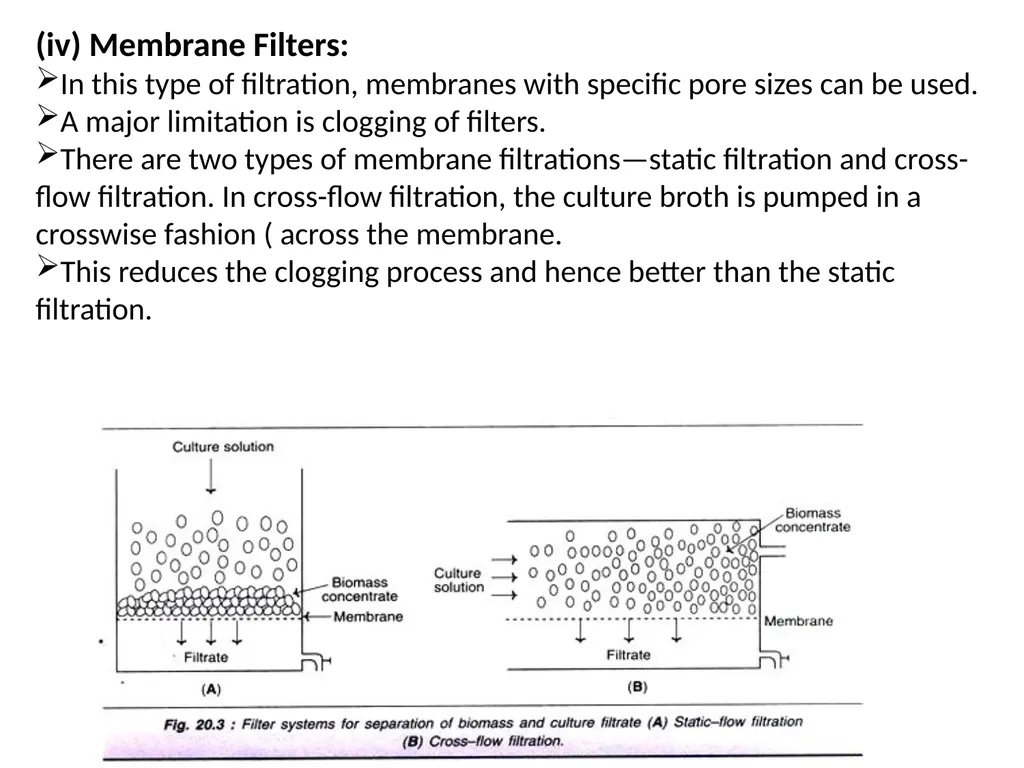
In this type of filtration, membranes with specific pore sizes can be used.
A major limitation is clogging of filters.
There are two types of membrane filtrations—static filtration and cross-flow filtration. In cross-flow filtration, the culture broth is pumped in a crosswise fashion ( across the membrane.
This reduces the clogging process and hence better than the static filtration.<br>
In this type of filtration, membranes with specific pore sizes can be used.
A major limitation is clogging of filters.
There are two types of membrane filtrations—static filtration and cross-flow filtration. In cross-flow filtration, the culture broth is pumped in a crosswise fashion ( across the membrane.
This reduces the clogging process and hence better than the static filtration.<br>
06
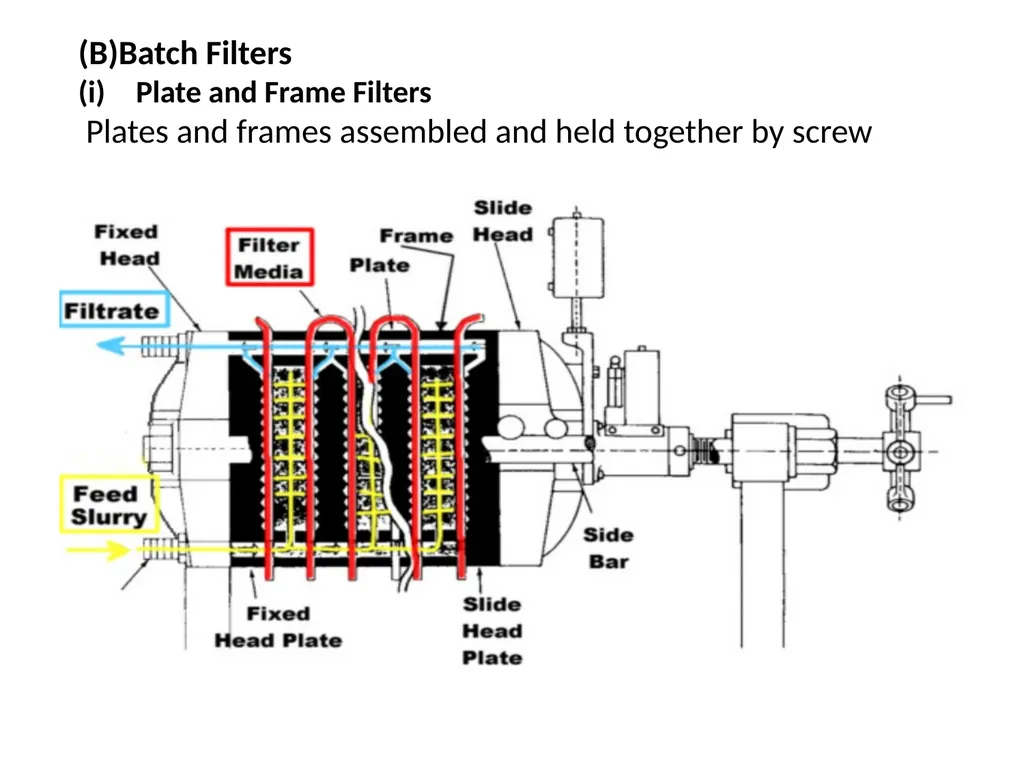
(B)Batch Filters
Plate and Frame Filters
Plates and frames assembled and held together by screw<br>
Plate and Frame Filters
Plates and frames assembled and held together by screw<br>
07
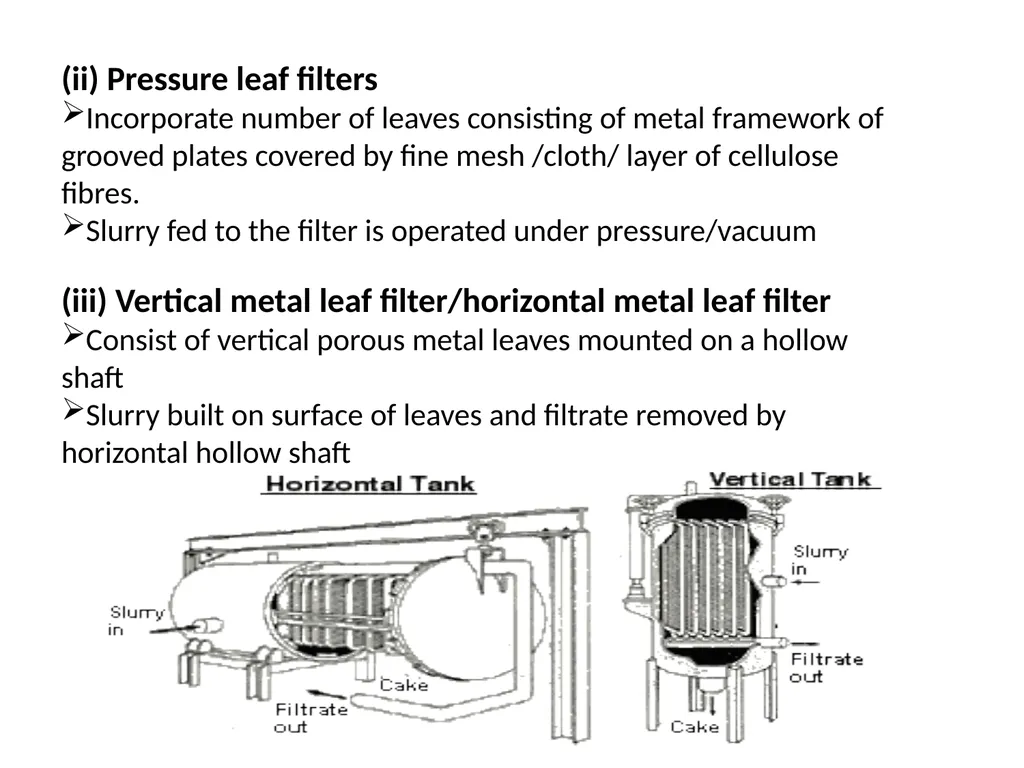
(ii) Pressure leaf filters
Incorporate number of leaves consisting of metal framework of grooved plates covered by fine mesh /cloth/ layer of cellulose fibres.
Slurry fed to the filter is operated under pressure/vacuum
(iii) Vertical metal leaf filter/horizontal metal leaf filter
Consist of vertical porous metal leaves mounted on a hollow shaft
Slurry built on surface of leaves and filtrate removed by horizontal hollow shaft<br>
Incorporate number of leaves consisting of metal framework of grooved plates covered by fine mesh /cloth/ layer of cellulose fibres.
Slurry fed to the filter is operated under pressure/vacuum
(iii) Vertical metal leaf filter/horizontal metal leaf filter
Consist of vertical porous metal leaves mounted on a hollow shaft
Slurry built on surface of leaves and filtrate removed by horizontal hollow shaft<br>
08
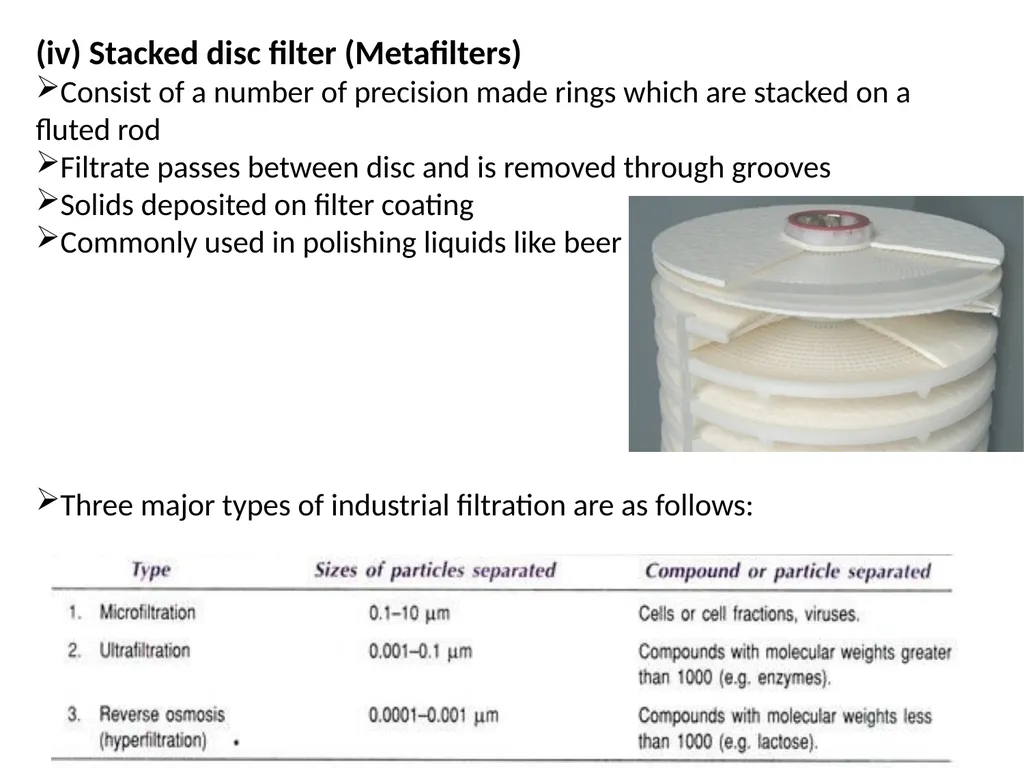
(iv) Stacked disc filter (Metafilters)
Consist of a number of precision made rings which are stacked on a fluted rod
Filtrate passes between disc and is removed through grooves
Solids deposited on filter coating
Commonly used in polishing liquids like beer
Three major types of industrial filtration are as follows:<br>
Consist of a number of precision made rings which are stacked on a fluted rod
Filtrate passes between disc and is removed through grooves
Solids deposited on filter coating
Commonly used in polishing liquids like beer
Three major types of industrial filtration are as follows:<br>
09
(d) Centrifugation:
The technique of centrifugation is based on the principle of density differences between the particles to be separated and the medium.
Centrifugation is mostly used for separating solid particles from liquid phase (fluid/particle separation).
Continuous flow industrial centrifuges are used in industrial scale.
There is a continuous feeding of the slurry and collection of clarified fluid, while the solids deposited can be removed intermittently.<br>
The technique of centrifugation is based on the principle of density differences between the particles to be separated and the medium.
Centrifugation is mostly used for separating solid particles from liquid phase (fluid/particle separation).
Continuous flow industrial centrifuges are used in industrial scale.
There is a continuous feeding of the slurry and collection of clarified fluid, while the solids deposited can be removed intermittently.<br>
10
(a) Tubular bowl centrifuge
This is a simple and a small centrifuge, commonly used in pilot plants.
Tubular bowl centrifuge can be operated at a high centrifugal speed, and can be run in both batch or continuous mode. The solids are removed manually.
(b) Disc centrifuge
It consists of several discs that separate the bowl into settling zones. The feed/slurry is fed through a central tube. The clarified fluid moves upwards while the solids settle at the lower surface<br>
This is a simple and a small centrifuge, commonly used in pilot plants.
Tubular bowl centrifuge can be operated at a high centrifugal speed, and can be run in both batch or continuous mode. The solids are removed manually.
(b) Disc centrifuge
It consists of several discs that separate the bowl into settling zones. The feed/slurry is fed through a central tube. The clarified fluid moves upwards while the solids settle at the lower surface<br>
11
(c) Multi-chamber centrifuge
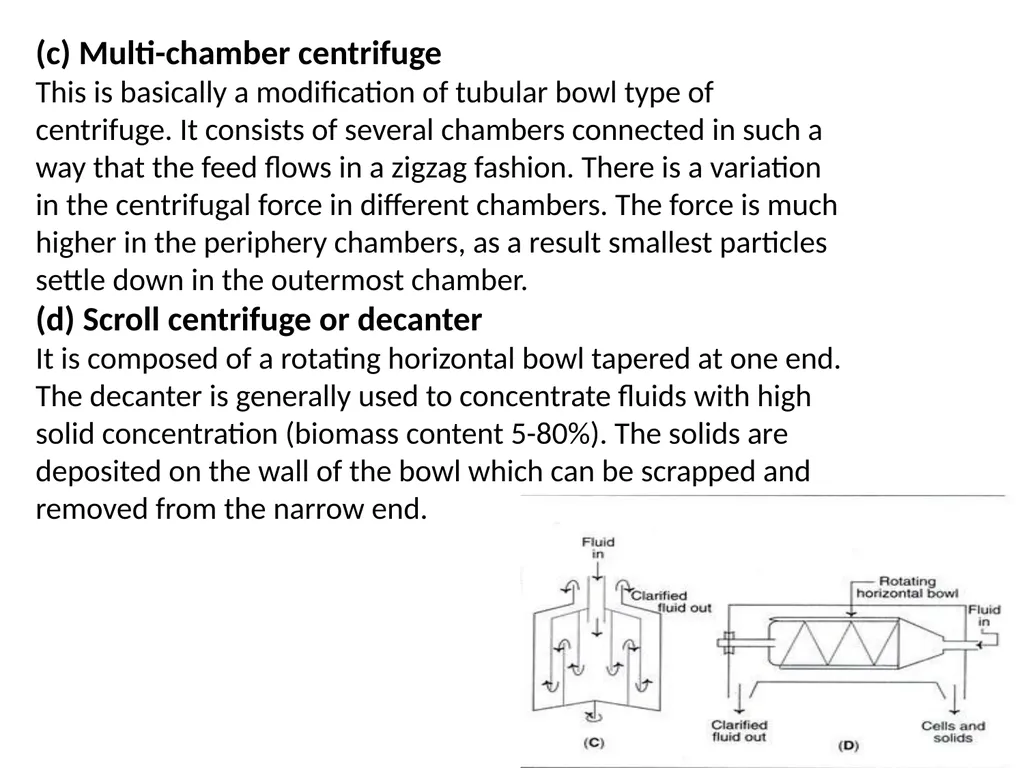
This is basically a modification of tubular bowl type of centrifuge. It consists of several chambers connected in such a way that the feed flows in a zigzag fashion. There is a variation in the centrifugal force in different chambers. The force is much higher in the periphery chambers, as a result smallest particles settle down in the outermost chamber.
(d) Scroll centrifuge or decanter
It is composed of a rotating horizontal bowl tapered at one end. The decanter is generally used to concentrate fluids with high solid concentration (biomass content 5-80%). The solids are deposited on the wall of the bowl which can be scrapped and removed from the narrow end.<br>
This is basically a modification of tubular bowl type of centrifuge. It consists of several chambers connected in such a way that the feed flows in a zigzag fashion. There is a variation in the centrifugal force in different chambers. The force is much higher in the periphery chambers, as a result smallest particles settle down in the outermost chamber.
(d) Scroll centrifuge or decanter
It is composed of a rotating horizontal bowl tapered at one end. The decanter is generally used to concentrate fluids with high solid concentration (biomass content 5-80%). The solids are deposited on the wall of the bowl which can be scrapped and removed from the narrow end.<br>
12
Impingement:
A stream of suspended cells at high velocity and pressure are forced to hit either a stationary surface or a second stream of suspended cells.
The cells are disrupted by the forces created at the point of contact. Micro fluidizer is a device developed based on the principle of impingement. It has been successfully used for breaking E. coli cells.
It an be effectively used for disrupting cells even at a low concentration.
Grinding with glass beads:
The cells mixed with glass beads are subjected to a very high speed in a reaction vessel.
The cells break as they are forced against the wall of the vessel by the beads.
Several factors influence the cell breakage-size and quantity of the glass beads, concentration and age of cells, temperature and agitator speed.<br>
A stream of suspended cells at high velocity and pressure are forced to hit either a stationary surface or a second stream of suspended cells.
The cells are disrupted by the forces created at the point of contact. Micro fluidizer is a device developed based on the principle of impingement. It has been successfully used for breaking E. coli cells.
It an be effectively used for disrupting cells even at a low concentration.
Grinding with glass beads:
The cells mixed with glass beads are subjected to a very high speed in a reaction vessel.
The cells break as they are forced against the wall of the vessel by the beads.
Several factors influence the cell breakage-size and quantity of the glass beads, concentration and age of cells, temperature and agitator speed.<br>
13
Alkalies:
Alkali treatment has been used for the extraction of some bacterial proteins. However, the alkali stability of the desired product is very crucial for the success of this method e.g., recombinant growth hormone can be efficiently released from E. coli by treatment with sodium hydroxide at pH 11.
Organic solvents:
Several water miscible organic solvents can be used to disrupt the cells e.g., methanol, ethanol, isopropanol, butanol. The organic solvent toluene is frequently used. It is believed that toluene dissolves membrane phospholipids and creates membrane pores for release of intracellular contents.
Detergents:
Detergents that are ionic in nature, cationic-cetyl trimethyl ammonium bromide or anionic-sodium lauryl sulfate can denature membrane proteins and lyse the cells.
Non-ionic detergents are also used to some extent e.g., Triton X-100 or Tween.
Detergents affect purification steps, particularly the salt precipitation and can be overcome by using ultrafiltration or ion-exchange chromatography.<br>
Alkali treatment has been used for the extraction of some bacterial proteins. However, the alkali stability of the desired product is very crucial for the success of this method e.g., recombinant growth hormone can be efficiently released from E. coli by treatment with sodium hydroxide at pH 11.
Organic solvents:
Several water miscible organic solvents can be used to disrupt the cells e.g., methanol, ethanol, isopropanol, butanol. The organic solvent toluene is frequently used. It is believed that toluene dissolves membrane phospholipids and creates membrane pores for release of intracellular contents.
Detergents:
Detergents that are ionic in nature, cationic-cetyl trimethyl ammonium bromide or anionic-sodium lauryl sulfate can denature membrane proteins and lyse the cells.
Non-ionic detergents are also used to some extent e.g., Triton X-100 or Tween.
Detergents affect purification steps, particularly the salt precipitation and can be overcome by using ultrafiltration or ion-exchange chromatography.<br>
14
Enzymatic methods of cell disruption
Lysis of cells occurs under mild conditions in a selective manner.
Lysozyme is the most frequently used enzyme and is commercially available .
It hydrolyses β-1, 4-glycosidic bonds of the mucopeptide in bacterial cell walls.
The Gram- positive bacteria (high content of cell wall mucopeptides) are more susceptible for the action of lysozyme.
For Gram-negative bacteria, lysozyme in association with EDTA can break the cells.
As the cell wall gets digested by lysozyme, the osmotic effects break the periplasmic membrane to release the intracellular contents.
For the lysis of yeast cell walls, glucanase and mannanase in combination with proteases are used.<br>
Lysis of cells occurs under mild conditions in a selective manner.
Lysozyme is the most frequently used enzyme and is commercially available .
It hydrolyses β-1, 4-glycosidic bonds of the mucopeptide in bacterial cell walls.
The Gram- positive bacteria (high content of cell wall mucopeptides) are more susceptible for the action of lysozyme.
For Gram-negative bacteria, lysozyme in association with EDTA can break the cells.
As the cell wall gets digested by lysozyme, the osmotic effects break the periplasmic membrane to release the intracellular contents.
For the lysis of yeast cell walls, glucanase and mannanase in combination with proteases are used.<br>
15
3) Concentration:
The filtrate free from suspended particles (cells, cell debris etc.) contains 80-98% of water.
The water has to be removed to achieve the product concentration.
The commonly used techniques for concentrating biological products are evaporation, liquid-liquid extraction, membrane filtration, precipitation and adsorption.
The actual procedure adopted depends on the nature of the desired product (quality and quantity to be retained as far as possible) and the cost factor.
( a) Evaporation:
Water in the broth filtrate can be removed by a simple evaporation process.
The evaporators have a heating device for supply of steam, and unit for the separation of concentrated product and vapour, a condenser for condensing vapour, accessories and control equipment.<br>
The filtrate free from suspended particles (cells, cell debris etc.) contains 80-98% of water.
The water has to be removed to achieve the product concentration.
The commonly used techniques for concentrating biological products are evaporation, liquid-liquid extraction, membrane filtration, precipitation and adsorption.
The actual procedure adopted depends on the nature of the desired product (quality and quantity to be retained as far as possible) and the cost factor.
( a) Evaporation:
Water in the broth filtrate can be removed by a simple evaporation process.
The evaporators have a heating device for supply of steam, and unit for the separation of concentrated product and vapour, a condenser for condensing vapour, accessories and control equipment.<br>
16
1. Plate evaporators:
The liquid to be concentrated flows over plates. As the heat is supplied, the liquid gets concentrated and becomes viscous.
2. Falling film evaporators:
In this case, the liquid flows down long tubes which gets distributed as a thin film over the heating surface. Falling film evaporators are suitable for removing water from viscous products of fermentation.
3. Forced film evaporators:
The liquid films are mechanically driven and these devices are suitable for producing dry product concentrates.
4. Centrifugal forced film evaporators:
In these evaporators, a centrifugal force is used to pass on the liquid over heated plates or conical surfaces for instantaneous evaporation. These equipment evaporate the liquid very quickly (in seconds), hence suitable for concentrating even heat-labile substances.<br>
The liquid to be concentrated flows over plates. As the heat is supplied, the liquid gets concentrated and becomes viscous.
2. Falling film evaporators:
In this case, the liquid flows down long tubes which gets distributed as a thin film over the heating surface. Falling film evaporators are suitable for removing water from viscous products of fermentation.
3. Forced film evaporators:
The liquid films are mechanically driven and these devices are suitable for producing dry product concentrates.
4. Centrifugal forced film evaporators:
In these evaporators, a centrifugal force is used to pass on the liquid over heated plates or conical surfaces for instantaneous evaporation. These equipment evaporate the liquid very quickly (in seconds), hence suitable for concentrating even heat-labile substances.<br>
17
2) Liquid-Liquid Extraction:
The concentration of biological products can be achieved by transferring the desired product (solute) from one liquid phase to another liquid phase, a phenomenon referred to as liquid-liquid extraction. This technique is also useful for partial purification of a product.
The efficiency of extraction is dependent on the partition coefficient i.e. the relative distribution of a substance between the two liquid phases. The process of liquid-liquid extraction may be broadly categorized as extraction of low molecular weight products and extraction of high molecular weight products.
(A) Extraction of low molecular weight products:
By using organic solvents, the lipophilic compounds can be conveniently extracted. However, it is quite difficult to extract hydrophilic compounds. Extraction of lipophilic products can be done by the following techniques.
(a) Physical extraction:
Based on the physical properties the compound gets itself distributed between two liquid phases. This technique is used for extraction of non-ionising compounds.<br>
The concentration of biological products can be achieved by transferring the desired product (solute) from one liquid phase to another liquid phase, a phenomenon referred to as liquid-liquid extraction. This technique is also useful for partial purification of a product.
The efficiency of extraction is dependent on the partition coefficient i.e. the relative distribution of a substance between the two liquid phases. The process of liquid-liquid extraction may be broadly categorized as extraction of low molecular weight products and extraction of high molecular weight products.
(A) Extraction of low molecular weight products:
By using organic solvents, the lipophilic compounds can be conveniently extracted. However, it is quite difficult to extract hydrophilic compounds. Extraction of lipophilic products can be done by the following techniques.
(a) Physical extraction:
Based on the physical properties the compound gets itself distributed between two liquid phases. This technique is used for extraction of non-ionising compounds.<br>
18
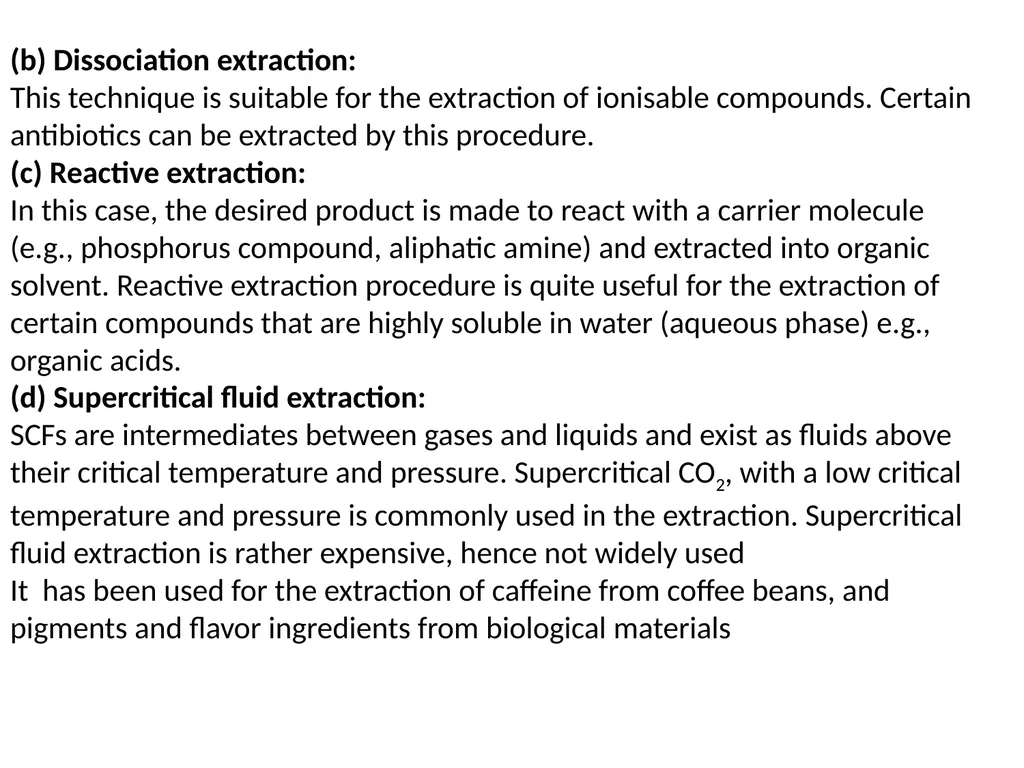
(b) Dissociation extraction:
This technique is suitable for the extraction of ionisable compounds. Certain antibiotics can be extracted by this procedure.
(c) Reactive extraction:
In this case, the desired product is made to react with a carrier molecule (e.g., phosphorus compound, aliphatic amine) and extracted into organic solvent. Reactive extraction procedure is quite useful for the extraction of certain compounds that are highly soluble in water (aqueous phase) e.g., organic acids.
(d) Supercritical fluid extraction:
SCFs are intermediates between gases and liquids and exist as fluids above their critical temperature and pressure. Supercritical CO2, with a low critical temperature and pressure is commonly used in the extraction. Supercritical fluid extraction is rather expensive, hence not widely used
It has been used for the extraction of caffeine from coffee beans, and pigments and flavor ingredients from biological materials<br>
This technique is suitable for the extraction of ionisable compounds. Certain antibiotics can be extracted by this procedure.
(c) Reactive extraction:
In this case, the desired product is made to react with a carrier molecule (e.g., phosphorus compound, aliphatic amine) and extracted into organic solvent. Reactive extraction procedure is quite useful for the extraction of certain compounds that are highly soluble in water (aqueous phase) e.g., organic acids.
(d) Supercritical fluid extraction:
SCFs are intermediates between gases and liquids and exist as fluids above their critical temperature and pressure. Supercritical CO2, with a low critical temperature and pressure is commonly used in the extraction. Supercritical fluid extraction is rather expensive, hence not widely used
It has been used for the extraction of caffeine from coffee beans, and pigments and flavor ingredients from biological materials<br>
19
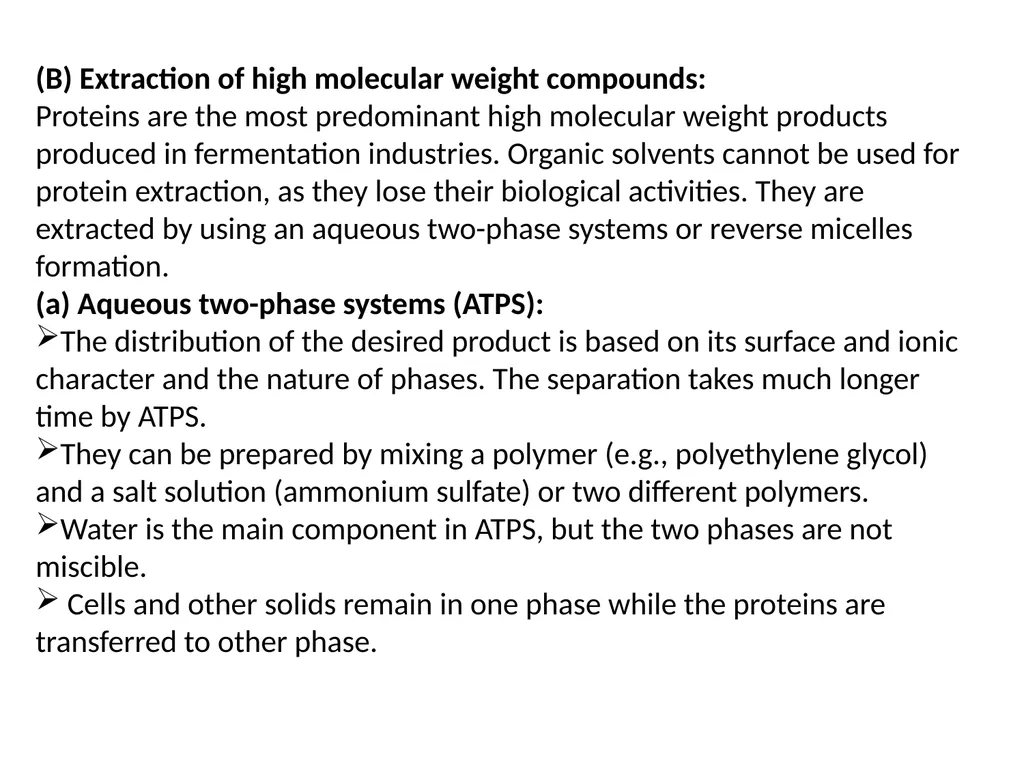
(B) Extraction of high molecular weight compounds:
Proteins are the most predominant high molecular weight products produced in fermentation industries. Organic solvents cannot be used for protein extraction, as they lose their biological activities. They are extracted by using an aqueous two-phase systems or reverse micelles formation.
(a) Aqueous two-phase systems (ATPS):
The distribution of the desired product is based on its surface and ionic character and the nature of phases. The separation takes much longer time by ATPS.
They can be prepared by mixing a polymer (e.g., polyethylene glycol) and a salt solution (ammonium sulfate) or two different polymers.
Water is the main component in ATPS, but the two phases are not miscible.
Cells and other solids remain in one phase while the proteins are transferred to other phase.<br>
Proteins are the most predominant high molecular weight products produced in fermentation industries. Organic solvents cannot be used for protein extraction, as they lose their biological activities. They are extracted by using an aqueous two-phase systems or reverse micelles formation.
(a) Aqueous two-phase systems (ATPS):
The distribution of the desired product is based on its surface and ionic character and the nature of phases. The separation takes much longer time by ATPS.
They can be prepared by mixing a polymer (e.g., polyethylene glycol) and a salt solution (ammonium sulfate) or two different polymers.
Water is the main component in ATPS, but the two phases are not miscible.
Cells and other solids remain in one phase while the proteins are transferred to other phase.<br>
20
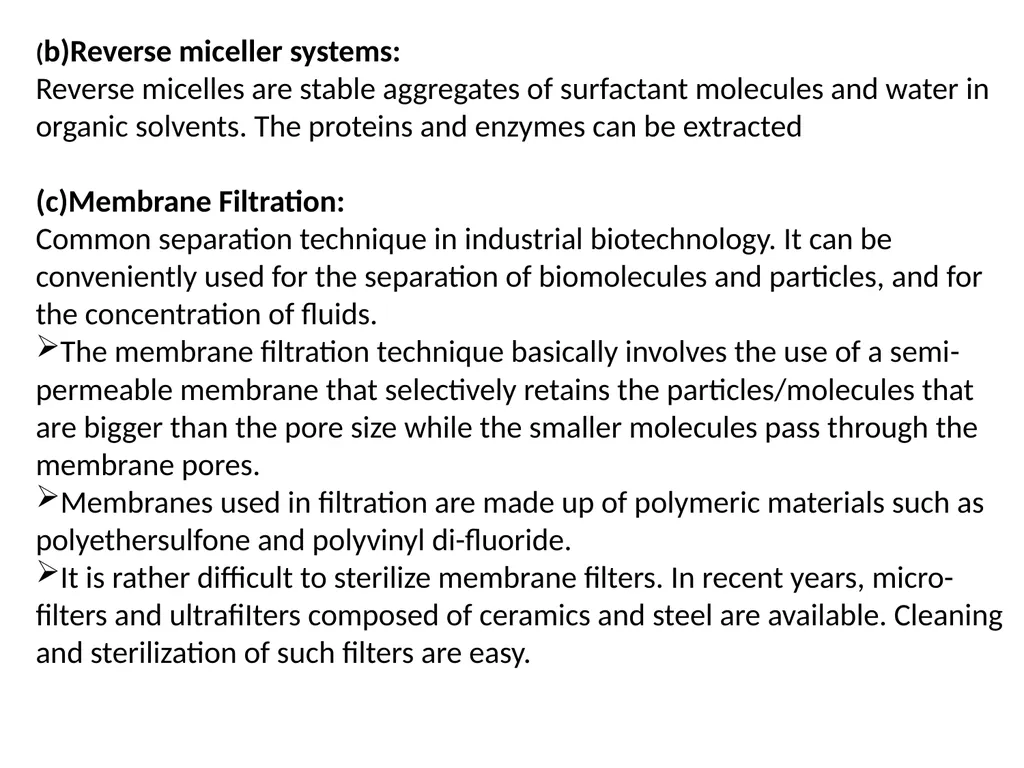
(b)Reverse miceller systems:
Reverse micelles are stable aggregates of surfactant molecules and water in organic solvents. The proteins and enzymes can be extracted
(c)Membrane Filtration:
Common separation technique in industrial biotechnology. It can be conveniently used for the separation of biomolecules and particles, and for the concentration of fluids.
The membrane filtration technique basically involves the use of a semipermeable membrane that selectively retains the particles/molecules that are bigger than the pore size while the smaller molecules pass through the membrane pores.
Membranes used in filtration are made up of polymeric materials such as polyethersulfone and polyvinyl di-fluoride.
It is rather difficult to sterilize membrane filters. In recent years, micro-filters and ultrafiIters composed of ceramics and steel are available. Cleaning and sterilization of such filters are easy.<br>
Reverse micelles are stable aggregates of surfactant molecules and water in organic solvents. The proteins and enzymes can be extracted
(c)Membrane Filtration:
Common separation technique in industrial biotechnology. It can be conveniently used for the separation of biomolecules and particles, and for the concentration of fluids.
The membrane filtration technique basically involves the use of a semipermeable membrane that selectively retains the particles/molecules that are bigger than the pore size while the smaller molecules pass through the membrane pores.
Membranes used in filtration are made up of polymeric materials such as polyethersulfone and polyvinyl di-fluoride.
It is rather difficult to sterilize membrane filters. In recent years, micro-filters and ultrafiIters composed of ceramics and steel are available. Cleaning and sterilization of such filters are easy.<br>
21
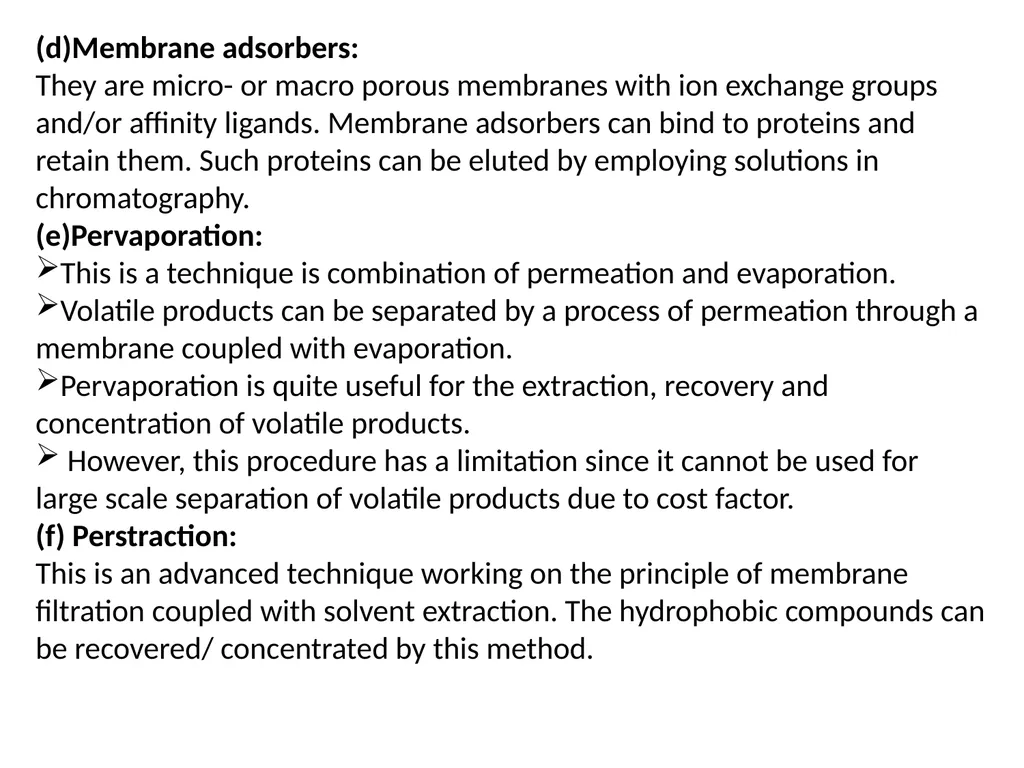
(d)Membrane adsorbers:
They are micro- or macro porous membranes with ion exchange groups and/or affinity ligands. Membrane adsorbers can bind to proteins and retain them. Such proteins can be eluted by employing solutions in chromatography.
(e)Pervaporation:
This is a technique is combination of permeation and evaporation.
Volatile products can be separated by a process of permeation through a membrane coupled with evaporation.
Pervaporation is quite useful for the extraction, recovery and concentration of volatile products.
However, this procedure has a limitation since it cannot be used for large scale separation of volatile products due to cost factor.
(f) Perstraction:
This is an advanced technique working on the principle of membrane filtration coupled with solvent extraction. The hydrophobic compounds can be recovered/ concentrated by this method.<br>
They are micro- or macro porous membranes with ion exchange groups and/or affinity ligands. Membrane adsorbers can bind to proteins and retain them. Such proteins can be eluted by employing solutions in chromatography.
(e)Pervaporation:
This is a technique is combination of permeation and evaporation.
Volatile products can be separated by a process of permeation through a membrane coupled with evaporation.
Pervaporation is quite useful for the extraction, recovery and concentration of volatile products.
However, this procedure has a limitation since it cannot be used for large scale separation of volatile products due to cost factor.
(f) Perstraction:
This is an advanced technique working on the principle of membrane filtration coupled with solvent extraction. The hydrophobic compounds can be recovered/ concentrated by this method.<br>
22
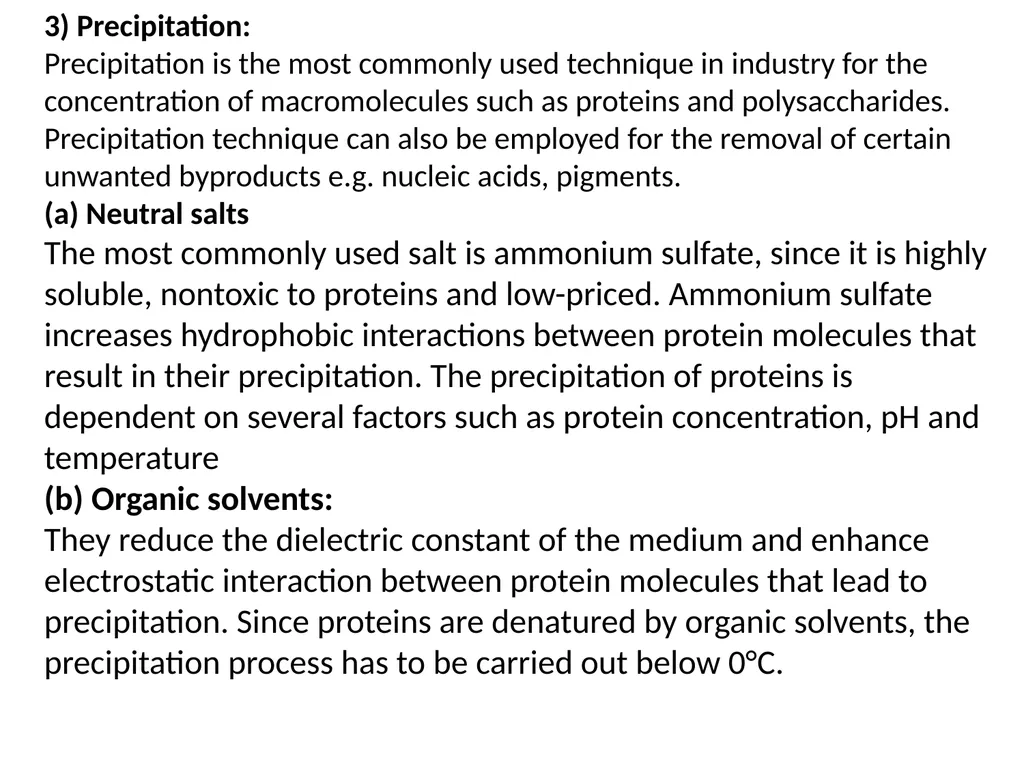
3) Precipitation:
Precipitation is the most commonly used technique in industry for the concentration of macromolecules such as proteins and polysaccharides. Precipitation technique can also be employed for the removal of certain unwanted byproducts e.g. nucleic acids, pigments.
(a) Neutral salts
The most commonly used salt is ammonium sulfate, since it is highly soluble, nontoxic to proteins and low-priced. Ammonium sulfate increases hydrophobic interactions between protein molecules that result in their precipitation. The precipitation of proteins is dependent on several factors such as protein concentration, pH and temperature
(b) Organic solvents:
They reduce the dielectric constant of the medium and enhance electrostatic interaction between protein molecules that lead to precipitation. Since proteins are denatured by organic solvents, the precipitation process has to be carried out below 0°C.<br>
Precipitation is the most commonly used technique in industry for the concentration of macromolecules such as proteins and polysaccharides. Precipitation technique can also be employed for the removal of certain unwanted byproducts e.g. nucleic acids, pigments.
(a) Neutral salts
The most commonly used salt is ammonium sulfate, since it is highly soluble, nontoxic to proteins and low-priced. Ammonium sulfate increases hydrophobic interactions between protein molecules that result in their precipitation. The precipitation of proteins is dependent on several factors such as protein concentration, pH and temperature
(b) Organic solvents:
They reduce the dielectric constant of the medium and enhance electrostatic interaction between protein molecules that lead to precipitation. Since proteins are denatured by organic solvents, the precipitation process has to be carried out below 0°C.<br>
23
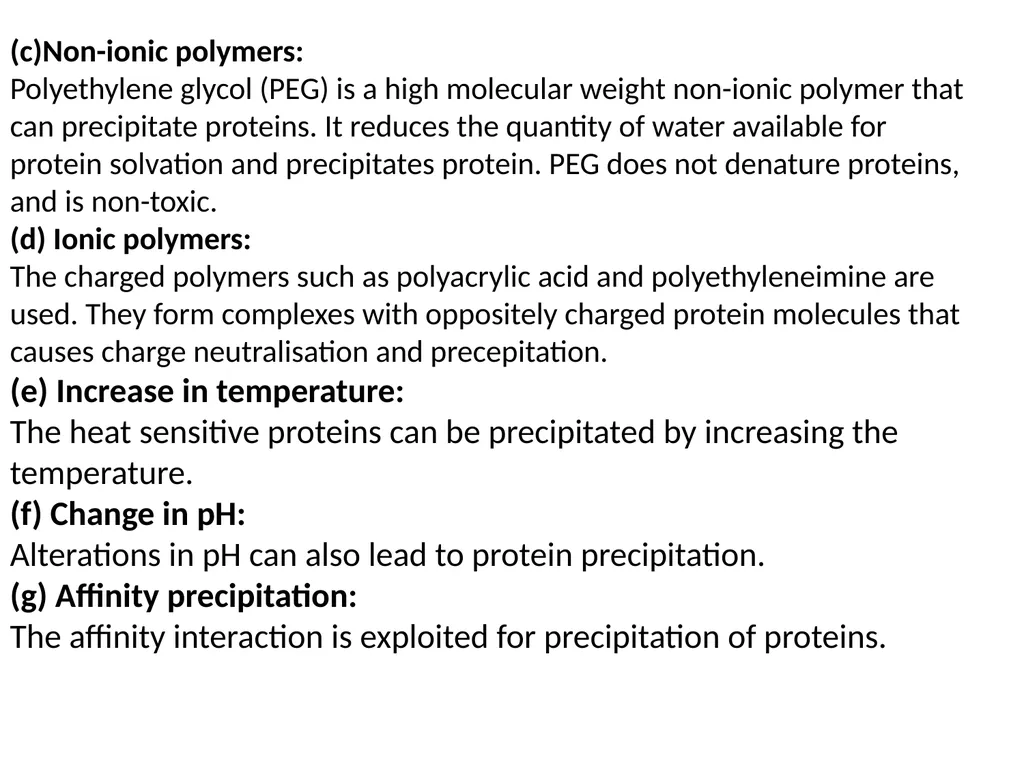
(c)Non-ionic polymers:
Polyethylene glycol (PEG) is a high molecular weight non-ionic polymer that can precipitate proteins. It reduces the quantity of water available for protein solvation and precipitates protein. PEG does not denature proteins, and is non-toxic.
(d) Ionic polymers:
The charged polymers such as polyacrylic acid and polyethyleneimine are used. They form complexes with oppositely charged protein molecules that causes charge neutralisation and precepitation.
(e) Increase in temperature:
The heat sensitive proteins can be precipitated by increasing the temperature.
(f) Change in pH:
Alterations in pH can also lead to protein precipitation.
(g) Affinity precipitation:
The affinity interaction is exploited for precipitation of proteins.<br>
Polyethylene glycol (PEG) is a high molecular weight non-ionic polymer that can precipitate proteins. It reduces the quantity of water available for protein solvation and precipitates protein. PEG does not denature proteins, and is non-toxic.
(d) Ionic polymers:
The charged polymers such as polyacrylic acid and polyethyleneimine are used. They form complexes with oppositely charged protein molecules that causes charge neutralisation and precepitation.
(e) Increase in temperature:
The heat sensitive proteins can be precipitated by increasing the temperature.
(f) Change in pH:
Alterations in pH can also lead to protein precipitation.
(g) Affinity precipitation:
The affinity interaction is exploited for precipitation of proteins.<br>
24
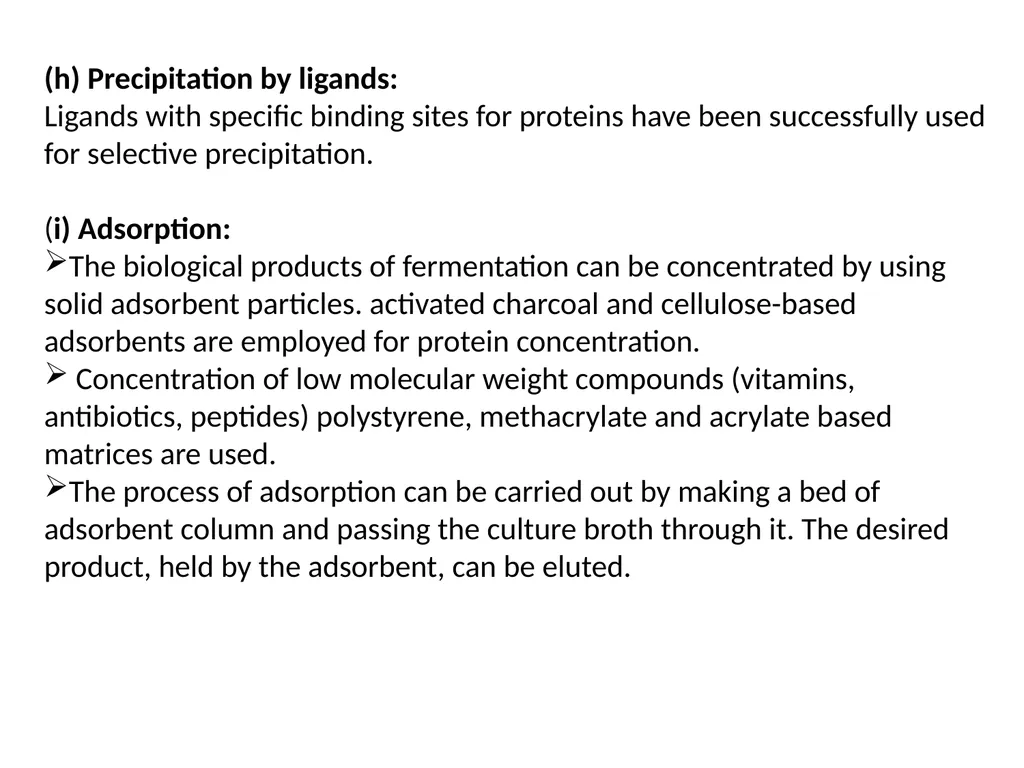
(h) Precipitation by ligands:
Ligands with specific binding sites for proteins have been successfully used for selective precipitation.
(i) Adsorption:
The biological products of fermentation can be concentrated by using solid adsorbent particles. activated charcoal and cellulose-based adsorbents are employed for protein concentration.
Concentration of low molecular weight compounds (vitamins, antibiotics, peptides) polystyrene, methacrylate and acrylate based matrices are used.
The process of adsorption can be carried out by making a bed of adsorbent column and passing the culture broth through it. The desired product, held by the adsorbent, can be eluted.<br>
Ligands with specific binding sites for proteins have been successfully used for selective precipitation.
(i) Adsorption:
The biological products of fermentation can be concentrated by using solid adsorbent particles. activated charcoal and cellulose-based adsorbents are employed for protein concentration.
Concentration of low molecular weight compounds (vitamins, antibiotics, peptides) polystyrene, methacrylate and acrylate based matrices are used.
The process of adsorption can be carried out by making a bed of adsorbent column and passing the culture broth through it. The desired product, held by the adsorbent, can be eluted.<br>
25
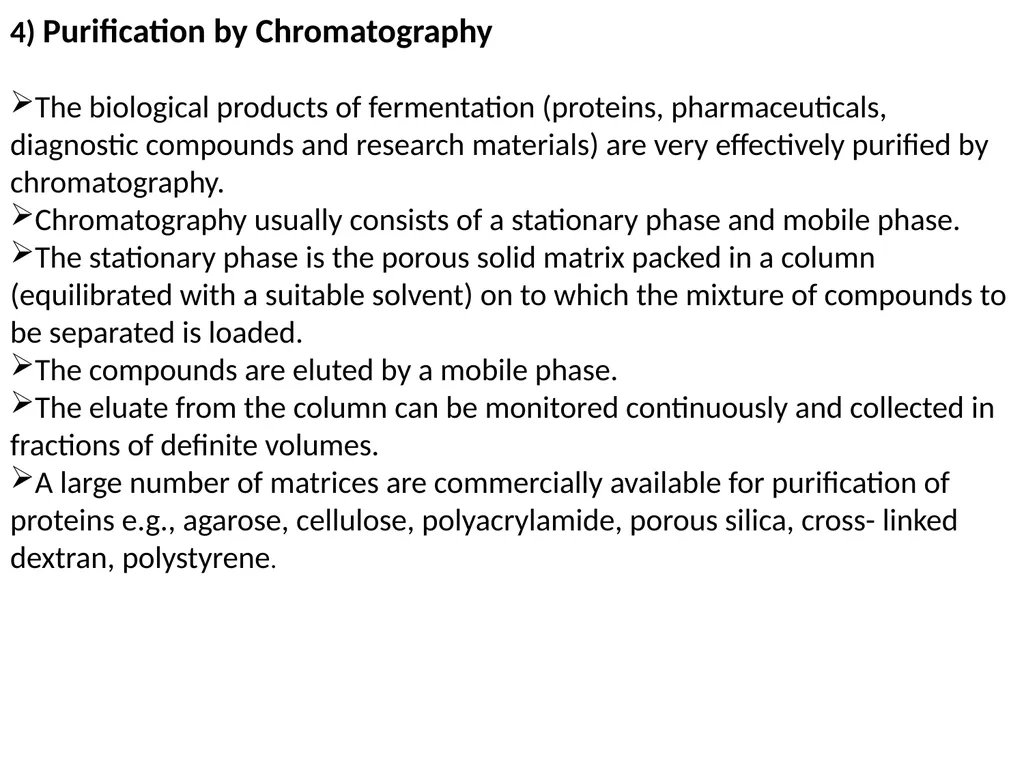
4) Purification by Chromatography
The biological products of fermentation (proteins, pharmaceuticals, diagnostic compounds and research materials) are very effectively purified by chromatography.
Chromatography usually consists of a stationary phase and mobile phase.
The stationary phase is the porous solid matrix packed in a column (equilibrated with a suitable solvent) on to which the mixture of compounds to be separated is loaded.
The compounds are eluted by a mobile phase.
The eluate from the column can be monitored continuously and collected in fractions of definite volumes.
A large number of matrices are commercially available for purification of proteins e.g., agarose, cellulose, polyacrylamide, porous silica, cross- linked dextran, polystyrene.<br>
The biological products of fermentation (proteins, pharmaceuticals, diagnostic compounds and research materials) are very effectively purified by chromatography.
Chromatography usually consists of a stationary phase and mobile phase.
The stationary phase is the porous solid matrix packed in a column (equilibrated with a suitable solvent) on to which the mixture of compounds to be separated is loaded.
The compounds are eluted by a mobile phase.
The eluate from the column can be monitored continuously and collected in fractions of definite volumes.
A large number of matrices are commercially available for purification of proteins e.g., agarose, cellulose, polyacrylamide, porous silica, cross- linked dextran, polystyrene.<br>
26
Gel-filtration chromatography
This is also referred to as size-exclusion chromatography.
The separation of molecules is based on the size, shape and molecular weight.
The sponge-like gel beads with pores serve as molecular sieves for separation of smaller and bigger molecules.
A solution mixture containing molecules of different sizes (e.g. different proteins) is applied to the column and eluted.
The smaller molecules enter the gel beads through their pores and get trapped.
On the other hand, the larger molecules cannot pass through the pores and therefore come out first with the mobile liquid.
At the industrial scale, gel-filtration is particularly useful to remove salts and low molecular weight compounds from high molecular weight products.<br>
This is also referred to as size-exclusion chromatography.
The separation of molecules is based on the size, shape and molecular weight.
The sponge-like gel beads with pores serve as molecular sieves for separation of smaller and bigger molecules.
A solution mixture containing molecules of different sizes (e.g. different proteins) is applied to the column and eluted.
The smaller molecules enter the gel beads through their pores and get trapped.
On the other hand, the larger molecules cannot pass through the pores and therefore come out first with the mobile liquid.
At the industrial scale, gel-filtration is particularly useful to remove salts and low molecular weight compounds from high molecular weight products.<br>
27
(b)Ion-exchange chromatography
It involves the separation of molecules based on their surface charges.
Ion-exchangers are of two types
cation- exchangers which have negatively charged groups like carboxymethyl and sulfonate
anion- exchangers with positively charged groups like diethylaminoethyl (DEAE).
The most commonly used cation-exchangers are Dowex HCR and Amberlite IR, the anion-exchangers are Dowex SAR and Amberlite IRA.
In ion-exchange chromatography, the pH of the medium is very crucial, since the net charge varies with pH.
The pH determines the effective charge on both the target molecule and the ion-exchanger. The ionic bound molecules can be eluted from the matrix by changing the pH of the eluant or by increasing the concentration of salt solution.
Ion-exchange chromatography is useful for the purification of antibiotics, besides the purification of proteins<br>
It involves the separation of molecules based on their surface charges.
Ion-exchangers are of two types
cation- exchangers which have negatively charged groups like carboxymethyl and sulfonate
anion- exchangers with positively charged groups like diethylaminoethyl (DEAE).
The most commonly used cation-exchangers are Dowex HCR and Amberlite IR, the anion-exchangers are Dowex SAR and Amberlite IRA.
In ion-exchange chromatography, the pH of the medium is very crucial, since the net charge varies with pH.
The pH determines the effective charge on both the target molecule and the ion-exchanger. The ionic bound molecules can be eluted from the matrix by changing the pH of the eluant or by increasing the concentration of salt solution.
Ion-exchange chromatography is useful for the purification of antibiotics, besides the purification of proteins<br>
28
(c) Affinity chromatography
This is an elegant method for the purification of proteins from a complex mixture.
Affinity chromatography is based on an interaction of a protein with an immobilized ligand.
The ligand can be a specific antibody, substrate, substrate analogue or an inhibitor. Eg. Ab-Ag, Cof-Enzyme, Receptor-Hormone, Inhibitor –Enzyme etc.
The immobilized ligand on a solid matrix can be effectively used to study complementary structures.
The protein bound to the ligand can be eluted by reducing their interaction.
This can be achieved by changing the pH of the buffer, altering the ionic strength or by using another free ligand molecule.<br>
This is an elegant method for the purification of proteins from a complex mixture.
Affinity chromatography is based on an interaction of a protein with an immobilized ligand.
The ligand can be a specific antibody, substrate, substrate analogue or an inhibitor. Eg. Ab-Ag, Cof-Enzyme, Receptor-Hormone, Inhibitor –Enzyme etc.
The immobilized ligand on a solid matrix can be effectively used to study complementary structures.
The protein bound to the ligand can be eluted by reducing their interaction.
This can be achieved by changing the pH of the buffer, altering the ionic strength or by using another free ligand molecule.<br>
29
(c) Hydrophobic interaction chromatography
This is based on the principle of weak hydrophobic interactions between the hydrophobic ligands (alkyl, aryl side chains on matrix) and hydrophobic amino acids of proteins.
The differences in the composition of hydrophobic amino acids in proteins can be used for their separation.
The elution of proteins can be done by lowering the salt concentration, decreasing the polarity of the medium or reducing the temperature.<br>
This is based on the principle of weak hydrophobic interactions between the hydrophobic ligands (alkyl, aryl side chains on matrix) and hydrophobic amino acids of proteins.
The differences in the composition of hydrophobic amino acids in proteins can be used for their separation.
The elution of proteins can be done by lowering the salt concentration, decreasing the polarity of the medium or reducing the temperature.<br>
30
5) Formulation
It refers to the maintenance of activity and stability of a biotechnological products during storage and distribution.
The formulation of low molecular weight products (solvents, organic acids) can be achieved by concentrating them with removal of most of the water.
For certain small molecules, (antibiotics, citric acid), formulation can be done by crystallization by adding salts.
Proteins are highly susceptible for loss of biological activity; hence their formulation requires special care. Certain stabilizing additives are added to prolong the shelf life of protein.
The stabilizers of protein formulation include sugars (sucrose, lactose), salts (sodium chloride, ammonium sulfate), polymers (polyethylene glycol) and polyhydric alcohols (glycerol).
Proteins may be formulated in the form of solutions, suspensions or dry powders.<br>
It refers to the maintenance of activity and stability of a biotechnological products during storage and distribution.
The formulation of low molecular weight products (solvents, organic acids) can be achieved by concentrating them with removal of most of the water.
For certain small molecules, (antibiotics, citric acid), formulation can be done by crystallization by adding salts.
Proteins are highly susceptible for loss of biological activity; hence their formulation requires special care. Certain stabilizing additives are added to prolong the shelf life of protein.
The stabilizers of protein formulation include sugars (sucrose, lactose), salts (sodium chloride, ammonium sulfate), polymers (polyethylene glycol) and polyhydric alcohols (glycerol).
Proteins may be formulated in the form of solutions, suspensions or dry powders.<br>
31
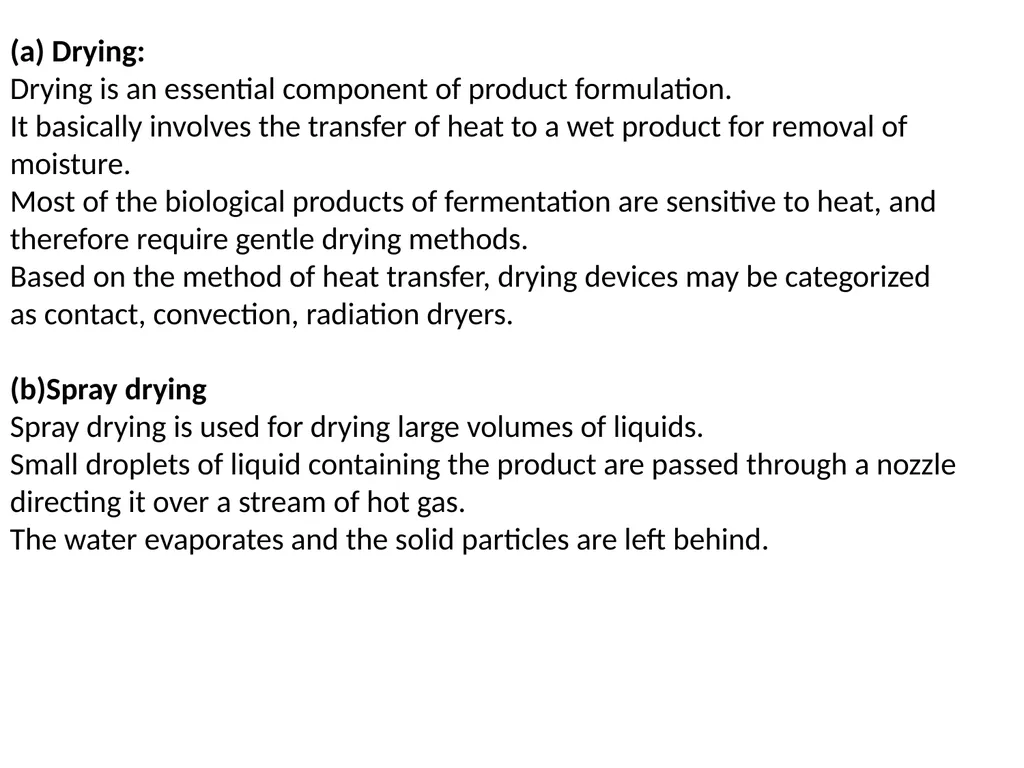
(a) Drying:
Drying is an essential component of product formulation.
It basically involves the transfer of heat to a wet product for removal of moisture.
Most of the biological products of fermentation are sensitive to heat, and therefore require gentle drying methods.
Based on the method of heat transfer, drying devices may be categorized as contact, convection, radiation dryers.
(b)Spray drying
Spray drying is used for drying large volumes of liquids.
Small droplets of liquid containing the product are passed through a nozzle directing it over a stream of hot gas.
The water evaporates and the solid particles are left behind.<br>
Drying is an essential component of product formulation.
It basically involves the transfer of heat to a wet product for removal of moisture.
Most of the biological products of fermentation are sensitive to heat, and therefore require gentle drying methods.
Based on the method of heat transfer, drying devices may be categorized as contact, convection, radiation dryers.
(b)Spray drying
Spray drying is used for drying large volumes of liquids.
Small droplets of liquid containing the product are passed through a nozzle directing it over a stream of hot gas.
The water evaporates and the solid particles are left behind.<br>
32
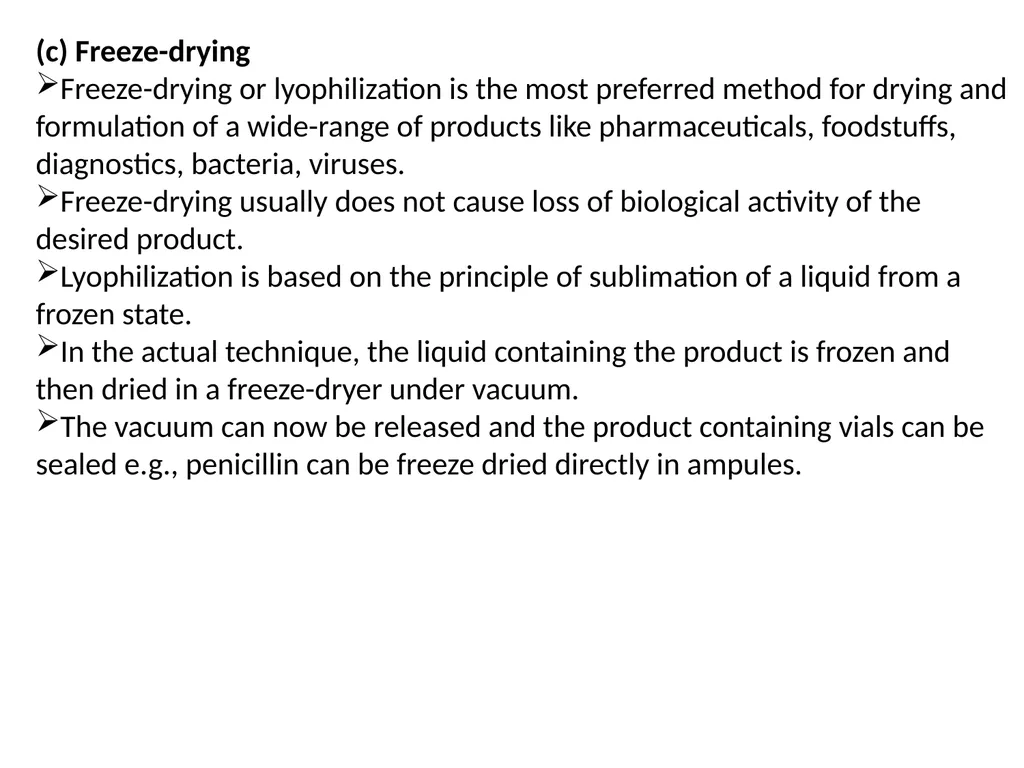
(c) Freeze-drying
Freeze-drying or lyophilization is the most preferred method for drying and formulation of a wide-range of products like pharmaceuticals, foodstuffs, diagnostics, bacteria, viruses.
Freeze-drying usually does not cause loss of biological activity of the desired product.
Lyophilization is based on the principle of sublimation of a liquid from a frozen state.
In the actual technique, the liquid containing the product is frozen and then dried in a freeze-dryer under vacuum.
The vacuum can now be released and the product containing vials can be sealed e.g., penicillin can be freeze dried directly in ampules.<br>
Freeze-drying or lyophilization is the most preferred method for drying and formulation of a wide-range of products like pharmaceuticals, foodstuffs, diagnostics, bacteria, viruses.
Freeze-drying usually does not cause loss of biological activity of the desired product.
Lyophilization is based on the principle of sublimation of a liquid from a frozen state.
In the actual technique, the liquid containing the product is frozen and then dried in a freeze-dryer under vacuum.
The vacuum can now be released and the product containing vials can be sealed e.g., penicillin can be freeze dried directly in ampules.<br>