Dr. Arnab Gupta Assistant Professor Department of Mathematics Prabhu Jagatbandhu College Webpage: www.sites.google.comsitearnabguptamath Mean Value Theorem Curriculum Mean Value Theorem (MVT) Lagranges MVT Rolles Theorem Cauchys MVT
"Dr. Arnab Gupta Assistant Professor Department of" is the property of its rightful owner. Permission is granted to
download and print the materials on this website for personal, non-commercial use only, and to display it
on your personal computer provided you do not modify the materials and that you retain all copyright
notices contained in the materials. By downloading content from our website, you accept the terms of this
agreement.
Presentation Transcript
01
Dr. Arnab Gupta
Assistant Professor
Department of Mathematics
Prabhu Jagatbandhu College
Webpage: www.sites.google.com/site/arnabguptamath/ Mean Value Theorem<br>
02
Curriculum Mean Value Theorem (MVT)
Lagrange’s MVT
Rolle’s Theorem
Cauchy’s MVT
Applications<br>
03
Motivation Law of Mean:
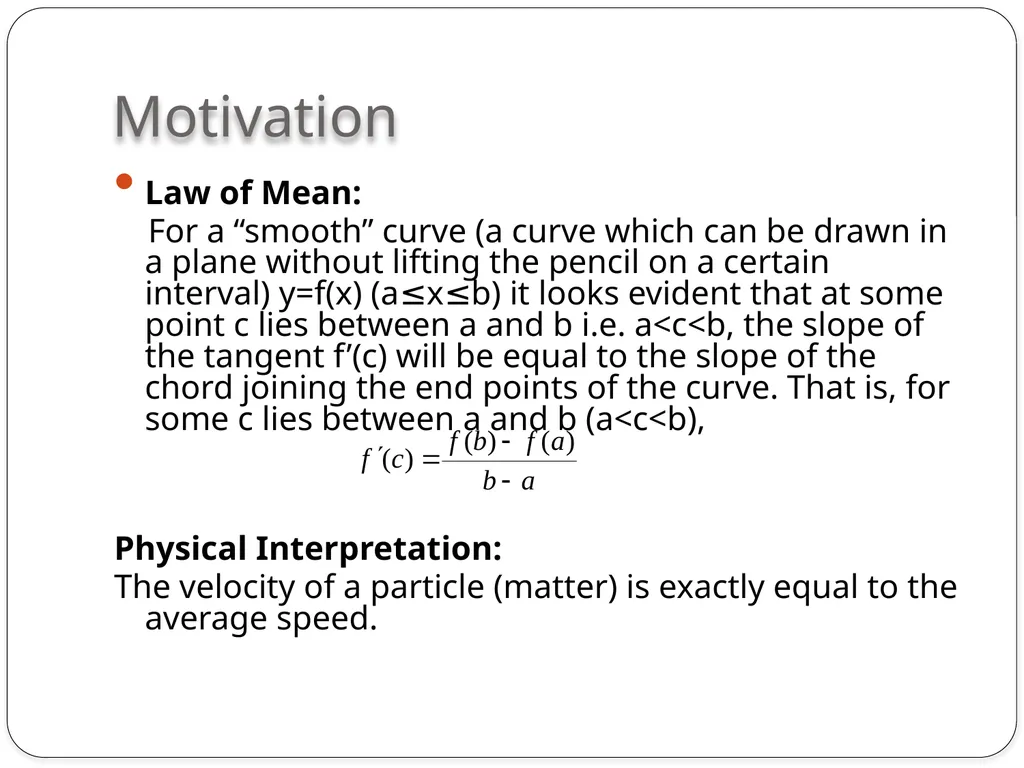
For a “smooth” curve (a curve which can be drawn in a plane without lifting the pencil on a certain interval) y=f(x) (a≤x≤b) it looks evident that at some point c lies between a and b i.e. a<c<b, the slope of the tangent f’(c) will be equal to the slope of the chord joining the end points of the curve. That is, for some c lies between a and b (a<c<b),
Physical Interpretation:
The velocity of a particle (matter) is exactly equal to the average speed.<br>
04
Mean value Theorem (Lagrange’s MVT) Statement:
Let f(x) be any real valued function defined in a≤x≤b such that
(i) f(x) is continuous in a≤x≤b
(ii) f(x) is differentiable in a<x<b
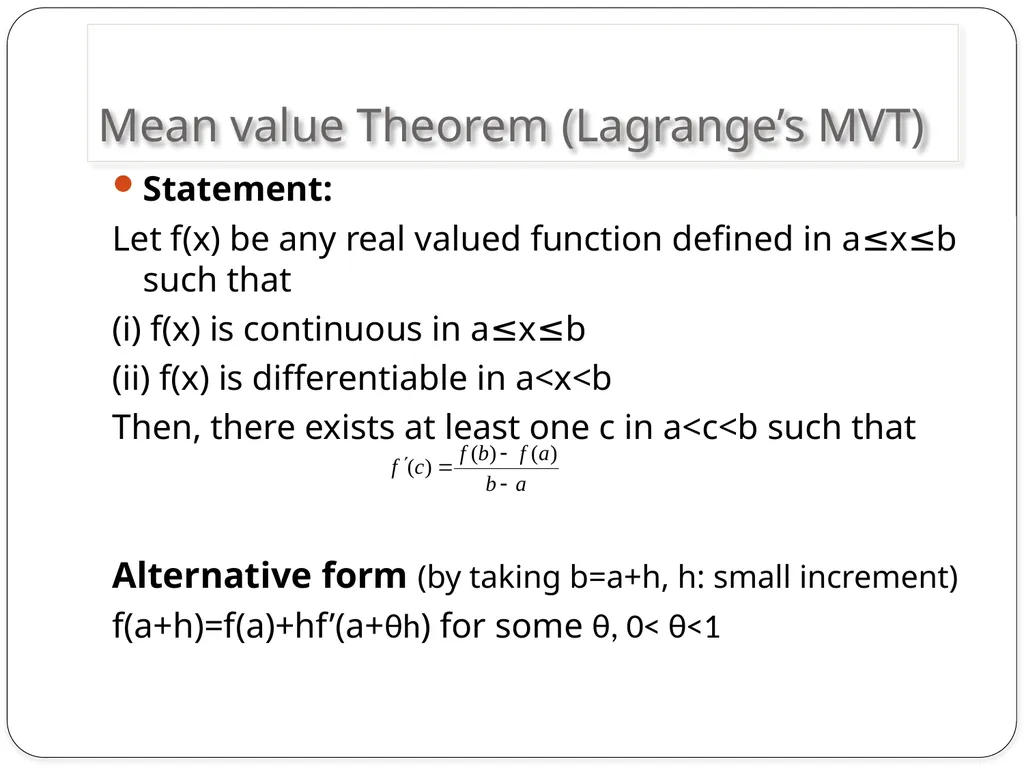
Then, there exists at least one c in a<c<b such that
Alternative form (by taking b=a+h, h: small increment)
f(a+h)=f(a)+hf’(a+θh) for some θ, 0< θ<1<br>
05
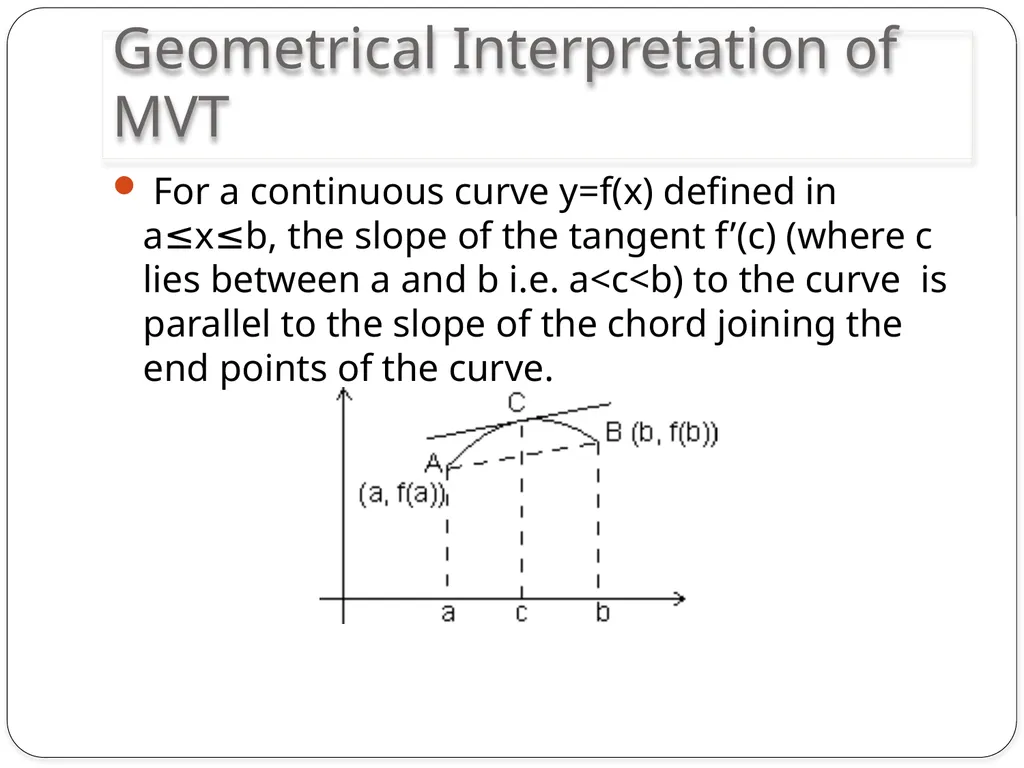
Geometrical Interpretation of MVT For a continuous curve y=f(x) defined in a≤x≤b, the slope of the tangent f’(c) (where c lies between a and b i.e. a<c<b) to the curve is parallel to the slope of the chord joining the end points of the curve.<br>
06
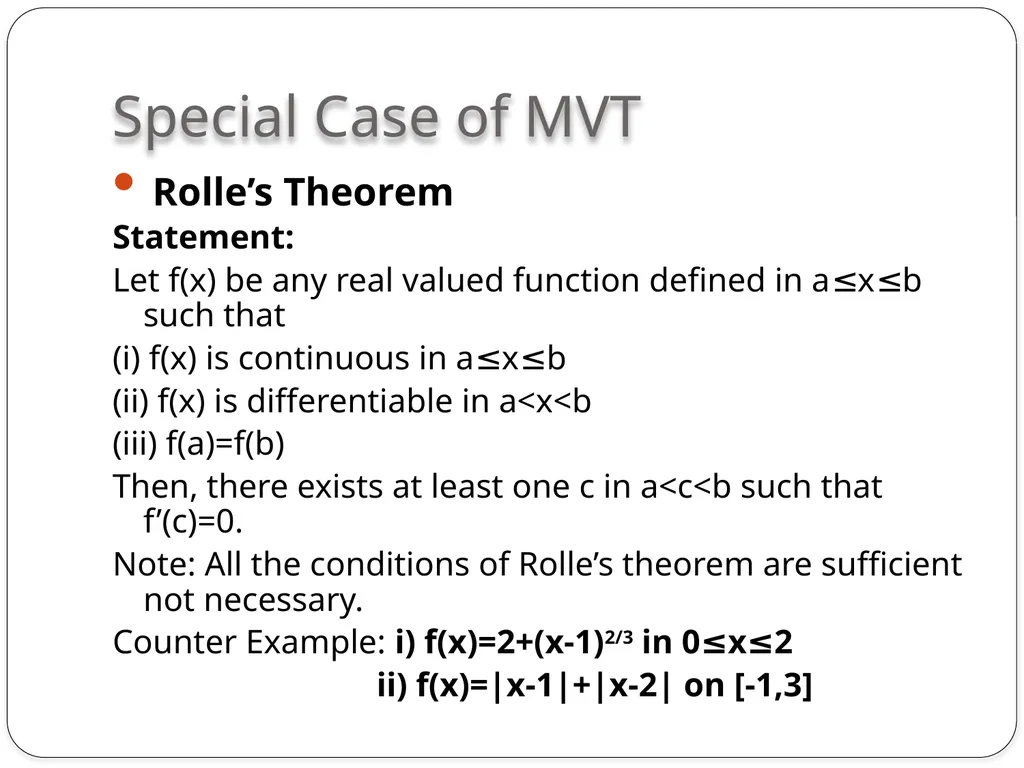
Special Case of MVT Rolle’s Theorem
Statement:
Let f(x) be any real valued function defined in a≤x≤b such that
(i) f(x) is continuous in a≤x≤b
(ii) f(x) is differentiable in a<x<b
(iii) f(a)=f(b)
Then, there exists at least one c in a<c<b such that f’(c)=0.
Note: All the conditions of Rolle’s theorem are sufficient not necessary.
Counter Example: i) f(x)=2+(x-1)2/3 in 0≤x≤2
ii) f(x)=|x-1|+|x-2| on [-1,3]<br>
07
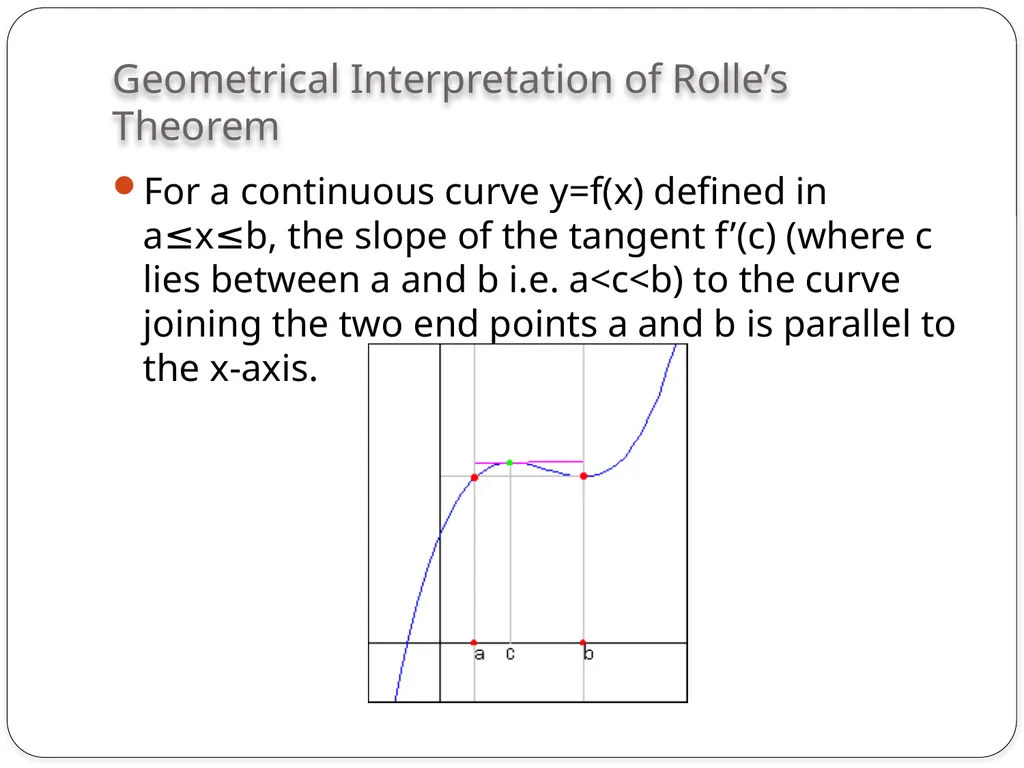
Geometrical Interpretation of Rolle’s Theorem For a continuous curve y=f(x) defined in a≤x≤b, the slope of the tangent f’(c) (where c lies between a and b i.e. a<c<b) to the curve joining the two end points a and b is parallel to the x-axis.<br>
08
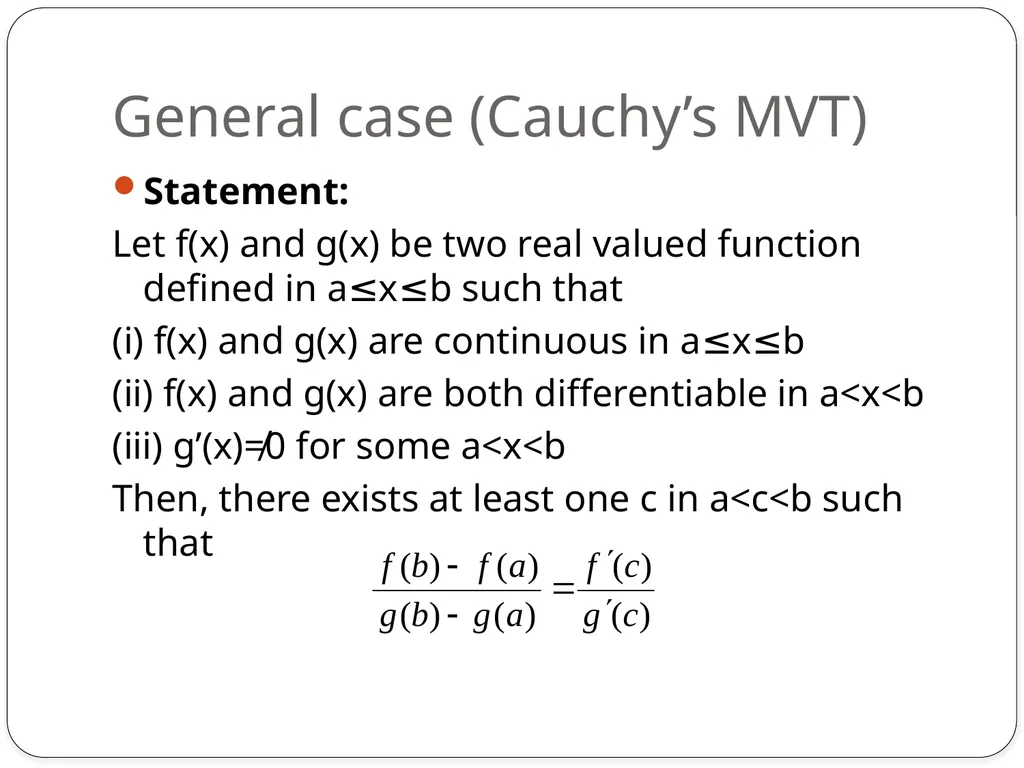
General case (Cauchy’s MVT) Statement:
Let f(x) and g(x) be two real valued function defined in a≤x≤b such that
(i) f(x) and g(x) are continuous in a≤x≤b
(ii) f(x) and g(x) are both differentiable in a<x<b
(iii) g’(x)≠0 for some a<x<b
Then, there exists at least one c in a<c<b such that<br>
09
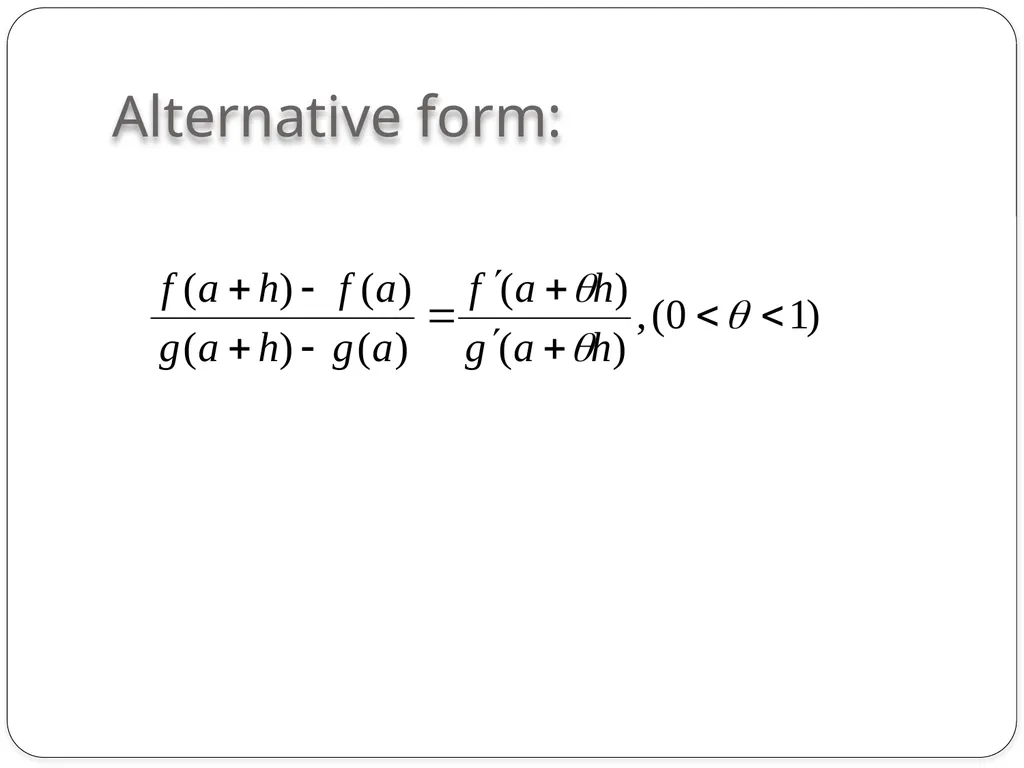
Alternative form:<br>
10
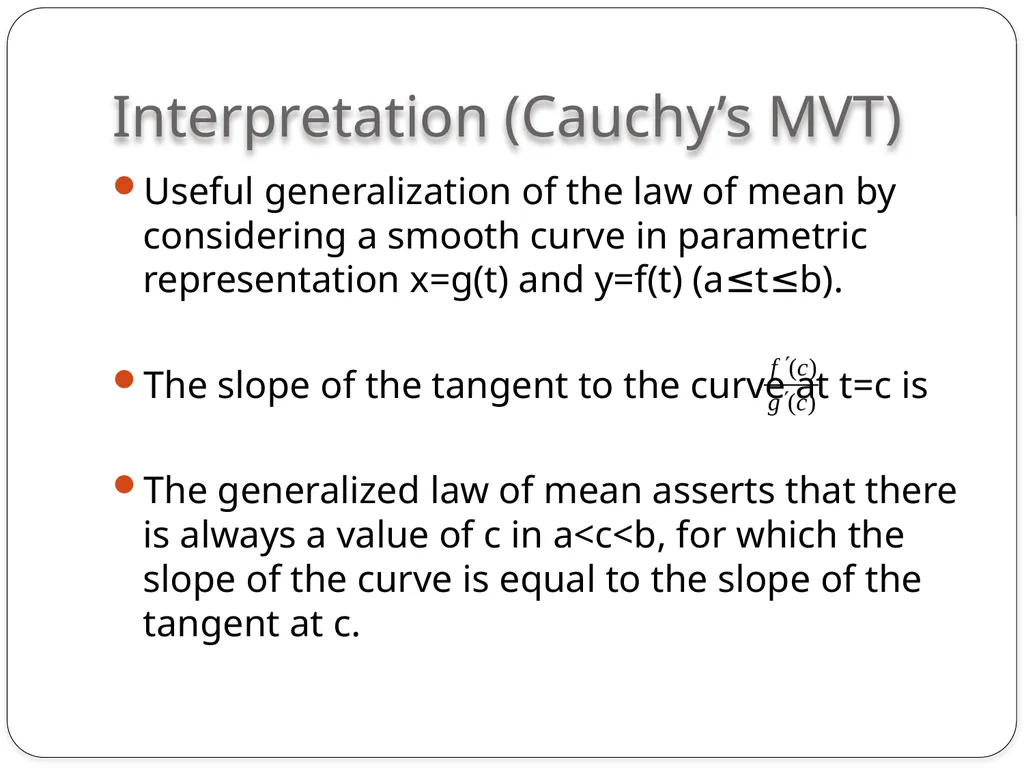
Interpretation (Cauchy’s MVT) Useful generalization of the law of mean by considering a smooth curve in parametric representation x=g(t) and y=f(t) (a≤t≤b).
The slope of the tangent to the curve at t=c is
The generalized law of mean asserts that there is always a value of c in a<c<b, for which the slope of the curve is equal to the slope of the tangent at c.<br>
11
Observations<br>
12
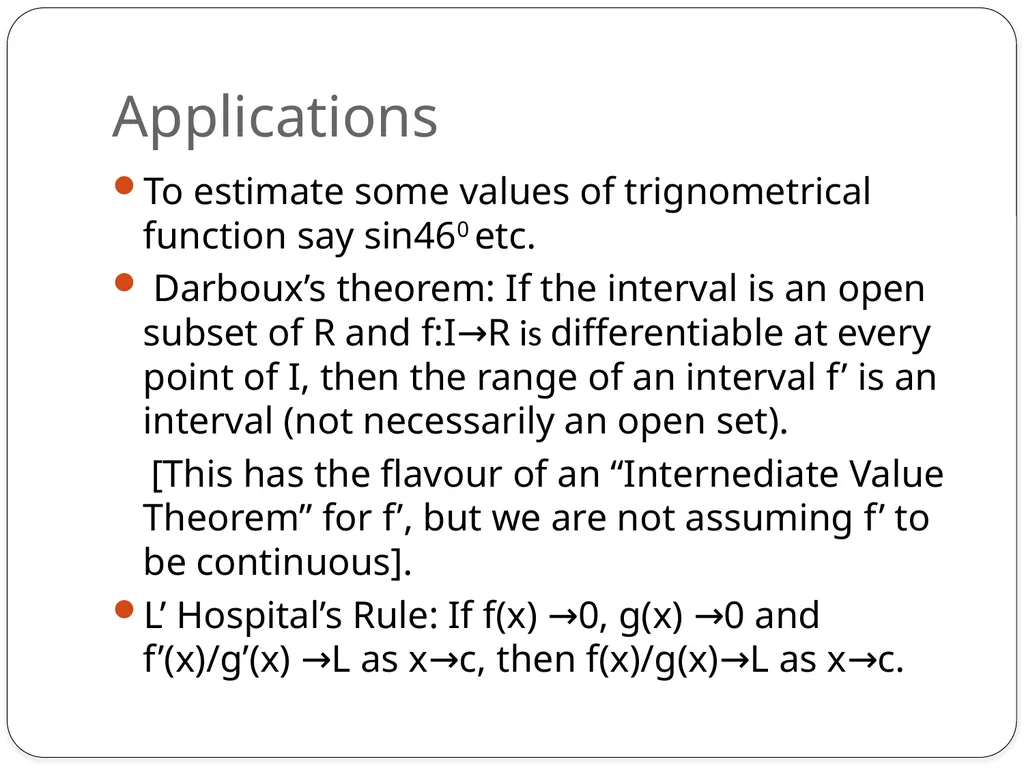
Applications To estimate some values of trignometrical function say sin460 etc.
Darboux’s theorem: If the interval is an open subset of R and f:I→R is differentiable at every point of I, then the range of an interval f’ is an interval (not necessarily an open set).
[This has the flavour of an “Internediate Value Theorem” for f’, but we are not assuming f’ to be continuous].
L’ Hospital’s Rule: If f(x) →0, g(x) →0 and f’(x)/g’(x) →L as x→c, then f(x)/g(x)→L as x→c.<br>
13
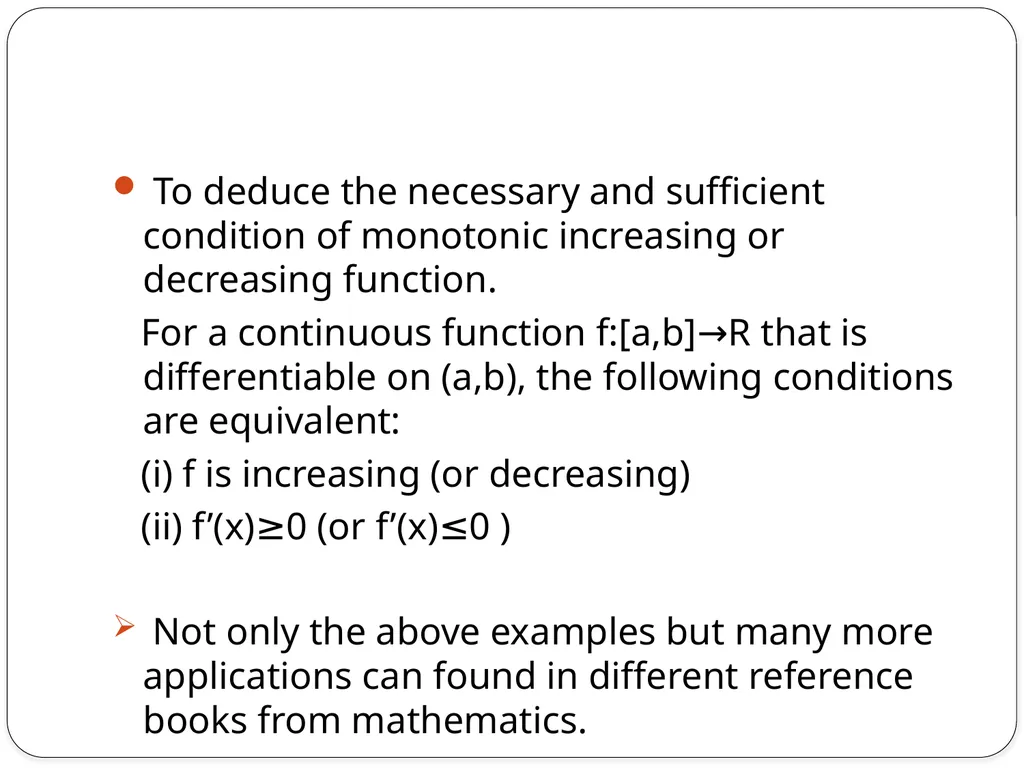
To deduce the necessary and sufficient condition of monotonic increasing or decreasing function.
For a continuous function f:[a,b]→R that is differentiable on (a,b), the following conditions are equivalent:
(i) f is increasing (or decreasing)
(ii) f’(x)≥0 (or f’(x)≤0 )
Not only the above examples but many more applications can found in different reference books from mathematics.<br>
14
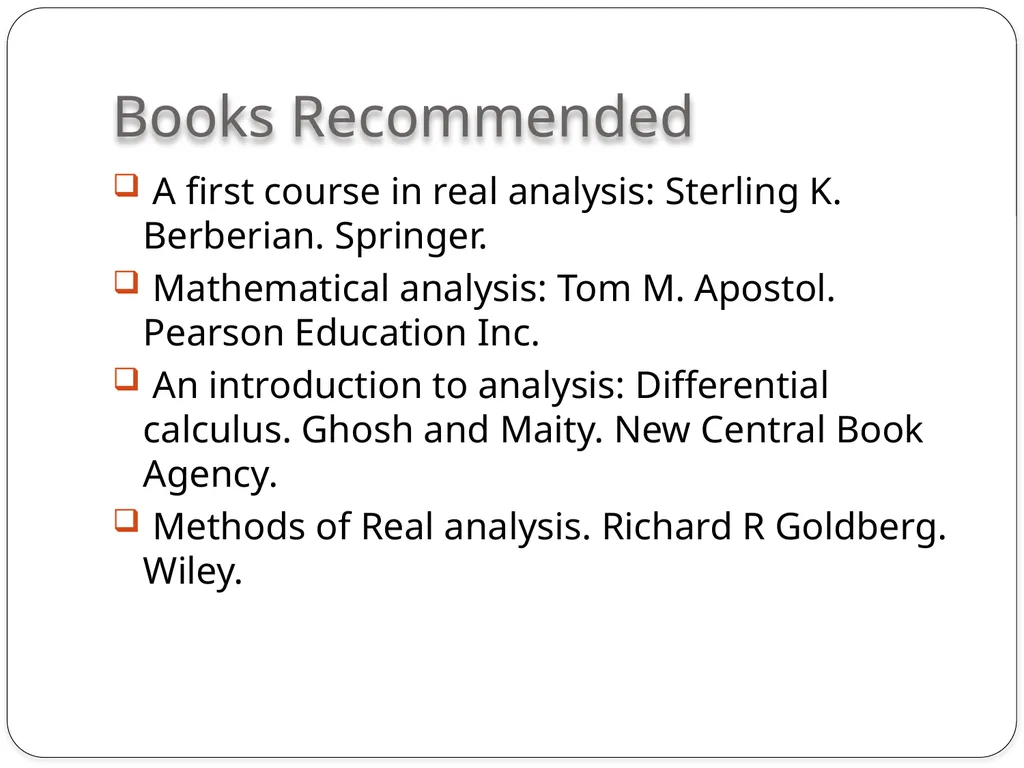
Books Recommended A first course in real analysis: Sterling K. Berberian. Springer.
Mathematical analysis: Tom M. Apostol. Pearson Education Inc.
An introduction to analysis: Differential calculus. Ghosh and Maity. New Central Book Agency.
Methods of Real analysis. Richard R Goldberg. Wiley.<br>