
DR. DELPHINE MASTER OF EDUCATION Course Code: FMTE
AM
Published · 54 slides · 0 views

1 / 1










Description
DR. DELPHINE MASTER OF EDUCATION Course Code: FMTE TEACHER EDUCATION IN INDIA: ELEMENTARY LEVEL UNIT 1 DR. DELPHINE Presented By : Dr. A. Mary Delphine Principal St. Justins College of Education , Madurai DR. DELPHINE OBJECTIVES: By the
Related Topics
Share
Embed code
Download this presentation From Below
"DR. DELPHINE MASTER OF EDUCATION Course Code: FMTE" is the property of its rightful owner. Permission is granted to download and print the materials on this website for personal, non-commercial use only, and to display it on your personal computer provided you do not modify the materials and that you retain all copyright notices contained in the materials. By downloading content from our website, you accept the terms of this agreement.
Presentation Transcript
01
DR. DELPHINE<br>
02
MASTER OF EDUCATION
Course Code: FMTE
TEACHER EDUCATION IN INDIA: ELEMENTARY LEVEL
UNIT 1 DR. DELPHINE<br>
03
Presented By :
Dr. A. Mary Delphine
Principal
St. Justin’s College of Education , Madurai DR. DELPHINE<br>
04
OBJECTIVES:
By the end of this lesson
you will be able to say:
i) The Concept Of Teaching,
ii) Instruction ,
iii) Indoctrination,
iv)Teacher And Teacher Education:
Ancient Period, Medieval Period
( Jainism, Buddhism, Islam) and
British Period DR. DELPHINE<br>
05
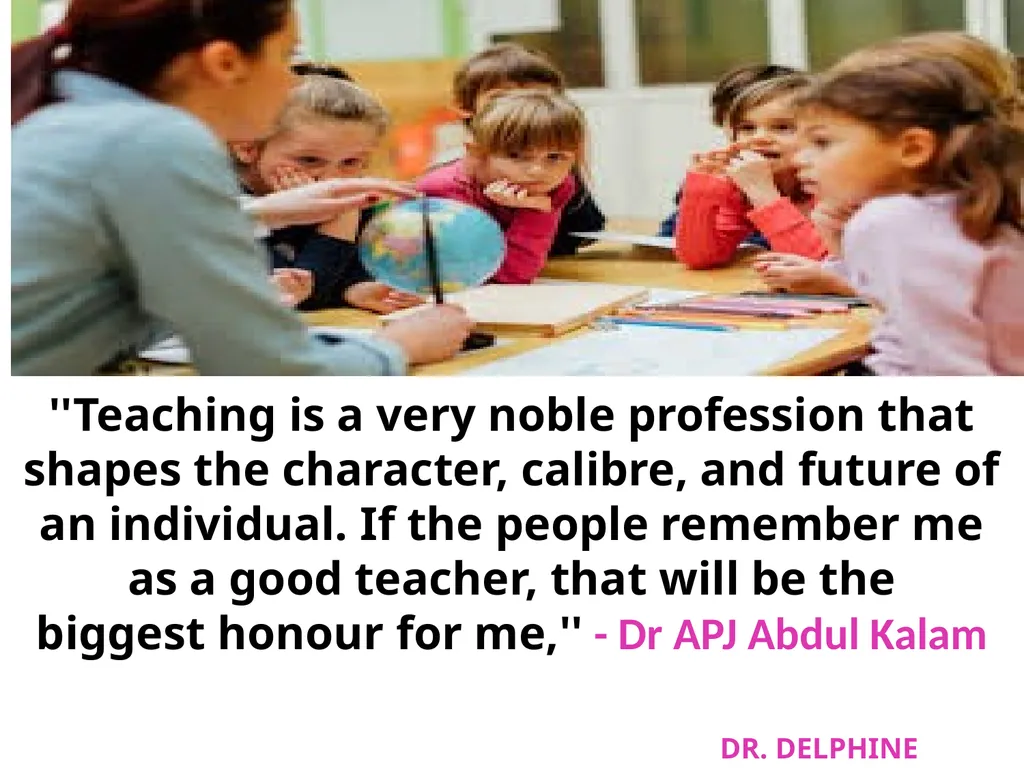
''Teaching is a very noble profession that shapes the character, calibre, and future of an individual. If the people remember me as a good teacher, that will be the biggest honour for me,'' - Dr APJ Abdul Kalam DR. DELPHINE<br>
06
CONCEPT OF TEACHING
Teaching is the process of attending to people’s needs, experiences and feelings, and intervening so that they learn particular things, and go beyond the given.
Impart knowledge to or instruct (someone) as to how to do something; or
Cause (someone) to learn or understand something by example or experience. DR. DELPHINE<br>
07
INSTRUCTION
It was defined previously as "the purposeful direction of the learning process" and is one of the major teacher class activities (along with planning and management).
Professional educators have developed a variety of models of instruction, each designed to produce classroom learning. DR. DELPHINE<br>
08
INDOCTRINATION
It is the process of inculcating a person with ideas, attitudes, cognitive strategies or professional methodologies (see doctrine).
Somedistinguish indoctrination from education on the basis that the indoctrinated person is expected not to question or critically examine the doctrine they have learned. DR. DELPHINE<br>
09
DR. DELPHINE<br>
10
DR. DELPHINE<br>
11
DR. DELPHINE The difference between education and indoctrination
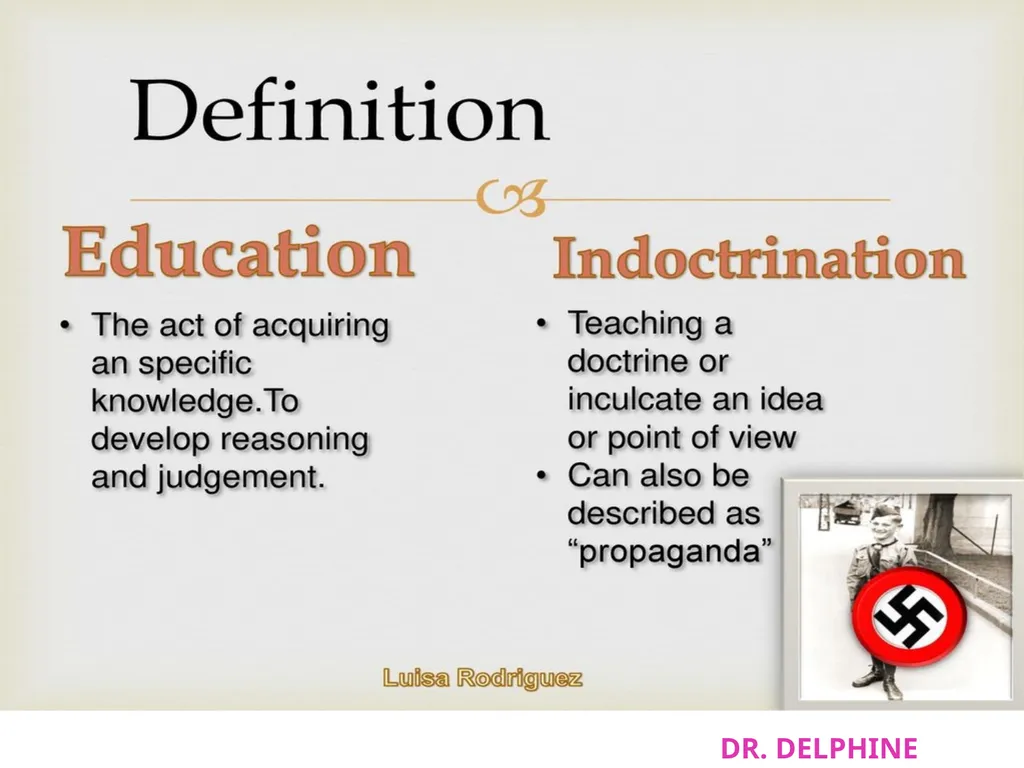
Education is often related with indoctrination.
Indoctrination is the process of inculcating ideas, attitudes, cognitive strategies or a professional methodology.
It is often distinguished from education by the fact that the indoctrinated person is expected not to question or critically examine the doctrine they have learned.
It is used pejoratively, often in the context of education, political opinions, theology or religious dogma.<br>
Education is often related with indoctrination.
Indoctrination is the process of inculcating ideas, attitudes, cognitive strategies or a professional methodology.
It is often distinguished from education by the fact that the indoctrinated person is expected not to question or critically examine the doctrine they have learned.
It is used pejoratively, often in the context of education, political opinions, theology or religious dogma.<br>
12
In order to fit ourselves in a more appropriate role we need to know the inception of teacher and his education.
Who was considered as a genuine Guru (preceptor)?
He who taught by precept and example, good conduct,
right thinking, loyalty to Truth, mental discipline and sense of duty. DR. DELPHINE<br>
13
The history of Indian education is as old as the history of human civilisation.
Hence it seems to be correct that the concept of informal teacher education must have been born in India during early ancient Indian period i.e in 2500 B.C. DR. DELPHINE<br>
14
A teacher's role may vary among cultures. Teachers may provide instruction in literacy and numeracy, craftsmanship or vocational training, the arts, religion, civics, community roles, or life skills DR. DELPHINE<br>
15
Religious and spiritual teachers such as
gurus, mullahs, rabbis, pastors/youth pastors and lamas, may teach religious texts such as the Quran, Torah or Bible. DR. DELPHINE<br>
16
Who was considered as a genuine student?
He who learnt the above. These are the qualities that will guarantee happiness here and bliss
hereafter.
These virtues will effectively countermand the evils that degrade man into a monster. DR. DELPHINE<br>
17
The educational system that brings both teacher and student together, has two aspects:
first, the provision of skills and information so that man can live in health and happiness
and the second, the understanding of one's inner urges and their sublimation in order to attain lasting peace, equanimity and bliss. DR. DELPHINE<br>
18
THREE ELEMENTS OF TEACHER EDUCATION
The principal elements that make teaching and learning possible and attainable are the teachers, the learners, and a conducive learning environment. The teacher serves as the prime mover of the educational wheel. The learners are the key participants in the learning process. DR. DELPHINE<br>
19
SCOPE OF TEACHER EDUCATION
Teacher education reaches out to the student teachers by providing the relevant knowledge, attitude and skills to function effectively in their teaching profession. It serves to equip the student teachers with the conceptual and theoretical framework within which they can understand the intricacies of the profession. DR. DELPHINE<br>
20
The traditional view of a teacher is-
“some one who dispenses knowledge” But every day according to the situation the teacher wears many hats... • Friend • Counselor • Judge • Mentor • Facilitator • Manager & So on
A good teacher knows when to act as sage on the stage and when to act as a guide on the side. DR. DELPHINE<br>
21
In ancient India, education formed an integral part of social structure and schools operated as a part of the total social system.
The educational processes reflected the dominant cultural patterns. The keenly felt need to educate the younger generations to acquire the cultural heritage had given
rise to social institutions like Ashram, Gurukula, Pathasala, Vihara. Vidyapeeth, etc.
The all-round cultural development of the person, and
formation of integrated moral character were the aims and objectives of educational processes. DR. DELPHINE<br>
22
The Gurukulas
The gurukulas were single-teacher schools, conducted by brahmins or pandirs who had taken up teaching as a profession.
Many of the gurukulas were residential schools. Often they were situated in natural and pastoral surroundings away from the din and bustle of towns and cities.
After upanayanam (initiation ceremony), which generally took place at the age between 8 to 12, boys were sent to gurukulas for their studies. DR. DELPHINE<br>
23
They stayed with the guru at his hermitage. The guru treated his students as his own sons.
The whole institution functioned as a joint family as the name
indicated, viz. guru is the teacher and kula means extended family. The students stayed together as brothers and respected the teacher as a father and
served him to the best of their abilities.
For all practical purposes ancient
Indian schools functioned as community schools. Much of the teaching was
done by word of mouth. The oral tradition remained strong in the ancient system of Indian education. DR. DELPHINE<br>
24
The guru was not only respected but also sought for and consulted by community leaders as also the kings and princes in important state matters and community problems.
Guru acted like a friend, philosopher and guide
to the community.
For the illiterate masses who craved for enlightenment
he organized discourses where large number of rural people came to listen and to learn. DR. DELPHINE<br>
25
Ancient and medieval period
(2500 B.C. to 500 B.C.):
In the beginning of Hindu civilization teaching was concerned with teaching of VEDAS.
Out of four classes of Hindu society and Brahmins served as a teachers of the community.
Only learned section of Hindu community undertook the task of teaching.
‘Manu’ lays down that only Brahmins shall teach Vedas and none else.
Gurukula system of education was in existence. DR. DELPHINE<br>
26
Ancient and medieval period
(2500 B.C. to 500 B.C.):
No evidence of teacher training existed in the formal sense.
There were Certain Brahmin families where teaching was a hereditary profession. There was no formal system of teacher’s training.
There was a close contact between teacher and a pupil.
Pupil had Complete faith in teacher. DR. DELPHINE<br>
27
Buddhist Period (5oo B.C. to 1200 A.D.)
The profession of teaching was no longer the privilege of only Brahmins.
As the expansion of teacher education was recognised till this period. Any enlightened person from any class of the community may get the status of a teacher after a vigorous training.
Thus, the formal system of teacher’s training emerged during this period. Teachers were trained for the purpose of spreading the spirit of Buddhists religion. DR. DELPHINE<br>
28
Buddhist Period (5oo B.C. to 1200 A.D.)
To get the status of a teacher one was kept under the supervision of the teacher.
Teacher trainee learned the elements of morality, proper conduct and training in Dharma from trainers.
When the supervisors were satisfied, they gave a certificate to be fit for teaching.
A system later on named as monitorial system. DR. DELPHINE<br>
29
Muslim Period(1200.A.D. to 1700 A.D):
During this period there was no formal system of teacher training.
Educational institutions were called ‘Madarshah’ where students were taught by ‘Molvies’.
Education was mainly teaching of Quran. There were also some Arabic schools with more advanced and comprehensive course of study.
Need of formal education was not recognized. So No special professional training was required.
Educated people available in the country or abroad from Arabia were appointed as Molvies in the educational institutions.
Only mohammadans were allowed to teach in Mokalis and Madarshahs. DR. DELPHINE<br>
30
Teacher Education in Pre Independent India: Monitorial System (1880)–
In India, the idea of formal teacher training originated out of an indigenous technique, called „Monitorial System‟. It was based on the principle of mutual instruction. The whole class was splitted into a number of small groups and by placing each group under the charge of a brilliant pupil, called monitor.
It was used in England and known as Bell-Lancaster system DR. DELPHINE<br>
31
Teacher’s Training Schools–
The first formal teacher‟s training School in India was set up at Serampur in Bengal in the name of “Normal School” by Carey, Marshman and Ward in 1793.
In Bombay, the Native Education Society trained a number of teachers for the improvement of teaching in primary schools.
In Bengal the Calcutta School Society did pioneering work for the training of teachers for indigenous schools.
The Ladies Society of Calcutta started a training class for training women teachers in the Calcutta Central School for girls.
A number of government training schools were also set up in the first half of the nineteenth century. DR. DELPHINE<br>
32
Sir Munro, in his Minute dated 13 December 1823, gave some ideas for the improvement of the education of teachers. He suggested an increase in their allowance and different types of syllabi for Hindu and Muslim teachers. DR. DELPHINE<br>
33
In June 1826, the first normal school was started in Madras under the management and with the finances of the British government. Initially it prepared teachers for the district schools. DR. DELPHINE<br>
34
A number of government training schools were also set up in the first half of the nineteenth century.
Wood's Despatch (1854) – The Wood's Despatch (popularly known as Magna Charta of English Education in India), an important educational document was released on 19 July, 1854.
It was rightly been called the most important document on English education in India. It gave some very valuable suggestions for the improvement of the education of teachers. It suggested that allowances be given to persons who possess and aptness for teaching and who are willing to devote themselves to the profession of school master. DR. DELPHINE<br>
35
The Despatch urged the establishment of training schools in India. The Despatch suggested the introduction of pupil teacher system (as prevailed in England) in India and an award/ stipend to the pupil teachers and a small payment to the masters of the school to which they were attached. On successful completion of the training programme they were to be given certificates and employment.
So the Despatch introduced sufficient incentive for the would-be teachers. DR. DELPHINE<br>
36
In 1959, Lord Stanley, Secretary of State for India, greatly emphasized on teacher training. The Despatch very emphatically stated that the administration should desist from procuring teachers from England and that teachers for vernacular schools should be made available locally. In 1859, the new grant-in-aid rules provided that salary grants to schools be given to those teachers who had obtained a certificate of teacher training. DR. DELPHINE<br>
37
Lord Stanley's Despatch (1859)–In 1959, Lord Stanley, Secretary of State for India, greatly emphasized on teacher training. The Despatch very emphatically stated that the administration should desist from procuring teachers from England and that teachers for vernacular schools should be made available locally.
In 1859, the new grant-in-aid rules provided that salary grants to schools be given to those teachers who had obtained a certificate of teacher training. In 1882 there existed 106 Normal Schools, including 15 institutions meant exclusively for women. About the training of secondary teachers, training classes were added to the following schools: (i) Government Normal School, Madras (1856) (ii)Central Training School, Lahore (1877) In 1886, the first training college to prepare secondary school teachers was set up at Saidapet in Madras followed by the opening of a Secondary Department in the Nagpur Training School in 1889. DR. DELPHINE<br>
38
Towards the end of nineteenth century, there were only six training colleges in India. Government of India Resolution on Education Policy (1904)–This is one of the most important educational documents which laid down the policies for the future educational system. Lord Curzon, the-then Viceroy of India felt the need of the training of teachers. It made some very vital suggestions for the improvement of the teacher-training Programme. DR. DELPHINE<br>
39
These were: (a) Training Colleges: The Resolution enunciated that if Secondary Education was to be improved then the teachers should be trained in the art of teaching. There were five teacher training colleges in all at places like Madras, Kurseong, Allahabad, Lahore and Jubbulpur. Intermediates or Graduates could seek admission to these Colleges. DR. DELPHINE<br>
40
The general principles upon which the training institutions were to be developed, were:
i. To enlist more men of ability and experience in the work of higher training.
ii. To equip the training colleges.
iii. To make the duration of the training programmes two years and for graduates, one year. The course would comprise knowledge of the principles which underlie the art of teaching and some degree of technical skill in the practice of the art.
iv. The course would culminate in a university degree or diploma.
v. There should be a close link between theory and practice and practicing schools should be attached to each college. There should be a close link between the training colleges and the school, so that the students do not neglect the methods learnt in the college. DR. DELPHINE<br>
41
(b) Training Schools: The Resolution recommended opening of more training schools, particularly in Bengal. The normal schools were mostly boarding schools where students with vernacular education came for training and were given stipends. They received general education combined with the instruction in the methods of teaching and practice in teaching. The Resolution recommended a minimum course of two years. It mentioned courses of training especially suited for teachers of rural schools. Thus, it can be observed that the recommendations and suggestions of the Resolution were of far reaching importance.
Universities instituted B.T. degree for graduate teachers. The Government of India Resolution on Education Policy (1913)–The second resolution on educational policy suggested many useful measures with regard to improvement of Primary education. The resolution suggested that teachers should be drawn from the class of the boys whom they will teach and they should have passed the middle vernacular examination and undergone a year's training. DR. DELPHINE<br>
42
It suggested periodical repetition and improvement courses for teachers.
The resolution emphasized that no teacher should be allowed to teach without a certificate and that there should be a constant exchange of ideas amongst the training college staff members and that they should visit different colleges.
Calcutta University Commission (1917-19)–This Commission, known as the Sadler Commission suggested opening of post graduate department of education in Universities, each department with a Professor, a Reader and a number of assistants and institute a post-graduate degree in Education. It recommended the introduction of Education as an optional subject at the Graduation and P.G. level.. DR. DELPHINE<br>
43
Sadler Commission had salutary effect on the teacher training Programme in India.
Mysore University started a faculty of Education in 1925.
The Hartog Committee (1929) –It continued the work of Sadler Commission
-primary education teacher training as well. It suggested that teachers for rural areas
-It also suggested that journals for teacher in the vernacular,
- refresher courses, conferences and meetings of teacher associations .
- For the secondary school teachers too, the committee had the same suggestions. DR. DELPHINE<br>
44
13 out of 18 universities set-up faculties of education.
The Lady Irwin College was setup in New Delhi.
Andhra University started a new degree the B.Ed. in 1932.
Bombay launched a post-graduate degree the M.Ed. in 1936.
The Central Advisory Board of Education was revived.
Basic Education was started by Mahatma Gandhi in 1937, leading to the training of teachers for basic schools.
In 1938, a Basic Training College was set-up at Allahabad
the Vidyamandir Training School was started at Wardha in 1938. DR. DELPHINE<br>
45
The Abbott - Wood Report (1937)–
This report submitted in 1937 -primarily analyzed the position of vocational education and teacher education saying training should be 3 years -general education along with professional training, and a refresher course for the teacher . DR. DELPHINE<br>
46
In 1941, the Vidya Bhawan teacher's College was started in Rajasthan and the Tilak College of Education in Poona.
Bombay took the lead in starting a doctorate degree in education in the same year. DR. DELPHINE<br>
47
The Sargent Report (1944) –
The Central Advisory Board of Education (CABE) in 1944 presented a scheme of education "Post-war Educational Development in India", popularly known as the "Sergeant Plan"
recommended that suitable boys and girls should be picked out into the teaching profession after high school
practical training should be provided, refresher courses be planned and research facilities be provided. DR. DELPHINE<br>
48
It suggested a two year course for preprimary and junior basic schools (after high school) and a three year course for the senior basic schools. The non-graduate teachers in high schools were to go for two year training and the graduates for one-year training. DR. DELPHINE<br>
49
The first year of the two years training should be devoted to the study of the general and professional subjects.
It should be supported by school visits, discussions and other experiences to kindle the trainee's interest in education.
It proposed revised pay scales for all categories of teachers, to attract better teachers. DR. DELPHINE<br>
50
In 1947, the number of secondary teachers training colleges in the country had risen to 41 DR. DELPHINE<br>
51
CONCLUSION:
Rabindranath Tagore rightly said,
“A teacher can never truly teach unless he is still learning himself”.
The progress of a country depends upon the quality of its teachers and for this reason teaching is the noblest among all professions. DR. DELPHINE<br>
52
QUALITY SHINES IN DARKNESS AND IN ABSENCE OF GOODNESS SR.DELPHINE JESU<br>
53
THANK YOU FOR BEING QUALITY TEACHERS OF THE NATION SR.DELPHINE JESU<br>
54
REFERENCES:
1. https://infed.org/mobi/what-is-teaching/
2. https://www.owlgen.in/what-is-the-difference-between-education-and-indoctrination/
3. TEACHER EDUCATION TBT Historical Development of Teacher Education in India. Presented ByAmruta V. Apte.
4. Teacher Education, Principles Theories and practices-S. P. Sharma.
5. https://www.google.com/search?q=teacher+education+in+ancient+and+medieval+period
6. https://www.slideshare.net/SureshKumar328/history-of-teacher-education-pptx
7. Sheikh Mustafa , Historical Development of Teacher Education In India, Historical Development of Teacher Education In India , Srinagar . DR. DELPHINE<br>