Dr.E.Ananda Reddy, Professor & Head, Department of
Description: Dr.E.Ananda Reddy, Professor Head, Department of Psychiatry, N.M.C.H Meaning of word Doctor. What is difference between Disease vs illness. Andragogy Heutagogy. CBME One minute preceptor. Scheme of presentation. General Principles.
Related Topics
Download Presentation
"Dr.E.Ananda Reddy, Professor & Head, Department of" is the property of its rightful owner. Permission is granted to download and print the materials on this website for personal, non-commercial use only, and to display it on your personal computer provided you do not modify the materials and that you retain all copyright notices contained in the materials. By downloading content from our website, you accept the terms of this agreement.
Presentation Transcript
slide1. Dr.E.Ananda Reddy,
Professor & Head,
Department of Psychiatry,
N.M.C.H<br>
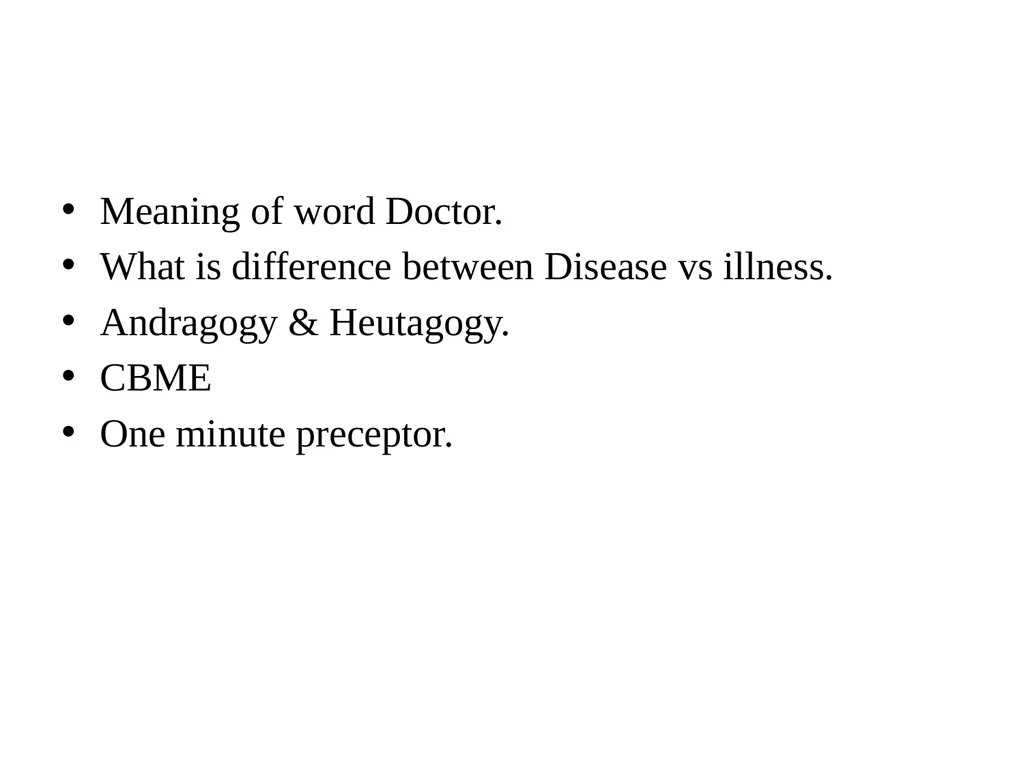
slide3. Meaning of word Doctor.
What is difference between Disease vs illness.
Andragogy & Heutagogy.
CBME
One minute preceptor.<br>
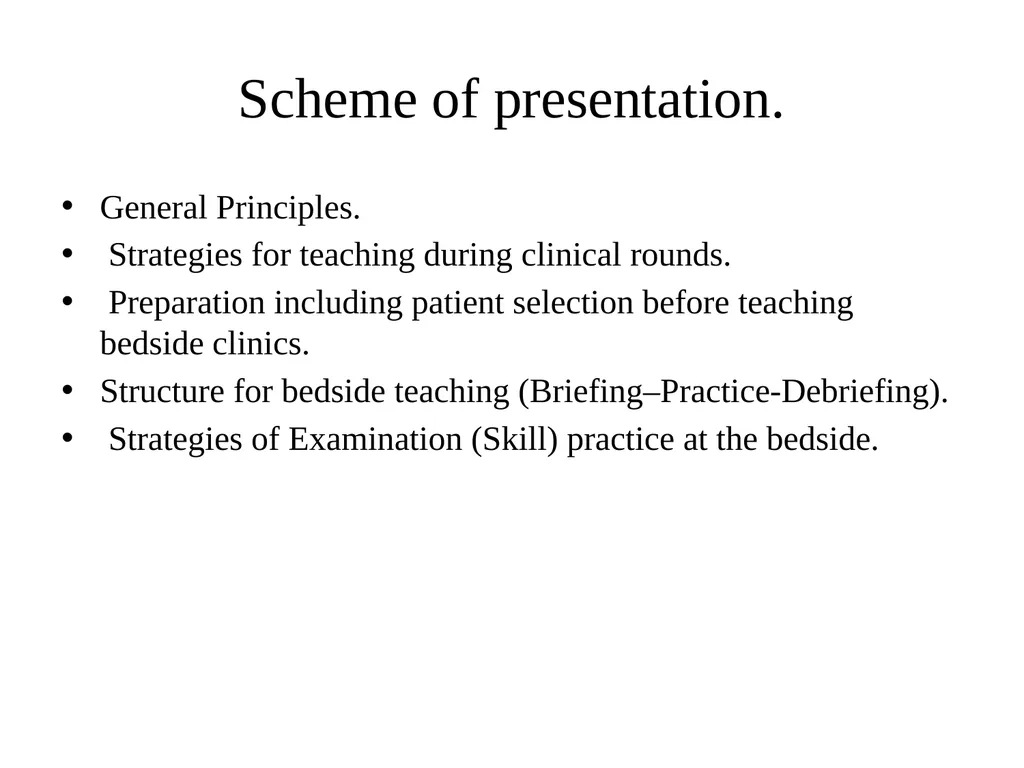
slide4. Scheme of presentation. General Principles.
Strategies for teaching during clinical rounds.
Preparation including patient selection before teaching bedside clinics.
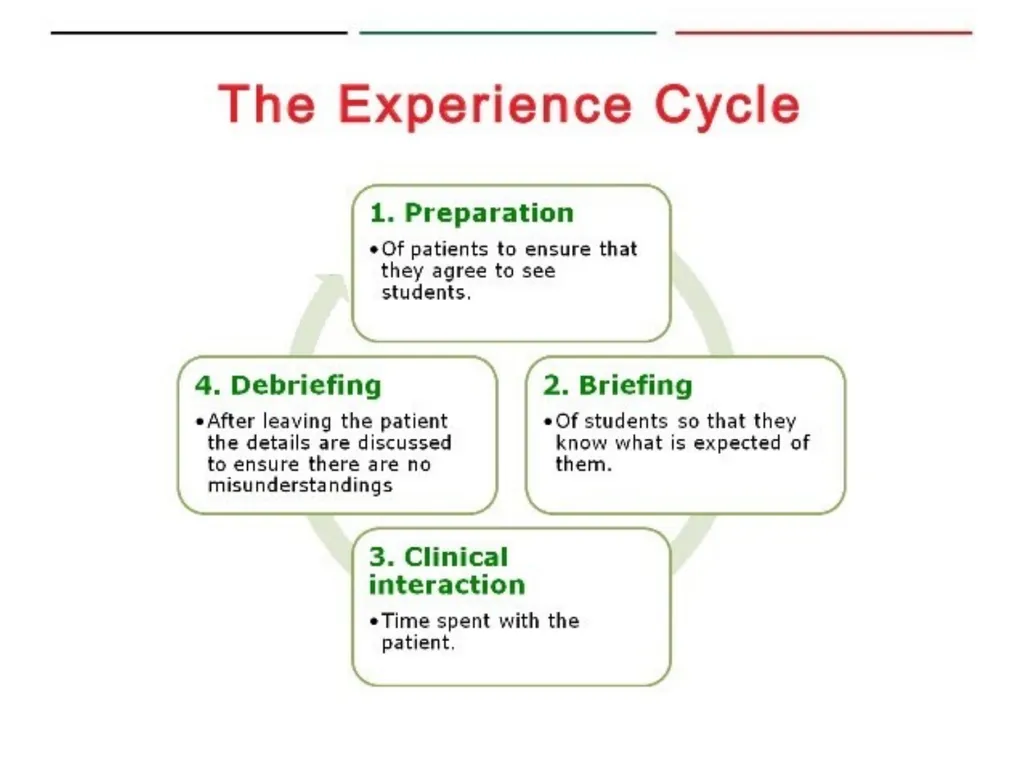
Structure for bedside teaching (Briefing–Practice-Debriefing).
Strategies of Examination (Skill) practice at the bedside.<br>
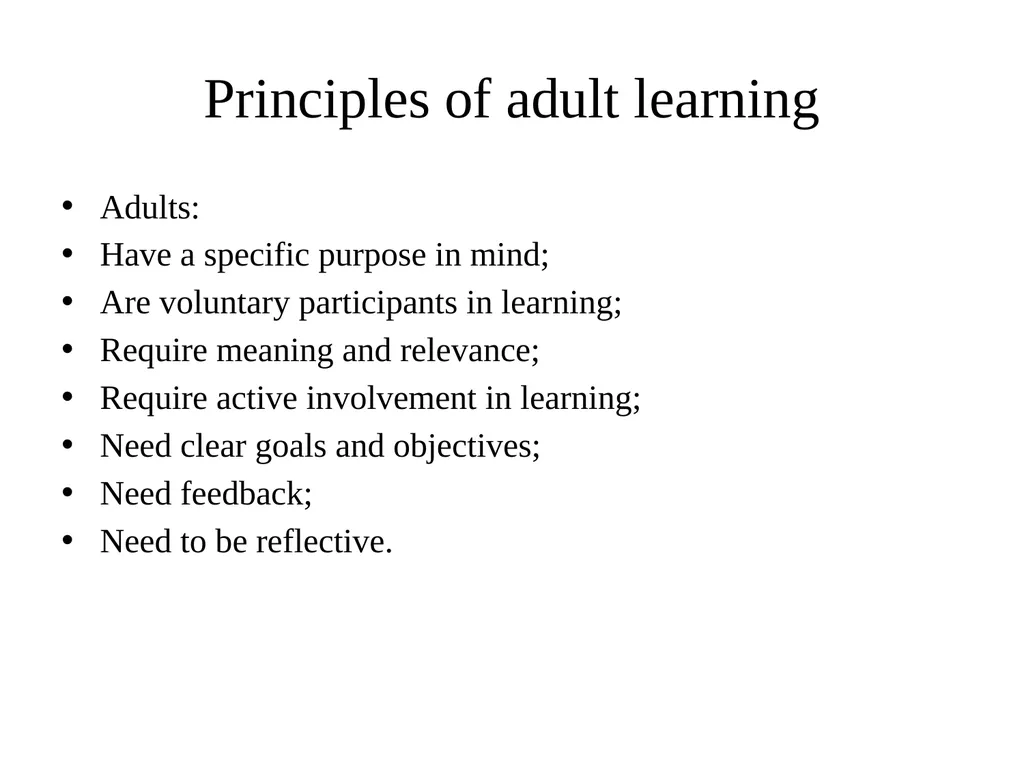
slide5. Principles of adult learning Adults:
Have a specific purpose in mind;
Are voluntary participants in learning;
Require meaning and relevance;
Require active involvement in learning;
Need clear goals and objectives;
Need feedback;
Need to be reflective.<br>
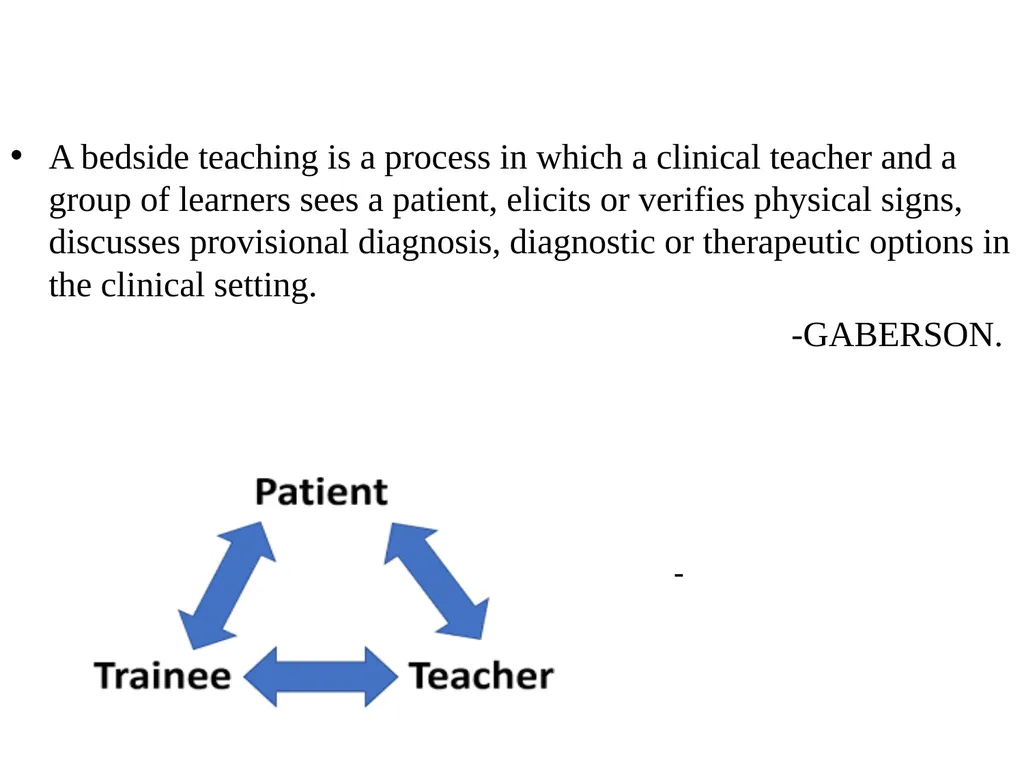
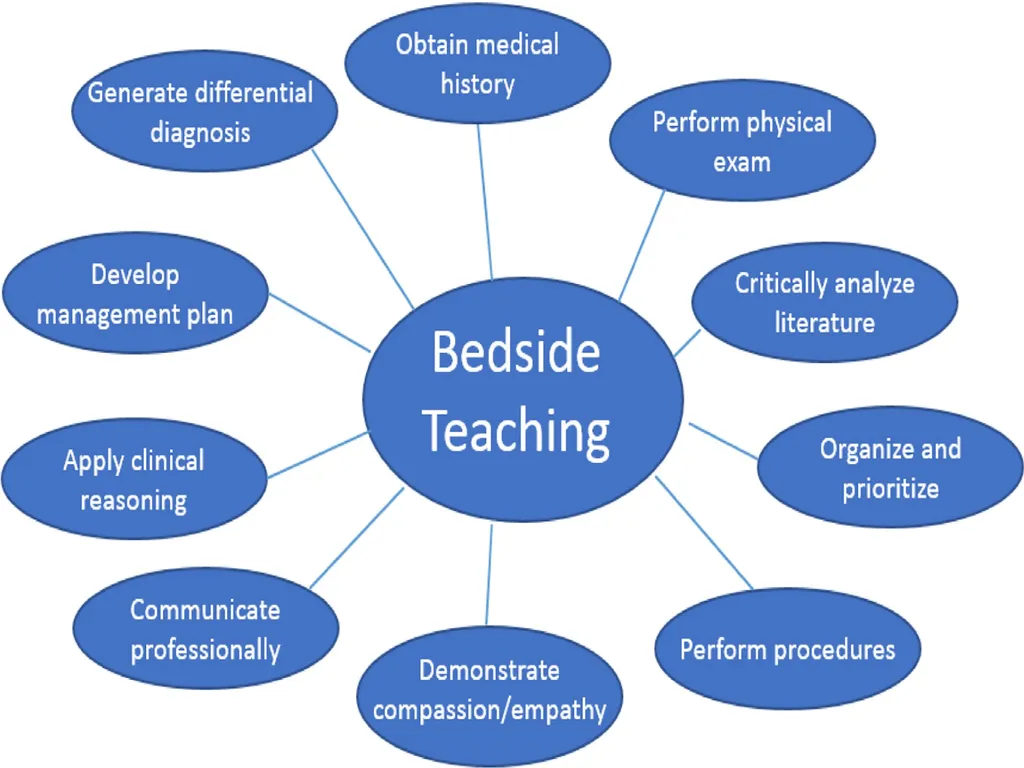
slide6. A bedside teaching is a process in which a clinical teacher and a group of learners sees a patient, elicits or verifies physical signs, discusses provisional diagnosis, diagnostic or therapeutic options in the clinical setting.
-GABERSON.
-<br>
slide7. Where bed side teaching done? Hospital.
Long-term care facility.
Out patient
Office/clinical setting.
Community.<br>
slide8. Patient-Centered Teaching Patient-centered teaching = Teaching what needs to be taught, for sake of patient
vs.
Teacher-centered teaching = Teaching what one knows, even if it does not address the patient’s problems
Treating the disease vs. treating the illness— effective teachers do not prioritize disease (what the patient has), but instead illness (what the patient feels)<br>
slide11. Problems with clinical teaching Lack of clear objectives and expectations.
Focus on recall of facts rather than problem solving.
Lack of active participation by learners.
Inadequate direct observation of learners and feedback.
Insufficient time for reflection and discussion.
Lack of congruence with the rest of the curriculum.<br>
slide12. Solutions for the problems Stanford faculty development model.
One-minute preceptor model.
SNAPPS model.<br>
slide13. Stanford Faculty Developmentmodel (1) Promoting a positive learning climate.
(2) Control of session.
(3) Communication of goals.
(4) Promoting understanding and retention.
(5) Evaluation.
(6) Feedback.
(7) Promoting self-directed learning.<br>
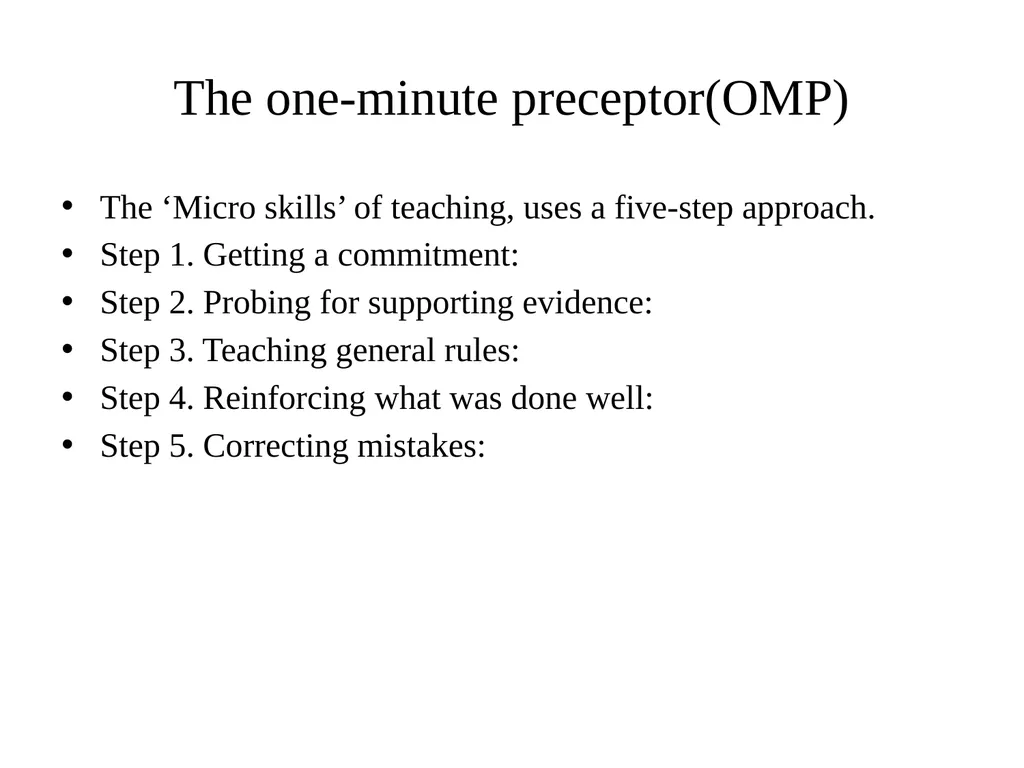
slide14. The one-minute preceptor(OMP) The ‘Micro skills’ of teaching, uses a five-step approach.
Step 1. Getting a commitment:
Step 2. Probing for supporting evidence:
Step 3. Teaching general rules:
Step 4. Reinforcing what was done well:
Step 5. Correcting mistakes:<br>
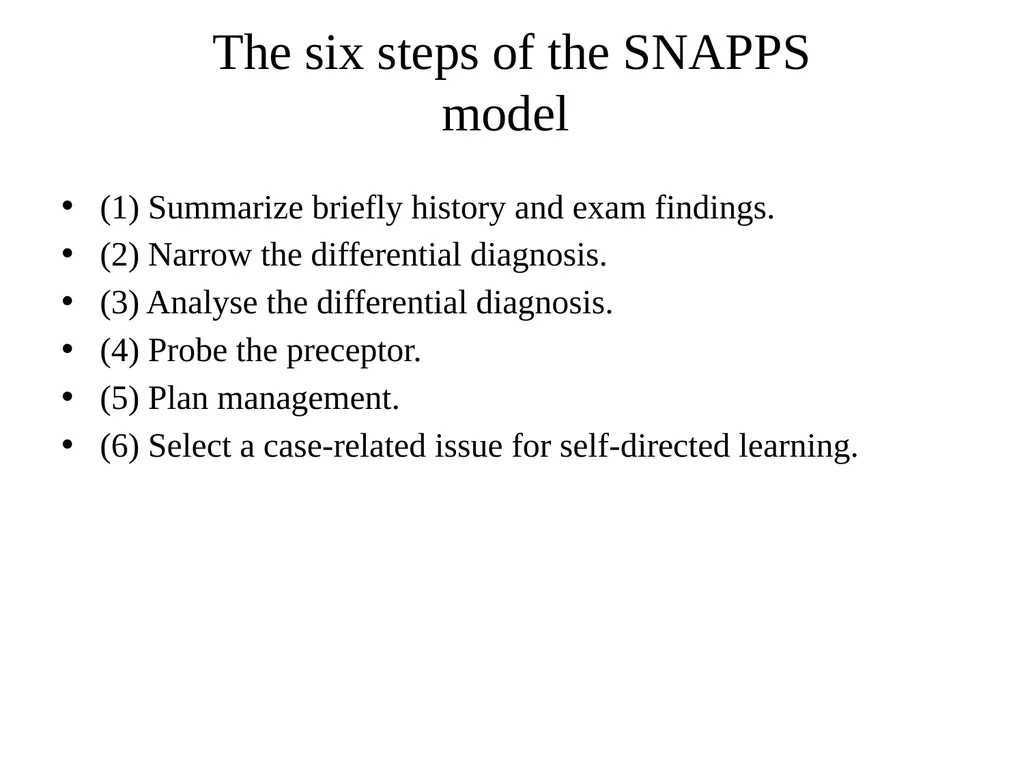
slide15. The six steps of the SNAPPSmodel (1) Summarize briefly history and exam findings.
(2) Narrow the differential diagnosis.
(3) Analyse the differential diagnosis.
(4) Probe the preceptor.
(5) Plan management.
(6) Select a case-related issue for self-directed learning.<br>
slide17. Steps of Bed-side teaching. Introduction
Discussion
Evaluation<br>
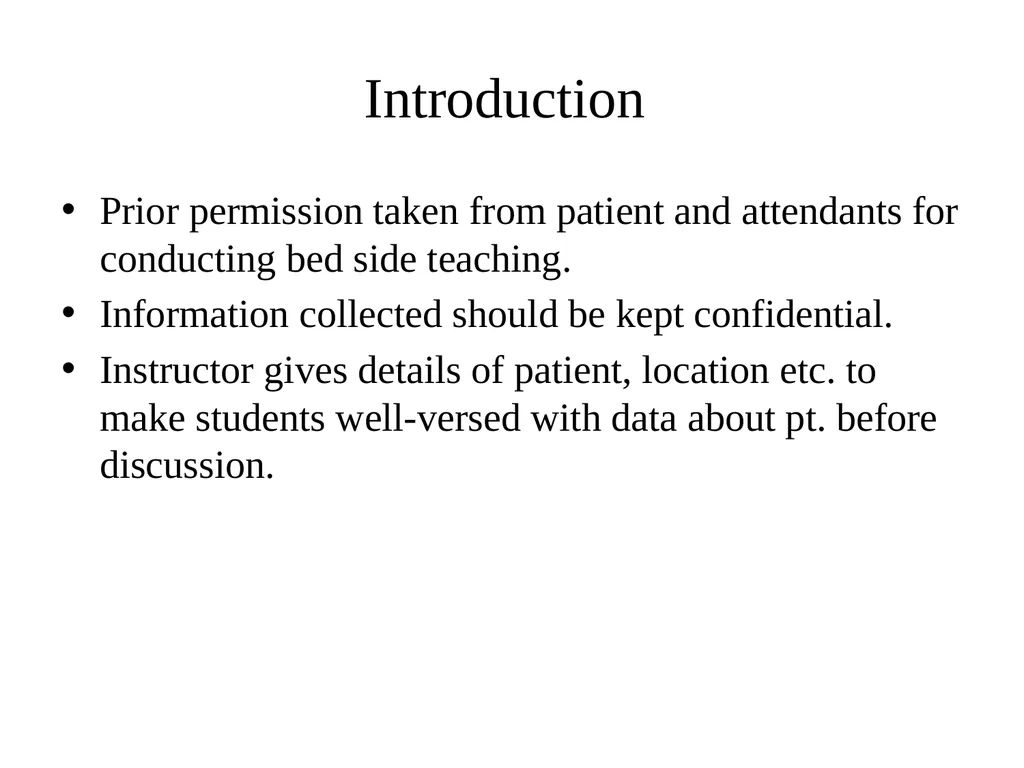
slide18. Introduction Prior permission taken from patient and attendants for conducting bed side teaching.
Information collected should be kept confidential.
Instructor gives details of patient, location etc. to make students well-versed with data about pt. before discussion.<br>
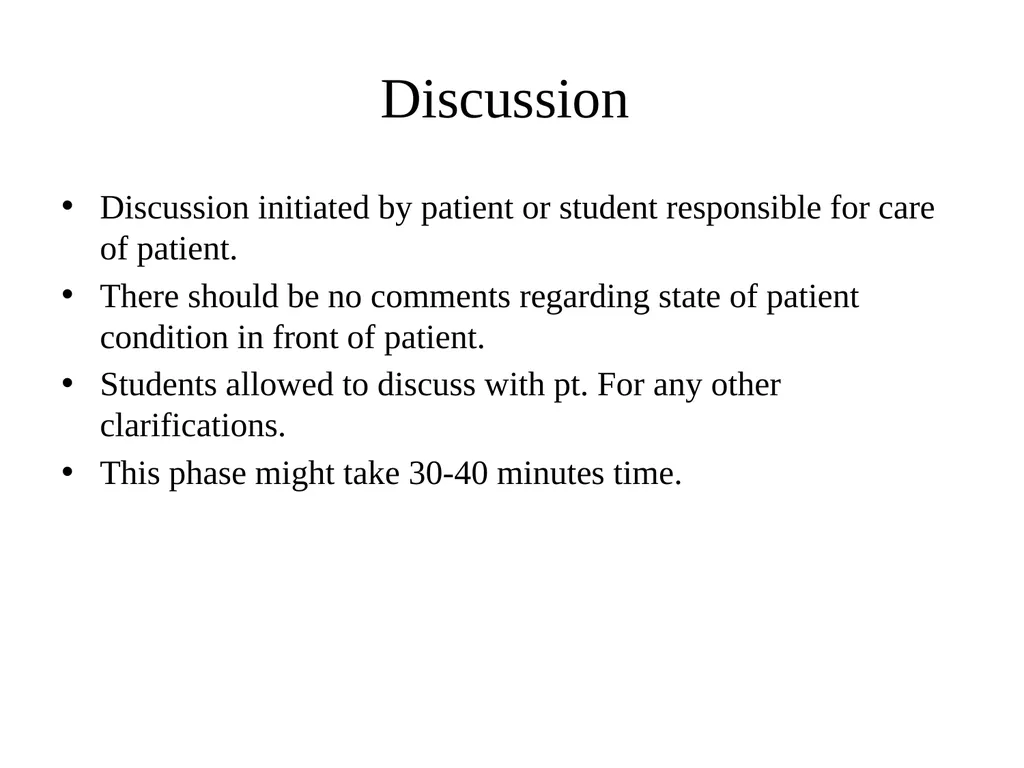
slide19. Discussion Discussion initiated by patient or student responsible for care of patient.
There should be no comments regarding state of patient condition in front of patient.
Students allowed to discuss with pt. For any other clarifications.
This phase might take 30-40 minutes time.<br>
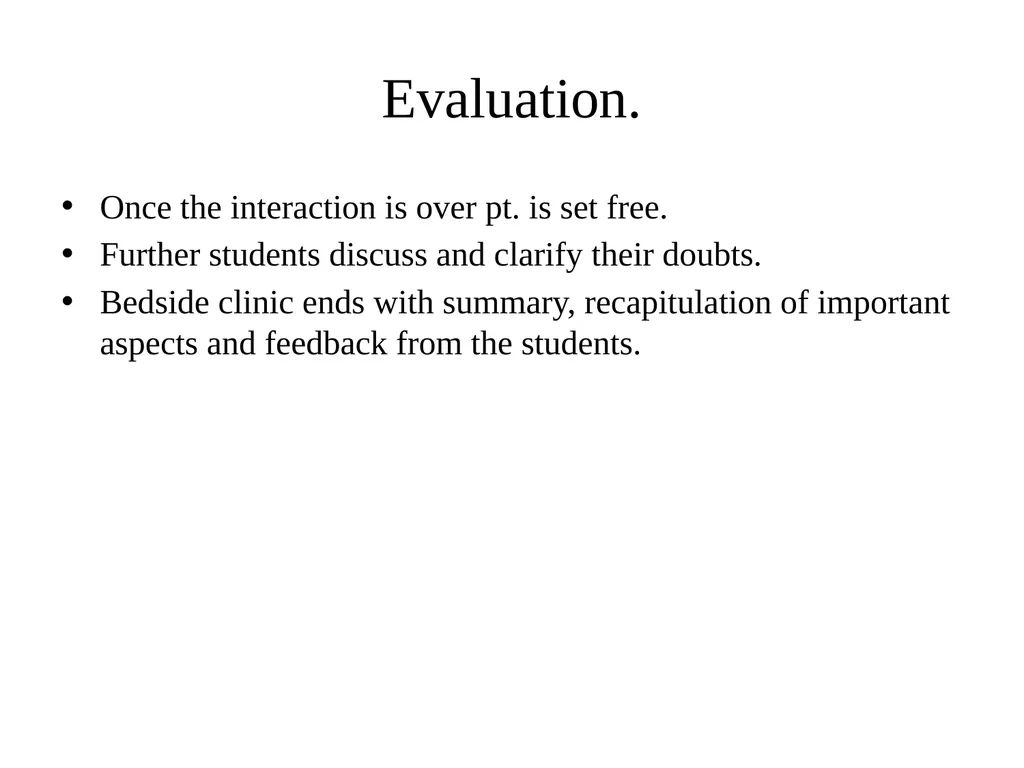
slide20. Evaluation. Once the interaction is over pt. is set free.
Further students discuss and clarify their doubts.
Bedside clinic ends with summary, recapitulation of important aspects and feedback from the students.<br>
slide22. Advantages It helps the student to prepare well in advance to participate effectively in discussion about pt. care.
It helps students to develop autonomy.
It allows students to select cases with diseases of common interest.
It helps the students to ably review and investigate the case and quality of patient care.
Allows students to develop reasoning, psychomotor and communication skills and professional competence.
Provides better understanding of illness and health care system and improves own performance of students.<br>
slide23. Disadvantages. Not-cost effectiveness.
Pt. privacy is disturbed.
Results in Poor Standardization.
Its narrowness limits the utilization of process.<br>
slide24. Teaching Techniques: TALK Think aloud
To highlight the process of expert reasoning.
Activate the mentee
Promote mentee’s initiative and autonomy.
Listen smart
Efficiently assess validity of mentee’s presentation.
Keep it simple
Model concise communication and rule-based decision making.<br>
slide25. Demonstration: Bedside Teaching Approach
Ask for two volunteers to be the mentor and the mentee.
Ask the volunteers to present the scene in front of the group.
Debrief the demonstration by discussing:
What did you think about this approach?
Is this an approach you could adopt in your mentoring?
Other reactions?<br>
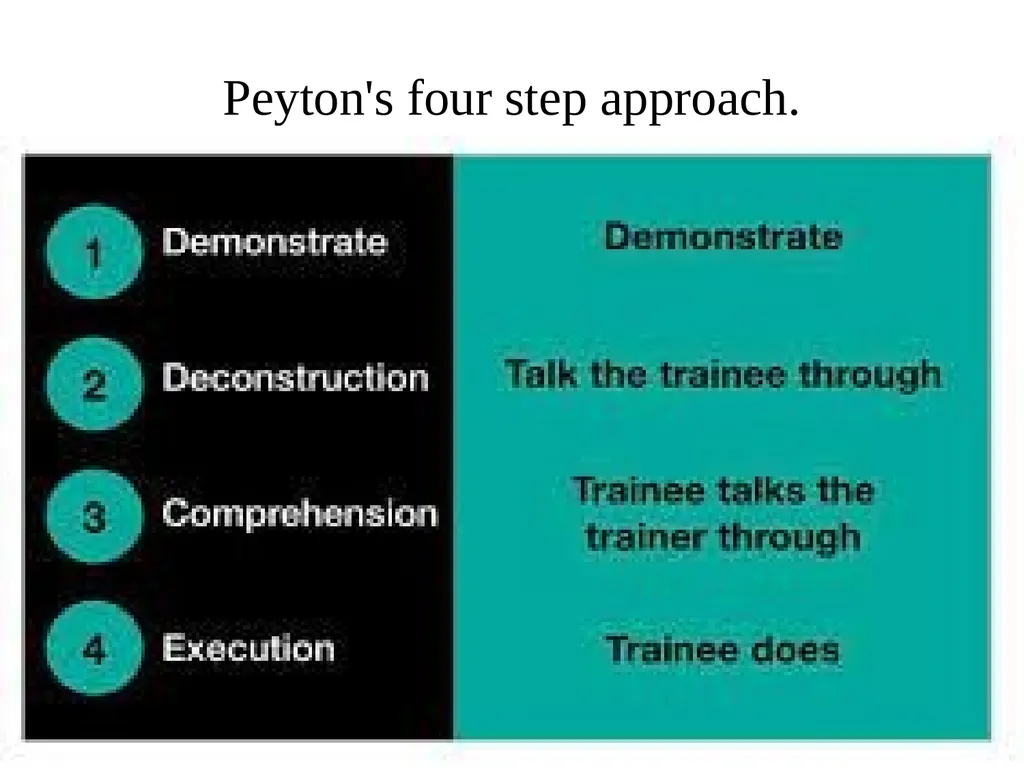
slide26. Peyton's four step approach.<br>
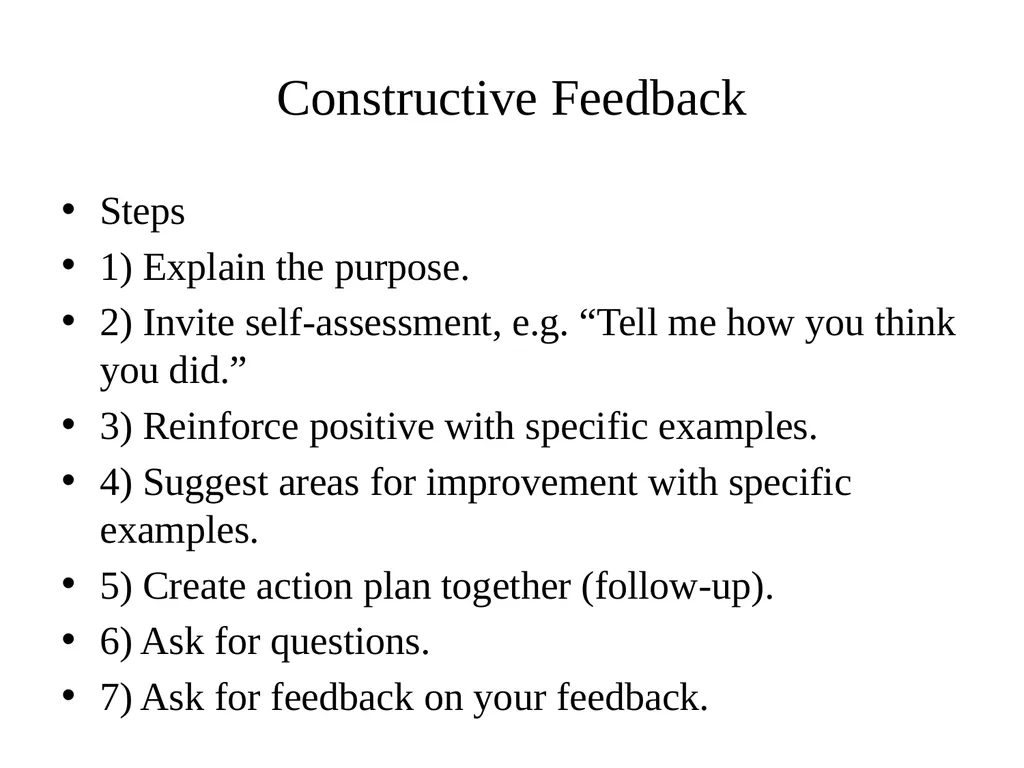
slide28. Constructive Feedback Steps
1) Explain the purpose.
2) Invite self-assessment, e.g. “Tell me how you think you did.”
3) Reinforce positive with specific examples.
4) Suggest areas for improvement with specific examples.
5) Create action plan together (follow-up).
6) Ask for questions.
7) Ask for feedback on your feedback.<br>
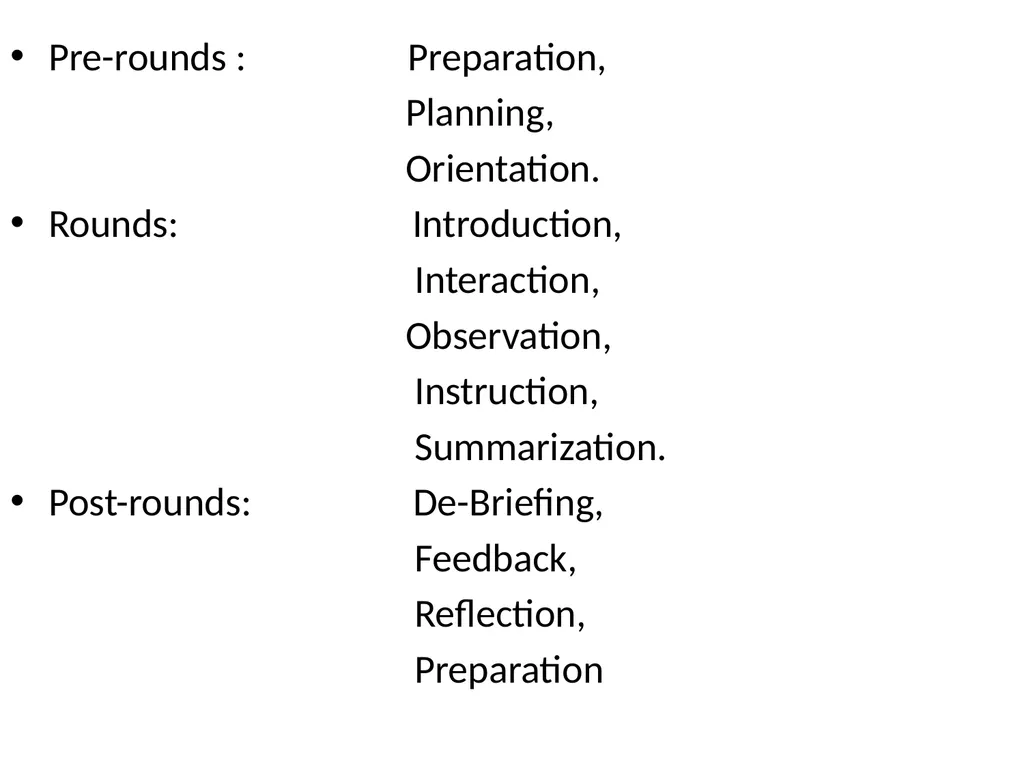
slide29. Pre-rounds : Preparation,
Planning,
Orientation.
Rounds: Introduction,
Interaction,
Observation,
Instruction,
Summarization.
Post-rounds: De-Briefing,
Feedback,
Reflection,
Preparation<br>
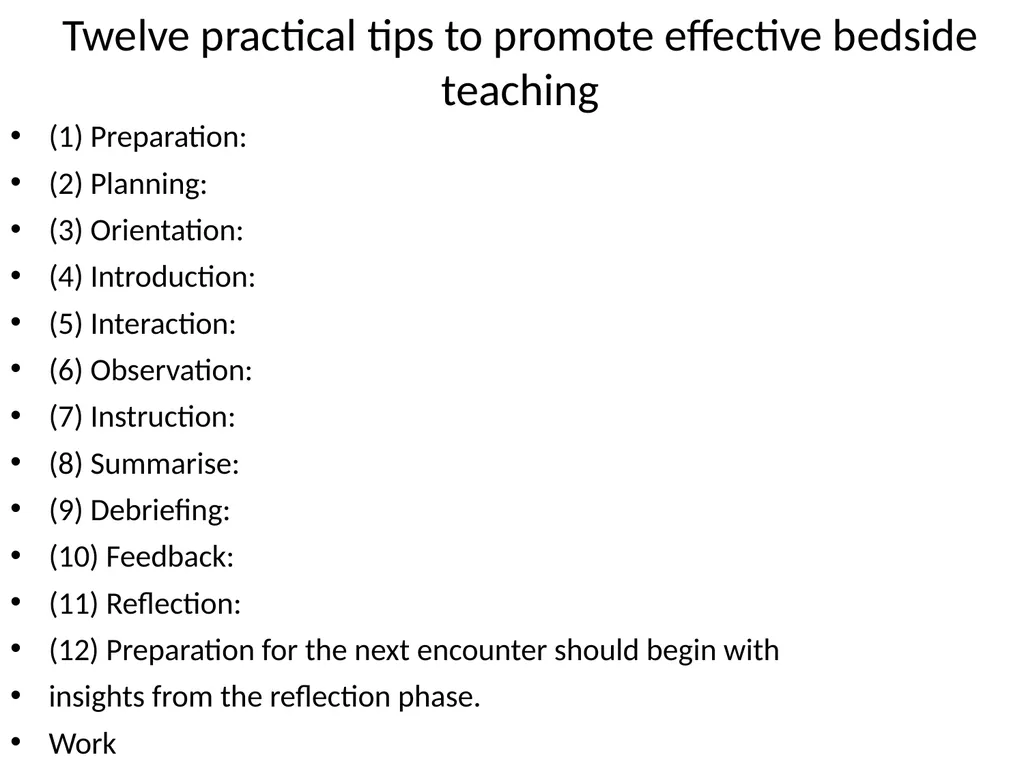
slide30. Twelve practical tips to promote effective bedside teaching (1) Preparation:
(2) Planning:
(3) Orientation:
(4) Introduction:
(5) Interaction:
(6) Observation:
(7) Instruction:
(8) Summarise:
(9) Debriefing:
(10) Feedback:
(11) Reflection:
(12) Preparation for the next encounter should begin with
insights from the reflection phase.
Work<br>
slide33. References Deza, C, Dickstein, A., Dmytrasz, K., Freebern, E., Kendale, S., Lucke, M., Meyer, C., Nathenson, M., Ritze, P., Sarges, P., Scaffidi, R., Silverman, E., Stafford, T., Taghizadeh, N., and Teplinsky, E., “Overcoming Common Clinical Teaching Challenges”, Faculty Development Handout. Tufts University School of Medicine,March 2009.
Edwards, J., Friedland, J. and Bing-You, R. (2002). Residents’ Teaching Skills. Springer Series on Medical Education.
Lyon, P. (2003). Making the most of learning in the operating theatre: student strategies and curricular initiatives. Medical Education 37:368-88.
Lyon, P. (2004). A model of teaching and learning in the operating theatre. Medical
Education 38:1278-1287.
Ramani, S. (2003). Twelve tips to improve bedside teaching. Medical Teacher 25:112-15.<br>

Professor & Head,
Department of Psychiatry,
N.M.C.H<br>
slide3. Meaning of word Doctor.
What is difference between Disease vs illness.
Andragogy & Heutagogy.
CBME
One minute preceptor.<br>
slide4. Scheme of presentation. General Principles.
Strategies for teaching during clinical rounds.
Preparation including patient selection before teaching bedside clinics.
Structure for bedside teaching (Briefing–Practice-Debriefing).
Strategies of Examination (Skill) practice at the bedside.<br>
slide5. Principles of adult learning Adults:
Have a specific purpose in mind;
Are voluntary participants in learning;
Require meaning and relevance;
Require active involvement in learning;
Need clear goals and objectives;
Need feedback;
Need to be reflective.<br>
slide6. A bedside teaching is a process in which a clinical teacher and a group of learners sees a patient, elicits or verifies physical signs, discusses provisional diagnosis, diagnostic or therapeutic options in the clinical setting.
-GABERSON.
-<br>
slide7. Where bed side teaching done? Hospital.
Long-term care facility.
Out patient
Office/clinical setting.
Community.<br>
slide8. Patient-Centered Teaching Patient-centered teaching = Teaching what needs to be taught, for sake of patient
vs.
Teacher-centered teaching = Teaching what one knows, even if it does not address the patient’s problems
Treating the disease vs. treating the illness— effective teachers do not prioritize disease (what the patient has), but instead illness (what the patient feels)<br>
slide11. Problems with clinical teaching Lack of clear objectives and expectations.
Focus on recall of facts rather than problem solving.
Lack of active participation by learners.
Inadequate direct observation of learners and feedback.
Insufficient time for reflection and discussion.
Lack of congruence with the rest of the curriculum.<br>
slide12. Solutions for the problems Stanford faculty development model.
One-minute preceptor model.
SNAPPS model.<br>
slide13. Stanford Faculty Developmentmodel (1) Promoting a positive learning climate.
(2) Control of session.
(3) Communication of goals.
(4) Promoting understanding and retention.
(5) Evaluation.
(6) Feedback.
(7) Promoting self-directed learning.<br>
slide14. The one-minute preceptor(OMP) The ‘Micro skills’ of teaching, uses a five-step approach.
Step 1. Getting a commitment:
Step 2. Probing for supporting evidence:
Step 3. Teaching general rules:
Step 4. Reinforcing what was done well:
Step 5. Correcting mistakes:<br>
slide15. The six steps of the SNAPPSmodel (1) Summarize briefly history and exam findings.
(2) Narrow the differential diagnosis.
(3) Analyse the differential diagnosis.
(4) Probe the preceptor.
(5) Plan management.
(6) Select a case-related issue for self-directed learning.<br>
slide17. Steps of Bed-side teaching. Introduction
Discussion
Evaluation<br>
slide18. Introduction Prior permission taken from patient and attendants for conducting bed side teaching.
Information collected should be kept confidential.
Instructor gives details of patient, location etc. to make students well-versed with data about pt. before discussion.<br>
slide19. Discussion Discussion initiated by patient or student responsible for care of patient.
There should be no comments regarding state of patient condition in front of patient.
Students allowed to discuss with pt. For any other clarifications.
This phase might take 30-40 minutes time.<br>
slide20. Evaluation. Once the interaction is over pt. is set free.
Further students discuss and clarify their doubts.
Bedside clinic ends with summary, recapitulation of important aspects and feedback from the students.<br>
slide22. Advantages It helps the student to prepare well in advance to participate effectively in discussion about pt. care.
It helps students to develop autonomy.
It allows students to select cases with diseases of common interest.
It helps the students to ably review and investigate the case and quality of patient care.
Allows students to develop reasoning, psychomotor and communication skills and professional competence.
Provides better understanding of illness and health care system and improves own performance of students.<br>
slide23. Disadvantages. Not-cost effectiveness.
Pt. privacy is disturbed.
Results in Poor Standardization.
Its narrowness limits the utilization of process.<br>
slide24. Teaching Techniques: TALK Think aloud
To highlight the process of expert reasoning.
Activate the mentee
Promote mentee’s initiative and autonomy.
Listen smart
Efficiently assess validity of mentee’s presentation.
Keep it simple
Model concise communication and rule-based decision making.<br>
slide25. Demonstration: Bedside Teaching Approach
Ask for two volunteers to be the mentor and the mentee.
Ask the volunteers to present the scene in front of the group.
Debrief the demonstration by discussing:
What did you think about this approach?
Is this an approach you could adopt in your mentoring?
Other reactions?<br>
slide26. Peyton's four step approach.<br>
slide28. Constructive Feedback Steps
1) Explain the purpose.
2) Invite self-assessment, e.g. “Tell me how you think you did.”
3) Reinforce positive with specific examples.
4) Suggest areas for improvement with specific examples.
5) Create action plan together (follow-up).
6) Ask for questions.
7) Ask for feedback on your feedback.<br>
slide29. Pre-rounds : Preparation,
Planning,
Orientation.
Rounds: Introduction,
Interaction,
Observation,
Instruction,
Summarization.
Post-rounds: De-Briefing,
Feedback,
Reflection,
Preparation<br>
slide30. Twelve practical tips to promote effective bedside teaching (1) Preparation:
(2) Planning:
(3) Orientation:
(4) Introduction:
(5) Interaction:
(6) Observation:
(7) Instruction:
(8) Summarise:
(9) Debriefing:
(10) Feedback:
(11) Reflection:
(12) Preparation for the next encounter should begin with
insights from the reflection phase.
Work<br>
slide33. References Deza, C, Dickstein, A., Dmytrasz, K., Freebern, E., Kendale, S., Lucke, M., Meyer, C., Nathenson, M., Ritze, P., Sarges, P., Scaffidi, R., Silverman, E., Stafford, T., Taghizadeh, N., and Teplinsky, E., “Overcoming Common Clinical Teaching Challenges”, Faculty Development Handout. Tufts University School of Medicine,March 2009.
Edwards, J., Friedland, J. and Bing-You, R. (2002). Residents’ Teaching Skills. Springer Series on Medical Education.
Lyon, P. (2003). Making the most of learning in the operating theatre: student strategies and curricular initiatives. Medical Education 37:368-88.
Lyon, P. (2004). A model of teaching and learning in the operating theatre. Medical
Education 38:1278-1287.
Ramani, S. (2003). Twelve tips to improve bedside teaching. Medical Teacher 25:112-15.<br>