
Dr Gillian Harris Understanding ARFID; diagnosis
CP
Published · 28 slides · 0 views

1 / 1




Description
Dr Gillian Harris Understanding ARFID; diagnosis and management BA, MSc, PhD, Cert Ed., AFBPsS, C.Psychol Consultant Clinical Psychologist Honorary Senior Research Fellow School of Psychology, University of Birmingham, School of Psychology,
Related Topics
Share
Embed code
Download this presentation From Below
"Dr Gillian Harris Understanding ARFID; diagnosis" is the property of its rightful owner. Permission is granted to download and print the materials on this website for personal, non-commercial use only, and to display it on your personal computer provided you do not modify the materials and that you retain all copyright notices contained in the materials. By downloading content from our website, you accept the terms of this agreement.
Presentation Transcript
01
Dr Gillian Harris
Understanding ARFID;
diagnosis and management
BA, MSc, PhD, Cert Ed., AFBPsS, C.Psychol
Consultant Clinical Psychologist
Honorary Senior Research Fellow
School of Psychology,
University of Birmingham,
School of Psychology,
University of Birmingham,
BA, MSc, PhD, Cert Ed., AFBPsS, C.Psychol.
Consultant Clinical Psychologist &
School of Psychology,
University of Birmingham,<br>
Understanding ARFID;
diagnosis and management
BA, MSc, PhD, Cert Ed., AFBPsS, C.Psychol
Consultant Clinical Psychologist
Honorary Senior Research Fellow
School of Psychology,
University of Birmingham,
School of Psychology,
University of Birmingham,
BA, MSc, PhD, Cert Ed., AFBPsS, C.Psychol.
Consultant Clinical Psychologist &
School of Psychology,
University of Birmingham,<br>
02
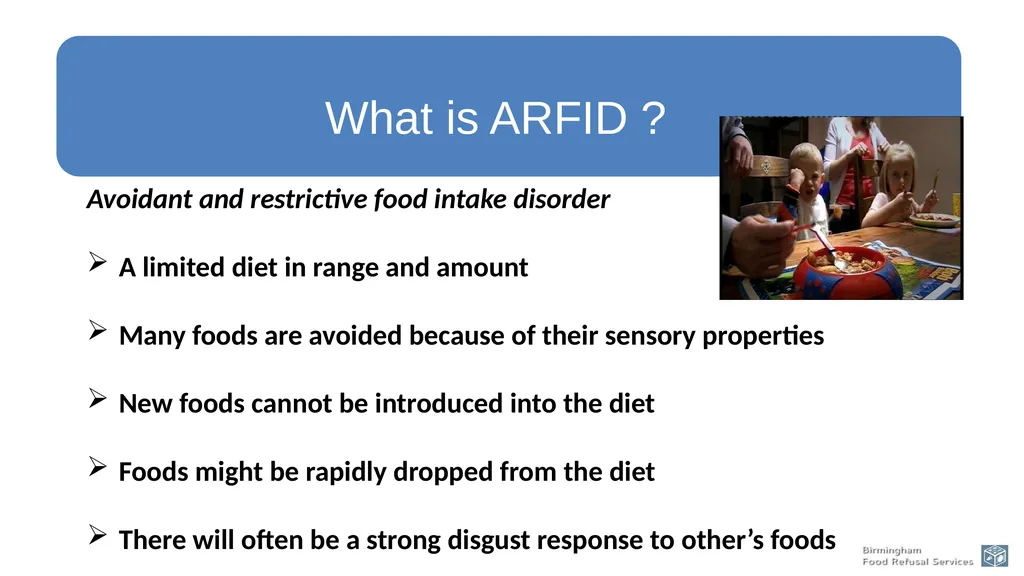
Avoidant and restrictive food intake disorder
A limited diet in range and amount
Many foods are avoided because of their sensory properties
New foods cannot be introduced into the diet
Foods might be rapidly dropped from the diet
There will often be a strong disgust response to other’s foods<br>
A limited diet in range and amount
Many foods are avoided because of their sensory properties
New foods cannot be introduced into the diet
Foods might be rapidly dropped from the diet
There will often be a strong disgust response to other’s foods<br>
03
Diagnostic criteria
The challenge of diagnosis DSM 5 (2013)
Lack of interest and avoidance of food
Sensory reactivity to foods
Concern about aversive consequences
Plus, one of the following
Significant weight loss
Significant dietary deficiency
Dependence on supplements or tube feeds
Psycho-social impairment due to food avoidance ICD 11 (2021)
Avoidance or restriction of food
Essential - either or both;-
Significant weight loss (may not be underweight )
Significant nutritional deficiency
And
Dependence on supplements or tube feeds
Significant psycho-social distress/ impairment due to food avoidance
Add on
Sensory reactivity
Lack of interest in food
Fear of aversive consequence<br>
Lack of interest and avoidance of food
Sensory reactivity to foods
Concern about aversive consequences
Plus, one of the following
Significant weight loss
Significant dietary deficiency
Dependence on supplements or tube feeds
Psycho-social impairment due to food avoidance ICD 11 (2021)
Avoidance or restriction of food
Essential - either or both;-
Significant weight loss (may not be underweight )
Significant nutritional deficiency
And
Dependence on supplements or tube feeds
Significant psycho-social distress/ impairment due to food avoidance
Add on
Sensory reactivity
Lack of interest in food
Fear of aversive consequence<br>
04
food has not been offered or is not available
there are concerns about weight or body image
the disorder is not better explained by another eating disorder
the disorder is not fully explained by another mental health or medical condition
So - exclude: - Anorexia nervosa, depression.
And - ICD11; ‘picky eating’ without dietary deficiency or weight loss<br>
there are concerns about weight or body image
the disorder is not better explained by another eating disorder
the disorder is not fully explained by another mental health or medical condition
So - exclude: - Anorexia nervosa, depression.
And - ICD11; ‘picky eating’ without dietary deficiency or weight loss<br>
05
For both DSM and ICD
Medical:
reflux, allergies, gastro-intestinal disorders, metabolic disorders
Mental health/ developmental:
Autism spectrum disorder -> Due to sensory processing difficulties
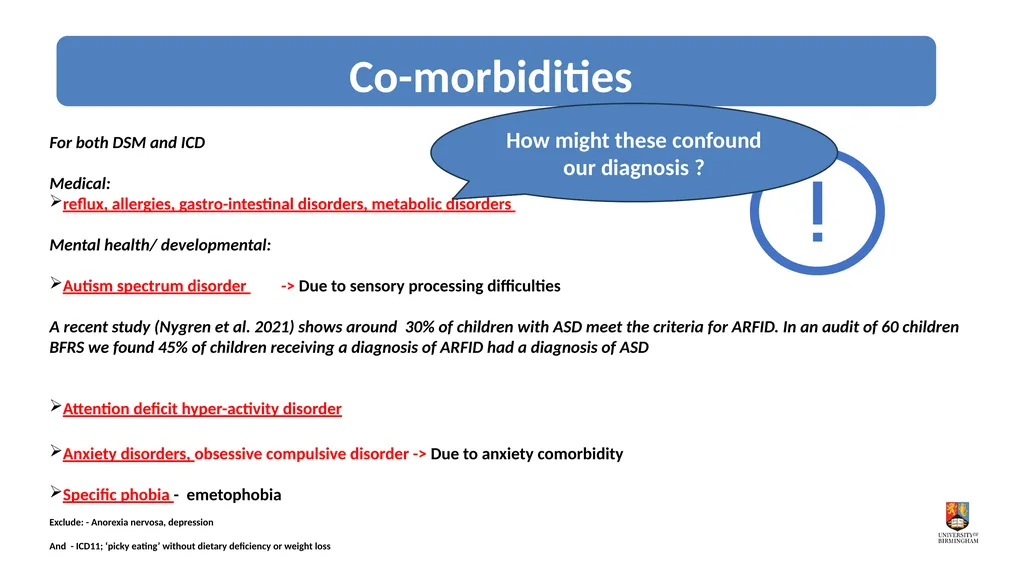
A recent study (Nygren et al. 2021) shows around 30% of children with ASD meet the criteria for ARFID. In an audit of 60 children BFRS we found 45% of children receiving a diagnosis of ARFID had a diagnosis of ASD
Attention deficit hyper-activity disorder
Anxiety disorders, obsessive compulsive disorder -> Due to anxiety comorbidity
Specific phobia - emetophobia
Exclude: - Anorexia nervosa, depression
And - ICD11; ‘picky eating’ without dietary deficiency or weight loss How might these confound our diagnosis ?<br>
Medical:
reflux, allergies, gastro-intestinal disorders, metabolic disorders
Mental health/ developmental:
Autism spectrum disorder -> Due to sensory processing difficulties
A recent study (Nygren et al. 2021) shows around 30% of children with ASD meet the criteria for ARFID. In an audit of 60 children BFRS we found 45% of children receiving a diagnosis of ARFID had a diagnosis of ASD
Attention deficit hyper-activity disorder
Anxiety disorders, obsessive compulsive disorder -> Due to anxiety comorbidity
Specific phobia - emetophobia
Exclude: - Anorexia nervosa, depression
And - ICD11; ‘picky eating’ without dietary deficiency or weight loss How might these confound our diagnosis ?<br>
06
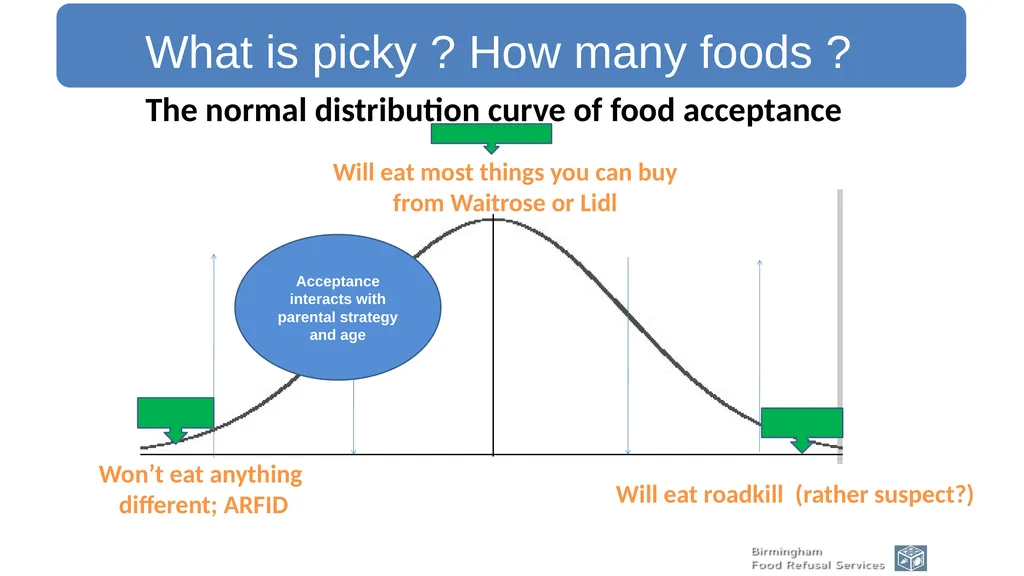
Won’t eat anything
different; ARFID Will eat roadkill (rather suspect?) Will eat most things you can buy from Waitrose or Lidl The normal distribution curve of food acceptance Acceptance interacts with parental strategy and age<br>
different; ARFID Will eat roadkill (rather suspect?) Will eat most things you can buy from Waitrose or Lidl The normal distribution curve of food acceptance Acceptance interacts with parental strategy and age<br>
07
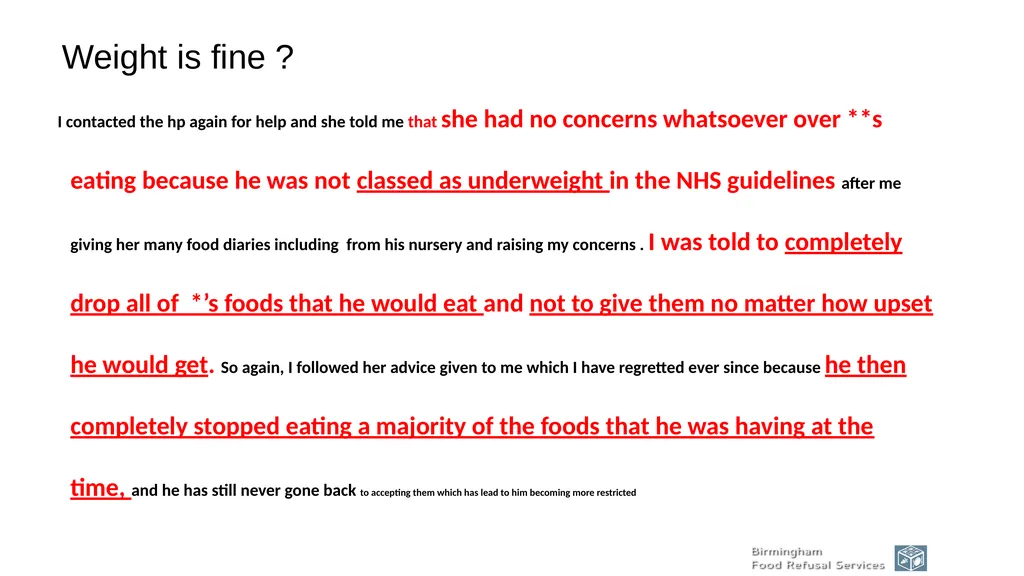
I contacted the hp again for help and she told me that she had no concerns whatsoever over **s eating because he was not classed as underweight in the NHS guidelines after me giving her many food diaries including from his nursery and raising my concerns . I was told to completely drop all of *’s foods that he would eat and not to give them no matter how upset he would get. So again, I followed her advice given to me which I have regretted ever since because he then completely stopped eating a majority of the foods that he was having at the time, and he has still never gone back to accepting them which has lead to him becoming more restricted Weight is fine ?<br>
08
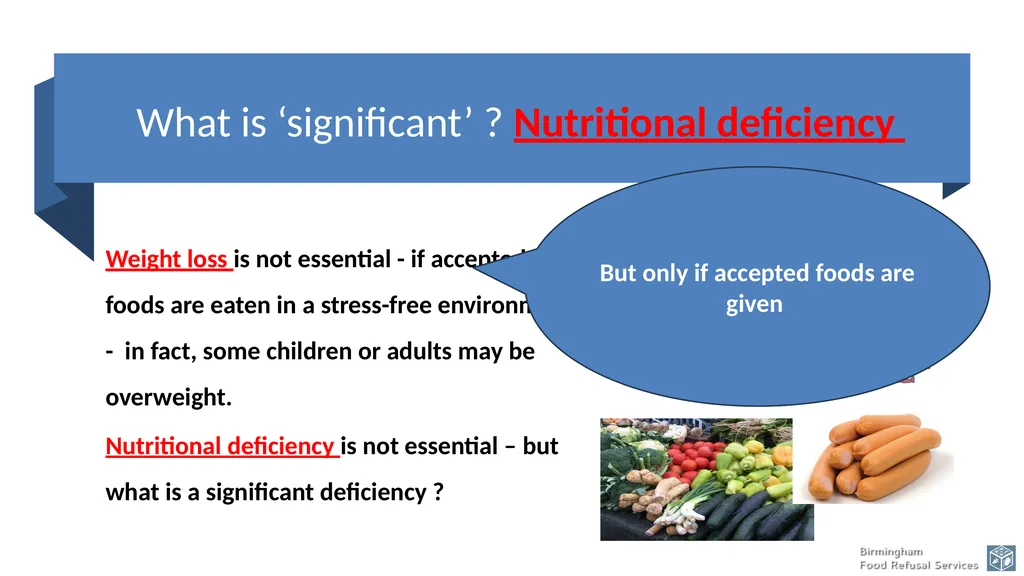
What is ‘significant’ ? Nutritional deficiency Weight loss is not essential - if accepted foods are eaten in a stress-free environment - in fact, some children or adults may be overweight.
Nutritional deficiency is not essential – but what is a significant deficiency ? But only if accepted foods are given<br>
Nutritional deficiency is not essential – but what is a significant deficiency ? But only if accepted foods are given<br>
09
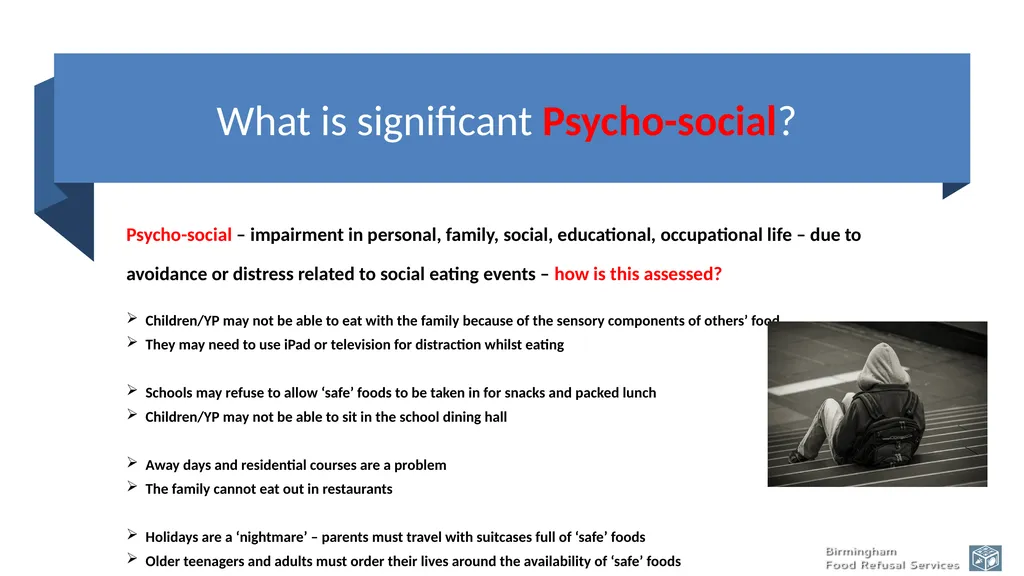
What is significant Psycho-social? Psycho-social – impairment in personal, family, social, educational, occupational life – due to avoidance or distress related to social eating events – how is this assessed?
Children/YP may not be able to eat with the family because of the sensory components of others’ food
They may need to use iPad or television for distraction whilst eating
Schools may refuse to allow ‘safe’ foods to be taken in for snacks and packed lunch
Children/YP may not be able to sit in the school dining hall
Away days and residential courses are a problem
The family cannot eat out in restaurants
Holidays are a ‘nightmare’ – parents must travel with suitcases full of ‘safe’ foods
Older teenagers and adults must order their lives around the availability of ‘safe’ foods<br>
Children/YP may not be able to eat with the family because of the sensory components of others’ food
They may need to use iPad or television for distraction whilst eating
Schools may refuse to allow ‘safe’ foods to be taken in for snacks and packed lunch
Children/YP may not be able to sit in the school dining hall
Away days and residential courses are a problem
The family cannot eat out in restaurants
Holidays are a ‘nightmare’ – parents must travel with suitcases full of ‘safe’ foods
Older teenagers and adults must order their lives around the availability of ‘safe’ foods<br>
10
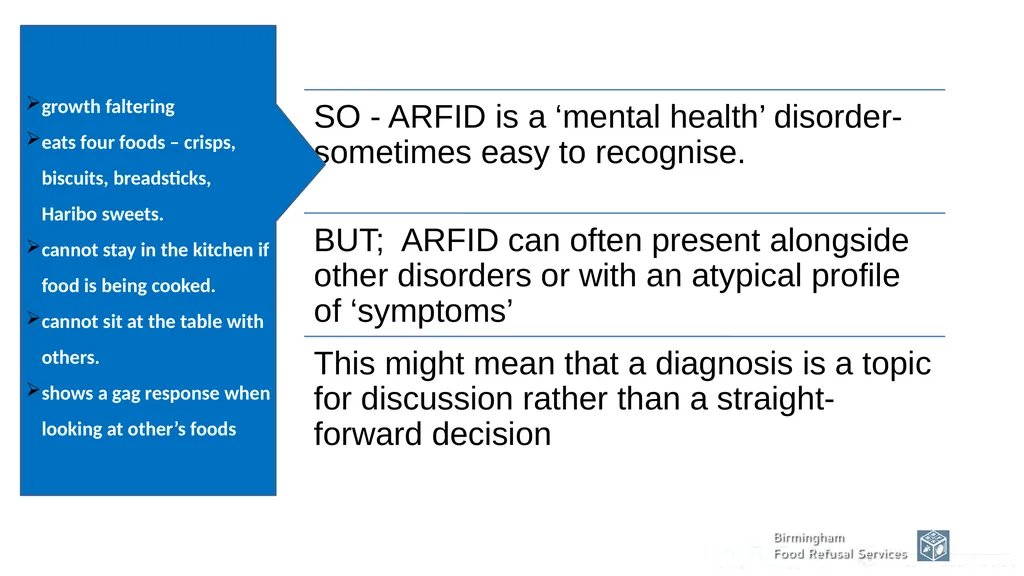
growth faltering
eats four foods – crisps, biscuits, breadsticks, Haribo sweets.
cannot stay in the kitchen if food is being cooked.
cannot sit at the table with others.
shows a gag response when looking at other’s foods<br>
eats four foods – crisps, biscuits, breadsticks, Haribo sweets.
cannot stay in the kitchen if food is being cooked.
cannot sit at the table with others.
shows a gag response when looking at other’s foods<br>
11
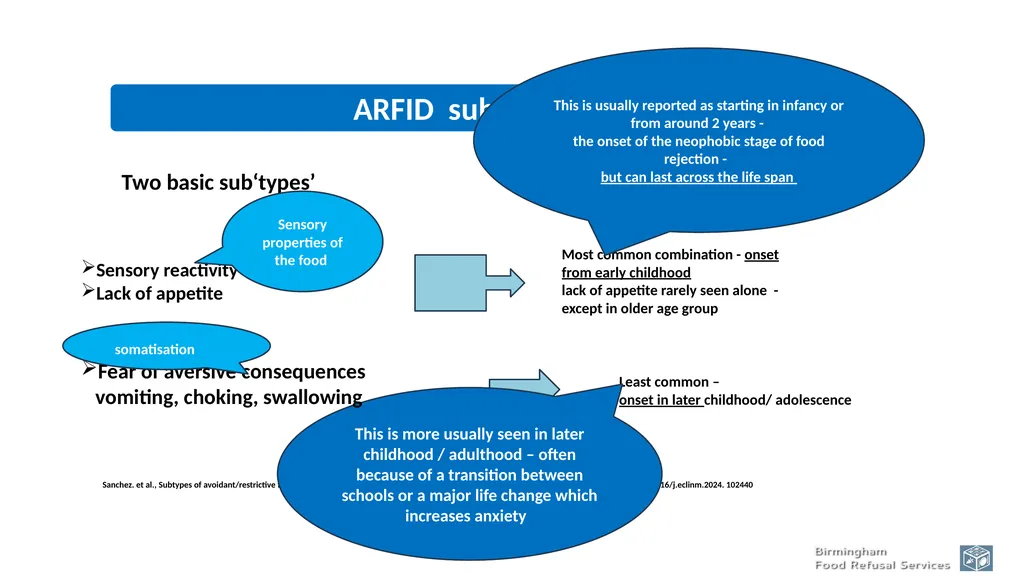
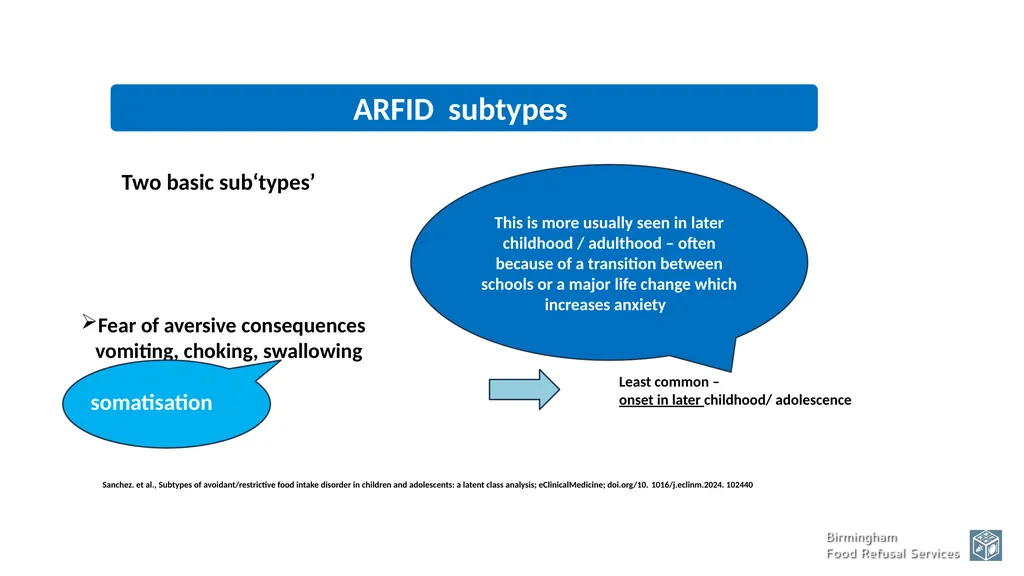
Two basic sub‘types’ Most common combination - onset from early childhood
lack of appetite rarely seen alone - except in older age group Least common –
onset in later childhood/ adolescence Sanchez. et al., Subtypes of avoidant/restrictive food intake disorder in children and adolescents: a latent class analysis; eClinicalMedicine; doi.org/10. 1016/j.eclinm.2024. 102440 ARFID subtypes This is usually reported as starting in infancy or from around 2 years -
the onset of the neophobic stage of food rejection -
but can last across the life span This is more usually seen in later childhood / adulthood – often because of a transition between schools or a major life change which increases anxiety Sensory reactivity
Lack of appetite
Fear of aversive consequences
vomiting, choking, swallowing somatisation Sensory properties of the food<br>
lack of appetite rarely seen alone - except in older age group Least common –
onset in later childhood/ adolescence Sanchez. et al., Subtypes of avoidant/restrictive food intake disorder in children and adolescents: a latent class analysis; eClinicalMedicine; doi.org/10. 1016/j.eclinm.2024. 102440 ARFID subtypes This is usually reported as starting in infancy or from around 2 years -
the onset of the neophobic stage of food rejection -
but can last across the life span This is more usually seen in later childhood / adulthood – often because of a transition between schools or a major life change which increases anxiety Sensory reactivity
Lack of appetite
Fear of aversive consequences
vomiting, choking, swallowing somatisation Sensory properties of the food<br>
12
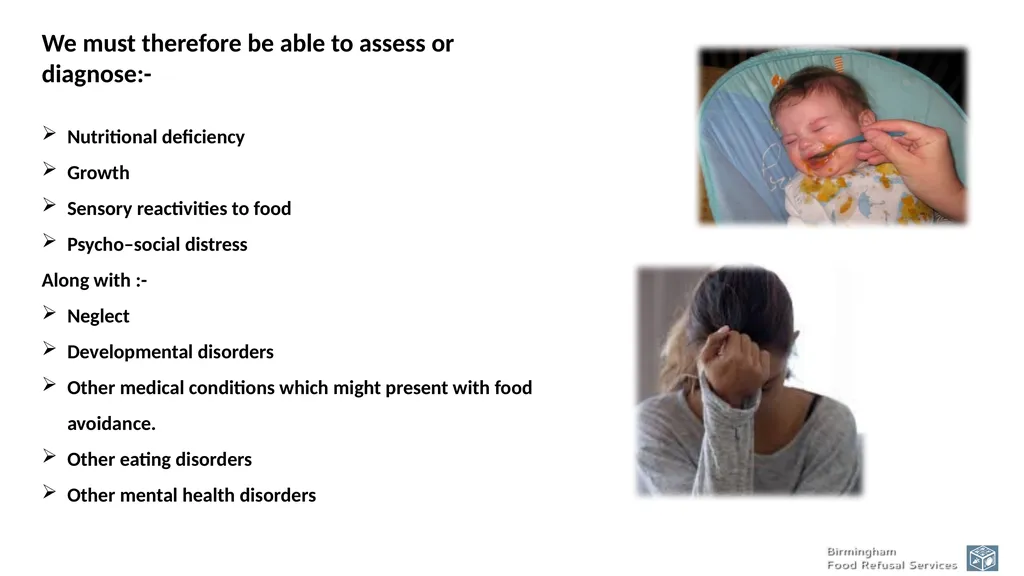
We must therefore be able to assess or diagnose:-
Nutritional deficiency
Growth
Sensory reactivities to food
Psycho–social distress
Along with :-
Neglect
Developmental disorders
Other medical conditions which might present with food avoidance.
Other eating disorders
Other mental health disorders<br>
Nutritional deficiency
Growth
Sensory reactivities to food
Psycho–social distress
Along with :-
Neglect
Developmental disorders
Other medical conditions which might present with food avoidance.
Other eating disorders
Other mental health disorders<br>
13
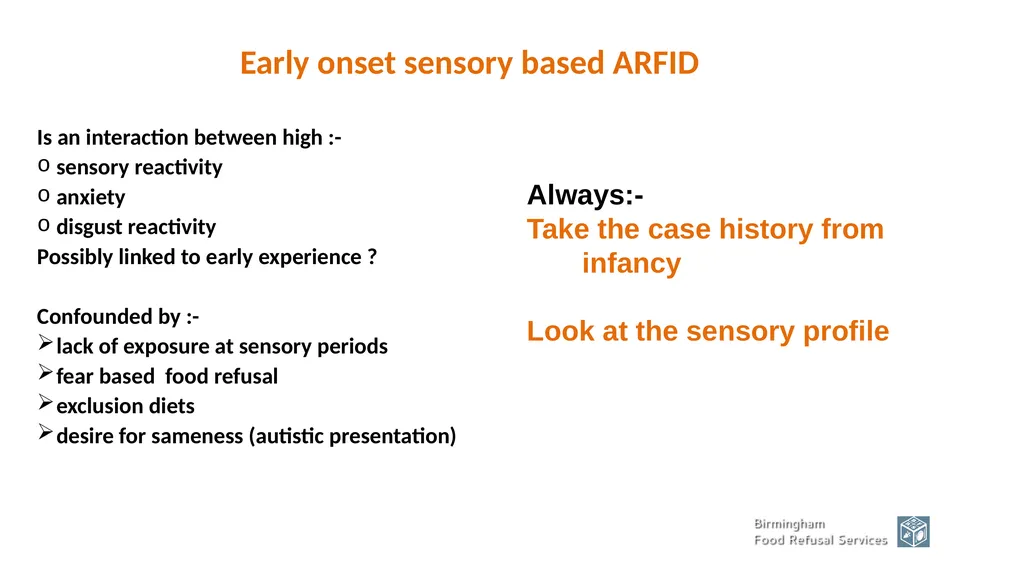
Early onset sensory based ARFID Is an interaction between high :-
sensory reactivity
anxiety
disgust reactivity
Possibly linked to early experience ?
Confounded by :-
lack of exposure at sensory periods
fear based food refusal
exclusion diets
desire for sameness (autistic presentation) Always:-
Take the case history from infancy
Look at the sensory profile<br>
sensory reactivity
anxiety
disgust reactivity
Possibly linked to early experience ?
Confounded by :-
lack of exposure at sensory periods
fear based food refusal
exclusion diets
desire for sameness (autistic presentation) Always:-
Take the case history from infancy
Look at the sensory profile<br>
14
Onset -Sensory factors - relating to food
these define ARFID – how are they assessed? They interact with social impairment and lead to the:-
avoidance of foods because of their sensory properties
avoidance of social events because of the sensory reactivity to others’ foods.
disgust and contamination responses (somatosensory disgust)
A child with ARFID -
“I can’t eat the pancake at the bottom of the pile – it tastes of plate” Early Onset -Sensory factors - relating to food these define ARFID – how are they assessed? This also interacts with a developmental stage -
the neophobic response<br>
avoidance of foods because of their sensory properties
avoidance of social events because of the sensory reactivity to others’ foods.
disgust and contamination responses (somatosensory disgust)
A child with ARFID -
“I can’t eat the pancake at the bottom of the pile – it tastes of plate” Early Onset -Sensory factors - relating to food these define ARFID – how are they assessed? This also interacts with a developmental stage -
the neophobic response<br>
15
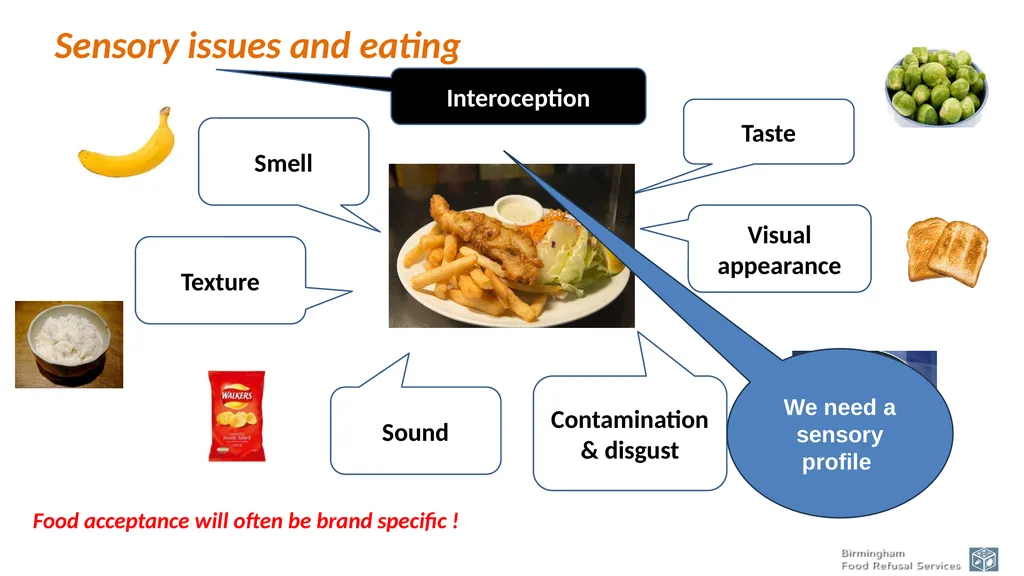
Smell Texture Taste Sound Visual appearance Sensory issues and eating Contamination & disgust Food acceptance will often be brand specific ! Interoception We need a sensory profile<br>
16
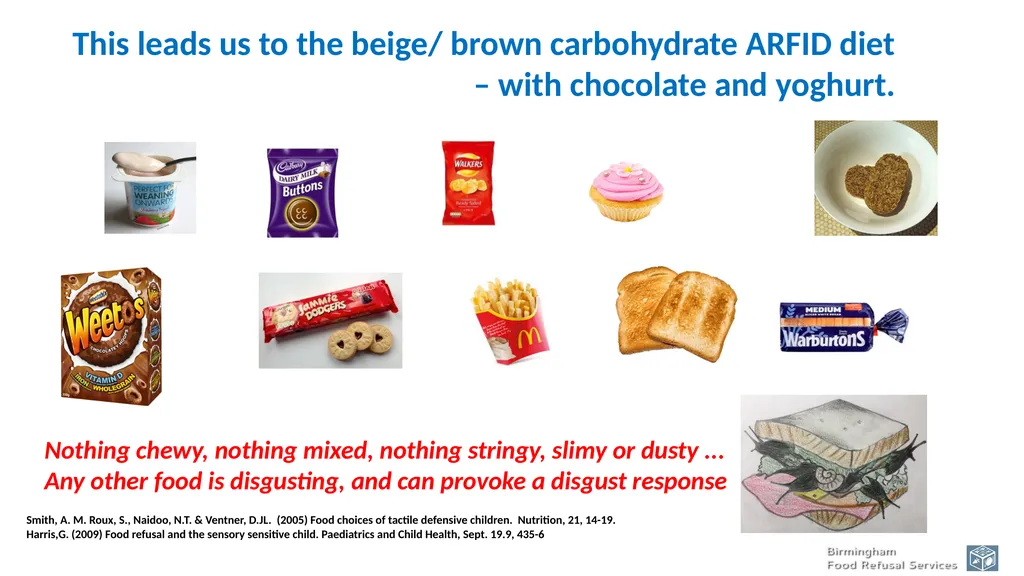
This leads us to the beige/ brown carbohydrate ARFID diet – with chocolate and yoghurt. Nothing chewy, nothing mixed, nothing stringy, slimy or dusty ...
Any other food is disgusting, and can provoke a disgust response Smith, A. M. Roux, S., Naidoo, N.T. & Ventner, D.JL. (2005) Food choices of tactile defensive children. Nutrition, 21, 14-19. Harris,G. (2009) Food refusal and the sensory sensitive child. Paediatrics and Child Health, Sept. 19.9, 435-6<br>
Any other food is disgusting, and can provoke a disgust response Smith, A. M. Roux, S., Naidoo, N.T. & Ventner, D.JL. (2005) Food choices of tactile defensive children. Nutrition, 21, 14-19. Harris,G. (2009) Food refusal and the sensory sensitive child. Paediatrics and Child Health, Sept. 19.9, 435-6<br>
17
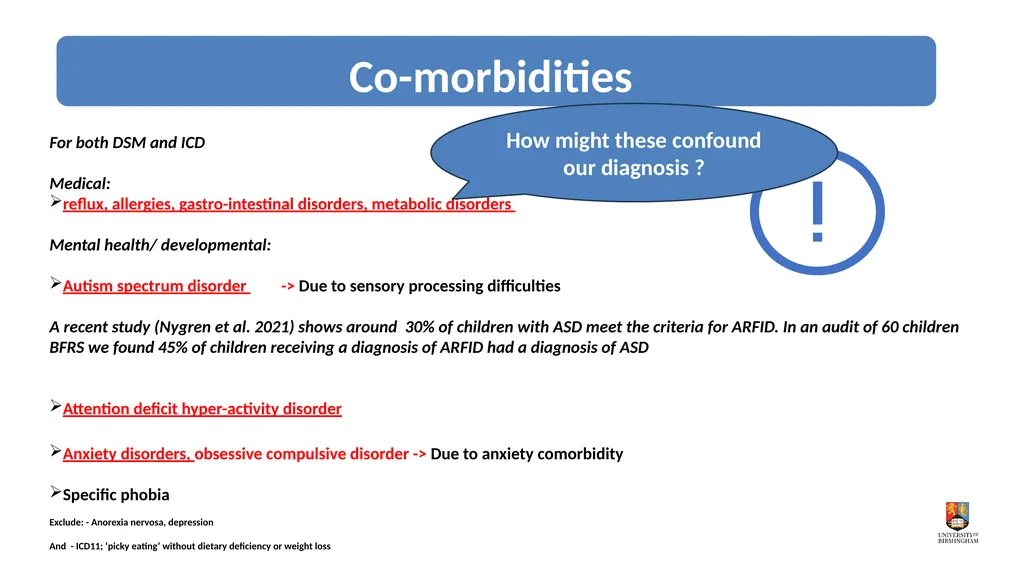
For both DSM and ICD
Medical:
reflux, allergies, gastro-intestinal disorders, metabolic disorders
Mental health/ developmental:
Autism spectrum disorder -> Due to sensory processing difficulties
A recent study (Nygren et al. 2021) shows around 30% of children with ASD meet the criteria for ARFID. In an audit of 60 children BFRS we found 45% of children receiving a diagnosis of ARFID had a diagnosis of ASD
Attention deficit hyper-activity disorder
Anxiety disorders, obsessive compulsive disorder -> Due to anxiety comorbidity
Specific phobia
Exclude: - Anorexia nervosa, depression
And - ICD11; ‘picky eating’ without dietary deficiency or weight loss How might these confound our diagnosis ?<br>
Medical:
reflux, allergies, gastro-intestinal disorders, metabolic disorders
Mental health/ developmental:
Autism spectrum disorder -> Due to sensory processing difficulties
A recent study (Nygren et al. 2021) shows around 30% of children with ASD meet the criteria for ARFID. In an audit of 60 children BFRS we found 45% of children receiving a diagnosis of ARFID had a diagnosis of ASD
Attention deficit hyper-activity disorder
Anxiety disorders, obsessive compulsive disorder -> Due to anxiety comorbidity
Specific phobia
Exclude: - Anorexia nervosa, depression
And - ICD11; ‘picky eating’ without dietary deficiency or weight loss How might these confound our diagnosis ?<br>
18
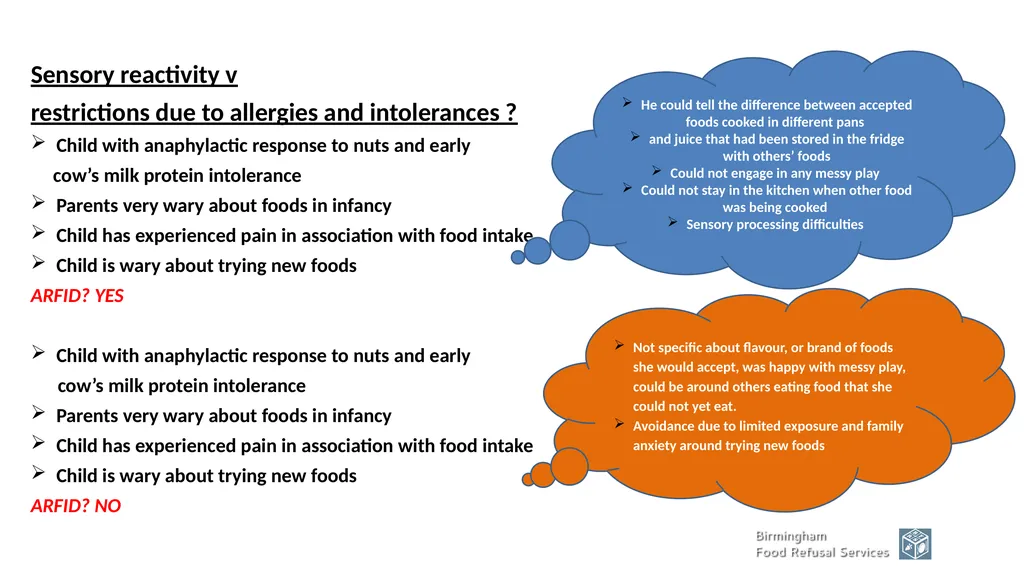
Sensory reactivity v
restrictions due to allergies and intolerances ?
Child with anaphylactic response to nuts and early
cow’s milk protein intolerance
Parents very wary about foods in infancy
Child has experienced pain in association with food intake
Child is wary about trying new foods
ARFID? YES
Child with anaphylactic response to nuts and early
cow’s milk protein intolerance
Parents very wary about foods in infancy
Child has experienced pain in association with food intake
Child is wary about trying new foods
ARFID? NO He could tell the difference between accepted foods cooked in different pans
and juice that had been stored in the fridge with others’ foods
Could not engage in any messy play
Could not stay in the kitchen when other food was being cooked
Sensory processing difficulties Not specific about flavour, or brand of foods she would accept, was happy with messy play, could be around others eating food that she could not yet eat.
Avoidance due to limited exposure and family anxiety around trying new foods<br>
restrictions due to allergies and intolerances ?
Child with anaphylactic response to nuts and early
cow’s milk protein intolerance
Parents very wary about foods in infancy
Child has experienced pain in association with food intake
Child is wary about trying new foods
ARFID? YES
Child with anaphylactic response to nuts and early
cow’s milk protein intolerance
Parents very wary about foods in infancy
Child has experienced pain in association with food intake
Child is wary about trying new foods
ARFID? NO He could tell the difference between accepted foods cooked in different pans
and juice that had been stored in the fridge with others’ foods
Could not engage in any messy play
Could not stay in the kitchen when other food was being cooked
Sensory processing difficulties Not specific about flavour, or brand of foods she would accept, was happy with messy play, could be around others eating food that she could not yet eat.
Avoidance due to limited exposure and family anxiety around trying new foods<br>
19
Two basic sub‘types’ Least common –
onset in later childhood/ adolescence Sanchez. et al., Subtypes of avoidant/restrictive food intake disorder in children and adolescents: a latent class analysis; eClinicalMedicine; doi.org/10. 1016/j.eclinm.2024. 102440 ARFID subtypes This is more usually seen in later childhood / adulthood – often because of a transition between schools or a major life change which increases anxiety Fear of aversive consequences
vomiting, choking, swallowing somatisation<br>
onset in later childhood/ adolescence Sanchez. et al., Subtypes of avoidant/restrictive food intake disorder in children and adolescents: a latent class analysis; eClinicalMedicine; doi.org/10. 1016/j.eclinm.2024. 102440 ARFID subtypes This is more usually seen in later childhood / adulthood – often because of a transition between schools or a major life change which increases anxiety Fear of aversive consequences
vomiting, choking, swallowing somatisation<br>
20
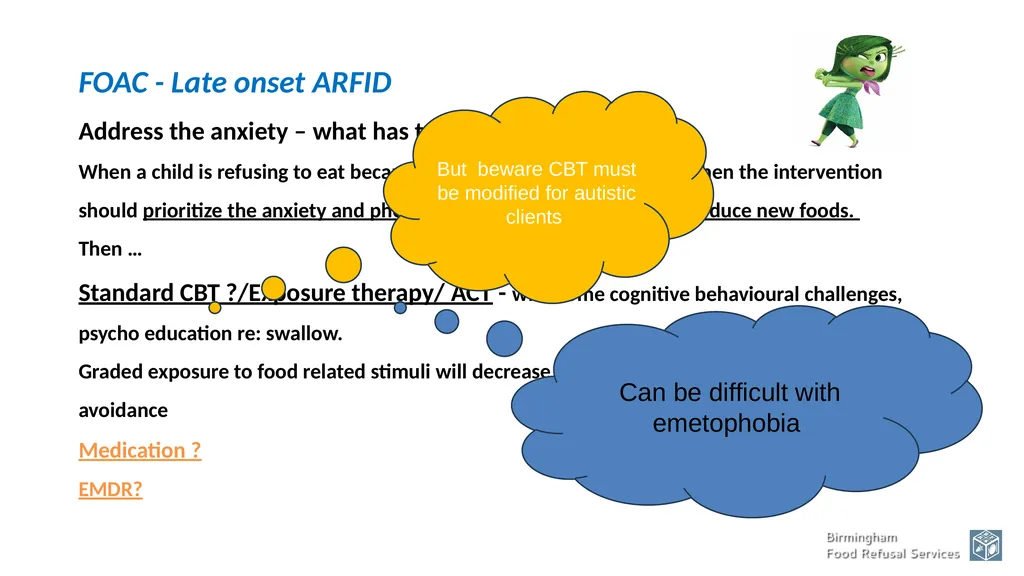
FOAC - Late onset ARFID
Address the anxiety – what has triggered this?
When a child is refusing to eat because of fear of vomiting or choking then the intervention should prioritize the anxiety and phobia rather than attempting to introduce new foods.
Then …
Standard CBT ?/Exposure therapy/ ACT - with some cognitive behavioural challenges, psycho education re: swallow.
Graded exposure to food related stimuli will decrease anxiety, negative cognitions and avoidance
Medication ?
EMDR? But beware CBT must be modified for autistic clients Can be difficult with emetophobia<br>
Address the anxiety – what has triggered this?
When a child is refusing to eat because of fear of vomiting or choking then the intervention should prioritize the anxiety and phobia rather than attempting to introduce new foods.
Then …
Standard CBT ?/Exposure therapy/ ACT - with some cognitive behavioural challenges, psycho education re: swallow.
Graded exposure to food related stimuli will decrease anxiety, negative cognitions and avoidance
Medication ?
EMDR? But beware CBT must be modified for autistic clients Can be difficult with emetophobia<br>
21
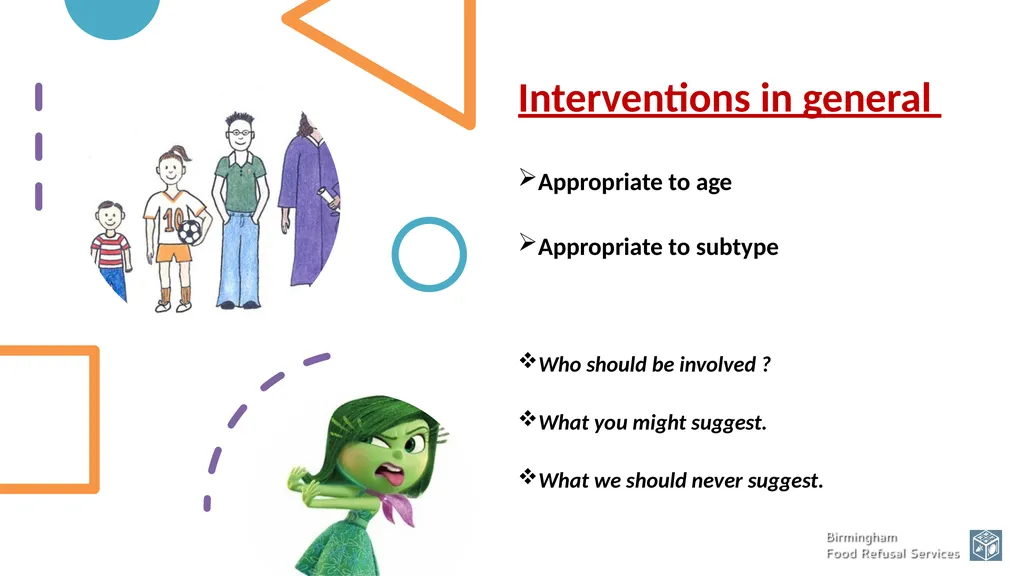
Interventions in general
Appropriate to age
Appropriate to subtype
Who should be involved ?
What you might suggest.
What we should never suggest.<br>
Appropriate to age
Appropriate to subtype
Who should be involved ?
What you might suggest.
What we should never suggest.<br>
22
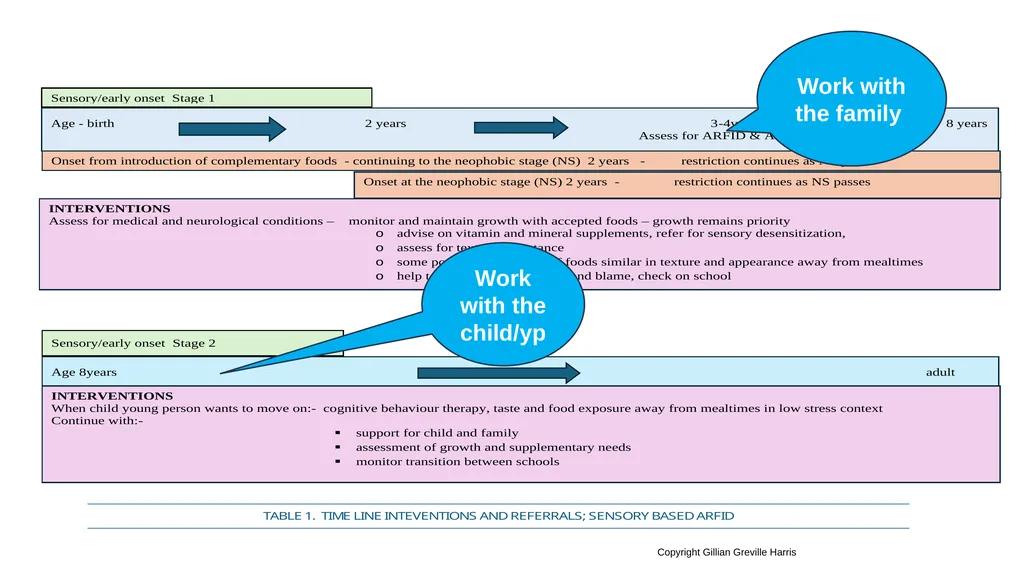
Copyright Gillian Greville Harris Work with the family Work with the child/yp<br>
23
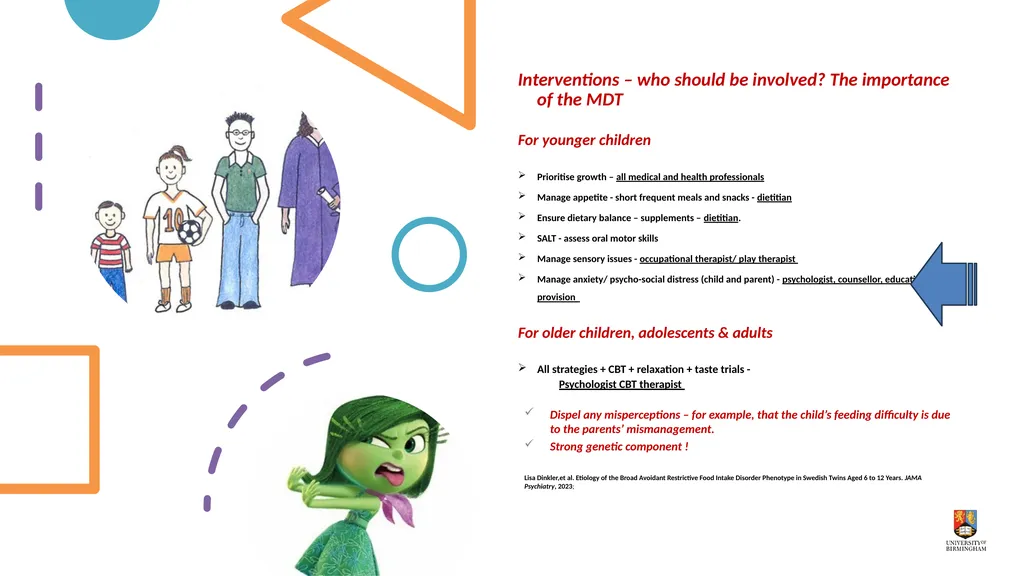
Interventions – who should be involved? The importance of the MDT
For younger children
Prioritise growth – all medical and health professionals
Manage appetite - short frequent meals and snacks - dietitian
Ensure dietary balance – supplements – dietitian.
SALT - assess oral motor skills
Manage sensory issues - occupational therapist/ play therapist
Manage anxiety/ psycho-social distress (child and parent) - psychologist, counsellor, educational provision
For older children, adolescents & adults
All strategies + CBT + relaxation + taste trials -
Psychologist CBT therapist
Dispel any misperceptions – for example, that the child’s feeding difficulty is due to the parents’ mismanagement.
Strong genetic component !
Lisa Dinkler,et al. Etiology of the Broad Avoidant Restrictive Food Intake Disorder Phenotype in Swedish Twins Aged 6 to 12 Years. JAMA Psychiatry, 2023;<br>
For younger children
Prioritise growth – all medical and health professionals
Manage appetite - short frequent meals and snacks - dietitian
Ensure dietary balance – supplements – dietitian.
SALT - assess oral motor skills
Manage sensory issues - occupational therapist/ play therapist
Manage anxiety/ psycho-social distress (child and parent) - psychologist, counsellor, educational provision
For older children, adolescents & adults
All strategies + CBT + relaxation + taste trials -
Psychologist CBT therapist
Dispel any misperceptions – for example, that the child’s feeding difficulty is due to the parents’ mismanagement.
Strong genetic component !
Lisa Dinkler,et al. Etiology of the Broad Avoidant Restrictive Food Intake Disorder Phenotype in Swedish Twins Aged 6 to 12 Years. JAMA Psychiatry, 2023;<br>
24
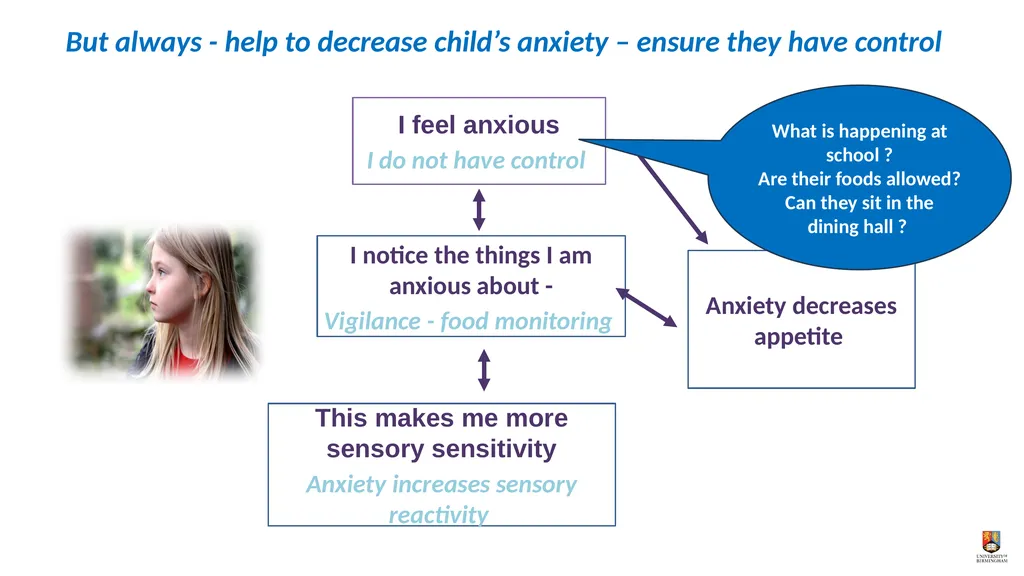
Manage anxiety- Always ! I feel anxious
I do not have control I notice the things I am anxious about -
Vigilance - food monitoring This makes me more sensory sensitivity
Anxiety increases sensory reactivity Anxiety decreases appetite But always - help to decrease child’s anxiety – ensure they have control What is happening at school ?
Are their foods allowed?
Can they sit in the dining hall ?<br>
I do not have control I notice the things I am anxious about -
Vigilance - food monitoring This makes me more sensory sensitivity
Anxiety increases sensory reactivity Anxiety decreases appetite But always - help to decrease child’s anxiety – ensure they have control What is happening at school ?
Are their foods allowed?
Can they sit in the dining hall ?<br>
25
The key criteria of ARFID are:-
Avoidance of foods and unwillingness to try new foods
Sensory hyper-reactivity
Psychosocial distress when around food
Fear of swallowing, choking, or vomiting
Nutritional deficiency - usually present
Weight loss is not a necessary criteria, children/ adults who are overweight can still meet the criteria for ARFID.
ARFID most often presents from early childhood with no precipitating event – sensory subtype,
or from later childhood with a precipitating event – anxiety subtype – fear of aversive consequences.
Somatosensory disgust and anxiety both underpin ARFID and might well be defining characteristics.<br>
Avoidance of foods and unwillingness to try new foods
Sensory hyper-reactivity
Psychosocial distress when around food
Fear of swallowing, choking, or vomiting
Nutritional deficiency - usually present
Weight loss is not a necessary criteria, children/ adults who are overweight can still meet the criteria for ARFID.
ARFID most often presents from early childhood with no precipitating event – sensory subtype,
or from later childhood with a precipitating event – anxiety subtype – fear of aversive consequences.
Somatosensory disgust and anxiety both underpin ARFID and might well be defining characteristics.<br>
26
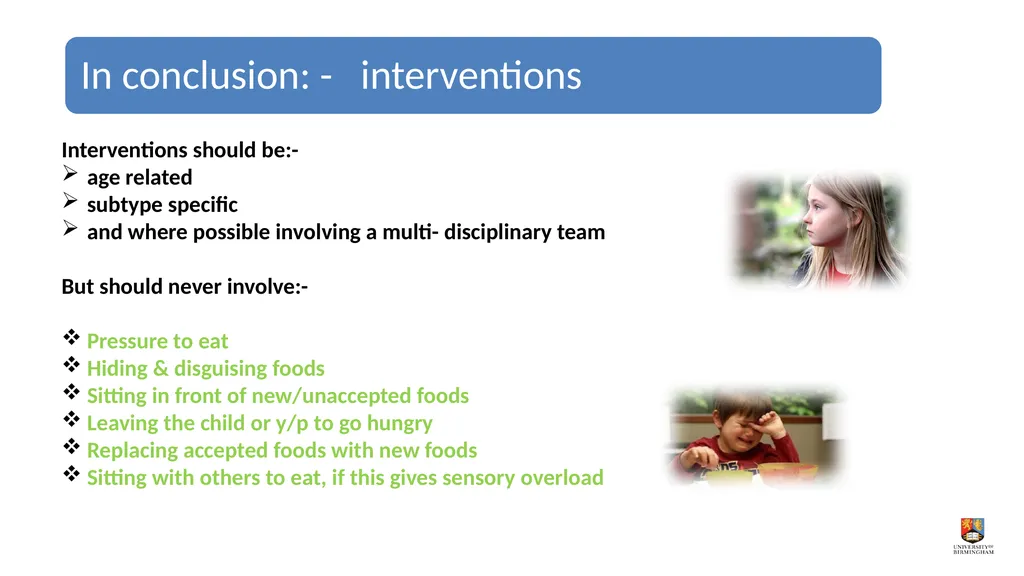
Interventions should be:-
age related
subtype specific
and where possible involving a multi- disciplinary team
But should never involve:-
Pressure to eat
Hiding & disguising foods
Sitting in front of new/unaccepted foods
Leaving the child or y/p to go hungry
Replacing accepted foods with new foods
Sitting with others to eat, if this gives sensory overload<br>
age related
subtype specific
and where possible involving a multi- disciplinary team
But should never involve:-
Pressure to eat
Hiding & disguising foods
Sitting in front of new/unaccepted foods
Leaving the child or y/p to go hungry
Replacing accepted foods with new foods
Sitting with others to eat, if this gives sensory overload<br>
27
www.arfidawarenessuk.org Thank you for your attention.....<br>