
Dr. Protibha Mukherjee Sahukar Assistant Professor
CB
Published · 13 slides · 0 views

1 / 1

Description
Dr. Protibha Mukherjee Sahukar Assistant Professor and Principal Department of English Durga Mahavidyalaya, Raipur (C.G.) Semester II Thomas Carlyles The Hero as a Poet 140823 INTRODUCTION - Thomas Carlyle and His Context: - Thomas
Related Topics
Share
Embed code
Download this presentation From Below
"Dr. Protibha Mukherjee Sahukar Assistant Professor" is the property of its rightful owner. Permission is granted to download and print the materials on this website for personal, non-commercial use only, and to display it on your personal computer provided you do not modify the materials and that you retain all copyright notices contained in the materials. By downloading content from our website, you accept the terms of this agreement.
Presentation Transcript
01
Dr. Protibha Mukherjee Sahukar
Assistant Professor and Principal
Department of English
Durga Mahavidyalaya, Raipur (C.G.)
Semester II
Thomas Carlyle’s ‘The Hero as a Poet’ 14/08/23<br>
Assistant Professor and Principal
Department of English
Durga Mahavidyalaya, Raipur (C.G.)
Semester II
Thomas Carlyle’s ‘The Hero as a Poet’ 14/08/23<br>
02
INTRODUCTION - Thomas Carlyle and His Context:
- Thomas Carlyle (1795-1881): Scottish philosopher, writer, and historian.
- A prominent figure of the Victorian era, known for his critiques of industrialization and emphasis on individualism.
- "The Hero as a Poet" Essay:
- A significant essay within Carlyle's body of work.
- Explores the profound relationship between heroism and poetic expression.
- Delves into the idea that heroes are not only exceptional individuals but also poets who convey deep truths.
- Exploring Heroes and Their Role:
- Carlyle's essay delves into the transformative power of heroes in society.
- It examines how heroes shape culture, inspire change, and guide collective morality.
- Highlights the unique ability of heroes to communicate their insights through creative expressions.
- Heroes as Poets:
- The essay redefines poetry beyond traditional verses, emphasizing the broader role of heroes as communicators of truths.
- Poetic expression becomes a vehicle for heroes to convey their profound insights and messages to the world.<br>
- Thomas Carlyle (1795-1881): Scottish philosopher, writer, and historian.
- A prominent figure of the Victorian era, known for his critiques of industrialization and emphasis on individualism.
- "The Hero as a Poet" Essay:
- A significant essay within Carlyle's body of work.
- Explores the profound relationship between heroism and poetic expression.
- Delves into the idea that heroes are not only exceptional individuals but also poets who convey deep truths.
- Exploring Heroes and Their Role:
- Carlyle's essay delves into the transformative power of heroes in society.
- It examines how heroes shape culture, inspire change, and guide collective morality.
- Highlights the unique ability of heroes to communicate their insights through creative expressions.
- Heroes as Poets:
- The essay redefines poetry beyond traditional verses, emphasizing the broader role of heroes as communicators of truths.
- Poetic expression becomes a vehicle for heroes to convey their profound insights and messages to the world.<br>
03
Carlyle's Perspective on Heroes - Unique Insight into the World:
- Carlyle sees heroes as individuals with a deep understanding of the world's complexities.
- They possess a heightened perception of societal dynamics, human nature, and ethical dilemmas.
- Exceptional Individuals:
- Carlyle's heroes are not ordinary figures but stand out for their exceptional qualities.
- They possess courage, moral integrity, and a visionary outlook that sets them apart.
- Guiding and Inspiring Others:
- Heroes, according to Carlyle, play a crucial role in guiding and inspiring society.
- Their actions and ideas serve as beacons of hope, motivating others to strive for greatness.
- Cultural Impact:
- Carlyle emphasizes that heroes have the power to transform culture and shape collective consciousness.
- They become cultural icons whose influence extends beyond their immediate time and place.<br>
- Carlyle sees heroes as individuals with a deep understanding of the world's complexities.
- They possess a heightened perception of societal dynamics, human nature, and ethical dilemmas.
- Exceptional Individuals:
- Carlyle's heroes are not ordinary figures but stand out for their exceptional qualities.
- They possess courage, moral integrity, and a visionary outlook that sets them apart.
- Guiding and Inspiring Others:
- Heroes, according to Carlyle, play a crucial role in guiding and inspiring society.
- Their actions and ideas serve as beacons of hope, motivating others to strive for greatness.
- Cultural Impact:
- Carlyle emphasizes that heroes have the power to transform culture and shape collective consciousness.
- They become cultural icons whose influence extends beyond their immediate time and place.<br>
04
Heroes as Poets - Expanding the Notion of Poetry:
- Carlyle redefines poetry beyond traditional verse and rhyme.
- Heroes are seen as poetic in their ability to convey profound truths through various creative forms.
- Communication of Deep Truths:
- Heroes, as poets, possess the capacity to communicate truths that resonate deeply with humanity.
- Their creative expressions serve as vehicles for transmitting complex ideas and moral principles.
- Creative Forms of Expression:
- Carlyle's heroes use diverse artistic mediums: literature, art, leadership, and more.
- Through these mediums, they effectively convey their insights, values, and messages.
- Impact on Society:
- Heroic poets leave an indelible mark on society through their creative endeavors.
- Their expressions influence cultural norms, inspire societal change, and challenge the status quo.<br>
- Carlyle redefines poetry beyond traditional verse and rhyme.
- Heroes are seen as poetic in their ability to convey profound truths through various creative forms.
- Communication of Deep Truths:
- Heroes, as poets, possess the capacity to communicate truths that resonate deeply with humanity.
- Their creative expressions serve as vehicles for transmitting complex ideas and moral principles.
- Creative Forms of Expression:
- Carlyle's heroes use diverse artistic mediums: literature, art, leadership, and more.
- Through these mediums, they effectively convey their insights, values, and messages.
- Impact on Society:
- Heroic poets leave an indelible mark on society through their creative endeavors.
- Their expressions influence cultural norms, inspire societal change, and challenge the status quo.<br>
05
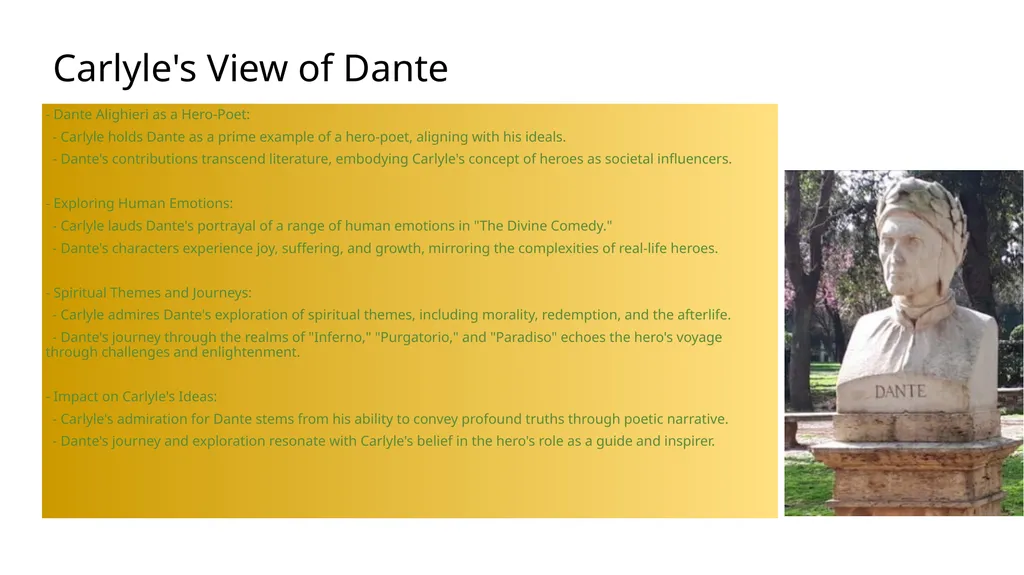
Carlyle's View of Dante - Dante Alighieri as a Hero-Poet:
- Carlyle holds Dante as a prime example of a hero-poet, aligning with his ideals.
- Dante's contributions transcend literature, embodying Carlyle's concept of heroes as societal influencers.
- Exploring Human Emotions:
- Carlyle lauds Dante's portrayal of a range of human emotions in "The Divine Comedy."
- Dante's characters experience joy, suffering, and growth, mirroring the complexities of real-life heroes.
- Spiritual Themes and Journeys:
- Carlyle admires Dante's exploration of spiritual themes, including morality, redemption, and the afterlife.
- Dante's journey through the realms of "Inferno," "Purgatorio," and "Paradiso" echoes the hero's voyage through challenges and enlightenment.
- Impact on Carlyle's Ideas:
- Carlyle's admiration for Dante stems from his ability to convey profound truths through poetic narrative.
- Dante's journey and exploration resonate with Carlyle's belief in the hero's role as a guide and inspirer.<br>
- Carlyle holds Dante as a prime example of a hero-poet, aligning with his ideals.
- Dante's contributions transcend literature, embodying Carlyle's concept of heroes as societal influencers.
- Exploring Human Emotions:
- Carlyle lauds Dante's portrayal of a range of human emotions in "The Divine Comedy."
- Dante's characters experience joy, suffering, and growth, mirroring the complexities of real-life heroes.
- Spiritual Themes and Journeys:
- Carlyle admires Dante's exploration of spiritual themes, including morality, redemption, and the afterlife.
- Dante's journey through the realms of "Inferno," "Purgatorio," and "Paradiso" echoes the hero's voyage through challenges and enlightenment.
- Impact on Carlyle's Ideas:
- Carlyle's admiration for Dante stems from his ability to convey profound truths through poetic narrative.
- Dante's journey and exploration resonate with Carlyle's belief in the hero's role as a guide and inspirer.<br>
06
Dante's Contribution to Heroism - Representation of Heroism in "The Divine Comedy":
- Dante's "The Divine Comedy" portrays heroes not only as figures of valor but as individuals on transformative journeys.
- Heroism is conveyed through characters' moral choices, quests for redemption, and encounters with challenges.
- Exemplification of Moral Struggles:
- Dante's characters confront moral dilemmas mirroring Carlyle's heroes navigating intricate moral complexities.
- Heroism is revealed in characters' introspection, choices, and ethical growth throughout their journeys.
- Journey as an Emblem of Heroism:
- Dante's portrayal of the hero's journey – from suffering to enlightenment – parallels Carlyle's vision of heroes' transformative quests.
- The hero's journey is symbolic of personal growth, reflecting Carlyle's belief in heroes' guidance and inspiration.
- Impact on Carlyle's Perspective:
- Dante's depiction of heroes reinforces Carlyle's perspective on heroism as a journey of self-discovery and societal influence.
- The hero-as-poet concept echoes in Dante's portrayal of characters using their experiences to convey universal truths.<br>
- Dante's "The Divine Comedy" portrays heroes not only as figures of valor but as individuals on transformative journeys.
- Heroism is conveyed through characters' moral choices, quests for redemption, and encounters with challenges.
- Exemplification of Moral Struggles:
- Dante's characters confront moral dilemmas mirroring Carlyle's heroes navigating intricate moral complexities.
- Heroism is revealed in characters' introspection, choices, and ethical growth throughout their journeys.
- Journey as an Emblem of Heroism:
- Dante's portrayal of the hero's journey – from suffering to enlightenment – parallels Carlyle's vision of heroes' transformative quests.
- The hero's journey is symbolic of personal growth, reflecting Carlyle's belief in heroes' guidance and inspiration.
- Impact on Carlyle's Perspective:
- Dante's depiction of heroes reinforces Carlyle's perspective on heroism as a journey of self-discovery and societal influence.
- The hero-as-poet concept echoes in Dante's portrayal of characters using their experiences to convey universal truths.<br>
07
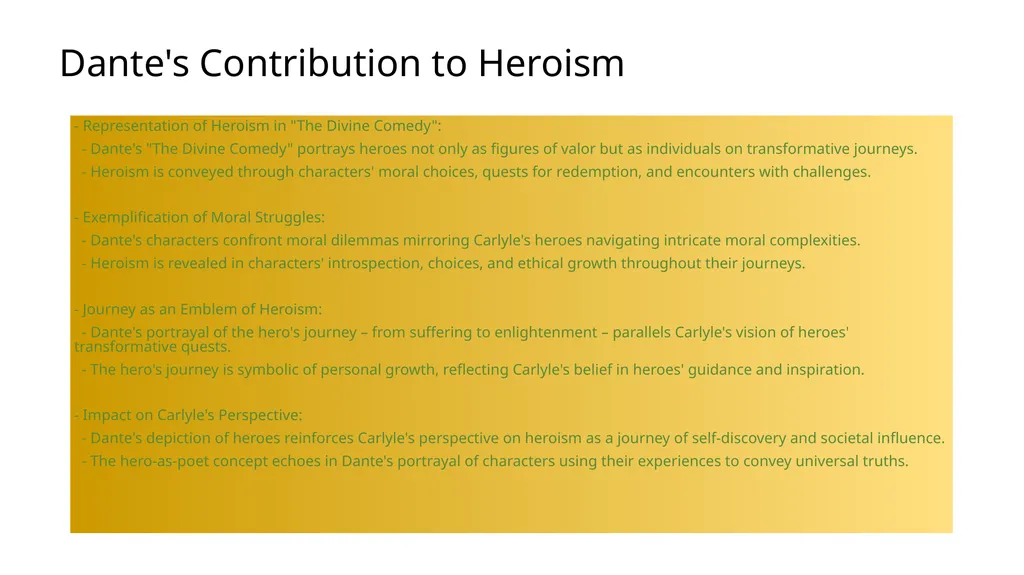
Carlyle's View of Shakespeare - William Shakespeare as a Hero-Poet:
- Carlyle extols Shakespeare's status as a hero-poet, exemplifying his ideals.
- Shakespeare's influence on literature, theater, and societal perception resonates with Carlyle's heroism.
- Penetrating Human Nature:
- Carlyle praises Shakespeare's profound insights into the intricacies of human behavior and emotions.
- Characters like Hamlet and Macbeth epitomize the multifaceted dimensions of heroism.
- Capture of Human Essence:
- Carlyle admires how Shakespeare's plays capture the essence of human experience.
- Characters' dilemmas, ambitions, and struggles mirror Carlyle's vision of heroes navigating life's complexities.
- Reflecting Heroic Traits:
- Carlyle sees in Shakespeare's characters the traits of bravery, integrity, and vision he associates with heroes.
- The Bard's creations embody Carlyle's perspective on heroes as sources of inspiration.<br>
- Carlyle extols Shakespeare's status as a hero-poet, exemplifying his ideals.
- Shakespeare's influence on literature, theater, and societal perception resonates with Carlyle's heroism.
- Penetrating Human Nature:
- Carlyle praises Shakespeare's profound insights into the intricacies of human behavior and emotions.
- Characters like Hamlet and Macbeth epitomize the multifaceted dimensions of heroism.
- Capture of Human Essence:
- Carlyle admires how Shakespeare's plays capture the essence of human experience.
- Characters' dilemmas, ambitions, and struggles mirror Carlyle's vision of heroes navigating life's complexities.
- Reflecting Heroic Traits:
- Carlyle sees in Shakespeare's characters the traits of bravery, integrity, and vision he associates with heroes.
- The Bard's creations embody Carlyle's perspective on heroes as sources of inspiration.<br>
08
Shakespeare's Exploration of Heroic Themes - Complexities of Heroism in Characters:
- Shakespeare's characters exhibit multifaceted dimensions of heroism, extending beyond mere valor.
- Hamlet's introspection and contemplation of moral dilemmas mirror Carlyle's emphasis on heroes' deep insights.
- Tragic Flaws and Moral Struggles:
- Characters like Macbeth portray Carlyle's notion of heroes' tragic flaws leading to their downfall.
- These flaws become cautionary tales, embodying Carlyle's belief in the vulnerability of even the heroic.
- Human Condition through Dramatic Lens:
- Shakespeare's plays delve into universal human experiences, reflecting Carlyle's emphasis on heroes as relatable figures.
- Themes of love, ambition, power, and morality resonate with Carlyle's perspective on heroes' impact on society.
- Shakespearean Tragedy and Enlightenment:
- Shakespearean tragedies like "Hamlet" and "Macbeth" align with Carlyle's view of heroes as figures whose journeys illuminate societal truths.
- Characters' decisions and fates convey Carlyle's belief in heroes shaping culture and collective conscience.<br>
- Shakespeare's characters exhibit multifaceted dimensions of heroism, extending beyond mere valor.
- Hamlet's introspection and contemplation of moral dilemmas mirror Carlyle's emphasis on heroes' deep insights.
- Tragic Flaws and Moral Struggles:
- Characters like Macbeth portray Carlyle's notion of heroes' tragic flaws leading to their downfall.
- These flaws become cautionary tales, embodying Carlyle's belief in the vulnerability of even the heroic.
- Human Condition through Dramatic Lens:
- Shakespeare's plays delve into universal human experiences, reflecting Carlyle's emphasis on heroes as relatable figures.
- Themes of love, ambition, power, and morality resonate with Carlyle's perspective on heroes' impact on society.
- Shakespearean Tragedy and Enlightenment:
- Shakespearean tragedies like "Hamlet" and "Macbeth" align with Carlyle's view of heroes as figures whose journeys illuminate societal truths.
- Characters' decisions and fates convey Carlyle's belief in heroes shaping culture and collective conscience.<br>
09
Commonalities between Carlyle, Dante, and Shakespeare - Interplay of Heroism and Poetry:
- All three visionaries view heroism as intertwined with the art of poetic expression.
- Carlyle, Dante, and Shakespeare recognize the potency of creative mediums to convey timeless truths.
- Heroes as Cultural Architects:
- Carlyle, Dante, and Shakespeare share the conviction that heroes serve as architects of culture.
- Their actions, stories, and insights influence societal norms, encouraging transformation.
- Individual Influence on Society:
- Carlyle, Dante, and Shakespeare emphasize the individual's ability to inspire collective change.
- The heroic figures in their works embody the potential for one person's impact on the broader world.
- Reflecting Universal Values:
- All three creators explore universal themes of morality, human nature, and societal dynamics.
- Carlyle, Dante, and Shakespeare offer insights into the human experience that transcend time and place.<br>
- All three visionaries view heroism as intertwined with the art of poetic expression.
- Carlyle, Dante, and Shakespeare recognize the potency of creative mediums to convey timeless truths.
- Heroes as Cultural Architects:
- Carlyle, Dante, and Shakespeare share the conviction that heroes serve as architects of culture.
- Their actions, stories, and insights influence societal norms, encouraging transformation.
- Individual Influence on Society:
- Carlyle, Dante, and Shakespeare emphasize the individual's ability to inspire collective change.
- The heroic figures in their works embody the potential for one person's impact on the broader world.
- Reflecting Universal Values:
- All three creators explore universal themes of morality, human nature, and societal dynamics.
- Carlyle, Dante, and Shakespeare offer insights into the human experience that transcend time and place.<br>
10
Legacy of Carlyle's Essay - Revolutionizing Literary Criticism:
- Carlyle's essay challenged traditional literary perspectives, shifting the focus to heroes and their impact on society.
- His ideas expanded the scope of literary analysis beyond aesthetics to societal influence.
- Reimagining Heroic Ideals:
- Carlyle's essay redefined the concept of heroism, emphasizing its connection to poetry and creative expression.
- His influence reshaped discussions on heroism, emphasizing the individual's role in shaping culture.
- Continued Influence on Discourse:
- Carlyle's notions remain relevant in contemporary discussions on creativity and societal change.
- His ideas provide a framework for understanding the relationship between creative expression and societal transformation.
- Echoes in Modern Culture:
- Carlyle's ideas continue to resonate in literature, film, and other forms of creative expression.
- The hero-poet archetype influences characters who navigate complex moral dilemmas and inspire change.<br>
- Carlyle's essay challenged traditional literary perspectives, shifting the focus to heroes and their impact on society.
- His ideas expanded the scope of literary analysis beyond aesthetics to societal influence.
- Reimagining Heroic Ideals:
- Carlyle's essay redefined the concept of heroism, emphasizing its connection to poetry and creative expression.
- His influence reshaped discussions on heroism, emphasizing the individual's role in shaping culture.
- Continued Influence on Discourse:
- Carlyle's notions remain relevant in contemporary discussions on creativity and societal change.
- His ideas provide a framework for understanding the relationship between creative expression and societal transformation.
- Echoes in Modern Culture:
- Carlyle's ideas continue to resonate in literature, film, and other forms of creative expression.
- The hero-poet archetype influences characters who navigate complex moral dilemmas and inspire change.<br>
11
Conclusion Carlyle's essay "The Hero as a Poet" explores the relationship between heroes, poetry, and societal impact.
Heroes, according to Carlyle, possess unique insights and the ability to shape culture and inspire change.
This perspective finds resonance in the works of Dante and Shakespeare, where heroes' complexities and creative expression mirror Carlyle's ideals.
Importance of Understanding:
Carlyle's ideas bridge the realms of heroism and creativity, enriching our understanding of their interconnectedness.
Dante and Shakespeare exemplify Carlyle's vision, showcasing how heroes' journeys and poetic expressions shape culture and human experience.
Enduring Relevance:
Carlyle's legacy continues to influence modern discussions on heroism, literature, and societal transformation.
The exploration of heroes as poets, evident in Dante and Shakespeare, transcends time, resonating with ongoing debates on individual impact.<br>
Heroes, according to Carlyle, possess unique insights and the ability to shape culture and inspire change.
This perspective finds resonance in the works of Dante and Shakespeare, where heroes' complexities and creative expression mirror Carlyle's ideals.
Importance of Understanding:
Carlyle's ideas bridge the realms of heroism and creativity, enriching our understanding of their interconnectedness.
Dante and Shakespeare exemplify Carlyle's vision, showcasing how heroes' journeys and poetic expressions shape culture and human experience.
Enduring Relevance:
Carlyle's legacy continues to influence modern discussions on heroism, literature, and societal transformation.
The exploration of heroes as poets, evident in Dante and Shakespeare, transcends time, resonating with ongoing debates on individual impact.<br>
12
References Primary Sources:
Carlyle, Thomas. "The Hero as a Poet."
Dante Alighieri. "The Divine Comedy" (specifically "Inferno," "Purgatorio," and "Paradiso" sections).
William Shakespeare. Select plays that emphasize heroic themes and complex characters:
- "Hamlet“, - "Macbeth“, - "King Lear“, - "Othello“, - "Julius Caesar"
Secondary Sources:
Adams, Hazard. "Critical Theory Since Plato." Harcourt Brace Jovanovich, 1992.
Bloom, Harold. "Shakespeare: The Invention of the Human." Riverhead Books, 1998.
Auerbach, Erich. "Dante: Poet of the Secular World." New York Review Books, 2007.
Carlyle, Thomas. "On Heroes, Hero-Worship, and the Heroic in History." Cambridge University Press, 2013.
Smith, David Nichol. "Carlyle's Hero as Poet: Dante, Shakespeare and Goethe." Princeton University Press, 1967.
Frye, Northrop. "Fearful Symmetry: A Study of William Blake." Princeton University Press, 1947.<br>
Carlyle, Thomas. "The Hero as a Poet."
Dante Alighieri. "The Divine Comedy" (specifically "Inferno," "Purgatorio," and "Paradiso" sections).
William Shakespeare. Select plays that emphasize heroic themes and complex characters:
- "Hamlet“, - "Macbeth“, - "King Lear“, - "Othello“, - "Julius Caesar"
Secondary Sources:
Adams, Hazard. "Critical Theory Since Plato." Harcourt Brace Jovanovich, 1992.
Bloom, Harold. "Shakespeare: The Invention of the Human." Riverhead Books, 1998.
Auerbach, Erich. "Dante: Poet of the Secular World." New York Review Books, 2007.
Carlyle, Thomas. "On Heroes, Hero-Worship, and the Heroic in History." Cambridge University Press, 2013.
Smith, David Nichol. "Carlyle's Hero as Poet: Dante, Shakespeare and Goethe." Princeton University Press, 1967.
Frye, Northrop. "Fearful Symmetry: A Study of William Blake." Princeton University Press, 1947.<br>