
Dr Umashree D K - Functional Assessment in


Description: Dr Umashree D K - Functional Assessment in Inclusive Education 1 Functional Assessment In Inclusive Education Dr Umashree D K Asst Professor Sri Sarvajna college of Education Bangalore, Karnataka shreeuma27gmail.com 2 2.2 Functional
Related Topics
Download Presentation
"Dr Umashree D K - Functional Assessment in" is the property of its rightful owner. Permission is granted to download and print the materials on this website for personal, non-commercial use only, and to display it on your personal computer provided you do not modify the materials and that you retain all copyright notices contained in the materials. By downloading content from our website, you accept the terms of this agreement.
Presentation Transcript
slide1. Dr Umashree D K - Functional Assessment in Inclusive Education 1<br>
slide2. Functional Assessment
In
Inclusive Education
Dr Umashree D K
Asst Professor
Sri Sarvajna college of Education
Bangalore, Karnataka
shreeuma27@gmail.com 2<br>
slide3. 2.2 Functional Assessment Functional Assessment/ Functional Behavioural Assessment
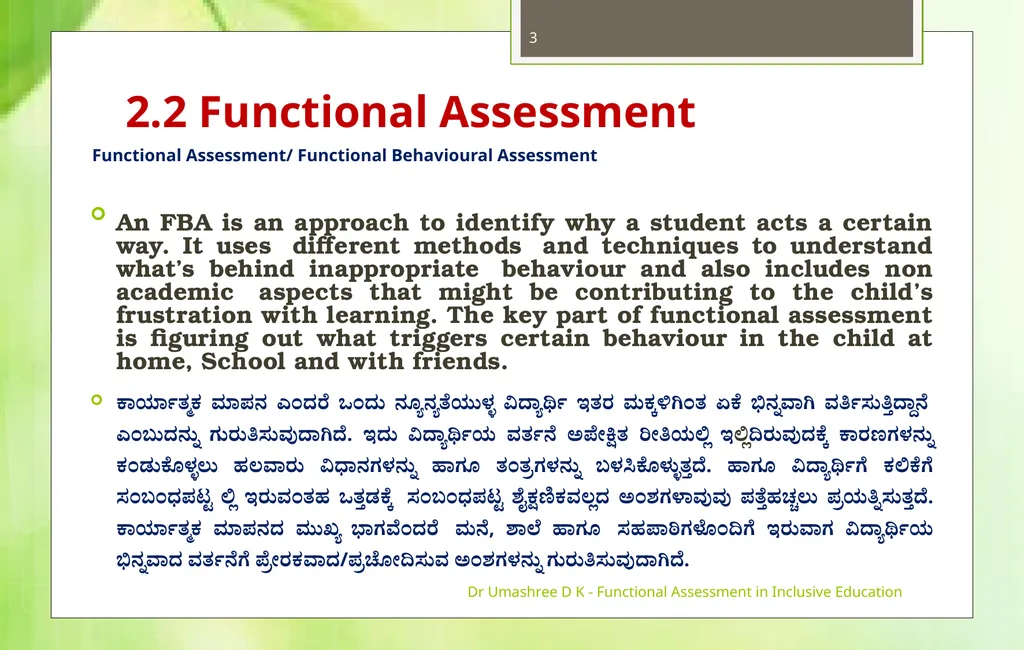
An FBA is an approach to identify why a student acts a certain way. It uses different methods and techniques to understand what’s behind inappropriate behaviour and also includes non academic aspects that might be contributing to the child’s frustration with learning. The key part of functional assessment is figuring out what triggers certain behaviour in the child at home, School and with friends.
ಕಾರ್ಯಾತ್ಮಕ ಮಾಪನ ಎಂದರೆ ಒಂದು ನ್ಯೂನ್ಯತೆಯುಳ್ಳ ವಿದ್ಯಾರ್ಥಿ ಇತರ ಮಕ್ಕಳಿಗಿಂತ ಏಕೆ ಭಿನ್ನವಾಗಿ ವರ್ತಿಸುತ್ತಿದ್ದಾನೆ ಎಂಬುದನ್ನು ಗುರುತಿಸುವುದಾಗಿದೆ. ಇದು ವಿದ್ಯಾರ್ಥಿಯ ವರ್ತನೆ ಅಪೇಕ್ಷಿತ ರೀತಿಯಲ್ಲಿ ಇಲ್ಲಿದಿರುವುದಕ್ಕೆ ಕಾರಣಗಳನ್ನು ಕಂಡುಕೊಳ್ಳಲು ಹಲವಾರು ವಿಧಾನಗಳನ್ನು ಹಾಗೂ ತಂತ್ರಗಳನ್ನು ಬಳಸಿಕೊಳ್ಳುತ್ತದೆ. ಹಾಗೂ ವಿದ್ಯಾರ್ಥಿಗೆ ಕಲಿಕೆಗೆ ಸಂಬಂಧಪಟ್ಟ ಲ್ಲಿ ಇರುವಂತಹ ಒತ್ತಡಕ್ಕೆ ಸಂಬಂಧಪಟ್ಟ ಶೈಕ್ಷಣಿಕವಲ್ಲದ ಅಂಶಗಳಾವುವು ಪತ್ತೆಹಚ್ಚಲು ಪ್ರಯತ್ನಿಸುತ್ತದೆ. ಕಾರ್ಯಾತ್ಮಕ ಮಾಪನದ ಮುಖ್ಯ ಭಾಗವೆಂದರೆ ಮನೆ, ಶಾಲೆ ಹಾಗೂ ಸಹಪಾಠಿಗಳೊಂದಿಗೆ ಇರುವಾಗ ವಿದ್ಯಾರ್ಥಿಯ ಭಿನ್ನವಾದ ವರ್ತನೆಗೆ ಪ್ರೇರಕವಾದ/ಪ್ರಚೋದಿಸುವ ಅಂಶಗಳನ್ನು ಗುರುತಿಸುವುದಾಗಿದೆ. Dr Umashree D K - Functional Assessment in Inclusive Education 3<br>
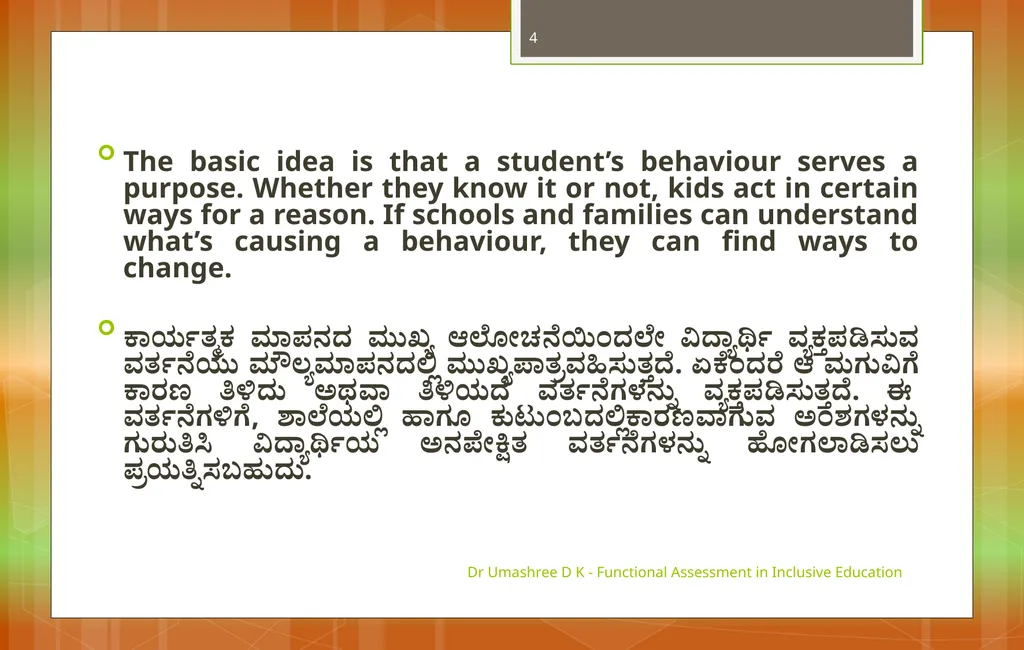
slide4. The basic idea is that a student’s behaviour serves a purpose. Whether they know it or not, kids act in certain ways for a reason. If schools and families can understand what’s causing a behaviour, they can find ways to change.
ಕಾರ್ಯತ್ಮಕ ಮಾಪನದ ಮುಖ್ಯ ಆಲೋಚನೆಯಿಂದಲೇ ವಿದ್ಯಾರ್ಥಿ ವ್ಯಕ್ತಪಡಿಸುವ ವರ್ತನೆಯು ಮೌಲ್ಯಮಾಪನದಲ್ಲಿ ಮುಖ್ಯಪಾತ್ರವಹಿಸುತ್ತದೆ. ಏಕೆಂದರೆ ಆ ಮಗುವಿಗೆ ಕಾರಣ ತಿಳಿದು ಅಥವಾ ತಿಳಿಯದೆ ವರ್ತನೆಗಳನ್ನು ವ್ಯಕ್ತಪಡಿಸುತ್ತದೆ. ಈ ವರ್ತನೆಗಳಿಗೆ, ಶಾಲೆಯಲ್ಲಿ ಹಾಗೂ ಕುಟುಂಬದಲ್ಲಿಕಾರಣವಾಗುವ ಅಂಶಗಳನ್ನು ಗುರುತಿಸಿ ವಿದ್ಯಾರ್ಥಿಯ ಅನಪೇಕ್ಷಿತ ವರ್ತನೆಗಳನ್ನು ಹೋಗಲಾಡಿಸಲು ಪ್ರಯತ್ನಿಸಬಹುದು. Dr Umashree D K - Functional Assessment in Inclusive Education 4<br>
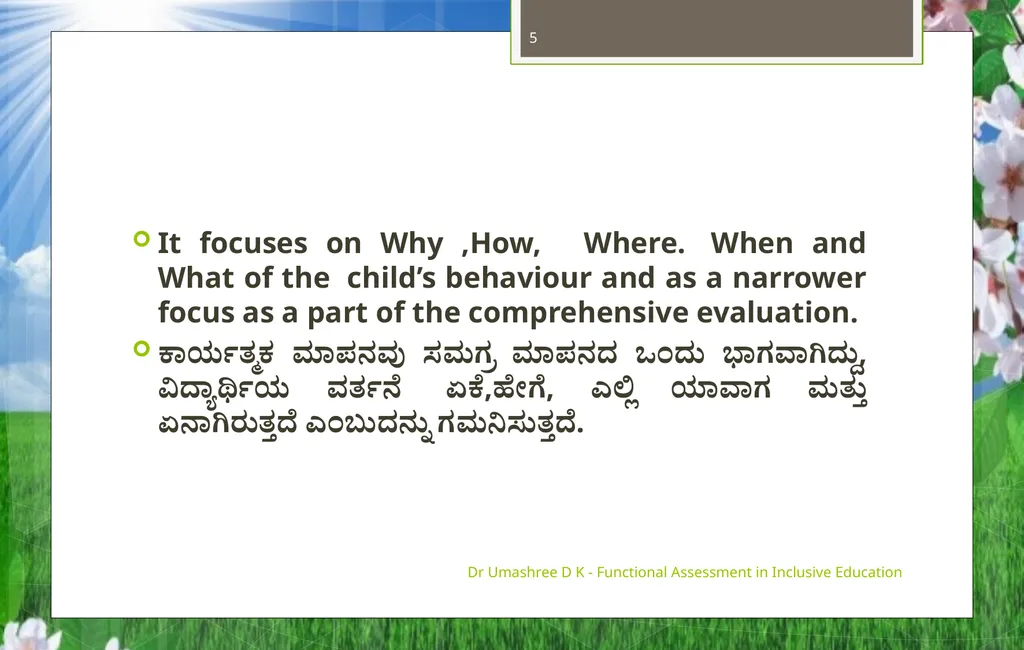
slide5. It focuses on Why ,How, Where. When and What of the child’s behaviour and as a narrower focus as a part of the comprehensive evaluation.
ಕಾರ್ಯತ್ಮಕ ಮಾಪನವು ಸಮಗ್ರ ಮಾಪನದ ಒಂದು ಭಾಗವಾಗಿದ್ದು, ವಿದ್ಯಾರ್ಥಿಯ ವರ್ತನೆ ಏಕೆ,ಹೇಗೆ, ಎಲ್ಲಿ ಯಾವಾಗ ಮತ್ತು ಏನಾಗಿರುತ್ತದೆ ಎಂಬುದನ್ನು ಗಮನಿಸುತ್ತದೆ. Dr Umashree D K - Functional Assessment in Inclusive Education 5<br>
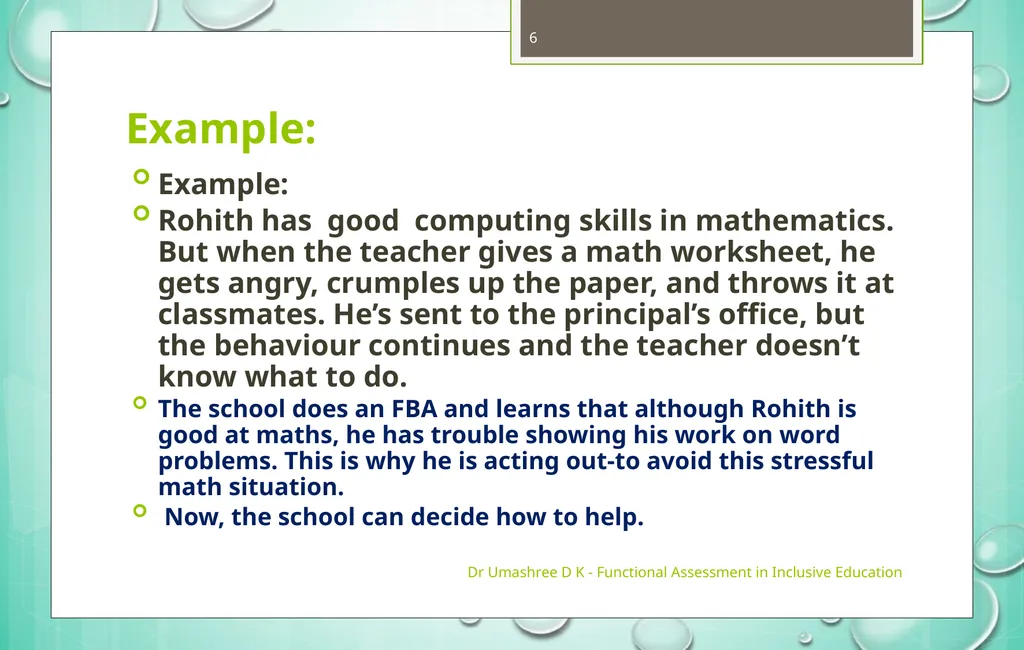
slide6. Example: Example:
Rohith has good computing skills in mathematics. But when the teacher gives a math worksheet, he gets angry, crumples up the paper, and throws it at classmates. He’s sent to the principal’s office, but the behaviour continues and the teacher doesn’t know what to do.
The school does an FBA and learns that although Rohith is good at maths, he has trouble showing his work on word problems. This is why he is acting out-to avoid this stressful math situation.
Now, the school can decide how to help. Dr Umashree D K - Functional Assessment in Inclusive Education 6<br>
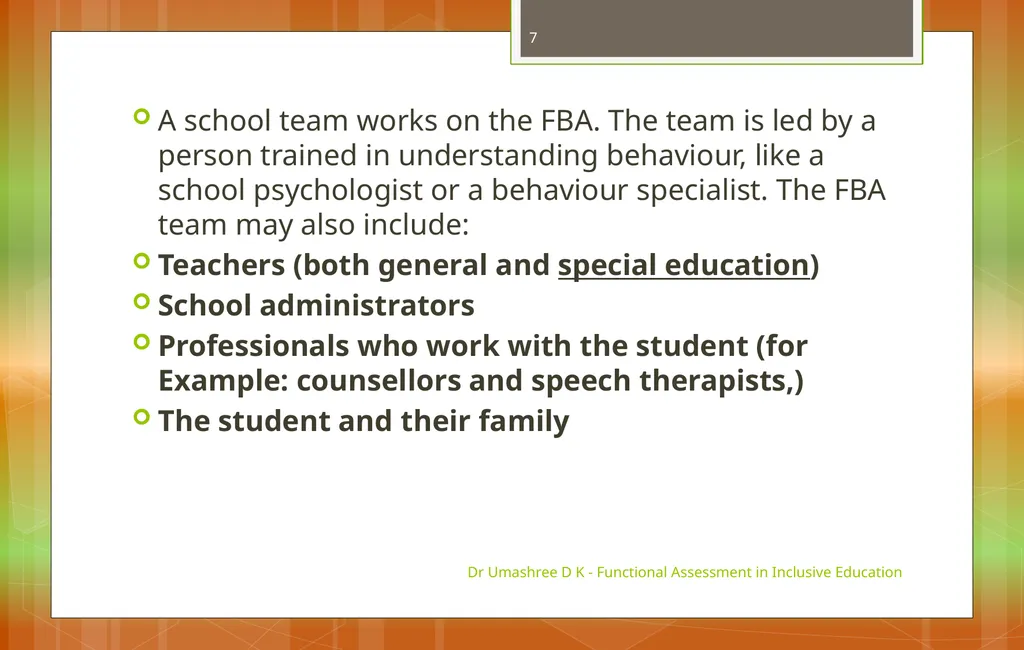
slide7. A school team works on the FBA. The team is led by a person trained in understanding behaviour, like a school psychologist or a behaviour specialist. The FBA team may also include:
Teachers (both general and special education)
School administrators
Professionals who work with the student (for Example: counsellors and speech therapists,)
The student and their family Dr Umashree D K - Functional Assessment in Inclusive Education 7<br>
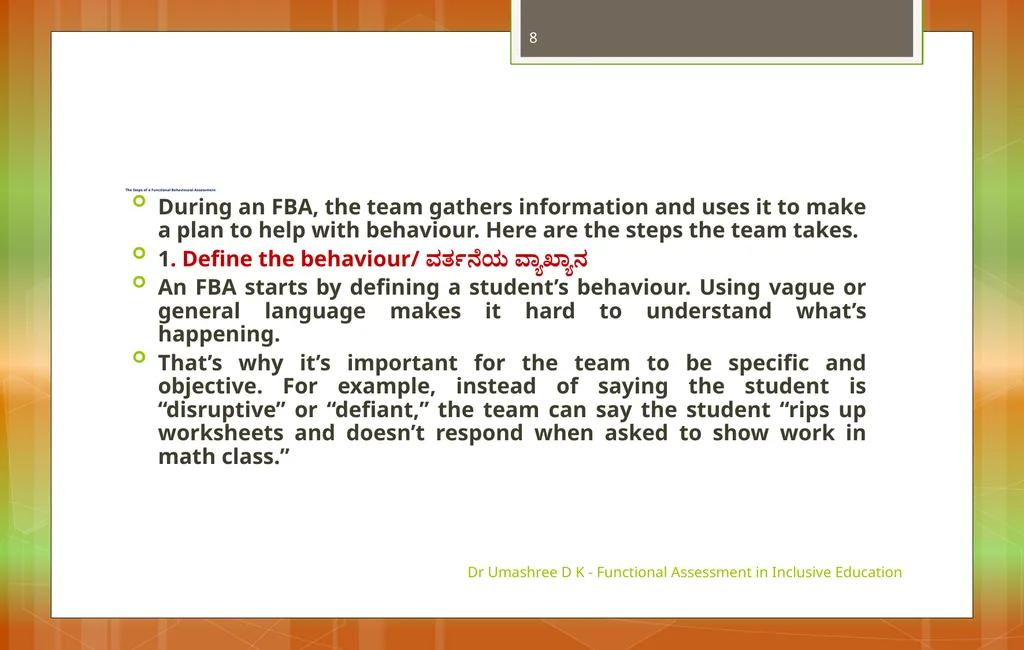
slide8. The Steps of a Functional Behavioural Assessment During an FBA, the team gathers information and uses it to make a plan to help with behaviour. Here are the steps the team takes.
1. Define the behaviour/ ವರ್ತನೆಯ ವ್ಯಾಖ್ಯಾನ
An FBA starts by defining a student’s behaviour. Using vague or general language makes it hard to understand what’s happening.
That’s why it’s important for the team to be specific and objective. For example, instead of saying the student is “disruptive” or “defiant,” the team can say the student “rips up worksheets and doesn’t respond when asked to show work in math class.” Dr Umashree D K - Functional Assessment in Inclusive Education 8<br>
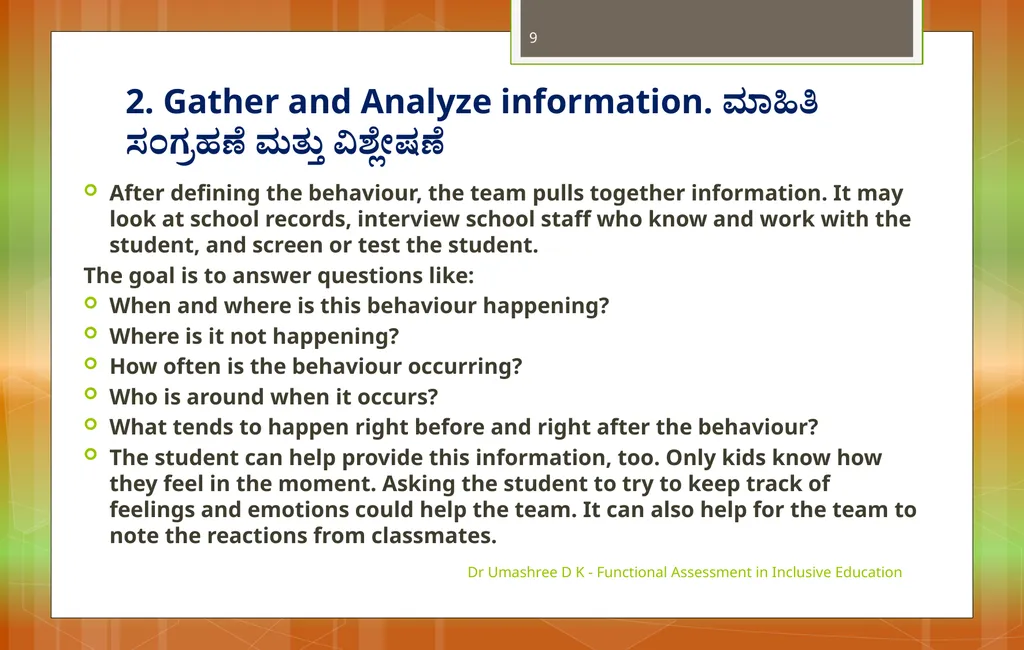
slide9. 2. Gather and Analyze information. ಮಾಹಿತಿ ಸಂಗ್ರಹಣೆ ಮತ್ತು ವಿಶ್ಲೇಷಣೆ After defining the behaviour, the team pulls together information. It may look at school records, interview school staff who know and work with the student, and screen or test the student.
The goal is to answer questions like:
When and where is this behaviour happening?
Where is it not happening?
How often is the behaviour occurring?
Who is around when it occurs?
What tends to happen right before and right after the behaviour?
The student can help provide this information, too. Only kids know how they feel in the moment. Asking the student to try to keep track of feelings and emotions could help the team. It can also help for the team to note the reactions from classmates. Dr Umashree D K - Functional Assessment in Inclusive Education 9<br>
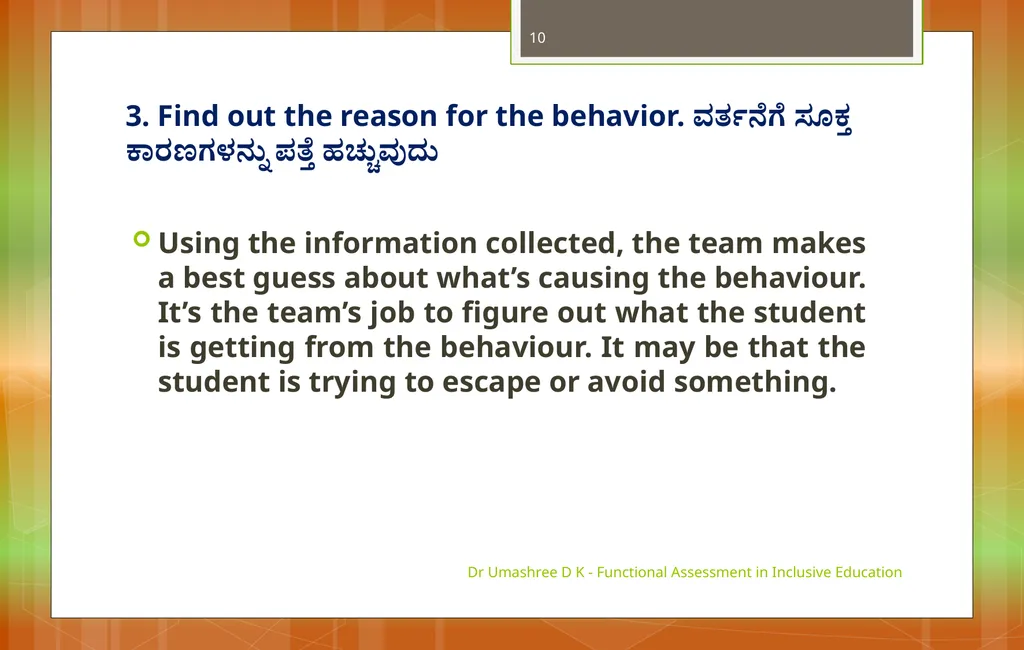
slide10. 3. Find out the reason for the behavior. ವರ್ತನೆಗೆ ಸೂಕ್ತ ಕಾರಣಗಳನ್ನು ಪತ್ತೆ ಹಚ್ಚುವುದು Using the information collected, the team makes a best guess about what’s causing the behaviour. It’s the team’s job to figure out what the student is getting from the behaviour. It may be that the student is trying to escape or avoid something. Dr Umashree D K - Functional Assessment in Inclusive Education 10<br>
slide11. 4. Make a plan. ಯೋಜನೆಯನ್ನು ರೂಪಿಸುವುದು Next, the team tries to see if it's best guess is right or not. The school psychologist or behaviour specialist leads this part. It includes making changes at school to see if the behaviour changes. To do this, the school creates a behaviour intervention plan (BIP) to teach and reward positive behaviours by the student.
Using the above example about Rohit, it might help to give him the chance to explain work out loud rather than writing it. Or have the option to show work on some, but not all the problems. As the school learns more, they can adjust the plan. Dr Umashree D K - Functional Assessment in Inclusive Education 11<br>
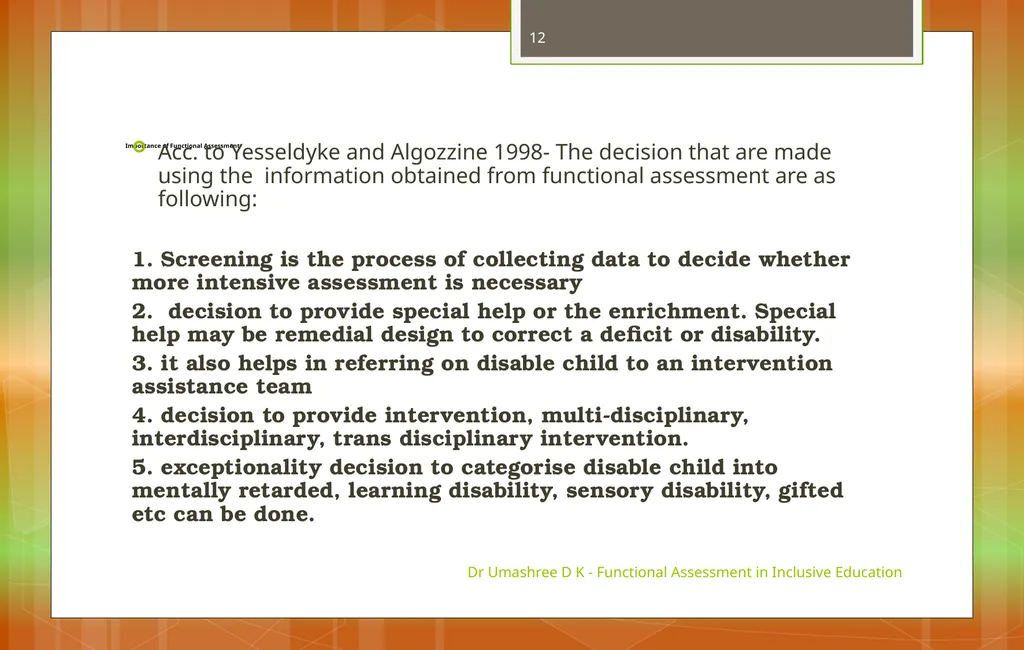
slide12. Importance of Functional Assessment Acc. to Yesseldyke and Algozzine 1998- The decision that are made using the information obtained from functional assessment are as following:
1. Screening is the process of collecting data to decide whether more intensive assessment is necessary
2. decision to provide special help or the enrichment. Special help may be remedial design to correct a deficit or disability.
3. it also helps in referring on disable child to an intervention assistance team
4. decision to provide intervention, multi-disciplinary, interdisciplinary, trans disciplinary intervention.
5. exceptionality decision to categorise disable child into mentally retarded, learning disability, sensory disability, gifted etc can be done. Dr Umashree D K - Functional Assessment in Inclusive Education 12<br>
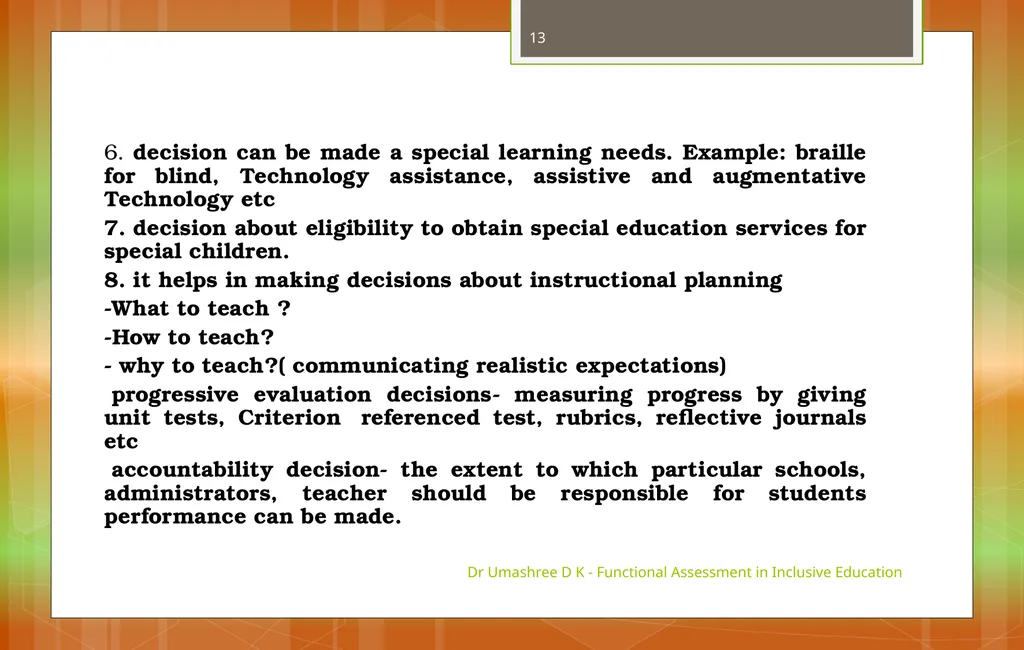
slide13. 6. decision can be made a special learning needs. Example: braille for blind, Technology assistance, assistive and augmentative Technology etc
7. decision about eligibility to obtain special education services for special children.
8. it helps in making decisions about instructional planning
-What to teach ?
-How to teach?
- why to teach?( communicating realistic expectations)
progressive evaluation decisions- measuring progress by giving unit tests, Criterion referenced test, rubrics, reflective journals etc
accountability decision- the extent to which particular schools, administrators, teacher should be responsible for students performance can be made. Dr Umashree D K - Functional Assessment in Inclusive Education 13<br>
slide14. Common Assessment Practices Curriculum Based Assessment
Instructional Diagnosis
Academic Time Analysis
Assessment of Institutional Environment
Assessing Outcome/ Outcome Based Approach
Performance Assessment Dr Umashree D K - Functional Assessment in Inclusive Education 14<br>
slide15. 1. Curriculum Based Assessment (CBA) A procedure for determining the instructional need of a student based on the student on going performance within existing course content.
If the content prepared by experts does not match the content taught, then the test is useless for evaluating what the student has learnt from school instruction. Dr Umashree D K - Functional Assessment in Inclusive Education 15<br>
slide16. Steps of CBA List skills in target material
Arrange skills in logical order
Develop your written objective for each skill listed
Develop items and prepare materials to test for each objective
Administer pre-test before teaching the target material
Evaluate pre test results( which skill is mastered and whether the prerequisite skills required)
Initiate instruction based on the information obtained in the previous step
Administer post test( after completion of the instruction administer the post test to determine which student have mastered on which skills) Dr Umashree D K - Functional Assessment in Inclusive Education 16<br>
slide17. 2. Instructional diagnosis Instructional diagnosis identifies the extent to which a student performance is caused by poor instruction and indicates possible remedies for the problem.
During instructional diagnosis, teachers look at the skills to complete the instructional task and compare them to skills the students do and do not do. task Analysis is one part of the instructional diagnosis.
Example for task analysis:
A teacher might break up a complex skill or task like brushing one’s teeth into its component skills.
Sub tasks:
Moving towards bathroom
taking brush in hand
taking paste and opening its lid
pressing the paste and applying it on brush
taking the brush with paste in hand
taking brush near the mouth
brushing the teeth etc Dr Umashree D K - Functional Assessment in Inclusive Education 17<br>
slide18. 3.Academic time analysis It is the study of the number of hours allocated in school for students. Contemporary educators have developed new tools to record students engaging formally as well as systemic analysis of how students spend their time in school is done.
Example: CCTV, Computer program- EBASS- Eco behavioural assessment system for students.
4. Assessment of Instructional Environment
Educators and teachers attempt to develop appropriate instructional intervention which helps in increasingly measure the extent to which factors that lead to improve outcome among the disabled children. Dr Umashree D K - Functional Assessment in Inclusive Education 18<br>
slide19. 5. Assessing outcomes / Outcome based approach Based on the outcome based approach the national centre for educational outcomes(NCEO) at the University of Minnesota developed a conceptual model for students with disabilities.
This approach concerned many groups of stakeholders like teachers, parents, School administrators, policymakers, legislators etc come to an agreement on major desired outcomes of education for students with disabilities. Following are the most valued outcomes by the stakeholders
1. Students completing schooling
2. competent in communication- verbal or sign language
3. able to cope effectively with personal challenges, frustration and stress
4. physically fit
5. awareness of voting and procedures of voting etc Dr Umashree D K - Functional Assessment in Inclusive Education 19<br>
slide20. 6. Performance assessment Performance assessment involves gathering data on Pupil’s performance directly by having them work singly or in groups to perform tasks. Data gathered on the quality with which tasks are completed, as well as on how students work together to perform tasks.
Data is gathered on the quality with which tasks are completed, as well as on how students work together. Dr Umashree D K - Functional Assessment in Inclusive Education 20<br>
slide21. Thank You Dr Umashree D K - Functional Assessment in Inclusive Education 21<br>
slide2. Functional Assessment
In
Inclusive Education
Dr Umashree D K
Asst Professor
Sri Sarvajna college of Education
Bangalore, Karnataka
shreeuma27@gmail.com 2<br>
slide3. 2.2 Functional Assessment Functional Assessment/ Functional Behavioural Assessment
An FBA is an approach to identify why a student acts a certain way. It uses different methods and techniques to understand what’s behind inappropriate behaviour and also includes non academic aspects that might be contributing to the child’s frustration with learning. The key part of functional assessment is figuring out what triggers certain behaviour in the child at home, School and with friends.
ಕಾರ್ಯಾತ್ಮಕ ಮಾಪನ ಎಂದರೆ ಒಂದು ನ್ಯೂನ್ಯತೆಯುಳ್ಳ ವಿದ್ಯಾರ್ಥಿ ಇತರ ಮಕ್ಕಳಿಗಿಂತ ಏಕೆ ಭಿನ್ನವಾಗಿ ವರ್ತಿಸುತ್ತಿದ್ದಾನೆ ಎಂಬುದನ್ನು ಗುರುತಿಸುವುದಾಗಿದೆ. ಇದು ವಿದ್ಯಾರ್ಥಿಯ ವರ್ತನೆ ಅಪೇಕ್ಷಿತ ರೀತಿಯಲ್ಲಿ ಇಲ್ಲಿದಿರುವುದಕ್ಕೆ ಕಾರಣಗಳನ್ನು ಕಂಡುಕೊಳ್ಳಲು ಹಲವಾರು ವಿಧಾನಗಳನ್ನು ಹಾಗೂ ತಂತ್ರಗಳನ್ನು ಬಳಸಿಕೊಳ್ಳುತ್ತದೆ. ಹಾಗೂ ವಿದ್ಯಾರ್ಥಿಗೆ ಕಲಿಕೆಗೆ ಸಂಬಂಧಪಟ್ಟ ಲ್ಲಿ ಇರುವಂತಹ ಒತ್ತಡಕ್ಕೆ ಸಂಬಂಧಪಟ್ಟ ಶೈಕ್ಷಣಿಕವಲ್ಲದ ಅಂಶಗಳಾವುವು ಪತ್ತೆಹಚ್ಚಲು ಪ್ರಯತ್ನಿಸುತ್ತದೆ. ಕಾರ್ಯಾತ್ಮಕ ಮಾಪನದ ಮುಖ್ಯ ಭಾಗವೆಂದರೆ ಮನೆ, ಶಾಲೆ ಹಾಗೂ ಸಹಪಾಠಿಗಳೊಂದಿಗೆ ಇರುವಾಗ ವಿದ್ಯಾರ್ಥಿಯ ಭಿನ್ನವಾದ ವರ್ತನೆಗೆ ಪ್ರೇರಕವಾದ/ಪ್ರಚೋದಿಸುವ ಅಂಶಗಳನ್ನು ಗುರುತಿಸುವುದಾಗಿದೆ. Dr Umashree D K - Functional Assessment in Inclusive Education 3<br>
slide4. The basic idea is that a student’s behaviour serves a purpose. Whether they know it or not, kids act in certain ways for a reason. If schools and families can understand what’s causing a behaviour, they can find ways to change.
ಕಾರ್ಯತ್ಮಕ ಮಾಪನದ ಮುಖ್ಯ ಆಲೋಚನೆಯಿಂದಲೇ ವಿದ್ಯಾರ್ಥಿ ವ್ಯಕ್ತಪಡಿಸುವ ವರ್ತನೆಯು ಮೌಲ್ಯಮಾಪನದಲ್ಲಿ ಮುಖ್ಯಪಾತ್ರವಹಿಸುತ್ತದೆ. ಏಕೆಂದರೆ ಆ ಮಗುವಿಗೆ ಕಾರಣ ತಿಳಿದು ಅಥವಾ ತಿಳಿಯದೆ ವರ್ತನೆಗಳನ್ನು ವ್ಯಕ್ತಪಡಿಸುತ್ತದೆ. ಈ ವರ್ತನೆಗಳಿಗೆ, ಶಾಲೆಯಲ್ಲಿ ಹಾಗೂ ಕುಟುಂಬದಲ್ಲಿಕಾರಣವಾಗುವ ಅಂಶಗಳನ್ನು ಗುರುತಿಸಿ ವಿದ್ಯಾರ್ಥಿಯ ಅನಪೇಕ್ಷಿತ ವರ್ತನೆಗಳನ್ನು ಹೋಗಲಾಡಿಸಲು ಪ್ರಯತ್ನಿಸಬಹುದು. Dr Umashree D K - Functional Assessment in Inclusive Education 4<br>
slide5. It focuses on Why ,How, Where. When and What of the child’s behaviour and as a narrower focus as a part of the comprehensive evaluation.
ಕಾರ್ಯತ್ಮಕ ಮಾಪನವು ಸಮಗ್ರ ಮಾಪನದ ಒಂದು ಭಾಗವಾಗಿದ್ದು, ವಿದ್ಯಾರ್ಥಿಯ ವರ್ತನೆ ಏಕೆ,ಹೇಗೆ, ಎಲ್ಲಿ ಯಾವಾಗ ಮತ್ತು ಏನಾಗಿರುತ್ತದೆ ಎಂಬುದನ್ನು ಗಮನಿಸುತ್ತದೆ. Dr Umashree D K - Functional Assessment in Inclusive Education 5<br>
slide6. Example: Example:
Rohith has good computing skills in mathematics. But when the teacher gives a math worksheet, he gets angry, crumples up the paper, and throws it at classmates. He’s sent to the principal’s office, but the behaviour continues and the teacher doesn’t know what to do.
The school does an FBA and learns that although Rohith is good at maths, he has trouble showing his work on word problems. This is why he is acting out-to avoid this stressful math situation.
Now, the school can decide how to help. Dr Umashree D K - Functional Assessment in Inclusive Education 6<br>
slide7. A school team works on the FBA. The team is led by a person trained in understanding behaviour, like a school psychologist or a behaviour specialist. The FBA team may also include:
Teachers (both general and special education)
School administrators
Professionals who work with the student (for Example: counsellors and speech therapists,)
The student and their family Dr Umashree D K - Functional Assessment in Inclusive Education 7<br>
slide8. The Steps of a Functional Behavioural Assessment During an FBA, the team gathers information and uses it to make a plan to help with behaviour. Here are the steps the team takes.
1. Define the behaviour/ ವರ್ತನೆಯ ವ್ಯಾಖ್ಯಾನ
An FBA starts by defining a student’s behaviour. Using vague or general language makes it hard to understand what’s happening.
That’s why it’s important for the team to be specific and objective. For example, instead of saying the student is “disruptive” or “defiant,” the team can say the student “rips up worksheets and doesn’t respond when asked to show work in math class.” Dr Umashree D K - Functional Assessment in Inclusive Education 8<br>
slide9. 2. Gather and Analyze information. ಮಾಹಿತಿ ಸಂಗ್ರಹಣೆ ಮತ್ತು ವಿಶ್ಲೇಷಣೆ After defining the behaviour, the team pulls together information. It may look at school records, interview school staff who know and work with the student, and screen or test the student.
The goal is to answer questions like:
When and where is this behaviour happening?
Where is it not happening?
How often is the behaviour occurring?
Who is around when it occurs?
What tends to happen right before and right after the behaviour?
The student can help provide this information, too. Only kids know how they feel in the moment. Asking the student to try to keep track of feelings and emotions could help the team. It can also help for the team to note the reactions from classmates. Dr Umashree D K - Functional Assessment in Inclusive Education 9<br>
slide10. 3. Find out the reason for the behavior. ವರ್ತನೆಗೆ ಸೂಕ್ತ ಕಾರಣಗಳನ್ನು ಪತ್ತೆ ಹಚ್ಚುವುದು Using the information collected, the team makes a best guess about what’s causing the behaviour. It’s the team’s job to figure out what the student is getting from the behaviour. It may be that the student is trying to escape or avoid something. Dr Umashree D K - Functional Assessment in Inclusive Education 10<br>
slide11. 4. Make a plan. ಯೋಜನೆಯನ್ನು ರೂಪಿಸುವುದು Next, the team tries to see if it's best guess is right or not. The school psychologist or behaviour specialist leads this part. It includes making changes at school to see if the behaviour changes. To do this, the school creates a behaviour intervention plan (BIP) to teach and reward positive behaviours by the student.
Using the above example about Rohit, it might help to give him the chance to explain work out loud rather than writing it. Or have the option to show work on some, but not all the problems. As the school learns more, they can adjust the plan. Dr Umashree D K - Functional Assessment in Inclusive Education 11<br>
slide12. Importance of Functional Assessment Acc. to Yesseldyke and Algozzine 1998- The decision that are made using the information obtained from functional assessment are as following:
1. Screening is the process of collecting data to decide whether more intensive assessment is necessary
2. decision to provide special help or the enrichment. Special help may be remedial design to correct a deficit or disability.
3. it also helps in referring on disable child to an intervention assistance team
4. decision to provide intervention, multi-disciplinary, interdisciplinary, trans disciplinary intervention.
5. exceptionality decision to categorise disable child into mentally retarded, learning disability, sensory disability, gifted etc can be done. Dr Umashree D K - Functional Assessment in Inclusive Education 12<br>
slide13. 6. decision can be made a special learning needs. Example: braille for blind, Technology assistance, assistive and augmentative Technology etc
7. decision about eligibility to obtain special education services for special children.
8. it helps in making decisions about instructional planning
-What to teach ?
-How to teach?
- why to teach?( communicating realistic expectations)
progressive evaluation decisions- measuring progress by giving unit tests, Criterion referenced test, rubrics, reflective journals etc
accountability decision- the extent to which particular schools, administrators, teacher should be responsible for students performance can be made. Dr Umashree D K - Functional Assessment in Inclusive Education 13<br>
slide14. Common Assessment Practices Curriculum Based Assessment
Instructional Diagnosis
Academic Time Analysis
Assessment of Institutional Environment
Assessing Outcome/ Outcome Based Approach
Performance Assessment Dr Umashree D K - Functional Assessment in Inclusive Education 14<br>
slide15. 1. Curriculum Based Assessment (CBA) A procedure for determining the instructional need of a student based on the student on going performance within existing course content.
If the content prepared by experts does not match the content taught, then the test is useless for evaluating what the student has learnt from school instruction. Dr Umashree D K - Functional Assessment in Inclusive Education 15<br>
slide16. Steps of CBA List skills in target material
Arrange skills in logical order
Develop your written objective for each skill listed
Develop items and prepare materials to test for each objective
Administer pre-test before teaching the target material
Evaluate pre test results( which skill is mastered and whether the prerequisite skills required)
Initiate instruction based on the information obtained in the previous step
Administer post test( after completion of the instruction administer the post test to determine which student have mastered on which skills) Dr Umashree D K - Functional Assessment in Inclusive Education 16<br>
slide17. 2. Instructional diagnosis Instructional diagnosis identifies the extent to which a student performance is caused by poor instruction and indicates possible remedies for the problem.
During instructional diagnosis, teachers look at the skills to complete the instructional task and compare them to skills the students do and do not do. task Analysis is one part of the instructional diagnosis.
Example for task analysis:
A teacher might break up a complex skill or task like brushing one’s teeth into its component skills.
Sub tasks:
Moving towards bathroom
taking brush in hand
taking paste and opening its lid
pressing the paste and applying it on brush
taking the brush with paste in hand
taking brush near the mouth
brushing the teeth etc Dr Umashree D K - Functional Assessment in Inclusive Education 17<br>
slide18. 3.Academic time analysis It is the study of the number of hours allocated in school for students. Contemporary educators have developed new tools to record students engaging formally as well as systemic analysis of how students spend their time in school is done.
Example: CCTV, Computer program- EBASS- Eco behavioural assessment system for students.
4. Assessment of Instructional Environment
Educators and teachers attempt to develop appropriate instructional intervention which helps in increasingly measure the extent to which factors that lead to improve outcome among the disabled children. Dr Umashree D K - Functional Assessment in Inclusive Education 18<br>
slide19. 5. Assessing outcomes / Outcome based approach Based on the outcome based approach the national centre for educational outcomes(NCEO) at the University of Minnesota developed a conceptual model for students with disabilities.
This approach concerned many groups of stakeholders like teachers, parents, School administrators, policymakers, legislators etc come to an agreement on major desired outcomes of education for students with disabilities. Following are the most valued outcomes by the stakeholders
1. Students completing schooling
2. competent in communication- verbal or sign language
3. able to cope effectively with personal challenges, frustration and stress
4. physically fit
5. awareness of voting and procedures of voting etc Dr Umashree D K - Functional Assessment in Inclusive Education 19<br>
slide20. 6. Performance assessment Performance assessment involves gathering data on Pupil’s performance directly by having them work singly or in groups to perform tasks. Data gathered on the quality with which tasks are completed, as well as on how students work together to perform tasks.
Data is gathered on the quality with which tasks are completed, as well as on how students work together. Dr Umashree D K - Functional Assessment in Inclusive Education 20<br>
slide21. Thank You Dr Umashree D K - Functional Assessment in Inclusive Education 21<br>