DRG and Code Reconciliation CDI and HIM Coding Teamwork Tessa Robinson, RN, BSN, CCDS CDI Supervisor, Nix Health Care System trobinsonnixhealth.com Saturday, June 29, 2019 Objectives A. Define CDI-Coding reconciliation B. Review
"DRG and Code Reconciliation – CDI and HIM Coding" is the property of its rightful owner. Permission is granted to
download and print the materials on this website for personal, non-commercial use only, and to display it
on your personal computer provided you do not modify the materials and that you retain all copyright
notices contained in the materials. By downloading content from our website, you accept the terms of this
agreement.
Presentation Transcript
01
DRG and Code Reconciliation – CDI and HIM Coding Teamwork Tessa Robinson, RN, BSN, CCDS
CDI Supervisor, Nix Health Care System
trobinson@nixhealth.com Saturday, June 29, 2019<br>
02
Objectives A. Define CDI-Coding reconciliation
B. Review reconciliation process
C. Coordinate learning opportunities
D. Identify root causes<br>
03
What is CDI–HIM Coding Reconciliation Reconciliation - the action of making one view or belief compatible with another.
For the CDI – Coding World, it’s the process of reviewing the medical record and comparing CDI findings to those in the Coding Summary, with adjustments as indicated so that the final DRGs are the same.
Goal: complete and accurate documentation and coding.<br>
04
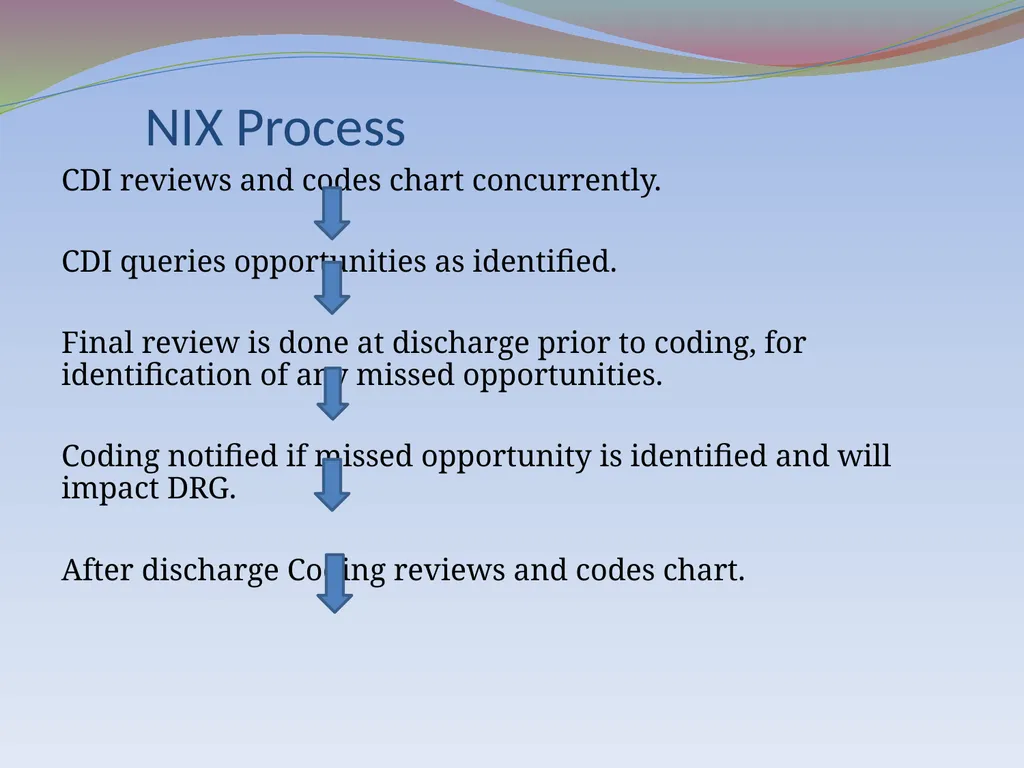
NIX Process CDI reviews and codes chart concurrently.
CDI queries opportunities as identified.
Final review is done at discharge prior to coding, for identification of any missed opportunities.
Coding notified if missed opportunity is identified and will impact DRG.
After discharge Coding reviews and codes chart.<br>
05
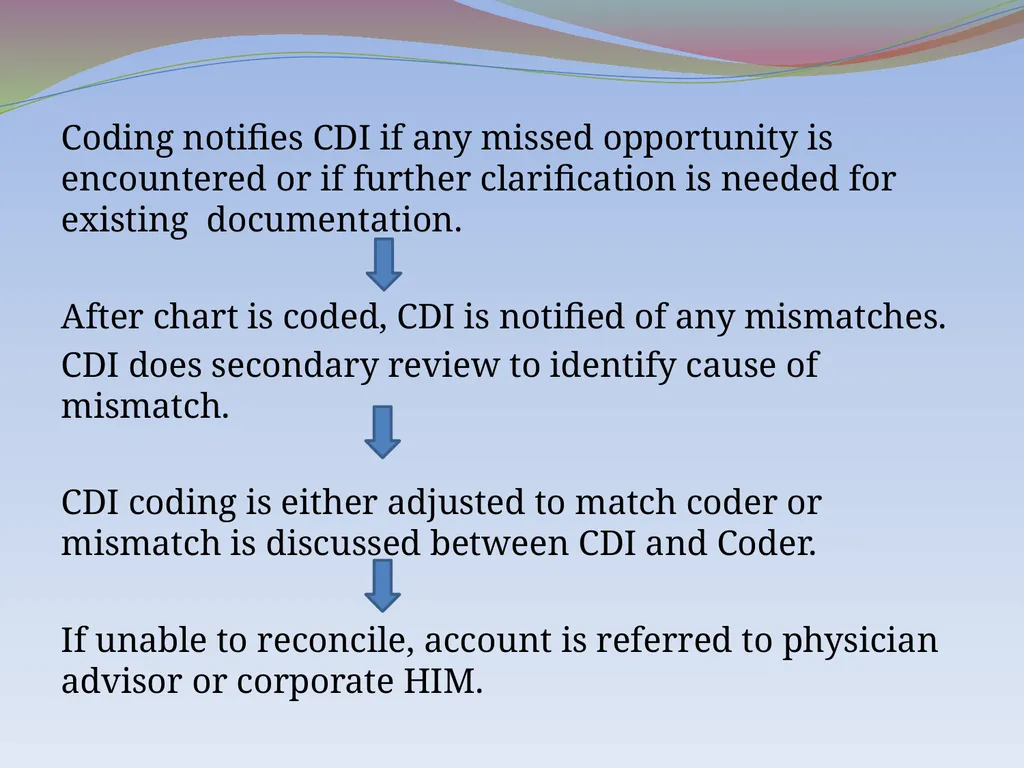
Coding notifies CDI if any missed opportunity is encountered or if further clarification is needed for existing documentation.
After chart is coded, CDI is notified of any mismatches.
CDI does secondary review to identify cause of mismatch.
CDI coding is either adjusted to match coder or mismatch is discussed between CDI and Coder.
If unable to reconcile, account is referred to physician advisor or corporate HIM.<br>
06
Collaboration Identify educational opportunities
Education exchanges
Build and strengthen common goals
Hold regular joint meetings
Participate in joint professional events
Overcome challenges<br>
07
Case # 1 History of presenting illness:
The patient is a 67-year-old female with a past medical history of hypertension, diabetes, coronary artery disease, arthritis, CHF, and colon cancer status post colostomy placement. She presented with abdominal wound dehiscence that is leaking stool for the past week. Leakage has gradually and progressively worsened and it is foul smelling. Patient also noted to have acute renal failure with mild CHF exacerbation. Patient reported mild to moderate amount of pain increasing with activity, while decreased with rest and pain medications.
Diagnosis:
Possible colocutaneous fistula.
Acute renal failure<br>
08
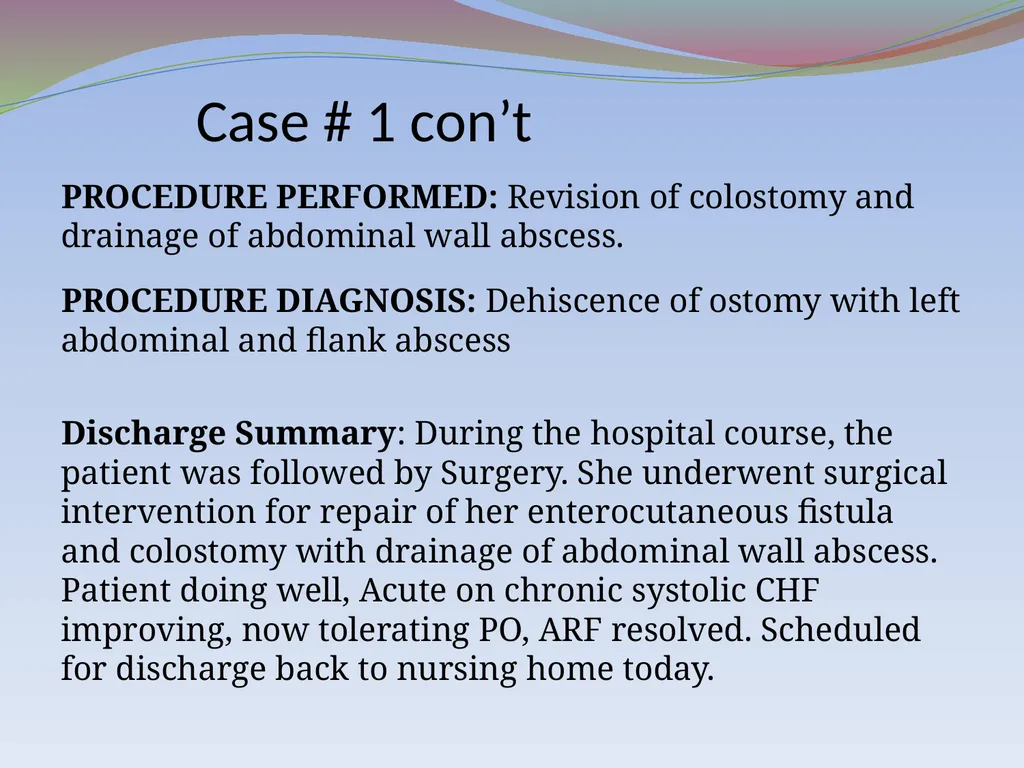
PROCEDURE PERFORMED: Revision of colostomy and drainage of abdominal wall abscess.
PROCEDURE DIAGNOSIS: Dehiscence of ostomy with left abdominal and flank abscess
Discharge Summary: During the hospital course, the patient was followed by Surgery. She underwent surgical intervention for repair of her enterocutaneous fistula and colostomy with drainage of abdominal wall abscess. Patient doing well, Acute on chronic systolic CHF improving, now tolerating PO, ARF resolved. Scheduled for discharge back to nursing home today. Case # 1 con’t<br>
09
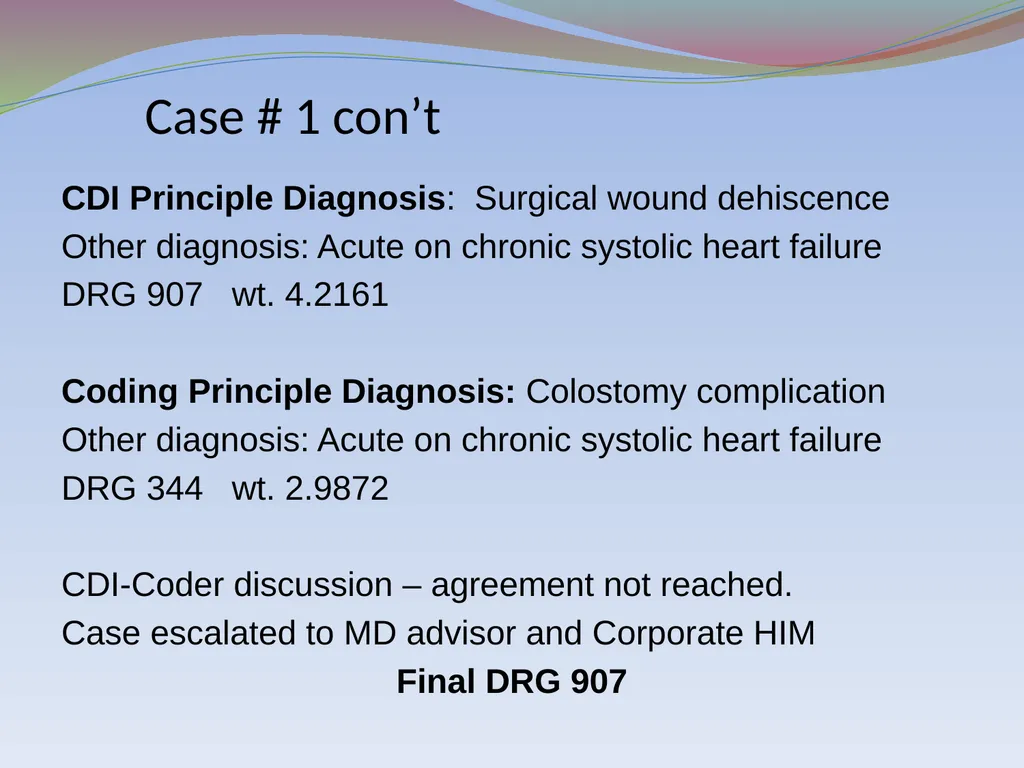
Case # 1 con’t CDI Principle Diagnosis: Surgical wound dehiscence
Other diagnosis: Acute on chronic systolic heart failure
DRG 907 wt. 4.2161
Coding Principle Diagnosis: Colostomy complication
Other diagnosis: Acute on chronic systolic heart failure
DRG 344 wt. 2.9872
CDI-Coder discussion – agreement not reached.
Case escalated to MD advisor and Corporate HIM
Final DRG 907<br>
10
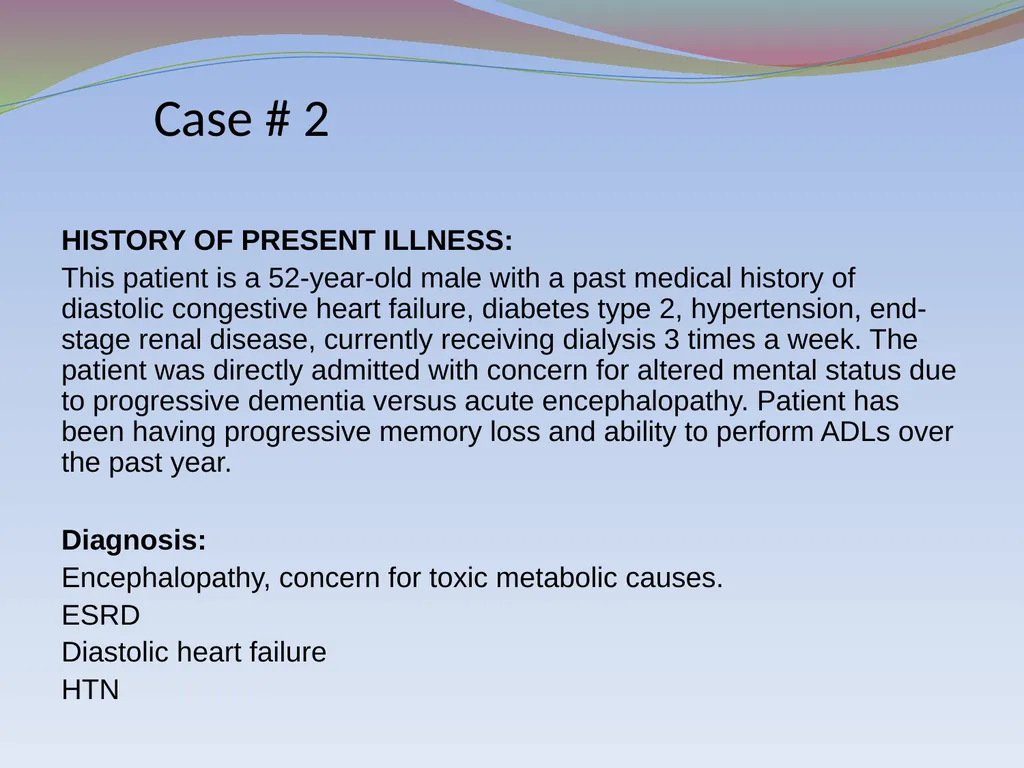
Case # 2 HISTORY OF PRESENT ILLNESS:
This patient is a 52-year-old male with a past medical history of diastolic congestive heart failure, diabetes type 2, hypertension, end-stage renal disease, currently receiving dialysis 3 times a week. The patient was directly admitted with concern for altered mental status due to progressive dementia versus acute encephalopathy. Patient has been having progressive memory loss and ability to perform ADLs over the past year.
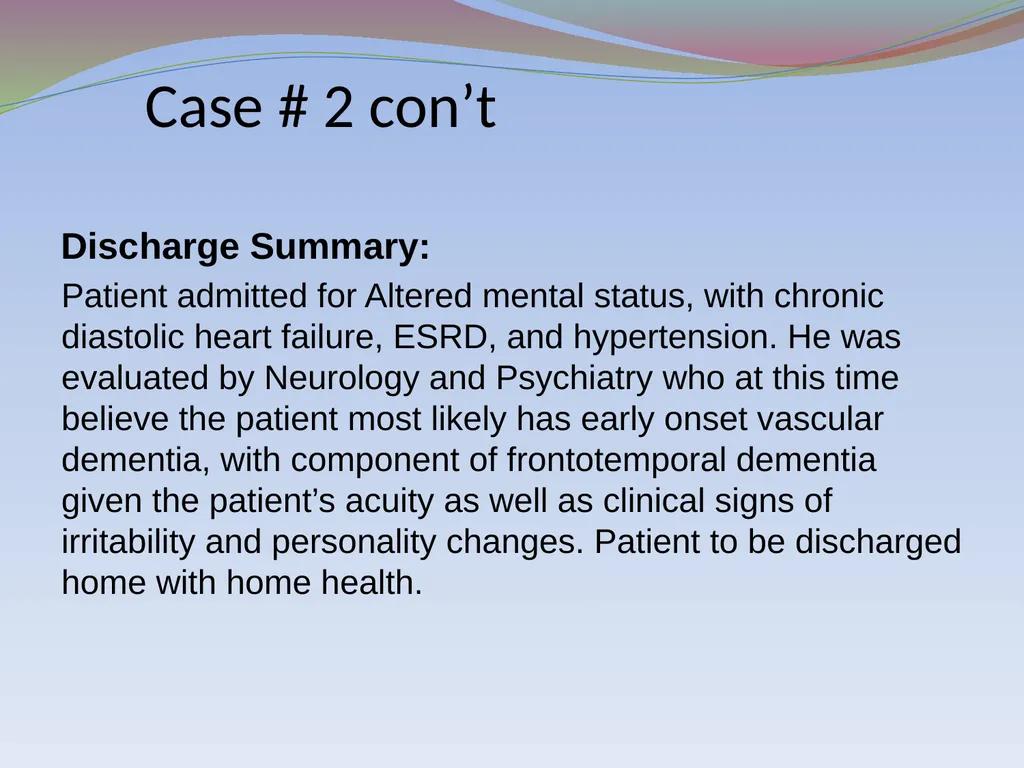
Case # 2 con’t Discharge Summary:
Patient admitted for Altered mental status, with chronic diastolic heart failure, ESRD, and hypertension. He was evaluated by Neurology and Psychiatry who at this time believe the patient most likely has early onset vascular dementia, with component of frontotemporal dementia given the patient’s acuity as well as clinical signs of irritability and personality changes. Patient to be discharged home with home health.<br>
12
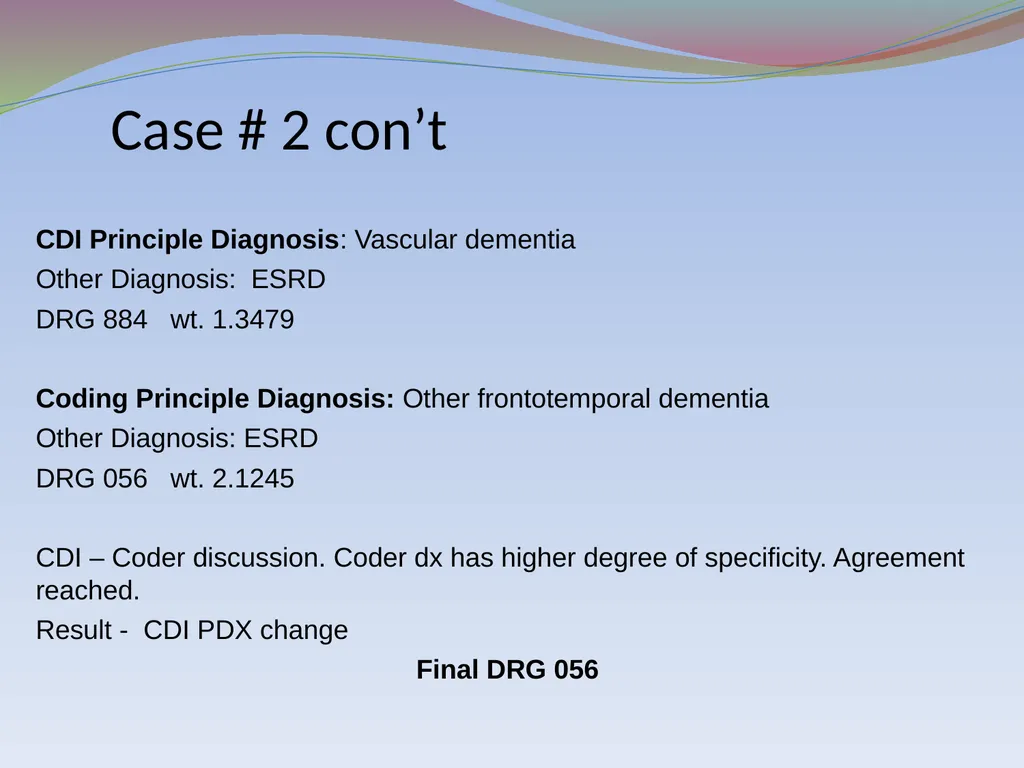
Case # 2 con’t CDI Principle Diagnosis: Vascular dementia
Other Diagnosis: ESRD
DRG 884 wt. 1.3479
Coding Principle Diagnosis: Other frontotemporal dementia
Other Diagnosis: ESRD
DRG 056 wt. 2.1245
CDI – Coder discussion. Coder dx has higher degree of specificity. Agreement reached.
Result - CDI PDX change
Final DRG 056<br>
13
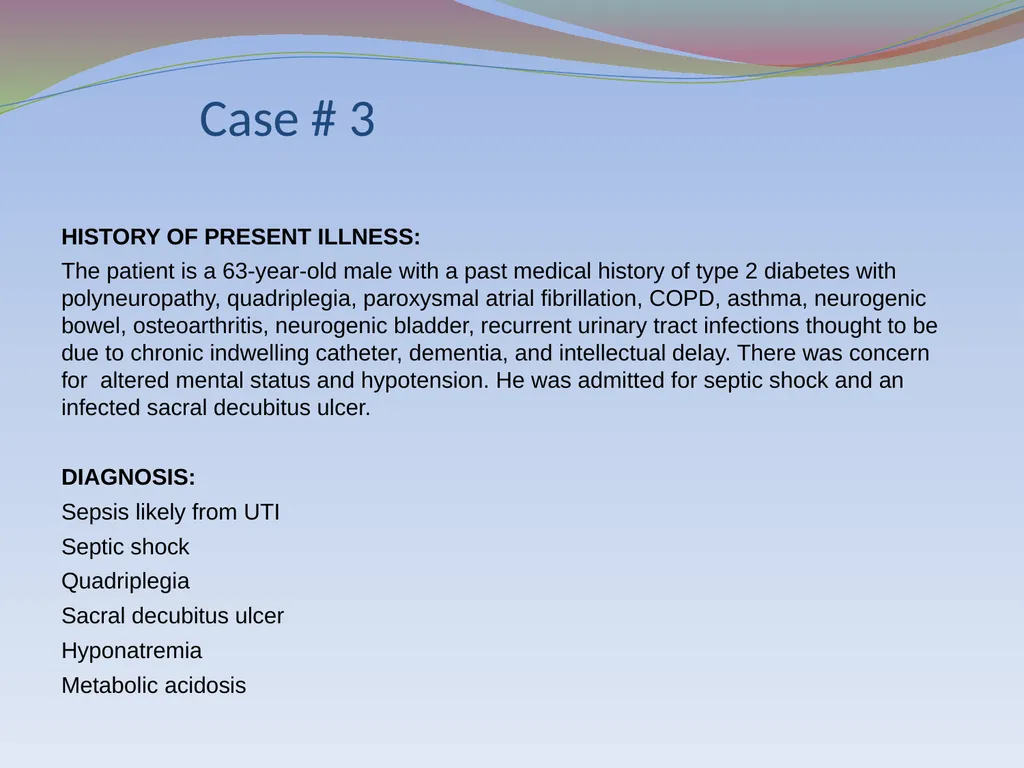
Case # 3 HISTORY OF PRESENT ILLNESS:
The patient is a 63-year-old male with a past medical history of type 2 diabetes with polyneuropathy, quadriplegia, paroxysmal atrial fibrillation, COPD, asthma, neurogenic bowel, osteoarthritis, neurogenic bladder, recurrent urinary tract infections thought to be due to chronic indwelling catheter, dementia, and intellectual delay. There was concern for altered mental status and hypotension. He was admitted for septic shock and an infected sacral decubitus ulcer.
DIAGNOSIS:
Sepsis likely from UTI
Septic shock
Quadriplegia
Sacral decubitus ulcer
Hyponatremia
Metabolic acidosis<br>
14
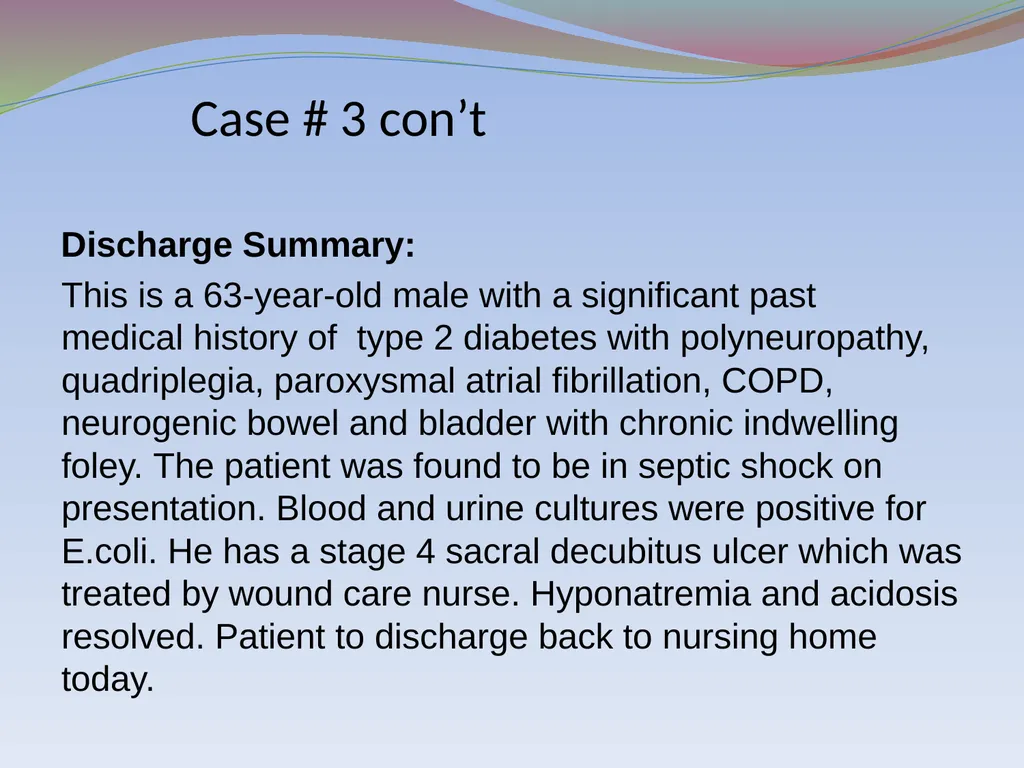
Discharge Summary:
This is a 63-year-old male with a significant past medical history of type 2 diabetes with polyneuropathy, quadriplegia, paroxysmal atrial fibrillation, COPD, neurogenic bowel and bladder with chronic indwelling foley. The patient was found to be in septic shock on presentation. Blood and urine cultures were positive for E.coli. He has a stage 4 sacral decubitus ulcer which was treated by wound care nurse. Hyponatremia and acidosis resolved. Patient to discharge back to nursing home today. Case # 3 con’t<br>
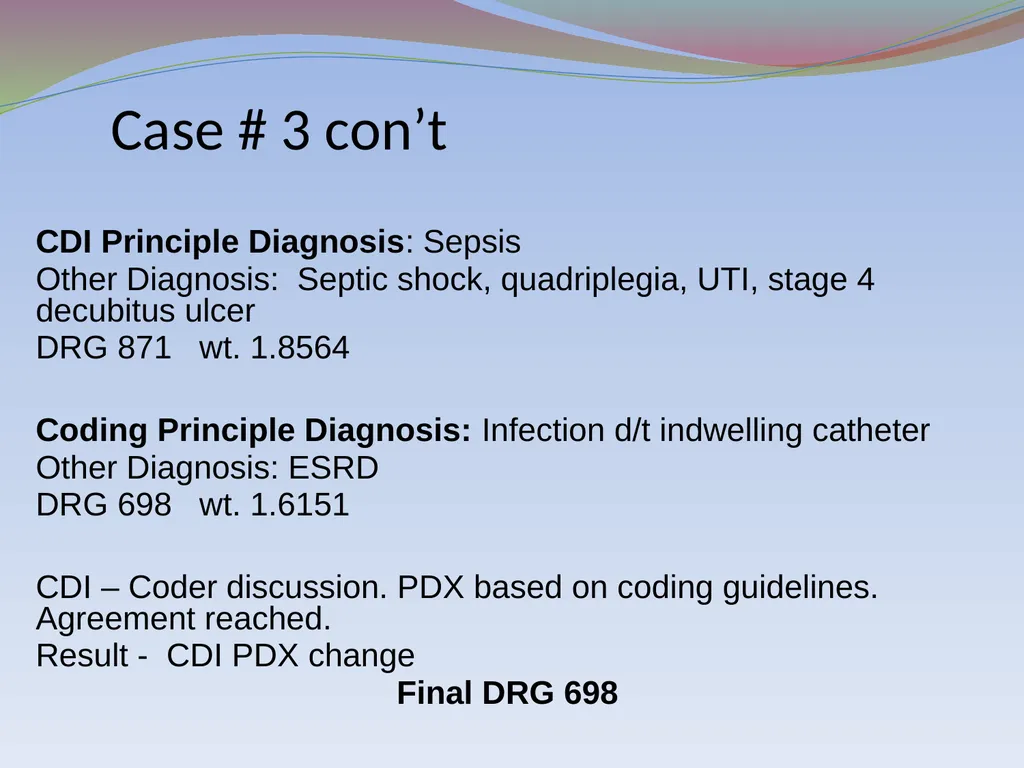
CDI – Coder discussion. PDX based on coding guidelines. Agreement reached.
Result - CDI PDX change
Final DRG 698<br>
16
Documentation Grins "History of sick as hell disease“
Head CT shows no hemorrhoids! And, urine intake is low
"Eyes and nose continue to be within normal limits“
"The chest xray has regrettably improved".
The lab test indicated abnormal lover function.
Discharge status: Alive but without permission.
Whilst in Casualty she was examined, Xrated and sent home.<br>