Drug-drug Interactions - opportunities for improved standardization and interoperability of data Richard D. Boyce, PhD University of Pittsburgh Brief presentation - OHDSI call 4919 Potential drug-drug interactions (PDDIs) Exposure two or
"Drug-drug Interactions - opportunities for" is the property of its rightful owner. Permission is granted to
download and print the materials on this website for personal, non-commercial use only, and to display it
on your personal computer provided you do not modify the materials and that you retain all copyright
notices contained in the materials. By downloading content from our website, you accept the terms of this
agreement.
Presentation Transcript
01
Drug-drug Interactions - opportunities for improved standardization and interoperability of data Richard D. Boyce, PhD
University of Pittsburgh
Brief presentation - OHDSI call 4/9/19<br>
02
Potential drug-drug interactions (PDDIs) Exposure two or more drugs that are known to interact
“potential” because exposure does not necessarily mean a clinically meaningful effect<br>
03
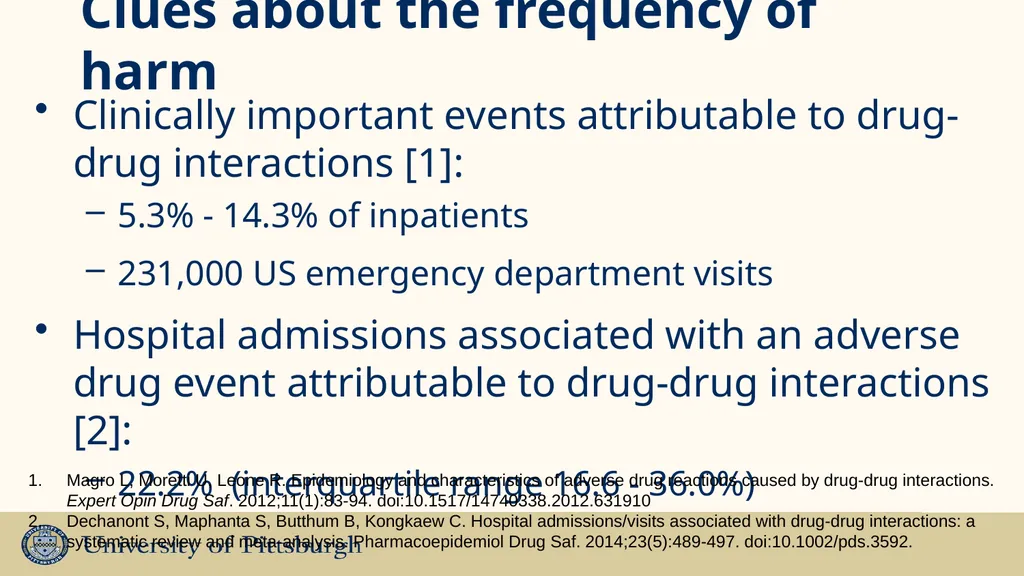
Clues about the frequency of harm Clinically important events attributable to drug-drug interactions [1]:
5.3% - 14.3% of inpatients
231,000 US emergency department visits
Hospital admissions associated with an adverse drug event attributable to drug-drug interactions [2]:
22.2% (interquartile range 16.6 - 36.0%) Magro L, Moretti U, Leone R. Epidemiology and characteristics of adverse drug reactions caused by drug-drug interactions. Expert Opin Drug Saf. 2012;11(1):83-94. doi:10.1517/14740338.2012.631910
Dechanont S, Maphanta S, Butthum B, Kongkaew C. Hospital admissions/visits associated with drug-drug interactions: a systematic review and meta-analysis. Pharmacoepidemiol Drug Saf. 2014;23(5):489-497. doi:10.1002/pds.3592.<br>
04
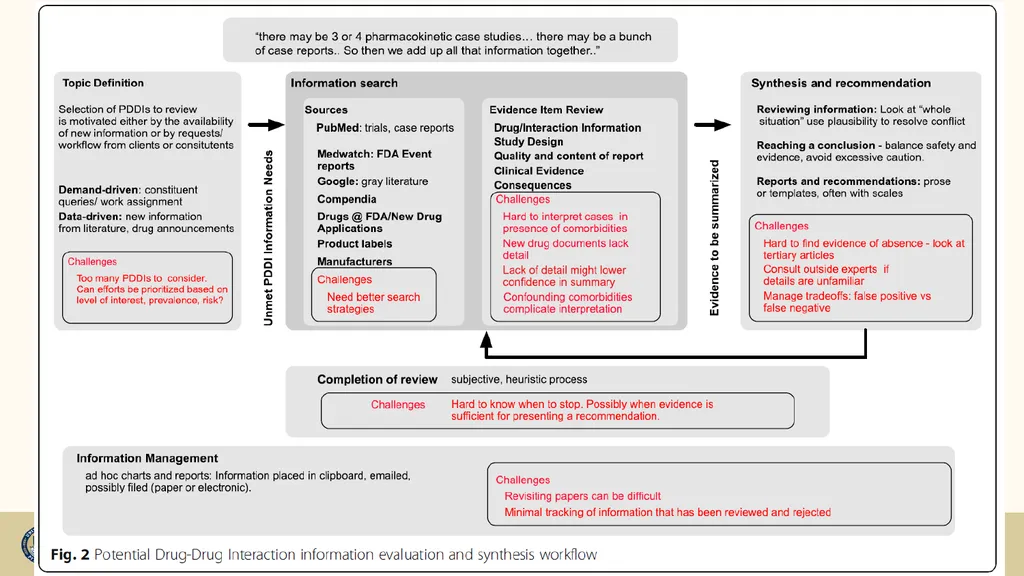
Key point No broadly accepted standards exist on how to organize and present PDDI knowledge<br>
05
PDDI clinical decision support (CDS) information needs Review and synthesis of:
77 journal articles
4 white papers from AHRQ-funded PDDI Working Groups
6 semi-structured interviews Romagnoli KM, Nelson SD, Hines L, Empey P, Boyce RD, Hochheiser H. Information needs for making clinical recommendations about potential drug-drug interactions: a synthesis of literature review and interviews. BMC Med Inform Decis Mak. 2017;17(1):21. doi:10.1186/s12911-017-0419-3<br>
06
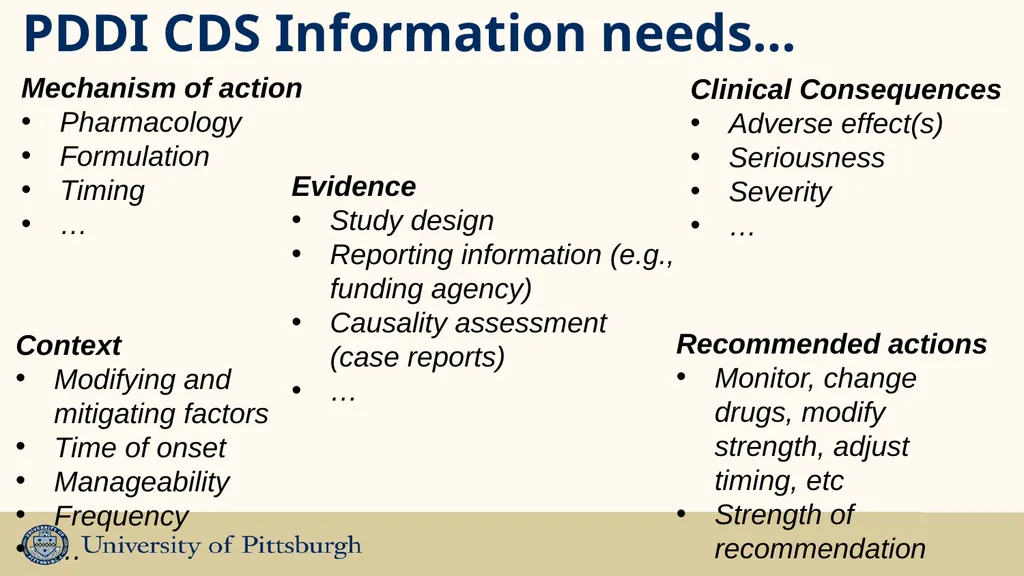
PDDI CDS Information needs… Mechanism of action
Pharmacology
Formulation
Timing
… Evidence
Study design
Reporting information (e.g., funding agency)
Causality assessment (case reports)
… Context
Modifying and mitigating factors
Time of onset
Manageability
Frequency
… Clinical Consequences
Adverse effect(s)
Seriousness
Severity
… Recommended actions
Monitor, change drugs, modify strength, adjust timing, etc
Strength of recommendation<br>
07
What have we done to address this gap?<br>
08
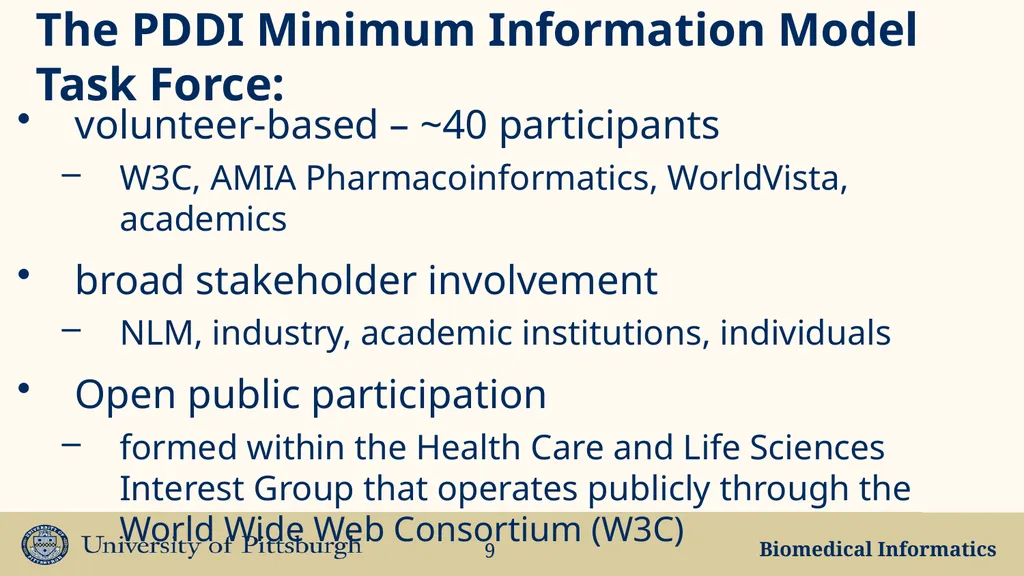
The PDDI Minimum Information Model Task Force: volunteer-based – ~40 participants
W3C, AMIA Pharmacoinformatics, WorldVista, academics
broad stakeholder involvement
NLM, industry, academic institutions, individuals
Open public participation
formed within the Health Care and Life Sciences Interest Group that operates publicly through the World Wide Web Consortium (W3C)<br>
09
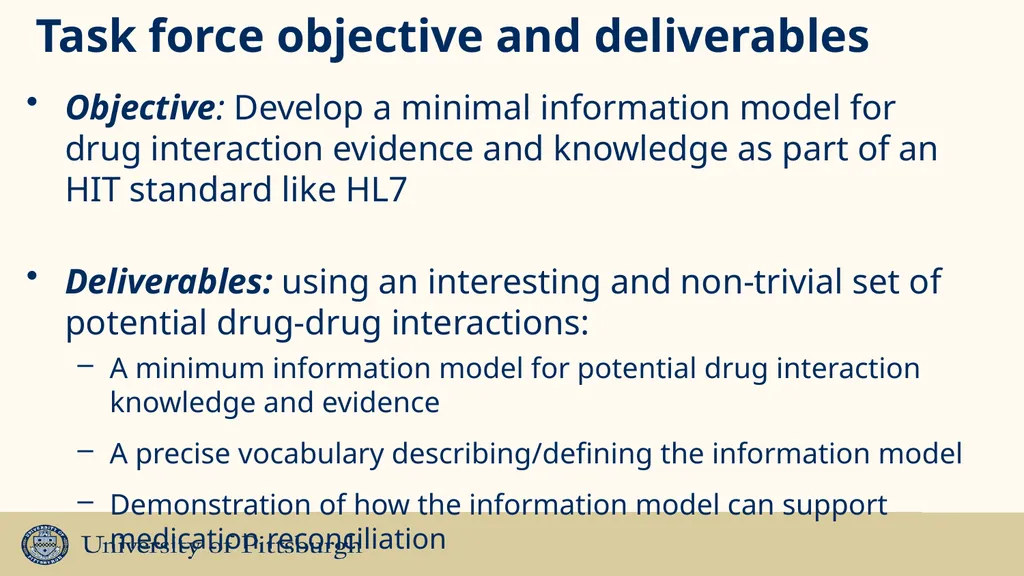
Task force objective and deliverables Objective: Develop a minimal information model for drug interaction evidence and knowledge as part of an HIT standard like HL7
Deliverables: using an interesting and non-trivial set of potential drug-drug interactions:
A minimum information model for potential drug interaction knowledge and evidence
A precise vocabulary describing/defining the information model
Demonstration of how the information model can support medication reconciliation<br>
10
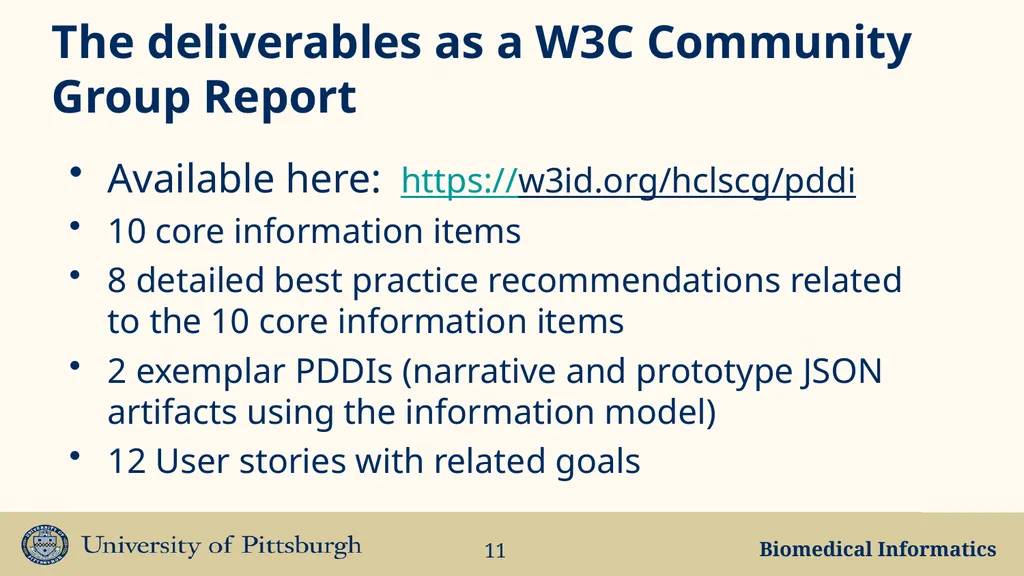
The deliverables as a W3C Community Group Report Available here: https://w3id.org/hclscg/pddi
10 core information items
8 detailed best practice recommendations related to the 10 core information items
2 exemplar PDDIs (narrative and prototype JSON artifacts using the information model)
12 User stories with related goals<br>
11
The minimum information model and related vocabulary<br>
12
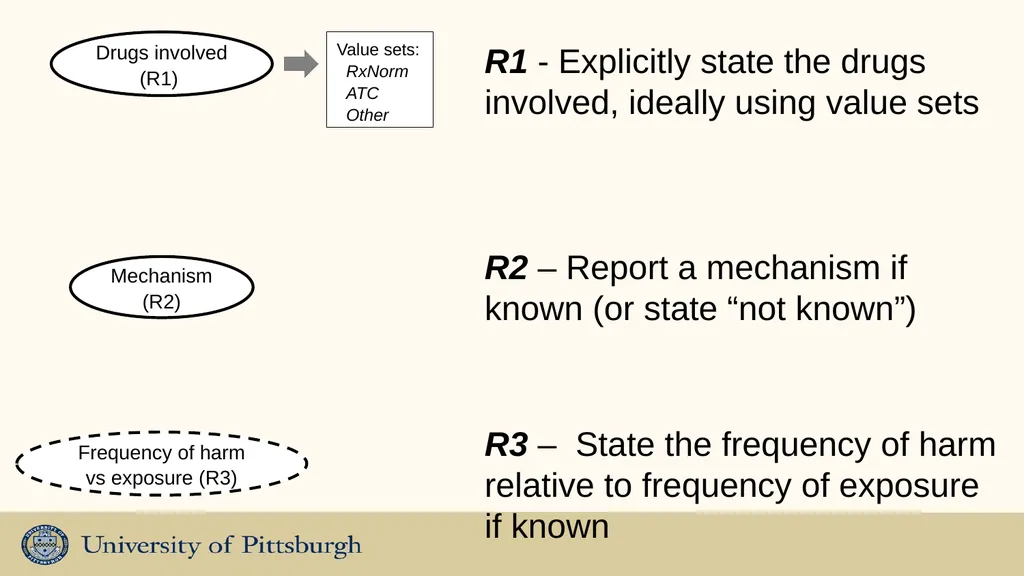
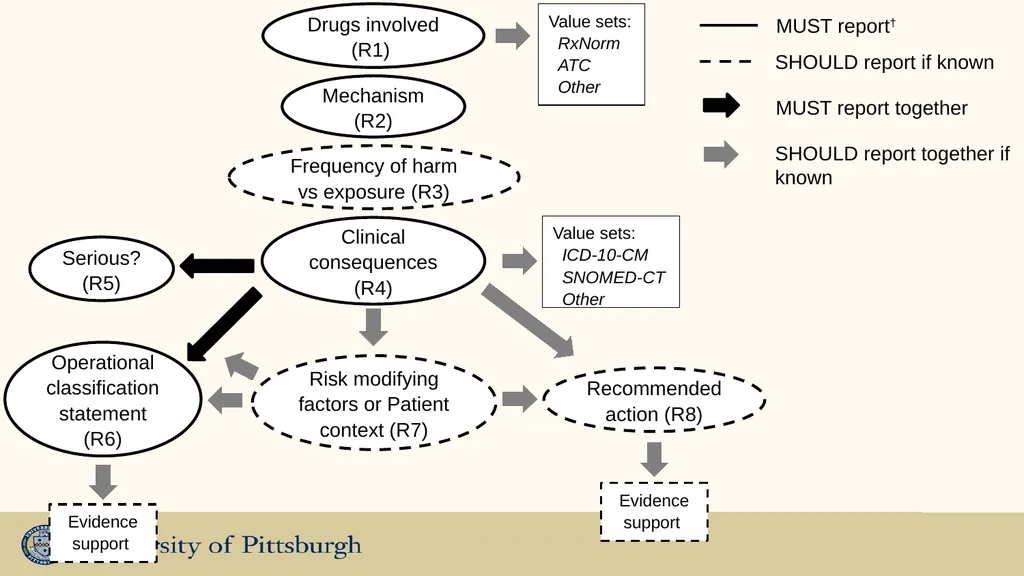
Frequency of harm vs exposure (R3) Drugs involved (R1) Value sets:
RxNorm
ATC
Other Mechanism (R2) R1 - Explicitly state the drugs involved, ideally using value sets R2 – Report a mechanism if known (or state “not known”) R3 – State the frequency of harm relative to frequency of exposure if known<br>
13
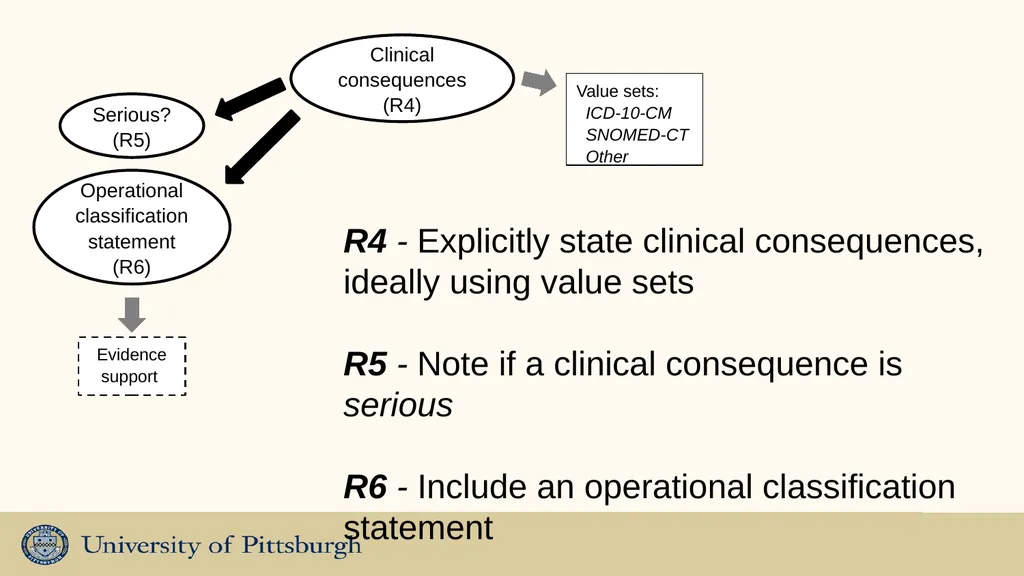
Evidence support R4 - Explicitly state clinical consequences, ideally using value sets
R5 - Note if a clinical consequence is serious
R6 - Include an operational classification statement<br>
14
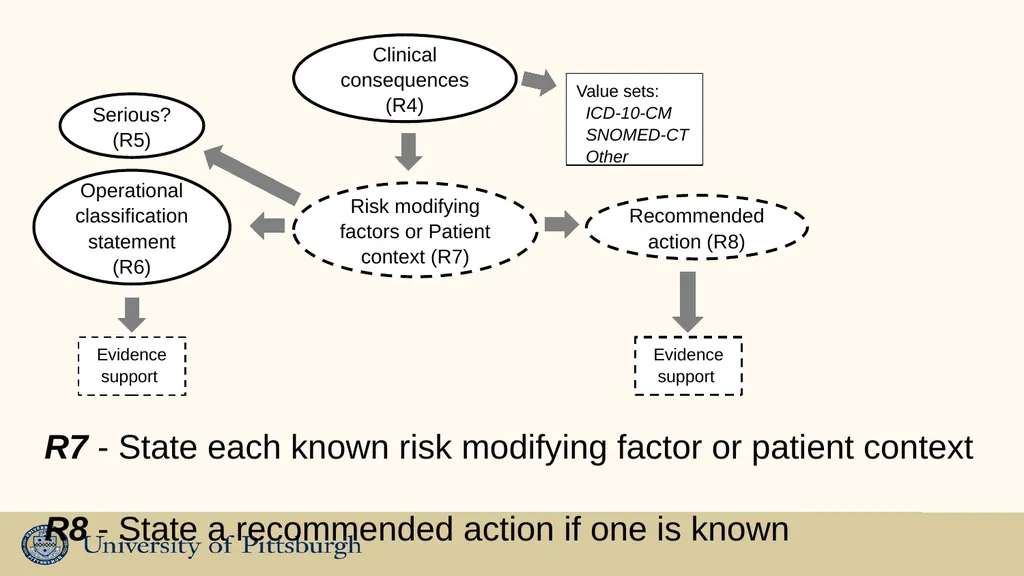
Recommended action (R8) Evidence support Evidence support Risk modifying factors or Patient context (R7) R7 - State each known risk modifying factor or patient context
R8 - State a recommended action if one is known<br>
15
Recommended action (R8) Evidence support Evidence support Drugs involved (R1) MUST report† SHOULD report if known MUST report together SHOULD report together if known<br>
16
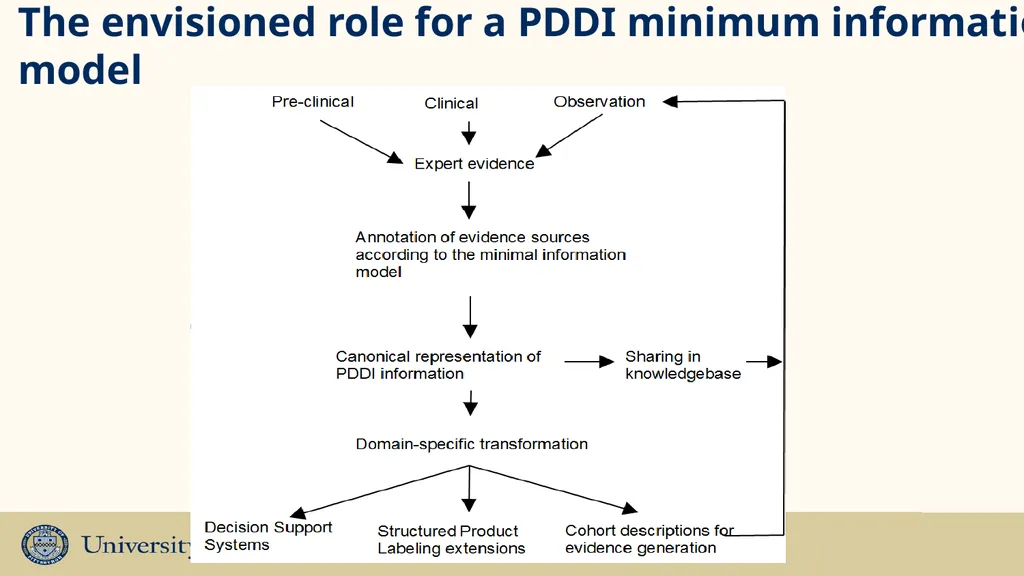
The envisioned role for a PDDI minimum information model<br>
17
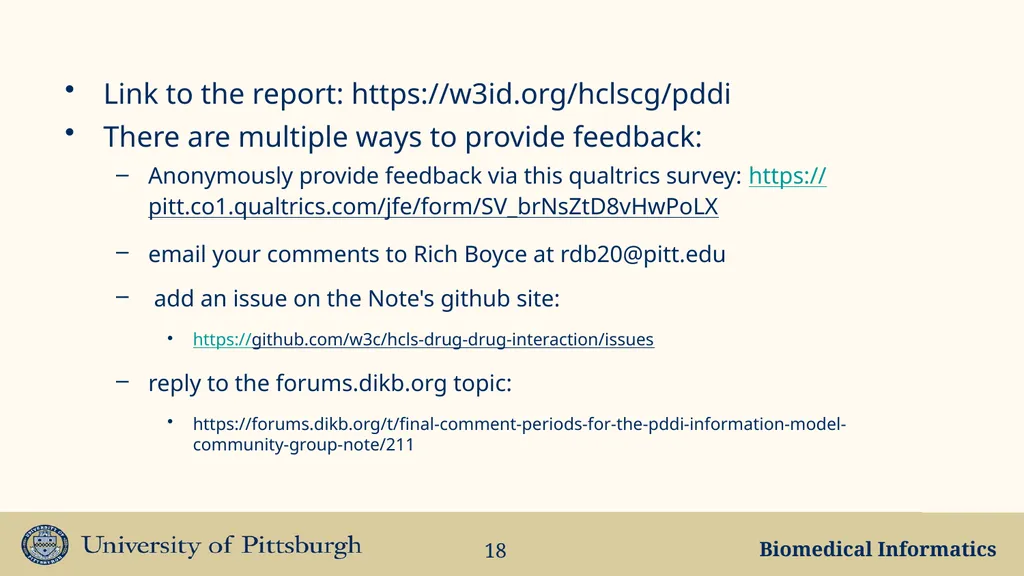
Link to the report: https://w3id.org/hclscg/pddi
There are multiple ways to provide feedback:
Anonymously provide feedback via this qualtrics survey: https://pitt.co1.qualtrics.com/jfe/form/SV_brNsZtD8vHwPoLX
email your comments to Rich Boyce at rdb20@pitt.edu
add an issue on the Note's github site:
https://github.com/w3c/hcls-drug-drug-interaction/issues
reply to the forums.dikb.org topic:
https://forums.dikb.org/t/final-comment-periods-for-the-pddi-information-model-community-group-note/211<br>
18
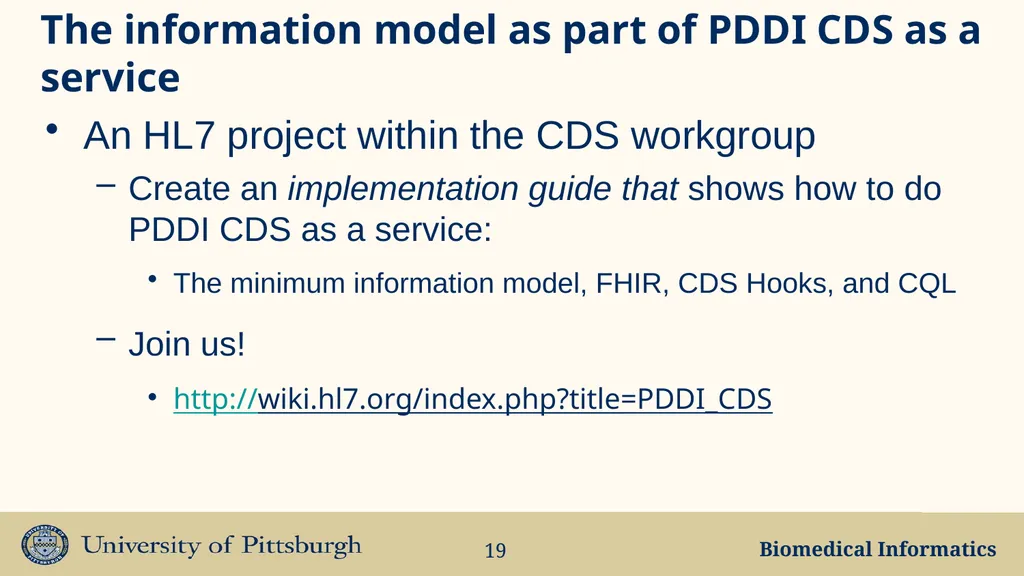
The information model as part of PDDI CDS as a service An HL7 project within the CDS workgroup
Create an implementation guide that shows how to do PDDI CDS as a service:
The minimum information model, FHIR, CDS Hooks, and CQL
Join us!
http://wiki.hl7.org/index.php?title=PDDI_CDS<br>
19
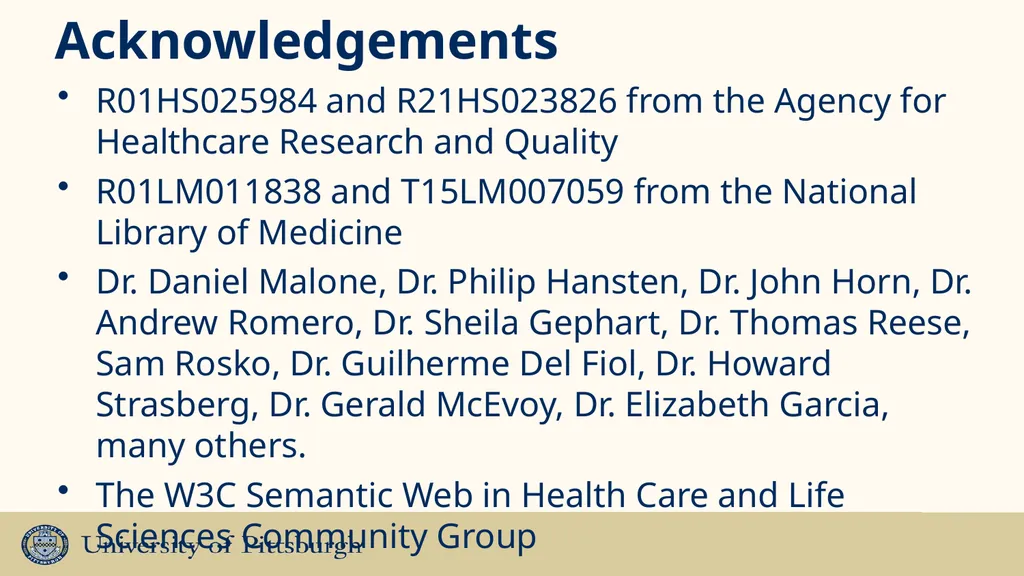
Acknowledgements R01HS025984 and R21HS023826 from the Agency for Healthcare Research and Quality
R01LM011838 and T15LM007059 from the National Library of Medicine
Dr. Daniel Malone, Dr. Philip Hansten, Dr. John Horn, Dr. Andrew Romero, Dr. Sheila Gephart, Dr. Thomas Reese, Sam Rosko, Dr. Guilherme Del Fiol, Dr. Howard Strasberg, Dr. Gerald McEvoy, Dr. Elizabeth Garcia, many others.
The W3C Semantic Web in Health Care and Life Sciences Community Group<br>