
DRY SYRUPS 1 CONTENTS DEFINITION CHARACTERISTICS
PM
Published · 26 slides · 0 views

1 / 1


Description
DRY SYRUPS 1 CONTENTS DEFINITION CHARACTERISTICS OF SUSPENSIONS FOR RECONSTITUTION COMMONLY USED INGREDIENTS PREPARATION OF DRY MIXTURE STABILITY CONSIDERATIONS GUIDELINES FOR STABILITY TESTING CONCLUSION REFERENCES 2 Dry Syrups Definition
Related Topics
Share
Embed code
Download this presentation From Below
"DRY SYRUPS 1 CONTENTS DEFINITION CHARACTERISTICS" is the property of its rightful owner. Permission is granted to download and print the materials on this website for personal, non-commercial use only, and to display it on your personal computer provided you do not modify the materials and that you retain all copyright notices contained in the materials. By downloading content from our website, you accept the terms of this agreement.
Presentation Transcript
01
DRY SYRUPS 1<br>
02
CONTENTS DEFINITION
CHARACTERISTICS OF SUSPENSIONS FOR RECONSTITUTION
COMMONLY USED INGREDIENTS
PREPARATION OF DRY MIXTURE
STABILITY CONSIDERATIONS
GUIDELINES FOR STABILITY TESTING
CONCLUSION
REFERENCES 2<br>
CHARACTERISTICS OF SUSPENSIONS FOR RECONSTITUTION
COMMONLY USED INGREDIENTS
PREPARATION OF DRY MIXTURE
STABILITY CONSIDERATIONS
GUIDELINES FOR STABILITY TESTING
CONCLUSION
REFERENCES 2<br>
03
Dry Syrups Definition
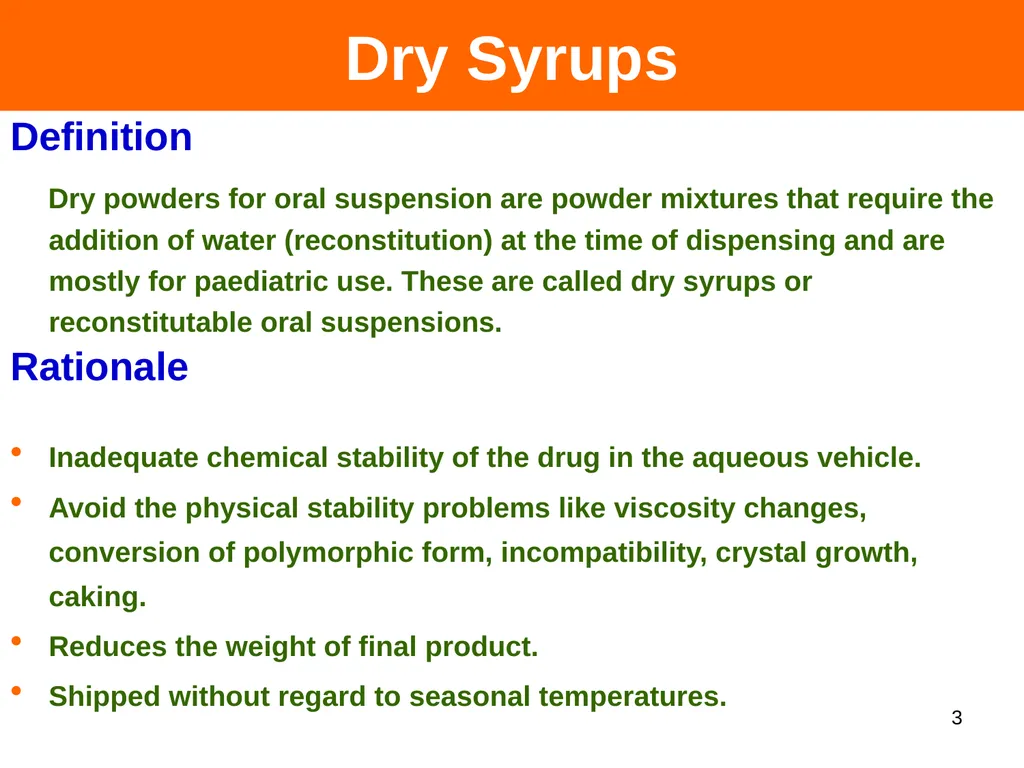
Dry powders for oral suspension are powder mixtures that require the addition of water (reconstitution) at the time of dispensing and are mostly for paediatric use. These are called dry syrups or reconstitutable oral suspensions.
Rationale
Inadequate chemical stability of the drug in the aqueous vehicle.
Avoid the physical stability problems like viscosity changes, conversion of polymorphic form, incompatibility, crystal growth, caking.
Reduces the weight of final product.
Shipped without regard to seasonal temperatures. 3<br>
Dry powders for oral suspension are powder mixtures that require the addition of water (reconstitution) at the time of dispensing and are mostly for paediatric use. These are called dry syrups or reconstitutable oral suspensions.
Rationale
Inadequate chemical stability of the drug in the aqueous vehicle.
Avoid the physical stability problems like viscosity changes, conversion of polymorphic form, incompatibility, crystal growth, caking.
Reduces the weight of final product.
Shipped without regard to seasonal temperatures. 3<br>
04
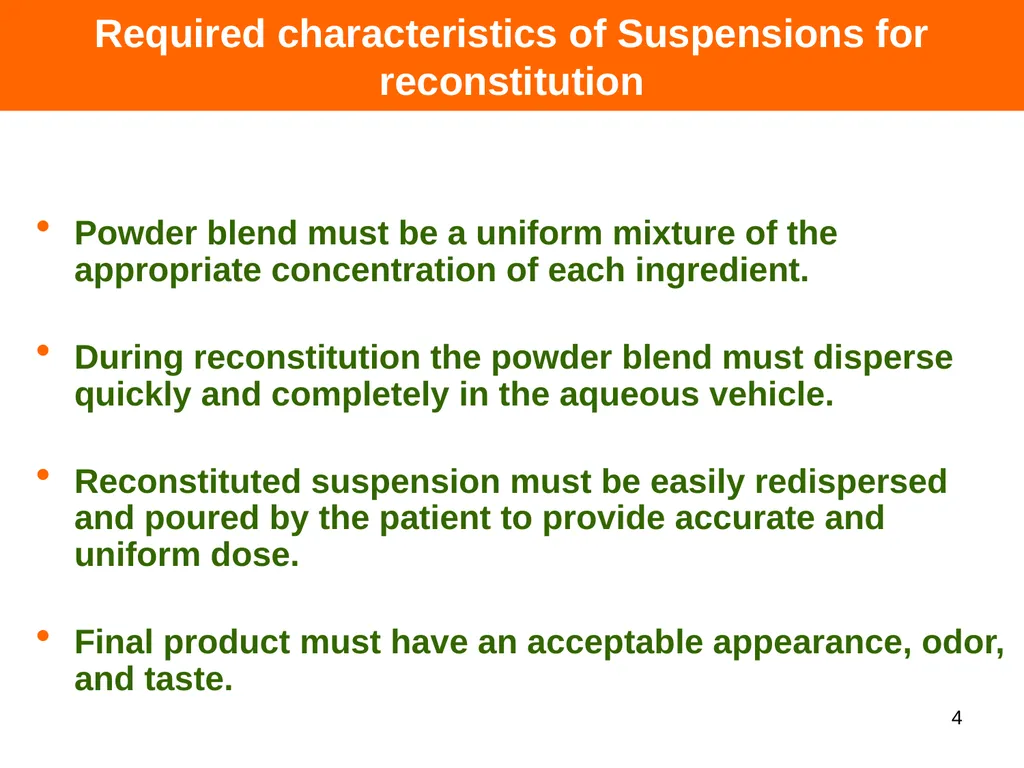
Required characteristics of Suspensions for reconstitution Powder blend must be a uniform mixture of the appropriate concentration of each ingredient.
During reconstitution the powder blend must disperse quickly and completely in the aqueous vehicle.
Reconstituted suspension must be easily redispersed and poured by the patient to provide accurate and uniform dose.
Final product must have an acceptable appearance, odor, and taste. 4<br>
During reconstitution the powder blend must disperse quickly and completely in the aqueous vehicle.
Reconstituted suspension must be easily redispersed and poured by the patient to provide accurate and uniform dose.
Final product must have an acceptable appearance, odor, and taste. 4<br>
05
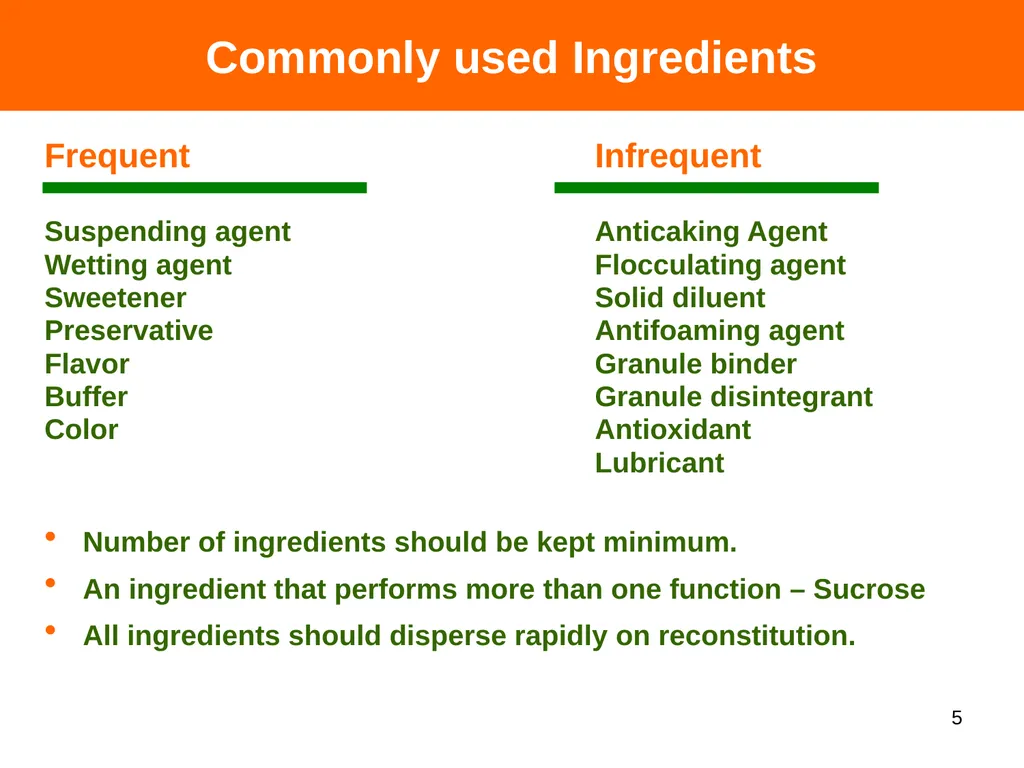
Commonly used Ingredients Frequent Infrequent
Suspending agent Anticaking Agent
Wetting agent Flocculating agent
Sweetener Solid diluent
Preservative Antifoaming agent
Flavor Granule binder
Buffer Granule disintegrant
Color Antioxidant
Lubricant
Number of ingredients should be kept minimum.
An ingredient that performs more than one function – Sucrose
All ingredients should disperse rapidly on reconstitution. 5<br>
Suspending agent Anticaking Agent
Wetting agent Flocculating agent
Sweetener Solid diluent
Preservative Antifoaming agent
Flavor Granule binder
Buffer Granule disintegrant
Color Antioxidant
Lubricant
Number of ingredients should be kept minimum.
An ingredient that performs more than one function – Sucrose
All ingredients should disperse rapidly on reconstitution. 5<br>
06
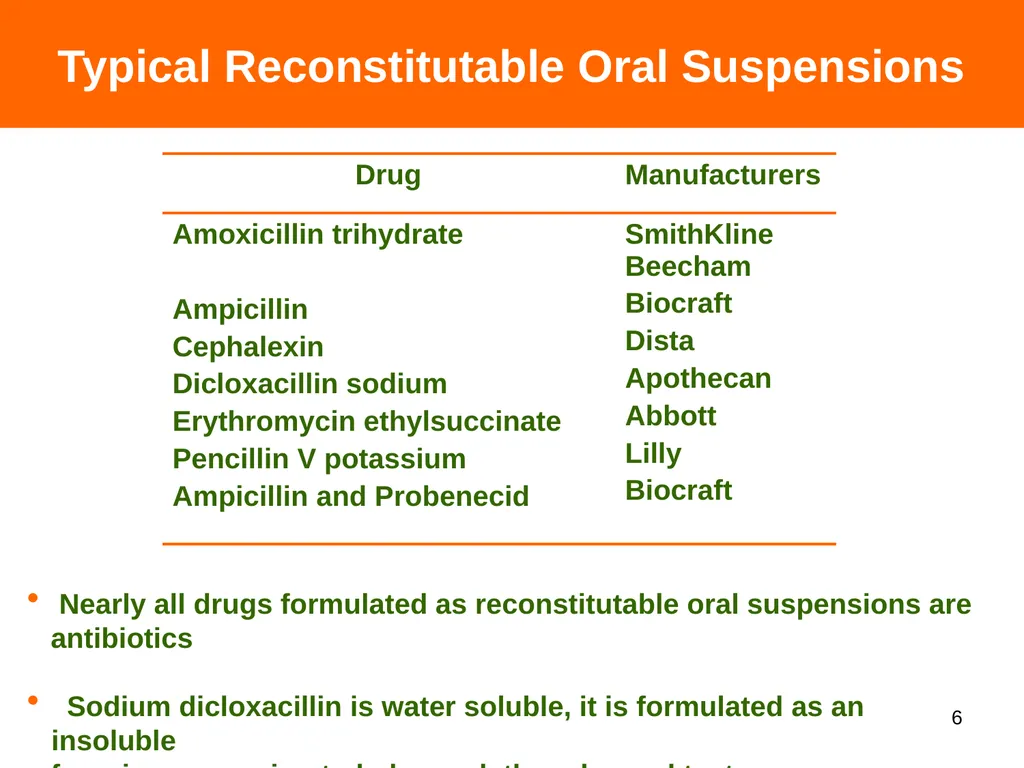
Typical Reconstitutable Oral Suspensions Nearly all drugs formulated as reconstitutable oral suspensions are
antibiotics
Sodium dicloxacillin is water soluble, it is formulated as an insoluble
form in suspension to help mask the odor and taste 6<br>
antibiotics
Sodium dicloxacillin is water soluble, it is formulated as an insoluble
form in suspension to help mask the odor and taste 6<br>
07
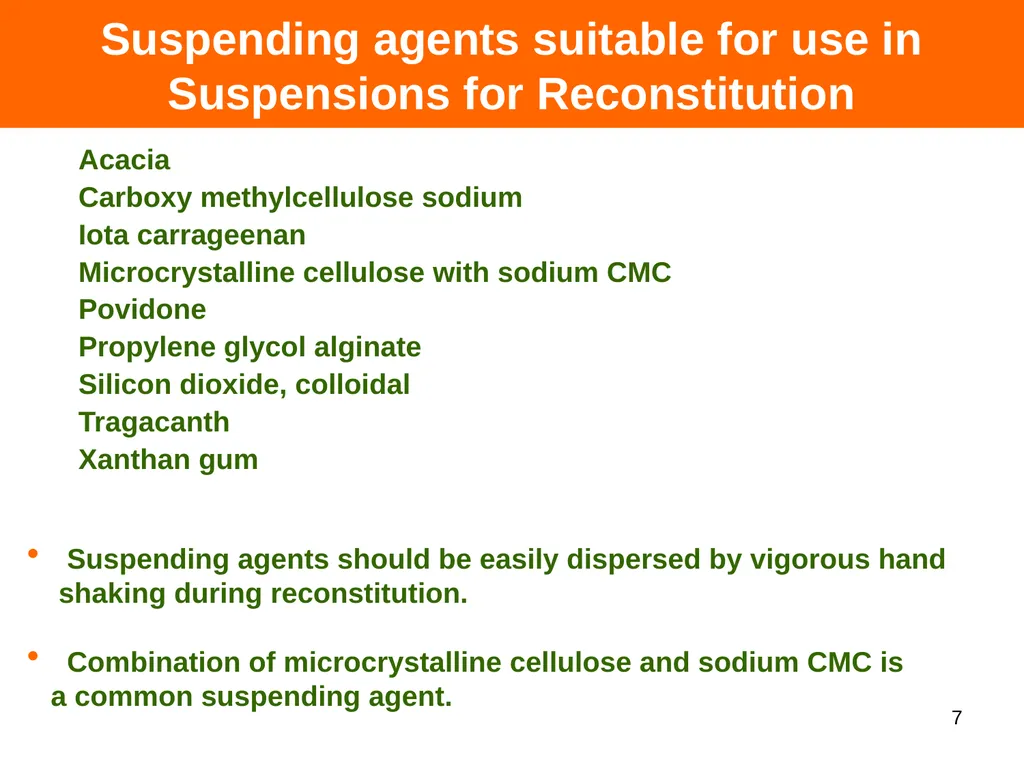
Suspending agents suitable for use in Suspensions for Reconstitution Suspending agents should be easily dispersed by vigorous hand
shaking during reconstitution.
Combination of microcrystalline cellulose and sodium CMC is
a common suspending agent. 7<br>
shaking during reconstitution.
Combination of microcrystalline cellulose and sodium CMC is
a common suspending agent. 7<br>
08
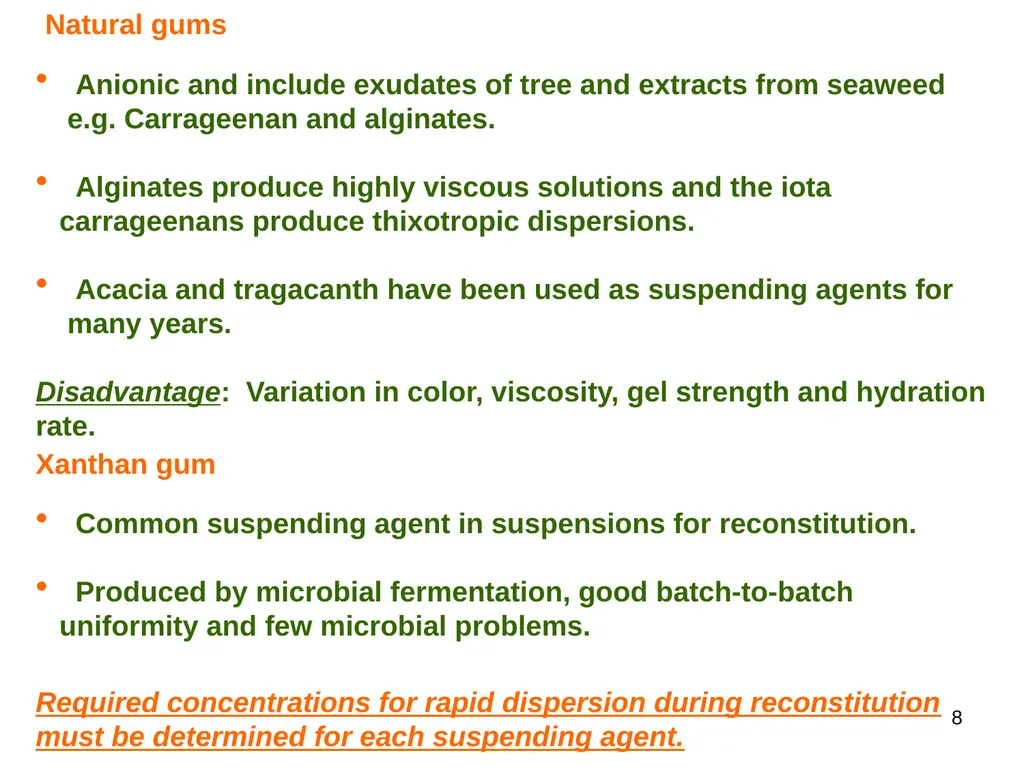
Natural gums
Anionic and include exudates of tree and extracts from seaweed
e.g. Carrageenan and alginates.
Alginates produce highly viscous solutions and the iota
carrageenans produce thixotropic dispersions.
Acacia and tragacanth have been used as suspending agents for
many years.
Disadvantage: Variation in color, viscosity, gel strength and hydration rate. Xanthan gum
Common suspending agent in suspensions for reconstitution.
Produced by microbial fermentation, good batch-to-batch
uniformity and few microbial problems.
Required concentrations for rapid dispersion during reconstitution must be determined for each suspending agent. 8<br>
Anionic and include exudates of tree and extracts from seaweed
e.g. Carrageenan and alginates.
Alginates produce highly viscous solutions and the iota
carrageenans produce thixotropic dispersions.
Acacia and tragacanth have been used as suspending agents for
many years.
Disadvantage: Variation in color, viscosity, gel strength and hydration rate. Xanthan gum
Common suspending agent in suspensions for reconstitution.
Produced by microbial fermentation, good batch-to-batch
uniformity and few microbial problems.
Required concentrations for rapid dispersion during reconstitution must be determined for each suspending agent. 8<br>
09
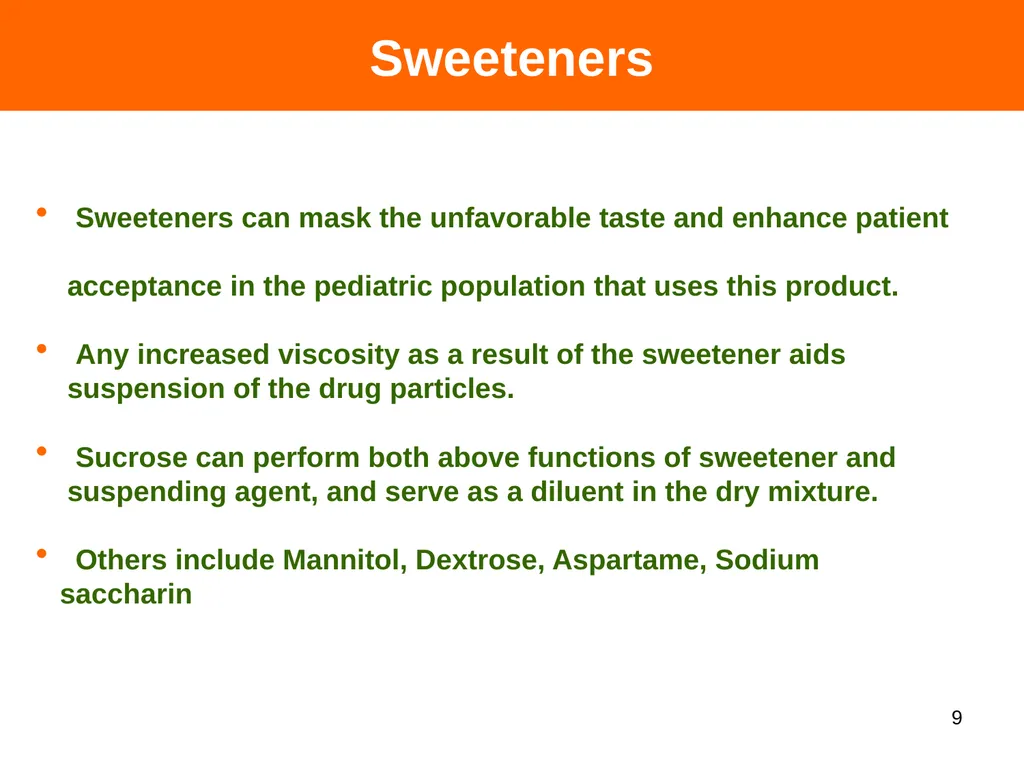
Sweeteners can mask the unfavorable taste and enhance patient
acceptance in the pediatric population that uses this product.
Any increased viscosity as a result of the sweetener aids
suspension of the drug particles.
Sucrose can perform both above functions of sweetener and
suspending agent, and serve as a diluent in the dry mixture.
Others include Mannitol, Dextrose, Aspartame, Sodium saccharin Sweeteners 9<br>
acceptance in the pediatric population that uses this product.
Any increased viscosity as a result of the sweetener aids
suspension of the drug particles.
Sucrose can perform both above functions of sweetener and
suspending agent, and serve as a diluent in the dry mixture.
Others include Mannitol, Dextrose, Aspartame, Sodium saccharin Sweeteners 9<br>
10
Drugs in suspension are hydrophobic, repel water and are not
easily wetted.
Surfactants are commonly used to aid in the dispersion of
hydrophobic drugs.
Excess wetting agent can produce foaming and impart an
unpleasant taste.
Polysorbate 80 is a common wetting agent. Nonionic and is
chemically compatible with both cationic and anionic excipients
and drugs. Used in concenrations < 0.1 %.
Another common wetting agent is sodium lauryl sulfate. Anionic
and may be incompatible with cationic drugs. Wetting Agents 10<br>
easily wetted.
Surfactants are commonly used to aid in the dispersion of
hydrophobic drugs.
Excess wetting agent can produce foaming and impart an
unpleasant taste.
Polysorbate 80 is a common wetting agent. Nonionic and is
chemically compatible with both cationic and anionic excipients
and drugs. Used in concenrations < 0.1 %.
Another common wetting agent is sodium lauryl sulfate. Anionic
and may be incompatible with cationic drugs. Wetting Agents 10<br>
11
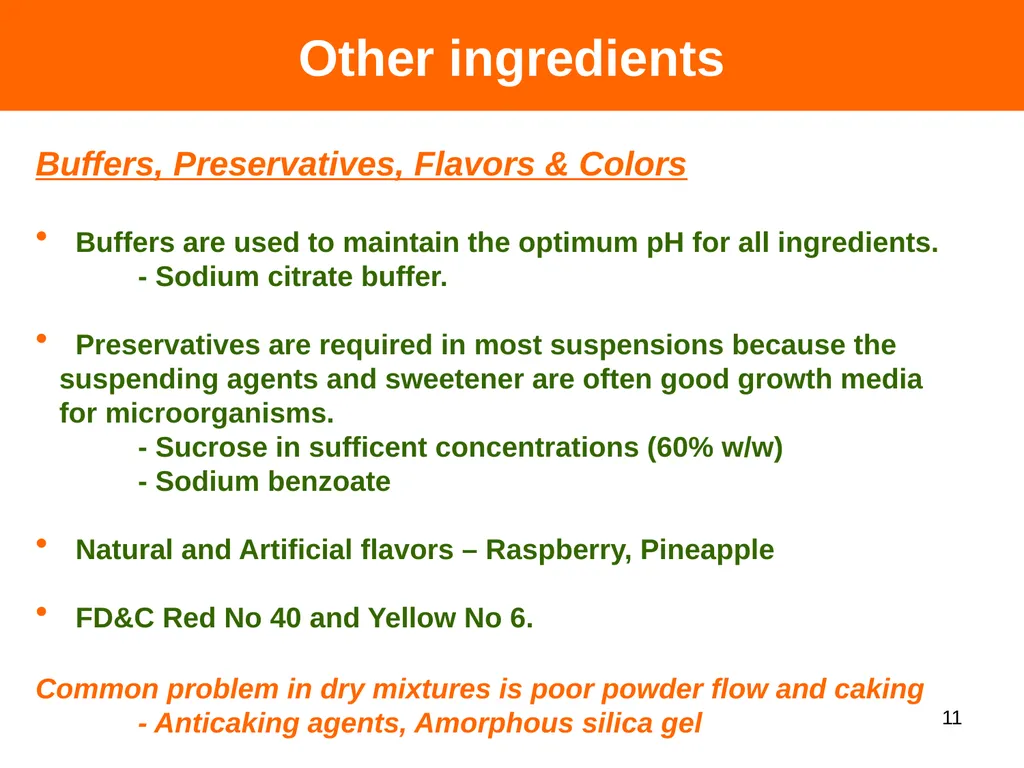
Buffers, Preservatives, Flavors & Colors
Buffers are used to maintain the optimum pH for all ingredients.
- Sodium citrate buffer.
Preservatives are required in most suspensions because the
suspending agents and sweetener are often good growth media
for microorganisms.
- Sucrose in sufficent concentrations (60% w/w)
- Sodium benzoate
Natural and Artificial flavors – Raspberry, Pineapple
FD&C Red No 40 and Yellow No 6. Other ingredients Common problem in dry mixtures is poor powder flow and caking
- Anticaking agents, Amorphous silica gel 11<br>
Buffers are used to maintain the optimum pH for all ingredients.
- Sodium citrate buffer.
Preservatives are required in most suspensions because the
suspending agents and sweetener are often good growth media
for microorganisms.
- Sucrose in sufficent concentrations (60% w/w)
- Sodium benzoate
Natural and Artificial flavors – Raspberry, Pineapple
FD&C Red No 40 and Yellow No 6. Other ingredients Common problem in dry mixtures is poor powder flow and caking
- Anticaking agents, Amorphous silica gel 11<br>
12
Preparation of Dry Mixture Powder Blends
Granulated Products
Combination Products 12<br>
Granulated Products
Combination Products 12<br>
13
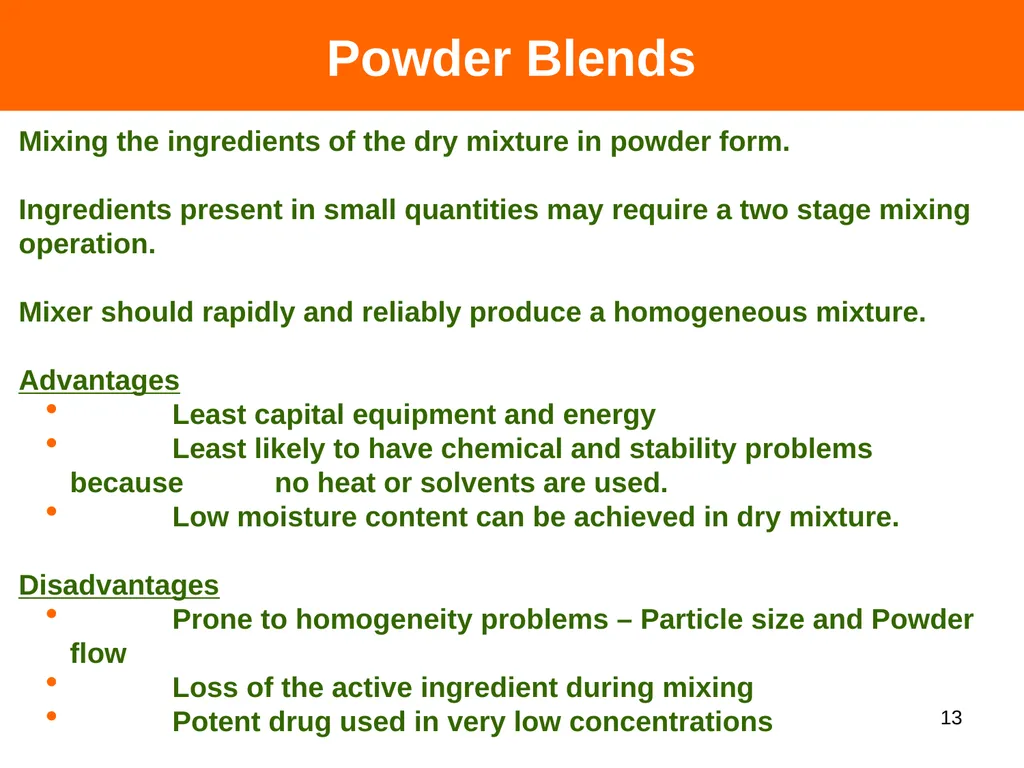
Powder Blends Mixing the ingredients of the dry mixture in powder form.
Ingredients present in small quantities may require a two stage mixing operation.
Mixer should rapidly and reliably produce a homogeneous mixture.
Advantages
Least capital equipment and energy
Least likely to have chemical and stability problems because no heat or solvents are used.
Low moisture content can be achieved in dry mixture.
Disadvantages
Prone to homogeneity problems – Particle size and Powder flow
Loss of the active ingredient during mixing
Potent drug used in very low concentrations 13<br>
Ingredients present in small quantities may require a two stage mixing operation.
Mixer should rapidly and reliably produce a homogeneous mixture.
Advantages
Least capital equipment and energy
Least likely to have chemical and stability problems because no heat or solvents are used.
Low moisture content can be achieved in dry mixture.
Disadvantages
Prone to homogeneity problems – Particle size and Powder flow
Loss of the active ingredient during mixing
Potent drug used in very low concentrations 13<br>
14
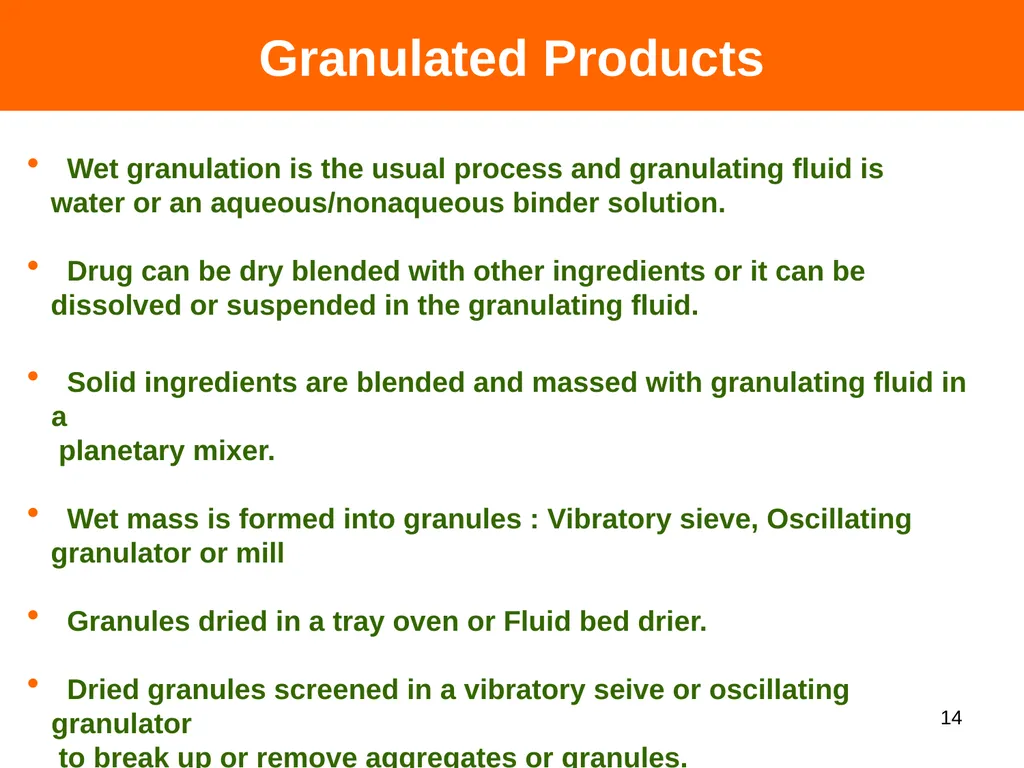
Granulated Products Wet granulation is the usual process and granulating fluid is
water or an aqueous/nonaqueous binder solution.
Drug can be dry blended with other ingredients or it can be
dissolved or suspended in the granulating fluid. Solid ingredients are blended and massed with granulating fluid in a
planetary mixer.
Wet mass is formed into granules : Vibratory sieve, Oscillating
granulator or mill
Granules dried in a tray oven or Fluid bed drier.
Dried granules screened in a vibratory seive or oscillating granulator
to break up or remove aggregates or granules. 14<br>
water or an aqueous/nonaqueous binder solution.
Drug can be dry blended with other ingredients or it can be
dissolved or suspended in the granulating fluid. Solid ingredients are blended and massed with granulating fluid in a
planetary mixer.
Wet mass is formed into granules : Vibratory sieve, Oscillating
granulator or mill
Granules dried in a tray oven or Fluid bed drier.
Dried granules screened in a vibratory seive or oscillating granulator
to break up or remove aggregates or granules. 14<br>
15
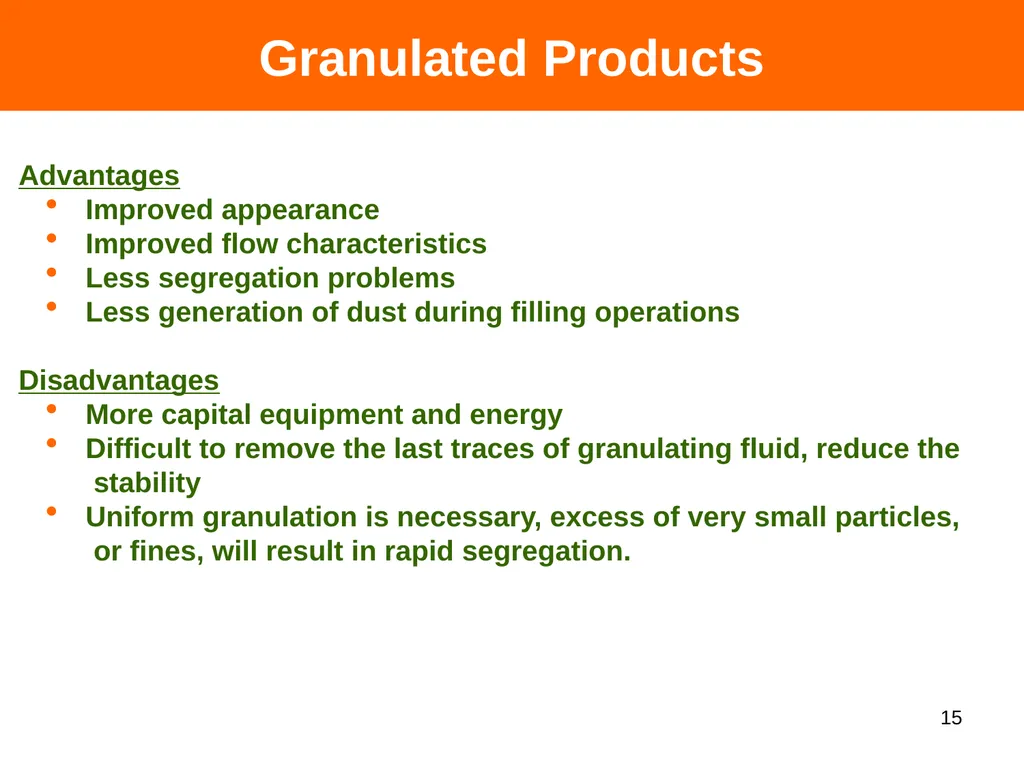
Granulated Products Advantages
Improved appearance
Improved flow characteristics
Less segregation problems
Less generation of dust during filling operations
Disadvantages
More capital equipment and energy
Difficult to remove the last traces of granulating fluid, reduce the
stability
Uniform granulation is necessary, excess of very small particles,
or fines, will result in rapid segregation. 15<br>
Improved appearance
Improved flow characteristics
Less segregation problems
Less generation of dust during filling operations
Disadvantages
More capital equipment and energy
Difficult to remove the last traces of granulating fluid, reduce the
stability
Uniform granulation is necessary, excess of very small particles,
or fines, will result in rapid segregation. 15<br>
16
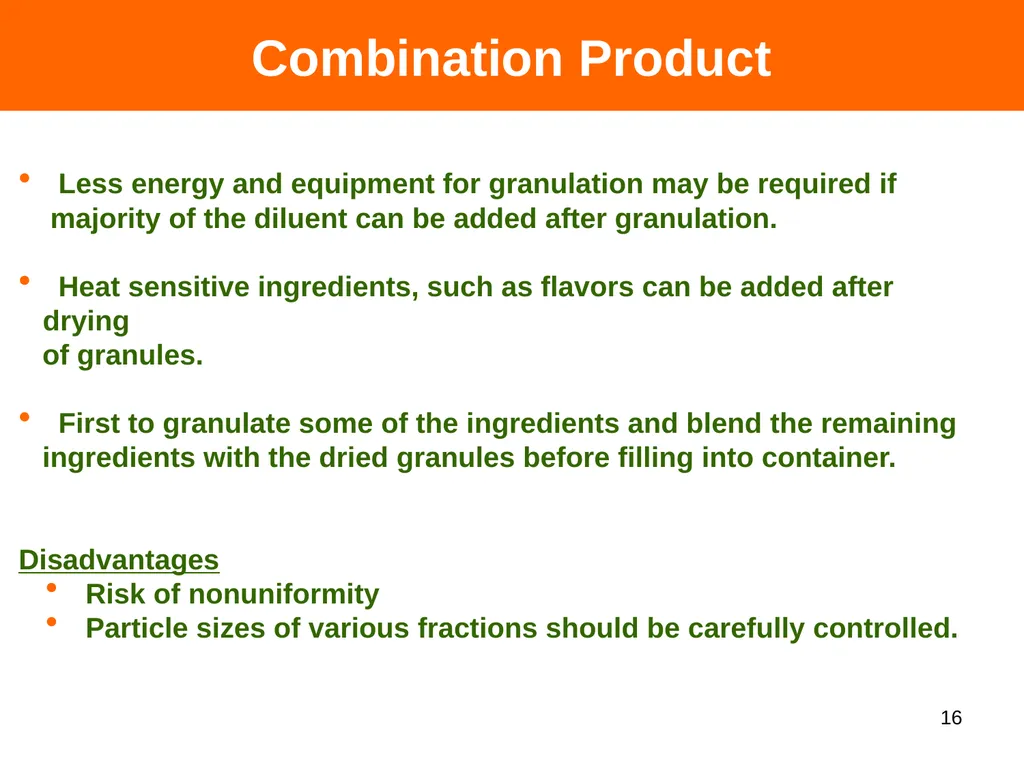
Combination Product Less energy and equipment for granulation may be required if
majority of the diluent can be added after granulation.
Heat sensitive ingredients, such as flavors can be added after drying
of granules.
First to granulate some of the ingredients and blend the remaining
ingredients with the dried granules before filling into container.
Disadvantages
Risk of nonuniformity
Particle sizes of various fractions should be carefully controlled. 16<br>
majority of the diluent can be added after granulation.
Heat sensitive ingredients, such as flavors can be added after drying
of granules.
First to granulate some of the ingredients and blend the remaining
ingredients with the dried granules before filling into container.
Disadvantages
Risk of nonuniformity
Particle sizes of various fractions should be carefully controlled. 16<br>
17
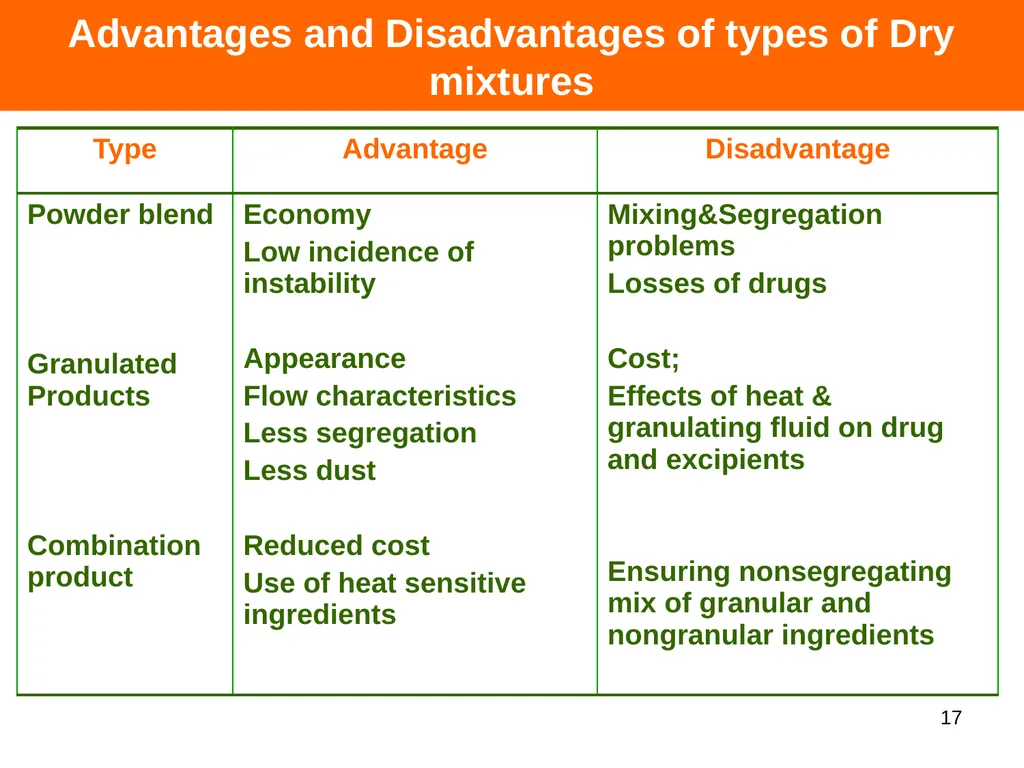
Advantages and Disadvantages of types of Dry mixtures 17<br>
18
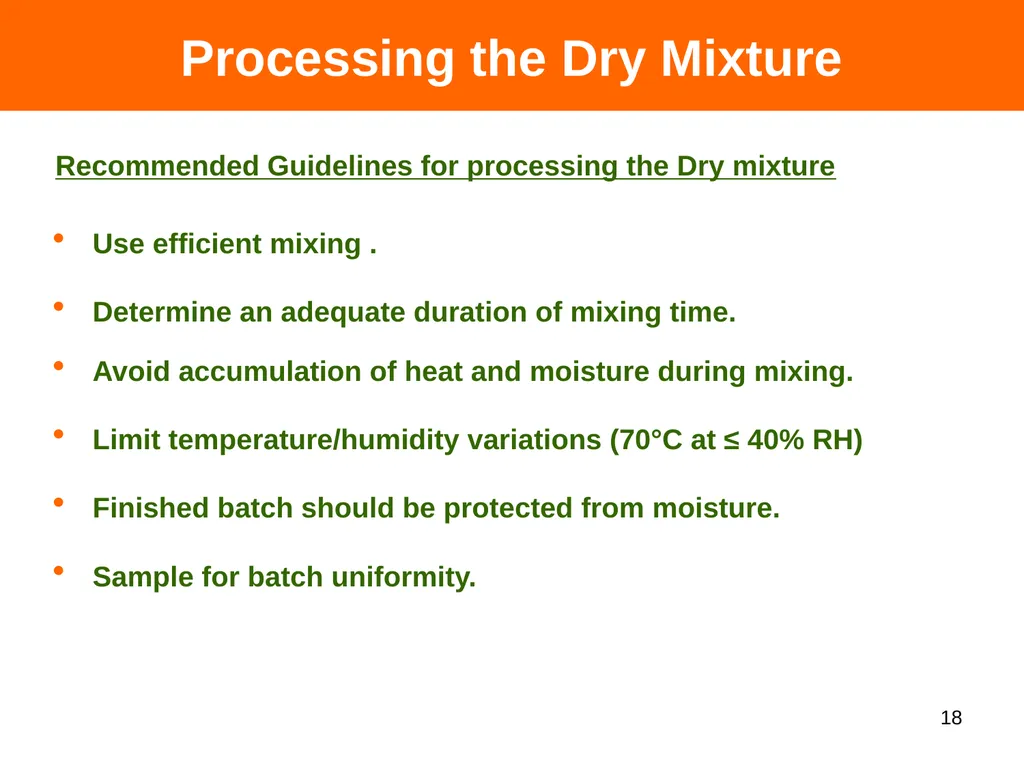
Processing the Dry Mixture Recommended Guidelines for processing the Dry mixture 18<br>
19
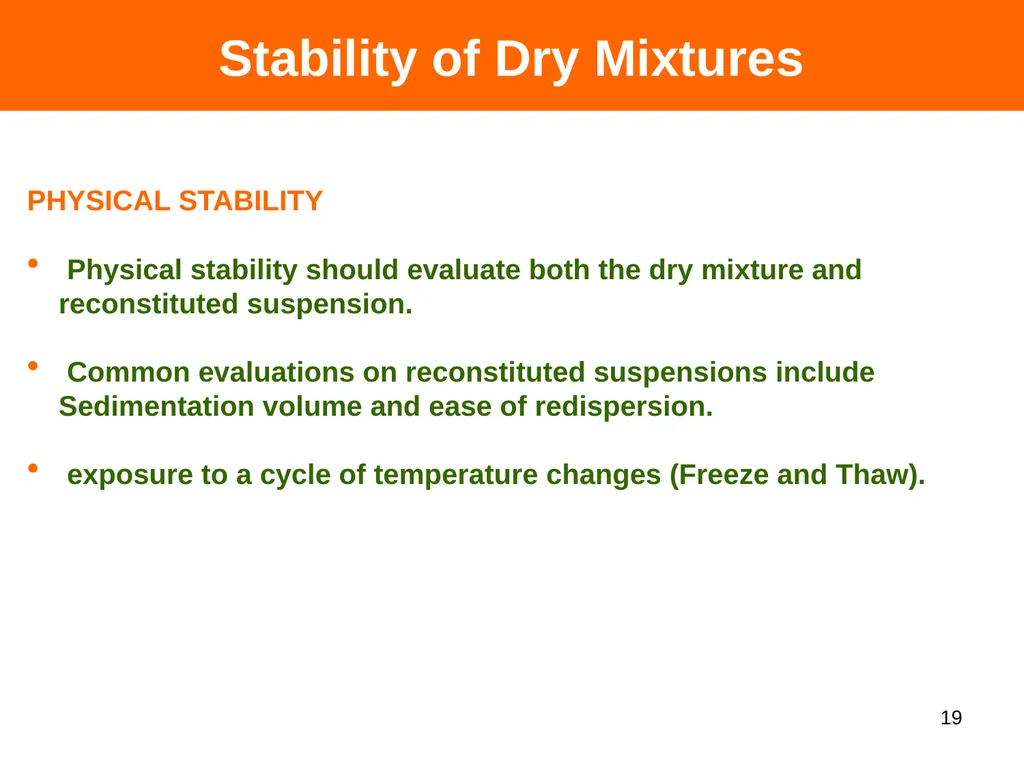
Stability of Dry Mixtures PHYSICAL STABILITY
Physical stability should evaluate both the dry mixture and
reconstituted suspension.
Common evaluations on reconstituted suspensions include
Sedimentation volume and ease of redispersion.
exposure to a cycle of temperature changes (Freeze and Thaw). 19<br>
Physical stability should evaluate both the dry mixture and
reconstituted suspension.
Common evaluations on reconstituted suspensions include
Sedimentation volume and ease of redispersion.
exposure to a cycle of temperature changes (Freeze and Thaw). 19<br>
20
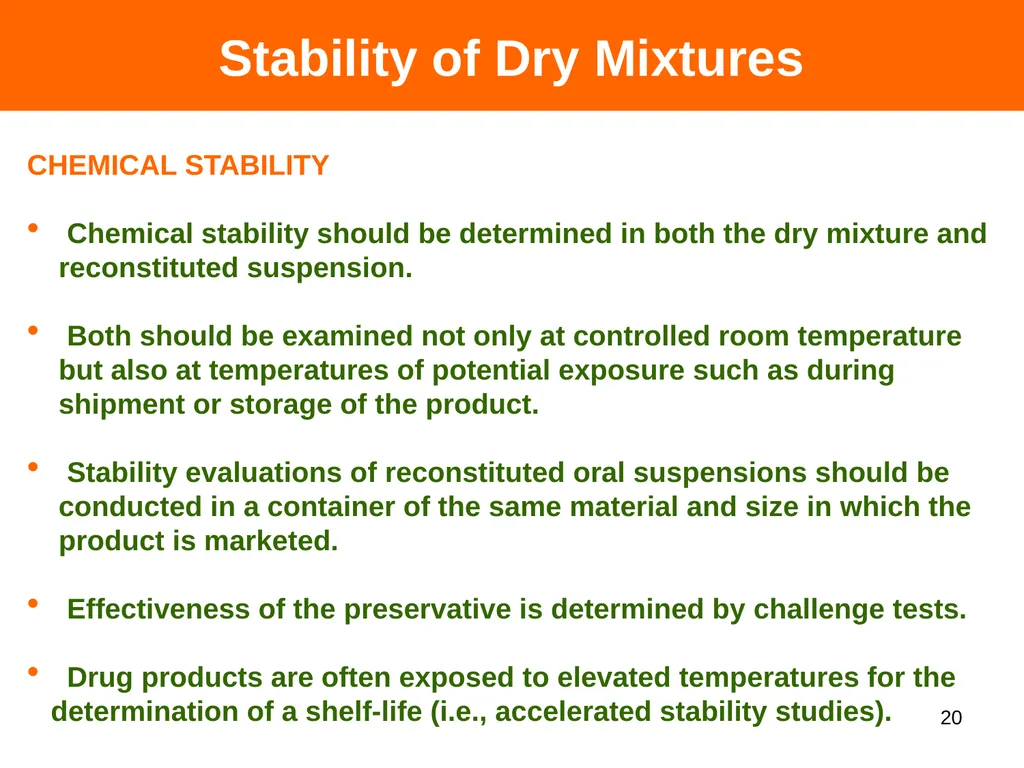
Stability of Dry Mixtures CHEMICAL STABILITY
Chemical stability should be determined in both the dry mixture and
reconstituted suspension.
Both should be examined not only at controlled room temperature
but also at temperatures of potential exposure such as during
shipment or storage of the product.
Stability evaluations of reconstituted oral suspensions should be
conducted in a container of the same material and size in which the
product is marketed.
Effectiveness of the preservative is determined by challenge tests.
Drug products are often exposed to elevated temperatures for the
determination of a shelf-life (i.e., accelerated stability studies). 20<br>
Chemical stability should be determined in both the dry mixture and
reconstituted suspension.
Both should be examined not only at controlled room temperature
but also at temperatures of potential exposure such as during
shipment or storage of the product.
Stability evaluations of reconstituted oral suspensions should be
conducted in a container of the same material and size in which the
product is marketed.
Effectiveness of the preservative is determined by challenge tests.
Drug products are often exposed to elevated temperatures for the
determination of a shelf-life (i.e., accelerated stability studies). 20<br>
21
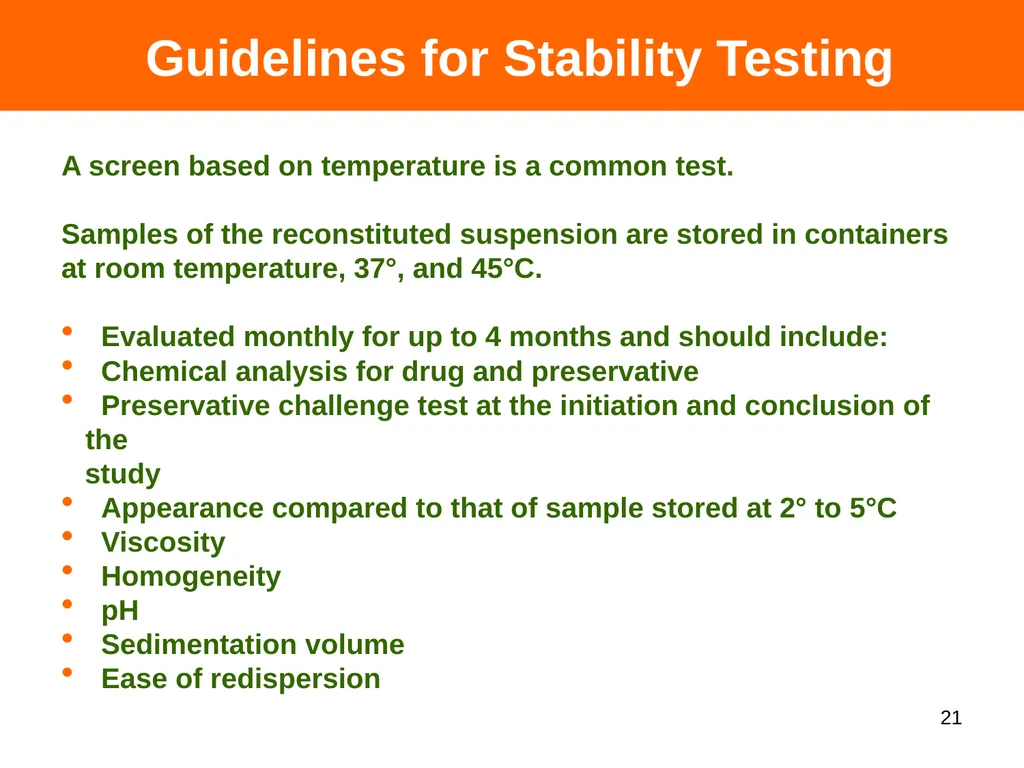
Guidelines for Stability Testing A screen based on temperature is a common test.
Samples of the reconstituted suspension are stored in containers at room temperature, 37°, and 45°C.
Evaluated monthly for up to 4 months and should include:
Chemical analysis for drug and preservative
Preservative challenge test at the initiation and conclusion of the
study
Appearance compared to that of sample stored at 2° to 5°C
Viscosity
Homogeneity
pH
Sedimentation volume
Ease of redispersion 21<br>
Samples of the reconstituted suspension are stored in containers at room temperature, 37°, and 45°C.
Evaluated monthly for up to 4 months and should include:
Chemical analysis for drug and preservative
Preservative challenge test at the initiation and conclusion of the
study
Appearance compared to that of sample stored at 2° to 5°C
Viscosity
Homogeneity
pH
Sedimentation volume
Ease of redispersion 21<br>
22
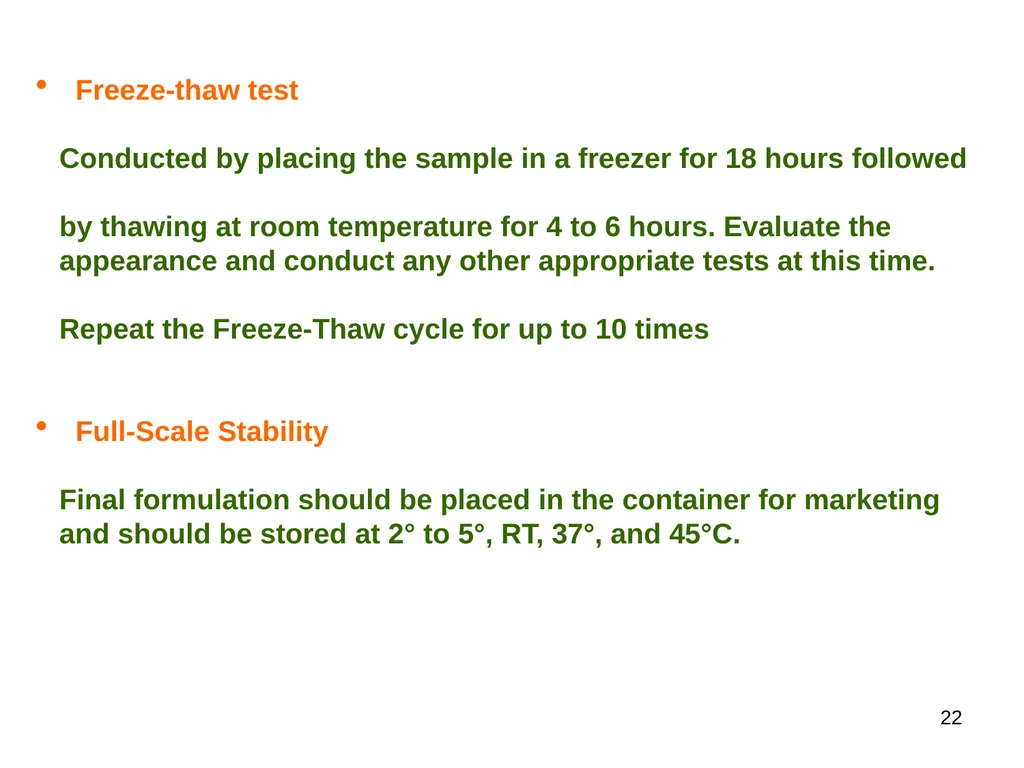
Freeze-thaw test
Conducted by placing the sample in a freezer for 18 hours followed
by thawing at room temperature for 4 to 6 hours. Evaluate the
appearance and conduct any other appropriate tests at this time.
Repeat the Freeze-Thaw cycle for up to 10 times
Full-Scale Stability
Final formulation should be placed in the container for marketing
and should be stored at 2° to 5°, RT, 37°, and 45°C. 22<br>
Conducted by placing the sample in a freezer for 18 hours followed
by thawing at room temperature for 4 to 6 hours. Evaluate the
appearance and conduct any other appropriate tests at this time.
Repeat the Freeze-Thaw cycle for up to 10 times
Full-Scale Stability
Final formulation should be placed in the container for marketing
and should be stored at 2° to 5°, RT, 37°, and 45°C. 22<br>
23
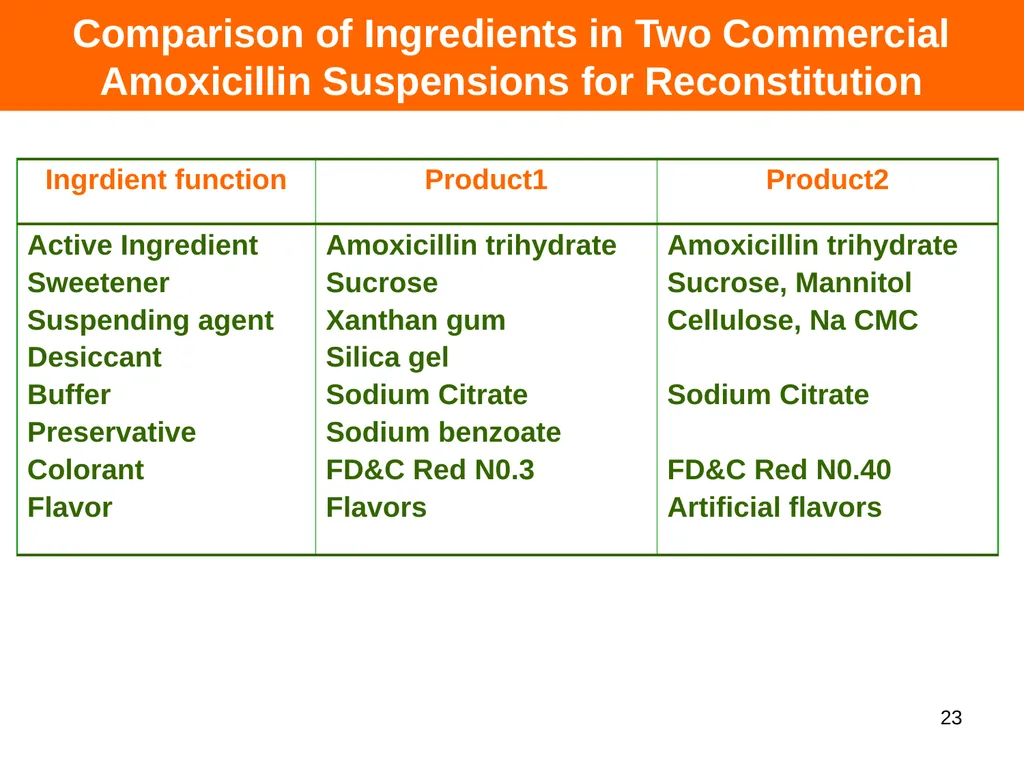
Comparison of Ingredients in Two Commercial Amoxicillin Suspensions for Reconstitution 23<br>
24
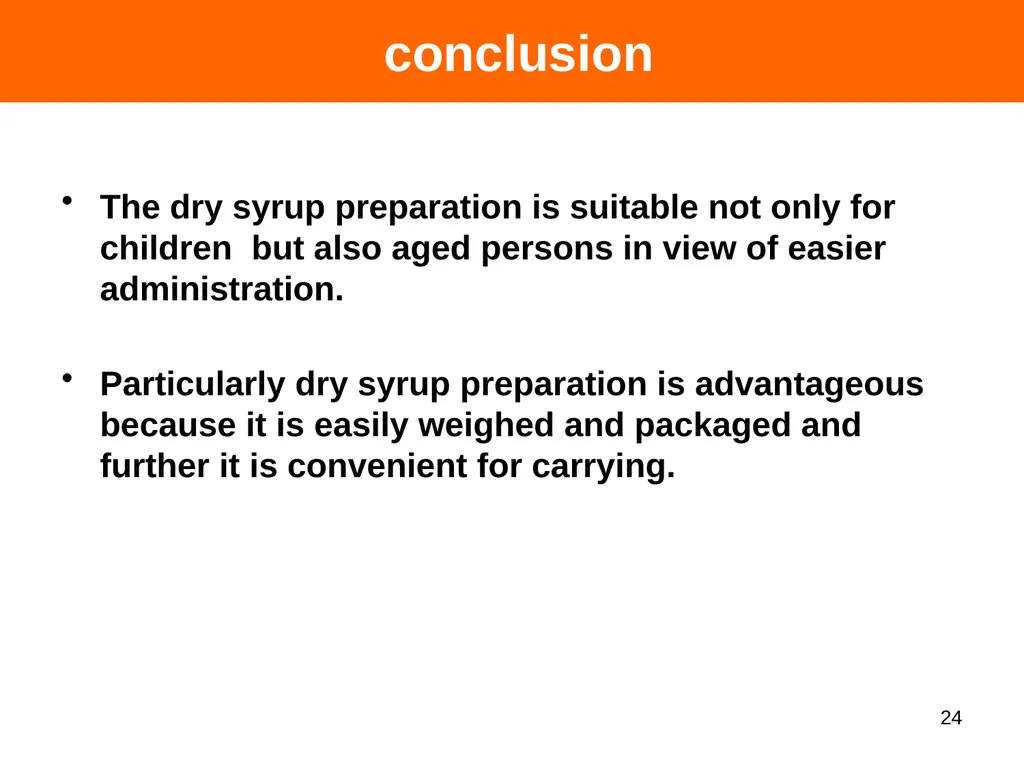
The dry syrup preparation is suitable not only for children but also aged persons in view of easier administration.
Particularly dry syrup preparation is advantageous because it is easily weighed and packaged and further it is convenient for carrying. conclusion 24<br>
Particularly dry syrup preparation is advantageous because it is easily weighed and packaged and further it is convenient for carrying. conclusion 24<br>
25
Herbert A.Lieberman, Martin M.Rieger and Gilbert S.Banker, Pharmaceutical dosage forms: Disperse systems, 2nd edition, volume-2.
Howard C.Ansel, Loyd V.Allen, Jr.Nicholas,G.Popovich, Pharmaceutical dosage forms and drug delivery systems,7th edition.
A.P. Pawer and R.S. Gaud,Modern dispensing pharmacy,2nd edition. References 25<br>
Howard C.Ansel, Loyd V.Allen, Jr.Nicholas,G.Popovich, Pharmaceutical dosage forms and drug delivery systems,7th edition.
A.P. Pawer and R.S. Gaud,Modern dispensing pharmacy,2nd edition. References 25<br>
26
Thank You 26<br>