04
Axiom 1 is its own plane dual.
The plane dual of Axiom 2 is a theorem.
THEOREM 2.1. Every point is incident with at least three distinct lines.<br>
05
Let AB and C be any line and point not incident, as in Axiom 1. By Axiom 3, points C and A determine a second line. By Axiom 2, BC has a third point D, and by Axiom 3, D and A determine a third line.<br>
06
Axioms 3 and 4 are, in effect, duals of each other.
The plane dual of Axiom 7 introduces new terminology that must be explained.
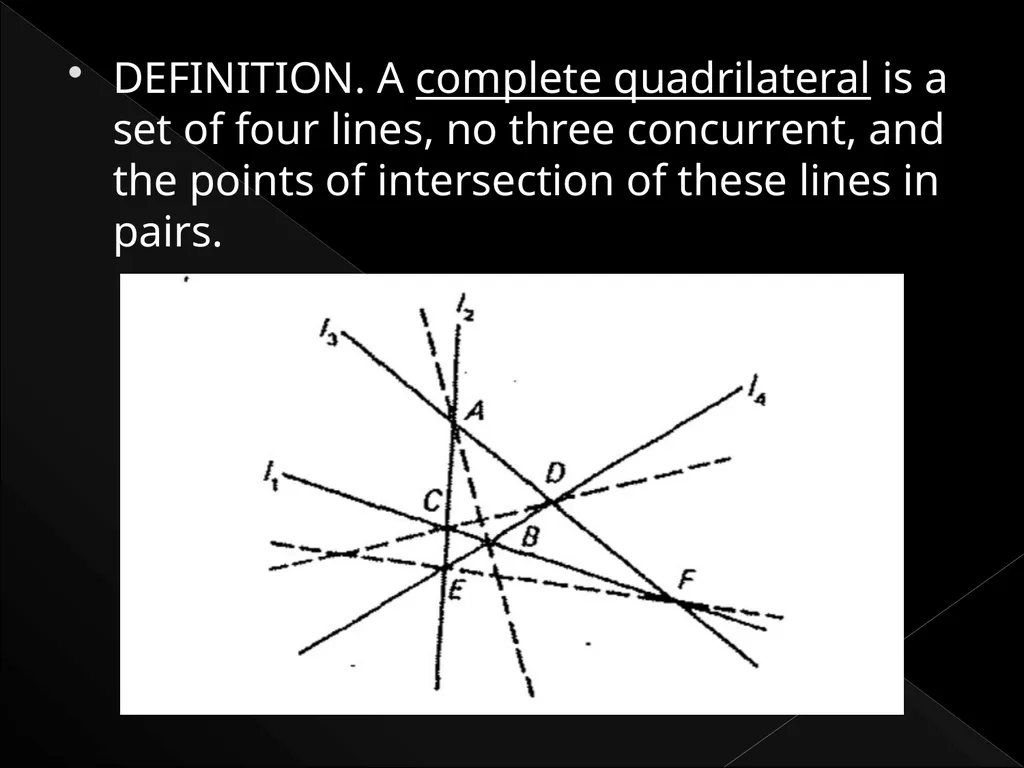
This dual states that the three diagonal lines of a complete quadrilateral are never concurrent.<br>
07
DEFINITION. A complete quadrilateral is a set of four lines, no three concurrent, and the points of intersection of these lines in pairs.<br>
08
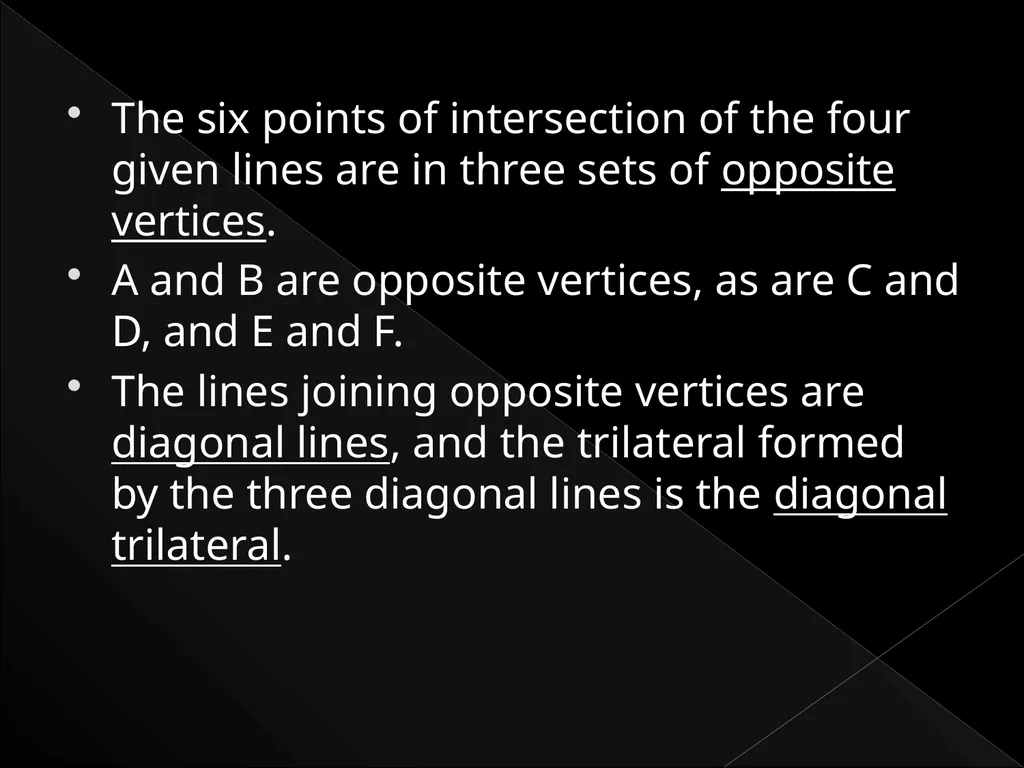
The six points of intersection of the four given lines are in three sets of opposite vertices.
A and B are opposite vertices, as are C and D, and E and F.
The lines joining opposite vertices are diagonal lines, and the trilateral formed by the three diagonal lines is the diagonal trilateral.<br>
09
In projective geometry, it is customary to speak of a triangle as being self-dual, since it includes both the vertices and the sides, and to use diagonal triangle for both the complete quadrangle and the complete quadrilateral.
The dual of Axiom 7 implies that the dotted lines in the given figure cannot be concurrent.<br>
10
The concept of space duality is based on an interchange of the words point and plane, with the word line being self-dual in space.
In the following statements, the second gives the space dual for the first.
(1) Any two distinct planes have at least two common points.
(2) Space dual: Any two distinct points have at least two common planes.<br>
11
THEOREM 2.2. Desargues’ theorem. If two triangles are perspective from a point, they are perspective from a line.
The theorem is named for the French mathematician Desargues (1593 – 1662), who anticipated the development of projective geometry many years before it was actually developed.<br>
12
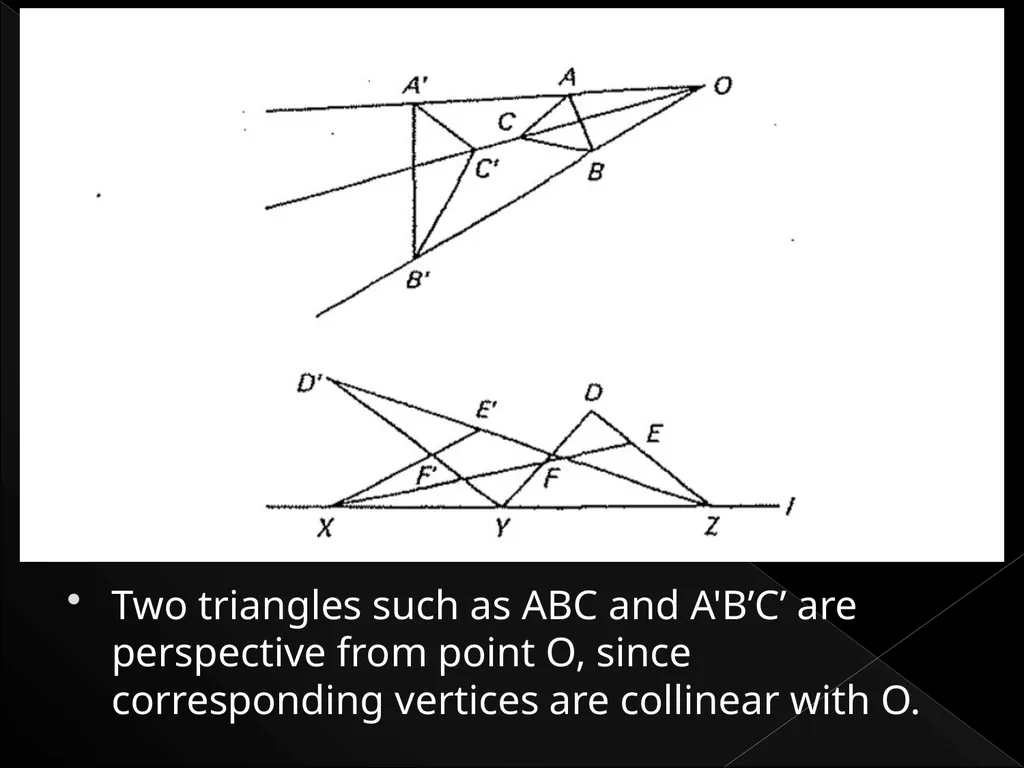
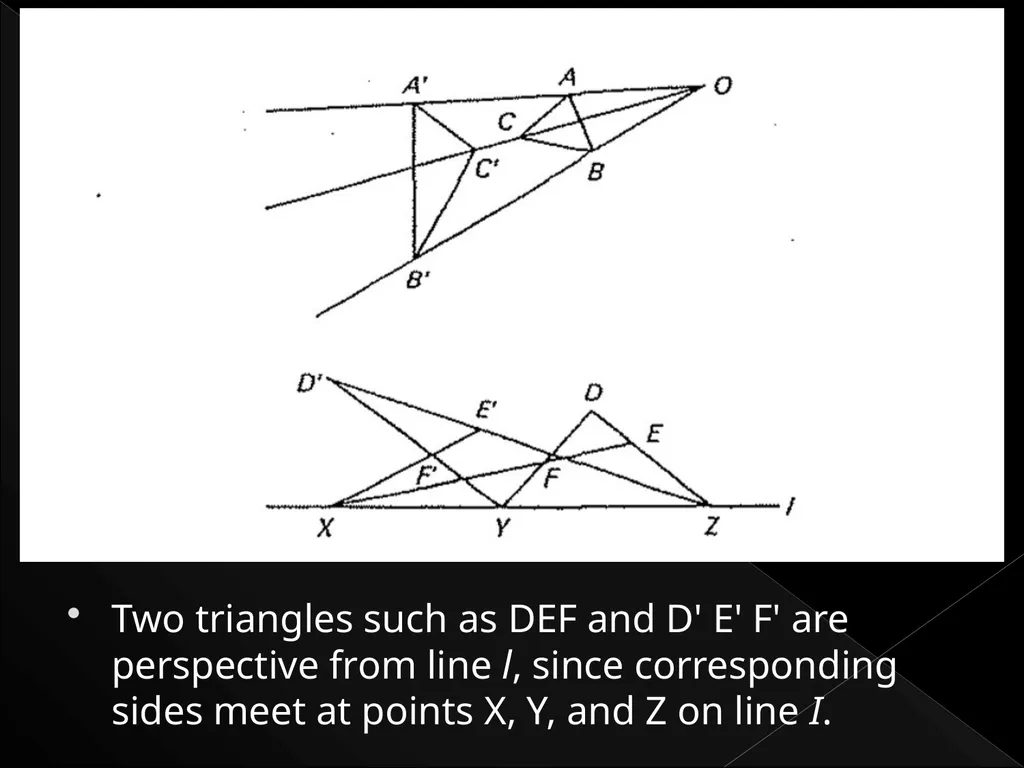
Two triangles such as ABC and A'B’C’ are perspective from point O, since corresponding vertices are collinear with O.<br>
13
Two triangles such as DEF and D' E' F' are perspective from line l, since corresponding sides meet at points X, Y, and Z on line I.<br>
14
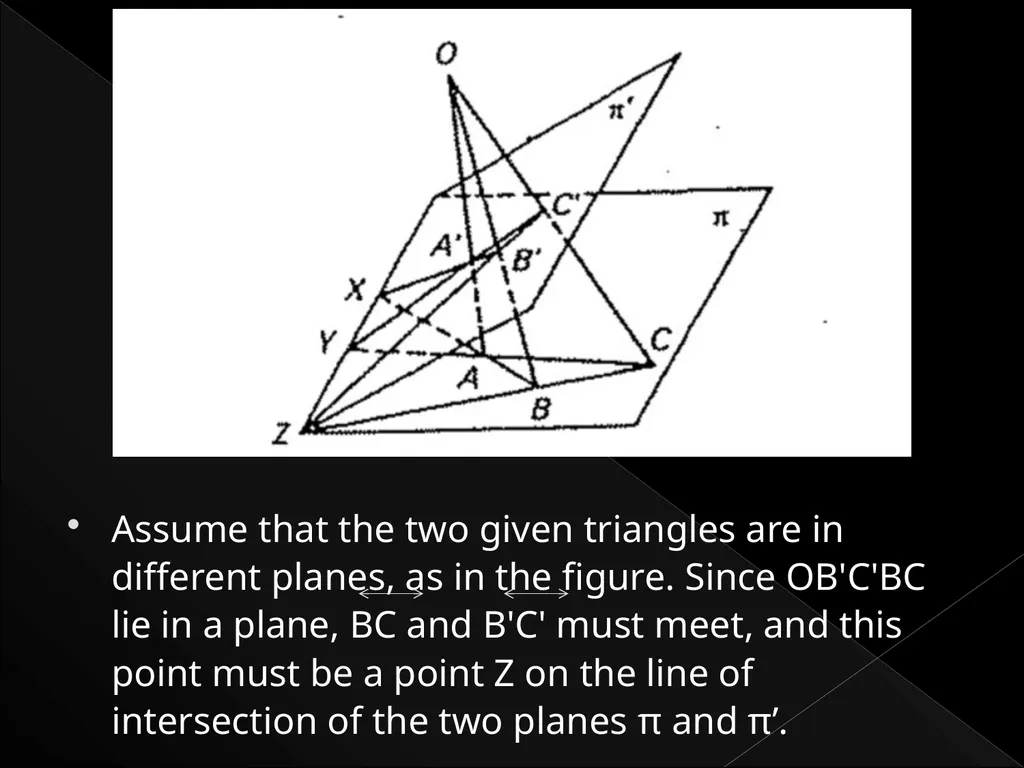
Assume that the two given triangles are in different planes, as in the figure. Since OB'C'BC lie in a plane, BC and B'C' must meet, and this point must be a point Z on the line of intersection of the two planes π and π’.<br>
15
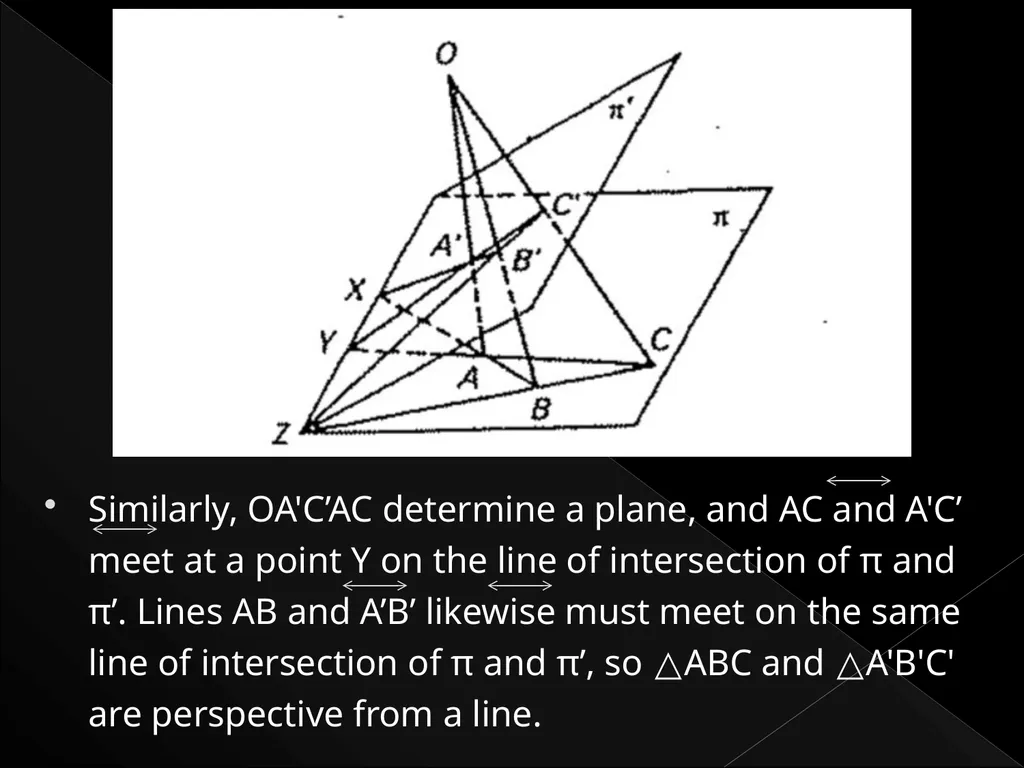
Similarly, OA'C’AC determine a plane, and AC and A'C’ meet at a point Y on the line of intersection of π and π’. Lines AB and A’B’ likewise must meet on the same line of intersection of π and π’, so △ABC and △A'B'C' are perspective from a line.<br>
16
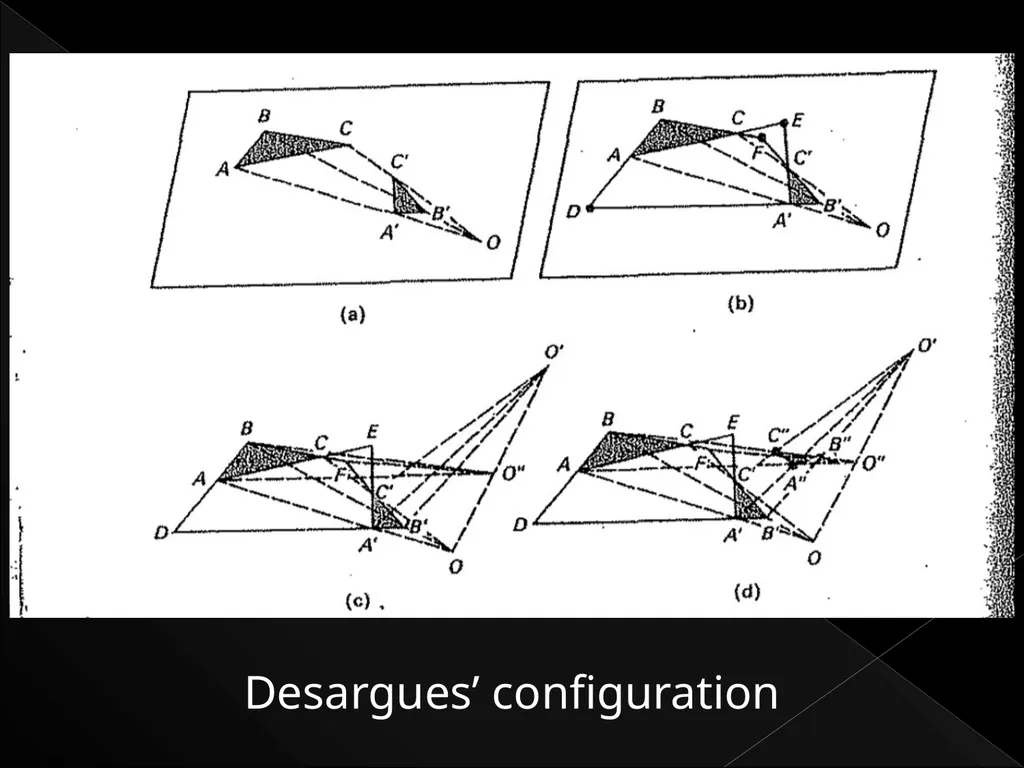
Desargues’ configuration<br>
17
From the principle of planar duality, the plane dual of Desargues’ theorem has also been established.
THEOREM 2.3. If two triangles are perspective from a line, they are perspective from a point.
(Converse of Desargues’ Theorem)<br>
18
The set of points and lines in the plane of the two given triangles is called the Desargues’ configuration.
It consists of ten points with three lines on each point and ten lines with three points on each line.
This is an example of a finite projective geometry.<br>
19
HARMONIC SETS Compiled:
Still John F. Reyes<br>
20
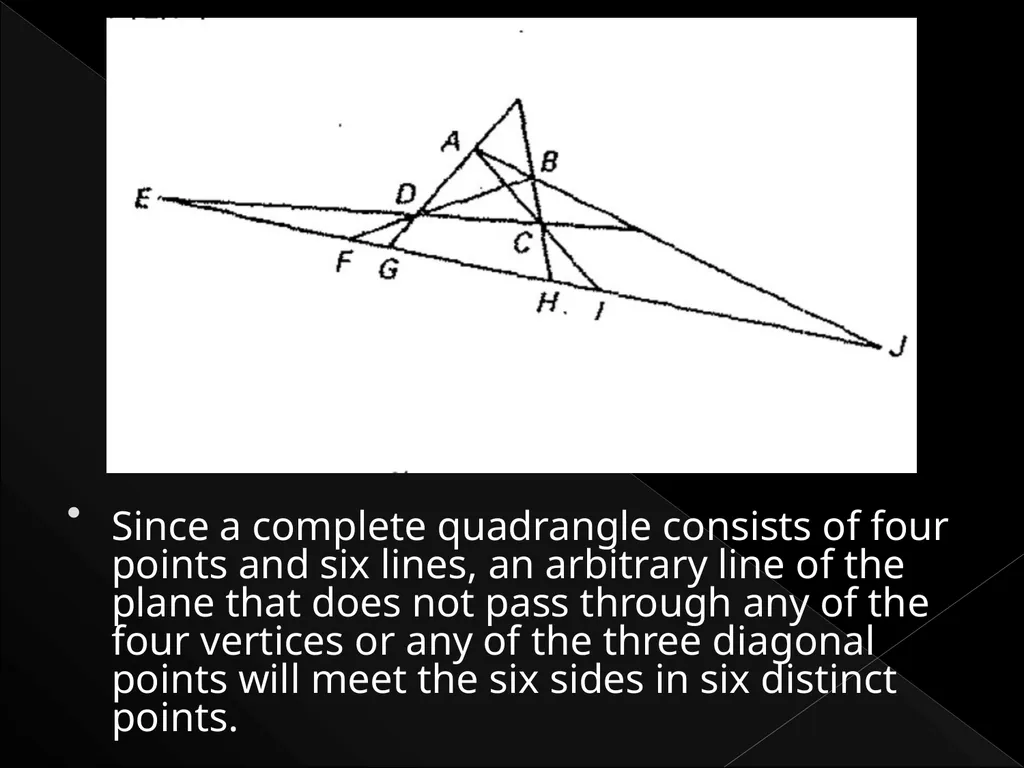
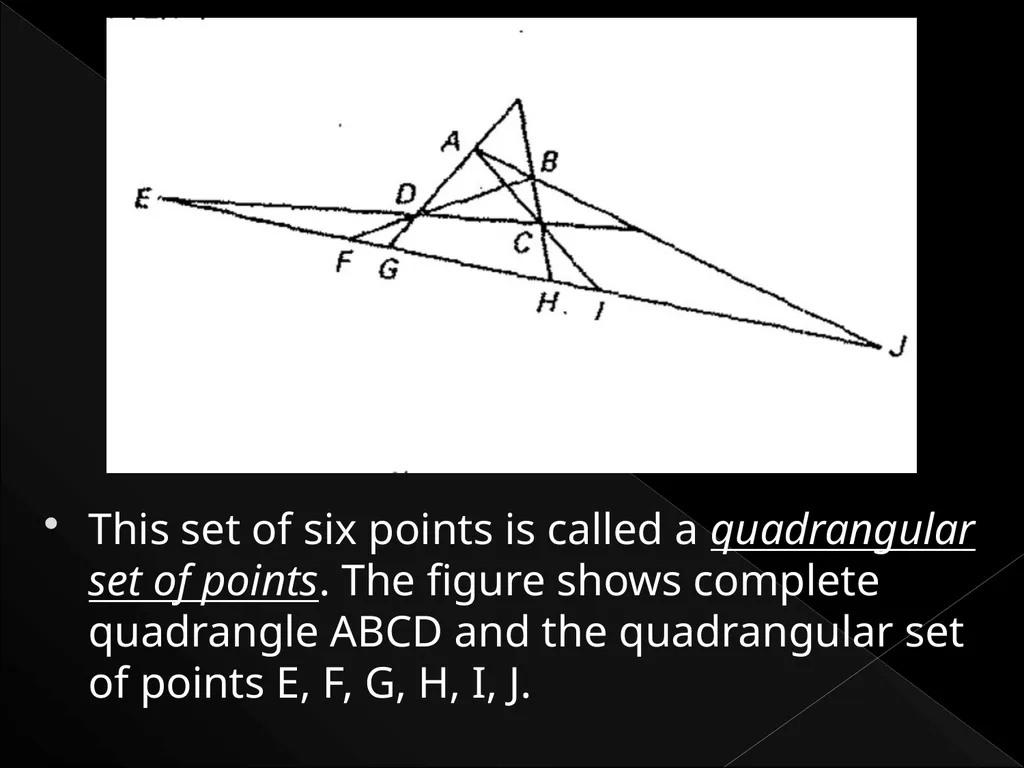
Since a complete quadrangle consists of four points and six lines, an arbitrary line of the plane that does not pass through any of the four vertices or any of the three diagonal points will meet the six sides in six distinct points.<br>
21
This set of six points is called a quadrangular set of points. The figure shows complete quadrangle ABCD and the quadrangular set of points E, F, G, H, I, J.<br>
22
A special case of a quadrangular set is called a harmonic set of points.
DEFINITION. A harmonic set of points, or a harmonic range, is a set of four collinear points consisting of the four points of intersection of the sides of a complete quadrangle with a line passing through two diagonal points.<br>
23
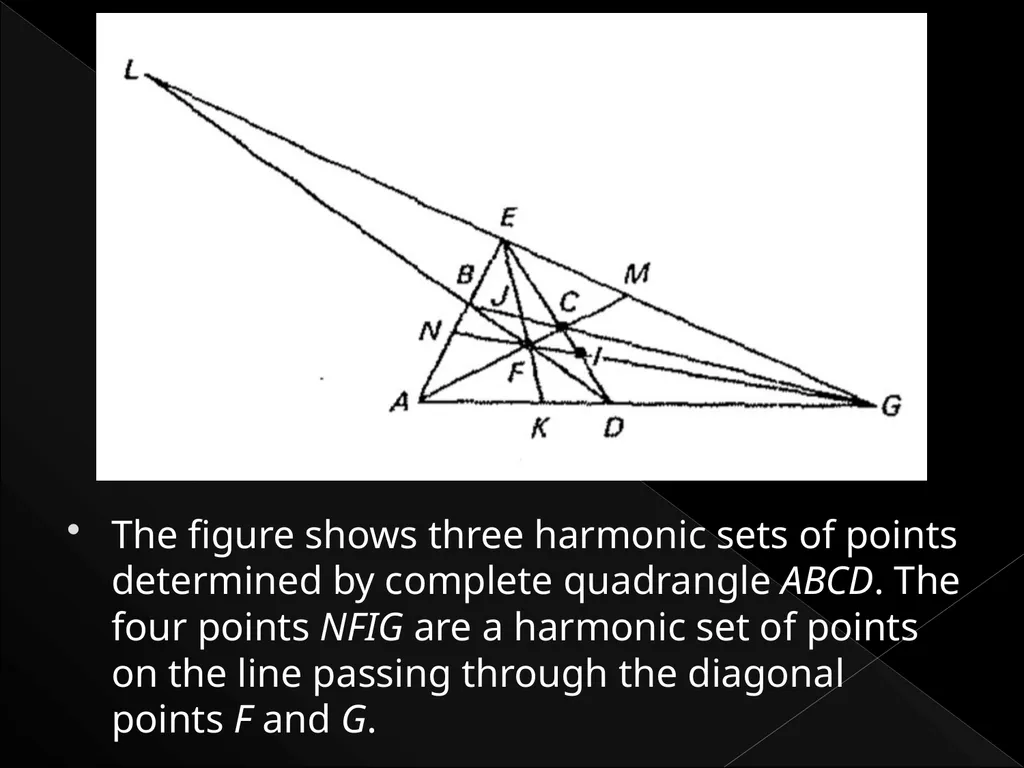
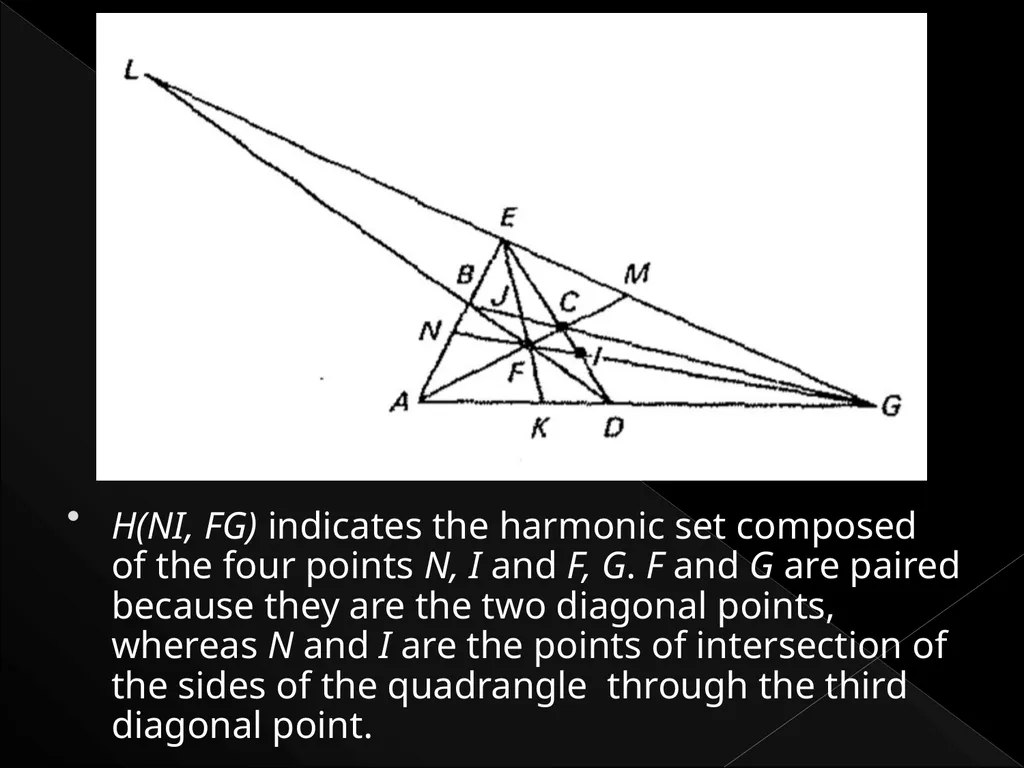
The figure shows three harmonic sets of points determined by complete quadrangle ABCD. The four points NFIG are a harmonic set of points on the line passing through the diagonal points F and G.<br>
24
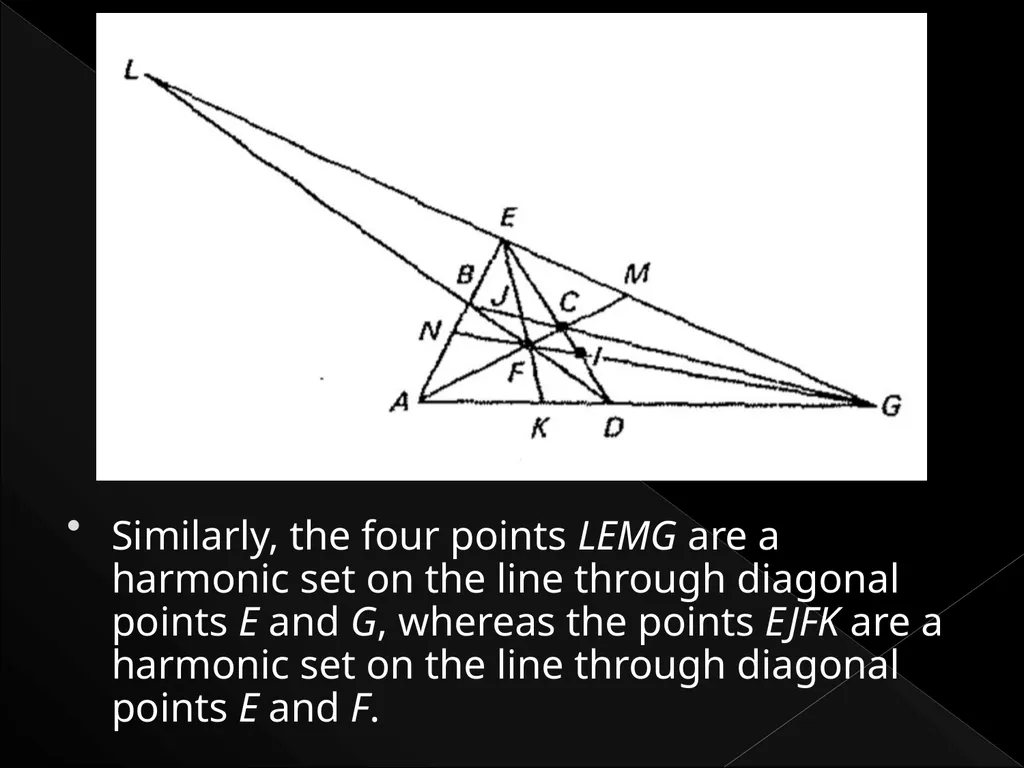
Similarly, the four points LEMG are a harmonic set on the line through diagonal points E and G, whereas the points EJFK are a harmonic set on the line through diagonal points E and F.<br>
25
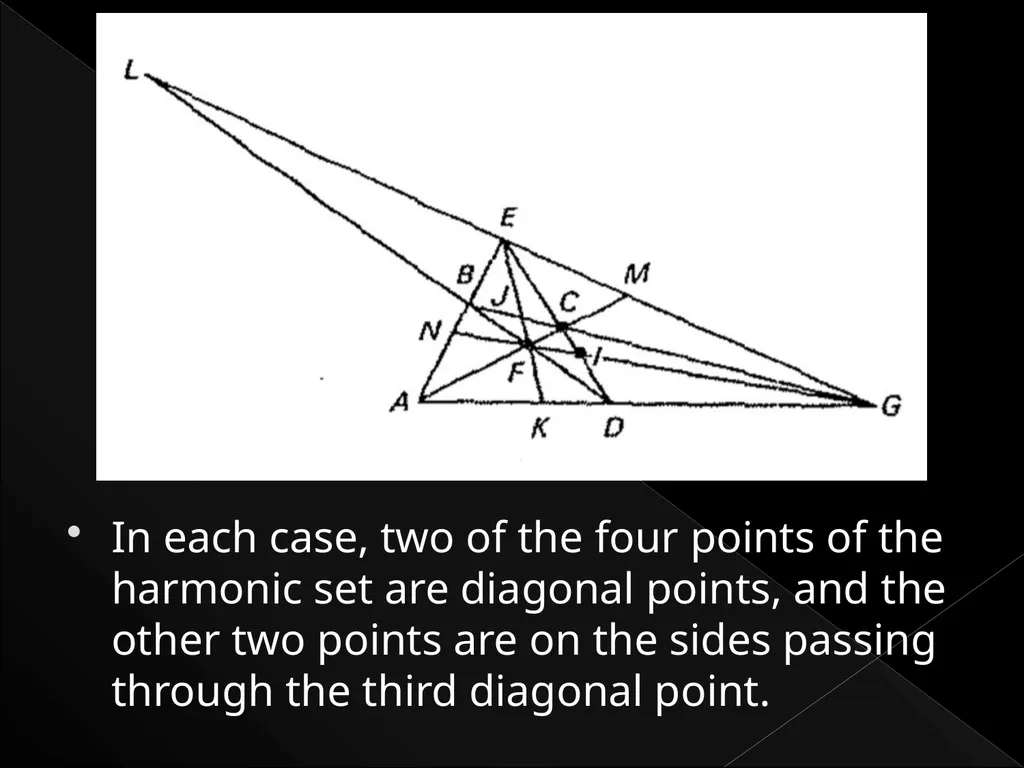
In each case, two of the four points of the harmonic set are diagonal points, and the other two points are on the sides passing through the third diagonal point.<br>
26
H(NI, FG) indicates the harmonic set composed of the four points N, I and F, G. F and G are paired because they are the two diagonal points, whereas N and I are the points of intersection of the sides of the quadrangle through the third diagonal point.<br>
27
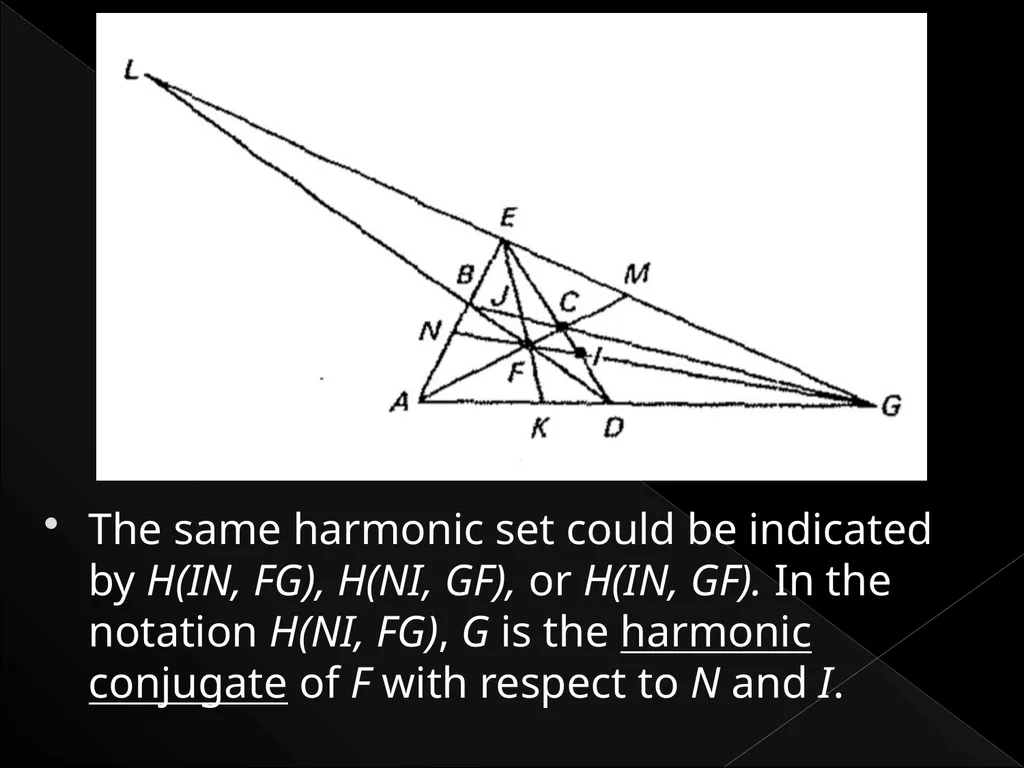
The same harmonic set could be indicated by H(IN, FG), H(NI, GF), or H(IN, GF). In the notation H(NI, FG), G is the harmonic conjugate of F with respect to N and I.<br>
28
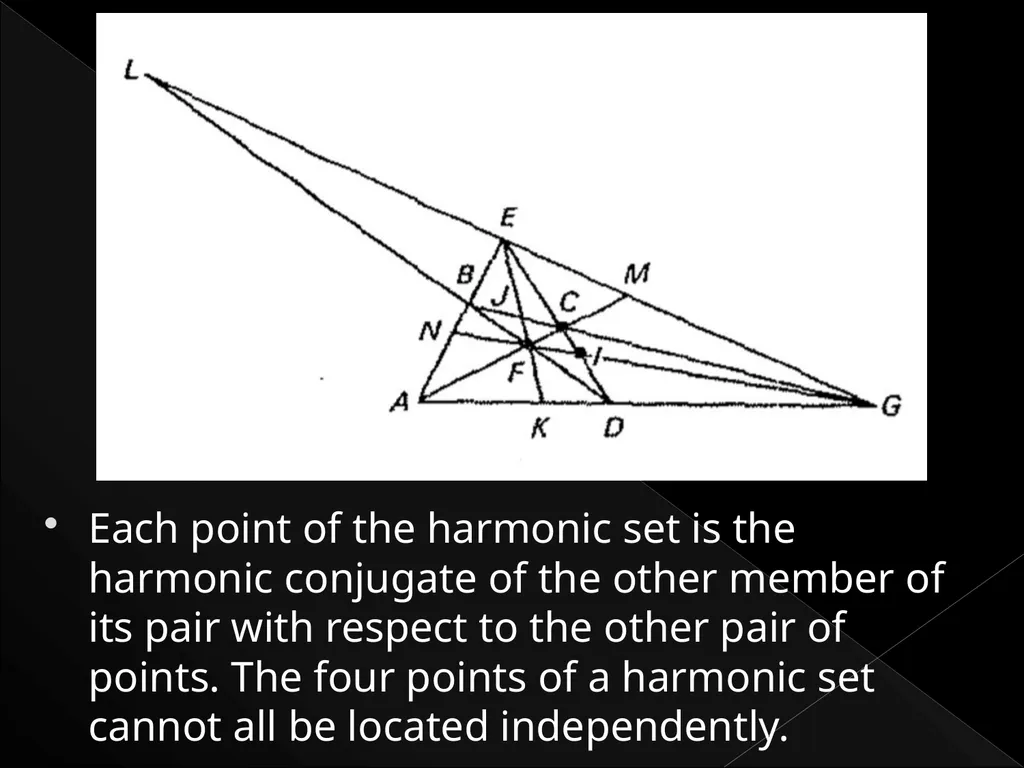
Each point of the harmonic set is the harmonic conjugate of the other member of its pair with respect to the other pair of points. The four points of a harmonic set cannot all be located independently.<br>
29
THEOREM 2.4. The harmonic conjugate of a point A with respect to two other given collinear points B and C is uniquely determined.<br>
30
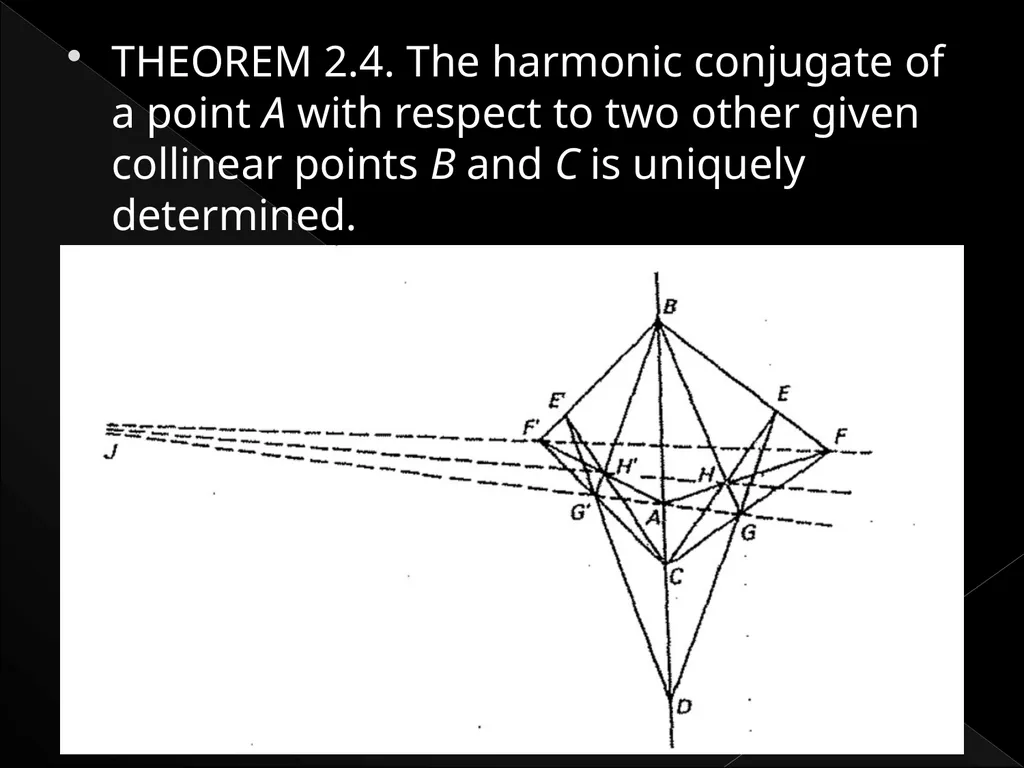
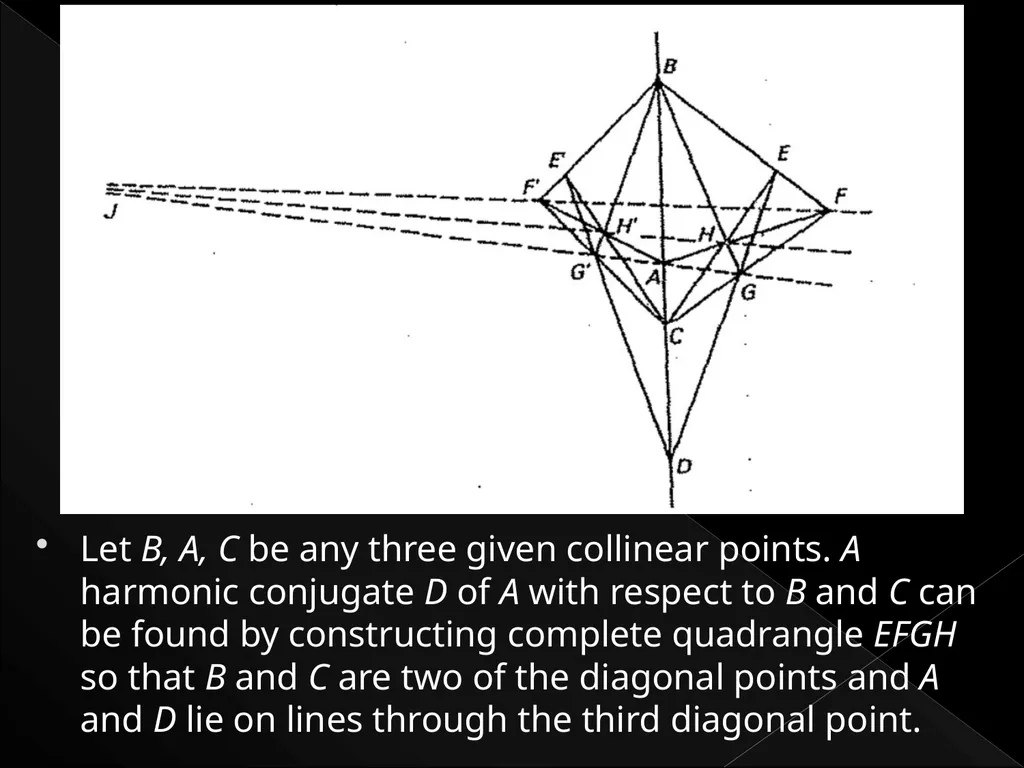
Let B, A, C be any three given collinear points. A harmonic conjugate D of A with respect to B and C can be found by constructing complete quadrangle EFGH so that B and C are two of the diagonal points and A and D lie on lines through the third diagonal point.<br>
31
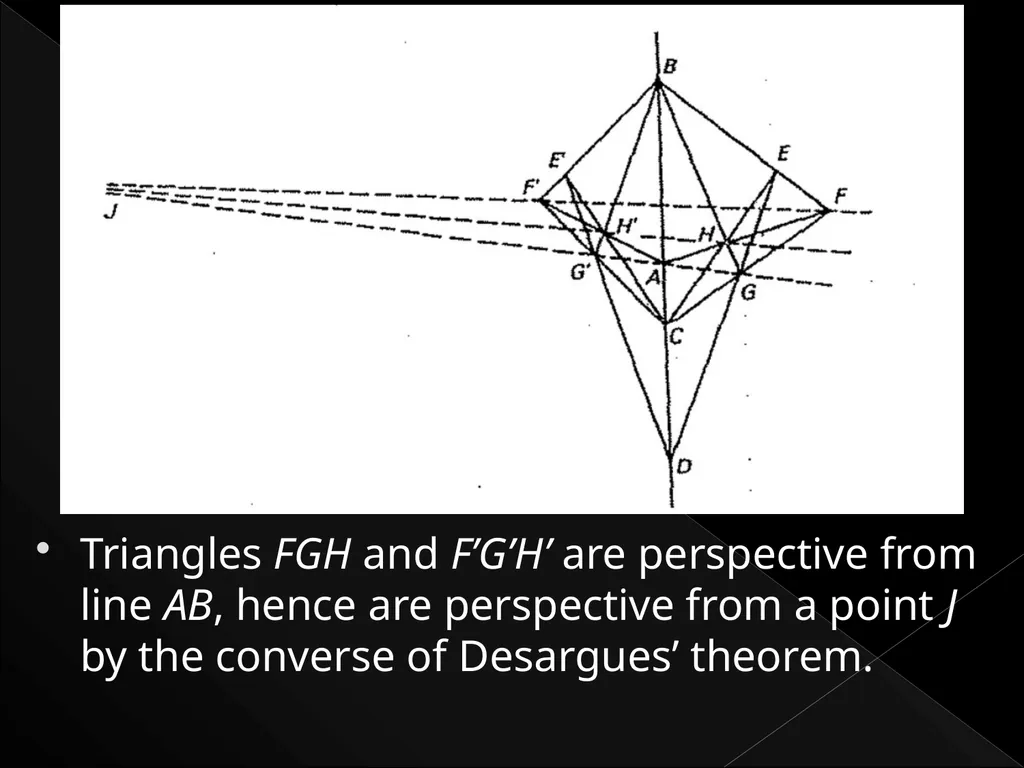
Triangles FGH and F’G’H’ are perspective from line AB, hence are perspective from a point J by the converse of Desargues’ theorem.<br>
32
How about triangles FEH and F’E’H’ and triangles FEG and F’E’G’?<br>
33
The dual of the definition of a harmonic set of points is the definition of a harmonic set of lines.
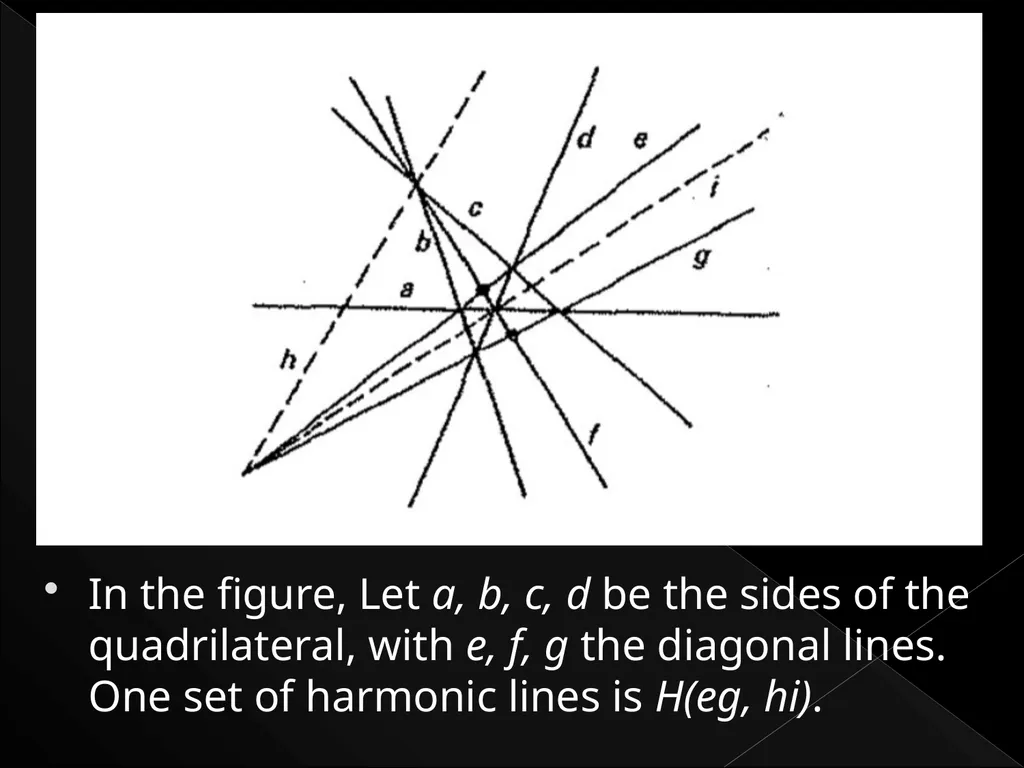
DEFINITION. A harmonic set of lines, or a harmonic pencil, is a set of four concurrent lines such that two of them are diagonal lines of a complete quadrilateral and the other two pass through the two vertices lying on the third diagonal line.<br>
34
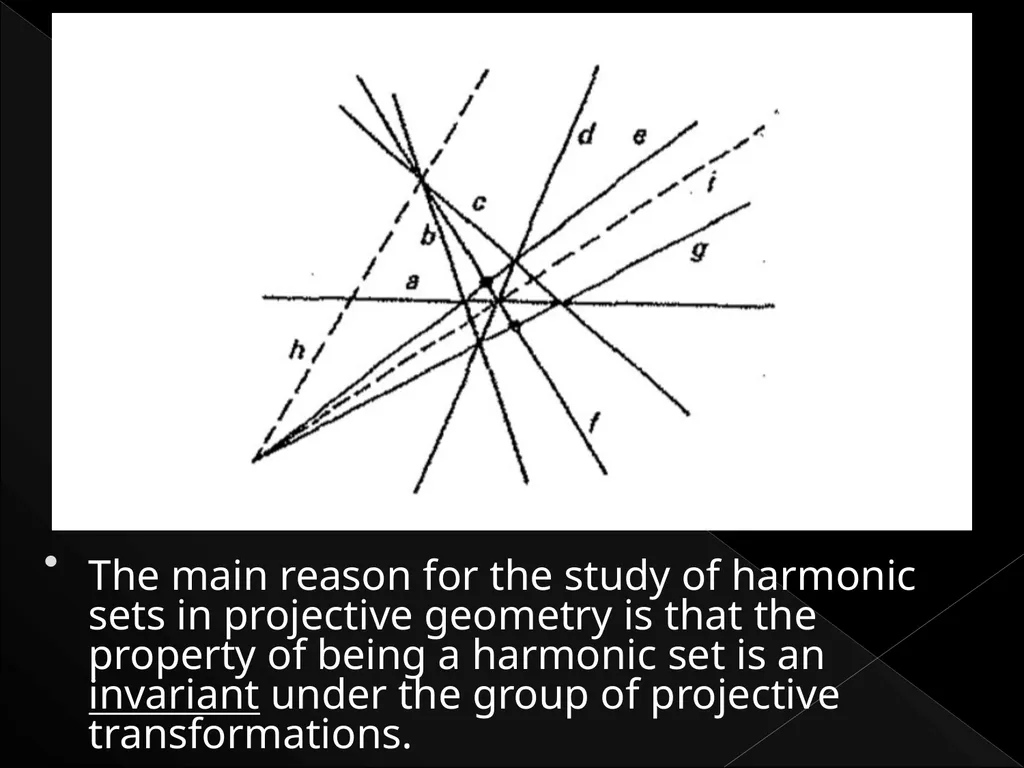
In the figure, Let a, b, c, d be the sides of the quadrilateral, with e, f, g the diagonal lines. One set of harmonic lines is H(eg, hi).<br>
35
The main reason for the study of harmonic sets in projective geometry is that the property of being a harmonic set is an invariant under the group of projective transformations.<br>
36
THEOREM 2.5. The harmonic property is preserved under projectivities.
We have to show that the harmonic property is preserved in a single perspectivity by proving:
The set of lines joining any noncollinear point to the four points of a harmonic set of points is a harmonic set of lines.
The set of points of intersection of the four lines of a harmonic set with any line not through the point of concurrency of the lines (the center of the pencil) is a harmonic set of points.<br>
37
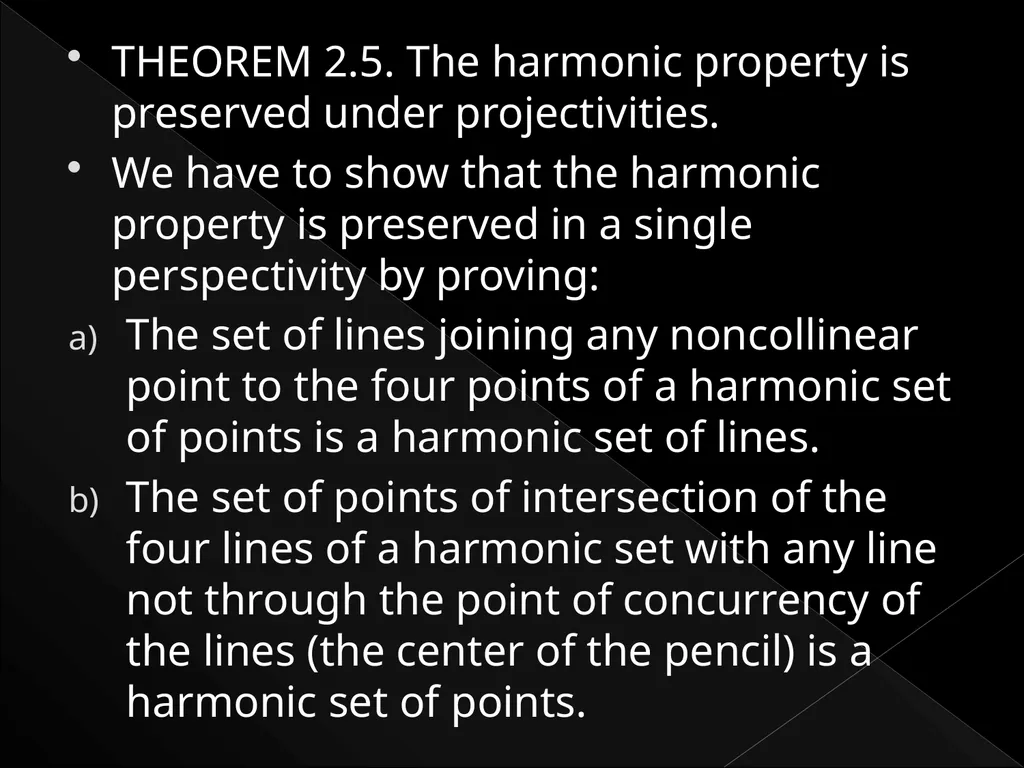
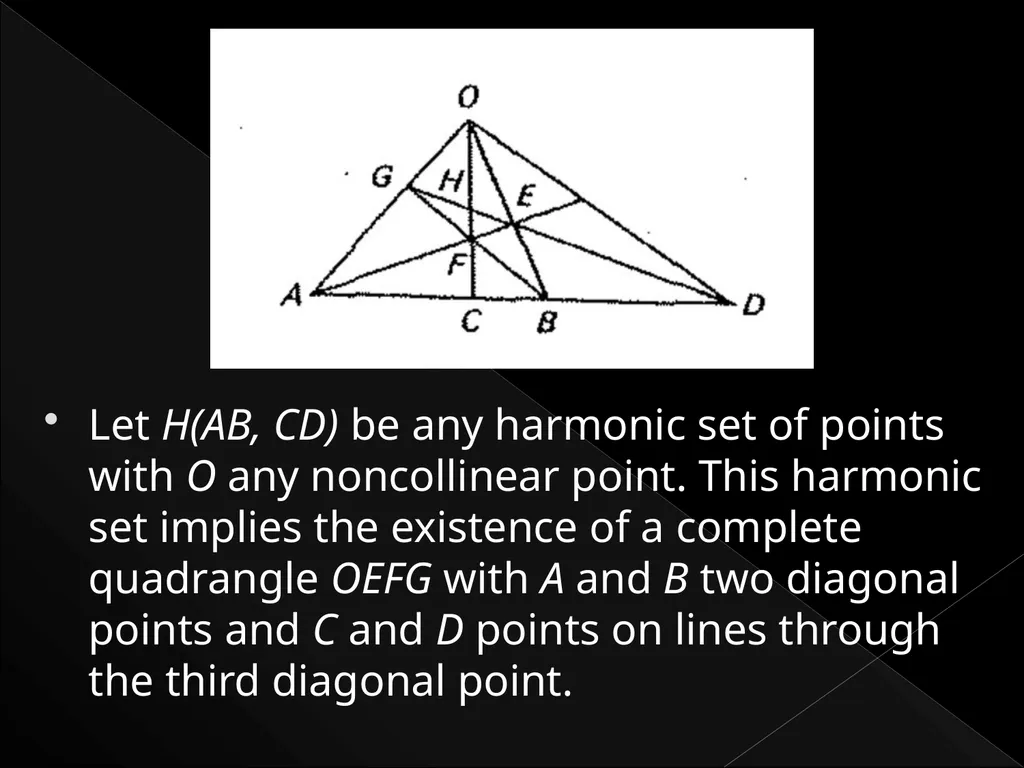
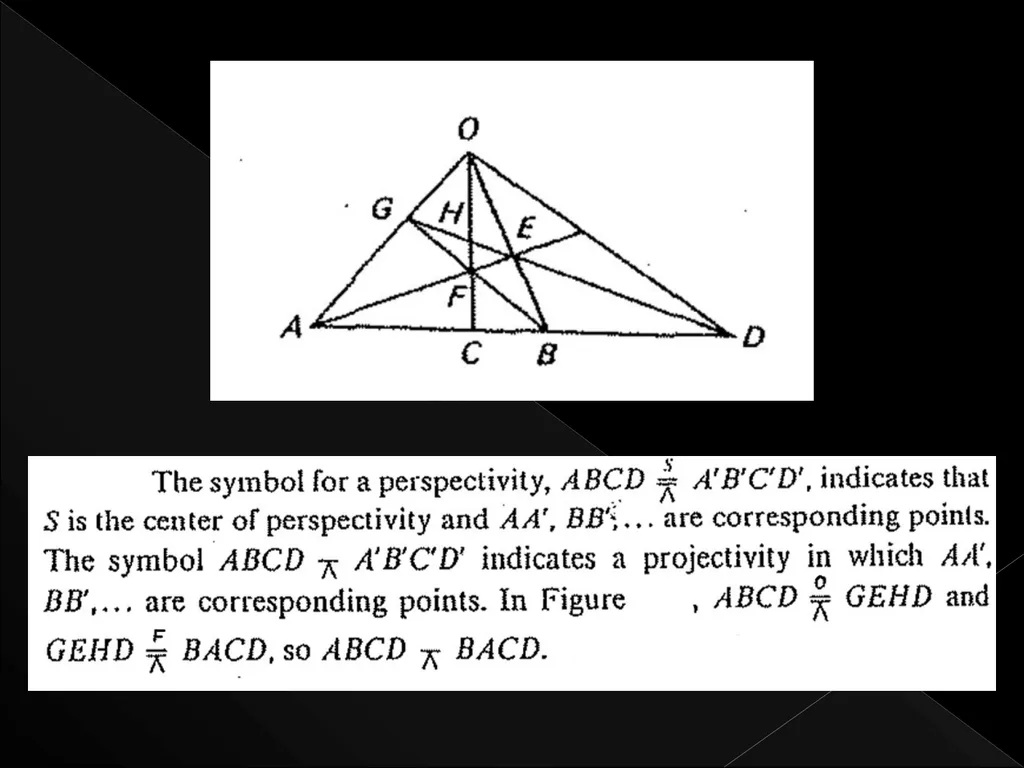
Let H(AB, CD) be any harmonic set of points with O any noncollinear point. This harmonic set implies the existence of a complete quadrangle OEFG with A and B two diagonal points and C and D points on lines through the third diagonal point.<br>
38
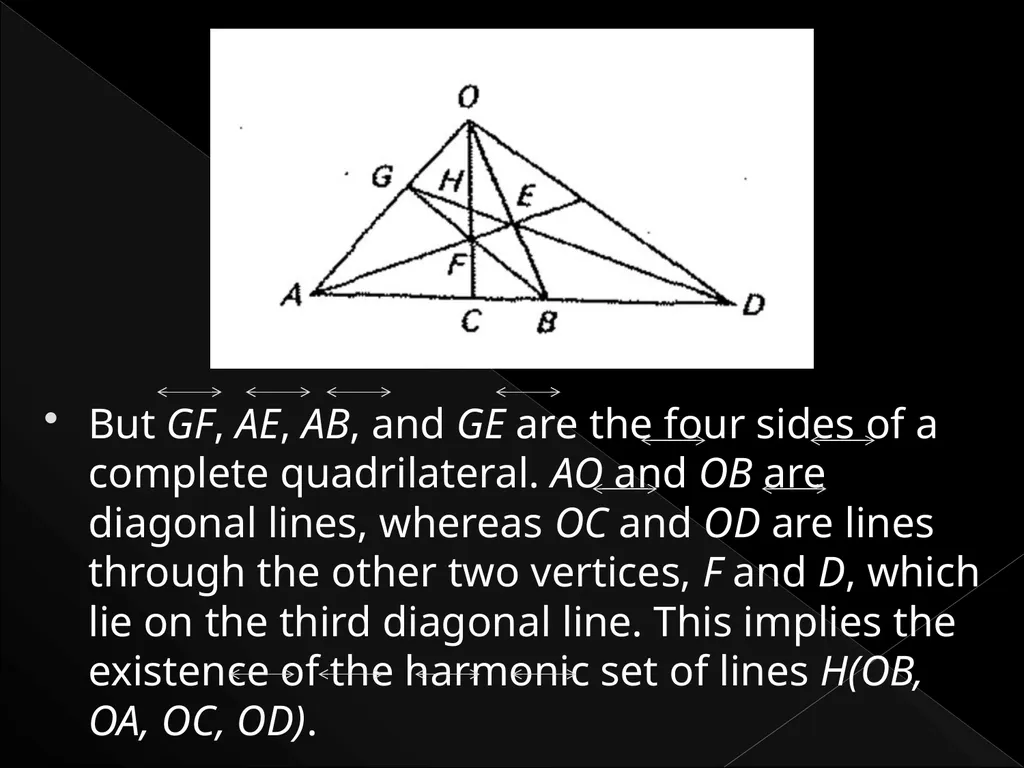
But GF, AE, AB, and GE are the four sides of a complete quadrilateral. AO and OB are diagonal lines, whereas OC and OD are lines through the other two vertices, F and D, which lie on the third diagonal line. This implies the existence of the harmonic set of lines H(OB, OA, OC, OD).<br>