
DUNE neutrino flavour identification using a CNN

Description: DUNE neutrino flavour identification using a CNN Saul Alonso Monsalve and Leigh Whitehead 190418 Introduction One of the most important parts of any neutrino oscillation analysis is the identification of the neutrino flavour We typically
Related Topics
Download Presentation
"DUNE neutrino flavour identification using a CNN" is the property of its rightful owner. Permission is granted to download and print the materials on this website for personal, non-commercial use only, and to display it on your personal computer provided you do not modify the materials and that you retain all copyright notices contained in the materials. By downloading content from our website, you accept the terms of this agreement.
Presentation Transcript
slide1. DUNE neutrino flavour identification using a CNN Saul Alonso Monsalve and Leigh Whitehead
19/04/18<br>
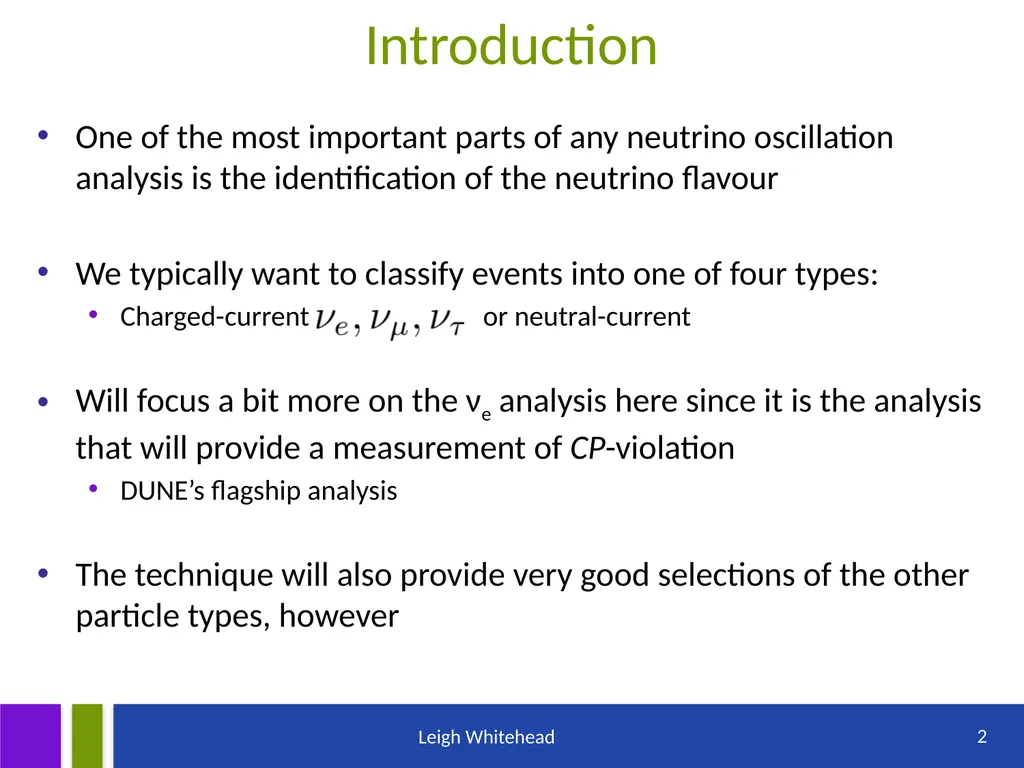
slide2. Introduction One of the most important parts of any neutrino oscillation analysis is the identification of the neutrino flavour
We typically want to classify events into one of four types:
Charged-current or neutral-current
Will focus a bit more on the νe analysis here since it is the analysis that will provide a measurement of CP-violation
DUNE’s flagship analysis
The technique will also provide very good selections of the other particle types, however Leigh Whitehead 2<br>
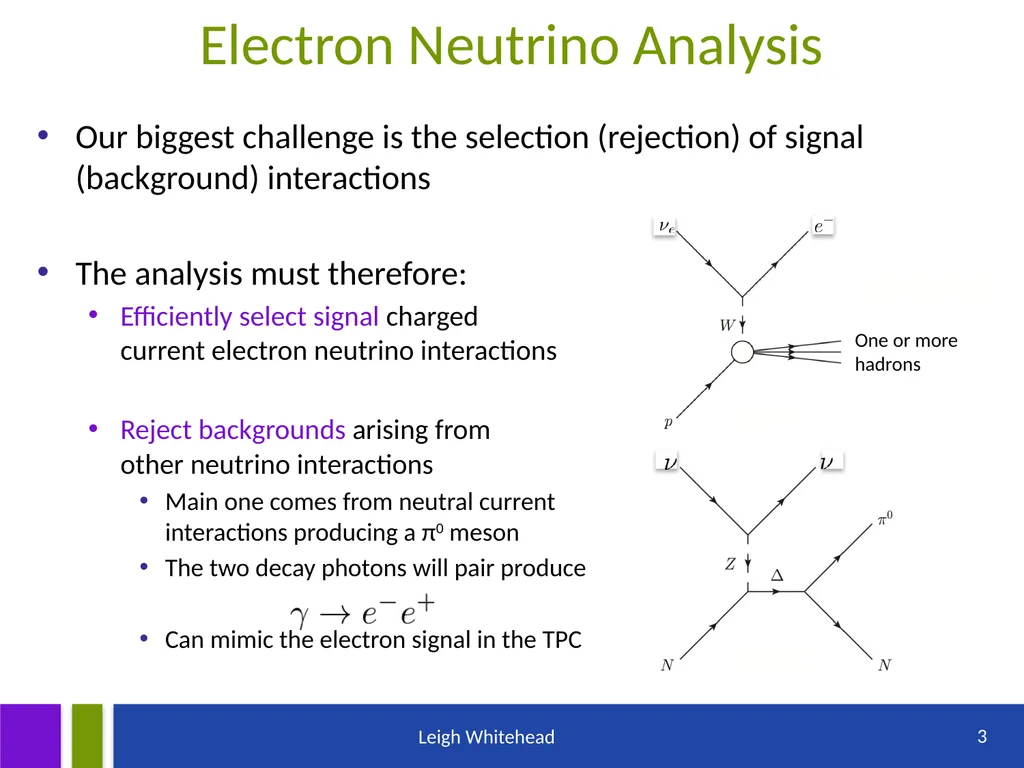
slide3. Electron Neutrino Analysis Our biggest challenge is the selection (rejection) of signal (background) interactions
The analysis must therefore:
Efficiently select signal charged current electron neutrino interactions
Reject backgrounds arising from other neutrino interactions
Main one comes from neutral current interactions producing a π0 meson
The two decay photons will pair produce
Can mimic the electron signal in the TPC Leigh Whitehead 3<br>
slide4. Image Recognition The human eye is a remarkably good image recognition tool
Once you know what to look for, it is fairly easy to spot whether the shower is displaced from the vertex or not
Realistically the experiment will produce too much data for scanning the interactions by eye
We need to be able to train a computer to do this task
Recent years have shown rapid development of automated image recognition
One of the most promising approaches is the Convolutional Neural Network (CNN) Leigh Whitehead 4<br>
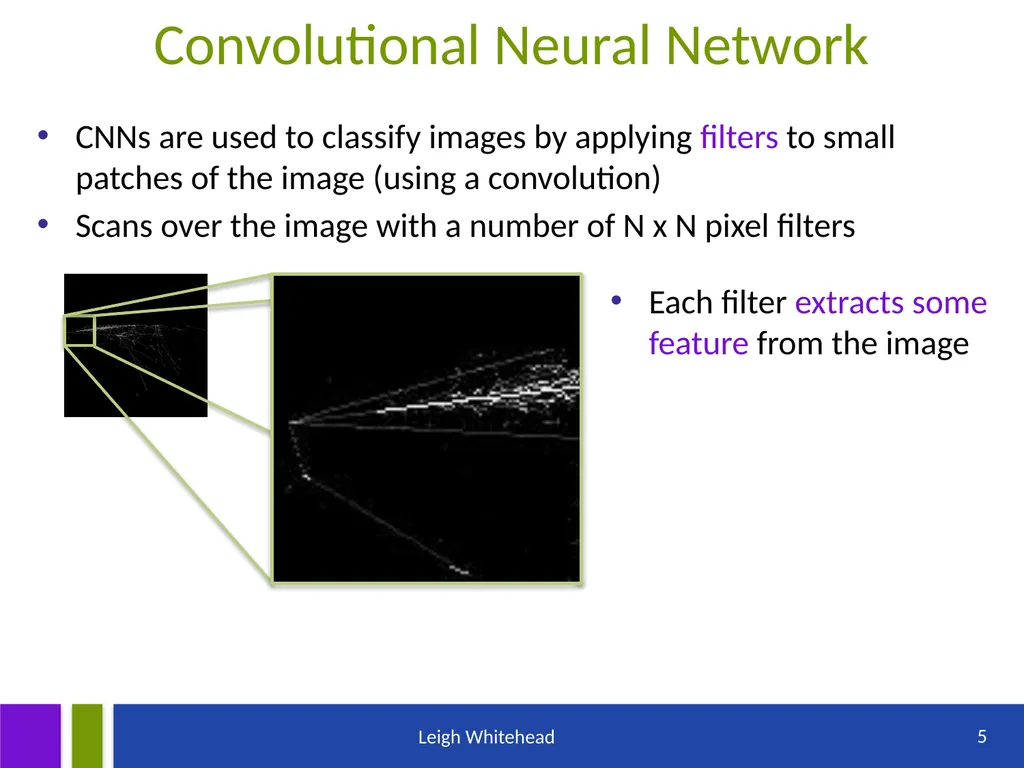
slide5. Convolutional Neural Network CNNs are used to classify images by applying filters to small patches of the image (using a convolution)
Scans over the image with a number of N x N pixel filters Leigh Whitehead 5 Each filter extracts some feature from the image<br>
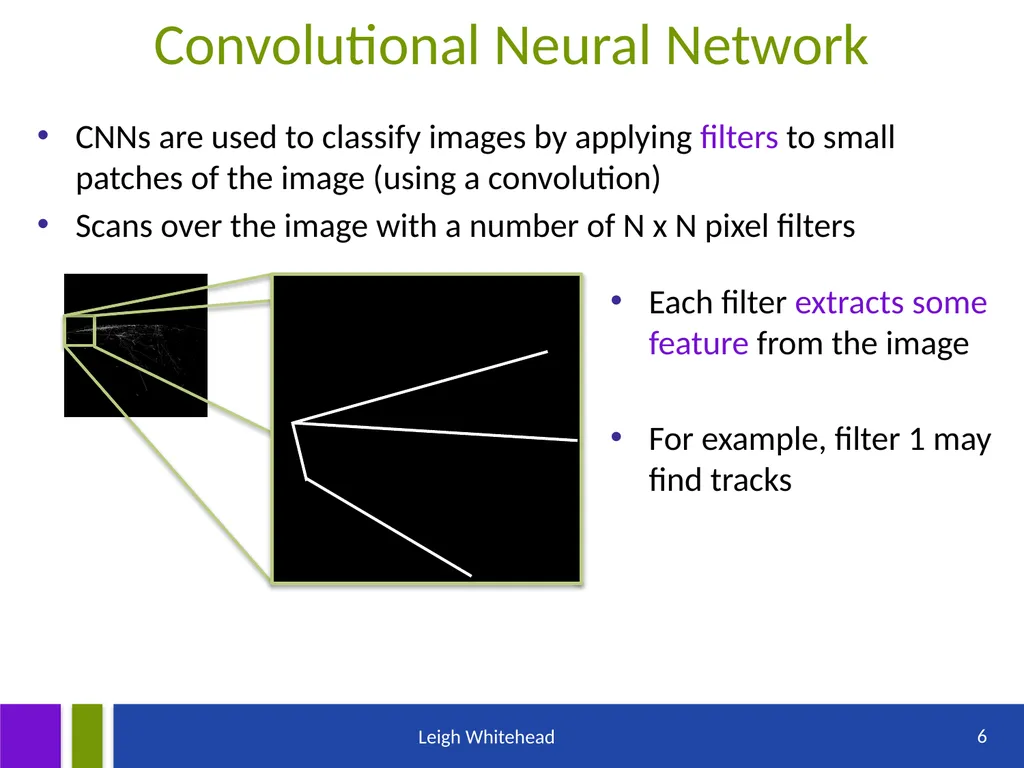
slide6. Convolutional Neural Network CNNs are used to classify images by applying filters to small patches of the image (using a convolution)
Scans over the image with a number of N x N pixel filters Leigh Whitehead 6 Each filter extracts some feature from the image
For example, filter 1 may find tracks<br>
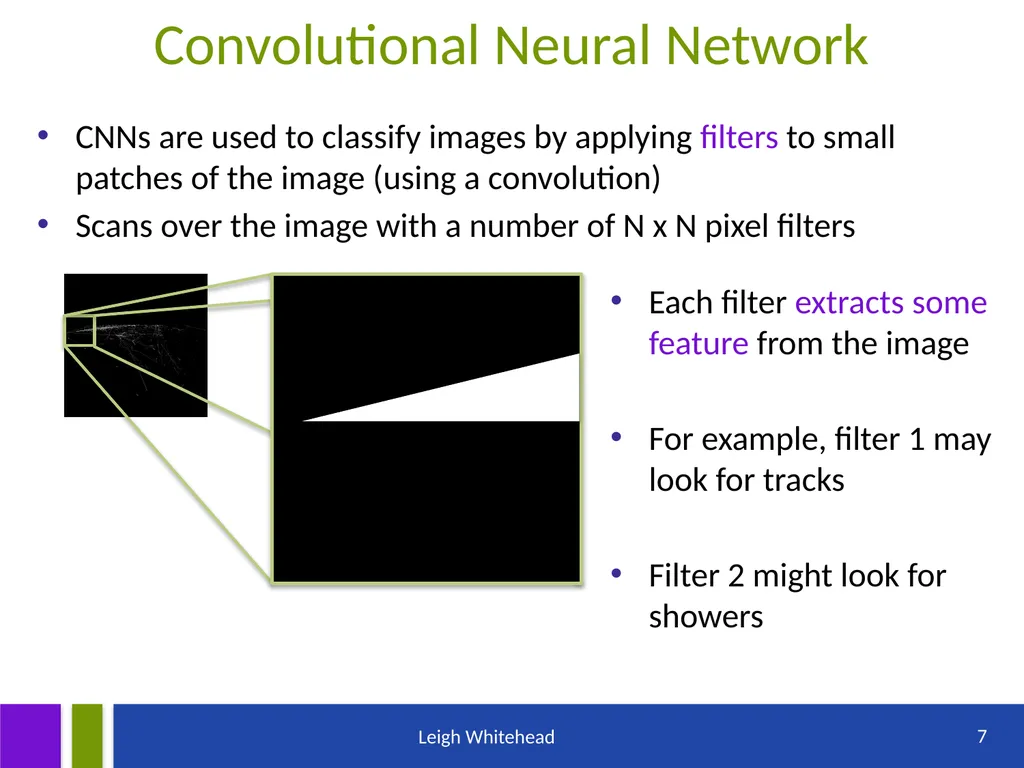
slide7. Convolutional Neural Network CNNs are used to classify images by applying filters to small patches of the image (using a convolution)
Scans over the image with a number of N x N pixel filters Leigh Whitehead 7 Each filter extracts some feature from the image
For example, filter 1 may look for tracks
Filter 2 might look for showers<br>
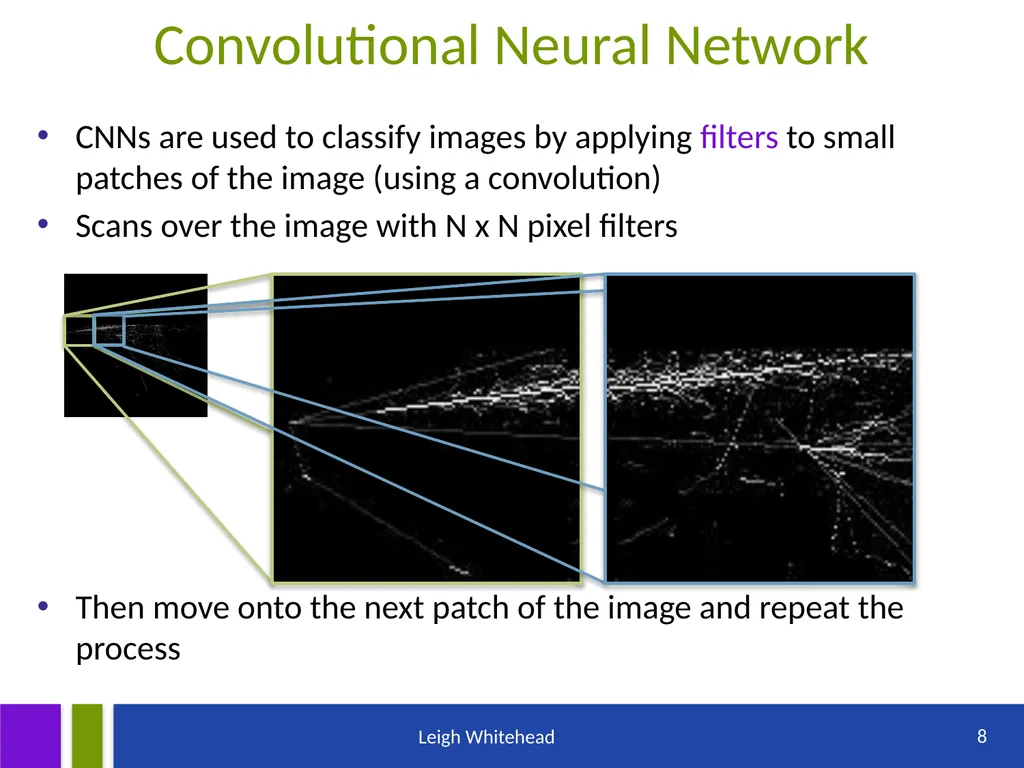
slide8. Convolutional Neural Network CNNs are used to classify images by applying filters to small patches of the image (using a convolution)
Scans over the image with N x N pixel filters
Then move onto the next patch of the image and repeat the process Leigh Whitehead 8<br>
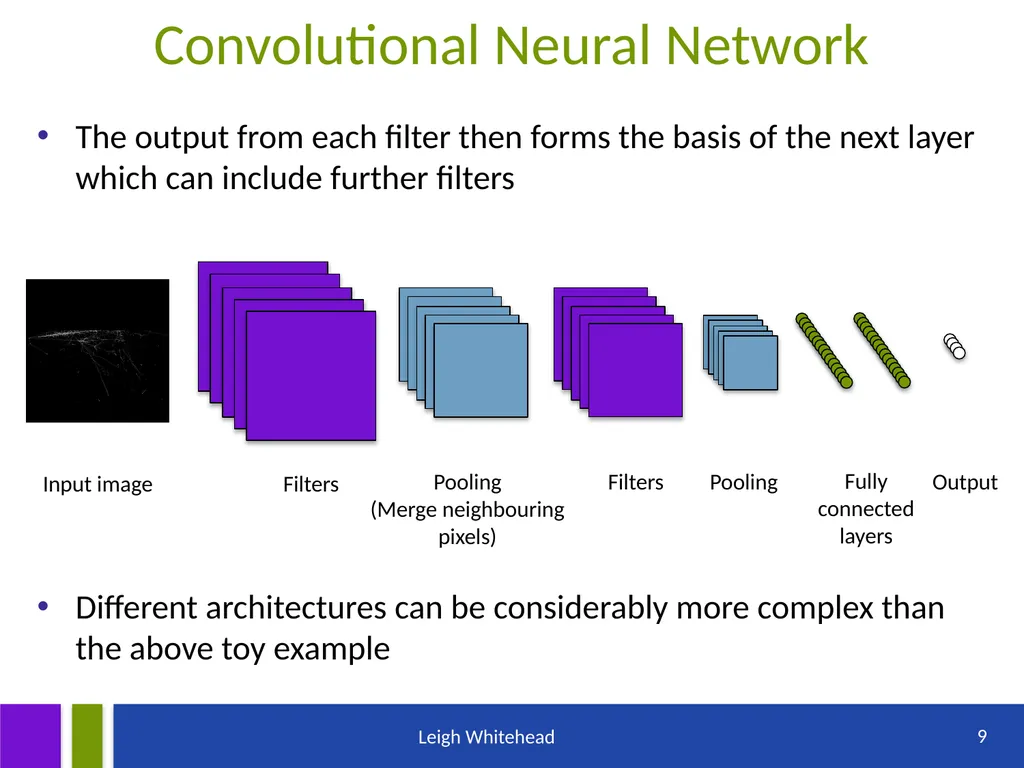
slide9. Convolutional Neural Network The output from each filter then forms the basis of the next layer which can include further filters
Different architectures can be considerably more complex than the above toy example Leigh Whitehead 9<br>
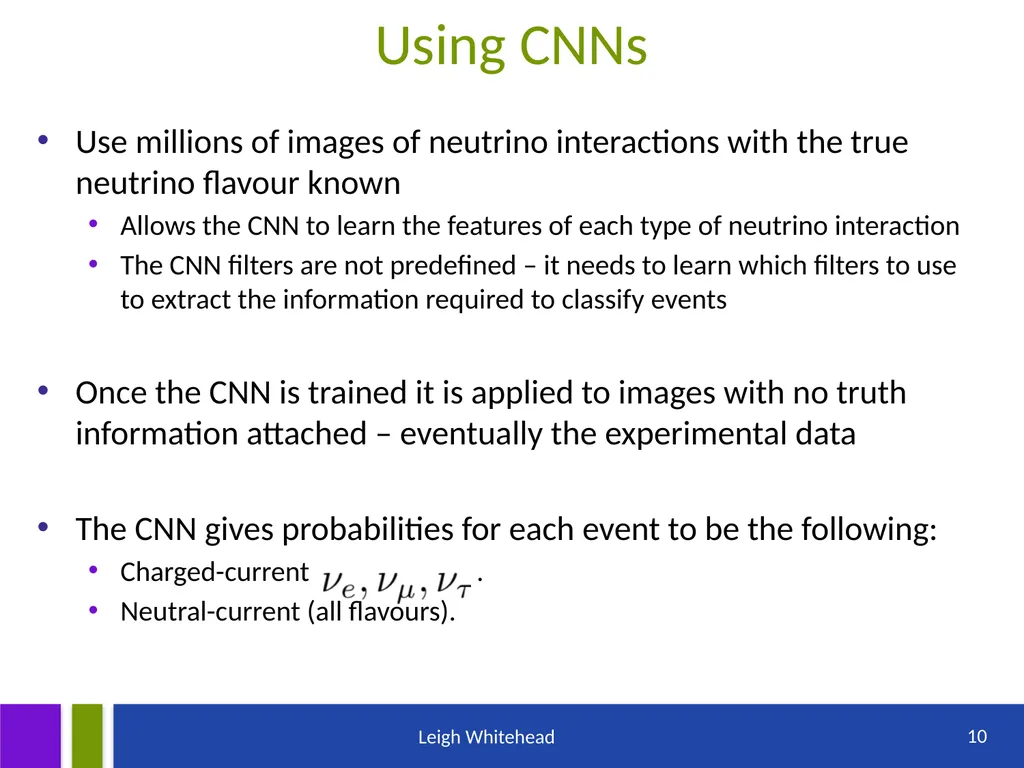
slide10. Using CNNs Use millions of images of neutrino interactions with the true neutrino flavour known
Allows the CNN to learn the features of each type of neutrino interaction
The CNN filters are not predefined – it needs to learn which filters to use to extract the information required to classify events
Once the CNN is trained it is applied to images with no truth information attached – eventually the experimental data
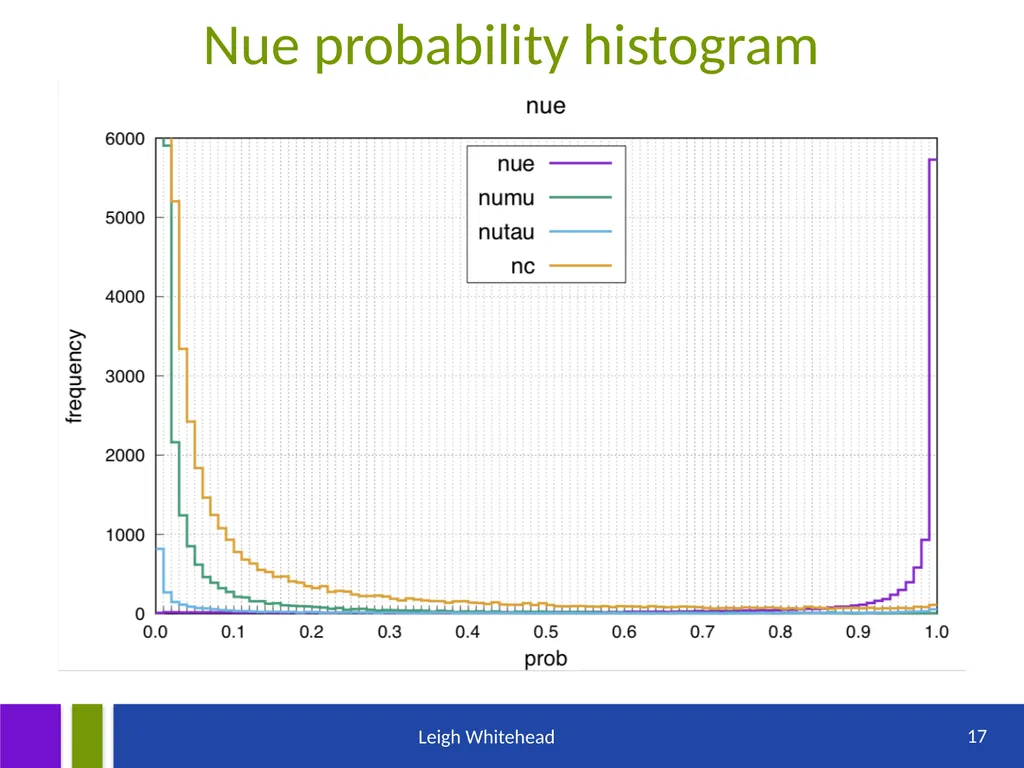
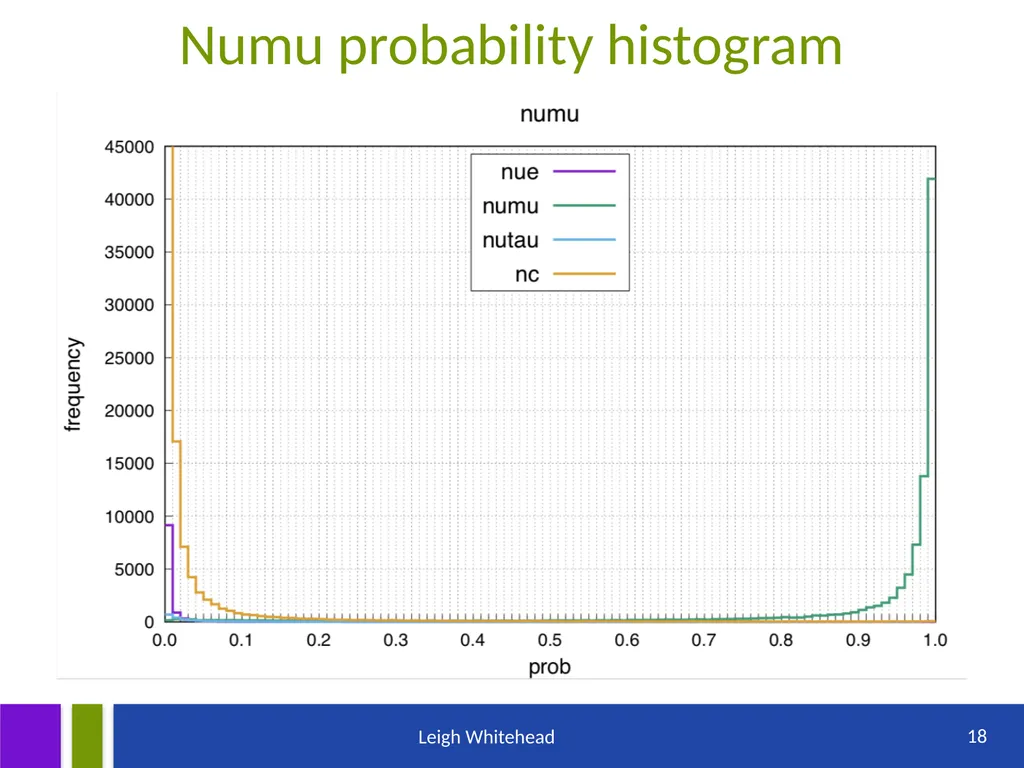
The CNN gives probabilities for each event to be the following:
Charged-current .
Neutral-current (all flavours). Leigh Whitehead 10<br>
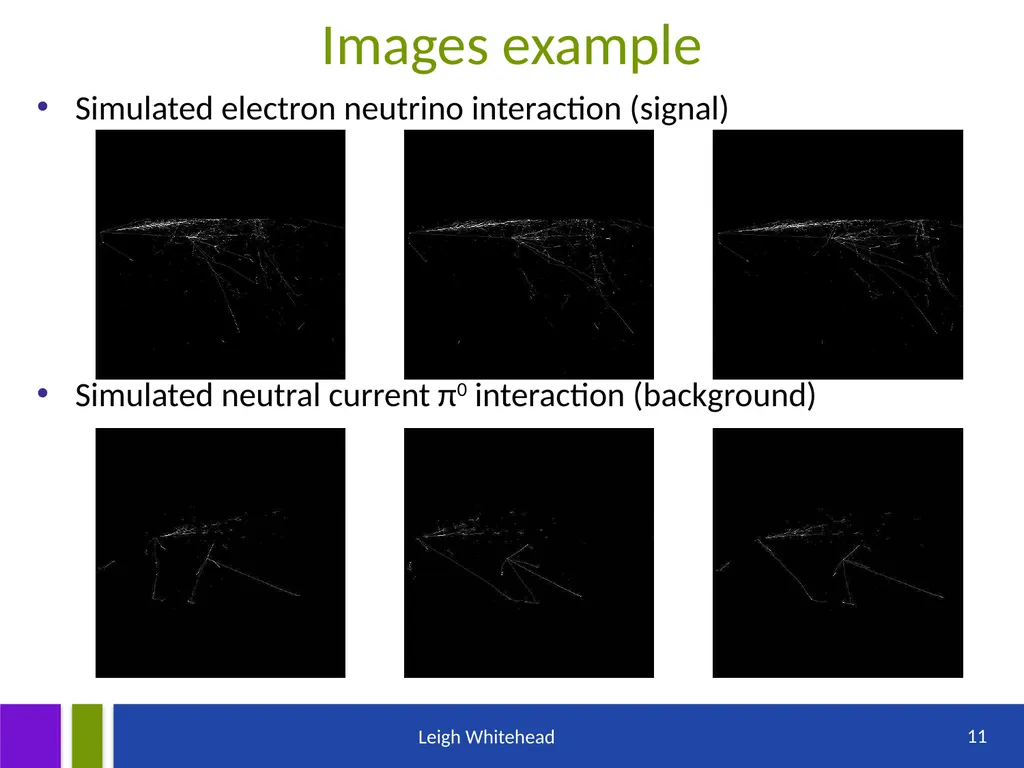
slide11. Images example Simulated electron neutrino interaction (signal)
Simulated neutral current π0 interaction (background) Leigh Whitehead 11<br>
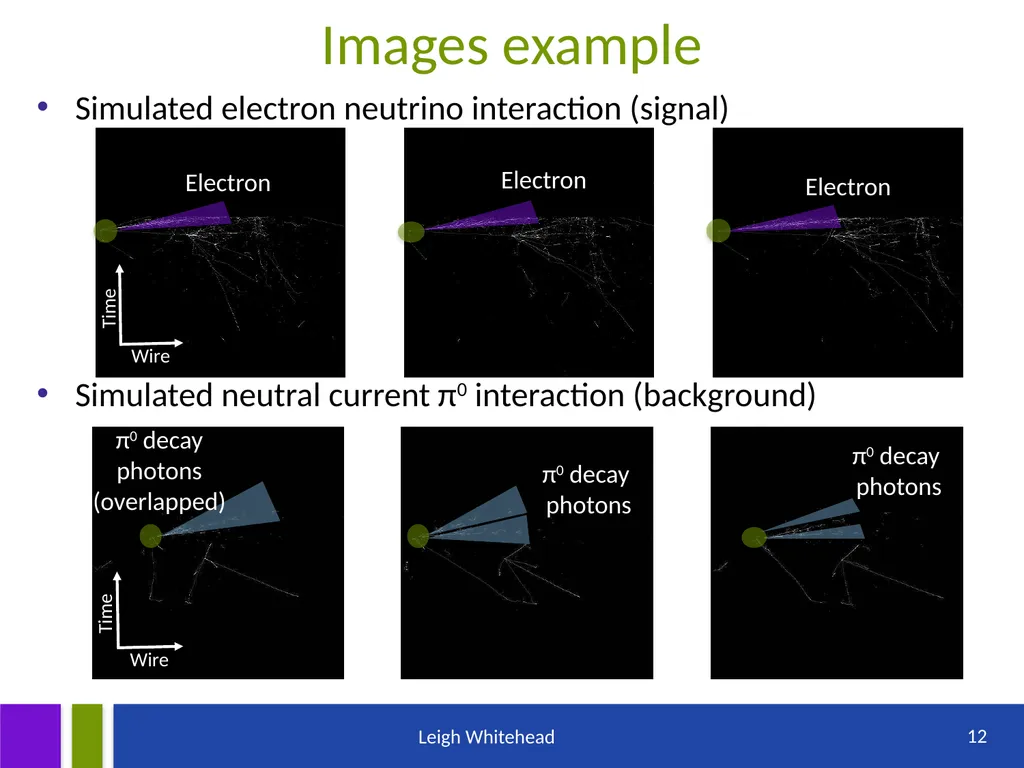
slide12. Images example Simulated electron neutrino interaction (signal)
Simulated neutral current π0 interaction (background) Leigh Whitehead 12 Electron Electron Electron π0 decay photons (overlapped) π0 decay
photons π0 decay
photons<br>
slide13. Last CVN state (January 2018) CVN: Convolutional Visual Network.
Input: 500x500 pixel images.
13 interaction types.
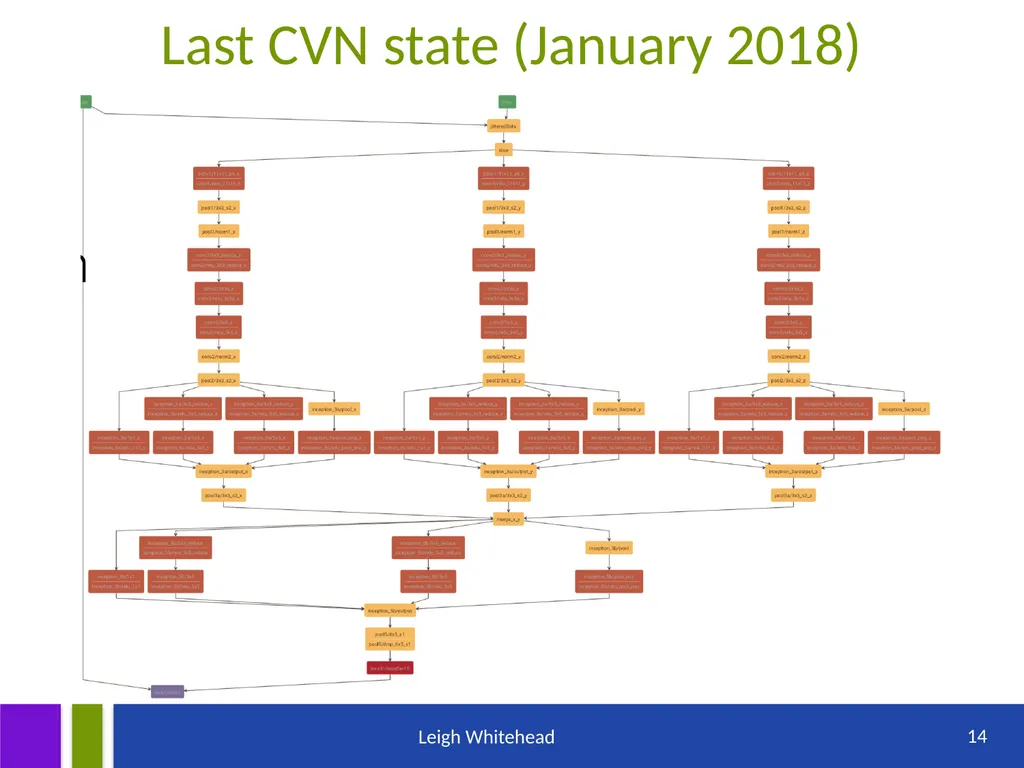
CVN inspired by the GoogleNet (arXiv:1409.4842) CNN architecture.
Deep Learning Framework: Caffe (developed by Berkeley AI Research).
Trained on the GPUs in the Wilson cluster (Fermilab).
Accuracy: ~68%... Leigh Whitehead 13<br>
slide14. Last CVN state (January 2018) Leigh Whitehead 14<br>
slide15. Moving forward Move from Caffe to Tensorflow (developed by Google Brain Team) for ease of design for more complex network topologies.
Tensorflow is also included in LArSoft.
Efficient image format.
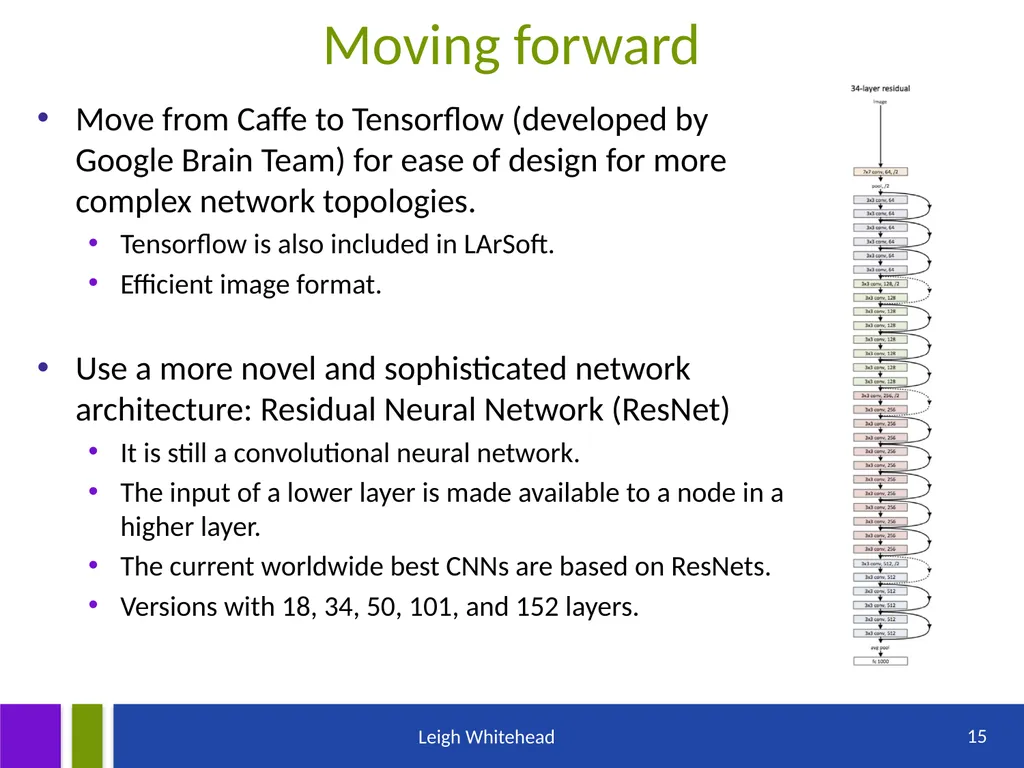
Use a more novel and sophisticated network architecture: Residual Neural Network (ResNet)
It is still a convolutional neural network.
The input of a lower layer is made available to a node in a higher layer.
The current worldwide best CNNs are based on ResNets.
Versions with 18, 34, 50, 101, and 152 layers. Leigh Whitehead 15<br>
slide16. Some results The network is still training.
Images generation:
Before: ~1 week. Now: ~1 day.
Number of images used while training:
Before: ~1 million. Now: ~4 million.
CVN accuracy:
Before: ~68%. Now: ~80%. Leigh Whitehead 16<br>
slide17. Nue probability histogram Leigh Whitehead 17<br>
slide18. Numu probability histogram Leigh Whitehead 18<br>
slide19. Conclusions We have implemented a new Tensorflow framework.
CVN architecture: from GoogleNet to ResNet.
We are now working on developing the performance with this new architecture:
The current CVN outperforms the previous one.
Next steps:
Get it interfaced into LarSoft (as part of the standard DUNE processing).
Once we have the network ready in LArSoft we can process things through the DUNE software to produce the new CP-violation sensitivity plot. Leigh Whitehead 19<br>
19/04/18<br>
slide2. Introduction One of the most important parts of any neutrino oscillation analysis is the identification of the neutrino flavour
We typically want to classify events into one of four types:
Charged-current or neutral-current
Will focus a bit more on the νe analysis here since it is the analysis that will provide a measurement of CP-violation
DUNE’s flagship analysis
The technique will also provide very good selections of the other particle types, however Leigh Whitehead 2<br>
slide3. Electron Neutrino Analysis Our biggest challenge is the selection (rejection) of signal (background) interactions
The analysis must therefore:
Efficiently select signal charged current electron neutrino interactions
Reject backgrounds arising from other neutrino interactions
Main one comes from neutral current interactions producing a π0 meson
The two decay photons will pair produce
Can mimic the electron signal in the TPC Leigh Whitehead 3<br>
slide4. Image Recognition The human eye is a remarkably good image recognition tool
Once you know what to look for, it is fairly easy to spot whether the shower is displaced from the vertex or not
Realistically the experiment will produce too much data for scanning the interactions by eye
We need to be able to train a computer to do this task
Recent years have shown rapid development of automated image recognition
One of the most promising approaches is the Convolutional Neural Network (CNN) Leigh Whitehead 4<br>
slide5. Convolutional Neural Network CNNs are used to classify images by applying filters to small patches of the image (using a convolution)
Scans over the image with a number of N x N pixel filters Leigh Whitehead 5 Each filter extracts some feature from the image<br>
slide6. Convolutional Neural Network CNNs are used to classify images by applying filters to small patches of the image (using a convolution)
Scans over the image with a number of N x N pixel filters Leigh Whitehead 6 Each filter extracts some feature from the image
For example, filter 1 may find tracks<br>
slide7. Convolutional Neural Network CNNs are used to classify images by applying filters to small patches of the image (using a convolution)
Scans over the image with a number of N x N pixel filters Leigh Whitehead 7 Each filter extracts some feature from the image
For example, filter 1 may look for tracks
Filter 2 might look for showers<br>
slide8. Convolutional Neural Network CNNs are used to classify images by applying filters to small patches of the image (using a convolution)
Scans over the image with N x N pixel filters
Then move onto the next patch of the image and repeat the process Leigh Whitehead 8<br>
slide9. Convolutional Neural Network The output from each filter then forms the basis of the next layer which can include further filters
Different architectures can be considerably more complex than the above toy example Leigh Whitehead 9<br>
slide10. Using CNNs Use millions of images of neutrino interactions with the true neutrino flavour known
Allows the CNN to learn the features of each type of neutrino interaction
The CNN filters are not predefined – it needs to learn which filters to use to extract the information required to classify events
Once the CNN is trained it is applied to images with no truth information attached – eventually the experimental data
The CNN gives probabilities for each event to be the following:
Charged-current .
Neutral-current (all flavours). Leigh Whitehead 10<br>
slide11. Images example Simulated electron neutrino interaction (signal)
Simulated neutral current π0 interaction (background) Leigh Whitehead 11<br>
slide12. Images example Simulated electron neutrino interaction (signal)
Simulated neutral current π0 interaction (background) Leigh Whitehead 12 Electron Electron Electron π0 decay photons (overlapped) π0 decay
photons π0 decay
photons<br>
slide13. Last CVN state (January 2018) CVN: Convolutional Visual Network.
Input: 500x500 pixel images.
13 interaction types.
CVN inspired by the GoogleNet (arXiv:1409.4842) CNN architecture.
Deep Learning Framework: Caffe (developed by Berkeley AI Research).
Trained on the GPUs in the Wilson cluster (Fermilab).
Accuracy: ~68%... Leigh Whitehead 13<br>
slide14. Last CVN state (January 2018) Leigh Whitehead 14<br>
slide15. Moving forward Move from Caffe to Tensorflow (developed by Google Brain Team) for ease of design for more complex network topologies.
Tensorflow is also included in LArSoft.
Efficient image format.
Use a more novel and sophisticated network architecture: Residual Neural Network (ResNet)
It is still a convolutional neural network.
The input of a lower layer is made available to a node in a higher layer.
The current worldwide best CNNs are based on ResNets.
Versions with 18, 34, 50, 101, and 152 layers. Leigh Whitehead 15<br>
slide16. Some results The network is still training.
Images generation:
Before: ~1 week. Now: ~1 day.
Number of images used while training:
Before: ~1 million. Now: ~4 million.
CVN accuracy:
Before: ~68%. Now: ~80%. Leigh Whitehead 16<br>
slide17. Nue probability histogram Leigh Whitehead 17<br>
slide18. Numu probability histogram Leigh Whitehead 18<br>
slide19. Conclusions We have implemented a new Tensorflow framework.
CVN architecture: from GoogleNet to ResNet.
We are now working on developing the performance with this new architecture:
The current CVN outperforms the previous one.
Next steps:
Get it interfaced into LarSoft (as part of the standard DUNE processing).
Once we have the network ready in LArSoft we can process things through the DUNE software to produce the new CP-violation sensitivity plot. Leigh Whitehead 19<br>