During an NSC meeting, POTUS stresses that she
Description: During an NSC meeting, POTUS stresses that she wants viable military options for countering Chinese aggression that T demonstrate US capability and resolve, T reassures treaty partners L in the region and avoids nuclear escalation.
Related Topics
Download Presentation
"During an NSC meeting, POTUS stresses that she" is the property of its rightful owner. Permission is granted to download and print the materials on this website for personal, non-commercial use only, and to display it on your personal computer provided you do not modify the materials and that you retain all copyright notices contained in the materials. By downloading content from our website, you accept the terms of this agreement.
Presentation Transcript
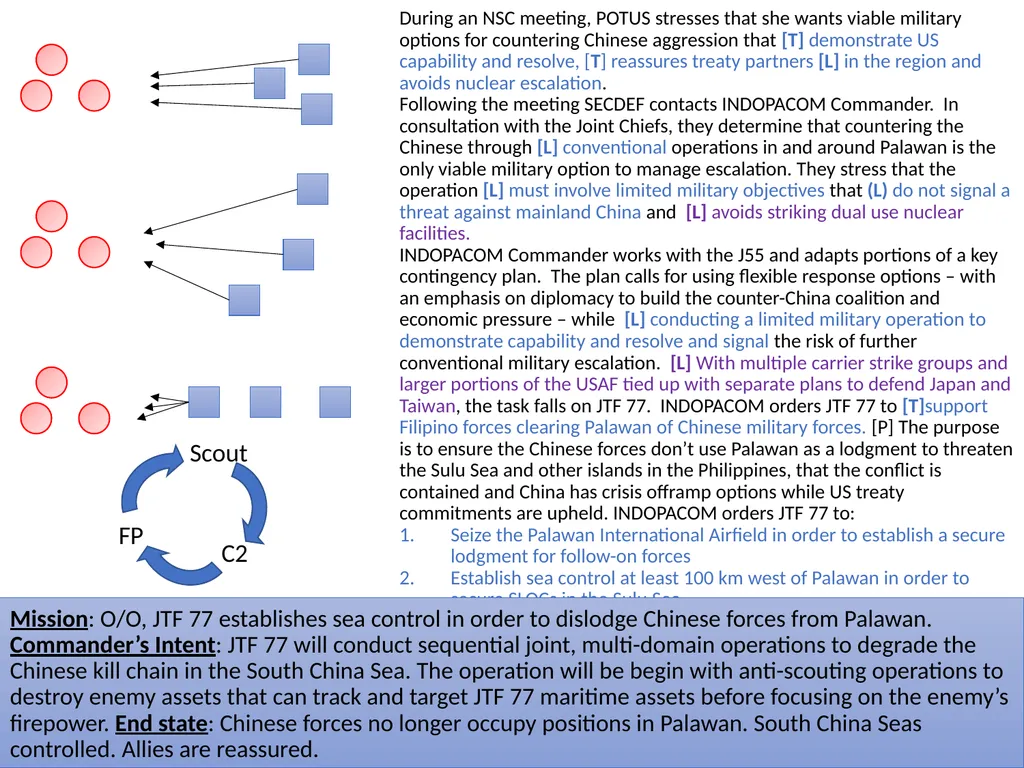
slide1. During an NSC meeting, POTUS stresses that she wants viable military options for countering Chinese aggression that [T] demonstrate US capability and resolve, [T] reassures treaty partners [L] in the region and avoids nuclear escalation.
Following the meeting SECDEF contacts INDOPACOM Commander. In consultation with the Joint Chiefs, they determine that countering the Chinese through [L] conventional operations in and around Palawan is the only viable military option to manage escalation. They stress that the operation [L] must involve limited military objectives that (L) do not signal a threat against mainland China and [L] avoids striking dual use nuclear facilities.
INDOPACOM Commander works with the J55 and adapts portions of a key contingency plan. The plan calls for using flexible response options – with an emphasis on diplomacy to build the counter-China coalition and economic pressure – while [L] conducting a limited military operation to demonstrate capability and resolve and signal the risk of further conventional military escalation. [L] With multiple carrier strike groups and larger portions of the USAF tied up with separate plans to defend Japan and Taiwan, the task falls on JTF 77. INDOPACOM orders JTF 77 to [T]support Filipino forces clearing Palawan of Chinese military forces. [P] The purpose is to ensure the Chinese forces don’t use Palawan as a lodgment to threaten the Sulu Sea and other islands in the Philippines, that the conflict is contained and China has crisis offramp options while US treaty commitments are upheld. INDOPACOM orders JTF 77 to:
Seize the Palawan International Airfield in order to establish a secure lodgment for follow-on forces
Establish sea control at least 100 km west of Palawan in order to secure SLOCs in the Sulu Sea Mission: O/O, JTF 77 establishes sea control in order to dislodge Chinese forces from Palawan.
Commander’s Intent: JTF 77 will conduct sequential joint, multi-domain operations to degrade the Chinese kill chain in the South China Sea. The operation will be begin with anti-scouting operations to destroy enemy assets that can track and target JTF 77 maritime assets before focusing on the enemy’s firepower. End state: Chinese forces no longer occupy positions in Palawan. South China Seas controlled. Allies are reassured.<br>
slide2. During an NSC meeting, POTUS stresses that she wants viable military options for countering Chinese aggression that [T] demonstrate US capability and resolve, [T] reassures treaty partners [L] in the region and avoids nuclear escalation.
Following the meeting SECDEF contacts INDOPACOM Commander. In consultation with the Joint Chiefs, they determine that countering the Chinese through [L] conventional operations in and around Palawan is the only viable military option to manage escalation. They stress that the operation [L] must involve limited military objectives that (L) do not signal a threat against mainland China and [L] avoids striking dual use nuclear facilities.
INDOPACOM Commander works with the J55 and adapts portions of a key contingency plan. The plan calls for using flexible response options – with an emphasis on diplomacy to build the counter-China coalition and economic pressure – while [L] conducting a limited military operation to demonstrate capability and resolve and signal the risk of further conventional military escalation. [L] With multiple carrier strike groups and larger portions of the USAF tied up with separate plans to defend Japan and Taiwan, the task falls on JTF 77. INDOPACOM orders JTF 77 to [T]support Filipino forces clearing Palawan of Chinese military forces. [P] The purpose is to ensure the Chinese forces don’t use Palawan as a lodgment to threaten the Sulu Sea and other islands in the Philippines, that the conflict is contained and China has crisis offramp options while US treaty commitments are upheld. INDOPACOM orders JTF 77 to:
Seize the Palawan International Airfield in order to establish a secure lodgment for follow-on forces
Establish sea control at least 100 km west of Palawan in order to secure SLOCs in the Sulu Sea Mission: O/O, JTF 77 establishes sea control in order to dislodge Chinese forces from Palawan.
Commander’s Intent: JTF 77 will conduct sequential joint, multi-domain operations to degrade the Chinese kill chain in the South China Sea. The operation will be begin with anti-scouting operations to destroy enemy assets that can track and target JTF 77 maritime assets before focusing on the enemy’s firepower. End state: Chinese forces no longer occupy positions in Palawan. South China Seas controlled. Allies are reassured.<br>
slide4. 1 2 Blue Takeaways
Protect friendly COG
Emissions control is not binary, on or off
Blue counter-firepower v. red firepower
Surface, subsurface, air, and space
CFACC airpower in support of sea denial
Time, space, and purpose of joint assets 3<br>
slide5. PLA Assessment PLAN (SCS)
2-4 Frigates (Type 54)
2-4 Destroyers (Type 52, 54)
1 CG (Type 55)
6+ fast attack (Type 21)
5+ SAM BN (HQ-9) – SCS islands
2+ SSM BN (YJ-62) - SCS islands
3+ Radar sites (air, surface) – SCS islands
4+ attack subs (Kilo, Yuan)
1-2 supply (Type 93)
PLAAF (SCS, Woody Island airbases)
20+ TACAIR (J-10, J-11, JH-7)
10+ H-6M
OTH Radar (Woody)
2+ Soar Dragon
PLA (Palawan)
Airborne Company Team (1 x Armor PLT ZTQ, 2 x INF PLTs, 1 x artillery platoon, AAA section)
Rocket Forces (Mainland)
4+ DF-26 BNs
SSF
Use of OECM from SCS Islands
Limited use of cyber to support targeting MLECOA: (PH 1) SAG will conduct sea control vic SCS IOT to secure the area and support an amphibious assault on Palawan. After PLA forces deploy 2x Marine Battalions to reinforce PLA airborne units holding Palawan airport, (PH2) the SAG and supporting PLAAF forces will transition to conduct sea control in the Sulu Sea IOT deny CJTF forces access to Palawan. Denying US forces access is the main effort. PLA/CCP leaders view limiting US forces as the best path to producing a fait accompli.<br>
slide8. HVT List
C2 Systems
Jamming
Cyber Intrusions
Spoofing and Deception
Unmanned ISR platforms
LHA, other ARG Ships, DDGs
EABs
Key airfields
Key ports
Underway Replenishment ships
Fuel storage tanks (aviation and ship) HPT List
C2 Systems
Unmanned ISR platforms
LHA, other ARG Ships, DDGs
EABs
Key ports
Key airfields<br>
slide9. PLA Wargame Findings U.S. Anti-Scouting operations against Soar Dragon high-altitude/long-duration ISR severed and impeded Chinese kill chain
U.S. Counterforce operations against radar sites disrupted accuracy and precision of PGMs
U.S. Counterforce decoys effective; PLA expended resources on what appeared to be an LPD on JPG2, while also illuminating position
PLA underestimated the effectiveness of U.S. airpower and LRASM to sea control
U.S. fighters superior to Chinese fighters when sequenced
Massing Tomahawk salvos effective against PLA defenses<br>
slide10. Further Look:
-Naval Reserve: PGM
-Ground Based Sea-Control
-Seat of Purpose
-Decisive Blow on the Maritime Maginot<br>
Following the meeting SECDEF contacts INDOPACOM Commander. In consultation with the Joint Chiefs, they determine that countering the Chinese through [L] conventional operations in and around Palawan is the only viable military option to manage escalation. They stress that the operation [L] must involve limited military objectives that (L) do not signal a threat against mainland China and [L] avoids striking dual use nuclear facilities.
INDOPACOM Commander works with the J55 and adapts portions of a key contingency plan. The plan calls for using flexible response options – with an emphasis on diplomacy to build the counter-China coalition and economic pressure – while [L] conducting a limited military operation to demonstrate capability and resolve and signal the risk of further conventional military escalation. [L] With multiple carrier strike groups and larger portions of the USAF tied up with separate plans to defend Japan and Taiwan, the task falls on JTF 77. INDOPACOM orders JTF 77 to [T]support Filipino forces clearing Palawan of Chinese military forces. [P] The purpose is to ensure the Chinese forces don’t use Palawan as a lodgment to threaten the Sulu Sea and other islands in the Philippines, that the conflict is contained and China has crisis offramp options while US treaty commitments are upheld. INDOPACOM orders JTF 77 to:
Seize the Palawan International Airfield in order to establish a secure lodgment for follow-on forces
Establish sea control at least 100 km west of Palawan in order to secure SLOCs in the Sulu Sea Mission: O/O, JTF 77 establishes sea control in order to dislodge Chinese forces from Palawan.
Commander’s Intent: JTF 77 will conduct sequential joint, multi-domain operations to degrade the Chinese kill chain in the South China Sea. The operation will be begin with anti-scouting operations to destroy enemy assets that can track and target JTF 77 maritime assets before focusing on the enemy’s firepower. End state: Chinese forces no longer occupy positions in Palawan. South China Seas controlled. Allies are reassured.<br>
slide2. During an NSC meeting, POTUS stresses that she wants viable military options for countering Chinese aggression that [T] demonstrate US capability and resolve, [T] reassures treaty partners [L] in the region and avoids nuclear escalation.
Following the meeting SECDEF contacts INDOPACOM Commander. In consultation with the Joint Chiefs, they determine that countering the Chinese through [L] conventional operations in and around Palawan is the only viable military option to manage escalation. They stress that the operation [L] must involve limited military objectives that (L) do not signal a threat against mainland China and [L] avoids striking dual use nuclear facilities.
INDOPACOM Commander works with the J55 and adapts portions of a key contingency plan. The plan calls for using flexible response options – with an emphasis on diplomacy to build the counter-China coalition and economic pressure – while [L] conducting a limited military operation to demonstrate capability and resolve and signal the risk of further conventional military escalation. [L] With multiple carrier strike groups and larger portions of the USAF tied up with separate plans to defend Japan and Taiwan, the task falls on JTF 77. INDOPACOM orders JTF 77 to [T]support Filipino forces clearing Palawan of Chinese military forces. [P] The purpose is to ensure the Chinese forces don’t use Palawan as a lodgment to threaten the Sulu Sea and other islands in the Philippines, that the conflict is contained and China has crisis offramp options while US treaty commitments are upheld. INDOPACOM orders JTF 77 to:
Seize the Palawan International Airfield in order to establish a secure lodgment for follow-on forces
Establish sea control at least 100 km west of Palawan in order to secure SLOCs in the Sulu Sea Mission: O/O, JTF 77 establishes sea control in order to dislodge Chinese forces from Palawan.
Commander’s Intent: JTF 77 will conduct sequential joint, multi-domain operations to degrade the Chinese kill chain in the South China Sea. The operation will be begin with anti-scouting operations to destroy enemy assets that can track and target JTF 77 maritime assets before focusing on the enemy’s firepower. End state: Chinese forces no longer occupy positions in Palawan. South China Seas controlled. Allies are reassured.<br>
slide4. 1 2 Blue Takeaways
Protect friendly COG
Emissions control is not binary, on or off
Blue counter-firepower v. red firepower
Surface, subsurface, air, and space
CFACC airpower in support of sea denial
Time, space, and purpose of joint assets 3<br>
slide5. PLA Assessment PLAN (SCS)
2-4 Frigates (Type 54)
2-4 Destroyers (Type 52, 54)
1 CG (Type 55)
6+ fast attack (Type 21)
5+ SAM BN (HQ-9) – SCS islands
2+ SSM BN (YJ-62) - SCS islands
3+ Radar sites (air, surface) – SCS islands
4+ attack subs (Kilo, Yuan)
1-2 supply (Type 93)
PLAAF (SCS, Woody Island airbases)
20+ TACAIR (J-10, J-11, JH-7)
10+ H-6M
OTH Radar (Woody)
2+ Soar Dragon
PLA (Palawan)
Airborne Company Team (1 x Armor PLT ZTQ, 2 x INF PLTs, 1 x artillery platoon, AAA section)
Rocket Forces (Mainland)
4+ DF-26 BNs
SSF
Use of OECM from SCS Islands
Limited use of cyber to support targeting MLECOA: (PH 1) SAG will conduct sea control vic SCS IOT to secure the area and support an amphibious assault on Palawan. After PLA forces deploy 2x Marine Battalions to reinforce PLA airborne units holding Palawan airport, (PH2) the SAG and supporting PLAAF forces will transition to conduct sea control in the Sulu Sea IOT deny CJTF forces access to Palawan. Denying US forces access is the main effort. PLA/CCP leaders view limiting US forces as the best path to producing a fait accompli.<br>
slide8. HVT List
C2 Systems
Jamming
Cyber Intrusions
Spoofing and Deception
Unmanned ISR platforms
LHA, other ARG Ships, DDGs
EABs
Key airfields
Key ports
Underway Replenishment ships
Fuel storage tanks (aviation and ship) HPT List
C2 Systems
Unmanned ISR platforms
LHA, other ARG Ships, DDGs
EABs
Key ports
Key airfields<br>
slide9. PLA Wargame Findings U.S. Anti-Scouting operations against Soar Dragon high-altitude/long-duration ISR severed and impeded Chinese kill chain
U.S. Counterforce operations against radar sites disrupted accuracy and precision of PGMs
U.S. Counterforce decoys effective; PLA expended resources on what appeared to be an LPD on JPG2, while also illuminating position
PLA underestimated the effectiveness of U.S. airpower and LRASM to sea control
U.S. fighters superior to Chinese fighters when sequenced
Massing Tomahawk salvos effective against PLA defenses<br>
slide10. Further Look:
-Naval Reserve: PGM
-Ground Based Sea-Control
-Seat of Purpose
-Decisive Blow on the Maritime Maginot<br>