
E-Commerce: Digital Markets, Digital Goods



Description: E-Commerce: Digital Markets, Digital Goods E-commerce and the Internet E-Commerce Today E-commerce: use of the Internet and Web to transact business; digitally enabled transactions. Began in 1995 and grew exponentially; still growing even
Related Topics
Download Presentation
"E-Commerce: Digital Markets, Digital Goods" is the property of its rightful owner. Permission is granted to download and print the materials on this website for personal, non-commercial use only, and to display it on your personal computer provided you do not modify the materials and that you retain all copyright notices contained in the materials. By downloading content from our website, you accept the terms of this agreement.
Presentation Transcript
slide1. E-Commerce: Digital Markets, Digital Goods<br>
slide2. E-commerce and the Internet E-Commerce Today E-commerce: use of the Internet and Web to transact business; digitally enabled transactions.
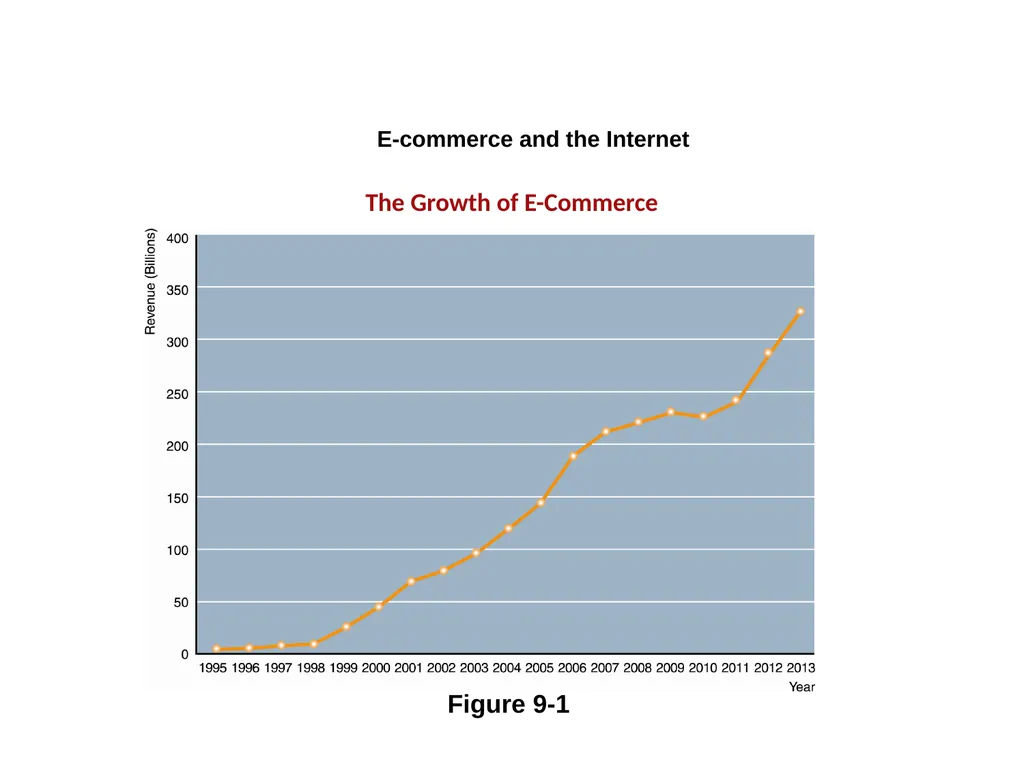
Began in 1995 and grew exponentially; still growing even in a recession.
Companies that survived the dot-com bubble burst and now thrive.<br>
slide3. E-commerce and the Internet Figure 9-1 The Growth of E-Commerce<br>
slide4. Why E-Commerce Is Different E-commerce and the Internet Ubiquity
Internet/Web technology available everywhere: work, home, and so on, anytime.
Effect:
Marketplace removed from temporal, geographic locations to become “marketspace”
Enhanced customer convenience and reduced shopping costs<br>
slide5. Unique Features of E-commerce Technology E-commerce and the Internet Global reach
The technology reaches across national boundaries, around Earth
Effect:
Commerce enabled across cultural and national boundaries seamlessly and without modification.
Marketspace includes, potentially, billions of consumers and millions of businesses worldwide.<br>
slide6. Unique Features of E-commerce Technology E-commerce and the Internet Universal standards
One set of technology standards: Internet standards
Effect:
Disparate computer systems easily communicate with one another.
Lower market entry costs—costs merchants must pay to bring goods to market.
Lower consumers’ search costs—effort required to find suitable products.<br>
slide7. Unique Features of E-commerce Technology E-commerce and the Internet Richness
Supports video, audio, and text messages
Effect:
Possible to deliver rich messages with text, audio, and video simultaneously to large numbers of people.
Video, audio, and text marketing messages can be integrated into single marketing message and consumer experience.<br>
slide8. Unique Features of E-commerce Technology E-commerce and the Internet Interactivity
The technology works through interaction with the user
Effect:
Consumers engaged in dialog that dynamically adjusts experience to the individual.
Consumer becomes co-participant in process of delivering goods to market.<br>
slide9. Unique Features of E-commerce Technology E-commerce and the Internet Information density
Large increases in information density—the total amount and quality of information available to all market participants
Effect:
Greater price transparency
Greater cost transparency
Enables merchants to engage in price discrimination<br>
slide10. Unique Features of E-commerce Technology E-commerce and the Internet Personalization/Customization
Technology permits modification of messages, goods
Effect:
Personalized messages can be sent to individuals as well as groups.
Products and services can be customized to individual preferences.<br>
slide11. Unique Features of E-commerce Technology E-commerce and the Internet Social technology
The technology promotes user content generation and social networking
Effect:
New Internet social and business models enable user content creation and distribution, and support social networks.<br>
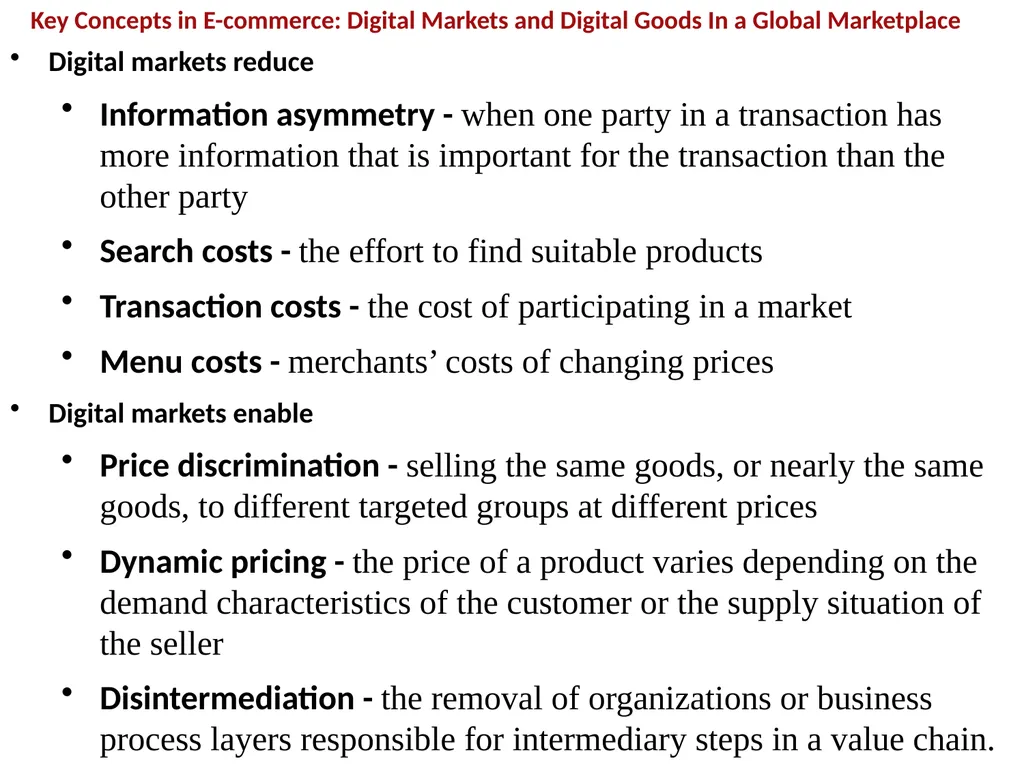
slide12. Key Concepts in E-commerce: Digital Markets and Digital Goods In a Global Marketplace Digital markets reduce
Information asymmetry - when one party in a transaction has more information that is important for the transaction than the other party
Search costs - the effort to find suitable products
Transaction costs - the cost of participating in a market
Menu costs - merchants’ costs of changing prices
Digital markets enable
Price discrimination - selling the same goods, or nearly the same goods, to different targeted groups at different prices
Dynamic pricing - the price of a product varies depending on the demand characteristics of the customer or the supply situation of the seller
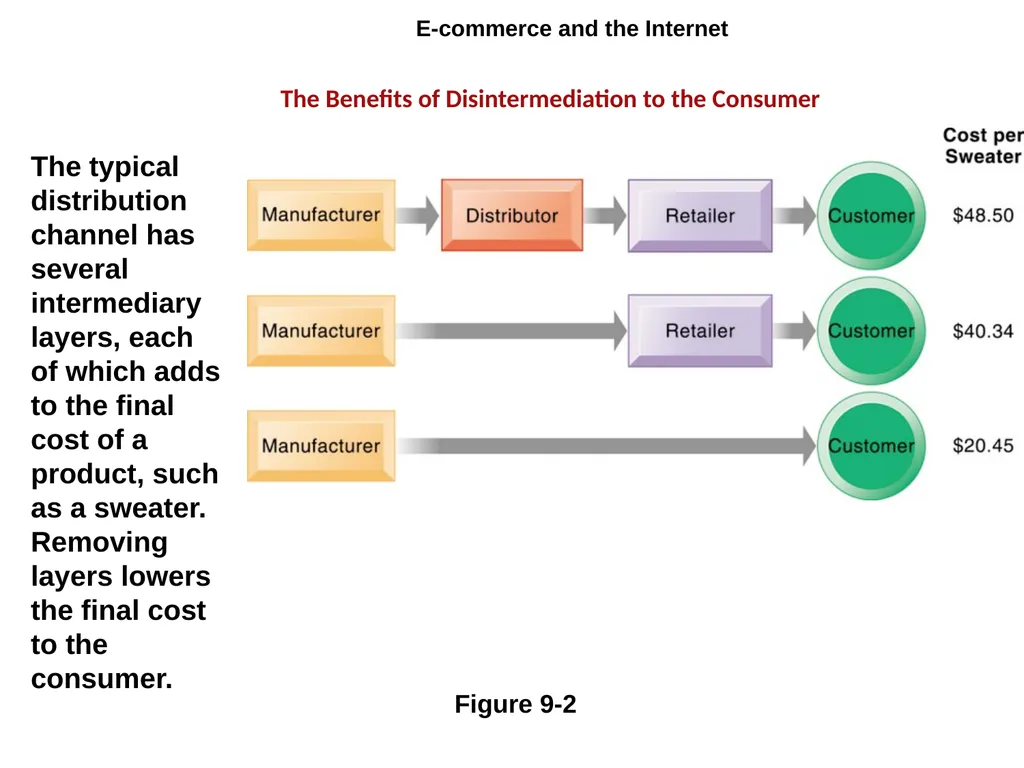
Disintermediation - the removal of organizations or business process layers responsible for intermediary steps in a value chain.<br>
slide13. E-commerce and the Internet Figure 9-2 The typical distribution channel has several intermediary layers, each of which adds to the final cost of a product, such as a sweater. Removing layers lowers the final cost to the consumer. The Benefits of Disintermediation to the Consumer<br>
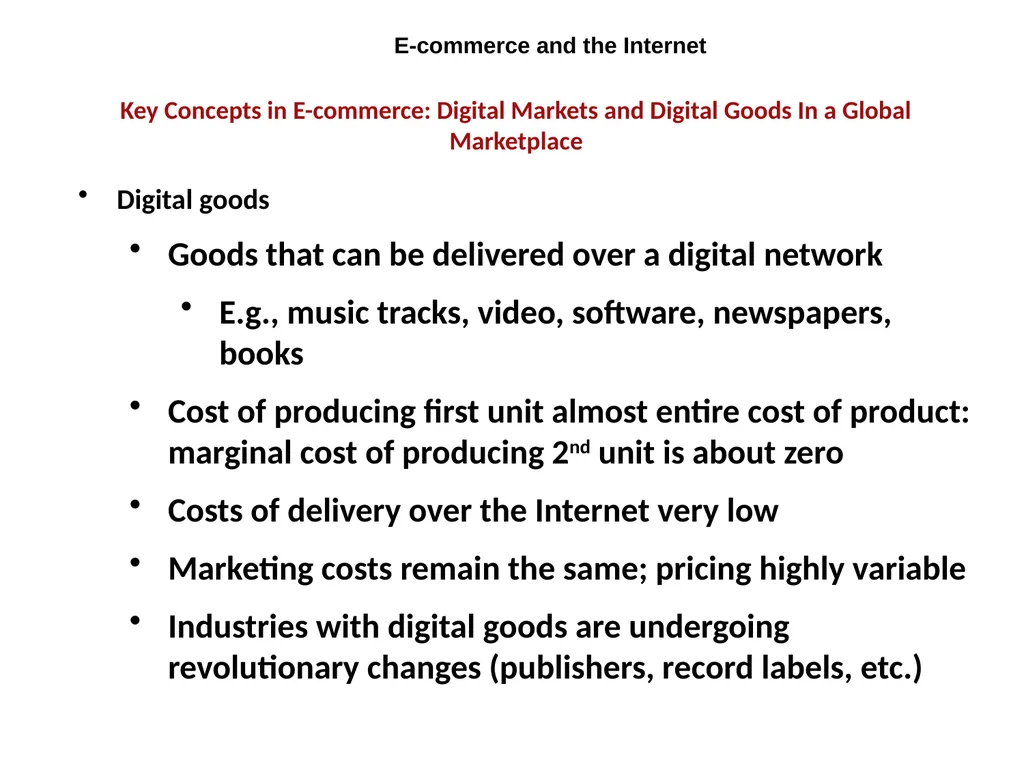
slide14. Key Concepts in E-commerce: Digital Markets and Digital Goods In a Global Marketplace E-commerce and the Internet Digital goods
Goods that can be delivered over a digital network
E.g., music tracks, video, software, newspapers, books
Cost of producing first unit almost entire cost of product: marginal cost of producing 2nd unit is about zero
Costs of delivery over the Internet very low
Marketing costs remain the same; pricing highly variable
Industries with digital goods are undergoing revolutionary changes (publishers, record labels, etc.)<br>
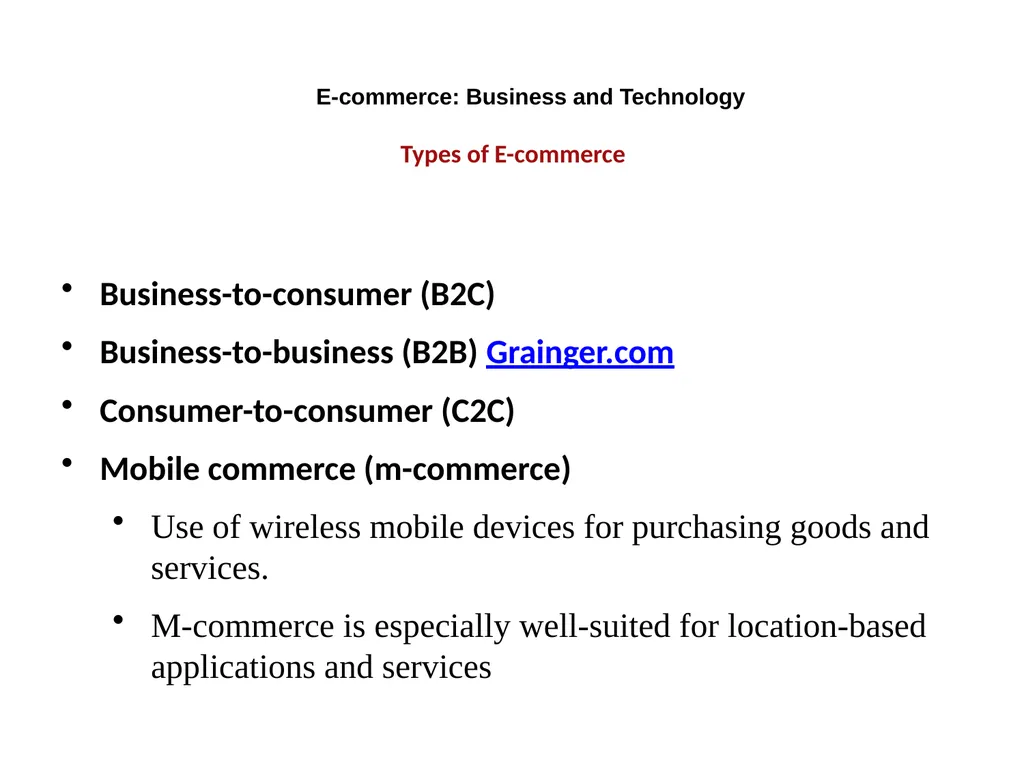
slide15. Types of E-commerce E-commerce: Business and Technology Business-to-consumer (B2C)
Business-to-business (B2B) Grainger.com
Consumer-to-consumer (C2C)
Mobile commerce (m-commerce)
Use of wireless mobile devices for purchasing goods and services.
M-commerce is especially well-suited for location-based applications and services<br>
slide16. E-commerce Business Models E-commerce: Business and Technology Portal - revenue: advertising
E-tailer – traditional sales over the web
Content provider - revenue: access fees, advertising
Transaction broker – eSchwab (charges for transaction)
Service provider - revenue: subscription fees, advertising
Community provider -<br>
slide17. E-commerce Revenue Models E-commerce: Business and Technology Advertising
Sales
Subscription
Free/Fremium
Transaction fee
Affiliate<br>
slide18. Web 2.0, Social Networking, and the Wisdom of Crowds E-commerce: Business and Technology Most popular Web 2.0 service: social networking
Social networking sites sell banner ads, user preference information, and music, videos and e-books.
Social shopping sites
Swap shopping ideas with friends (Kaboodle, ThisNext)
Wisdom of crowds (crowd sourcing)
Large numbers of people can make better decisions about topics and products than a single person.
Prediction markets: peer-to-peer betting markets on specific outcomes (elections, sales figures, designs for new products)
LinkedIn is the largest professional and business social network that members often use to recruit employees and find jobs.<br>
slide19. E-commerce Marketing Internet provides marketers with new ways of identifying and communicating with customers.
Long tail marketing: ability to reach a large audience inexpensively.
Behavioral targeting: tracking online behavior of individuals on thousands of Web sites.
Advertising formats include search engine marketing, display ads, rich media, and e-mail.
Collaborative filtering - a method of making automatic predictions (filtering) about the interests of a user by collecting preferences from many users .The assumption is that if a person A has the same opinion as a person B on an issue, A is more likely to have B's opinion on a different issue x than to have the opinion on x of a person chosen randomly E-commerce: Business and Technology<br>
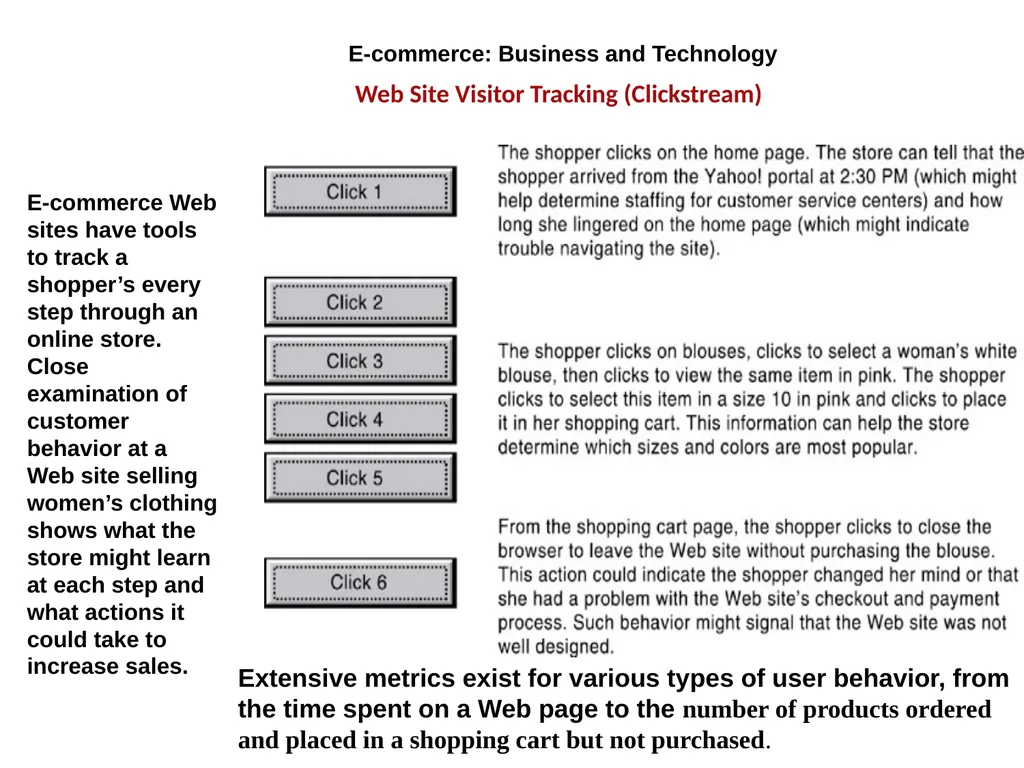
slide20. E-commerce: Business and Technology E-commerce Web sites have tools to track a shopper’s every step through an online store. Close examination of customer behavior at a Web site selling women’s clothing shows what the store might learn at each step and what actions it could take to increase sales. Web Site Visitor Tracking (Clickstream) Extensive metrics exist for various types of user behavior, from the time spent on a Web page to the number of products ordered and placed in a shopping cart but not purchased.<br>
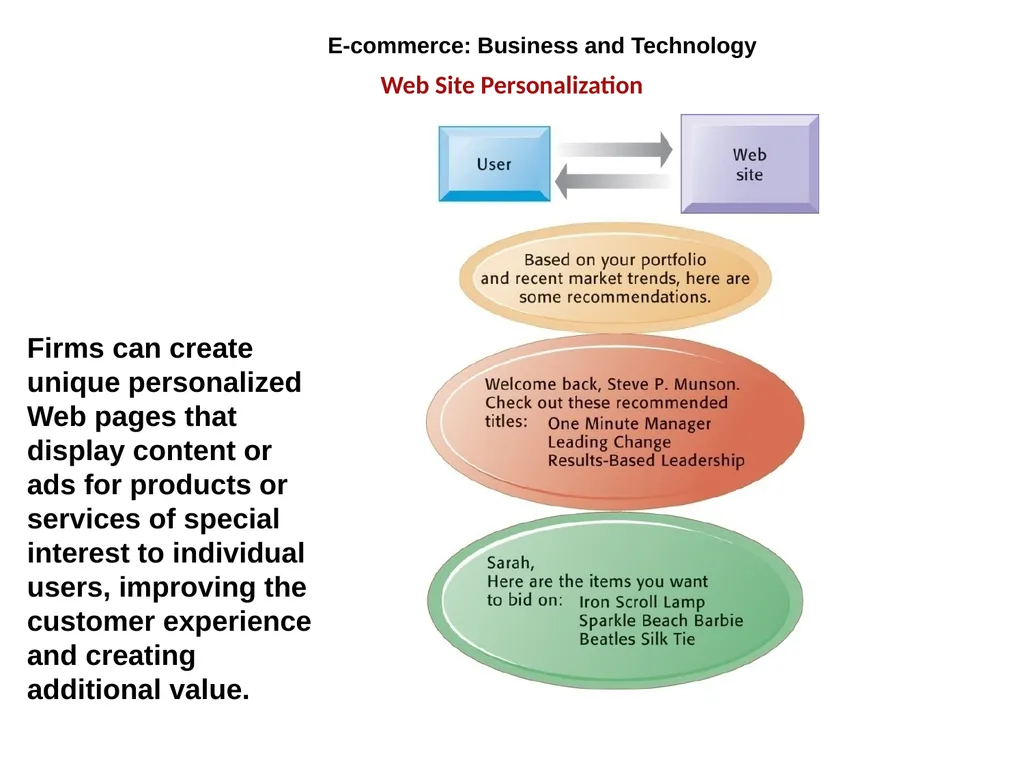
slide21. E-commerce: Business and Technology Firms can create unique personalized Web pages that display content or ads for products or services of special interest to individual users, improving the customer experience and creating additional value. Web Site Personalization<br>
slide22. Business-to-Business Electronic Commerce: New Efficiencies and Relationships Electronic data interchange (EDI)
Computer-to-computer exchange of standard transactions such as invoices, purchase orders.
Major industries have EDI standards that define structure and information fields of electronic documents for that industry.
More companies increasingly moving away from private networks to Internet for linking to other firms.
E.g., procurement: businesses can now use Internet to locate most low-cost supplier, search online catalogs of supplier products, negotiate with suppliers, place orders, and so on E-commerce: Business and Technology<br>
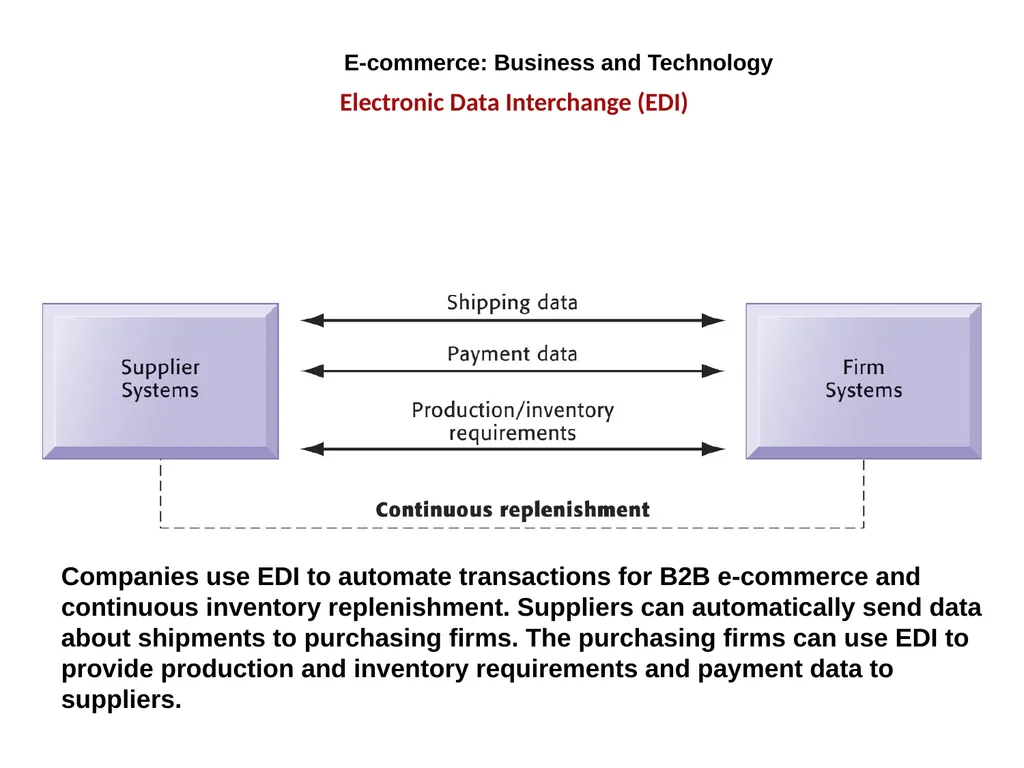
slide23. E-commerce: Business and Technology Companies use EDI to automate transactions for B2B e-commerce and continuous inventory replenishment. Suppliers can automatically send data about shipments to purchasing firms. The purchasing firms can use EDI to provide production and inventory requirements and payment data to suppliers. Electronic Data Interchange (EDI)<br>
slide24. Business-to-Business Electronic Commerce: New Efficiencies and Relationships Private industrial networks (private exchanges)
Large firm using extranet to link to its suppliers, distributors, and other key business partners
Owned by buyer
Permits sharing of:
Product design and development
Marketing
Production scheduling and inventory management
Unstructured communication (graphics and e-mail) E-commerce: Business and Technology<br>
slide25. Business-to-Business Electronic Commerce: New Efficiencies and Relationships Net marketplaces (e-hubs)
Single market for many buyers and sellers.
Industry-owned or owned by independent intermediary.
Generate revenue from transaction fees, other services.
Use prices established through negotiation, auction, RFQs, or fixed prices.
May focus on direct or indirect goods.
May be vertical or horizontal marketplaces. E-commerce: Business and Technology<br>
slide26. Social e-commerce:
Based on digital social graph
Mapping of all significant online relationships
Four features of social e-commerce driving its growth
Social sign-on
Collaborative shopping
Network notification
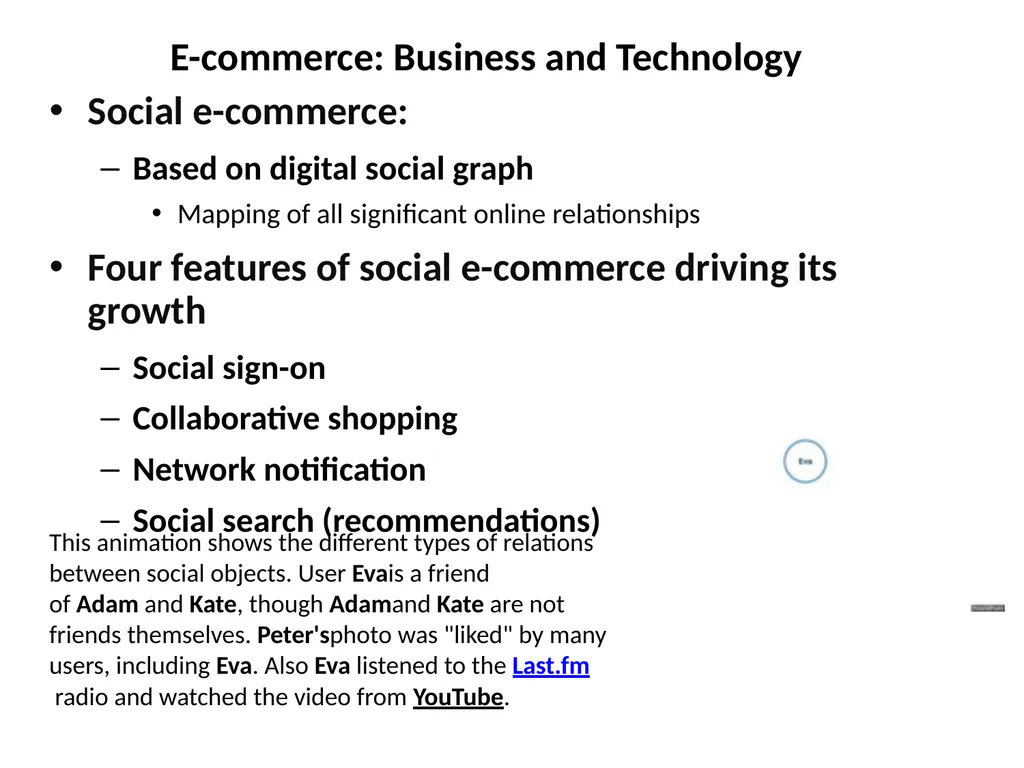
Social search (recommendations) E-commerce: Business and Technology This animation shows the different types of relations between social objects. User Evais a friend of Adam and Kate, though Adamand Kate are not friends themselves. Peter'sphoto was "liked" by many users, including Eva. Also Eva listened to the Last.fm radio and watched the video from YouTube.<br>
slide27. Social media:
Fastest growing media for branding and marketing
Social network marketing:
Seeks to leverage individuals influence over others in social graph
Target is a social network of people sharing interests and advice
Social networks have huge audiences
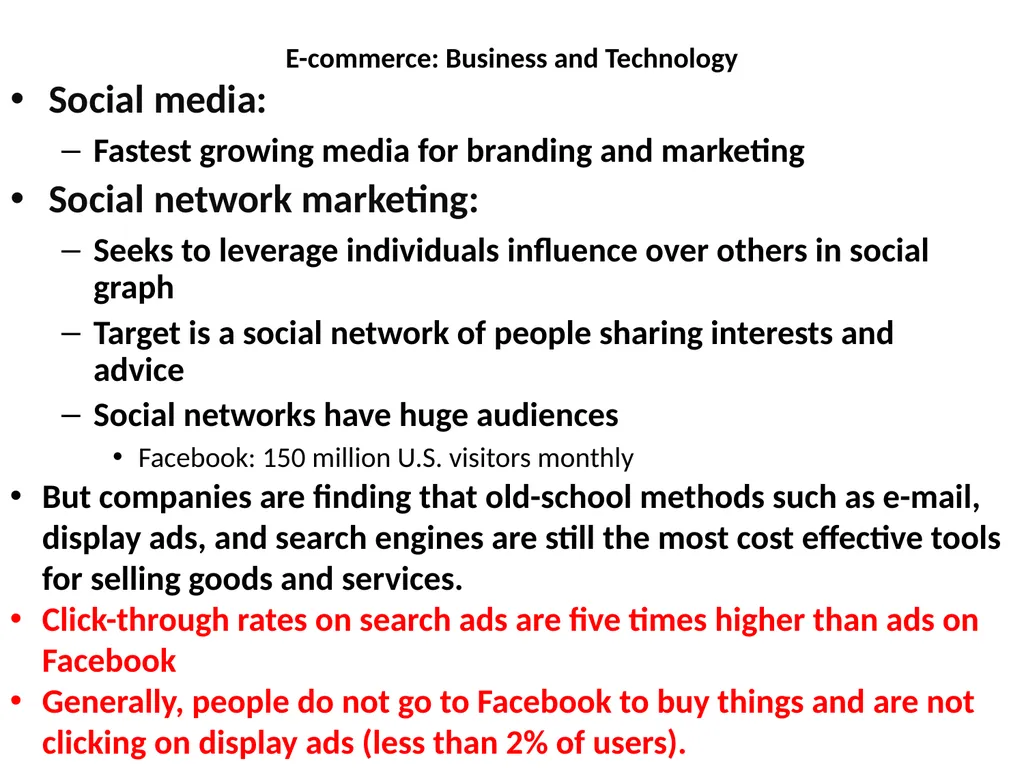
Facebook: 150 million U.S. visitors monthly E-commerce: Business and Technology But companies are finding that old-school methods such as e-mail, display ads, and search engines are still the most cost effective tools for selling goods and services.
Click-through rates on search ads are five times higher than ads on Facebook
Generally, people do not go to Facebook to buy things and are not clicking on display ads (less than 2% of users).<br>
slide28. M-commerce
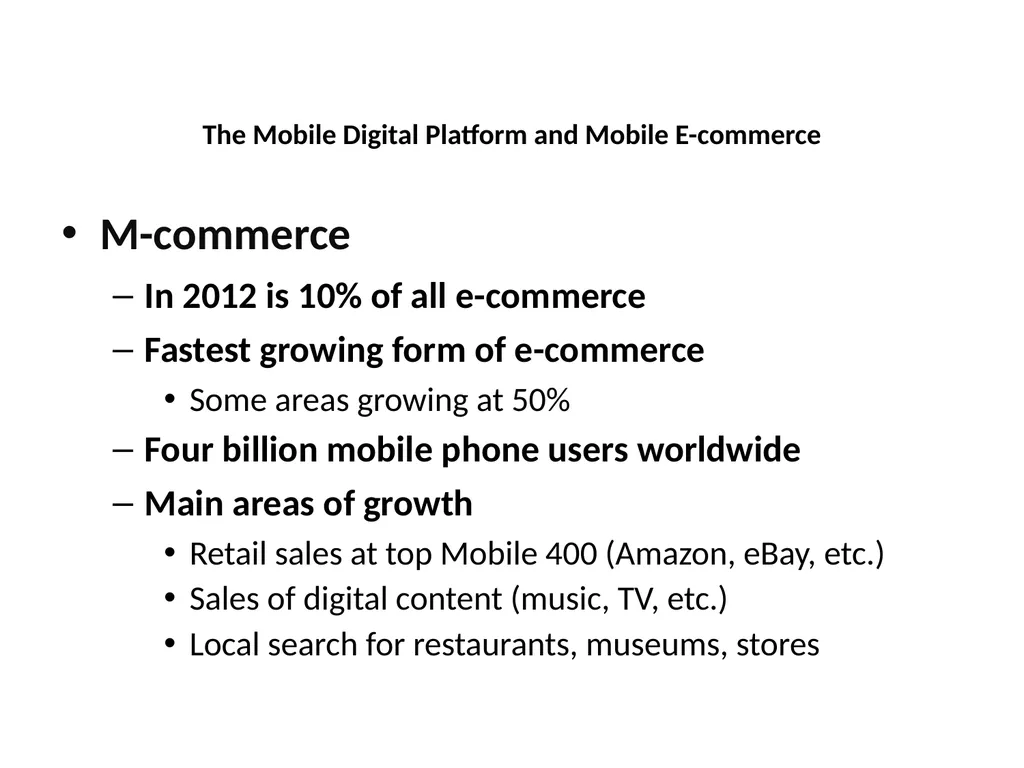
In 2012 is 10% of all e-commerce
Fastest growing form of e-commerce
Some areas growing at 50%
Four billion mobile phone users worldwide
Main areas of growth
Retail sales at top Mobile 400 (Amazon, eBay, etc.)
Sales of digital content (music, TV, etc.)
Local search for restaurants, museums, stores The Mobile Digital Platform and Mobile E-commerce<br>
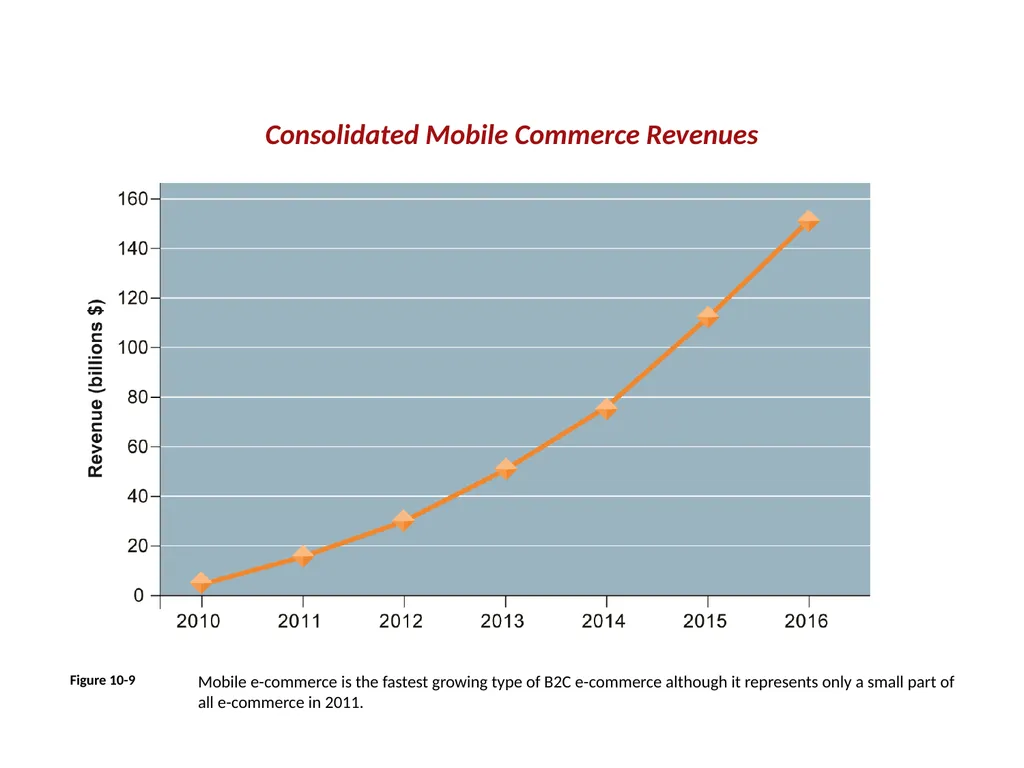
slide29. Mobile e-commerce is the fastest growing type of B2C e-commerce although it represents only a small part of all e-commerce in 2011. Figure 10-9 Consolidated Mobile Commerce Revenues<br>
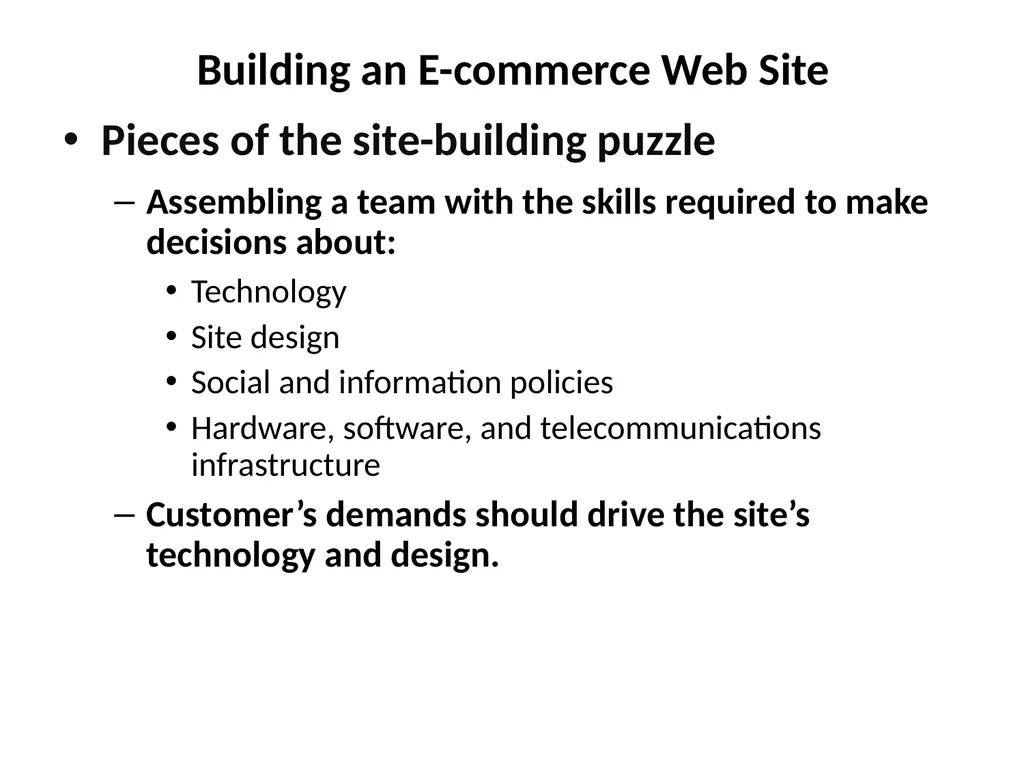
slide30. Pieces of the site-building puzzle
Assembling a team with the skills required to make decisions about:
Technology
Site design
Social and information policies
Hardware, software, and telecommunications infrastructure
Customer’s demands should drive the site’s technology and design. Building an E-commerce Web Site<br>
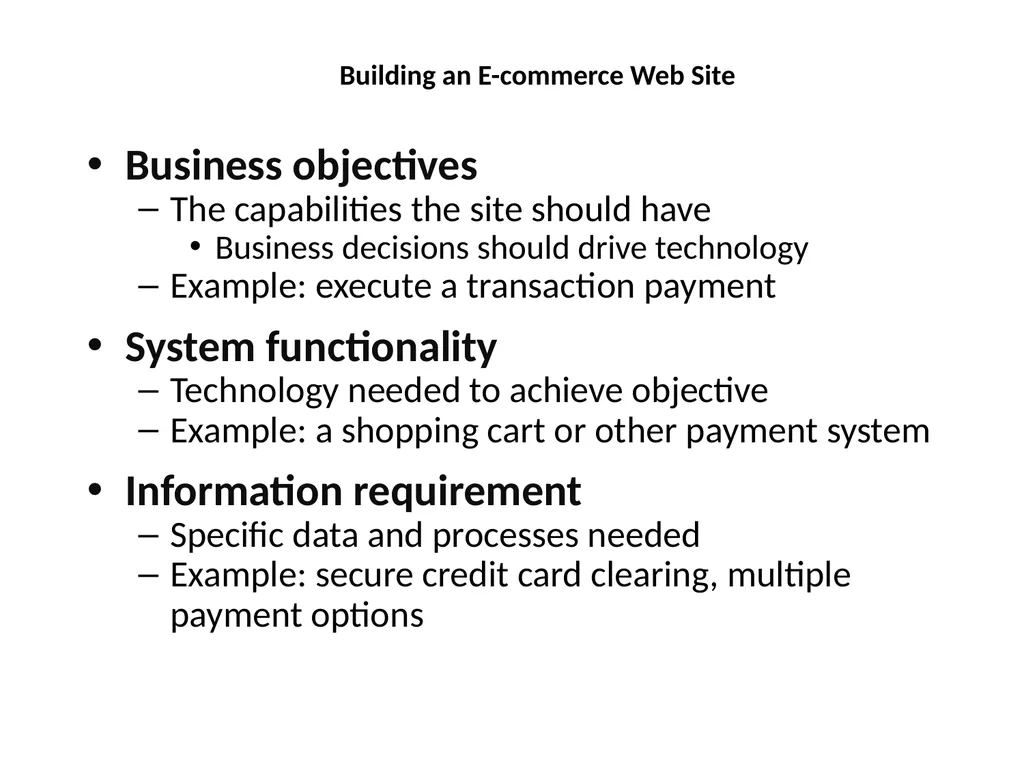
slide31. Business objectives
The capabilities the site should have
Business decisions should drive technology
Example: execute a transaction payment
System functionality
Technology needed to achieve objective
Example: a shopping cart or other payment system
Information requirement
Specific data and processes needed
Example: secure credit card clearing, multiple payment options Building an E-commerce Web Site<br>
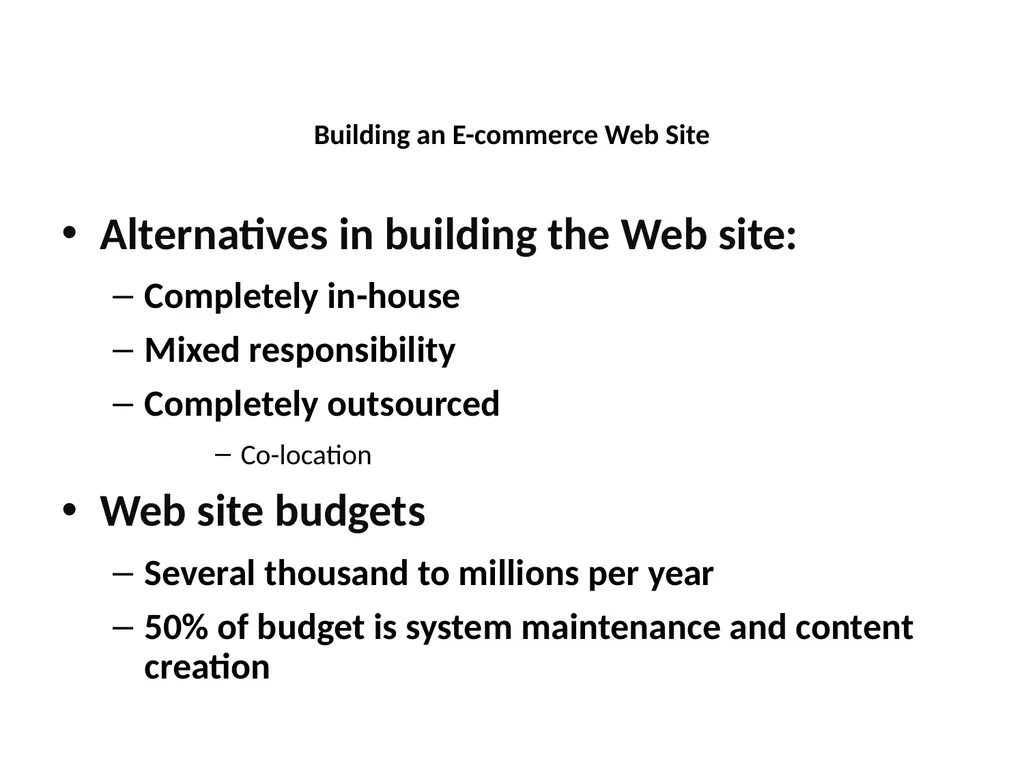
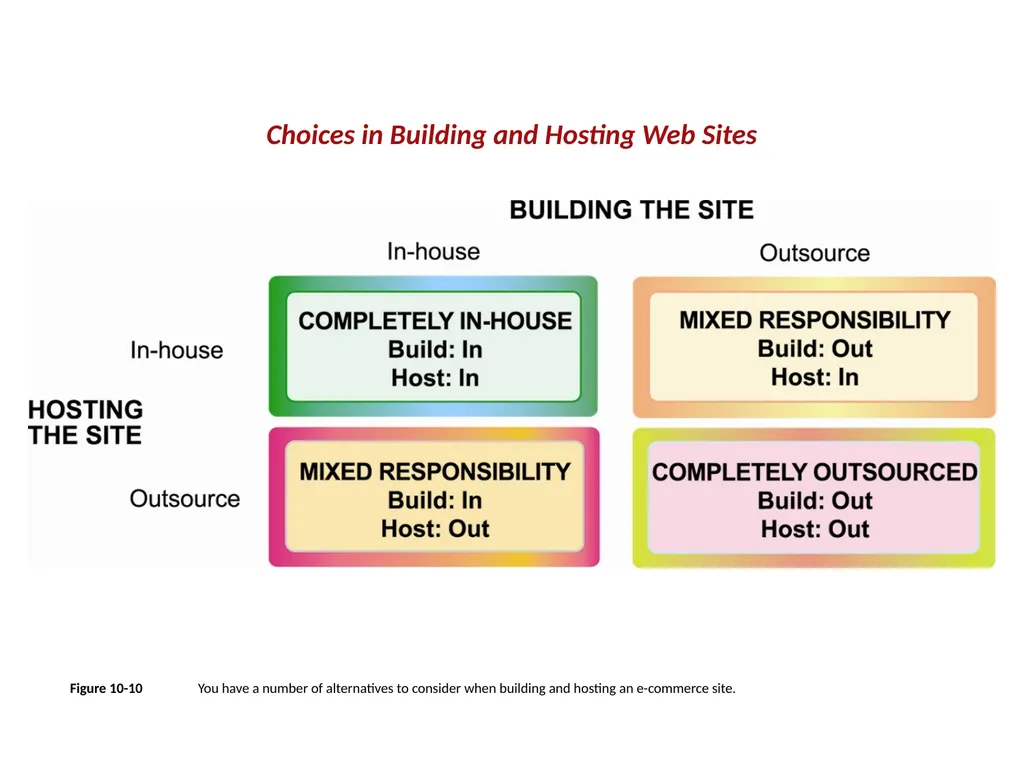
slide32. Alternatives in building the Web site:
Completely in-house
Mixed responsibility
Completely outsourced
Co-location
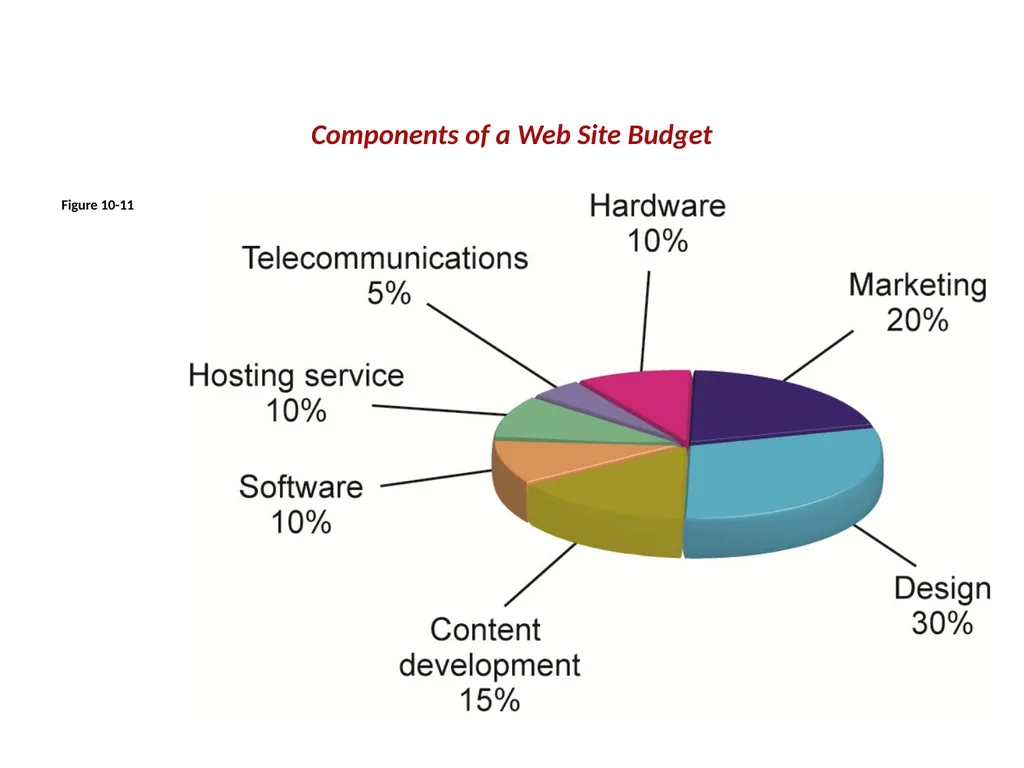
Web site budgets
Several thousand to millions per year
50% of budget is system maintenance and content creation Building an E-commerce Web Site<br>
slide33. You have a number of alternatives to consider when building and hosting an e-commerce site. Figure 10-10 Choices in Building and Hosting Web Sites<br>
slide34. Figure 10-11 Components of a Web Site Budget<br>
slide2. E-commerce and the Internet E-Commerce Today E-commerce: use of the Internet and Web to transact business; digitally enabled transactions.
Began in 1995 and grew exponentially; still growing even in a recession.
Companies that survived the dot-com bubble burst and now thrive.<br>
slide3. E-commerce and the Internet Figure 9-1 The Growth of E-Commerce<br>
slide4. Why E-Commerce Is Different E-commerce and the Internet Ubiquity
Internet/Web technology available everywhere: work, home, and so on, anytime.
Effect:
Marketplace removed from temporal, geographic locations to become “marketspace”
Enhanced customer convenience and reduced shopping costs<br>
slide5. Unique Features of E-commerce Technology E-commerce and the Internet Global reach
The technology reaches across national boundaries, around Earth
Effect:
Commerce enabled across cultural and national boundaries seamlessly and without modification.
Marketspace includes, potentially, billions of consumers and millions of businesses worldwide.<br>
slide6. Unique Features of E-commerce Technology E-commerce and the Internet Universal standards
One set of technology standards: Internet standards
Effect:
Disparate computer systems easily communicate with one another.
Lower market entry costs—costs merchants must pay to bring goods to market.
Lower consumers’ search costs—effort required to find suitable products.<br>
slide7. Unique Features of E-commerce Technology E-commerce and the Internet Richness
Supports video, audio, and text messages
Effect:
Possible to deliver rich messages with text, audio, and video simultaneously to large numbers of people.
Video, audio, and text marketing messages can be integrated into single marketing message and consumer experience.<br>
slide8. Unique Features of E-commerce Technology E-commerce and the Internet Interactivity
The technology works through interaction with the user
Effect:
Consumers engaged in dialog that dynamically adjusts experience to the individual.
Consumer becomes co-participant in process of delivering goods to market.<br>
slide9. Unique Features of E-commerce Technology E-commerce and the Internet Information density
Large increases in information density—the total amount and quality of information available to all market participants
Effect:
Greater price transparency
Greater cost transparency
Enables merchants to engage in price discrimination<br>
slide10. Unique Features of E-commerce Technology E-commerce and the Internet Personalization/Customization
Technology permits modification of messages, goods
Effect:
Personalized messages can be sent to individuals as well as groups.
Products and services can be customized to individual preferences.<br>
slide11. Unique Features of E-commerce Technology E-commerce and the Internet Social technology
The technology promotes user content generation and social networking
Effect:
New Internet social and business models enable user content creation and distribution, and support social networks.<br>
slide12. Key Concepts in E-commerce: Digital Markets and Digital Goods In a Global Marketplace Digital markets reduce
Information asymmetry - when one party in a transaction has more information that is important for the transaction than the other party
Search costs - the effort to find suitable products
Transaction costs - the cost of participating in a market
Menu costs - merchants’ costs of changing prices
Digital markets enable
Price discrimination - selling the same goods, or nearly the same goods, to different targeted groups at different prices
Dynamic pricing - the price of a product varies depending on the demand characteristics of the customer or the supply situation of the seller
Disintermediation - the removal of organizations or business process layers responsible for intermediary steps in a value chain.<br>
slide13. E-commerce and the Internet Figure 9-2 The typical distribution channel has several intermediary layers, each of which adds to the final cost of a product, such as a sweater. Removing layers lowers the final cost to the consumer. The Benefits of Disintermediation to the Consumer<br>
slide14. Key Concepts in E-commerce: Digital Markets and Digital Goods In a Global Marketplace E-commerce and the Internet Digital goods
Goods that can be delivered over a digital network
E.g., music tracks, video, software, newspapers, books
Cost of producing first unit almost entire cost of product: marginal cost of producing 2nd unit is about zero
Costs of delivery over the Internet very low
Marketing costs remain the same; pricing highly variable
Industries with digital goods are undergoing revolutionary changes (publishers, record labels, etc.)<br>
slide15. Types of E-commerce E-commerce: Business and Technology Business-to-consumer (B2C)
Business-to-business (B2B) Grainger.com
Consumer-to-consumer (C2C)
Mobile commerce (m-commerce)
Use of wireless mobile devices for purchasing goods and services.
M-commerce is especially well-suited for location-based applications and services<br>
slide16. E-commerce Business Models E-commerce: Business and Technology Portal - revenue: advertising
E-tailer – traditional sales over the web
Content provider - revenue: access fees, advertising
Transaction broker – eSchwab (charges for transaction)
Service provider - revenue: subscription fees, advertising
Community provider -<br>
slide17. E-commerce Revenue Models E-commerce: Business and Technology Advertising
Sales
Subscription
Free/Fremium
Transaction fee
Affiliate<br>
slide18. Web 2.0, Social Networking, and the Wisdom of Crowds E-commerce: Business and Technology Most popular Web 2.0 service: social networking
Social networking sites sell banner ads, user preference information, and music, videos and e-books.
Social shopping sites
Swap shopping ideas with friends (Kaboodle, ThisNext)
Wisdom of crowds (crowd sourcing)
Large numbers of people can make better decisions about topics and products than a single person.
Prediction markets: peer-to-peer betting markets on specific outcomes (elections, sales figures, designs for new products)
LinkedIn is the largest professional and business social network that members often use to recruit employees and find jobs.<br>
slide19. E-commerce Marketing Internet provides marketers with new ways of identifying and communicating with customers.
Long tail marketing: ability to reach a large audience inexpensively.
Behavioral targeting: tracking online behavior of individuals on thousands of Web sites.
Advertising formats include search engine marketing, display ads, rich media, and e-mail.
Collaborative filtering - a method of making automatic predictions (filtering) about the interests of a user by collecting preferences from many users .The assumption is that if a person A has the same opinion as a person B on an issue, A is more likely to have B's opinion on a different issue x than to have the opinion on x of a person chosen randomly E-commerce: Business and Technology<br>
slide20. E-commerce: Business and Technology E-commerce Web sites have tools to track a shopper’s every step through an online store. Close examination of customer behavior at a Web site selling women’s clothing shows what the store might learn at each step and what actions it could take to increase sales. Web Site Visitor Tracking (Clickstream) Extensive metrics exist for various types of user behavior, from the time spent on a Web page to the number of products ordered and placed in a shopping cart but not purchased.<br>
slide21. E-commerce: Business and Technology Firms can create unique personalized Web pages that display content or ads for products or services of special interest to individual users, improving the customer experience and creating additional value. Web Site Personalization<br>
slide22. Business-to-Business Electronic Commerce: New Efficiencies and Relationships Electronic data interchange (EDI)
Computer-to-computer exchange of standard transactions such as invoices, purchase orders.
Major industries have EDI standards that define structure and information fields of electronic documents for that industry.
More companies increasingly moving away from private networks to Internet for linking to other firms.
E.g., procurement: businesses can now use Internet to locate most low-cost supplier, search online catalogs of supplier products, negotiate with suppliers, place orders, and so on E-commerce: Business and Technology<br>
slide23. E-commerce: Business and Technology Companies use EDI to automate transactions for B2B e-commerce and continuous inventory replenishment. Suppliers can automatically send data about shipments to purchasing firms. The purchasing firms can use EDI to provide production and inventory requirements and payment data to suppliers. Electronic Data Interchange (EDI)<br>
slide24. Business-to-Business Electronic Commerce: New Efficiencies and Relationships Private industrial networks (private exchanges)
Large firm using extranet to link to its suppliers, distributors, and other key business partners
Owned by buyer
Permits sharing of:
Product design and development
Marketing
Production scheduling and inventory management
Unstructured communication (graphics and e-mail) E-commerce: Business and Technology<br>
slide25. Business-to-Business Electronic Commerce: New Efficiencies and Relationships Net marketplaces (e-hubs)
Single market for many buyers and sellers.
Industry-owned or owned by independent intermediary.
Generate revenue from transaction fees, other services.
Use prices established through negotiation, auction, RFQs, or fixed prices.
May focus on direct or indirect goods.
May be vertical or horizontal marketplaces. E-commerce: Business and Technology<br>
slide26. Social e-commerce:
Based on digital social graph
Mapping of all significant online relationships
Four features of social e-commerce driving its growth
Social sign-on
Collaborative shopping
Network notification
Social search (recommendations) E-commerce: Business and Technology This animation shows the different types of relations between social objects. User Evais a friend of Adam and Kate, though Adamand Kate are not friends themselves. Peter'sphoto was "liked" by many users, including Eva. Also Eva listened to the Last.fm radio and watched the video from YouTube.<br>
slide27. Social media:
Fastest growing media for branding and marketing
Social network marketing:
Seeks to leverage individuals influence over others in social graph
Target is a social network of people sharing interests and advice
Social networks have huge audiences
Facebook: 150 million U.S. visitors monthly E-commerce: Business and Technology But companies are finding that old-school methods such as e-mail, display ads, and search engines are still the most cost effective tools for selling goods and services.
Click-through rates on search ads are five times higher than ads on Facebook
Generally, people do not go to Facebook to buy things and are not clicking on display ads (less than 2% of users).<br>
slide28. M-commerce
In 2012 is 10% of all e-commerce
Fastest growing form of e-commerce
Some areas growing at 50%
Four billion mobile phone users worldwide
Main areas of growth
Retail sales at top Mobile 400 (Amazon, eBay, etc.)
Sales of digital content (music, TV, etc.)
Local search for restaurants, museums, stores The Mobile Digital Platform and Mobile E-commerce<br>
slide29. Mobile e-commerce is the fastest growing type of B2C e-commerce although it represents only a small part of all e-commerce in 2011. Figure 10-9 Consolidated Mobile Commerce Revenues<br>
slide30. Pieces of the site-building puzzle
Assembling a team with the skills required to make decisions about:
Technology
Site design
Social and information policies
Hardware, software, and telecommunications infrastructure
Customer’s demands should drive the site’s technology and design. Building an E-commerce Web Site<br>
slide31. Business objectives
The capabilities the site should have
Business decisions should drive technology
Example: execute a transaction payment
System functionality
Technology needed to achieve objective
Example: a shopping cart or other payment system
Information requirement
Specific data and processes needed
Example: secure credit card clearing, multiple payment options Building an E-commerce Web Site<br>
slide32. Alternatives in building the Web site:
Completely in-house
Mixed responsibility
Completely outsourced
Co-location
Web site budgets
Several thousand to millions per year
50% of budget is system maintenance and content creation Building an E-commerce Web Site<br>
slide33. You have a number of alternatives to consider when building and hosting an e-commerce site. Figure 10-10 Choices in Building and Hosting Web Sites<br>
slide34. Figure 10-11 Components of a Web Site Budget<br>