
E-Government Chapter 6 E-Government Services 1
OM
Published · 61 slides · 0 views

1 / 1











Description
E-Government Chapter 6 E-Government Services 1 E-Government Services E-government services have become an important instrument of public administration. The main drivers for their evolution during the past two decades have been the
Related Topics
Share
Embed code
Download this presentation From Below
"E-Government Chapter 6 E-Government Services 1" is the property of its rightful owner. Permission is granted to download and print the materials on this website for personal, non-commercial use only, and to display it on your personal computer provided you do not modify the materials and that you retain all copyright notices contained in the materials. By downloading content from our website, you accept the terms of this agreement.
Presentation Transcript
01
E-Government
Chapter 6
E-Government Services 1<br>
02
E-Government Services E-government services have become an important instrument of public administration.
The main drivers for their evolution during the past two decades have been the development of modern information and communication technologies and the public demand for more convenient public service provision. 2<br>
The main drivers for their evolution during the past two decades have been the development of modern information and communication technologies and the public demand for more convenient public service provision. 2<br>
03
E-Government Services This has led to the advancement of existing e-government services and prepared the way for new innovative e-government information and service provision.
Moreover, it triggers radical(جذري) process changes in public administration organizations.
For example, the introduction of electronic tax declarations, which significantly reduced transmission efforts and processing times since direct electronic data processing substituted former workflows and electronic completion of forms drastically(بشكل جذري) limited incorrectly filled out declarations. 3<br>
Moreover, it triggers radical(جذري) process changes in public administration organizations.
For example, the introduction of electronic tax declarations, which significantly reduced transmission efforts and processing times since direct electronic data processing substituted former workflows and electronic completion of forms drastically(بشكل جذري) limited incorrectly filled out declarations. 3<br>
04
E-Government Services This e-government service evolution, however, was not a digital process that only required to flip the switch and all public service offers would automatically be available to the public stakeholders.
It rather has been a long and cumbersome(مرهقة) way of sequential service development and technology steps to reach the level of today’s e-government service provision. 4<br>
It rather has been a long and cumbersome(مرهقة) way of sequential service development and technology steps to reach the level of today’s e-government service provision. 4<br>
05
6.1 E-Government Service Maturity Models Following the time course of e-government service evolution, various practitioners and scientists divided this process into specific development stages.
These development stages represent a categorization that determines particular e-government portal maturity levels.
Therefore, maturity models are used, for example, to compare the development status of different e-government portals, to support public service development, and to serve as a guide for evaluating and improving e-government portal quality. 5<br>
These development stages represent a categorization that determines particular e-government portal maturity levels.
Therefore, maturity models are used, for example, to compare the development status of different e-government portals, to support public service development, and to serve as a guide for evaluating and improving e-government portal quality. 5<br>
06
6<br>
07
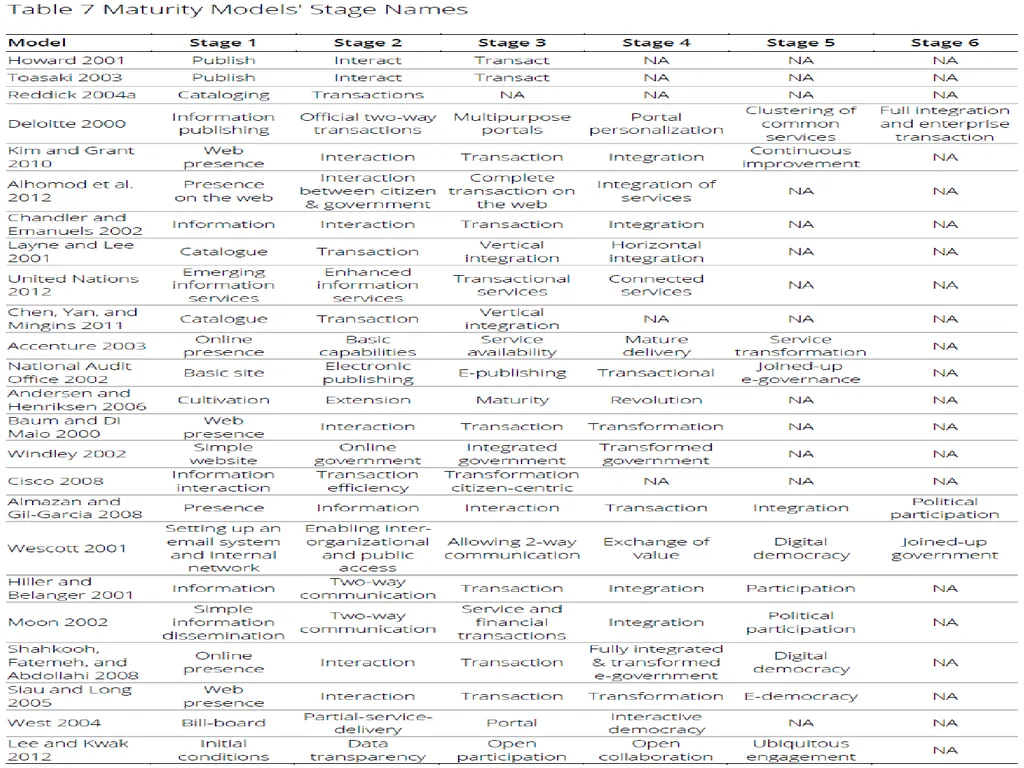
6.1 E-Government Service Maturity Models Taking into account all maturity models presented in Table 7, it can be stated that e-government maturity models show up to six development stages, with a minimum of two.
Furthermore, although the denominations(فئات) of the individual stages differ from one maturity model to another, the conceptual approaches—ranging from a basic to an advanced level—are comparable.
Nevertheless, the maturity models clearly differ from each other, which allows to classify them into five groups, according to their overall development scope/highest development stage:
(1) transaction, (2) integration, (3) transformation, (4) participation, and (5) open collaboration 7<br>
Furthermore, although the denominations(فئات) of the individual stages differ from one maturity model to another, the conceptual approaches—ranging from a basic to an advanced level—are comparable.
Nevertheless, the maturity models clearly differ from each other, which allows to classify them into five groups, according to their overall development scope/highest development stage:
(1) transaction, (2) integration, (3) transformation, (4) participation, and (5) open collaboration 7<br>
08
6.1 E-Government Service Maturity Models The most basic maturity models, in comparison to the level of the highest development stage, are the transaction-related models.
Howard (2001) and Toasaki (2003) follow a three stage approach that starts with publishing information.
The next stage is user-government interaction. The model closes with the transaction stage, which allows to complete public administration procedures online.
Reddick (2004a) broke this down to two stages: cataloging and transactions.
In the first stage, the public sector organization presents relevant information online and in the second stage, given public administrative procedures or transactions can be completed online via the Internet. 8<br>
Howard (2001) and Toasaki (2003) follow a three stage approach that starts with publishing information.
The next stage is user-government interaction. The model closes with the transaction stage, which allows to complete public administration procedures online.
Reddick (2004a) broke this down to two stages: cataloging and transactions.
In the first stage, the public sector organization presents relevant information online and in the second stage, given public administrative procedures or transactions can be completed online via the Internet. 8<br>
09
6.1 E-Government Service Maturity Models The second group of maturity models may be formed through integration-related models .
Although the maturity models differ concerning the number of stages (from three to six), the underlying principle is the same: they start with providing basic information services and close with the integration stage.
The systems of different administrative functionalities and jurisdictions are fully integrated and available through a customized one-stop e-government portal that allows the user to administer fully automated governmental procedures. 9<br>
Although the maturity models differ concerning the number of stages (from three to six), the underlying principle is the same: they start with providing basic information services and close with the integration stage.
The systems of different administrative functionalities and jurisdictions are fully integrated and available through a customized one-stop e-government portal that allows the user to administer fully automated governmental procedures. 9<br>
10
6.1 E-Government Service Maturity Models The maturity models of the transformation group rather focus on the transformation perspective of e-government .
Instead of focusing on the technology readiness of the e-government system, they refer to the level of achieved e-democracy or citizen-centric transformation.
The participation-oriented maturity models see e-government as a system that finally leads to e-democracy or political participation by citizens via the Internet.
This empowering of the civil society takes place for example via polling, public forums, online petitions, and online voting. 10<br>
Instead of focusing on the technology readiness of the e-government system, they refer to the level of achieved e-democracy or citizen-centric transformation.
The participation-oriented maturity models see e-government as a system that finally leads to e-democracy or political participation by citizens via the Internet.
This empowering of the civil society takes place for example via polling, public forums, online petitions, and online voting. 10<br>
11
6.1 E-Government Service Maturity Models The fifth group, open collaboration. Already in the third maturity stage, open participation is used for policy decisions and in stage four and five, public open data is integrated and made ubiquitously accessible respectively.
as the overall direction of the models is comparable, starting with simple information provision that finally leads to digital administration or e-democracy, the proposed development was generally replicated in various independent surveys. 11<br>
as the overall direction of the models is comparable, starting with simple information provision that finally leads to digital administration or e-democracy, the proposed development was generally replicated in various independent surveys. 11<br>
12
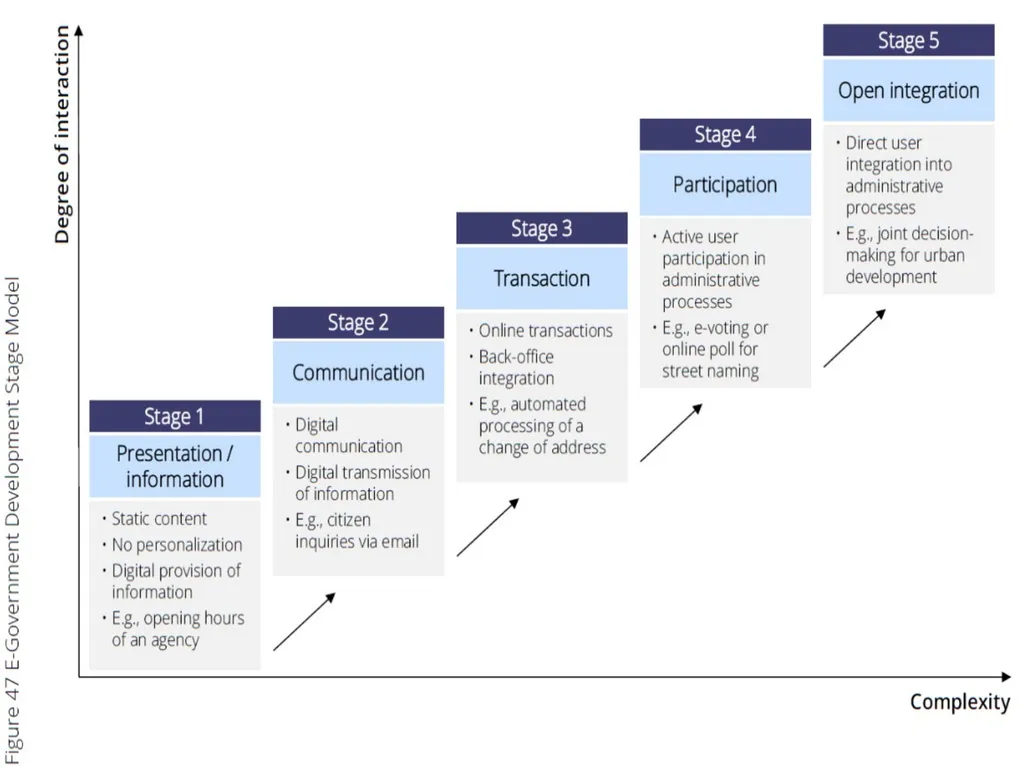
6.1 E-Government Service Maturity Models For a common understanding of e-government maturity levels, the main characteristics of the above-mentioned maturity models are summarized in an e-government development stage model, which is outlined in the following.
Taking into account the findings of previous e-government maturity level studies, we see five key e-government development stages:
(1) presentation/information, (2) communication, (3) transaction, (4) participation, and (5) open integration.
With each stage, the e-government application reaches a higher degree of interaction, which in turn is also connected to an increase in complexity. 12<br>
Taking into account the findings of previous e-government maturity level studies, we see five key e-government development stages:
(1) presentation/information, (2) communication, (3) transaction, (4) participation, and (5) open integration.
With each stage, the e-government application reaches a higher degree of interaction, which in turn is also connected to an increase in complexity. 12<br>
13
13<br>
14
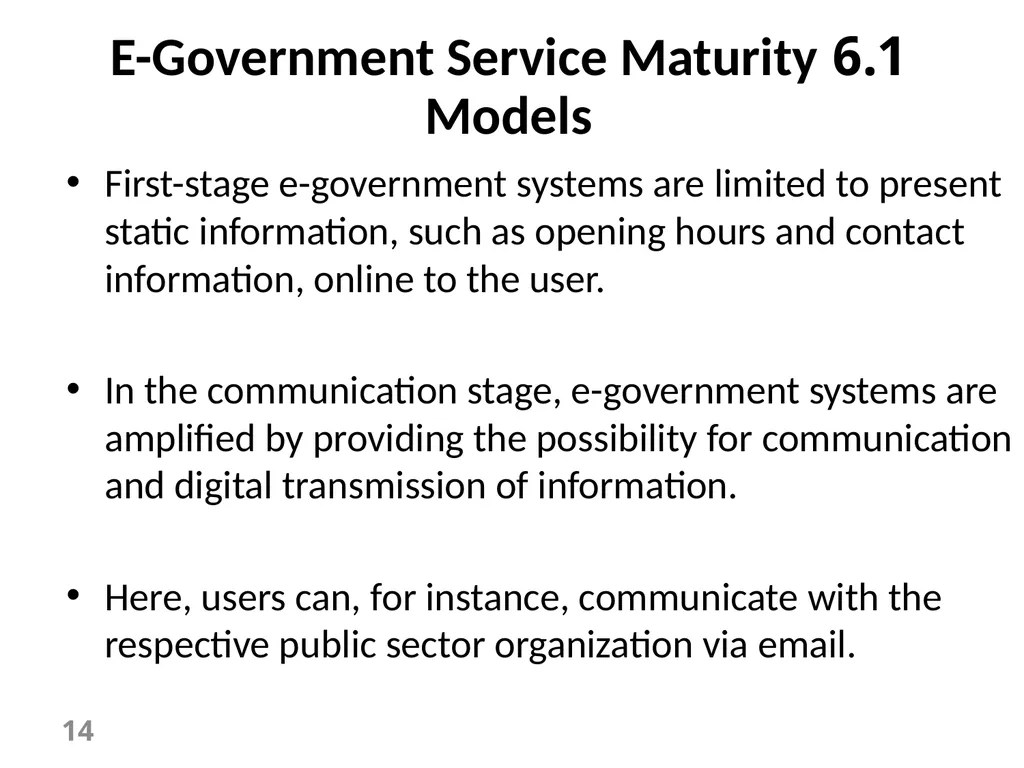
6.1 E-Government Service Maturity Models First-stage e-government systems are limited to present static information, such as opening hours and contact information, online to the user.
In the communication stage, e-government systems are amplified by providing the possibility for communication and digital transmission of information.
Here, users can, for instance, communicate with the respective public sector organization via email. 14<br>
In the communication stage, e-government systems are amplified by providing the possibility for communication and digital transmission of information.
Here, users can, for instance, communicate with the respective public sector organization via email. 14<br>
15
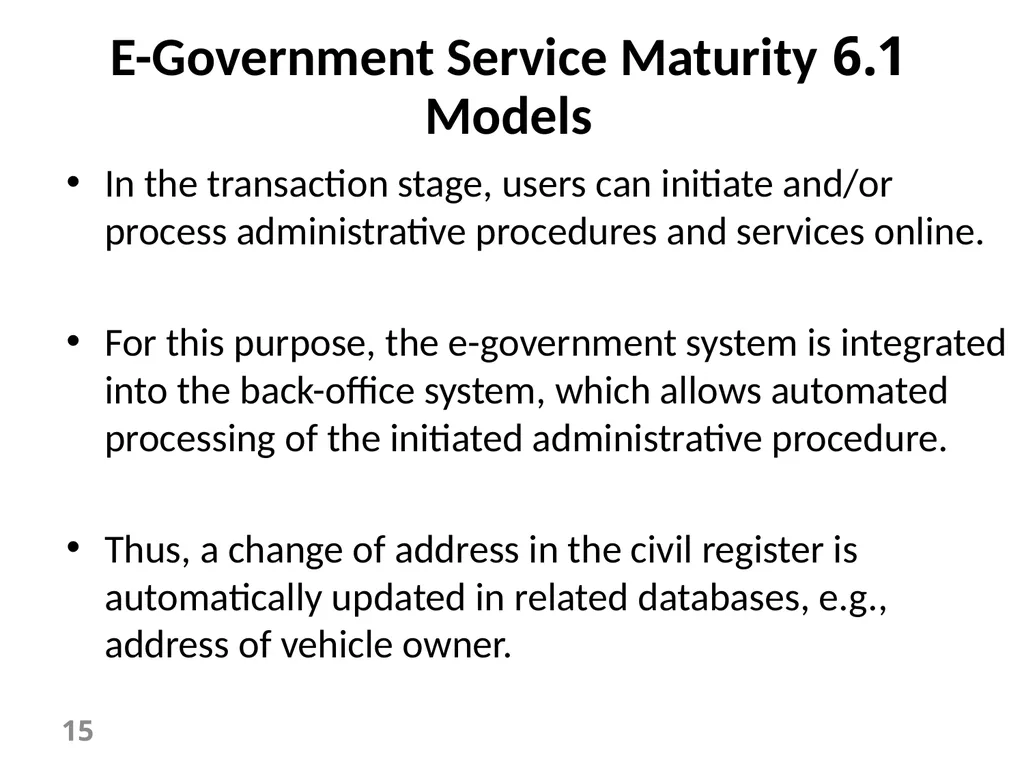
6.1 E-Government Service Maturity Models In the transaction stage, users can initiate and/or process administrative procedures and services online.
For this purpose, the e-government system is integrated into the back-office system, which allows automated processing of the initiated administrative procedure.
Thus, a change of address in the civil register is automatically updated in related databases, e.g., address of vehicle owner. 15<br>
For this purpose, the e-government system is integrated into the back-office system, which allows automated processing of the initiated administrative procedure.
Thus, a change of address in the civil register is automatically updated in related databases, e.g., address of vehicle owner. 15<br>
16
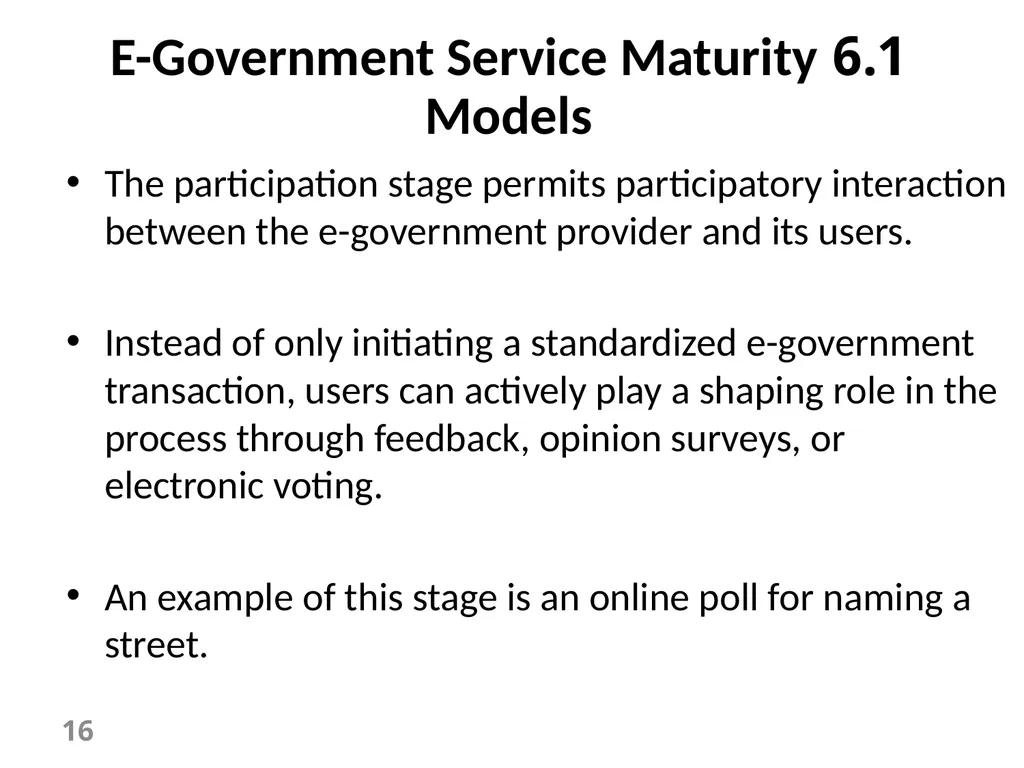
6.1 E-Government Service Maturity Models The participation stage permits participatory interaction between the e-government provider and its users.
Instead of only initiating a standardized e-government transaction, users can actively play a shaping role in the process through feedback, opinion surveys, or electronic voting.
An example of this stage is an online poll for naming a street. 16<br>
Instead of only initiating a standardized e-government transaction, users can actively play a shaping role in the process through feedback, opinion surveys, or electronic voting.
An example of this stage is an online poll for naming a street. 16<br>
17
6.1 E-Government Service Maturity Models In the open integration stage, the user is directly integrated into public processes and value creation, and manages interconnected administrative procedures that support an automated execution of multiple transactions.
Thus, the user is ubiquitously engaged with public administration, openly sharing data and public input through various devices and channels while cooperating and collaborating with the respective public entities. 17<br>
Thus, the user is ubiquitously engaged with public administration, openly sharing data and public input through various devices and channels while cooperating and collaborating with the respective public entities. 17<br>
18
6.1 E-Government Service Maturity Models Although the stages differ greatly concerning the related degree of interaction and the level of complexity that is associated with the respective stage, favoring one of them does not make sense since all play a vital role in e-government.
According to the e-government development stages and the associated degrees of interaction and complexity, various e-government interaction patterns are conceivable.
Within these interaction patterns, several public e-government stakeholders form a part of the government-user structure.
Against this background and the target to provide e-government services in a user-oriented way, it is important to identify the relevant actors and interaction patterns. 18<br>
According to the e-government development stages and the associated degrees of interaction and complexity, various e-government interaction patterns are conceivable.
Within these interaction patterns, several public e-government stakeholders form a part of the government-user structure.
Against this background and the target to provide e-government services in a user-oriented way, it is important to identify the relevant actors and interaction patterns. 18<br>
19
6.2 Actors and Interaction Patterns of E-Government All recipients and providers of e-government information and services within the e-government interaction procedures form the group of actors.
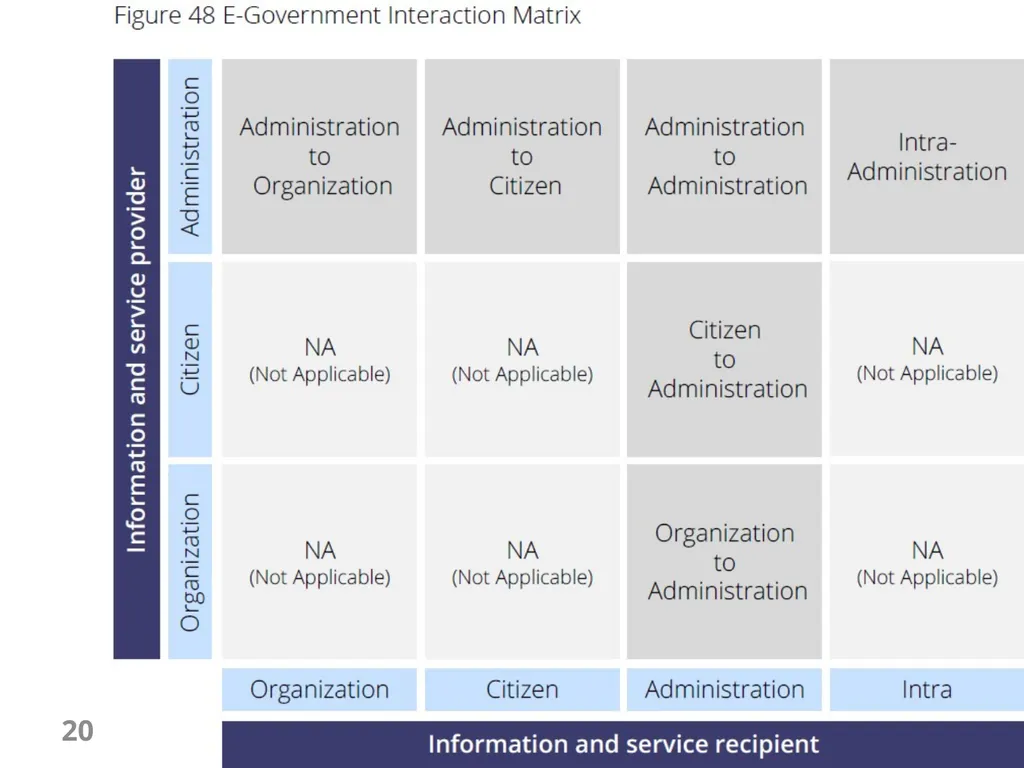
This group can be divided into people (citizens), private sector organizations (organization), and public sector organizations (administration), which interact with each other and thus build the basis for the interaction patterns. Figure 48 presents these relationships. 19<br>
This group can be divided into people (citizens), private sector organizations (organization), and public sector organizations (administration), which interact with each other and thus build the basis for the interaction patterns. Figure 48 presents these relationships. 19<br>
20
20<br>
21
6.2 Actors and Interaction Patterns of E-Government The providers of e-government information and services establish the basis for service provision within the underlying electronic networks.
For e-government, public administration (administration) is the prevalent information and service provider.
Administration to organization: it includes important administrative procedures to handle the interaction between private organizations, such as small, medium, and large companies, as well as non-profit organizations, and public administration (e.g., transactions related to income tax, value-added tax, social security). 21<br>
For e-government, public administration (administration) is the prevalent information and service provider.
Administration to organization: it includes important administrative procedures to handle the interaction between private organizations, such as small, medium, and large companies, as well as non-profit organizations, and public administration (e.g., transactions related to income tax, value-added tax, social security). 21<br>
22
6.2 Actors and Interaction Patterns of E-Government Administration to citizen: This interaction pattern mainly serves public administration in providing information and services to citizens. Most of these offers are provided free of charge, such as an online job portal of the employment agency. However, there are also fee-based interactions that require payment to complete the transaction (e.g., auctions(مزادات) of confiscated(المصادرة) goods, visa application). 22<br>
23
6.2 Actors and Interaction Patterns of E-Government Administration to administration: With growing data and service exchange as well as increasing collaboration between public sector entities on a national and international level, this interaction pattern becomes more and more important. Here, vivid(الحية) examples are the Federal Administration Office, which provides services for other public sector organizations.
Intra-administration: Automated one-stop e-government portals also require well functioning exchange of information and services within the respective public sector organization providing the e-government service. Therefore, this interaction pattern is mainly concerned with network-based, intra-organizational online procedures (e.g., connecting registration office data with vehicle registration data). 23<br>
Intra-administration: Automated one-stop e-government portals also require well functioning exchange of information and services within the respective public sector organization providing the e-government service. Therefore, this interaction pattern is mainly concerned with network-based, intra-organizational online procedures (e.g., connecting registration office data with vehicle registration data). 23<br>
24
6.2 Actors and Interaction Patterns of E-Government Citizen to administration: Here, public administration is the recipient of information and services that are provided by citizens. Thus, in the citizen to administration interaction pattern, citizens, for instance, send information to public institutions via online devices. An example is the electronic transmission of income tax returns.
Organization to administration: This interaction pattern is the equivalent to the citizen to administration interaction pattern, but with organizations as information and service providers. Therefore, it is mainly concerned with the handling of administrative tasks (e.g., tax declarations) or business relation tasks (e.g., electronic procurement) of private organizations. 24<br>
Organization to administration: This interaction pattern is the equivalent to the citizen to administration interaction pattern, but with organizations as information and service providers. Therefore, it is mainly concerned with the handling of administrative tasks (e.g., tax declarations) or business relation tasks (e.g., electronic procurement) of private organizations. 24<br>
25
6.2 Actors and Interaction Patterns of E-Government The interconnection among the e-government actors and the associated interaction patterns can lead to complex structures.
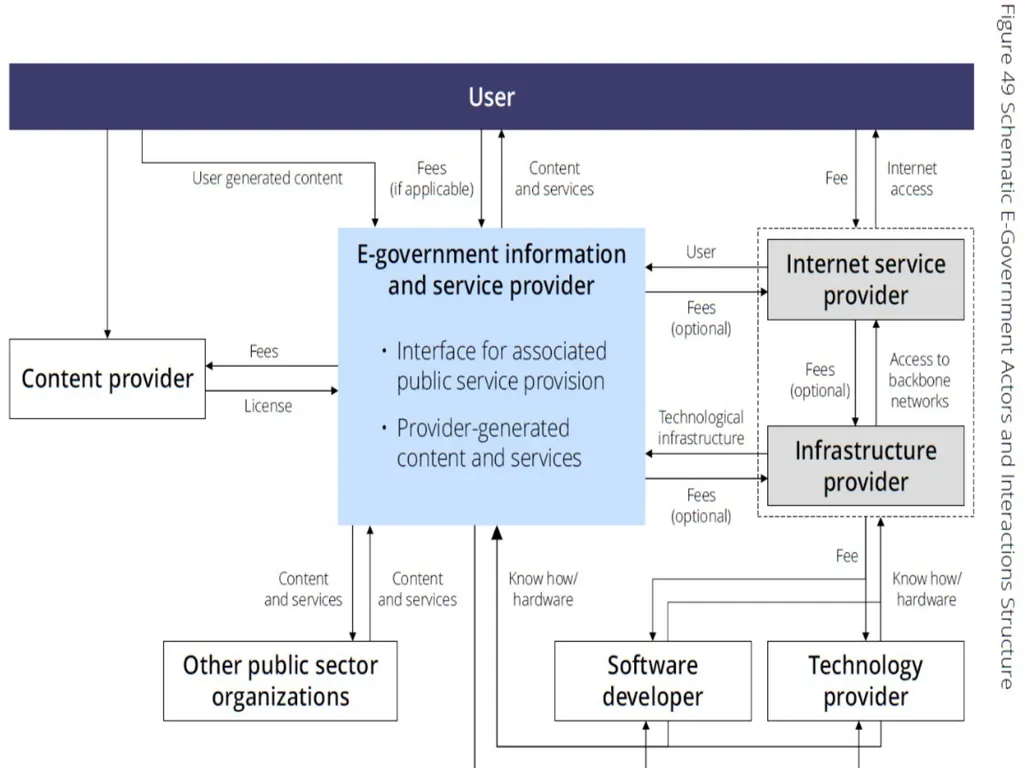
In the following, a schematic e-government actors and interactions structure is presented (see Figure 49) to better illustrate potential relationships that need to be established and managed.
The Internet service provider maintains the system between the user and the Internet, supplying the technological prerequisites for accessing the e-government platform.
This access may take place via stationary or mobile devices.
The Internet service provider works closely with the infrastructure providers, who connect the various Internet service providers with fast backbone networks across different countries and continents. 25<br>
In the following, a schematic e-government actors and interactions structure is presented (see Figure 49) to better illustrate potential relationships that need to be established and managed.
The Internet service provider maintains the system between the user and the Internet, supplying the technological prerequisites for accessing the e-government platform.
This access may take place via stationary or mobile devices.
The Internet service provider works closely with the infrastructure providers, who connect the various Internet service providers with fast backbone networks across different countries and continents. 25<br>
26
6.2 Actors and Interaction Patterns of E-Government The e-government information and service provider develops, designs, and manages the e-government portal as well as the associated content and service offering.
While service transactions are still mainly executed under their own direction, content creation is partly outsourced to content providers.
In addition, other public sector organizations regularly take an expert role and provide content concerning e-government transactions within their scope of functions.
Moreover, user generated content plays an increasingly important role. 26<br>
While service transactions are still mainly executed under their own direction, content creation is partly outsourced to content providers.
In addition, other public sector organizations regularly take an expert role and provide content concerning e-government transactions within their scope of functions.
Moreover, user generated content plays an increasingly important role. 26<br>
27
6.2 Actors and Interaction Patterns of E-Government In combination, Internet service providers as well as infrastructure providers offer e-government service providers to host their system and/or the technological infrastructure for digital information and service provision.
Usually depending on their size, the e-government service provider either possesses the necessary knowhow internally or buys it on the market from external technology providers or software developers and programmers. 27<br>
Usually depending on their size, the e-government service provider either possesses the necessary knowhow internally or buys it on the market from external technology providers or software developers and programmers. 27<br>
28
6.2 Actors and Interaction Patterns of E-Government Another essential aspect is the e-government service provider’s focus on the user since increasing user acceptance leads to a wider dissemination of the services provided.
This in turn, leads to a release of public administration because services that have previously been provided face-to-face are then processed automatically. Figure 49 illustrates a schematic structure of e-government actors and interactions.
Having defined the relevant e-government actors, interaction patterns, and interaction structure leads to determining the information and service offering. 28<br>
This in turn, leads to a release of public administration because services that have previously been provided face-to-face are then processed automatically. Figure 49 illustrates a schematic structure of e-government actors and interactions.
Having defined the relevant e-government actors, interaction patterns, and interaction structure leads to determining the information and service offering. 28<br>
29
29<br>
30
6.3 Government-to-Citizen Services (G2C) E-government services have become an important part of public service provision.
For this reason, this topic is a frequently discussed subject within science as well as public management and administration.
Against this background, there exists a large number of scientific publications that study e-government services.
These studies either investigate a particular service, look at a specific service cluster, or analyze e-government service provision in general.
Since a comprehensive overview of e-government services that also provides a systematic taxonomy for this field could not be found, it is developed in the following. 30<br>
For this reason, this topic is a frequently discussed subject within science as well as public management and administration.
Against this background, there exists a large number of scientific publications that study e-government services.
These studies either investigate a particular service, look at a specific service cluster, or analyze e-government service provision in general.
Since a comprehensive overview of e-government services that also provides a systematic taxonomy for this field could not be found, it is developed in the following. 30<br>
31
6.3 Government-to-Citizen Services (G2C) To derive an exemplary set of available e-government services, the investigation was conducted by means of the peer-reviewed scientific literature since this source represents state-of-the-art research. 31<br>
32
6.3 Government-to-Citizen Services (G2C) considering the historical development of e-government services, e-government service diversity has grown significantly in recent years.
This growth was accompanied by an increase in e-government service complexity, which also suggests a classification of service offers. 32<br>
This growth was accompanied by an increase in e-government service complexity, which also suggests a classification of service offers. 32<br>
33
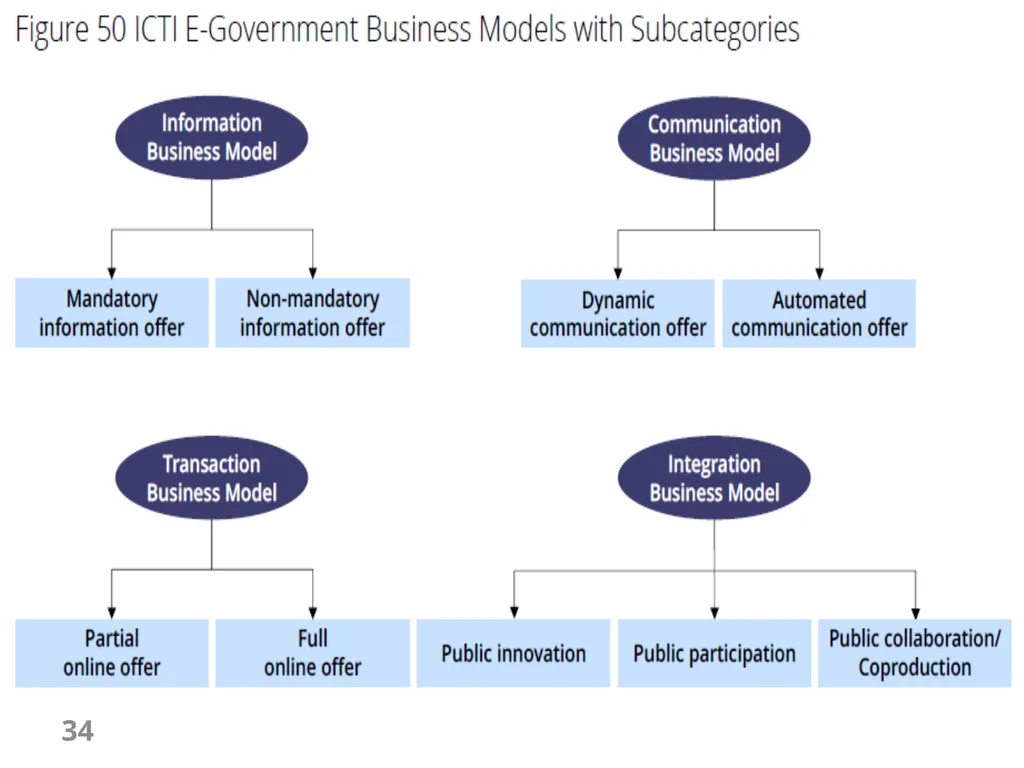
6.3 Government-to-Citizen Services (G2C) Since a business model represents an abstracted, simplified system behind an organization’s service offer and service provision, the ICTI E-Government Business Model is used for service classification and clustering.
This approach carries an additional advantage: The ICTI E-Government Business Model also serves as management instrument, which allows to directly link e-government services with the e-government business model management. 33<br>
This approach carries an additional advantage: The ICTI E-Government Business Model also serves as management instrument, which allows to directly link e-government services with the e-government business model management. 33<br>
34
34<br>
35
6.3 Government-to-Citizen Services (G2C) In the following, the e-government services that were identified in the scientific literature are presented according to their affiliation with the respective e-government business model. 35<br>
36
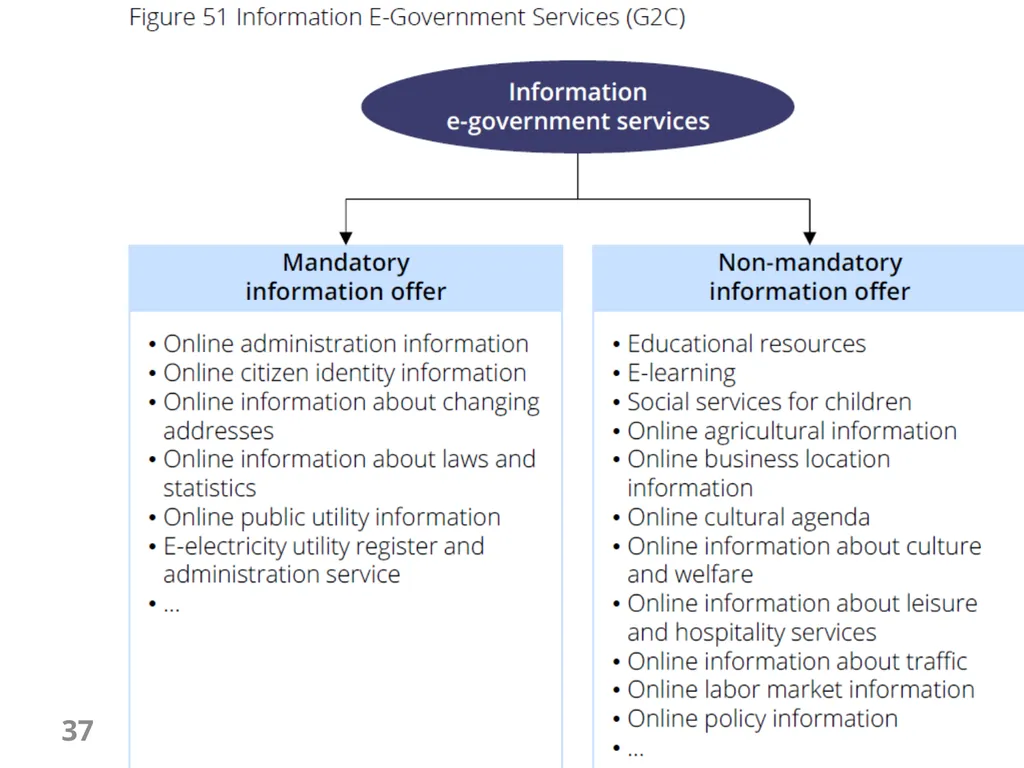
6.3 Government-to-Citizen Services (G2C) Information-related e-government service offers can be divided into mandatory information offers and non-mandatory information offers.
Mandatory information offers refer to information that needs to be supplied to public stakeholders in connection with services that have to be provided in accordance with laws or regulations.
Examples are online administration information, online citizen identity information, and online information about laws and statistics.
Non-mandatory information offers describe information services that are neither required by law nor associated with any obligatory government service.
Thus, nonmandatory information offers refer to services such as educational resources, online business location information, online cultural agenda, and online information about culture and welfare. 36<br>
Mandatory information offers refer to information that needs to be supplied to public stakeholders in connection with services that have to be provided in accordance with laws or regulations.
Examples are online administration information, online citizen identity information, and online information about laws and statistics.
Non-mandatory information offers describe information services that are neither required by law nor associated with any obligatory government service.
Thus, nonmandatory information offers refer to services such as educational resources, online business location information, online cultural agenda, and online information about culture and welfare. 36<br>
37
37<br>
38
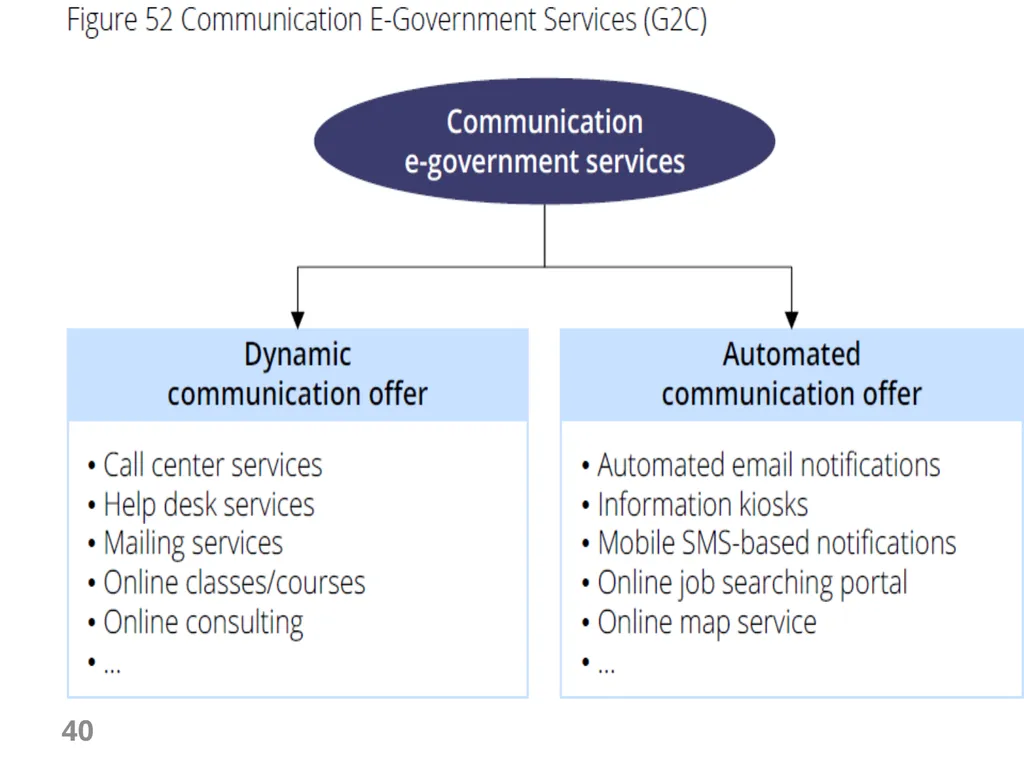
6.3 Government-to-Citizen Services (G2C) The target of communication e-government services is the provision of online services that serve as communication possibilities for government-to-user interaction.
These are made up of two subcategories: interactive communication offers and automated communication offers. Interactive communication services, such as call center services, help desk services, mailing services, online courses, or online consulting, require a two-way flow of information.
The information exchange takes place between two active participants that have an impact on each other, and thus these communication services are of dynamic nature. 38<br>
These are made up of two subcategories: interactive communication offers and automated communication offers. Interactive communication services, such as call center services, help desk services, mailing services, online courses, or online consulting, require a two-way flow of information.
The information exchange takes place between two active participants that have an impact on each other, and thus these communication services are of dynamic nature. 38<br>
39
6.3 Government-to-Citizen Services (G2C) Automated communication services may show a one-way or two-way flow of information, but at least one participant of the communication is a machine or computer that exchanges information based on predefined algorithms.
This means that automated communication takes place human-to-computer or computer-tocomputer. E-government service examples of automated communication services are automated email notifications, information kiosks, mobile SMS-based notifications, online job searching portal, and online map service. 39<br>
This means that automated communication takes place human-to-computer or computer-tocomputer. E-government service examples of automated communication services are automated email notifications, information kiosks, mobile SMS-based notifications, online job searching portal, and online map service. 39<br>
40
40<br>
41
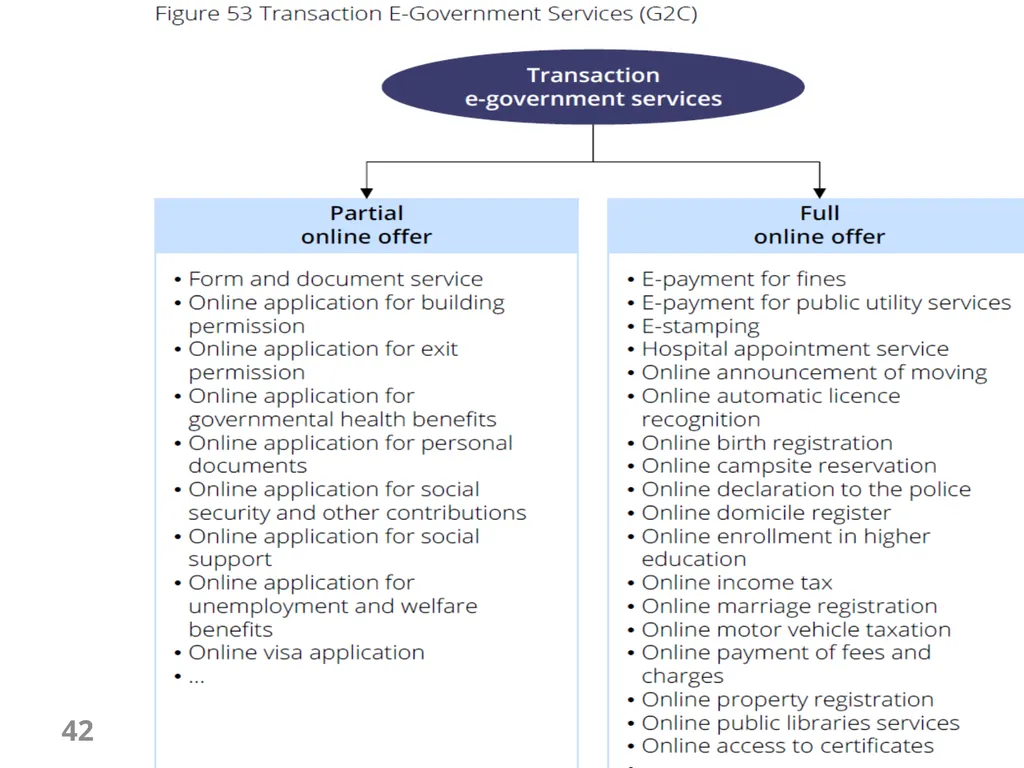
6.3 Government-to-Citizen Services (G2C) Transaction e-government services serve to initiate, handle, and process administrative procedures online.
Their service offering can either be partial or full.
Partial online offers refer to services that cannot be completed without at least one further media break.
Examples of partial transaction e-government services are form and document service, online application for welfare benefits, and online visa application. 41<br>
Their service offering can either be partial or full.
Partial online offers refer to services that cannot be completed without at least one further media break.
Examples of partial transaction e-government services are form and document service, online application for welfare benefits, and online visa application. 41<br>
42
42<br>
43
6.3 Government-to-Citizen Services (G2C) In contrast, full online offers, such as e-payment for public utility services, online automatic number plate recognition, online enrollment in higher education, and online public libraries services, allow to initiate, process, and complete an administrative procedure entirely online.
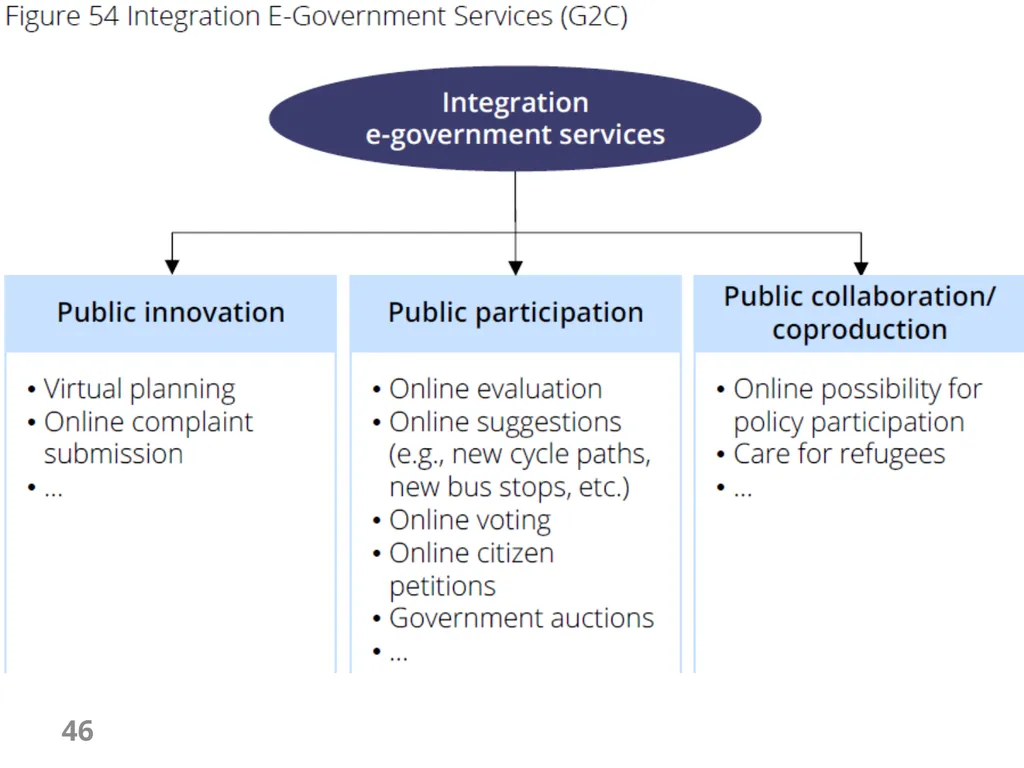
Integration e-government services serve to integrate users into the value chain of the public sector organization via participative, collaborative, or cooperative action.
These services can be divided into the following subcategories: public innovation, public participation, as well as public collaboration and coproduction. 43<br>
Integration e-government services serve to integrate users into the value chain of the public sector organization via participative, collaborative, or cooperative action.
These services can be divided into the following subcategories: public innovation, public participation, as well as public collaboration and coproduction. 43<br>
44
6.3 Government-to-Citizen Services (G2C) Public innovation e-government services enable the user to become part of the governmental or public sector innovation process.
Examples are virtual planning and online complaint submission services.
This way, external groups and individuals can engage in the public sector innovation process. 44<br>
Examples are virtual planning and online complaint submission services.
This way, external groups and individuals can engage in the public sector innovation process. 44<br>
45
6.3 Government-to-Citizen Services (G2C) Public participation e-government services enable users to indirectly shape public decisions and policy-making by calling attention to their preferences through user feedback, opinion polls, online petitions, etc.
Typical public participation e-government services are online suggestion systems for new cycle paths or new bus stops, government auctions.
While public participation e-government services allow indirect exertion of influence, public collaboration and coproduction e-government services directly involve the user into public decisions and policy-making by giving the user a proactive role in the respective process. 45<br>
Typical public participation e-government services are online suggestion systems for new cycle paths or new bus stops, government auctions.
While public participation e-government services allow indirect exertion of influence, public collaboration and coproduction e-government services directly involve the user into public decisions and policy-making by giving the user a proactive role in the respective process. 45<br>
46
46<br>
47
6.4 Government-to-Business Services (G2B) Although government-to-citizen and government-to-business e-government services appear similar at first glance, there are significant differences embedded in these two service streams.
These differences can be broken down into explicit and tacit dissimilarities. 47<br>
These differences can be broken down into explicit and tacit dissimilarities. 47<br>
48
6.4 Government-to-Business Services (G2B) Explicit dissimilarities are e-government services that de facto can only be used by either citizens or businesses.
Examples of services that only apply to individuals are online birth registration, online marriage registration, or election services.
Since companies do not marriage and do not possess the right to vote, these e-government services are not relevant for business entities.
Tacit dissimilarities refer to differences in content and trait of the e-government services provided as well as distinct characteristics of the service recipients. 48<br>
Examples of services that only apply to individuals are online birth registration, online marriage registration, or election services.
Since companies do not marriage and do not possess the right to vote, these e-government services are not relevant for business entities.
Tacit dissimilarities refer to differences in content and trait of the e-government services provided as well as distinct characteristics of the service recipients. 48<br>
49
6.4 Government-to-Business Services (G2B) Business organizations represent a considerably lower number of service recipients and rather follow a rational cost-benefit approach.
Moreover, their efficiency oriented actions are usually based on collective, formalized decision-making.
Against the background of the explicit and tacit dissimilarities between government-to citizen and government-to-business e-government service provision, the e-government service provider always has to ensure to cover both perspectives.
السلايد الأخير 49<br>
Moreover, their efficiency oriented actions are usually based on collective, formalized decision-making.
Against the background of the explicit and tacit dissimilarities between government-to citizen and government-to-business e-government service provision, the e-government service provider always has to ensure to cover both perspectives.
السلايد الأخير 49<br>
50
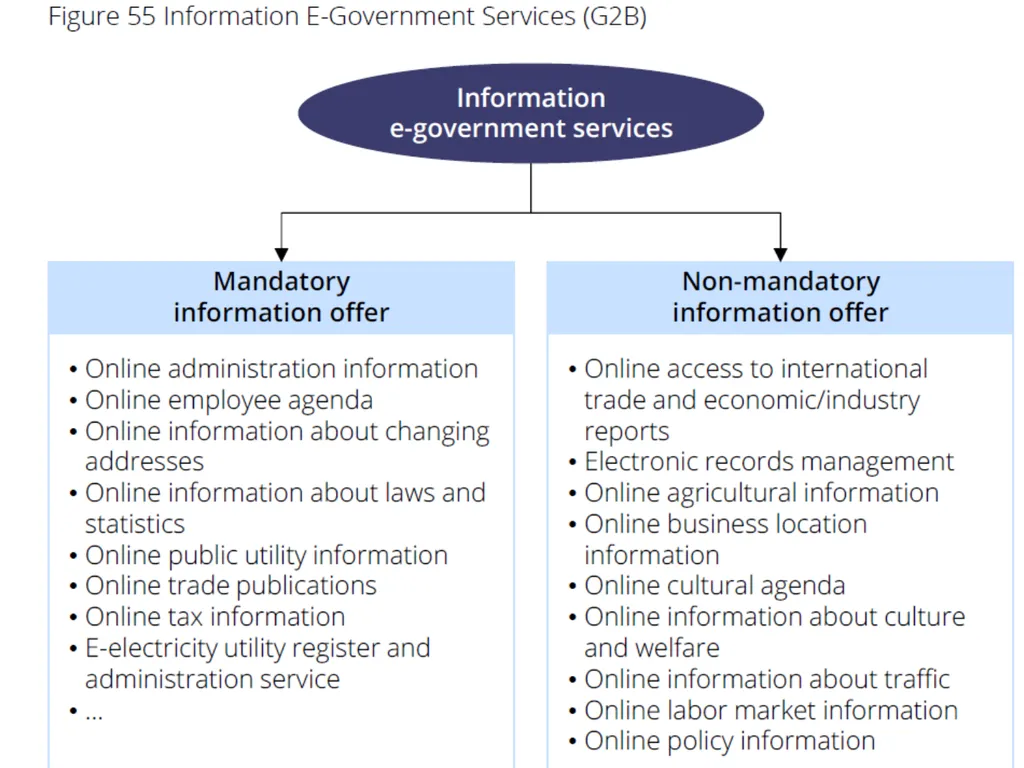
Similarly to the government-to-citizen setting, information-related e-government service offers are broken down into mandatory information offers and non-mandatory information offers.
Although many services have the same denomination and show similar functionalities like in government-to-citizen service provision, the presentation and the content of the information has to be specified to the needs and requirements of business users.
Figure 55 shows typical information e-government services in a government-to-business setting. 50<br>
Although many services have the same denomination and show similar functionalities like in government-to-citizen service provision, the presentation and the content of the information has to be specified to the needs and requirements of business users.
Figure 55 shows typical information e-government services in a government-to-business setting. 50<br>
51
51<br>
52
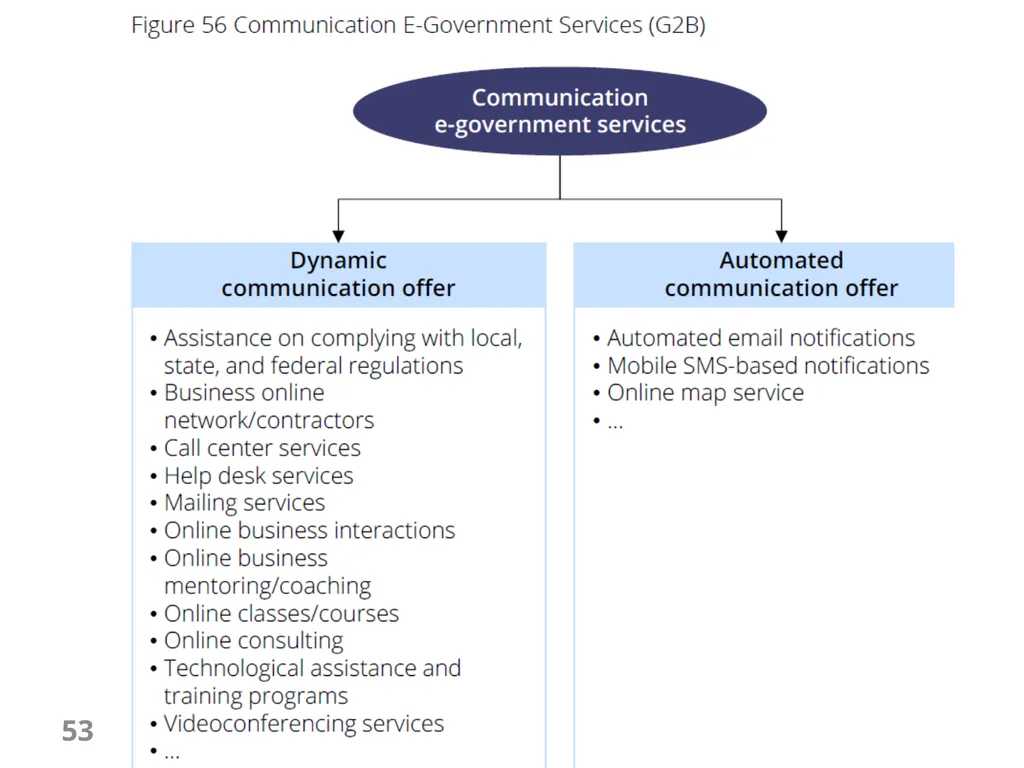
Concerning communication e-government services, which refer to the provision of online services that serve as communication possibilities for government-to-user interaction, greater differences between the service offerings of the two target groups can be seen.
In the e-government service subcategory dynamic communication offer, for example, particular business services, such as assistance on complying with local, state, and federal regulations, business online network/contractors, and videoconferencing services, are provided. 52<br>
In the e-government service subcategory dynamic communication offer, for example, particular business services, such as assistance on complying with local, state, and federal regulations, business online network/contractors, and videoconferencing services, are provided. 52<br>
53
53<br>
54
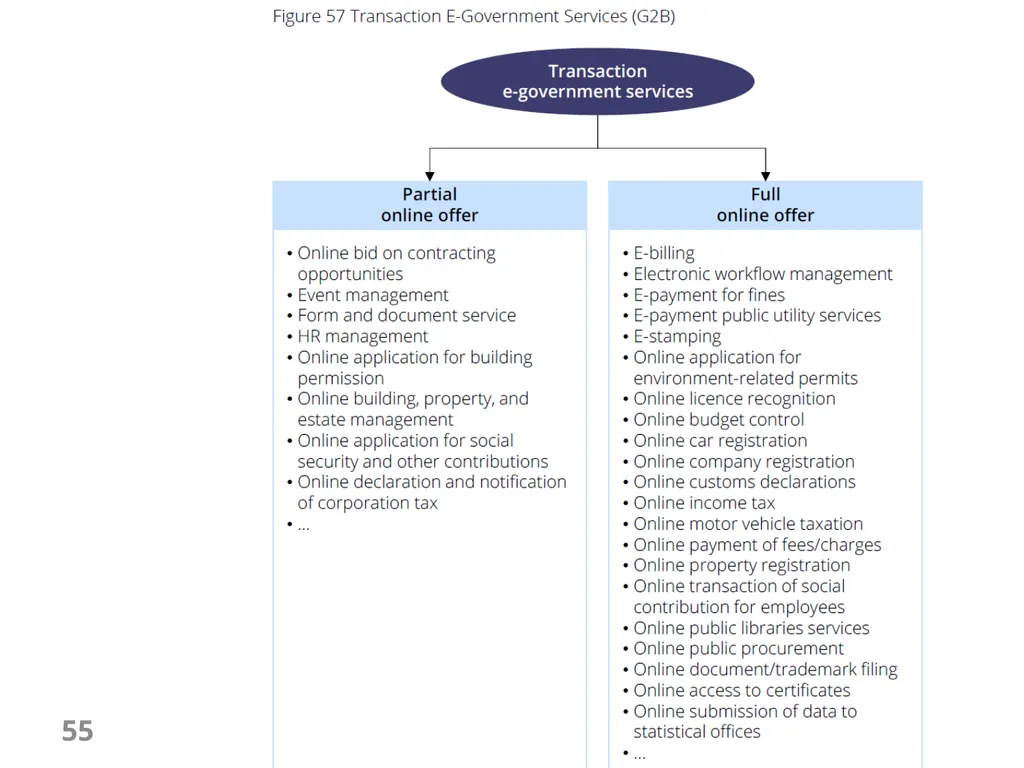
When comparing transaction e-government services of a government-to-citizen and a government-to-business setting, which serve to initiate, handle, and process administrative procedures online, several different services can be identified. In the case of partial online offers, examples of typical transaction e-government services in a government-to-business setting are event management, HR management, as well as online declaration and notification of corporation tax services.
The same holds true for full online offers. Here, e-billing, electronic workflow management, online transaction of social contribution for employees, online public procurement, online document and trademark filing, online submission of data to statistical offices are examples of e-government services that particularly fit the needs of business users. 54<br>
The same holds true for full online offers. Here, e-billing, electronic workflow management, online transaction of social contribution for employees, online public procurement, online document and trademark filing, online submission of data to statistical offices are examples of e-government services that particularly fit the needs of business users. 54<br>
55
55<br>
56
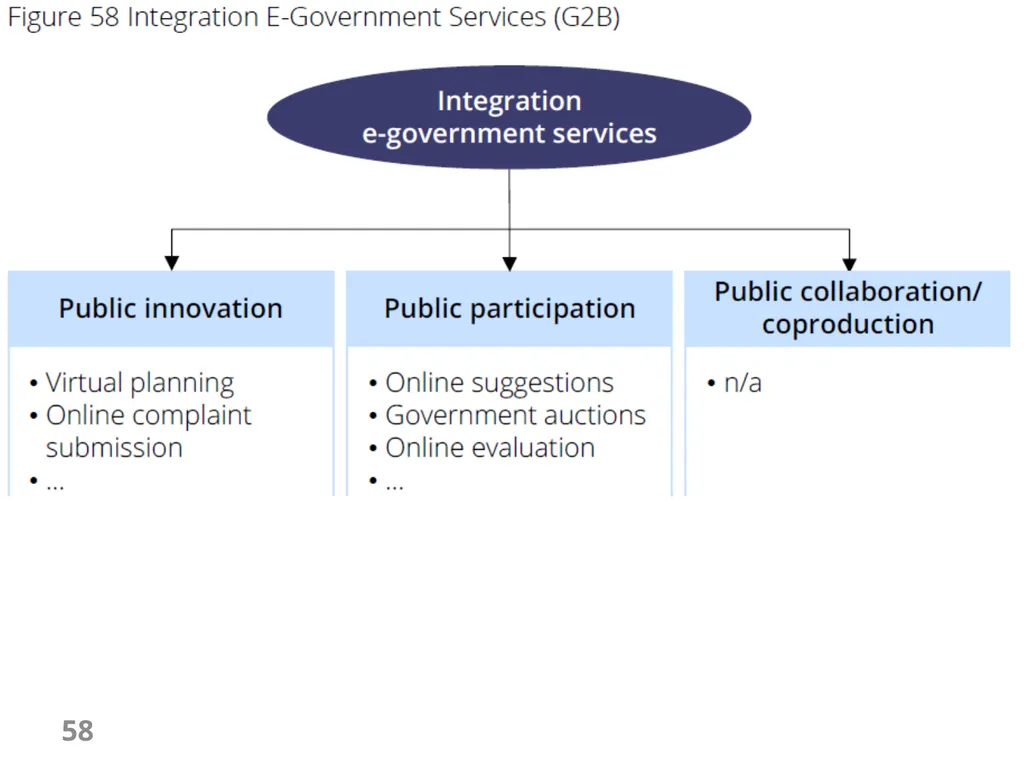
Integration e-government services integrate users into the value chain of the public sector organization via participative, collaborative, or cooperative action.
Sticking to the ICTI E-Government Business Model methodology, these services can be divided into the subcategories public innovation, public participation, as well as public collaboration and coproduction.
For public innovation services, no particular differences regarding e-government services (e.g., virtual planning and online complaint submission) could be identified between the government-to-citizen and the government-to-business e-government service offering.
In the public participation service category, the government-to business setting shows less e-government service offers since daily life services, online voting, or online petitions are pure citizen services. 56<br>
Sticking to the ICTI E-Government Business Model methodology, these services can be divided into the subcategories public innovation, public participation, as well as public collaboration and coproduction.
For public innovation services, no particular differences regarding e-government services (e.g., virtual planning and online complaint submission) could be identified between the government-to-citizen and the government-to-business e-government service offering.
In the public participation service category, the government-to business setting shows less e-government service offers since daily life services, online voting, or online petitions are pure citizen services. 56<br>
57
Concerning the findings of the literature review, which was conducted to identify the set of e-government services that serves as a basis for this e-government service overview, no government-to-business service could be identified that fits the public collaboration and coproduction service subcategory.
Summing up, the high number of already available e-government services, ranging from information to integration purposes, demonstrates that e-government has come a long way since the first digital public information provision.
Moreover, this shows that e-government service provision has become an important instrument of public governance and administration. 57<br>
Summing up, the high number of already available e-government services, ranging from information to integration purposes, demonstrates that e-government has come a long way since the first digital public information provision.
Moreover, this shows that e-government service provision has become an important instrument of public governance and administration. 57<br>
58
58<br>
59
This impression is underlined by the variety of e-government maturity models, which indirectly confirm the progress achieved and the high current state from a technology as well as a service provision view by generally showing high development levels in the final stage of the models.
From an e-government management perspective, e-government service provision needs a clear focus on the target groups that ought to be covered by the e-government portal.
When selecting actors and interaction patterns citizens, private sector organizations, and public sector organizations have to be taken into account. 59<br>
From an e-government management perspective, e-government service provision needs a clear focus on the target groups that ought to be covered by the e-government portal.
When selecting actors and interaction patterns citizens, private sector organizations, and public sector organizations have to be taken into account. 59<br>
60
Although the e-government service offering can conceptually be built straightaway on the ICT E-Government Business Model and its respective service subcategories, the dissimilarities of a government-to-citizen and a government-to-business setting have to be kept in mind when designing, developing, and maintaining the e-government portal.
Apart from that, it has to be mentioned that the service overview—despite the extensive underlying literature review—cannot claim to be exhaustive.
Even if it could, it would not reflect the services of top-notch e-government portals anymore by the time of publication since information and communication technology is advancing and the digitalization of public sector organizations is increasing. 60<br>
Apart from that, it has to be mentioned that the service overview—despite the extensive underlying literature review—cannot claim to be exhaustive.
Even if it could, it would not reflect the services of top-notch e-government portals anymore by the time of publication since information and communication technology is advancing and the digitalization of public sector organizations is increasing. 60<br>
61
However, the overview should provide acceptable insights into e-government service provision.
Especially, the systematic allocation of e-government services to the ICTI E-Government Business Models seems useful for managing online public service offers and provides a clear-cut approach to e-government service supervision. 61<br>
Especially, the systematic allocation of e-government services to the ICTI E-Government Business Models seems useful for managing online public service offers and provides a clear-cut approach to e-government service supervision. 61<br>