E-learning platform choice for higher learning institutions during the lockdown in Tanzania: The role of NREN Dr. Goodiel C. Moshi, The University of Dodoma, Tanzania 1 Table of content Introduction Research Questions Literature Review
"E-learning platform choice for higher learning" is the property of its rightful owner. Permission is granted to
download and print the materials on this website for personal, non-commercial use only, and to display it
on your personal computer provided you do not modify the materials and that you retain all copyright
notices contained in the materials. By downloading content from our website, you accept the terms of this
agreement.
Presentation Transcript
01
E-learning platform choice for higher learning institutions during the lockdown in Tanzania: The role of NREN Dr. Goodiel C. Moshi, The University of Dodoma, Tanzania 1<br>
02
Table of content Introduction
Research Questions
Literature Review
Methodology
Results
Conclusion 2<br>
03
1. Introduction Unlike any time in the recent history, the world has experienced a record disruption of human social economic activities during the COVID19 pandemic.
Among the key issues during the pandemic is choice of the e-learning platform to be used. In the current technology space, there is a plethora of e-learning platforms to be used.
Among factors that influence technology choice is the presence of affordances such as those provided by National Research and Education Networks (NREN)designed to ensure that research and education institutions share resources. 3<br>
04
2. Research Questions First, what online learning/teaching platforms were used during the lockdown;
Second, what factors determined institutional choice of online learning/teaching platform; and what challenging.
Third, how did institutions take advantage of TERNET infrastructure and services used to increase resilience of research and education network members in Tanzania during the lockdown and pandemic. 4<br>
05
3. Literature review Appolloni et al. (2021) and Mishra et al. (2020) indicated that online teaching and learning platforms could enhance continuance of learning for higher learning students, thus resilience of these institutions in Italy and India respectively.
Mtebe et al. (2021) has shown the process the University of Dar es Salaam went through to evoke and operationalize technology enhanced teaching during the pandemic.
However, most studies have only generally discussed on platforms used but not inquire the reason behind such decisions. Further, less is known about the role of National Research and Education Network (NREN) role in enhancing education delivery resilience during pandemic. 5<br>
06
4. Methodology The study adopted qualitative methodology, where data was collected through in-depth interviews and documentary survey.
Interviews were done for Directors/Managers of ICT or individuals leading the online interventions in five Universities in Tanzania namely:
The University of Dodoma,
Mbeya University of Science and Technology (MUST),
Institute of Rural Development Planning (IRDP),
Stefano Moshi Memorial University College
University of Dar es Salaam
Tanzania Education and Research Network (TERNET) 6<br>
07
5 Findings I: Leading platforms
It was found that the following platforms were leading in terms of deployment or usage during the pandemic:
Moodle
Zoom
Google Classroom
Others include: edumoodle, blackboard, etc Moodle and Zoom were the mostly used platforms. 7<br>
08
5. Findings continue… II: Reasons for using the platform chosen
For Moodle
Most instructors were already familiar with the system
It is free to deploy, customize and use
Allow interaction with students especially quizzes.
Zoom
The platform was efficient in using bandwidth thus could be operational even with users with constrained bandwidth.
The cost per account was subsidized by 72 percent thus, though was a paid solution, it was highly discounted.
Convenience due to the ability to setup meetings without requirement of additional audiovisual equipment other than computer/laptop or smart phone. 8<br>
09
5. Findings continue… III: Challenges
Upsurge in use of storage infrastructure demand due to video uploads in Moodle servers. Some higher learning institutions opted to host their online learning/teaching platform into abroad servers.
Difficulties for students to access online content due to poor network or cost of paying for connectivity.
For majority of instructors, the shift to online content delivery was not a well accepted concept, even instructors in information technology faculties.
Lack of skilled personnel for preparation and packaging of digital content for online delivery.
Lack of policy and procedures for online delivery of learning content as most curricula were designed for face-to-face delivery with no provisions for online delivery. 9<br>
10
NREN activities and role played
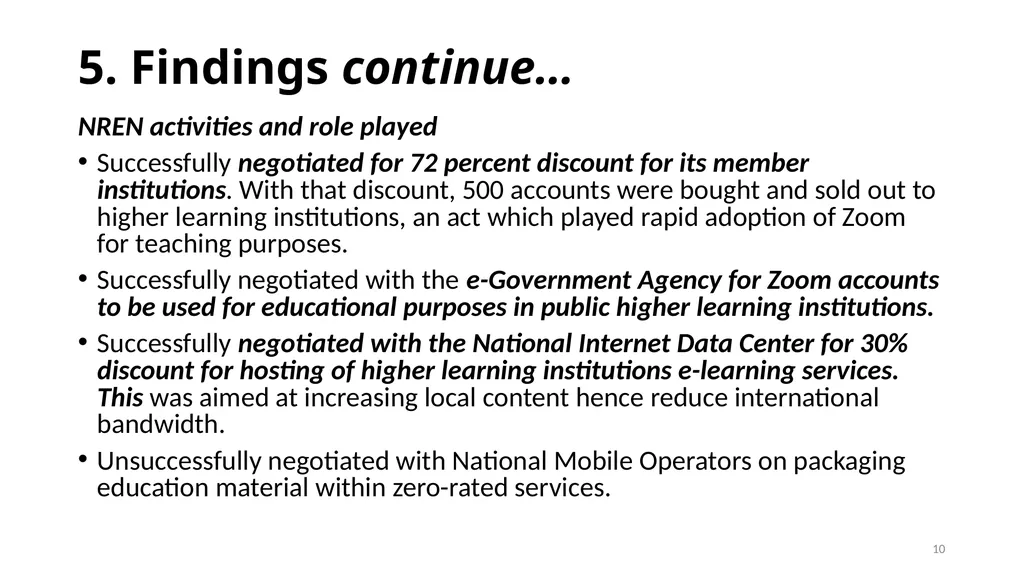
Successfully negotiated for 72 percent discount for its member institutions. With that discount, 500 accounts were bought and sold out to higher learning institutions, an act which played rapid adoption of Zoom for teaching purposes.
Successfully negotiated with the e-Government Agency for Zoom accounts to be used for educational purposes in public higher learning institutions.
Successfully negotiated with the National Internet Data Center for 30% discount for hosting of higher learning institutions e-learning services. This was aimed at increasing local content hence reduce international bandwidth.
Unsuccessfully negotiated with National Mobile Operators on packaging education material within zero-rated services. 5. Findings continue… 10<br>
11
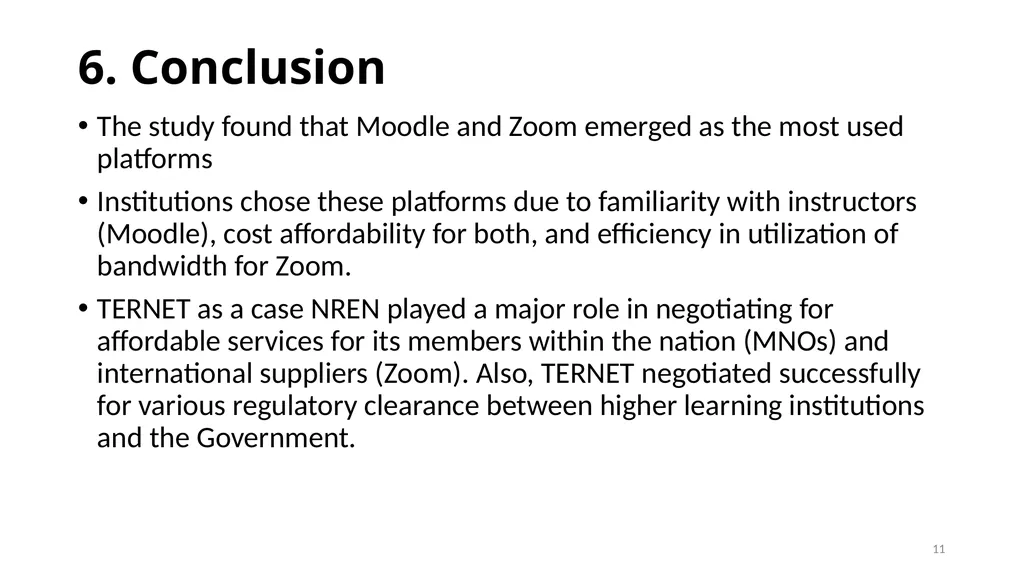
6. Conclusion The study found that Moodle and Zoom emerged as the most used platforms
Institutions chose these platforms due to familiarity with instructors (Moodle), cost affordability for both, and efficiency in utilization of bandwidth for Zoom.
TERNET as a case NREN played a major role in negotiating for affordable services for its members within the nation (MNOs) and international suppliers (Zoom). Also, TERNET negotiated successfully for various regulatory clearance between higher learning institutions and the Government. 11<br>