03
Chapter 14 Objectives, cont. Highlight seven ways in which companies can attract users and move them up the engagement ladder.
Discuss how a company can build, maintain, monitor, and repair its reputation online.
Identify specific metrics used to monitor, measure, and refine earned media activities. 14-3 ©2014 Pearson Education, Inc. publishing as Prentice Hall<br>
04
Dell Starts Listening A blog post about Dell Computer brought a hailstorm of customer service complaints that lasted for nearly 2 years.
The blogger complained that a laptop and its in-home service he purchased from Dell were inadequate.
The complaint followed Dell’s decision to outsource technical customer service to India, a move which also generated many negative comments.
When the complaints didn’t stop, Dell appointed a media manager to deal with internet chatter who initiated blogs in multiple languages to handle complaints and ideas.
The blog IdeaStorm gathered ideas and endorsements that resulted in numerous changes in the company. 14-4 ©2014 Pearson Education, Inc. publishing as Prentice Hall<br>
05
Earned Media Earned media are like physical word-of-mouth on steroids: a social megaphone.
Can be initiated by the company through branded content, news sites, and press releases.
Companies have little to no control over user-generated content (UGC). 14-5 ©2014 Pearson Education, Inc. publishing as Prentice Hall<br>
06
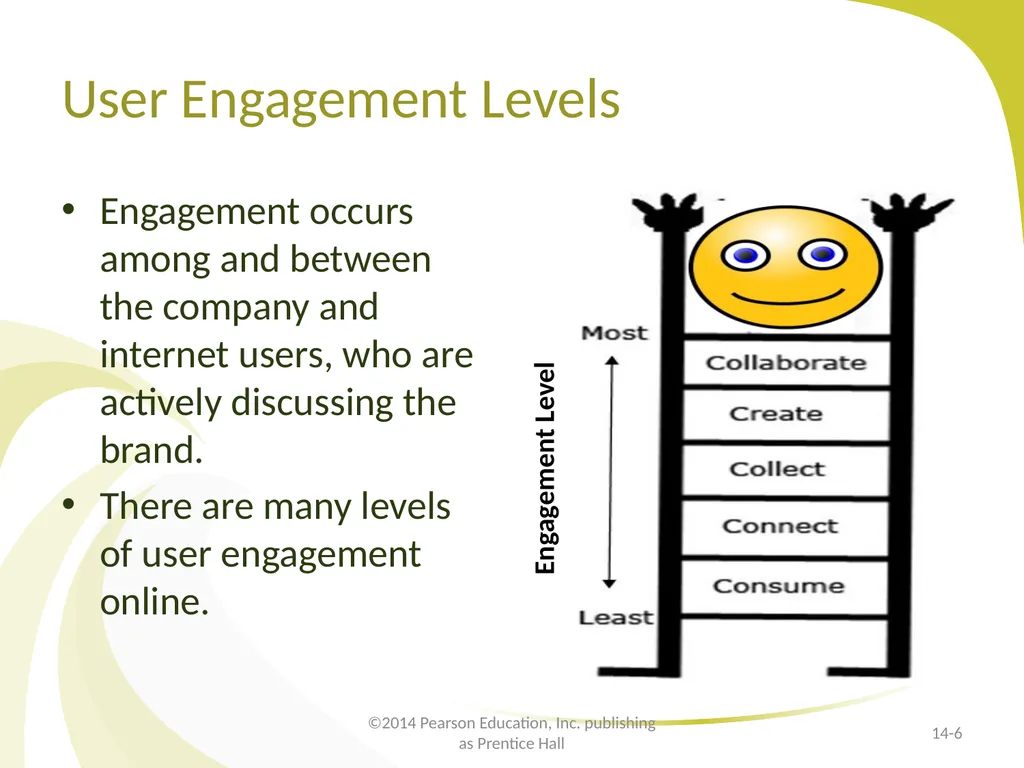
User Engagement Levels Engagement occurs among and between the company and internet users, who are actively discussing the brand.
There are many levels of user engagement online. 14-6 ©2014 Pearson Education, Inc. publishing as Prentice Hall<br>
07
User Engagement Levels, cont. Least engaged users consume only online content.
At the next level, users connect with others by creating a profile on a social network, such as by “friending” on Facebook.
Consumers who collect information filter content and tag what they find valuable in social media sites.
Creators write or upload original content.
The most engaged customers collaborate with the company when they engage in discussions to improve products. 14-7 ©2014 Pearson Education, Inc. publishing as Prentice Hall<br>
08
Social Media Influencers and �Traditional Journalists Companies identify social media influencers by observing and participating in social media discussions.
They can also find influentials by using a service such as Klout.com.
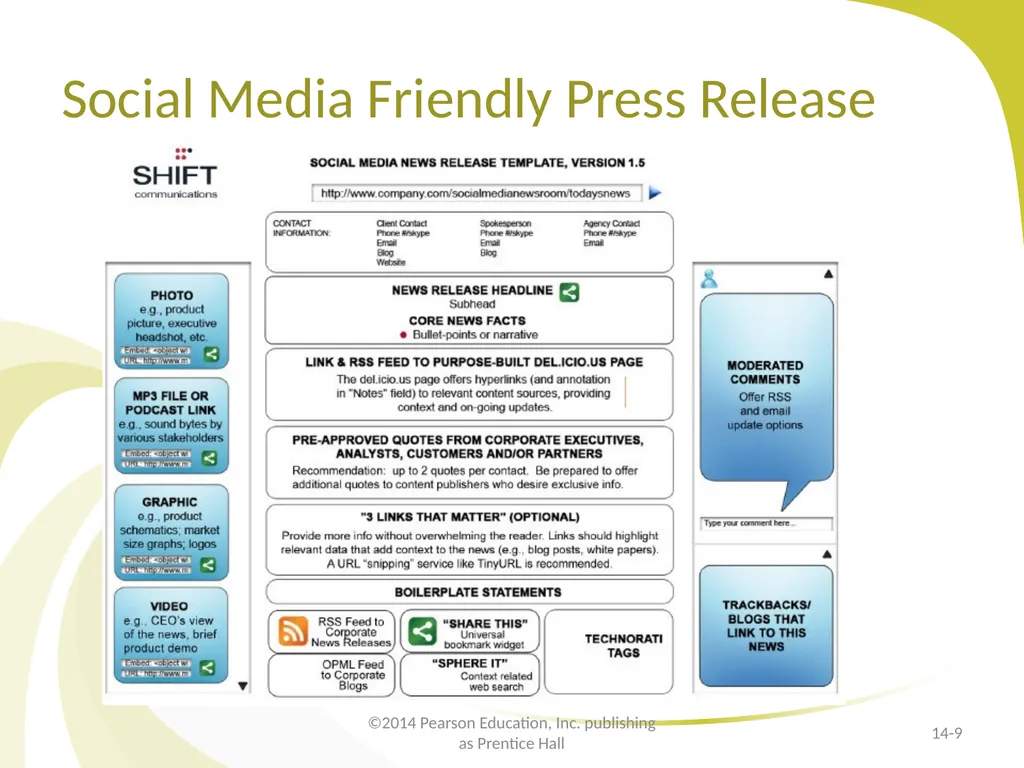
Companies often include press releases about their brands on their Web sites and send them to media firms for publishing. 14-8 ©2014 Pearson Education, Inc. publishing as Prentice Hall<br>
09
Social Media Friendly Press Release 14-9 ©2014 Pearson Education, Inc. publishing as Prentice Hall<br>
10
Techniques for Engaging Users Successful viral marketing programs involve appealing content that has a high chance of spreading.
Few companies can create content that goes viral, although Old Spice is credited with the fastest-growing online viral video campaign.
Viral blogging via Twitter can also be effective. 14-10 ©2014 Pearson Education, Inc. publishing as Prentice Hall<br>
11
Techniques for Engaging Users, cont. Multimedia sharing of photos, art, video, and music can generate online discussion.
Wikis, Web sites that allow users to post, edit, and organize content, as well as online ratings and reviews can also be effective tools for engaging online users. 14-11 ©2014 Pearson Education, Inc. publishing as Prentice Hall<br>
12
Social Recommendations & Referrals Social bookmarking sites allow users to share their favorite Web sites and comments.
StumbleUpon.com
Delicious.com
Referral programs involve rewards for customers who refer new customers.
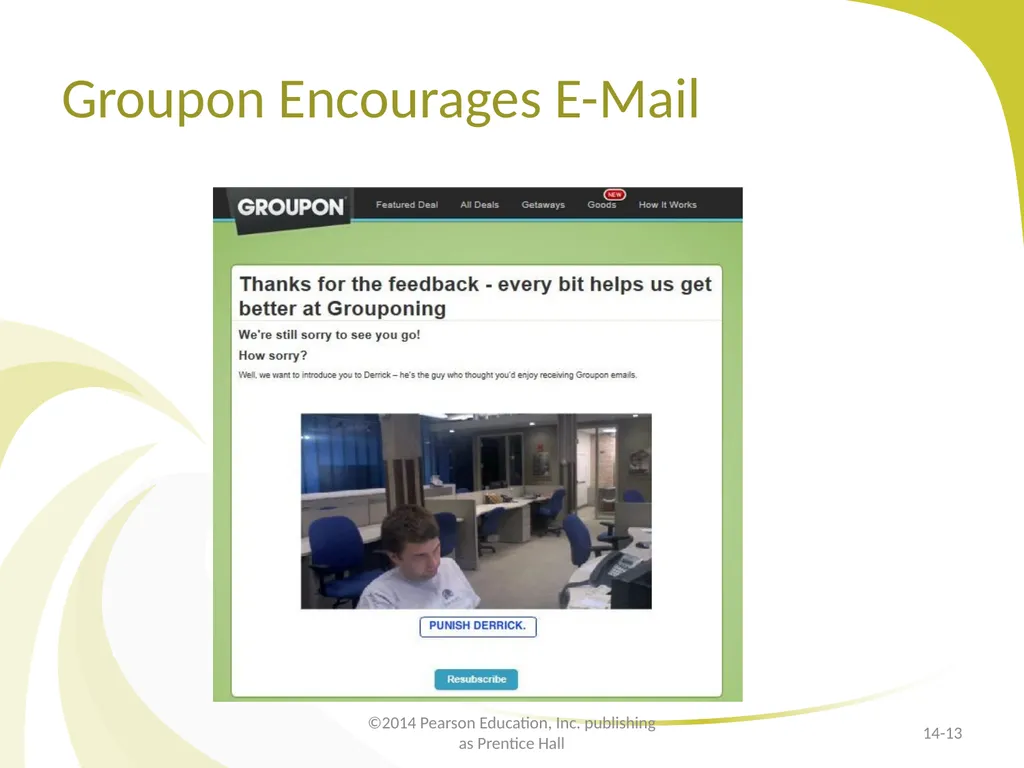
Groupon
Gilt
Marketers can integrate email with social media.
Yahoo!, Gmail and Outlook allow integration with Facebook contacts. 14-12 ©2014 Pearson Education, Inc. publishing as Prentice Hall<br>
13
Groupon Encourages E-Mail 14-13 ©2014 Pearson Education, Inc. publishing as Prentice Hall<br>
14
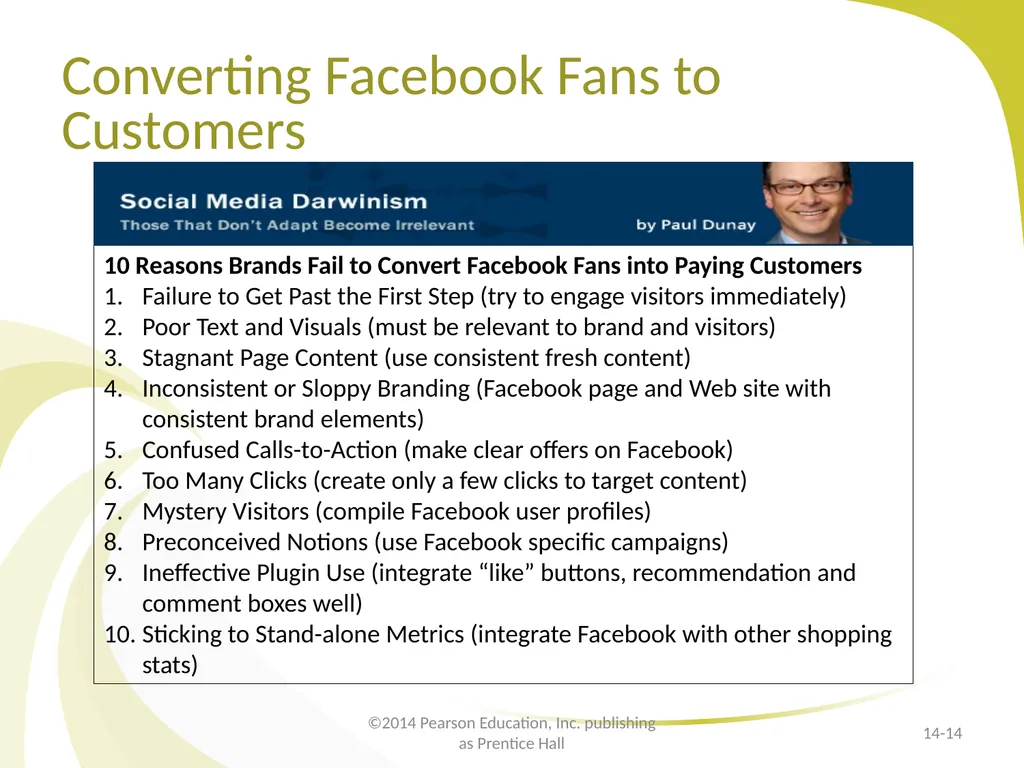
Converting Facebook Fans to Customers 14-14 ©2014 Pearson Education, Inc. publishing as Prentice Hall<br>
15
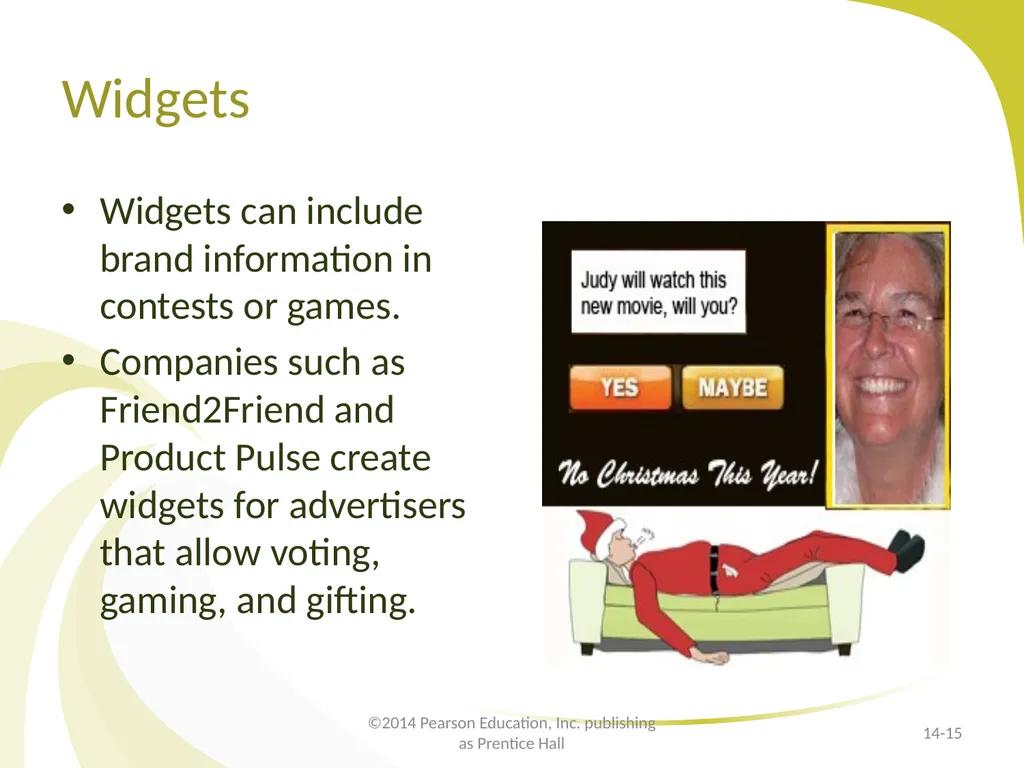
Widgets Widgets can include brand information in contests or games.
Companies such as Friend2Friend and Product Pulse create widgets for advertisers that allow voting, gaming, and gifting. 14-15 ©2014 Pearson Education, Inc. publishing as Prentice Hall<br>
16
Social Apps Facebook features thousands of software apps on its site that engage users.
Facebook messenger allows users to send messages to mobile phones.
Instagram allows users to take photos and share them on Facebook, Twitter, and Tumblr. 14-16 ©2014 Pearson Education, Inc. publishing as Prentice Hall<br>
17
Location-Based Services (LBS) LBS is a business model for m-commerce.
There are several major players.
Foursquare works via a smartphone app on its mobile Web site.
Yelp published 33 million reviews of local businesses in 2012.
Facebook places can add a location to Facebook text-based or photo posts. 14-17 ©2014 Pearson Education, Inc. publishing as Prentice Hall<br>
18
How Do Companies Entice Engagement? Provide high-quality, timely, unique, and relevant information.
Create entertaining content.
Offer competitions.
Appeal to altruism.
Make an exclusive offer.
Reward influentials and fans.
Incentivize group behavior. 14-18 ©2014 Pearson Education, Inc. publishing as Prentice Hall<br>
19
Reputation Management Online With earned media, there are many opportunities for other people to shape the reputations of a company, its brand, and employees.
According to PR firm Weber Shandwick, 63% of a company’s market value is attributable to reputation.
The reputation management process includes 4 steps:
Build
Maintain
Monitor
Repair 14-19 ©2014 Pearson Education, Inc. publishing as Prentice Hall<br>
20
Earned Media Performance Metrics In addition to metrics such as number of likes and shares on company-owned channels, there are a number of metrics that can be applied to earned media.
General earned media metrics: number of users who interact with an application, time spent viewing a video, social media fan growth, etc.
Actions taken by users: Number of downloads of a white paper, ring tones, number of games played, polls voted, etc.
Conversations on blogs and elsewhere: Tweets/retweets, positive/negative comments, etc. 14-20 ©2014 Pearson Education, Inc. publishing as Prentice Hall<br>
21
All rights reserved. No part of this publication may be reproduced, stored in a retrieval system, or transmitted, in any form or by any means, electronic, mechanical, photocopying, recording, or otherwise, without the prior written permission of the publisher. Printed in the United States of America. Copyright © 2014 Pearson Education, Inc.
Publishing as Prentice Hall 14-21<br>