
Early Childhood Integrated Data System Claudia
Description: Early Childhood Integrated Data System Claudia Coulton, Ph.D. Lillian F. Harris Professor Co-Director Center on Urban Poverty and Community Development e-mail: claudia.coultoncase.edu November 2010 Developed for IIC Public-private
Related Topics
Download Presentation
"Early Childhood Integrated Data System Claudia" is the property of its rightful owner. Permission is granted to download and print the materials on this website for personal, non-commercial use only, and to display it on your personal computer provided you do not modify the materials and that you retain all copyright notices contained in the materials. By downloading content from our website, you accept the terms of this agreement.
Presentation Transcript
slide1. Early Childhood Integrated Data System Claudia Coulton, Ph.D.
Lillian F. Harris Professor & Co-Director
Center on Urban Poverty and Community Development
e-mail: claudia.coulton@case.edu November 2010<br>
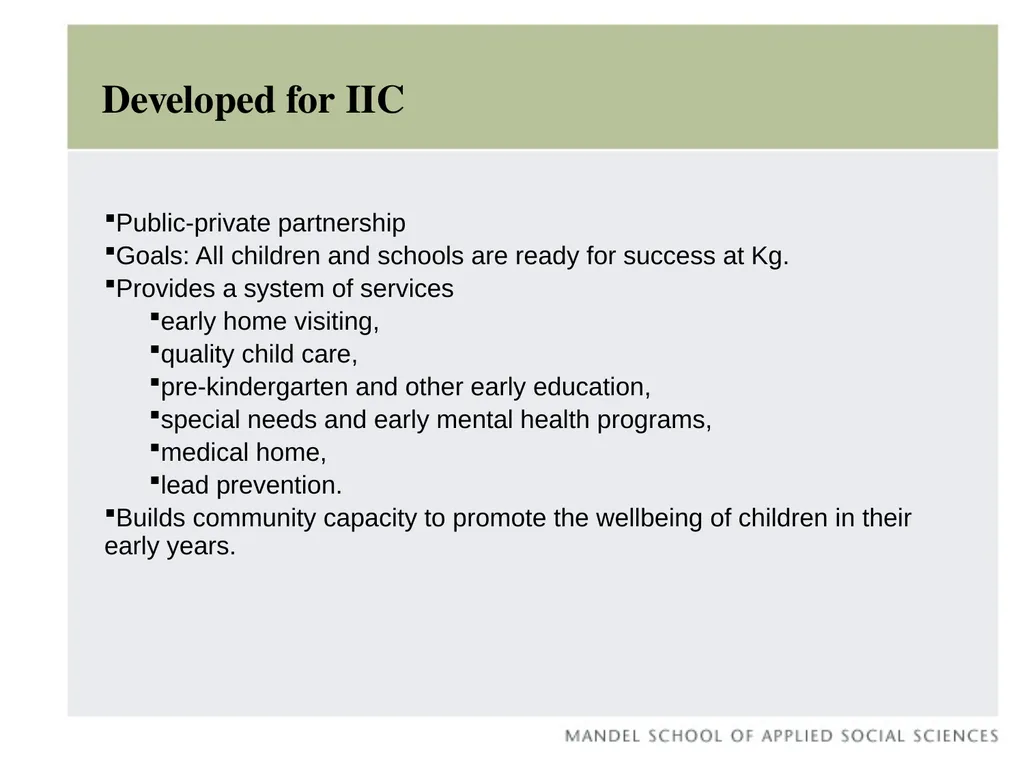
slide2. Developed for IIC Public-private partnership
Goals: All children and schools are ready for success at Kg.
Provides a system of services
early home visiting,
quality child care,
pre-kindergarten and other early education,
special needs and early mental health programs,
medical home,
lead prevention.
Builds community capacity to promote the wellbeing of children in their early years.<br>
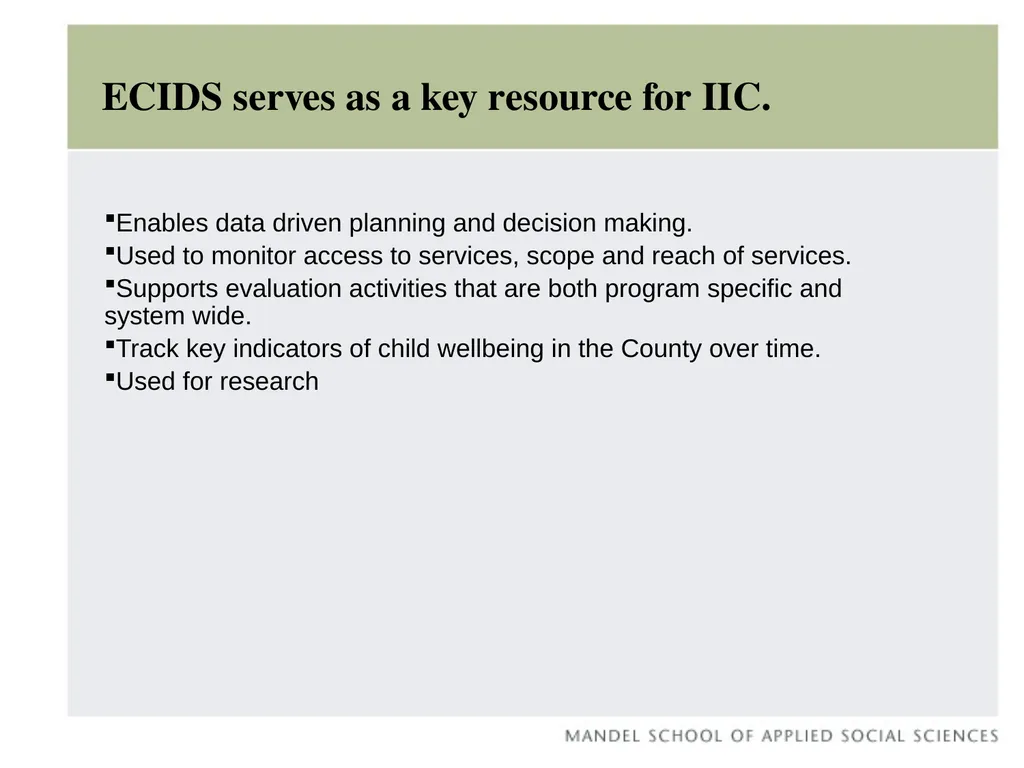
slide3. ECIDS serves as a key resource for IIC. Enables data driven planning and decision making.
Used to monitor access to services, scope and reach of services.
Supports evaluation activities that are both program specific and system wide.
Track key indicators of child wellbeing in the County over time.
Used for research<br>
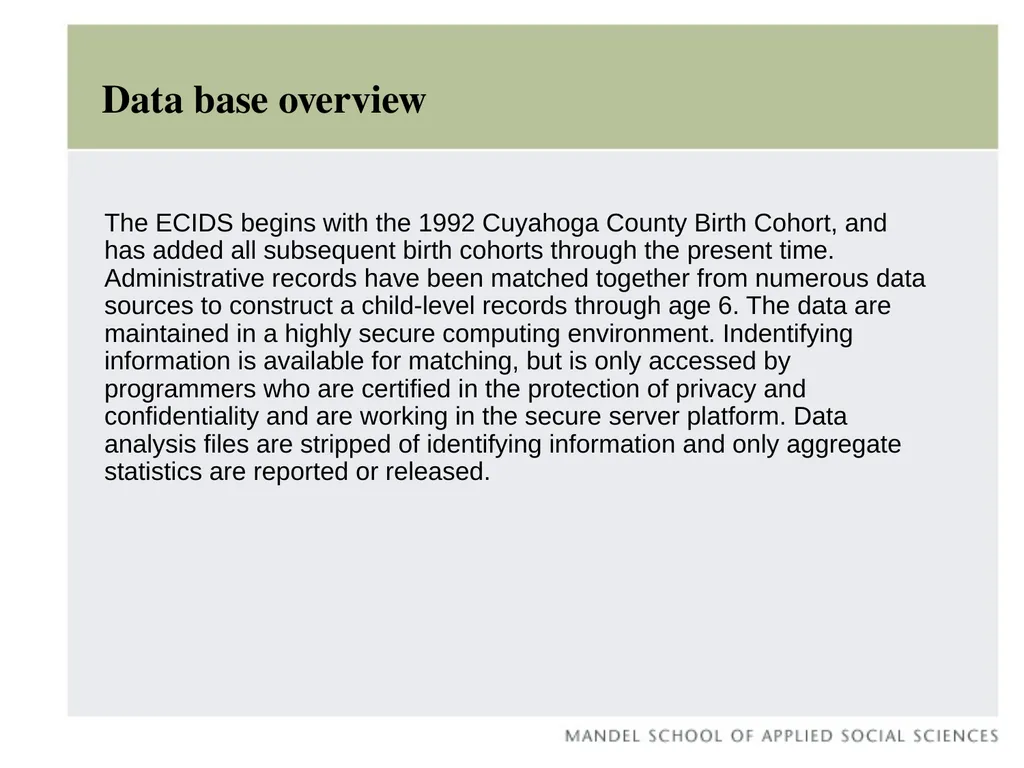
slide4. Data base overview The ECIDS begins with the 1992 Cuyahoga County Birth Cohort, and has added all subsequent birth cohorts through the present time. Administrative records have been matched together from numerous data sources to construct a child-level records through age 6. The data are maintained in a highly secure computing environment. Indentifying information is available for matching, but is only accessed by programmers who are certified in the protection of privacy and confidentiality and are working in the secure server platform. Data analysis files are stripped of identifying information and only aggregate statistics are reported or released.<br>
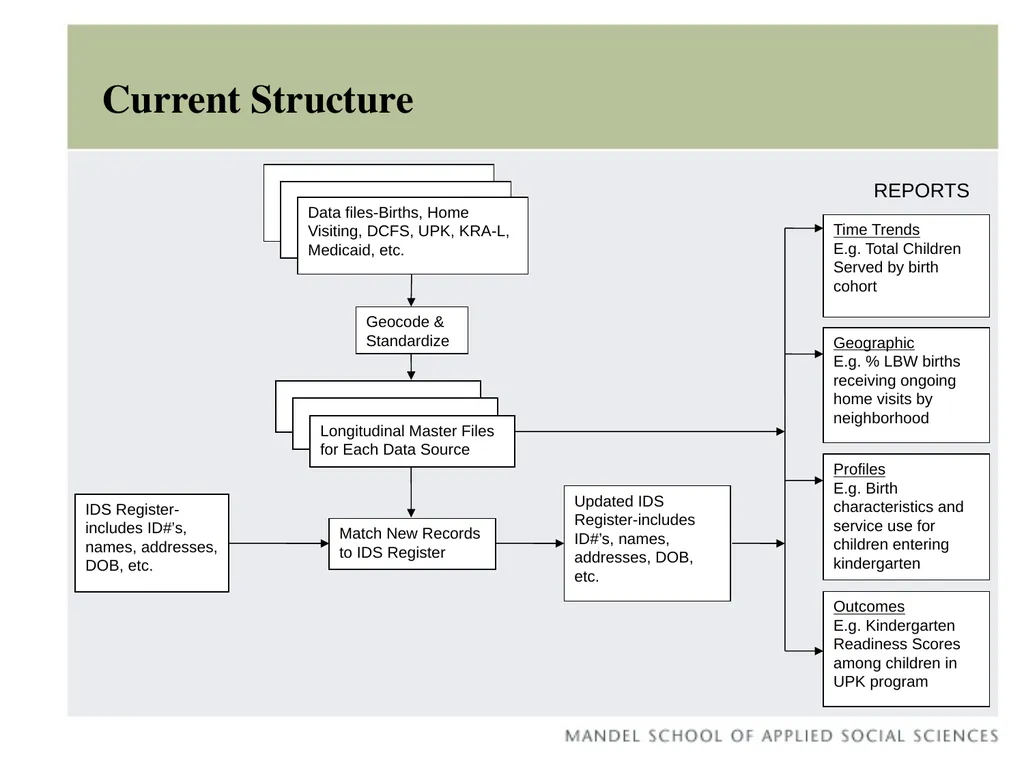
slide5. Current Structure Geocode & Standardize Match New Records to IDS Register Updated IDS Register-includes ID#’s, names, addresses, DOB, etc. IDS Register-includes ID#’s, names, addresses, DOB, etc. Outcomes
E.g. Kindergarten Readiness Scores among children in UPK program Profiles
E.g. Birth characteristics and service use for children entering kindergarten Geographic
E.g. % LBW births receiving ongoing home visits by neighborhood Time Trends
E.g. Total Children Served by birth cohort REPORTS<br>
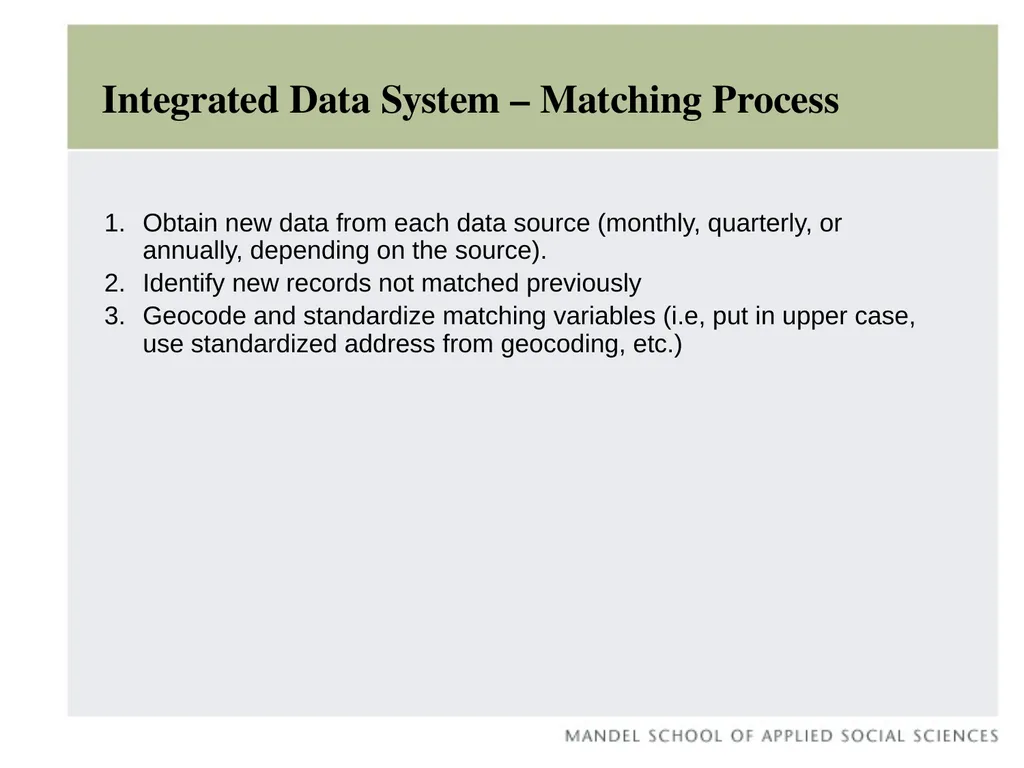
slide6. Integrated Data System – Matching Process Obtain new data from each data source (monthly, quarterly, or annually, depending on the source).
Identify new records not matched previously
Geocode and standardize matching variables (i.e, put in upper case, use standardized address from geocoding, etc.)<br>
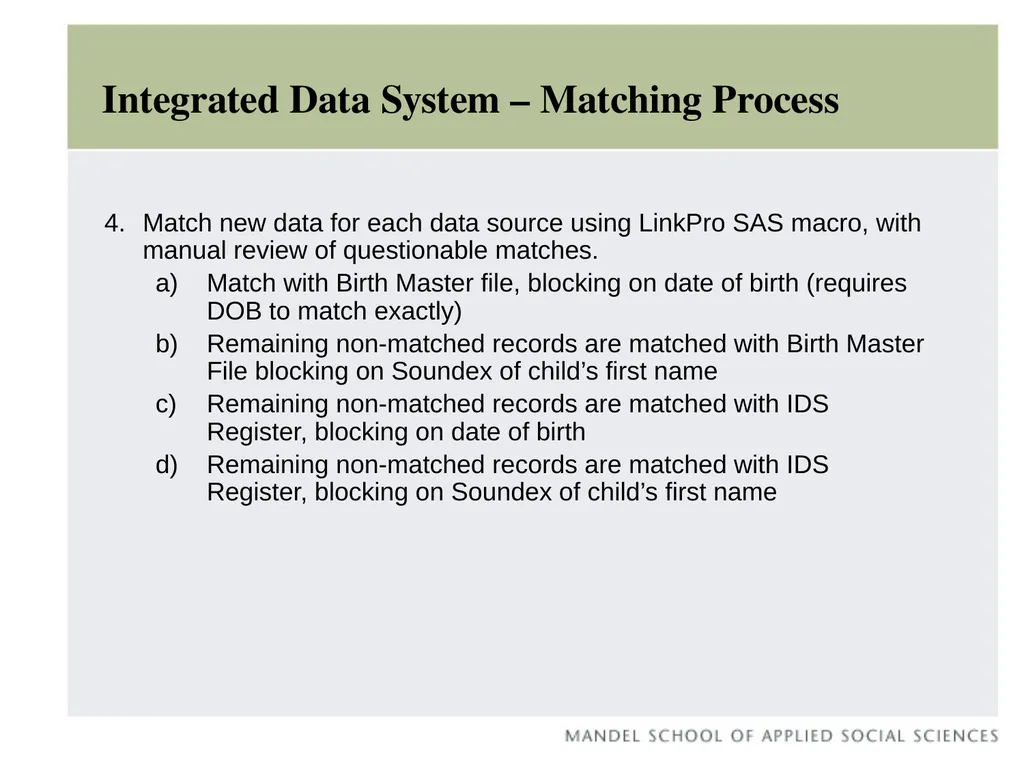
slide7. Integrated Data System – Matching Process Match new data for each data source using LinkPro SAS macro, with manual review of questionable matches.
Match with Birth Master file, blocking on date of birth (requires DOB to match exactly)
Remaining non-matched records are matched with Birth Master File blocking on Soundex of child’s first name
Remaining non-matched records are matched with IDS Register, blocking on date of birth
Remaining non-matched records are matched with IDS Register, blocking on Soundex of child’s first name<br>
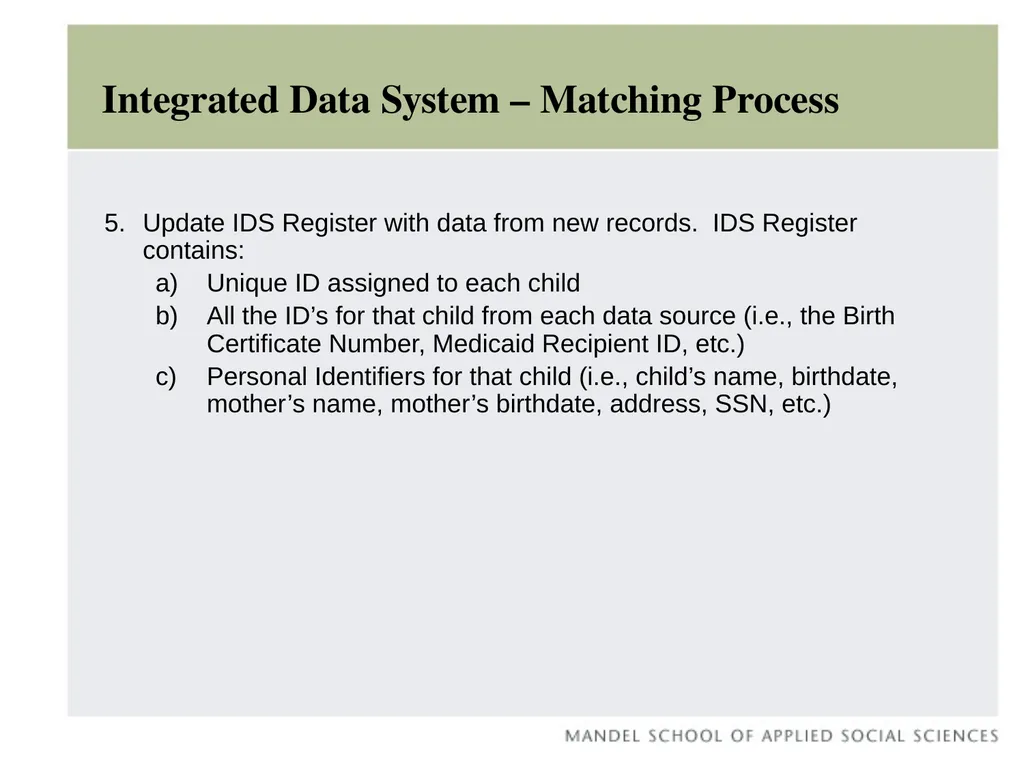
slide8. Integrated Data System – Matching Process Update IDS Register with data from new records. IDS Register contains:
Unique ID assigned to each child
All the ID’s for that child from each data source (i.e., the Birth Certificate Number, Medicaid Recipient ID, etc.)
Personal Identifiers for that child (i.e., child’s name, birthdate, mother’s name, mother’s birthdate, address, SSN, etc.)<br>
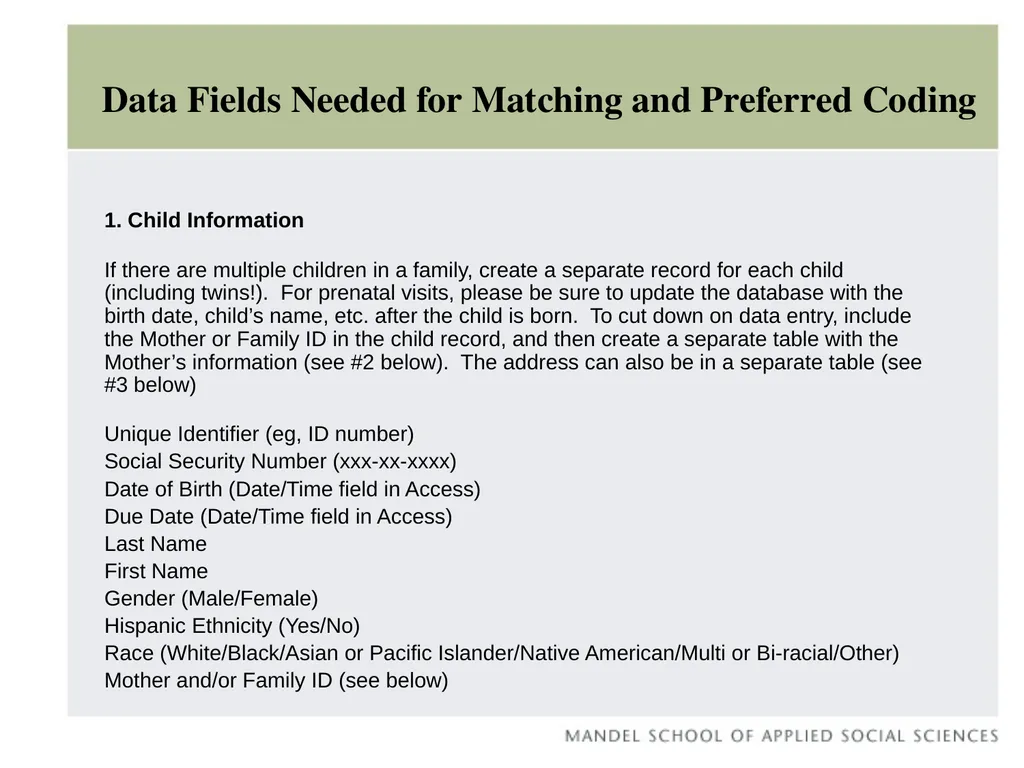
slide9. Data Fields Needed for Matching and Preferred Coding 1. Child Information
If there are multiple children in a family, create a separate record for each child (including twins!). For prenatal visits, please be sure to update the database with the birth date, child’s name, etc. after the child is born. To cut down on data entry, include the Mother or Family ID in the child record, and then create a separate table with the Mother’s information (see #2 below). The address can also be in a separate table (see #3 below)
Unique Identifier (eg, ID number)
Social Security Number (xxx-xx-xxxx)
Date of Birth (Date/Time field in Access)
Due Date (Date/Time field in Access)
Last Name
First Name
Gender (Male/Female)
Hispanic Ethnicity (Yes/No)
Race (White/Black/Asian or Pacific Islander/Native American/Multi or Bi-racial/Other)
Mother and/or Family ID (see below)<br>
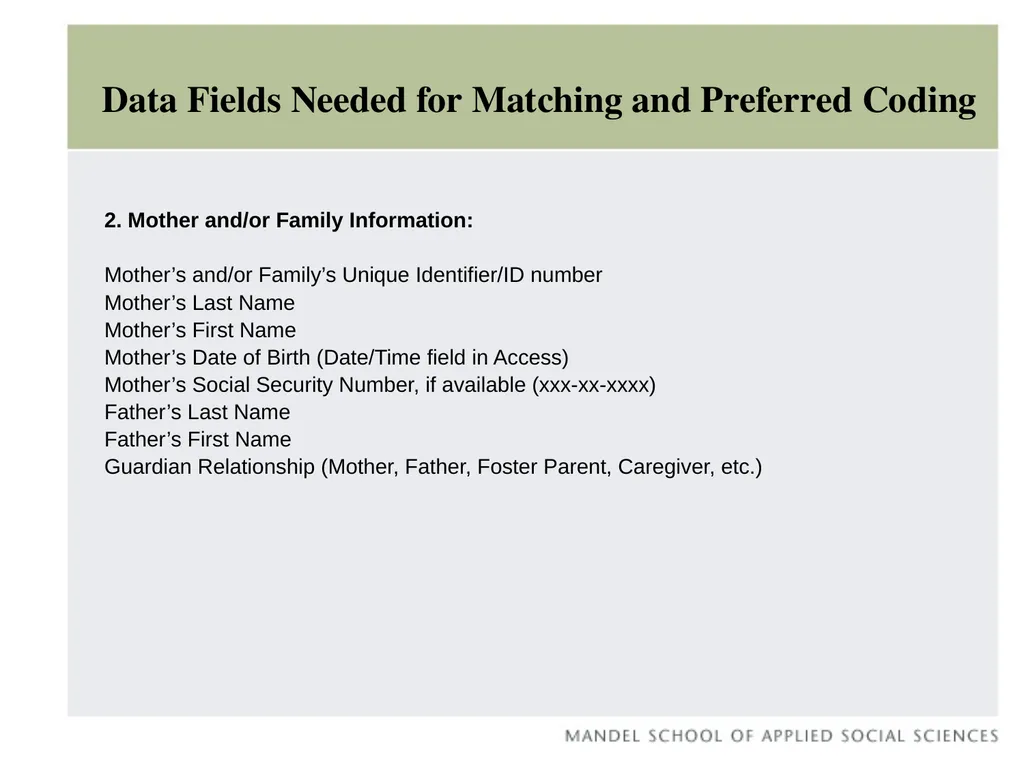
slide10. Data Fields Needed for Matching and Preferred Coding 2. Mother and/or Family Information:
Mother’s and/or Family’s Unique Identifier/ID number
Mother’s Last Name
Mother’s First Name
Mother’s Date of Birth (Date/Time field in Access)
Mother’s Social Security Number, if available (xxx-xx-xxxx)
Father’s Last Name
Father’s First Name
Guardian Relationship (Mother, Father, Foster Parent, Caregiver, etc.)<br>
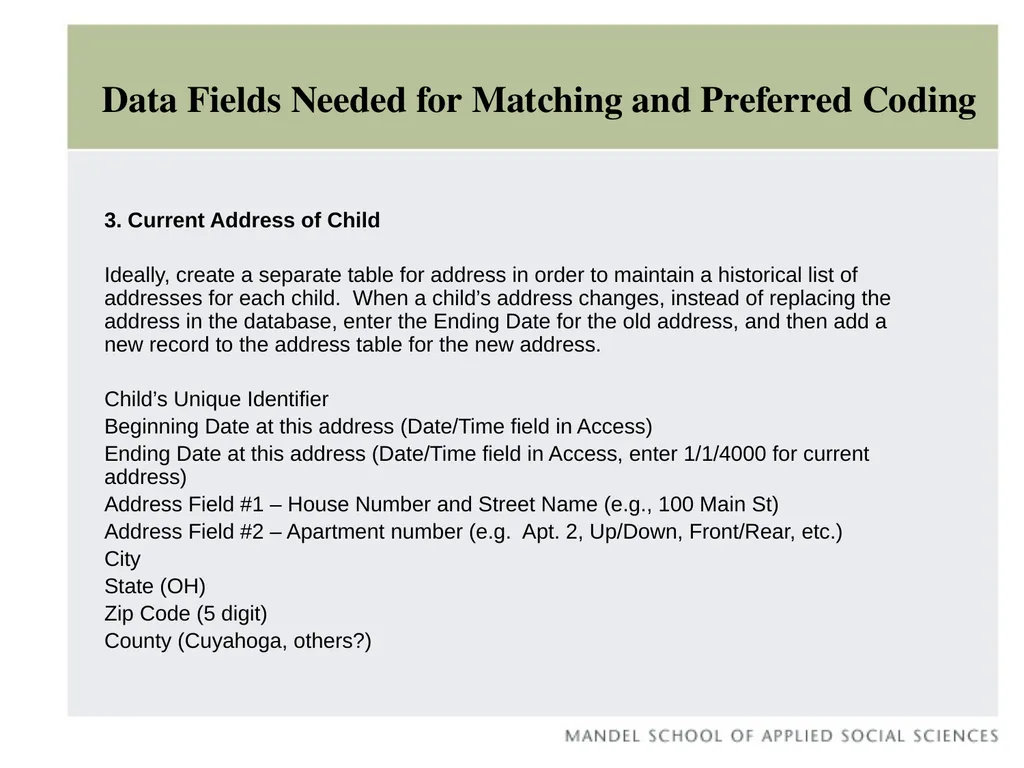
slide11. Data Fields Needed for Matching and Preferred Coding 3. Current Address of Child
Ideally, create a separate table for address in order to maintain a historical list of addresses for each child. When a child’s address changes, instead of replacing the address in the database, enter the Ending Date for the old address, and then add a new record to the address table for the new address.
Child’s Unique Identifier
Beginning Date at this address (Date/Time field in Access)
Ending Date at this address (Date/Time field in Access, enter 1/1/4000 for current address)
Address Field #1 – House Number and Street Name (e.g., 100 Main St)
Address Field #2 – Apartment number (e.g. Apt. 2, Up/Down, Front/Rear, etc.)
City
State (OH)
Zip Code (5 digit)
County (Cuyahoga, others?)<br>
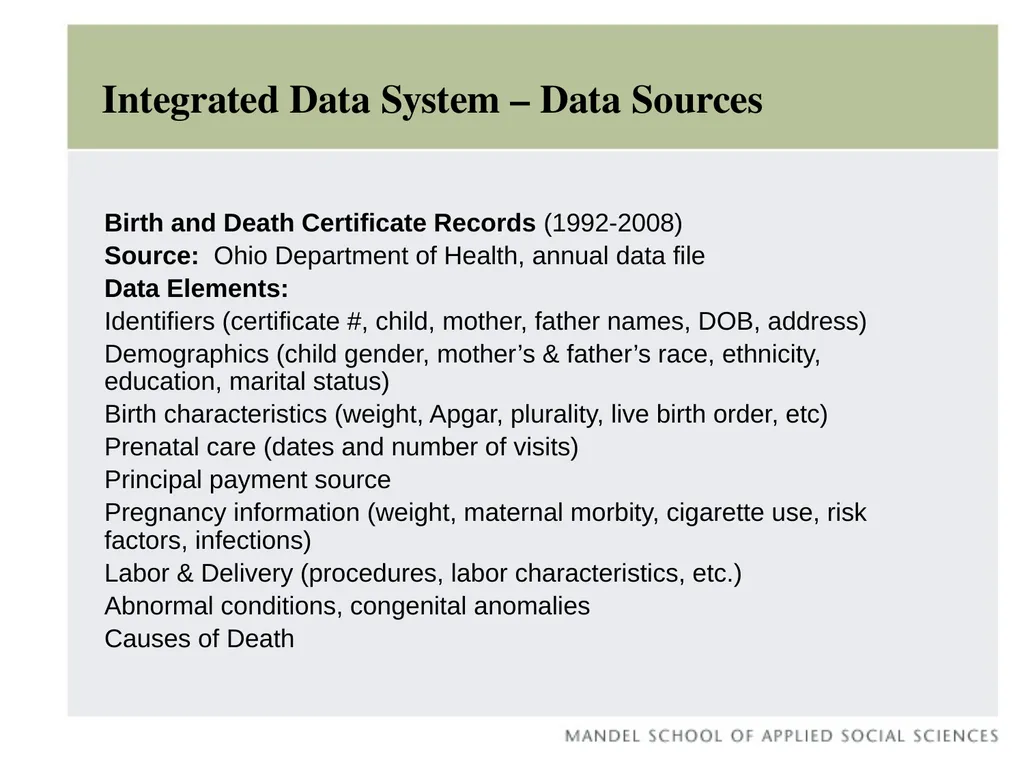
slide12. Integrated Data System – Data Sources Birth and Death Certificate Records (1992-2008)
Source: Ohio Department of Health, annual data file
Data Elements:
Identifiers (certificate #, child, mother, father names, DOB, address)
Demographics (child gender, mother’s & father’s race, ethnicity, education, marital status)
Birth characteristics (weight, Apgar, plurality, live birth order, etc)
Prenatal care (dates and number of visits)
Principal payment source
Pregnancy information (weight, maternal morbity, cigarette use, risk factors, infections)
Labor & Delivery (procedures, labor characteristics, etc.)
Abnormal conditions, congenital anomalies
Causes of Death<br>
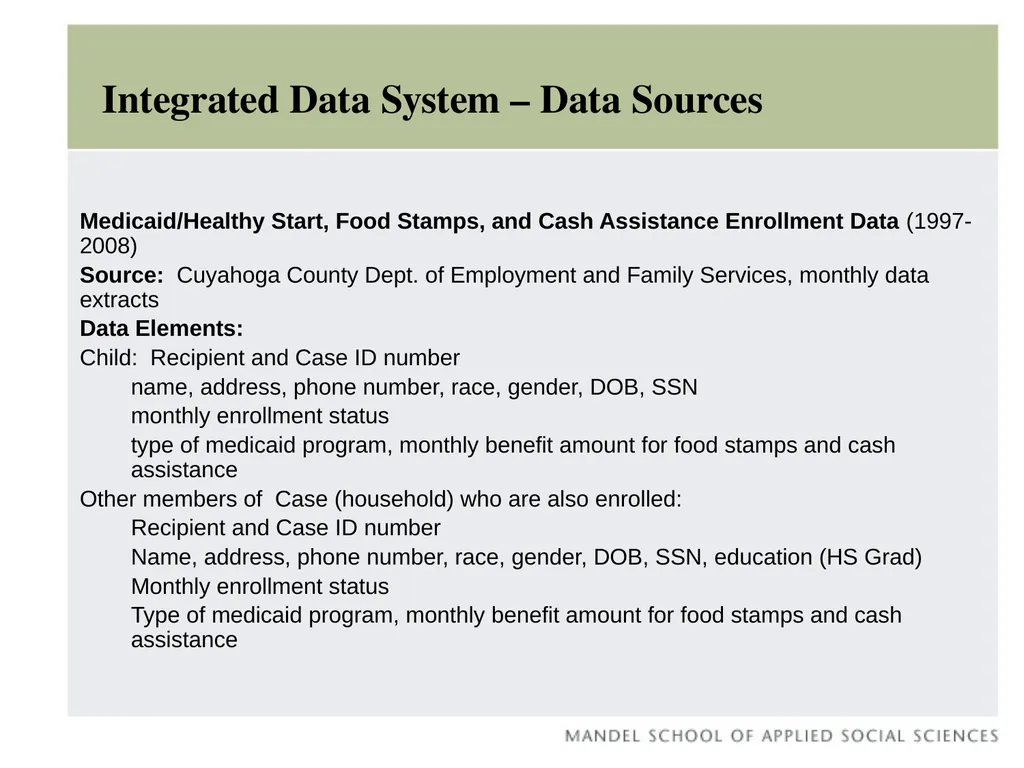
slide13. Integrated Data System – Data Sources Medicaid/Healthy Start, Food Stamps, and Cash Assistance Enrollment Data (1997-2008)
Source: Cuyahoga County Dept. of Employment and Family Services, monthly data extracts
Data Elements:
Child: Recipient and Case ID number
name, address, phone number, race, gender, DOB, SSN
monthly enrollment status
type of medicaid program, monthly benefit amount for food stamps and cash assistance
Other members of Case (household) who are also enrolled:
Recipient and Case ID number
Name, address, phone number, race, gender, DOB, SSN, education (HS Grad)
Monthly enrollment status
Type of medicaid program, monthly benefit amount for food stamps and cash assistance<br>
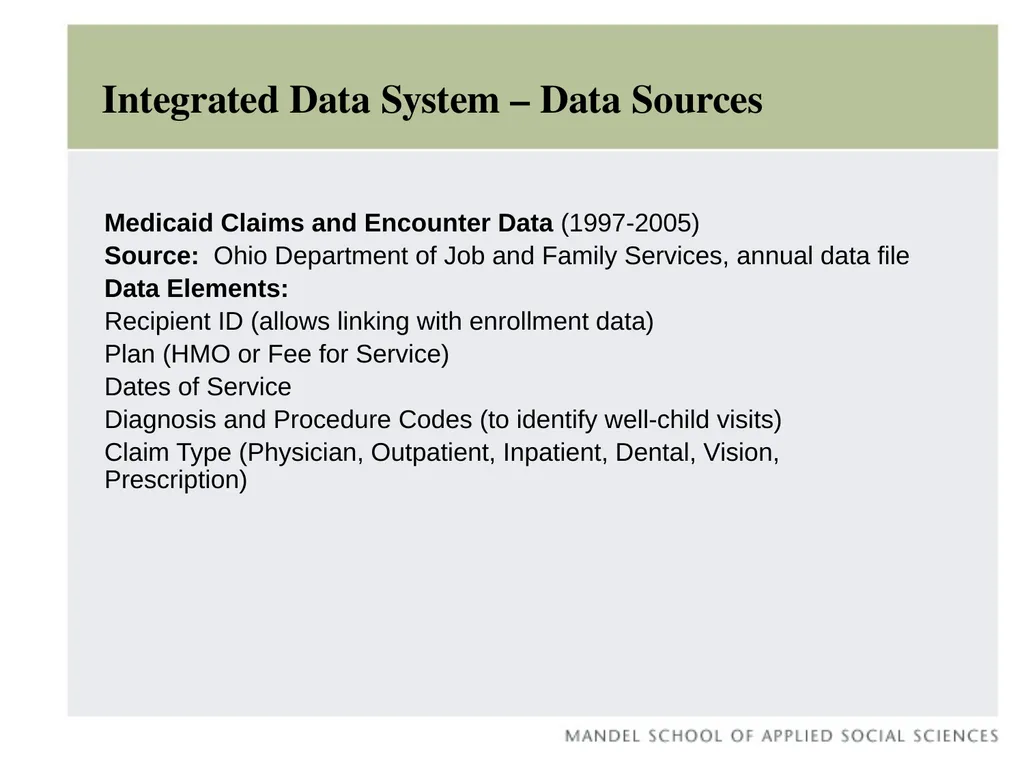
slide14. Integrated Data System – Data Sources Medicaid Claims and Encounter Data (1997-2005)
Source: Ohio Department of Job and Family Services, annual data file
Data Elements:
Recipient ID (allows linking with enrollment data)
Plan (HMO or Fee for Service)
Dates of Service
Diagnosis and Procedure Codes (to identify well-child visits)
Claim Type (Physician, Outpatient, Inpatient, Dental, Vision, Prescription)<br>
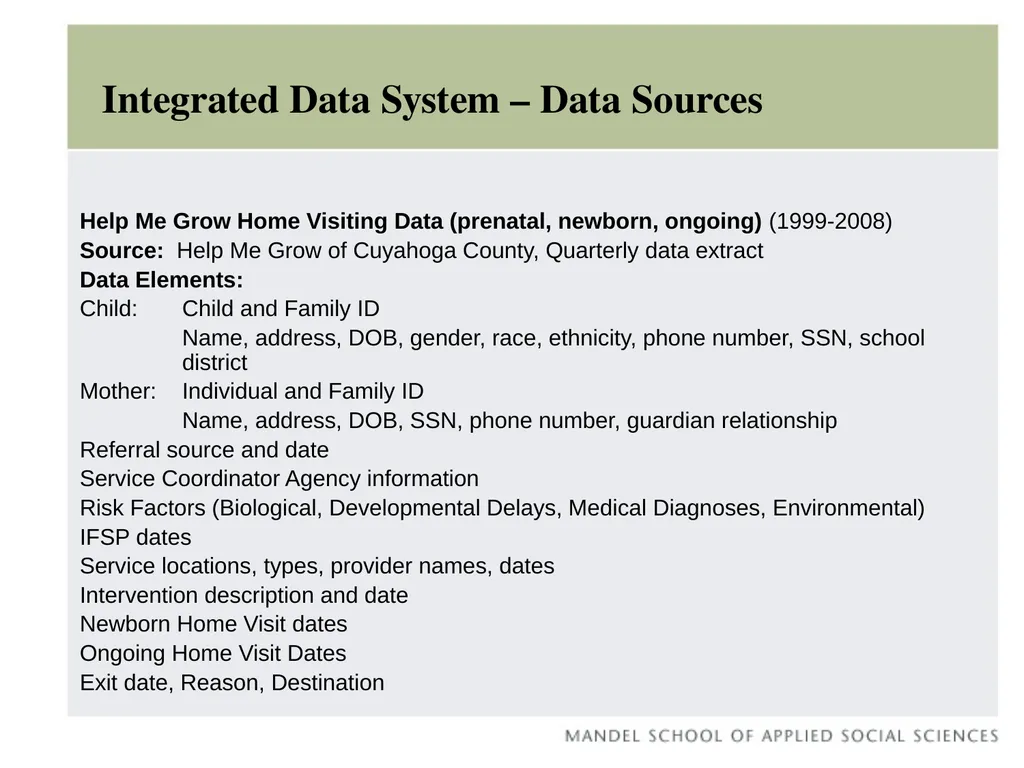
slide15. Integrated Data System – Data Sources Help Me Grow Home Visiting Data (prenatal, newborn, ongoing) (1999-2008)
Source: Help Me Grow of Cuyahoga County, Quarterly data extract
Data Elements:
Child: Child and Family ID
Name, address, DOB, gender, race, ethnicity, phone number, SSN, school district
Mother: Individual and Family ID
Name, address, DOB, SSN, phone number, guardian relationship
Referral source and date
Service Coordinator Agency information
Risk Factors (Biological, Developmental Delays, Medical Diagnoses, Environmental)
IFSP dates
Service locations, types, provider names, dates
Intervention description and date
Newborn Home Visit dates
Ongoing Home Visit Dates
Exit date, Reason, Destination<br>
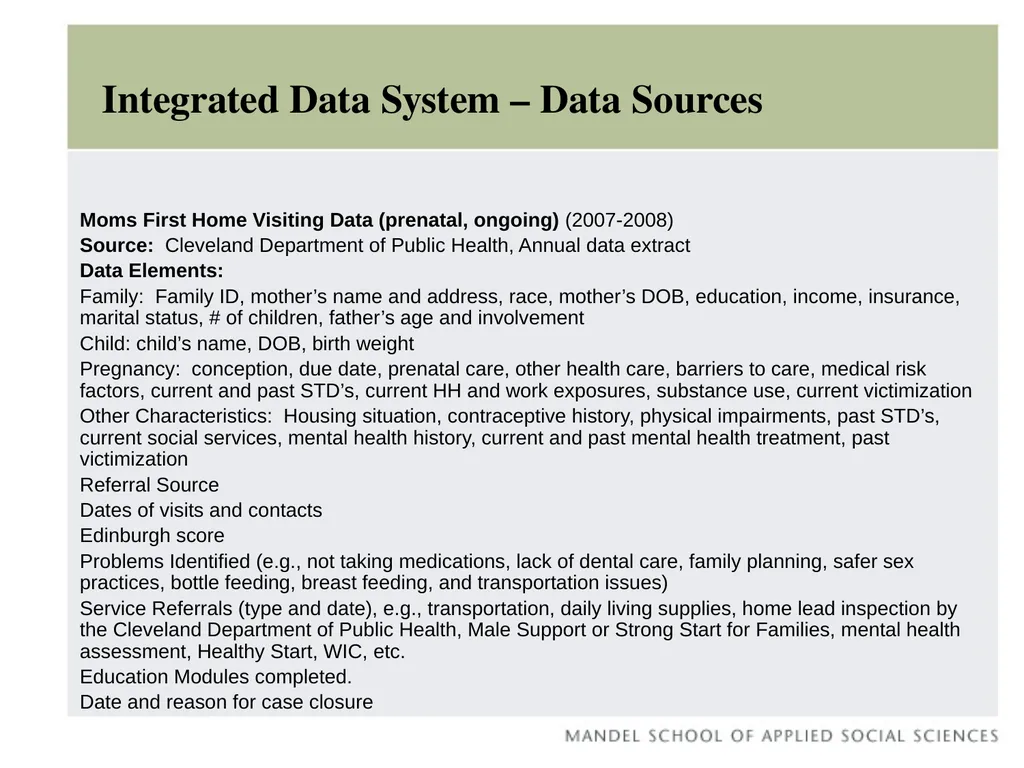
slide16. Integrated Data System – Data Sources Moms First Home Visiting Data (prenatal, ongoing) (2007-2008)
Source: Cleveland Department of Public Health, Annual data extract
Data Elements:
Family: Family ID, mother’s name and address, race, mother’s DOB, education, income, insurance, marital status, # of children, father’s age and involvement
Child: child’s name, DOB, birth weight
Pregnancy: conception, due date, prenatal care, other health care, barriers to care, medical risk factors, current and past STD’s, current HH and work exposures, substance use, current victimization
Other Characteristics: Housing situation, contraceptive history, physical impairments, past STD’s, current social services, mental health history, current and past mental health treatment, past victimization
Referral Source
Dates of visits and contacts
Edinburgh score
Problems Identified (e.g., not taking medications, lack of dental care, family planning, safer sex practices, bottle feeding, breast feeding, and transportation issues)
Service Referrals (type and date), e.g., transportation, daily living supplies, home lead inspection by the Cleveland Department of Public Health, Male Support or Strong Start for Families, mental health assessment, Healthy Start, WIC, etc.
Education Modules completed.
Date and reason for case closure<br>
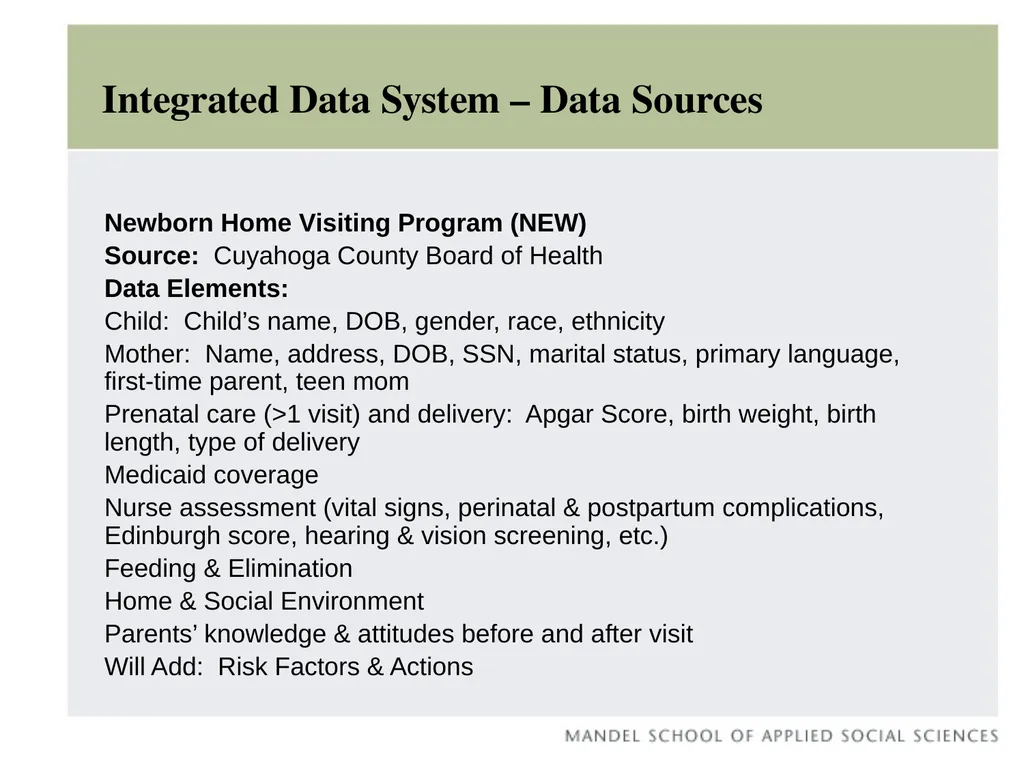
slide17. Integrated Data System – Data Sources Newborn Home Visiting Program (NEW)
Source: Cuyahoga County Board of Health
Data Elements:
Child: Child’s name, DOB, gender, race, ethnicity
Mother: Name, address, DOB, SSN, marital status, primary language, first-time parent, teen mom
Prenatal care (>1 visit) and delivery: Apgar Score, birth weight, birth length, type of delivery
Medicaid coverage
Nurse assessment (vital signs, perinatal & postpartum complications, Edinburgh score, hearing & vision screening, etc.)
Feeding & Elimination
Home & Social Environment
Parents’ knowledge & attitudes before and after visit
Will Add: Risk Factors & Actions<br>
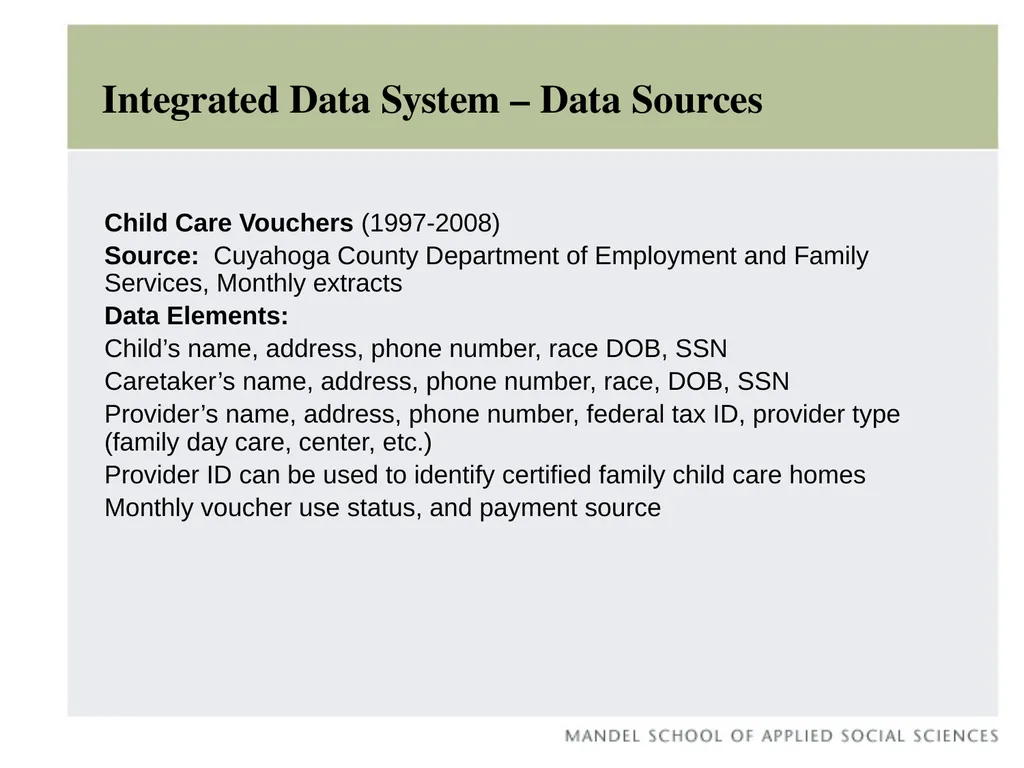
slide18. Integrated Data System – Data Sources Child Care Vouchers (1997-2008)
Source: Cuyahoga County Department of Employment and Family Services, Monthly extracts
Data Elements:
Child’s name, address, phone number, race DOB, SSN
Caretaker’s name, address, phone number, race, DOB, SSN
Provider’s name, address, phone number, federal tax ID, provider type (family day care, center, etc.)
Provider ID can be used to identify certified family child care homes
Monthly voucher use status, and payment source<br>
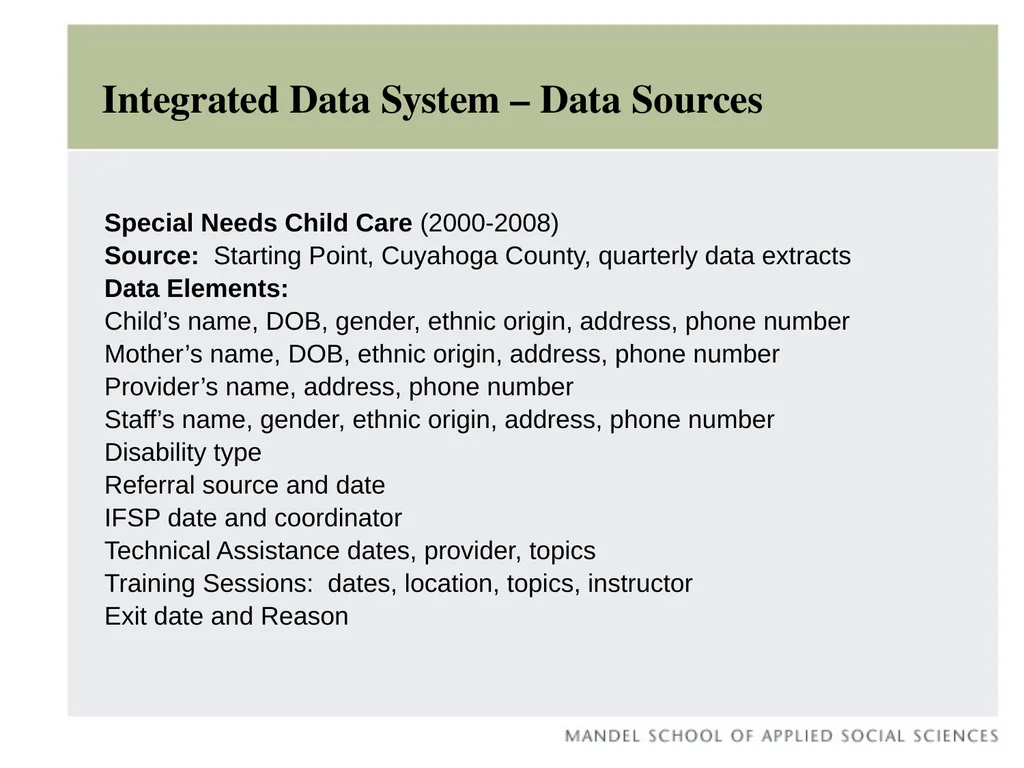
slide19. Integrated Data System – Data Sources Special Needs Child Care (2000-2008)
Source: Starting Point, Cuyahoga County, quarterly data extracts
Data Elements:
Child’s name, DOB, gender, ethnic origin, address, phone number
Mother’s name, DOB, ethnic origin, address, phone number
Provider’s name, address, phone number
Staff’s name, gender, ethnic origin, address, phone number
Disability type
Referral source and date
IFSP date and coordinator
Technical Assistance dates, provider, topics
Training Sessions: dates, location, topics, instructor
Exit date and Reason<br>
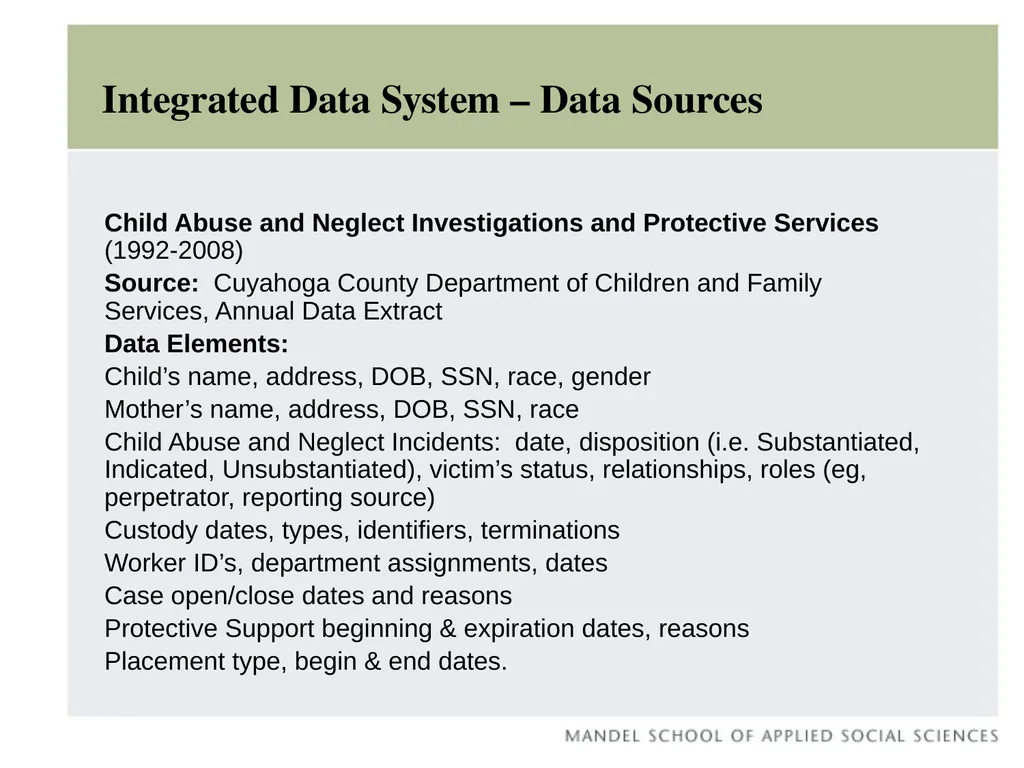
slide20. Integrated Data System – Data Sources Child Abuse and Neglect Investigations and Protective Services (1992-2008)
Source: Cuyahoga County Department of Children and Family Services, Annual Data Extract
Data Elements:
Child’s name, address, DOB, SSN, race, gender
Mother’s name, address, DOB, SSN, race
Child Abuse and Neglect Incidents: date, disposition (i.e. Substantiated, Indicated, Unsubstantiated), victim’s status, relationships, roles (eg, perpetrator, reporting source)
Custody dates, types, identifiers, terminations
Worker ID’s, department assignments, dates
Case open/close dates and reasons
Protective Support beginning & expiration dates, reasons
Placement type, begin & end dates.<br>
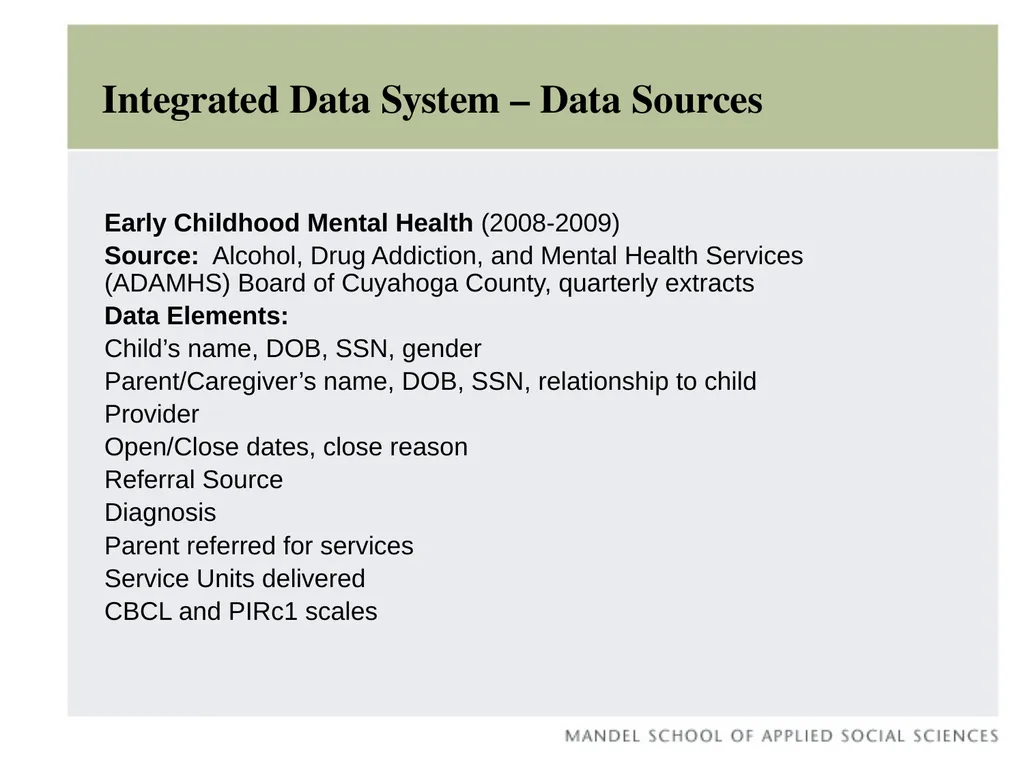
slide21. Integrated Data System – Data Sources Early Childhood Mental Health (2008-2009)
Source: Alcohol, Drug Addiction, and Mental Health Services (ADAMHS) Board of Cuyahoga County, quarterly extracts
Data Elements:
Child’s name, DOB, SSN, gender
Parent/Caregiver’s name, DOB, SSN, relationship to child
Provider
Open/Close dates, close reason
Referral Source
Diagnosis
Parent referred for services
Service Units delivered
CBCL and PIRc1 scales<br>
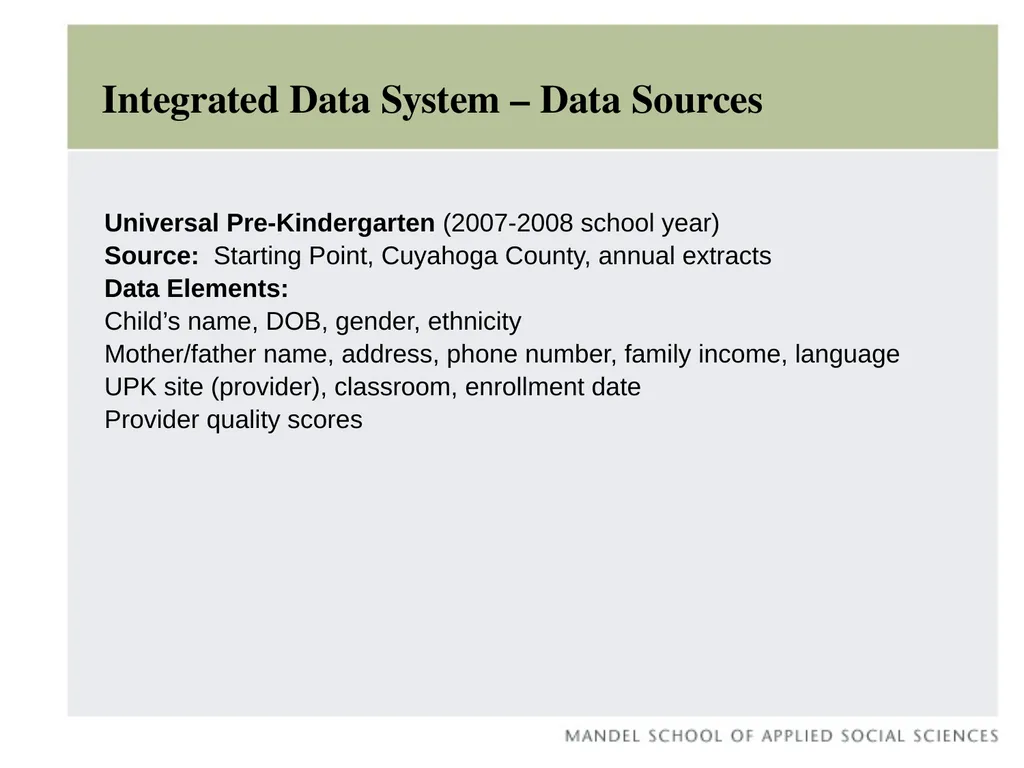
slide22. Integrated Data System – Data Sources Universal Pre-Kindergarten (2007-2008 school year)
Source: Starting Point, Cuyahoga County, annual extracts
Data Elements:
Child’s name, DOB, gender, ethnicity
Mother/father name, address, phone number, family income, language
UPK site (provider), classroom, enrollment date
Provider quality scores<br>
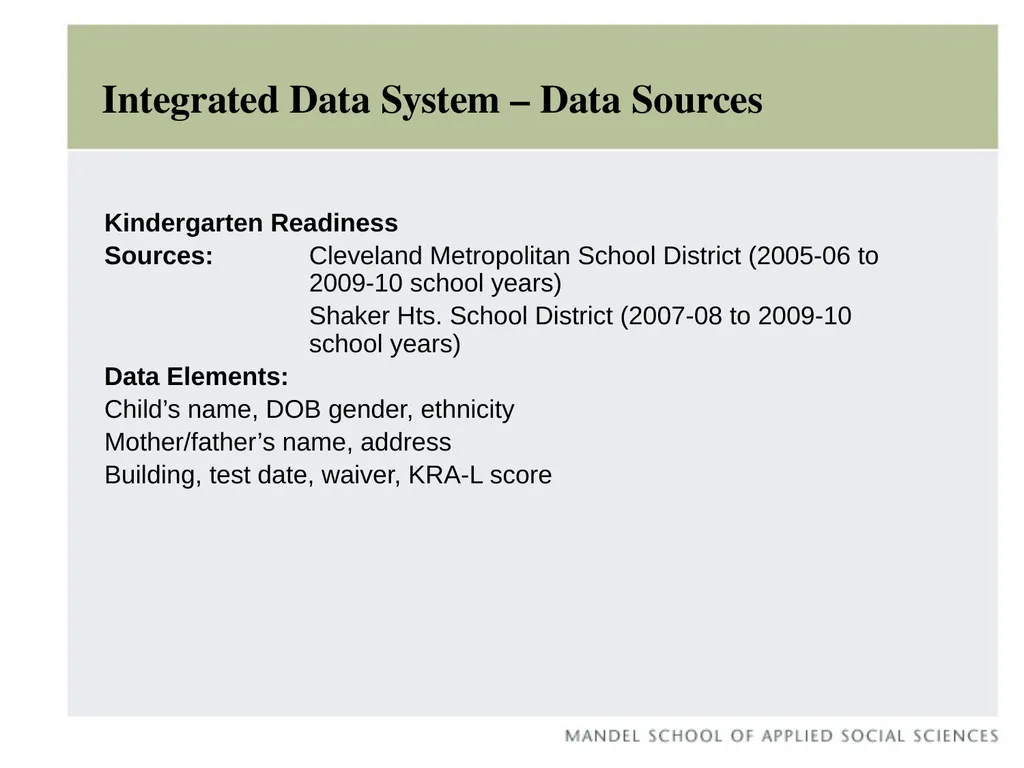
slide23. Integrated Data System – Data Sources Kindergarten Readiness
Sources: Cleveland Metropolitan School District (2005-06 to 2009-10 school years)
Shaker Hts. School District (2007-08 to 2009-10 school years)
Data Elements:
Child’s name, DOB gender, ethnicity
Mother/father’s name, address
Building, test date, waiver, KRA-L score<br>
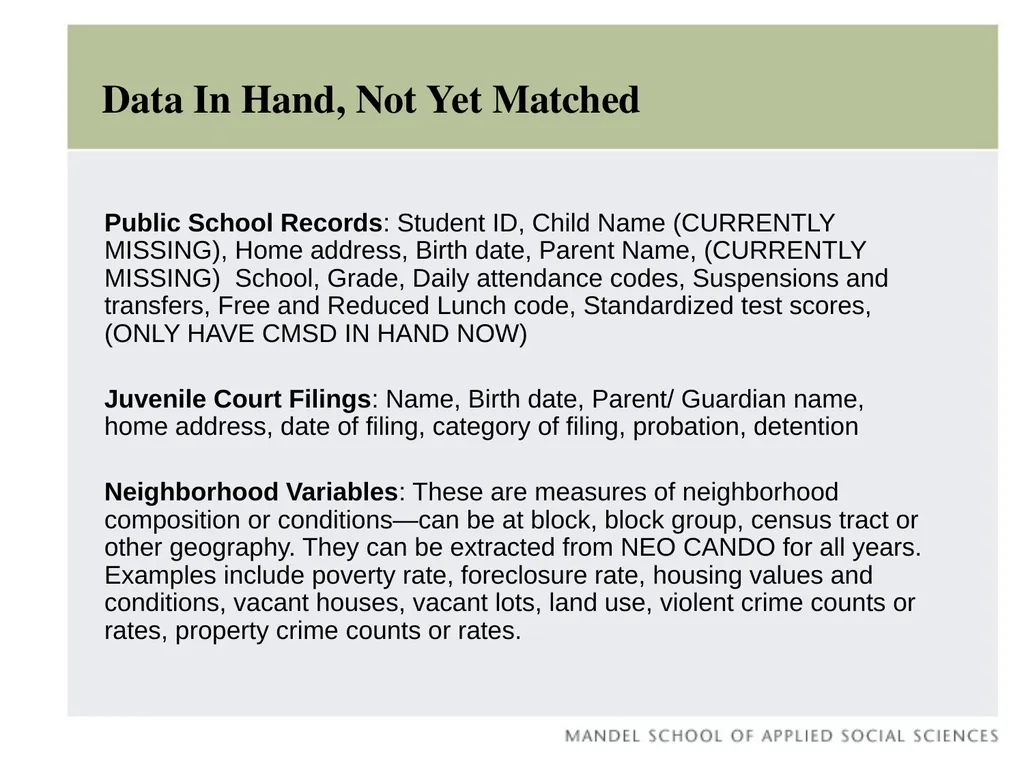
slide24. Data In Hand, Not Yet Matched Public School Records: Student ID, Child Name (CURRENTLY MISSING), Home address, Birth date, Parent Name, (CURRENTLY MISSING) School, Grade, Daily attendance codes, Suspensions and transfers, Free and Reduced Lunch code, Standardized test scores, (ONLY HAVE CMSD IN HAND NOW)
Juvenile Court Filings: Name, Birth date, Parent/ Guardian name, home address, date of filing, category of filing, probation, detention
Neighborhood Variables: These are measures of neighborhood composition or conditions—can be at block, block group, census tract or other geography. They can be extracted from NEO CANDO for all years. Examples include poverty rate, foreclosure rate, housing values and conditions, vacant houses, vacant lots, land use, violent crime counts or rates, property crime counts or rates.<br>
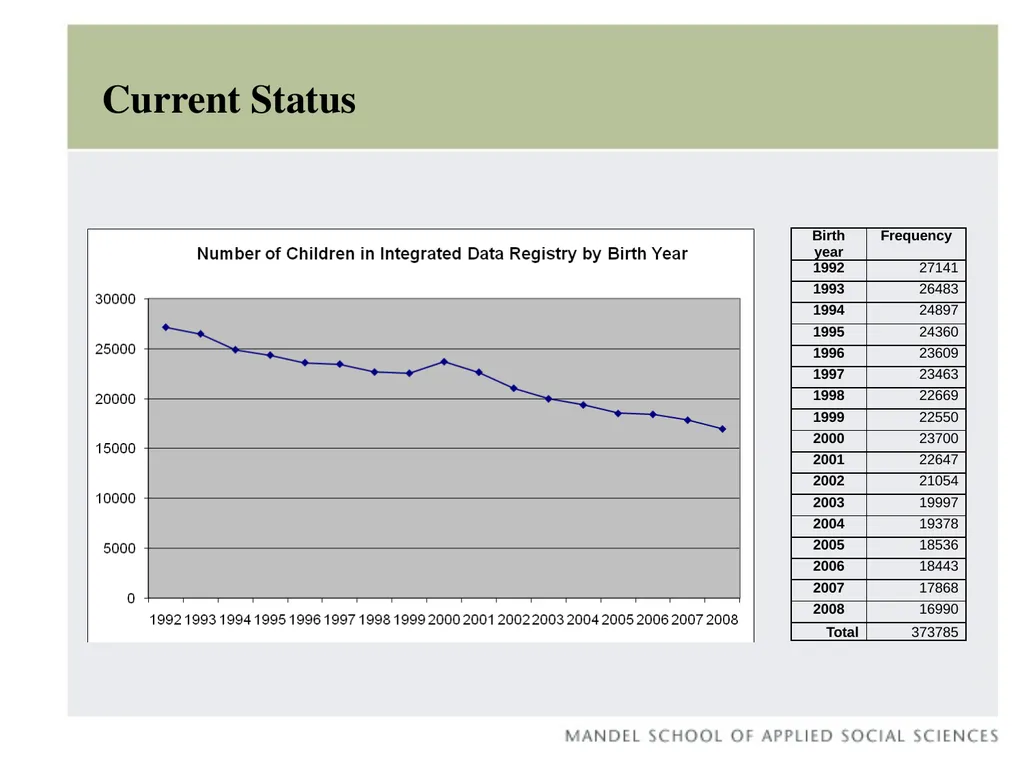
slide25. Current Status<br>
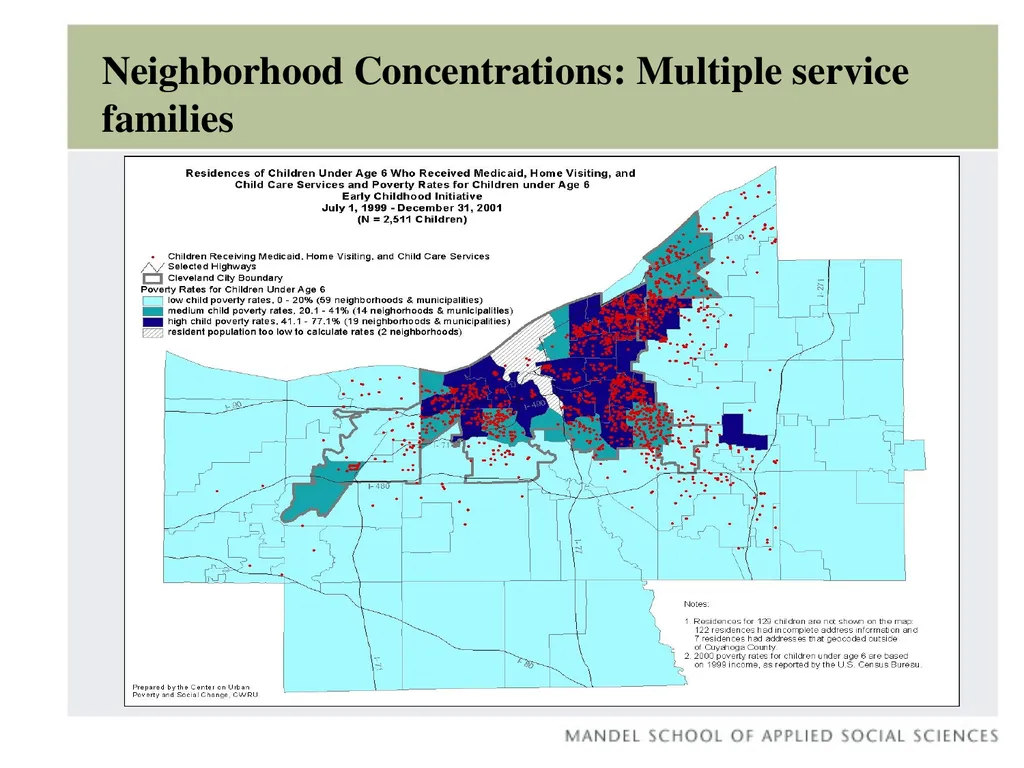
slide26. Neighborhood Concentrations: Multiple service families<br>
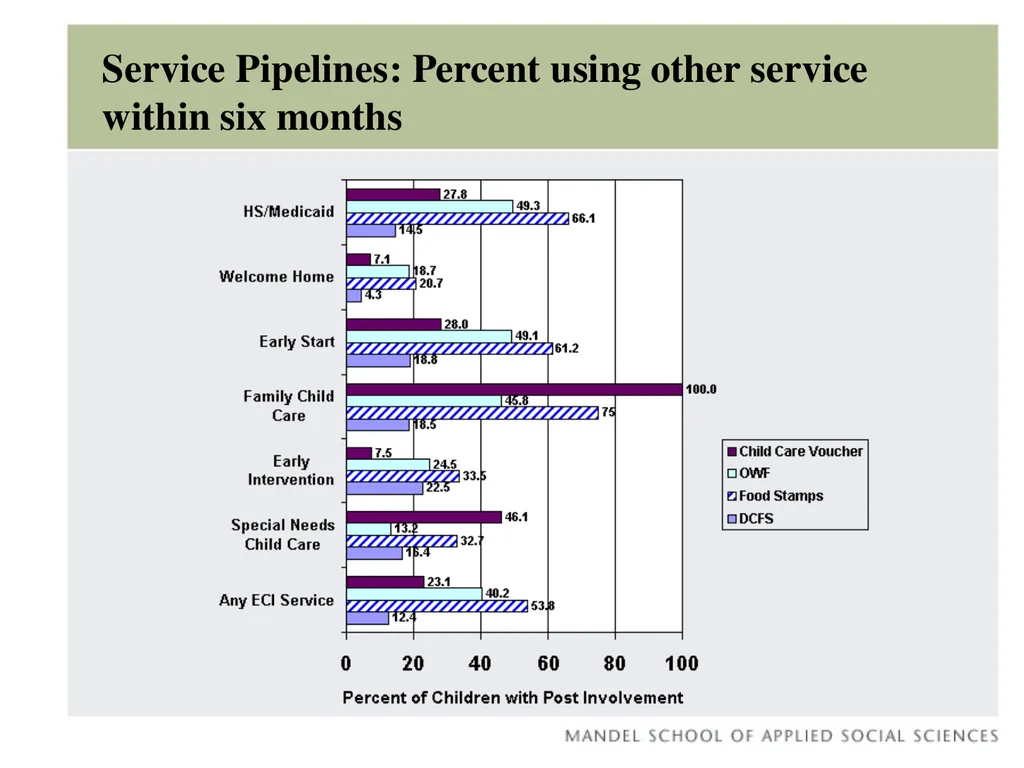
slide27. Service Pipelines: Percent using other service within six months<br>
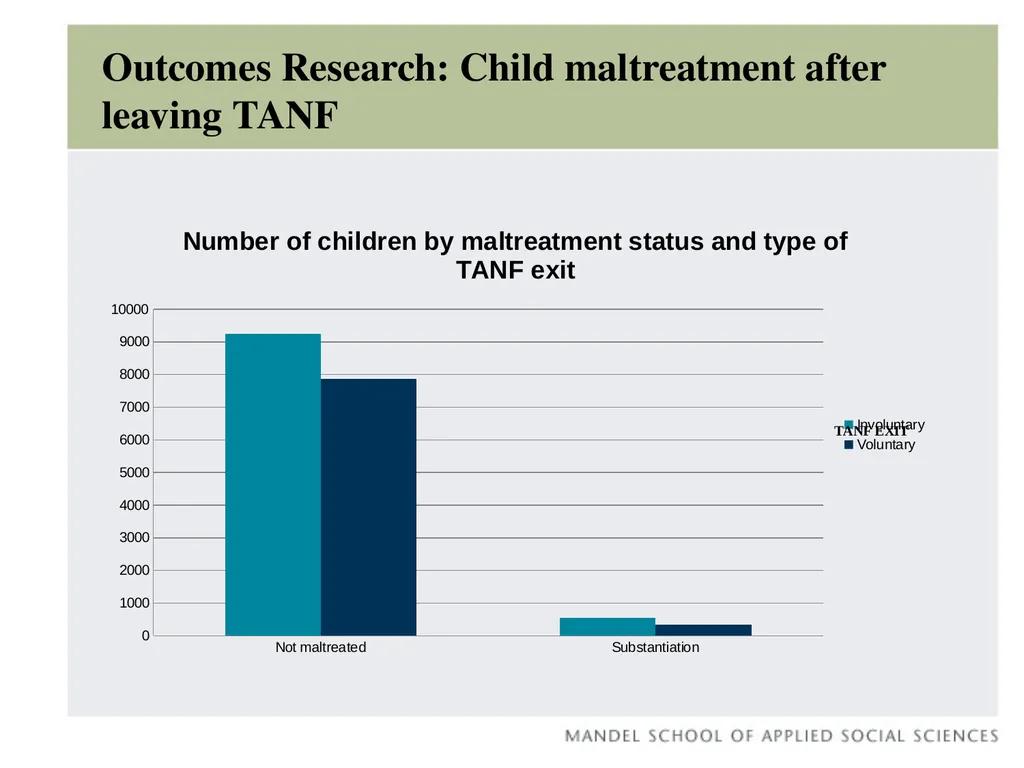
slide28. Outcomes Research: Child maltreatment after leaving TANF<br>
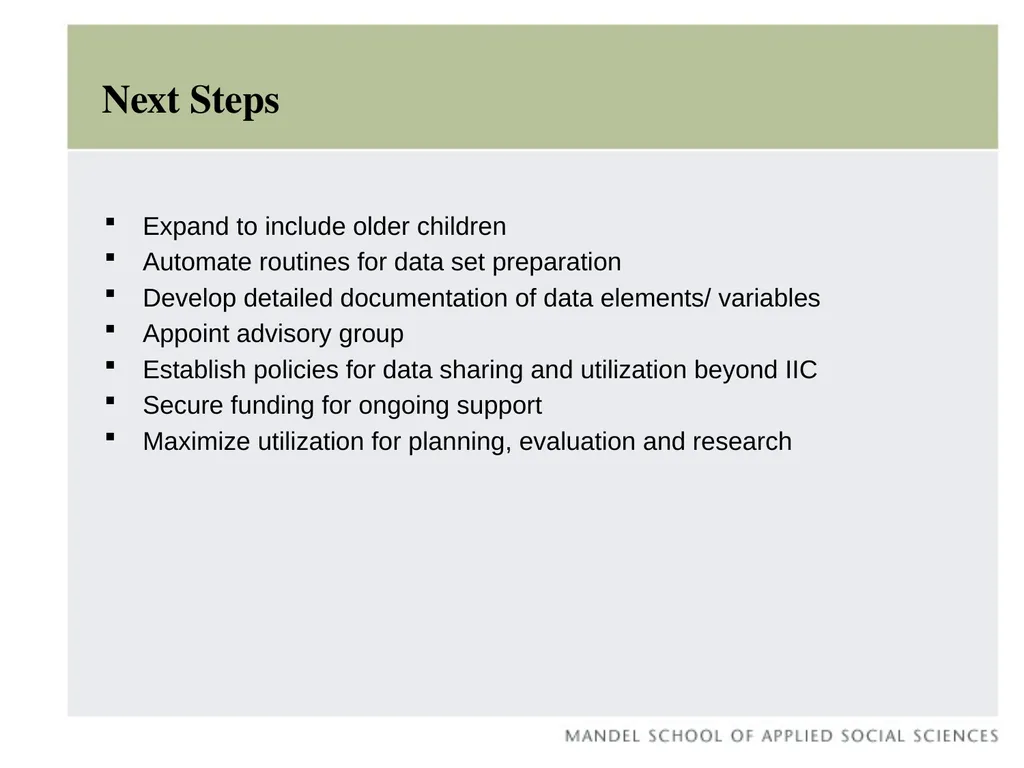
slide29. Expand to include older children
Automate routines for data set preparation
Develop detailed documentation of data elements/ variables
Appoint advisory group
Establish policies for data sharing and utilization beyond IIC
Secure funding for ongoing support
Maximize utilization for planning, evaluation and research Next Steps<br>
slide2. Developed for IIC Public-private partnership
Goals: All children and schools are ready for success at Kg.
Provides a system of services
early home visiting,
quality child care,
pre-kindergarten and other early education,
special needs and early mental health programs,
medical home,
lead prevention.
Builds community capacity to promote the wellbeing of children in their early years.<br>
slide3. ECIDS serves as a key resource for IIC. Enables data driven planning and decision making.
Used to monitor access to services, scope and reach of services.
Supports evaluation activities that are both program specific and system wide.
Track key indicators of child wellbeing in the County over time.
Used for research<br>
slide4. Data base overview The ECIDS begins with the 1992 Cuyahoga County Birth Cohort, and has added all subsequent birth cohorts through the present time. Administrative records have been matched together from numerous data sources to construct a child-level records through age 6. The data are maintained in a highly secure computing environment. Indentifying information is available for matching, but is only accessed by programmers who are certified in the protection of privacy and confidentiality and are working in the secure server platform. Data analysis files are stripped of identifying information and only aggregate statistics are reported or released.<br>
slide5. Current Structure Geocode & Standardize Match New Records to IDS Register Updated IDS Register-includes ID#’s, names, addresses, DOB, etc. IDS Register-includes ID#’s, names, addresses, DOB, etc. Outcomes
E.g. Kindergarten Readiness Scores among children in UPK program Profiles
E.g. Birth characteristics and service use for children entering kindergarten Geographic
E.g. % LBW births receiving ongoing home visits by neighborhood Time Trends
E.g. Total Children Served by birth cohort REPORTS<br>
slide6. Integrated Data System – Matching Process Obtain new data from each data source (monthly, quarterly, or annually, depending on the source).
Identify new records not matched previously
Geocode and standardize matching variables (i.e, put in upper case, use standardized address from geocoding, etc.)<br>
slide7. Integrated Data System – Matching Process Match new data for each data source using LinkPro SAS macro, with manual review of questionable matches.
Match with Birth Master file, blocking on date of birth (requires DOB to match exactly)
Remaining non-matched records are matched with Birth Master File blocking on Soundex of child’s first name
Remaining non-matched records are matched with IDS Register, blocking on date of birth
Remaining non-matched records are matched with IDS Register, blocking on Soundex of child’s first name<br>
slide8. Integrated Data System – Matching Process Update IDS Register with data from new records. IDS Register contains:
Unique ID assigned to each child
All the ID’s for that child from each data source (i.e., the Birth Certificate Number, Medicaid Recipient ID, etc.)
Personal Identifiers for that child (i.e., child’s name, birthdate, mother’s name, mother’s birthdate, address, SSN, etc.)<br>
slide9. Data Fields Needed for Matching and Preferred Coding 1. Child Information
If there are multiple children in a family, create a separate record for each child (including twins!). For prenatal visits, please be sure to update the database with the birth date, child’s name, etc. after the child is born. To cut down on data entry, include the Mother or Family ID in the child record, and then create a separate table with the Mother’s information (see #2 below). The address can also be in a separate table (see #3 below)
Unique Identifier (eg, ID number)
Social Security Number (xxx-xx-xxxx)
Date of Birth (Date/Time field in Access)
Due Date (Date/Time field in Access)
Last Name
First Name
Gender (Male/Female)
Hispanic Ethnicity (Yes/No)
Race (White/Black/Asian or Pacific Islander/Native American/Multi or Bi-racial/Other)
Mother and/or Family ID (see below)<br>
slide10. Data Fields Needed for Matching and Preferred Coding 2. Mother and/or Family Information:
Mother’s and/or Family’s Unique Identifier/ID number
Mother’s Last Name
Mother’s First Name
Mother’s Date of Birth (Date/Time field in Access)
Mother’s Social Security Number, if available (xxx-xx-xxxx)
Father’s Last Name
Father’s First Name
Guardian Relationship (Mother, Father, Foster Parent, Caregiver, etc.)<br>
slide11. Data Fields Needed for Matching and Preferred Coding 3. Current Address of Child
Ideally, create a separate table for address in order to maintain a historical list of addresses for each child. When a child’s address changes, instead of replacing the address in the database, enter the Ending Date for the old address, and then add a new record to the address table for the new address.
Child’s Unique Identifier
Beginning Date at this address (Date/Time field in Access)
Ending Date at this address (Date/Time field in Access, enter 1/1/4000 for current address)
Address Field #1 – House Number and Street Name (e.g., 100 Main St)
Address Field #2 – Apartment number (e.g. Apt. 2, Up/Down, Front/Rear, etc.)
City
State (OH)
Zip Code (5 digit)
County (Cuyahoga, others?)<br>
slide12. Integrated Data System – Data Sources Birth and Death Certificate Records (1992-2008)
Source: Ohio Department of Health, annual data file
Data Elements:
Identifiers (certificate #, child, mother, father names, DOB, address)
Demographics (child gender, mother’s & father’s race, ethnicity, education, marital status)
Birth characteristics (weight, Apgar, plurality, live birth order, etc)
Prenatal care (dates and number of visits)
Principal payment source
Pregnancy information (weight, maternal morbity, cigarette use, risk factors, infections)
Labor & Delivery (procedures, labor characteristics, etc.)
Abnormal conditions, congenital anomalies
Causes of Death<br>
slide13. Integrated Data System – Data Sources Medicaid/Healthy Start, Food Stamps, and Cash Assistance Enrollment Data (1997-2008)
Source: Cuyahoga County Dept. of Employment and Family Services, monthly data extracts
Data Elements:
Child: Recipient and Case ID number
name, address, phone number, race, gender, DOB, SSN
monthly enrollment status
type of medicaid program, monthly benefit amount for food stamps and cash assistance
Other members of Case (household) who are also enrolled:
Recipient and Case ID number
Name, address, phone number, race, gender, DOB, SSN, education (HS Grad)
Monthly enrollment status
Type of medicaid program, monthly benefit amount for food stamps and cash assistance<br>
slide14. Integrated Data System – Data Sources Medicaid Claims and Encounter Data (1997-2005)
Source: Ohio Department of Job and Family Services, annual data file
Data Elements:
Recipient ID (allows linking with enrollment data)
Plan (HMO or Fee for Service)
Dates of Service
Diagnosis and Procedure Codes (to identify well-child visits)
Claim Type (Physician, Outpatient, Inpatient, Dental, Vision, Prescription)<br>
slide15. Integrated Data System – Data Sources Help Me Grow Home Visiting Data (prenatal, newborn, ongoing) (1999-2008)
Source: Help Me Grow of Cuyahoga County, Quarterly data extract
Data Elements:
Child: Child and Family ID
Name, address, DOB, gender, race, ethnicity, phone number, SSN, school district
Mother: Individual and Family ID
Name, address, DOB, SSN, phone number, guardian relationship
Referral source and date
Service Coordinator Agency information
Risk Factors (Biological, Developmental Delays, Medical Diagnoses, Environmental)
IFSP dates
Service locations, types, provider names, dates
Intervention description and date
Newborn Home Visit dates
Ongoing Home Visit Dates
Exit date, Reason, Destination<br>
slide16. Integrated Data System – Data Sources Moms First Home Visiting Data (prenatal, ongoing) (2007-2008)
Source: Cleveland Department of Public Health, Annual data extract
Data Elements:
Family: Family ID, mother’s name and address, race, mother’s DOB, education, income, insurance, marital status, # of children, father’s age and involvement
Child: child’s name, DOB, birth weight
Pregnancy: conception, due date, prenatal care, other health care, barriers to care, medical risk factors, current and past STD’s, current HH and work exposures, substance use, current victimization
Other Characteristics: Housing situation, contraceptive history, physical impairments, past STD’s, current social services, mental health history, current and past mental health treatment, past victimization
Referral Source
Dates of visits and contacts
Edinburgh score
Problems Identified (e.g., not taking medications, lack of dental care, family planning, safer sex practices, bottle feeding, breast feeding, and transportation issues)
Service Referrals (type and date), e.g., transportation, daily living supplies, home lead inspection by the Cleveland Department of Public Health, Male Support or Strong Start for Families, mental health assessment, Healthy Start, WIC, etc.
Education Modules completed.
Date and reason for case closure<br>
slide17. Integrated Data System – Data Sources Newborn Home Visiting Program (NEW)
Source: Cuyahoga County Board of Health
Data Elements:
Child: Child’s name, DOB, gender, race, ethnicity
Mother: Name, address, DOB, SSN, marital status, primary language, first-time parent, teen mom
Prenatal care (>1 visit) and delivery: Apgar Score, birth weight, birth length, type of delivery
Medicaid coverage
Nurse assessment (vital signs, perinatal & postpartum complications, Edinburgh score, hearing & vision screening, etc.)
Feeding & Elimination
Home & Social Environment
Parents’ knowledge & attitudes before and after visit
Will Add: Risk Factors & Actions<br>
slide18. Integrated Data System – Data Sources Child Care Vouchers (1997-2008)
Source: Cuyahoga County Department of Employment and Family Services, Monthly extracts
Data Elements:
Child’s name, address, phone number, race DOB, SSN
Caretaker’s name, address, phone number, race, DOB, SSN
Provider’s name, address, phone number, federal tax ID, provider type (family day care, center, etc.)
Provider ID can be used to identify certified family child care homes
Monthly voucher use status, and payment source<br>
slide19. Integrated Data System – Data Sources Special Needs Child Care (2000-2008)
Source: Starting Point, Cuyahoga County, quarterly data extracts
Data Elements:
Child’s name, DOB, gender, ethnic origin, address, phone number
Mother’s name, DOB, ethnic origin, address, phone number
Provider’s name, address, phone number
Staff’s name, gender, ethnic origin, address, phone number
Disability type
Referral source and date
IFSP date and coordinator
Technical Assistance dates, provider, topics
Training Sessions: dates, location, topics, instructor
Exit date and Reason<br>
slide20. Integrated Data System – Data Sources Child Abuse and Neglect Investigations and Protective Services (1992-2008)
Source: Cuyahoga County Department of Children and Family Services, Annual Data Extract
Data Elements:
Child’s name, address, DOB, SSN, race, gender
Mother’s name, address, DOB, SSN, race
Child Abuse and Neglect Incidents: date, disposition (i.e. Substantiated, Indicated, Unsubstantiated), victim’s status, relationships, roles (eg, perpetrator, reporting source)
Custody dates, types, identifiers, terminations
Worker ID’s, department assignments, dates
Case open/close dates and reasons
Protective Support beginning & expiration dates, reasons
Placement type, begin & end dates.<br>
slide21. Integrated Data System – Data Sources Early Childhood Mental Health (2008-2009)
Source: Alcohol, Drug Addiction, and Mental Health Services (ADAMHS) Board of Cuyahoga County, quarterly extracts
Data Elements:
Child’s name, DOB, SSN, gender
Parent/Caregiver’s name, DOB, SSN, relationship to child
Provider
Open/Close dates, close reason
Referral Source
Diagnosis
Parent referred for services
Service Units delivered
CBCL and PIRc1 scales<br>
slide22. Integrated Data System – Data Sources Universal Pre-Kindergarten (2007-2008 school year)
Source: Starting Point, Cuyahoga County, annual extracts
Data Elements:
Child’s name, DOB, gender, ethnicity
Mother/father name, address, phone number, family income, language
UPK site (provider), classroom, enrollment date
Provider quality scores<br>
slide23. Integrated Data System – Data Sources Kindergarten Readiness
Sources: Cleveland Metropolitan School District (2005-06 to 2009-10 school years)
Shaker Hts. School District (2007-08 to 2009-10 school years)
Data Elements:
Child’s name, DOB gender, ethnicity
Mother/father’s name, address
Building, test date, waiver, KRA-L score<br>
slide24. Data In Hand, Not Yet Matched Public School Records: Student ID, Child Name (CURRENTLY MISSING), Home address, Birth date, Parent Name, (CURRENTLY MISSING) School, Grade, Daily attendance codes, Suspensions and transfers, Free and Reduced Lunch code, Standardized test scores, (ONLY HAVE CMSD IN HAND NOW)
Juvenile Court Filings: Name, Birth date, Parent/ Guardian name, home address, date of filing, category of filing, probation, detention
Neighborhood Variables: These are measures of neighborhood composition or conditions—can be at block, block group, census tract or other geography. They can be extracted from NEO CANDO for all years. Examples include poverty rate, foreclosure rate, housing values and conditions, vacant houses, vacant lots, land use, violent crime counts or rates, property crime counts or rates.<br>
slide25. Current Status<br>
slide26. Neighborhood Concentrations: Multiple service families<br>
slide27. Service Pipelines: Percent using other service within six months<br>
slide28. Outcomes Research: Child maltreatment after leaving TANF<br>
slide29. Expand to include older children
Automate routines for data set preparation
Develop detailed documentation of data elements/ variables
Appoint advisory group
Establish policies for data sharing and utilization beyond IIC
Secure funding for ongoing support
Maximize utilization for planning, evaluation and research Next Steps<br>